
Psalms 60:8

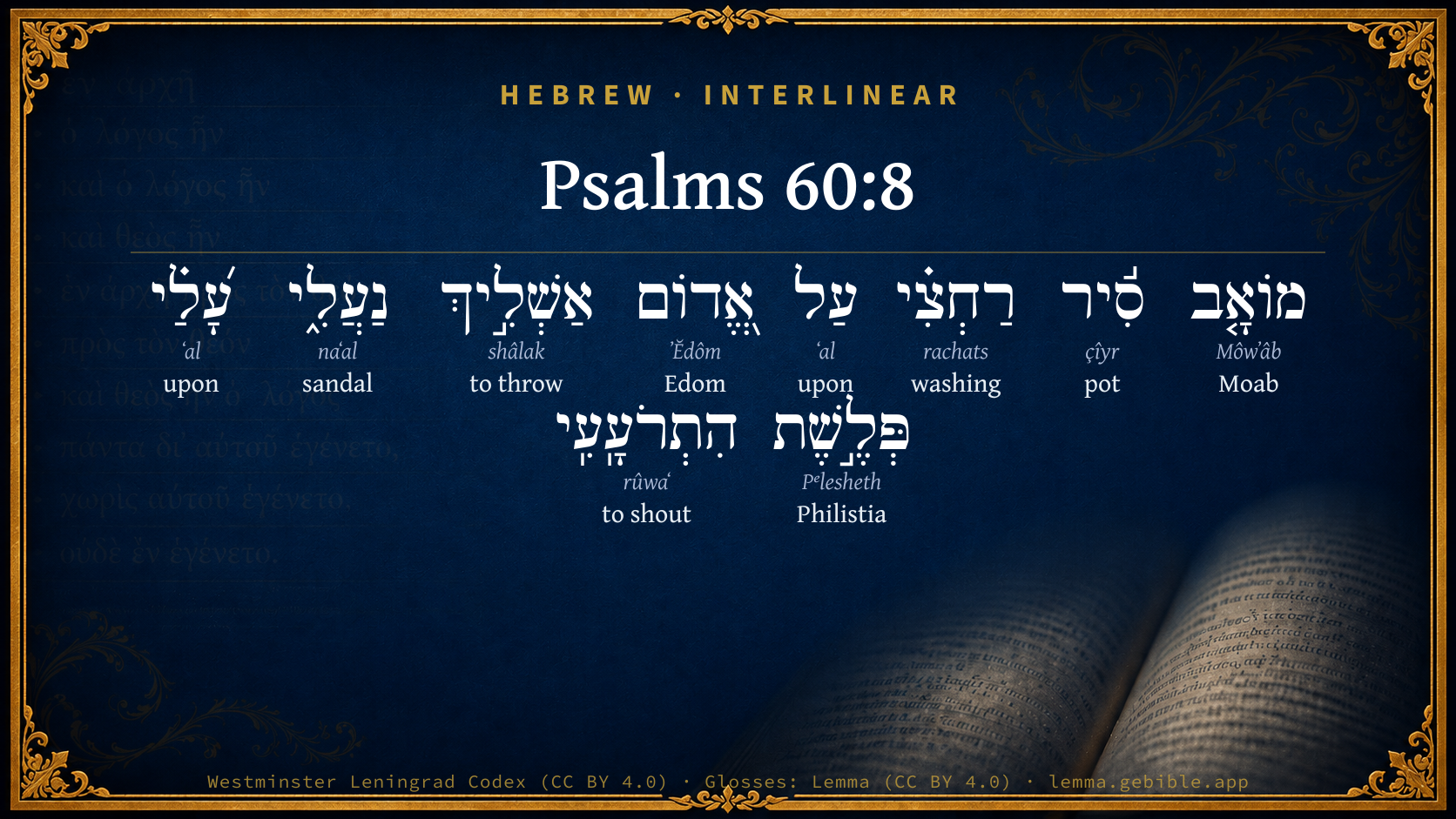
Hebrew (Westminster Leningrad Codex) Psalms 60:8 appears in the Hebrew Old Testament. The text above is from the Westminster Leningrad Codex. Each word links to its Strong’s number, a concise gloss, and parsing drawn from the Open Scriptures Hebrew Bible morphology. Click any word for its full Brown-Driver-Briggs (BDB) entry.
Download image
Cite this verse

Psalms 60:8 (World English Bible). Public Domain. Lemma interlinear Bible study tool, https://lemma.gebible.app/v/psalms/60/8.

Show BibTeX & RIS
BibTeX
RIS
English Translation
Moab is my wash basin. I will throw my shoe on Edom. I shout in triumph over Philistia."
World English Bible · Public Domain
Highlights
  • 1 first appearance in the Hebrew Bible
Full analysis ↓
Download a study sheet

One document with this verse’s original text, its word-by-word gloss line, the meaning frame, cross-references with their text, attributed commentary, and full source and license credits — printable, and it pastes into notes with its structure intact.

This verse Autodidact and up

Study sheet (.html) Plain text (.txt)

A passage Seminary Student

Up to 50 verses in one chapter. A passage sheet keeps up to 6 commentary sources and 12 cross-references per verse, in the order this page ranks them, and says so on the sheet whenever that leaves anything out. Ask for a single verse and you get the Autodidact verse sheet above.

Everything on this page stays free to read, with no account — the sheet is a download of what is already on screen, not access to it.

Want to remove ads? Support Godless Engineer
Compare translations 3

The same verse in 3 English versions, stacked beneath the original-language interlinear above. Click any original word for its lexicon entry.

Each is an independent rendering of the whole verse — the interlinear is not word-aligned to these translations.

Highlighted words mark where these versions differ — a whole-verse word diff, not a word-by-word alignment.

  • World English Bible Public Domain
    Moab is my wash basin. I will throw my shoe on Edom. I shout in triumph over Philistia."
  • King James Version Public Domain
    Moab is my washpot; over Edom will I cast out my shoe: Philistia, triumph thou because of me.
  • unfoldingWord Literal Text CC BY-SA 4.0
    Moab is the tub of my washing. Over Edom I throw my sandal. Over me, Philistia, shout triumphantly.”

unfoldingWord Literal Text — © unfoldingWord, licensed CC BY-SA 4.0. Word-aligned USFM3 via Door43 (git.door43.org/unfoldingWord/en_ult).

Versions to compare (up to 4)

3 of 4 selected

Show all 18 translations

Every available English version of this verse, each an independent rendering of the whole verse.

  • World English Bible Public Domain
    Moab is my wash basin. I will throw my shoe on Edom. I shout in triumph over Philistia."
  • Berean Standard Bible Public Domain
    Moab is My washbasin; upon Edom I toss My sandal; over Philistia I shout in triumph.”
  • Majority Standard Bible Public Domain
    Moab is My washbasin; upon Edom I toss My sandal; over Philistia I shout in triumph.”
  • King James Version Public Domain
    Moab is my washpot; over Edom will I cast out my shoe: Philistia, triumph thou because of me.
  • American Standard Version (1901) Public Domain
    Moab is my washpot; Upon Edom will I cast my shoe: Philistia, shout thou because of me.
  • Revised Version (1885) Public Domain
    Moab is my washpot; upon Edom will I cast my shoe: Philistia, shout thou because of me.
  • Geneva Bible (1599) Public Domain
    Moab shalbe my wash pot: ouer Edom will I cast out my shoe: Palestina shew thy selfe ioyfull for me.
  • Douay-Rheims (1899) Public Domain
    God hath spoken in his holy place: I will rejoice, and I will divide Sichem; and will mete out the vale of tabernacles.
  • Young's Literal Translation Public Domain
    Moab `is' my pot for washing, over Edom I cast my shoe, Shout, concerning me, O Philistia.
  • Literal Standard Version CC BY-SA 4.0
    Moab [is] My pot for washing, || Over Edom I cast My shoe, || Shout, concerning Me, O Philistia.
  • Unlocked Literal Bible CC BY-SA 4.0
    Moab is my washbasin; over Edom I will throw my shoe; I will shout in triumph because of Philistia.”
  • unfoldingWord Literal Text CC BY-SA 4.0
    Moab is the tub of my washing. Over Edom I throw my sandal. Over me, Philistia, shout triumphantly.”
  • Darby Bible Public Domain
    Moab is my wash-pot; upon Edom will I cast my sandal; Philistia, shout aloud because of me.
  • World Messianic Bible Public Domain
    Moab is my wash basin. I will throw my sandal on Edom. I shout in triumph over Philistia.”
  • Webster's Bible Public Domain
    \\60:6\\God hath spoken in his holiness; I will rejoice, I will divide Shechem, and measure out the valley of Succoth.
  • Free Bible Version CC BY-SA 4.0
    I will treat Moab as my washbasin; I will place my sandal on Edom; I will shout in triumph over Philistia.”
  • Bible in Basic English Public Domain
    Moab is my washpot; over Edom will I put out my shoe; over Philistia will a glad cry be sounded.
  • JPS Tanakh (1917) Public Domain
    (60-10) Moab is my washpot; upon Edom do I cast my shoe; Philistia, cry aloud because of me!

Literal Standard Version (2020), Covenant Press — licensed CC BY-SA 4.0. Text via the HelloAO Bible API (eBible.org). Unlocked Literal Bible (unfoldingWord) — licensed CC BY-SA 4.0. Text via the HelloAO Bible API (eBible.org). unfoldingWord Literal Text — © unfoldingWord, licensed CC BY-SA 4.0. Word-aligned USFM3 via Door43 (git.door43.org/unfoldingWord/en_ult). Free Bible Version, Dr. Jonathan Gallagher — licensed CC BY-SA 4.0. Text via the HelloAO Bible API (eBible.org).

Word by word

More ways to search: Search by grammar → Find every occurrence → Compare this word →

Practice this passage: Drill this verse → Learn its vocabulary →

About this verse

These counts appear in no published source. They are computed here, from the morphology-tagged text and Lemma’s own curated glosses. What Lemma adds →

10
words
9
distinct lemmas
Wisdom
section

Notable vocabulary

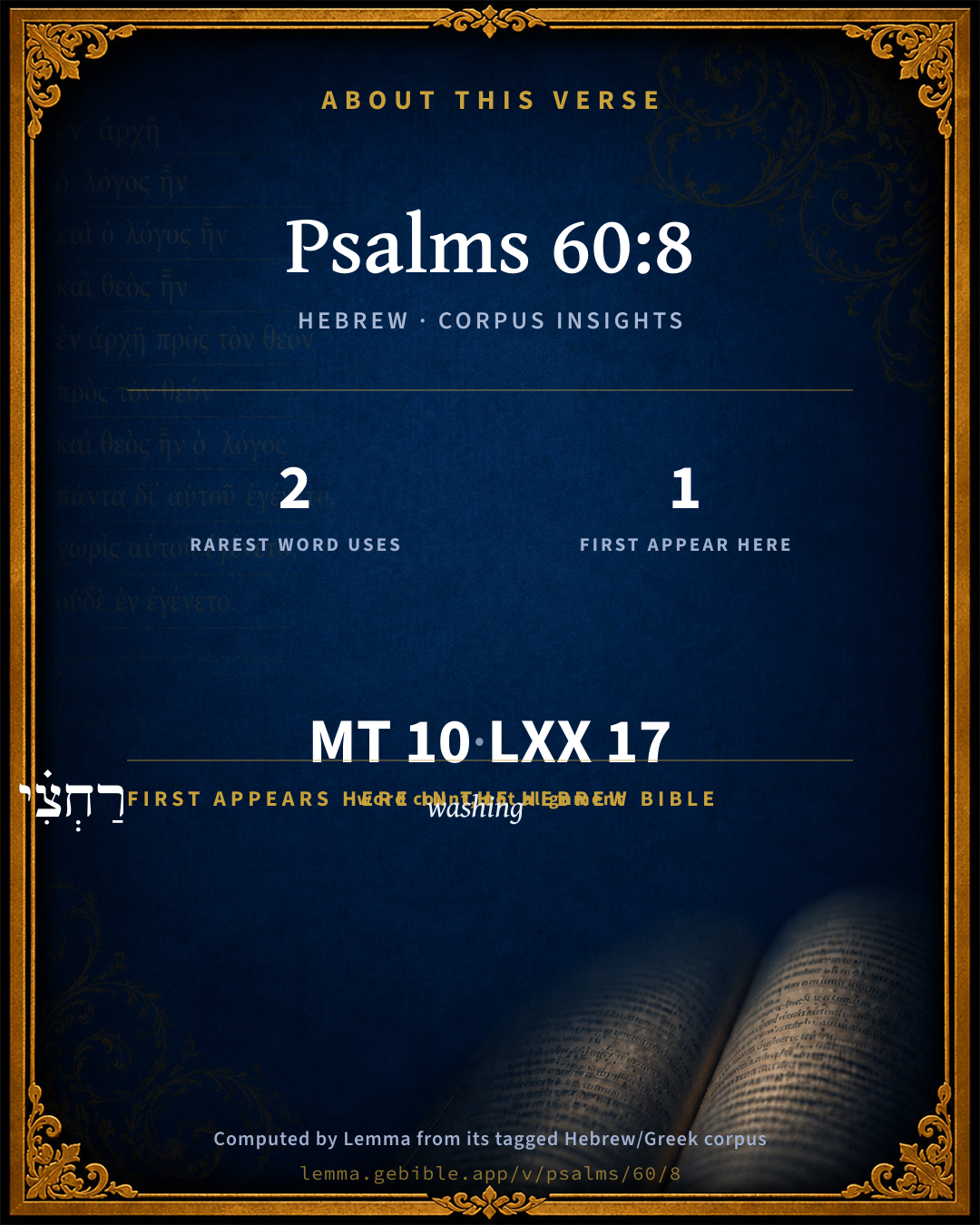
The rarest word here is רַחְצִ֗י washing H7366 — appearing just 2 times in the whole Hebrew Bible.

First appearance in Scripture

This word makes its first canonical appearance in the Hebrew Bible here:

  • רַחְצִ֗י washing H7366

Shared distinctive vocabulary

רַחְצִ֗י washing H7366 occurs in 2 verses of the Hebrew Bible. Also found in:

Grammatical profile

  • 2 verbs
  • 6 nouns
  • 2 prepositions

Verb forms

  • אַשְׁלִ֣יךְ Hiphil · Imperfect
  • הִתְרֹעָֽעִֽי Hithpolel · Imperative

Repetition

A word recurs within this verse — often emphatic in Hebrew:

Hebrew & Septuagint length

In English translation the verse runs 18 words from the Hebrew and 26 from the Septuagint (LXX English) — closely comparable.

A rough comparison of the two English renderings, which tokenize alike — not a word-level alignment.

Word counts can differ between the Hebrew and the Greek without any difference in meaning — e.g. the Hebrew direct-object marker אֵת has no separate Greek word, and Greek often adds the article ὁ.

In the original languages it is 10 Hebrew tokens and 17 Greek tokens — but the two are counted differently (Hebrew bundles its prefixes and suffixes into one token; the Greek is in lemma form), so that isn’t a like-for-like length.

Cross-references

10

Topical passages linked to Psalms 60:8 in the Treasury of Scripture Knowledge — connected by theme and wording, ordered by reader-vote popularity; previews shown in the World English Bible.

  • 2 Samuel 8:1–2 After this it happened that David struck the Philistines, and subdued them: and David took the bridle of the mother city out of the hand of the Philistines.
  • 2 Samuel 8:14 He put garrisons in Edom; throughout all Edom put he garrisons, and all the Edomites became servants to David. Yahweh gave victory to David wherever he went.
  • 2 Samuel 21:15–22 The Philistines had war again with Israel; and David went down, and his servants with him, and fought against the Philistines. David grew faint;
  • 1 Chronicles 18:1–2 After this it happened, that David struck the Philistines, and subdued them, and took Gath and its towns out of the hand of the Philistines.
  • 1 Chronicles 18:13 He put garrisons in Edom; and all the Edomites became servants to David. Yahweh gave victory to David wherever he went.
  • Psalms 108:9–10 Moab is my wash pot. I will toss my sandal on Edom. I will shout over Philistia."
  • Genesis 25:23 Yahweh said to her, Two nations are in your womb, Two peoples will be separated from your body. The one people will be stronger than the other people. The elder will serve the younger.
  • Numbers 24:18 Edom shall be a possession, Seir also shall be a possession, [who were] his enemies; While Israel does valiantly.
  • 2 Samuel 5:17–25 When the Philistines heard that they had anointed David king over Israel, all the Philistines went up to seek David; and David heard of it, and went down to the stronghold.
  • Genesis 27:40 By your sword will you live, and you will serve your brother. It will happen, when you will break loose, That you shall shake his yoke from off your neck."

Cross-references courtesy of OpenBible.info (CC BY 4.0).

Hebrew and Greek witnesses Masoretic Hebrew ↔ Greek Septuagint

The same verse in the two great witnesses to the Old Testament, shown verse-for-verse.

You’re reading Greek Psalm 59 (Hebrew Psalm 60). The Septuagint counts the superscription, so verse numbers can differ from the Hebrew — chapter-level alignment, not verse-by-verse. Numbering follows Rahlfs.

These are two independent witnesses, not word-aligned to each other, and the Septuagint is shown in lemma (dictionary) form.

Hebrew Psalms 60:8 Masoretic · Westminster Leningrad Codex

מוֹאָ֤ב סִ֬יר רַחְצִ֗י עַל אֱ֭דוֹם אַשְׁלִ֣יךְ נַעֲלִ֑י עָ֝לַ֗י פְּלֶ֣שֶׁת הִתְרֹעָֽעִֽי

Moab is my wash basin. I will throw my shoe on Edom. I shout in triumph over Philistia."

World English Bible · Public Domain

Greek LXX Greek Psalm 59:8 Septuagint · lemma form

ὁ θεός λαλέω ἐν ὁ ἅγιος αὐτός ἀγαλλιάομαι καί διαμερίζω σικιμα καί ὁ κοιλάς ὁ σκηνή διαμετρέω

Judas is my king; Moab is the caldron of my hope; over Idumea will I stretch out my shoe; the Philistines have been subjected to me.

LXX2012 (modern English Septuagint) · Public Domain

On this verse, Ellicott's Commentary for English Readers discusses the Septuagint’s reading. Read the note in Commentary ↓

Hebrew: Westminster Leningrad Codex (CC BY 4.0). Greek: Septuagint (public domain); English from LXX2012 (modern English Septuagint) (Public Domain). How the Septuagint differs from the Hebrew →

Commentary

Notes on Psalms 60:8 from classic Christian and Jewish commentators (each source and its license shown beneath its notes). The classic Christian expositions comment on the surrounding passage and are grouped to its opening verse, so a note may address several verses; the Jewish commentaries on the Tanakh (Rashi and others) are per-verse, so they appear only where the commentator wrote on this verse.

Lemma curates 59 commentaries, every one of them public domain or Creative Commons licensed, each selected and text-cleaned for this edition rather than reprinted as found. About our sources →

Trapp's Complete Commentary

John Trapp

Psa 60:8 Moab [is] my washpot; over Edom will I cast out my shoe: Philistia, triumph thou because of me.

Ver. 8. Moab is my wash pot] A pot wherein to wash my feet, a vessel of dishonour, such as at my pleasure I will break in pieces, Psa 2:9; and such as I reserve of them alive, shall be my scullions and underlings, glad to do my drudgery. Non vas coquendi carnes, sed lavandi pedes (Kimchi).

Over Edom I will cast out my shoe] i.e. Walk through their country as a conqueror; or, I will tread them under my feet; or, I will throw my shoe at the heads of them, and make them to take it up; or, I will make no more of subduing them, than of casting my shoe over them. Exutos mihi calceos et in ipsorum caput proiectos attollere iubebo (Beza).

Philistia, triumph thou because of me] i.e. Cry me up for thy king; Si velis, et videas quid in extremum eveniet, saith Kimchi. Or, triumph thou over me (by an irony) as thou lately didst over Saul and his sons in Mount Gilboa; and as since that time thou camest forth to seek me, but wentest home again by weeping cross.

John Trapp, A Commentary or Exposition upon All the Books of the Old and New Testament (1647–1656) — public domain. Text from a community e-Sword module.

The Biblical Illustrator

Joseph S. Exell

Psa_60:8-10

Moab is my washpot.

Moab is my washpot

Moab is my wash-pot, nothing more--a thing contemptible and despicable as compared with the eternal realities of covenant blessings; yet, for all that, there was a use for Moab, a use to be rightly understood. My object will be to show that, contrary to the ordinary course of nature, but not contrary to faith, even this ungodly world may be made to assist our advance in holiness. Moab may become our washpot. The defiling world may be made helpful to us in the following ways.

I. First of all, ungodly men, if we are in a gracious spirit, may be of solemn service to us, because we see in them what sin is. They are beacons upon the rocks to keep us from danger. They are our washpot in that respect, that they warn us of pollution, and so help to prevent our falling into it. We were heirs of wrath even as others. All have sinned and come short of the glory of God. Our sins are different, but we were all without exception shapen in iniquity, and as in water, face answereth unto face, so the heart of man to man. When you see the wickedness of an ungodly man, make him your washpot, by remembering that you also, though you are regenerate, are encompassed with the body of this death. By remembering what we are, and what we were, we may, by taking warning from the evil courses of others, avoid the like condemnation. There are certain sins which we readily detect in others, which should serve as loud calls to us to correct the same things in ourselves. For instance, as to the matter of bodily indulgence. The sinner is a man who puts his body before his soul, and his head where his feet should be; he is a monster in nature. When, therefore, you see a drunkard, or an unchaste person, say to yourself, I must mortify my members, and give my spiritual nature the predominance. For this I must cry mightily to God, the Eternal Spirit, lest the body of this death prevail over me. I must keep under my body and bring it into subjection, lest I, too, become a prey to the same animal passions, which lead sinners captives. Warnings are neglected by the foolish. The young sluggard sees the huge thorns and thistles in the older sluggards garden, and yet he follows the same lazy habits. One sheep follows another into the shambles. The Lord make us wise and prudent, and from the errors of others may we learn to steer our own course aright.

II. We see in the ungodly the present evil results of sin.

1. First, are you not very certain, those of you who watch unconverted and ungodly people, that they are not solidly happy? What roaring-boys they are sometimes I How hilarious their laughter! Their joy comes and goes with the hour. See them when the feast is over--Who hath woe? Who hath redness of the eyes? They that tarry long at the wine; the men of strength to mingle strong drink. Mark them when alone: they are ready to die with dulness. Ungodly men at bottom are unhappy men. The way of transgressors is hard. There is no peace, saith my God, to the wicked. Their Marah is never dry, but flows with perennial waters of bitterness.

2. It is not merely that ungodly men are not happy; there are times when they are positively wretched through their sin. Sometimes fear cometh upon them as a whirlwind, and they have no refuge or way of escape. When we think of the despair of men, of blasted hopes, Moab may become our washpot, and may keep us from setting our affection upon their fleeting joys. If young men knew the price of sin, even in this life, they would not be so hot to purchase pleasurable moments at the price of painful years. Who would coin his life into iniquity to have it returned to him in this life, red-hot from the mint of torment!

III. Men of this world are made useful to us since they discover in us our weak places. Their opposition, slander, and persecution, are a rough pumice-stone, to remove some of our spots. If we cannot bear a little shake from men, how shall we bear the shaking of heaven and earth at the last day? The world often tries us as with fire, and the things which we reckoned to be gold and silver perish in the ordeal if they are but counterfeit, but we are gainers by such a loss. In the world our temper is tried, and too often we become irritated. What then? Why, just this. If sanctification has regulated our emotions, patience will have her perfect work, and charity will suffer long; but if we are soon angry and find it hard to forgive, let us not so much find fault with those who try us as with ourselves, because we cannot bear the ordeal. Our pride must go down, we must become slow to wrath, we must be content to be as our Lord, the meek and lowly Saviour.

IV. In reference to the world to come, the terrible doom of the ungodly is a most solemn warning to us. (C. H. Spurgeon.)

Moab is my wash-pot

Implying that Moab should be reduced to slavery, it being the business of a slave to present the wash-hand basin to his master. With the Greeks, πλύνειν τινά, to wash down any one, was a slang term, signifying to ridicule, abuse, or beat; hence we have the word washpot applied to the subject of such treatment. You dont appear to be in your right sense, who make a washpot of me in the presence of many men.--Aristophanes. (Thomas S. Millington.)

Over Edom will I cast out my shoe.--

Edom vanquished

The person who is about to wash his feet casts his shoe to a slave. To Edom will I cast my shoe, (Hengstenberg). Or else the idea of casting the shoe in contempt upon Edom expresses at once the taking possession victoriously of the Edomite land and the treading upon the pride of Edom, wherewith he had trodden the Israelite land as an invader. The casting of the shoe was also a symbol of transference of possession (Rth_4:7). (A. R. Fausset.)

The Biblical Illustrator, edited by Joseph S. Exell (c. 1880s–1900s) — public domain. Text from a community e-Sword module.

Joseph Benson's Commentary

Psa 60:8. Moab is my wash-pot — The wash-pot being a mean article of household stuff, for the use of the feet, (as the Syriac interprets it,) the lowest part of the body, it is a fit title for the Moabites, whom David intended to bring into the lowest degree of servitude, and to render contemptible, 2Sa 8:2. Over Edom — An old, proud, insolent, and cruel enemy of Israel; will I cast my shoe — I will use them like slaves. I will, as it were, trample upon them; a proverbial expression. Philistia, triumph thou because of me — Or, over me, as in former years thou didst use to triumph and insult over the poor Israelites. It is an ironical expression, signifying that her triumphs were to come to an end. Bishop Patrick gives a different interpretation to this clause, thus: “The Philistines likewise, whom I have begun to smite, shall add to my triumphs, and be forced to meet me as their conquering Lord.”

Joseph Benson's Commentary on the Old and New Testaments (1811–1818) — public domain. Text from a community e-Sword module.

J. A. Alexander on Psalms

Joseph Addison Alexander

10. (Psa 60:8). Moab (is) my wash pot; at Edom will I throw my shoe; at me, Philistia, shout aloud! The three hostile powers, with which Israel was most frequently at war, are here put together, as the objects of a contemptuous address. Moab is likened to the humblest household utensil, the vessel in which slaves were wont to wash their master's feet. Edom is likened to the slave himself, to whom or at whom the master throws his shoe when about to bathe his feet. Compare Mat 3:11, Act 13:25. This is much better suited to the context than the allusion, which some assume, to the practice mentioned in Rth 4:7, where the removal of the shoe is a symbol of renunciation, and could not be here used to express the opposite idea of seizure or triumphant occupation. Shout aloud, or make a noise, is by some explained as an expression of triumph, and the whole clause treated as ironical. Others understand it of the acclamation or shout of welcome and applause by which subjects recognise and hail their sovereign. See above, on Psa 2:11, where the exhortation to rejoice with trembling is, by the same interpreters, explained in the same manner. In either case, the clause implies superiority in him who speaks, and willing or compulsory subjection on the part of those whom he addresses.

Joseph Addison Alexander, The Psalms Translated and Explained (1850) — public domain. Text from a community e-Sword module.

Geneva Bible (1599)

Geneva Bible translators

In most vile subjection.

For thou wilt dissemble, and feign as though thou werest glad.

Geneva Bible (1599) marginal notes — public domain. Text via Bolls.life.

Jamieson, Fausset & Brown

Robert Jamieson, A. R. Fausset & David Brown

Moab--is a my washpot--the most ordinary vessel.

over--or, "at"

Edom--(as a slave) he casts his shoe.

Philistia, triumph, &c.--or, rather, "shout."

for me--acknowledges subjection (compare Psa 108:9, "over Philistia will I triumph").

Jamieson, Fausset & Brown — Commentary Critical and Explanatory on the Whole Bible (1871) — public domain (CC PDM 1.0). Text via the HelloAO Bible API.

Adam Clarke's Commentary

Verse 8. Moab is my washpot] The Moabites shall be reduced to the meanest slavery.

Over Edom will I cast out my shoe] I will make a complete conquest of Idumea, and subject the Edomites to the meanest offices, as well as the Moabites.

Philistia, triumph thou because of me.] John Hyrcanus subdued the Idumeans, and caused them to receive circumcision, and profess the Jewish religion. The words here seem to predict their entire subjugation.

In an essay for a new translation of the Bible, there is what appears to me a correct paraphrase of the seventh and eighth verses: "Gilead and Manasseh have submitted unto me; Ephraim furnishes me with valiant men, and Judah with men of prudence and wisdom. I will reduce the Moabites to servitude; I will triumph over the Edomites, and make them my slaves; and the Philistines shall add to my triumph."

Adam Clarke's Commentary on the Bible (1810–1826) — public domain. Text from a community e-Sword/MySword module.

John Calvin's Commentaries

8 Moab is my wash-pot In proceeding to speak of foreigners, he observes a wide distinction between them and his own countrymen. The posterity of Abraham he would govern as brethren, and not as slaves; but it was allowable for him to exercise greater severities upon the profane and the uncircumcised, in order to their being brought under forcible subjection. In this he affords no precedent to conquerors who would inflict lawless oppression upon nations taken in war; for they want the divine warrant and commission which David had, invested as he was not only with the authority of a king, but with the character of an avenger of the Church, especially of its more implacable enemies, such as had thrown off every feeling of humanity, and persisted in harassing a people descended from the same stock with themselves. He remarks, in contempt of the Moabites, that they would be a vessel in which he should wash his feet, the washing of the feet being, as is well known, a customary practice in Eastern nations. With the same view he speaks of casting his shoe over Edom. This is expressive of reproach, and intimates, that as it had once insulted over the chosen people of God, so now it should be reduced to servitude. What follows concerning Palestina is ambiguous. By some the words are taken ironically, as if David would deride the vain boastings of the Philistines, who were constantly assaulting him with all the petulance which they could command. And the Hebrew verb רוע, ruang, though it means in general to shout with triumph, signifies also to make a tumult, as soldiers when they rush to battle. Others, without supposing any ironical allusion, take the words as they stand, and interpret them as meaning servile plaudits; that much and obstinately as they hated his dominion, they would be forced to hail and applaud him as conqueror. Thus in Psalm 18:44, it is said, “The sons of the strangers shall feign submission to me.”

John Calvin's Commentaries (1540-1563) — public domain. Text from the Calvin Translation Society English edition (1840s-50s) via the Christian Classics Ethereal Library (ccel.org). Calvin's coverage is partial (roughly two-thirds of the Bible); uncommented books and verses are honest gaps, never fabricated. The 19th-century editor's footnotes and remarks are omitted so the notes are faithfully Calvin's own voice.

Ellicott's Commentary for English Readers

(8) Moab is my washpot—i.e., probably the footbath, a figure expressing great contempt, which receives illustration from the story told of Amasis (Herod. ii. 172) and the golden footpan, which he had broken to pieces and made into an image of one of the gods—from base use made divine—as allegorical of his own transformation from a private person to a king. Others explain, from analogy of Arabic proverbs, that the conqueror would as it were wash his face white, i.e., acquire renown in Moab.

Possibly the comparison of Moab to a bath was suggested by its proximity to the Dead Sea, which might be said to be at the foot of Israel.

Over Edom . . .—The most natural explanation of this figure is that Edom is disgraced to the character of the slave to whom the conqueror tosses his sandals (na’al is collective), that they may be cleaned. (Comp. Mat_3:11). The symbolic action of Rth_4:7 had a different meaning, the transfer of a right of ownership, and so cannot be employed in illustration.

Of the “shoe,” as a figure of what is vilest and most common, Dr. J. G. Wetzstein quotes many Arabic proverbs. A covering for the feet would naturally draw to it such associations. (Comp. the use of footstool repeatedly in the Psalms, and Shakespeare’s use of foot,

“What my foot my tutor!”—Tempest.)

But the custom which Israel brought from Egypt (Exo_3:3), of dropping the sandals outside the door of a temple, and even of an ordinary house, must have served still more to fasten on that article of dress, ideas of vileness and profanation.

Philistia, triumph thou because of me . . .—This cannot be the meaning intended by the clause, since it is quite out of keeping with the context, and in Psalms 108 we have the very opposite, “over Philistia will I triumph.” We must therefore change this reading so as to get, over Philistia is my triumph, or render the text as it stands, from analogy with Isa_15:4 : Upon (i.e., because of) me, Philistia, raise a mournful wail.

The LXX. and Vulg. indicate this meaning while translating the proper name, “the foreigners have been subdued to me.”

A Bible Commentary for English Readers, edited by Charles John Ellicott (1878–1897) — public domain. Text from a community e-Sword module.

The Cambridge Bible for Schools and Colleges

gen. ed. J. J. S. Perowne

8. The neighbouring nations are reduced to servitude. In strong contrast to the honour assigned to Ephraim and Judah is the disgrace of Moab and Edom. Moab, notorious for its pride (Isa_16:6), is compared to the vessel which is brought to the victorious warrior to wash his feet when he returns from the battle. The old enemy of God and His people is degraded to do menial service: in other words, it becomes a subject and a vassal.

In close connexion with this metaphor the next line may be rendered, Unto Edom will I cast my shoe: Edom is like the slave to whom the warrior flings his sandals to carry or to clean. Haughty and defiant Edom (Oba_1:3 f.) must perform the duty of the lowest slave (cp. Mat_3:11). The R.V. renders, Upon Edom will I cast my shoe. This would mean, ‘I will take possession of Edom,’ in allusion to an Oriental custom of taking possession of land by casting the shoe upon it; but the first explanation agrees best with the context.

Philistia, triumph thou because of me] R.V., shout thou because of me. Mighty Philistia must raise the shout of homage to its conqueror. Cp. Psa_2:11; Psa_18:44; Psa_47:1. This rendering is preferable to that of A.V. marg. (with its explanatory note) ‘triumph thou over me (by an irony)’: and to the rendering, ‘cry aloud in terror.’ But perhaps we should alter the vocalisation and read: Over Philistia shall be my shout of triumph, or adopt the reading of Psa_108:9, Over Philistia will I shut in triumph.

The Cambridge Bible for Schools and Colleges (gen. ed. J. J. S. Perowne; Cambridge University Press, 1878–1918) — public domain. Text from a community e-Sword module.

John Gill's Exposition

Moab is my washpot,.... To wash hands and feet in: and so the Syriac version, "and Moab the washing of my feet"; a vessel for low and mean service, and so denotes the servile subjection of the Moabites to David; see Sa2 8:2; and as the words may be rendered, "the pot of my washing" (r). Great numbers of the Moabites might be at this time servants to the Israelites, and to David and his court particularly; and might be employed, as the Gibeonites were, to be drawers of water, to fill their pots, in which they washed their hands and feet, and their bathing vessels, in which they bathed themselves: Aben Ezra explains it,

"I wilt wash their land as a pot;''

and so may not only signify the very great subjection of the Gentiles, even the chief among them, to Christ and his church, Isa 49:23; but as Moab was begotten and born in uncleanness, and his posterity an unclean generation, it may design the washing, cleansing, sanctifying, and justifying of the Gentiles in the name of Christ, and by his Spirit, Co1 6:11;

over Edom will I cast out my shoe; as a token of possessing their land, Rut 4:7; so some; or of subduing them; putting the feet on which the shoe is upon the necks of them, Jos 10:24. So Kimchi interprets it,

"the treading of my foot;''

to which the Targum agrees, paraphrasing it thus;

"upon the joint of the neck of the mighty men of Edom I have cast my shoe.''

It may allude to a custom (s) in confirming a bargain, or taking possession, to pluck off the shoe in token of it, may be rendered "my glove"; as it is by the Targum on Rut 4:7; for, as the shoe encloses and binds the foot, so the glove the hand: and the allusion may be thought to be to a custom used by kings, when they sat down before any strong city to besiege it, to throw in a glove into the city; signifying they would never depart from the city until they had took it. Hence the custom, which still continues, of sending a glove to a person challenged to fight. And indeed the custom of casting a shoe was used by the emperor of the Abyssines, as a sign of dominion (t). Take the phrase in every light, it signifies victory and power; that he should be in Edom as at home, and there pluck off his shoe, and cast it upon him; either to carry it after him, as some think, which was the work of a servant, to which the Baptist alludes, Mat 3:11; or rather to clean it for him; for as Moab was his washpot, to wash his hands and feet, in Edom was his shoe cleaner, to wipe off and remove the dirt and dust that was upon them (u); all which denotes great subjection: and this was fulfilled in David, Sa2 8:14; and may refer to the spread of the Gospel in the Gentile world, and the power accompanying that to the subduing of many sinners in it, carried thither by those whose feet were shod with the preparation of the Gospel of peace;

Philistia, triumph thou because of me: some take this to be an ironic expression, like that in Ecc 11:9; so R. Moses in Aben Ezra, and also Kimchi. Triumph now as thou usedst to do, or if thou canst: but rather they are seriously spoken, seeing they had reason to rejoice and be glad, because they had changed hands and masters for the better, being subject to David, Sa2 8:1, with this compare Psa 108:9, and may very well be applied to the Gentiles, subdued and conquered by Christ, who triumph in him; and because delivered out of the hands of sin, Satan, and the world, through his victorious arms.

(r) "olla lotionis meae", Pagninus, Montanus, Michaelis, Gejerus; so Tigurine version, Musculus, Vatablus. (s) Elias in Tishbi, fol. 267. (t) R. Immanuel apud Castell. Lex. Polygott. col. 2342. (u) Vid. Bynaeum de Calceis Heb. l. 2. c. 8. Gusset. Ebr. Comment p. 520.

John Gill's Exposition of the Whole Bible (1746–1763) — public domain (CC PDM 1.0). Text via the HelloAO Bible API.

Albert Barnes' Notes on the Bible

Moab is my washpot - Moab was a region of country on the east of the Dead Sea, extending as far north as the river Arnon. See the notes at Isa 15:1-9. The words rendered wash-pot mean properly a pot or basin for washing, a wash-basin; and the expression is used here as one of contempt, as if he would use it as the meanest vessel is used. It implies that Moab was already subdued, and that the author of the psalm could make any use of it he pleased. It also implies that Moab was not regarded as adding much to his strength, or to the value of his dominions; but that, compared with other portions of his kingdom, it was of as little value as a wash-basin compared with the more valuable vessels in a house.

Over Edom will I cast out my shoe - Edom or Idumea was the country which still remained unsubdued. This David was anxious to possess, though the conquest had been delayed and prevented by the adverse circumstances to which allusion has already been made in the notes at the psalm. On the situation of Idumea, see the notes at Isa. 34. It was a region whose possession was necessary to complete the acquisition of territory that properly pertained to the promised land; and David was now intent on acquiring it. He here expresses the utmost confidence that he would succeed in this, notwithstanding the adverse events which had occurred. It is supposed that there is allusion in the expression “I will cast out my shoe,” to the custom, when transferring a possession, of throwing down a shoe on the ground as a symbol of occupancy. Compare Rth 4:7. In the middle ages this was expressed by throwing down a glove; in the time of Columbus, by solemnly taking possession and setting up a cross; in other times, by erecting a standard, or by building a fort. Compare Rosenmuller, Das alte und neue Morgenland, No. 483. The idea is, that he would take possession of it, or would make it his own.

Philistia, triumph thou because of me - On the situation of Philistia, see the notes at Isa 11:14. In the margin this is, “triumph thou over me, by an irony.” It may be regarded as irony, or as a taunt, meaning that Philistia was no longer now in a situation to triumph over him; or it may be understood as referring to the exultation and shouting which would ensue on the reception of its sovereign. The former seems to be the most probable interpretation, as the language is undoubtedly intended to denote absolute subjection, and not the voluntary reception of a king. The language in the entire passage is that of triumph over foes.

Albert Barnes' Notes on the Bible (1834–1885) — public domain. Text from a community e-Sword/MySword module.

Matthew Poole's English Annotations

Moab is my wash-pot, in which I shall wash my feet. I shall bring them into the lowest degree of servitude, and make them contemptible and miserable. See 2Sa 8:2.

Over Edom, an old, and proud, and insolent, and cruel enemy of Israel,

will I cast out my shoe, i.e. I will use them like slaves; either holding forth my shoes, that they may pluck them off; or throwing my shoes at them, either in anger or contempt, as the manner of many masters was and is in such cases. Or, I will take possession of them; which was done by treading upon their land. Or, I will tread upon their necks; as they did in like case, Jos 10:24. But these notions suit not with this phrase of casting or throwing the shoe.

Philistia, triumph thou because of me; or, over me, as thou didst in former years use to triumph and insult over the poor Israelites. It is an ironical expression, signifying that her triumphs were come to an end.

Matthew Poole's English Annotations on the Holy Bible (1683–1685) — public domain. Text from a community e-Sword/MySword module.

The Treasury of David

Charles H. Spurgeon

Ver. 8. Having looked at home with satisfaction, the hero king now looks abroad with exultation.

Moab, so injurious to me in former years, is my washpot. The basin into which the water falls when it is poured from an ewer upon my feet. A mere pot to hold the dirty water after my feet have been washed in it. Once she defiled Israel, according to the counsel of Balaam, the son of Beor; but she shall no longer be able to perpetrate such baseness; she shall be a washpot for those whom she sought to pollute. The wicked as we see in them the evil, the fruit, and the punishment of sin, shall help on the purification of the saints. This is contrary to their will, and to the nature of things, but faith finds honey in the lion, and a washpot in filthy Moab. David treats his foes as but insignificant and inconsiderable; a whole nation he counts but as a footbath for his kingdom.

Over Edom will I cast out my shoe. As a man when bathing throws his shoes on one side, so would he obtain his dominion over haughty Esau's descendants as easily as a man casts a shoe. Perhaps he would throw his shoe as nowadays men throw their glove, as a challenge to them to dare dispute his sway. He did not need draw a sword to smite his now crippled and utterly despondent adversary, for if he dared revolt he would only need to throw his slipper at him, and he would tremble. Easily are we victors when Omnipotence leads the way. The day shall come when the church shall with equal ease subdue China and Ethiopia to the sceptre of the Son of David. Every believer also may by faith triumph over all difficulties, and reign with him who hath made us kings and priests. "They overcame through the blood of the Lamb, "shall yet be said of all who rest in the power of Jesus.

Philistia, triumph thou because of me. Be so subdued as to rejoice in my victories over my other foes. Or does he mean, I who smote thy champion have at length so subdued thee that thou shalt never be able to rejoice over Israel again; but if thou must needs triumph it must be with me, and not against me; or rather is it a taunting defiance, a piece of irony? O proud Philistia, where are thy vaunts? Where now thy haughty looks, and promised conquests? Thus dare we defy the last enemy, "O death, where is thy sting? O grave, where is thy victory?" So utterly hopeless is the cause of hell when the Lord comes forth to the battle, that even the weakest daughter of Zion may shake her head at the enemy, and laugh him to scorn. O the glorifying of faith! There is not a grain of vain glory in it, but yet her holy boastings none can hinder. When the Lord speaks the promise, we will not be slow to rejoice and glory in it.

Ver. 8. Moab is my washpot. Implying that Moab should be reduced to slavery, it being the business of a slave to present the hand washing basin to his master. With the Greeks, plunein tina, to wash down any one, was a slang term, signifying to ridicule, abuse, or beat; hence we have the word washpot applied to the subject of such treatment. "You do not appear to be in your right senses, who make a washpot of me in the presence of many men." Aristophanes. Thomas S. Millington, in "The Testimony of the Heathen to the Truths of Holy Writ, "1863.

Ver. 8. (second clause). When, keeping in view the idea of washing the feet, a person throws his shoes, which he has taken off, to any one to be taken away or to be cleaned--kylvh with le and also with la, 1Ki 19:19, is "to throw to any one" -- the individual to whom it belongs to perform such an office must be a slave of the lowest kind. E. W. Hengstenberg.

Ver. 8. Over Edom will I cast out my shoe, which notes either contempt of them, as if he had said, O look upon them as worthy only to scrape and make clean my shoes. Or secondly, conquest over them --I will walk through Edom and subdue it. Joseph Caryl.

Ver. 8. Over Edom will I cast out my shoe. By extension, immission, or projection of the shoe, either upon the necks of people, or over their countries, is meant nothing else but to overcome, subdue, bring under power, possess, and subject to vileness such men and such countries. The very vulgar acceptation of the word possession, in the grammatical sense, imports as much; for the etymology of possessio is no more but pedum positio. This manner of speaking hath also allusion to the positive law recorded in De 25:6-10; for the letter of the law is, that is the kinsman would not marry the brother's widow and raise up seed unto his brother; the widow loosing his shoe, and spitting in his face, he lost the claim and interest of such possessions as belonged to the woman in right of her husband. And the house of such a man was called domus discalceati, that is to say, "The house of him that hath his shoe loosed." The practice also of this law we find recorded in the book of Ruth, in the case of Elimelech's land, between Boaz and the kinsman, about the widow Ruth, who had her interest by right of her husband in the said land. Moreover, the frequent use of this phrase meeting us very often in the book of God, makes this to be the meaning of the words, as clear as the day. This king elsewhere singing his trophies, saith, "They are fallen under my feet." "Caleb the son of Jephunneh; he shall see it, and to him will I give the land that he hath trodden upon." But the people must "not meddle with Mount Seir; for God would not give them thereof so much as a foot's breadth; "yet ever the place whereon the soles of their feet should tread, from the wilderness of Lebanon and from the river Euphrates unto the utmost sea, should be theirs. Ps 18:38 De 1:36 2:5. William Loe, in "A Sermon before the King at Theobalds, "entitled, "The King's Shoe, made and ordained to trample on, and to tread down enemies, "1623.

Ver. 8. Over Edom will I cast out my shoe. Turnus, having slain Palias, --

"Bestrode the corpse, and pressed it with his foot." Virgil.

Ver. 8. Of the Philistines he says, Over Philistia it is mine to boast; for so I would translate, and not, as is usual, Philistia, triumph thou over me, which does not yield a consistent meaning. Hermann Venema.

Ver. 8. (last clause). Let not our adversaries triumph over our breaches. "Rejoice not against me, O mine enemy." Or, if they will, let them triumph: Triumph thou, O Philistia, because of me, or over me. John Brinsley.

Ver. 8-10. Moab in the East, Edom in the South, and Philistia in the West (the North is not mentioned, because the banner of David had already been victorious there.) Augustus F. Tholuck.

Ver. 8. Moab is my washpot. How we may make sinners subservient to our sanctification. We are warned by their sin, and punishment, etc. See "Spurgeon's Sermons, "No. 983, "Moab is my washpot."

Psalms 60:9*

Ver. 8-10. Moab in the East, Edom in the South, and Philistia in the West (the North is not mentioned, because the banner of David had already been victorious there.) Augustus F. Tholuck.

Ver. 8-10. Moab in the East, Edom in the South, and Philistia in the West (the North is not mentioned, because the banner of David had already been victorious there.) Augustus F. Tholuck.

None.

Psalms 60:11*

Charles H. Spurgeon's The Treasury of David (1869–1885) — public domain. Psalms only. Text from a community e-Sword/MySword module.

Whedon's Commentary on the Bible

Daniel D. Whedon

8. Washpot—A vessel for common washing, as distinct from a seething pot, or a sacred vessel. Some suppose it the same as Herodotus mentions as (book ii, c. 172) used for “spitting and washing feet.” The term is expressive of great contempt and degradation.

Cast out my shoe—Rather, cast upon, or cast at, my shoe. The throwing the shoe at one, or striking him with it, was a sign of servile submission and contempt. The language is highly oriental, and must be explained in conformity with the usages and proverbialisms of the country. Wetzstein, however, thinks the most natural interpretation to be, “Moab is the vessel in which I wash my face and hands clean; that is, the country and people in which I acquire to myself (by its conquest) splendour and renown, and Edom I degrade to the place whither I throw my cast-off shoes; that is, I cause Edom to endure the most humiliating treatment, that of a helot” or slave. But the history of 2Sa_8:2, suggests a degradation of Moab not less than that of Edom. The figure is not to be compared with Rth_4:7, which was a civil transaction denoting legal transfer.

Philistia, triumph… because of me— Not an irony. The word for “triumph” means simply to cry aloud, but whether for victory or from alarm and distress the connexion must determine. In Hiphil it is used in both senses. For distress, the wail of the captive, see Jdg_7:21; Isa_15:4; Mic_4:9. “The Hithpael may also be used of a loud outcry of violence.”—Delitzsch. Translate: Philistia, wail [as a captive] because of me. The preposition admits this sense, and the connexion and history require it. See note on Psa_108:9

Daniel D. Whedon (gen. ed.), Commentary on the Old and New Testaments (1874–1909) — public domain. Text from a community e-Sword module.

The Pulpit Commentary

Moab is my washpot. A term of extreme contempt (see Herod., 2:172). The subjugation of Moab was prophesied by Balaam, (Num_24:17) and effected by David. (2Sa_8:2) Over Edom will I cast out my shoe. The reference to Rth_4:7, Rth_4:8, which is commonly made, is very doubtful. Probably no more is intended than that Edom will be a slave of so low a rank as only to clean the shoes of its master. The subjugation of Edom, like that of Moab, had been prophesied by Balaam. (Num_24:18) Philistia, triumph thou because of me. The context will not allow of this rendering, since Philistia, like the other enemies of Israel, must be triumphed over, and not triumph. Translate, over Philistia is my triumphing. (comp. Psa_108:9)

The Pulpit Commentary (1880–1919), ed. H.D.M. Spence-Jones & Joseph S. Exell — public domain. Text from a community e-Sword module.

John Wesley's Explanatory Notes

Wash-pot - In which I shall wash my feet. I shall bring them into the lowest degree of servitude. Shoe - I will use them like slaves; a proverbial expression. Triumph - It is an ironical expression, signifying that her triumphs were come to an end.

John Wesley, Explanatory Notes Upon the Whole Bible (1754–1765) — public domain. Text via the GEBible commentary corpus.

unfoldingWord translationNotes

Door43 World Missions Community

Moab is my washbasin

God speaks of Moab being unimportant as if Moab were a washbasin or a lowly servant. AT: "Moab is like a bowl that I use for washing" (See: Metaphor)

over Edom I will throw my shoe

God was probably speaking of taking ownership of Edom as if he were symbolically throwing his shoe onto that land to show that he owns it. However some versions have other interpretations. AT: "I take ownership of the land of Edom" or "I throw my shoe onto the land of Edom to show that it is mine" (See: Metaphor and Symbolic Action)

translationWords

Moab

Edom

Philistia

unfoldingWord translationNotes — © Distant Shores Media and the Door43 World Missions Community, licensed CC BY-SA 4.0. Source: git.door43.org/Door43/en_tn.

Rashi

Rabbi Shlomo Yitzchaki (Rashi)

God spoke in His Sanctuary that He would gather the exiles and his [David’s] seed would rule over them. Another explanation: God spoke in His Sanctuary [saying] that I would be king over them.

I will exult in His salvation. In another explanation, I found: God spoke in His Sanctuaryto help me, as it is written (II Sam. 3:18): “For (sic) by the hand of My bondsman David shall I deliver My people Israel.”

I will divide a portion I will divide for them a portion of the property of their enemies.

and I will measure the valley of Succoth I do not know of what nation this Succoth is, and I do not know where the Succoth is that Israel came to when they traveled from Rameses. In other commentaries I found (this is not in all editions): I will divide Shechem—I will restore to them the heritage of their father Jacob. Another explanation: And I will measure the valley of Succoth when I divide it for Israel. Shechem and Succoth were at the edge of the land of Canaan, as we find Jacob’s entry to the land through Succoth and Shechem. Another explanation: and I will measure the valley of Succoth Succoth is an expression of shapes and imaginations, as is written (II Kings 17:30): “Succoth- Benoth.”

I will measure I measure their form, as is written (II Sam. 8:2): “two cord-lengths to put to death and one full cord-length to keep alive.”

Rashi on the Tanakh — English translations: “The Judaica Press complete Tanach with Rashi, translated by A. J. Rosenberg” (CC BY 4.0); “Pentateuch with Rashi's commentary by M. Rosenbaum and A.M. Silbermann, 1929-1934” (public domain); “The Metsudah Tanach series, Lakewood, N.J” (CC BY 4.0); and “The Book of Joshua, Metsudah Publications, 1997” (CC BY 4.0). Text via Sefaria.

Lesson kit

Teaching starters — assembled from the data on this page, not authored interpretation. Every prompt links to the verse data it draws on. Edit before teaching.

Psalms, in the Wisdom, opens this verse with 10 words (9 distinct Hebrew lemmas). Its most distinctive word is rachats (“washing”). A historical commentator’s framing appears above. Read the whole chapter for the surrounding context.

Discussion questions

  1. How does “washing” (rachats) shape what this verse is saying?
  2. The word “washing” first appears here in Scripture. What is being introduced at this debut?
  3. Psalms 108:9 shares the word «washing» with this verse. How do the two illuminate each other?
  4. “upon” occurs 2× in this one verse. What is the effect of the repetition?
  5. The translations on this page render this verse differently — a whole-verse word diff, not a word-by-word alignment. What might account for the different wordings?
  6. The verb «אַשְׁלִ֣יךְ» is Hiphil Imperfect. How does its form color the action?
  7. Reading how Trapp's Complete Commentary and The Biblical Illustrator read this verse, where do the two commentators agree and where do they part?

Things to notice

Reading settings

Reading text

Shown beneath each verse's original-language words.

Old Testament
Old Testament edition

Read the OT as the Masoretic Hebrew (MT) or the Greek Septuagint (LXX).

English shown for the Greek Septuagint (in the Hebrew ↔ Greek comparison).

Comparing translations? Open the Compare panel on any verse page to stack up to four side by side.