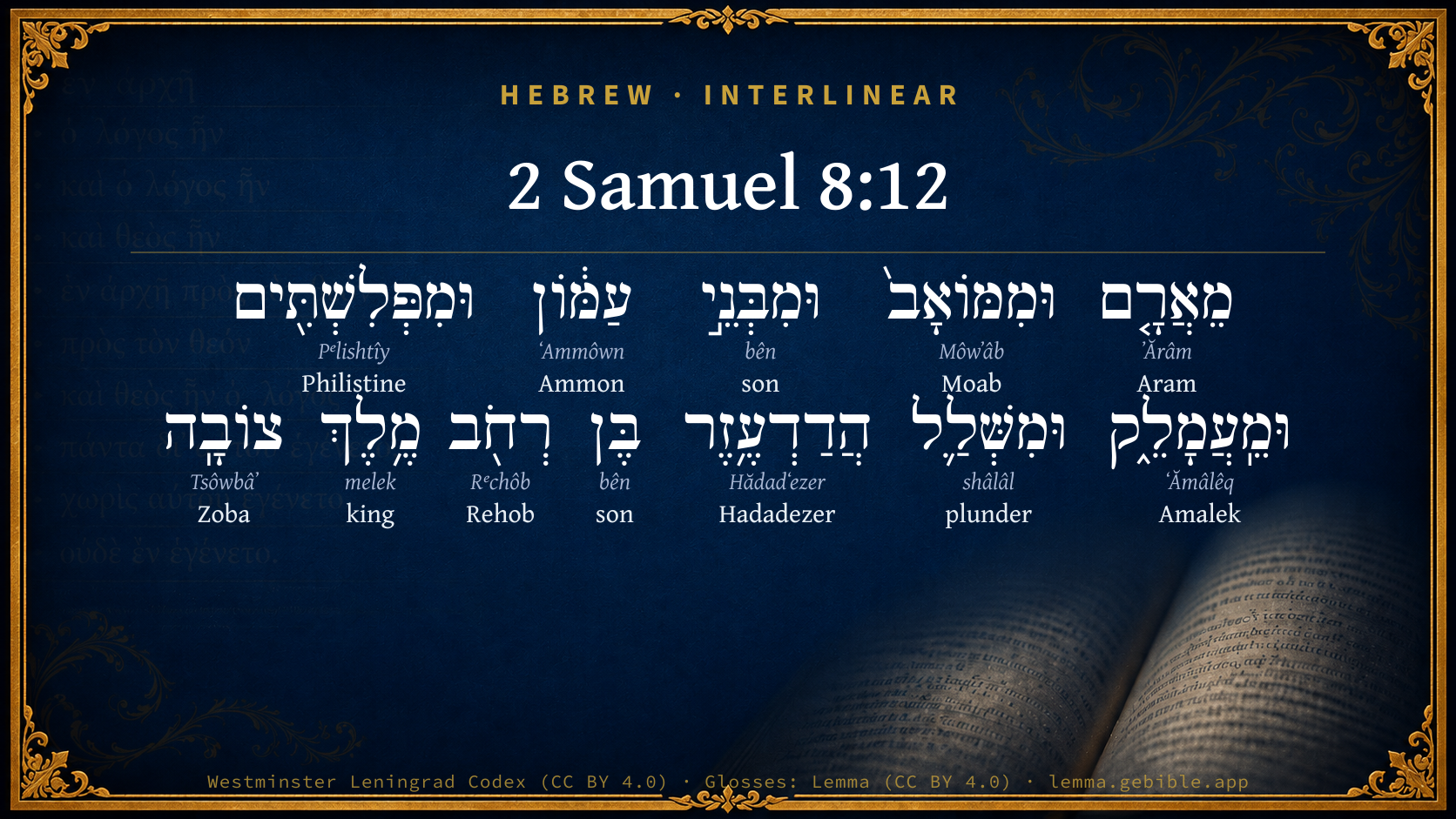
2 Samuel 8:12

Hebrew (Westminster Leningrad Codex) 2 Samuel 8:12 appears in the Hebrew Old Testament. The text above is from the Westminster Leningrad Codex. Each word links to its Strong’s number, a concise gloss, and parsing drawn from the Open Scriptures Hebrew Bible morphology. Click any word for its full Brown-Driver-Briggs (BDB) entry.
Download image
Cite this verse

2 Samuel 8:12 (World English Bible). Public Domain. Lemma interlinear Bible study tool, https://lemma.gebible.app/v/2-samuel/8/12.

Show BibTeX & RIS
BibTeX
RIS
English Translation
of Syria, and of Moab, and of the children of Ammon, and of the Philistines, and of Amalek, and of the spoil of Hadadezer, son of Rehob, king of Zobah.
World English Bible · Public Domain
Download a study sheet

One document with this verse’s original text, its word-by-word gloss line, the meaning frame, cross-references with their text, attributed commentary, and full source and license credits — printable, and it pastes into notes with its structure intact.

This verse Autodidact and up

Study sheet (.html) Plain text (.txt)

A passage Seminary Student

Up to 50 verses in one chapter. A passage sheet keeps up to 6 commentary sources and 12 cross-references per verse, in the order this page ranks them, and says so on the sheet whenever that leaves anything out. Ask for a single verse and you get the Autodidact verse sheet above.

Everything on this page stays free to read, with no account — the sheet is a download of what is already on screen, not access to it.

Want to remove ads? Support Godless Engineer
Compare translations 3

The same verse in 3 English versions, stacked beneath the original-language interlinear above. Click any original word for its lexicon entry.

Each is an independent rendering of the whole verse — the interlinear is not word-aligned to these translations.

Highlighted words mark where these versions differ — a whole-verse word diff, not a word-by-word alignment.

  • World English Bible Public Domain
    of Syria, and of Moab, and of the children of Ammon, and of the Philistines, and of Amalek, and of the spoil of Hadadezer, son of Rehob, king of Zobah.
  • King James Version Public Domain
    Of Syria, and of Moab, and of the children of Ammon, and of the Philistines, and of Amalek, and of the spoil of Hadadezer, son of Rehob, king of Zobah.
  • unfoldingWord Literal Text CC BY-SA 4.0
    from Aram and from Moab and from the sons of Ammon and from the Philistines and from Amalek and from the plunder of Hadadezer, the son of Rehob, the king of Zobah.

unfoldingWord Literal Text — © unfoldingWord, licensed CC BY-SA 4.0. Word-aligned USFM3 via Door43 (git.door43.org/unfoldingWord/en_ult).

Versions to compare (up to 4)

3 of 4 selected

Show all 18 translations

Every available English version of this verse, each an independent rendering of the whole verse.

  • World English Bible Public Domain
    of Syria, and of Moab, and of the children of Ammon, and of the Philistines, and of Amalek, and of the spoil of Hadadezer, son of Rehob, king of Zobah.
  • Berean Standard Bible Public Domain
    from Edom and Moab, from the Ammonites and Philistines and Amalekites, and from the spoil of Hadadezer son of Rehob, king of Zobah.
  • Majority Standard Bible Public Domain
    from Edom and Moab, from the Ammonites and Philistines and Amalekites, and from the spoil of Hadadezer son of Rehob, king of Zobah.
  • King James Version Public Domain
    Of Syria, and of Moab, and of the children of Ammon, and of the Philistines, and of Amalek, and of the spoil of Hadadezer, son of Rehob, king of Zobah.
  • American Standard Version (1901) Public Domain
    of Syria, and of Moab, and of the children of Ammon, and of the Philistines, and of Amalek, and of the spoil of Hadadezer, son of Rehob, king of Zobah.
  • Revised Version (1885) Public Domain
    of Syria, and of Moab, and of the children of Ammon, and of the Philistines, and of Amalek, and of the spoil of Hadadezer, son of Rehob, king of Zobah.
  • Geneva Bible (1599) Public Domain
    Of Aram, and of Moab, and of the children of Ammon, and of the Philistims, and of Amalek, and of the spoyle of Hadadezer ye sonne of Rehob King of Zobah.
  • Douay-Rheims (1899) Public Domain
    Of Syria, and of Moab, and of the children of Ammon, and of the Philistines, and of Amalec, and of the spoils of Adarezer the son of Rohob king of Soba.
  • Young's Literal Translation Public Domain
    of Aram, and of Moab, and of the Bene-Ammon, and of the Philistines, and of Amalek, and of the spoil of Hadadezer son of Rehob king of Zobah.
  • Literal Standard Version CC BY-SA 4.0
    of Aram, and of Moab, and of the sons of Ammon, and of the Philistines, and of Amalek, and of the spoil of Hadadezer son of Rehob king of Zobah.
  • Unlocked Literal Bible CC BY-SA 4.0
    from Aram, Moab, the people of Ammon, the Philistines, and Amalek, along with all of the plundered goods of Hadadezer son of Rehob, the king of Zobah.
  • unfoldingWord Literal Text CC BY-SA 4.0
    from Aram and from Moab and from the sons of Ammon and from the Philistines and from Amalek and from the plunder of Hadadezer, the son of Rehob, the king of Zobah.
  • Darby Bible Public Domain
    of the Syrians, and of the Moabites, and of the children of Ammon, and of the Philistines, and of the Amalekites, and of the spoil of Hadadezer, the son of Rehob, king of Zobah.
  • World Messianic Bible Public Domain
    of Syria, of Moab, of the children of Ammon, of the Philistines, of Amalek, and of the plunder of Hadadezer, son of Rehob, king of Zobah.
  • Webster's Bible Public Domain
    Of Syria, and of Moab, and of the children of Ammon, and of the Philistines, and of Amalek, and of the spoil of Hadadezer son of Rehob, king of Zobah.
  • Free Bible Version CC BY-SA 4.0
    Edom, Moab, the Ammonites, the Philistines, and Amalekites; as well as the plunder taken from Hadadezer, son of Rehob, king of Zobah.
  • Bible in Basic English Public Domain
    The nations of Edom and Moab, and the children of Ammon and the Philistines and the Amalekites and the goods he had taken from Hadadezer, the son of Rehob, king of Zobah.
  • JPS Tanakh (1917) Public Domain
    of Aram, and of Moab, and of the children of Ammon, and of the Philistines, and of Amalek, and of the spoil of Hadadezer, son of Rehob, king of Zobah.

Literal Standard Version (2020), Covenant Press — licensed CC BY-SA 4.0. Text via the HelloAO Bible API (eBible.org). Unlocked Literal Bible (unfoldingWord) — licensed CC BY-SA 4.0. Text via the HelloAO Bible API (eBible.org). unfoldingWord Literal Text — © unfoldingWord, licensed CC BY-SA 4.0. Word-aligned USFM3 via Door43 (git.door43.org/unfoldingWord/en_ult). Free Bible Version, Dr. Jonathan Gallagher — licensed CC BY-SA 4.0. Text via the HelloAO Bible API (eBible.org).

Word by word

More ways to search: Search by grammar → Find every occurrence → Compare this word →

Practice this passage: Drill this verse → Learn its vocabulary →

רְחֹ֖ב
Rᵉchôb
H7340
“Rehob”
Noun, Proper
Part of Speech
Noun
Type
Proper
Full BDB Definition

Origin: the same as H7339

TWOT: None

Rehob = "broad place" - father of Hadadezer the king of Zobah who was killed by David (noun proper masculine) - a Levite who sealed the covenant with Nehemiah (noun proper masculine) - the northern limit of the exploration of the spies in Canaan; on the road to Hamath (noun proper locative) - a town in Asher (noun proper locative) - a second town by the same name also in Asher (noun proper locative)
  1. מֵאֲרָ֤ם ʼĂrâm H758 “from · Aram” Preposition + Noun, Proper
  2. וּמִמּוֹאָב֙ Môwʼâb H4124 “and · from · Moab” Conjunction + Preposition + Noun, Proper
  3. וּמִבְּנֵ֣י bên H1121 “and · from · sons of” Conjunction + Preposition + Noun, Common, Masculine, Plural, Construct
  4. עַמּ֔וֹן ʻAmmôwn H5983 “Ammon” Noun, Proper
  5. וּמִפְּלִשְׁתִּ֖ים Pᵉlishtîy H6430 “and · from · Philistines” Conjunction + Preposition + Noun, Gentilic, Masculine, Plural, Absolute
  6. וּמֵֽעֲמָלֵ֑ק ʻĂmâlêq H6002 “and · from · Amalek” Conjunction + Preposition + Noun, Proper
  7. וּמִשְּׁלַ֛ל shâlâl H7998 “and · from · plunder of” Conjunction + Preposition + Noun, Common, Masculine, Singular, Construct
  8. הֲדַדְעֶ֥זֶר Hădadʻezer H1909 “Hadadezer” Noun, Proper
  9. בֶּן bên H1121 “son of” Noun, Common, Masculine, Singular, Construct
  10. מֶ֥לֶךְ melek H4428 “king of” Noun, Common, Masculine, Singular, Construct
  11. צוֹבָֽה Tsôwbâʼ H6678 “Zoba” Noun, Proper

About this verse

These counts appear in no published source. They are computed here, from the morphology-tagged text and Lemma’s own curated glosses. What Lemma adds →

12
words
11
distinct lemmas
Historical
section

Notable vocabulary

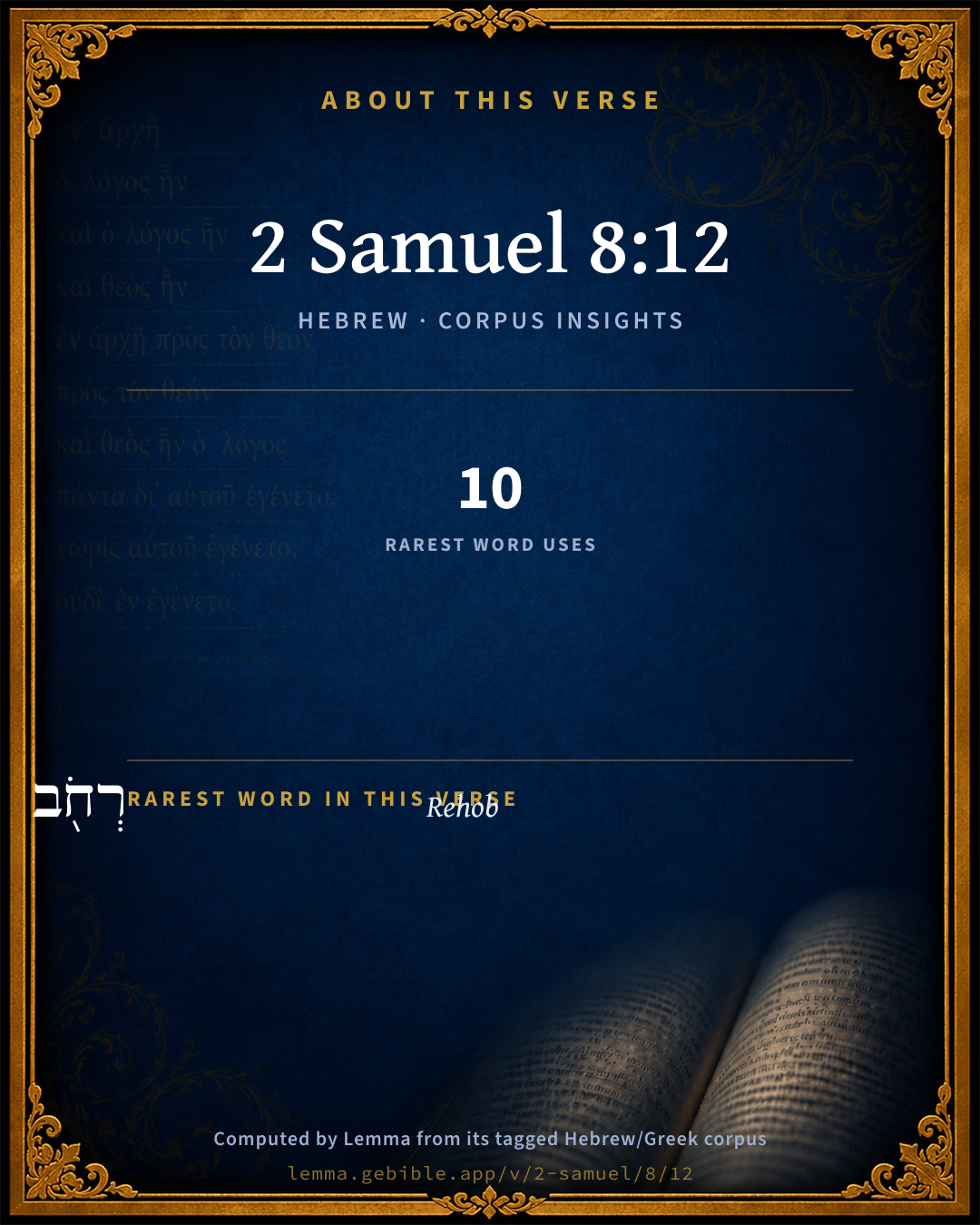
The rarest word here is רְחֹ֖ב Rehob H7340 — appearing just 10 times in the whole Hebrew Bible.

Shared distinctive vocabulary

רְחֹ֖ב Rehob H7340 occurs in 10 verses of the Hebrew Bible. Also found in:

Grammatical profile

  • 12 nouns

Repetition

A word recurs within this verse — often emphatic in Hebrew:

  • וּמִבְּנֵ֣י son H1121 ×2

Hebrew & Septuagint length

In English translation the verse runs 30 words from the Hebrew and 32 from the Septuagint (LXX English) — closely comparable.

A rough comparison of the two English renderings, which tokenize alike — not a word-level alignment.

Word counts can differ between the Hebrew and the Greek without any difference in meaning — e.g. the Hebrew direct-object marker אֵת has no separate Greek word, and Greek often adds the article ὁ.

Cross-references

8

Topical passages linked to 2 Samuel 8:12 in the Treasury of Scripture Knowledge — connected by theme and wording, ordered by reader-vote popularity; previews shown in the World English Bible.

  • 2 Samuel 10:14 When the children of Ammon saw that the Syrians were fled, they likewise fled before Abishai, and entered into the city. Then Joab returned from the children of Ammon, and came to Jerusalem.
  • 2 Samuel 8:2 He struck Moab, and measured them with the line, making them to lie down on the ground; and he measured two lines to put to death, and one full line to keep alive. The Moabites became servants to David, and brought tribute.
  • 1 Chronicles 18:11 These also did king David dedicate to Yahweh, with the silver and the gold that he carried away from all the nations; from Edom, and from Moab, and from the children of Ammon, and from the Philistines, and from Amalek.
  • 1 Samuel 27:8 David and his men went up, and made a raid on the Geshurites, and the Girzites, and the Amalekites; for those [nations] were the inhabitants of the land, who were of old, as you go to Shur, even to the land of Egypt.
  • 1 Samuel 30:20 David took all the flocks and the herds, [which] they drove before those [other] cattle, and said, This is David's spoil.
  • 2 Samuel 5:17–25 When the Philistines heard that they had anointed David king over Israel, all the Philistines went up to seek David; and David heard of it, and went down to the stronghold.
  • 2 Samuel 10:11 He said, If the Syrians be too strong for me, then you shall help me; but if the children of Ammon be too strong for you, then I will come and help you.
  • 2 Samuel 12:26–31 Now Joab fought against Rabbah of the children of Ammon, and took the royal city.

Cross-references courtesy of OpenBible.info (CC BY 4.0).

Hebrew and Greek witnesses Masoretic Hebrew ↔ Greek Septuagint

The same verse in the two great witnesses to the Old Testament, shown verse-for-verse.

These are two independent witnesses, not word-aligned to each other, and the Septuagint is shown in lemma (dictionary) form.

Hebrew 2 Samuel 8:12 Masoretic · Westminster Leningrad Codex

מֵאֲרָ֤ם וּמִמּוֹאָב֙ וּמִבְּנֵ֣י עַמּ֔וֹן וּמִפְּלִשְׁתִּ֖ים וּמֵֽעֲמָלֵ֑ק וּמִשְּׁלַ֛ל הֲדַדְעֶ֥זֶר בֶּן רְחֹ֖ב מֶ֥לֶךְ צוֹבָֽה

of Syria, and of Moab, and of the children of Ammon, and of the Philistines, and of Amalek, and of the spoil of Hadadezer, son of Rehob, king of Zobah.

World English Bible · Public Domain

Greek LXX 2 Samuel 8:12 Septuagint · lemma form

ἐκ ὁ ιδουμαία καί ἐκ ὁ γῆ μωαβ καί ἐκ ὁ υἱός αμμων καί ἐκ ὁ ἀλλόφυλος καί ἐκ αμαληκ καί ἐκ ὁ σκῦλον αδρααζαρ υἱός ρααβ βασιλεύς σουβα

out of Idumea, and out of Moab, and from the children of Ammon, and from the Philistines, and from Amalec, and from the spoils of Adraazar son of Raab king of Suba.

LXX2012 (modern English Septuagint) · Public Domain

Hebrew: Westminster Leningrad Codex (CC BY 4.0). Greek: Septuagint (public domain); English from LXX2012 (modern English Septuagint) (Public Domain). How the Septuagint differs from the Hebrew →

Targum (Aramaic paraphrase)

1

The Targum is the ancient Jewish Aramaic paraphrase of the Hebrew Scriptures — an interpretive translation, not the Hebrew text itself. Onkelos (literal) and Pseudo-Jonathan (expansive) render the Torah, and Jonathan the Prophets. Coverage is partial: where no permissively-licensed English translation exists for a verse, only the Aramaic is shown. This is verse-level text, not a word-by-word alignment to the Hebrew.

  1. Targum Jonathan Prophets (Joshua–Malachi)
    מֵאֲרָם וּמִמוֹאָב וּמִבְּנֵי עַמוֹן וּמִפְּלִשְׁתָּאֵי וּמֵעֲמַלְקָאֵי וּמִבִּיזַת הֲדַדְעֶזֶר בַּר רְחוֹב מַלְכָּא דְצוֹבָה:

    (no public-domain English translation for this verse)

    Targum Jonathan — Aramaic: “Mikraot Gedolot” (public domain). English: “Sefaria Community Translation” (CC0 1.0 (public-domain dedication)); “London "Chaldee Paraphrase," 1871” (public domain). Text via Sefaria.

Commentary

Notes on 2 Samuel 8:12 from classic Christian and Jewish commentators (each source and its license shown beneath its notes). The classic Christian expositions comment on the surrounding passage and are grouped to its opening verse, so a note may address several verses; the Jewish commentaries on the Tanakh (Rashi and others) are per-verse, so they appear only where the commentator wrote on this verse.

Lemma curates 59 commentaries, every one of them public domain or Creative Commons licensed, each selected and text-cleaned for this edition rather than reprinted as found. About our sources →

Trapp's Complete Commentary

John Trapp

2Sa 8:12 Of Syria, and of Moab, and of the children of Ammon, and of the Philistines, and of Amalek, and of the spoil of Hadadezer, son of Rehob, king of Zobah.

Ver. 12. Of Syria, &c.] Rupertus well applieth these seven victories of David recorded in this chapter to those seven vials of wrath and judgments which Christ shall pour upon the beast and others, for contempt of the gospel.

John Trapp, A Commentary or Exposition upon All the Books of the Old and New Testament (1647–1656) — public domain. Text from a community e-Sword module.

Geneva Bible (1599)

Geneva Bible translators

Or, Syria, or Cœlosyria.

Geneva Bible (1599) marginal notes — public domain. Text via Bolls.life.

Ellicott's Commentary for English Readers

(12) Of Syria.—1Ch_18:11 reads Edom. The two names differing in the original only by one very similar letter (the d and r, which are so often confused), it might be supposed that one was an error for the other, were it not that both were actually conquered and the spoils of both dedicated by David, Syria is spoken of here because Edom has not yet been mentioned, and the account of its conquest is given afterwards (2Sa_8:14; 1Ki_11:15-17); while Edom is given in Chron. because the booty from Syria had just before been spoken of particularly. It may be, however, that both names were originally in both places.

Amalek.—This is the only allusion to a war with Amalek after David came to the throne. They had been “utterly destroyed” by Saul (1 Samuel 15); but they were a nation of many tribes, and Saul’s victory can relate to only one branch, since David afterwards inflicted a severe blow upon them (1 Samuel 30), and there is no reason why still other branches of the nation may not have proved troublesome, and been defeated by him at other times.

A Bible Commentary for English Readers, edited by Charles John Ellicott (1878–1897) — public domain. Text from a community e-Sword module.

The Cambridge Bible for Schools and Colleges

gen. ed. J. J. S. Perowne

12. of Syria] Chr. and the Sept. agree in reading Edom instead of Aram (Syria). The two names are easily confused (cp. note on 2Sa_8:3), and it is not easy to decide between them. The order, and the connexion with Moab and Ammon, are in favour of Edom: on the other hand Edom has not yet been mentioned, and Syria of Damascus was distinct from Zobah, and might very well be specified in addition to it (2Sa_8:5).

Amalek] The only allusion to an Amalekite war, unless the spoil taken in the victory of 1Sa_30:16 ff. is meant.

Chr. omits the rest of the verse.

The Cambridge Bible for Schools and Colleges (gen. ed. J. J. S. Perowne; Cambridge University Press, 1878–1918) — public domain. Text from a community e-Sword module.

John Gill's Exposition

Of Syria,.... Of Syria of Damascus, as distinct from Syriazobah, Hadadezer was king of, after mentioned; this is omitted in Ch1 18:11,

and of Moab: who brought him gifts and presents, and were tributaries to him, Sa2 8:2,

and of the children of Ammon; who very probably joined the Moabites, and were conquered and spoiled at the same time:

and of the Philistines; when Methegammah was taken from them, Sa2 8:1,

and of Amalek; for though we have no account of any war of his with that people, since he was king, yet he doubtless had, and had been victorious and spoiled them; see Psa 83:7,

and of the spoil of Hadadezer, son of Rehob, king of Zobah; see Sa2 8:3. These conquests of David, are confirmed by the testimony of Eupolemus, an Heathen writer, who says that he overcame the Syrians by Euphrates, and the Assyrians in Galadene (or Gilead), and the Phoenicians; that he fought against the Idumeans (or Edomites), the Ammonites, Moabites, Ituraeans, Nabathaeans, and Nabdaeans; also against Syron king of Tyre and Phoenicia; all of whom he obliged to pay tribute to the Jews (a).

(a) Apud Euseb. Praepar. Evangel. l. 9. c. 30. p. 447.

John Gill's Exposition of the Whole Bible (1746–1763) — public domain (CC PDM 1.0). Text via the HelloAO Bible API.

Albert Barnes' Notes on the Bible

Syria - Rather, as in 1Ch 18:11, Edom, which is manifestly the right reading, both because Edom, Moab, and Ammon are so frequently joined together, and because David’s Syrian spoil is expressly mentioned at the end of the verse. (The Hebrew letters for Aram (Syria) and Edom are very similar.)

Albert Barnes' Notes on the Bible (1834–1885) — public domain. Text from a community e-Sword/MySword module.

The Pulpit Commentary

Of Syria; Hebrew, Aram. The reading in 1Ch_18:11 is Edom, which differs from Aram in only one letter. The two words are constantly confused in manuscripts, and "Edom" is probably right here, first, because it is coupled with Moab and Ammon, which were its neighbours; but chiefly because the spoil of Hadarezer, mentioned at the end of the verse, is the spoil of Aram. It would not be enumerated twice.

The Pulpit Commentary (1880–1919), ed. H.D.M. Spence-Jones & Joseph S. Exell — public domain. Text from a community e-Sword module.

Lesson kit

Teaching starters — assembled from the data on this page, not authored interpretation. Every prompt links to the verse data it draws on. Edit before teaching.

2 Samuel, in the Historical, opens this verse with 12 words (11 distinct Hebrew lemmas). Its most distinctive word is Rᵉchôb (“Rehob”). A historical commentator’s framing appears above. Read the whole chapter for the surrounding context.

Discussion questions

  1. What does “Rehob” (Rᵉchôb) contribute to the verse as a whole?
  2. Numbers 13:21 shares the word «Rehob» with this verse. How do the two illuminate each other?
  3. “son” occurs 2× in this one verse. What is the effect of the repetition?
  4. These translations render this verse differently. What is at stake in choosing one wording over another?
  5. Reading how Trapp's Complete Commentary and Geneva Bible (1599) read this verse, where do the two commentators agree and where do they part?

Things to notice

Reading settings

Reading text

Shown beneath each verse's original-language words.

Old Testament
Old Testament edition

Read the OT as the Masoretic Hebrew (MT) or the Greek Septuagint (LXX).

English shown for the Greek Septuagint (in the Hebrew ↔ Greek comparison).

Comparing translations? Open the Compare panel on any verse page to stack up to four side by side.