Jeremiah 48:15

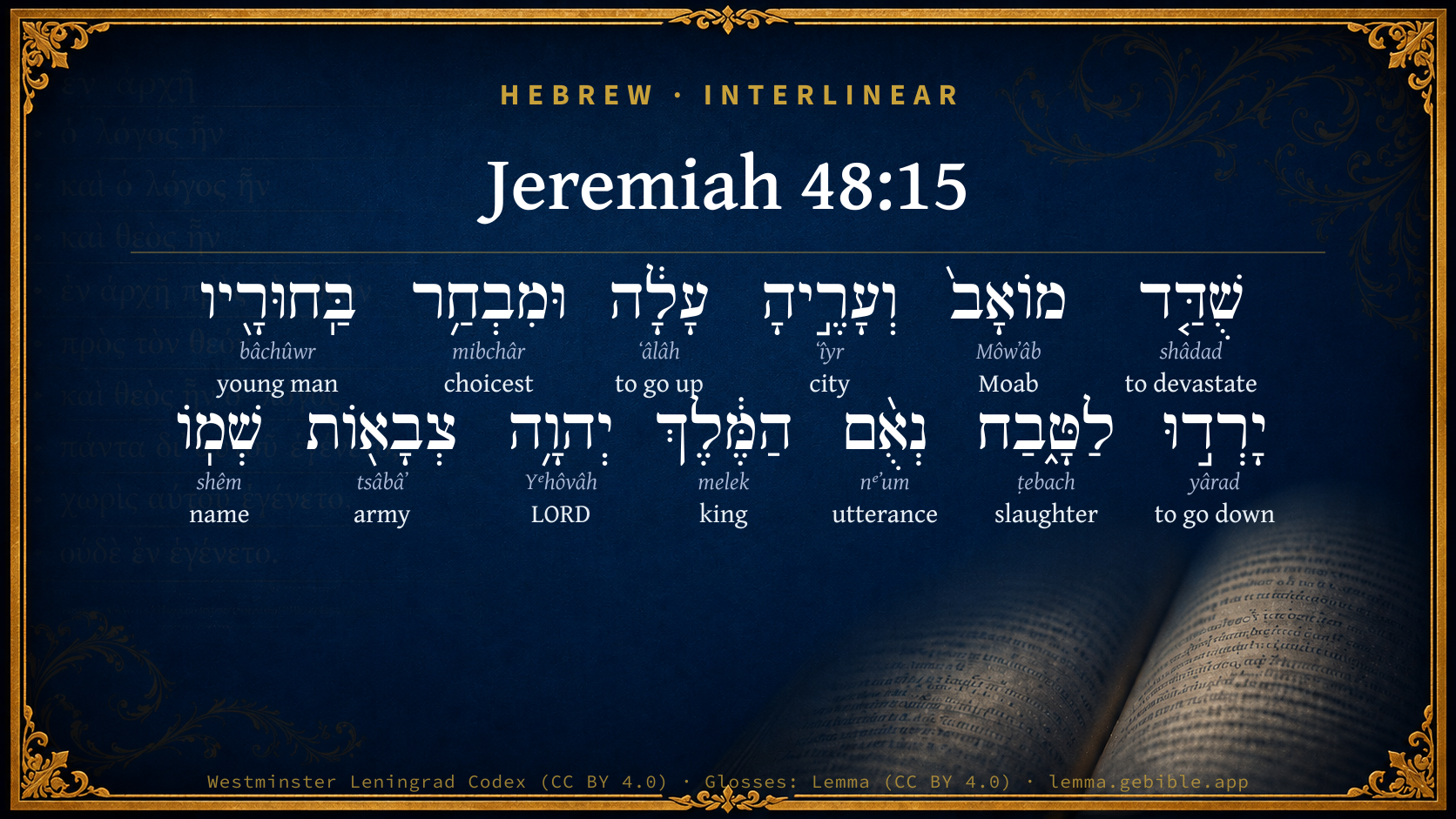
Hebrew (Westminster Leningrad Codex) Jeremiah 48:15 appears in the Hebrew Old Testament. The text above is from the Westminster Leningrad Codex. Each word links to its Strong’s number, a concise gloss, and parsing drawn from the Open Scriptures Hebrew Bible morphology. Click any word for its full Brown-Driver-Briggs (BDB) entry.
Download image
Cite this verse

Jeremiah 48:15 (World English Bible). Public Domain. Lemma interlinear Bible study tool, https://lemma.gebible.app/v/jeremiah/48/15.

Show BibTeX & RIS
BibTeX
RIS
English Translation
Moab is laid waste, and they are gone up into his cities, and his chosen young men are gone down to the slaughter, says the King, whose name is Yahweh of Hosts.
World English Bible · Public Domain
Download a study sheet

One document with this verse’s original text, its word-by-word gloss line, the meaning frame, cross-references with their text, attributed commentary, and full source and license credits — printable, and it pastes into notes with its structure intact.

This verse Autodidact and up

Study sheet (.html) Plain text (.txt)

A passage Seminary Student

Up to 50 verses in one chapter. A passage sheet keeps up to 6 commentary sources and 12 cross-references per verse, in the order this page ranks them, and says so on the sheet whenever that leaves anything out. Ask for a single verse and you get the Autodidact verse sheet above.

Everything on this page stays free to read, with no account — the sheet is a download of what is already on screen, not access to it.

Want to remove ads? Support Godless Engineer
Compare translations 3

The same verse in 3 English versions, stacked beneath the original-language interlinear above. Click any original word for its lexicon entry.

Each is an independent rendering of the whole verse — the interlinear is not word-aligned to these translations.

Highlighted words mark where these versions differ — a whole-verse word diff, not a word-by-word alignment.

  • World English Bible Public Domain
    Moab is laid waste, and they are gone up into his cities, and his chosen young men are gone down to the slaughter, says the King, whose name is Yahweh of Hosts.
  • King James Version Public Domain
    Moab is spoiled, and gone up out of her cities, and his chosen young men are gone down to the slaughter, saith the King, whose name is the LORD of hosts.
  • unfoldingWord Literal Text CC BY-SA 4.0
    Moab will be devastated and its cities attacked. For its finest young men have gone down to the place of slaughter. This is the king’s declaration! Yahweh of hosts is his name.

unfoldingWord Literal Text — © unfoldingWord, licensed CC BY-SA 4.0. Word-aligned USFM3 via Door43 (git.door43.org/unfoldingWord/en_ult).

Versions to compare (up to 4)

3 of 4 selected

Show all 18 translations

Every available English version of this verse, each an independent rendering of the whole verse.

  • World English Bible Public Domain
    Moab is laid waste, and they are gone up into his cities, and his chosen young men are gone down to the slaughter, says the King, whose name is Yahweh of Hosts.
  • Berean Standard Bible Public Domain
    Moab has been destroyed and its towns have been invaded; the best of its young men have gone down in the slaughter, declares the King, whose name is the LORD of Hosts.
  • Majority Standard Bible Public Domain
    Moab has been destroyed and its towns have been invaded; the best of its young men have gone down in the slaughter, declares the King, whose name is the LORD of Hosts.
  • King James Version Public Domain
    Moab is spoiled, and gone up out of her cities, and his chosen young men are gone down to the slaughter, saith the King, whose name is the LORD of hosts.
  • American Standard Version (1901) Public Domain
    Moab is laid waste, and they are gone up into his cities, and his chosen young men are gone down to the slaughter, saith the King, whose name is Jehovah of hosts.
  • Revised Version (1885) Public Domain
    Moab is laid waste, and they are gone up into her cities; and his chosen young men are gone down to the slaughter, saith the King, whose name is the LORD of hosts.
  • Geneva Bible (1599) Public Domain
    Moab is destroyed, and his cities burnt vp, and his chose yong men are gone downe to slaughter, saith ye King, whose name is ye Lord of hostes.
  • Douay-Rheims (1899) Public Domain
    Moab is laid waste, and they have cast down her cities: and her choice young men are gone down to the slaughter: saith the king, whose name is the Lord of hosts.
  • Young's Literal Translation Public Domain
    Spoiled is Moab, and her cities hath one gone up, And the choice of its young men Have gone down to slaughter, An affirmation of the King, Jehovah of Hosts `is' His name.
  • Literal Standard Version CC BY-SA 4.0
    Moab is spoiled, and has gone up [from] her cities, || And the choice of its young men || Have gone down to slaughter, || An affirmation of the King, || YHWH of Hosts [is] His Name.
  • Unlocked Literal Bible CC BY-SA 4.0
    Moab will be devastated and its cities attacked. For its finest young men have gone down to the place of slaughter. This is the king's declaration! Yahweh of hosts is his name.
  • unfoldingWord Literal Text CC BY-SA 4.0
    Moab will be devastated and its cities attacked. For its finest young men have gone down to the place of slaughter. This is the king’s declaration! Yahweh of hosts is his name.
  • Darby Bible Public Domain
    Moab is laid waste, and his cities are gone up [in smoke], and his chosen young men are gone down to the slaughter, saith the King, whose name is Jehovah of hosts.
  • World Messianic Bible Public Domain
    Moab is laid waste, and they have gone up into his cities, and his chosen young men have gone down to the slaughter,” says the King, whose name is the LORD of Hosts.
  • Webster's Bible Public Domain
    Moab is laid waste, and gone up out of her cities, and his chosen young men are gone down to the slaughter, saith the king, whose name is the LORD of hosts.
  • Free Bible Version CC BY-SA 4.0
    Moab is going to be destroyed and its towns conquered. Its finest young men will be killed, declares the King, whose name is the Lord Almighty.
  • Bible in Basic English Public Domain
    He who makes Moab waste has gone up against her; and the best of her young men have gone down to their death, says the King, whose name is the Lord of armies.
  • JPS Tanakh (1917) Public Domain
    Moab is spoiled, and they are gone up into her cities, and his chosen young men are gone down to the slaughter, saith the King, whose name is the LORD of hosts.

Literal Standard Version (2020), Covenant Press — licensed CC BY-SA 4.0. Text via the HelloAO Bible API (eBible.org). Unlocked Literal Bible (unfoldingWord) — licensed CC BY-SA 4.0. Text via the HelloAO Bible API (eBible.org). unfoldingWord Literal Text — © unfoldingWord, licensed CC BY-SA 4.0. Word-aligned USFM3 via Door43 (git.door43.org/unfoldingWord/en_ult). Free Bible Version, Dr. Jonathan Gallagher — licensed CC BY-SA 4.0. Text via the HelloAO Bible API (eBible.org).

Word by word

More ways to search: Search by grammar → Find every occurrence → Compare this word →

Practice this passage: Drill this verse → Learn its vocabulary →

לַטָּ֑בַח
ṭebach
H2874
“to/for the · slaughter”
Preposition, Determined + Noun, Common, Masculine, Singular, Absolute
Part of Speech
Preposition + Noun
Type
Common
Gender
Masculine
Number
Singular
State
Absolute
Full BDB Definition

Origin: from H2873

TWOT: 786a

slaughter, slaughtering, animal - slaughtering, slaughter (of animals) - slaughter (figuratively)
  1. שֻׁדַּ֤ד shâdad H7703 “to devastate” Verb, Pual, Perfect, 3rd Person, Masculine, Singular
  2. מוֹאָב֙ Môwʼâb H4124 “Moab” Noun, Proper
  3. וְעָרֶ֣יהָ ʻîyr H5892 “and · cities · her” Conjunction + Noun, Common, Feminine, Plural, Construct + Suffix, Personal, 3rd Person, Feminine, Singular
  4. עָלָ֔ה ʻâlâh H5927 “to go up” Verb, Qal, Perfect, 3rd Person, Masculine, Singular
  5. וּמִבְחַ֥ר mibchâr H4005 “and · choicest of” Conjunction + Noun, Common, Masculine, Singular, Construct
  6. בַּֽחוּרָ֖יו bâchûwr H970 “young men · his” Noun, Common, Masculine, Plural, Construct + Suffix, Personal, 3rd Person, Masculine, Singular
  7. יָרְד֣וּ yârad H3381 “to go down” Verb, Qal, Perfect, 3rd Person, Common, Plural
  8. נְאֻ֨ם nᵉʼum H5002 “utterance of” Noun, Common, Masculine, Singular, Construct
  9. הַמֶּ֔לֶךְ melek H4428 “the · king” Particle, Definite Article + Noun, Common, Masculine, Singular, Absolute
  10. יְהוָ֥ה Yᵉhôvâh H3068 “LORD” Noun, Proper
  11. צְבָא֖וֹת tsâbâʼ H6635 “armies” Noun, Common, Both, Plural, Absolute
  12. שְׁמֽוֹ shêm H8034 “name · his” Noun, Common, Masculine, Singular, Construct + Suffix, Personal, 3rd Person, Masculine, Singular

About this verse

These counts appear in no published source. They are computed here, from the morphology-tagged text and Lemma’s own curated glosses. What Lemma adds →

13
words
13
distinct lemmas
Prophets
section

Notable vocabulary

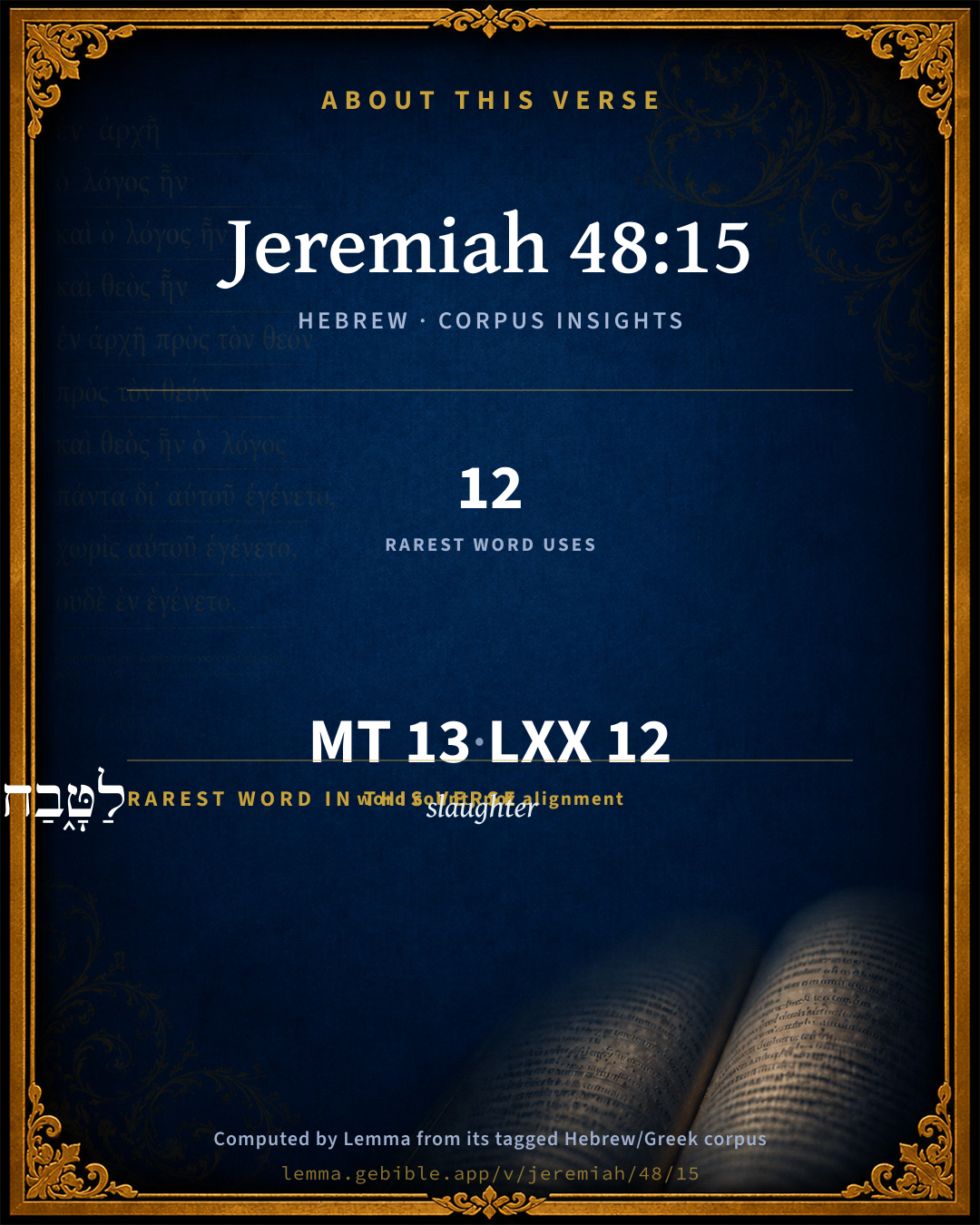
The rarest word here is לַטָּ֑בַח slaughter H2874 — appearing just 12 times in the whole Hebrew Bible.

Shared distinctive vocabulary

לַטָּ֑בַח slaughter H2874 occurs in 12 verses of the Hebrew Bible. Also found in:

Grammatical profile

  • 3 verbs
  • 10 nouns

Verb forms

  • שֻׁדַּ֤ד Pual · Perfect
  • עָלָ֔ה Qal · Perfect
  • יָרְד֣וּ Qal · Perfect

Hebrew & Septuagint length

In the original languages it is 13 Hebrew tokens and 12 Greek tokens — but the two are counted differently (Hebrew bundles its prefixes and suffixes into one token; the Greek is in lemma form), so that isn’t a like-for-like length.

Cross-references

15

Topical passages linked to Jeremiah 48:15 in the Treasury of Scripture Knowledge — connected by theme and wording, ordered by reader-vote popularity; previews shown in the World English Bible.

  • Jeremiah 46:18 As I live, says the King, whose name is Yahweh of Hosts, surely like Tabor among the mountains, and like Carmel by the sea, so shall he come.
  • Jeremiah 50:27 Kill all her bulls; let them go down to the slaughter: woe to them! for their day is come, the time of their visitation.
  • Jeremiah 51:57 I will make drunk her princes and her wise men, her governors and her deputies, and her mighty men; and they shall sleep a perpetual sleep, and not wake up, says the King, whose name is Yahweh of Hosts.
  • Isaiah 40:30–31 Even the youths shall faint and be weary, and the young men shall utterly fall:
  • Malachi 1:14 "But the deceiver is cursed, who has in his flock a male, and vows, and sacrifices to the Lord a blemished thing; for I am a great King," says Yahweh of hosts, "and my name is awesome among the nations."
  • Psalms 24:8–10 Who is the King of glory? Yahweh strong and mighty, Yahweh mighty in battle.
  • Psalms 47:2 For Yahweh Most High is awesome. He is a great King over all the earth.
  • Isaiah 34:2–8 For Yahweh has indignation against all the nations, and wrath against all their host: he has utterly destroyed them, he has delivered them to the slaughter.
  • Jeremiah 48:4 Moab is destroyed; her little ones have caused a cry to be heard.
  • Jeremiah 48:8–25 The destroyer shall come on every city, and no city shall escape; the valley also shall perish, and the plain shall be destroyed; as Yahweh has spoken.
  • Jeremiah 51:40 I will bring them down like lambs to the slaughter, like rams with male goats.
  • Daniel 4:37 Now I, Nebuchadnezzar, praise and extol and honor the King of heaven; for all his works are truth, and his ways justice; and those who walk in pride he is able to abase.
  • Zechariah 14:9 Yahweh will be King over all the earth. In that day Yahweh will be one, and his name one.
  • James 5:4 Behold, the wages of the laborers who mowed your fields, which you have kept back by fraud, cry out, and the cries of those who reaped have entered into the ears of the Lord of Hosts.
  • Revelation 19:16 He has on his garment and on his thigh a name written, "KING OF KINGS, AND LORD OF LORDS."

Cross-references courtesy of OpenBible.info (CC BY 4.0).

Hebrew and Greek witnesses Masoretic Hebrew ↔ Greek Septuagint

The same verse in the two great witnesses to the Old Testament, shown verse-for-verse.

These are two independent witnesses, not word-aligned to each other, and the Septuagint is shown in lemma (dictionary) form.

Hebrew Jeremiah 48:15 Masoretic · Westminster Leningrad Codex

שֻׁדַּ֤ד מוֹאָב֙ וְעָרֶ֣יהָ עָלָ֔ה וּמִבְחַ֥ר בַּֽחוּרָ֖יו יָרְד֣וּ לַטָּ֑בַח נְאֻ֨ם הַמֶּ֔לֶךְ יְהוָ֥ה צְבָא֖וֹת שְׁמֽוֹ

Moab is laid waste, and they are gone up into his cities, and his chosen young men are gone down to the slaughter, says the King, whose name is Yahweh of Hosts.

World English Bible · Public Domain

Greek LXX Structure differs

In the Septuagint, Jeremiah is about an eighth shorter than the Hebrew and arranges its material differently — the Oracles Against the Nations (Hebrew chapters 46–51) appear in the middle of the Greek book, after 25:13. Because the chapter and verse boundaries do not line up, a verse-for-verse comparison with the Hebrew is not shown.

A verse-for-verse comparison isn’t shown here because the chapters and verses don’t line up. Switch to the LXX edition with the MT / LXX toggle above to read the Greek directly.

Hebrew: Westminster Leningrad Codex (CC BY 4.0). Greek: Septuagint (public domain); English from a public-domain English Septuagint. How the Septuagint differs from the Hebrew →

Targum (Aramaic paraphrase)

1

The Targum is the ancient Jewish Aramaic paraphrase of the Hebrew Scriptures — an interpretive translation, not the Hebrew text itself. Onkelos (literal) and Pseudo-Jonathan (expansive) render the Torah, and Jonathan the Prophets. Coverage is partial: where no permissively-licensed English translation exists for a verse, only the Aramaic is shown. This is verse-level text, not a word-by-word alignment to the Hebrew.

  1. Targum Jonathan Prophets (Joshua–Malachi)
    אִתְבְּזִיזוּ מוֹאֲבָאֵי וְקִרְוֵיהוֹן חָרוֹבָא וּשְׁפַר עוֹלֵימֵיהוֹן יִתְמַסְרוּן לִקְטָלָא אֲמַר מַלְכָּא יְיָ צְבָאוֹת שְׁמֵיהּ:

    (no public-domain English translation for this verse)

    Targum Jonathan — Aramaic: “Mikraot Gedolot” (public domain). English: “Sefaria Community Translation” (CC0 1.0 (public-domain dedication)); “London "Chaldee Paraphrase," 1871” (public domain). Text via Sefaria.

Commentary

Notes on Jeremiah 48:15 from classic Christian and Jewish commentators (each source and its license shown beneath its notes). The classic Christian expositions comment on the surrounding passage and are grouped to its opening verse, so a note may address several verses; the Jewish commentaries on the Tanakh (Rashi and others) are per-verse, so they appear only where the commentator wrote on this verse.

Lemma curates 59 commentaries, every one of them public domain or Creative Commons licensed, each selected and text-cleaned for this edition rather than reprinted as found. About our sources →

Trapp's Complete Commentary

John Trapp

Jer 48:15 Moab is spoiled, and gone up [out of] her cities, and his chosen young men are gone down to the slaughter, saith the King, whose name [is] the LORD of hosts.

Ver. 15. Moab is spoiled.] Quae hucusque, eadem maiore cum luce repetit. The same again, but with more exornations.

John Trapp, A Commentary or Exposition upon All the Books of the Old and New Testament (1647–1656) — public domain. Text from a community e-Sword module.

Geneva Bible (1599)

Geneva Bible translators

Hebrew, gone up, or destroyed.

Geneva Bible (1599) marginal notes — public domain. Text via Bolls.life.

Jamieson, Fausset & Brown

Robert Jamieson, A. R. Fausset & David Brown

gone up . . . gone down--in antithesis.

out of her cities--Rather, "Moab . . . and her cities are gone up," namely, pass away in the ascending smoke of their conflagration (Jos 8:20-21; Jdg 20:40). When this took place, the young warriors would go down from the burning citadels only to meet their own slaughter [GROTIUS]. English Version is somewhat favored by the fact that "gone out" is singular, and "cities" plural. The antithesis favors GROTIUS.

Jamieson, Fausset & Brown — Commentary Critical and Explanatory on the Whole Bible (1871) — public domain (CC PDM 1.0). Text via the HelloAO Bible API.

The Cambridge Bible for Schools and Colleges

gen. ed. J. J. S. Perowne

15. Moab … her cities] The Hebrew is difficult. Dr., followed by Pe., alters the MT. on the model of Jer_48:18, so as to read, “The spoiler of Moab is come up against him, and his, etc.”

The Cambridge Bible for Schools and Colleges (gen. ed. J. J. S. Perowne; Cambridge University Press, 1878–1918) — public domain. Text from a community e-Sword module.

John Gill's Exposition

The calamity of Moab is near to come,.... As it did come within live years after the destruction of Jerusalem, as observed on Jer 48:12; out of Josephus:

and his affliction hasteth fast: or, "his evil" (z) the evil of punishment for his sin; his utter destruction.

(z) "malum ejus", V. L. Pagninus, Montanus, Calvin, Junius & Tremellius, Piscator, Cocceius, Schmidt.

John Gill's Exposition of the Whole Bible (1746–1763) — public domain (CC PDM 1.0). Text via the HelloAO Bible API.

Albert Barnes' Notes on the Bible

Rather, “Moab is spoiled,” and her cities have gone up, i. e., in smoke, have been burned Jos 8:20-21. Others render, “The waster of Moab and of her towns is coming up to the attack, and her chosen youths are gone down to the slaughter.”

Albert Barnes' Notes on the Bible (1834–1885) — public domain. Text from a community e-Sword/MySword module.

Matthew Poole's English Annotations

Moab is spoiled; your country will be wasted and spoiled.

And gone up out of her cities; the inhabitants of it shall be all driven out of their cities. The Hebrew is, and her cities, it, or he, is gone up. So the sense may be, Moab and her cities are all spoiled, and he, that is, the enemy, is gone up.

And his chosen young men are gone down to the slaughter; and the strong and mighty men she boasted of, and alerted in, are gone to the battle, as oxen or sheep to a slaughter-house.

Saith the King, whose name is the Lord of hosts: I do not speak this of myself, I cannot of myself tell things that shall come to pass hereafter, but the words I say are the words of him who is the Lord of all the armies of heaven and earth, who both knoweth what shall be, and is able to effect what he saith.

Matthew Poole's English Annotations on the Holy Bible (1683–1685) — public domain. Text from a community e-Sword/MySword module.

Whedon's Commentary on the Bible

Daniel D. Whedon

15. Gone up… gone down — An evident antithesis. The words out of, inserted by the translators in this verse, are unjustifiable and misleading. The simplest translation is, her cities have gone up, perhaps in smoke and flame. Another rendering is preferred by Keil, and is, perhaps, barely defensible, which leaves the subject of the verb indeterminate: they go up to his cities. The enemy ascends to the cities: the soldiers go down to slaughter.

Daniel D. Whedon (gen. ed.), Commentary on the Old and New Testaments (1874–1909) — public domain. Text from a community e-Sword module.

The Pulpit Commentary

Moab is spoiled, and gone up out of her cities. The latter part of this clause in the Hebrew is extremely difficult; the Authorized Version is indefensible. It is even doubtful whether it can be translated at all consistently with grammar, though Hitzig, a good grammarian, has adopted the suggestion of Grotius, rendering, "and her cities have gone up," viz. in smoke, i.e. they have been burnt; comp. Jud_1:20:40, the end of which verso ought to run thus: "The whole city went up to heaven." But even if the verb in third masc. sing. be allowable after the plural noun, it is very harsh to give it such an interpretation, when the context says nothing about fire or smoke. J.D. Michaelis and Ewald, therefore, propose to change the vowel points of the first word, rendering, "The spoiler of Moab and of her cities is gone up;" and Dr. Payne Smith inclines to follow them. We thus obtain a striking antithesis; the enemy has "gone up," and Moab"s young men are gone down, i.e. are felled by murderous hands Isa_34:7.

The Pulpit Commentary (1880–1919), ed. H.D.M. Spence-Jones & Joseph S. Exell — public domain. Text from a community e-Sword module.

unfoldingWord translationNotes

Door43 World Missions Community

Moab will be devastated and its cities attacked

This can be stated in active form. AT: "The enemy army will devastate Moab and attack its cities" (See: Active or Passive)

its finest young men have gone down to the place of slaughter

The best men of Moab going to battle and being killed is spoken of as if they were animals taken to a place to be slaughtered. AT: "their fine young men will all be slaughtered" or "the enemy army will kill all of the finest men of Moab" (See: Metaphor)

This is the king's declaration

Here "king" refers to Yahweh. This can be stated in first person. See how you translated this in Jeremiah 46:18. AT: "This is what I, the king, declare" (See: First, Second, or Third Person)

Moab's disaster is soon to happen; calamity is hurrying quickly

These two sentences mean basically the same thing and emphasize that Moab's destruction will happen very soon. AT: "Moab's enemies will destroy her very soon" (See: Parallelism)

calamity is hurrying quickly

Something terrible happening soon is spoken of as if calamity were something that could move quickly to a place. AT: "terrible things will happen very soon" (See: Metaphor)

the strong staff, the honored rod, has been broken

Here the words "staff" and "rod" represent the power and political support that Moab provided to other nations. This can be stated in active form. AT: "Moab's enemies have ended her great power" (See: Metonymy and Doublet and Active or Passive)

translationWords

devastate

slaughter

king

declare

Yahweh of hosts

name

woe

staff

honor

rod

unfoldingWord translationNotes — © Distant Shores Media and the Door43 World Missions Community, licensed CC BY-SA 4.0. Source: git.door43.org/Door43/en_tn.

Lesson kit

Teaching starters — assembled from the data on this page, not authored interpretation. Every prompt links to the verse data it draws on. Edit before teaching.

Jeremiah, in the Prophets, opens this verse with 13 words (13 distinct Hebrew lemmas). Its most distinctive word is ṭebach (“slaughter”). A historical commentator’s framing appears above. Read the whole chapter for the surrounding context.

Discussion questions

  1. What does “slaughter” (ṭebach) contribute to the verse as a whole?
  2. How does Genesis 43:16, which shares the word «slaughter», read alongside this verse?
  3. These translations render this verse differently; the difference is in the English rendering, not the original. What questions does that raise?
  4. «שֻׁדַּ֤ד» is a Pual Perfect verb. How does that grammatical form shape the action described?
  5. Compare how Trapp's Complete Commentary and Geneva Bible (1599) read this verse. Where do they agree or differ?

Things to notice

Reading settings

Reading text

Shown beneath each verse's original-language words.

Old Testament
Old Testament edition

Read the OT as the Masoretic Hebrew (MT) or the Greek Septuagint (LXX).

English shown for the Greek Septuagint (in the Hebrew ↔ Greek comparison).

Comparing translations? Open the Compare panel on any verse page to stack up to four side by side.