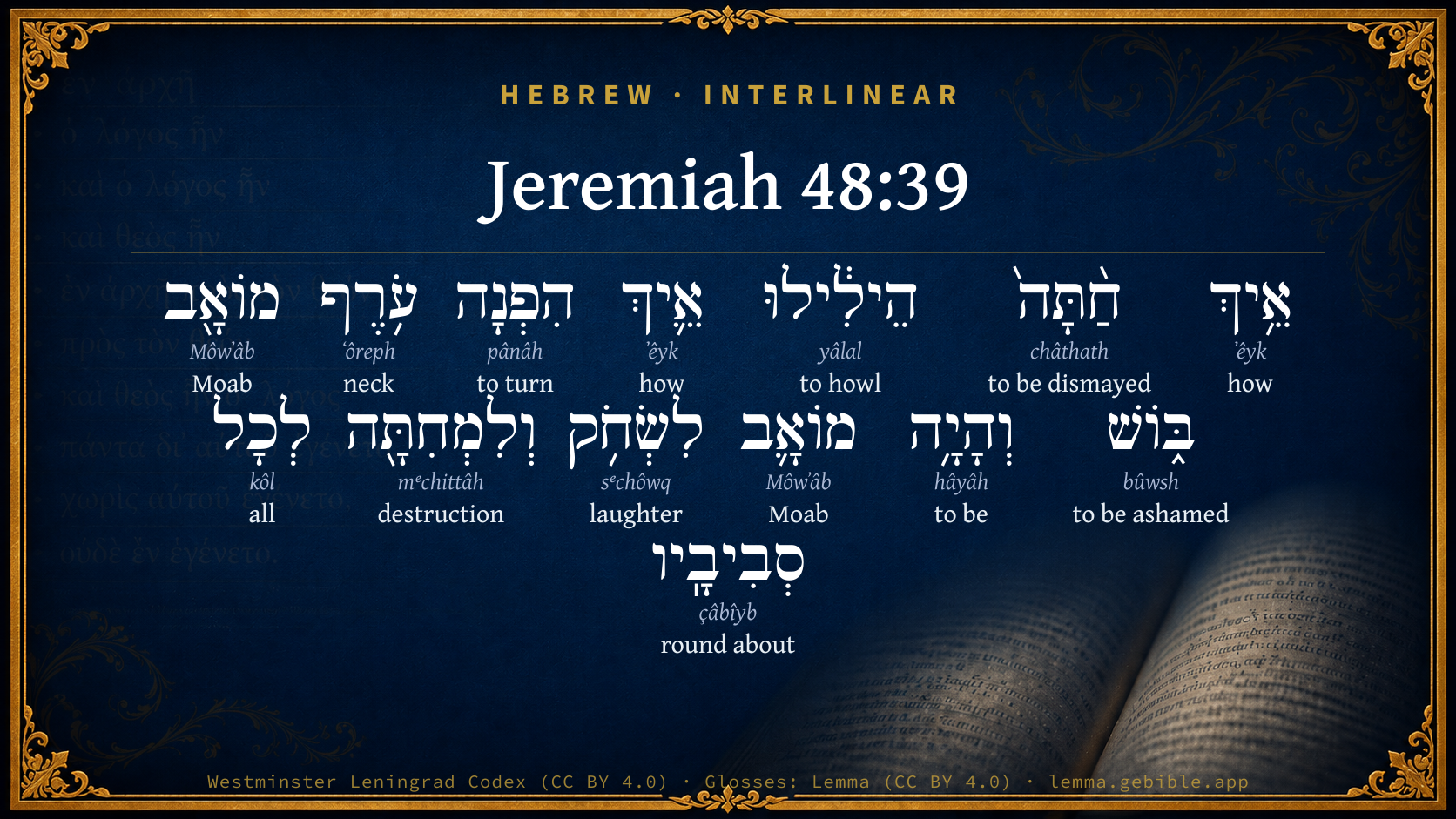
Jeremiah 48:39

Hebrew (Westminster Leningrad Codex) Jeremiah 48:39 appears in the Hebrew Old Testament. The text above is from the Westminster Leningrad Codex. Each word links to its Strong’s number, a concise gloss, and parsing drawn from the Open Scriptures Hebrew Bible morphology. Click any word for its full Brown-Driver-Briggs (BDB) entry.
Download image
Cite this verse

Jeremiah 48:39 (World English Bible). Public Domain. Lemma interlinear Bible study tool, https://lemma.gebible.app/v/jeremiah/48/39.

Show BibTeX & RIS
BibTeX
RIS
English Translation
How is it broken down! [how] do they wail! how has Moab turned the back with shame! so shall Moab become a derision and a terror to all who are round about him.
World English Bible · Public Domain
Download a study sheet

One document with this verse’s original text, its word-by-word gloss line, the meaning frame, cross-references with their text, attributed commentary, and full source and license credits — printable, and it pastes into notes with its structure intact.

This verse Autodidact and up

Study sheet (.html) Plain text (.txt)

A passage Seminary Student

Up to 50 verses in one chapter. A passage sheet keeps up to 6 commentary sources and 12 cross-references per verse, in the order this page ranks them, and says so on the sheet whenever that leaves anything out. Ask for a single verse and you get the Autodidact verse sheet above.

Everything on this page stays free to read, with no account — the sheet is a download of what is already on screen, not access to it.

Want to remove ads? Support Godless Engineer
Compare translations 3

The same verse in 3 English versions, stacked beneath the original-language interlinear above. Click any original word for its lexicon entry.

Each is an independent rendering of the whole verse — the interlinear is not word-aligned to these translations.

Highlighted words mark where these versions differ — a whole-verse word diff, not a word-by-word alignment.

  • World English Bible Public Domain
    How is it broken down! [how] do they wail! how has Moab turned the back with shame! so shall Moab become a derision and a terror to all who are round about him.
  • King James Version Public Domain
    They shall howl, saying, How is it broken down! how hath Moab turned the back with shame! so shall Moab be a derision and a dismaying to all them about him.
  • unfoldingWord Literal Text CC BY-SA 4.0
    How it has been shattered! How they howl in their lamenting! Moab turns its back in shame! So Moab will become an object of derision and a terror to all those who are around him.”

unfoldingWord Literal Text — © unfoldingWord, licensed CC BY-SA 4.0. Word-aligned USFM3 via Door43 (git.door43.org/unfoldingWord/en_ult).

Versions to compare (up to 4)

3 of 4 selected

Show all 18 translations

Every available English version of this verse, each an independent rendering of the whole verse.

  • World English Bible Public Domain
    How is it broken down! [how] do they wail! how has Moab turned the back with shame! so shall Moab become a derision and a terror to all who are round about him.
  • Berean Standard Bible Public Domain
    “How shattered it is! How they wail! How Moab has turned his back in shame! Moab has become an object of ridicule and horror to all those around him.”
  • Majority Standard Bible Public Domain
    “How shattered it is! How they wail! How Moab has turned his back in shame! Moab has become an object of ridicule and horror to all those around him.”
  • King James Version Public Domain
    They shall howl, saying, How is it broken down! how hath Moab turned the back with shame! so shall Moab be a derision and a dismaying to all them about him.
  • American Standard Version (1901) Public Domain
    How is it broken down! `how' do they wail! how hath Moab turned the back with shame! so shall Moab become a derision and a terror to all that are round about him.
  • Revised Version (1885) Public Domain
    How is it broken down! how do they howl! how hath Moab turned the back with shame! so shall Moab become a derision and a dismaying to all that are round about him.
  • Geneva Bible (1599) Public Domain
    They shall howle, saying, How is he destroyed? howe hath Moab turned the backe with shame? so shall Moab be a derision, and a feare to all them about him.
  • Douay-Rheims (1899) Public Domain
    How is it overthrown, and they have howled! How hath Moab bowed down the neck, and is confounded! And Moab shall be a derision, and an example to all round about him.
  • Young's Literal Translation Public Domain
    How hath it been broken down! they have howled, How hath Moab turned the neck ashamed, And Moab hath been for a derision. And for a terror to all round about her.
  • Literal Standard Version CC BY-SA 4.0
    “How it has been broken down! They have howled, || How Moab has turned the neck ashamed! And Moab has been for a derision || And for a terror to all around her.”
  • Unlocked Literal Bible CC BY-SA 4.0
    How it has been shattered! How they howl in their lamenting! Moab turns its back in shame! So Moab will become an object of derision and a terror to all those who are around him.”
  • unfoldingWord Literal Text CC BY-SA 4.0
    How it has been shattered! How they howl in their lamenting! Moab turns its back in shame! So Moab will become an object of derision and a terror to all those who are around him.”
  • Darby Bible Public Domain
    They howl, How is it broken down! how hath Moab turned the back with shame! And Moab shall be a derision and a terror to all that are round about him.
  • World Messianic Bible Public Domain
    “How it is broken down! How they wail! How Moab has turned the back with shame! So will Moab become a derision and a terror to all who are around him.”
  • Webster's Bible Public Domain
    They shall howl, saying, How is it broken down! how hath Moab turned the back with shame! so shall Moab be a derision and a dismaying to all them about him.
  • Free Bible Version CC BY-SA 4.0
    Moab is completely shattered! Listen to them cry! See how the Moabites turn away in shame! All the surrounding nations are horrified at what's happened to the country, and ridicule its people.
  • Bible in Basic English Public Domain
    How is it broken down! how is Moab's back turned in shame! so Moab will be a cause of sport and of fear to everyone round about him.
  • JPS Tanakh (1917) Public Domain
    'How is it broken down!' wail ye! 'How hath Moab turned the back with shame!' So shall Moab become a derision and a dismay to all that are round about him.

Literal Standard Version (2020), Covenant Press — licensed CC BY-SA 4.0. Text via the HelloAO Bible API (eBible.org). Unlocked Literal Bible (unfoldingWord) — licensed CC BY-SA 4.0. Text via the HelloAO Bible API (eBible.org). unfoldingWord Literal Text — © unfoldingWord, licensed CC BY-SA 4.0. Word-aligned USFM3 via Door43 (git.door43.org/unfoldingWord/en_ult). Free Bible Version, Dr. Jonathan Gallagher — licensed CC BY-SA 4.0. Text via the HelloAO Bible API (eBible.org).

Word by word

More ways to search: Search by grammar → Find every occurrence → Compare this word →

Practice this passage: Drill this verse → Learn its vocabulary →

וְלִמְחִתָּ֖ה
mᵉchittâh
H4288
“and · to/for · destruction”
Conjunction + Preposition + Noun, Common, Feminine, Singular, Absolute
Part of Speech
Conjunction + Preposition + Noun
Type
Common
Gender
Feminine
Number
Singular
State
Absolute
Full BDB Definition

Origin: from H2846

TWOT: 784g

destruction, ruin, terror, a breaking - terror, dismay, object of terror - ruin
  1. אֵ֥יךְ ʼêyk H349 “how” Particle, Interrogative
  2. חַ֨תָּה֙ châthath H2865 “to be dismayed” Verb, Qal, Perfect, 3rd Person, Feminine, Singular
  3. הֵילִ֔ילוּ yâlal H3213 “to howl” Verb, Hiphil, Perfect, 3rd Person, Common, Plural
  4. אֵ֛יךְ ʼêyk H349 “how” Particle, Interrogative
  5. הִפְנָה pânâh H6437 “to turn” Verb, Hiphil, Perfect, 3rd Person, Masculine, Singular
  6. עֹ֥רֶף ʻôreph H6203 “neck” Noun, Common, Masculine, Singular, Absolute
  7. מוֹאָ֖ב Môwʼâb H4124 “Moab” Noun, Proper
  8. בּ֑וֹשׁ bûwsh H954 “to be ashamed” Verb, Qal, Infinitive Construct
  9. וְהָיָ֥ה hâyâh H1961 “and · to be” Conjunction + Verb, Qal, Sequential Perfect, 3rd Person, Masculine, Singular
  10. מוֹאָ֛ב Môwʼâb H4124 “Moab” Noun, Proper
  11. לִשְׂחֹ֥ק sᵉchôwq H7814 “to/for · laughter” Preposition + Noun, Common, Masculine, Singular, Absolute
  12. לְכָל kôl H3605 “to/for · all of” Preposition + Noun, Common, Masculine, Singular, Construct
  13. סְבִיבָֽיו çâbîyb H5439 “surroundings · his” Noun, Common, Both, Plural, Construct + Suffix, Personal, 3rd Person, Masculine, Singular

About this verse

These counts appear in no published source. They are computed here, from the morphology-tagged text and Lemma’s own curated glosses. What Lemma adds →

14
words
12
distinct lemmas
Prophets
section

Notable vocabulary

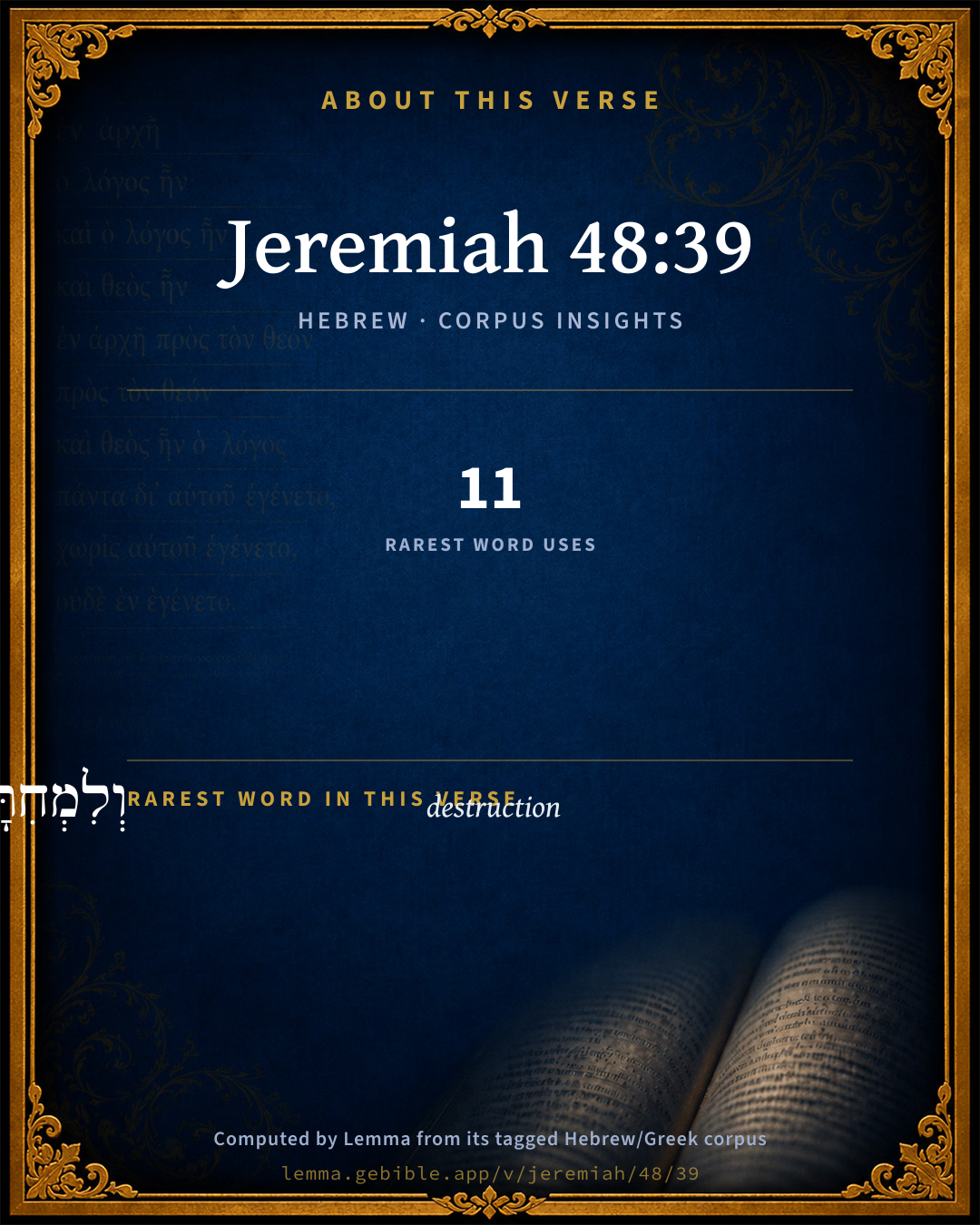
The rarest word here is וְלִמְחִתָּ֖ה destruction H4288 — appearing just 11 times in the whole Hebrew Bible.

Shared distinctive vocabulary

וְלִמְחִתָּ֖ה destruction H4288 occurs in 11 verses of the Hebrew Bible. Also found in:

Grammatical profile

  • 5 verbs
  • 7 nouns
  • 2 particles

Verb forms

  • חַ֨תָּה֙ Qal · Perfect
  • הֵילִ֔ילוּ Hiphil · Perfect
  • הִפְנָה Hiphil · Perfect
  • בּ֑וֹשׁ Qal · Infinitive Construct
  • וְהָיָ֥ה Qal · Sequential Perfect

Repetition

Words recur within this verse — often emphatic in Hebrew:

  • אֵ֥יךְ how H349 ×2
  • מוֹאָ֖ב Moab H4124 ×2

Cross-references

9

Topical passages linked to Jeremiah 48:39 in the Treasury of Scripture Knowledge — connected by theme and wording, ordered by reader-vote popularity; previews shown in the World English Bible.

  • Isaiah 20:4–6 so shall the king of Assyria lead away the captives of Egypt, and the exiles of Ethiopia, young and old, naked and barefoot, and with buttocks uncovered, to the shame of Egypt.
  • Jeremiah 48:17 All you who are round about him, bemoan him, and all you who know his name; say, How is the strong staff broken, the beautiful rod!
  • Jeremiah 48:26–27 Make you him drunken; for he magnified himself against Yahweh: and Moab shall wallow in his vomit, and he also shall be in derision.
  • Lamentations 1:1 How does the city sit solitary, that was full of people! She has become as a widow, who was great among the nations! She who was a princess among the provinces is become tributary!
  • Lamentations 2:1 How has the Lord covered the daughter of Zion with a cloud in his anger! He has cast down from heaven to the earth the beauty of Israel, And hasn't remembered his footstool in the day of his anger.
  • Lamentations 4:1 How is the gold become dim! [how] is the most pure gold changed! The stones of the sanctuary are poured out at the head of every street.
  • Ezekiel 26:16–18 Then all the princes of the sea shall come down from their thrones, and lay aside their robes, and strip off their embroidered garments: they shall clothe themselves with trembling; they shall sit on the ground, and shall tremble every moment, and be astonished at you.
  • Revelation 18:9–10 The kings of the earth, who committed sexual immorality and lived wantonly with her, will weep and wail over her, when they look at the smoke of her burning,
  • Revelation 18:15–16 The merchants of these things, who were made rich by her, will stand far away for the fear of her torment, weeping and mourning;

Cross-references courtesy of OpenBible.info (CC BY 4.0).

Hebrew and Greek witnesses Masoretic Hebrew ↔ Greek Septuagint

The same verse in the two great witnesses to the Old Testament, shown verse-for-verse.

These are two independent witnesses, not word-aligned to each other, and the Septuagint is shown in lemma (dictionary) form.

Hebrew Jeremiah 48:39 Masoretic · Westminster Leningrad Codex

אֵ֥יךְ חַ֨תָּה֙ הֵילִ֔ילוּ אֵ֛יךְ הִפְנָה עֹ֥רֶף מוֹאָ֖ב בּ֑וֹשׁ וְהָיָ֥ה מוֹאָ֛ב לִשְׂחֹ֥ק וְלִמְחִתָּ֖ה לְכָל סְבִיבָֽיו

How is it broken down! [how] do they wail! how has Moab turned the back with shame! so shall Moab become a derision and a terror to all who are round about him.

World English Bible · Public Domain

Greek LXX Structure differs

In the Septuagint, Jeremiah is about an eighth shorter than the Hebrew and arranges its material differently — the Oracles Against the Nations (Hebrew chapters 46–51) appear in the middle of the Greek book, after 25:13. Because the chapter and verse boundaries do not line up, a verse-for-verse comparison with the Hebrew is not shown.

A verse-for-verse comparison isn’t shown here because the chapters and verses don’t line up. Switch to the LXX edition with the MT / LXX toggle above to read the Greek directly.

On this verse, Haydock's Catholic Bible Commentary discusses the Septuagint’s reading. Read the note in Commentary ↓

Hebrew: Westminster Leningrad Codex (CC BY 4.0). Greek: Septuagint (public domain); English from a public-domain English Septuagint. How the Septuagint differs from the Hebrew →

Targum (Aramaic paraphrase)

1

The Targum is the ancient Jewish Aramaic paraphrase of the Hebrew Scriptures — an interpretive translation, not the Hebrew text itself. Onkelos (literal) and Pseudo-Jonathan (expansive) render the Torah, and Jonathan the Prophets. Coverage is partial: where no permissively-licensed English translation exists for a verse, only the Aramaic is shown. This is verse-level text, not a word-by-word alignment to the Hebrew.

  1. Targum Jonathan Prophets (Joshua–Malachi)
    אֵיכְדֵין אִתְּבָרוּ אַיְלִילוּ אֵיכְדֵין אַחְזָרוּ קְדִלְהוֹן מוֹאֲבָאֵי בְּהִיתוּ וִיהוֹן מוֹאֲבָאֵי לְחוֹךְ וְלִתְבִיר לְכָל סָחֳרָנֵיהוֹן:

    (no public-domain English translation for this verse)

    Targum Jonathan — Aramaic: “Mikraot Gedolot” (public domain). English: “Sefaria Community Translation” (CC0 1.0 (public-domain dedication)); “London "Chaldee Paraphrase," 1871” (public domain). Text via Sefaria.

Commentary

Notes on Jeremiah 48:39 from classic Christian and Jewish commentators (each source and its license shown beneath its notes). The classic Christian expositions comment on the surrounding passage and are grouped to its opening verse, so a note may address several verses; the Jewish commentaries on the Tanakh (Rashi and others) are per-verse, so they appear only where the commentator wrote on this verse.

Lemma curates 59 commentaries, every one of them public domain or Creative Commons licensed, each selected and text-cleaned for this edition rather than reprinted as found. About our sources →

Trapp's Complete Commentary

John Trapp

Jer 48:39 They shall howl, [saying], How is it broken down! how hath Moab turned the back with shame! so shall Moab be a derision and a dismaying to all them about him.

Ver. 39. How hath Moab turned the back with shame?] Heb., Neck.

“ Submisit tristi colla superba iugo. ”

John Trapp, A Commentary or Exposition upon All the Books of the Old and New Testament (1647–1656) — public domain. Text from a community e-Sword module.

Keil & Delitzsch

C. F. Keil & F. Delitzsch

No escape from destruction. - Jer 48:39. "How it is broken! they howl. How hath Moab turned the back, for shame! And Moab becomes a laughing-stock and a terror to all his neighbours. Jer 48:40. For thus saith Jahveh: Behold, he shall fly like the eagle, and spread his wings over Moab. Jer 48:41. Kerioth is taken, and the strongholds are seized, and the heart of the heroes of Moab on that day become like the heart of a travailing woman. Jer 48:42. And Moab is destroyed from being a people, because he hath boasted against Jahveh. Jer 48:43. Fear, and a pit, and a snare, are against thee, O inhabitants of Moab, saith Jahveh. Jer 48:44. He who flees from the fear shall fall into the pit, and he who goes up out of the pit shall be taken in the snare; for I will bring against it, against Moab, the year of their recompense, saith Jahveh."

The subject of חתּה in Jer 48:39 is Moab viewed as a nation. הילילוּ might be imperative, but in this case we would be obliged to take בּושׁ also as an imperative (as Hitzig and Graf do). It is simpler to take both forms as perfects: "they howl...Moab turns the back, is ashamed" (= for shame). On היה לשׂחק, cf. Jer 48:26. מחתּה, object of terror, as in Jer 17:17. "All who are round about him," as in Jer 48:17. "For (Jer 48:40) the enemy rushes down upon Moab like an eagle, and seizes Kerioth and all his strongholds." The subject is left unnamed, as in Jer 46:18, but it is Nebuchadnezzar. The figure of the eagle, darting down in flight on its prey, is founded on Deu 28:49 (on אל- for על, cf. Jer 49:22). Kerioth, the capital, is taken (see on Jer 48:24); so are the other strongholds or fastnesses of the country. The mere fact that קריּות has the article does not justify any one in taking it as an appellative, "the cities;" this appears from a comparison of Amo 2:2 with this verse. No plural of קריה occurs anywhere. Then the fear of death falls on the heroes of Moab like a woman in labour. מצרה, partic. Hiphil from צרר, uterum comprimens, is found only here and in Jer 49:22, where the figure is repeated. Moab is annihilated, so that it is no longer a nation (cf. Jer 48:2), because it has risen up in pride against the God of Israel; cf. Jer 48:26. He who flees from one danger falls into the other. The play on the words פּחד, fear, horror, פּחת, pit, and פּח, spring-trap, as well as the mode in which it is carried out, is taken from Isa 24:17., - a prophecy of the judgment on the world; see a similar idea presented in Amo 5:19, but somewhat differently expressed. The Kethib הניס, perfect Hiphil, "he flees," is less suitable than the Qeri הנּס (after Isaiah). The last clause, "for I will bring," etc., is quite in Jeremiah's peculiar style; cf. Jer 4:23; Jer 23:12. אליה belongs to אל־מואב: the noun is anticipated by the pronoun, as frequently occurs; cf. Jer 9:14; Jer 41:3; Jer 43:11.

Keil & Delitzsch — Biblical Commentary on the Old Testament (1861–1891) — public domain (CC PDM 1.0). Text via the HelloAO Bible API. (Old Testament only.)

Tyndale Open Study Notes

Tyndale Open Resources

48:39 The Lord’s judgment of Moab would cause nearby countries to realize that the same kind of ruin might be their punishment.

Tyndale Open Study Notes — © Tyndale Open Resources, licensed CC BY-SA 4.0. Text via the HelloAO Bible API.

Jamieson, Fausset & Brown

Robert Jamieson, A. R. Fausset & David Brown

it--Moab.

How . . . how--prodigious, yet sure to happen.

turned the back--not daring to show her face.

derision . . . dismaying to all--a derision to some; a dismaying to others in beholding such a judgment of God, fearing a like fate for themselves.

Jamieson, Fausset & Brown — Commentary Critical and Explanatory on the Whole Bible (1871) — public domain (CC PDM 1.0). Text via the HelloAO Bible API.

John Calvin's Commentaries

The Prophet still speaks in the person of others, and according to their feelings and not his own. He then says, that howling, they would say, through wonder, How is it that Moab has been so broken, that all had turned their backs, that Moab had become ashamed? He indirectly intimates, that though no one could then know God’s judgment, which he now foretells, yet God would by the event prove that he had said nothing but in earnest. This wonder then was expressed for this purpose, that the Jews might know, that though the calamity of Moab would fill all with astonishment, and make them cry out as respecting an extraordinary thing, “What can this mean?” yet the fulfillment of his prophecy would be certain.

This is the meaning of the words when he says, Howling, they will cry out, How has Moab been broken? and how has he turned his neck, or as they say, his back? Moab is ashamed; and then, he is made a derision, which we have observed before. He adds, a terror, though some read, “a bruising;” but more suitable is fear or terror. For the Prophet means, that Moab would be to others a derision, and that he would be to others a dread, being an example of God’s awful judgment. And he says that he would be a terror to all around, that is, to the whole surrounding country, as well as a laughter and a derision. It follows, —

John Calvin's Commentaries (1540-1563) — public domain. Text from the Calvin Translation Society English edition (1840s-50s) via the Christian Classics Ethereal Library (ccel.org). Calvin's coverage is partial (roughly two-thirds of the Bible); uncommented books and verses are honest gaps, never fabricated. The 19th-century editor's footnotes and remarks are omitted so the notes are faithfully Calvin's own voice.

Ellicott's Commentary for English Readers

(39) They shall howl, saying, How is it broken down!—Better, taking the words in the Hebrew order, How is she broken down! How do they howl! In the word “derision” we have the emphatic iteration of the term that had been pointedly used in Jer_48:26; Jer_48:2. At this stage the parallelism with Isaiah 15, 16 ceases, and the prediction has a more independent character.

A Bible Commentary for English Readers, edited by Charles John Ellicott (1878–1897) — public domain. Text from a community e-Sword module.

The Cambridge Bible for Schools and Colleges

gen. ed. J. J. S. Perowne

39. broken down] See on Jer_48:1.

The Cambridge Bible for Schools and Colleges (gen. ed. J. J. S. Perowne; Cambridge University Press, 1878–1918) — public domain. Text from a community e-Sword module.

John Gill's Exposition

For thus saith the Lord, behold, he shall fly as an eagle,.... The enemy, Nebuchadnezzar king of Babylon, with his army; who is compared to an eagle for his strength, swiftness, and greediness after the prey:

and shall spread his wings over Moab; as an eagle spreads its wings, which are very large, over the little birds it seizes upon as its prey; so the king of Babylon would bring a numerous army against Moab, and spread it over his country. The Targum is,

"behold, as all eagle which flies, so a king shall come up with his army, and encamp against Moab.''

John Gill's Exposition of the Whole Bible (1746–1763) — public domain (CC PDM 1.0). Text via the HelloAO Bible API.

Albert Barnes' Notes on the Bible

Literally, “How is it broken down! they wail! How hath Moab tutored the back in shame! Yea, Moab is become a laughter and a terror Jer 17:17 to all who are round about him.”

Albert Barnes' Notes on the Bible (1834–1885) — public domain. Text from a community e-Sword/MySword module.

Haydock's Catholic Bible Commentary

Bowed. Septuagint and Chaldean, "turned his back."

George Leo Haydock (1774–1849), Haydock's Catholic Family Bible and Commentary, 1859 edition — public domain. Excludes Psalms (Douay-Rheims chapter numbering differs from Protestant) and Deuterocanonical books (Catholic canon only).

Matthew Poole's English Annotations

Those that formerly lived in Moab, when it was in its glory, shall lament to see how the case is altered with it, that all its glory is broken down, and they that were wont to conquer their enemies turn their backs with shame upon their enemies. And Moab, that was wont to be the praise and admiration of all people, was become an astonishment, and an object of derision and scoffing to them.

Matthew Poole's English Annotations on the Holy Bible (1683–1685) — public domain. Text from a community e-Sword/MySword module.

The Pulpit Commentary

They shall howl, saying etc.; rather, How is it dismayed! (how) they wail! How hath Moab turned the back ashamed! Yea, Moab becometh, etc.

The Pulpit Commentary (1880–1919), ed. H.D.M. Spence-Jones & Joseph S. Exell — public domain. Text from a community e-Sword module.

Rashi

Rabbi Shlomo Yitzchaki (Rashi)

Wail, “How was she dismayed?” Wail about her and say, “How was she dismayed?”

Rashi on the Tanakh — English translations: “The Judaica Press complete Tanach with Rashi, translated by A. J. Rosenberg” (CC BY 4.0); “Pentateuch with Rashi's commentary by M. Rosenbaum and A.M. Silbermann, 1929-1934” (public domain); “The Metsudah Tanach series, Lakewood, N.J” (CC BY 4.0); and “The Book of Joshua, Metsudah Publications, 1997” (CC BY 4.0). Text via Sefaria.

Lesson kit

Teaching starters — assembled from the data on this page, not authored interpretation. Every prompt links to the verse data it draws on. Edit before teaching.

Jeremiah, in the Prophets, opens this verse with 14 words (12 distinct Hebrew lemmas). Its most distinctive word is mᵉchittâh (“destruction”). A historical commentator’s framing appears above. Read the whole chapter for the surrounding context.

Discussion questions

  1. The word mᵉchittâh carries the sense “destruction.” How does it shape the verse?
  2. How does Psalms 89:40, which shares the word «destruction», read alongside this verse?
  3. What does the repetition of “how” (2× in this one verse) do in this verse?
  4. These translations render this verse differently. What is at stake in choosing one wording over another?
  5. «חַ֨תָּה֙» is a Qal Perfect verb. How does that grammatical form shape the action described?
  6. Compare how Trapp's Complete Commentary and Keil & Delitzsch read this verse. Where do they agree or differ?

Things to notice

Reading settings

Reading text

Shown beneath each verse's original-language words.

Old Testament
Old Testament edition

Read the OT as the Masoretic Hebrew (MT) or the Greek Septuagint (LXX).

English shown for the Greek Septuagint (in the Hebrew ↔ Greek comparison).

Comparing translations? Open the Compare panel on any verse page to stack up to four side by side.