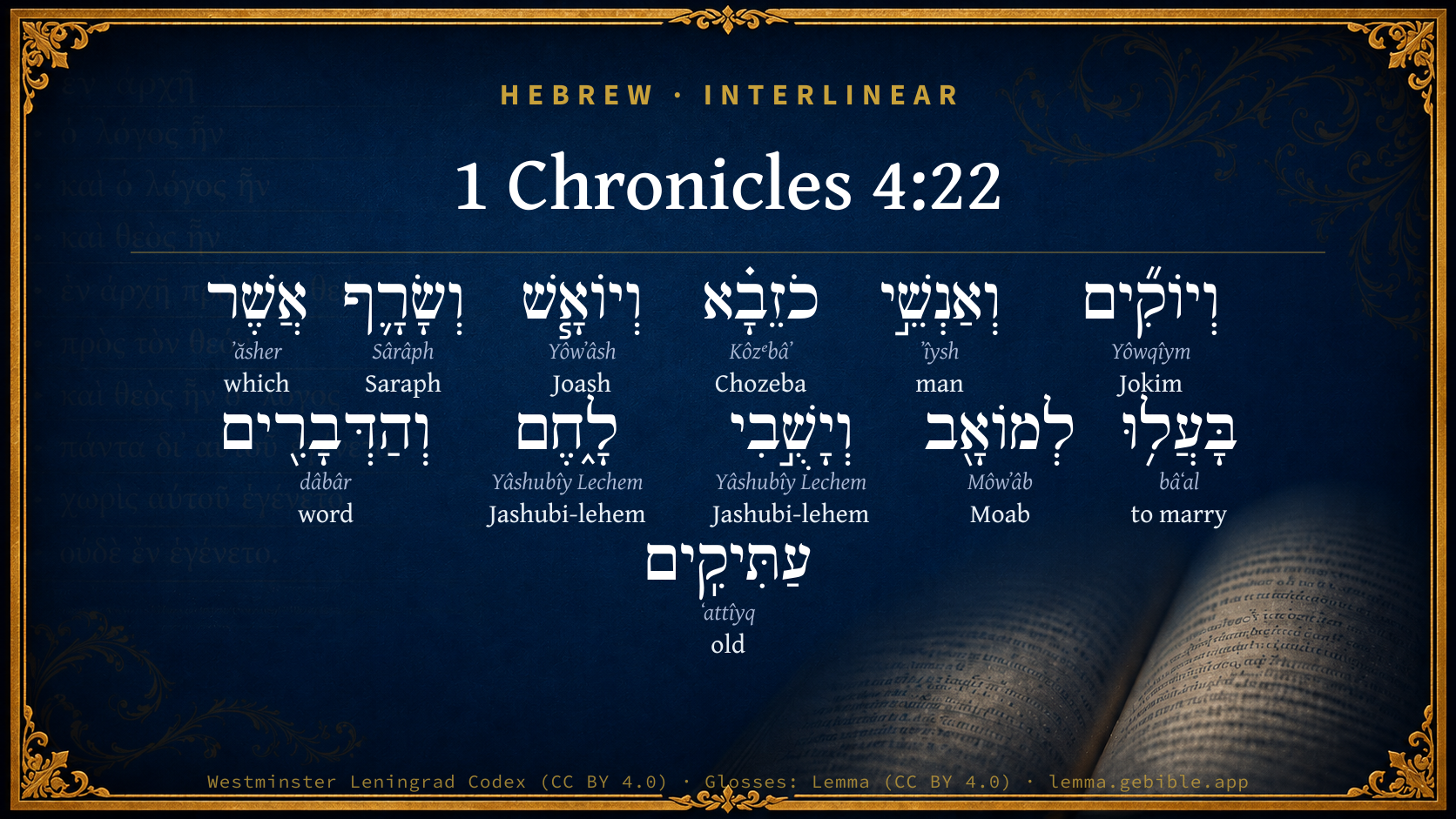
1 Chronicles 4:22

Hebrew (Westminster Leningrad Codex) 1 Chronicles 4:22 appears in the Hebrew Old Testament. The text above is from the Westminster Leningrad Codex. Each word links to its Strong’s number, a concise gloss, and parsing drawn from the Open Scriptures Hebrew Bible morphology. Click any word for its full Brown-Driver-Briggs (BDB) entry.
Download image
Cite this verse

1 Chronicles 4:22 (World English Bible). Public Domain. Lemma interlinear Bible study tool, https://lemma.gebible.app/v/1-chronicles/4/22.

Show BibTeX & RIS
BibTeX
RIS
English Translation
and Jokim, and the men of Cozeba, and Joash, and Saraph, who had dominion in Moab, and Jashubilehem. The records are ancient.
World English Bible · Public Domain
Highlights
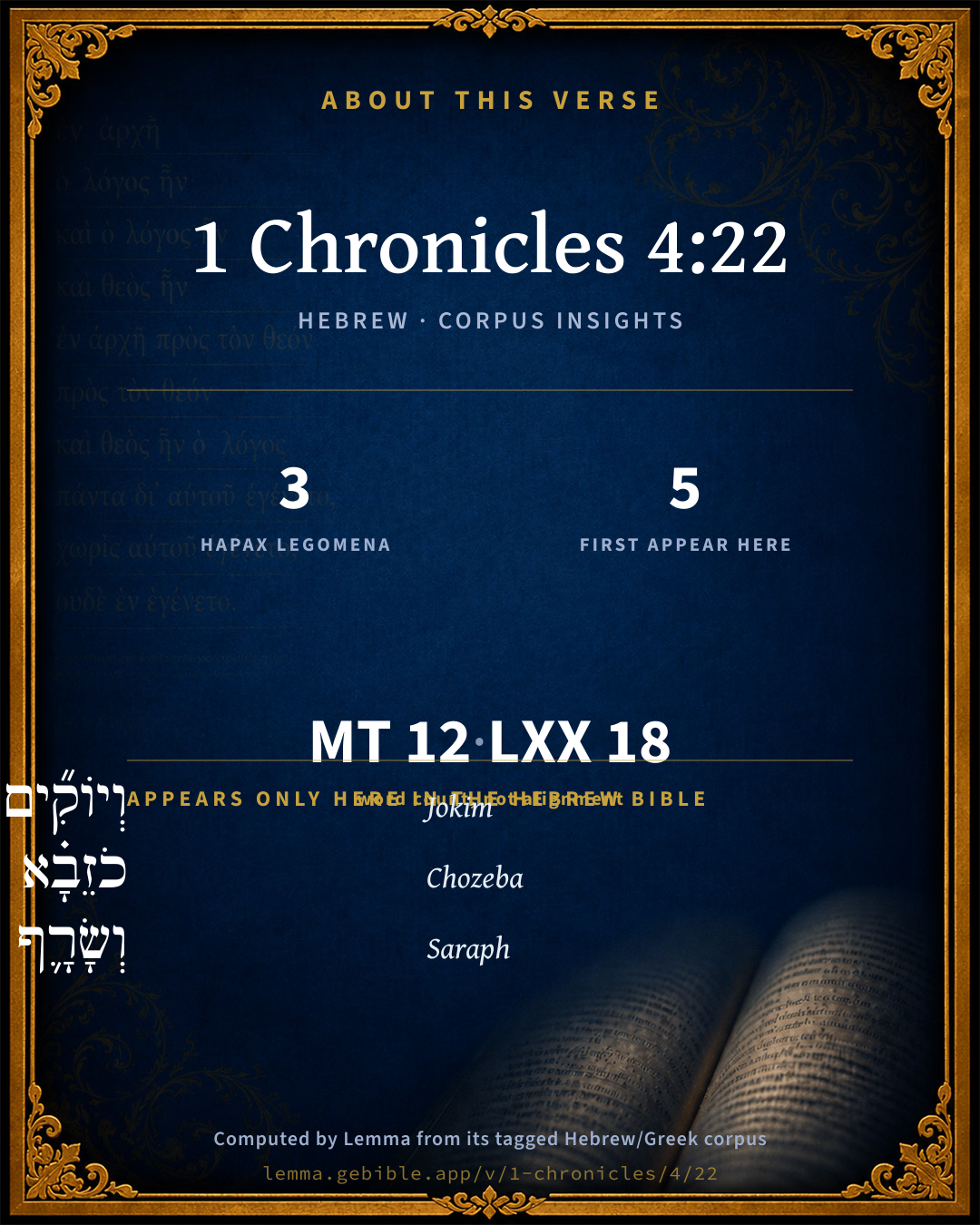
  • 3 hapax legomena — only here in the Hebrew Bible
  • 5 first appearances in the Hebrew Bible
Full analysis ↓
Download a study sheet

One document with this verse’s original text, its word-by-word gloss line, the meaning frame, cross-references with their text, attributed commentary, and full source and license credits — printable, and it pastes into notes with its structure intact.

This verse Autodidact and up

Study sheet (.html) Plain text (.txt)

A passage Seminary Student

Up to 50 verses in one chapter. A passage sheet keeps up to 6 commentary sources and 12 cross-references per verse, in the order this page ranks them, and says so on the sheet whenever that leaves anything out. Ask for a single verse and you get the Autodidact verse sheet above.

Everything on this page stays free to read, with no account — the sheet is a download of what is already on screen, not access to it.

Want to remove ads? Support Godless Engineer
Compare translations 3

The same verse in 3 English versions, stacked beneath the original-language interlinear above. Click any original word for its lexicon entry.

Each is an independent rendering of the whole verse — the interlinear is not word-aligned to these translations.

Highlighted words mark where these versions differ — a whole-verse word diff, not a word-by-word alignment.

  • World English Bible Public Domain
    and Jokim, and the men of Cozeba, and Joash, and Saraph, who had dominion in Moab, and Jashubilehem. The records are ancient.
  • King James Version Public Domain
    And Jokim, and the men of Chozeba, and Joash, and Saraph, who had the dominion in Moab, and Jashubilehem. And these are ancient things.
  • unfoldingWord Literal Text CC BY-SA 4.0
    and Jokim and the men of Cozeba and Joash and Saraph, who ruled in Moab and Jashubi Lehem. And the words ancient.

unfoldingWord Literal Text — © unfoldingWord, licensed CC BY-SA 4.0. Word-aligned USFM3 via Door43 (git.door43.org/unfoldingWord/en_ult).

Versions to compare (up to 4)

3 of 4 selected

Show all 18 translations

Every available English version of this verse, each an independent rendering of the whole verse.

  • World English Bible Public Domain
    and Jokim, and the men of Cozeba, and Joash, and Saraph, who had dominion in Moab, and Jashubilehem. The records are ancient.
  • Berean Standard Bible Public Domain
    Jokim, the men of Cozeba, and Joash and Saraph, who ruled in Moab and Jashubi-lehem. (These names are from ancient records.)
  • Majority Standard Bible Public Domain
    Jokim, the men of Cozeba, and Joash and Saraph, who ruled in Moab and Jashubi-lehem. (These names are from ancient records.)
  • King James Version Public Domain
    And Jokim, and the men of Chozeba, and Joash, and Saraph, who had the dominion in Moab, and Jashubilehem. And these are ancient things.
  • American Standard Version (1901) Public Domain
    and Jokim, and the men of Cozeba, and Joash, and Saraph, who had dominion in Moab, and Jashubilehem. And the records are ancient.
  • Revised Version (1885) Public Domain
    and Jokim, and the men of Cozeba, and Joash, and Saraph, who had dominion in Moab, and Jashubi-lehem. And the records are ancient.
  • Geneva Bible (1599) Public Domain
    And Iokim and the men of Chozeba and Ioash, and Saraph, which had the dominion in Moab, and Iashubi Lehem. These also are auncient things.
  • Douay-Rheims (1899) Public Domain
    And he that made the sun to stand, and the men of Lying, and Secure, and Burning, who were princes in Moab, and who returned into Lahem. Now these are things of old.
  • Young's Literal Translation Public Domain
    and Jokim, and the men of Chozeba, and Joash, and Saraph, who ruled over Moab and Jashubi-Lehem; and these things `are' ancient.
  • Literal Standard Version CC BY-SA 4.0
    and Jokim, and the men of Chozeba, and Joash, and Saraph, who ruled over Moab and Jashubi-Lehem; and these things [are] ancient.
  • Unlocked Literal Bible CC BY-SA 4.0
    Jokim, the men of Kozeba, and Joash and Saraph, who ruled in Moab and Jashubi Lehem. (This information is from ancient records.)
  • unfoldingWord Literal Text CC BY-SA 4.0
    and Jokim and the men of Cozeba and Joash and Saraph, who ruled in Moab and Jashubi Lehem. And the words ancient.
  • Darby Bible Public Domain
    and Jokim, and the men of Chozeba, and Joash, and Saraph, who ruled over Moab, and Jashubi-lehem. And these are ancient things.
  • World Messianic Bible Public Domain
    and Jokim, and the men of Cozeba, and Joash, and Saraph, who had dominion in Moab, and Jashubilehem. These records are ancient.
  • Webster's Bible Public Domain
    And Jokim, and the men of Chozeba, and Joash, and Saraph, who had the dominion in Moab, and Jashubi-lehem. And these are ancient things.
  • Free Bible Version CC BY-SA 4.0
    Jokim, the men of Cozeba, and Joash and Saraph, who ruled over Moab and Jashubi Lehem. (These are old records.)
  • Bible in Basic English Public Domain
    And Jokim, and the men of Cozeba, and Joash and Saraph, who were rulers in Moab, and went back to Beth-lehem. And the records are very old.
  • JPS Tanakh (1917) Public Domain
    and Jokim, and the men of Cozeba, and Joash, and Saraph, who had dominion in Moab, and Jashubi-lehem. And the records are ancient.

Literal Standard Version (2020), Covenant Press — licensed CC BY-SA 4.0. Text via the HelloAO Bible API (eBible.org). Unlocked Literal Bible (unfoldingWord) — licensed CC BY-SA 4.0. Text via the HelloAO Bible API (eBible.org). unfoldingWord Literal Text — © unfoldingWord, licensed CC BY-SA 4.0. Word-aligned USFM3 via Door43 (git.door43.org/unfoldingWord/en_ult). Free Bible Version, Dr. Jonathan Gallagher — licensed CC BY-SA 4.0. Text via the HelloAO Bible API (eBible.org).

Word by word

More ways to search: Search by grammar → Find every occurrence → Compare this word →

Practice this passage: Drill this verse → Learn its vocabulary →

וְיוֹקִ֞ים
Yôwqîym
H3137
“and · Jokim”
Conjunction + Noun, Proper
Part of Speech
Conjunction + Noun
Type
Proper
Full BDB Definition

Origin: a form of H3113 , cf. H3079

TWOT: None

Jokim = "Jehovah raises up" - a descendant of Judah
  1. וְאַנְשֵׁ֣י ʼîysh H376 “and · men of” Conjunction + Noun, Common, Masculine, Plural, Construct
  2. כֹזֵבָ֗א Kôzᵉbâʼ H3578 “Chozeba” Noun, Proper
  3. וְיוֹאָ֧שׁ Yôwʼâsh H3101 “and · Joash” Conjunction + Noun, Proper
  4. וְשָׂרָ֛ף Sârâph H8315 “and · Saraph” Conjunction + Noun, Proper
  5. אֲשֶׁר ʼăsher H834 “which” Particle, Relative
  6. בָּעֲל֥וּ bâʻal H1166 “to marry” Verb, Qal, Perfect, 3rd Person, Common, Plural
  7. לְמוֹאָ֖ב Môwʼâb H4124 “to/for · Moab” Preposition + Noun, Proper
  8. וְיָשֻׁ֣בִי Yâshubîy Lechem H3433 “and · Jashubi-lehem” Conjunction + Noun, Proper
  9. לָ֑חֶם Yâshubîy Lechem H3433 “Jashubi-lehem” Noun, Proper
  10. וְהַדְּבָרִ֖ים dâbâr H1697 “and · the · words” Conjunction + Particle, Definite Article + Noun, Common, Masculine, Plural, Absolute
  11. עַתִּיקִֽים ʻattîyq H6267 “old” Adjective, Adjective, Masculine, Plural, Absolute

About this verse

These counts appear in no published source. They are computed here, from the morphology-tagged text and Lemma’s own curated glosses. What Lemma adds →

12
words
11
distinct lemmas
Historical
section

Notable vocabulary

3 hapax legomena — words that appear only here in the entire Hebrew Bible:

  • וְיוֹקִ֞ים Jokim H3137
  • כֹזֵבָ֗א Chozeba H3578
  • וְשָׂרָ֛ף Saraph H8315

First appearance in Scripture

These words make their first canonical appearance in the Hebrew Bible here:

  • וְיוֹקִ֞ים Jokim H3137
  • כֹזֵבָ֗א Chozeba H3578
  • וְשָׂרָ֛ף Saraph H8315
  • וְיָשֻׁ֣בִי Jashubi-lehem H3433
  • עַתִּיקִֽים old H6267

Grammatical profile

  • 1 verb
  • 9 nouns
  • 1 adjective
  • 1 particle

Verb forms

  • בָּעֲל֥וּ Qal · Perfect

Repetition

A word recurs within this verse — often emphatic in Hebrew:

  • וְיָשֻׁ֣בִי Jashubi-lehem H3433 ×2

Hebrew & Septuagint length

In English translation the verse runs 22 words from the Hebrew and 24 from the Septuagint (LXX English) — closely comparable.

A rough comparison of the two English renderings, which tokenize alike — not a word-level alignment.

Word counts can differ between the Hebrew and the Greek without any difference in meaning — e.g. the Hebrew direct-object marker אֵת has no separate Greek word, and Greek often adds the article ὁ.

In the original languages it is 12 Hebrew tokens and 18 Greek tokens — but the two are counted differently (Hebrew bundles its prefixes and suffixes into one token; the Greek is in lemma form), so that isn’t a like-for-like length.

Hebrew and Greek witnesses Masoretic Hebrew ↔ Greek Septuagint

The same verse in the two great witnesses to the Old Testament, shown verse-for-verse.

These are two independent witnesses, not word-aligned to each other, and the Septuagint is shown in lemma (dictionary) form.

Hebrew 1 Chronicles 4:22 Masoretic · Westminster Leningrad Codex

וְיוֹקִ֞ים וְאַנְשֵׁ֣י כֹזֵבָ֗א וְיוֹאָ֧שׁ וְשָׂרָ֛ף אֲשֶׁר בָּעֲל֥וּ לְמוֹאָ֖ב וְיָשֻׁ֣בִי לָ֑חֶם וְהַדְּבָרִ֖ים עַתִּיקִֽים

and Jokim, and the men of Cozeba, and Joash, and Saraph, who had dominion in Moab, and Jashubilehem. The records are ancient.

World English Bible · Public Domain

Greek LXX 1 Chronicles 4:22 Septuagint · lemma form

καί ιωακιμ καί ἀνήρ χωζηβα καί ιωας καί σαραφ ὅς καταοἰκέω ἐν μωαβ καί ἀποστρέφω αὐτός αβεδηριν αθουκιιν

And Joakim, and the men of Chozeba, and Joas, and Saraph, who lived in Moab, and he changed their names to Abederin and Athukiim.

LXX2012 (modern English Septuagint) · Public Domain

On this verse, Haydock's Catholic Bible Commentary discusses the Septuagint’s reading. Read the note in Commentary ↓

Hebrew: Westminster Leningrad Codex (CC BY 4.0). Greek: Septuagint (public domain); English from LXX2012 (modern English Septuagint) (Public Domain). How the Septuagint differs from the Hebrew →

Commentary

Notes on 1 Chronicles 4:22 from classic Christian and Jewish commentators (each source and its license shown beneath its notes). The classic Christian expositions comment on the surrounding passage and are grouped to its opening verse, so a note may address several verses; the Jewish commentaries on the Tanakh (Rashi and others) are per-verse, so they appear only where the commentator wrote on this verse.

Lemma curates 59 commentaries, every one of them public domain or Creative Commons licensed, each selected and text-cleaned for this edition rather than reprinted as found. About our sources →

Trapp's Complete Commentary

John Trapp

1Ch 4:22 And Jokim, and the men of Chozeba, and Joash, and Saraph, who had the dominion in Moab, and Jashubilehem. And [these are] ancient things.

Ver. 22. Who had the dominion in Moab.] Ruled as viceroys under the kings of Judah, who had subdued Moab.

And these are ancient things.] Old and obsolete, Vatablus rendereth it. Ista nomina sunt virorum veterum, these are the names of such as lived long since. Haec sunt nomina prisca priscorum heroum: A Lapide. Thus writeth Ezra; who yet lived before that Socrates taught in Athens, and before any chronicles of the world now extant in the world. Such is the antiquity of holy writ.

John Trapp, A Commentary or Exposition upon All the Books of the Old and New Testament (1647–1656) — public domain. Text from a community e-Sword module.

The Biblical Illustrator

Joseph S. Exell

1Ch_4:22

And these are ancient things.

Ancient things

The ancient is no use except it be also modern. This is the true test of antiquity. Things are not valuable simply because they are ancient; they may be ancient and dead. We have nothing to do with that kind of antiquity--it is the antiquity of mythology, not of history.

1. All the greatest things are ancient. All you can do is to modernise their form. The telegraph is older than the garden of Eden--not under that name: nothing new has been invented, except combination, adaptation; all the elements and factors are as old as God.

2. Where usefulness is proved antiquity becomes an argument and an illustration. This is the true root and the true use of history. Where usefulness has not been proved, to refer to antiquity is to invoke the sophistical assistance of superstition. We must insist on living usefulness. We must not prop up tottering walls because the copestones are covered with grey moss. This doctrine of the usefulness of antiquity must be applied ruthlessly:

(1) To churches.

(2) To men. Many men would like to live upon their reputation. It is poor living. You cannot live upon your old prayers; it is the prayer of this morning that fed your soul. Not the feast you had in childhood, but the bread you brake this very dawn is sustaining your frame.

(3) To the Bible. Would you burn the Bible? Yes, if it has been superseded, if it has proved itself to be useless, if it can no longer direct men to God, if it has ceased to be the messenger of salvation; but if it contain the living God, it it reveal the living Saviour and breathe the eternal Holy Ghost, then it is not ancient in any sense of obsoleteness, it is ancient in the sense of eternity.

3. Antiquity without Christianity dies. Any civilisation that has not in it the living spirit, the living God, dies. What is the proof? History is the elucidation and history is the evidence. Civilisation will be of no use to you when you lose the risen Christ. Non-spiritual civilisation is useless. Look at China--aa infinite death--the hermit of the globe--a living extinction. China was printing from type five hundred years before Caxton was born; she had the mariners compass before England was a nation. There was a time when our forefathers were clothed in sheepskins, when they dyed and painted their whole bodies; and at that time the Chinese were blasting their rocks with gunpowder. Before Daniel saw his visions China had a constitutional government. Then what makes China, this great cipher of the globe, a burden to civilisation? Because its civilisation is only ancient; she has not the Cross. Without that all things tend to decay. Greek--Roman--European civilisation have all gone down in the proportion in which they were not vitally connected with the Cross. (J. Parker, D. D.)

The Biblical Illustrator, edited by Joseph S. Exell (c. 1880s–1900s) — public domain. Text from a community e-Sword module.

Joseph Benson's Commentary

1Ch 4:22-23. Who had the dominion in Moab — Which they ruled in the name and for the use of the kings of Judah, to whom Moab was subject from David’s time. Ancient things — The sense is, those blessed times are long since past. Our ancestors had the dominion over the heathen, but their degenerate posterity are slaves in Chaldea, where they are employed as potters or gardeners, or in other servile works These were — Or, rather, these are the potters, &c. — For he seems to oppose their present servitude to their former glory, and to show how low and mean they were in spirit, in that they would rather tarry among the heathen to do their drudgery than return to Jerusalem to serve God, and enjoy their freedom. There they dwelt — Or, rather, now dwell, when their brethren are returned: for Ezra seems to have written this, after leave was given by Cyrus for the return of the Jews. With the king for his work — The king of Persia, esteeming it a greater honour and happiness to serve that earthly monarch in the meanest employments, than the King of kings in his temple, and in his most noble and heavenly work.

Joseph Benson's Commentary on the Old and New Testaments (1811–1818) — public domain. Text from a community e-Sword module.

Geneva Bible (1599)

Geneva Bible translators

Or, of the inhabitants of Lehem.

Geneva Bible (1599) marginal notes — public domain. Text via Bolls.life.

Jamieson, Fausset & Brown

Robert Jamieson, A. R. Fausset & David Brown

had the dominion in Moab, and Jashubi-lehem--"And these are ancient things" seems a strange rendering of a proper name; and, besides, it conveys a meaning that has no bearing on the record. The following improved translation has been suggested: "Sojourned in Moab, but returned to Beth-lehem and Adaberim-athekim. These and the inhabitants of Netaim and Gedera were potters employed by the king in his own work." Gedera or Gederoth, and Netaim, belonged to the tribe of Judah, and lay on the southeast border of the Philistines' territory (Jos 15:36; Ch2 28:18).

Jamieson, Fausset & Brown — Commentary Critical and Explanatory on the Whole Bible (1871) — public domain (CC PDM 1.0). Text via the HelloAO Bible API.

Adam Clarke's Commentary

Verse 22. And Joash, and Saraph] "And the prophets and scribes which sprang from the seed of Joshua, and the Gibeonites, whose office it was to serve in the house of the sanctuary, because they had lied to the princes of Israel; also Joash, who is the same as Mahlon; and Saraph, who is the same as Chilion, who took wives of the daughters of Moab and Boaz, the chief of the wise men of the college of Bethlehem, and of those who existed in former days." - T.

Adam Clarke's Commentary on the Bible (1810–1826) — public domain. Text from a community e-Sword/MySword module.

The Cambridge Bible for Schools and Colleges

gen. ed. J. J. S. Perowne

22. and Joash, and Saraph, who etc.] Targ. “and Joash who is Mahlon and Seraph who is Chilion who took wives of the daughters of Moab” (cp. Rth_1:2; Rth_1:4). There is little to be said for the identification, which rests on the fact that the Hebrew word for had dominion might be translated married. We find no other trace of these two as rulers of Moab.

and Jashubi-lehem] Vulg. who returned to Bethlehem, a translation which requires only an easy emendation of the present Hebrew text. Mahlon and Chilion did not return. Joash and Saraph may have retired to Moab either (like Mahlon and Chilion) because of a famine, or to escape foreign oppression, e.g. that of the Chaldeans, married wives there, and subsequently returned to their own country.

these are ancient things] R.V. the records are ancient.

The Cambridge Bible for Schools and Colleges (gen. ed. J. J. S. Perowne; Cambridge University Press, 1878–1918) — public domain. Text from a community e-Sword module.

John Gill's Exposition

And Jokim,.... The Vulgate Latin version is:

and he that made the sun to stand: as if Joshua was meant; and in the Talmud it is (g) said Jokim, this is Joshua, who confirmed the oath to the Gibeonites; and the Targum here is,

"and the prophets of the scribes that sprang from the posterity of Joshua;''but Joshua was of the tribe of Ephraim, and not of Judah; though some interpret it of Elimelech, as Lyra observes (h), of whom the fable is, that the sun stood still at his prayers, as it did in Joshua's time, to convert the men of Bethlehem; but Jokim is no doubt the proper name of some famous man or family that descended from Shelah:

and the men of Chozeba: which signifies a lie; and the Targum interprets it of the Gibeonites, who lied to Joshua; but those were Canaanites, and not of the posterity of Shelah, and tribe of Judah; Chezib, or Achzib, a city in the tribe of Judah, very probably is meant, as Kimchi, the very place where Shelah was born, Gen 38:5 and where dwelt some of his posterity:

and Joash and Saraph, who had the dominion in Moab; some render the word, "which married in Moab"; and so the Targum interprets it of Mahlon and Chilion, who took wives of the daughters of Moab; but rather it is to be understood of some who were governors in Moab in the times of David, when Moab was subdued by him, Sa2 8:2 or however were such, who, at one time or another, made war with Moab, and overcame them:

and Jashubilehem: which the Targumist understands of Boaz, prince of the wise men of the school of Bethlehem, and the Talmudists (i) of Ruth, that dwelt in Bethlehem; and may be interpreted of some of the inhabitants of that place which sprang from Shelah; or rather is the name of a single man, famous in his time, though not now known:

and these are ancient things; an account of persons that lived in ancient times, and which the writer of this book gives not on his own knowledge, but by tradition, or rather by inspiration.

(g) T. Bab. Bava Bathra, fol. 91. 2. (h) So Heb. in Hieron. Trad. Heb. in Paralip. fol. 81. M. (i) Ut supra. (T. Bab. Bava Bathra, fol. 91. 2.)

John Gill's Exposition of the Whole Bible (1746–1763) — public domain (CC PDM 1.0). Text via the HelloAO Bible API.

Albert Barnes' Notes on the Bible

Who had the dominion in Moab - Moab was conquered by David 2Sa 8:2, and again by Omri, after which it remained subject until the death of Ahab 2Ki 3:5. But a more ancient rule, in times of which we have no further record, is probably intended.

Albert Barnes' Notes on the Bible (1834–1885) — public domain. Text from a community e-Sword/MySword module.

Haydock's Catholic Bible Commentary

He, that made, &c. viz., Joazim, the meaning of whose name in Hebrew, is, he that made the sun to stand. In like manner the following names, Lying, (Cozeba) Secure, (Joash) and Burning, (Saraph) are substituted in place of the Hebrew names of the same signification. (Challoner) --- The first etymology is not perfectly accurate, as Jokim means simply, "he made to stand;" Jachin, the pillar which Solomon erected, has the same import. (Haydock) --- Some injudicious person seems to have placed the sun in the margin, whence it has crept into the text. (Tirinus) --- It might be occasioned by the fable of the Rabbins, who assert (Haydock) that Elimelech wrought the like miracle as Josue, to convince the people of Bethlehem of the necessity of being converted; but, finding them incorrigible, denounced a famine, which forced him to retire with his family into the country of Moab. (St. Jerome, Trad., &c.) --- Elimelech died in that country; but these four descendants of Sela retired, probably, along with him, and returned afterwards to Lehem, or Bethlehem, as it is customary to omit a part of a word. (Tirinus) --- This town was peopled by different branches of Juda’s family, ver. 4., and chap. ii. 54. (Calmet) --- Lahem, &c. Septuagint seem to leave the original terms: "he made them return to Abedderim Athoukiim." --- Who returned, is also left as a proper name by the Protestants, (Haydock) &c. "And Jasubi Lehem." (Vatable) (Menochius) --- It is not easy to decide, when the Hebrew words should be translated. --- Old. Hebrew, "and ancient words;" (Haydock) records, shewing where these families resided, (Calmet) unless this be also the name (Haydock) of a place. (Septuagint)

George Leo Haydock (1774–1849), Haydock's Catholic Family Bible and Commentary, 1859 edition — public domain. Excludes Psalms (Douay-Rheims chapter numbering differs from Protestant) and Deuterocanonical books (Catholic canon only).

Matthew Poole's English Annotations

Who had the dominion in Moab; which they ruled in the name and for the use and service of the kings of Judah, to whom Moab was subject from David’s time. Or, who had possessions in Moab; or, who married wives in Moab. These are ancient things: the sense is either,

1. These persons and things were in ancient times, and therefore it is not strange if now they be so little known. But that might have been with equal truth said of divers other parts of this account. Or rather,

2. But those blessed times and things are long since past and gone. Our ancestors then had the dominion over the heathen, but their degenerate posterity are now slaves to them in Chaldea, Persia, &c., where they are employed as potters or gardeners, or in other servile works.

Matthew Poole's English Annotations on the Holy Bible (1683–1685) — public domain. Text from a community e-Sword/MySword module.

John Wesley's Explanatory Notes

Had dominion - Which they ruled in the name and for the use of the kings of Judah, to whom Moab was subject from David's time. Ancient things - The sense is those blessed times are long since past. Our ancestors had the dominion over the Heathen, but their degenerate posterity are slaves in Chaldea, were they are employed as potters or gardeners, or in other servile works.

John Wesley, Explanatory Notes Upon the Whole Bible (1754–1765) — public domain. Text via the GEBible commentary corpus.

Keil & Delitzsch

C. F. Keil & F. Delitzsch

And Jokim,.... The Vulgate Latin version is:

and he that made the sun to stand: as if Joshua was meant; and in the Talmud it is (g) said Jokim, this is Joshua, who confirmed the oath to the Gibeonites; and the Targum here is,

"and the prophets of the scribes that sprang from the posterity of Joshua;''but Joshua was of the tribe of Ephraim, and not of Judah; though some interpret it of Elimelech, as Lyra observes (h), of whom the fable is, that the sun stood still at his prayers, as it did in Joshua's time, to convert the men of Bethlehem; but Jokim is no doubt the proper name of some famous man or family that descended from Shelah:

and the men of Chozeba: which signifies a lie; and the Targum interprets it of the Gibeonites, who lied to Joshua; but those were Canaanites, and not of the posterity of Shelah, and tribe of Judah; Chezib, or Achzib, a city in the tribe of Judah, very probably is meant, as Kimchi, the very place where Shelah was born, Gen 38:5 and where dwelt some of his posterity:

and Joash and Saraph, who had the dominion in Moab; some render the word, "which married in Moab"; and so the Targum interprets it of Mahlon and Chilion, who took wives of the daughters of Moab; but rather it is to be understood of some who were governors in Moab in the times of David, when Moab was subdued by him, Sa2 8:2 or however were such, who, at one time or another, made war with Moab, and overcame them:

and Jashubilehem: which the Targumist understands of Boaz, prince of the wise men of the school of Bethlehem, and the Talmudists (i) of Ruth, that dwelt in Bethlehem; and may be interpreted of some of the inhabitants of that place which sprang from Shelah; or rather is the name of a single man, famous in his time, though not now known:

and these are ancient things; an account of persons that lived in ancient times, and which the writer of this book gives not on his own knowledge, but by tradition, or rather by inspiration.

(g) T. Bab. Bava Bathra, fol. 91. 2. (h) So Heb. in Hieron. Trad. Heb. in Paralip. fol. 81. M. (i) Ut supra. (T. Bab. Bava Bathra, fol. 91. 2.)

Keil & Delitzsch — Biblical Commentary on the Old Testament (1861–1891) — public domain (CC PDM 1.0). Text via the HelloAO Bible API. (Old Testament only.)

Rashi

Rabbi Shlomo Yitzchaki (Rashi)

And Jokim and the people of Kozeba until “and Jashubi Lehem.” All these were the sons of Shelah the son of Judah.

and Joash and Saraph Our Sages say that these were Mahlon and Chilion.

and the matters are ancient The meaning is: Do not say that since I began to trace the lineage of the people of our generation that they all came afterwards. All the people mentioned in this verse (were ancient) were early, [i.e.], they lived in earlier days.

who married in Moab who married Moabite women.

Rashi on the Tanakh — English translations: “The Judaica Press complete Tanach with Rashi, translated by A. J. Rosenberg” (CC BY 4.0); “Pentateuch with Rashi's commentary by M. Rosenbaum and A.M. Silbermann, 1929-1934” (public domain); “The Metsudah Tanach series, Lakewood, N.J” (CC BY 4.0); and “The Book of Joshua, Metsudah Publications, 1997” (CC BY 4.0). Text via Sefaria.

Lesson kit

Teaching starters — assembled from the data on this page, not authored interpretation. Every prompt links to the verse data it draws on. Edit before teaching.

1 Chronicles, in the Historical, opens this verse with 12 words (11 distinct Hebrew lemmas). Its most distinctive word is Yôwqîym (“Jokim”). A historical commentator’s framing appears above. Read the whole chapter for the surrounding context.

Discussion questions

  1. What does “Jokim” (Yôwqîym) contribute to the verse as a whole?
  2. 3 words here appear nowhere else in the Hebrew Bible. Why might the author reach for such rare wording?
  3. 5 words make their first appearance in Scripture here. What does this debut establish?
  4. What does the repetition of “Jashubi-lehem” (2× in this one verse) do in this verse?
  5. These translations render this verse differently; the difference is in the English rendering, not the original. What questions does that raise?
  6. «בָּעֲל֥וּ» is a Qal Perfect verb. How does that grammatical form shape the action described?
  7. Compare how Trapp's Complete Commentary and The Biblical Illustrator read this verse. Where do they agree or differ?

Things to notice

  • 3 words in this verse appear nowhere else in the Hebrew Bible.
  • 5 words make their first canonical appearance in Scripture here.
  • This verse counts 12 Hebrew ↔ 18 Greek words.
  • These translations choose different wording for 11 words in this verse.
  • “Jashubi-lehem” occurs 2× in this single verse.

Reading settings

Reading text

Shown beneath each verse's original-language words.

Old Testament
Old Testament edition

Read the OT as the Masoretic Hebrew (MT) or the Greek Septuagint (LXX).

English shown for the Greek Septuagint (in the Hebrew ↔ Greek comparison).

Comparing translations? Open the Compare panel on any verse page to stack up to four side by side.