Jeremiah 48:29

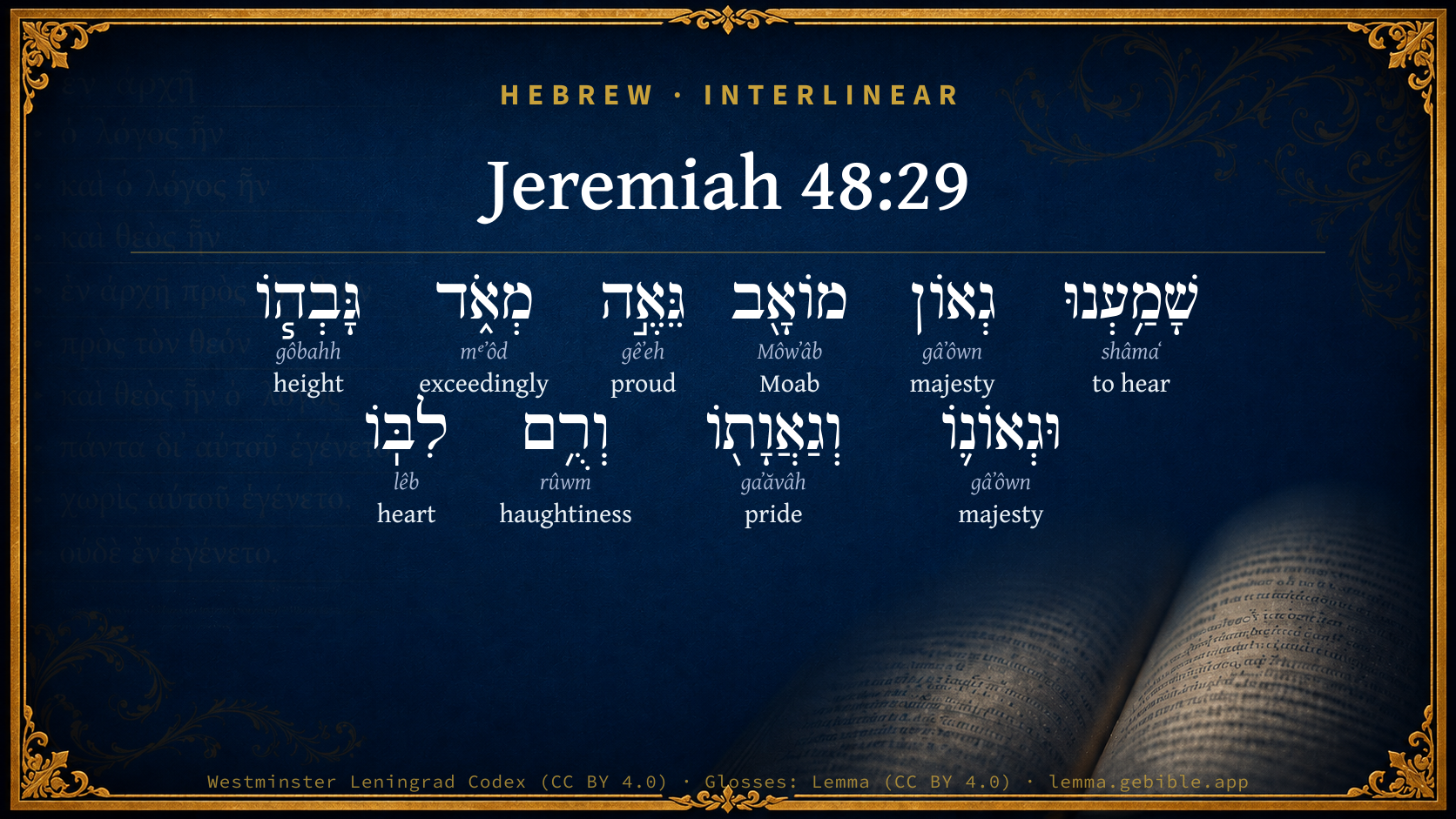
Hebrew (Westminster Leningrad Codex) Jeremiah 48:29 appears in the Hebrew Old Testament. The text above is from the Westminster Leningrad Codex. Each word links to its Strong’s number, a concise gloss, and parsing drawn from the Open Scriptures Hebrew Bible morphology. Click any word for its full Brown-Driver-Briggs (BDB) entry.
Download image
Cite this verse

Jeremiah 48:29 (World English Bible). Public Domain. Lemma interlinear Bible study tool, https://lemma.gebible.app/v/jeremiah/48/29.

Show BibTeX & RIS
BibTeX
RIS
English Translation
We have heard of the pride of Moab, [that] he is very proud; his loftiness, and his pride, and his arrogance, and the haughtiness of his heart.
World English Bible · Public Domain
Download a study sheet

One document with this verse’s original text, its word-by-word gloss line, the meaning frame, cross-references with their text, attributed commentary, and full source and license credits — printable, and it pastes into notes with its structure intact.

This verse Autodidact and up

Study sheet (.html) Plain text (.txt)

A passage Seminary Student

Up to 50 verses in one chapter. A passage sheet keeps up to 6 commentary sources and 12 cross-references per verse, in the order this page ranks them, and says so on the sheet whenever that leaves anything out. Ask for a single verse and you get the Autodidact verse sheet above.

Everything on this page stays free to read, with no account — the sheet is a download of what is already on screen, not access to it.

Want to remove ads? Support Godless Engineer
Compare translations 3

The same verse in 3 English versions, stacked beneath the original-language interlinear above. Click any original word for its lexicon entry.

Each is an independent rendering of the whole verse — the interlinear is not word-aligned to these translations.

Highlighted words mark where these versions differ — a whole-verse word diff, not a word-by-word alignment.

  • World English Bible Public Domain
    We have heard of the pride of Moab, [that] he is very proud; his loftiness, and his pride, and his arrogance, and the haughtiness of his heart.
  • King James Version Public Domain
    We have heard the pride of Moab, (he is exceeding proud) his loftiness, and his arrogancy, and his pride, and the haughtiness of his heart.
  • unfoldingWord Literal Text CC BY-SA 4.0
    We have heard of Moab’s pride—his arrogance, his haughtiness, his pride, his self-glory and the conceit in his heart.

unfoldingWord Literal Text — © unfoldingWord, licensed CC BY-SA 4.0. Word-aligned USFM3 via Door43 (git.door43.org/unfoldingWord/en_ult).

Versions to compare (up to 4)

3 of 4 selected

Show all 18 translations

Every available English version of this verse, each an independent rendering of the whole verse.

  • World English Bible Public Domain
    We have heard of the pride of Moab, [that] he is very proud; his loftiness, and his pride, and his arrogance, and the haughtiness of his heart.
  • Berean Standard Bible Public Domain
    We have heard of Moab’s pomposity, his exceeding pride and conceit, his proud arrogance and haughtiness of heart.
  • Majority Standard Bible Public Domain
    We have heard of Moab’s pomposity, his exceeding pride and conceit, his proud arrogance and haughtiness of heart.
  • King James Version Public Domain
    We have heard the pride of Moab, (he is exceeding proud) his loftiness, and his arrogancy, and his pride, and the haughtiness of his heart.
  • American Standard Version (1901) Public Domain
    We have heard of the pride of Moab, `that' he is very proud; his loftiness, and his pride, and his arrogancy, and the haughtiness of his heart.
  • Revised Version (1885) Public Domain
    We have heard of the pride of Moab, that he is very proud; his loftiness, and his pride, and his arrogancy, and the haughtiness of his heart.
  • Geneva Bible (1599) Public Domain
    We haue heard the pride of Moab (hee is exceeding proude) his stoutnesse, and his arrogancie, and his pride, and the hautinesse of his heart.
  • Douay-Rheims (1899) Public Domain
    We have heard the pride of Moab, he is exceeding proud: his haughtiness, and his arrogancy, and his pride, and the loftiness of his heart.
  • Young's Literal Translation Public Domain
    We have heard of the arrogance of Moab, Exceeding proud! His haughtiness, and his arrogance, And his pride, and the height of his heart,
  • Literal Standard Version CC BY-SA 4.0
    We have heard of the arrogance of Moab, || Exceedingly proud! His haughtiness, and his arrogance, || And his pride, and the height of his heart,
  • Unlocked Literal Bible CC BY-SA 4.0
    We have heard of Moab's pride—his arrogance, his haughtiness, his pride, his self-glory and the conceit in his heart.
  • unfoldingWord Literal Text CC BY-SA 4.0
    We have heard of Moab’s pride—his arrogance, his haughtiness, his pride, his self-glory and the conceit in his heart.
  • Darby Bible Public Domain
    We have heard of the arrogance of Moab, -- [he is] very proud; -- his loftiness, and his arrogance, and his pride, and the haughtiness of his heart.
  • World Messianic Bible Public Domain
    “We have heard of the pride of Moab. He is very proud in his loftiness, his pride, his arrogance, and the arrogance of his heart.
  • Webster's Bible Public Domain
    We have heard the pride of Moab, (he is exceeding proud) his loftiness, and his arrogance, and his pride, and the haughtiness of his heart.
  • Free Bible Version CC BY-SA 4.0
    We know all about how pompous Moabites are, how extremely proud and conceited they are, arrogantly thinking so highly of themselves.
  • Bible in Basic English Public Domain
    We have had word of the pride of Moab, how great it is; how he is lifted up in pride; and his great opinion of himself, and that his heart is lifted up.
  • JPS Tanakh (1917) Public Domain
    We have heard of the pride of Moab; he is very proud; his loftiness, and his pride, and his haughtiness, and the assumption of his heart.

Literal Standard Version (2020), Covenant Press — licensed CC BY-SA 4.0. Text via the HelloAO Bible API (eBible.org). Unlocked Literal Bible (unfoldingWord) — licensed CC BY-SA 4.0. Text via the HelloAO Bible API (eBible.org). unfoldingWord Literal Text — © unfoldingWord, licensed CC BY-SA 4.0. Word-aligned USFM3 via Door43 (git.door43.org/unfoldingWord/en_ult). Free Bible Version, Dr. Jonathan Gallagher — licensed CC BY-SA 4.0. Text via the HelloAO Bible API (eBible.org).

Word by word

More ways to search: Search by grammar → Find every occurrence → Compare this word →

Practice this passage: Drill this verse → Learn its vocabulary →

וְרֻ֥ם
rûwm
H7312
“and · haughtiness of”
Conjunction + Noun, Common, Masculine, Singular, Construct
Part of Speech
Conjunction + Noun
Type
Common
Gender
Masculine
Number
Singular
State
Construct
Full BDB Definition

Origin: from H7311

TWOT: 2133a

haughtiness, height, elevation - height, loftiness - haughtiness
  1. שָׁמַ֥עְנוּ shâmaʻ H8085 “to hear” Verb, Qal, Perfect, 1st Person, Common, Plural
  2. גְאוֹן gâʼôwn H1347 “majesty of” Noun, Common, Masculine, Singular, Construct
  3. מוֹאָ֖ב Môwʼâb H4124 “Moab” Noun, Proper
  4. גֵּאֶ֣ה gêʼeh H1343 “proud” Adjective, Adjective, Masculine, Singular, Absolute
  5. מְאֹ֑ד mᵉʼôd H3966 “exceedingly” Adverb
  6. גָּבְה֧וֹ gôbahh H1363 “height · his” Noun, Common, Masculine, Singular, Construct + Suffix, Personal, 3rd Person, Masculine, Singular
  7. וּגְאוֹנ֛וֹ gâʼôwn H1347 “and · majesty · his” Conjunction + Noun, Common, Masculine, Singular, Construct + Suffix, Personal, 3rd Person, Masculine, Singular
  8. וְגַאֲוָת֖וֹ gaʼăvâh H1346 “and · pride · his” Conjunction + Noun, Common, Feminine, Singular, Construct + Suffix, Personal, 3rd Person, Masculine, Singular
  9. לִבּֽוֹ lêb H3820 “heart · his” Noun, Common, Masculine, Singular, Construct + Suffix, Personal, 3rd Person, Masculine, Singular

About this verse

These counts appear in no published source. They are computed here, from the morphology-tagged text and Lemma’s own curated glosses. What Lemma adds →

10
words
9
distinct lemmas
Prophets
section

Notable vocabulary

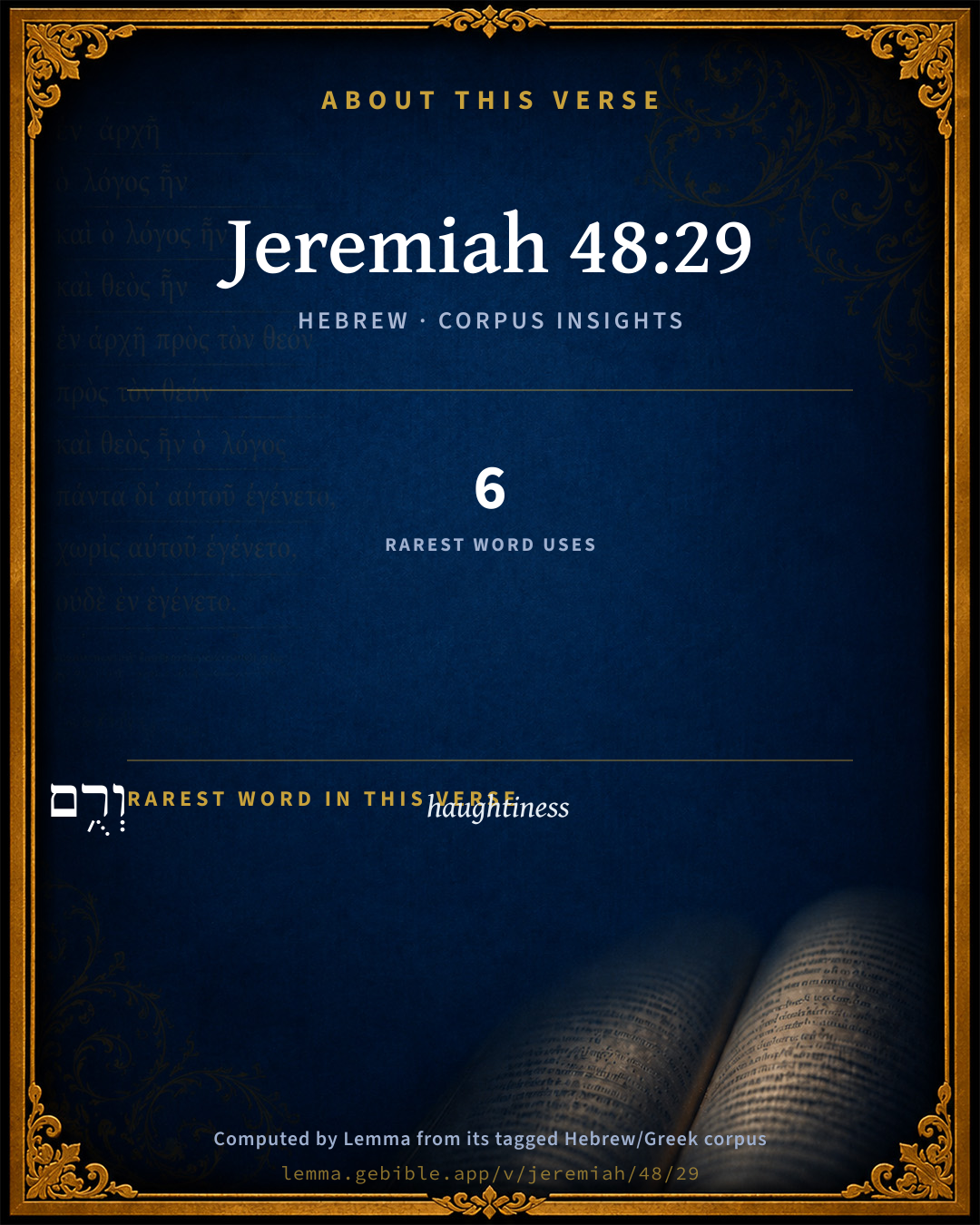
The rarest word here is וְרֻ֥ם haughtiness H7312 — appearing just 6 times in the whole Hebrew Bible.

Shared distinctive vocabulary

וְרֻ֥ם haughtiness H7312 occurs in 6 verses of the Hebrew Bible. Also found in:

Grammatical profile

  • 1 verb
  • 7 nouns
  • 1 adjective
  • 1 adverb

Verb forms

  • שָׁמַ֥עְנוּ Qal · Perfect

Repetition

A word recurs within this verse — often emphatic in Hebrew:

  • גְאוֹן majesty H1347 ×2

Cross-references

11

Topical passages linked to Jeremiah 48:29 in the Treasury of Scripture Knowledge — connected by theme and wording, ordered by reader-vote popularity; previews shown in the World English Bible.

  • Isaiah 16:6 We have heard of the pride of Moab, [that] he is very proud; even of his arrogance, and his pride, and his wrath; his boastings are nothing.
  • Psalms 138:6 For though Yahweh is high, yet he looks after the lowly; But the proud, he knows from afar.
  • Isaiah 2:11–12 The lofty looks of man will be brought low, The haughtiness of men will be bowed down, And Yahweh alone will be exalted in that day.
  • Job 40:10–12 "Now deck yourself with excellency and dignity. Array yourself with honor and majesty.
  • Proverbs 8:13 The fear of Yahweh is to hate evil. I hate pride, arrogance, the evil way, and the perverse mouth.
  • Proverbs 18:12 Before destruction the heart of man is proud, But before honor is humility.
  • Proverbs 30:13 There is a generation, oh how lofty are their eyes! Their eyelids are lifted up.
  • Daniel 4:37 Now I, Nebuchadnezzar, praise and extol and honor the King of heaven; for all his works are truth, and his ways justice; and those who walk in pride he is able to abase.
  • Zephaniah 2:8–15 I have heard the reproach of Moab, and the insults of the children of Ammon, with which they have reproached my people, and magnified themselves against their border.
  • Luke 14:11 For everyone who exalts himself will be humbled, and whoever humbles himself will be exalted."
  • James 4:6 But he gives more grace. Therefore it says, "God resists the proud, but gives grace to the humble."

Cross-references courtesy of OpenBible.info (CC BY 4.0).

Hebrew and Greek witnesses Masoretic Hebrew ↔ Greek Septuagint

The same verse in the two great witnesses to the Old Testament, shown verse-for-verse.

These are two independent witnesses, not word-aligned to each other, and the Septuagint is shown in lemma (dictionary) form.

Hebrew Jeremiah 48:29 Masoretic · Westminster Leningrad Codex

שָׁמַ֥עְנוּ גְאוֹן מוֹאָ֖ב גֵּאֶ֣ה מְאֹ֑ד גָּבְה֧וֹ וּגְאוֹנ֛וֹ וְגַאֲוָת֖וֹ וְרֻ֥ם לִבּֽוֹ

We have heard of the pride of Moab, [that] he is very proud; his loftiness, and his pride, and his arrogance, and the haughtiness of his heart.

World English Bible · Public Domain

Greek LXX Structure differs

In the Septuagint, Jeremiah is about an eighth shorter than the Hebrew and arranges its material differently — the Oracles Against the Nations (Hebrew chapters 46–51) appear in the middle of the Greek book, after 25:13. Because the chapter and verse boundaries do not line up, a verse-for-verse comparison with the Hebrew is not shown.

A verse-for-verse comparison isn’t shown here because the chapters and verses don’t line up. Switch to the LXX edition with the MT / LXX toggle above to read the Greek directly.

On this verse, Keil & Delitzsch discusses the Septuagint’s reading. Read the note in Commentary ↓

Hebrew: Westminster Leningrad Codex (CC BY 4.0). Greek: Septuagint (public domain); English from a public-domain English Septuagint. How the Septuagint differs from the Hebrew →

Targum (Aramaic paraphrase)

1

The Targum is the ancient Jewish Aramaic paraphrase of the Hebrew Scriptures — an interpretive translation, not the Hebrew text itself. Onkelos (literal) and Pseudo-Jonathan (expansive) render the Torah, and Jonathan the Prophets. Coverage is partial: where no permissively-licensed English translation exists for a verse, only the Aramaic is shown. This is verse-level text, not a word-by-word alignment to the Hebrew.

  1. Targum Jonathan Prophets (Joshua–Malachi)
    שְׁמַעְנָא רַבְרְבֵי מוֹאָב דְמִתְגַאָן לַחֲדָא רַבְרְבֵיהוֹן וּמְפַנְקֵיהוֹן וְגֵיוָתָנוּתְהוֹן וְרָמוּת לִבְּהוֹן:

    (no public-domain English translation for this verse)

    Targum Jonathan — Aramaic: “Mikraot Gedolot” (public domain). English: “Sefaria Community Translation” (CC0 1.0 (public-domain dedication)); “London "Chaldee Paraphrase," 1871” (public domain). Text via Sefaria.

Commentary

Notes on Jeremiah 48:29 from classic Christian and Jewish commentators (each source and its license shown beneath its notes). The classic Christian expositions comment on the surrounding passage and are grouped to its opening verse, so a note may address several verses; the Jewish commentaries on the Tanakh (Rashi and others) are per-verse, so they appear only where the commentator wrote on this verse.

Lemma curates 59 commentaries, every one of them public domain or Creative Commons licensed, each selected and text-cleaned for this edition rather than reprinted as found. About our sources →

Trapp's Complete Commentary

John Trapp

Jer 48:29 We have heard the pride of Moab, (he is exceeding proud) his loftiness, and his arrogancy, and his pride, and the haughtiness of his heart.

Ver. 29. We have heard the pride of Moab.] See Isa 16:6. Proud he was then, and the same he is still; no changeling is he.

John Trapp, A Commentary or Exposition upon All the Books of the Old and New Testament (1647–1656) — public domain. Text from a community e-Sword module.

Joseph Benson's Commentary

Jer 48:29; Jer 48:39. We have heard the pride of Moab — The several synonymous terms made use of in this verse are meant to express the great pride and insolence of Moab. Though some of these terms are not found in the parallel passage, (Isa 16:6,) yet in the main they agree therewith; and “while they describe the overweening pride and haughtiness of Moab, and the intemperance of his rage, they intimate the small pretensions he had for such high assuming, either in respect of the extent of his power, or his actual performances.” I know his wrath — Hebrew, עברתו, his fierce wrath, or rage; but it shall not be so — He shall not be able to execute it, or bring to pass what he thinks to do: his power shall not be equal to his malice. His lies shall not so effect it — Or rather, have not so effected, the verb being in the past time. But this latter part of the sentence seems more properly rendered by Blaney, thus: “But he is not alike,” (that is, equal to his wrath and threats,) “in the extent of his ability he is not alike in performing.”

Joseph Benson's Commentary on the Old and New Testaments (1811–1818) — public domain. Text from a community e-Sword module.

Keil & Delitzsch

C. F. Keil & F. Delitzsch

Jer 48:29 and Jer 48:30 only more fully develop the idea contained in Isa 16:6. Those who "heard" are the prophet and the people of God. There is an accumulation of words to describe the pride of Moab. Isaiah's expression also, עברתו לא־כן בּדּיו, is here expanded into two clauses, and Jahveh is named as the subject. Not only have the people of God perceived the pride of Moab, but God also knows his wrath. בּדּיו belongs to לא־כן as a genitive, as in Isaiah לא־כן means "not right," contrary to actual facts, i.e., untrue.

(Note: The Masoretic accentuation, according to which Athnach is placed under כּן, exhibits another view of the words in the text: this is shown by the Chaldee paraphrase, "their nobles endure not, they have not done what is right." The Masoretes took בּדּים in the sense of "staves," and took staves as a symbol of princes, as in Hos 11:6. Luther, in his translation, "I know his anger well, that he cannot do so very much, and attempts to do more than he can," follows the Vulgate, Ego scio jactantiam ejus, et quod non sit juxta eam virtus ejus, nec juxta quod poterat conata sit facere, which again seems to have followed the lxx in taking בּדיּו for בּדּיו.)

Keil & Delitzsch — Biblical Commentary on the Old Testament (1861–1891) — public domain (CC PDM 1.0). Text via the HelloAO Bible API. (Old Testament only.)

Jamieson, Fausset & Brown

Robert Jamieson, A. R. Fausset & David Brown

pride-- (Isa 16:6-7). Moab was the trumpeter of his own fame. Jeremiah adds "loftiness and arrogancy" to Isaiah's picture, so that Moab had not only not been bettered by the chastisement previously endured as foretold by Isaiah, but had even become worse; so that his guilt, and therefore his sentence of punishment, are increased now. Six times Moab's pride (or the synonyms) are mentioned, to show the exceeding hatefulness of his sin.

Jamieson, Fausset & Brown — Commentary Critical and Explanatory on the Whole Bible (1871) — public domain (CC PDM 1.0). Text via the HelloAO Bible API.

Adam Clarke's Commentary

Verse 29. The pride of Moab] See Clarke on Isa 16:1.

Adam Clarke's Commentary on the Bible (1810–1826) — public domain. Text from a community e-Sword/MySword module.

John Calvin's Commentaries

Here the Prophet intimates by anticipation, that how much soever the Moabites might boast, they could not, by their boastings and their pride, so succeed that God should not appear against them as a Judge. We have said already, that as the Moabites had been long in a quiet state, what the Prophet denounced on them, appeared at the first hearing as incredible. It is then by way of anticipation that he says, that the Moabites were proud, did swell with haughtiness, and breathed much arrogance, that, in short, they manifested high and lofty spirits. When the Prophet says all this, and adds, that nothing would avail them, we see that he meets those doubts which might have possessed weak minds, so as to prevent them to believe his prophecy.

And when he uses the words, We have heard, he not only means by report, but that the Moabites loudly boasted, as it is usual with proud men; for they made, so to speak, a bellowing, and sought, even by their tongues alone, to strike others with terror. As then they proclaimed their wealth and their power, they sought in a manner to shake the very air, so that all might tremble at their voice alone. This seems to have been expressed by the Prophet, when he said, We have heard In short, Jeremiah does not mean that the report of the pride of Moab had spread abroad, as rumors often fly respecting the haughtiness and boastings of men; but he intimates that the Moabites were heralds of their own power, so that they spoke in lofty terms of their own greatness, and thus their own tongues testified of their haughtiness and arrogance. And hence it was that the Prophet enlarged on their pride; Moab is very proud, he says; we have heard his haughtiness, his pride and his arrogance, (though it be the same word,) and the loftiness of his heart, or, as we may say in Latin, et altos spiritus, and his high sprits. It now follows —

John Calvin's Commentaries (1540-1563) — public domain. Text from the Calvin Translation Society English edition (1840s-50s) via the Christian Classics Ethereal Library (ccel.org). Calvin's coverage is partial (roughly two-thirds of the Bible); uncommented books and verses are honest gaps, never fabricated. The 19th-century editor's footnotes and remarks are omitted so the notes are faithfully Calvin's own voice.

Ellicott's Commentary for English Readers

(29) We have heard the pride of Moab . . .—It will be seen that here and in the next verse the very words of Isaiah (Isa_16:6) are reproduced. The prophet seems to find a pleasure in going back to the old words as showing that the fault of which he spoke was inveterate, and had shown itself incurable. It is, however, a free reproduction, and Jeremiah, instead of making the whole utterance that of the Jews, inserts the words, “I know his wrath, saith the Lord,” which come as an oracle from God, affirming the judgment of the people.

A Bible Commentary for English Readers, edited by Charles John Ellicott (1878–1897) — public domain. Text from a community e-Sword module.

The Cambridge Bible for Schools and Colleges

gen. ed. J. J. S. Perowne

29, 30. Expanded from Isa_16:6. For pride as a characteristic of Moab cp. Isa_25:11; Zep_2:8-10.

29–39. See introd. summary to the ch. The passage may contain some Jeremianic matter, but on the whole is late (see also on Jer_48:37-38) and borrowed to a large extent from Is. 15., 16. (chs. which are perhaps earlier than Isaiah’s time and republished by him. See Skinner, C.B. ad loc.).

The Cambridge Bible for Schools and Colleges (gen. ed. J. J. S. Perowne; Cambridge University Press, 1878–1918) — public domain. Text from a community e-Sword module.

John Gill's Exposition

I know his wrath, saith the Lord,.... Against the Jews, and other nations; what he has threatened to do unto them, and would do if not restrained:

but it shall not be so; as he has devised in his mind, and threatened in his wrath; all his swelling thoughts and big words shall come to nothing:

his lies shall not so effect it; it shall not be according to his words; they will prove lies, and of no effect. Kimchi interprets it of the sons of Moab, who shall not be able to do what they thought to do; and Jarchi of his mighty ones; and the Targum of his nobles, paraphrasing it,

"and their nobles are not right, they do not as is becoming;''

perhaps it may be better understood of his diviners and soothsayers, as the word is used in Isa 44:25; and be rendered, "his diviners have not done right" (f); they have deceived him with their lying oracles; swelled him with pride; and brought him to ruin, he trusting to them.

(f) "vaniloqui ejus non rectum fecerunt", Cocceius. So R. Sol. Urbin. Ohel Moed, fol. 38. 1.

John Gill's Exposition of the Whole Bible (1746–1763) — public domain (CC PDM 1.0). Text via the HelloAO Bible API.

Matthew Poole's English Annotations

There is a passage, Isa 16:6, &c., concerning Moab, very little differing from this: Isaiah lived some years before this prophet, who yet complaineth of them for the same sins, so as they were not at all reformed. God saith he had heard of their pride and arrogancy; a vice which commonly attendeth ease and prosperity, and is exceeding odious in the sight of God, so as a wicked man is often in Scripture set out under the notion of a proud man.

Matthew Poole's English Annotations on the Holy Bible (1683–1685) — public domain. Text from a community e-Sword/MySword module.

Whedon's Commentary on the Bible

Daniel D. Whedon

29-33. Substantially taken from Isa_16:6-10.

Daniel D. Whedon (gen. ed.), Commentary on the Old and New Testaments (1874–1909) — public domain. Text from a community e-Sword module.

The Pulpit Commentary

Vers. 29, 30. These verses are an expansion of Isa_16:6. The boastfulness of Moab seems to have much impressed its Israelitish neighbours (comp. vers. 14, 27). It has been thought to be illustrated by the inscription on the Moabite Stone; but we must remember that all national monuments of this sort have a tendency to exaggeration.

We have heard; viz. the prophet and his countrymen.

Pride.

With accumulated phrases emphasis is laid upon this leading sin of Moab, a sin which is condemned throughout Scripture as one of great wickedness.

I THE NATURE OF PRIDE. Pride is a passion rising out of an inordinate opinion of our own worthiness. It is to be distinguished from vanity. Vanity is eager for the admiration of others, though, perhaps, in its own heart conscious of possessing hut little to deserve it. But pride is inwardly elated with the feeling of self-importance, and may be quite indifferent to the opinion of the world. Indeed, the height of pride is to scorn the admiration as much as the hatred of other men, to look down upon the "dim multitude" as in all respects beneath contempt. Vanity craves social position; pride is essentially lonely. (Nevertheless we must beware of the common injustice of mistaking all reserve for pride; this may arise from constitutional habit, from sensitiveness, even from extreme humility.) Vanity smiles with the desire of pleasing; pride frowns in haughty independence. It is possible, however, for a man to have a very high opinion of his own powers, importance, etc., without much pride. For pride is not a mere conviction of the great worth of one"s self, it is an emotion, a passion, a disposition to dwell on one"s own merits and make idols of them.

II THE SINFULNESS OF PRIDE. Why is this so strongly condemned in Scripture? so hateful to God? Consider how it must appear in his sight. We are all his helpless children; "we have erred and strayed from his ways like lost sheep;" before him we are foul with sin, humiliated with failure; our best works are poor and imperfect; in free grace he spares, endures, pardons. Where, then, is there ground for pride? Pride is the denial of guilt, the assumption that the good we receive from God is deserved; it is, therefore, a gross presumption, an evidence of base ingratitude, a proof of self-will that refuses to humble itself before the good and holy Father.

III THE INJURIOUS EFFECTS OF PRIDE.

1. It blinds us to our own danger. It assumes that all must be well But the assumption does. not alter facts. It only aggravates the danger by preventing us from taking precautions against it. Moab was not saved in the general overthrow of the nations for all her pride. Humility sees the stumbling block in the path, but pride holds its head so high as never to observe it, and so fells over it. (Pro_16:18)

2. It prevents us from securing our own highest good. This can only be given by the mercy of God, and he can only bestow it on the humble, the contrite, the submissive. The proud man bars his own heart against the incoming of the grace of God.

3. It hinders the good work of life. It is directly opposed to charity; it is incongruous with that spirit of mutual concession and cooperation which is required in the service of life. Thus pride often wastes those very powers on the existence of which it stands. To conquer pride let us look at our lives in the light of the life of the meek and humble Jesus of Nazareth.

Concerning pride.

The graces of God"s Spirit are like choice flowers and fruits. They will not grow just anywhere, nor without cultivation and careful tending, and they are easily destroyed. Not so with moral evils like pride. They are as the ill weeds which grow apace. They will grow anywhere, and require no cultivation; the more you let them alone the more they will increase, and, do what you will, you can hardly destroy them. Now, concerning this ill weed, pride, note

I THAT IT IS VERY HATEFUL IN THE SIGHT OF GOD. See here, in this verse, with what varied names it is branded. Evil names, all of them. And turn to the many utterances in Scripture concerning this same sin, and the condemnation of God upon it will be yet more clearly seen. "There never was a saint yet that grew proud of his fine feathers, but what the Lord plucked them out by and by; there never yet was an angel that had pride in his heart, but he lost his wings, and fell into Gehenna, as Satan and those fallen angels did; and there shall never be a saint who indulges self-conceit and pride and self-confidence, but the Lord will spoil his glories, and trample his honours in the mire, and make him cry out yet again, "Lord, have mercy upon me!" less than the least of all saints, and the "very chief of sinners." The first Adam was for self-exaltation, and to be as gods; the second bids us be as he was, "meek and lowly in heart.

II ITS SIGNS AND TOKENS. Sometimes it is so concealed and masked that only a very intimate acquaintance with the man enables you to detect it; and sometimes the man himself may be unaware how proud he is, and may deem himself a very Moses for meekness, when he is just the reverse. But at other times it may be discerned in the countenance. There is "a proud look." The face is the dial plate of the character, "the expression" of what lies silent in the mind. Conduct yet more betrays it. Note how a man acts towards those whom he deems superior or inferior to himself; he will fawn upon the former, and be disdainful towards the latter. He will "mind high things," but will not "condescend to them that are of low estate." Who does not know pride"s hateful ways, and has not had to suffer from them; and also, alas! has made others suffer from them at one time or another? But note

III SOME OF ITS OCCASIONS AND EXCITEMENTS.

1. Birth is one of them; as if a man chose his own father and mother. Men pride themselves that they come of a certain family, that they are "well born." "We are Abraham"s children;" what a multitude of sorrows did that notion originate! They who pride themselves on those who were their ancestors in generations gone by are, as one has quaintly said,." like those useful vegetables of which we are wont to eat the best part of them is underground.

2. Physical strength. "It always seems to me to be a very insane thing for a man to glory in his animal force, for there can be no merit in it. In the strength of those brawny limbs of theirs and those powerful muscles, some vaunt themselves abundantly. Though "the Lord taketh not pleasure in the legs of a man," yet some count it a very wonderful thing that they can outrun or outleap their fellows. O athlete, though thou be strong as Samson or swift as Asahel, what hast thou that thou hast not received? Hadst thou been born with a tendency to consumption, or with some other hereditary weakness, couldst thou have prevented it? And now that thou art strong, art thou to be praised for that, any more than a horse or a steam engine?" (Spurgeon).

3. Beauty. What a fount of pride this is!

4. And talent of intellect, power of application, artistic taste, and the like.

5. Acquirements. "I have noticed of self-made men," says one, "that they generally have great respect for their Maker." And he who has acquired wealth is in sore peril of the pride which it is apt to beget. Position, influence, high office, and the like, these, too, are acquirements won, it may be, by diligent toil, yet, when won, may do a man much harm by generating an unhallowed pride. And even God"s grace to a man in giving him a name and a place amongst sincerely religious men, even this may be an occasion of pride. Our best works may be made fuel to the fire of pride. "The demon of pride was born with us, and it will not die one hour before us. It is so woven into the very warp and woof of our nature that, till we are wrapt in our winding sheet, we shall never be completely rid of it.

IV SOME OF ITS MANY EVILS. They are such as these:

1. It leads to the forgetting of God. "What hast thou that thou hast not received?". (1Co_9:7) "Is not this great Babylon that I have built?" so spake the God-forgetting and therefore the God-forsaken Nebuchadnezzar". (Dan_4:30)

2. It sets but little value upon God. God dwindles in the proud man"s esteem, whilst to himself he himself ever grows greater. The reverse of John the Baptist"s thought is his. John said, "He must increase, but I must decrease." The proud man changes the place of the "he" and the "I

3. It makes a man despise his fellows. He looks down upon them, and therefore is unjust to them.

4. It leads him to make bad use of what gifts he has. He is so taken up with admiration of the machinery that he fails to apply it to those ends which it was designed to serve.

5. It is the prelude not seldom to some great fall. "Pride goeth before destruction, and a haughty spirit before a fall.

6. It makes a man content with the inferior, when, instead of so admiring what he has, he should be aspiring after what is higher and better still. It is said of an artist that, when he had painted a picture which satisfied himself, he threw away his brushes; for now, he said, "I never shall go beyond this." And so he who is self-satisfied will never rise to a higher degree.

7. It dishonours Christ and his cause. A proud Christian helps the devil, for he makes men hate Christianity and all belonging to it.

V SALUTARY SUGGESTIONS FOR ITS CURE.

1. How entirely all our gifts are gifts! Much as we may think of ourselves on account of them, we are excelled by very many. If we have many gifts, that does but mean much and solemn responsibility. How ill it would fare with us were we to be called now to account for the use we have made of our gifts in the past! How but for the mercy of God in Christ, the most gifted is but a poor lost sinner, cast out from the presence of God forever! C.

The Pulpit Commentary (1880–1919), ed. H.D.M. Spence-Jones & Joseph S. Exell — public domain. Text from a community e-Sword module.

Lesson kit

Teaching starters — assembled from the data on this page, not authored interpretation. Every prompt links to the verse data it draws on. Edit before teaching.

Jeremiah, in the Prophets, opens this verse with 10 words (9 distinct Hebrew lemmas). Its most distinctive word is rûwm (“haughtiness”). A historical commentator’s framing appears above. Read the whole chapter for the surrounding context.

Discussion questions

  1. The word rûwm carries the sense “haughtiness.” How does it shape the verse?
  2. Proverbs 21:4 shares the word «haughtiness» with this verse. How do the two illuminate each other?
  3. “majesty” occurs 2× in this one verse. What is the effect of the repetition?
  4. The translations on this page render this verse differently — a whole-verse word diff, not a word-by-word alignment. What might account for the different wordings?
  5. The verb «שָׁמַ֥עְנוּ» is Qal Perfect. How does its form color the action?
  6. Reading how Trapp's Complete Commentary and Joseph Benson's Commentary read this verse, where do the two commentators agree and where do they part?

Things to notice

Reading settings

Reading text

Shown beneath each verse's original-language words.

Old Testament
Old Testament edition

Read the OT as the Masoretic Hebrew (MT) or the Greek Septuagint (LXX).

English shown for the Greek Septuagint (in the Hebrew ↔ Greek comparison).

Comparing translations? Open the Compare panel on any verse page to stack up to four side by side.