Jeremiah 48:41

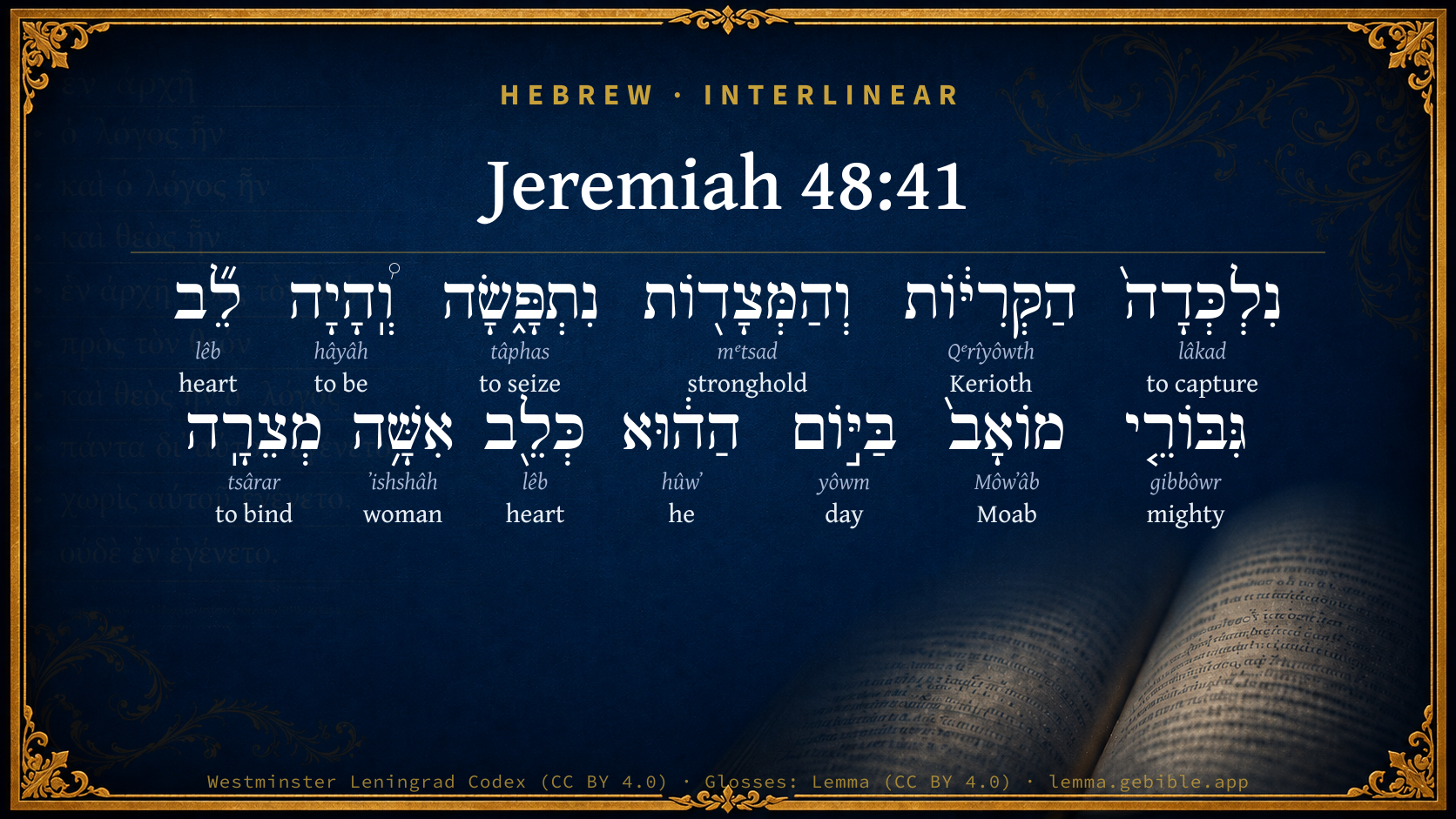
Hebrew (Westminster Leningrad Codex) Jeremiah 48:41 appears in the Hebrew Old Testament. The text above is from the Westminster Leningrad Codex. Each word links to its Strong’s number, a concise gloss, and parsing drawn from the Open Scriptures Hebrew Bible morphology. Click any word for its full Brown-Driver-Briggs (BDB) entry.
Download image
Cite this verse

Jeremiah 48:41 (World English Bible). Public Domain. Lemma interlinear Bible study tool, https://lemma.gebible.app/v/jeremiah/48/41.

Show BibTeX & RIS
BibTeX
RIS
English Translation
Kerioth is taken, and the strongholds are seized, and the heart of the mighty men of Moab at that day shall be as the heart of a woman in her pangs.
World English Bible · Public Domain
Download a study sheet

One document with this verse’s original text, its word-by-word gloss line, the meaning frame, cross-references with their text, attributed commentary, and full source and license credits — printable, and it pastes into notes with its structure intact.

This verse Autodidact and up

Study sheet (.html) Plain text (.txt)

A passage Seminary Student

Up to 50 verses in one chapter. A passage sheet keeps up to 6 commentary sources and 12 cross-references per verse, in the order this page ranks them, and says so on the sheet whenever that leaves anything out. Ask for a single verse and you get the Autodidact verse sheet above.

Everything on this page stays free to read, with no account — the sheet is a download of what is already on screen, not access to it.

Want to remove ads? Support Godless Engineer
Compare translations 3

The same verse in 3 English versions, stacked beneath the original-language interlinear above. Click any original word for its lexicon entry.

Each is an independent rendering of the whole verse — the interlinear is not word-aligned to these translations.

Highlighted words mark where these versions differ — a whole-verse word diff, not a word-by-word alignment.

  • World English Bible Public Domain
    Kerioth is taken, and the strongholds are seized, and the heart of the mighty men of Moab at that day shall be as the heart of a woman in her pangs.
  • King James Version Public Domain
    Kerioth is taken, and the strong holds are surprised, and the mighty men's hearts in Moab at that day shall be as the heart of a woman in her pangs.
  • unfoldingWord Literal Text CC BY-SA 4.0
    Kerioth has been captured, and its strongholds have been seized. For in that day the hearts of Moab’s soldiers will be like the hearts of women in birth labor.

unfoldingWord Literal Text — © unfoldingWord, licensed CC BY-SA 4.0. Word-aligned USFM3 via Door43 (git.door43.org/unfoldingWord/en_ult).

Versions to compare (up to 4)

3 of 4 selected

Show all 18 translations

Every available English version of this verse, each an independent rendering of the whole verse.

  • World English Bible Public Domain
    Kerioth is taken, and the strongholds are seized, and the heart of the mighty men of Moab at that day shall be as the heart of a woman in her pangs.
  • Berean Standard Bible Public Domain
    Kirioth has been taken, and the strongholds seized. In that day the heart of Moab’s warriors will be like the heart of a woman in labor.
  • Majority Standard Bible Public Domain
    Kirioth has been taken, and the strongholds seized. In that day the heart of Moab’s warriors will be like the heart of a woman in labor.
  • King James Version Public Domain
    Kerioth is taken, and the strong holds are surprised, and the mighty men's hearts in Moab at that day shall be as the heart of a woman in her pangs.
  • American Standard Version (1901) Public Domain
    Kerioth is taken, and the strongholds are seized, and the heart of the mighty men of Moab at that day shall be as the heart of a woman in her pangs.
  • Revised Version (1885) Public Domain
    Kerioth is taken, and the strong holds are surprised, and the heart of the mighty men of Moab at that day shall be as the heart of a woman in her pangs.
  • Geneva Bible (1599) Public Domain
    The cities are taken, and the strong holdes are wonne, and ye mightie mens hearts in Moab at that day shalbe as ye heart of a woman in trauaile.
  • Douay-Rheims (1899) Public Domain
    Carioth is taken, and the strong holds are won: and the heart of the valiant men of Moab in that day shall be as the heart of a woman in labour.
  • Young's Literal Translation Public Domain
    Captured have been the cities, And the strongholds are caught, And the heart of the mighty of Moab Hath been in that day as the heart of a distressed woman.
  • Literal Standard Version CC BY-SA 4.0
    The cities have been captured, || And the strongholds are caught, || And the heart of the mighty of Moab || Has been in that day as the heart of a distressed woman.
  • Unlocked Literal Bible CC BY-SA 4.0
    Kerioth has been captured, and its strongholds have been seized. For in that day the hearts of Moab's soldiers will be like the hearts of women in birth labor.
  • unfoldingWord Literal Text CC BY-SA 4.0
    Kerioth has been captured, and its strongholds have been seized. For in that day the hearts of Moab’s soldiers will be like the hearts of women in birth labor.
  • Darby Bible Public Domain
    Kerijoth is taken, and the strongholds are seized, and at that day the heart of the mighty men of Moab shall be as the heart of a woman in her pangs.
  • World Messianic Bible Public Domain
    Kerioth is taken, and the strongholds are seized. The heart of the mighty men of Moab at that day will be as the heart of a woman in her pangs.
  • Webster's Bible Public Domain
    Kerioth is taken, and the strong holds are surprised, and the mighty men's hearts in Moab at that day shall be as the heart of a woman in her pangs.
  • Free Bible Version CC BY-SA 4.0
    Kirioth has been conquered, and the fortresses captured. At that time Moab's warriors will be as scared as a woman in labor.
  • Bible in Basic English Public Domain
    Kerioth is taken, and the strong places have been forced, and the hearts of Moab's men of war in that day will be like the heart of a woman in birth-pains.
  • JPS Tanakh (1917) Public Domain
    The cities are taken, and the strongholds are seized, and the heart of the mighty men of Moab at that day shall be as the heart of a woman in her pangs.

Literal Standard Version (2020), Covenant Press — licensed CC BY-SA 4.0. Text via the HelloAO Bible API (eBible.org). Unlocked Literal Bible (unfoldingWord) — licensed CC BY-SA 4.0. Text via the HelloAO Bible API (eBible.org). unfoldingWord Literal Text — © unfoldingWord, licensed CC BY-SA 4.0. Word-aligned USFM3 via Door43 (git.door43.org/unfoldingWord/en_ult). Free Bible Version, Dr. Jonathan Gallagher — licensed CC BY-SA 4.0. Text via the HelloAO Bible API (eBible.org).

Word by word

More ways to search: Search by grammar → Find every occurrence → Compare this word →

Practice this passage: Drill this verse → Learn its vocabulary →

הַקְּרִיּ֔וֹת
Qᵉrîyôwth
H7152
“the · Kerioth”
Particle, Definite Article + Noun, Common, Feminine, Plural, Absolute
Part of Speech
Particle + Noun
Type
Common
Gender
Feminine
Number
Plural
State
Absolute
Full BDB Definition

Origin: pl. of H7151

TWOT: None

Kerioth = "cities" - a town in the southern district of Judah - a city in Moab
  1. נִלְכְּדָה֙ lâkad H3920 “to capture” Verb, Niphal, Perfect, 3rd Person, Feminine, Singular
  2. וְהַמְּצָד֖וֹת mᵉtsad H4679 “and · the · strongholds” Conjunction + Particle, Definite Article + Noun, Common, Feminine, Plural, Absolute
  3. נִתְפָּ֑שָׂה tâphas H8610 “to seize” Verb, Niphal, Perfect, 3rd Person, Feminine, Singular
  4. וְֽ֠הָיָה hâyâh H1961 “and · to be” Conjunction + Verb, Qal, Sequential Perfect, 3rd Person, Masculine, Singular
  5. לֵ֞ב lêb H3820 “heart of” Noun, Common, Masculine, Singular, Construct
  6. גִּבּוֹרֵ֤י gibbôwr H1368 “mighty of” Adjective, Adjective, Masculine, Plural, Construct
  7. מוֹאָב֙ Môwʼâb H4124 “Moab” Noun, Proper
  8. בַּיּ֣וֹם yôwm H3117 “in/at the · day” Preposition, Determined + Noun, Common, Masculine, Singular, Absolute
  9. הַה֔וּא hûwʼ H1931 “the · he” Particle, Definite Article + Pronoun, Personal, 3rd Person, Masculine, Singular
  10. כְּלֵ֖ב lêb H3820 “like/as · heart of” Preposition + Noun, Common, Masculine, Singular, Construct
  11. אִשָּׁ֥ה ʼishshâh H802 “woman” Noun, Common, Feminine, Singular, Absolute
  12. מְצֵרָֽה tsârar H6887 “binding” Verb, Hiphil, Participle Active, Feminine, Singular, Absolute

About this verse

These counts appear in no published source. They are computed here, from the morphology-tagged text and Lemma’s own curated glosses. What Lemma adds →

13
words
12
distinct lemmas
Prophets
section

Notable vocabulary

The rarest word here is הַקְּרִיּ֔וֹת Kerioth H7152 — appearing just 4 times in the whole Hebrew Bible.

Shared distinctive vocabulary

הַקְּרִיּ֔וֹת Kerioth H7152 occurs in 4 verses of the Hebrew Bible. Also found in:

Grammatical profile

  • 4 verbs
  • 7 nouns
  • 1 adjective
  • 1 pronoun

Verb forms

  • נִלְכְּדָה֙ Niphal · Perfect
  • נִתְפָּ֑שָׂה Niphal · Perfect
  • וְֽ֠הָיָה Qal · Sequential Perfect
  • מְצֵרָֽה Hiphil · Participle Active

Repetition

A word recurs within this verse — often emphatic in Hebrew:

  • לֵ֞ב heart H3820 ×2

Cross-references

12

Topical passages linked to Jeremiah 48:41 in the Treasury of Scripture Knowledge — connected by theme and wording, ordered by reader-vote popularity; previews shown in the World English Bible.

  • Isaiah 13:8 and they shall be dismayed; pangs and sorrows shall take hold [of them]; they shall be in pain as a woman in travail: they shall look in amazement one at another; their faces [shall be] faces of flame.
  • Isaiah 21:3 Therefore are my loins filled with anguish; pangs have taken hold on me, as the pangs of a woman in travail: I am pained so that I can't hear; I am dismayed so that I can't see.
  • Jeremiah 6:24 We have heard the report of it; our hands wax feeble: anguish has taken hold of us, [and] pangs as of a woman in travail.
  • Jeremiah 30:6 Ask now, and see whether a man does travail with child: why do I see every man with his hands on his loins, as a woman in travail, and all faces are turned into paleness?
  • Jeremiah 49:22 Behold, he shall come up and fly as the eagle, and spread out his wings against Bozrah: and the heart of the mighty men of Edom at that day shall be as the heart of a woman in her pangs.
  • Micah 4:9–10 Now why do you cry out aloud? Is there no king in you? Has your counselor perished, That pains have taken hold of you as of a woman in travail?
  • Isaiah 26:17–18 Like as a woman with child, who draws near the time of her delivery, is in pain and cries out in her pangs; so we have been before you, Yahweh.
  • Jeremiah 4:31 For I have heard a voice as of a woman in travail, the anguish as of her who brings forth her first child, the voice of the daughter of Zion, who gasps for breath, who spreads her hands, [saying], Woe is me now! for my soul faints before the murderers.
  • Jeremiah 49:24 Damascus has grown feeble, she turns herself to flee, and trembling has seized on her: anguish and sorrows have taken hold of her, as of a woman in travail.
  • Jeremiah 50:43 The king of Babylon has heard the news of them, and his hands wax feeble: anguish has taken hold of him, [and] pangs as of a woman in travail.
  • Jeremiah 51:30 The mighty men of Babylon have forborne to fight, they remain in their strongholds; their might has failed; they are become as women: her dwelling-places are set on fire; her bars are broken.
  • 1 Thessalonians 5:3 For when they are saying, "Peace and safety," then sudden destruction will come on them, like birth pains on a pregnant woman; and they will in no way escape.

Cross-references courtesy of OpenBible.info (CC BY 4.0).

Hebrew and Greek witnesses Masoretic Hebrew ↔ Greek Septuagint

The same verse in the two great witnesses to the Old Testament, shown verse-for-verse.

These are two independent witnesses, not word-aligned to each other, and the Septuagint is shown in lemma (dictionary) form.

Hebrew Jeremiah 48:41 Masoretic · Westminster Leningrad Codex

נִלְכְּדָה֙ הַקְּרִיּ֔וֹת וְהַמְּצָד֖וֹת נִתְפָּ֑שָׂה וְֽ֠הָיָה לֵ֞ב גִּבּוֹרֵ֤י מוֹאָב֙ בַּיּ֣וֹם הַה֔וּא כְּלֵ֖ב אִשָּׁ֥ה מְצֵרָֽה

Kerioth is taken, and the strongholds are seized, and the heart of the mighty men of Moab at that day shall be as the heart of a woman in her pangs.

World English Bible · Public Domain

Greek LXX Structure differs

In the Septuagint, Jeremiah is about an eighth shorter than the Hebrew and arranges its material differently — the Oracles Against the Nations (Hebrew chapters 46–51) appear in the middle of the Greek book, after 25:13. Because the chapter and verse boundaries do not line up, a verse-for-verse comparison with the Hebrew is not shown.

A verse-for-verse comparison isn’t shown here because the chapters and verses don’t line up. Switch to the LXX edition with the MT / LXX toggle above to read the Greek directly.

On this verse, Haydock's Catholic Bible Commentary discusses the Septuagint’s reading. Read the note in Commentary ↓

Hebrew: Westminster Leningrad Codex (CC BY 4.0). Greek: Septuagint (public domain); English from a public-domain English Septuagint. How the Septuagint differs from the Hebrew →

Targum (Aramaic paraphrase)

1

The Targum is the ancient Jewish Aramaic paraphrase of the Hebrew Scriptures — an interpretive translation, not the Hebrew text itself. Onkelos (literal) and Pseudo-Jonathan (expansive) render the Torah, and Jonathan the Prophets. Coverage is partial: where no permissively-licensed English translation exists for a verse, only the Aramaic is shown. This is verse-level text, not a word-by-word alignment to the Hebrew.

  1. Targum Jonathan Prophets (Joshua–Malachi)
    וְתִתְכְּבֵישׁ כְּרַכָּא וּמְצָדָתָא יִתְאַחְדָן וִיהֵי לֵב גִבָּרֵיהוֹן דְמוֹאֲבָאֵי בְּיוֹמָא הַהוּא כְּלֵב אִתְּתָא דְעָקָא לָהּ בְּחֶבְלָהָא:

    (no public-domain English translation for this verse)

    Targum Jonathan — Aramaic: “Mikraot Gedolot” (public domain). English: “Sefaria Community Translation” (CC0 1.0 (public-domain dedication)); “London "Chaldee Paraphrase," 1871” (public domain). Text via Sefaria.

Commentary

Notes on Jeremiah 48:41 from classic Christian and Jewish commentators (each source and its license shown beneath its notes). The classic Christian expositions comment on the surrounding passage and are grouped to its opening verse, so a note may address several verses; the Jewish commentaries on the Tanakh (Rashi and others) are per-verse, so they appear only where the commentator wrote on this verse.

Lemma curates 59 commentaries, every one of them public domain or Creative Commons licensed, each selected and text-cleaned for this edition rather than reprinted as found. About our sources →

Trapp's Complete Commentary

John Trapp

Jer 48:41 Kerioth is taken, and the strong holds are surprised, and the mighty men’s hearts in Moab at that day shall be as the heart of a woman in her pangs.

Ver. 41. Kerioth is taken.] Of this city, some say, was Judas Iscariot.

As the heart of a woman in her pangs.] Which is very low: neither is such a one in case to defend herself.

John Trapp, A Commentary or Exposition upon All the Books of the Old and New Testament (1647–1656) — public domain. Text from a community e-Sword module.

Jamieson, Fausset & Brown

Robert Jamieson, A. R. Fausset & David Brown

as . . . woman in . . . pangs-- (Isa 13:8).

Jamieson, Fausset & Brown — Commentary Critical and Explanatory on the Whole Bible (1871) — public domain (CC PDM 1.0). Text via the HelloAO Bible API.

John Calvin's Commentaries

I have already reminded you, that the Prophet is not using too many words in this extended discourse, for it was necessary to confirm at large what all would have otherwise rejected. He then says, that the cities of Moab were taken, that strongholds were seized He mentions these things expressly, because the country of Moab thought that it was defended by cities and strongholds; and they thus thought, “Should the Chaldeans come and make an irruption, there are many cities who will oppose them; they will then have to spend much time in overcoming these obstacles. It may then so happen, that being broken down with fatigue they will return to their own country, and we shall recover what we may have lost.” With this confidence then the Moabites deceived themselves, when they looked on their well fortified cities and strongholds. For this reason the Prophet now says, Taken are the cities, and seized on are the strongholds

There was another thing of which the Moabites boasted, that they possessed military valor; and yet they had not of late made a trial of their strength, as they had been indulging themselves in sloth and pleasures. But as they had formerly performed deeds worthy of being remembered, they despised, as I have said, their enemies, arrogating to themselves the credit of great valor. The Prophet, on the other hand, declares that their courage would vanish away: The heart, he says, of the men of Moab shall become effeminate in that day, softer than the heart of a woman, when oppressed with evils. It might have appeared a complete comparison, when he said that the men of Moab would be soft and effeminate; but he wished to express something more, and hence he added, that they would become softer than women when in great trouble. And by these words he intimates, that it is in God’s power to melt the hearts of men, and to break down their fierceness, so that they who were like lions are made like does. And this ought to be carefully noticed; because courage is not only a special gift, but it is also necessary that God should daily and constantly strengthen those whom he has once made brave; otherwise they who are courageous above others will soon lose their valor. It follows, —

John Calvin's Commentaries (1540-1563) — public domain. Text from the Calvin Translation Society English edition (1840s-50s) via the Christian Classics Ethereal Library (ccel.org). Calvin's coverage is partial (roughly two-thirds of the Bible); uncommented books and verses are honest gaps, never fabricated. The 19th-century editor's footnotes and remarks are omitted so the notes are faithfully Calvin's own voice.

Ellicott's Commentary for English Readers

(41) Kerioth.—(See Note on Jer_48:24.) Here the word is used with the article, and should probably be translated, as in the margin, the cities, as painting the wide-spread devastation that was to come on all the fortresses.

As the heart of a woman in her pangs.—See Notes on Jer_30:6; Isa_13:8; Isa_21:3. The precise phrase, however, occurs only here and in Jer_49:22.

A Bible Commentary for English Readers, edited by Charles John Ellicott (1878–1897) — public domain. Text from a community e-Sword module.

The Cambridge Bible for Schools and Colleges

gen. ed. J. J. S. Perowne

41. Kerioth] See on Jer_48:20-24. But, because of the parallel expression “strong holds” in the next clause, the word may simply mean cities.

The Cambridge Bible for Schools and Colleges (gen. ed. J. J. S. Perowne; Cambridge University Press, 1878–1918) — public domain. Text from a community e-Sword module.

John Gill's Exposition

And Moab shall be destroyed from being a people,.... For some time, not always; since the captivity of Moab is promised to be returned, Jer 48:47; or from being such a people as they had been, enjoying so much ease, wealth, power, and prosperity. Abarbinel takes it to be a comparative, and renders it, "more than a people"; that is, shall be destroyed more than any other people; but the former sense is best;

because he hath magnified himself against the Lord; the Targum is, against the people of the Lord; this is the cause of his destruction; See Gill on Jer 48:26.

John Gill's Exposition of the Whole Bible (1746–1763) — public domain (CC PDM 1.0). Text via the HelloAO Bible API.

Albert Barnes' Notes on the Bible

Surprised - captured by force.

Albert Barnes' Notes on the Bible (1834–1885) — public domain. Text from a community e-Sword/MySword module.

Haydock's Catholic Bible Commentary

Carioth, probably Kir Hares, which the eagle of Babylon seized. Roman Septuagint omits verse 40. (Calmet) --- Grabe supplies, Behold, &c., and here, the heart, &c. (Haydock)

George Leo Haydock (1774–1849), Haydock's Catholic Family Bible and Commentary, 1859 edition — public domain. Excludes Psalms (Douay-Rheims chapter numbering differs from Protestant) and Deuterocanonical books (Catholic canon only).

Matthew Poole's English Annotations

Whether

Kerioth here be the proper name of a city, as it is Jer 48:24, or an appellative noun signifying cities, is doubtful. The latter seems best to agree to this place: The cities and the strong holds are all taken; and though Moab hath in it many mighty and valiant men, yet their hearts will be full of fear, or ready to fail them, like a woman’s who is in her travail and hath great and sore pains.

Matthew Poole's English Annotations on the Holy Bible (1683–1685) — public domain. Text from a community e-Sword/MySword module.

Whedon's Commentary on the Bible

Daniel D. Whedon

41. Kerioth — The capital.

Is taken — Captured. The use of the present term denotes the certainty of the event predicted.

Daniel D. Whedon (gen. ed.), Commentary on the Old and New Testaments (1874–1909) — public domain. Text from a community e-Sword module.

The Pulpit Commentary

Kerioth is taken. Kerioth has been already mentioned in ver. 24 (see note). Another possible rendering is, The cities are taken, and this certainly agrees better with the parallel line. But a plural of kiryah, a city, does not occur elsewhere. If the identification of Kerioth with Ar-moab, the capital of Moab, be accepted (see on ver. 24), the equalization of Kerioth and "the strongholds" seems to be a stumbling block. Strongholds; or, mountain fastnesses. (Jer_51:30)

The Pulpit Commentary (1880–1919), ed. H.D.M. Spence-Jones & Joseph S. Exell — public domain. Text from a community e-Sword module.

Rashi

Rabbi Shlomo Yitzchaki (Rashi)

Kerioth Heb. הקריות, the name of the city.

Rashi on the Tanakh — English translations: “The Judaica Press complete Tanach with Rashi, translated by A. J. Rosenberg” (CC BY 4.0); “Pentateuch with Rashi's commentary by M. Rosenbaum and A.M. Silbermann, 1929-1934” (public domain); “The Metsudah Tanach series, Lakewood, N.J” (CC BY 4.0); and “The Book of Joshua, Metsudah Publications, 1997” (CC BY 4.0). Text via Sefaria.

Lesson kit

Teaching starters — assembled from the data on this page, not authored interpretation. Every prompt links to the verse data it draws on. Edit before teaching.

Jeremiah, in the Prophets, opens this verse with 13 words (12 distinct Hebrew lemmas). Its most distinctive word is Qᵉrîyôwth (“Kerioth”). A historical commentator’s framing appears above. Read the whole chapter for the surrounding context.

Discussion questions

  1. How does “Kerioth” (Qᵉrîyôwth) shape what this verse is saying?
  2. Joshua 15:25 shares the word «Kerioth» with this verse. How do the two illuminate each other?
  3. “heart” occurs 2× in this one verse. What is the effect of the repetition?
  4. The translations on this page render this verse differently — a whole-verse word diff, not a word-by-word alignment. What might account for the different wordings?
  5. The verb «נִלְכְּדָה֙» is Niphal Perfect. How does its form color the action?
  6. Reading how Trapp's Complete Commentary and Jamieson, Fausset & Brown read this verse, where do the two commentators agree and where do they part?

Things to notice

Reading settings

Reading text

Shown beneath each verse's original-language words.

Old Testament
Old Testament edition

Read the OT as the Masoretic Hebrew (MT) or the Greek Septuagint (LXX).

English shown for the Greek Septuagint (in the Hebrew ↔ Greek comparison).

Comparing translations? Open the Compare panel on any verse page to stack up to four side by side.