Isaiah 25:10

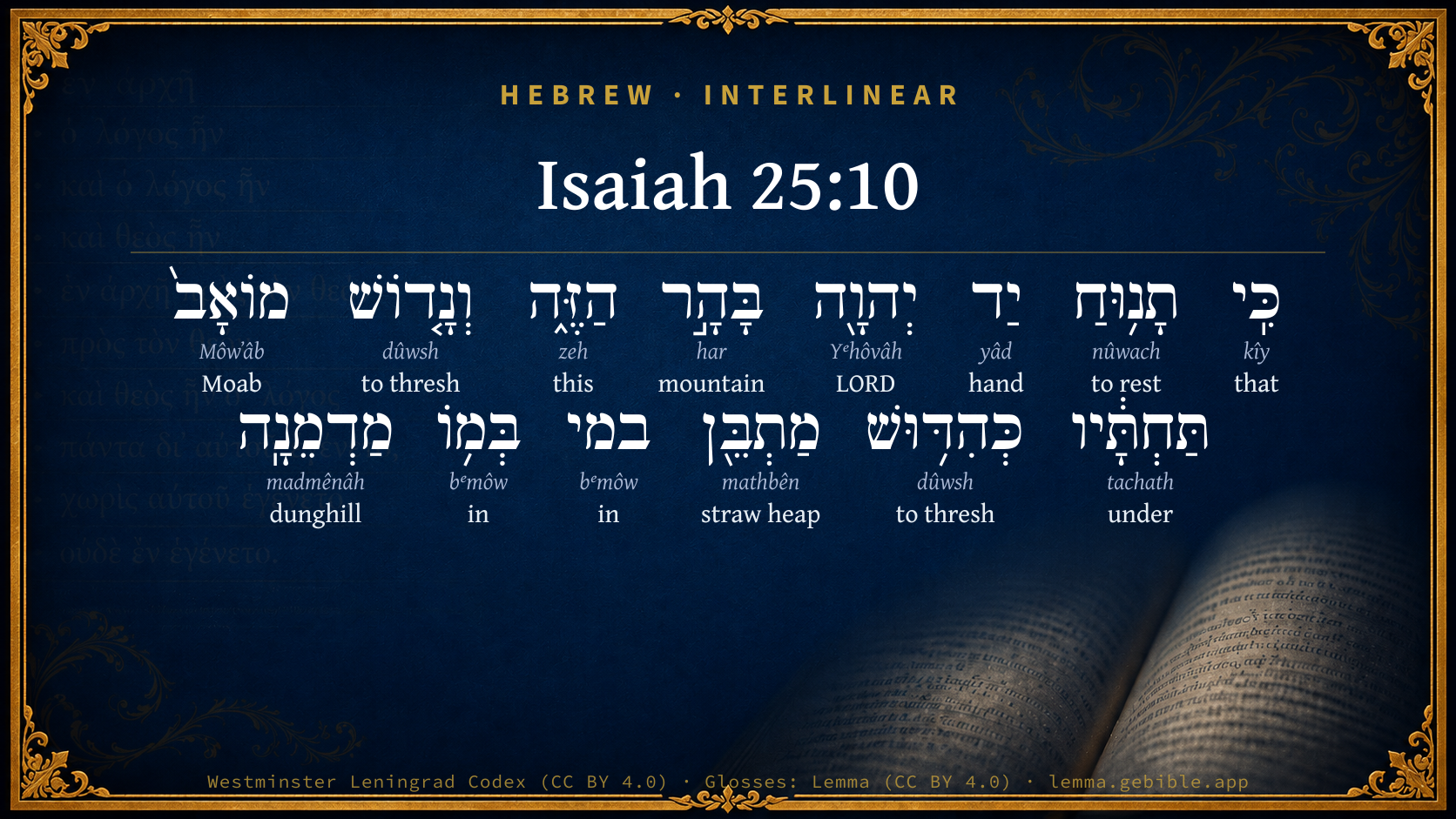
Hebrew (Westminster Leningrad Codex) Isaiah 25:10 appears in the Hebrew Old Testament. The text above is from the Westminster Leningrad Codex. Each word links to its Strong’s number, a concise gloss, and parsing drawn from the Open Scriptures Hebrew Bible morphology. Click any word for its full Brown-Driver-Briggs (BDB) entry.
Download image
Cite this verse

Isaiah 25:10 (World English Bible). Public Domain. Lemma interlinear Bible study tool, https://lemma.gebible.app/v/isaiah/25/10.

Show BibTeX & RIS
BibTeX
RIS
English Translation
For in this mountain will the hand of Yahweh rest; and Moab shall be trodden down in his place, even as straw is trodden down in the water of the dung-hill.
World English Bible · Public Domain
Highlights
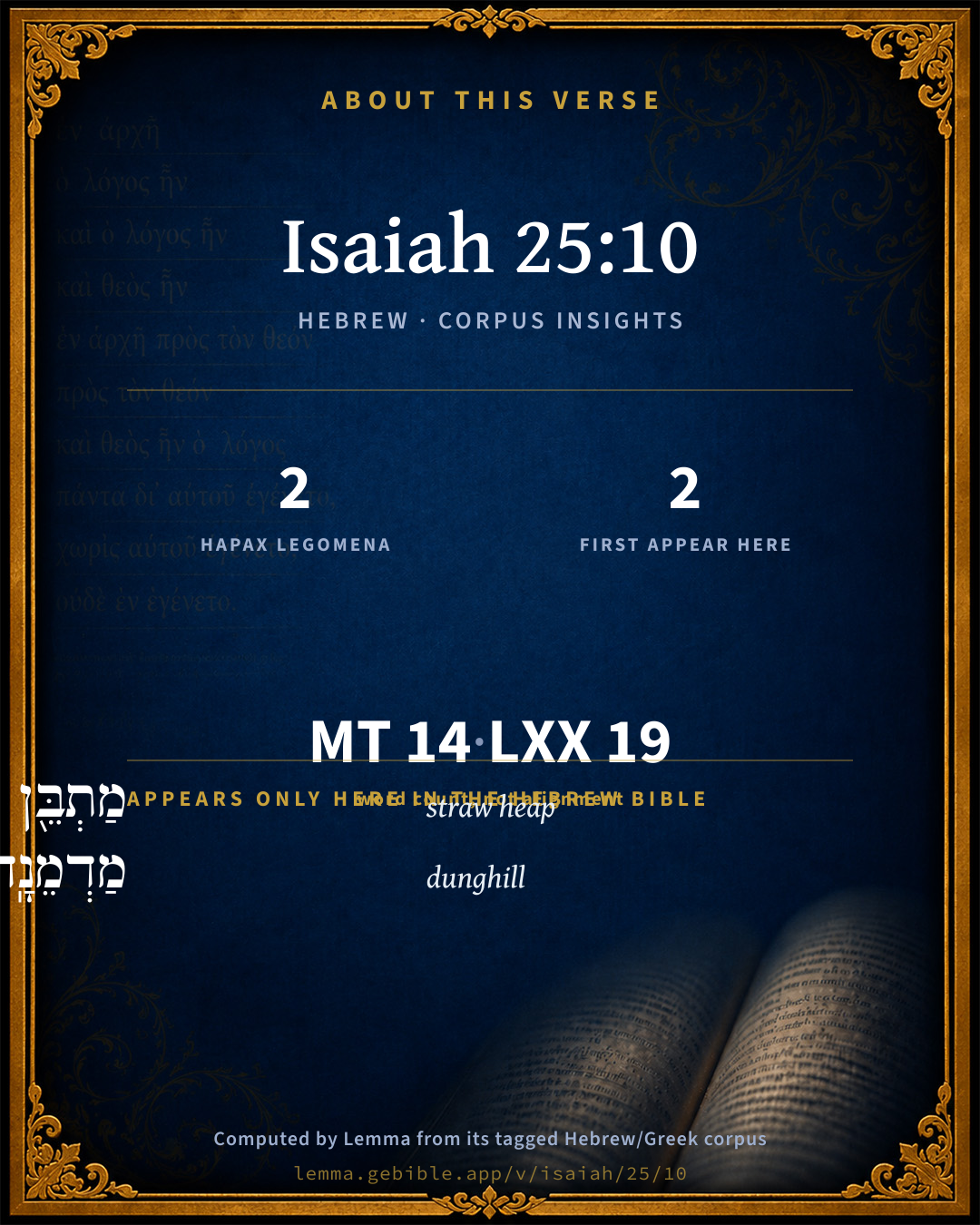
  • 2 hapax legomena — only here in the Hebrew Bible
  • 2 first appearances in the Hebrew Bible
Full analysis ↓
Download a study sheet

One document with this verse’s original text, its word-by-word gloss line, the meaning frame, cross-references with their text, attributed commentary, and full source and license credits — printable, and it pastes into notes with its structure intact.

This verse Autodidact and up

Study sheet (.html) Plain text (.txt)

A passage Seminary Student

Up to 50 verses in one chapter. A passage sheet keeps up to 6 commentary sources and 12 cross-references per verse, in the order this page ranks them, and says so on the sheet whenever that leaves anything out. Ask for a single verse and you get the Autodidact verse sheet above.

Everything on this page stays free to read, with no account — the sheet is a download of what is already on screen, not access to it.

Want to remove ads? Support Godless Engineer
Compare translations 3

The same verse in 3 English versions, stacked beneath the original-language interlinear above. Click any original word for its lexicon entry.

Each is an independent rendering of the whole verse — the interlinear is not word-aligned to these translations.

Highlighted words mark where these versions differ — a whole-verse word diff, not a word-by-word alignment.

  • World English Bible Public Domain
    For in this mountain will the hand of Yahweh rest; and Moab shall be trodden down in his place, even as straw is trodden down in the water of the dung-hill.
  • King James Version Public Domain
    For in this mountain shall the hand of the LORD rest, and Moab shall be trodden down under him, even as straw is trodden down for the dunghill.
  • unfoldingWord Literal Text CC BY-SA 4.0
    For the hand of Yahweh will rest on this mountain, and Moab will be trampled in its place as straw is trampled in a dunghill.

unfoldingWord Literal Text — © unfoldingWord, licensed CC BY-SA 4.0. Word-aligned USFM3 via Door43 (git.door43.org/unfoldingWord/en_ult).

Versions to compare (up to 4)

3 of 4 selected

Show all 17 translations

Every available English version of this verse, each an independent rendering of the whole verse.

  • World English Bible Public Domain
    For in this mountain will the hand of Yahweh rest; and Moab shall be trodden down in his place, even as straw is trodden down in the water of the dung-hill.
  • Berean Standard Bible Public Domain
    For the hand of the LORD will rest on this mountain. But Moab will be trampled in his place as straw is trodden into the dung pile.
  • Majority Standard Bible Public Domain
    For the hand of the LORD will rest on this mountain. But Moab will be trampled in his place as straw is trodden into the dung pile.
  • King James Version Public Domain
    For in this mountain shall the hand of the LORD rest, and Moab shall be trodden down under him, even as straw is trodden down for the dunghill.
  • American Standard Version (1901) Public Domain
    For in this mountain will the hand of Jehovah rest; and Moab shall be trodden down in his place, even as straw is trodden down in the water of the dung-hill.
  • Revised Version (1885) Public Domain
    For in this mountain shall the hand of the LORD rest, and Moab shall be trodden down in his place, even as straw is trodden down in the water of the dunghill.
  • Geneva Bible (1599) Public Domain
    For in this mountaine shall the hand of the Lord rest, and Moab shalbe threshed vnder him, euen as strawe is thresshed in Madmenah.
  • Young's Literal Translation Public Domain
    For rest doth the hand of Jehovah on this mountain, And trodden down is Moab under Him, As trodden down is straw on a dunghill.
  • Literal Standard Version CC BY-SA 4.0
    For the hand of YHWH rests on this mountain, || And Moab is trodden down under Him, || As straw is trodden down on a dunghill.
  • Unlocked Literal Bible CC BY-SA 4.0
    For on this mountain the hand of Yahweh will rest; and Moab will be trampled down in his place, even as straw is trampled down in a pit filled with manure.
  • unfoldingWord Literal Text CC BY-SA 4.0
    For the hand of Yahweh will rest on this mountain, and Moab will be trampled in its place as straw is trampled in a dunghill.
  • Darby Bible Public Domain
    For in this mountain shall the hand of Jehovah rest, and Moab shall be trodden down under him, as straw is trodden down in the dunghill;
  • World Messianic Bible Public Domain
    For the LORD’s hand will rest in this mountain. Moab will be trodden down in his place, even like straw is trodden down in the water of the dunghill.
  • Webster's Bible Public Domain
    For on this mountain shall the hand of the LORD rest, and Moab shall be trodden down under him, even as straw is trodden down for the dunghill.
  • Free Bible Version CC BY-SA 4.0
    The Lord's hand of protection will be on this mountain. But the Moabites will be trampled underfoot like straw into the water of a manure pit.
  • Bible in Basic English Public Domain
    For in this mountain will the hand of the Lord come to rest, and Moab will be crushed down in his place, even as the dry stems of the grain are crushed under foot in the waste place.
  • JPS Tanakh (1917) Public Domain
    For in this mountain will the hand of the LORD rest, and Moab shall be trodden down in his place, even as straw is trodden down in the dunghill.

Literal Standard Version (2020), Covenant Press — licensed CC BY-SA 4.0. Text via the HelloAO Bible API (eBible.org). Unlocked Literal Bible (unfoldingWord) — licensed CC BY-SA 4.0. Text via the HelloAO Bible API (eBible.org). unfoldingWord Literal Text — © unfoldingWord, licensed CC BY-SA 4.0. Word-aligned USFM3 via Door43 (git.door43.org/unfoldingWord/en_ult). Free Bible Version, Dr. Jonathan Gallagher — licensed CC BY-SA 4.0. Text via the HelloAO Bible API (eBible.org).

Word by word

More ways to search: Search by grammar → Find every occurrence → Compare this word →

Practice this passage: Drill this verse → Learn its vocabulary →

מַתְבֵּ֖ן
mathbên
H4963
“straw heap”
Noun, Common, Masculine, Singular, Absolute
Part of Speech
Noun
Type
Common
Gender
Masculine
Number
Singular
State
Absolute
Full BDB Definition

Origin: denominative from H8401

TWOT: 2493a

straw heap
  1. כִּֽי kîy H3588 “that” Conjunction
  2. תָנ֥וּחַ nûwach H5117 “to rest” Verb, Qal, Imperfect, 3rd Person, Feminine, Singular
  3. יַד yâd H3027 “hand of” Noun, Common, Both, Singular, Construct
  4. יְהוָ֖ה Yᵉhôvâh H3068 “LORD” Noun, Proper
  5. בָּהָ֣ר har H2022 “in/at the · mountain” Preposition, Determined + Noun, Common, Masculine, Singular, Absolute
  6. הַזֶּ֑ה zeh H2088 “the · this” Particle, Definite Article + Pronoun, Demonstrative, Masculine, Singular
  7. וְנָ֤דוֹשׁ dûwsh H1758 “and · to thresh” Conjunction + Verb, Niphal, Sequential Perfect, 3rd Person, Masculine, Singular
  8. מוֹאָב֙ Môwʼâb H4124 “Moab” Noun, Proper
  9. תַּחְתָּ֔יו tachath H8478 “under · him” Preposition + Suffix, Personal, 3rd Person, Masculine, Singular
  10. כְּהִדּ֥וּשׁ dûwsh H1758 “like/as · to thresh” Preposition + Verb, Niphal, Infinitive Construct
  11. במי bᵉmôw H1119 “in/at · in of” Preposition + Noun, Common, Masculine, Plural, Construct
  12. בְּמ֥וֹ bᵉmôw H1119 “in” Preposition
  13. מַדְמֵנָֽה madmênâh H4087 “dunghill” Noun, Common, Feminine, Singular, Absolute

About this verse

These counts appear in no published source. They are computed here, from the morphology-tagged text and Lemma’s own curated glosses. What Lemma adds →

14
words
12
distinct lemmas
Prophets
section

Notable vocabulary

2 hapax legomena — words that appear only here in the entire Hebrew Bible:

  • מַתְבֵּ֖ן straw heap H4963
  • מַדְמֵנָֽה dunghill H4087

First appearance in Scripture

These words make their first canonical appearance in the Hebrew Bible here:

  • מַתְבֵּ֖ן straw heap H4963
  • מַדְמֵנָֽה dunghill H4087

Shared distinctive vocabulary

במי in H1119 occurs in 10 verses of the Hebrew Bible. Also found in:

Grammatical profile

  • 3 verbs
  • 7 nouns
  • 1 pronoun
  • 2 prepositions
  • 1 conjunction

Verb forms

  • תָנ֥וּחַ Qal · Imperfect
  • וְנָ֤דוֹשׁ Niphal · Sequential Perfect
  • כְּהִדּ֥וּשׁ Niphal · Infinitive Construct

Repetition

Words recur within this verse — often emphatic in Hebrew:

  • וְנָ֤דוֹשׁ to thresh H1758 ×2
  • במי in H1119 ×2

Hebrew & Septuagint length

In English translation the verse runs 31 words from the Hebrew and 23 from the Septuagint (LXX English) — closely comparable.

A rough comparison of the two English renderings, which tokenize alike — not a word-level alignment.

Word counts can differ between the Hebrew and the Greek without any difference in meaning — e.g. the Hebrew direct-object marker אֵת has no separate Greek word, and Greek often adds the article ὁ.

In the original languages it is 14 Hebrew tokens and 19 Greek tokens — but the two are counted differently (Hebrew bundles its prefixes and suffixes into one token; the Greek is in lemma form), so that isn’t a like-for-like length.

Cross-references

23

Topical passages linked to Isaiah 25:10 in the Treasury of Scripture Knowledge — connected by theme and wording, ordered by reader-vote popularity; previews shown in the World English Bible.

  • Isaiah 18:4 For thus has Yahweh said to me, I will be still, and I will see in my dwelling-place, like clear heat in sunshine, like a cloud of dew in the heat of harvest.
  • Isaiah 25:6 In this mountain will Yahweh of Hosts make to all peoples a feast of fat things, a feast of wines on the lees, of fat things full of marrow, of wines on the lees well refined.
  • Isaiah 26:6 The foot shall tread it down; even the feet of the poor, and the steps of the needy.
  • Jeremiah 48:2 The praise of Moab is no more; in Heshbon they have devised evil against her: Come, and let us cut her off from being a nation. You also, Madmen, shall be brought to silence: the sword shall pursue you.
  • Amos 2:1–3 Thus says Yahweh: "For three transgressions of Moab, yes, for four, I will not turn away its punishment; Because he burned the bones of the king of Edom into lime;
  • Zephaniah 2:9 Therefore as I live, says Yahweh of Hosts, the God of Israel, surely Moab will be as Sodom, and the children of Ammon as Gomorrah, a possession of nettles, and salt pits, and a perpetual desolation. The remnant of my people will plunder them, and the survivors of my nation will inherit them.
  • Zephaniah 3:15–17 Yahweh has taken away your judgments. He has thrown out your enemy. The King of Israel, Yahweh, is in the midst of you. You will not be afraid of evil any more.
  • Numbers 24:17 I see him, but not now; I see him, but not near: There shall come forth a star out of Jacob, A scepter shall rise out of Israel, Shall strike through the corners of Moab, Break down all the sons of tumult.
  • Psalms 83:10 Who perished at Endor, Who became as dung for the earth.
  • Psalms 132:13–14 For Yahweh has chosen Zion. He has desired it for his habitation.
  • Isaiah 5:25 Therefore Yahweh's anger burns against his people, And he has stretched out his hand against them, and has struck them. The mountains tremble, And their dead bodies are as refuse in the midst of the streets. For all this, his anger is not turned away, But his hand is still stretched out.
  • Isaiah 10:6 I will send him against a profane nation, and against the people of my wrath will I give him a charge, to take the spoil, and to take the prey, and to tread them down like the mire of the streets.
  • Isaiah 10:31 Madmenah is a fugitive; the inhabitants of Gebim flee for safety.
  • Isaiah 11:10 It shall happen in that day, that the root of Jesse, who stands for an ensign of the peoples, to him shall the nations seek; and his resting-place shall be glorious.
  • Isaiah 11:14 They shall fly down on the shoulder of the Philistines on the west; together shall they despoil the children of the east: they shall put forth their hand on Edom and Moab; and the children of Ammon shall obey them.
  • Isaiah 12:6 Cry aloud and shout, you inhabitant of Zion; for great in the midst of you is the Holy One of Israel!"
  • Isaiah 14:19 But you are cast forth away from your tomb like an abominable branch, clothed with the slain, who are thrust through with the sword, who go down to the stones of the pit; as a dead body trodden under foot.
  • Isaiah 41:15–16 Behold, I have made you [to be] a new sharp threshing instrument having teeth; you shall thresh the mountains, and beat them small, and shall make the hills as chaff.
  • Lamentations 1:15 The Lord has set at nothing all my mighty men in the midst of me; He has called a solemn assembly against me to crush my young men: The Lord has trodden as in a winepress the virgin daughter of Judah.
  • Micah 4:13 Arise and thresh, daughter of Zion; For I will make your horn iron, And I will make your hoofs brass; And you will beat in pieces many peoples: And I will devote their gain to Yahweh, And their substance to the Lord of the whole earth.
  • Zechariah 9:9–11 Rejoice greatly, daughter of Zion! Shout, daughter of Jerusalem! Behold, your king comes to you! He is righteous, and having salvation; Lowly, and riding on a donkey, Even on a colt, the foal of a donkey.
  • Isaiah 15:1–9 The burden of Moab. For in a night Ar of Moab is laid waste, [and] brought to nothing; for in a night Kir of Moab is laid waste, [and] brought to nothing.
  • Ezekiel 48:35 It shall be eighteen thousand [reeds] round about: and the name of the city from that day shall be, Yahweh is there.

Cross-references courtesy of OpenBible.info (CC BY 4.0).

Hebrew and Greek witnesses Masoretic Hebrew ↔ Greek Septuagint

The same verse in the two great witnesses to the Old Testament, shown verse-for-verse.

These are two independent witnesses, not word-aligned to each other, and the Septuagint is shown in lemma (dictionary) form.

Hebrew Isaiah 25:10 Masoretic · Westminster Leningrad Codex

כִּֽי תָנ֥וּחַ יַד יְהוָ֖ה בָּהָ֣ר הַזֶּ֑ה וְנָ֤דוֹשׁ מוֹאָב֙ תַּחְתָּ֔יו כְּהִדּ֥וּשׁ מַתְבֵּ֖ן במי בְּמ֥וֹ מַדְמֵנָֽה

For in this mountain will the hand of Yahweh rest; and Moab shall be trodden down in his place, even as straw is trodden down in the water of the dung-hill.

World English Bible · Public Domain

Greek LXX Isaiah 25:10 Septuagint · lemma form

ὅτι ἀνάπαυσις δίδωμι ὁ θεός ἐπί ὁ ὄρος οὗτος καί καταπατέω ὁ μωαβῖτις ὅς τρόπος πατέω ἅλων ἐν ἅμαξα

God will give rest on this mountain, and the country of Moab shall be trodden down, as they tread the floor with wagons.

LXX2012 (modern English Septuagint) · Public Domain

On this verse, Jamieson, Fausset & Brown discusses the Septuagint’s reading. Read the note in Commentary ↓

Hebrew: Westminster Leningrad Codex (CC BY 4.0). Greek: Septuagint (public domain); English from LXX2012 (modern English Septuagint) (Public Domain). How the Septuagint differs from the Hebrew →

Targum (Aramaic paraphrase)

1

The Targum is the ancient Jewish Aramaic paraphrase of the Hebrew Scriptures — an interpretive translation, not the Hebrew text itself. Onkelos (literal) and Pseudo-Jonathan (expansive) render the Torah, and Jonathan the Prophets. Coverage is partial: where no permissively-licensed English translation exists for a verse, only the Aramaic is shown. This is verse-level text, not a word-by-word alignment to the Hebrew.

  1. Targum Jonathan Prophets (Joshua–Malachi)
    אֲרֵי תִתְגְלֵי גְבוּרְתָּא דַייָ בְּטוּרָא הָדֵין וְיִתְדָשׁוּן מוֹאֲבָאֵי בְּאַתְרֵיהוֹן כְּמָא דְמִתְּדָשׁ תִּבְנָא בְּטִינָא:

    For the power of the Lord of hosts shall be revealed in this mountain; and the Moabites shall be trodden under foot even as straw is in the clay.

    Targum Jonathan — Aramaic: “Mikraot Gedolot” (public domain). English: “Sefaria Community Translation” (CC0 1.0 (public-domain dedication)); “London "Chaldee Paraphrase," 1871” (public domain). Text via Sefaria.

Commentary

Notes on Isaiah 25:10 from classic Christian and Jewish commentators (each source and its license shown beneath its notes). The classic Christian expositions comment on the surrounding passage and are grouped to its opening verse, so a note may address several verses; the Jewish commentaries on the Tanakh (Rashi and others) are per-verse, so they appear only where the commentator wrote on this verse.

Lemma curates 59 commentaries, every one of them public domain or Creative Commons licensed, each selected and text-cleaned for this edition rather than reprinted as found. About our sources →

Trapp's Complete Commentary

John Trapp

Isa 25:10 For in this mountain shall the hand of the LORD rest, and Moab shall be trodden down under him, even as straw is trodden down for the dunghill.

Ver. 10. For in this mountain.] In the Church. {as Isa 25:6-7}

Shall the hand of the Lord rest,] i.e., Settle for their safeguard.

And Moab shall be trodden down,] i.e., Contumax quisque et perversus hostis Dei et Ecclesiae. {a} Piscator thinketh Papists are here meant by these Moabites, who were nearly allied to God’s Israel, but ardeliones, bitter and brutish enemies, skilful only to destroy. {as Eze 21:31}

As straw for the dunghill.] Or, As straw in Madmenah. {Jer 48:2} God will make a hand of all his people’s adversaries, as is here and in the following verses set forth by three several metaphors.

{a} Junius.

John Trapp, A Commentary or Exposition upon All the Books of the Old and New Testament (1647–1656) — public domain. Text from a community e-Sword module.

The Biblical Illustrator

Joseph S. Exell

Isa_25:10

Moab shall be trodden down under Him

Gods judgments manure

After the process of primary ploughing has been completed our fields are covered with some appropriate manure, that the earth may be enriched, and larger crops gathered into our barns.

In the world at large which is Gods husbandry, His judgments, which deface and destroy countries and nations, are clearly intended, in their remoter influence, to effect the subsequent fruitfulness of those very spots: and the products of righteousness, in larger abundance, have been gathered among those people where the full measure of Divine vengeance had been previously poured. When His judgments are in the earth, the inhabitants will learn righteousness. (W. Clayton.)

The ground manured

Our text will furnish us with an occasion to establish and illustrate the fast that Divine vengeance shall overwhelm the enemies of the Church; and from their disgraceful ruin shall result advantage to the cause, and glory to the perfections of Deity.

I. GOD HAS REVEALED HIS WRATH FROM HEAVEN AGAINST ALL UNGODLINESS AND UNRIGHTEOUSNESS OF MEN; and although slack in executing His threatenings, as some men count slackness, the expected day of the Lords vengeance will certainly and suddenly arrive.

1. However exalted among the great ones of the earth offenders have been, the just displeasure of God has been displayed, and vengeance has overwhelmed them.

2. As no person, however elevated, is exempt from the judicial control of the Most High; so no part of the world is found where this truth has not been proclaimed.

3. In every successive age have these truths received an awful confirmation.

II. THESE SIGNAL PROOFS OF GODS DISPLEASURE PROMOTE THE BEST INTERESTS OF ZION, and consequently redound to His glory.

1. A large accession to the Church on earth is stated to be the immediate consequence of the ruin of Moab (Isa_26:1-2). In a degree infinitely more astonishing shall the final destruction of Zions foes precede the period of her destined perfection on earth.

2. It is pleasant to see the strength and establishment of Zion resulting from the demolition of the schemes which were formed for her ruin.

3. The rich and abundant fruitfulness of the Church--the field which God blesseth--is advanced by these displays of His vindictive wrath

III. CONCLUSION.

1. We are taught to whose culture we are exclusively indebted, if these fruits of righteousness are in our case the results of beholding Gods judgments. Manure spread on the ground will only render weeds, its natural product, of more luxuriant and disgusting growth; nor will the Divine judgments, but for the subsequent care and cultivation of the Great Husbandman, promote the salutary change which is desired.

2. Do not our minds, necessarily, when contemplating any species of suffering, revert to Him who was bruised or threshed for our sakes; who, bearing the indignation of the Lord because we have sinned against Him, was trodden down as mire in the streets by ungodly men, and finally suffered without the camp; and to those also who, being conformed to His death, were esteemed the off-scouring of all men, of whom the world was not worthy?

3. Estimate aright the invaluable privilege of being interested in the cultivating care of the great Husbandman. (W. Clayton.)

Moab

As the name British in our own revolutionary war became equivalent to hostile, without losing its specific sense, so might the prophets threaten Moab with Gods vengeance, without meaning to exclude from the denunciation other like-minded enemies. (J. A. Alexander, U. S. A.)

The Biblical Illustrator, edited by Joseph S. Exell (c. 1880s–1900s) — public domain. Text from a community e-Sword module.

Joseph Benson's Commentary

Isa 25:10. For in this mountain — In the gospel church; (he alludes to mount Zion, which was a type of it;) shall the hand of the Lord rest — His powerful and gracious presence (which is often signified in Scripture by God’s hand) shall have its constant and settled abode: it shall not move from place to place, as it formerly did, with the tabernacle; nor shall it depart as it did from Jerusalem, but shall continue in his church, even to the end of the world, Mat 28:20. And Moab shall be trodden down under him. — Under his feet, as appears by the following similitude. The Moabites, having been constant and implacable enemies to Israel, are here put for all the enemies of God’s church, as the Edomites upon the same account are, chap. 34:6, and 63:1. Even as straw is trodden down — Even as easily and effectually as the straw, left upon the ground, is trampled upon by the feet of men and beasts.

Joseph Benson's Commentary on the Old and New Testaments (1811–1818) — public domain. Text from a community e-Sword module.

The Preacher's Complete Homiletical Commentary

Joseph S. Exell (gen. ed.)

THE PROTECTING HAND

Isa_25:10. For in this mountain shall the hand of the Lord rest.

“Rest!” As a father’s hand on the head of his first-born, blessing and protecting his child. That mountain is impregnable which rests under the shadow of God’s hand.

I. Of every enterprise we should ask, “Is it right?” If wickedness be in “the mountain,” God’s protecting hand will not rest upon it. A just cause creates a good conscience, and hence inspires strength. It is only the just man who feels that God “teaches his hands to war and his fingers to fight, so that a bow of steel is broken by his arms.” “The righteous is bold as a lion.” The good man can patiently wait and confidently expect God’s blessing (Jas_5:7).

II. Material force allied with injustice will eventually become weak as straw, vile as a dung-heap. The strong places of Moab had no inherent lastingness, because built in a godless spirit (Psa_127:1).

III. Forts and castles, ironclads and armies, can never save an unrighteous nation from decay. National selfishness, oppressive enterprises, weaken the strongest defences, corrupt the richest treasures. Babylon became a marsh, Nineveh a forsaken mound, Tyre a deserted rock. In the colloseum at Rome where martyrs bled, the fox, the bat, and the owl now make their home. The walls of Moab were levelled with the dust. By justice only can peoples be strong. If God be in the city, its walls will be lasting as the hills.—William Parkes.

The Preacher's Complete Homiletical Commentary (gen. ed. Joseph S. Exell; Funk & Wagnalls, c. 1892) — public domain (pre-1929). A full-Bible homiletical/sermon-outline anthology covering 65 of 66 books (2 John is absent from the source module). Text from a community e-Sword module.

Tyndale Open Study Notes

Tyndale Open Resources

25:10 on Jerusalem: Literally on this mountain. • Moab (see 15:1–16:14) here represents the nations under judgment, those who trust only themselves (see 34:5-17). • like straw trampled down: The people would be helpless and dying in the most degrading circumstances.

Tyndale Open Study Notes — © Tyndale Open Resources, licensed CC BY-SA 4.0. Text via the HelloAO Bible API.

Geneva Bible (1599)

Geneva Bible translators

There were two cities of this name: one in Judah, 1 Chron. 2:49, and another in the land of Moab, Jer. 48:2, which seemeth to have been a plentiful place of corn, Isa. 10:31.

By Moab are meant all the enemies of his Church.

Geneva Bible (1599) marginal notes — public domain. Text via Bolls.life.

Jamieson, Fausset & Brown

Robert Jamieson, A. R. Fausset & David Brown

rest--as its permanent protector; on "hand" in this sense; compare Ezr 7:6, Ezr 7:28.

Moab--while Israel is being protected, the foe is destroyed; Moab is the representative of all the foes of God's people.

under him--Rather, "in his own place" or "country" (Exo 10:23; Exo 16:29).

for the dunghill--Rather, "in the water of the dung heap," in which straw was trodden to make it manure (Psa 83:10). HORSLEY translates either, "in the waters of Madmenah," namely, for the making of bricks; or as the Septuagint, "as the threshing-floor is trampled by the corn-drag" (see Margin; Mic 4:11-13).

Jamieson, Fausset & Brown — Commentary Critical and Explanatory on the Whole Bible (1871) — public domain (CC PDM 1.0). Text via the HelloAO Bible API.

Adam Clarke's Commentary

Verse 10. Shall the hand of the Lord rest - "The hand of JEHOVAH shall give rest"] Heb. תנוח tenuach, quiescet. Annon תניח taniach, quietem dabit, shall rest; shall give rest, ut Graeci, αναπαυσιν δωσει, et Copt.? - Mr. WOIDE. That is, "shall give peace and quiet to Sion, by destroying the enemy;" as it follows.

As straw is trodden down - "As the straw is threshed"] Hoc juxta ritum loquitur Palastinae et multarum Orientis provinciarum, quae ob pratorum et foeni penuriam paleas preparant esui animantium. Sunt autem carpenta ferrata rotis per medium in serrarum modum se volventibus, quae stipulam conterunt; et comminuunt in paleas. Quomodo igitur plaustris ferratis paleae conteruntur, sic conteretur Moab sub eo; sive sub Dei potentia, sive in semetipso, ut nihil in eo integri remaneat. "This is spoken in reference to the mode of threshing in Palestine, and various other Asiatic provinces. Because of the scarcity of meadow land and hay they make chopped straw for the cattle. They have large wheels studded over with iron teeth or nails, by which, on the out-of-door threshing-floors, they pound and reduce the straw into chaff. As, therefore, the straw is reduced to chaff by bringing the iron-shod wheel over it; so shall Moab be bruised by the power of God, that nothing whole shall remain." - Hieron. in loc. See Clarke on Isa 28:27.

For the dunghill - "Under the wheels of the car."] For מדמנה madmenah, the Septuagint, Syriac, and Vulgate read מרכבה mercabah, which I have followed. See Jos 15:31, compared with Jos 19:5, where there is a mistake very nearly the same. The keri, במי bemi, is confirmed by twenty-eight MSS., seven ancient, and three editions.

Adam Clarke's Commentary on the Bible (1810–1826) — public domain. Text from a community e-Sword/MySword module.

Ellicott's Commentary for English Readers

(10) Moab shall be trodden down . . .—There seems at first something like a descent from the great apocalypse of a triumph over death and sin and sorrow, to a name associated with the local victories or defeats of a remote period in the history of Israel. The inscription of the Moabite stone, in connection with Isaiah 15, helps to explain the nature of the allusion. Moab had been prominent among the enemies of Israel; the claims of Chemosh, the god of Moab, had been set up against those of Jehovah, the God of Israel (Records of the Past, xi. 166), and so the name had become representative of His enemies. There was a mystical Moab, as there was afterwards a mystical Babylon, and in Rabbinic writings a mystical Edom (i.e., Rome). The proud nation was to lie wallowing in the mire of shame, trampled on by its s on the threshing-floor is trampled by the oxen till it looks like a heap of dung. In the Hebrew word for “dunghill” (madmçnah) we may probably trace a reference to the Moabite city of that name (Jer_48:2), in which Isaiah sees an unconscious prophecy of the future condition of the whole nation.

A Bible Commentary for English Readers, edited by Charles John Ellicott (1878–1897) — public domain. Text from a community e-Sword module.

The Cambridge Bible for Schools and Colleges

gen. ed. J. J. S. Perowne

10. The fate of Moab is contrasted with that of Israel. It is as if one hand of Jehovah rested lightly and protectingly on Zion while the other crushes and extinguishes Moab.

under him] means “under himself,” i.e. in the place where he (Moab) stands.

for the dunghill] R.V. in the water of the dunghill rightly follows the consonantal text in opposition to the Massoretic tradition. But it should have at the same time substituted “dung-pit” for “dunghill.” This word (madmçnâh) is perhaps a play on the name Madmen (Jer_48:2); it also resembles the word for “straw” (mathbçn).

The Cambridge Bible for Schools and Colleges (gen. ed. J. J. S. Perowne; Cambridge University Press, 1878–1918) — public domain. Text from a community e-Sword module.

John Gill's Exposition

For in this mountain shall the hand of the Lord rest,.... Where he will make the feast of fat things, Isa 25:6 even in his church, which is his resting place, and where he delights to dwell; and over whom his hand is, and abides for their protection and safeguard; and where he gives rest, as the Septuagint (k) render it; even spiritual rest to the souls of his people; and where, as the Targum has it,

"the power of the Lord is revealed;''

namely, in the preservation of his church, and in the destruction of its enemies; as follows:

and Moab shall be trodden down under him: under the Lord, and his mighty hand of power; or "under it"; under the mountain, the church; under the feet of the saints; see Mal 4:2 or, "in his place" (l), as Jarchi and Kimchi explain it; wherever he is, or shall be found, where he lies there shall he be trodden upon. By Moab the enemies of the church are meant, and is put for them all, even all the antichristian powers, both Turks and Papists; their ruin is expressed by treading down or threshing, in allusion to the threshing of corn, as the word used mostly signifies, when the straw is bruised by the cartwheel, or the feet of oxen; or to the treading of straw in the mire, as follows:

even as straw is trodden down for the dunghill; or in "it" (m); or "in the waters of the dunghill" (n), as the Cetib; where being cast and trodden, it rots, and becomes dung; and so the Targum,

"as straw is trodden in the clay;''

Jarchi interprets it to this sense. R. Joseph Kimchi takes it to be the name of a place, Madmenah, which was one of the cities of Moab, Jer 48:2.

(k) . (l) "apud se", i.e. "in loco suo", Vatablus, Junius & Tremellius. (m) as the Keri or marginal reading directs it should be read. (n) in "aquis sterquilinii", De Dieu.

John Gill's Exposition of the Whole Bible (1746–1763) — public domain (CC PDM 1.0). Text via the HelloAO Bible API.

Albert Barnes' Notes on the Bible

For in this mountain - In mount Zion.

Shall the land of the Lord rest - “The hand” in the Scriptures is often used as the symbol of protection and defense. By the expression that the hand of Yahweh should REST on mount Zion, is meant probably that be would be its defender; his protection would not be withdrawn, but would be permanent there. For an illustration of the phrase, see a similar use of the word hand as denoting protection, in Ezr 7:6, Ezr 7:28; Ezr 8:18, Ezr 8:22, Ezr 8:31; Neh 2:8.

And Moab - (For an account of Moab, see the notes at Isa 15:1-9; Isa 16:1-14.) Moab here seems to be used in a general sense to denote the enemies of God, a and the declaration that it would be trodden down seems designed to indicate that the foes of God and his people would all be destroyed (compare the notes at Isa. 34)

Under him - The Chaldee renders this, ‘In his own place.’ The phrase has the sense of ‘in his place,’ in Exo 16:29; 2Sa 2:23. Here it may mean that Moab, or the enemies of God, would be trodden down and destroyed in their own land.

As straw is trodden down for the dunghill - As straw is suffered to lie in the yard where cattle lie, to be trodden down by them for the purpose of making manure. Lowth renders this,

‘As the straw is threshed under the wheels of the car.’

The Septuagint renders it in the same way. Lowth supposes that there has been an error in transcribing the Hebrew text, and that the former reading was מדכבה instead of מדמנה. But there is not the slightest evidence from the MSS that any such mistake has occurred. Nor is it necessary to suppose it. The image is one that is not of unfrequent occurrence in the Scriptures, to denote the complete and disgraceful prostration of an enemy (see Psa 83:10; 2Ki 9:37; Jer 8:2; Jer 9:22; Jer 16:4; Jer 25:33).

Albert Barnes' Notes on the Bible (1834–1885) — public domain. Text from a community e-Sword/MySword module.

Haydock's Catholic Bible Commentary

Mountain: the Church. (Calmet) --- Moab. That is, the reprobate, whose eternal punishment, from which they can no way escape, is described under these figures. (Challoner) --- The Machabees probably executed this vengeance on Moab, 1 Machabees v. 6.

George Leo Haydock (1774–1849), Haydock's Catholic Family Bible and Commentary, 1859 edition — public domain. Excludes Psalms (Douay-Rheims chapter numbering differs from Protestant) and Deuterocanonical books (Catholic canon only).

Matthew Poole's English Annotations

Shall the hand of the Lord rest; the powerful and gracious presence of God (which is oft signified in Scripture by God’s hand) shall have its constant and settled abode; it shall not move from place to place, as it did with the tabernacle; nor shall it depart from it, as it did from Jerusalem; but shall continue in his church even to the end of the world, Mat 28:20.

Moab; the Moabites, which having been constant and implacable enemies to Israel, are synecdochically put for all the enemies of God’s church, as the Edomites upon the same account are, Isa 34:6; 63:1.

Under him; under his feet, as appears by the following similitude.

Even as straw is trodden down for the dunghill; as easily and as effectually as the straw, which being left upon the ground, and mixed with the dung which lies there, is trampled upon by the feet of men and beasts.

Matthew Poole's English Annotations on the Holy Bible (1683–1685) — public domain. Text from a community e-Sword/MySword module.

Whedon's Commentary on the Bible

Daniel D. Whedon

10. In this mountain — Zion, symbol again of God’s located presence and power, namely, his Church.

Hand… rest — The term “hand” is usually employed as an emblem of active power; it is here used as the pledge of the Church’s security from hostility without a protection, and that hostility to Zion the Jews more readily and keenly apprehended when it was expressed in connexion with a “household” name of an ever bitter enemy to the Jews. Usually that name was Edom or Moab. Here it is Moab. Moab’s hostility is to have the fate of the refuse, dirt, and filth of each Palestinian town — removal to the dunghill, which to this day is everywhere in the villages a conspicuous object.

Daniel D. Whedon (gen. ed.), Commentary on the Old and New Testaments (1874–1909) — public domain. Text from a community e-Sword module.

The Pulpit Commentary

In this mountain shall the hand of the Lord rest. The protecting hand of God will ever be stretched out over the spiritual Zion the Church of the Redeemed to defend it and keep it safe throughout eternity. Moab shall be trodden down. Various reasons have been given for the selection of Moab to represent the enemies of the redeemed. Perhaps, as the Moabites were, on the whole, the bitterest of all the adversaries of the Jews, (see 2Ki_24:2 Eze_25:8-11) they are regarded as the fittest representatives of the human adversaries of God. For the dung-hill; rather, in the water of a dung-pit. The image is, perhaps, selected with conscious reference to Psalm 83., where the psalmist prays that the "children of Lot" and their helpers may become "as the dung of the earth" (ver. 10).

The Pulpit Commentary (1880–1919), ed. H.D.M. Spence-Jones & Joseph S. Exell — public domain. Text from a community e-Sword module.

John Wesley's Explanatory Notes

Rest - The powerful and gracious presence, of God shall have its constant and settled abode. Moab - The Moabites are put for all the enemies of God's church.

John Wesley, Explanatory Notes Upon the Whole Bible (1754–1765) — public domain. Text via the GEBible commentary corpus.

Keil & Delitzsch

C. F. Keil & F. Delitzsch

In the land of promise there is rejoicing, but on the other side of the Jordan there is fear of ruin. Two contrasted pictures are placed here side by side. The Jordan is the same as the "great gulf" in the parable of the rich man. Upon Zion Jehovah descends in mercy, but upon the highlands of Moab in His wrath. "For the hand of Jehovah will sink down upon this mountain, and Moab is trodden down there where it is, as straw is trodden down in the water of the dung-pit. And he spreadeth out his hands in the pool therein, as the swimmer spreadeth them out to swim; but Jehovah forceth down the pride of Moab in spite of the artifices of his hands. Yea, thy steep, towering walls He bows down, forces under, and casts earthwards into dust." Jehovah brings down His hand upon Zion (nūach, as in Isa 7:2; Isa 11:1), not only to shelter, but also to avenge. Israel, that has been despised, He now makes glorious, and for contemptuous Moab He prepares a shameful end. In the place where it now is תּחתּיו, as in Sa2 7:10; Hab 3:16, "in its own place," its own land) it is threshed down, stamped or trodden down, as straw is trodden down into a dung-pit to turn it into manure: hiddūsh, the inf. constr., with the vowel sound u, possibly to distinguish it from the inf. absol. hiddosh (Ewald, 240, b). Instead of בּמו (as in Isa 43:2), the chethib has בּמי (cf., Job 9:30); and this is probably the more correct reading, since madmēnâh, by itself, means the dunghill, and not the tank of dung water. At the same time, it is quite possible that b'mo is intended as a play upon the name Moab, just as the word madmēnâh may possibly have been chosen with a play upon the Moabitish Madmēn (Jer 48:2). In Isa 25:11 Jehovah would be the subject, if b'kirbo (in the midst of it) referred back to Moab; but although the figure of Jehovah pressing down the pride of Moab, by spreading out His hands within it like a swimmer, might produce the impression of boldness and dignity in a different connection, yet here, where Moab has just been described as forced down into the manure-pit, the comparison of Jehovah to a swimmer would be a very offensive one. The swimmer is Moab itself, as Gesenius, Hitzig, Knobel, and in fact the majority of commentators suppose. "In the midst of it:" b'kirbo points back in a neuter sense to the place into which Moab had been violently plunged, and which was so little adapted for swimming. A man cannot swim in a manure pond; but Moab attempts it, though without success, for Jehovah presses down the pride of Moab in spite of its artifices עם, as in Neh 5:18; ארבּות, written with dagesh (according to the majority of MSS, from ארבּה, like the Arabic urbe, irbe, cleverness, wit, sharpness), i.e., the skilful and cunning movement of its hands. Saad. gives it correctly, as muchâtale, wiles and stratagems; Hitzig also renders it "machinations," i.e., twistings and turnings, which Moab makes with its arms, for the purpose of keeping itself up in the water. What Isa 25:11 affirms in figure, Isa 25:12 illustrates without any figure. If the reading were מבצרך חומות משׂגּב, the reference would be to Kir-Moab (Isa 15:1; Isa 16:7). But as the text stands, we are evidently to understand by it the strong and lofty walls of the cities of Moab in general.

Keil & Delitzsch — Biblical Commentary on the Old Testament (1861–1891) — public domain (CC PDM 1.0). Text via the HelloAO Bible API. (Old Testament only.)

J. A. Alexander on Isaiah

Joseph Addison Alexander

“For the hand of Jehovah shall rest upon this mountain, and Moab shall be trodden down under Him (or in his place) as straw is trodden in the water of the dunghill.” While Israel shall thus enjoy the permanent protection of Jehovah, His inveterate enemies shall experience ignominious destruction. God’s hand is the symbol of His power, its resting on an object is the continued exercise of that power, whether for good or evil. This is determined by the nature of the object, as this mountain cannot well mean anything but what is meant in vs. 6, 7, to wit, Mount Zion or the church of God, and the promise of the foregoing context must of course be continued here. Moab and Edom were the two hereditary and inveterate enemies of Israel, their hatred being rendered more annoying and conspicuous by their affinity and neighboring situation. Hence they are repeatedly mentioned, separately or together, as the representatives of obstinate and malignant enemies in general. As the name British, in our own revolutionary war, became equivalent to hostile, without losing its specific sense, so might the Prophets threaten Moab with God’s vengeance, without meaning to exclude from the denunciation other like-minded enemies. This wide interpretation, both of Moab and Edom, is confirmed by the fact that one of them is often mentioned where both would seem to be equally included. The figure in the last clause is strongly expressive both of degradation and destruction. Moab is likened not only to straw, but to straw left to rot for the dunghill. The idea of subjection and ruin is expressed by the figure of treading down or trampling under foot. The Hebrew word is commonly translated thresh; but as the oriental threshing was performed for the most part by the feet of cattle, this sense and that of treading down are really coincident. Under him may either mean under Jehovah or under himself that is, in his own place, in the country of Moab, or wherever he is found.

Joseph Addison Alexander, The Prophecies of Isaiah (1846–1847; New York: Scribner, 1870–1878) — public domain. Text from a community e-Sword module.

Rashi

Rabbi Shlomo Yitzchaki (Rashi)

For the hand of the Lord shall rest The might of the Omnipresent.

shall be trampled וְנָדוֹשׁ, shall be trampled.

in its place (תַּחְתָּיו, lit., under him,) in its place. וְנָדוֹשׁ is of the same structure as (Eccl. 12: 6) “And the wheel is crushed (וְנָרוֹץ),” the “nun” indicating the passive voice.

straw (מַתְבֵּן) derived from תֶּבֶן.

mire (מַדְמֵנָה) mire. Comp. (Jer. 8:2) “For dung (לְדֹמֶן) on the face of the earth.”

Rashi on the Tanakh — English translations: “The Judaica Press complete Tanach with Rashi, translated by A. J. Rosenberg” (CC BY 4.0); “Pentateuch with Rashi's commentary by M. Rosenbaum and A.M. Silbermann, 1929-1934” (public domain); “The Metsudah Tanach series, Lakewood, N.J” (CC BY 4.0); and “The Book of Joshua, Metsudah Publications, 1997” (CC BY 4.0). Text via Sefaria.

Ibn Ezra

Rabbi Abraham ibn Ezra

The hand of the Lord. His punishment.

Moab, that will come to help the besiegers of Zion.

ונדוש And shall be trodden down. Niphal of a verb (דוש) ע״ו or בְּהִדּוּשׁ.(דשש) ע״ע As is trodden down. Infinitive Niphal; וּ is here instead of וֹ; these two vowels are capable of interchange.

מדמנה Dunghill.

Ibn Ezra on the Tanakh — English translations: “Sefaria Community Translation” (CC0 1.0 (public-domain dedication)); “Yalkut, Sifsei Chachomim Chumash, Metsudah Publications, 2009” (CC BY 4.0); and “Commentary of Ibn Ezra on Isaiah - trans. by M. Friedlander, 1873” (public domain). Text via Sefaria.

Lesson kit

Teaching starters — assembled from the data on this page, not authored interpretation. Every prompt links to the verse data it draws on. Edit before teaching.

Isaiah, in the Prophets, opens this verse with 14 words (12 distinct Hebrew lemmas). Its most distinctive word is mathbên (“straw heap”). A historical commentator’s framing appears above. Read the whole chapter for the surrounding context.

Discussion questions

  1. The word mathbên carries the sense “straw heap.” How does it shape the verse?
  2. 2 words here appear nowhere else in the Hebrew Bible. Why might the author reach for such rare wording?
  3. 2 words make their first appearance in Scripture here. What does this debut establish?
  4. How does Job 9:30, which shares the word «in», read alongside this verse?
  5. What does the repetition of “to thresh” (2× in this one verse) do in this verse?
  6. These translations render this verse differently; the difference is in the English rendering, not the original. What questions does that raise?
  7. «תָנ֥וּחַ» is a Qal Imperfect verb. How does that grammatical form shape the action described?
  8. Compare how Trapp's Complete Commentary and The Biblical Illustrator read this verse. Where do they agree or differ?

Things to notice

  • 2 words in this verse appear nowhere else in the Hebrew Bible.
  • 2 words make their first canonical appearance in Scripture here.
  • This verse counts 14 Hebrew ↔ 19 Greek words.
  • These translations choose different wording for 14 words in this verse.
  • “to thresh” occurs 2× in this single verse.

Reading settings

Reading text

Shown beneath each verse's original-language words.

Old Testament
Old Testament edition

Read the OT as the Masoretic Hebrew (MT) or the Greek Septuagint (LXX).

English shown for the Greek Septuagint (in the Hebrew ↔ Greek comparison).

Comparing translations? Open the Compare panel on any verse page to stack up to four side by side.