Numbers 21:11

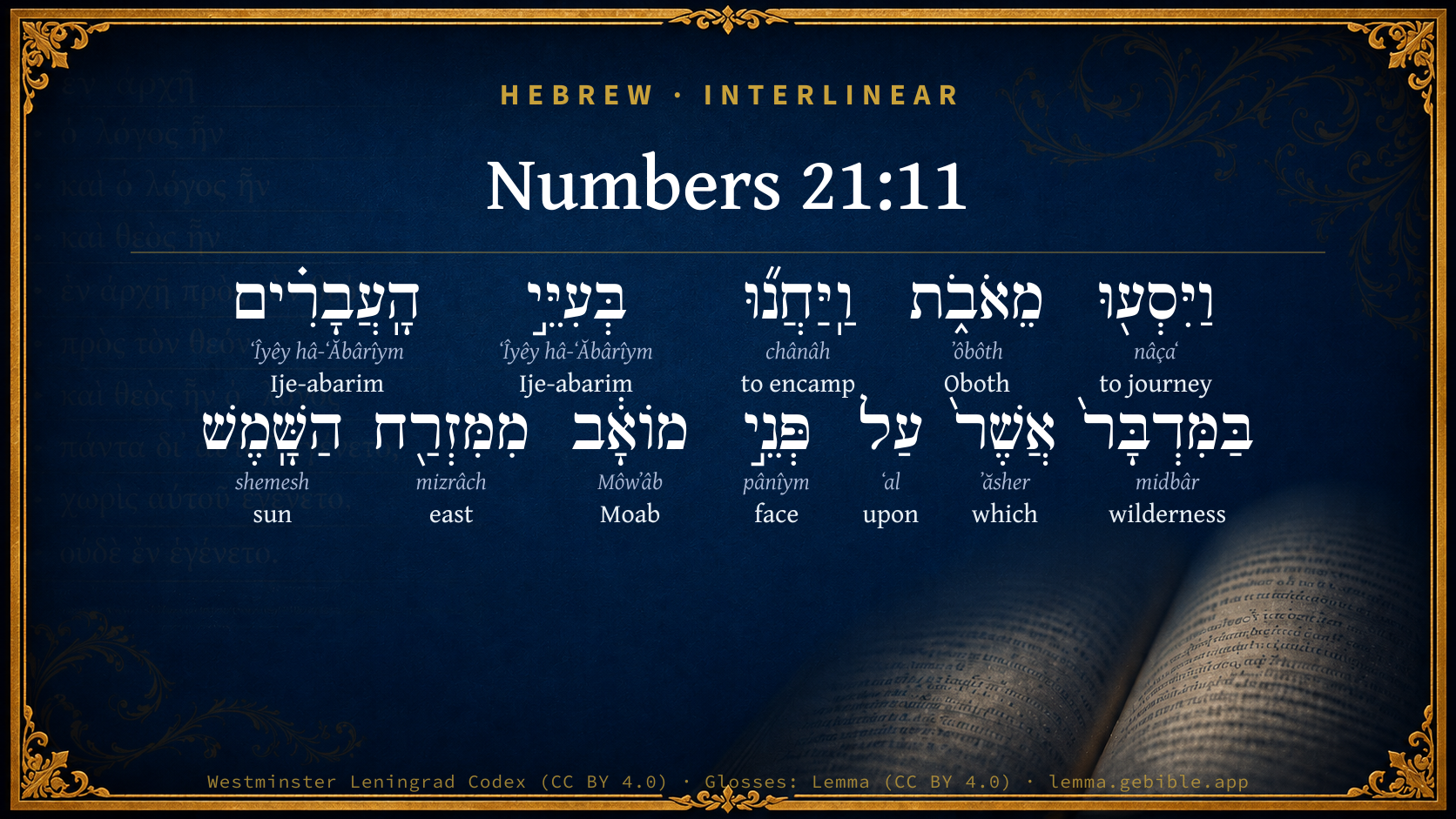
Hebrew (Westminster Leningrad Codex) Numbers 21:11 appears in the Hebrew Old Testament. The text above is from the Westminster Leningrad Codex. Each word links to its Strong’s number, a concise gloss, and parsing drawn from the Open Scriptures Hebrew Bible morphology. Click any word for its full Brown-Driver-Briggs (BDB) entry.
Download image
Cite this verse

Numbers 21:11 (World English Bible). Public Domain. Lemma interlinear Bible study tool, https://lemma.gebible.app/v/numbers/21/11.

Show BibTeX & RIS
BibTeX
RIS
English Translation
They traveled from Oboth, and encamped at Iyeabarim, in the wilderness which is before Moab, toward the sunrise.
World English Bible · Public Domain
Highlights
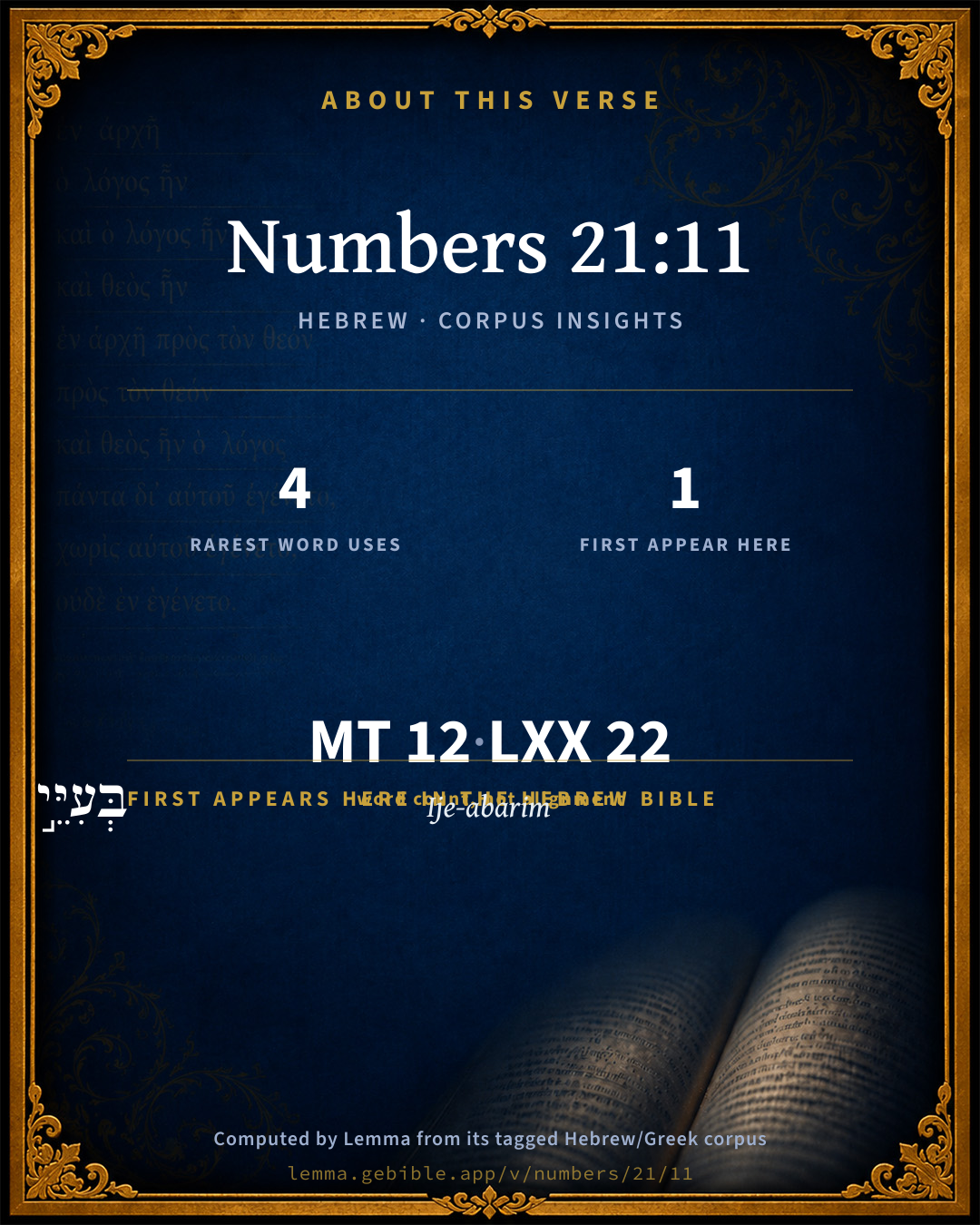
  • 1 first appearance in the Hebrew Bible
Full analysis ↓
Download a study sheet

One document with this verse’s original text, its word-by-word gloss line, the meaning frame, cross-references with their text, attributed commentary, and full source and license credits — printable, and it pastes into notes with its structure intact.

This verse Autodidact and up

Study sheet (.html) Plain text (.txt)

A passage Seminary Student

Up to 50 verses in one chapter. A passage sheet keeps up to 6 commentary sources and 12 cross-references per verse, in the order this page ranks them, and says so on the sheet whenever that leaves anything out. Ask for a single verse and you get the Autodidact verse sheet above.

Everything on this page stays free to read, with no account — the sheet is a download of what is already on screen, not access to it.

Want to remove ads? Support Godless Engineer
Compare translations 3

The same verse in 3 English versions, stacked beneath the original-language interlinear above. Click any original word for its lexicon entry.

Each is an independent rendering of the whole verse — the interlinear is not word-aligned to these translations.

Highlighted words mark where these versions differ — a whole-verse word diff, not a word-by-word alignment.

  • World English Bible Public Domain
    They traveled from Oboth, and encamped at Iyeabarim, in the wilderness which is before Moab, toward the sunrise.
  • King James Version Public Domain
    And they journeyed from Oboth, and pitched at Ijeabarim, in the wilderness which is before Moab, toward the sunrising.
  • unfoldingWord Literal Text CC BY-SA 4.0
    And they set out from Oboth and camped at Iye Abarim in the wilderness that on the face of Moab, from the rising of the sun.

unfoldingWord Literal Text — © unfoldingWord, licensed CC BY-SA 4.0. Word-aligned USFM3 via Door43 (git.door43.org/unfoldingWord/en_ult).

Versions to compare (up to 4)

3 of 4 selected

Show all 18 translations

Every available English version of this verse, each an independent rendering of the whole verse.

  • World English Bible Public Domain
    They traveled from Oboth, and encamped at Iyeabarim, in the wilderness which is before Moab, toward the sunrise.
  • Berean Standard Bible Public Domain
    They journeyed from Oboth and camped at Iye-abarim in the wilderness opposite Moab to the east.
  • Majority Standard Bible Public Domain
    They journeyed from Oboth and camped at Iye-abarim in the wilderness opposite Moab to the east.
  • King James Version Public Domain
    And they journeyed from Oboth, and pitched at Ijeabarim, in the wilderness which is before Moab, toward the sunrising.
  • American Standard Version (1901) Public Domain
    And they journeyed from Oboth, and encamped at Iyeabarim, in the wilderness which is before Moab, toward the sunrising.
  • Revised Version (1885) Public Domain
    And they journeyed from Oboth, and pitched at Iye-abarim, in the wilderness which is before Moab, toward the sunrising.
  • Geneva Bible (1599) Public Domain
    And they departed from Oboth, and pitched in lie-abarim, in the wildernesse, which is before Moab on the Eastside.
  • Douay-Rheims (1899) Public Domain
    And departing thence they pitched their tents in Jeabarim, in the wilderness, that faceth Moab toward the east.
  • Young's Literal Translation Public Domain
    And they journey from Oboth, and encamp in Ije-Abarim, in the wilderness that `is' on the front of Moab, at the rising of the sun.
  • Literal Standard Version CC BY-SA 4.0
    And they journey from Oboth and encamp in Ije-Abarim, in the wilderness that [is] on the front of Moab, at the rising of the sun.
  • Unlocked Literal Bible CC BY-SA 4.0
    They traveled from Oboth and camped at Iye Abarim in the wilderness that faces Moab toward the east.
  • unfoldingWord Literal Text CC BY-SA 4.0
    And they set out from Oboth and camped at Iye Abarim in the wilderness that on the face of Moab, from the rising of the sun.
  • Darby Bible Public Domain
    And they removed from Oboth, and encamped at Ijim-Abarim, in the wilderness that is before Moab, toward the sun-rising.
  • World Messianic Bible Public Domain
    They traveled from Oboth, and encamped at Iyeabarim, in the wilderness which is before Moab, toward the sunrise.
  • Webster's Bible Public Domain
    And they journeyed from Oboth, and pitched at Ije-abarim, in the wilderness which is before Moab, towards the sun-rising.
  • Free Bible Version CC BY-SA 4.0
    Then they moved on from Oboth and camped at Iye-abarim in the desert on the east side of Moab.
  • Bible in Basic English Public Domain
    And journeying on again from Oboth, they put up their tents in Iye-abarim, in the waste land before Moab looking east.
  • JPS Tanakh (1917) Public Domain
    And they journeyed from Oboth, and pitched at Ije-abarim, in the wilderness which is in front of Moab, toward the sun-rising.

Literal Standard Version (2020), Covenant Press — licensed CC BY-SA 4.0. Text via the HelloAO Bible API (eBible.org). Unlocked Literal Bible (unfoldingWord) — licensed CC BY-SA 4.0. Text via the HelloAO Bible API (eBible.org). unfoldingWord Literal Text — © unfoldingWord, licensed CC BY-SA 4.0. Word-aligned USFM3 via Door43 (git.door43.org/unfoldingWord/en_ult). Free Bible Version, Dr. Jonathan Gallagher — licensed CC BY-SA 4.0. Text via the HelloAO Bible API (eBible.org).

Word by word

More ways to search: Search by grammar → Find every occurrence → Compare this word →

Practice this passage: Drill this verse → Learn its vocabulary →

מֵאֹבֹ֑ת
ʼôbôth
H88
“from · Oboth”
Preposition + Noun, Proper
Part of Speech
Preposition + Noun
Type
Proper
Full BDB Definition

Origin: plural of H178

TWOT: None

Oboth = "waterskins" - undetermined site of an Israelite camp in the wilderness
  1. וַיִּסְע֖וּ nâçaʻ H5265 “and · to journey” Conjunction + Verb, Qal, Sequential Imperfect, 3rd Person, Masculine, Plural
  2. וַֽיַּחֲנ֞וּ chânâh H2583 “and · to encamp” Conjunction + Verb, Qal, Sequential Imperfect, 3rd Person, Masculine, Plural
  3. בְּעִיֵּ֣י ʻÎyêy hâ-ʻĂbârîym H5863 “in/at · Ije-abarim” Preposition + Noun, Proper
  4. הָֽעֲבָרִ֗ים ʻÎyêy hâ-ʻĂbârîym H5863 “Ije-abarim” Noun, Proper
  5. בַּמִּדְבָּר֙ midbâr H4057 “in/at the · wilderness” Preposition, Determined + Noun, Common, Masculine, Singular, Absolute
  6. אֲשֶׁר֙ ʼăsher H834 “which” Particle, Relative
  7. עַל ʻal H5921 “upon” Preposition
  8. פְּנֵ֣י pânîym H6440 “face(s) of” Noun, Common, Both, Plural, Construct
  9. מוֹאָ֔ב Môwʼâb H4124 “Moab” Noun, Proper
  10. מִמִּזְרַ֖ח mizrâch H4217 “from · east of” Preposition + Noun, Common, Masculine, Singular, Construct
  11. הַשָּֽׁמֶשׁ shemesh H8121 “the · sun” Particle, Definite Article + Noun, Common, Both, Singular, Absolute

About this verse

These counts appear in no published source. They are computed here, from the morphology-tagged text and Lemma’s own curated glosses. What Lemma adds →

12
words
11
distinct lemmas
Pentateuch
section

Notable vocabulary

The rarest word here is מֵאֹבֹ֑ת Oboth H88 — appearing just 4 times in the whole Hebrew Bible.

First appearance in Scripture

This word makes its first canonical appearance in the Hebrew Bible here:

  • בְּעִיֵּ֣י Ije-abarim H5863

Shared distinctive vocabulary

מֵאֹבֹ֑ת Oboth H88 occurs in 4 verses of the Hebrew Bible. Also found in:

Grammatical profile

  • 2 verbs
  • 8 nouns
  • 1 preposition
  • 1 particle

Verb forms

  • וַיִּסְע֖וּ Qal · Sequential Imperfect
  • וַֽיַּחֲנ֞וּ Qal · Sequential Imperfect

Repetition

A word recurs within this verse — often emphatic in Hebrew:

  • בְּעִיֵּ֣י Ije-abarim H5863 ×2

Hebrew & Septuagint length

In English translation the verse runs 18 words from the Hebrew and 23 from the Septuagint (LXX English) — closely comparable.

A rough comparison of the two English renderings, which tokenize alike — not a word-level alignment.

Word counts can differ between the Hebrew and the Greek without any difference in meaning — e.g. the Hebrew direct-object marker אֵת has no separate Greek word, and Greek often adds the article ὁ.

In the original languages it is 12 Hebrew tokens and 22 Greek tokens — but the two are counted differently (Hebrew bundles its prefixes and suffixes into one token; the Greek is in lemma form), so that isn’t a like-for-like length.

Hebrew and Greek witnesses Masoretic Hebrew ↔ Greek Septuagint

The same verse in the two great witnesses to the Old Testament, shown verse-for-verse.

These are two independent witnesses, not word-aligned to each other, and the Septuagint is shown in lemma (dictionary) form.

Hebrew Numbers 21:11 Masoretic · Westminster Leningrad Codex

וַיִּסְע֖וּ מֵאֹבֹ֑ת וַֽיַּחֲנ֞וּ בְּעִיֵּ֣י הָֽעֲבָרִ֗ים בַּמִּדְבָּר֙ אֲשֶׁר֙ עַל פְּנֵ֣י מוֹאָ֔ב מִמִּזְרַ֖ח הַשָּֽׁמֶשׁ

They traveled from Oboth, and encamped at Iyeabarim, in the wilderness which is before Moab, toward the sunrise.

World English Bible · Public Domain

Greek LXX Numbers 21:11 Septuagint · lemma form

καί ἐκαἴρω ἐκ ωβωθ παρα ἐνβάλλω ἐν αχελγαι ἐκ ὁ πέραν ἐν ὁ ἔρημος ὅς εἰμί κατά πρόσωπον μωαβ κατά ἀνατολή ἥλιος

And having departed from Oboth, they encamped in Achalgai, on the farther side in the wilderness, which is opposite Moab, toward the east.

LXX2012 (modern English Septuagint) · Public Domain

On this verse, Haydock's Catholic Bible Commentary discusses the Septuagint’s reading. Read the note in Commentary ↓

Hebrew: Westminster Leningrad Codex (CC BY 4.0). Greek: Septuagint (public domain); English from LXX2012 (modern English Septuagint) (Public Domain). How the Septuagint differs from the Hebrew →

Targum (Aramaic paraphrase)

2

The Targum is the ancient Jewish Aramaic paraphrase of the Hebrew Scriptures — an interpretive translation, not the Hebrew text itself. Onkelos (literal) and Pseudo-Jonathan (expansive) render the Torah, and Jonathan the Prophets. Coverage is partial: where no permissively-licensed English translation exists for a verse, only the Aramaic is shown. This is verse-level text, not a word-by-word alignment to the Hebrew.

  1. Targum Onkelos Torah (Genesis–Deuteronomy)
    וּנְטָלוּ מֵאוֹבוֹת וּשְׁרוֹ בִמְגִיזַת עֲבָרָאֵי בְּמַדְבְּרָא דִי עַל אַפֵּי מוֹאָב מִמַדְנַח שִׁמְשָׁא

    (no public-domain English translation for this verse)

    Targum Onkelos — Aramaic: “Onkelos Genesis” (public domain); “Onkelos Exodus” (public domain); “Onkelos Leviticus” (public domain); “Onkelos Numbers” (public domain); “Onkelos Deuteronomy” (public domain). English: “Sefaria Community Translation” (CC0 1.0 (public-domain dedication)); “J.W. Etheridge. The Targums of Onkelos and Jonathan Ben Uzziel on the Pentateuch. London: Longmans, Green, 1862” (public domain). Text via Sefaria.

  2. Targum Pseudo-Jonathan Torah (Genesis–Deuteronomy)
    וּנְטָלוּ מֵאוֹבוֹת וּשְׁרוֹ בְּמֵשְׁרֵי מְגִזְתָא בְּמַדְבְּרָא אָתַר דִמְכֻוָן עַל אַנְפֵּי מוֹאָב מִמַדְנַח שִׁמְשָׁא

    and they journeyed from Oboth, and encamped in the plain of Megistha, in a desert place which looketh toward Moab from the rising of the sun.

    Targum Pseudo-Jonathan — Aramaic: “Targum Jonathan on Genesis” (public domain); “Targum Jonathan on Exodus” (public domain); “Targum Jonathan on Leviticus” (public domain); “Targum Jonathan on Numbers” (public domain); “Targum Jonathan on Deuteronomy” (public domain). English: “The Targum of Jonathan ben Uzziel, trans. J. W. Etheridge, London, 1862” (public domain). Text via Sefaria.

Commentary

Notes on Numbers 21:11 from classic Christian and Jewish commentators (each source and its license shown beneath its notes). The classic Christian expositions comment on the surrounding passage and are grouped to its opening verse, so a note may address several verses; the Jewish commentaries on the Tanakh (Rashi and others) are per-verse, so they appear only where the commentator wrote on this verse.

Lemma curates 59 commentaries, every one of them public domain or Creative Commons licensed, each selected and text-cleaned for this edition rather than reprinted as found. About our sources →

Tyndale Open Study Notes

Tyndale Open Resources

21:11-12 The Israelites made their way along the east side of Edom. • Iye-abarim (“ruins of Abarim” or “ruins of the region beyond”) was probably near the northern bank of Zered Brook (cp. Deut 2:13-14) which separated ancient Edom from Moab (Deut 2:8-25).

Tyndale Open Study Notes — © Tyndale Open Resources, licensed CC BY-SA 4.0. Text via the HelloAO Bible API.

Geneva Bible (1599)

Geneva Bible translators

Or, in the heaps of Abarim, or hills.

Geneva Bible (1599) marginal notes — public domain. Text via Bolls.life.

Ellicott's Commentary for English Readers

(11) At Ije-abarim.—This word seems to denote the heaps (or, ruins) of passages or of coast or river lands—i.e., of districts bordering upon the sea or a river. It is called Iim or Iyim simply in Num_33:45.

A Bible Commentary for English Readers, edited by Charles John Ellicott (1878–1897) — public domain. Text from a community e-Sword module.

John Gill's Exposition

And they journeyed from Oboth,.... How long they stayed there is not certain:

and pitched at Ijeabarim; which, according to Bunting (k), was sixteen miles from Oboth; Jarchi says it was the way that passengers pass by Mount Nebo to the land of Canaan, and which divides between the land of Moab and the land of the Amorites:

in the wilderness which is before Moab; called the wilderness of Moab, Deu 2:8.

towards the sunrising; the east side of the land of Moab, Jdg 11:18.

(k) Ut supra. (Travels of the Patriarchs, &c. 83.)

John Gill's Exposition of the Whole Bible (1746–1763) — public domain (CC PDM 1.0). Text via the HelloAO Bible API.

Haydock's Catholic Bible Commentary

Jeabarim, means "the ford, (of Zared, ver. 12,) or the straits of passages, passengers, or Hebrews; or the hills Abarim," which extended over the eastern parts of Moab. It was the 38th station, (Calmet) at the southern extremity of Mount Abarim. (Haydock) --- After which Moses specifies those of Zared, (ver 12,) Mathana, Nahaliel, Bamoth, Arnon, (ver. 19,) Dibon-gad, and Helmon-dablataim, (Calmet) all on the sides of that mountain, before they came to the summit, which was also called Phasga and Nabo, chap. xxxiii. 45, &c. But Pococke reckons only the two last among the stations, and makes those of Abarim and Shittim the 41st and 42d. The Septuagint read, "they encamped in Achelgai, on the other side, in the desert." (Haydock) --- Eusebius and St. Jerome call this station of Jee, Gai or Hai, which they place near Petra, Jeremias xlix. 4. --- East. The Samaritan here inserts, (Deuteronomy ii. 9,) "And the Lord said to Moses, Fight not," &c.

George Leo Haydock (1774–1849), Haydock's Catholic Family Bible and Commentary, 1859 edition — public domain. Excludes Psalms (Douay-Rheims chapter numbering differs from Protestant) and Deuterocanonical books (Catholic canon only).

Matthew Poole's English Annotations

Moab is called the wilderness of Moab, Deu 2:8.

Matthew Poole's English Annotations on the Holy Bible (1683–1685) — public domain. Text from a community e-Sword/MySword module.

Whedon's Commentary on the Bible

Daniel D. Whedon

11. Ije-abarim — Literally, the ruins of the further regions. In chap.

Num_33:45, it is abbreviated to Iim, or “the hills of the passages.” It was on the south-east boundary of Moab, not in the pasture grounds of modern el-Belka, but in the uncultivated wilderness at some point which has not been identified. If there is any connexion between this place and Har-Abarim, the range opposite Jericho, then Abarim is doubtless a general appellation for the whole plateau east of the Dead Sea. See Num_21:20, note.

Daniel D. Whedon (gen. ed.), Commentary on the Old and New Testaments (1874–1909) — public domain. Text from a community e-Sword module.

The Pulpit Commentary

And pitched at Ije-abarim. Ije (Yyii), as it is called in Num_33:45, signifies "heaps" or "ruins." Abarim is a word of somewhat doubtful meaning, best rendered "ridges" or "ranges." It was apparently applied to the whole of Peraea in later times, (cf. Jer_22:20, "passages but in the Pentateuch is confined elsewhere to the ranges facing Jericho. These "ruinous heaps of the ranges" lay to the east of Moab, along the desert side of which Israel was now marching, still going northwards: they cannot-be identified.

The Pulpit Commentary (1880–1919), ed. H.D.M. Spence-Jones & Joseph S. Exell — public domain. Text from a community e-Sword module.

Rashi

Rabbi Shlomo Yitzchaki (Rashi)

בעיי העברים IN IJE-ABARIM (in the עיים of Abarim) — I do not know why the name (that of these places) was called עיים, for the term עי signifies ruins; it is a thing (spot) that has been swept as it were with a broom. Only the single letter ע in it belongs to the root; it is connected in meaning with יעים (Exodus 27:3) and (Isaiah 28:17) “And the hail shall sweep away (יעה).

העברים (from עבר to pass) — the road forming a pass for those who at that spot pass by Mount Nebo on their way to the land of Canaan, which mount separates the land of Moab from the land of the Amorites....

על פני מואב ממזרח השמש [IN THE WILDERNESS WHICH IS] BEFORE MOAB TOWARDS THE SUN-RISING (the East) — i.e., to the East of the land of Moab (not in the East of the world).

Rashi on the Tanakh — English translations: “The Judaica Press complete Tanach with Rashi, translated by A. J. Rosenberg” (CC BY 4.0); “Pentateuch with Rashi's commentary by M. Rosenbaum and A.M. Silbermann, 1929-1934” (public domain); “The Metsudah Tanach series, Lakewood, N.J” (CC BY 4.0); and “The Book of Joshua, Metsudah Publications, 1997” (CC BY 4.0). Text via Sefaria.

Lesson kit

Teaching starters — assembled from the data on this page, not authored interpretation. Every prompt links to the verse data it draws on. Edit before teaching.

Numbers, in the Pentateuch, opens this verse with 12 words (11 distinct Hebrew lemmas). Its most distinctive word is ʼôbôth (“Oboth”). A historical commentator’s framing appears above. Read the whole chapter for the surrounding context.

Discussion questions

  1. How does “Oboth” (ʼôbôth) shape what this verse is saying?
  2. This is the first place “Ije-abarim” appears in Scripture (first appears here). What does its debut here establish?
  3. How does Numbers 21:10, which shares the word «Oboth», read alongside this verse?
  4. What does the repetition of “Ije-abarim” (2× in this one verse) do in this verse?
  5. The translations on this page render this verse differently — a whole-verse word diff, not a word-by-word alignment. What might account for the different wordings?
  6. «וַיִּסְע֖וּ» is a Qal Sequential Imperfect verb. How does that grammatical form shape the action described?
  7. Compare how Tyndale Open Study Notes and Geneva Bible (1599) read this verse. Where do they agree or differ?

Things to notice

Reading settings

Reading text

Shown beneath each verse's original-language words.

Old Testament
Old Testament edition

Read the OT as the Masoretic Hebrew (MT) or the Greek Septuagint (LXX).

English shown for the Greek Septuagint (in the Hebrew ↔ Greek comparison).

Comparing translations? Open the Compare panel on any verse page to stack up to four side by side.