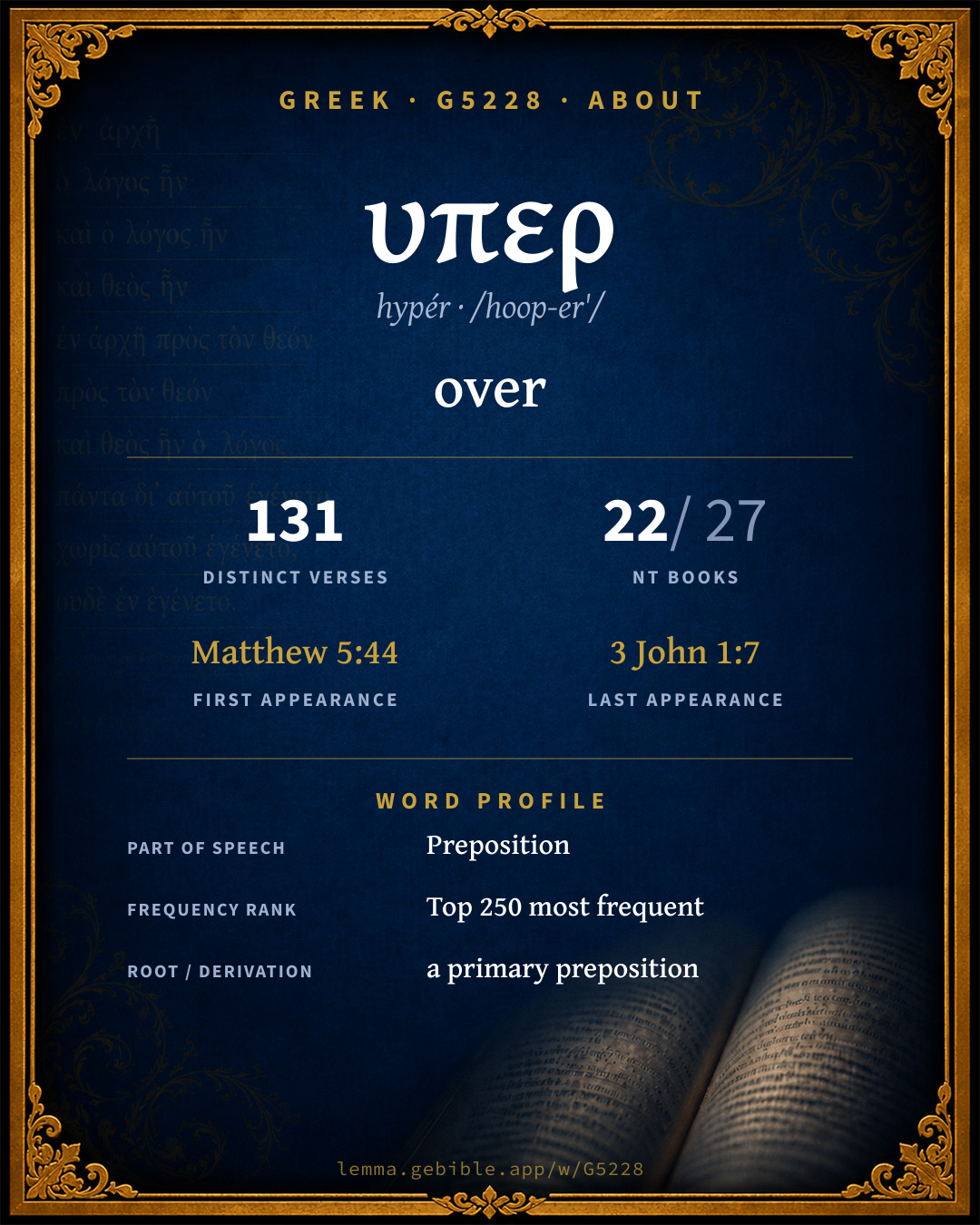
ὑπέρ
over
‘over’ is one of 3 main senses fuller range ↓
Full lexicon entry — Thayer's Greek Lexicon
From Thayer's Greek Lexicon
Where this word appears
Grammar key — what these labels mean
Part of speech
- Preposition
- A relational word governing a noun in a particular case.
Every verse where G5228 appears — 131 distinct verses across 22 books. Click any verse to open its interlinear word-by-word view. Verse text shown in the World English Bible for context — . Each verse’s Greek form is shown with its reference; the English is not keyword-highlighted, since the data carries no word-level English alignment. Use “Compare translations” on any verse to read it across multiple English versions. This concordance covers the Greek New Testament; Septuagint (Greek Old Testament) occurrences of this word are not indexed here.
Matthew 3 verses
- Matthew 5:44 ὑπὲρ prep But I tell you, love your enemies, bless those who curse you, do good to those who hate you, and pray for those who mistreat you and persecute you,
- Matthew 10:24 ὑπὲρ ὑπὲρ prep prep "A disciple is not above his teacher, nor a servant above his lord.
- Matthew 10:37 ὑπὲρ ὑπὲρ prep prep He who loves father or mother more than me is not worthy of me; and he who loves son or daughter more than me isn't worthy of me.
Mark 2 verses
Luke 5 verses
- Luke 6:40 ὑπὲρ prep A disciple is not above his teacher, but everyone when he is fully trained will be like his teacher.
- Luke 9:50 ὑπὲρ prep Jesus said to him, "Don't forbid him, for he who is not against us is for us."
- Luke 16:8 ὑπὲρ prep "His lord commended the dishonest manager because he had done wisely, for the children of this world are, in their own generation, wiser than the children of the light.
- Luke 22:19 ὑπὲρ prep He took bread, and when he had given thanks, he broke it, and gave to them, saying, "This is my body which is given for you. Do this in memory of me."
- Luke 22:20 ὑπὲρ prep Likewise, he took the cup after supper, saying, "This cup is the new covenant in my blood, which is poured out for you.
John 13 verses
- John 1:30 ὑπὲρ prep This is he of whom I said, 'After me comes a man who is preferred before me, for he was before me.'
- John 6:51 ὑπὲρ prep I am the living bread which came down out of heaven. If anyone eats of this bread, he will live forever. Yes, the bread which I will give for the life of the world is my flesh."
- John 10:11 ὑπὲρ prep I am the good shepherd. The good shepherd lays down his life for the sheep.
- John 10:15 ὑπὲρ prep even as the Father knows me, and I know the Father. I lay down my life for the sheep.
- John 11:4 ὑπὲρ prep But when Jesus heard it, he said, "This sickness is not to death, but for the glory of God, that God's Son may be glorified by it."
- John 11:50 ὑπὲρ prep nor do you consider that it is advantageous for us that one man should die for the people, and that the whole nation not perish."
- John 11:51 ὑπὲρ prep Now he didn't say this of himself, but being high priest that year, he prophesied that Jesus would die for the nation,
- John 11:52 ὑπὲρ prep and not for the nation only, but that he might also gather together into one the children of God who are scattered abroad.
- John 13:37 ὑπὲρ prep Peter said to him, "Lord, why can't I follow you now? I will lay down my life for you."
- John 13:38 ὑπὲρ prep Jesus answered him, "Will you lay down your life for me? Most assuredly I tell you, the rooster won't crow until you have denied me three times.
- John 15:13 ὑπὲρ prep Greater love has no one than this, that someone lay down his life for his friends.
- John 17:19 ὑπὲρ prep For their sakes I sanctify myself, that they themselves also may be sanctified in truth.
- John 18:14 ὑπὲρ prep Now it was Caiaphas who advised the Jews that it was expedient that one man should perish for the people.
Acts 7 verses
- Acts 5:41 ὑπὲρ prep They therefore departed from the presence of the council, rejoicing that they were counted worthy to suffer dishonor for Jesus' name.
- Acts 8:24 ὑπὲρ prep Simon answered, "Pray for me to the Lord, that none of the things which you have spoken happen to me."
- Acts 9:16 ὑπὲρ prep For I will show him how many things he must suffer for my name's sake."
- Acts 15:26 ὑπὲρ prep men who have risked their lives for the name of our Lord Jesus Christ.
- Acts 21:13 ὑπὲρ prep Then Paul answered, "What are you doing, weeping and breaking my heart? For I am ready not only to be bound, but also to die at Jerusalem for the name of the Lord Jesus."
- Acts 21:26 ὑπὲρ prep Then Paul took the men, and the next day, purified himself and went with them into the temple, declaring the fulfillment of the days of purification, until the offering was offered for every one of them.
- Acts 26:13 ὑπὲρ prep at noon, O King, I saw on the way a light from the sky, brighter than the sun, shining around me and those who traveled with me.
Romans 16 verses
- Romans 1:5 ὑπὲρ prep through whom we received grace and apostleship, for obedience of faith among all the nations, for his name's sake;
- Romans 5:6 ὑπὲρ prep For while we were yet weak, at the right time Christ died for the ungodly.
- Romans 5:7 ὑπὲρ ὑπὲρ prep prep For one will hardly die for a righteous man. Yet perhaps for a righteous person someone would even dare to die.
- Romans 5:8 ὑπὲρ prep But God commends his own love toward us, in that while we were yet sinners, Christ died for us.
- Romans 8:27 ὑπὲρ prep He who searches the hearts knows what is on the Spirit's mind, because he makes intercession for the saints according to God.
- Romans 8:31 ὑπὲρ prep What then shall we say about these things? If God is for us, who can be against us?
- Romans 8:32 ὑπὲρ prep He who didn't spare his own Son, but delivered him up for us all, how would he not also with him freely give us all things?
- Romans 8:34 ὑπὲρ prep Who is he who condemns? It is Christ who died, yes rather, who was raised from the dead, who is at the right hand of God, who also makes intercession for us.
- Romans 9:3 ὑπὲρ prep For I could wish that I myself were accursed from Christ for my brothers' sake, my relatives according to the flesh,
- Romans 9:27 ὑπὲρ prep Isaiah cries concerning Israel, "If the number of the children of Israel are as the sand of the sea, It is the remnant who will be saved;
- Romans 10:1 ὑπὲρ prep Brothers, my heart's desire and my prayer to God is for Israel, that they may be saved.
- Romans 14:15 ὑπὲρ prep Yet if because of food your brother is grieved, you walk no longer in love. Don't destroy with your food him for whom Christ died.
- Romans 15:8 ὑπὲρ prep Now I say that Christ has been made a minister of the circumcision for the truth of God, that he might confirm the promises given to the fathers,
- Romans 15:9 ὑπὲρ prep and that the Gentiles might glorify God for his mercy. As it is written, "Therefore will I give praise to you among the Gentiles, And sing to your name."
- Romans 15:30 ὑπὲρ prep Now I beg you, brothers, by our Lord Jesus Christ, and by the love of the Spirit, that you strive together with me in your prayers to God for me,
- Romans 16:4 ὑπὲρ prep who for my life, laid down their own necks; to whom not only I give thanks, but also all the assemblies of the Gentiles.
1 Corinthians 8 verses
- 1 Corinthians 1:13 ὑπὲρ prep Is Christ divided? Was Paul crucified for you? Or were you baptized into the name of Paul?
- 1 Corinthians 4:6 ὑπὲρ ὑπὲρ prep prep Now these things, brothers, I have in a figure transferred to myself and Apollos for your sakes, that in us you might learn not to think beyond the things which are written, that none of you be puffed up against one another.
- 1 Corinthians 10:13 ὑπὲρ prep No temptation has taken you except what is common to man. God is faithful, who will not allow you to be tempted above what you are able, but will with the temptation also make the way of escape, that you may be able to endure it.
- 1 Corinthians 10:30 ὑπὲρ prep If I partake with thankfulness, why am I denounced for that for which I give thanks?
- 1 Corinthians 11:24 ὑπὲρ prep When he had given thanks, he broke it, and said, "Take, eat. This is my body, which is broken for you. Do this in memory of me."
- 1 Corinthians 12:25 ὑπὲρ prep that there should be no division in the body, but that the members should have the same care for one another.
- 1 Corinthians 15:3 ὑπὲρ prep For I delivered to you first of all that which I also received: that Christ died for our sins according to the Scriptures,
- 1 Corinthians 15:29 ὑπὲρ ὑπὲρ prep prep Or else what will they do who are baptized for the dead? If the dead aren't raised at all, why then are they baptized for the dead?
2 Corinthians 26 verses
- 2 Corinthians 1:6 ὑπὲρ ὑπὲρ ὑπὲρ prep prep prep But if we are afflicted, it is for your comfort and salvation. If we are comforted, it is for your comfort, which produces in you the patient enduring of the same sufferings which we also suffer.
- 2 Corinthians 1:8 ὑπὲρ ὑπὲρ prep prep For we don't desire to have you uninformed, brothers, concerning our affliction which happened to us in Asia, that we were weighed down exceedingly, beyond our power, so much that we despaired even of life.
- 2 Corinthians 1:11 ὑπὲρ ὑπὲρ prep prep you also helping together on our behalf by your supplication; that, for the gift bestowed on us by means of many, thanks may be given by many persons on your behalf.
- 2 Corinthians 5:12 ὑπὲρ prep For we are not commending ourselves to you again, but speak as giving you occasion of boasting on our behalf, that you may have something to answer those who boast in appearance, and not in heart.
- 2 Corinthians 5:15 ὑπὲρ ὑπὲρ ὑπὲρ prep prep prep He died for all, that those who live should no longer live to themselves, but to him who for their sakes died and rose again.
- 2 Corinthians 5:20 ὑπὲρ ὑπὲρ prep prep We are therefore ambassadors on behalf of Christ, as though God were entreating by us. We beg you on behalf of Christ, be reconciled to God.
- 2 Corinthians 5:21 ὑπὲρ prep For him who knew no sin he made to be sin on our behalf; so that in him we might become the righteousness of God.
- 2 Corinthians 7:4 ὑπὲρ prep Great is my boldness of speech toward you. Great is my boasting on your behalf. I am filled with comfort. I overflow with joy in all our affliction.
- 2 Corinthians 7:7 ὑπὲρ prep and not by his coming only, but also by the comfort with which he was comforted in you, while he told us of your longing, your mourning, and your zeal for me; so that I rejoiced still more.
- 2 Corinthians 7:12 ὑπὲρ prep So although I wrote to you, I wrote not for his cause that did the wrong, nor for his cause that suffered the wrong, but that your earnest care for us might be revealed in you in the sight of God.
- 2 Corinthians 7:14 ὑπὲρ prep For if in anything I have boasted to him on your behalf, I was not disappointed. But as we spoke all things to you in truth, so our glorying also which I made before Titus was found to be truth.
- 2 Corinthians 8:16 ὑπὲρ prep But thanks be to God, who puts the same earnest care for you into the heart of Titus.
- 2 Corinthians 8:23 ὑπὲρ prep As for Titus, he is my partner and fellow worker for you. As for our brothers, they are the apostles of the assemblies, the glory of Christ.
- 2 Corinthians 8:24 ὑπὲρ prep Therefore show the proof of your love to them in front of the assemblies, and of our boasting on your behalf.
- 2 Corinthians 9:2 ὑπὲρ prep for I know your readiness, of which I boast on your behalf to them of Macedonia, that Achaia has been prepared for a year past. Your zeal has stirred up very many of them.
- 2 Corinthians 9:3 ὑπὲρ prep But I have sent the brothers that our boasting on your behalf may not be in vain in this respect, that, just as I said, you may be prepared,
- 2 Corinthians 9:14 ὑπὲρ prep while they themselves also, with supplication on your behalf, yearn for you by reason of the exceeding grace of God in you.
- 2 Corinthians 11:23 ὑπὲρ prep Are they servants of Christ? (I speak as one beside himself) I am more so; in labors more abundantly, in prisons more abundantly, in stripes above measure, in deaths often.
- 2 Corinthians 12:5 ὑπὲρ ὑπὲρ prep prep On behalf of such a one I will boast, but on my own behalf I will not boast, except in my weaknesses.
- 2 Corinthians 12:6 ὑπὲρ prep For if I would desire to boast, I will not be foolish; for I will speak the truth. But I forbear, so that no man may account of me above that which he sees in me, or hears from me.
- 2 Corinthians 12:8 ὑπὲρ prep Concerning this thing, I begged the Lord three times that it might depart from me.
- 2 Corinthians 12:10 ὑπὲρ prep Therefore I take pleasure in weaknesses, in injuries, in necessities, in persecutions, in distresses, for Christ's sake. For when I am weak, then am I strong.
- 2 Corinthians 12:13 ὑπὲρ prep For what is there in which you were made inferior to the rest of the assemblies, unless it is that I myself was not a burden to you? Forgive me this wrong.
- 2 Corinthians 12:15 ὑπὲρ prep I will most gladly spend and be spent for your souls. If I love you more abundantly, am I loved the less?
- 2 Corinthians 12:19 ὑπὲρ prep Again, do you think that we are excusing ourselves to you? In the sight of God we speak in Christ. But all things, beloved, are for your edifying.
- 2 Corinthians 13:8 ὑπὲρ prep For we can do nothing against the truth, but for the truth.
Galatians 3 verses
- Galatians 1:14 ὑπὲρ prep I advanced in the Jews' religion beyond many of my own age among my countrymen, being more exceedingly zealous for the traditions of my fathers.
- Galatians 2:20 ὑπὲρ prep I have been crucified with Christ, and it is no longer I that live, but Christ living in me. That life which I now live in the flesh, I live by faith in the Son of God, who loved me, and gave himself up for me.
- Galatians 3:13 ὑπὲρ prep Christ redeemed us from the curse of the law, having become a curse for us. For it is written, "Cursed is everyone who hangs on a tree,"
Ephesians 10 verses
- Ephesians 1:16 ὑπὲρ prep don't cease to give thanks for you, making mention of you in my prayers,
- Ephesians 1:22 ὑπὲρ prep He put all things in subjection under his feet, and gave him to be head over all things for the assembly,
- Ephesians 3:1 ὑπὲρ prep For this cause I, Paul, am the prisoner of Christ Jesus on behalf of you Gentiles,
- Ephesians 3:13 ὑπὲρ prep Therefore I ask that you may not lose heart at my troubles for you, which are your glory.
- Ephesians 3:20 ὑπὲρ prep Now to him who is able to do exceedingly abundantly above all that we ask or think, according to the power that works in us,
- Ephesians 5:2 ὑπὲρ prep Walk in love, even as Christ also loved you, and gave himself up for us, an offering and a sacrifice to God for a sweet-smelling fragrance.
- Ephesians 5:20 ὑπὲρ prep giving thanks always concerning all things in the name of our Lord Jesus Christ, to God, even the Father;
- Ephesians 5:25 ὑπὲρ prep Husbands, love your wives, even as Christ also loved the assembly, and gave himself up for it;
- Ephesians 6:19 ὑπὲρ prep on my behalf, that utterance may be given to me in opening my mouth, to make known with boldness the mystery of the Gospel,
- Ephesians 6:20 ὑπὲρ prep for which I am an ambassador in chains; that in it I may speak boldly, as I ought to speak.
Philippians 6 verses
- Philippians 1:4 ὑπὲρ prep always in every request of mine on behalf of you all making my requests with joy,
- Philippians 1:7 ὑπὲρ prep It is even right for me to think this way on behalf of all of you, because I have you in my heart, because, both in my bonds and in the defense and confirmation of the Gospel, you all are partakers with me of grace.
- Philippians 1:29 ὑπὲρ ὑπὲρ prep prep Because it has been granted to you on behalf of Christ, not only to believe in him, but also to suffer on his behalf,
- Philippians 2:9 ὑπὲρ prep Therefore God also highly exalted him, and gave to him the name which is above every name;
- Philippians 2:13 ὑπὲρ prep For it is God who works in you both to will and to work, for his good pleasure.
- Philippians 4:10 ὑπὲρ prep But I rejoice in the Lord greatly, that now at length you have revived your thought for me; in which you did indeed take thought, but you lacked opportunity.
Colossians 6 verses
- Colossians 1:7 ὑπὲρ prep even as you learned of Epaphras our beloved fellow servant, who is a faithful minister of Christ on our behalf,
- Colossians 1:9 ὑπὲρ prep For this cause, we also, since the day we heard this, don't cease praying and making requests for you, that you may be filled with the knowledge of his will in all spiritual wisdom and understanding,
- Colossians 1:24 ὑπὲρ ὑπὲρ prep prep Now I rejoice in my sufferings for your sake, and fill up on my part that which is lacking of the afflictions of Christ in my flesh for his body's sake, which is the assembly;
- Colossians 2:1 ὑπὲρ prep For I desire to have you know how greatly I struggle for you, and for those at Laodicea, and for as many as have not seen my face in the flesh;
- Colossians 4:12 ὑπὲρ prep Epaphras, who is one of you, a servant of Christ, salutes you, always striving for you in his prayers, that you may stand perfect and complete in all the will of God.
- Colossians 4:13 ὑπὲρ prep For I testify about him, that he has great zeal for you, and for those in Laodicea, and for those in Hierapolis.
1 Thessalonians 1 verse
2 Thessalonians 3 verses
- 2 Thessalonians 1:4 ὑπὲρ prep so that we ourselves boast about you in the assemblies of God for your patience and faith in all your persecutions and in the afflictions which you endure.
- 2 Thessalonians 1:5 ὑπὲρ prep This is an obvious sign of the righteous judgment of God, to the end that you may be counted worthy of the Kingdom of God, for which you also suffer.
- 2 Thessalonians 2:1 ὑπὲρ prep Now, brothers, concerning the coming of our Lord Jesus Christ, and our gathering together to him, we ask you
1 Timothy 3 verses
- 1 Timothy 2:1 ὑπὲρ prep I exhort therefore, first of all, that petitions, prayers, intercessions, and givings of thanks, be made for all men:
- 1 Timothy 2:2 ὑπὲρ prep for kings and all who are in high places; that we may lead a tranquil and quiet life in all godliness and reverence.
- 1 Timothy 2:6 ὑπὲρ prep who gave himself as a ransom for all; the testimony in its own times;
Titus 1 verse
Philemon 3 verses
- Philemon 1:13 ὑπὲρ prep whom I desired to keep with me, that on your behalf he might serve me in my chains for the Gospel.
- Philemon 1:16 ὑπὲρ prep no longer as a slave, but more than a slave, a beloved brother, especially to me, but how much rather to you, both in the flesh and in the Lord.
- Philemon 1:21 ὑπὲρ prep Having confidence in your obedience, I write to you, knowing that you will do even beyond what I say.
Hebrews 10 verses
- Hebrews 2:9 ὑπὲρ prep But we see him who has been made a little lower than the angels, Jesus, because of the suffering of death crowned with glory and honor, that by the grace of God he should taste of death for everyone.
- Hebrews 4:12 ὑπὲρ prep For the word of God is living, and active, and sharper than any two-edged sword, and piercing even to the dividing of soul and spirit, of both joints and marrow, and is able to discern the thoughts and intentions of the heart.
- Hebrews 5:1 ὑπὲρ ὑπὲρ prep prep For every high priest, being taken from among men, is appointed for men in things pertaining to God, that he may offer both gifts and sacrifices for sins.
- Hebrews 6:20 ὑπὲρ prep where as a forerunner Jesus entered for us, having become a high priest forever after the order of Melchizedek.
- Hebrews 7:25 ὑπὲρ prep Therefore he is also able to save to the uttermost those who draw near to God through him, seeing he ever lives to make intercession for them.
- Hebrews 7:27 ὑπὲρ prep who doesn't need, like those high priests, to daily offer up sacrifices, first for his own sins, and then for the sins of the people. For this he did once for all, when he offered up himself.
- Hebrews 9:7 ὑπὲρ prep but into the second the high priest alone, once in the year, not without blood, which he offers for himself, and for the errors of the people.
- Hebrews 9:24 ὑπὲρ prep For Christ hasn't entered into holy places made with hands, which are representations of the true, but into heaven itself, now to appear in the presence of God for us;
- Hebrews 10:12 ὑπὲρ prep but he, when he had offered one sacrifice for sins for ever, sat down on the right hand of God;
- Hebrews 13:17 ὑπὲρ prep Obey your leaders and submit to them, for they watch on behalf of your souls, as those who will give account, that they may do this with joy, and not with groaning, for that would be unprofitable for you.
James 1 verse
1 Peter 2 verses
- 1 Peter 2:21 ὑπὲρ prep For to this you were called, because Christ also suffered for us, leaving you an example, that you should follow his steps,
- 1 Peter 3:18 ὑπὲρ prep Because Christ also suffered for sins once, the righteous for the unrighteous, that he might bring you to God; being put to death in the flesh, but made alive in the spirit;
1 John 1 verse
3 John 1 verse
About this entry
At a glance — auto-summarized from this page’s data, not written by a person. Every figure links to its source below. This summary describes the numbers; it doesn’t interpret them.
“over” is the headline sense of the Greek preposition υπερ (hypér). First canonically at Matthew 5:44, it enters the text early. It appears 131 verses across 22 books of the Greek New Testament, among its common vocabulary. Lexicons map it across 3 senses. Related forms include υβρις, υπεραιρομαι and υπερακμος. The sections below give every sense, occurrence, and version rendering.
Gloss history
Strong's 1890 vs modern scholarship

About this word
Strong's G5228 catalogs a Greek word from the Greek New Testament.
These counts are not copied from any lexicon or concordance. They are computed here, from the morphology-tagged Greek New Testament. What Lemma adds →
- 131
- distinct verses
- The word appears in 131 distinct verses.
- 22 / 27
- NT books
- The word appears in 22 of 27 New Testament books.
- #108
- by frequency
- Top 250 most frequent Greek words (rank 108 of 5,347 Greek words by occurrence).
View all 131 occurrences in the concordance →
Most concentrated in
- 2 Corinthians 26 verses 20%
- Romans 16 verses 12%
- John 13 verses 10%
By section of the New Testament
By traditional corpus
Conventional, traditional groupings — biblical authorship is debated, so this is a traditional corpus grouping, not an authorship claim. Some books belong to more than one corpus (Luke is in both the Gospels and the Lukan corpus, and so on), so these shares overlap and need not total 100%. Each figure is a share of the word’s 131 distinct verses.
- Pauline corpus 86 verses · 66%
- Gospels 23 verses · 18%
- Johannine 15 verses · 11%
- Lukan (Luke–Acts) 12 verses · 9%
- Hebrews 10 verses · 8%
- General (Catholic) Epistles 5 verses · 4%
How translations render this word
Counts come from each version’s own published word-to-Strong’s tagging or interlinear alignment — an approximate guide to how each version renders this word, not a word-level alignment the data otherwise carries. Because each total is that version’s own tagged count, the per-version totals vary from one another and need not match the appearance or distinct-verse counts above. These counts may also differ from a printed concordance because Lemma counts each distinctly tagged rendering and does not collapse phrase taggings into a single head-word total. This is a fixed set of word-tagged versions (KJV, ASV, BSB, ULT) and does not change with the reading translation you choose elsewhere. Each version’s license is shown beside its name below (and on Sources).
- King James Version: For 105×, Of 11×, Above 10×
- American Standard Version: For 93×, Behalf 15×, Above 8×
- Berean Standard Bible: For 88×, About 7×, Behalf 6×
- unfoldingWord Literal Text: For 60×, Behalf of 23×, Behalf 15×
King James Version Public Domain
Renders G5228 across 165 tagged occurrences — most commonly:
Plus 17 renderings that appear only once — usually multi-word phrases or single function words the recovered tagging swept in, not distinct renderings. Not rendered by a distinct English word in 5 further occurrences.
American Standard Version Public Domain
Renders G5228 across 159 tagged occurrences — most commonly:
Plus other, less common renderings. Plus 13 renderings that appear only once — usually multi-word phrases or single function words the recovered tagging swept in, not distinct renderings.
Berean Standard Bible Public Domain
Renders G5228 across 145 tagged occurrences — most commonly:
Plus other, less common renderings. Plus 11 renderings that appear only once — usually multi-word phrases or single function words the recovered tagging swept in, not distinct renderings. Not rendered by a distinct English word in 7 further occurrences.
unfoldingWord Literal Text CC BY-SA 4.0
Renders G5228 across 164 tagged occurrences — most commonly:
Plus other, less common renderings. Plus 8 renderings that appear only once — usually multi-word phrases or single function words the recovered tagging swept in, not distinct renderings.
Senses in Thayer's
The 3 senses Thayer's distinguishes for this word, in lexicon order (not ranked by frequency or importance). The full entry — with sub-senses — is in the Lexicon Entry tab.
- in behalf of, for the sake of
- over, beyond, more than
- more, beyond, over
Word origin
Origin: a primary preposition
A primary preposition; over that is (with the genitive case) of place above beyond across or causal for the sake of instead regarding ; with the accusative case superior to more than . In compounds it retains many of the listed applications : - (+ exceeding abundantly) above in (on) behalf of beyond by + very chiefest concerning exceeding (above -ly) for + very highly more (than) of over on the part of for sake of in stead than to (-ward) very. In compounds it retains many of the above applications.
— Strong’s Exhaustive Concordance (1890), public domain.
Same root — word family
Other Thayer's entries built from the same root as G5228, grouped by Strong’s listed origin. These share a root / origin per the lexicon — not necessarily a shared meaning. Each links to that word’s own entry.
Derived from this word
- υβρις hýbris G5196 insult
- υπεραιρομαι hyperaíromai G5229 to exalt oneself
- υπερακμος hypérakmos G5230 overripe
- υπερανω hyperánō G5231 above
- υπεραυξανω hyperauxánō G5232 to increase greatly
- υπερβαινω hyperbaínō G5233 to step over
- υπερβαλλω hyperbállō G5235 to surpass
- υπερειδω hypereídō G5237 to overlook
- υπερεκεινα hyperékeina G5238 beyond
- υπερεκτεινω hyperekteínō G5239 to stretch beyond
- υπερεκχυνω hyperekchýnō G5240 to overflow
- υπερεντυγχανω hyperentynchánō G5241 to intercede
- υπερεχω hyperéchō G5242 to stand out
- υπερηφανος hyperḗphanos G5244 haughty
- υπερνικαω hypernikáō G5245 to overcome completely
- υπερογκος hypéronkos G5246 immoderate
- υπερπερισσευω hyperperisseúō G5248 to abound greatly
- υπερπερισσως hyperperissōs G5249 exceedingly
- υπερπλεοναζω hyperpleonázō G5250 to overflow
- υπερυψοω hyperypsóō G5251 to exalt highly
- υπερφρονεω hyperphronéō G5252 to think arrogantly
- υπερωον hyperōion G5253 upper room
- υψος hýpsos G5311 height
Compare all same-root words → Showing 4 of 24 — not the complete family. They share a root, not necessarily a meaning.
Septuagint usage
The same Greek word υπερ appears 307 times in the Greek Old Testament (Septuagint), across 263 verses in 31 books.
- 307
- LXX occurrences
- Tagged occurrences of this Greek word in the Septuagint.
- 263
- verses
- Distinct Septuagint verses containing this word.
- 31 / 39
- OT books
- The word appears in 31 of the 39 Old Testament books.
Sample Septuagint occurrences
- Genesis 48:22 ὑπέρ
- Exodus 1:9 ὑπέρ
- Deuteronomy 24:16 ὑπέρ
- Judges 2:19 ὑπέρ
- Ruth 1:13 ὑπέρ
- 1 Samuel 1:5 ὑπέρ
- 2 Samuel 1:19 ὑπέρ
- 1 Kings 1:37 ὑπέρ
- 2 Kings 3:26 ὑπέρ
- 1 Chronicles 4:9 ὑπέρ
- 2 Chronicles 9:22 ὑπέρ
- Ezra 5:5 ὑπέρ
Septuagint occurrences (same lexeme)
Every verse where the same Strong’s number (G5228) appears in the Greek Septuagint — showing the first 50 of 263. Verse text shown in the World English Bible for context; the Greek form is the matched word — the English is not keyword-highlighted.
- Genesis 48:22 ὑπέρ Moreover I have given to you one portion above your brothers, which I took out of the hand of the Amorite with my sword and with my bow."
- Exodus 1:9 ὑπέρ He said to his people, "Behold, the people of the children of Israel are more and mightier than we.
- Deuteronomy 24:16 ὑπέρ The fathers shall not be put to death for the children, neither shall the children be put to death for the fathers: every man shall be put to death for his own sin.
- Deuteronomy 25:3 ὑπέρ Forty stripes he may give him, he shall not exceed; lest, if he should exceed, and beat him above these with many stripes, then your brother should seem vile to you.
- Deuteronomy 28:23 ὑπέρ Your sky that is over your head shall be brass, and the earth that is under you shall be iron.
- Deuteronomy 30:5 ὑπέρ and Yahweh your God will bring you into the land which your fathers possessed, and you shall possess it; and he will do you good, and multiply you above your fathers.
- Judges 2:19 ὑπέρ But it happened, when the judge was dead, that they turned back, and dealt more corruptly than their fathers, in following other gods to serve them, and to bow down to them; they didn't cease from their doings, nor from their stubborn way.
- Judges 3:9 ὑπέρ When the children of Israel cried to Yahweh, Yahweh raised up a savior to the children of Israel, who saved them, even Othniel the son of Kenaz, Caleb's younger brother.
- Judges 6:31 ὑπέρ Joash said to all who stood against him, Will you contend for Baal? Or will you save him? he who will contend for him, let him be put to death while [it is yet] morning: if he be a god, let him contend for himself, because one has broken down his altar.
- Judges 9:17 ὑπέρ (for my father fought for you, and adventured his life, and delivered you out of the hand of Midian:
- Judges 11:25 ὑπέρ Now are you anything better than Balak the son of Zippor, king of Moab? did he ever strive against Israel, or did he ever fight against them?
- Judges 15:2 ὑπέρ Her father said, I most assuredly thought that you had utterly hated her; therefore I gave her to your companion: isn't her younger sister more beautiful than she? Please take her, instead.
- Judges 18:26 ὑπέρ The children of Dan went their way: and when Micah saw that they were too strong for him, he turned and went back to his house.
- Ruth 1:13 ὑπέρ would you therefore wait until they were grown? would you therefore stay from having husbands? nay, my daughters, for it grieves me much for your sakes, for the hand of Yahweh is gone forth against me.
- Ruth 3:10 ὑπέρ He said, Blessed are you by Yahweh, my daughter: you have shown more kindness in the latter end than at the beginning, inasmuch as you didn't follow young men, whether poor or rich.
- Ruth 3:12 ὑπέρ Now it is true that I am a near kinsman; however there is a kinsman nearer than I.
- Ruth 4:15 ὑπέρ He shall be to you a restorer of life, and sustain you in your old age, for your daughter-in-law, who loves you, who is better to you than seven sons, has borne him.
- 1 Samuel 1:5 ὑπέρ but to Hannah he gave a double portion; for he loved Hannah, but Yahweh had shut up her womb.
- 1 Samuel 1:8 ὑπέρ Elkanah her husband said to her, Hannah, why weep you? and why don't you eat? and why is your heart grieved? am I not better to you than ten sons?
- 1 Samuel 1:27 ὑπέρ For this child I prayed; and Yahweh has given me my petition which I asked of him:
- 1 Samuel 2:25 ὑπέρ If one man sin against another, God shall judge him; but if a man sin against Yahweh, who shall entreat for him? Notwithstanding, they didn't listen to the voice of their father, because Yahweh was minded to kill them.
- 1 Samuel 2:29 ὑπέρ Why kick you at my sacrifice and at my offering, which I have commanded in [my] habitation, and honor your sons above me, to make yourselves fat with the best of all the offerings of Israel my people?
- 1 Samuel 4:21 ὑπέρ She named the child Ichabod, saying, The glory is departed from Israel; because the ark of God was taken, and because of her father-in-law and her husband.
- 1 Samuel 9:2 ὑπέρ He had a son, whose name was Saul, an impressive young man; and there was not among the children of Israel a better person than he. From his shoulders and upward he was higher than any of the people.
- 1 Samuel 10:2 ὑπέρ When you are departed from me today, then you shall find two men by Rachel's tomb, in the border of Benjamin at Zelzah; and they will tell you, The donkeys which you went to seek are found; and, behold, your father has left off caring for the donkeys, and is anxious for you, saying, What shall I do for my son?
- 1 Samuel 10:23 ὑπέρ They ran and fetched him there; and when he stood among the people, he was higher than any of the people from his shoulders and upward.
- 1 Samuel 12:19 ὑπέρ All the people said to Samuel, Pray for your servants to Yahweh your God, that we not die; for we have added to all our sins [this] evil, to ask us a king.
- 1 Samuel 15:22 ὑπέρ Samuel said, Has Yahweh as great delight in burnt offerings and sacrifices, as in obeying the voice of Yahweh? Behold, to obey is better than sacrifice, and to listen than the fat of rams.
- 1 Samuel 15:28 ὑπέρ Samuel said to him, Yahweh has torn the kingdom of Israel from you this day, and has given it to a neighbor of yours who is better than you.
- 1 Samuel 21:3 ὑπέρ Now therefore what is under your hand? give me five loaves of bread in my hand, or whatever there is present.
- 1 Samuel 24:18 ὑπέρ You have declared this day how that you have dealt well with me, because when Yahweh had delivered me up into your hand, you didn't kill me.
- 2 Samuel 1:19 ὑπέρ Your glory, Israel, is slain on your high places! How are the mighty fallen!
- 2 Samuel 1:23 ὑπέρ Saul and Jonathan were lovely and pleasant in their lives, In their death they were not divided: They were swifter than eagles, They were stronger than lions.
- 2 Samuel 1:26 ὑπέρ I am distressed for you, my brother Jonathan: Very pleasant have you been to me: Your love to me was wonderful, Passing the love of women.
- 2 Samuel 3:8 ὑπέρ Then was Abner very angry for the words of Ish-bosheth, and said, Am I a dog's head that belongs to Judah? This day do I show kindness to the house of Saul your father, to his brothers, and to his friends, and have not delivered you into the hand of David; and yet you charge me this day with a fault concerning this woman.
- 2 Samuel 6:8 ὑπέρ David was displeased, because Yahweh had broken forth on Uzzah; and he called that place Perez Uzzah, to this day.
- 2 Samuel 6:21 ὑπέρ David said to Michal, [It was] before Yahweh, who chose me above your father, and above all his house, to appoint me prince over the people of Yahweh, over Israel: therefore will I play before Yahweh.
- 2 Samuel 7:19 ὑπέρ This was yet a small thing in your eyes, Lord Yahweh; but you have spoken also of your servant's house for a great while to come; and this [too] after the manner of men, Lord Yahweh!
- 2 Samuel 7:28 ὑπέρ Now, O Lord Yahweh, you are God, and your words are truth, and you have promised this good thing to your servant:
- 2 Samuel 8:10 ὑπέρ then Toi sent Joram his son to king David, to Greet him, and to bless him, because he had fought against Hadadezer and struck him: for Hadadezer had wars with Toi. [Joram] brought with him vessels of silver, and vessels of gold, and vessels of brass:
- 2 Samuel 10:5 ὑπέρ When they told it to David, he sent to meet them; for the men were greatly ashamed. The king said, Wait at Jericho until your beards be grown, and then return.
- 2 Samuel 10:11 ὑπέρ He said, If the Syrians be too strong for me, then you shall help me; but if the children of Ammon be too strong for you, then I will come and help you.
- 2 Samuel 10:12 ὑπέρ Be of good courage, and let us play the man for our people, and for the cities of our God: and Yahweh do that which seems him good.
- 2 Samuel 13:14 ὑπέρ However he would not listen to her voice; but being stronger than she, he forced her, and lay with her.
- 2 Samuel 13:15 ὑπέρ Then Amnon hated her with exceeding great hatred; for the hatred with which he hated her was greater than the love with which he had loved her. Amnon said to her, Arise, be gone.
- 2 Samuel 13:16 ὑπέρ She said to him, Not so, because this great wrong in putting me forth is [worse] than the other that you did to me. But he would not listen to her.
- 2 Samuel 17:14 ὑπέρ Absalom and all the men of Israel said, The counsel of Hushai the Archite is better than the counsel of Ahithophel. For Yahweh had ordained to defeat the good counsel of Ahithophel, to the intent that Yahweh might bring evil on Absalom.
- 2 Samuel 18:5 ὑπέρ The king commanded Joab and Abishai and Ittai, saying, Deal gently for my sake with the young man, even with Absalom. All the people heard when the king gave all the captains charge concerning Absalom.
- 2 Samuel 18:8 ὑπέρ For the battle was there spread over the surface of all the country; and the forest devoured more people that day than the sword devoured.
- 2 Samuel 19:8 ὑπέρ Then the king arose, and sat in the gate. They told to all the people, saying, Behold, the king is sitting in the gate: and all the people came before the king. Now Israel had fled every man to his tent.
These are occurrences of the same Greek lexeme (G5228) in the Septuagint — not a translation of any one Hebrew word. The store carries no word-level Hebrew↔Greek alignment, so no Hebrew original is asserted here. Counts come from the recovered LXX Strong's tagging — high-frequency vocabulary is well covered, while rare or late forms may be untagged — so they reflect tagged occurrences and may slightly undercount.