

1 Peter 3:18
Greek (Tischendorf 8th ed.) 1 Peter 3:18 appears in the Greek New Testament. The text above is from the Tischendorf 8th edition. Each word links to its Strong’s number and a concise gloss. Click any word for its full Thayer’s Greek Lexicon entry.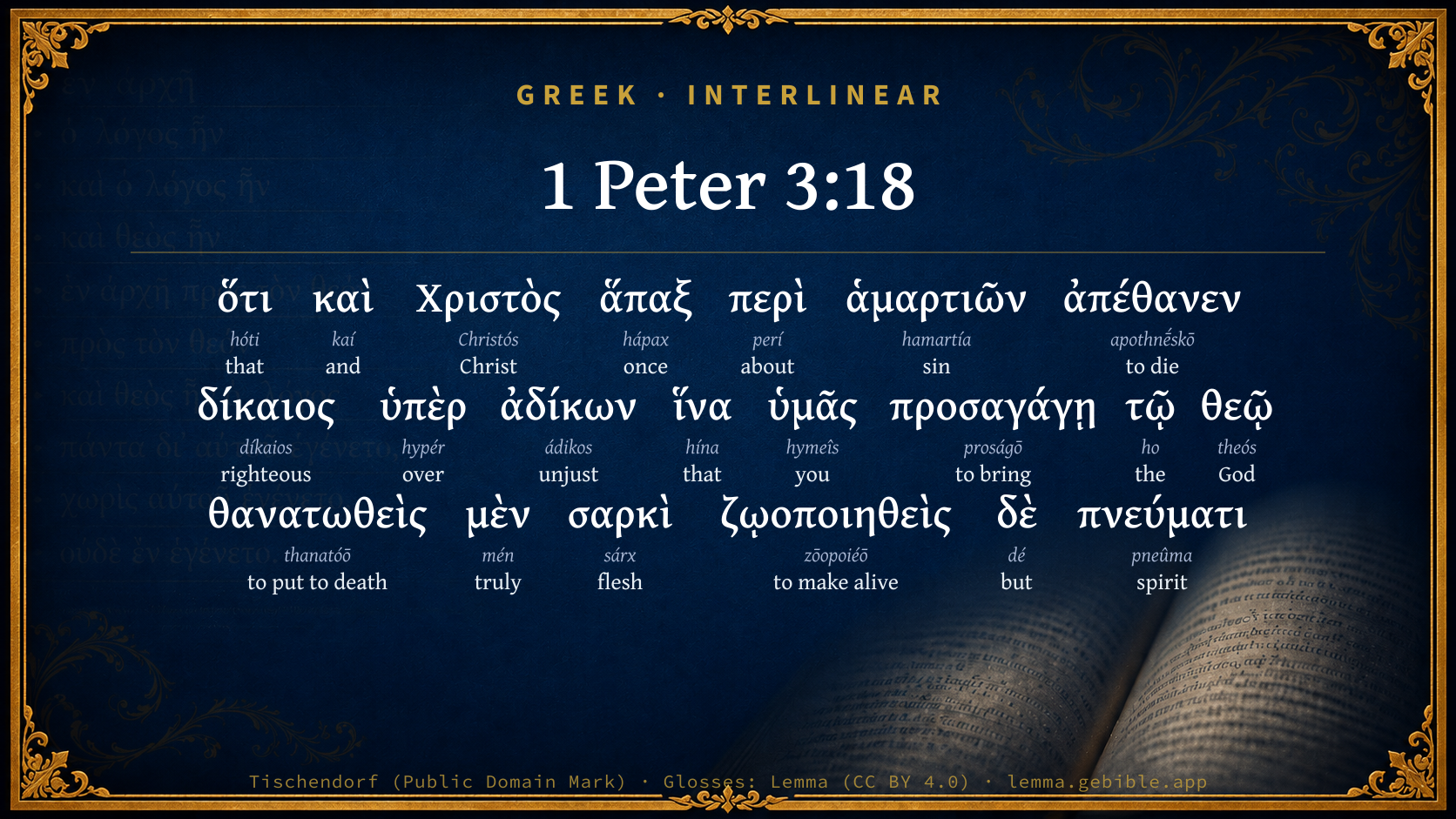
Because Christ also suffered for sins once, the righteous for the unrighteous, that he might bring you to God; being put to death in the flesh, but made alive in the spirit;
Download a study sheet
One document with this verse’s original text, its word-by-word gloss line, the meaning frame, cross-references with their text, attributed commentary, and full source and license credits — printable, and it pastes into notes with its structure intact.
This verse Autodidact and up
A passage Seminary Student
Up to 50 verses in one chapter. A passage sheet keeps up to 6 commentary sources and 12 cross-references per verse, in the order this page ranks them, and says so on the sheet whenever that leaves anything out. Ask for a single verse and you get the Autodidact verse sheet above.
Everything on this page stays free to read, with no account — the sheet is a download of what is already on screen, not access to it.
Compare translations 3
The same verse in 3 English versions, stacked beneath the original-language interlinear above. Click any original word for its lexicon entry.
Each is an independent rendering of the whole verse — the interlinear is not word-aligned to these translations.
Highlighted words mark where these versions differ — a whole-verse word diff, not a word-by-word alignment.
-
World English Bible Public Domain
Because Christ also suffered for sins once, the righteous for the unrighteous, that he might bring you to God; being put to death in the flesh, but made alive in the spirit;
-
King James Version Public Domain
For Christ also hath once suffered for sins, the just for the unjust, that he might bring us to God, being put to death in the flesh, but quickened by the Spirit:
-
unfoldingWord Literal Text CC BY-SA 4.0
For Christ also suffered once for sins—righteous on behalf of unrighteous—so that he might bring you to God, having indeed been killed in flesh, but having been made alive in spirit,
unfoldingWord Literal Text — © unfoldingWord, licensed CC BY-SA 4.0. Word-aligned USFM3 via Door43 (git.door43.org/unfoldingWord/en_ult).
Show all 19 translations
Every available English version of this verse, each an independent rendering of the whole verse.
-
World English Bible Public Domain
Because Christ also suffered for sins once, the righteous for the unrighteous, that he might bring you to God; being put to death in the flesh, but made alive in the spirit;
-
Berean Standard Bible Public Domain
For Christ also suffered for sins once for all, the righteous for the unrighteous, to bring you to God. He was put to death in the body but made alive in the Spirit,
-
Majority Standard Bible Public Domain
For Christ also suffered for sins once for all, the righteous for the unrighteous, to bring you to God. He was put to death in the body but made alive in the Spirit,
-
King James Version Public Domain
For Christ also hath once suffered for sins, the just for the unjust, that he might bring us to God, being put to death in the flesh, but quickened by the Spirit:
-
American Standard Version (1901) Public Domain
Because Christ also suffered for sins once, the righteous for the unrighteous, that he might bring us to God; being put to death in the flesh, but made alive in the spirit;
-
Revised Version (1885) Public Domain
Because Christ also suffered for sins once, the righteous for the unrighteous, that he might bring us to God; being put to death in the flesh, but quickened in the spirit;
-
Geneva Bible (1599) Public Domain
For Christ also hath once suffered for sinnes, the iust for the vniust, that he might bring vs to God, and was put to death concerning the flesh, but was quickened by the spirit.
-
Douay-Rheims (1899) Public Domain
Because Christ also died once for our sins, the just for the unjust: that he might offer us to God, being put to death indeed in the flesh, but enlivened in the spirit,
-
Young's Literal Translation Public Domain
because also Christ once for sin did suffer -- righteous for unrighteous -- that he might lead us to God, having been put to death indeed, in the flesh, and having been made alive in the spirit,
-
Literal Standard Version CC BY-SA 4.0
also because Christ suffered once for sin—righteous for unrighteous—that He might lead us to God, indeed having been put to death in the flesh, but having been made alive in the Spirit,
-
Unlocked Literal Bible CC BY-SA 4.0
Christ also suffered once for sins. He who is righteous suffered for us, who were unrighteous, so that he would bring us to God. He was put to death in the flesh, but he was made alive by the Spirit.
-
unfoldingWord Literal Text CC BY-SA 4.0
For Christ also suffered once for sins—righteous on behalf of unrighteous—so that he might bring you to God, having indeed been killed in flesh, but having been made alive in spirit,
-
Darby Bible Public Domain
for Christ indeed has once suffered for sins, [the] just for [the] unjust, that he might bring us to God; being put to death in flesh, but made alive in [the] Spirit,
-
World Messianic Bible Public Domain
Because Messiah also suffered for sins once, the righteous for the unrighteous, that he might bring you to God, being put to death in the flesh, but made alive in the Spirit,
-
Webster's Bible Public Domain
For Christ also hath once suffered for sins, the just for the unjust, that he might bring us to God, being put to death in the flesh, but made alive by the Spirit:
-
Free Bible Version CC BY-SA 4.0
Jesus died because of sins, once and for all, the one who is completely true and good and right died for those who are bad, so that he could bring you to God. He was put to death in the body, but he came to life in the spirit.
-
Bible in Basic English Public Domain
Because Christ once went through pain for sins, the upright one taking the place of sinners, so that through him we might come back to God; being put to death in the flesh, but given life in the Spirit;
-
Text-Critical English NT CC BY 4.0
For Christ also suffered for sins once for all, the righteous for the unrighteous, so that he might bring us to God. He was put to death in the flesh, but made alive in the spirit,
-
Tyndale New Testament (1534) Public Domain
For as moche as Christ hath once suffered for synnes the iuste for the vniuste forto bringe vs to God and was kylled as pertayninge to the flesshe: but was quyckened in the sprete.
Literal Standard Version (2020), Covenant Press — licensed CC BY-SA 4.0. Text via the HelloAO Bible API (eBible.org). Unlocked Literal Bible (unfoldingWord) — licensed CC BY-SA 4.0. Text via the HelloAO Bible API (eBible.org). unfoldingWord Literal Text — © unfoldingWord, licensed CC BY-SA 4.0. Word-aligned USFM3 via Door43 (git.door43.org/unfoldingWord/en_ult). Free Bible Version, Dr. Jonathan Gallagher — licensed CC BY-SA 4.0. Text via the HelloAO Bible API (eBible.org).
Word by word
More ways to search: Search by grammar → Find every occurrence → Compare this word →
Practice this passage: Drill this verse → Learn its vocabulary →
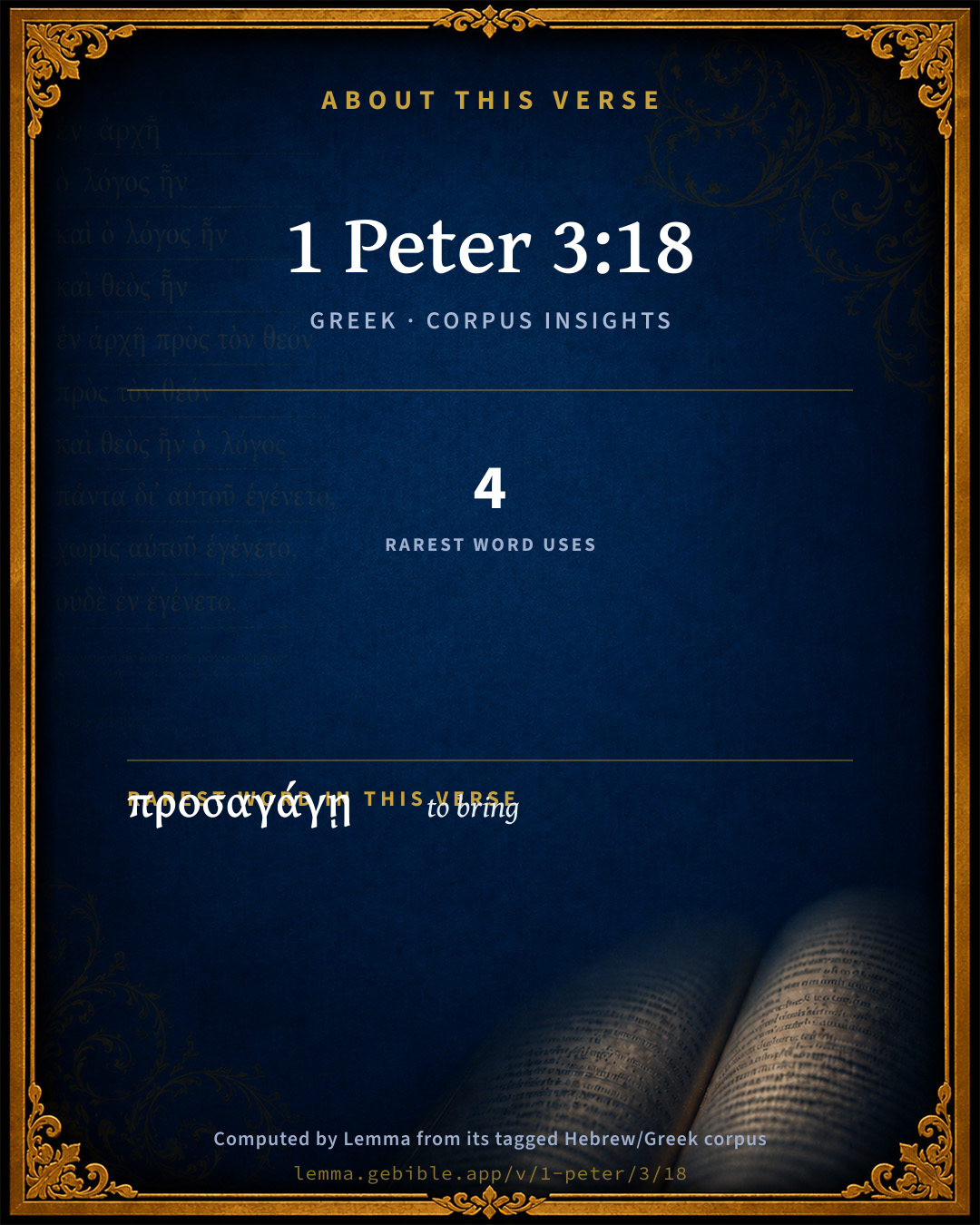
- Appears 4× in the Greek New Testament
- First appears at Luke 9:41
- Part of Speech
- Verb
- Tense
- Aorist
- Voice
- Active
- Mood
- Subjunctive
- Person
- 3rd person
- Number
- Singular
Full Thayer's Definition
- ὅτι hóti G3754 “that” Conjunction
- καὶ kaí G2532 “and” Conjunction
- Χριστὸς Christós G5547 “Christ” Noun, Nominative, Singular, Masculine
- ἅπαξ hápax G530 “once” Adverb
- περὶ perí G4012 “about” Preposition
- ἁμαρτιῶν hamartía G266 “sin” Noun, Genitive, Plural, Feminine
- ἀπέθανεν apothnḗskō G599 “to die” Verb, Aorist, Active, Indicative, 3rd person, Singular
- δίκαιος díkaios G1342 “righteous” Adjective, Nominative, Singular, Masculine
- ὑπὲρ hypér G5228 “over” Preposition
- ἀδίκων ádikos G94 “unjust” Adjective, Genitive, Plural, Masculine
- ἵνα hína G2443 “that” Conjunction
- ὑμᾶς hymeîs G5210 “you” Personal pronoun, 2nd person, Accusative, Plural
- προσαγάγῃ proságō G4317 “to bring” Verb, Aorist, Active, Subjunctive, 3rd person, Singular
- τῷ ho G3588 “the” Article, Dative, Singular, Masculine
- θεῷ theós G2316 “God” Noun, Dative, Singular, Masculine
- θανατωθεὶς thanatóō G2289 “to put to death” Verb, Perfect, Passive, Participle, Nominative, Singular, Masculine
- μὲν mén G3303 “truly” Particle
- σαρκὶ sárx G4561 “flesh” Noun, Dative, Singular, Feminine
- ζῳοποιηθεὶς zōopoiéō G2227 “to make alive” Verb, Aorist, Passive, Participle, Nominative, Singular, Masculine
- δὲ dé G1161 “but” Conjunction
- πνεύματι pneûma G4151 “spirit” Noun, Dative, Singular, Neuter
About this verse
These counts appear in no published source. They are computed here, from the morphology-tagged text and Lemma’s own curated glosses. What Lemma adds →
- 21
- words
- 21
- distinct lemmas
- General Epistles
- section
Cross-references
26Topical passages linked to 1 Peter 3:18 in the Treasury of Scripture Knowledge — connected by theme and wording, ordered by reader-vote popularity; previews shown in the World English Bible.
- Hebrews 9:28 so Christ also, having been once offered to bear the sins of many, will appear a second time, without sin, to those who are eagerly waiting for him for salvation.
- Hebrews 9:26 or else he must have suffered often since the foundation of the world. But now once at the end of the ages, he has been revealed to put away sin by the sacrifice of himself.
- 2 Corinthians 5:21 For him who knew no sin he made to be sin on our behalf; so that in him we might become the righteousness of God.
- 1 Peter 4:6 For to this end was the Gospel preached even to the dead, that they might be judged indeed as men in the flesh, but live as to God in the spirit.
- Romans 5:6–8 For while we were yet weak, at the right time Christ died for the ungodly.
- Titus 2:14 who gave himself for us, that he might redeem us from all iniquity, and purify for himself a people for his own possession, zealous for good works.
- 1 John 1:9 If we confess our sins, he is faithful and righteous to forgive us the sins, and to cleanse us from all unrighteousness.
- Colossians 1:21–22 You, being in past times alienated and enemies in your mind in your evil works,
- Romans 4:25 who was delivered up for our trespasses, and was raised for our justification.
- Romans 8:3 For what the law couldn't do, in that it was weak through the flesh, God did, sending his own Son in the likeness of sinful flesh and for sin, he condemned sin in the flesh;
- 1 Peter 4:1 Forasmuch then as Christ suffered for us in the flesh, arm yourselves also with the same mind; for he who has suffered in the flesh has ceased from sin;
- Galatians 3:13 Christ redeemed us from the curse of the law, having become a curse for us. For it is written, "Cursed is everyone who hangs on a tree,"
- Galatians 1:4 who gave himself for our sins, that he might deliver us out of this present evil age, according to the will of our God and Father--
- Isaiah 53:4–6 Surely he has borne our sickness, and carried our suffering; yet we considered him plagued, struck by God, and afflicted.
- Ephesians 2:16–18 and might reconcile them both in one body to God through the cross, having killed the hostility thereby.
- Romans 1:4 who was declared to be the Son of God with power, according to the Spirit of holiness, by the resurrection from the dead, Jesus Christ our Lord,
- Romans 5:2 through whom we also have our access by faith into this grace in which we stand. We rejoice in hope of the glory of God.
- 1 Peter 2:21–24 For to this you were called, because Christ also suffered for us, leaving you an example, that you should follow his steps,
- 2 Corinthians 13:4 For he was crucified through weakness, yet he lives through the power of God. For we also are weak in him, but we will live with him through the power of God toward you.
- Acts 3:14 But you denied the Holy and Righteous One, and asked for a murderer to be granted to you,
- Romans 8:11 But if the Spirit of him who raised up Jesus from the dead dwells in you, he who raised up Christ Jesus from the dead will also give life to your mortal bodies through his Spirit who dwells in you.
- James 5:6 You have condemned, you have murdered the righteous one. He doesn't resist you.
- Zechariah 9:9 Rejoice greatly, daughter of Zion! Shout, daughter of Jerusalem! Behold, your king comes to you! He is righteous, and having salvation; Lowly, and riding on a donkey, Even on a colt, the foal of a donkey.
- Matthew 27:19 While he was sitting on the judgment seat, his wife sent to him, saying, "Have nothing to do with that righteous man, for I have suffered many things this day in a dream because of him."
- Acts 22:14 He said, 'The God of our fathers has appointed you to know his will, and to see the Righteous One, and to hear a voice from his mouth.
- 2 Corinthians 1:24 Not that we have lordship over your faith, but are fellow workers with you for your joy. For you stand firm in faith.
Cross-references courtesy of OpenBible.info (CC BY 4.0).
Where the printed editions differ
2 variantsPlaces in this verse where the major printed Greek editions disagree on the wording in a way that affects the translation — a comparison of editions, not a manuscript-by-manuscript collation. The editions are the modern critical texts (Nestlé-Aland 28/27, SBL, Westcott-Hort, Tregelles, Tyndale House) and the traditional texts behind the KJV (the Textus Receptus and the Byzantine/Majority text). It is not a claim about which reading is original.
-
Different wording
ἔπαθεν,
“suffered,”
In NA28NA27TynSBLTRByz Not in WHTregἀπέθανεν (apethanen) 'died' occurs in a few manuscripts (WH+Treg) instead of ἔπαθεν, (epathen) 'suffered,' in older manuscripts (NA28+NA27+Tyn+SBL+TR+Byz)
-
Different wording
ὑμᾶς
“you”
In NA28NA27TynSBLWHByz Not in TregTRἡμᾶς (hēmas) 'us' occurs in traditional manuscripts (Treg+TR) instead of ὑμᾶς (humas) 'you' in older manuscripts (NA28+NA27+Tyn+SBL+WH+Byz)
Textual data: Translators Amalgamated Greek New Testament (STEPBible TAGNT) · CC BY 4.0.
Lesson kit
Teaching starters — assembled from the data on this page, not authored interpretation. Every prompt links to the verse data it draws on. Edit before teaching.
1 Peter, in the General Epistles, opens this verse with 21 words (21 distinct Greek lemmas). Its most distinctive word is proságō (“to bring”). A historical commentator’s framing appears above. Read the whole chapter for the surrounding context.
Discussion questions
- How does “to bring” (proságō) shape what this verse is saying?
- How does Luke 9:41, which shares the word «to bring», read alongside this verse?
- These translations render this verse differently; the difference is in the English rendering, not the original. What questions does that raise?
- Compare how Jamieson, Fausset & Brown and Albert Barnes' Notes on the Bible read this verse. Where do they agree or differ?
Things to notice
- These translations choose different wording for 21 words in this verse.
- 21 distinct Greek lemmas span 21 words in this verse.
Commentary
Notes on 1 Peter 3:18 from classic Christian and Jewish commentators (each source and its license shown beneath its notes). The classic Christian expositions comment on the surrounding passage and are grouped to its opening verse, so a note may address several verses; the Jewish commentaries on the Tanakh (Rashi and others) are per-verse, so they appear only where the commentator wrote on this verse.
Lemma curates 59 commentaries, every one of them public domain or Creative Commons licensed, each selected and text-cleaned for this edition rather than reprinted as found. About our sources →
Jamieson, Fausset & Brown
Robert Jamieson, A. R. Fausset & David Brown
Jamieson, Fausset & Brown — Commentary Critical and Explanatory on the Whole Bible (1871) — public domain (CC PDM 1.0). Text via the HelloAO Bible API.
Albert Barnes' Notes on the Bible
Albert Barnes' Notes on the Bible (1834–1885) — public domain. Text from a community e-Sword/MySword module.
The Biblical Illustrator
Joseph S. Exell
The Biblical Illustrator, edited by Joseph S. Exell (c. 1880s–1900s) — public domain. Text from a community e-Sword module.
Lange's Commentary on the Holy Scriptures
Lange's Commentary on the Holy Scriptures (Critical, Doctrinal, and Homiletical), ed. John Peter Lange, English translation edited by Philip Schaff (1864–1880) — public domain. Text from a community e-Sword module.
Tyndale Open Study Notes
Tyndale Open Resources
Tyndale Open Study Notes — © Tyndale Open Resources, licensed CC BY-SA 4.0. Text via the HelloAO Bible API.
Bengel's Gnomon
Johann Albrecht Bengel
Bengel's Gnomon of the New Testament — English translation (T&T Clark, Edinburgh, 1860) — public domain. Text from a community e-Sword module.
Meyer's Critical & Exegetical Commentary
Heinrich August Wilhelm Meyer
Meyer — Critical and Exegetical Commentary on the New Testament — English translation by Peter Christie, edited by Frederick Crombie (T&T Clark, 1880) — public domain. Text from a community e-Sword module.
Expositor's Greek Testament
ed. W. Robertson Nicoll
The Expositor's Greek Testament, edited by W. Robertson Nicoll (1897–1910) — public domain. Text from a community e-Sword module.
Geneva Bible (1599)
Geneva Bible translators
Geneva Bible (1599) marginal notes — public domain. Text via Bolls.life.
Matthew Henry's Commentary
Matthew Henry's Commentary on the Whole Bible (1708–1710) — public domain (CC PDM 1.0). Text via the HelloAO Bible API.
Adam Clarke's Commentary
Adam Clarke's Commentary on the Bible (1810–1826) — public domain. Text from a community e-Sword/MySword module.
John Calvin's Commentaries
John Calvin's Commentaries (1540-1563) — public domain. Text from the Calvin Translation Society English edition (1840s-50s) via the Christian Classics Ethereal Library (ccel.org). Calvin's coverage is partial (roughly two-thirds of the Bible); uncommented books and verses are honest gaps, never fabricated. The 19th-century editor's footnotes and remarks are omitted so the notes are faithfully Calvin's own voice.
Ellicott's Commentary for English Readers
A Bible Commentary for English Readers, edited by Charles John Ellicott (1878–1897) — public domain. Text from a community e-Sword module.
The Cambridge Bible for Schools and Colleges
gen. ed. J. J. S. Perowne
The Cambridge Bible for Schools and Colleges (gen. ed. J. J. S. Perowne; Cambridge University Press, 1878–1918) — public domain. Text from a community e-Sword module.
John Gill's Exposition
John Gill's Exposition of the Whole Bible (1746–1763) — public domain (CC PDM 1.0). Text via the HelloAO Bible API.
Trapp's Complete Commentary
John Trapp
John Trapp, A Commentary or Exposition upon All the Books of the Old and New Testament (1647–1656) — public domain. Text from a community e-Sword module.
Haydock's Catholic Bible Commentary
George Leo Haydock (1774–1849), Haydock's Catholic Family Bible and Commentary, 1859 edition — public domain. Excludes Psalms (Douay-Rheims chapter numbering differs from Protestant) and Deuterocanonical books (Catholic canon only).
Matthew Poole's English Annotations
Matthew Poole's English Annotations on the Holy Bible (1683–1685) — public domain. Text from a community e-Sword/MySword module.
Whedon's Commentary on the Bible
Daniel D. Whedon
Daniel D. Whedon (gen. ed.), Commentary on the Old and New Testaments (1874–1909) — public domain. Text from a community e-Sword module.
The Pulpit Commentary
The Pulpit Commentary (1880–1919), ed. H.D.M. Spence-Jones & Joseph S. Exell — public domain. Text from a community e-Sword module.
John Wesley's Explanatory Notes
John Wesley, Explanatory Notes Upon the Whole Bible (1754–1765) — public domain. Text via the GEBible commentary corpus.
Scofield Reference Notes
C. I. Scofield
The Scofield Reference Bible (1917 edition), notes by C. I. Scofield — public domain. Text from a community e-Sword module.
Burkitt's Expository Notes on the New Testament
William Burkitt
William Burkitt's Expository Notes on the New Testament (1700–1703) — public domain. Text from a community e-Sword module.
Godbey's Commentary on the New Testament
William B. Godbey
William B. Godbey, Commentary on the New Testament (1896–1900) — public domain. Text from a community e-Sword module.
The People's New Testament
B. W. Johnson
B. W. Johnson's The People's New Testament with Notes (1889–1891) — public domain. Electronic text from the Christian Classics Ethereal Library (CCEL) ThML edition.
unfoldingWord translationNotes
Door43 World Missions Community
unfoldingWord translationNotes — © Distant Shores Media and the Door43 World Missions Community, licensed CC BY-SA 4.0. Source: git.door43.org/Door43/en_tn.
Cambridge Greek Testament for Schools and Colleges
Cambridge Greek Testament for Schools and Colleges (Cambridge University Press, 1896; 21 vols, various authors incl. Carr, Maclear, Plummer, Farrar, Lumby, Moule, M. R. James, Simcox) — public domain. Text from a community e-Sword module.
Alford’s Greek Testament
Henry Alford
Henry Alford, The Greek Testament (1849–1861) — public domain. Text from a community e-Sword module.
Vincent's Word Studies in the New Testament
Marvin R. Vincent
Marvin R. Vincent, Word Studies in the New Testament (1887–1900) — public domain. Text from a community e-Sword/MySword module.