Ephesians 5:2

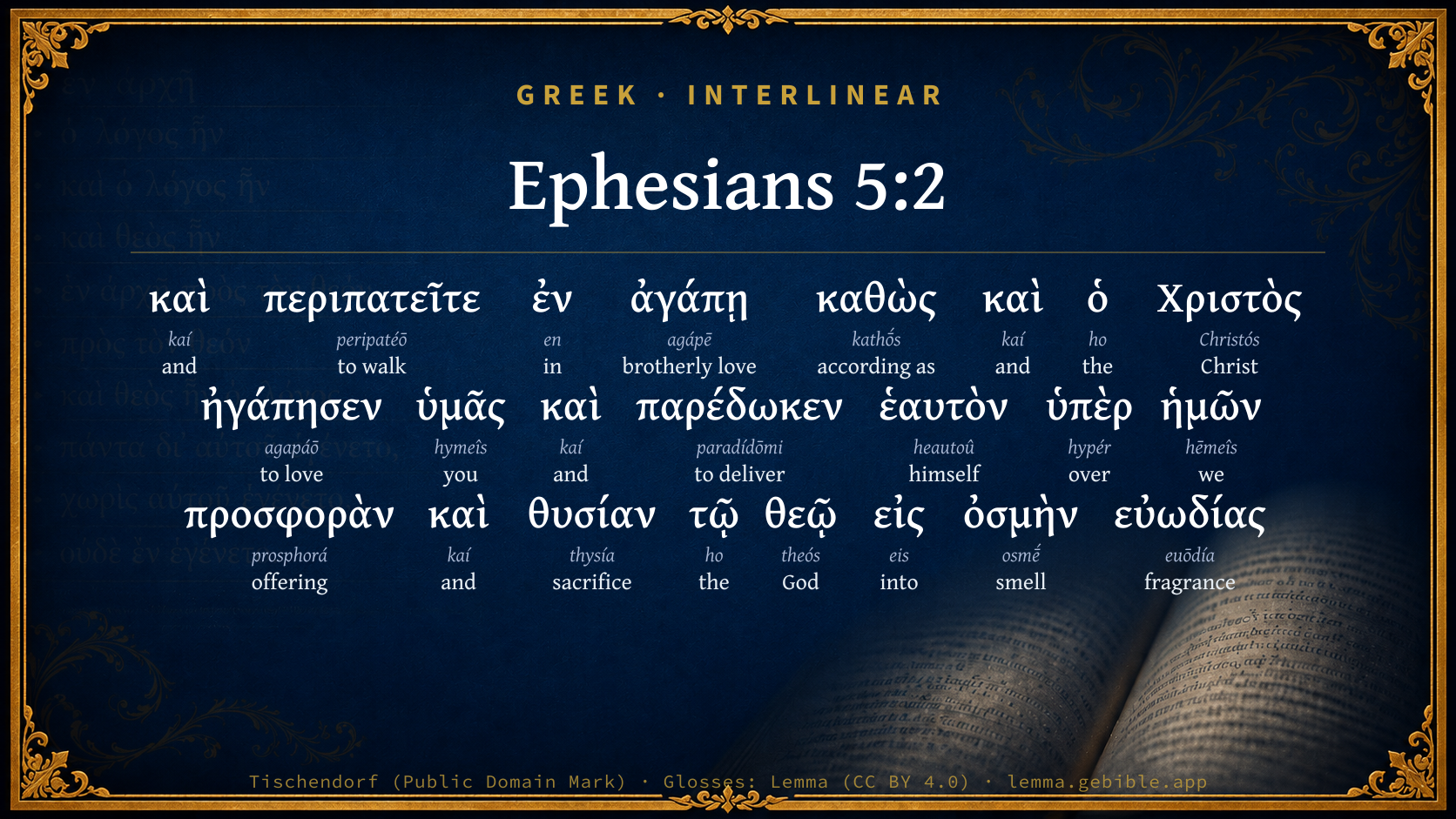
Greek (Tischendorf 8th ed.) Ephesians 5:2 appears in the Greek New Testament. The text above is from the Tischendorf 8th edition. Each word links to its Strong’s number and a concise gloss. Click any word for its full Thayer’s Greek Lexicon entry.
Download image
Cite this verse

Ephesians 5:2 (World English Bible). Public Domain. Lemma interlinear Bible study tool, https://lemma.gebible.app/v/ephesians/5/2.

Show BibTeX & RIS
BibTeX
RIS
English Translation
Walk in love, even as Christ also loved you, and gave himself up for us, an offering and a sacrifice to God for a sweet-smelling fragrance.
World English Bible · Public Domain
Download a study sheet

One document with this verse’s original text, its word-by-word gloss line, the meaning frame, cross-references with their text, attributed commentary, and full source and license credits — printable, and it pastes into notes with its structure intact.

This verse Autodidact and up

Study sheet (.html) Plain text (.txt)

A passage Seminary Student

Up to 50 verses in one chapter. A passage sheet keeps up to 6 commentary sources and 12 cross-references per verse, in the order this page ranks them, and says so on the sheet whenever that leaves anything out. Ask for a single verse and you get the Autodidact verse sheet above.

Everything on this page stays free to read, with no account — the sheet is a download of what is already on screen, not access to it.

Want to remove ads? Support Godless Engineer
Compare translations 3

The same verse in 3 English versions, stacked beneath the original-language interlinear above. Click any original word for its lexicon entry.

Each is an independent rendering of the whole verse — the interlinear is not word-aligned to these translations.

Highlighted words mark where these versions differ — a whole-verse word diff, not a word-by-word alignment.

  • World English Bible Public Domain
    Walk in love, even as Christ also loved you, and gave himself up for us, an offering and a sacrifice to God for a sweet-smelling fragrance.
  • King James Version Public Domain
    And walk in love, as Christ also hath loved us, and hath given himself for us an offering and a sacrifice to God for a sweetsmelling savour.
  • unfoldingWord Literal Text CC BY-SA 4.0
    and walk in love, as also Christ loved us and gave himself up for us, an offering and sacrifice to God for a fragrant aroma.

unfoldingWord Literal Text — © unfoldingWord, licensed CC BY-SA 4.0. Word-aligned USFM3 via Door43 (git.door43.org/unfoldingWord/en_ult).

Versions to compare (up to 4)

3 of 4 selected

Show all 19 translations

Every available English version of this verse, each an independent rendering of the whole verse.

  • World English Bible Public Domain
    Walk in love, even as Christ also loved you, and gave himself up for us, an offering and a sacrifice to God for a sweet-smelling fragrance.
  • Berean Standard Bible Public Domain
    and walk in love, just as Christ loved us and gave Himself up for us as a fragrant sacrificial offering to God.
  • Majority Standard Bible Public Domain
    and walk in love, just as Christ loved us and gave Himself up for us as a fragrant sacrificial offering to God.
  • King James Version Public Domain
    And walk in love, as Christ also hath loved us, and hath given himself for us an offering and a sacrifice to God for a sweetsmelling savour.
  • American Standard Version (1901) Public Domain
    and walk in love, even as Christ also loved you, and gave himself up for us, an offering and a sacrifice to God for an odor of a sweet smell.
  • Revised Version (1885) Public Domain
    and walk in love, even as Christ also loved you, and gave himself up for us, an offering and a sacrifice to God for an odour of a sweet smell.
  • Geneva Bible (1599) Public Domain
    And walke in loue, euen as Christ hath loued vs, and hath giuen himselfe for vs, to be an offering and a sacrifice of a sweete smellling sauour to God.
  • Douay-Rheims (1899) Public Domain
    And walk in love, as Christ also hath loved us, and hath delivered himself for us, an oblation and a sacrifice to God for an odour of sweetness.
  • Young's Literal Translation Public Domain
    and walk in love, as also the Christ did love us, and did give himself for us, an offering and a sacrifice to God for an odour of a sweet smell,
  • Literal Standard Version CC BY-SA 4.0
    and walk in love, as the Christ also loved us, and gave Himself for us, an offering and a sacrifice to God for an odor of a refreshing fragrance,
  • Unlocked Literal Bible CC BY-SA 4.0
    And walk in love, as also Christ loved us and gave himself up for us, a fragrant offering and sacrifice to God.
  • unfoldingWord Literal Text CC BY-SA 4.0
    and walk in love, as also Christ loved us and gave himself up for us, an offering and sacrifice to God for a fragrant aroma.
  • Darby Bible Public Domain
    and walk in love, even as the Christ loved us, and delivered himself up for us, an offering and sacrifice to God for a sweet-smelling savour.
  • World Messianic Bible Public Domain
    Walk in love, even as Messiah also loved us and gave himself up for us, an offering and a sacrifice to God for a sweet-smelling fragrance.
  • Webster's Bible Public Domain
    And walk in love, as Christ also hath loved us, and hath given himself for us an offering and a sacrifice to God for a sweet-smelling savor.
  • Free Bible Version CC BY-SA 4.0
    Live in love, just as Christ loved you. He gave himself for us, a gift and sacrificial offering to God like a sweet-smelling perfume.
  • Bible in Basic English Public Domain
    And be living in love, even as Christ had love for you, and gave himself up for us, an offering to God for a perfume of a sweet smell.
  • Text-Critical English NT CC BY 4.0
    and walk in love, just as Christ loved us and gave himself up for us as a fragrant offering and sacrifice to God.
  • Tyndale New Testament (1534) Public Domain
    and walke in love even as Christ loved vs and gave him silfe for vs an offerynge and a sacrifyce of a swete saver to god.

Literal Standard Version (2020), Covenant Press — licensed CC BY-SA 4.0. Text via the HelloAO Bible API (eBible.org). Unlocked Literal Bible (unfoldingWord) — licensed CC BY-SA 4.0. Text via the HelloAO Bible API (eBible.org). unfoldingWord Literal Text — © unfoldingWord, licensed CC BY-SA 4.0. Word-aligned USFM3 via Door43 (git.door43.org/unfoldingWord/en_ult). Free Bible Version, Dr. Jonathan Gallagher — licensed CC BY-SA 4.0. Text via the HelloAO Bible API (eBible.org).

Word by word

More ways to search: Search by grammar → Find every occurrence → Compare this word →

Practice this passage: Drill this verse → Learn its vocabulary →

εὐωδίας
euōdía
G2175
“fragrance”
Noun, Genitive, Singular, Feminine
Part of Speech
Noun
Case
Genitive
Number
Singular
Gender
Feminine
Full Thayer's Definition

Origin: from a compound of G2095 and a derivative of G3605

TDNT: 15:28,3

1. a sweet smell, fragrance 2. a fragrant or sweet smelling thing, incense, on odour or something sweet smelling a. an odour of acquiescence, satisfaction b. a sweet odour, spoken of the smell of sacrifices and obligations, agreeably to the ancient notion that God smells and is pleased with the odour of sacrifices 3. metaph. a thing well pleasing to God
  1. καὶ kaí G2532 “and” Conjunction
  2. περιπατεῖτε peripatéō G4043 “to walk” Verb, Present, Active, Imperative, 2nd person, Plural
  3. ἐν en G1722 “in” Preposition
  4. ἀγάπῃ agápē G26 “brotherly love” Noun, Dative, Singular, Feminine
  5. καθὼς kathṓs G2531 “according as” Adverb
  6. καὶ kaí G2532 “and” Conjunction
  7. ὁ ho G3588 “the” Article, Nominative, Singular, Masculine
  8. Χριστὸς Christós G5547 “Christ” Noun, Nominative, Singular, Masculine
  9. ἠγάπησεν agapáō G25 “to love” Verb, Aorist, Active, Indicative, 3rd person, Singular
  10. ὑμᾶς hymeîs G5210 “you” Personal pronoun, 2nd person, Accusative, Plural
  11. καὶ kaí G2532 “and” Conjunction
  12. παρέδωκεν paradídōmi G3860 “to deliver” Verb, Aorist, Active, Indicative, 3rd person, Singular
  13. ἑαυτὸν heautoû G1438 “himself” Reflexive pronoun, 3rd person, Accusative, Singular, Masculine
  14. ὑπὲρ hypér G5228 “over” Preposition
  15. ἡμῶν hēmeîs G2249 “we” Personal pronoun, 1st person, Genitive, Plural
  16. προσφορὰν prosphorá G4376 “offering” Noun, Accusative, Singular, Feminine
  17. καὶ kaí G2532 “and” Conjunction
  18. θυσίαν thysía G2378 “sacrifice” Noun, Accusative, Singular, Feminine
  19. τῷ ho G3588 “the” Article, Dative, Singular, Masculine
  20. θεῷ theós G2316 “God” Noun, Dative, Singular, Masculine
  21. εἰς eis G1519 “into” Preposition
  22. ὀσμὴν osmḗ G3744 “smell” Noun, Accusative, Singular, Feminine

About this verse

These counts appear in no published source. They are computed here, from the morphology-tagged text and Lemma’s own curated glosses. What Lemma adds →

23
words
19
distinct lemmas
Pauline Epistles
section

Notable vocabulary

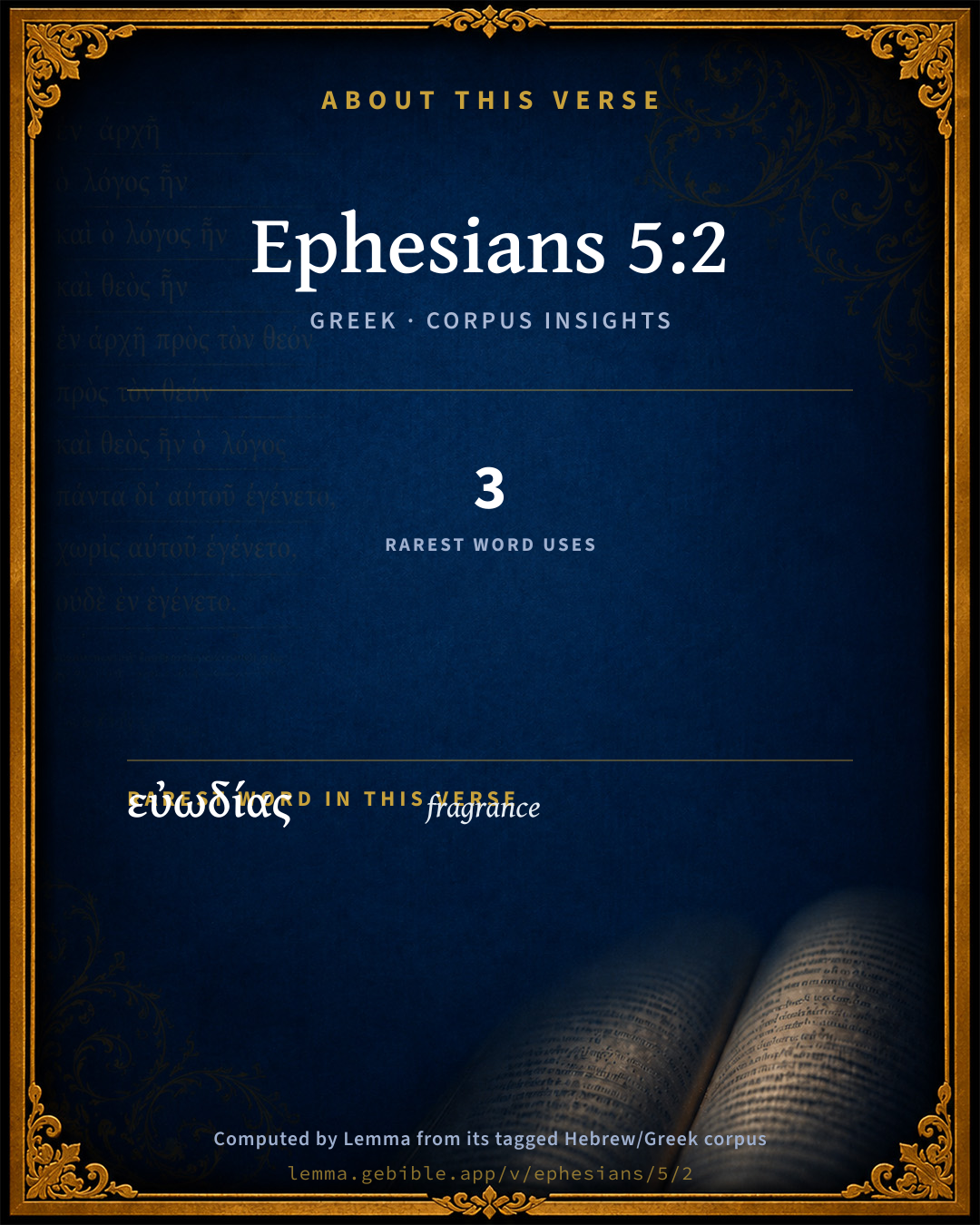
The rarest word here is εὐωδίας fragrance G2175 — appearing just 3 times in the whole Greek New Testament.

Shared distinctive vocabulary

εὐωδίας fragrance G2175 occurs in 3 verses of the Greek New Testament. Also found in:

Repetition

Words recur within this verse:

Cross-references

44

Topical passages linked to Ephesians 5:2 in the Treasury of Scripture Knowledge — connected by theme and wording, ordered by reader-vote popularity; previews shown in the World English Bible.

  • John 13:34 A new commandment I give to you, that you love one another, just like I have loved you; that you also love one another.
  • Galatians 2:20 I have been crucified with Christ, and it is no longer I that live, but Christ living in me. That life which I now live in the flesh, I live by faith in the Son of God, who loved me, and gave himself up for me.
  • Colossians 3:14 Above all these things, walk in love, which is the bond of perfection.
  • 2 Corinthians 2:15 For we are a sweet aroma of Christ to God, in those who are saved, and in those who perish;
  • Matthew 20:28 even as the Son of Man came not to be served, but to serve, and to give his life as a ransom for many."
  • 1 Corinthians 16:14 Let all that you do be done in love.
  • Titus 2:14 who gave himself for us, that he might redeem us from all iniquity, and purify for himself a people for his own possession, zealous for good works.
  • 1 Peter 4:8 And above all things be earnest in your love among yourselves, for love covers a multitude of sins.
  • 2 Corinthians 8:9 For you know the grace of our Lord Jesus Christ, that, though he was rich, yet for your sakes he became poor, that you through his poverty might become rich.
  • Hebrews 7:25–27 Therefore he is also able to save to the uttermost those who draw near to God through him, seeing he ever lives to make intercession for them.
  • 1 Peter 2:21–24 For to this you were called, because Christ also suffered for us, leaving you an example, that you should follow his steps,
  • Genesis 8:21 Yahweh smelled the sweet savor. Yahweh said in his heart, "I will not again curse the ground any more for man's sake, because the imagination of man's heart is evil from his youth; neither will I ever again strike everything living, as I have done.
  • John 15:12–13 "This is my commandment, that you love one another, even as I have loved you.
  • 1 Timothy 2:6 who gave himself as a ransom for all; the testimony in its own times;
  • Galatians 1:4 who gave himself for our sins, that he might deliver us out of this present evil age, according to the will of our God and Father--
  • Ephesians 4:15 but speaking truth in love, we may grow up in all things into him, who is the head, Christ;
  • 1 Timothy 4:12 Let no man despise your youth; but be an example to those who believe, in word, in your way of life, in love, in spirit, in faith, and in purity.
  • Hebrews 9:14 how much more will the blood of Christ, who through the eternal Spirit offered himself without blemish to God, cleanse your conscience from dead works to serve the living God?
  • 1 John 3:23 This is his commandment, that we should believe in the name of his Son, Jesus Christ, and love one another, even as he commanded.
  • 1 John 4:20–21 If a man says, "I love God," and hates his brother, he is a liar; for he who doesn't love his brother whom he has seen, how can he love God whom he has not seen?
  • Revelation 1:5 and from Jesus Christ, the faithful witness, the firstborn of the dead, and the ruler of the kings of the earth. To him who loves us, and washed us from our sins by his blood;
  • Leviticus 1:17 He shall tear it by its wings, but shall not divide it apart. The priest shall burn it on the altar, on the wood that is on the fire. It is a burnt offering, an offering made by fire, of a sweet savor to Yahweh.
  • 2 Corinthians 5:14–15 For the love of Christ constrains us; because we judge thus, that one died for all, therefore all died.
  • Ephesians 3:17 that Christ may dwell in your hearts through faith; to the end that you, being rooted and grounded in love,
  • Ephesians 4:2 with all lowliness and humility, with patience, bearing with one another in love;
  • Hebrews 9:26 or else he must have suffered often since the foundation of the world. But now once at the end of the ages, he has been revealed to put away sin by the sacrifice of himself.
  • Hebrews 10:10–12 by which will we have been sanctified through the offering of the body of Jesus Christ once for all.
  • 1 John 3:11–12 For this is the message which you heard from the beginning, that we should love one another;
  • 1 John 3:16 By this we know love, because he laid down his life for us. And we ought to lay down our lives for the brothers.
  • Leviticus 1:9 but its innards and its legs he shall wash with water. The priest shall burn the whole on the altar, for a burnt offering, an offering made by fire, of a sweet savor to Yahweh.
  • Amos 5:21 I hate, I despise your feasts, And I can't stand your solemn assemblies.
  • Ephesians 3:19 and to know Christ's love which surpasses knowledge, that you may be filled with all the fullness of God.
  • Hebrews 9:23 It was necessary therefore that the copies of the things in the heavens should be cleansed with these; but the heavenly things themselves with better sacrifices than these.
  • Revelation 5:9 They sang a new song, saying, "You are worthy to take the book, And to open its seals: For you were killed, And bought us for God with your blood, Out of every tribe, language, people, and nation,
  • Leviticus 1:13 but the innards and the legs he shall wash with water. The priest shall offer the whole, and burn it on the altar. It is a burnt offering, an offering made by fire, of a sweet savor to Yahweh.
  • Romans 4:25 who was delivered up for our trespasses, and was raised for our justification.
  • Romans 8:3 For what the law couldn't do, in that it was weak through the flesh, God did, sending his own Son in the likeness of sinful flesh and for sin, he condemned sin in the flesh;
  • Romans 14:15–16 Yet if because of food your brother is grieved, you walk no longer in love. Don't destroy with your food him for whom Christ died.
  • 1 Corinthians 5:7 Purge out the old yeast, that you may be a new lump, even as you are unleavened. For indeed Christ, our Passover, has been sacrificed in our place.
  • Ephesians 5:25 Husbands, love your wives, even as Christ also loved the assembly, and gave himself up for it;
  • Leviticus 3:16 The priest shall burn them on the altar: it is the food of the offering made by fire, for a sweet savor; all the fat is Yahweh's.
  • Romans 8:37 No, in all these things, we are more than conquerors through him who loved us.
  • 1 Thessalonians 4:9 But concerning brotherly love, you have no need that one write to you. For you yourselves are taught by God to love one another,
  • John 6:51 I am the living bread which came down out of heaven. If anyone eats of this bread, he will live forever. Yes, the bread which I will give for the life of the world is my flesh."

Cross-references courtesy of OpenBible.info (CC BY 4.0).

Where the printed editions differ

2 variants

Places in this verse where the major printed Greek editions disagree on the wording in a way that affects the translation — a comparison of editions, not a manuscript-by-manuscript collation. The editions are the modern critical texts (Nestlé-Aland 28/27, SBL, Westcott-Hort, Tregelles, Tyndale House) and the traditional texts behind the KJV (the Textus Receptus and the Byzantine/Majority text). It is not a claim about which reading is original.

  1. Different wording
    ἡμᾶς

    “us”

    In NA28NA27TynSBLTRByz Not in WHTreg

    ὑμᾶς (humas) 'you' occurs in a few manuscripts (WH+Treg) instead of ἡμᾶς (hēmas) 'us' in older manuscripts (NA28+NA27+Tyn+SBL+TR+Byz)

  2. Different wording
    ἡμῶν

    “us”

    In NA28NA27TynSBLTregTRByz Not in WH

    ὑμῶν (humōn) 'you' occurs in a few manuscripts (WH) instead of ἡμῶν (hēmōn) 'us' in older manuscripts (NA28+NA27+Tyn+SBL+Treg+TR+Byz)

Textual data: Translators Amalgamated Greek New Testament (STEPBible TAGNT) · CC BY 4.0.

Commentary

Notes on Ephesians 5:2 from classic Christian and Jewish commentators (each source and its license shown beneath its notes). The classic Christian expositions comment on the surrounding passage and are grouped to its opening verse, so a note may address several verses; the Jewish commentaries on the Tanakh (Rashi and others) are per-verse, so they appear only where the commentator wrote on this verse.

Lemma curates 59 commentaries, every one of them public domain or Creative Commons licensed, each selected and text-cleaned for this edition rather than reprinted as found. About our sources →

Albert Barnes' Notes on the Bible

And walk in love - That is, let your lives be characterized by love; let that be evinced in all your deportment and conversation; see notes on Joh 13:34.

As Christ also hath loved us - We are to evince the same love for one another which he has done for us. He showed his love by giving himself to die for us, and we should evince similar love to one another; 1Jo 3:16.

And hath given himself for us - “As Christ also hath loved us.” We are to evince the same love for one another which he has done for us He showed his love by giving himself to die for us, and we should evince similar love to one another; 1Jo 3:16. “And hath given himself for us.” This is evidently added by the apostle to show what he meant by saying that Christ loved us, and what we ought to do to evince our love for each other. The strength of his love was so great that he was willing to give himself up to death on our account; our love for our brethren should be such that we would be willing to do the same thing for them; 1Jo 3:16.

An offering - The word used here - προσφορά prosphora - means properly that which is “offered to God” in any way; or whatever it may be. It is, however, in the Scriptures commonly used to denote an offering without blood - a thank-offering - and thus is distinguished from a sacrifice or a bloody oblation. The word occurs only in Act 21:26; Act 24:17; Rom 15:16; Eph 5:2; Heb 10:5, Heb 10:8,Heb 10:10, Heb 10:14, Heb 10:18. It means here that he regarded himself as an offering to God.

And a sacrifice - θυσίαν thusian. Christ is here expressly called a “Sacrifice” - the usual word in the Scriptures to denote a proper sacrifice. A sacrifice was an offering made to God by killing an animal and burning it on an altar, designed to make atonement for sin. It always implied the “killing” of the animal as an acknowledgment of the sinner that he deserved to die. It was the giving up of “life,” which was supposed to reside in the “blood” (see the notes on Rom 3:25), and hence it was necessary that “blood” should be shed. Christ was such a sacrifice; and his love was shown in his being willing that his blood should be shed to save people.

For a sweet-smelling savour - see the notes on 2Co 2:15, where the word “savor” is explained. The meaning here is, that the offering which Christ made of himself to God, was like the grateful and pleasant smell of “incense,” that is, it was acceptable to him. It was an exhibition of benevolence with which he was pleased, and it gave him the opportunity of evincing his own benevolence in the salvation of people. The meaning of this in the connection here is that the offering which Christ made was one of “love.” So, says Paul, do you love one another. Christ sacrificed himself by “love,” and that sacrifice was acceptable to God. So do you show love one to another. Sacrifice everything which opposes it. and it will be acceptable to God. He will approve nil which is designed to promote love, as he approved the sacrifice which was made, under the influence of love, by his Son.

Albert Barnes' Notes on the Bible (1834–1885) — public domain. Text from a community e-Sword/MySword module.

The Biblical Illustrator

Joseph S. Exell

Eph_5:2

And walk in love, as Christ also hath loved us, and hath given Himself for us an offering and a sacrifice to God.

Walking in love

I. I gather out of these words something calculated to touch the heart.

1. There are many of our fellow creatures who have found but little love from man. To them this would have been a cold, cheerless place. To them the love of God, revealed in the gospel, comes as a strange and startling thing. It transforms life when thoroughly realized and embraced.

2. There are others who have known the value of human affection, and have lost it. A dark cloud has settled down upon their once happy homes and hearts. The gospel announces that all they have lost, and far more, they may find again in Christ. When anyone shall not only hear it, but grasp it--not only understand it, but try it--then life will wear a new aspect, and under the influence of Christ the whole soul expands.

II. I find here something to satisfy the conscience. What should we do in the presence of our sins, if we had no such truth as this to trust to?

III. I find here something to regulate life.

1. Walk in love as in an atmosphere of bright sunshine, bathing your soul in a consciousness of Gods love for you. It is your privilege, let it be your joy.

2. Walk in love as an apparel. It is a beautiful sight to see a man clothed with humility. It is a cheering sight when you look at a servant of Jesus in the armour of light, and a worshipper of God in the garments of salvation. It is a glorious sight when you see a holy man putting on zeal for a cloak. But above all these things put on charity or love, for it is the bond of perfectness. In this world of sorrow the Christian should be conspicuous for love. It was the prominent feature in Christ; it should be prominent in Christs followers.

3. Walk in love, as the appointed path in which God would have His children found. The walk of love will lead you into ways which you never once thought to find. It often turns aside from the more crowded thoroughfares of life, and runs through scenes where sorrow and shame have crept out of sight to weep and endeavour to forget. But there are some of the keenest experiences of human joy to be found in this lowly path. To stand, e.g., in the presence of despair, and watch how hope begins again to brighten a brothers eye; to whisper some holy truth in the ear of grief, and then receive the rich reward of a smile of thankfulness; to put the cup of cold water to the parched lip, and then listen to the gurgle of a new joy as some poor sufferer drinks down what refreshes soul and body both--oh, this comes only in the lanes and the by walks of the path of love. Sometimes the path descends into the darker regions of trial and temptation, when the believer himself needs sympathy; and I know nothing more sweet, nothing more soothing, than in such an hour of ones own sorrow to experience the sympathy which Christ shows in the tenderness of His insight into all our need, and to feel that the world is better than we thought it to be when some brother man comes in the warmth of his own regenerated heart and testifies that all is not cold, all is not barren. But sometimes the walk of love rises among the upland scenery of grace and godliness, and then, when we climb from height to height of Gods great mystery of redemption, as we look down and back upon all the way in which goodness and mercy have followed us all the days of our life, as we look around on the vastness and variety and beauty and blessedness for which our Father has given us an eye and a heart, and as we look above into that cloudland overhead and up to those greater worlds of glory which enable us to think what the universe must be and what the great Governor of that universe can do, why then the walk of love rises into a sublimity which a man can feel but cannot describe, and the climax upon earth is reached, and beyond it nothing further can go till this winged soul of ours shall have broken the silver cord that tied it to the body, and found the expansion of her wing feathers causing her to sear away into the presence of God, where are fulness of joy and pleasures for evermore. It is a great bright world that is yet known to few. Some have landed upon its shore--a great continent of joy. They know but the fringe of flower and fruit which the search of a few short days has found. But go through the length and breadth of the land, wander among its hills and valleys, drink of the deep fountains of love, swim over its inner seas, and you will never again return to the haunts of sin and the ways of shame, for the love of the higher and the purer and the more perfect will swallow up every meaner passion, and absorb every fainter light, and the passion, the privilege, the prerogative, the pleasure of the sinner saved by grace, is to walk in love. (John Richardson.)

The duty of walking in love

The doctrine is that Christ showed so much love in giving Himself for a propitiatory sacrifice to God for us, that thereby all true Christians are bound to walk in love.

I. Let me open the example and pattern here set before us. And there I begin--

1. With the principle--Christ also loved us. That was it which moved and inclined Him to so strange an undertaking as to die for our sins.

2. The act--He gave Himself for us. Where you have the giver, the gift, and the parties interested.

(1) The Giver, Christ. He voluntarily first assumed a body and then parted with His life for this use.

(2) The Gift was Himself. And both put together show that Christ was both Priest and Sacrifice; as God the Priest, as man the sacrifice: He offered up Himself to God through the eternal Spirit (Heb_9:14).

(3) The parties interested--for us.

II. The nature of the duty thence inferred, or what it is to walk in love. To walk in love signifieth not one act or two, but the perpetual tenor of our lives; our whole life should be an exercise of love. But what love doth He mean? Either love to God and Christ, or love to men? I answer--I cannot exclude the former totally, for these reasons.

1. Love to men is of little worth unless it flow from love to God.

2. Because it is a genuine product of this great love of Christ to us: We love Him because He loved us first (1Jn_4:19). To God Himself; we beat back His own beam and flame upon Himself first, and then to all that belong to Him.

3. Because not only the direct improvement of the love of Christ, but so much of the Christian life dependeth on the love of God, that it should not be excluded when we are discoursing of it (2Co_5:14-15). The sense of this love should work in us certainly a great fervour of love to God, that may level and direct all our actions to His glory, and make us study to please Him. Well, then, if we take it in this sense, how are we to walk in love?

I answer--

1. That love is to be at the bottom of all our actions and duties, that our whole religion may be but an acting of love, Let all your things be done with charity (1Co_16:14). If we pray, let us act the seeking love; if we praise God, let us act the delighting love; if we obey God, let us act the pleasing love.

2. Let us walk in love, all will be nothing else; but let us continue constant to the death in the profession of the Christian faith; for vehement pure Christian love casteth out all fear in danger. If we love Christ, we will run all hazards for His sake.

III. I come now to show you how we are bound to do so by the example of Christs love. And here I shall show you that it is both a motive and a pattern.

1. It is a motive to excite us to love Him, because the great thing that is remarkable in Christs giving Himself as a sacrifice for us is love. You may conceive it by these considerations.

(1) To suffer for another is more than to do or act for him, for therein is more self-denial.

(2) To suffer death for another is the greatest obligation that we can put upon him (Joh_15:13).

(3) This is the highest expression of love to friends, but Christ did it for enemies, for the ungodly sinful world (Rom_5:7-8).

(4) To suffer for the faults of another is the greatest condescension.

(5) Because this is not fit to be done among mankind, that the innocent should suffer capital punishment for the guilty. This was the wonderful act of Gods grace to find such a strange and unusual sacrifice for us.

(6) That He should suffer to such ends, or that the consequent benefits should be so great, as the remission of sins and eternal life.

(7) That, with respect to the end, God and Christ took such pleasure in it (Isa_53:10).

2. It is a pattern which we should imitate.

(1) In the reality of it (1Jn_3:18).

(2) In the freeness of it. He was not induced to it by any overture from us, but by His own love only (Eph_5:25).

(3) In the constancy of it. He was not discouraged when it came to push of pike (Joh_13:1).

(4) In the self-denial and condescension of it (Mat_20:28). But because we cannot pursue all, two things I shall commend to you from this love of Christ.

(a) The kind of the love; it was a love of souls.

(b) The greatness and degree of this love. We must be ready to lay down our lives for the Church of God.

Use

1. This love of Christ must be firmly believed.

2. It must be closely applied for our good and benefit, till we are duly affected with it, so as to make suitable returns to God; partly by devoting ourselves to Him (Rom_12:1), and partly by rendering our thank offerings of charity towards others (Heb_13:17). (T. Manton, D. D.)

The nature, properties, and acts of charity

I. Loving our neighbour doth imply that we should value and esteem him: this is necessary, for affection doth follow opinion; that is not amiable, which is wholly contemptible; or so far as it is such.

II. Loving our neighbour doth imply a sincere and earnest desire of his welfare, and good of all kinds, in due proportion: for it is a property of love, that it would have its object most worthy of itself, and consequently that it should attain the best state whereof it is capable, and persist firm therein; to be fair and plump, to flourish and thrive without diminution or decay; this is plain to experience in respect to any other thing (a horse, a flower, a building, or any such thing) which we pretend to love: wherefore charity should dispose us to be thus affected to our neighbour. We should wish him prosperous success in all his designs, and a comfortable satisfaction of his desires; we should wish him with alacrity of mind to reap the fruits of his industry; and to enjoy the best accommodation of his life.

III. Charity doth imply a complacence or delightful satisfaction in the good of our neighbour; this is consequent on the former property, for that joy naturally doth result from events agreeable to our desire. Charity hath a good eye, which is not offended or dazzled with the lustre of its neighbours virtue, or with the splendour of his fortune, but vieweth either of them steadily with pleasure, as a very delightful spectacle.

IV. Correspondently, love of our neighbour doth imply condolency and commiseration of the evils befalling him: for what we love, we cannot without displeasure behold lying in a bad condition, sinking into decay, or in danger to perish; so, to a charitable mind, the bad state of any man is a most unpleasant and painful sight. Is any man fallen into disgrace? charity doth hold down its head, is abashed and out of countenance, partaking of his shame; is any man disappointed of his hopes or endeavours? charity crieth out alas, as if it were itself defeated; is any man afflicted with pain or sickness? charity looketh sadly, it sigheth and groaneth, it fainteth and languisheth with him; is any man pinched with hard want? charity, if it cannot succour, it will condole; doth ill news arrive? charity doth hear it with an unwilling ear and a sad heart, although not particularly concerned in it. The sight of a wreck at sea, of a field spread with carcasses, of a country desolated, of houses burnt and cities ruined, and of the like calamities incident to mankind, would touch the bowels of any man; but the very report of them would affect the heart of charity. It doth not suffer a man with comfort or ease to enjoy the accommodations of his own state, while others before him are in distress; it cannot be merry while any man in presence is sorrowful; it cannot seem happy while its neighbour doth appear miserable: it hath a share in all the afflictions which it doth behold or hear of, according to that instance in St. Paul of the Philippians: Ye have done well, that ye did communicate with (or partake in) my afflictions; and according to that precept, Remember those which are in bonds, as bound with them.

V. It is generally a property of love to appropriate its object; in apprehension and affection embracing it, possessing it, enjoying it as its own; so charity doth make our neighbour to be ours, engaging us to tender his case and his concerns as our own; so that we shall exercise about them the same affections of soul (the same desires, the same hopes and fears, the same joys and sorrows), as about our own nearest and most peculiar interest. So charity doth enlarge our minds beyond private considerations, conferring on them an universal interest, and reducing all the world within the verge of their affectionate care; so that a mans self is a very small and inconsiderable portion of his regard.

VI. It is a property of love to affect union, or the greatest approximation that can be to its object.

VII. It is a property of love to desire a reciprocal affection; for that is the surest possession and firmest union which is grounded on voluntarily conspiring in affection; and if we do value any person, we cannot but prize his goodwill and esteem. Charity is the mother of friendship, not only as inclining us to love others, but as attracting others to love us; disposing us to affect their amity, and by obliging means to procure it.

VIII. Hence also charity disposeth to please our neighbour, not only by inoffensive but by obliging demeanour; by a ready complacence and compliance with his fashion, with his humour, with his desire in matters lawful, or in a way consistent with duty and discretion.

IX. Love of our neighbour doth imply readiness on all occasions to do him good, to promote and advance his benefit in all kinds.

X. This indeed is a property of charity, to make a man deny himself, to neglect his own interest, yea to despise all selfish regards for the benefit of his neighbour. To him that is inspired with charity, his own good is not good, when it standeth in competition with the more considerable good of another; nothing is so dear to him, which he gladly will not part with on such considerations.

XI. It is a property of love not to stand on distinctions and nice respects; but to be condescensive, and willing to perform the meanest offices, needful or useful for the good of its friend. He that truly loveth is a voluntary servant, and gladly will stoop to any employment for which the need or considerable benefit of him whom he loveth doth call. So the greatest souls, and the most glorious beings, the which are most endued with charity, by it are disposed with greatest readiness to serve their inferiors.

XII. Charity doth regulate our dealing, our deportment, our conversation toward our neighbour, implying good usage and fair treatment of him on all occasions; for no man doth handle that which he loveth rudely or roughly, so as to endanger the loss, the detriment, the hurt or offence thereof. Wherefore the language of charity is soft and sweet, not wounding the heart, nor grating on the ear of any with whom a man converseth; like the language of which the wise man saith, The words of the pure are pleasant words; such as are sweet to the soul, and health to the bones; and, The words of a wise man are gracious. Such are the properties of charity. There be also farther many particular acts, which have a very close alliance to it.

1. It is a proper act of charity to forbear anger on provocation, or to repress its motions; to resent injuries and discourtesies either not at all, or very calmly and mildly.

2. It is a proper act of charity to remit offences, suppressing all designs of revenge, and not retaining any grudge.

3. It is a duty coherent with charity, to maintain concord and peace; to abstain from contention and strife, together with the sources of them, pride, envy, emulation, malice.

4. Another charitable practice is, being candid in opinion, and mild in censure, about our neighbour and his actions.

5. Another charitable practice is, to comport with the infirmities of our neighbour; according to that rule of St. Paul, We that are strong ought to bear the infirmities of the weak, and not to please ourselves; and that precept, Bear one anothers burdens, and so fulfil the law of Christ.

6. It is an act of charity to abstain from offending, or scandalizing our brethren. (I. Barrow, D. D.)

Christs love

But how doth it appear that Christ loves us?

1. By amorous expressions. Read His love songs and see how affectionately He sets out the beauty of His beloved (Son_4:1; Son_4:3, etc.).

2. By His thoughts. Thoughts and affections are mutual causes one of another. Thoughts give life to affection, and affection begets thoughts. Christs thoughts of us are many and high. He had thoughts of love to us from eternity, and we were never one moment out of His mind since then (Isa_49:15).

3. But this flame, where it is, cannot be confined to the breast and thoughts, but will break forth into action. And so does the love of Christ appear to us, by what He has done for us. He has made us rich, fair, honourable, potent, yea, one with Himself.

4. The love of Christ appears by what He has given us; His love tokens. Whatever we have, for being or well-being, spring from His love. Take a survey of heaven and earth, and all things therein; and whatever upon sure grounds appears good, ask it confidently of Christ; His love will not deny it. But we are not yet come to the height of Christs love. These unspeakable, inconceivable, unsearchable favours are but streams or drops of love; Christ has given us the fountain, the ocean: these are but sparks and beams; He has given us the sun, the element of love. The love of Christ gives us interest in the glorious Trinity. And now, what is there in heaven and earth that the love of Christ has not made ours?

5. Take an estimate of the love of Christ from His sufferings. Consider how and what He suffers by us, with us, for us.

(1) His love makes Him patiently suffer many things by us.

(2) This love makes Him willing to suffer with us. In all our afflictions He is afflicted.

(3) His love made Him willing to suffer for us.

But further, to set out this love of Christ, consider some properties by which the Spirit describes it.

1. Christ loves us freely. He loved us when we had neither love nor beauty to attract His affections.

2. It is unchangeable (Joh_13:1). No act of unkindness or disloyalty of ours can nonplus it.

3. It is an incomprehensible love (Eph_3:19).

1. Consider whom he loves. How unfit, unworthy, unlovely.

(1) How impotent! Man can do nothing to engage or deserve love, nothing to please or honour such a lover; and was so considered when Christ had intentions of love, therefore it is admirable.

(2) How poor! No such poverty as mans.

(3) How deformed! Poverty alone cannot hinder love, especially if there be beauty; but who can love deformity?

(4) How hated! Not only hateful, but hated; hated of all. Who would love him whom none loves, who has no friends, who can meet with none in the world but enemies? The whole creation is at enmity with man. He cannot meet any creature, but harbours a secret hatred, and would be ready to manifest it at Gods command. What a wonder that Christ will love that which all hate!

(5) What enmity! Man is not only hateful and hated, but a hater of Christ, with such a hatred as would exclude all love from the breast of any creature; a hatred so extensive, that he hates Christ and all that is His, all that is like Him; all His offices, especially that which is most glorious, His royal office; keeps Christ out of His throne as to himself, and would do it in others.

(6) How pre-engaged to his deadly enemies, sin and Satan. Who will love one for a wife who is contracted to another, given her heart and self into his possession, and has long continued so? Such is a mans state, married to sin, in league with Satan, and brings forth fruit, not unto God, but unto them. Here is the wonder of Christs love, that it does fix upon the worst of creatures, man, yea, and upon the worst of men in some respects.

(7) How powerful. All power is given to Him in heaven and earth (Mat_28:18), that as Mediator; but as God, He is coequal with His Father, and so omnipotent.

(8) How absolute. The sovereignty of Christ makes His love a wonder.

2. How Christ loves man.

(1) Christ loves men more than the best of men love one another.

(2) Christ loves man more than man loves himself. The love of Christ is more than self-love in man; therefore it is wonderful.

(3) Christ loves man more than He loves the angels, in divers respects. It is evident in that distinction His love has made betwixt both fallen by sin. Not one of the fallen angels have, or ever shall taste of His love; but innumerable companies of men are restored to His favour.

(4) Christ loves man more than heaven and earth, more than the kingdom of heaven, more than all the kingdoms of the earth and the glory of both, more than the whole world.

(5) Christ loves man as Himself, in some respects more. Christ loves man more than Himself, as man. I do not say Christ as God, or absolutely; but as man, and in some respects. He advances them to the like state with himself, so far as man is capable. He bestows upon them all things that Himself hath, so far as they are communicable. The same natures. He consists of Divine and human, and so does man in some sense. That Christ might be like them, He took human nature; that they might be like Him, He communicates the Divine nature (2Pe_1:4). Not that it is altogether the same, but that it most resembles it. Did not Christ get much glory by the work of redemption? Was not this the most glorious administration that ever the world was witness of? Yes. Yet the glory the Son of God got hereby was an inconsiderable advantage to Him, compared with the benefits thereby purchased for man. The Son of God had lost nothing if He had wanted this; this did not add any degree of glory to that which He enjoyed from eternity. He was infinitely glorious before the foundation of the world, and nothing can be added to that which is infinite. (D. Clarkson, B. D.)

Christs sacrifice

1.He gave. Gifts are expressions of love. We judge of love by the quality or value of the gift. Now, what did Christ give?

2. He gave Himself, nothing less than Himself; and that is more, incomparably more, than if He had given all the angels in heaven, all the treasures on earth for us; more than if He had given all the works of His hands. The small dust of the balance is as nothing to the universe, and the universe is as nothing compared with the Son of God.

3. How did He give Himself? He did not give Himself as we are wont to give, nor did He give Himself as He gives other things. He gave Himself, not in the common way of giving; but, as the text shows, His giving was an offering of Himself. He gave Himself an offering for us. But then--

4. How did He give Himself as an offering for us? There are several sorts of offerings mentioned in Scripture. Offerings that were not sacrifices. Such were the persons and things which were devoted or dedicated unto God for the service of the tabernacle and of the temple. Thus the vessels and utensils given up and set apart for the service and ministration under the law are called offerings (Num_7:10), and those offerings are specified (verse 13, etc.). Silver chargers, bowls, and spoons; and not only things, but persons are called offerings when set apart; for thus the legal ministry (Num_10:10-11; Num_10:13). The other sort of offerings were sacrifices, such as were offered so as to be consumed and destroyed, and to be deprived of life, if they were things that had life. So that there is a great difference betwixt these offerings: the former were offered so as to be preserved, the latter were offered so as to be killed or consumed. For that is the true notion of a sacrifice; it is an offering daily consumed. And such an offering was Christ, such an offering as was a sacrifice, as the text shows. He gave Himself to be sacrificed for us. He was led as a lamb to the slaughter. Christ offered Himself a sacrifice of expiation for His people.

To give you distinctly the evidence which the Scripture affords for this great and fundamental truth, take it in these severals.

1. He offered Himself (Heb_7:27); He offered up Himself (Heb_9:14; Heb_9:28).

2. He offered Himself a sacrifice (1Co_5:7; Heb_9:26).

(1) The person offering was to be a priest; it was the peculiar office of the priest under the law (Heb_5:1). So Christ, that He might offer this sacrifice, was called to that office, and made a high priest (verses 5, 6, 10).

(2) The things offered were to beef Gods appointment, otherwise it had been not a true and acceptable sacrifice, but will-worship.

(3) That which was offered for a sacrifice was to be destroyed. This is essential to a sacrifice; it is an offering daily consumed. Those things that had life, that they might be offered as sacrifices, they were killed, and their blood poured out; and the other parts of them, besides the blood, were burned, either wholly or in part. Thus was Christ sacrificed; His dying and bleeding on the cross answered the killing and bloodshed of the Levitical sacrifices, and His sufferings were correspondent to the burnings of the sacrifices (Heb_13:12-13); His sufferings without the gate are held forth here as answering the burning of the sacrifices without the camp.

(4) The person to whom they were offered was God, and Him only.

3. He offered Himself a sacrifice of expiation.

(1) He suffered. He was a man of sorrows and sufferings; His whole life was a state of humiliation, and His humiliation was a continued suffering. But near and in His death He was made perfect through sufferings; there was the extremity of His sufferings, there He became a perfect sacrifice (Heb_2:9-10; Heb_5:9).

(2) What He suffered was penal; it was that which sin deserved, and the law threatened.

(3) Thirdly, He suffered this in our stead.

(4) The sacrifice pacified, appeased, the Lord, made atonement, turned away His anger. (D. Clarkson, B. D.)

Christs sacrifice

I. Christs sacrifice was voluntary. There was no external compulsion brought to bear upon Christ which He could not have successfully resisted; but with an entire concurrence of His will, He gave Himself up.

II. Christs sacrifice was vicarious. It was in the room and place of others--of us all. His sufferings, though voluntary, were, in this sense, necessary to accomplish the end He had in view.

III. Christs sacrifice was of infinite valve and sufficiency. He gave Himself.

IV. The sacrificial dedication of Christ for man was perfectly pleasing to the father. (Dr. Drummond.)

The sacrifice of Christ

Let us consider--

I. The interposition of Christ on behalf of His people: He hath given Himself for us, an offering and a sacrifice to God.

1. He is represented as our Priest. The offering of sacrifices, unquestionably had its origin in the earliest ages of the world. This mode of worship may be traced back, not only to the era of giving the law from Sinai, but to the days of the ancient patriarchs. Its Divine origin is not less evident than its antiquity. We read, indeed, of the practice, before we read of the precept enjoining it; but from the former, we may fairly infer the latter. Since, then, the offering of sacrifices was enjoined by the Supreme Lawgiver, and was practised in the Church from the beginning, for what end was it appointed? What could move the eternal Majesty to require that sacrificial oblation should, for so many ages, form an essential part of His worship? My brethren, ye know the sublime explanation! Ye know that it was to prefigure the offering up, in the fulness of time, by Jesus Christ.

2. Christ is also represented as the sacrifice of His people. Let us, then, contemplate this stupendous sacrifice. In it we behold a sacrifice at once perfectly suitable, and infinitely valuable. Christ, I say, in giving Himself, gave a sacrifice that was perfectly suitable. Being independent, His life was entirely at His own disposal; being a partaker of flesh and blood, He was allied to His people, and was thus qualified to make satisfaction in the same nature that had offended; and, being at the same time supernaturally conceived and born of the Virgin, He was exempt from the penalty which Divine justice had attached to the violation of the first covenant, and immaculately pure--and was thus altogether fitted for being a true and proper sacrifice in the room of His people. But the sacrifice which Christ gave was not only perfectly suitable, it was also infinitely valuable; for, mark the force of that wonderful expression, He gave Himself. It was not simply His blood, or His life, or abstractly His human nature, but Himself that He gave an offering and a sacrifice for us. We now proceed to consider--

II. The satisfaction and delight with which this interposition of Christ on behalf of His people is regarded by God. His sacrifice is to Him for a sweet-smelling savour. In this expression the allusion is clearly to the wine and oil, or rather, to the precious perfumes that were wont to be sprinkled on the sacrifices under the law, in order to counteract the offensive savour of that bloody service. The apostle represents the fragrance of such sweet perfumes as arising to God from the propitiatory sacrifice of His beloved Son, to intimate the supreme satisfaction and pleasure which He has in that sacrifice. When the magnificent work of creation was finished, Jehovah is represented as resting from all His work which He had made, and surveying it with delight. But from no part of creation, even although retaining its original purity and loveliness, does there arise so sweet and grateful a fragrance to Him as from the altar of the Saviours sacrifice. If you inquire on what grounds that sacrifice is so peculiarly and supremely delightful to God, the following considerations may serve to illustrate the subject: It is a sacrifice of Gods own appointment; it is in itself a sacrifice of transcendent worth and efficacy; and it is in consequence of these things the means of eternal salvation and happiness to countless thousands of His immortal creatures, and the source of glory to Himself in the highest. (W. Duncan.)

Christs redeeming love

I. The love of Christ, as the source of our redemption.

II. The sacrifice of Christ, as the means by which our redemption was accomplished.

1. It is evident from these words that we had incurred some penalty which we must have endured personally, had not the love of Christ induced Him to interpose on our behalf.

2. But the text intimates that Jesus Christ did interpose on our behalf, and hath given Himself for us.

3. Our text intimates that it was the person of Christ which rendered His sacrifice efficacious, and that because He gave Himself for us. His substitution was acceptable to God, and available to the salvation of man.

4. The text intimates that this offering and sacrifice was acceptable to the Father to whom it was presented, for it is said to be a sweet smelling savour to Him.

III. Walking in love, as the effect which this redemption is intended to produce.

1. Let us walk in love to Christ.

2. Let us walk in love to Christians.

3. Let us walk in love to all mankind. (J. Alexander.)

Christs sacrifice, a sweet-smelling savour

I. In the first place, let us consider, that as the offering and sacrifice, the burnt offering and burnt sacrifice, the Lord Jesus Christ is especially a sweet-smelling savour to God.

1. Consider the dignity of His Person.

2. Look at the purity of His sacrifice. Look at the faith that never gave way; look at the patience that never was exhausted; look at the courage that never flinched; look at the love that never wasted; look at the zeal for God that was always on fire; look at the tenderness for poor, perishing, lost and ruined sinners.

3. Look we at the work itself--look we at those for whom He was all this.

II. But observe the many proofs that have been given and are still given, that this sacrifice is a sweet-smelling savour before God. Four thousand years before that sacrifice was offered, there came forth the first promise in all its fragrancy. Whence that cry of victory--It is finished? Why was it the stone was rolled away? why did the body ascend? why did the Conqueror go up? why did the Spirit descend? why was it, on the Day of Pentecost, that the timid became brave, that blasphemers stood forth as real penitents before God? Why was all this? Because the sacrifice went up as a sweet-smelling savour, and a descending Spirit was the mark of Gods infinite and eternal approval of it. But, beloved, perhaps now the savour of it has passed away. More than 1,800 years have passed away since it was offered. Kingdoms have risen and fallen since then. But the fragrancy of that offering has in no sense passed away. It has not lost one iota of its acceptance before a holy God. But, beloved, there is one point more in reference to this sweet savour--it will cast its fragrancy throughout eternity. It fills heaven with its odour.

III. And now let us consider a few practical bearings of our subject.

1. In the first place, if all this be true, then how awful is that mans state, that can hear of this atonement and find fragrancy in everything else except that one thing that is fragrant before God! The things that God hates he can delight in.

2. Let me give one word of tender caution to those whose conscience has been awakened by the blessed Spirit to feel a real concern for salvation. If they go to other sacrifices, they have still to seek sweetness elsewhere. (J. H. Evans, M. A.)

Christs sacrifice

I. The design of the Saviours interposition. He gave Himself a sacrifice for us. He had given us many things before. He had given us the sun to cheer us, the air to brace us, the rain to refresh us, and made the earth to bring forth and to bud; and at last He gave us Himself. He gave Himself for us long before His incarnation; and when the fulness of the time was come, God sent forth His Son, made of a woman, made under the law, to redeem them that are under the law, that we might receive the adoption of sons.

II. The acceptableness of the sacrifice. An offering and sacrifice to God, for a sweet-smelling savour. Go back to the time of the flood. Here we are informed that Noah builded an altar unto the Lord, and offered sacrifices; and the Lord smelled a sweet savour: and the Lord said, I will not again curse the ground any more for mans sake. So God delighted in the sacrifice of His Son, and said, This is My beloved Son, in whom I am well pleased. You may be reconciled to a servant, and you may admit him to a place in your house; still it may not be easy to admit him to a place in your affections. But we never can be so dear to God as when clothed with the righteousness of Christ, and sprinkled with His precious blood.

III. The principles that actuated him. He loved us, and gave Himself for us. That which cannot be known perfectly may be known preeminently.

1. His love is magnified in His gift.

2. It is magnified in the greatness of His sufferings.

3. It is magnified because He was acquainted with every part of His sufferings before He engaged to suffer.

4. It magnifies His love because we were unworthy of its exercise.

5. It magnifies His love because He did not wait to be asked. He did this not only without our desert, but without our desire.

6. It magnifies His love by the number of blessings to be derived from it.

IV. We have now to draw some inferences from this subject.

1. What is enjoined? Walk in love. Strive to excel in it. We read of men walking in pride. He is lofty; he swaggers as he walks; he answers those beneath him roughly. Pride is his region; it is the air in which he breathes. So is it with love: you are not only to walk in love, but to live in it.

2. For whom is this enjoined? It is to be exercised towards Himself.

3. To whom is this enjoined? Walk in love. It was to the Ephesians. But are you blameless here?

4. How is it enjoined? Walk in love, as Christ also hath loved us.

(1) As the model of our love. Thus our love must resemble His. And are you to exercise no self-denial? His love was a constant love; is yours to be changeable and varying?

(2) But the apostle means that we should make the love of Christ the motive as well as the model of ours. We love Him, because He first loved us. By this motive be led to present your bodies a living sacrifice, holy, acceptable to God, which is your reasonable service. (W. Jay.)

The love of Christ

As God is incomprehensible in His eternity, His power, His immensity, His knowledge, and His wisdom; so is He in His love.

1. The first thing which strikes us as wonderful in this love of God is, that it should have sinners as its objects.

2. Another thing which is incomprehensible in the love of Christ to sinners is, that among men, all of whom were equally lost and helpless, it should select a certain number as its objects and leave all the rest under condemnation and depravity, as they were before.

3. A third characteristic of the love of Christ is its degree of intensity, which is unparalleled.

4. As this love did not originate in time, but, from eternity, the delights of the Son were with the children of men; so it will never have an end.

5. The love of Christ to His people is manifested by the revelation which He has made for their instruction; by all the institutions of His Church for their edification; and by all the dispensations of His providence, whether afflictive or prosperous. But, especially, the love of Christ toward His chosen people is evinced by the gift of His Spirit, the Comforter, to abide with them forever.

6. Finally, the love of Christ to His disciples is tender, condescending love. He deals with them as a mother with a child; carries tern in His bosom, and gently leads them in the right way. (A. Alexander, D. D.)

The voluntariness of Christs death

His love was antecedent to His shedding His blood, and our being washed in it. Love renders any work delightful.

I. Propositions for explaining it.

1. The Fathers appointing Him to be a sacrifice, doth not impair His own willingness in undertaking. The Father is said to send Him and deliver Him (Joh_3:34; Rom_8:32). The Father is said to deliver Him, because the first motion of redemption is supposed to arise from the will and motion of the Father; yet the love of Christ was the spring of all mediatory actions, and His taking our nature on Him; and therefore He is no less said to give Himself, than the Father is said to give Him to us and for us. His engagement was an act of choice, liberty, and affection.

2. The necessity of His death impeacheth not the voluntariness of it. Many things are voluntary which yet are necessary; there are voluntary necessities. God is necessarily yet voluntarily holy.

II. Wherein this voluntariness of Christs death appears.

1. He willingly offered Himself in the first counsel about redemption to stand in our stead.

2. The whole course of His life manifests this willingness. His will stood right to this point of the compass all His life. Many enter the lists with difficulties out of ignorance, but the willingness of our Saviour cannot be ascribed either to ignorance or forgetfulness.

III. Why this voluntariness was necessary.

1. On the part of the sacrifice itself. He was above any obligation to that work He so freely undertook for us. Nor could He be overruled to anything against His own consent.

2. Necessary on the part of justice.

3. Necessary in regard of acceptation. Christs consent was as necessary as Gods order. In vain had we hoped for the benefit of a forced redemption.

IV. Use.

1. The way of redemption by a sacrifice was necessary.

2. The death of Christ for us was most just on the part of God. Christ did willingly submit to, God might justly charge upon Him as a due debt.

3. How wonderful was the love of Christ!

4. How willingly then should we part with our sins for Christ, and do our duty to Him! (S. Charnock, B. D.)

The love of Christ seen in His best gift

I. Christ giving Himself for us, is the utmost which He could devote to our service and to our use. He does employ, for the use and service of those who trust in Him, all things. He hath all things under His feet, all things that are in heaven and on earth. If Christ see that an angel can serve one of His disciples, He gives some angel a commission to serve that disciple. Here is a case of self being given. Not the purse only; not the hand merely, or the eye, or the ear, in an occasional service; but the whole being. And, in this sense, Christ gives to His disciples Himself. In giving Himself for us, Christ gives us all that pertains to His original nature; the Divine qualities of His nature as the manifested God; His knowledge, His wisdom, His power; all that is involved in His goodness, and He gives the qualities of His woman-born nature, as the Word made flesh. For example, His sympathy. Moreover, in giving Himself for us, Christ gives us all that pertains to His position as Lord of all.

II. But, brethren, He gave Himself for a special purpose--an offering and a sacrifice to God for a sweet-smelling savour. He gave Himself for us--what to be? If we only wanted teaching, He would have given Himself as a teacher. If we only wanted leading, He would have given Himself to us as a leader. But a starving man wants something more than instruction about food, or information about digestion, or instruction as to the laws of life and death; and a criminal who is under a capital sentence wants something more than discussions about rewards and punishments, or about human governments and human laws; and if anything is to be done for sinning man, you must do something more than present to him a teacher. If you are sick, you do not send for your medical attendant to give you, at the side of your sick bed, a lecture on anatomy or physiology. You want the medical man to do something for you as well as to say something to you. And Christ gave Himself, not to be my teacher, or nay leader chiefly, but, in the first instance, He offered Himself to be a sacrifice.

III. Now, herein is love; not self-love, but outloving love; not the love that is shut up within a man, as wafer in a sealed fountain, but the love that flows forth from a being as water from an open spring. Herein is love; not complacent love, the love of delight in another because that being is delightsome, but benevolent love. Herein is love; not merited love; but undeserved love. Herein is love; not expected love, but surprising love. Herein is love; not love of friendship, but mercy, and compassion, and pity. Herein is love; not ordinary love, but unequalled love, love to which there is no parallel, and to which there never can be. Brethren, there are just two things more I want to say to you.

1. This love of Christ is our refuge. The heart of Christ is the refuge we need.

2. The love of Christ is our refuge, but this love is also our pattern. We are to love as Jesus loved. I do not wonder at people saying this is impossible. It does seem impossible, and it would be utterly impossible, if we were required to attain to such love at once, but we are to grow into it. If you were unacquainted with the oak, and a full-grown tree were pointed out to you, and if you were then shown an acorn, and were told that out of that little thing would spring forth the monarch of the forest, you would not believe the statement, or you would say, if this happen it certainly will be a miracle, (S. Martin, D. D.)

The sweet-smelling sacrifice

I. That in His redeeming work the self-sacrificing love of Christ reached its climax--its last and highest point.

II. That this self-sacrificing love of Christ was not intended to produce any change in God, but rather to affect the relations and the destinies of our humanity.

III. That in this self-sacrificing love of Christ there was something peculiarly acceptable and well-pleasing to God.

IV. That it is only as man is brought to replace his dependence on God through the mediation of Jesus Christ as the Helper and Redeemer of our race, that he can rise into the enjoyment of the great salvation. (R. Ferguson, LL. D.)

The acceptableness of Christs death

The sacrifice of Christ was acceptable to God and efficacious for men.

I. I shall premise two things for the explication of it.

1. God was not absolutely bound to accept it for us. He might have rejected every sacrifice but that of the offender.

2. As the acceptation of it depended upon the will of the Lawgiver and Rector, so the acceptableness of it depended upon the will of the Redeemer. The merit of His death depended not upon His mere dying, or upon the penal part in that death, but upon His willing obedience in it, in conjunction with the dignity of His person; without this, He might have breathed out His soul without being a victim.

II. That this sacrifice is acceptable to God and efficacious for us will appear in several propositions.

1. God took pleasure in the designment and expectation of it.

2. The highest perfections of Gods nature had a peculiar glory from this sacrifice. All His perfections, not discovered before to the sons of men, are glorified punctually according to His intentions and resolves for their discovery. Not a tittle of His nature which was to be made known to the sons of men, but is unveiled in this sacrifice to their view in a greater glory than the creatures were able to exhibit Him.

3. Compare this sacrifice with the evil for which He was sacrificed, and which had invaded the rights of God, and the sweet savour of it will appear, as also the efficacy of it.

4. It is so acceptable to God, that it is sufficient sacrifice for all, if all would accept of it, and by a fixed faith plead it.

5. The effects of this sacrifice show the acceptableness of it to God. As the effect of Adams disobedience demonstrates the blackness and strength of his sin, so the fruit of this sacrifice evidenceth the efficacy of it.

What was it that rendered this sacrifice acceptable to God, and efficacious for us?

1. The dignity of His person.

2. As the dignity of the person, so the purity of the sacrifice renders it fragrant to God, and efficacious for us.

3. The graces exercised in this sacrifice rendered it fragrant in the account of God.

(1) His obedience.

(2) His humility (Php_2:8).

(3) His faith. This resolution of trust He brought with Him, and this resolution He kept--I will put my trust in Him (Heb_2:13), cited out of Psa_18:2.

(4) In regard of the full compensation made to God by this sacrifice, and the equivalency of it to all the demands of God. His obedience was fully answerable to the law: His active answered the perceptive part, and His passive the penalty.

(5) In regard of the glory Christ by His sacrifice brought to God. The glory of God was that which He aimed at, and that which He perfected. Needs must that be fragrant to God that accomplished the triumph of all His attributes.

III. Use.

1. If this sacrifice be acceptable to God, it is then a perfect oblation.

2. All popish doctrines of satisfaction, and all resting upon our own righteousness and inherent graces, are to be abandoned.

3. It is a desperate thing to refuse this sacrifice, which is so sweet to God.

(1) It is a great sin.

(2) It will end into a great misery.

4. It administers matter of comfort to the believer. It is a comfort to a diseased hospital that a physician is chosen and accepted by the governors that is able to cure every disease; it is no less a comfort to a guilty soul that there is a sacrifice sufficient to expiate every sin.

(1) If once acceptable to God, then it is forever acceptable; if once sweet, it is always sweet. God cannot be deceived in His estimations, nor change His value of it, nor can the sacrifice ever become noisome.

(2) From this ariseth pardon of sin.

(3) Hence, then, there can be no condemnation to them that are in Christ.

(4) Here is a sufficient ground for peace of conscience. This only can give a repose to our spirits, turn our fears into hopes, and our sorrows into songs.

(5) Here is a full ground of expectation of all necessary blessings. Let those that believe, continually apply and plead it. (S. Charnock, B. D.)

The Biblical Illustrator, edited by Joseph S. Exell (c. 1880s–1900s) — public domain. Text from a community e-Sword module.

Tyndale Open Study Notes

Tyndale Open Resources

5:2 Christ’s love is shown especially in his offering himself as a sacrifice for us (cp. 5:25; John 15:13; Rom 5:8). Christian love is motivated by and modeled after Christ’s sacrificial love (see Phil 2:5-8). • Paul draws on Old Testament imagery, where the smell of a burning sacrifice was a pleasing aroma to God (see Lev 1:9; 2:2; cp. Rom 12:1).

Tyndale Open Study Notes — © Tyndale Open Resources, licensed CC BY-SA 4.0. Text via the HelloAO Bible API.

Bengel's Gnomon

Johann Albrecht Bengel

Eph 5:2. Περιπατεῖτε, walk) The fruit of our love, which has been kindled from [by the love of] Christ [to us].[76]—ὑπὲρ ἡμῶν, for us) The Dative, to God, is not construed with the verb, gave Himself, but with an offering and sacrifice, which immediately precede it. For Paul is alluding to Moses, in whose writings such words are common: ὁλοκαύτωμα τῷ Κυρίῳ, εἰς ὀσμὴν εὐωδίας, θυσίασμα τῷ Κυρίῳ ἐστί, κ.τ.λ., Exo 29:18; Exo 29:25; Exo 29:41; Lev 23:13; Lev 23:18, etc.—προσφορὰν καὶ θυσίαν, an offering and a sacrifice) Comp. Heb 10:5, etc.—εἰς ὀσμὴν εὐωδίας, for a sweet-smelling savour) By this sweet-smelling odour we are reconciled to God.

[76] And also kindled by the Holy Ghost as the agent.—ED.

Bengel's Gnomon of the New Testament — English translation (T&T Clark, Edinburgh, 1860) — public domain. Text from a community e-Sword module.

Expositor's Greek Testament

ed. W. Robertson Nicoll

Eph 5:2 . καὶ περιπατεῖτε ἐν ἀγάπῃ : and walk in love . Here, again, καί explains in connecting and adding . The “imitation” must take effect in the practical, unmistakable form of a loving course of life. καθὼς καὶ ὁ Χριστὸς ἠγάπησεν ἡμᾶς : even as Christ also loved us [ you ]. The reading ὑμᾶς (with [489] [490] 1 [491] , Sah., Eth., etc.; TTrWHRV) is to be preferred to the ἡμᾶς of TR (with [492] [493] [494] [495] [496] 3 , etc.). The aor. should have its proper historical force, “loved,” not “hath loved” (AV). Christ is now introduced as the great Example, instead of God , and the Divine love as openly seen in Christ is given as the motive and the pattern of the love that should mark our walk. καὶ παρέδωκεν ἑαυτὸν : and gave Himself up . Statement of the act in which Christ’s love received its last and highest expression, viz. , the surrender of Himself to death. The καί has something of its ascensive force. The idea of death as that to which He gave Himself up is implied in the great Pauline declarations, e.g. , Rom 4:25 ; Rom 8:32 ; Gal 2:20 ; Eph 5:25 . ὑπὲρ ἡμῶν : for us . The ἡμῶν of the TR, supported by [497] [498] [499] [500] [501] [502] , etc., is to be preferred on the whole to the ὑμῶν of [503] , m, 116, etc., which is regarded by WH as the primary reading and given in marg. by RV. The prep, ὑπέρ seldom goes beyond the idea of “on account of,” “for the benefit of”. In classical Greek, however, it does sometimes become much the same as ἀντί ( e.g. , Eurip., Alc. , 700; Plato, Gorg. , 515 c), and in the NT we find a clear instance in Phm 1:13 . In some of the more definite statements, therefore, on Christ’s death as a sacrifice (2Co 5:14-15 ; 2Co 5:21 ; Gal 3:13 , and here) it is thought that the more general sense is sharpened by the context into that of “in place of”. But even in these the idea of substitution, which is properly expressed by ἀντί (Mat 20:28 ; Mar 10:45 ), is not in the ὑπέρ itself, although it may be in the context; cf. Win.-Moult., pp. 434, 435; Mey. on Rom 5:6 , Gal 3:13 ; Ell. on Gal 3:13 . προσφορὰν καὶ θυσίαν τῷ Θεῷ : an offering and a sacrifice to God . The primary idea in the whole statement is the love of Christ, and that love as shown in giving Himself up to death. This giving up of Himself to death is next defined in respect of its character and meaning, and this again with the immediate purpose of magnifying the love which is the main subject. The acc., therefore, is the pred. acc., = “as an offering”. The defining τῷ Θεῷ , as its position indicates, is best connected with the προσφορὰν καὶ θυσίαν ; not with παρέδωκεν αὐτόν , to which εἰς θάνατον is the natural supplement; nor with εἰς ὀσμὴν εὐωδίας , for that would place τῷ Θεῷ in an emphatic position not easy to account for. The term προσφορά is used in the NT of offerings of all kinds, whether bloody or unbloody, whether of the meal offering , מִנְחָה (Heb 10:6 ; Psa 40:7 ), or of the bloody offering (Heb 10:10 ) and the expiatory sacrifice (Heb 10:18 ). When it has the latter sense, it has usually some defining term attached to it ( περὶ ἁμαρτίας (Heb 10:18 ), τοῦ σώματος Ἰ . Χ . (Heb 10:10 )). The term θυσία in like manner is used for different kinds of offerings. In the LXX it represents both מִנְחָה and זֶבַח , and in the NT in such passages as Mat 9:13 ; Mat 12:7 , etc., it is used generally. Sometimes it is applied to unbloody oblations (Heb 11:4 ). Again ( e.g. , Heb 9:23 ; Heb 10:5 ; Heb 10:26 ) it is sin-offerings, expiatory offerings that are in view. The two terms, therefore, cannot in themselves be sharply distinguished, but they get their distinctive sense in each case from the context. Here, as in Heb 5:8 , etc., it is possible that the two terms are used to cover the two great classes of offerings; in which case, as in Psa 40:6 ; Psa 40:8 , the θυσίαν will refer to the sacrifice of slain beasts. If that is so, the sin-offering, or oblation presented with a view to the restoration of broken fellowship will be in view. And this is in accordance with the particular NT doctrine of Christ’s death as a propitiation , which has a distinct and unmistakable place in Paul’s Epistles, though not in his only (Rom 3:23 ; 1Jn 2:2 ; 1Jn 4:10 ), and a reconciliation (Rom 5:11 ; 2Co 5:18-19 ), as well as with the OT view of sacrifice offered in order to effect forgiveness and removal of guilt (Lev 4:20 ; Lev 4:26 ; Lev 4:35 ; Lev 5:10 ; Lev 5:13 ; Lev 5:16 , etc.). εἰς ὀσμὴν εὐωδίας : for a savour of sweet smell . So Ell.; “for an odour of a sweet smell” (RV); “for a sweet smelling savour” (AV, Gen., Bish.); “in to the odour of sweetness” (Wicl.); “in an odour of sweetness” (Rhem.); “sacrifice of a sweet savour” (Tynd., Cov., Cranm.). Statement of the acceptability of Christ’s sacrifice, taken from the OT רֵיהַ־נִיחו̇חַ , Lev 1:9 ; Lev 1:13 ; Lev 1:17 ; Lev 2:12 ; Lev 3:5 , etc. ( cf. Gen 8:21 ; Phi 4:18 ), where ὀσμὴν εὐωδίας is defined as θυσίαν δεκτήν , εὐάρεστον τῷ θεῷ . The foundation of the phrase is of course the ancient idea that the smoke of the offerings rose to the nostrils of the god, and that in this way the Deity became partaker of the oblation along with the worshipper (Hom., Il. , xxiv., 69, 70). The phrase was naturally used oftenest of the burnt offering (Lev 2:9 , Lev 2:13 , 17), and some have argued that there is nothing more in view here than the idea of self-dedication contained in that offering. But the phrase is used also of the expiatory offering (Lev 4:31 ).

[489] Codex Vaticanus (sæc. iv.), published in photographic facsimile in 1889 under the care of the Abbate Cozza-Luzi.

[490] Codex Sinaiticus (sæc. iv.), now at St. Petersburg, published in facsimile type by its discoverer, Tischendorf, in 1862.

[491] Codex Alexandrinus (sæc. v.), at the British Museum, published in photographic facsimile by Sir E. M. Thompson (1879).

[492] Codex Claromontanus (sæc. vi.), a Græco-Latin MS. at Paris, edited by Tischendorf in 1852.

[493] Codex Mosquensis (sæc. ix.), edited by Matthæi in 1782.

[494] Codex Augiensis (sæc. ix.), a Græco-Latin MS., at Trinity College, Cambridge, edited by Scrivener in 1859. Its Greek text is almost identical with that of G, and it is therefore not cited save where it differs from that MS. Its Latin version, f, presents the Vulgate text with some modifications.

[495] Codex Angelicus (sæc. ix.), at Rome, collated by Tischendorf and others.

[496] Codex Sinaiticus (sæc. iv.), now at St. Petersburg, published in facsimile type by its discoverer, Tischendorf, in 1862.

[497] Codex Sinaiticus (sæc. iv.), now at St. Petersburg, published in facsimile type by its discoverer, Tischendorf, in 1862.

[498] Codex Alexandrinus (sæc. v.), at the British Museum, published in photographic facsimile by Sir E. M. Thompson (1879).

[499] Codex Claromontanus (sæc. vi.), a Græco-Latin MS. at Paris, edited by Tischendorf in 1852.

[500] Codex Augiensis (sæc. ix.), a Græco-Latin MS., at Trinity College, Cambridge, edited by Scrivener in 1859. Its Greek text is almost identical with that of G, and it is therefore not cited save where it differs from that MS. Its Latin version, f, presents the Vulgate text with some modifications.

[501] Codex Mosquensis (sæc. ix.), edited by Matthæi in 1782.

[502] Codex Angelicus (sæc. ix.), at Rome, collated by Tischendorf and others.

[503] Codex Vaticanus (sæc. iv.), published in photographic facsimile in 1889 under the care of the Abbate Cozza-Luzi.

The Expositor's Greek Testament, edited by W. Robertson Nicoll (1897–1910) — public domain. Text from a community e-Sword module.

Hodge's Commentary on Romans, Ephesians & First Corinthians

Charles Hodge

Eph_5:1, Eph_5:2

As God has placed us under so great obligation, be ye, therefore, imitators of God. The exhortation is enlarged. We are not only to imitate God in being forgiving, but also as becomes dear children, by walking in love. As God is love, and as we by regeneration and adoption are his children, we are bound to exercise love habitually. Our whole walk should be characterized by it. As Christ also hath loved us. This is the reason why we should love one another. We should be like Christ, which is being like God, for Christ is God. The apostle makes no distinction between our being the objects of Gods love and our being the objects of the love of Christ. We are to be imitators of God in love, for Christ hath loved us. And given himself for us. Here as elsewhere the great evidence of divine love is the death of Christ. See Eph_4:25; Eph_3:19. Joh_15:13, Greater love hath no man than this, that a man lay down his live for his friends. Gal_2:20, Who loved me and gave himself for me. 1Jo_3:16, Hereby perceive we the love of God, because he laid down his life for us, and we ought to lay down our lives for the brethren. Christs death was for us as a sacrifice, and therefore, from the nature of the transaction, in our place. Whether the idea of substitution be expressed by ὑπὲρ ἡμῶν depends on the context rather than on the force of the preposition. To die for any one, may mean either for his benefit or in his stead., as the connection demands. Christ gave himself, as an offering and a sacrifice, προσφορὰν καὶ θυσίαν; the latter term explains the former. Anything presented to God was a προσφορά, but θυσία was something slain. The addition of that term, therefore, determines the nature of the offering. This is elsewhere determined by the nature of the thing offered, as in Heb_10:10, the offering of the Body of Christ; or, himself, Heb_9:14, Heb_9:25; by the effects ascribed to it, viz. expiation of guilt and the propitiation of God, which are the appropriate effects of a sin-offering; see Heb_2:17; Heb_10:10, Heb_10:14; Rom_3:25; Rom_5:9, Rom_5:10 : by explanatory expressions, the one offering of Christ is declared to be μίαν ὑπὲρ ἁμαρτιῶν θυσίαν, Heb_10:12; a sacrifice for sin, and προσφορὰ περὶ ἁμαρτίας, Heb_10:18; ἀντίλυτρον, and λυτρον ἀντὶ πολλῶν, as in 1Ti_1:6; Mat_20:28; it is called a propitiation, Rom_3:25, as well as a ransom. Christ himself therefore, is called the Lamb of God who bore our sins; his blood is the object of faith or ground of confidence, by which, as the blood of a sacrifice, we are redeemed, 2Pe_1:18, 2Pe_1:19. He saves us as a priest does, i.e. by a sacrifice. Every victim ever slain on Pagan altars was a declaration of the necessity for such a sacrifice; all the blood shed on Jewish altars was a prophecy and promise of propitiation by the blood of Christ; and the whole New Testament is the record of the Son of God offering himself up as a sacrifice for the sins of the world. This, according to the faith of the church universal, is the sum of the Gospel the incarnation and death of the eternal Son of God as a propitiation for sin. There can, therefore, be no doubt as to the sense in which the apostle here declares Christ to be, an offering and a sacrifice.

There is some doubt as to the construction of the words, to God. They may be connected with what precedes, He gave himself as a sacrifice to God; or with the following clause, For a sweet savor to God, i.e. acceptable to him. The sense of the whole would then be, He gave himself, παρέδωκεν ἑαυτὸν, (unto death, εἰς θάνατον), an offering and sacrifice well pleasing to God. The reasons in favor of this construction are

1. That παραδιδόναι means properly to deliver up to the power of any one, and is not the suitable or common term to express the idea of presenting as a sacrifice. The word almost always used in such cases is προσφέρειν, to bring near to, to offer.

2. With Paul the favorite construction of παραδιδόναι is with εἰς and not with the dative.

3. In Hebrew, from which the phrase εἰς ὀσμὴν εὐωδίας here used is borrowed, the expression means a sweet smelling savor to Jehovah which the Septuagint render, ὀσμὴ εὐωδίας τῷ Κυπίῳ.

It is not probable in using so familiar a scriptural phrase Paul would depart from the common construction. The Hebrew phrase properly means a savor of rest; that is, one which composes, pacifies, or pleases.

The last is what the Greek expresses, and therefore the equivalent expression is εὐάπεστος τῷ θεῷ, well pleasing to God. Rom_12:1; Phi_4:18. It was in the exercise of the highest conceivable love, which ought to influence all our conduct, that Christ delivered himself unto death, an offering and sacrifice well pleasing unto God.

Charles Hodge — Commentary on Romans (1835), First Corinthians (1857), and Ephesians (1856) — public domain. Text from a community e-Sword module.

Jamieson, Fausset & Brown

Robert Jamieson, A. R. Fausset & David Brown

And--in proof that you are so.

walk in love--resuming Eph 4:1, "walk worthy of the vocation."

as Christ . . . loved us--From the love of the Father he passes to the love of the Son, in whom God most endearingly manifests His love to us.

given himself for us--Greek, "given Himself up (namely, to death, Gal 2:20) for us," that is, in our behalf: not here vicarious substitution, though that is indirectly implied, "in our stead." The offerer, and the offering that He offered, were one and the same (Joh 15:13; Rom 5:8).

offering and a sacrifice--"Offering" expresses generally His presenting Himself to the Father, as the Representative undertaking the cause of the whole of our lost race (Psa 40:6-8), including His life of obedience; though not excluding His offering of His body for us (Heb 10:10). It is usually an unbloody offering, in the more limited sense. "Sacrifice" refers to His death for us exclusively. Christ is here, in reference to Psa 40:6 (quoted again in Heb 10:5), represented as the antitype of all the offerings of the law, whether the unbloody or bloody, eucharistical or propitiatory.

for a sweet-smelling savour--Greek, "for an odor of a sweet smell," that is, God is well pleased with the offering on the ground of its sweetness,and so is reconciled to us (Eph 1:6; Mat 3:17; Co2 5:18-19; Heb 10:6-17). The ointment compounded of principal spices, poured upon Aaron's head, answers to the variety of the graces by which He was enabled to "offer Himself a sacrifice for a sweet-smelling savor." Another type, or prophecy by figure, was "the sweet savor" ("savor of rest," Margin) which God smelled in Noah's sacrifice (Gen 8:21). Again, as what Christ is, believers also are (Jo1 4:17), and ministers are: Paul says (Co2 2:17) "we are unto God a sweet savor of Christ."

Jamieson, Fausset & Brown — Commentary Critical and Explanatory on the Whole Bible (1871) — public domain (CC PDM 1.0). Text via the HelloAO Bible API.

Adam Clarke's Commentary

Verse 2. And walk in love] Let every act of life be dictated by love to God and man.

As Christ - hath loved us] Laying down your lives for your brethren if necessary; counting nothing too difficult to be done in order to promote their eternal salvation.

Hath given himself for us] Christ hath died in our stead, and become thereby a sacrifice for our sins.

An offering] προσφορα. An oblation, an eucharistic offering; the same as מנחה minchah, Le 2:1, c., which is explained to be an offering made unto the Lord, of fine flour, with oil and frankincense. It means, any offering by which gratitude was expressed for temporal blessings received from the bounty of God.

A sacrifice] θυσια. A sin-offering, a victim for sin the same as זבח zebach, which almost universally means that sacrificial act in which the blood of an animal was poured out as an atonement for sin. These terms may be justly considered as including every kind of sacrifice, offering, and oblation made to God on any account; and both these terms are with propriety used here, because the apostle's design was to represent the sufficiency of the offering made by Christ for the sin of the world. And the passage strongly intimates, that as man is bound to be grateful to God for the good things of this life, so he should testify that gratitude by suitable offerings; but having sinned against God, he has forfeited all earthly blessings as well as those that come from heaven; and that Jesus Christ gave himself υπερ ημων, in our stead and on our account, as the gratitude-offering, προσφορα, which we owed to our MAKER, and, without which a continuance of temporal blessings could not be expected; and also as a sacrifice for sin, θυσια, without which we could never approach God, and without which we must be punished with an everlasting destruction from the presence of God and the glory of his power. Thus we find that even our temporal blessings come from and by Jesus Christ, as well as all our spiritual and eternal mercies.

For a sweet-smelling savour.] εις οσμην ευωδιας. The same as is expressed in Ge 8:21; Le 1:9; Le 3:16: ריח ניהוח ליהוה reiach nichoach laihovah, "a sweet savour unto the Lord;" i.e. an offering of his own prescription, and one with which he was well pleased; and by accepting of which he showed that he accepted the person who offered it. The sweet-smelling savour refers to the burnt-offerings, the fumes of which ascended from the fire in the act of burning; and as such odors are grateful to man, God represents himself as pleased with them, when offered by an upright worshipper according to his own appointment.

Adam Clarke's Commentary on the Bible (1810–1826) — public domain. Text from a community e-Sword/MySword module.

John Calvin's Commentaries

2. And walk in love as Christ also hath loved us. Having called on us to imitate God, he now calls on us to imitate Christ, who is our true model. We ought to embrace each other with that love with which Christ has embraced us, for what we perceive in Christ is our true guide.

And gave himself for us. This was a remarkable proof of the highest love. Forgetful, as it were, of himself, Christ spared not his own life, that he might redeem us from death. If we desire to be partakers of this benefit, we must cultivate similar affections toward our neighbors. Not that any of us has reached such high perfection, but all must aim and strive according to the measure of their ability.

An offering and a sacrifice to God of a sweet smelling savor. While this statement leads us to admire the grace of Christ, it bears directly on the present subject. No language, indeed, can fully represent the consequences and efficacy of Christ’s death. This is the only price by which we are reconciled to God. The doctrine of faith on this subject holds the highest rank. But the more extraordinary the discoveries which have reached us of the Redeemer’s kindness, the more strongly are we bound to his service. Besides, we may infer from Paul’s words, that, unless we love one another, none of our duties will be acceptable in the sight of God. If the reconciliation of men, effected by Christ, was a sacrifice of a sweet smelling savor, we, too, shall be “unto God a sweet savor,” (2 Corinthians 2:15,) when this holy perfume is spread over us. To this applies the saying of Christ,

“Leave thy gift before the altar, and go and be reconciled to thy brother.” (Matthew 5:24.)

John Calvin's Commentaries (1540-1563) — public domain. Text from the Calvin Translation Society English edition (1840s-50s) via the Christian Classics Ethereal Library (ccel.org). Calvin's coverage is partial (roughly two-thirds of the Bible); uncommented books and verses are honest gaps, never fabricated. The 19th-century editor's footnotes and remarks are omitted so the notes are faithfully Calvin's own voice.

Ellicott's Commentary for English Readers

(2) As Christ also hath loved us.—To this idea of the “imitation of God,” essential to all true religion, St. Paul now adds an exhortation to follow the example of our Lord Jesus Christ, in that especial exhibition of love by suffering and self-sacrifice, which is impossible to the Godhead in itself, but which belongs to the incarnate Son of God, and was the ultimate purpose of His incarnation. There is a similar connection of idea in Joh_15:12-13, “This is My commandment, That ye love one another, as I have loved you. Greater love hath no man than this, that a man lay down his life for his friends.” The imitation of God is in free and natural beneficence; the imitation of Christ is in that power of showing mercy, which is bought by suffering and sacrifice. He not only “loved us,” but “gave Himself for us.”

An offering and a sacrifice to God,—The same words, “sacrifice and offering,” are found in close connection in Heb_10:5, which is a quotation from Psa_40:7. Comparing these with the Hebrew words which they represent, and looking also to the etymology of the Greek words themselves, we see that the word “offering” signifies simply a gift offered to God, and is applied especially, though not exclusively, to unbloody sacrifices; while the word “sacrifice” distinctly implies the shedding of blood. Each word, when used alone, has constantly a more general sense. Thus “offering” is used in Heb_10:10; Heb_10:14; Heb_10:18, for the sacrifice on the cross; while “sacrifice,” in Act_7:42, is made to translate the word commonly rendered as “offering.” But when placed in juxtaposition they must be held distinctive; and hence we may conclude that our Lord made Himself “an offering” in the perfect obedience of His great humility, “coming to do God’s will” (according to the prophetic anticipation of Psa_40:7-8), and gave Himself a “sacrifice,” when He completed that offering by shedding His blood on the cross. Both are said to be offered “for us,” i.e., on our behalf. We have, therefore, here a complete summary—all the more striking and characteristic because incidental—of the doctrine of the Atonement.

For a sweet-smelling savour.—The sense of this phrase is explained in Php_4:18 by the addition of the words “a sacrifice acceptable, well-pleasing to God.” It is the translation of an expression, frequent in the Old Testament (as in Gen_8:21; Exo_29:18; et al.), signifying “a smell of acquiescence” or “satisfaction.” It describes the atoning sacrifice as already accepted by God.

A Bible Commentary for English Readers, edited by Charles John Ellicott (1878–1897) — public domain. Text from a community e-Sword module.

The Cambridge Bible for Schools and Colleges

gen. ed. J. J. S. Perowne

2. walk] On the metaphor, see above on Eph_2:2. It is just in the steps of actual life that Divine grace is to shew itself, if it is indeed present.

as Christ also] “Also,” as an Exemplar additional to the Father, and in different though profoundly kindred respects. See next notes.—On “God” and “Christ” thus collocated see above on Eph_4:32.

hath loved … hath given] Better, loved … gave. Cp. for a pregnant parallel, Gal_2:20, “Who loved me, and gave Himself for me.” And, again of the community, the Church, ch. Eph_5:25; Rev_1:5. On this holy Love see above Eph_3:19; Rom_8:35; 2Co_5:14.

us] Considerable evidence, but scarcely conclusive, gives the reading “you.” All the ancient Versions favour the received text.

given himself for us] as atoning, pacificatory, satisfactory Sacrifice. Thus we may safely interpret in the light of Scripture at large, and of the next following words here. But the business of this passage is with the Lord’s Example, and it does not enter in detail into His Sacrificial work, nor employ (in the Gr.) the strict formula for substitution, such as the Lord Himself uses, Mat_20:28, “to give His soul a Ransom in place, instead, of many.” The supreme Act of self-devoting love for others which, as a fact, the Atoning Death was, is here used as the great Example of all acts of self-devoting love in the Christian Church. As the Father has just been named as the Ideal for the forgiving Christian, so here the Son is named as the Ideal for the self-sacrificing Christian.

“Hath given”:—better, as R.V., gave Himself up, to the agents of death.—“For us” = “on behalf of us,” not here (see first paragraph of this note) “in place of us.” The phrase is the less precise and more inclusive.

offering … sacrifice] Both Gr. nouns have a large and general meaning in many places and thus often “overlap” each other; but where, as here, they occur together we must look for some limit and distinction. “Offering” is, on the whole, the more general word, “sacrifice” the more particular. “Offering” gives the thought of dedication and surrender at large to God’s purposes; “sacrifice” gives that of such surrender carried out in altar-death. Not that “sacrifice” necessarily implies death, but death is its very frequent connexion. Bp Ellicott here sees in “offering” a suggestion of the obedience of the Lord’s life, in “sacrifice,” of His atoning death.

a sweet-smelling savour] The same Gr. occurs Php_4:18 (A. V. “an odour of a sweet smell”). It occurs often in the LXX. of the Pentateuch; e.g. Gen_8:21; and see esp. Lev_1:9; Lev_1:13; Lev_1:17, where the reference is to atoning sacrifices (see Eph_5:3). It translates the Heb. rêach nîchôach, “a savour of rest.” In the picture language of typical sacrifices, the savour was “smelt” by the Deity as a welcome token of worship and submission, and thus it conveyed the thought of pacification and acceptance. Pagan sacrificial language has many parallels; see, e.g. Homer, Il. 1. 317, viii. 549. Cowper renders the last passage

“Next the Gods

With sacrifice they sought, and from the plain

Upwafted by the wind, the smoke aspires,

Savoury, but unacceptable to those

Above, such hatred in their hearts they bore” &c.

The Lord’s obedience and atonement “reconciled the Father unto us” (Art. ii.), in that they perfectly met the unalterable demand of the holy and broken Law. He thus sent up, as the result of His work for us, the sacred “odour of rest;” becoming our “peace with God.”

The Cambridge Bible for Schools and Colleges (gen. ed. J. J. S. Perowne; Cambridge University Press, 1878–1918) — public domain. Text from a community e-Sword module.

John Gill's Exposition

And walk in love,.... To God; to which the saints are obliged, not only by the law of God, which requires it, but by the goodness of God, and the discoveries of his love to them; and which shows itself in fearing to offend him, in a conformity to his will, in making his glory the chief end of all actions, and in loving all that belong to him: and also the saints should walk in love to Christ; who is to be loved fervently, constantly, in sincerity, with all the heart, and above all creatures and things; because of the loveliness of his person, the love he bears to them, and the things he has done for them, and the relations he stands in to them; and which is manifested in keeping his commands, in delighting in his presence, and in a concern at his absence: and also they should walk in love to one another, which is chiefly designed; which is Christ's new commandment, and is an evidence of regeneration; and without which a profession of religion is in vain: and to "walk" in love, is not merely to talk of it, but to exercise it; and to do all that is done for God, and Christ, and the saints, from a principle of love; and to advance, increase, and abound in it, and to go on and continue therein: the example to be copied after, and which carries in it an argument engaging to it is,

as Christ also hath loved us; with a love exceeding great and strong, which is wonderful, inconceivable, and unparalleled; and even as the Father has loved him; with a love that is free and sovereign, unchangeable and everlasting, of which he has given many instances; and a principal one is hereafter mentioned: the "as" here is a note of similitude, not of equality; for it cannot be thought that the saints should love God, or Christ, or one another, with a love equal to Christ's love to them, but only that theirs should bear some likeness to his: the Alexandrian copy and Ethiopic version, instead of "us", read "you":

and hath given himself for us; not the world, and the things of it, which are his; not men, nor angels, nor animals, but himself; he gave away his time, service, and strength; his name, fame, and reputation; all the comforts of life, and life itself; his whole human nature, soul and body, and that as in union with his divine person; and that not only for the good of his people, but in their room and stead; not for angels, nor for all men, but for his chosen ones, the church, his sheep, his people, and when they, were sinners; in the following manner, and for the said purpose:

an offering and a sacrifice to God, for a sweet smelling savour; Christ was both priest and sacrifice; he offered up himself a propitiatory sacrifice for the sins of his people, to expiate them, and make reconciliation and satisfaction for them; and this he offered up to God, against whom they had sinned, and whose justice must be satisfied, who called him to this work, and engaged him in it; and which was well pleasing to him, he smelled a sweet savour of rest in it, it being an unblemished sacrifice, and voluntarily offered up; and was complete, full, and adequate to the demands of his justice; by it sin was put away, finished, and made an end of, and his people perfected for ever; see Gen 8:20.

John Gill's Exposition of the Whole Bible (1746–1763) — public domain (CC PDM 1.0). Text via the HelloAO Bible API.

Trapp's Complete Commentary

John Trapp

2 And walk in love, as Christ also hath loved us, and hath given himself for us an offering and a sacrifice to God for a sweetsmelling savour.

Ver. 2. Hath loved us, and hath given] When Christ wept for Lazarus, "Lo, how he loved him," said the Jews, Joh 11:35-36. When he poured forth his soul for a drink offering for us, was not this a surer seal of his endeared love?

An offering and a sacrifice] By this to expiate our sins, by that to mediate and make request for us; and so to show himself a perfect High Priest.

John Trapp, A Commentary or Exposition upon All the Books of the Old and New Testament (1647–1656) — public domain. Text from a community e-Sword module.

Matthew Poole's English Annotations

And walk in love; let your whole conversation be in love.

As Christ also hath loved us, and hath given himself for us; viz. to die for us, Gal 2:20, as the greatest argument of his love, Joh 15:13; Rom 5:8.

An offering and a sacrifice to God: either offering signifies a meat-offering, which was joined as an appendix with the bloody sacrifice; or rather more generally, all the oblations that were under the law; and the word

sacrifice either restrains it to those especially in which blood was shed for expiation of sin, or explains the meaning of it: q.d. Christ gave himself an offering, even a sacrifice in the proper sense, i.e. a bloody one.

For a sweet-smelling savour; i.e. acceptable to God; alluding to the legal sacrifices, {see Gen 8:21; Lev 1:9} and intimating those other to have been accepted of God, only, with respect to that of Christ; and that as Christ dying to reconcile sinners to God was acceptable to him, so our spiritual sacrifices are then only like to be accepted of him, when we are reconciled to our brother, Mat 5:23,24.

Matthew Poole's English Annotations on the Holy Bible (1683–1685) — public domain. Text from a community e-Sword/MySword module.

Whedon's Commentary on the Bible

Daniel D. Whedon

2. And—Not only as children forgive and forget, but even walk in love. And that no mere animal love. There are meretricious natures who appear strongly capable of blending what they esteem spiritual with sexual love. Such blending, in thought or language, is morbid, and repulsive to a sound Christianity. But Christian love is after the model of Christ, which is absolutely pure and transcendently self sacrificing.

Hath given himself— By an act of free, voluntary love. His right to so act he very explicitly declares in Joh_10:18. He performed this self-surrender by that right which we all have to suffer for others, undeterred even by the guilt of those who inflict the suffering, as well as by that divine right which he possessed over himself.

For us—The offering was for us; to furnish blessed results to us, parallel to those which a sacrifice under the law furnished to him in whose behalf the victim bled.

Offering… sacrifice—The former includes any presentation to God, bloody or bloodless; but it is also defined by the word sacrifice as bloody.

To God—Not given himself… to God, but for us a sacrifice to God, as the Levitical sacrifices all were.

Sweet-smelling savour—Literally, a smell of fragrance; the smell referring to the sensation, the fragrance to its agreeableness. So Gen_8:21, at Noah’s sacrifice, “Jehovah smelled a sweet savour,” and became propitious. So Lev_1:9. Christ is here doubly presented: 1. In his manward relation, as an example of unsurpassable self-sacrificing love, forming and glorifying a holy Church by its inspiring power; and, 2. In his Godward relation, as a well-pleasing self-sacrifice to the divine well-pleasing. The former of these views is admitted by all classes of Christian thinkers; the latter is denied by some classes, but in vain.

Daniel D. Whedon (gen. ed.), Commentary on the Old and New Testaments (1874–1909) — public domain. Text from a community e-Sword module.

The Pulpit Commentary

And walk in love. Taking up anew the exhortation of Eph_4:1. Let your ordinary life be spent in an atmosphere of love. Drink it in from heaven, as plants drink in the sunshine; radiate it forth from eyes and face; let hands and feet be active in the service; let looks, words, and acts all be steeped in it. Even as Christ also loved us. The passing from the Father to the Son as our Example is not a new departure; for the Son reveals the Father, the Son"s love is the counterpart of the Father"s, made visible to us in the way most fitted to impress us. Though Christ"s love, like his Father"s, is eternal, the aorist is used, to denote that specific act of love which is immediately in view. And gave himself for us. The Pauline phrase (Gal_1:4 Gal_2:20; Tit_2:14; 1Ti_2:6) simple, but very comprehensive: "himself all that he was as God, all that he became as Man, a complete self-surrender, a whole burnt offering. "For us," not merely on our behalf, but in our room (after verbs of giving, dying, etc.); this, indeed, being implied in the idea immediately following of a sacrifice, which, alike to the Jewish and pagan mind, conveyed the idea of a life given in room of another. An offering and a sacrifice to God. Offering and sacrifice are nearly synonymous, but the first probably includes the whole earthly career of Christ incarnate his holy life, blessed example, gracious teaching, loving companionship, as well as his atoning death, which last is more precisely the qusia, sacrifice. The offering and sacrifice were presented to God, to satisfy his justice, fulfill the demands of his law, and glorify his holy and righteous government. For a sweet-smelling savor. Allusion to Noah"s sacrifice of every clean beast and of every fowl the Lord smelled a sweet savor;" that is, the whole transaction, not the offering merely, but the spirit in which it was offered likewise, was grateful to God. The whole work of Christ, and the beautiful spirit in which he offered himself, were grateful to the Father, and procure saving blessings for all who by faith make the offering their own.

The walk of love.

We are bound to love one another.

I THIS WAS THE GREAT DUTY OF THE LAW. "All the Law is fulfilled in one word, even in this, Thou shalt love thy neighbor as thyself". (Gal_5:14) "The end of the commandment is love". (1Ti_1:5) All our duty to our neighbor is summed up in love. Love supplies the motive-power to all right relations with our fellow-men.

II THIS WAS THE NEW COMMANDMENT OF CHRIST, "A new commandment give I unto you, that ye love one another". (Joh_13:34) The love thus newly enjoined has certain important characteristics.

1. It must be the love of deeds, not words. Let us not love in word, neither in tongue, but in deed and in truth". (1Jn_3:18)

2. It must be ardent. "Above all things have fervent charity among yourselves". (1Pe_4:7, 1Pe_4:8)

3. It must be self-sacrificing. "We ought also to lay down our lives for the brethren". (1Jn_3:16)

4. It ought to be a love well guided and controlled. "This I pray, that your love may abound yet more and more in knowledge and all judgment". (Php_1:9)

1. It ought to be a constant love like that of Christ. "Having loved his own which were in the world, he loved them unto the end". (Joh_13:1)

2. It ought to be a decisive test as to our condition in Gods sight. "He that loveth his brother abideth in the light, and there is none occasion of stumbling in him". (1Jn_2:10) "We know that we have passed from death unto life, because we love the brethren". (1Jn_3:14)

3. It must be a love recommended by the highest examples. "God is love." "If God so loved us, we ought also to love one another." We are to "walk in love, as Christ also loved us." "Let the same mind be in you which was also in Christ Jesus". T.C. (Php_2:5)

The pattern of Christian love.

Christ also hath loved us, and hath given himself for us an offering and a sacrifice to God for a sweet-smelling savor." Jesus was an example of love in his life, for he went about every day doing good. (Act_10:38) But it is to his suffering of death that the apostle points us for the most sublime and impressive illustration of his love. The words suggest many pregnant thoughts.

I WHO OFFERED HIMSELF? It was Christ, the only begotten Son of God. It was his own voluntary act. "Greater love hath no man than this, that a man lay down his life for his friends". (Joh_15:13) Who loved me, and gave himself for me". (Gal_2:20) It was love that prompted the gift of himself eternal, infinite, free.

II WHAT DID HE OFFER? Himself. Not the blood of others, much less the blood of bulls and goats. It was the offering of the body of Christ. (Heb_10:10)

III FOR WHOM? For us, while we were yet enemies. (Rom_5:10) Whether he died in our stead or merely for our benefit is determined by the context, which represents him as giving himself "an offering and a sacrifice." This language marks the distinctly substitutionary character of Christ"s death, just as he is himself described elsewhere as "a ransom for many.

IV TO WHOM DID HE OFFER HIMSELF? To God. That is, with the design that God might accept the sacrifice. God had pleasure in the death and atonement of his Son.

V IN WHAT MANNER? "As an offering and a sacrifice." The term "offering" applies to propitiatory sacrifices, as well as to free-will offerings. (Heb_10:18, Heb_10:14) The additional word, "sacrifice," marks the clearly propitiatory character of his offering. (Heb_7:27)

VI WITH WHAT RESULT? "For a sweet-smelling savor." This phrase is applied to propitiatory as well as to free-will offerings, as, for example, to the burnt offerings of Noah. (Gen_8:21) The sacrifice of Christ was well-pleasing to God, who could henceforth manifest his character "as just, and the Justifier of him who believeth in Jesus." The whole passage teaches us:

1. The unsoundness of that theology which sees in the sufferings of Christ, not a propitiatory sacrifice, but the love, faith, and submission of God"s Son, as an example to man. This view is altogether one-sided.

2. The unsoundness of that theology which sees in his sufferings a mere exhibition of love, without that element of righteousness which made these sufferings necessary. If love alone could save, why should he have suffered or died at all? It is the atoning love that is the element of consolation to man.

3. The unsoundness of that theology which sees the redeeming power of Christ in his birth rather than in his death, as if the event of Bethlehem were transcendently more important than the event of Golgotha.

4. That there is in Christ"s love, not merely a force of argument or motive, but a very rule or measure, of the love which we ought to exercise toward each other in the bonds of the gospel. T.C.

The sacrifice of Christ.

I THE SACRIFICE OF CHRIST WAS VOLUNTARY. He gave himself. He said he had power right as well as ability to lay down his life. (Joh_10:18) Had the sacrifice of Christ not been the free giving of himself, it would have been like the human sacrifices of the heathen a fearful deed in those who slew him and of no import to any one else. The essence of the sacrifice, all that gave to it propitiatory efficacy, was the willingness of the Sufferer who offered himself. God is not pleased with pain and death. What he is pleased with is the devotion, fidelity, and love that endure pain and death in the fulfillment of an unselfish and noble mission.

II THE SACRIFICE OF CHRIST WAS OFFERED TO GOD. Christ was not simply a Martyr to truth, nor only a Sufferer in the cause of humanity. The cup that he drank was given to him by his Father. His persistence through mortal agony was in submission to the will of God. Gethsemane interprets Calvary. It reveals an essential element of the sacrifice of Christ that has been too much neglected in our theologies the obedience of Christ. St. Paul saw tints when he said that Christ became "obedient unto death." Thus the cross was an altar and the crucifixion an offering to God.

III THE SACRIFICE OF CHRIST WAS WELL-PLEASING TO GOD. In primite language it is said that when the smoke of Noah"s sacrifice went up to heaven "God smelled a sweet savor literally, a savor of satisfaction," i.e. it was acceptable to God. So Christ"s sacrifice is described as "an odor of a sweet smell." Such an act of fidelity to God and love to man could not but be pleasing to God. Thus the sacrifice becomes a propitiation; it becomes the means through which God looks favorably on those for whom it is offered.

IV THE SACRIFICE OF CHRIST WAS MADE ON OUR BEHALF. "For us." Men had often offered sacrifices for themselves to express their own devotion and to expiate their own sins. It is customary now for people to talk of making a present sacrifice in order to secure a future advantage. But Christ"s sacrifice was not for his own interests. It was the Shepherd giving his life for the sheep, the Friend laying down his life for his friends. His was the pain, ours is the gain; his the cross of death, ours the crown of life.

V THE SACRIFICE OF CHRIST WAS OCCASIONED BY HIS LOVE TO US. "Christ also loved you." There was no necessity that Christ should die. Ordinary duty would not have required the sacrifice, for, though fidelity and obedience entered into it, these elements were consequent on the free undertaking of a work of love by Christ. Christ as a man was possessed of a great love of his kind that constrained him to die for the world; Christ as the Son of God and "the very image of his substance" (Heb_1:3) died because he was full of the love of the Father for his lost children.

VI THE SACRIFICE OF CHRIST SHOULD LEAD US TO WALK IN LOVE.

1. In return for His love. Love should inspire love. If it does we shall show our love to Christ by loving our brethren.

2. In breathing his Spirit. Christianity is not merely appropriating the fruits of the work of Christ. It is following in his footsteps. Christians are called to be imitators of God, especially as he is manifested in Christ. An imitation of God must therefore consist chiefly in an exercise of love like that of Christ. tits love to us led him to submit to crucifixion. He asks us simply to walk in love. W.F.A.

The Pulpit Commentary (1880–1919), ed. H.D.M. Spence-Jones & Joseph S. Exell — public domain. Text from a community e-Sword module.

Burkitt's Expository Notes on the New Testament

William Burkitt

Here we have a second argument urged, to walk in love one with and one towards another, drawn from the example of Christ; he also, as well as God the Father, hath loved us; and the instance given of his love, is the highest that ever was or can be given: He gave himself for us, an offering, and a sacrifice to God for a sweet-smelling savour.

Observe here, 1. The great duty of the law: Walk in love. This implies the exercise of this grace, not barely to have it in the principle and habit, but to exercise and exert it in the act; and it implies the universal exercise of grace; whatever we do both to God and man, must be done in love, Let all your deeds be done with charity. 1Co 16:14

Observe, 2. As the great duty of the law, to walk in love, so the great pattern of the gospel, as Christ also hath loved us. The particle as hath first the force of an argument, and is as much as because Christ hath loved us; and it has also the force of a rule to direct us in the manner how we should love one another, with an as of identity, but not equality: not with the same degree, but with the same kind, of love wherewith Christ hath loved us.

But why hath, rather than doth love us? Why in the past, rather than in the present, tense?

Ans. To denote both the priority of Christ’s love; that he loved us before we loved him; yea, before we loved ourselves; nay, before we had any being in the world, we had a being in his love, even from all eternity. And also to denote the indubitable certainty of his love: He hath loved you; you need not doubt it, nor question it; he hath given actual and undeniable proofs of it; follow him from heaven to earth, and from earth to heaven again, and you will find every step he took to have been in love: Walk then in love, as Christ also hath loved us.

Learn hence, 1. That our Lord Jesus Christ hath given an ample and full demonstration of his great and wonderful love unto his church and people.

2. That this love of Christ towards us, should not only be an argument and motive to excite and quicken us to walk in love one towards another, but also an exact rule and copy to direct and guide us in our walking.

There are some incommunicable properties in Christ’s love, which we cannot imitate. As his love was an eternal love, an infinite love, a free love, without motive, and in despite of obstacles, a redeeming love; such cannot our love be one to another; but as Christ’s love was an operative love, a beneficent love, a preventive love, a soul love, a constant love: thus we are to imitate it, and walk in love one towards another.

Observe, 3. The high instance and expression which Christ has given of his love unto us: He gave himself for us, a sacrifice unto God, & c.

He gave; now gifts are expressions of love; he gave himself, that is more than if he had given all the angels in heaven, and all the treasures on earth, for us, more than the whole world, yea, than ten thousand worlds: he gave himself an offering and a sacrifice, a voluntary sacrifice, a meritorious, efficacious, expiatory, and propitiatory sacrifice, and this for us, to be stuck, and bleed to death in our stead. And he gave himself a sacrifice to God, as an injured and offended God; to God, as a revenger of sin; to God, as the asserter of his truth in the threatenings; he appeared before God as sitting upon a seat of justice, that he might open to us a throne of grace.

Lastly, For a sweet-smelling savour, that is, he gave himself with an intention to be accepted, and God received him with a choice acceptation. Our sin had sent up a very ill savour to heaven, which disturbed the rest of God: Christ expels this ill scent, by the perfume of his precious blood.

Learn hence, 1. That the sacrifice and sufferings of our Lord Jesus Christ were very free and voluntary: he offered himself, and his offering was a free-will offering.

Learn, 2. That this voluntary sacrifice and free-will offering of Christ, was acceptable to God, because a complete satisfaction for sin’s wrong; and efficacious for us, because a discharge from the obligation of sin’s guilt.

William Burkitt's Expository Notes on the New Testament (1700–1703) — public domain. Text from a community e-Sword module.

The People's New Testament

B. W. Johnson

2. And walk in love. Thus imitate God, and Christ who gave himself for us. An offering and a sacrifice. In the Jewish temple there were offerings which were not sacrifices. Christ gave himself as an offering and was sacrificed. A sweet-smelling savour. See Gen. 8:21; Lev. 1:9; 2 Cor. 2:15. An expression denoting an offering grateful to God.

B. W. Johnson's The People's New Testament with Notes (1889–1891) — public domain. Electronic text from the Christian Classics Ethereal Library (CCEL) ThML edition.

Cambridge Greek Testament for Schools and Colleges

2. καθὼς καὶ ὁ χριστὸς ἠγάπησεν ὑμᾶς καὶ παρέδωκεν ἑαυτὸν ὑπὲρ ὑμῶν. Familiarity ought not to dull our sense of wonder at this instinctive re-enforcement of the appeal to the example of God by an appeal to the example of Christ. It has its ground in the Gospels. Because He could say ‘He that hath seen me hath seen the Father,’ He could say also ‘Take my yoke upon you and learn from me,’ and His example in loving is the measure and ground of the ‘New Commandment ‘John 13. The love of Christ is characteristically and finally displayed in His Death. It is this that gives the Cross its constraining power over the hearts of men. See 2Co 5:14; Gal 2:20. And it was meant from the first to bear fruit after its kind, in similar acts of self-surrender on the part of His disciples, Mar 10:45. Later, in this Epistle, Eph 5:25 f., one result of the self-surrender is seen in its power to consecrate and cleanse the Church. Here it is regarded in its Godward aspect as the final expression of human adoration and worship, ‘an offering of a sweet savour.’ As a sacrifice for sin the offering of Christ on our behalf is represented especially in the Epistle to the Hebrews as single and complete. There is no hint anywhere that we can share any part of that burthen with Him. But as this verse more than any other helps us to realize, there is another side to the Cross. Regarded as the perfect expression of dutiful love to God and man, finding expression in the uttermost self-sacrifice for the service of His brethren, there is that in the Cross on which the heart of the Father can rest with infinite satisfaction, and which makes it a worthy offering in our name as well as on our behalf, gathering up into itself every longing to find some outlet for adoring gratitude and every aspiration after Divine Communion which the heart of man has known or can know. In this aspect of the sacrifice of the Cross St Paul here calls Christians to take a living and personal share. He reminds us that what we do in loving service of our brethren after the example of Christ is at the same time an offering of a sweet savour before God. It is the service which we offer in the temple which we are. On this side of Christian life and on the whole thought of Christian sacrifice, see Hort’s notes on 1Pe 2:5. The thought that the restored Israel would constitute a ‘sacrifice of sweet savour’ is found in Eze 20:41. Cf. also Php 4:18 where the kindness shown by the Philippians to St Paul at Rome is described in the same terms.

Cambridge Greek Testament for Schools and Colleges (Cambridge University Press, 1896; 21 vols, various authors incl. Carr, Maclear, Plummer, Farrar, Lumby, Moule, M. R. James, Simcox) — public domain. Text from a community e-Sword module.

Alford’s Greek Testament

Henry Alford

2.] These verses are best taken as transitional,—the inference from the exhortation which has immediately preceded, and introduction to the dehortatory passage which follows. Certainly Stier seems right in viewing the περιπατεῖτε as resuming περιπατῆσαι ch. 4:1, and indicating a beginning, rather than a close, of a paragraph. Be ye (γίνεσθε, see on last verse) therefore (seeing that God forgave you in Christ, see next verse) imitators of God (viz. in walking in love, see below), as children beloved (see next verse: and 1Jn 4:19, ἡμεῖς ἀγαπῶμεν, ὅτι αὐτὸς πρῶτος ἠγάπησεν ἡμᾶς) and (shew it by this, that ye) walk in love, as Christ also (this comes even nearer: from the love of the Father who gave His Son, to that of the Son, the Personal manifestation of that love in our humanity) loved (not, ‘hath loved’ as E. V.) you (the ὑμᾶς … ὑμῶν is more a personal appeal: the ἡμᾶς … ἡμῶν of the rec. is a general one, deduced from the universal relation of us all to Christ), and gave up Himself (absol.: not to be joined with τῷ θεῷ) for you (see note on Gal 3:13:—‘on your behalf:’ in fact, but not necessarily here implied, ‘in your stead’) an offering and a sacrifice (beware of προσφ. κ. θυσ. = θυσίαν προσφερομένην (Conyb.): it is our duty, in rendering, to preserve the terms coupled, even though we may not be able precisely to say wherein they differ. The ordinary distinction, that προσφορά is an unbloody offering, θυσία a slain victim, cannot be maintained, see Heb 10:5, Heb 10:18; Heb 11:4. I believe the nearest approach to the truth will be made by regarding προσφ. as the more general word, including all kinds of offering,—θυσία as the more special one, usually involving the death of a victim. The great prominent idea here is the one sacrifice, which the Son of God made of Himself in his redeeming Love, in our nature—bringing it, in Himself, near to God—offering Himself as our representative Head: whether in perfect righteousness of life, or in sacrifice, properly so called, at his Death) to God (to be joined, as a (dat. commodi, with πρ. κ. θυσ.: not with παρέδωκεν (as De W. and Mey.), from which it is too far removed: still less (as Stier, who would apply the clause τῷ θ … εὐωδίας, to us) with what follows) for an odour of sweet smell (the question so much discussed, whether these words can apply to a sin-offering strictly so called, is an irrelevant one here. It is not [see above] the death of Christ which is treated of, but the whole process of His redeeming Love. His death lies in the background as one, and the chief, of the acknowledged facts of that process: but it does not give the character to what is here predicated of Him. The allusion primarily is to ref. Gen., where after Noah had brought to God a sacrifice of every clean beast and bird, ὠσφράνθη κύριος ὁ θεὸς ὀσμὴν εὐωδίας,—and the promise followed, that He would no more destroy the earth for man’s sake).

Henry Alford, The Greek Testament (1849–1861) — public domain. Text from a community e-Sword module.

International Critical Commentary

2. καὶ περιπατεῖτε ἐν ἀγάπῃ specifying, further, wherein the imitation of God is to be shown. Love is to be the rule of our life.

καθὼς καὶ ὁ χριστὸς ἠγάπησεν ὑμᾶς καὶ παρέδωκεν ἑαυτὸν ὑπὲρ ἡμῶν. Compare Joh 13:34, “as I have loved you, that ye also love one another.” καὶ παρέδωκεν expresses wherein this love was shown. So ver. 25, “loved the Church, and gave Himself for it”; Gal 2:20, “loved me, and gave Himself for me.” The verb requires no supplement, such εἰς θάνατον or τῷ Θεῷ see Rom 8:32; Gal 2:20, and ver. 25. ὑπέρ “on behalf of.”

προσφορὰν καὶ θυσίαν τῷ Θεῷ. τῷ Θεῷ is best connected with these words for the reason just mentioned; not with the following, since this would suppose the words placed emphatically before εἰς ὀσμήν, as if to exclude the idea of human pleasure, which is out of the question. προσφορά and θυσία are sometimes said to specify respectively an unbloody and a bloody offering; but such a distinction cannot be maintained either in classical or biblical Greek. The idea of “sacrifice” in θύω is not derived from that of slaying, but of “smoking,” “burning incense.” This was, according to Aristarchus, the meaning of the verb in Homer; cf. Latin “fumus,” “subfio,” which are from the same root. For biblical usage see Gen 4:3; Num 7:49, Num 7:73, etc. The alleged sense would be especially out of harmony with the figurative use of θυσία in St. Paul, θυσία ζῶσα, Rom 12:1; cf. Php 2:17, Php 4:18. Ellicott supposes that προσφορά is used as the more general term, relating, not to the death only, but to the life of obedience of our blessed Lord, His θυσία ζῶσα; while θυσία refers more particularly to His atoning death. The words appear, however, to be borrowed from Psa 40:6 (quoted Heb 10:5), where they are used simply as together including all kinds of ceremonial offering.

εἰς ὀσμὴν εὐωδίας. “For a sweet-smelling savour.” The figure was founded originally on the heathen idea that the smell of the burnt sacrifice did literally ascend to the gods, who thereby participated with the worshipper in the sacred feast. So in Homer often; see especially Il. xxiv. 69, 70, οὐ γάρ μοί ποτε βωμὸς ἐδεύετο δαιτὸς εἴσης, Λοιβῆς τε κνίσης τε· τὸ γὰρ λάχομεν γέρας ἡμεῖς. It is appropriate only to a burnt-offering.

That St. Paul here speaks of Christ as a sacrifice cannot, of course, be denied. But does he do so by way of stating the nature or manner of the atonement? Surely not. There is not one word to hint at the relation of this sacrifice to God’s forgiveness. On the contrary, God in Christ forgiving us, and Christ showing His love by His offering of Himself, are put forward as exactly parallel examples; indeed, in view of the parallel in Col.,ὀ Κύριος ἐχαρίσατο, we might say as one and the same. It is this single aspect of Christ’s sacrifice as a supreme exhibition of love on the part both of the Father and of the Son that is here presented. Indeed, in Rom 8:32 the very same word παρέδωκε is used of the Father that is here used of the Son. And if we cannot argue as if the apostle were here stating the essential nature of the atonement, still less are we justified in assuming that he had in his mind the “substitutionary” view of sacrifice. Whatever the original idea of sacrifice may have been (and certainly the substitutionary view is not the only one possible), neither psalmists nor apostles seem to have had this idea present to their minds whenever they spoke of sacrifice. The psalmist speaks of sacrificing thanksgiving and praise (Psa 50:14); St. Paul, of his offering of the Gentiles (Rom 15:16). In Rom 12:1, already quoted, he calls on his readers to present their bodies as a sacrifice. In Php 2:17 he represents himself as offering their faith as a sacrifice; and in the same Eph 4:18, he calls their present to him a sacrifice, an odour of a sweet savour. With the exception of 1Co 10:18 (“they that eat of the sacrifices”), these are the only passages beside the present in which he uses the words. This gives little support to the notion that we are to interpret his words here as if we were dealing with a treatise on scientific theology.

Chrysostorn certainly does not err in this way. He observes: ὁρᾷς τὸ ὑπὲρ ἐχθρῶν παθεῖν, ὅτι ὀσμὴ εὐωδίας ἐστί, καὶ θυσία εὐπροσδεκτός κἂν ἀποθάνῃς τότε ἔσῃ θυσία· τοῦτο μιμήσασθαί ἐστι τὸν Θεόν.

International Critical Commentary — older volumes (1896–1929), various authors — public domain. Text from a community e-Sword module.

Vincent's Word Studies in the New Testament

Marvin R. Vincent

Walk in love. As imitators of God who is love.

Loved us [ημας] The correct reading is uJmav you.

Gave [παρεδωκεν] . To death Compare Rom 4:25, where the same verb was delivered is followed by was raised. See also Rom 8:32; Gal 2:20.

Offering - sacrifice [προσφοραν - θυσιαν] . Offering, general, including the life as well as the death of Christ : sacrifice, special : on the cross. Properly, a slain offering.

A sweet smelling savor [οσμην ευωδιας] . Rev., correctly, odor of a sweet smell. See on 2Co 2:14, 15, 16. The Septuagint, in Lev 1:9, uses this phrase to render the Hebrew, a savor of quietness. For [εις] expresses design, that it might become, or result : so that it became.

Marvin R. Vincent, Word Studies in the New Testament (1887–1900) — public domain. Text from a community e-Sword/MySword module.

Lesson kit

Teaching starters — assembled from the data on this page, not authored interpretation. Every prompt links to the verse data it draws on. Edit before teaching.

Ephesians, in the Pauline Epistles, opens this verse with 23 words (19 distinct Greek lemmas). Its most distinctive word is euōdía (“fragrance”). A historical commentator’s framing appears above. Read the whole chapter for the surrounding context.

Discussion questions

  1. The word euōdía carries the sense “fragrance.” How does it shape the verse?
  2. How does 2 Corinthians 2:15, which shares the word «fragrance», read alongside this verse?
  3. What does the repetition of “and” (4× in this one verse) do in this verse?
  4. These translations render this verse differently; the difference is in the English rendering, not the original. What questions does that raise?
  5. Compare how Albert Barnes' Notes on the Bible and The Biblical Illustrator read this verse. Where do they agree or differ?

Things to notice

Reading settings

Reading text

Shown beneath each verse's original-language words.

Old Testament
Old Testament edition

Read the OT as the Masoretic Hebrew (MT) or the Greek Septuagint (LXX).

English shown for the Greek Septuagint (in the Hebrew ↔ Greek comparison).

Comparing translations? Open the Compare panel on any verse page to stack up to four side by side.