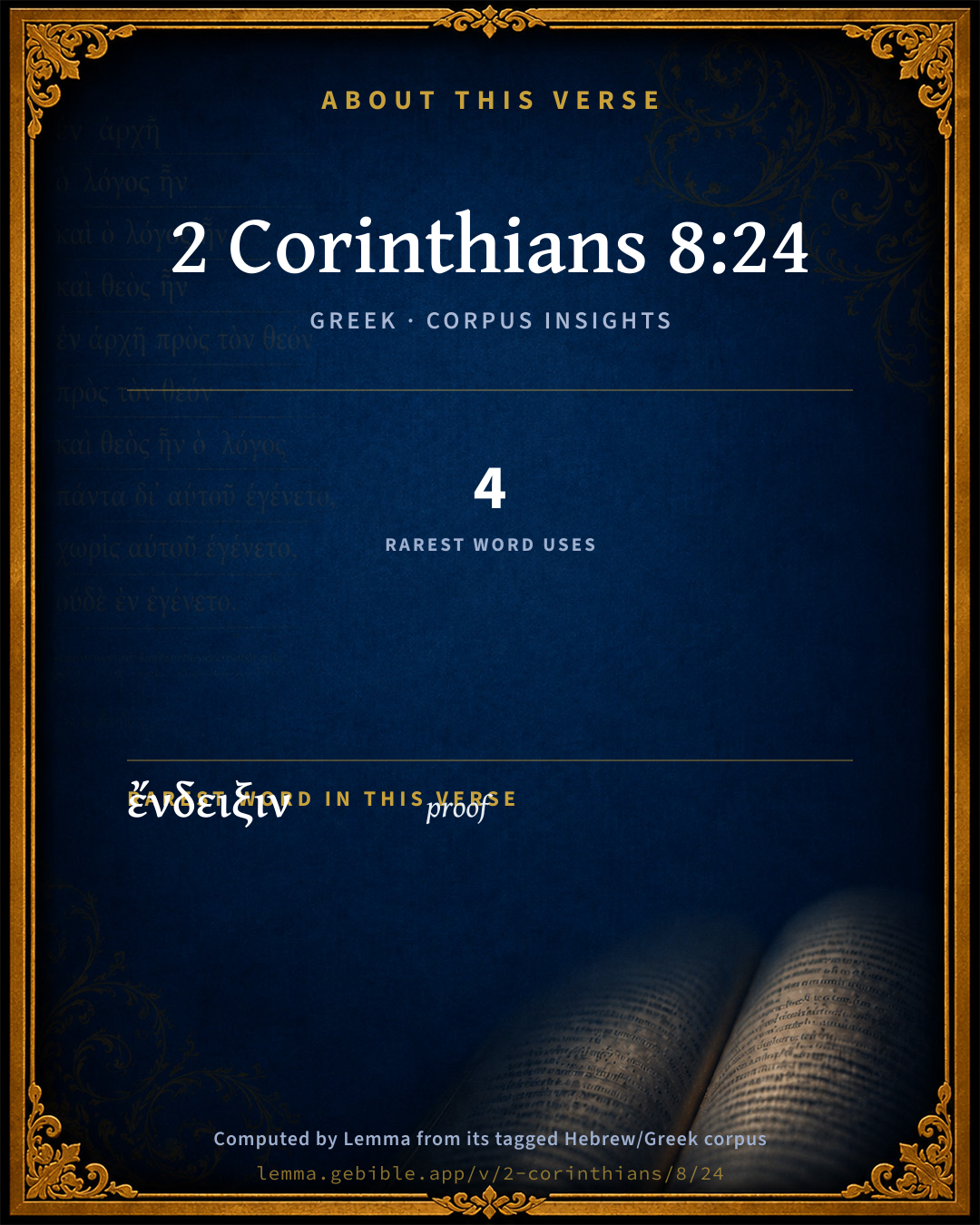
2 Corinthians 8:24

Greek (Tischendorf 8th ed.) 2 Corinthians 8:24 appears in the Greek New Testament. The text above is from the Tischendorf 8th edition. Each word links to its Strong’s number and a concise gloss. Click any word for its full Thayer’s Greek Lexicon entry.

Download image
Cite this verse

2 Corinthians 8:24 (World English Bible). Public Domain. Lemma interlinear Bible study tool, https://lemma.gebible.app/v/2-corinthians/8/24.

Show BibTeX & RIS
BibTeX
RIS
English Translation
Therefore show the proof of your love to them in front of the assemblies, and of our boasting on your behalf.
World English Bible · Public Domain
Download a study sheet

One document with this verse’s original text, its word-by-word gloss line, the meaning frame, cross-references with their text, attributed commentary, and full source and license credits — printable, and it pastes into notes with its structure intact.

This verse Autodidact and up

Study sheet (.html) Plain text (.txt)

A passage Seminary Student

Up to 50 verses in one chapter. A passage sheet keeps up to 6 commentary sources and 12 cross-references per verse, in the order this page ranks them, and says so on the sheet whenever that leaves anything out. Ask for a single verse and you get the Autodidact verse sheet above.

Everything on this page stays free to read, with no account — the sheet is a download of what is already on screen, not access to it.

Want to remove ads? Support Godless Engineer
Compare translations 3

The same verse in 3 English versions, stacked beneath the original-language interlinear above. Click any original word for its lexicon entry.

Each is an independent rendering of the whole verse — the interlinear is not word-aligned to these translations.

Highlighted words mark where these versions differ — a whole-verse word diff, not a word-by-word alignment.

  • World English Bible Public Domain
    Therefore show the proof of your love to them in front of the assemblies, and of our boasting on your behalf.
  • King James Version Public Domain
    Wherefore shew ye to them, and before the churches, the proof of your love, and of our boasting on your behalf.
  • unfoldingWord Literal Text CC BY-SA 4.0
    Therefore, prove to them to the faces of the churches the proof of your love and of our boasting about you.

unfoldingWord Literal Text — © unfoldingWord, licensed CC BY-SA 4.0. Word-aligned USFM3 via Door43 (git.door43.org/unfoldingWord/en_ult).

Versions to compare (up to 4)

3 of 4 selected

Show all 19 translations

Every available English version of this verse, each an independent rendering of the whole verse.

  • World English Bible Public Domain
    Therefore show the proof of your love to them in front of the assemblies, and of our boasting on your behalf.
  • Berean Standard Bible Public Domain
    In full view of the churches, then, show these men the proof of your love and the reason for our boasting about you.
  • Majority Standard Bible Public Domain
    In full view of the churches, then, show these men the proof of your love and the reason for our boasting about you.
  • King James Version Public Domain
    Wherefore shew ye to them, and before the churches, the proof of your love, and of our boasting on your behalf.
  • American Standard Version (1901) Public Domain
    Show ye therefore unto them in the face of the churches the proof of your love, and of our glorying on your behalf.
  • Revised Version (1885) Public Domain
    Shew ye therefore unto them in the face of the churches the proof of your love, and of our glorying on your behalf.
  • Geneva Bible (1599) Public Domain
    Wherefore shew toward them, and before the Churches the proofe of your loue, and of the reioycing that we haue of you.
  • Douay-Rheims (1899) Public Domain
    Wherefore shew ye to them, in the sight of the churches, the evidence of your charity, and of our boasting on your behalf.
  • Young's Literal Translation Public Domain
    the shewing therefore of your love, and of our boasting on your behalf, to them shew ye, even in the face of the assemblies.
  • Literal Standard Version CC BY-SA 4.0
    the showing therefore of your love, and of our boasting on your behalf, show to them, even in the face of the assemblies.
  • Unlocked Literal Bible CC BY-SA 4.0
    So show them your love, and show to the churches the reason for our boasting about you.
  • unfoldingWord Literal Text CC BY-SA 4.0
    Therefore, prove to them to the faces of the churches the proof of your love and of our boasting about you.
  • Darby Bible Public Domain
    Shew therefore to them, before the assemblies, the proof of your love, and of our boasting about you.
  • World Messianic Bible Public Domain
    Therefore show the proof of your love to them before the assemblies, and of our boasting on your behalf.
  • Webster's Bible Public Domain
    Wherefore show ye to them, and before the churches, the proof of your love, and of our boasting on your behalf.
  • Free Bible Version CC BY-SA 4.0
    So please welcome them before all the churches and show them your love, proving how rightly proud we are of you.
  • Bible in Basic English Public Domain
    Make clear then to them, as representatives of the churches, the quality of your love, and that the things which we have said about you are true.
  • Text-Critical English NT CC BY 4.0
    Therefore show them in front of all the churches the proof of your love and the reason for our boasting about you.
  • Tyndale New Testament (1534) Public Domain
    Wherfore shewe vnto them the proffe of youre love and of the reioysynge that we have of you that the congregacions maye se it.

Literal Standard Version (2020), Covenant Press — licensed CC BY-SA 4.0. Text via the HelloAO Bible API (eBible.org). Unlocked Literal Bible (unfoldingWord) — licensed CC BY-SA 4.0. Text via the HelloAO Bible API (eBible.org). unfoldingWord Literal Text — © unfoldingWord, licensed CC BY-SA 4.0. Word-aligned USFM3 via Door43 (git.door43.org/unfoldingWord/en_ult). Free Bible Version, Dr. Jonathan Gallagher — licensed CC BY-SA 4.0. Text via the HelloAO Bible API (eBible.org).

Word by word

More ways to search: Search by grammar → Find every occurrence → Compare this word →

Practice this passage: Drill this verse → Learn its vocabulary →

ἔνδειξιν
éndeixis
G1732
“proof”
Noun, Accusative, Singular, Feminine
Part of Speech
Noun
Case
Accusative
Number
Singular
Gender
Feminine
Full Thayer's Definition

Origin: from G1731

TDNT: None

1. demonstration, proof a. manifestation made by act b. sign, evidence
  1. τὴν ho G3588 “the” Article, Accusative, Singular, Feminine
  2. οὖν oûn G3767 “therefore” Conjunction
  3. τῆς ho G3588 “the” Article, Genitive, Singular, Feminine
  4. ἀγάπης agápē G26 “brotherly love” Noun, Genitive, Singular, Feminine
  5. ὑμῶν hymeîs G5210 “you” Personal pronoun, 2nd person, Genitive, Plural
  6. καὶ kaí G2532 “and” Conjunction
  7. ἡμῶν hēmeîs G2249 “we” Personal pronoun, 1st person, Genitive, Plural
  8. καυχήσεως kaúchēsis G2746 “glorying” Noun, Genitive, Singular, Feminine
  9. ὑπὲρ hypér G5228 “over” Preposition
  10. ὑμῶν hymeîs G5210 “you” Personal pronoun, 2nd person, Genitive, Plural
  11. εἰς eis G1519 “into” Preposition
  12. αὐτοὺς autós G846 “he” Personal pronoun, Accusative, Plural, Masculine
  13. ἐνδεικνύμενοι endeíknymi G1731 “to display” Verb, Present, Middle, Participle, Nominative, Plural, Masculine
  14. εἰς eis G1519 “into” Preposition
  15. πρόσωπον prósōpon G4383 “face” Noun, Accusative, Singular, Neuter
  16. τῶν ho G3588 “the” Article, Genitive, Plural, Feminine
  17. ἐκκλησιῶν ekklēsía G1577 “assembly” Noun, Genitive, Plural, Feminine

About this verse

These counts appear in no published source. They are computed here, from the morphology-tagged text and Lemma’s own curated glosses. What Lemma adds →

18
words
14
distinct lemmas
Pauline Epistles
section

Notable vocabulary

The rarest word here is ἔνδειξιν proof G1732 — appearing just 4 times in the whole Greek New Testament.

Shared distinctive vocabulary

ἔνδειξιν proof G1732 occurs in 4 verses of the Greek New Testament. Also found in:

Repetition

Words recur within this verse:

Cross-references

4

Topical passages linked to 2 Corinthians 8:24 in the Treasury of Scripture Knowledge — connected by theme and wording, ordered by reader-vote popularity; previews shown in the World English Bible.

  • 2 Corinthians 7:14 For if in anything I have boasted to him on your behalf, I was not disappointed. But as we spoke all things to you in truth, so our glorying also which I made before Titus was found to be truth.
  • 2 Corinthians 7:4 Great is my boldness of speech toward you. Great is my boasting on your behalf. I am filled with comfort. I overflow with joy in all our affliction.
  • 2 Corinthians 8:8 I speak not by way of commandment, but as proving through the earnestness of others the sincerity also of your love.
  • 2 Corinthians 9:2–4 for I know your readiness, of which I boast on your behalf to them of Macedonia, that Achaia has been prepared for a year past. Your zeal has stirred up very many of them.

Cross-references courtesy of OpenBible.info (CC BY 4.0).

Commentary

Notes on 2 Corinthians 8:24 from classic Christian and Jewish commentators (each source and its license shown beneath its notes). The classic Christian expositions comment on the surrounding passage and are grouped to its opening verse, so a note may address several verses; the Jewish commentaries on the Tanakh (Rashi and others) are per-verse, so they appear only where the commentator wrote on this verse.

Lemma curates 59 commentaries, every one of them public domain or Creative Commons licensed, each selected and text-cleaned for this edition rather than reprinted as found. About our sources →

Bengel's Gnomon

Johann Albrecht Bengel

2Co 8:24. Ἔνδειξιν ἐνδείξασθε) This expression is the same idiom as χαίρειν χαράν.[53]—εἰς αὐτοὺς, εἰς πρόσωπον τῶν ἐκκλησιῶν, to them, in the face of the churches) The knowledge of the matter was sure to spread by means of the messengers [deputies] among the churches.

[53] An accus. of a cognate signification to the verb, Manifest a manifestation.—ED.

Bengel's Gnomon of the New Testament — English translation (T&T Clark, Edinburgh, 1860) — public domain. Text from a community e-Sword module.

Meyer's Critical & Exegetical Commentary

Heinrich August Wilhelm Meyer

2Co_8:24. According to the Recepta, ἐνδείξασθε is here a direct exhortation, in conformity with the points adduced in 2Co_8:23 (οὖν), to furnish towards those three (εἰς αὐτούς) the demonstration (τὴν ἐνδ.) of their love, etc., which demonstration of love is shown to the churches that were represented by them (εἰς πρόσωπ.). Since, however, the Recepta is a gloss (see the critical remarks), and ἐνδεικνύμενοι is the correct reading, we have here an indirect exhortation, which puts the matter as a point of honour, and so touches the readers the more effectively, without directly making a demand on them. When you accordingly show towards them the demonstration of your love and of what we have boasted regarding you, you do it in presence of the churches. In this way εἰς αὐτούς and εἰς πρόσωπον τῶν ἐκκλ. emphatically correspond with each other, and after the participle ἐνδεικν. the second person of the present indicative of the same verb is to be supplied. Comp. Soph. O. C. 520; El. 1428 (1434): τὰ πρὶν εὖ θέμενοι τάδʼ ἑς πάλιν, sc. εὖ θῆσθε. See Schneidewin in loc., and, in general, Doederl. de brachyl. 1831, p. 10 f.; also Dissen, ad Dem. de Cor. 190, p. 359. We might also simply supply the imperative ἐστέ with ἐνδεικν. (see on Rom_12:9), so that also with this reading there would be a direct, stern summons. But with the former interpretation the contextually appropriate emphasis of εἰς πρόσωπον τῶν ἐκκλ. comes out more strongly and more independently.

On points of detail we may further observe(1) The οὖν does not draw the inference simply from the second half of 2Co_8:23, but from both halves, since the exclusion of reference to Titus is not warranted by εἰς πρόσωπ. τ. ἐκκλ., which, in fact, suits all three together, and ἡμῶν καυχησέως κ.τ.λ. includes specially a glance at the apostles relation to Titus; comp. 2Co_8:6; 2Co_7:14. (2) Πρόσωπον is here also not (see on 2Co_1:11) person, which would be against the usage of the N. T., and, besides, in the singular would be unsuitable here; but εἰς πρόσωπον means to the face, i.e. coram in the sense of the direction. The conception, namely, which Paul wishes to excite in the minds of his readers, is this, that in those three men they have to think of the churches themselves, whose instruments these men are in the matter of the collection, as present and as witnesses of the demonstrations of love that fall to the share of the representatives, and to measure their demeanour towards them accordingly. According to this view, every evidence of love, which is shown to these men, comes, when it takes place, before the eyes of the churches (ideally present in the case). The churches stand by and look on. (3) τῆς ἀγάπης ὑμ. is not the love to Paul (Grotius, Billroth, de Wette, Ewald, and others, following Chrysostom and Theophylact), but the Christian brotherly love, which thereupon has its definite object marked out by εἰς αὐτούς.

On τὴν ἔνδειξιν ἐνδείκνυσθαι, comp. Plat. Legg. 12, p. 966 B. The demonstration of the boasting: namely, how true it was. Comp. 2Co_7:14.

Meyer — Critical and Exegetical Commentary on the New Testament — English translation by Peter Christie, edited by Frederick Crombie (T&T Clark, 1880) — public domain. Text from a community e-Sword module.

Expositor's Greek Testament

ed. W. Robertson Nicoll

2Co 8:24 . τὴν οὖν ἔνδειξιν κ . τ . λ .: shew ye therefore (if we read ἐνδεικνύμενοι the exhortation is indirect, as at Rom 12:9-21 ) unto them in the face of the Churches the demonstration of your love, sc. , to us ( cf. 2Co 8:7 ), and of our glorying on your behalf, sc. , my boasting of your readiness to give ( cf. 2Co 7:4 ; 2Co 7:14 , and 2Co 9:2-3 ).

The Expositor's Greek Testament, edited by W. Robertson Nicoll (1897–1910) — public domain. Text from a community e-Sword module.

Geneva Bible (1599)

Geneva Bible translators

All Churches shall be witnesses of this your godly dealing, in whose presence you are, for so much as you see the messengers whom they have chosen by all their consents, and sent them unto you.

Geneva Bible (1599) marginal notes — public domain. Text via Bolls.life.

Jamieson, Fausset & Brown

Robert Jamieson, A. R. Fausset & David Brown

The oldest manuscripts read "[continue] manifesting to them in the face of the churches the manifestation of your love, and of our boasting on your behalf."

Next: 2 Corinthians Chapter 9

Jamieson, Fausset & Brown — Commentary Critical and Explanatory on the Whole Bible (1871) — public domain (CC PDM 1.0). Text via the HelloAO Bible API.

Adam Clarke's Commentary

Verse 24. Wherefore show ye to them, and before the Churches, c.] Seeing they are persons every way worthy in themselves, and coming to you on such an important occasion, and so highly recommended, receive them affectionately and let them thus see that the very high character I have given of you is not exaggerated, and that you are as ready in every work of charity as I have stated you to be. Act in this for your honour.

1. THE whole of this chapter and the following is occupied in exciting the richer followers of Christ to be liberal to the poorer; the obligation of each to be so, the reasons on which that obligation is founded, the arguments to enforce the obligation from those reasons, are all clearly stated, and most dexterously and forcibly managed. These two chapters afford a perfect model for a Christian minister who is pleading the cause of the poor.

2. In the management of charities a man ought carefully to avoid the least suspicion of avarice, self-interest, and unfaithfulness. How few persons are entirely free from the upbraidings of their own consciences in the matter of alms! But who will be able to hear the upbraidings of Christ at the time of death and judgment? No man can waste without injustice, or neglect without sin, those things of which he is only the dispenser and steward.

3. God has not settled an equality among men by their birth to the end that this equality might be the work of his grace. He has put the temporal portion of the poor into the hands of the rich, and the spiritual portion of the rich into the hands of the poor, on purpose to keep up a good understanding betwixt the members of the same body by a mutual dependence on one another. He who withholds the part belonging to the poor steals more from himself than from them. Let every one answer this admirable design of God, and labour to re-establish equality: the poor, in praying much for the rich; and the rich, in giving much to the poor. See Quesnel.

Adam Clarke's Commentary on the Bible (1810–1826) — public domain. Text from a community e-Sword/MySword module.

John Calvin's Commentaries

He mentions two things in the close: “See that our brethren behold your love,” and secondly, “Take care, that it be not in vain that I have boasted of you.” For αὐτούς (to them,) appears to me to be equivalent to coram ipsis, (before them,) for this clause does not refer to the poor, but to the messengers of whom mention had been made. For he immediately afterwards subjoins, that they would not be alone witnesses, but in consequence of the report given by them, a report would go out even to distant Churches.

John Calvin's Commentaries (1540-1563) — public domain. Text from the Calvin Translation Society English edition (1840s-50s) via the Christian Classics Ethereal Library (ccel.org). Calvin's coverage is partial (roughly two-thirds of the Bible); uncommented books and verses are honest gaps, never fabricated. The 19th-century editor's footnotes and remarks are omitted so the notes are faithfully Calvin's own voice.

Ellicott's Commentary for English Readers

(24) Wherefore shew ye to them.—In adding “before the churches” (literally, in the face of the churches), St. Paul appeals, as he has done throughout the chapter, to that natural love of praise which takes its place as a legitimate, though it may be, and ought to be, a subordinate, motive for the activity of Christian benevolence. They were not to consider only what he and Titus and the two brethren would think of them. The eyes of the churches were upon them. Probably Philippi, Thessalonica, and Berœa are referred to.

The proof of your love, and of our boasting.—The “love” to which he appeals is probably their personal regard for him. What the “boast” was he states more fully in 2Co_9:2. With a subtle knowledge of human nature, he attacks them, as it were, on every side. They have to compete with Macedonia; they have to show their love for their teacher; they have to sustain their own reputation.

A Bible Commentary for English Readers, edited by Charles John Ellicott (1878–1897) — public domain. Text from a community e-Sword module.

The Cambridge Bible for Schools and Colleges

gen. ed. J. J. S. Perowne

24. before the churches] To which they belong, and of which they are the representatives, 2Co_8:19; 2Co_8:23. The spirit shewn by the Corinthians would of necessity be reported by these delegates to the Churches which had commissioned them. For the expression, literally in the face of, cf. ch. 2Co_2:10, 2Co_4:6, 2Co_5:12 and notes.

our boasting on your behalf] See ch. 2Co_9:2.

The Cambridge Bible for Schools and Colleges (gen. ed. J. J. S. Perowne; Cambridge University Press, 1878–1918) — public domain. Text from a community e-Sword module.

Trapp's Complete Commentary

John Trapp

24 Wherefore shew ye to them, and before the churches, the proof of your love, and of our boasting on your behalf.

Ver. 24. Wherefore show ye] As by an ocular demonstration, or as by pointing the finger, ενδειξασθε.

Before the Churches] In the face of the Churches, εις προσωπον, whose eyes are now full set upon you, to see what entertainment ye will give to their messengers. A Christian is like a crystal glass with a lamp in the midst.

John Trapp, A Commentary or Exposition upon All the Books of the Old and New Testament (1647–1656) — public domain. Text from a community e-Sword module.

Albert Barnes' Notes on the Bible

Wherefore show ye to them ... - By a liberal contribution in the cause in which they are engaged and for which they have come among you now, furnish the evidence that you love me and the Christian cause, and show that I have not boasted of you in vain.

The proof of your love - Your love to me, to God, to the cause of religion; see the note on 2Co 8:8.

And of our boasting ... - My boasting that you would give liberally to the object; see the note, 2Co 7:14. Let it now be seen that my boasting was well founded, and that I properly understood your character, and your readiness to contribute to the objects of Christian benevolence.

Remarks

1. Let us bear in mind that a disposition to be liberal proceeds only from God, 2Co 8:1. The human heart is by nature selfish, and indisposed to benevolence. It is only by the grace of God that people are excited to liberality; and we should therefore pray for this as well as for all other graces. We should beseech God to remove selfishness from our minds; to dispose us to feel as we should feel for the needs of others, and to incline us to give just what we ought to give to relieve them in trouble, and to promote their temporal and eternal welfare.

2. It is an inestimable blessing when God gives a spirit of liberality to the church, 2Co 8:1. It should be regarded as a proof of his special favor; and as an evidence of the prevalence of the principles of true religion.

3. People are often most liberal when in circumstances of distress, perplexity, and affliction, 2Co 8:2. Prosperity often freezes the heart, but adversity opens it. Success in life often closes the hand of benevolence, but adversity opens it. We are taught to feel for the sufferings of others by suffering ourselves; and in the school of adversity we learn invaluable lessons of benevolence which we should never acquire in prosperity. If you lack the tear of sympathy: if you want aid in a good cause, go to a man in affliction, and his heart is open. And hence, it is that God often suffers his people to pass through trials in order that they may possess the spirit of large and active benevolence.

4. If Christians desire to be generous, they must first devote themselves to God, 2Co 8:5. If this is not done they will have no heart to give, and they will not give. They will have a thousand excuses ready, and there will be no ground of appeal which we can make to them. True liberality is always based on the fact that we have given ourselves wholly to God.

5. When Christians have honestly devoted themselves to God, it will be easy to contribute liberally to the cause of benevolence, 2Co 8:5. They will find something to give; or if they have nothing now they will labor and deny themselves in order that they may have something to give. If every professed Christian on earth had honestly given himself to God, and should act in accordance with this, the channels of benevolence Would never be dry.

6. We should compare ourselves in the matter of benevolence with the churches here referred to, 2Co 8:3. They were poor; they were in deep affliction, and yet they contributed all in their power, and beyond their power. Do we do this? Do we give according to our ability? Do we deny ourselves of one comfort? withhold one gratification? curtail one expense which fashion demands, in order that we may have the means of doing good? O! if every Christian would give according to his ability to the sacred cause of charity, how soon would the means be ample to place the Bible in every family on the globe, to preach the gospel in every country, and to maintain all the institutions which the cause of humanity needs in this and in other lands.

7. The Christian character is incomplete unless there is a spirit of large and liberal beneficence, 2Co 8:7. This is indispensable to the proper symmetry of the Christian graces, and this should be cultivated in order to give beauty and completeness to the whole. Yet it cannot be denied that there are true Christians where this is lacking. There are those who give every other evidence of piety; who are people of prayer, and who evince humility, and who are submissive in trials, and whose conversation is that of Christians, who are yet sadly deficient in this virtue. Either by an original closeness of disposition, or by a defect of education, or by lack of information in regard to the objects of Christian benevolence, they are most stinted in their benefactions, and often excite the amazement of others that they give so little to the cause of benevolence. Such persons should be entreated to carry out their Christian character to completion. As they abound in other things, they should abound in this grace also. They are depriving themselves of much comfort, and are bringing much injury on the cause of the Redeemer while they refuse to sustain the great objects of Christian charity. No Christian character is symmetrical or complete unless it is crowned with the spirit of large and comprehensive benevolence toward every object that tends to promote the temporal and eternal welfare of man.

8. The sincerity of our love should be tested, and will be, by our readiness to deny ourselves to do good to others, 2Co 8:8. The love of the Lord Jesus was tested in that way; and there can be no true love to God or man where there is not a readiness to contribute of our means for the welfare of others. If we love the Redeemer. we shall devote all to his service; if we love our fellow-men we shall evince our “sincerity” by being willing to part with our earthly substance to alleviate their woes, enlighten their ignorance, and save their souls.

9. Let us imitate the example of the Lord Jesus, 2Co 8:9. He was rich, yet he became poor; and, o how poor! Let the rich learn to copy his example, and be willing to part with their abundant and superfluous wealth in order that they may relieve and benefit others. That man is most happy as well as most useful, who most resembles the Redeemer; that man will be most happy who stoops from the highest earthly elevation to the lowest condition that he may minister to the welfare of others.

10. Charity should be voluntary, 2Co 8:12. It should be the free and spontaneous offering of the heart; and the first promptings of the heart, before the pleadings of avarice come in, and the heart grows cold by the influence of returning covetousness, are likely to be the most correct.

11. Charity should be in an honest proportion to our means, 2Co 8:12. It should be according to what a man hath. God hath left the determination of this proportion to every individual, responsible to him alone. He has not told us how much we shall give, or in what proportion we shall give; but he has left it for every individual to decide what he may give, and what he ought to give.

12. If people do not give according to their means they must answer for it to God. Every man may have opportunity to contribute to relieve others if he will open his heart and ears to the cries of a suffering and a dying world. No man can complain that he has no opportunity to give; or that he may not procure for his own soul all the blessings which can be produced by the most large and liberal benevolence.

13. People have no excuse for being lost, 2Co 8:12. If God required more of them than they could render they would have excuse. They would not be to blame. They might be sufferers and martyrs in hell, but no one would blame them. But the sinner can never have any such excuse. God never required anymore of him than he had power to render; and if he dies it will be his own fault, and the throne of God will still be spotless and pure.

14. God’s government is an equal, and just, and good government, 2Co 8:12. What can be more equitable than the principle that a man is accepted according to what he has? What ground of complaint can the sinner have in regard to this administration?

15. The churches should bear their just proportion in the cause of Christian beneficence, 2Co 8:13-15. There are great interests of charity which must be sustained. The world cannot do without them. Not only must the poor be provided for, but the cause of temperance, and of Sunday schools, and of missions must be sustained. Bibles must be distributed, and people must be educated for the ministry, and the widow and the fatherless must be the objects of Christian benevolence. These burdens, if they are burdens, should be equally distributed. The rich should furnish their fair proportion in sustaining them; and those in more moderate circumstances must do their fair proportion also in sustaining them. If this were done, all the objects of Christian benevolence could be sustained, and they would in fact not be burdensome to the churches. With infinite ease all might be contributed that is necessary to send the gospel around the world.

16. Ministers of the gospel should have as little as possible to do with money matters, 2Co 8:19-21. While they should be willing, if it is necessary, to be the almoners of the churches, and should esteem it a privilege to he the means of conveying to the poor and needy, and to the great cause of benevolence, what the churches may choose to commit to them, yet they should not covet this office; they should not show any particular desire for it; nor should they do it unless, like Paul, they have the most ample security that the voice of slander can never be raised in regard to their management. Let them see to it that they have persons associated with them who have the entire confidence of the churches; people who will be responsible also, and who will be competent witnesses of the manner in which they discharge their duty. In all things ministers should be pure. On few points is there more danger that the enemy will endeavor to take advantage, and to injure their character, than in regard to their abuse of.

17. Let all Christians so live that it may be honestly said of them they are “the glory of Christ,” 2Co 8:23. Let them aim so to live that it will be esteemed to be an honor to the Redeemer that he called them into his kingdom, and that he so richly endowed them by his grace. This would be a commendation to all people where they might go; to say this is enough to say of any man. None can have a higher character than to have it said with truth of him “he is the glory of Christ; he is an honor to his Redeemer and to his cause.”

Albert Barnes' Notes on the Bible (1834–1885) — public domain. Text from a community e-Sword/MySword module.

Matthew Poole's English Annotations

The chapter concludeth with an exhortation to their liberality, backed with a heap of arguments.

1. It would be an evidence of their love to God, to their afflicted brethren, and to the apostle.

2. It would be a proof of it to those messengers of the churches, and to the churches whose messengers they were.

3. It would evidence that the apostle had not, to Titus and others, boasted on their behalf in vain.

Matthew Poole's English Annotations on the Holy Bible (1683–1685) — public domain. Text from a community e-Sword/MySword module.

Whedon's Commentary on the Bible

Daniel D. Whedon

24. Show… to them—Literally, Show before all the Churches, in their behalf, the exhibition of your love and of our boasting of you. Paul desired that his own friends in Corinth would make such public demonstration of their regard for his deputies, as well as of his own boasting of Corinthian liberality, as would impress the Churches to favour the deputies and make good his own boasts.

Daniel D. Whedon (gen. ed.), Commentary on the Old and New Testaments (1874–1909) — public domain. Text from a community e-Sword module.

The Pulpit Commentary

Of your love. Not only of your love "to me," but of your brotherly love in general. And of our boasting. Show to the Church that my boasting of you was justifiable.

The Pulpit Commentary (1880–1919), ed. H.D.M. Spence-Jones & Joseph S. Exell — public domain. Text from a community e-Sword module.

John Wesley's Explanatory Notes

Before the churches - Present by their messengers.

John Wesley, Explanatory Notes Upon the Whole Bible (1754–1765) — public domain. Text via the GEBible commentary corpus.

McGarvey & Pendleton's Commentaries

J. W. McGarvey

Show ye therefore unto them in the face of the churches the proof of your love, and of our glorying on your behalf . [As a final commendation, and as one calculated to stop the mouths of all objectors, Paul describes Titus as a partner with himself in raising the contribution of Corinth, and he describes the other two who went with Titus as not only messengers of the churches in this behalf, but as men whose daily life glorified the Master whom they served. In view, therefore, of the fitness of those whom he sent to them, Paul asks the Corinthian church to raise the collection under their direction as an evidence of the general benevolence of their disposition, and as a proof that he spoke the truth when he boasted of their liberality.]

J. W. McGarvey (with Philip Y. Pendleton), Commentaries on the New Testament (The Fourfold Gospel, 1914; Acts; and the epistles) — public domain. Text from a community e-Sword/MySword module.

The People's New Testament

B. W. Johnson

24. Therefore, shew ye to them. Since these are representative men, delegates of the churches, and of Christ, receive them cordially. Give proof of your love, and show that when we have boasted of your excellencies that our boasting was not empty. An ill reputation would not only reflect upon the churches, but upon Paul himself.

B. W. Johnson's The People's New Testament with Notes (1889–1891) — public domain. Electronic text from the Christian Classics Ethereal Library (CCEL) ThML edition.

Cambridge Greek Testament for Schools and Colleges

24. ἐνδείξασθε (אCD2D3KLP, f Vulg. Syrr. Copt. Arm. Aeth.) rather than ἐνδεικνύμενοι (BDFG, d e g): but the reading is doubtful.

CHAPS. 8, 9. THE COLLECTION FOR THE POOR SAINTS AT JERUSALEM; THE PALESTINE RELIEF FUND

This subject is treated in “the ablest and most convincing section in Paley’s Horae Paulinae” (chap. ii. 1). On the raising of this relief fund S. Paul bestowed immense trouble; not merely because the need was great, but because he regarded it as a proof of the corporate union existing between all Christians, Jew and Gentile, and as a tie likely to strengthen that union. The Gentiles had shared the spiritual blessings of the Jews, and it was only fair that they should share the temporal necessities of the Jews by giving them a share of their temporal blessings. He was resolved that he must himself carry the proceeds of the collection to Jerusalem, even if to go there cost him his life (Chase, Hulsean Lectures, 1900–1901, pp. 257–260). Besides these two chapters, he speaks of the collection in 1Co 16:1-3 and Rom 15:26-27; and S. Luke records some important words of the Apostle on the subject Act 24:17. Paley shows how these four passages mutually explain one another, and especially how Rom 15:26-27 dovetails into the other three, thus giving strong evidence of the genuineness of Romans 15, which is sometimes disputed, and of the Epistle as a whole.

S. Paul uses eight words in connexion with the relief fund, and six of them occur in these two chapters: 1. κοινωνία (2Co 8:4, 2Co 9:13; Rom 15:26): 2. διακονία (2Co 8:4, 2Co 9:1; 2Co 9:12-13): 3. χάρις (2Co 8:4; 1Co 16:3): 4. ἁδρότης (2Co 8:20): 5. εὐλογία (2Co 9:5): 6. λειτουγία (2Co 9:12): 7. λογία (1Co 16:1): 8. ἐλεημοσύναι (Act 24:17, in the report of the speech before Felix).

No doubt there was poverty at Jerusalem before the first converts made their limited and temporary attempt to have ἅπαντα κοινά (Act 2:44). Among the Jewish Christians poverty had been produced or aggravated by famine (Act 11:28), by the paucity of wealthy converts and the persecution of poor converts by the wealthy Jews, and by converts’ own unwillingness to work, in consequence of the belief that Christ’s Return was at hand, a fault which S. Paul had to rebuke in other Churches (2Th 3:10; comp. Didache xii.). All these may have contributed to produce poverty. In the condition of society denounced by S. James in his Epistle there must have been many indigent persons who were not relieved by their richer neighbours; and to whatever extent there was community of goods, this would in the long run aggravate the evil, for community of goods without organization of labour must fail. See Rendall, Expositor, Nov. 1893, p. 322.

The contributions of the Galatian Churches (1Co 16:1) had possibly already been sent to Jerusalem. What is said here perhaps refers exclusively to the bounty of Corinth and Macedonia. This relief fund, so anxiously worked for by S. Paul, was not the first thing of the kind in the Christian Church. Some years before (c. A.D. 47), the Church in Antioch had spontaneously sent relief to their poorer brethren in Judaea ‘by the hands of Barnabas and Saul’ (Act 11:30); and this act may have been suggested by the fact that the Jews of the Dispersion were in the habit of sending money to their countrymen at home: cum aurum Judaeorum nomine quotannis ex Italia et ex omnibus provinciis Hierosolyma exportarl soleret (Cic. Pro Flacco xxviii.). Comp. Joseph. Ant. XVI. vi. 2–7; B. J. VI. vi. 2. It has been conjectured that Jewish Christians at Jerusalem continued to have a share of these offerings from the Dispersion, and that it was Gentile Christians for whom S. Paul’s fund was required. But there cannot have been many Gentile Christians in Jerusalem, or even in Judaea, to need relief. And would the Jewish authorities at Jerusalem have given anything to Jewish Christians? Moreover the Apostle nowhere makes the appeal that Gentiles must help Gentiles. In Rom 15:26-27 the argument rather is that Gentiles must help Jews; and S. Paul tells Felix that he came to Jerusalem ‘to bring alms to my nation’ (Act 24:17).

Here a marked change of tone shows the anxiety of the Apostle in urging the claims of this relief fund upon the Corinthians. The overflowing enthusiasm of the previous section is checked, and the style becomes laboured. He feels his way, as if not quite confident of success; and he presses his appeal with carefully chosen and carefully worded arguments. There is more at stake than the relief of distress. His influence over the Corinthians, and his reputation with unfriendly critics at Jerusalem, are at stake also. That Christians helped Christians promoted goodwill. That Gentile Christians helped Jewish Christians promoted unity. That Christians of Corinth, where his authority had been challenged by Judaizers, should be induced to help Christians of Jerusalem, would be evidence both of his authority to work among the Gentiles, and also of his loyalty to the Mother Church in so working.

2Co 8:1-7. THE EXAMPLE OF LIBERALITY SET BY THE CHURCHES OF MACEDONIA

‘Macedonia’ at this time meant the Roman province of Macedonia, including Thessaly and Epirus, as well as Macedonia proper. But the Apostle perhaps means Macedonia proper, for the Churches which he had founded in Macedonia,—Philippi, Thessalonica, and Beroea,—were situated in the ancient kingdom. His “first visit to Macedonia was the dawn of a new era in the development of the Christian Church.” This “and the visit to Borne are the two most important stages in the Apostle’s missionary life, as they are also the two most emphatic passages in the historian’s narrative—the one the opening campaign of the Gospel in the West, the other its crowning triumph” (Lightfoot, Biblical Essays, p. 237).

S. Paul calls attention to two facts about these Macedonian congregations; (1) their deep poverty, and (2) their rich liberality. The Romans had seized the mines and imposed heavy taxation; which explains the poverty. Macedonian liberality was shown by their contributions to the relief fund (2Co 8:3-4), by their sending support to the Apostle himself at Corinth (2Co 11:9), in his travels (Php 4:15), and at Rome (Php 2:25; Php 4:18). See J. A. Beet on “The Gift from Philippi” in the Expositor, 3rd Series, IX. p. 68. Several gave themselves as fellow-workers, as Sopater, Aristarchus, Secundus, and Epaphroditus.

24. τὴν οὖν ἔνδειξιν … ἐνδείξασθε. Ostensionem … ostendite (Vulgate). See critical note. Manifest therefore to them the manifestation of your love and of our glorying on your behalf to the face of the Churches. ‘These brethren are delegates of Churches. Respect shown to them is respect shown to the Churches and will be reported to the Churches.’ In Aesch. in Ctes. 220 ἔνδειξις is ‘a display of goodwill.’ The word is not found in the LXX. and in the N.T. is peculiar to S. Paul (Rom 3:25-26; Php 1:28).

Cambridge Greek Testament for Schools and Colleges (Cambridge University Press, 1896; 21 vols, various authors incl. Carr, Maclear, Plummer, Farrar, Lumby, Moule, M. R. James, Simcox) — public domain. Text from a community e-Sword module.

Alford’s Greek Testament

Henry Alford

24.] Shew then to them the proof of your love (‘to us,’ or perhaps, ‘to your poor brethren’ (Meyer):—but the word has not been so used throughout this passage, see verse 7: χάρις has been the word), and of our boasting concerning you, in the sight of the churches. I may remark, (1) that the participial construction is elliptic, as in Rom 12:16 al. (2) That πρόσωπον τῶν ἐκκλησιῶν does not actually import ‘the representatives of the churches,’ as Meyer (which would be τὸ πρόσωπον or τὰ πρόσωπα, without εἰς), but as above, it being implied that they, being the ἀπόστολοι τ. ἐκκλ., are such representatives. And this is all that Theodoret seems to mean, whom Meyer quotes in support of his view:—τὸ πρόσωπον γὰρ τῶν ἐκκλησιῶν ἐπέχουσιν οὗτοι τῶν πεμψασῶν αὐτούς.

Henry Alford, The Greek Testament (1849–1861) — public domain. Text from a community e-Sword module.

International Critical Commentary

24. τὴν οὖν ἔνδειξιν … ἐνδείξασθε. See crit. note below. ‘Demonstrate therefore to them the demonstration of your love and of our glorying on your behalf to the face of the Churches.’ ‘Show the proof’ (AV, RV) does not preserve the repetition, which is probably deliberate. Vulg. has Ostensionem ergo … ostendite. It is easily preserved in English; ‘Exhibit to them the exhibition,’ ‘Manifest to them the manifestation.’ The Corinthians are urged to show that their own love is genuine and that the Apostle’s pride in them is fully justified. Ἔνδειξις in N. T. is a Pauline word (Rom 3:25, Rom 3:26 and Php 1:28 only), and it is not found in LXX. It means ‘an appeal to facts,’ demonstratio rebus gestis facta.

εἰς πρόσωπον τῶν ἐκκλησιῶν. ‘To the face of the Churches’; i.e. as if the congregations to which they belong were present. They are representative men; delegates, who will report to the Churches that elected them what they see and hear at Corinth, to which they are coming with high expectations; and the Corinthians must take care that there is no disappointment. This last clause is added with solemnity; it points to a host of witnesses, in whose presence the Corinthians will virtually be acting. The Apostle has suggested a variety of motives, from the example of Christ down to respect for their own reputation, for being generous.

It is not easy to decide between ἐνδείξασθε (א C D 2 and 3 E * * K L P, f Vulg. Syrr. Copt. Arm. Aeth.) and ἐνδεικνύμενοι (B D * E * G 17, d e g Goth.). WH. prefer the former, with the latter in marg. Tisch. prefers the latter, which would be likely to be corrected to ἐνδείξασθε. The καί before εἰς πρόσωπον τ. ἐκκλ., ‘and before the Churches’ (AV) has very little authority (only a few cursives).

* “L’habilite, la souplesse de language, la dexterite epistolaire de Paul, etaient employees tout entieres a cette oeuvre. 11 trouve pour la recommandevaux Corinthiens les tours les plus vifs et les plus tendres” (Renan, Saint Paul, p.453).

* Simplicitas malignitati opponitur (Calvin). In the Testaments the word is freq., esp. in Issachar, e.g. πάντα γὰρ πένησι καὶ θλιβομένοις παρεῖχον ἐκ τῶν ἀγαθῶν τῆς γῆς ἐν ἁπλότητι καρδίας μου. But the usual meaning is ‘simplicity,’ ‘innocence,’ rather than ‘liberality.’

אԠא (Fourth century). Codex Sinaiticus; now at Petrograd, the only uncial MS. containing the whole N.T.

* information respecting the commentator is to be found in the volume on the First Epistle, pp. lxvi f.

B B (Fourth century). Codex Vaticanus.

C C (Fifth century). Codex Ephraemi, a Palimpsest; now at Paris, very defective. Of 2 Corinthians all from 10:8 onwards is wanting.

P P (Ninth century). Codex Porfirianus Chiovensis, formerly possessed by Bishop Porfiri of Kiev, and now at Petrograd.

D D (Sixth century). Codex Claromontanus; now at Paris. A Graeco-Latin MS. The Latin (d) is akin to the Old Latin. Many subsequent hands (sixth to ninth centuries) have corrected the MS.

F F (Late ninth century). Codex Augiensis (from Reichenau); now at Trinity College, Cambridge.

G G (Late ninth century). Codex Boernerianus; at Dresden. Interlined with the Latin (in minluscules). The Greek text is almost the same as that of F, but the Latin (g) shows Old Latin elements.

K K (Ninth century). Codex Mosquensis; now at Moscow.

L L (Ninth century). Codex Angelicus; now in the Angelica Library at Rome.

* The supra viriuiem of Vulg. has led to needless discussion as to whethe it is right to give supra virtutem: παρὰ δύναμιν is rather supra vires.

* The meaning here might be that he treated the collection as a religious act, a sacrifice to God.

* Vulg. has vestrae caritatis ingenium bonum comprobans. It this is a corruption of ingenuum, the corruption must be very early, for it is found in the earliest commentators as well as in the most ancient MSS. Augustine loosely renders the words by vertrae caritatis carissimum. It is to the world at large that the genuineness of their love is to be proved; St Paul needed no proof.

* This is a natural and permissible view of the Incarnation, but it is not the deepest. See W. Temple, Foundations, pp. 319, 245.

* In his letter to Eustochium (Ep. cviii. 15) Jerome quotes thus; Non ui aliis refrigerium, vobis autem tribulatio, sed ex equalitate in hoc tempore, ut vestra abundontia sit ad illorum snopiasm abundantia sit ad westram inopiam.

E E (Ninth century). At Petrograd. A copy of D, and unimportant

* ‘At the present season’ is emphaticm and Lewin thinks that it may refer to the Sabbatic year, “during which the means of the Jews were soi stinted, that even the Romans for that year remitted the tribute (Jos. Ant. xiv. x. 6).” More probably it refers to the prolonged poverty of the Hebrew Church.

17 17. (Evan. 33, Act_13. Ninth century). Now at paris. “The queen of the cursives” and the best for the Pauline Epistles; more than any other it preserves Pre-Syrian readings and agrees with B D L.

d d The Latin companion of D

e d The Latin companion of E

g d The Latin companion of G

* St Paul often gives commendations of this kind; to Timothy and Stephanas (1Co 16:10-15), Phoebe (Rom 16:1), Tychicus, Onesimus, and Mark (Col 4:7-10) Zenas and Apollos (Tit 3:12-14).

f d The Latin companion of F

* Moffatt compares Byron’s remark to Moore in 1822; “I doubt the accuracy of all almoners, or remitters of benevolent cash.” Philo tells of the care that was taken to have trustworthy men to carry the temple-tribute (De Monarch. ii. § 3, Mang. 224, sub fin.). Schürer greatly enlarges Philo’s statement (Jewish People, 11. ii p. 289).

† If he had a brother, he could not have made use of him as a check on himself. We know of no brother.

International Critical Commentary — older volumes (1896–1929), various authors — public domain. Text from a community e-Sword module.

Lesson kit

Teaching starters — assembled from the data on this page, not authored interpretation. Every prompt links to the verse data it draws on. Edit before teaching.

2 Corinthians, in the Pauline Epistles, opens this verse with 18 words (14 distinct Greek lemmas). Its most distinctive word is éndeixis (“proof”). A historical commentator’s framing appears above. Read the whole chapter for the surrounding context.

Discussion questions

  1. What does “proof” (éndeixis) contribute to the verse as a whole?
  2. Romans 3:25 shares the word «proof» with this verse. How do the two illuminate each other?
  3. “into” occurs 2× in this one verse. What is the effect of the repetition?
  4. These translations render this verse differently. What is at stake in choosing one wording over another?
  5. Reading how Bengel's Gnomon and Meyer's Critical & Exegetical Commentary read this verse, where do the two commentators agree and where do they part?

Things to notice

Reading settings

Reading text

Shown beneath each verse's original-language words.

Old Testament
Old Testament edition

Read the OT as the Masoretic Hebrew (MT) or the Greek Septuagint (LXX).

English shown for the Greek Septuagint (in the Hebrew ↔ Greek comparison).

Comparing translations? Open the Compare panel on any verse page to stack up to four side by side.