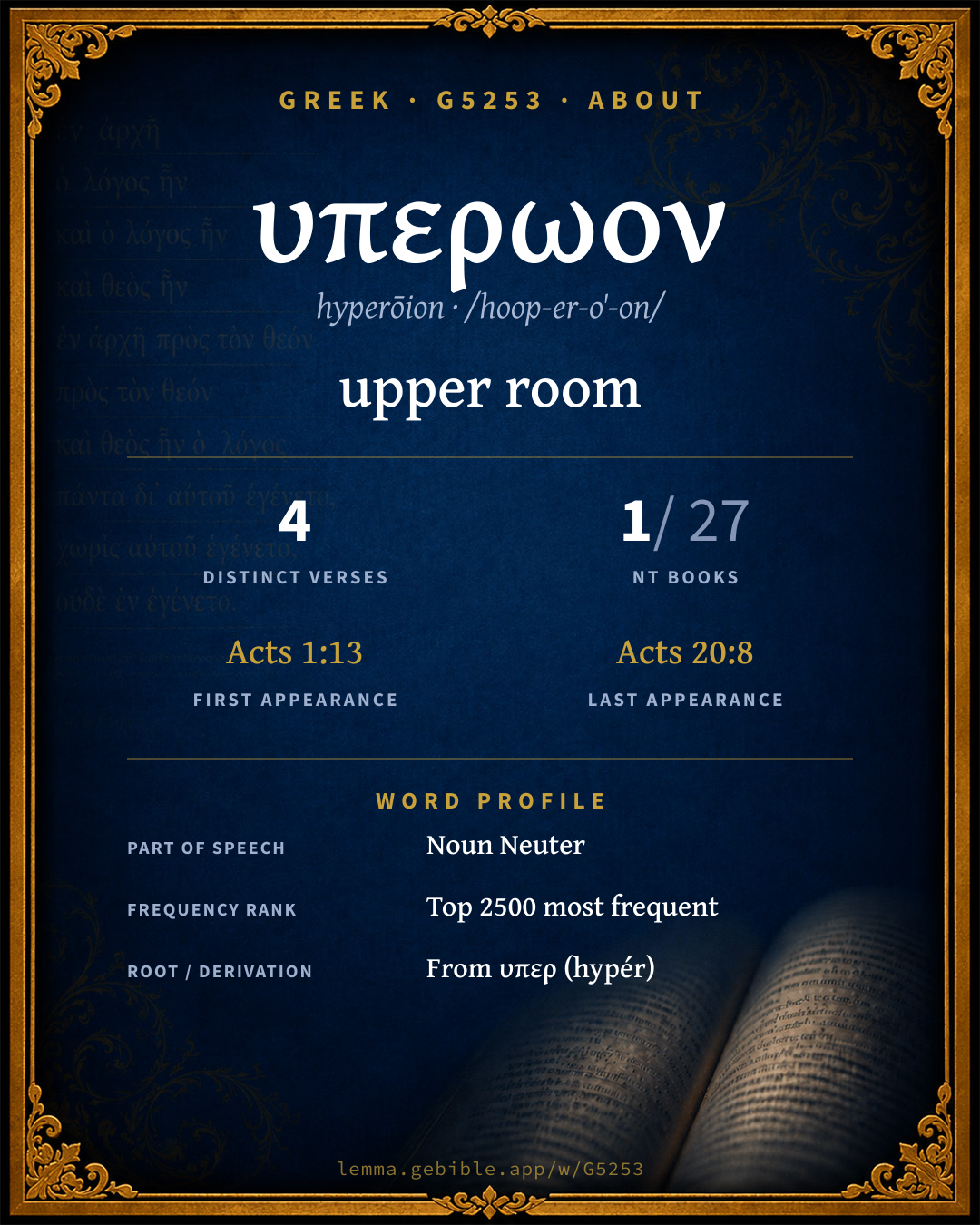
ὑπερῷον
upper room
‘upper room’ is one of 2 main senses fuller range ↓
Full lexicon entry — Thayer's Greek Lexicon
From Thayer's Greek Lexicon
Where this word appears
See every Accusative-case word in the Greek New Testament →
Grammar key — what these labels mean
Part of speech
- Noun
- A naming word — a person, place, thing, or idea.
Case
- Accusative
- The case of the direct object and of extent.
- Dative
- The case of the indirect object, means, or location — “to / for / with / in.”
Gender
- Neuter
- Grammatically neuter.
Number
- Singular
- One.
Grammatical forms
- Noun, Accusative, Singular, Neuter 2 times (50%)
- Noun, Dative, Singular, Neuter 2 times (50%)
Parsed forms decoded from the imported morphology (Robinson–Tischendorf, public domain), counted across 4 parsed occurrences — not distinct verses.
Every verse where G5253 appears — 4 distinct verses across 1 book. Click any verse to open its interlinear word-by-word view. Verse text shown in the World English Bible for context — . Each verse’s Greek form is shown with its reference; the English is not keyword-highlighted, since the data carries no word-level English alignment. Use “Compare translations” on any verse to read it across multiple English versions. This concordance covers the Greek New Testament; Septuagint (Greek Old Testament) occurrences of this word are not indexed here.
Acts 4 verses
- Acts 1:13 ὑπερῷον n acc sg neut When they had come in, they went up into the upper room, where they were staying; that is Peter, John, James, Andrew, Philip, Thomas, Bartholomew, Matthew, James the son of Alphaeus, Simon the Zealot, and Judas the son of James.
- Acts 9:37 ὑπερῴῳ n dat sg neut It happened in those days that she fell sick, and died. When they had washed her, they laid her in an upper chamber.
- Acts 9:39 ὑπερῷον n acc sg neut Peter got up and went with them. When he had come, they brought him into the upper chamber. All the widows stood by him weeping, and showing the coats and garments which Dorcas had made while she was with them.
- Acts 20:8 ὑπερῴῳ n dat sg neut There were many lights in the upper chamber where we were gathered together.
About this entry
At a glance — auto-summarized from this page’s data, not written by a person. Every figure links to its source below. This summary describes the numbers; it doesn’t interpret them.
υπερωον (hyperōion) is a Greek noun most often rendered “upper room.” It is rare — just 4 verses in the entire Greek New Testament. Acts dominates its distribution — 4 of 4 verses. Debuting at Acts 1:13, it then recurs through the corpus. Its lexical range runs to 2 senses. The sections below give every sense, occurrence, and version rendering.
Gloss history
Strong's 1890 vs modern scholarship
About this word
Strong's G5253 catalogs a Greek word from the Greek New Testament.
These counts are not copied from any lexicon or concordance. They are computed here, from the morphology-tagged Greek New Testament. What Lemma adds →
- 4
- distinct verses
- The word appears in 4 distinct verses.
- 1 / 27
- NT books
- The word appears in 1 of 27 New Testament books.
- #1,877
- by frequency
- Top 2500 most frequent Greek words (rank 1,877 of 5,347 Greek words by occurrence).
View all 4 occurrences in the concordance →
Most concentrated in
- Acts 4 verses 100%
By section of the New Testament
By traditional corpus
Conventional, traditional groupings — biblical authorship is debated, so this is a traditional corpus grouping, not an authorship claim. Some books belong to more than one corpus (Luke is in both the Gospels and the Lukan corpus, and so on), so these shares overlap and need not total 100%. Each figure is a share of the word’s 4 distinct verses.
- Lukan (Luke–Acts) 4 verses · 100%
How translations render this word
Counts come from each version’s own published word-to-Strong’s tagging or interlinear alignment — an approximate guide to how each version renders this word, not a word-level alignment the data otherwise carries. Because each total is that version’s own tagged count, the per-version totals vary from one another and need not match the appearance or distinct-verse counts above. These counts may also differ from a printed concordance because Lemma counts each distinctly tagged rendering and does not collapse phrase taggings into a single head-word total. This is a fixed set of word-tagged versions (KJV, ASV, BSB, ULT) and does not change with the reading translation you choose elsewhere. Each version’s license is shown beside its name below (and on Sources).
- King James Version: Upper chamber 3×
- American Standard Version: Upper chamber 4×
- Berean Standard Bible: Upper room 4×
- unfoldingWord Literal Text: Upper room 3×
King James Version Public Domain
Renders G5253 across 4 tagged occurrences — most commonly:
Plus 1 rendering that appears only once — usually multi-word phrases or single function words the recovered tagging swept in, not distinct renderings.
American Standard Version Public Domain
Renders G5253 across 4 tagged occurrences — most commonly:
Berean Standard Bible Public Domain
Renders G5253 across 4 tagged occurrences — most commonly:
unfoldingWord Literal Text CC BY-SA 4.0
Renders G5253 across 4 tagged occurrences — most commonly:
Plus 1 rendering that appears only once — usually multi-word phrases or single function words the recovered tagging swept in, not distinct renderings.
Senses in Thayer's
The 2 senses Thayer's distinguishes for this word, in lexicon order (not ranked by frequency or importance). The full entry — with sub-senses — is in the Lexicon Entry tab.
- the highest part of the house, the upper rooms or story where the women resided
- a room in the upper part of a house…
Word origin
Derived from υπερ (hypér) (G5228) — over.
Neuter of a derivative of G5228 ; a higher part of the house that is apartment in the third story : - upper chamber (room).
— Strong’s Exhaustive Concordance (1890), public domain.
Forms in the corpus
The 2 distinct written forms G5253 takes in the Greek New Testament, most frequent first — each parse links to that case’s occurrences in the concordance.
| Form | Parsing | Example | Uses |
|---|---|---|---|
| ὑπερῴῳ hyperṓō | Noun, Dative, Singular, Neuter | Acts 9:37 | 2 |
| ὑπερῷον hyperō̂on | Noun, Accusative, Singular, Neuter | Acts 1:13 | 2 |
Same root — word family
Other Thayer's entries built from the same root as G5253, grouped by Strong’s listed origin. These share a root / origin per the lexicon — not necessarily a shared meaning. Each links to that word’s own entry.
Derives from
Shares the same root
- υβρις hýbris G5196 insult
- υπεραιρομαι hyperaíromai G5229 to exalt oneself
- υπερακμος hypérakmos G5230 overripe
- υπερανω hyperánō G5231 above
- υπεραυξανω hyperauxánō G5232 to increase greatly
- υπερβαινω hyperbaínō G5233 to step over
- υπερβαλλω hyperbállō G5235 to surpass
- υπερειδω hypereídō G5237 to overlook
- υπερεκεινα hyperékeina G5238 beyond
- υπερεκτεινω hyperekteínō G5239 to stretch beyond
- υπερεκχυνω hyperekchýnō G5240 to overflow
- υπερεντυγχανω hyperentynchánō G5241 to intercede
- υπερεχω hyperéchō G5242 to stand out
- υπερηφανος hyperḗphanos G5244 haughty
- υπερνικαω hypernikáō G5245 to overcome completely
- υπερογκος hypéronkos G5246 immoderate
- υπερπερισσευω hyperperisseúō G5248 to abound greatly
- υπερπερισσως hyperperissōs G5249 exceedingly
- υπερπλεοναζω hyperpleonázō G5250 to overflow
- υπερυψοω hyperypsóō G5251 to exalt highly
- υπερφρονεω hyperphronéō G5252 to think arrogantly
- υψος hýpsos G5311 height
Compare all same-root words → Showing 4 of 24 — not the complete family. They share a root, not necessarily a meaning.
Septuagint usage
The same Greek word υπερωον appears 21 times in the Greek Old Testament (Septuagint), across 21 verses in 10 books.
- 21
- LXX occurrences
- Tagged occurrences of this Greek word in the Septuagint.
- 21
- verses
- Distinct Septuagint verses containing this word.
- 10 / 39
- OT books
- The word appears in 10 of the 39 Old Testament books.
Sample Septuagint occurrences
- Judges 3:20 ὑπερῷον
- 2 Samuel 19:1 ὑπερῷον
- 1 Kings 17:19 ὑπερῷον
- 2 Kings 1:2 ὑπερῷον
- 1 Chronicles 28:11 ὑπερῷον
- 2 Chronicles 3:9 ὑπερῷον
- Psalms 103:3 ὑπερῷον
- Jeremiah 20:2 ὑπερῷον
- Ezekiel 41:7 ὑπερῷον
- Daniel 6:11 ὑπερῷον
Septuagint occurrences (same lexeme)
Every verse where the same Strong’s number (G5253) appears in the Greek Septuagint. Verse text shown in the World English Bible for context; the Greek form is the matched word — the English is not keyword-highlighted.
- Judges 3:20 ὑπερῷον Ehud came to him; and he was sitting by himself alone in the cool upper room. Ehud said, I have a message from God to you. He arose out of his seat.
- Judges 3:23 ὑπερῷον Then Ehud went forth into the porch, and shut the doors of the upper room on him, and locked them.
- Judges 3:24 ὑπερῷον Now when he was gone out, his servants came; and they saw, and, behold, the doors of the upper room were locked; and they said, Surely he is covering his feet in the upper chamber.
- Judges 3:25 ὑπερῷον They waited until they were ashamed; and, behold, he didn't open the doors of the upper room: therefore they took the key, and opened [them], and, behold, their lord was fallen down dead on the earth.
- 2 Samuel 19:1 ὑπερῷον It was told Joab, Behold, the king weeps and mourns for Absalom.
- 1 Kings 17:19 ὑπερῷον He said to her, Give me your son. He took him out of her bosom, and carried him up into the chamber, where he abode, and laid him on his own bed.
- 1 Kings 17:23 ὑπερῷον Elijah took the child, and brought him down out of the chamber into the house, and delivered him to his mother; and Elijah said, Behold, your son lives.
- 2 Kings 1:2 ὑπερῷον Ahaziah fell down through the lattice in his upper chamber that was in Samaria, and was sick: and he sent messengers, and said to them, Go, inquire of Baal Zebub, the god of Ekron, whether I shall recover of this sickness.
- 2 Kings 4:10 ὑπερῷον Let us make, Please, a little chamber on the wall; and let us set for him there a bed, and a table, and a seat, and a lamp stand: and it shall be, when he comes to us, that he shall turn in there.
- 2 Kings 4:11 ὑπερῷον It fell on a day, that he came there, and he turned into the chamber and lay there.
- 2 Kings 23:12 ὑπερῷον The altars that were on the roof of the upper chamber of Ahaz, which the kings of Judah had made, and the altars which Manasseh had made in the two courts of the house of Yahweh, did the king break down, and beat [them] down from there, and cast the dust of them into the brook Kidron.
- 1 Chronicles 28:11 ὑπερῷον Then David gave to Solomon his son the pattern of the porch [of the temple], and of the houses of it, and of the treasuries of it, and of the upper rooms of it, and of the inner chambers of it, and of the place of the mercy seat;
- 2 Chronicles 3:9 ὑπερῷον The weight of the nails was fifty shekels of gold. He overlaid the upper chambers with gold.
- Psalms 103:3 ὑπερῷον Who forgives all your sins; Who heals all your diseases;
- Psalms 103:13 ὑπερῷον Like a father has compassion on his children, So Yahweh has compassion on those who fear him.
- Jeremiah 20:2 ὑπερῷον Then Pashhur struck Jeremiah the prophet, and put him in the stocks that were in the upper gate of Benjamin, which was in the house of Yahweh.
- Jeremiah 22:13 ὑπερῶον Woe to him who builds his house by unrighteousness, and his chambers by injustice; who uses his neighbor's service without wages, and doesn't give him his hire;
- Jeremiah 22:14 ὑπερῶον who says, I will build me a wide house and spacious chambers, and cuts him out windows; and it is ceiling with cedar, and painted with vermilion.
- Ezekiel 41:7 ὑπερῷον The side-chambers were broader as they encompassed [the house] higher and higher; for the encompassing of the house went higher and higher round about the house: therefore the breadth of the house [continued] upward; and so one went up [from] the lowest [chamber] to the highest by the middle [chamber].
- Ezekiel 42:5 ὑπερῷον Now the upper chambers were shorter; for the galleries took away from these, more than from the lower and the middle, in the building.
- Daniel 6:11 ὑπερῷον Then these men assembled together, and found Daniel making petition and supplication before his God.
These are occurrences of the same Greek lexeme (G5253) in the Septuagint — not a translation of any one Hebrew word. The store carries no word-level Hebrew↔Greek alignment, so no Hebrew original is asserted here. Counts come from the recovered LXX Strong's tagging — high-frequency vocabulary is well covered, while rare or late forms may be untagged — so they reflect tagged occurrences and may slightly undercount.