
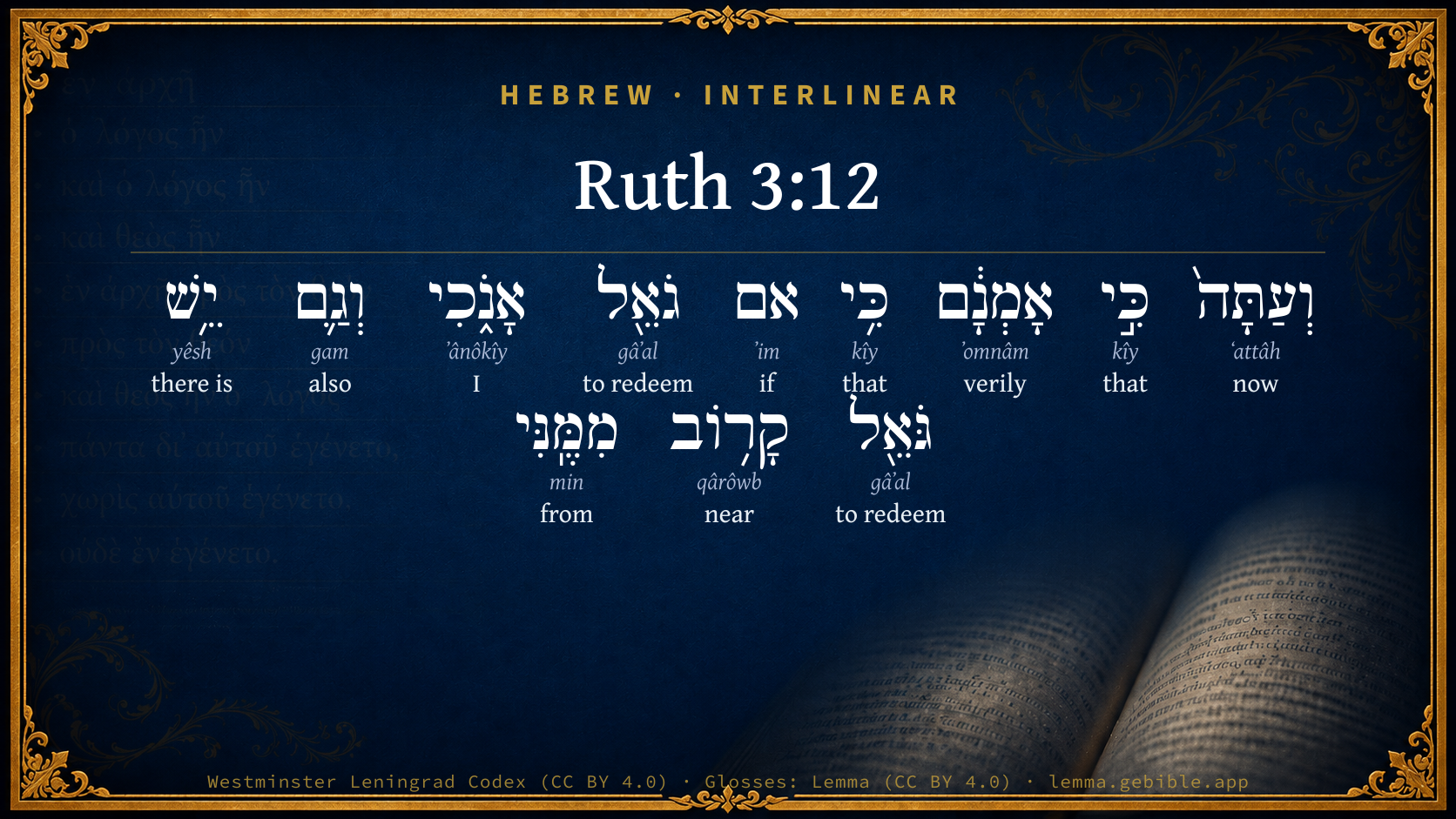
Ruth 3:12

Hebrew (Westminster Leningrad Codex) Ruth 3:12 appears in the Hebrew Old Testament. The text above is from the Westminster Leningrad Codex. Each word links to its Strong’s number, a concise gloss, and parsing drawn from the Open Scriptures Hebrew Bible morphology. Click any word for its full Brown-Driver-Briggs (BDB) entry.
Download image
Cite this verse

Ruth 3:12 (World English Bible). Public Domain. Lemma interlinear Bible study tool, https://lemma.gebible.app/v/ruth/3/12.

Show BibTeX & RIS
BibTeX
RIS
English Translation
Now it is true that I am a near kinsman; however there is a kinsman nearer than I.
World English Bible · Public Domain
Highlights
  • 1 first appearance in the Hebrew Bible
Full analysis ↓
Download a study sheet

One document with this verse’s original text, its word-by-word gloss line, the meaning frame, cross-references with their text, attributed commentary, and full source and license credits — printable, and it pastes into notes with its structure intact.

This verse Autodidact and up

Study sheet (.html) Plain text (.txt)

A passage Seminary Student

Up to 50 verses in one chapter. A passage sheet keeps up to 6 commentary sources and 12 cross-references per verse, in the order this page ranks them, and says so on the sheet whenever that leaves anything out. Ask for a single verse and you get the Autodidact verse sheet above.

Everything on this page stays free to read, with no account — the sheet is a download of what is already on screen, not access to it.

Want to remove ads? Support Godless Engineer
Compare translations 3

The same verse in 3 English versions, stacked beneath the original-language interlinear above. Click any original word for its lexicon entry.

Each is an independent rendering of the whole verse — the interlinear is not word-aligned to these translations.

Highlighted words mark where these versions differ — a whole-verse word diff, not a word-by-word alignment.

  • World English Bible Public Domain
    Now it is true that I am a near kinsman; however there is a kinsman nearer than I.
  • King James Version Public Domain
    And now it is true that I am thy near kinsman: howbeit there is a kinsman nearer than I.
  • unfoldingWord Literal Text CC BY-SA 4.0
    And now, it is indeed true that I am a kinsman-redeemer, but there is also a kinsman-redeemer nearer than I.

unfoldingWord Literal Text — © unfoldingWord, licensed CC BY-SA 4.0. Word-aligned USFM3 via Door43 (git.door43.org/unfoldingWord/en_ult).

Versions to compare (up to 4)

3 of 4 selected

Show all 18 translations

Every available English version of this verse, each an independent rendering of the whole verse.

  • World English Bible Public Domain
    Now it is true that I am a near kinsman; however there is a kinsman nearer than I.
  • Berean Standard Bible Public Domain
    Yes, it is true that I am a kinsman-redeemer, but there is a redeemer nearer than I.
  • Majority Standard Bible Public Domain
    Yes, it is true that I am a kinsman-redeemer, but there is a redeemer nearer than I.
  • King James Version Public Domain
    And now it is true that I am thy near kinsman: howbeit there is a kinsman nearer than I.
  • American Standard Version (1901) Public Domain
    And now it is true that I am a near kinsman; howbeit there is a kinsman nearer than I.
  • Revised Version (1885) Public Domain
    And now it is true that I am a near kinsman: howbeit there is a kinsman nearer than I.
  • Geneva Bible (1599) Public Domain
    And now, it is true that I am thy kinsman, howbeit there is a kinsman neerer then I.
  • Douay-Rheims (1899) Public Domain
    Neither do I deny myself to be near of kin, but there is another nearer than I.
  • Young's Literal Translation Public Domain
    And now, surely, true, that I `am' a redeemer, but also there is a redeemer nearer than I.
  • Literal Standard Version CC BY-SA 4.0
    And now, surely, true, that I [am] a redeemer, but also there is a redeemer nearer than I.
  • Unlocked Literal Bible CC BY-SA 4.0
    It is true that I am a kinsman, but there is a kinsman nearer than I.
  • unfoldingWord Literal Text CC BY-SA 4.0
    And now, it is indeed true that I am a kinsman-redeemer, but there is also a kinsman-redeemer nearer than I.
  • Darby Bible Public Domain
    And now, truly I am one that has the right of redemption, yet there is one that has the right of redemption who is nearer than I.
  • World Messianic Bible Public Domain
    Now it is true that I am a near kinsman. However, there is a kinsman nearer than I.
  • Webster's Bible Public Domain
    And now it is true that I am thy near kinsman: yet there is a kinsman nearer than I.
  • Free Bible Version CC BY-SA 4.0
    However, even though I'm one of your family redeemers, there's one who is more closely related than I am.
  • Bible in Basic English Public Domain
    Now it is true that I am a near relation: but there is a relation nearer than I.
  • JPS Tanakh (1917) Public Domain
    And now it is true that I am a near kinsman; howbeit there is a kinsman nearer than I.

Literal Standard Version (2020), Covenant Press — licensed CC BY-SA 4.0. Text via the HelloAO Bible API (eBible.org). Unlocked Literal Bible (unfoldingWord) — licensed CC BY-SA 4.0. Text via the HelloAO Bible API (eBible.org). unfoldingWord Literal Text — © unfoldingWord, licensed CC BY-SA 4.0. Word-aligned USFM3 via Door43 (git.door43.org/unfoldingWord/en_ult). Free Bible Version, Dr. Jonathan Gallagher — licensed CC BY-SA 4.0. Text via the HelloAO Bible API (eBible.org).

Word by word

More ways to search: Search by grammar → Find every occurrence → Compare this word →

Practice this passage: Drill this verse → Learn its vocabulary →

About this verse

These counts appear in no published source. They are computed here, from the morphology-tagged text and Lemma’s own curated glosses. What Lemma adds →

12
words
10
distinct lemmas
Historical
section

Notable vocabulary

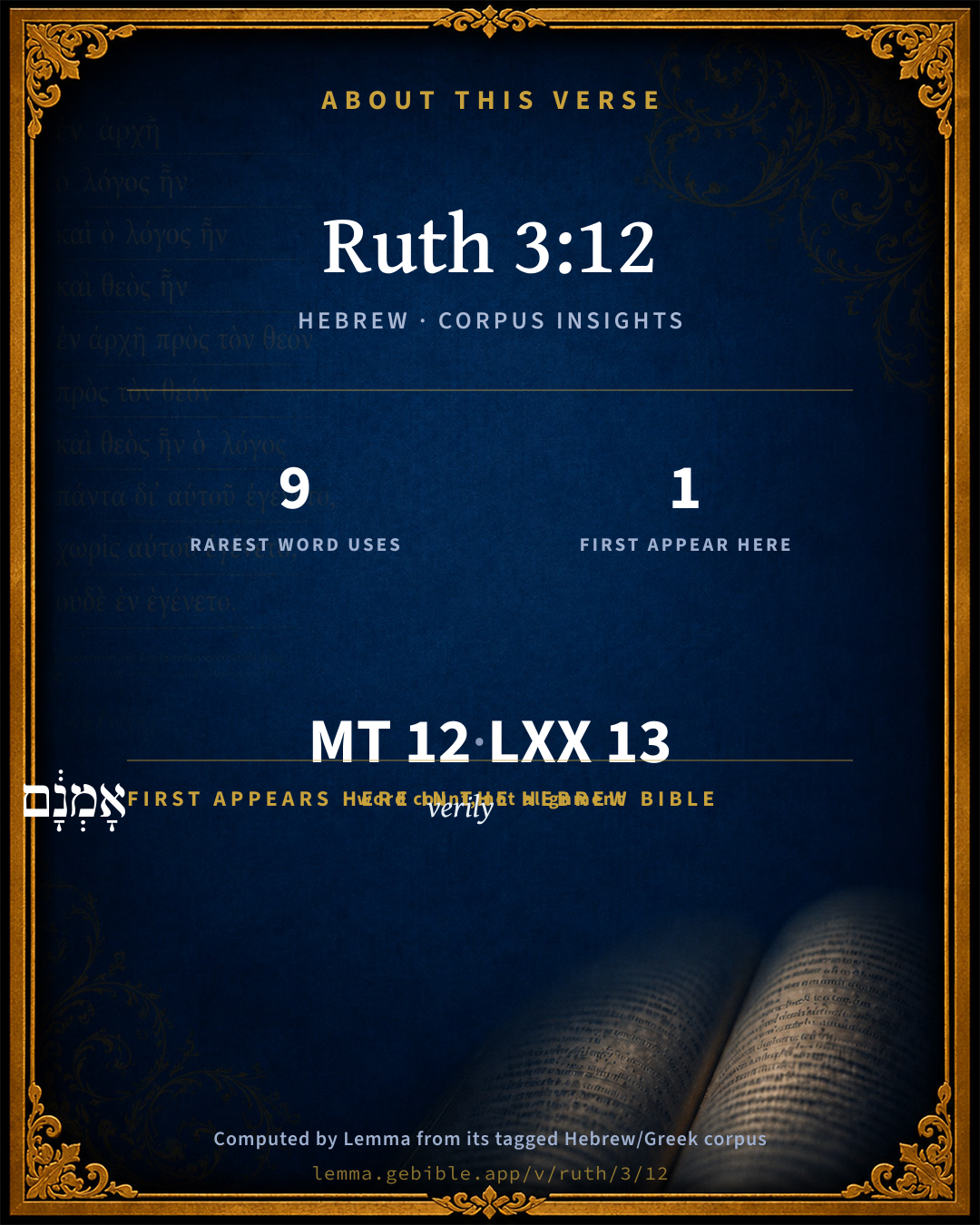
The rarest word here is אָמְנָ֔ם verily H551 — appearing just 9 times in the whole Hebrew Bible.

First appearance in Scripture

This word makes its first canonical appearance in the Hebrew Bible here:

  • אָמְנָ֔ם verily H551

Shared distinctive vocabulary

אָמְנָ֔ם verily H551 occurs in 9 verses of the Hebrew Bible. Also found in:

Grammatical profile

  • 2 verbs
  • 1 adjective
  • 1 pronoun
  • 1 preposition
  • 3 conjunctions
  • 2 adverbs
  • 2 particles

Verb forms

  • גֹאֵ֖ל Qal · Participle Active
  • גֹּאֵ֖ל Qal · Participle Active

Repetition

Words recur within this verse — often emphatic in Hebrew:

  • גֹאֵ֖ל to redeem H1350 ×2
  • כִּ֣י that H3588 ×2

Hebrew & Septuagint length

In English translation the verse runs 18 words from the Hebrew and 16 from the Septuagint (LXX English) — closely comparable.

A rough comparison of the two English renderings, which tokenize alike — not a word-level alignment.

Word counts can differ between the Hebrew and the Greek without any difference in meaning — e.g. the Hebrew direct-object marker אֵת has no separate Greek word, and Greek often adds the article ὁ.

In the original languages it is 12 Hebrew tokens and 13 Greek tokens — but the two are counted differently (Hebrew bundles its prefixes and suffixes into one token; the Greek is in lemma form), so that isn’t a like-for-like length.

Cross-references

3

Topical passages linked to Ruth 3:12 in the Treasury of Scripture Knowledge — connected by theme and wording, ordered by reader-vote popularity; previews shown in the World English Bible.

  • Ruth 4:1 Now Boaz went up to the gate, and sat him down there: and, behold, the near kinsman of whom Boaz spoke came by; to whom he said, Ho, such a one! turn aside, sit down here. He turned aside, and sat down.
  • 1 Thessalonians 4:6 that no one should take advantage of and wrong a brother or sister in this matter; because the Lord is an avenger in all these things, as also we forewarned you and testified.
  • Matthew 7:12 Therefore whatever you desire for men to do to you, you shall also do to them; for this is the law and the prophets.

Cross-references courtesy of OpenBible.info (CC BY 4.0).

Hebrew and Greek witnesses Masoretic Hebrew ↔ Greek Septuagint

The same verse in the two great witnesses to the Old Testament, shown verse-for-verse.

These are two independent witnesses, not word-aligned to each other, and the Septuagint is shown in lemma (dictionary) form.

Hebrew Ruth 3:12 Masoretic · Westminster Leningrad Codex

וְעַתָּה֙ כִּ֣י אָמְנָ֔ם כִּ֥י אם גֹאֵ֖ל אָנֹ֑כִי וְגַ֛ם יֵ֥שׁ גֹּאֵ֖ל קָר֥וֹב מִמֶּֽנִּי

Now it is true that I am a near kinsman; however there is a kinsman nearer than I.

World English Bible · Public Domain

Greek LXX Ruth 3:12 Septuagint · lemma form

καί ὅτι ἀληθῶς ἀγχιστεύς ἐγώ εἰμί καί γέ εἰμί ἀγχιστεύς ἐγγύς ὑπέρ ἐγώ

And now I am truly akin to you; nevertheless there is a kinsman nearer than I.

LXX2012 (modern English Septuagint) · Public Domain

Hebrew: Westminster Leningrad Codex (CC BY 4.0). Greek: Septuagint (public domain); English from LXX2012 (modern English Septuagint) (Public Domain). How the Septuagint differs from the Hebrew →

Commentary

Notes on Ruth 3:12 from classic Christian and Jewish commentators (each source and its license shown beneath its notes). The classic Christian expositions comment on the surrounding passage and are grouped to its opening verse, so a note may address several verses; the Jewish commentaries on the Tanakh (Rashi and others) are per-verse, so they appear only where the commentator wrote on this verse.

Lemma curates 59 commentaries, every one of them public domain or Creative Commons licensed, each selected and text-cleaned for this edition rather than reprinted as found. About our sources →

Trapp's Complete Commentary

John Trapp

Rth 3:12 And now it is true that I [am thy] near kinsman: howbeit there is a kinsman nearer than I.

Ver. 12. And now it is true.] He easily yieldeth to the truth of her allegation, as being φιλαληθης, a lover of truth - a title given to Arrian the historian - and a promoter of it, as it is said of Vespasian.

Howbeit there is a kinsman nearer than I.] Whose first right unto thee I freely acknowledge, and to whom thou shouldst first have addressed thyself. This was justice, - to give to every one his own.

John Trapp, A Commentary or Exposition upon All the Books of the Old and New Testament (1647–1656) — public domain. Text from a community e-Sword module.

Tyndale Open Study Notes

Tyndale Open Resources

3:12-13 Another man was more closely related to Elimelech than Boaz. He had the first right of refusal to act as family redeemer and (according to most interpreters) to marry Ruth.

Tyndale Open Study Notes — © Tyndale Open Resources, licensed CC BY-SA 4.0. Text via the HelloAO Bible API.

Adam Clarke's Commentary

Verse 12. There is a kinsman nearer than I.] It is very likely that Naomi was not acquainted with this circumstance. Some have supposed that there was a brother of Elimelech remaining, who was nearer than Boaz, who is supposed to have been only a nephew; the former, therefore, must have a prior right.

Adam Clarke's Commentary on the Bible (1810–1826) — public domain. Text from a community e-Sword/MySword module.

The Cambridge Bible for Schools and Colleges

gen. ed. J. J. S. Perowne

12. there is a kinsman nearer than I] with a better right to do the kinsman’s part. Boaz displays a nice sense of honour, and a desire to adhere strictly to the rules of social usage.

The Cambridge Bible for Schools and Colleges (gen. ed. J. J. S. Perowne; Cambridge University Press, 1878–1918) — public domain. Text from a community e-Sword module.

John Gill's Exposition

And now it is true, that I am thy near kinsman,.... Her husband and he being brothers' sons, so own cousins:

howbeit, there is a kinsman nearer than I, who was, the Jews say (w), the brother of her husband's father, and so his uncle, which was a nearer relation than an own cousin.

(w) Midrash Ruth, ut supra. (31. 4. & 34. 2) Jarchi in loc.

John Gill's Exposition of the Whole Bible (1746–1763) — public domain (CC PDM 1.0). Text via the HelloAO Bible API.

Albert Barnes' Notes on the Bible

By “kinsman,” understand the גאל gā'al (Rth 2:20 note).

Albert Barnes' Notes on the Bible (1834–1885) — public domain. Text from a community e-Sword/MySword module.

Haydock's Catholic Bible Commentary

Than I. The Jews think that he was brother of Elimelech, while Booz was only his nephew. But they might be in the same degree; the other being only older. (Calmet)

George Leo Haydock (1774–1849), Haydock's Catholic Family Bible and Commentary, 1859 edition — public domain. Excludes Psalms (Douay-Rheims chapter numbering differs from Protestant) and Deuterocanonical books (Catholic canon only).

Whedon's Commentary on the Bible

Daniel D. Whedon

12. There is a kinsman nearer than I — From this it appears that Naomi had laboured under some mistake. Probably she was ignorant of the existence of a nearer kinsman than Boaz; or she may have known that nearer kinsman, and also that it would have marred his inheritance to have redeemed that of her husband, Elimelech. Compare Rth_4:6.

Daniel D. Whedon (gen. ed.), Commentary on the Old and New Testaments (1874–1909) — public domain. Text from a community e-Sword module.

The Pulpit Commentary

And now it is the case of a truth that while I am a kinsman, there is yet a kinsman nearer than I. Or the rendering might with greater brevity be given thus: And now of a truth I am a kinsman; and yet there is a kinsman nearer than I. The survivals of a very ancient style of elaborately-detailed composition are here preserved. The archaism, however, was not quite appreciated by the Mazorites, who, in accordance with the spirit of the age in which they flourished, took but little note of the philological development, historical and prehistorical, of the language they were handling. Hence they suppressed the in K"ri, though faithfully preserving it in C"tib. The particles, standing up and semi-isolated, palaeolithic-wise, might be accounted for in some such way as is shown in the following paraphrase: And now (I declare) "that" of a truth (it is the case) that if"(I declare the whole truth) I (am) a kinsman , and also there is a kinsman nearer than I." Boas was of that strictly honorable cast of mind that he could not for a moment entertain any project that might amount to a disregard of the rights of others, even although these rights should fly violently in the teeth own personal desires.

Note the highly honorable character of Boaz. There was one nearer in kinship to Ruth than himself. This person, therefore, must receive the first offer. Had the case come before Boaz as simply one of personal affection, he would in all probability have made no reference to the nearer kinsman. But as it had come before him in its relation to the deceased, and connected itself with Ruth because of her relation to the deceased, he felt that he must act in strictest honor. There were rights of property at stake, as well as affections of the heart, and Boaz could be no party to deprive any one of such rights. Still we need not doubt that his heart thrilled at the thought that the rights involved would not prove an insurmountable barrier between himself and Ruth.

Vers. 12, 13. Respect for others" rights.

The situation in which Boaz found himself was very singular. All that he had heard and all that he had observed of this young Moabitess had impressed him favorably. His language and his conduct show that Ruth had made an impression upon his heart. And it was honorable to him that it was so. Her youth, her beauty, her misfortunes, her industry, her cheerfulness, her filial devotedness, her virtue, her piety, all commended her to the judgment and the affections of the upright and conscientious Boaz. And now, with the most perfect modesty, and in the presentation of an undoubted claim upon him, Ruth offered herself to him as his lawful, rightful wife. What hindered him from immediately complying with her request, and taking her to his heart and his home? There was one impediment. Another had, if he chose to exercise it, a prior claim. Another had the first right to redeem the field of Elimelech, and to espouse the heiress, and raise up seed to the departed. And until this person the nameless one had exercised his option, Boaz did not feel at liberty to act upon the suggestion of his heart.

I PERSONAL FEELINGS ALWAYS INCREASE THE URGENCY OF THE CLAIMS OF SELFISHNESS. "By nature and by practice" men seek their own interest. But experience shows us that strong emotion increases the danger of our yielding to such impulses.

II WHERE PERSONAL FEELINGS ARE CONCERNED THERE IS NEED OF WATCHFULNESS AND PRAYER. It is so easy to wrong others for the sake of our own gratification, that it is well to question the arguments and pleas by which our interests are commended. Boaz must have been tempted, in the circumstances, to say nothing about the nearer kinsman, but quietly to accept the proposal of Ruth.

III TRUE PRINCIPLE, AIDED BY THE POWER OF RELIGION, WILL ENABLE A MAN TO DO THE RIGHT, EVEN THOUGH HIS OWN INTERESTS AND HIS OWN FEELINGS ARE OPPOSED TO SUCH A COURSE. Boaz gained the victory over himself, and consented to abide the issue of an appeal to the nearer kinsman, although he risked thereby the loss of Ruth. Many of the highest illustrations of the nobility possible to man turn upon some such situation, and the course which honor and virtue prescribe is the course in which true and lasting happiness will be found. T.

A woman"s influence.

In all history woman has held a place of regal influence. Not by intruding on the sphere of man, not by acting as if there were no Divine providence in the more delicate physical constitution of woman which incapacitates her for the strain of hardest toil; but in the ideal of "home," in which she is to be the "abiding" one, filling it with the charm of quiet influence and the sacredness of self-sacrificing love.

I HERE IS A STRANGE CONJUNCTION OF TERMS. "Virtuous" comes from the Latin vir, which means a man. What then? Is a woman to be like a man? Does it mean a manly woman? In one sense it does. For "the man" is taken in the Scripture as the type of humanity in its best estate. "Show thyself a man," says David to Solomon. It means all that is pure, and brave, and true, and good. Thus "abominable" means something ab homo, to be designated as "away from a man;" something altogether alien to his nature. A virtuous woman is a woman who has strength of resistance to evil, strength of devotion to God, strength of patience and endurance in the path of obedience.

II HERE IS THE POWER OF INFLUENCE. "All the people of my city (or, at the gate) doth know that thou art a virtuous woman." Certainly. "They that be otherwise cannot be hid." What a lesson that is! Character tells everywhere. You may not note the current running, but place your boat upon it, and you soon see it. So it is with a good life it bears others in its current. We are all known. Men and women are judged at their true worth even in this world, and even the wicked respect the upright and the just. It was said of Nehemiah to the king in a time of trouble, "There is a man in thy kingdom in whose heart is the fear of the holy God.

III HERE IS THE SECRET OF NATIONAL GLORY. It was so in Rome when they could speak with pride of the Roman matron, and it has been so in every nation under heaven. A Divine judgment was needed to purify this nation after the days of Charles II Had it not been a time of judgment, the nation, as Charles Kingsley says, would have perished. Let the young be taught modesty even in dress and demeanor. Let all that is "fast" be frowned upon and made unfashionable. The grace that Christ gives is humility with the fear of the Lord. W.M.S.

The Pulpit Commentary (1880–1919), ed. H.D.M. Spence-Jones & Joseph S. Exell — public domain. Text from a community e-Sword module.

unfoldingWord translationNotes

Door43 World Missions Community

kinsman nearer than I

It was the duty of the closest male relative to help the widow.

if he will perform for you the duty of a kinsman

Boaz is referring to the expectation that the closest male relative of Ruth's dead husband would marry her and help carry on his family name. (See: Assumed Knowledge and Implicit Information)

by the life of Yahweh

"as surely as Yahweh lives." This was a common Hebrew vow.

translationWords

true

kin

life

Yahweh

unfoldingWord translationNotes — © Distant Shores Media and the Door43 World Missions Community, licensed CC BY-SA 4.0. Source: git.door43.org/Door43/en_tn.

Rashi

Rabbi Shlomo Yitzchaki (Rashi)

And now indeed “If” is written but it is not read, i.e., it conveys the idea of doubt. There is surely a redeemer closer than I. (Other editions: כִּי אִם means a doubt, but it is certain.) Said Rabbi Joshua the son of Levi: Salmon, Elimelech, and Tov were brothers. Now what is the meaning of “that belonged to our brother, to Elimelech”? A person always calls his uncle his brother, as is stated (Gen. 14:14): “And Abram heard that his brother was captured.” Now was not Abraham his (Lot’s) uncle? Similarly, Boaz was Elimelech’s nephew, a kinsman of Mahlon, but Tov was closer.

closer than I for he is a brother, and I am a nephew.

Rashi on the Tanakh — English translations: “The Judaica Press complete Tanach with Rashi, translated by A. J. Rosenberg” (CC BY 4.0); “Pentateuch with Rashi's commentary by M. Rosenbaum and A.M. Silbermann, 1929-1934” (public domain); “The Metsudah Tanach series, Lakewood, N.J” (CC BY 4.0); and “The Book of Joshua, Metsudah Publications, 1997” (CC BY 4.0). Text via Sefaria.

Lesson kit

Teaching starters — assembled from the data on this page, not authored interpretation. Every prompt links to the verse data it draws on. Edit before teaching.

Ruth, in the Historical, opens this verse with 12 words (10 distinct Hebrew lemmas). Its most distinctive word is ʼomnâm (“verily”). A historical commentator’s framing appears above. Read the whole chapter for the surrounding context.

Discussion questions

  1. What does “verily” (ʼomnâm) contribute to the verse as a whole?
  2. This is the first place “verily” appears in Scripture (first appears here). What does its debut here establish?
  3. How does 2 Kings 19:17, which shares the word «verily», read alongside this verse?
  4. What does the repetition of “to redeem” (2× in this one verse) do in this verse?
  5. These translations render this verse differently. What is at stake in choosing one wording over another?
  6. «גֹאֵ֖ל» is a Qal Participle Active verb. How does that grammatical form shape the action described?
  7. Compare how Trapp's Complete Commentary and Tyndale Open Study Notes read this verse. Where do they agree or differ?

Things to notice

Reading settings

Reading text

Shown beneath each verse's original-language words.

Old Testament
Old Testament edition

Read the OT as the Masoretic Hebrew (MT) or the Greek Septuagint (LXX).

English shown for the Greek Septuagint (in the Hebrew ↔ Greek comparison).

Comparing translations? Open the Compare panel on any verse page to stack up to four side by side.