

James 5:16
Greek (Tischendorf 8th ed.) James 5:16 appears in the Greek New Testament. The text above is from the Tischendorf 8th edition. Each word links to its Strong’s number and a concise gloss. Click any word for its full Thayer’s Greek Lexicon entry.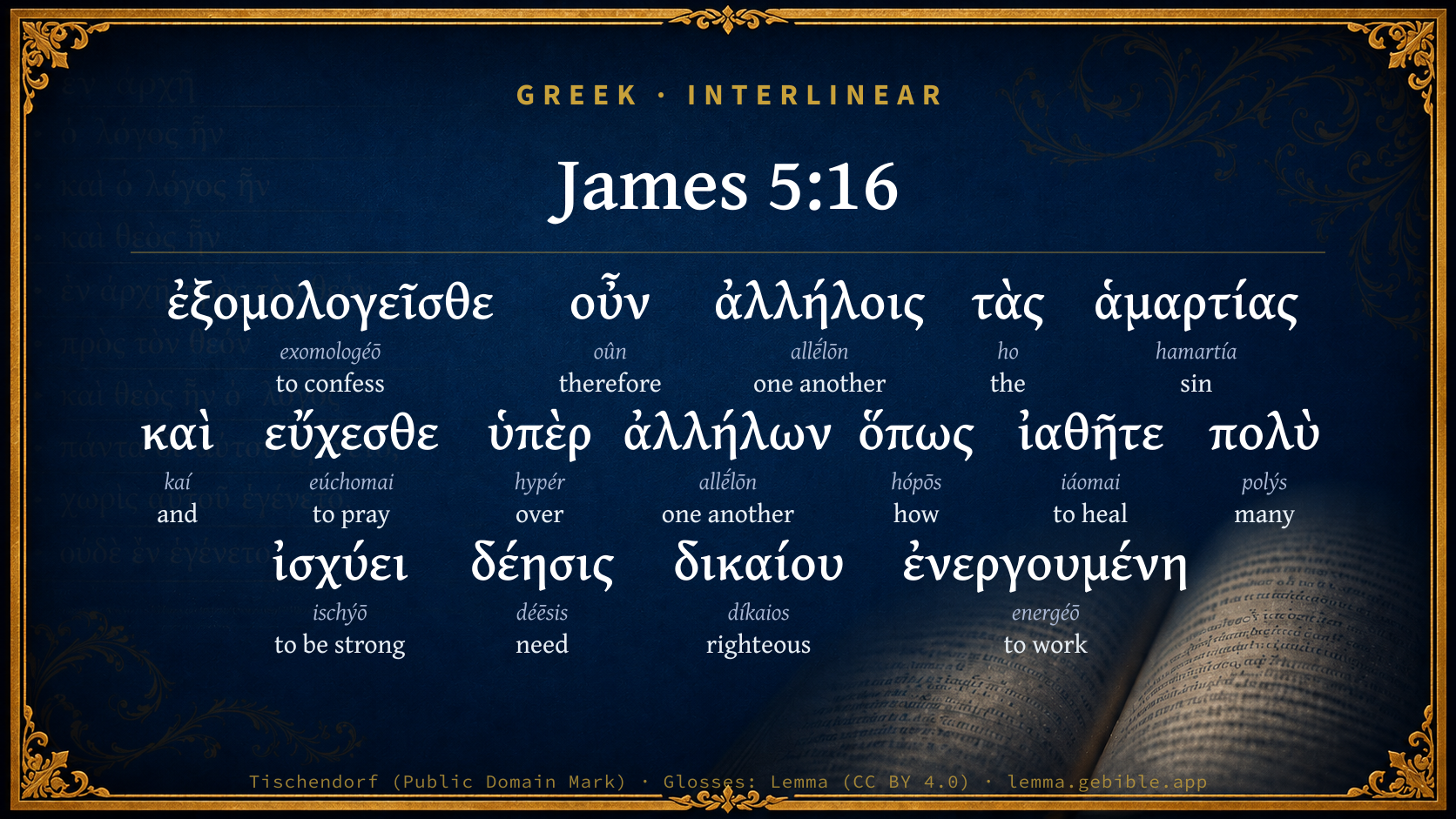
Confess your offenses to one another, and pray one for another, that you may be healed. The effective, earnest prayer of a righteous man is powerfully effective.
Download a study sheet
One document with this verse’s original text, its word-by-word gloss line, the meaning frame, cross-references with their text, attributed commentary, and full source and license credits — printable, and it pastes into notes with its structure intact.
This verse Autodidact and up
A passage Seminary Student
Up to 50 verses in one chapter. A passage sheet keeps up to 6 commentary sources and 12 cross-references per verse, in the order this page ranks them, and says so on the sheet whenever that leaves anything out. Ask for a single verse and you get the Autodidact verse sheet above.
Everything on this page stays free to read, with no account — the sheet is a download of what is already on screen, not access to it.
Compare translations 3
The same verse in 3 English versions, stacked beneath the original-language interlinear above. Click any original word for its lexicon entry.
Each is an independent rendering of the whole verse — the interlinear is not word-aligned to these translations.
Highlighted words mark where these versions differ — a whole-verse word diff, not a word-by-word alignment.
-
World English Bible Public Domain
Confess your offenses to one another, and pray one for another, that you may be healed. The effective, earnest prayer of a righteous man is powerfully effective.
-
King James Version Public Domain
Confess your faults one to another, and pray one for another, that ye may be healed. The effectual fervent prayer of a righteous man availeth much.
-
unfoldingWord Literal Text CC BY-SA 4.0
Therefore, confess your sins to one another and pray for one another so that you may be healed. A working prayer of the righteous is very strong.
unfoldingWord Literal Text — © unfoldingWord, licensed CC BY-SA 4.0. Word-aligned USFM3 via Door43 (git.door43.org/unfoldingWord/en_ult).
Show all 19 translations
Every available English version of this verse, each an independent rendering of the whole verse.
-
World English Bible Public Domain
Confess your offenses to one another, and pray one for another, that you may be healed. The effective, earnest prayer of a righteous man is powerfully effective.
-
Berean Standard Bible Public Domain
Therefore confess your sins to each other and pray for each other so that you may be healed. The prayer of a righteous man has great power to prevail.
-
Majority Standard Bible Public Domain
Confess your trespasses to each other and pray for each other so that you may be healed. The prayer of a righteous man has great power to prevail.
-
King James Version Public Domain
Confess your faults one to another, and pray one for another, that ye may be healed. The effectual fervent prayer of a righteous man availeth much.
-
American Standard Version (1901) Public Domain
Confess therefore your sins one to another, and pray one for another, that ye may be healed. The supplication of a righteous man availeth much in its working.
-
Revised Version (1885) Public Domain
Confess therefore your sins one to another, and pray one for another, that ye may be healed. The supplication of a righteous man availeth much in its working.
-
Geneva Bible (1599) Public Domain
Acknowledge your faultes one to another, and pray one for another, that ye may be healed: for the prayer of a righteous man auaileth much, if it be feruent.
-
Douay-Rheims (1899) Public Domain
Confess therefore your sins one to another: and pray one for another, that you may be saved. For the continual prayer of a just man availeth much.
-
Young's Literal Translation Public Domain
Be confessing to one another the trespasses, and be praying for one another, that ye may be healed; very strong is a working supplication of a righteous man;
-
Literal Standard Version CC BY-SA 4.0
Be confessing to one another the trespasses, and be praying for one another, that you may be healed; very strong is a working supplication of a righteous man;
-
Unlocked Literal Bible CC BY-SA 4.0
So confess your sins to one another, and pray for each other, so that you may be healed. The prayer of a righteous person is very strong in its working.
-
unfoldingWord Literal Text CC BY-SA 4.0
Therefore, confess your sins to one another and pray for one another so that you may be healed. A working prayer of the righteous is very strong.
-
Darby Bible Public Domain
Confess therefore your offences to one another, and pray for one another, that ye may be healed. [The] fervent supplication of the righteous [man] has much power.
-
World Messianic Bible Public Domain
Confess your sins to one another and pray for one another, that you may be healed. The insistent prayer of a righteous person is powerfully effective.
-
Webster's Bible Public Domain
Confess your faults one to another, and pray one for another, that ye may be healed. The effectual fervent prayer of the righteous man availeth much.
-
Free Bible Version CC BY-SA 4.0
Admit the wrongs you've done to each other, and pray for one another so that you'll be healed. Earnest prayer from those who live right is very effective.
-
Bible in Basic English Public Domain
So then, make a statement of your sins to one another, and say prayers for one another so that you may be made well. The prayer of a good man is full of power in its working.
-
Text-Critical English NT CC BY 4.0
Confess your trespasses to one another and pray for one another so that you may be healed. The prayer of a righteous person is very powerful and effective.
-
Tyndale New Testament (1534) Public Domain
knowledge youre fautes one to another: and praye one for another that ye maye be healed. The prayer of a ryghteous man avayleth moche yf it be fervet.
Literal Standard Version (2020), Covenant Press — licensed CC BY-SA 4.0. Text via the HelloAO Bible API (eBible.org). Unlocked Literal Bible (unfoldingWord) — licensed CC BY-SA 4.0. Text via the HelloAO Bible API (eBible.org). unfoldingWord Literal Text — © unfoldingWord, licensed CC BY-SA 4.0. Word-aligned USFM3 via Door43 (git.door43.org/unfoldingWord/en_ult). Free Bible Version, Dr. Jonathan Gallagher — licensed CC BY-SA 4.0. Text via the HelloAO Bible API (eBible.org).
Word by word
More ways to search: Search by grammar → Find every occurrence → Compare this word →
Practice this passage: Drill this verse → Learn its vocabulary →
- Appears 7× in the Greek New Testament
- First appears at Acts 26:29
- Part of Speech
- Verb
- Tense
- Present
- Voice
- Middle or Passive deponent
- Mood
- Imperative
- Person
- 2nd person
- Number
- Plural
Full Thayer's Definition
- ἐξομολογεῖσθε exomologéō G1843 “to confess” Verb, Present, Middle, Imperative, 2nd person, Plural
- οὖν oûn G3767 “therefore” Conjunction
- ἀλλήλοις allḗlōn G240 “one another” Reciprocal pronoun, Dative, Plural, Masculine
- τὰς ho G3588 “the” Article, Accusative, Plural, Feminine
- ἁμαρτίας hamartía G266 “sin” Noun, Accusative, Plural, Feminine
- καὶ kaí G2532 “and” Conjunction
- εὔχεσθε eúchomai G2172 “to pray” Verb, Present, Middle or Passive deponent, Imperative, 2nd person, Plural
- ὑπὲρ hypér G5228 “over” Preposition
- ἀλλήλων allḗlōn G240 “one another” Reciprocal pronoun, Genitive, Plural, Masculine
- ὅπως hópōs G3704 “how” Adverb
- ἰαθῆτε iáomai G2390 “to heal” Verb, Aorist, Passive, Subjunctive, 2nd person, Plural
- πολὺ polýs G4183 “many” Adjective, Accusative, Singular, Neuter
- ἰσχύει ischýō G2480 “to be strong” Verb, Present, Active, Indicative, 3rd person, Singular
- δέησις déēsis G1162 “need” Noun, Nominative, Singular, Feminine
- δικαίου díkaios G1342 “righteous” Adjective, Genitive, Singular, Masculine
- ἐνεργουμένη energéō G1754 “to work” Verb, Present, Middle, Participle, Nominative, Singular, Feminine
About this verse
These counts appear in no published source. They are computed here, from the morphology-tagged text and Lemma’s own curated glosses. What Lemma adds →
- 16
- words
- 15
- distinct lemmas
- General Epistles
- section
Notable vocabulary
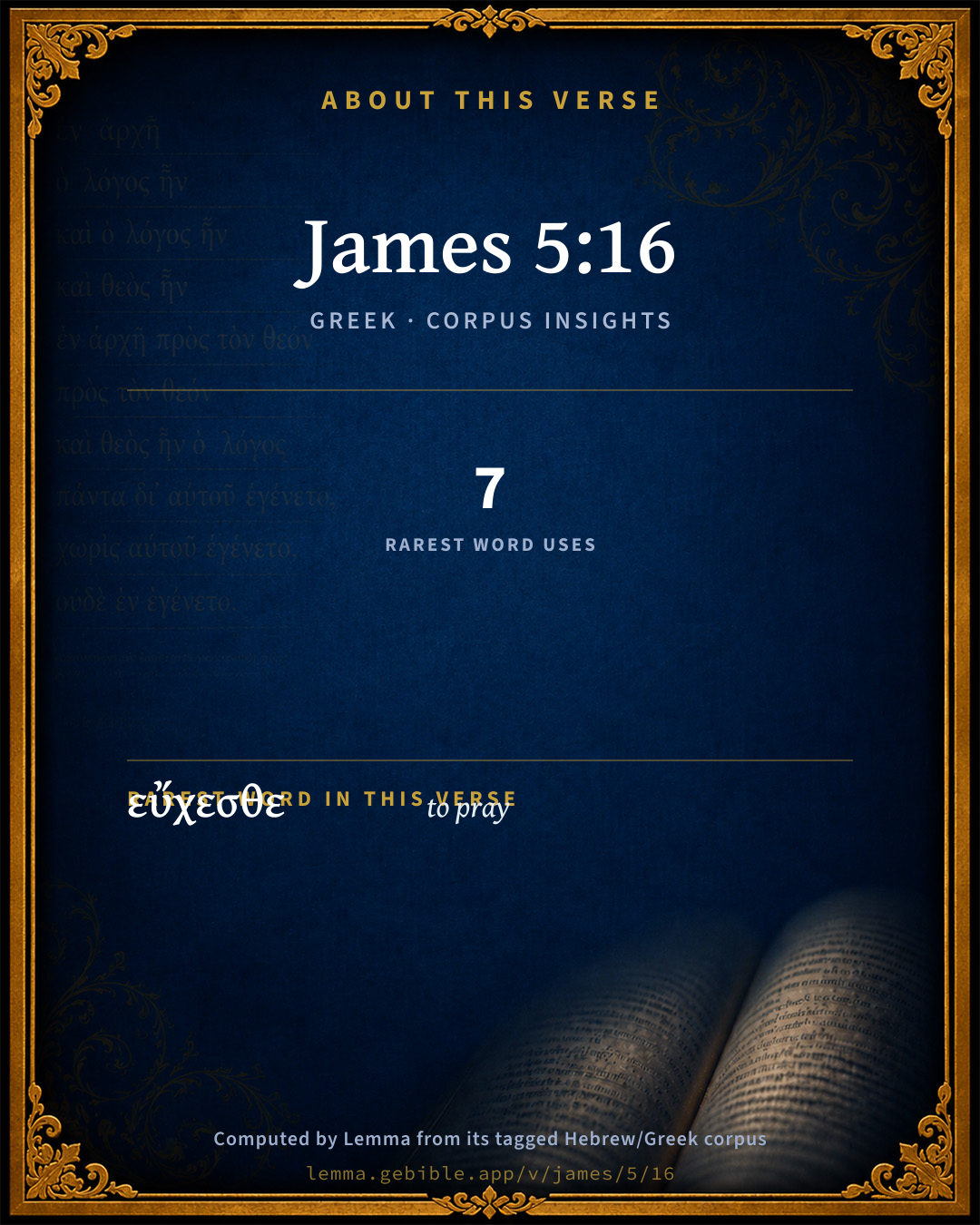
The rarest word here is εὔχεσθε to pray G2172 — appearing just 7 times in the whole Greek New Testament.
Shared distinctive vocabulary
εὔχεσθε to pray G2172 occurs in 7 verses of the Greek New Testament. Also found in:
Repetition
A word recurs within this verse:
- ἀλλήλοις one another G240 ×2
Cross-references
63Topical passages linked to James 5:16 in the Treasury of Scripture Knowledge — connected by theme and wording, ordered by reader-vote popularity; previews shown in the World English Bible.
- Jeremiah 29:12–13 You shall call on me, and you shall go and pray to me, and I will listen to you.
- Proverbs 15:29 Yahweh is far from the wicked, But he hears the prayer of the righteous.
- Matthew 21:22 All things, whatever you ask in prayer, believing, you will receive."
- Psalms 34:15 Yahweh's eyes are toward the righteous. His ears listen to their cry.
- John 9:31 We know that God doesn't listen to sinners, but if anyone is a worshipper of God, and does his will, he listens to him.
- Jeremiah 33:3 Call to me, and I will answer you, and will show you great things, and difficult, which you don't know.
- Psalms 145:18–19 Yahweh is near to all those who call on him, To all who call on him in truth.
- 1 Peter 2:24 who his own self bore our sins in his body on the tree, that we, having died to sins, might live to righteousness; by whose stripes you were healed.
- Matthew 7:7–11 "Ask, and it will be given you. Seek, and you will find. Knock, and it will be opened for you.
- 1 John 3:22 and whatever we ask, we receive from him, because we keep his commandments and do the things that are pleasing in his sight.
- Daniel 9:20–22 While I was speaking, and praying, and confessing my sin and the sin of my people Israel, and presenting my supplication before Yahweh my God for the holy mountain of my God;
- Proverbs 15:8 The sacrifice made by the wicked is an abomination to Yahweh, But the prayer of the upright is his delight.
- Acts 19:18 Many also of those who had believed came, confessing, and declaring their deeds.
- Luke 11:11–13 "Which of you fathers, if your son asks for bread, will give him a stone? Or if he asks for a fish, he won't give him a snake instead of a fish, will he?
- Psalms 10:17–18 Yahweh, you have heard the desire of the humble. You will prepare their heart. You will cause your ear to hear,
- 1 Thessalonians 5:17 Pray without ceasing.
- Genesis 20:17 Abraham prayed to God. God healed Abimelech, and his wife, and his maid-servants, and they bore children.
- Job 42:8 Now therefore, take to yourselves seven bulls and seven rams, and go to my servant Job, and offer up for yourselves a burnt offering; and my servant Job shall pray for you, for I will accept him, that I not deal with you according to your folly. For you have not spoken of me the thing that is right, as my servant Job has."
- Proverbs 28:9 He who turns away his ear from hearing the law, Even his prayer is an abomination.
- 2 Chronicles 30:20 Yahweh listened to Hezekiah, and healed the people.
- Numbers 11:2 The people cried to Moses; and Moses prayed to Yahweh, and the fire abated.
- Matthew 3:6 They were baptized by him in the Jordan, confessing their sins.
- Genesis 18:23–32 Abraham drew near, and said, "Will you consume the righteous with the wicked?
- Hebrews 12:13 and make straight paths for your feet, so that which is lame may not be dislocated, but rather be healed.
- 2 Kings 20:2–5 Then he turned his face to the wall, and prayed to Yahweh, saying,
- 1 Thessalonians 5:25 Brothers, pray for us.
- 2 Kings 4:33–35 He went in therefore, and shut the door on them both, and prayed to Yahweh.
- Luke 18:1–8 He also spoke a parable to them that they must always pray, and not give up,
- Acts 12:5–11 Peter therefore was kept in the prison, but constant prayer was made by the assembly to God for him.
- Romans 3:10 As it is written, "There is no one righteous. No, not one.
- Exodus 9:28–29 Pray to Yahweh; for there has been enough of mighty thunderings and hail. I will let you go, and you shall stay no longer."
- Acts 10:38 even Jesus of Nazareth, how God anointed him with the Holy Spirit and with power, who went about doing good and healing all who were oppressed by the devil, for God was with him.
- Hebrews 11:7 By faith, Noah, being warned about things not yet seen, moved with godly fear, prepared an ark for the saving of his house, through which he condemned the world, and became heir of the righteousness which is according to faith.
- Genesis 20:7 Now therefore, restore the man's wife. For he is a prophet, and he will pray for you, and you will live. If you don't restore her, know for sure that you will die, you, and all who are yours."
- 1 Kings 13:6 The king answered the man of God, Entreat now the favor of Yahweh your God, and pray for me, that my hand may be restored me again. The man of God entreated Yahweh, and the king's hand was restored him again, and became as it was before.
- 2 Chronicles 14:11–12 Asa cried to Yahweh his God, and said, Yahweh, there is none besides you to help, between the mighty and him who has no strength: help us, Yahweh our God; for we rely on you, and in your name are we come against this multitude. Yahweh, you are our God; don't let man prevail against you.
- Acts 4:24–31 When they heard it, they lifted up their voice to God with one accord, and said, "O Lord, you are God, who made the heaven, the earth, the sea, and all that is in them;
- Romans 5:19 For as through the one man's disobedience many were made sinners, even so through the obedience of the one will many be made righteous.
- Hebrews 11:4 By faith, Abel offered to God a more excellent sacrifice than Cain, through which he had testimony given to him that he was righteous, God bearing witness with respect to his gifts; and through it he, being dead, still speaks.
- Hebrews 13:18 Pray for us, for we are persuaded that we have a good conscience, desiring to live honorably in all things.
- Genesis 32:28 He said, "Your name will no longer be called 'Jacob,' but, 'Israel,' for you have fought with God and with men, and have prevailed."
- Exodus 32:10–14 Now therefore leave me alone, that my wrath may burn hot against them, and that I may consume them; and I will make of you a great nation."
- Numbers 14:13–20 Moses said to Yahweh, Then the Egyptians will hear it; for you brought up this people in your might from among them;
- Numbers 21:7–9 The people came to Moses, and said, We have sinned, because we have spoken against Yahweh, and against you; pray to Yahweh, that he take away the serpents from us. Moses prayed for the people.
- Joshua 10:12 Then spoke Joshua to Yahweh in the day when Yahweh delivered up the Amorites before the children of Israel; and he said in the sight of Israel, Sun, stand you still on Gibeon; You, Moon, in the valley of Aijalon.
- 1 Kings 17:18–24 She said to Elijah, What have I to do with you, you man of God? You have come to me to bring my sin to memory, and to kill my son!
- 2 Kings 19:15–20 Hezekiah prayed before Yahweh, and said, Yahweh, the God of Israel, who sit [above] the cherubim, you are the God, even you alone, of all the kingdoms of the earth; you have made heaven and earth.
- Jeremiah 15:1 Then said Yahweh to me, Though Moses and Samuel stood before me, yet my mind would not be toward this people: cast them out of my sight, and let them go forth.
- Daniel 2:18–23 that they would desire mercies of the God of heaven concerning this secret; that Daniel and his companions should nor perish with the rest of the wise men of Babylon.
- Matthew 18:15–17 "If your brother sins against you, go, show him his fault between you and him alone. If he listens to you, you have gained back your brother.
- Luke 7:3–4 When he heard about Jesus, he sent to him elders of the Jews, asking him to come and save his servant.
- Genesis 19:29 It happened, when God destroyed the cities of the plain, that God remembered Abraham, and sent Lot out of the midst of the overthrow, when he overthrew the cities in which Lot lived.
- Exodus 9:33 Moses went out of the city from Pharaoh, and spread abroad his hands to Yahweh; and the thunders and hail ceased, and the rain was not poured on the earth.
- Exodus 17:11 It happened, when Moses held up his hand, that Israel prevailed; and when he let down his hand, Amalek prevailed.
- Deuteronomy 9:18–20 I fell down before Yahweh, as at the first, forty days and forty nights; I did neither eat bread nor drink water; because of all your sin which you sinned, in doing that which was evil in the sight of Yahweh, to provoke him to anger.
- 2 Chronicles 32:20–22 Hezekiah the king, and Isaiah the prophet the son of Amoz, prayed because of this, and cried to heaven.
- 1 Thessalonians 5:23 May the God of peace himself sanctify you completely. May your whole spirit, soul, and body be preserved blameless at the coming of our Lord Jesus Christ.
- 1 Samuel 12:18 So Samuel called to Yahweh; and Yahweh sent thunder and rain that day: and all the people greatly feared Yahweh and Samuel.
- Hosea 12:3–4 In the womb he took his brother by the heel; And in his manhood he had power with God.
- Genesis 41:9–10 Then the chief cupbearer spoke to Pharaoh, saying, "I remember my faults today.
- 2 Samuel 19:19 He said to the king, Don't let my lord impute iniquity to me, neither do you remember that which your servant did perversely the day that my lord the king went out of Jerusalem, that the king should take it to his heart.
- Colossians 1:9 For this cause, we also, since the day we heard this, don't cease praying and making requests for you, that you may be filled with the knowledge of his will in all spiritual wisdom and understanding,
- Luke 9:6 They departed, and went throughout the villages, preaching the Gospel, and healing everywhere.
Cross-references courtesy of OpenBible.info (CC BY 4.0).
Where the printed editions differ
1 variantPlaces in this verse where the major printed Greek editions disagree on the wording in a way that affects the translation — a comparison of editions, not a manuscript-by-manuscript collation. The editions are the modern critical texts (Nestlé-Aland 28/27, SBL, Westcott-Hort, Tregelles, Tyndale House) and the traditional texts behind the KJV (the Textus Receptus and the Byzantine/Majority text). It is not a claim about which reading is original.
-
Extra text
οὖν
“therefore”
In NA28NA27TynSBLWHTreg Not in TRByzοὖν (oun) 'therefore' is only in older manuscripts (NA28+NA27+Tyn+SBL+WH+Treg)
Textual data: Translators Amalgamated Greek New Testament (STEPBible TAGNT) · CC BY 4.0.
Lesson kit
Teaching starters — assembled from the data on this page, not authored interpretation. Every prompt links to the verse data it draws on. Edit before teaching.
James, in the General Epistles, opens this verse with 16 words (15 distinct Greek lemmas). Its most distinctive word is eúchomai (“to pray”). A historical commentator’s framing appears above. Read the whole chapter for the surrounding context.
Discussion questions
- What does “to pray” (eúchomai) contribute to the verse as a whole?
- Acts 26:29 shares the word «to pray» with this verse. How do the two illuminate each other?
- “one another” occurs 2× in this one verse. What is the effect of the repetition?
- The translations on this page render this verse differently — a whole-verse word diff, not a word-by-word alignment. What might account for the different wordings?
- Reading how The Biblical Illustrator and Joseph Benson's Commentary read this verse, where do the two commentators agree and where do they part?
Things to notice
- These translations choose different wording for 16 words in this verse.
- “one another” occurs 2× in this single verse.
- 15 distinct Greek lemmas span 16 words in this verse.
Commentary
Notes on James 5:16 from classic Christian and Jewish commentators (each source and its license shown beneath its notes). The classic Christian expositions comment on the surrounding passage and are grouped to its opening verse, so a note may address several verses; the Jewish commentaries on the Tanakh (Rashi and others) are per-verse, so they appear only where the commentator wrote on this verse.
Lemma curates 59 commentaries, every one of them public domain or Creative Commons licensed, each selected and text-cleaned for this edition rather than reprinted as found. About our sources →
The Biblical Illustrator
Joseph S. Exell
The Biblical Illustrator, edited by Joseph S. Exell (c. 1880s–1900s) — public domain. Text from a community e-Sword module.
Joseph Benson's Commentary
Joseph Benson's Commentary on the Old and New Testaments (1811–1818) — public domain. Text from a community e-Sword module.
The Expositor's Bible
William Robertson Nicoll, ed., The Expositor's Bible (London: Hodder & Stoughton, 1887–1910) — public domain. 65 of 66 books (1 Corinthians is not separately keyed, as that volume carries no machine-parseable verse references); section-level commentary keyed to the opening verse. Introductory and overview sections not keyed to a specific passage are excluded.
Bengel's Gnomon
Johann Albrecht Bengel
Bengel's Gnomon of the New Testament — English translation (T&T Clark, Edinburgh, 1860) — public domain. Text from a community e-Sword module.
Meyer's Critical & Exegetical Commentary
Heinrich August Wilhelm Meyer
Meyer — Critical and Exegetical Commentary on the New Testament — English translation by Peter Christie, edited by Frederick Crombie (T&T Clark, 1880) — public domain. Text from a community e-Sword module.
Expositor's Greek Testament
ed. W. Robertson Nicoll
The Expositor's Greek Testament, edited by W. Robertson Nicoll (1897–1910) — public domain. Text from a community e-Sword module.
Geneva Bible (1599)
Geneva Bible translators
Geneva Bible (1599) marginal notes — public domain. Text via Bolls.life.
Jamieson, Fausset & Brown
Robert Jamieson, A. R. Fausset & David Brown
Jamieson, Fausset & Brown — Commentary Critical and Explanatory on the Whole Bible (1871) — public domain (CC PDM 1.0). Text via the HelloAO Bible API.
Adam Clarke's Commentary
Adam Clarke's Commentary on the Bible (1810–1826) — public domain. Text from a community e-Sword/MySword module.
John Calvin's Commentaries
John Calvin's Commentaries (1540-1563) — public domain. Text from the Calvin Translation Society English edition (1840s-50s) via the Christian Classics Ethereal Library (ccel.org). Calvin's coverage is partial (roughly two-thirds of the Bible); uncommented books and verses are honest gaps, never fabricated. The 19th-century editor's footnotes and remarks are omitted so the notes are faithfully Calvin's own voice.
Ellicott's Commentary for English Readers
A Bible Commentary for English Readers, edited by Charles John Ellicott (1878–1897) — public domain. Text from a community e-Sword module.
The Cambridge Bible for Schools and Colleges
gen. ed. J. J. S. Perowne
The Cambridge Bible for Schools and Colleges (gen. ed. J. J. S. Perowne; Cambridge University Press, 1878–1918) — public domain. Text from a community e-Sword module.
John Gill's Exposition
John Gill's Exposition of the Whole Bible (1746–1763) — public domain (CC PDM 1.0). Text via the HelloAO Bible API.
Trapp's Complete Commentary
John Trapp
John Trapp, A Commentary or Exposition upon All the Books of the Old and New Testament (1647–1656) — public domain. Text from a community e-Sword module.
Albert Barnes' Notes on the Bible
Albert Barnes' Notes on the Bible (1834–1885) — public domain. Text from a community e-Sword/MySword module.
Haydock's Catholic Bible Commentary
George Leo Haydock (1774–1849), Haydock's Catholic Family Bible and Commentary, 1859 edition — public domain. Excludes Psalms (Douay-Rheims chapter numbering differs from Protestant) and Deuterocanonical books (Catholic canon only).
Matthew Poole's English Annotations
Matthew Poole's English Annotations on the Holy Bible (1683–1685) — public domain. Text from a community e-Sword/MySword module.
Whedon's Commentary on the Bible
Daniel D. Whedon
Daniel D. Whedon (gen. ed.), Commentary on the Old and New Testaments (1874–1909) — public domain. Text from a community e-Sword module.
The Pulpit Commentary
The Pulpit Commentary (1880–1919), ed. H.D.M. Spence-Jones & Joseph S. Exell — public domain. Text from a community e-Sword module.
John Wesley's Explanatory Notes
John Wesley, Explanatory Notes Upon the Whole Bible (1754–1765) — public domain. Text via the GEBible commentary corpus.
Scofield Reference Notes
C. I. Scofield
The Scofield Reference Bible (1917 edition), notes by C. I. Scofield — public domain. Text from a community e-Sword module.
Kretzmann's Popular Commentary
Paul E. Kretzmann
Paul E. Kretzmann, Popular Commentary of the Bible (1921–1924) — public domain. Text from a community e-Sword module.
Burkitt's Expository Notes on the New Testament
William Burkitt
William Burkitt's Expository Notes on the New Testament (1700–1703) — public domain. Text from a community e-Sword module.
Godbey's Commentary on the New Testament
William B. Godbey
William B. Godbey, Commentary on the New Testament (1896–1900) — public domain. Text from a community e-Sword module.
The People's New Testament
B. W. Johnson
B. W. Johnson's The People's New Testament with Notes (1889–1891) — public domain. Electronic text from the Christian Classics Ethereal Library (CCEL) ThML edition.
unfoldingWord translationNotes
Door43 World Missions Community
unfoldingWord translationNotes — © Distant Shores Media and the Door43 World Missions Community, licensed CC BY-SA 4.0. Source: git.door43.org/Door43/en_tn.
Cambridge Greek Testament for Schools and Colleges
Cambridge Greek Testament for Schools and Colleges (Cambridge University Press, 1896; 21 vols, various authors incl. Carr, Maclear, Plummer, Farrar, Lumby, Moule, M. R. James, Simcox) — public domain. Text from a community e-Sword module.
Alford’s Greek Testament
Henry Alford
Henry Alford, The Greek Testament (1849–1861) — public domain. Text from a community e-Sword module.
International Critical Commentary
International Critical Commentary — older volumes (1896–1929), various authors — public domain. Text from a community e-Sword module.
Vincent's Word Studies in the New Testament
Marvin R. Vincent
Marvin R. Vincent, Word Studies in the New Testament (1887–1900) — public domain. Text from a community e-Sword/MySword module.