
Galatians 1:14

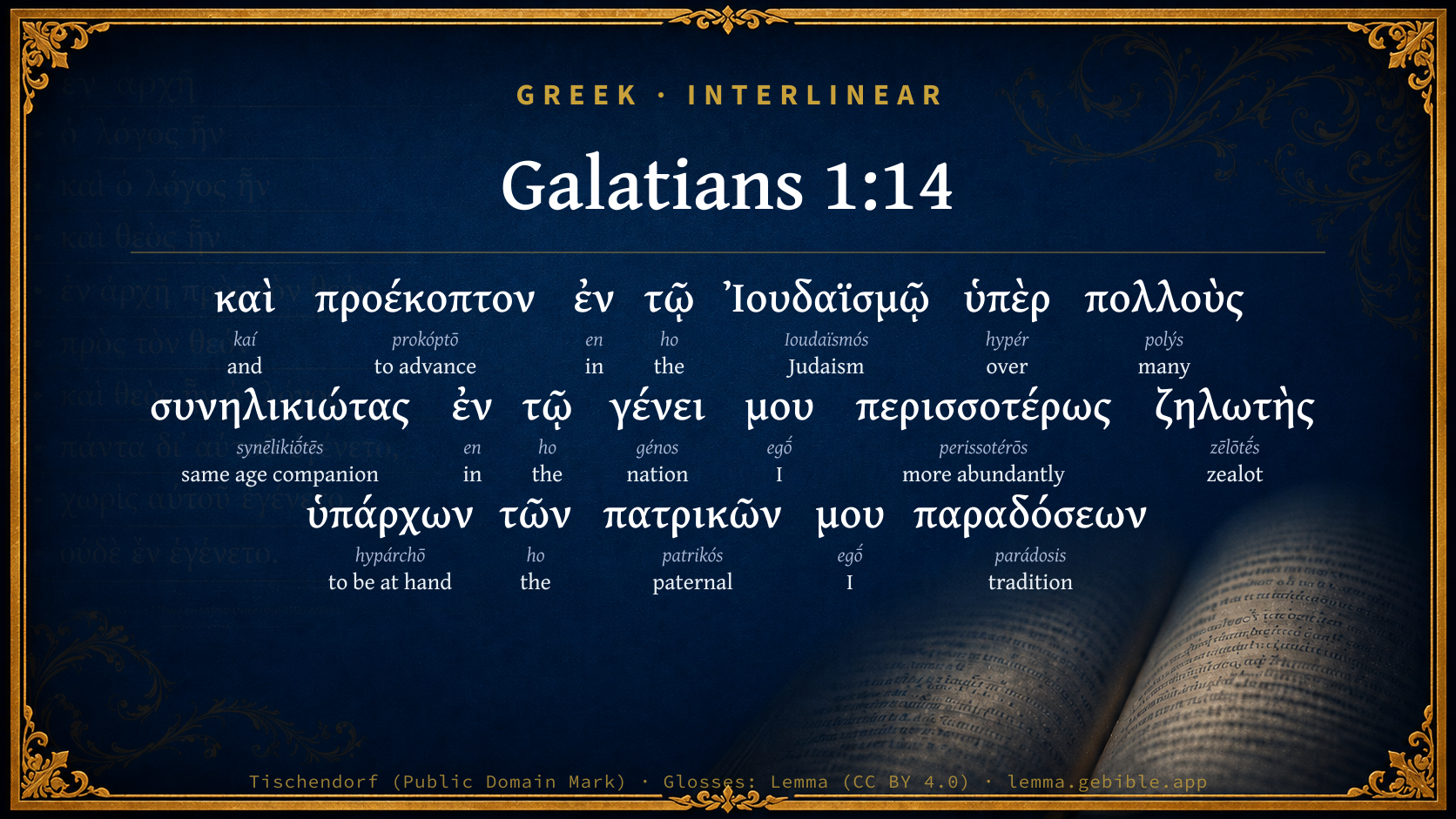
Greek (Tischendorf 8th ed.) Galatians 1:14 appears in the Greek New Testament. The text above is from the Tischendorf 8th edition. Each word links to its Strong’s number and a concise gloss. Click any word for its full Thayer’s Greek Lexicon entry.
Download image
Cite this verse

Galatians 1:14 (World English Bible). Public Domain. Lemma interlinear Bible study tool, https://lemma.gebible.app/v/galatians/1/14.

Show BibTeX & RIS
BibTeX
RIS
English Translation
I advanced in the Jews' religion beyond many of my own age among my countrymen, being more exceedingly zealous for the traditions of my fathers.
World English Bible · Public Domain
Highlights
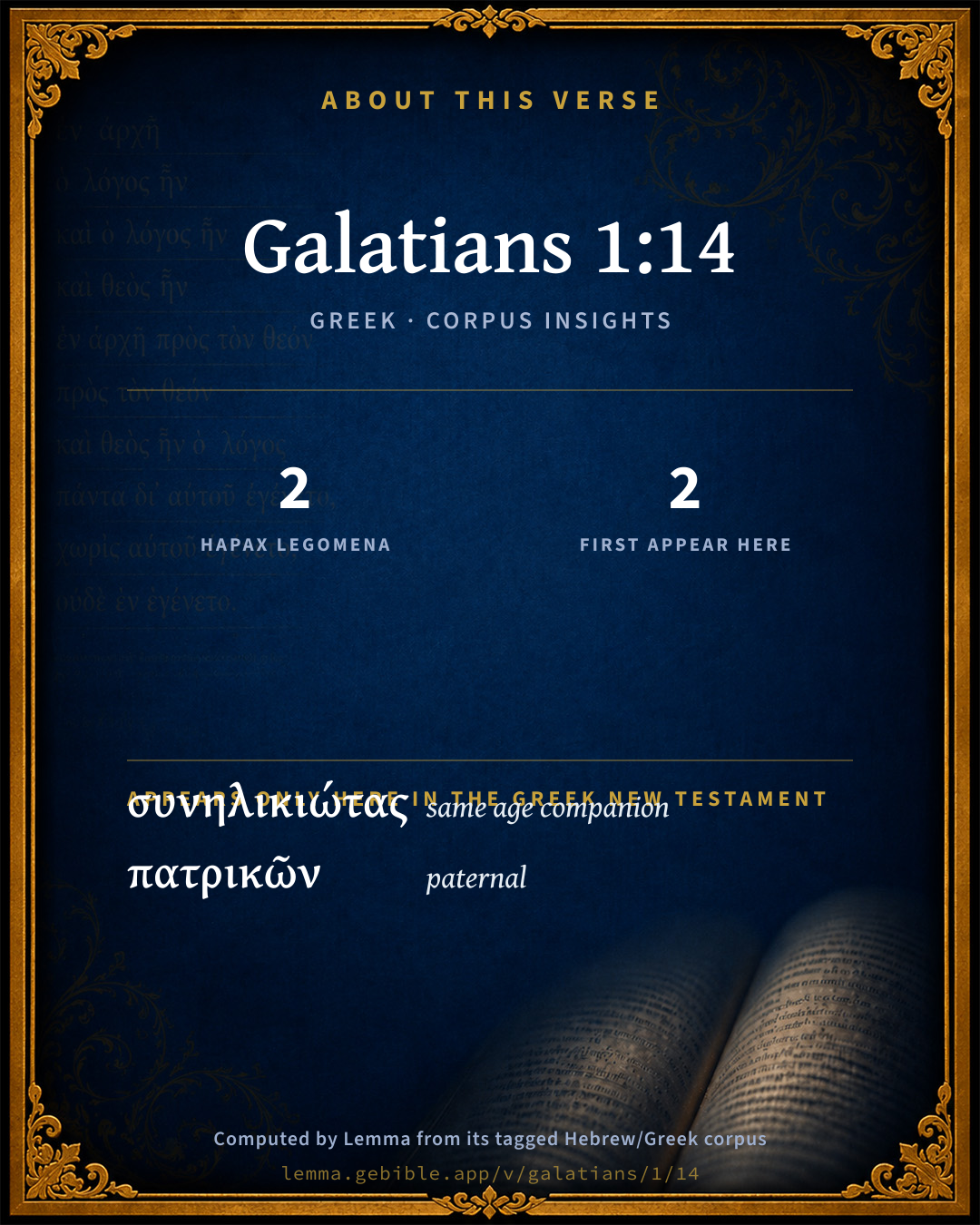
  • 2 hapax legomena — only here in the Greek New Testament
  • 2 first appearances in the Greek New Testament
Full analysis ↓
Download a study sheet

One document with this verse’s original text, its word-by-word gloss line, the meaning frame, cross-references with their text, attributed commentary, and full source and license credits — printable, and it pastes into notes with its structure intact.

This verse Autodidact and up

Study sheet (.html) Plain text (.txt)

A passage Seminary Student

Up to 50 verses in one chapter. A passage sheet keeps up to 6 commentary sources and 12 cross-references per verse, in the order this page ranks them, and says so on the sheet whenever that leaves anything out. Ask for a single verse and you get the Autodidact verse sheet above.

Everything on this page stays free to read, with no account — the sheet is a download of what is already on screen, not access to it.

Want to remove ads? Support Godless Engineer
Compare translations 3

The same verse in 3 English versions, stacked beneath the original-language interlinear above. Click any original word for its lexicon entry.

Each is an independent rendering of the whole verse — the interlinear is not word-aligned to these translations.

Highlighted words mark where these versions differ — a whole-verse word diff, not a word-by-word alignment.

  • World English Bible Public Domain
    I advanced in the Jews' religion beyond many of my own age among my countrymen, being more exceedingly zealous for the traditions of my fathers.
  • King James Version Public Domain
    And profited in the Jews' religion above many my equals in mine own nation, being more exceedingly zealous of the traditions of my fathers.
  • unfoldingWord Literal Text CC BY-SA 4.0
    And I was advancing in Judaism beyond many of the same age among my race, being far more zealous for the traditions of my fathers.

unfoldingWord Literal Text — © unfoldingWord, licensed CC BY-SA 4.0. Word-aligned USFM3 via Door43 (git.door43.org/unfoldingWord/en_ult).

Versions to compare (up to 4)

3 of 4 selected

Show all 19 translations

Every available English version of this verse, each an independent rendering of the whole verse.

  • World English Bible Public Domain
    I advanced in the Jews' religion beyond many of my own age among my countrymen, being more exceedingly zealous for the traditions of my fathers.
  • Berean Standard Bible Public Domain
    I was advancing in Judaism beyond many of my contemporaries and was extremely zealous for the traditions of my fathers.
  • Majority Standard Bible Public Domain
    I was advancing in Judaism beyond many of my contemporaries and was extremely zealous for the traditions of my fathers.
  • King James Version Public Domain
    And profited in the Jews' religion above many my equals in mine own nation, being more exceedingly zealous of the traditions of my fathers.
  • American Standard Version (1901) Public Domain
    and I advanced in the Jews' religion beyond many of mine own age among my countrymen, being more exceedingly zealous for the traditions of my fathers.
  • Revised Version (1885) Public Domain
    and I advanced in the Jews’ religion beyond many of mine own age among my countrymen, being more exceedingly zealous for the traditions of my fathers.
  • Geneva Bible (1599) Public Domain
    And profited in the Iewish religion aboue many of my companions of mine owne nation, and was much more zealous of the traditions of my fathers.
  • Douay-Rheims (1899) Public Domain
    And I made progress in the Jews' religion above many of my equals in my own nation, being more abundantly zealous for the traditions of my fathers.
  • Young's Literal Translation Public Domain
    and I was advancing in Judaism above many equals in age in mine own race, being more abundantly zealous of my fathers' deliverances,
  • Literal Standard Version CC BY-SA 4.0
    and I was advancing in Judaism above many equals in age in my own race, being more abundantly zealous of my fathers’ deliverances,
  • Unlocked Literal Bible CC BY-SA 4.0
    I advanced in Judaism beyond many of those who were my own age, from out of my own people. That is how extremely zealous I was for the traditions of my fathers.
  • unfoldingWord Literal Text CC BY-SA 4.0
    And I was advancing in Judaism beyond many of the same age among my race, being far more zealous for the traditions of my fathers.
  • Darby Bible Public Domain
    and advanced in Judaism beyond many [my] contemporaries in my nation, being exceedingly zealous of the doctrines of my fathers.
  • World Messianic Bible Public Domain
    I advanced in Judaism beyond many of my own age among my countrymen, being more exceedingly zealous for the traditions of my fathers.
  • Webster's Bible Public Domain
    And profited in the Jews' religion above many my equals in my own nation, being more exceedingly zealous of the traditions of my fathers.
  • Free Bible Version CC BY-SA 4.0
    I surpassed my contemporaries in the practice of the Jewish religion because I was so fervently devoted to the traditions of my ancestors.
  • Bible in Basic English Public Domain
    And I went farther in the Jews' religion than a number of my generation among my countrymen, having a more burning interest in the beliefs handed down from my fathers.
  • Text-Critical English NT CC BY 4.0
    I was advancing in Judaism beyond many of my own age among my people, being far more zealous for the traditions of my fathers.
  • Tyndale New Testament (1534) Public Domain
    and prevayled in the Iewes laye above many of my companions which were of myne awne nacion and was a moche more fervet mayntener of the tradicions of the elders.

Literal Standard Version (2020), Covenant Press — licensed CC BY-SA 4.0. Text via the HelloAO Bible API (eBible.org). Unlocked Literal Bible (unfoldingWord) — licensed CC BY-SA 4.0. Text via the HelloAO Bible API (eBible.org). unfoldingWord Literal Text — © unfoldingWord, licensed CC BY-SA 4.0. Word-aligned USFM3 via Door43 (git.door43.org/unfoldingWord/en_ult). Free Bible Version, Dr. Jonathan Gallagher — licensed CC BY-SA 4.0. Text via the HelloAO Bible API (eBible.org).

Word by word

More ways to search: Search by grammar → Find every occurrence → Compare this word →

Practice this passage: Drill this verse → Learn its vocabulary →

συνηλικιώτας
synēlikiṓtēs
G4915
“same age companion”
Noun, Accusative, Plural, Masculine
Part of Speech
Noun
Case
Accusative
Number
Plural
Gender
Masculine
Full Thayer's Definition

Origin: from G4862 and a derivative of G2244

TDNT: None

1. one of the same age, an equal in age
  1. καὶ kaí G2532 “and” Conjunction
  2. προέκοπτον prokóptō G4298 “to advance” Verb, Imperfect, Active, Indicative, 1st person, Singular
  3. ἐν en G1722 “in” Preposition
  4. τῷ ho G3588 “the” Article, Dative, Singular, Masculine
  5. Ἰουδαϊσμῷ Ioudaïsmós G2454 “Judaism” Noun, Dative, Singular, Masculine
  6. ὑπὲρ hypér G5228 “over” Preposition
  7. πολλοὺς polýs G4183 “many” Adjective, Accusative, Plural, Masculine
  8. ἐν en G1722 “in” Preposition
  9. τῷ ho G3588 “the” Article, Dative, Singular, Neuter
  10. γένει génos G1085 “nation” Noun, Dative, Singular, Neuter
  11. μου egṓ G1473 “I” Personal pronoun, 1st person, Genitive, Singular
  12. περισσοτέρως perissotérōs G4056 “more abundantly” Adverb, Comparative
  13. ζηλωτὴς zēlōtḗs G2207 “zealot” Noun, Nominative, Singular, Masculine
  14. ὑπάρχων hypárchō G5225 “to be at hand” Verb, Present, Active, Participle, Nominative, Singular, Masculine
  15. τῶν ho G3588 “the” Article, Genitive, Plural, Feminine
  16. πατρικῶν patrikós G3967 “paternal” Adjective, Genitive, Plural, Feminine
  17. μου egṓ G1473 “I” Personal pronoun, 1st person, Genitive, Singular
  18. παραδόσεων parádosis G3862 “tradition” Noun, Genitive, Plural, Feminine

About this verse

These counts appear in no published source. They are computed here, from the morphology-tagged text and Lemma’s own curated glosses. What Lemma adds →

19
words
15
distinct lemmas
Pauline Epistles
section

Notable vocabulary

2 hapax legomena — words that appear only here in the entire Greek New Testament:

  • συνηλικιώτας same age companion G4915
  • πατρικῶν paternal G3967

First appearance in Scripture

These words make their first canonical appearance in the Greek New Testament here:

  • συνηλικιώτας same age companion G4915
  • πατρικῶν paternal G3967

Shared distinctive vocabulary

Ἰουδαϊσμῷ Judaism G2454 occurs in 2 verses of the Greek New Testament. Also found in:
Repetition

Words recur within this verse:

Cross-references

13

Topical passages linked to Galatians 1:14 in the Treasury of Scripture Knowledge — connected by theme and wording, ordered by reader-vote popularity; previews shown in the World English Bible.

  • Colossians 2:8 Be careful that you don't let anyone rob you through his philosophy and vain deceit, after the tradition of men, after the elements of the world, and not after Christ.
  • Acts 26:5 having known me from the first, if they are willing to testify, that after the strictest sect of our religion I lived a Pharisee.
  • Acts 22:3 "I am indeed a Jew, born in Tarsus of Cilicia, but brought up in this city at the feet of Gamaliel, instructed according to the strict manner of the law of our fathers, being zealous for God, even as you all are this day.
  • Philippians 3:4–6 though I myself might have confidence even in the flesh. If any other man thinks that he has confidence in the flesh, I yet more:
  • Matthew 15:6 he shall not honor his father or mother.' You have made the commandment of God void because of your tradition.
  • Jeremiah 9:14 but have walked after the stubbornness of their own heart, and after the Baals, which their fathers taught them;
  • Acts 26:9 "I myself most assuredly thought that I ought to do many things contrary to the name of Jesus of Nazareth.
  • 1 Peter 1:8 whom not having known you love; in whom, though now you don't see him, yet believing, you rejoice greatly with joy unspeakable and full of glory--
  • Isaiah 29:13 The Lord said, Because this people draw near [to me], and with their mouth and with their lips to honor me, but have removed their heart far from me, and their fear of me is a commandment of men which has been taught [them];
  • Isaiah 57:12 I will declare your righteousness; and as for your works, they shall not profit you.
  • Matthew 15:2–3 "Why do your disciples disobey the tradition of the elders? For they don't wash their hands when they eat bread."
  • Mark 7:3–13 (For the Pharisees, and all the Jews, don't eat unless they wash their hands and forearms, holding to the tradition of the elders.
  • Jeremiah 15:2 It shall happen, when they tell you, Where shall we go forth? then you shall tell them, Thus says Yahweh: Such as are for death, to death; and such as are for the sword, to the sword; and such as are for the famine, to the famine; and such as are for captivity, to captivity.

Cross-references courtesy of OpenBible.info (CC BY 4.0).

Commentary

Notes on Galatians 1:14 from classic Christian and Jewish commentators (each source and its license shown beneath its notes). The classic Christian expositions comment on the surrounding passage and are grouped to its opening verse, so a note may address several verses; the Jewish commentaries on the Tanakh (Rashi and others) are per-verse, so they appear only where the commentator wrote on this verse.

Lemma curates 59 commentaries, every one of them public domain or Creative Commons licensed, each selected and text-cleaned for this edition rather than reprinted as found. About our sources →

The Biblical Illustrator

Joseph S. Exell

Gal_1:14

And profited in the Jews religion above many.

Pauls prospects in the Jewish religion

He might, no doubt, have been the head of the Pharisaic faction in the last expiring struggles of his nation; he might have rallied round him the nobler spirits of his countrymen, and by his courage and prudence have caused Jerusalem to hold out a few months or years more against the army of Titus. Still at best he would have been a Maccabeus or a Gamaliel, and what a difference to the whole subsequent fortunes of the world between a Maccabeus and a Paul, between the Jewish Rabbi and the Apostle to the Gentiles. (Dean Stanley.)

Pauls zeal

His natural faculties were by his conversion not unclothed, but clothed upon; the glory of Divine grace was shown here as always, not by repressing and weakening the human character, but by bringing it out for the first time in its full vigour. He was still a Jew; the zeal of his ancestral tribe (Gen_49:27), which had caused him to ravin as a wolf in the morning of his life, still glowed in his veins when he returned in the evening to divide the spoil of the mightier enemy whom he had defeated and bound; and in the unwearied energy and self.devotion, no less than the peculiar intensity of natural feeling, which mark his whole life and writings, we discern the qualities which the Jewish people alone of all the nations then existing on the earth could have furnished. (Dean Stanley.)

The traditions of the fathers

There are two large divisions of Rabbinic lore which may be classed under the heads of Hagadoth, or unrecorded legends; and Halachoth, or rules and precedents in explanation of dubious or undefined points of legal observance. It is natural that there should be but few traces of the latter in the writings of one whose express object was to deliver the Gentiles from the intolerable burden of legal Judaism. But though there is little trace of them he tells us that he had once been enthusiastic in their observance. And there are abundant signs that with the Hagadoth he was extremely familiar--e.g., Jannes and Jambres (2Ti_3:8), the last trumpet (1Co_15:52), the giving of the law by angels (Gal_3:19), Satan as god of this world and prince of the power of the air (Eph_2:2), celestial and infernal hierarchies (Eph_1:21; Eph_3:10; Eph_6:12), are all recurrent in Talmudic writings. 1Co_11:10 refers to the Rabbinic interpretation of Gen_6:2, which avers that angels fell because of their guilty love of women. The following rock of 1Co_10:4 is also a tradition. (F. W. Farrar.)

False zeal

A false zeal in religion is always, in some respect or other, a misdirected zeal, or a zeal not according to knowledge; a zeal seeking some false end, or, while proposing to itself a good end, seeking its promotion in some unauthorized way. Jehu had a good zeal, which he called zeal for the Lord of Hosts. His fault was not that he was too zealous, but that his zeal was really directed to his own advancement. The Jews, in the days of Christ, had a zeal for God; but it was so misdirected as to fire them with a frenzy to destroy the Son of God, and extinguish the Light of the world. There are countless forms of false zeal now at work; but, in all cases, they sin not by excess, but by misdirection. Some are flaming with a zeal to spread some of the corruption of Christianity, and to carry men away from its great and cardinal truths. Some are equally zealous to build up a sect or a party on other foundations than those which God has laid in Zion; and that which taints their zeal is the purpose to which they employ it, and not any excessive fervour of their zeal itself. (Dr. Bonar.)

Ministerial zeal

The most remarkable examples of zeal are found in the records of the early itinerant ministers. Richard Nolley, one of these, came upon the fresh trail of an emigrant in the wilderness, and followed it till he overtook the family. When the emigrant saw him, he said, What, a methodist preacher! I quit Virginia to be out of the way of them; but in my settlement in Georgia I thought I should be beyond their reach. There they were; and they got my wife and daughter to join them. Then I come here to Chocktaw Corner, find a piece of land, feel sure that I shall have some peace from the preachers; and here is one before I have unloaded my waggon! The preacher exhorted him to make his peace with God, that he might not be troubled by the everywhere-present methodist preachers.

Remarkable zeal

During the battle of Gettysburg, Chaplain Eastman was so badly injured by a fall of his horse as to be compelled to lie down on the field for the night. As he lay in the darkness, he heard a voice say, Oh my God! and thought, How can I get at him? Unable to walk, he started to roll to the sufferer, and rolled through blood, among the dead bodies, till he came to the dying man, to whom he preached Christ. This service done, he was sent for to attend a dying officer, to whom he had to be carried by two soldiers. Thus he passed the long night; the soldiers carrying him from one dying man to another, to whom he preached Christ, and with whom he prayed, while compelled to lie on his back beside them.

Suspicious zeal

The purity of that zeal for religion by which we gain worldly wealth is open to suspicion. Well fare their hearts who will not only wear out their shoes, but also their feet, in Gods service, even if they should not gain a shoe-latchet thereby.

True zeal

True zeal is a sweet, heavenly, and gentle flame, which makes us active for God, but always within the sphere of love. It never calls for fire from heaven, to censure those who differ a little from us in their apprehensions. It is like that kind of lightning which melts the sword within, but singes not the scabbard; it strives to save the soul without hurting the body: (R. Cudworth.)

Good objects not to be unduly esteemed

Human nature is prone to extremes, sometimes in that which is good. St. Paul did not deem it necessary to underrate Judaism in order to justify his adherence to Christianity, But it is not to undervalue an institution to place it in its true light, and to regard it according to its intrinsic worth. It is not to undervalue a stream, to say of it that it is not the fountain, nor the blossom that it is not fruit, nor a shadow that it is not the substance, nor a taper that it is not the sun. St. Paul knew well that the Jewish ceremonies were valuable not for their own sake merely, but as so many moral conductors to Christ; and that that end being accomplished, their virtue ceased. And he was not the man to tolerate for a moment the egregious absurdity of those who, for sinister purposes, would depose Christ from his high supremacy, and substitute the ancient ritual of Moses for the atonement of the cross, and go back to the dim twilight of the law, while living under the meridian brightness of the gospel day. But it is only when viewed in contrast with the inherent efficacy of the better sacrifice, the better covenant, and the better promises, introduced by the Son of God Himself, that he ever speaks with anything like disparagement of the abrogated institutions of Judaism; which, like the waning orbs of night when the sun is nigh, have no glory by reason of the glory that excelleth. Ye have heard of my conversation in times past in the Jews religion; being more exceedingly zealous of the traditions of my fathers. The general instruction to be derived from this reference to his own past history, and to the errors of the Galatian people, is, that great care is requisite lest objects, good in themselves, be perverted to lead the mind away from Christ. (The Evangelist.)

Pauls Jewish life

I. The religion of Paul before his conversion was distinguished by hatred and cruelty. He persecuted the Church of God and wasted it.

II. The religion of Paul before his conversion was distinguished by great proficiency in Jewish rites and ceremonies. He profited in the Jews religion above many his equals in his own nation.

III. Pauls religion before his conversion was distinguished by zeal for the traditions of the fathers. Being more exceedingly zealous of the traditions of my fathers. Lessons:

1. Paul exhibited a character in which the desire to excel was ever prominent. His persecution was above measure, his proficiency and zeal in the Jewish religion, were superior to his contemporaries. The same feature of character was observed in Christian work.

2. Pauls history teaches that sincerity is no proof of righteousness. He thought that he ought to do many things contrary to the name of Jesus of Nazareth. (R. Nicholls.)

Sectarian zeal

I. Is founded on the human in religion;

II. Is bitter and persecuting in its spirit; III Indicates not true religion but the want of it. (J. Lyth.)

The Biblical Illustrator, edited by Joseph S. Exell (c. 1880s–1900s) — public domain. Text from a community e-Sword module.

Tyndale Open Study Notes

Tyndale Open Resources

1:14 zeal for the traditions of my ancestors: Cp. Mark 7:6-13.

Tyndale Open Study Notes — © Tyndale Open Resources, licensed CC BY-SA 4.0. Text via the HelloAO Bible API.

Bengel's Gnomon

Johann Albrecht Bengel

Gal 1:14. Προέκοπτον, I was becoming a proficient [I profited]) in my very acts.—συνηλικιώτας, my equals in years) who were at that time in their full vigour.—πατρικῶν μου, of my fathers [of my hereditary and national traditions]) which were very dear to me, as if they depended on me as their sole patron. A mimesis.[4]

[4] See App. Here he imitates the language which himself formerly, and which the Jewish legalists used in speaking of the traditions.—ED.

Bengel's Gnomon of the New Testament — English translation (T&T Clark, Edinburgh, 1860) — public domain. Text from a community e-Sword module.

Meyer's Critical & Exegetical Commentary

Heinrich August Wilhelm Meyer

Gal_1:14. Still dependent on ὅτι.

καί] the προκόπτειν ἐν τῷ Ἰουδαϊσμῷ had then been combined in Paul with his hostile action against Christianity, had kept pace with it.

Ἰουδαϊσμός, not Jewish theology (Grotius, Rückert), but just as in Gal_1:13. Judaism was the sphere in which he advanced further and improved more than those of his age by growth in Jewish culture, in Jewish zeal for the law, in Jewish energy of works, etc. On προκόπτειν as intransitive (Luk_2:52; 2Ti_2:16; 2Ti_3:9; 2Ti_3:13), very frequent in Polyb., Lucian, etc., comp. Jacobs, ad Anthol. X. p. 35; on ἐν τ. Ἰουδ., comp. Lucian, Herm. 63, ἐν τοῖς μαθήμασι, Paras. 13, ἐν ταῖς τέχναις.

συνηλικιώτης] one of the same age, occurring only here in the N.T., a word belonging to the later Greek (Diod. Sic. i. 53? Alciphr. i. 12). See Wetstein. The ancient authors use ἡλικιώτης (Plat. Apol. p. 33 C, and frequently).

ἐν τῷ γένει μου] a more precise definition of συνηλικ.; γένει is therefore, in conformity with the context (comp. ἐν τῷ Ἰουδ.), to be understood in a national sense,[27] and not of the sect of the Pharisees (Paulus). Comp. Php_3:5; 2Co_11:26; Rom_9:3; Act_7:19.

περισσοτέρως ζηλωτὴς ὑπάρχων κ.τ.λ.] a more detailed statement, specifying in what way the προέκοπτον … γένει μου found active expression; so that I etc.

περισσοτέρως] than those ΠΟΛΛΟΊ. They, too, were zealous for the traditions of their fathers (whether like Paul they were Pharisees, or not); but Paul was so in a more superabundant measure for his.

τῶν πατρικῶν μου παραδόσεων] endeavouring with zealous interest to obey, uphold, and assert them. On the genitive of the object, comp. 2Ma_4:2; Act_21:20; Act_22:3; 1Co_14:12; Tit_2:14; Plat. Prot. p. 343 A. The πατρικαί μου παραδόσεις, that is, the religious definitions handed down to me from my fathers (in respect to doctrine, ritual, asceticism, interpretation of Scripture, conduct of life, and the like), are the Pharisaic traditions (comp. Mat_5:21; Mat_15:2; Mar_7:3); for Paul was Φαρισαῖος (Php_3:5; Act_26:5), ΥἹῸς ΦΑΡΙΣΑΊΩΝ (Act_23:6). So also Erasmus (Annot.), Beza, Calovius, de Wette, Hofmann, and others. If Paul had intended to refer to the Mosaic law, either alone (Erasmus, Paraphr., Luther, Calvin, and others) or together with the Pharisaic traditions (Estius, Grotius, Calixtus, Morus, Koppe, Flatt, Winer, Usteri, Rückert, Schott, Olshausen, Hilgenfeld, Wieseler, the law according to the strict rule of Pharisaism, comp. Möller), he would have named the law either by itself or along with the traditions (Act_21:20; Act_22:3; 2Ma_4:2); but by μου he limits the ΠΑΤΡΙΚᾺς ΠΑΡΑΔΌΣΕΙς to the special elements resulting from his descent, which did not apply to those who were in different circumstances as to descent; whereas the law applied to all Jews. Comp., as parallel, Act_26:5. That Paul had been zealous for the law in general, followed as a matter of course from προέκοπτ. ἐν τ. Ἰουδαϊσμῷ; but here he is stating the specific way in which his own peculiar προκόπτειν ἐν Ἰουδαϊσμῷ had displayed itselfhis Pharisaic zealotry. It would have been surprising if in this connection he had omitted to mention the latter.

πατρικός, not found elsewhere in the N.T., means paternal. Comp. LXX. Gen_50:8; Lev_22:13; Sir_42:10; 3 Esd. 1:5, 29; 4Ma_18:7; Plat. Lach. p. 180 E, Soph. p. 242 A; Isocr. Evag. p. 218, 35; Diod. Sic. i. 88; Polyb. i. 78. 1; Athen. xv. p. 667 F. In this case the context alone decides whether the idea a patribus acceptus (πατροπαράδοτος, 1Pe_1:18) is conveyed by it, as in this passage by ΜΟΥ, or not (as, for instance, Polyb. xxi. 5, 7). The former is very frequently the case. As to the much discussed varying distinction between ΠΆΤΡΙΟς, ΠΑΤΡΙΚΌς, and ΠΑΤΡῷΟς, comp. on Act_22:3.

[27] For with Hellenist associates, of whom likewise in Jerusalem there could be no lack, he does not desire to compare himself.

Meyer — Critical and Exegetical Commentary on the New Testament — English translation by Peter Christie, edited by Frederick Crombie (T&T Clark, 1880) — public domain. Text from a community e-Sword module.

Expositor's Greek Testament

ed. W. Robertson Nicoll

Gal 1:14 . συνηλικιώτας . Saul had been educated at Jerusalem, and this word points to his contemporaries in the schools of the Pharisees. γένει . This term sometimes denotes family , but here race and nation , as in Act 18:2 ; Act 18:24 . So also συγγενής in Rom 9:3 ; Rom 16:7 ; Rom 16:21 . ζηλωτὴς . This is not here the proper name of a sect, being coupled with a genitive, as in Act 21:20 . Saul had no sympathy with the anarchical sect of Zealots who preached the sacred duty of revolt from Rome, though he had the persecuting zeal of an orthodox Pharisee. πατρικῶν . This differs in sense from πατρῷος . The latter denotes the national law and customs of Israel (Act 22:3 ; Act 28:17 ), the former the hereditary traditions of the family, as the addition of μου further signifies. In Act 23:6 Paul describes himself as a son of Pharisees.

The Expositor's Greek Testament, edited by W. Robertson Nicoll (1897–1910) — public domain. Text from a community e-Sword module.

Geneva Bible (1599)

Geneva Bible translators

He calleth them the traditions of his Fathers, because he was not only a Pharisee himself, but also had a Pharisee to his father.

Geneva Bible (1599) marginal notes — public domain. Text via Bolls.life.

Jamieson, Fausset & Brown

Robert Jamieson, A. R. Fausset & David Brown

profited--Greek, "I was becoming a proficient"; "I made progress."

above--beyond.

my equals--Greek, "Of mine own age, among my countrymen."

traditions of my fathers--namely, those of the Pharisees, Paul being "a Pharisee, and son of a Pharisee" (Act 23:6; Act 26:5). "MY fathers," shows that it is not to be understood generally of the traditions of the nation.

Jamieson, Fausset & Brown — Commentary Critical and Explanatory on the Whole Bible (1871) — public domain (CC PDM 1.0). Text via the HelloAO Bible API.

Adam Clarke's Commentary

Verse 14. And profited in the Jews' religion] The apostle does not mean that he became more exemplary in the love and practice of the pure law of God than any of his countrymen, but that he was more profoundly skilled in the traditions of the fathers than most of his fellow students were, or, as the word συνηλικιωτας may mean his contemporaries.

Adam Clarke's Commentary on the Bible (1810–1826) — public domain. Text from a community e-Sword/MySword module.

Ellicott's Commentary for English Readers

(14) Profited.—Made progress. The kind of progress would correspond to the width of the term “Judaism,” with which it is connected, and would imply, not merely proficiency in theological knowledge, but also increase in zeal and strictness of ritualistic observance.

My equals.—Strictly, my equals in age. St. Paul is thinking of his contemporaries among the young men who came up, ardent like himself, to study the Law at the feet of Gamaliel or some other eminent Rabbi. He looks back upon them much as some English political or religious leader might look back upon his contemporaries at the university, and might point to his zealous advocacy of a cause that he has long since given over.

Traditions.—The “traditions of the elders” mentioned in Mat_15:2, Mar_7:3, by which the commandment of God “was made of none effect” (Mat_15:6); the oral or unwritten law, which had gradually grown up by the side of the Pentateuch, and was afterwards embodied in the Mishnah.

A Bible Commentary for English Readers, edited by Charles John Ellicott (1878–1897) — public domain. Text from a community e-Sword module.

The Cambridge Bible for Schools and Colleges

gen. ed. J. J. S. Perowne

14. St Paul was always in earnest. In the acquisition of Rabbinic lore he outstripped most of those of his own age, not merely his fellow-disciples at Tarsus, and in the school of Gamaliel at Jerusalem (Act_22:3), but in his own nation generally.

zealous] Lit. a zealot (Act_21:20). St Paul by birth and by early education was associated with the extreme party of the Pharisees, who were marked by their bigoted adherence to the traditional interpretations of the Old Testament, as distinct from the written text.

traditions of my fathers] By ‘traditions’ we must understand religious teaching and precept handed down orally from father to son, whether ultimately committed to writing or not. The word occurs twelve times in the N. T. and is always used in the Gospels in a disparaging sense. Compare for example Mat_15:6; Mat_15:9; Mar_7:9; so Col_2:8.

In 1Co_11:2 (where it is rendered ‘ordinances’) and in 2Th_2:15; 2Th_3:6, it refers to oral directions given by St Paul, of which some (as that contained in 1Co_16:1-2) were temporary and special, others subsequently embodied in writing.

Here St Paul is referring to the traditions which were held and transmitted by the ‘most straitest sect’ of the Jewish religion (Act_26:5). Similarly St Peter, addressing the Jews of the dispersion, who had embraced Christianity, reminds them that they had been redeemed from their vain manner of life, handed down by tradition from their fathers (1Pe_1:18).

The Cambridge Bible for Schools and Colleges (gen. ed. J. J. S. Perowne; Cambridge University Press, 1878–1918) — public domain. Text from a community e-Sword module.

John Gill's Exposition

And profited in the Jews' religion,.... Or "in Judaism"; and the more he did so, or was versed in, and wedded to their principles, the more violent a persecutor he was. He was under a very considerable master, Gamaliel, a Rabbi of great note among the Jews; and he himself a youth of uncommon natural abilities, so that his proficiency in Jewish learning was very great; even, as he says,

above many my equals in mine own nation: not proselytes in other nations, but such as were natives of his own country: or were "in his own kindred", his near relations, who were his contemporaries, of the same age with him; and very modestly he says "many", not "all":

being more exceedingly zealous of the traditions of my fathers: he had a zeal, but, not according to knowledge; and a greater degree of it than the rest of his countrymen; and that not so much for the written law delivered to his fathers, as for the oral law, the traditions and customs of his ancestors; which had been handed down, as they pretended, from one to another, and were now swelled to an almost infinite bulk; and mean the traditions of the elders, condemned by Christ, as making void the commandments of God: now his close attachment to, and eager zeal for these traditions, put him upon using more violent measures in persecuting the saints, and further off from the Gospel of Christ: and now from this account of himself it is a clear point, that during this period of his life he could never have received the Gospel from men, which is his view in giving it.

John Gill's Exposition of the Whole Bible (1746–1763) — public domain (CC PDM 1.0). Text via the HelloAO Bible API.

Trapp's Complete Commentary

John Trapp

14 And profited in the Jews’ religion above many my equals in mine own nation, being more exceedingly zealous of the traditions of my fathers.

Ver. 14. Above many mine equals] Porphyry said it was great pity such a man as Paul was ever cast away upon the Christian religion. The monarch of Morocco told the English ambassador in King John’s time, that he had lately read Paul’s Epistles, which he liked so well, that were he now to choose his religion, he would, before any other, embrace Christianity; but every one, saith he, ought to die in his own religion; and the leaving of the faith wherein he was born was the only thing that he disliked in that apostle.

John Trapp, A Commentary or Exposition upon All the Books of the Old and New Testament (1647–1656) — public domain. Text from a community e-Sword module.

Albert Barnes' Notes on the Bible

And profited - Made advances and attainments. Paul made advances not only in the knowledge of the Jewish religion, but he also surpassed others in his zeal in defending its interests. He had had better advantages than most of his countrymen; and by his great zeal and characteristic ardor he had been able to make higher attainments than most others had done.

Above many my equals - Margin, Equal in years. This is the true sense of the original. It means that he surpassed those of the same age with himself. Possibly there may be a reference here to those of the same age who attended with him on the instructions of Gamaliel.

Being more exceedingly zealous - More studious of; more ardently attached to them; more anxious to distinguish himself in attainments in the religion in which he was brought up. All this is fully sustained by all that we know of the character of Paul, as at all times a man of singular and eminent zeal in all that he undertook.

Of the traditions of my fathers - Or the traditions of the Jews; see the note at Mat 15:2. A large part of the doctrines of the Pharisees depended on mere tradition; and Paul doubtless made this a special matter of study, and was particularly tenacious in regard to it. It was to be learned, from the very nature of it, only by oral teaching, since there is no evidence that it was then recorded. Subsequently, these traditions were recorded in the Mishna, and are found in the Jewish writings. But in the time of Paul they were to be learned as they were handed down from one to another; and hence, the utmost diligence was requisite to obtain a knowledge of them. Paul does not here say that he was zealous then for the practice of the new religion, nor for the study of the Bible. His object in going to Jerusalem and studying at the feet of Gamaliel was doubtless to obtain a knowledge of the traditions of the sect of the Pharisees. Had he been studying the Bible all that time, he would have kept from the fiery zeal which he evinced in persecuting the church, and would, if he had studied it right, been saved from much trouble of conscience afterward.

Albert Barnes' Notes on the Bible (1834–1885) — public domain. Text from a community e-Sword/MySword module.

Haydock's Catholic Bible Commentary

He here alludes to his being a Pharisee, as he himself mentions more openly in Acts xxiii. 6. A Pharisee, and son of Pharisees. This sect always distinguished itself by its zeal for ancient traditions, which shews evidently that he was very far from being instructed in a religion of which he was the sworn enemy; nor since his conversion did he apply for instruction. What he delivered, he learned not of man, but of God. See below.

George Leo Haydock (1774–1849), Haydock's Catholic Family Bible and Commentary, 1859 edition — public domain. Excludes Psalms (Douay-Rheims chapter numbering differs from Protestant) and Deuterocanonical books (Catholic canon only).

Matthew Poole's English Annotations

The word here used, and translated profited, may be interpreted either of his own personal proficiency, and going on in the Jewish religion, or of his propagating of it, and making that to go on, which seemeth to be the sense of the same word, 2Ti 2:16. And it is observed, that active verbs in the Greek in imitation of the Heb. con. Pihil., sometimes signify to do an action oneself, sometimes to make others do it; and Paul’s wasting the Christian church had a rational tendency to uphold and propagate Judaism, the propagation of which was the end designed by it; this he saith he did above others of his countrymen, that were his equals in years. By this also he lets them know, that his persecuting the Christian church was not a passionate act, or for a gain to himself, but from an erroneous judgment, he verily thought that he ought to do what he against Jesus of Nazareth, and his disciples. He that he was

more exceedingly zealous of the traditions of the fathers; by which he understands not only the rites of the ceremonial law, but the whole body of their constitutions, which the rulers of that church had made, under the notion of sepimenta legis, hedges or fences to the laws of God, to keep men at a distance from the violation of them; and other constitutions also, of which they had innumerable. Paul was a Pharisee, (the son of a Pharisee, Act 23:6), bred up at the feet of Gamaliel (one of the doctors of their law); this was the strictest sect (for ceremonies) of their religion: and this his zeal for traditions, is that which he calleth a progress, or profiting in the Jewish religion, and was a cause of the propagation of that religion.

Matthew Poole's English Annotations on the Holy Bible (1683–1685) — public domain. Text from a community e-Sword/MySword module.

Whedon's Commentary on the Bible

Daniel D. Whedon

14. Profited—Became proficient and eminent, even after his persecuting course had commenced, as the order of the narrative indicates.

Zealous— The inspiring motive; zeal for the ancestral traditions; not merely the sacred books, but hereditary customs and rabbinical maxims, as afterwards embodied in the Talmud.

Daniel D. Whedon (gen. ed.), Commentary on the Old and New Testaments (1874–1909) — public domain. Text from a community e-Sword module.

The Pulpit Commentary

And profited in the Jews" religion (kaikopton ejn tw jIoudai"smw); and was going forward in Judaism; that is, was going on further and further in Judaism. The Greek verb (prokoptein) "to make way," advance," is found also Luk_2:52; Rom_13:12; 2Ti_2:16 2Ti_3:9, 2Ti_3:13. "In Judaism," i.e. in the sentiments and practices of Judaism. The particular kind of Judaism which he has in view was the Pharisean form of Mosaism. A "Pharisee and son of a Pharisee," a high-caste "Hebrew sprung of Hebrews" (Act_23:6; Php_3:5) Saul had thrown himself upon the study and observance, not only of all the rites and ceremonies prescribed in the written Law, but also of the doctrines, rites, and ceremonies which rabbinical teaching and tradition added thereto; outvying in strictness those who were the strictest; never satisfied without adopting whatever fresh observances the authority of a Pharisean rabbin might commend to his regard. Above many my equals in mine own nation (uJper polloutav ejn tw genei Mou)"above," beyond; the same Greek preposition as in Act_26:13; Phm_1:16, Phm_1:21; thv, Heb_4:12. Sunhlikiw synonymous with sunhlix, used in the Septuagint of thv Dan_1:10, is equivalent to hJlikiw or hlix, the sun being prefixed merely to make the notion of parity more emphatic. Saul was then "a young man"; (Act_7:58) and the reference which he here makes to "coevals" of his, as sharing in his Judaistic enthusiasm, but outstripped by him therein, seems to point to the rising up at that time of a party, "a young Jewry," as we might nowadays style it. especially espoused by the more youthful "Hebrews," which devoted itself to the revival and consolidation of Pharisean Judaism in its most advanced form. We may cone,lye of them as actuated by antagonism, alike to the Gentilizing spirit of the Herodians; to the rigid hare form of Mosaism cherished by the Sadducees which rejected that development of spiritual doctrine which for many generations had been going on in many pious and thoughtful minds; and finally, and perhaps most specially of all, to the new but rapidly spreading sect of the "Nazarenes." "In my nation." The apostle says "my," as conscious of the presence of the Gentiles to whom he is writing. For the like reason uses the singular possessive pronoun, "my people (to eqnov mou) in his address to Felix and in his defense before Agrippa, this king sitting only as an assesor by compliment at the side of the heathen governor. (Act_24:17 Act_26:4) Elsewhere also St. Paul uses the word genov "nation" to denote the Jewish people, whence also he employs the phrase "my kinsmen" suggenhv mou when addressing Gentiles to denote a fellow-Jew in contrast to Gentiles. (Rom_9:3, Rom_16:7, Rom_16:21) In the present passage, "among my countrymen" presupposes is founded on relation to country, whereas genov denotes a blood connection, comprising Jews of whatever country. Being more exceedingly zealous of the traditions of my fathers (perissoterwv zhlwthrcw twn patrikwn mou paradosewn) The strong adverb here used, "more excessively" perissoterwv which frequently occurs in St. Paul"s ardent style, always retains its proper comparative sense; as e.g. 2Co_7:15 2Co_11:23, 2Co_12:15. It means, therefore, more excessively than they." The word zhlwth) rendered "zealous," followed by the genetive "of the traditions," has much the same meaning as in the phrases, "zealous of spirits or, spiritual gifts;" "zealous of good works;" "zealous of the Law" (1Co_14:12; Tit_2:14; Act_21:20) in all which passages it is rendered in the Authorized Version as here. Its meaning is illustrated by use of the verb from which it is derived in 1Co_14:1, "Desire earnestly to prophesy;" denoting, as it should seem, "admire and long to possess" "aspire after" (see below, the notes on. (Gal_4:17, Gal_4:18) The clause may be paraphrased, "With more excessive fervency than they, affecting or, being devoted to the traditions of my fathers." The only remaining passage in the New Testament in which the Greek word occurs as an adjective in Act_22:3 (zhlwthv tou Qeou) "zealous towards God" (Authorized Version), "zealous for God" (Revised Version); where the sense is probably still that of fervent devotion, but implying also a palliating reference to the intense zeal which the Jews were then showing in vindicating the honour of God against a supposed insult. "Zeal towards" an object implies also a "zeal for it;" in other words, fervent attachment and devotion has also an outward-looking aspect of resentment and resistance against any who are regarded as disposed to assail what we love. And this latter element of thought, the vindicatory, is frequently the more prominent of the two, in the use of the word "zeal" and its derivatives, in the Hellenistical Greek of both the LXX and the New Testament; while in some cases it is not clear which for the moment is the most in the speaker"s mind The latter, no doubt, forms the principal notion of the name "Zealot" as applied in the closing decades of the Jewish commonwealth to a fanatical party, who felt they had a special vocation to vindicate the honour of God and his service by deeds of rancourous violence; to which party probably at one time belonged the Simon who in Luk_6:15 is styled "Zelotes," a word no doubt, synonymous with the Chaldeian word "Cananaean" found in Mat_10:4 and Mar_3:18. In the phrase, "the traditions of my fathers," the apostle has beensupposed by some critics to allude to the circumstance that he was "the son of a Pharisee:" thus making it equivalent to "the traditions of my family. But the context shows that he is thinking of traditions observed likewise by those "coevals" of his to whom he refers; the "fathers," therefore, are the forefathers of the nation, equivalent to the elders," in the phrase current among the Jews, "the tradition of the elders". (Mat_15:2) Comp. tou 1Pe_1:18, "Your vain manner of life patroparado handed down from your fathers." In the possessive pronoun "my" the apostle still speaks of himself as a born Jew, in contradiction to Gentiles such as he was addressing. If he had been addressing Jews, he would probably have written "our," or omitted the pronoun altogether, as indosan Act_22:3 Act_24:14 Act_28:17. There seems to be a tone of mimesis in the phrase: q.d. "The traditions which I proudly and fondly cherished as those of my fathers." The adjective rendered "of the fathers" marks them as those who had transmitted pare those traditions paradoseiv, not merely those who had possessed them. It has been questioned whether this phrase "paternal traditions" includes those transmitted religious maxims and observances which the Mosaic Law itself prescribed. Probably it does. The "customs which the Jews said Moses delivered paredwken to us". (Act_6:14) as they appertained to "the fathers." at the same time, the apostle would hardly have written as he here has done, if he had had these alone in his view; he would rather have introduced the venerable name of "the Law." The expression appears chosen as comprehending, together with the prescriptions of the original Law, those transmitted maxims and usages also which are described in the Gospels (cf. Mat_5:15 Mt 23 Mr 7) as things said "by" or "to" them of old time, or as "the traditions of the elders;" the particular instances of such which are specified in the Gospels being only samples taken out of a a very large class. (Mar_7:4) Our Lord himself, it is true, made a distinction between these two classes of religions doctrines or observances, rebuking specifically many of the latter class, and discountenancing the whole class in general when enforced on men"s consciences as a religious obligation; in contrast with "the Word of God," these, he insisted, were "commandments" or "traditions of men". (Mar_7:7-13) But a Judaist would hardly have been disposed to make the same distinction, Rather, it would be the habit of his mind to blend and confound the two together as forming one entire system of formal religion; regarding those of the latter class simply as explanatory of the former, or as a fitting suppletion required to give to the former due coherency and entireness. He would be disposed to consider that portion of the whole tradition which in reality was of purely human device as invested with the like obligatoriness as that other portion which could truly plead the sanction of Divine authorization. It is plain that this was the case with those Judaists with whom, in the Gospels, our Lord is seen contending. And in all the references which St. Paul makes to Judaism, whether as part of his own former life, or as confronted by him in his apostolic agency, nowhere, either, is he found making any distinction between the two certainly distinguishable elements which composed it. There were, however, different schools of thought in Judaistic traditionalism, some stricter, some more lax. We must, therefore, further define our view of the particular branch of "paternal traditions" which the apostle here refers to by remembering that, as he said in his speech from the stairs, (Act_22:3) he had been "instructed according to the strict manner of the Law of their fathers;" trained, that is, to construe the requirements of the Law as these were interpreted by the strictest of all the schools; as he said before Agrippa, "After the straitest sect of our religion I lived a Pharisee". (Act_26:5) Here the inquiry presents itself In what way does the substance of these two verses (13, 14) help to bear out the apostle"s statement in ver. 12, that the gospel which he preached was altogether derived from God"s own immediate revelation to himself? The whole complexion of the passage shows that the point which the apostle is here concerned to indicate relates to the posture of his own spirit at the time of his first receiving the gospel. The Saul of those days, he says, was animated by the sentiment of bitter hostility to the faith; by a stern resolve the dictate, as he thought, of conscience if possible to extirpate theChurch. Was it supposable that a mind possessed with such an abhorrence of the Nazarenes was nevertheless accessible to voices and teachings coming to him out of their society? Again, an earnestly religious man according to his lights, Saul"s spirit was absorbed by devotion to Judaism to the eager carrying out in practice, and to the vindication, of thosemodes of religious life which the revered and fondly cherished traditions of his people recommended to him. Was it credible that he could for a moment have given a favourable hearing to statements, whether of matters of fact or of religious belief, which proceeded from a sect of latitudinarians such as these, whose teacher had notoriously been foremost both in trampling down the fences of Pharisaism in his own practice and in loudly denouncing alike its principles and its representatives? Why, anything which those men could have said would to his view be at once self-condemned because simply of the quarter from which it issued. It may be objected that words which he had heard, we may confidently believe, from the martyr Stephen, who, in the controversy between Judaism and Christianity, may be regarded as in a certain degree Paul"s own forerunner, and very supposably from many another confessor of the faith of less enlightenment than St. Stephen, though at the time repelled from his acceptance through his all-absorbing Pharisaism, may nevertheless have deposited in his mind pregnant seeds of thought and instruction afterwards to be fully developed. To this objection it appears a sufficient reply that the gospel of the grace of God to all mankind, untrammelled by any Judaical restriction whatever, which was the gospel entrusted to St. Paul, and which at this present hour of conflict in Galatia he was more specifically concerned to maintain, had at the time of his conversion been as yet most imperfectly disclosed even to the most advanced disciples of the faith. This more perfectly developed form of the gospel it was not possible that he should have heretofore heard from any Christian martyr or from any Christian teacher; for at float time it was still a mystery, not patent as yet to the eyes of even apostles themselves. (see Eph_3:1-7)

The Pulpit Commentary (1880–1919), ed. H.D.M. Spence-Jones & Joseph S. Exell — public domain. Text from a community e-Sword module.

John Wesley's Explanatory Notes

Being zealous of the unwritten traditions - Over and above those written in the law.

John Wesley, Explanatory Notes Upon the Whole Bible (1754–1765) — public domain. Text via the GEBible commentary corpus.

Luther on Galatians

Martin Luther

VERSE 14. Being more exceedingly zealous of the traditions of my fathers.

Speaking now of the Mosaic Law, Paul declares that he was wrapped up in it. To the Philippians he wrote: "As touching the law, a Pharisee; concerning zeal, persecuting the church; touching the righteousness which is in the law, blameless." He means to say, "I can compare myself with the best and holiest of all those who are of the circumcision. Let them show me if they can, a more earnest defender of the Mosaic Law than I was at one time. This fact, O Galatians, should have put you on your guard against these deceivers who make so much of the Law. If anybody ever had reason to glory in the righteousness of the Law, it was I."

I too may say that before I was enlightened by the Gospel, I was as zealous for the papistical laws and traditions of the fathers as ever a man was. I tried hard to live up to every law as best I could. I punished myself with fasting, watching, praying, and other exercises more than all those who today hate and persecute me. I was so much in earnest that I imposed upon my body more than it could stand. I honored the pope as a matter of conscience. Whatever I did, I did with a single heart to the glory of God. But our opponents, well-fed idlers that they are, will not believe what I and many others have endured.

Martin Luther — Commentary on the Epistle to the Galatians (1535), English translation by Theodore Graebner (Zondervan, 1939) — public domain (U.S. copyright not renewed). Text from a community e-Sword module.

Scofield Reference Notes

C. I. Scofield

religion

In Gal 1:13-14 the Greek word for "the Jews’ religion" is Ioudaismos (Judaism). In Act 26:5; Jas 1:26; Jas 1:27 threskeia--religious service--is translated "religion," and in Col 2:18, "worshipping." Excepting Jas 1:27, "religion" has always a bad sense, and nowhere is it synonymous with salvation or spirituality.

The Scofield Reference Bible (1917 edition), notes by C. I. Scofield — public domain. Text from a community e-Sword module.

McGarvey & Pendleton's Commentaries

J. W. McGarvey

and I advanced in the Jews' religion beyond many of mine own age among my countrymen, being more exceedingly zealous for the traditions of my fathers. [Paul's first proposition is that though it might be possible that he was taught the gospel by men, or that he might have attempted to originate it, it was certainly highly improbable; for his whole early life showed a strong antipathy and aversion to such teaching, and an intense love for that very form of teaching which was now being used to pervert the gospel. Of these very facts the Galatians themselves were in a manner witnesses; for they had doubtless heard the common report concerning them, and had also learned them from Paul himself at a time when they had no bearing on the question now discussed. Paul made no secret of his past life ( 1Co_15:9 ; 1Ti_1:13 ; Act_22:4-5 ; Act_26:10-11 ). Thus the story of his miraculous call, with which they were perfectly familiar, was evidently true. By "my fathers" Paul means his spiritual fathers, the Pharisees. He was zealous for the whole Jewish religion, as expounded by the Pharisees, with all its forms, rites, laws, etc., both divine and human.]

J. W. McGarvey (with Philip Y. Pendleton), Commentaries on the New Testament (The Fourfold Gospel, 1914; Acts; and the epistles) — public domain. Text from a community e-Sword/MySword module.

The People's New Testament

B. W. Johnson

14. Profited in the Jews' religion. Made progress in it. He was a Pharisee, was well educated, exceedingly zealous, and reached a high degree. Traditions of my fathers. Not only the law of Moses, but the traditions handed down which were taught so assiduously. See Matt. 15:2; Mark 7:3, 13. Our Lord condemned these Jewish traditions.

B. W. Johnson's The People's New Testament with Notes (1889–1891) — public domain. Electronic text from the Christian Classics Ethereal Library (CCEL) ThML edition.

Cambridge Greek Testament for Schools and Colleges

14. καὶ προέκοπτον. Always intransitive in the N.T. as sometimes in classical Greek. Cf. προκοπή Php 1:12; Php 1:25 and ἐνκόπτω, ch. Gal 5:7. So on a papyrus of the 2nd cent. A.D. a young soldier thinking of his promotion writes ἐλπίζω ταχὺ προκόσαι (προκόψαι, Deissmann, Licht vom Osten, p. 118); and on an inscription of the 1st cent. A.D. it is said of a person that he μέχρι τᾶς τῶν Σεβαστῶν γνώσεως προκό[ψ]αντος “advanced to personal acquaintance with the Emperors (Augustus and Tiberius),” ibid. p. 277.

ὑπὲρ πολλοὺς. With some modesty. Doubtless he could have said πάντας.

συνηλικιώτας[50]. Cf. the quotation from Polybius Gal 1:13. In Theodotion’s translation of Dan 1:10 we find συνήλικος.

[50] Is affixed it means that all the passages are mentioned where the word occurs in the Greek Bible.

περισσοτέρως, “somewhat excessively.”

ζηλωτὴς. Cf. ζηλόω Gal 4:17 bis, 18. So he describes himself as ζηλωτὴς ὑπάρχων τοῦ θεοῦ καθὼς πάντες ὑμεῖς ἐστὲ σήμερον in Act 22:3. Cf. also Php 3:6. The same word is used of the Jewish Christians in Jerusalem, Act 21:20. It would imply that he belonged to the party of the Pharisees but not more than this. On the other hand Simon ὁ καλούμενος Ζηλωτής Luk 6:15, ὁ ζηλωτής Act 1:13, doubtless belonged once to the extreme wing of that party which both before and after this time worked so much mischief politically. For its meaning here cf. Mattathias’ words in Josephus, Ant. XII. 6. 2 (§ 271) εἴ τις ζηλωτής ἐστιν τῶν πατρίων ἐθῶν καὶ τῆς τοῦ θεοῦ θρησκείας ἑπέσθω ἐμοί.

ὑπάρχων. Gal 2:14; Act 16:20; Act 16:37, i.e. from the very first and all the time.

τῶν πατρικῶν[51] μου παραδόσεων, “of the traditions of my fathers.” παράδοσις, when referring to Jewish teachings, is used so specifically of the Oral in contrast to the Written Law (Mar 7:3-13; Josephus, Ant. XIII. 10. 6 (§ 297), 16. 2 (§ 408)), that there can be little doubt that St Paul uses it so here. His phrase is thus a summary statement of the great principle of the Oral Law, the existence and importance of traditions explanatory of the Written Law and supplementary to it, systematically handed down. By the addition of μου St Paul seems to indicate that he uses πατρικός in its stricter sense (Gen 50:8; Lev 22:13; Sir 42:10; 4Ma 18:7) of his own relations, not in the wider sense of ancestral as belonging to all Jews; see πατρῷος (Act 22:3; Act 24:14; Act 28:17[52]) and πάτριος (Ecclus. Prol.). He doubtless mentions his own ancestors as being in the chain of tradition, which began (technically speaking) with Moses, because they were not only of purest Hebrew blood, but also Pharisees (Php 3:5; Act 23:6). In Act 22:3 ὁ πατρῷος νόμος seems to refer primarily to the written Law. See also Col 2:8 note.

[51] Is affixed to a word it means that all the passages are mentioned where that word occurs in the New Testament.

[52] Is affixed to a word it means that all the passages are mentioned where that word occurs in the New Testament.

Cambridge Greek Testament for Schools and Colleges (Cambridge University Press, 1896; 21 vols, various authors incl. Carr, Maclear, Plummer, Farrar, Lumby, Moule, M. R. James, Simcox) — public domain. Text from a community e-Sword module.

Alford’s Greek Testament

Henry Alford

14. συνηλικιώτας] “The compound form (compare συμμέτοχος, Eph 3:6; Eph 5:7: συγκοινωνός, 1Co 9:23 al,) is condemned by the Atticists: Attic writers using only the simple form.” Ellicott.

ἐν τῷ γένει μ., in my nation, see reff.

περισσ.] viz. than they.

ζηλ. τ. πῷ μ. παρ.] a zealous assertor (or defender) of my ancestral traditions (i.e. those handed down in the sect of the Pharisees, Paul being Φαρισαῖος, υἱὸς Φαρισαίων, Act 23:6,—not, the law of Moses. This meaning is given by the μου: without it the παραδόσεις of the whole Jewish nation handed down from οἱ πατέρες, might be meant: cf. Act 26:5).

Henry Alford, The Greek Testament (1849–1861) — public domain. Text from a community e-Sword module.

International Critical Commentary

14. καὶ προέκοπτον ἐν τῷ Ἰουδαίσμῷ ὑπὲρ πολλοὺς συνηλικιώτας ἐν τῷ γένει μου, “and I was advancing in the religion of the Jews beyond many who were of equal age with me in my nation.” As in the preceding part of the sentence, so here the action is presented not as a mere fact but as continuing. Cf. Luk 2:52. The nature of this advance in Judaism is not defined. Cf. below on ὑπάρχων. Increasing knowledge of those things which constituted the learning of the Jewish schools, a more perfect realisation of the Jewish (in his case specifically the Pharisaic) ideal of conduct, higher standing and official position in the Pharisaic order, may all have been included in the experience, and in his thought as here expressed; but, as Php 3:5, Php 3:6 would suggest, especially the achievement of righteousness according to the standards and ideals of Pharisaism. His progress, he adds, not only carried him beyond his own former attainments, but by it he outstripped many of his contemporaries, making more rapid progress than they.

On ἐν τῷ γένει μου, cf. 2Co 11:26, Php 3:5. Though γένος varies in inclusiveness from family to race in the largest sense, yet the etymological sense (cf. γίνομαι, γεννάω, etc.) is so far retained that the word almost invariably refers to what is determined by origin, not by choice. In Jos. Ant. 13. 297 (10:5) we find indeed the phrase τὸ Σαδδουκαίων γένος. Yet this is not N. T. usage, and in view of the use of the term Ἰουδαισμός, indicating that to his Gentile readers Paul is describing his life from the general national point of view, without reference to distinction of sects, and in the absence of any qualifying phrase giving to it a narrower sense than usual, it can not be understood to have specific reference to the sect of the Pharisees.

περισσοτέρως ζηλωτὴς ὑπάρχων τῶν πατρικῶν μου παραδόσεων. “being more exceedingly zealous than they of the traditions of my fathers.” περισσοτέρως is in form and force a comparative; the unexpressed member of the comparison is doubtless to be supplied from the πολλοὺς συνηλικιώτας. The participle ὑπάρχων is probably causal, though not emphatically so, “because I was more exceedingly zealous than they.” See a similar use of ὑπάρχων in similar position in Act 19:40, 1Co 11:7, 2Co 8:17. Ell. and Sief. take it as a participle of closer definition, defining that in which the action of προέκοπτον takes place. But this interpretation mistakes either the meaning or the tense-force of προέκοπτον, taking it in a sense impossible to it, “I was in advance of.” The whole phrase accounts for his extraordinary advancement as compared with his fellows. Though ὑπάρχων is grammatically subordinate to προέκοπτον the fact expressed by it is, even more emphatically than that conveyed by the verb, an evidence of that which the apostle is here endeavouring to establish, viz., that he was not at the time referred to under such influences or in such frame of mind as to make reception of the gospel by him from human hands or by instruction possible. The limitation of ζηλωτής by τῶν πατρικῶν παραδόσεων makes it probable that it is not to be taken as a class name meaning a Zealot, a member of the Zealot party (see Th. s. v. and Dict. Bib.), but rather as an adjective meaning “zealous for,” “zealously devoted to.” Aside from the question whether the Zealots and Pharisees were so related to one another that one could be a member of both parties (Php 3:5 shows that Paul was a Pharisee), there is no clear or even probable N. T. instance of ζηλωτής used as a class name, and at the same time limited by an objective genitive, and the passages cited by Ltft. do not at all prove that Paul belonged to this party. As an adjective the word does not define the exact relation to that which is expressed by the genitive, but is general enough to refer to zeal to acquire, to observe, to defend, according to the nature of the case. In the present instance it evidently includes the two latter ideas. Cf. Act 21:20, Act 21:22:3; the sense is slightly different in Tit 2:14, 1Pe 3:13.

παράδοσις itself signifies an act of transmission or that which is transmitted (in N. T. always in the latter sense and with reference to instruction or information), without indicating the method of transmission, or implying any lapse of time such as is usually associated with the English word tradition. Thus Paul uses it of his own instructions, both oral and written, 1Co 11:2, 2Th 2:15 (though possibly referring to elements of his teaching received from others), and Josephus of his own written narrative, Con. Ap. 1. 50 (9), 53 (10). Here, however, the addition of πατρικῶν μου distinctly describes the παράδοσις as transmitted from previous generations, and the similarity of the phrase to παράδοσις τῶν πρεσβυτέρων (Mat 15:2, Mar 7:3, Mar 7:5 where it is contrasted with the laws of Moses), and to τὰ ἐκ παραδόσεως τῶν πατέρων, Jos. Ant. 13. 297 (10:6),* where the things derived by tradition from the fathers and not written in the laws of Moses are contrasted with those which are thus written, makes it clear that Paul refers to the well-known orally transmitted traditions which were observed by the Pharisees. There is no reason, however, especially in view of the fact that Paul is writing to Gentiles, to take πατρικῶν μου otherwise than simply in the national sense (cf. ἐν τῷ γένει μου above), describing the traditions as derived from his national ancestors, not from his (Pharisaic) fathers in contrast with those of other Jews, or of the Sadducees. Cf. the passage cited above from Josephus, in which the traditions observed by the Pharisees are described not as coming from the Pharisees, but from the fathers, and criticised not on the ground of their Pharisaic origin, but as being observed by the Pharisees as authoritative. Cf. also Mar 7:3, Mar 7:5.

(b) Evidence of his independent apostleship drawn from the circumstances of his conversion and his conduct immediately thereafter (1:15-17)

Passing from the evidence of his pre-Christian life, the apostle now draws evidence from the conversion-experience and his conduct immediately thereafter.

15And when it pleased him who from my mother’s womb had set me apart, and who called me through his grace, 16 to reveal his Son in me, that I might preach him among the Gentiles, immediately I communicated not with flesh and blood, 17 nor did I go up to Jerusalem to those that were apostles before me, but I went away into Arabia and again I returned to Damascus.

International Critical Commentary — older volumes (1896–1929), various authors — public domain. Text from a community e-Sword module.

Vincent's Word Studies in the New Testament

Marvin R. Vincent

Profited [προεκοπτον] . Better, advanced. See on is far spent, Rom 13:12. Paul means that he outstripped his Jewish contemporaries in distinctively Jewish culture, zeal, and activity. Comp. Phi 3:4 - 6.

Equals [συνηλικιωτας] . N. T. o. The A. V. is indefinite. The meaning is equals in age. So Rev., of mine own age.

Nation [γενει] . Race. Not sect of the Pharisees. Comp. Phi 3:5; 2Co 11:26; Rom 9:3.

Zealous [ζηλωτης] . Lit. a zealot. The extreme party of the Pharisees called themselves "zealots of the law ";" zealots of God. " See on Simon the Canaanite, Mr 3:18. Paul describes himself under this name in his speech on the stairs, Act 22:3. Comp. Phi 3:5, 6.

Traditions [παραδοσεων] . The Pharisaic traditions which had been engrafted on the law. See Mt 14:2, 6; Mr 7:3, 13, and on 2Th 2:15.

Marvin R. Vincent, Word Studies in the New Testament (1887–1900) — public domain. Text from a community e-Sword/MySword module.

Lesson kit

Teaching starters — assembled from the data on this page, not authored interpretation. Every prompt links to the verse data it draws on. Edit before teaching.

Galatians, in the Pauline Epistles, opens this verse with 19 words (15 distinct Greek lemmas). Its most distinctive word is synēlikiṓtēs (“same age companion”). A historical commentator’s framing appears above. Read the whole chapter for the surrounding context.

Discussion questions

  1. What does “same age companion” (synēlikiṓtēs) contribute to the verse as a whole?
  2. This verse holds 2 words here found nowhere else in the Greek New Testament. What might the rare words draw attention to?
  3. 2 words here appear for the first time in Scripture. What is being introduced at this debut?
  4. Galatians 1:13 shares the word «Judaism» with this verse. How do the two illuminate each other?
  5. “the” occurs 3× in this one verse. What is the effect of the repetition?
  6. The translations on this page render this verse differently — a whole-verse word diff, not a word-by-word alignment. What might account for the different wordings?
  7. Reading how The Biblical Illustrator and Tyndale Open Study Notes read this verse, where do the two commentators agree and where do they part?

Things to notice

  • 2 words in this verse appear nowhere else in the Greek New Testament.
  • 2 words make their first canonical appearance in Scripture here.
  • These translations choose different wording for 20 words in this verse.
  • “the” occurs 3× in this single verse.
  • 15 distinct Greek lemmas span 19 words in this verse.

Reading settings

Reading text

Shown beneath each verse's original-language words.

Old Testament
Old Testament edition

Read the OT as the Masoretic Hebrew (MT) or the Greek Septuagint (LXX).

English shown for the Greek Septuagint (in the Hebrew ↔ Greek comparison).

Comparing translations? Open the Compare panel on any verse page to stack up to four side by side.