
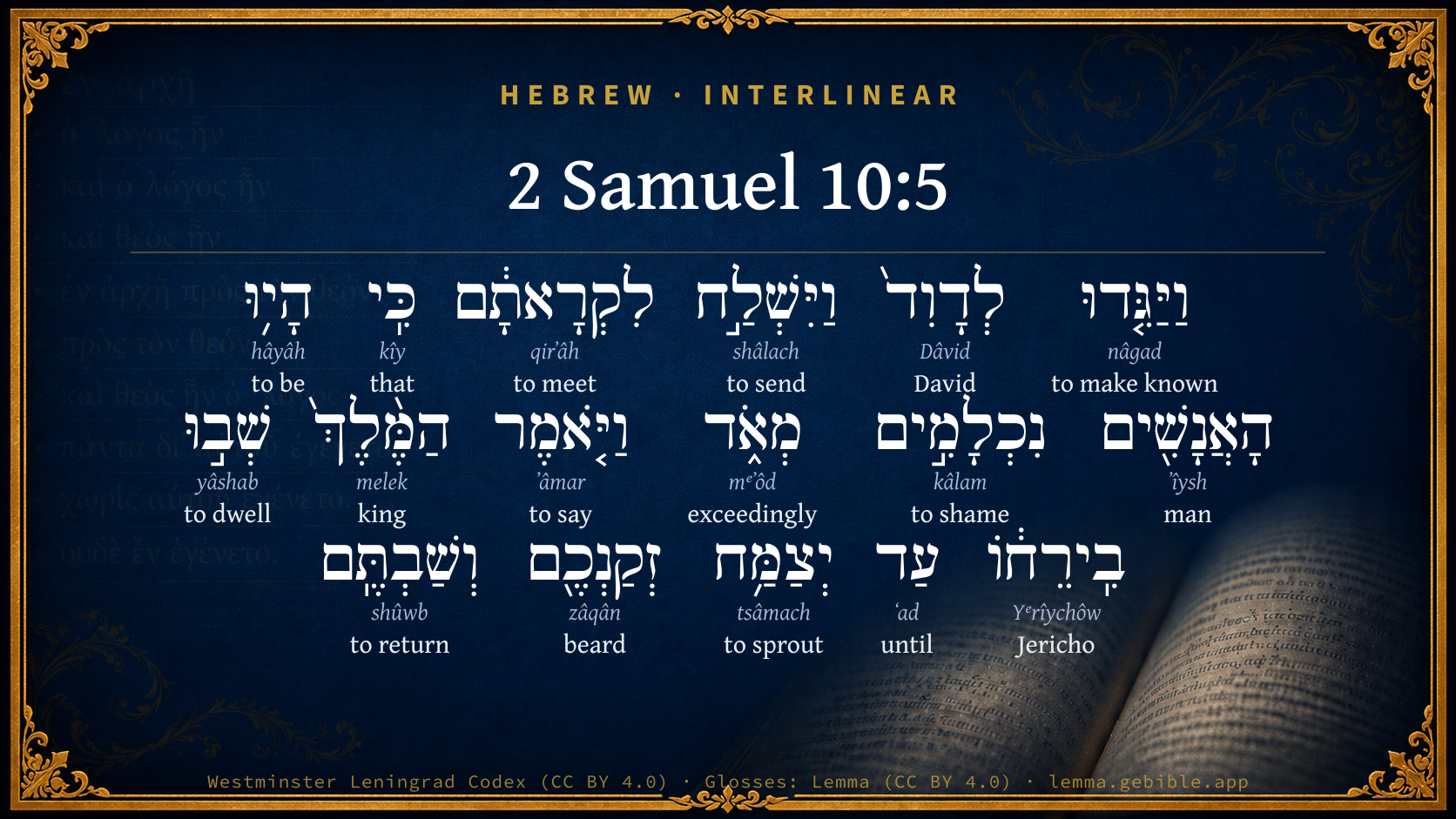
2 Samuel 10:5

Hebrew (Westminster Leningrad Codex) 2 Samuel 10:5 appears in the Hebrew Old Testament. The text above is from the Westminster Leningrad Codex. Each word links to its Strong’s number, a concise gloss, and parsing drawn from the Open Scriptures Hebrew Bible morphology. Click any word for its full Brown-Driver-Briggs (BDB) entry.
Download image
Cite this verse

2 Samuel 10:5 (World English Bible). Public Domain. Lemma interlinear Bible study tool, https://lemma.gebible.app/v/2-samuel/10/5.

Show BibTeX & RIS
BibTeX
RIS
English Translation
When they told it to David, he sent to meet them; for the men were greatly ashamed. The king said, Wait at Jericho until your beards be grown, and then return.
World English Bible · Public Domain
Download a study sheet

One document with this verse’s original text, its word-by-word gloss line, the meaning frame, cross-references with their text, attributed commentary, and full source and license credits — printable, and it pastes into notes with its structure intact.

This verse Autodidact and up

Study sheet (.html) Plain text (.txt)

A passage Seminary Student

Up to 50 verses in one chapter. A passage sheet keeps up to 6 commentary sources and 12 cross-references per verse, in the order this page ranks them, and says so on the sheet whenever that leaves anything out. Ask for a single verse and you get the Autodidact verse sheet above.

Everything on this page stays free to read, with no account — the sheet is a download of what is already on screen, not access to it.

Want to remove ads? Support Godless Engineer
Compare translations 3

The same verse in 3 English versions, stacked beneath the original-language interlinear above. Click any original word for its lexicon entry.

Each is an independent rendering of the whole verse — the interlinear is not word-aligned to these translations.

Highlighted words mark where these versions differ — a whole-verse word diff, not a word-by-word alignment.

  • World English Bible Public Domain
    When they told it to David, he sent to meet them; for the men were greatly ashamed. The king said, Wait at Jericho until your beards be grown, and then return.
  • King James Version Public Domain
    When they told it unto David, he sent to meet them, because the men were greatly ashamed: and the king said, Tarry at Jericho until your beards be grown, and then return.
  • unfoldingWord Literal Text CC BY-SA 4.0
    And they declared to David, and he sent to meet them, for the men were greatly humiliated. And the king said, “Stay in Jericho until your beard has grown, then you shall return.”

unfoldingWord Literal Text — © unfoldingWord, licensed CC BY-SA 4.0. Word-aligned USFM3 via Door43 (git.door43.org/unfoldingWord/en_ult).

Versions to compare (up to 4)

3 of 4 selected

Show all 18 translations

Every available English version of this verse, each an independent rendering of the whole verse.

  • World English Bible Public Domain
    When they told it to David, he sent to meet them; for the men were greatly ashamed. The king said, Wait at Jericho until your beards be grown, and then return.
  • Berean Standard Bible Public Domain
    When this was reported to David, he sent messengers to meet the men, since they had been thoroughly humiliated. The king told them, “Stay in Jericho until your beards have grown back, and then return.”
  • Majority Standard Bible Public Domain
    When this was reported to David, he sent messengers to meet the men, since they had been thoroughly humiliated. The king told them, “Stay in Jericho until your beards have grown back, and then return.”
  • King James Version Public Domain
    When they told it unto David, he sent to meet them, because the men were greatly ashamed: and the king said, Tarry at Jericho until your beards be grown, and then return.
  • American Standard Version (1901) Public Domain
    When they told it unto David, he sent to meet them; for the men were greatly ashamed. And the king said, Tarry at Jericho until your beards be grown, and then return.
  • Revised Version (1885) Public Domain
    When they told it unto David, he sent to meet them; for the men were greatly ashamed. And the king said, Tarry at Jericho until your beards be grown, and then return.
  • Geneva Bible (1599) Public Domain
    When it was told vnto Dauid, he sent to meete them (for the men were exceedingly ashamed) and the King sayde, Tary at Iericho, vntill your beards be growen, then returne.
  • Douay-Rheims (1899) Public Domain
    When this was told David, he sent to meet them: for the men were sadly put to confusion, and David commanded them, saying: Stay at Jericho, till your beards be grown, and then return.
  • Young's Literal Translation Public Domain
    and they declare `it' to David, and he sendeth to meet them, for the men have been greatly ashamed, and the king saith, `Abide in Jericho till your beard doth spring up -- then ye have returned.'
  • Literal Standard Version CC BY-SA 4.0
    and they declare [it] to David, and he sends to meet them, for the men have been greatly ashamed, and the king says, “Abide in Jericho until your beard springs up—then you have returned.”
  • Unlocked Literal Bible CC BY-SA 4.0
    When they explained this to David, he sent to meet with them, for the men were deeply ashamed. The king said, “Stay at Jericho until your beards have grown back, and then return.”
  • unfoldingWord Literal Text CC BY-SA 4.0
    And they declared to David, and he sent to meet them, for the men were greatly humiliated. And the king said, “Stay in Jericho until your beard has grown, then you shall return.”
  • Darby Bible Public Domain
    And they told [it] to David; and he sent to meet them, for the men were greatly ashamed. And the king said, Abide at Jericho until your beards be grown, and then return.
  • World Messianic Bible Public Domain
    When they told David this, he sent to meet them, for the men were greatly ashamed. The king said, “Wait at Jericho until your beards have grown, and then return.”
  • Webster's Bible Public Domain
    When they told it to David, he sent to meet them, because the men were greatly ashamed. And the king said, Tarry at Jericho until your beards are grown, and then return.
  • Free Bible Version CC BY-SA 4.0
    When David was told about this, he sent messengers to meet them, because they were very embarrassed. The king instructed them, “Stay in Jericho until your beards have re-grown, and then you can return.”
  • Bible in Basic English Public Domain
    When David had news of it, he sent men out with the purpose of meeting them on their way, for the men were greatly shamed: and the king said, Go to Jericho till your hair is long again, and then come back.
  • JPS Tanakh (1917) Public Domain
    When they told it unto David, he sent to meet them; for the men were greatly ashamed. And the king said: 'Tarry at Jericho until your beards be grown, and then return.'

Literal Standard Version (2020), Covenant Press — licensed CC BY-SA 4.0. Text via the HelloAO Bible API (eBible.org). Unlocked Literal Bible (unfoldingWord) — licensed CC BY-SA 4.0. Text via the HelloAO Bible API (eBible.org). unfoldingWord Literal Text — © unfoldingWord, licensed CC BY-SA 4.0. Word-aligned USFM3 via Door43 (git.door43.org/unfoldingWord/en_ult). Free Bible Version, Dr. Jonathan Gallagher — licensed CC BY-SA 4.0. Text via the HelloAO Bible API (eBible.org).

Word by word

More ways to search: Search by grammar → Find every occurrence → Compare this word →

Practice this passage: Drill this verse → Learn its vocabulary →

זְקַנְכֶ֖ם
zâqân
H2206
“beard · your”
Noun, Common, Both, Singular, Construct + Suffix, Personal, 2nd Person, Masculine, Plural
Part of Speech
Noun
Type
Common
Gender
Both
Number
Singular
State
Construct
Full BDB Definition

Origin: from H2204

TWOT: 574a

beard, chin - beard - chin
  1. וַיַּגִּ֤דוּ nâgad H5046 “and · to make known” Conjunction + Verb, Hiphil, Sequential Imperfect, 3rd Person, Masculine, Plural
  2. לְדָוִד֙ Dâvid H1732 “to/for · David” Preposition + Noun, Proper
  3. וַיִּשְׁלַ֣ח shâlach H7971 “and · to send” Conjunction + Verb, Qal, Sequential Imperfect, 3rd Person, Masculine, Singular
  4. לִקְרָאתָ֔ם qirʼâh H7125 “to meet · them” Preposition + Verb, Qal, Infinitive Construct + Suffix, Personal, 3rd Person, Masculine, Plural
  5. כִּֽי kîy H3588 “that” Conjunction
  6. הָי֥וּ hâyâh H1961 “to be” Verb, Qal, Perfect, 3rd Person, Common, Plural
  7. הָאֲנָשִׁ֖ים ʼîysh H376 “the · men” Particle, Definite Article + Noun, Common, Masculine, Plural, Absolute
  8. נִכְלָמִ֣ים kâlam H3637 “shaming” Verb, Niphal, Participle Active, Masculine, Plural, Absolute
  9. מְאֹ֑ד mᵉʼôd H3966 “exceedingly” Adverb
  10. וַיֹּ֤אמֶר ʼâmar H559 “and · to say” Conjunction + Verb, Qal, Sequential Imperfect, 3rd Person, Masculine, Singular
  11. הַמֶּ֨לֶךְ֙ melek H4428 “the · king” Particle, Definite Article + Noun, Common, Masculine, Singular, Absolute
  12. שְׁב֣וּ yâshab H3427 “dwell” Verb, Qal, Imperative, 2nd Person, Masculine, Plural
  13. בִֽירֵח֔וֹ Yᵉrîychôw H3405 “in/at · Jericho” Preposition + Noun, Proper
  14. עַד ʻad H5704 “until” Preposition
  15. יְצַמַּ֥ח tsâmach H6779 “to sprout” Verb, Piel, Imperfect, 3rd Person, Masculine, Singular
  16. וְשַׁבְתֶּֽם shûwb H7725 “and · to return” Conjunction + Verb, Qal, Sequential Perfect, 2nd Person, Masculine, Plural

About this verse

These counts appear in no published source. They are computed here, from the morphology-tagged text and Lemma’s own curated glosses. What Lemma adds →

17
words
17
distinct lemmas
Historical
section

Notable vocabulary

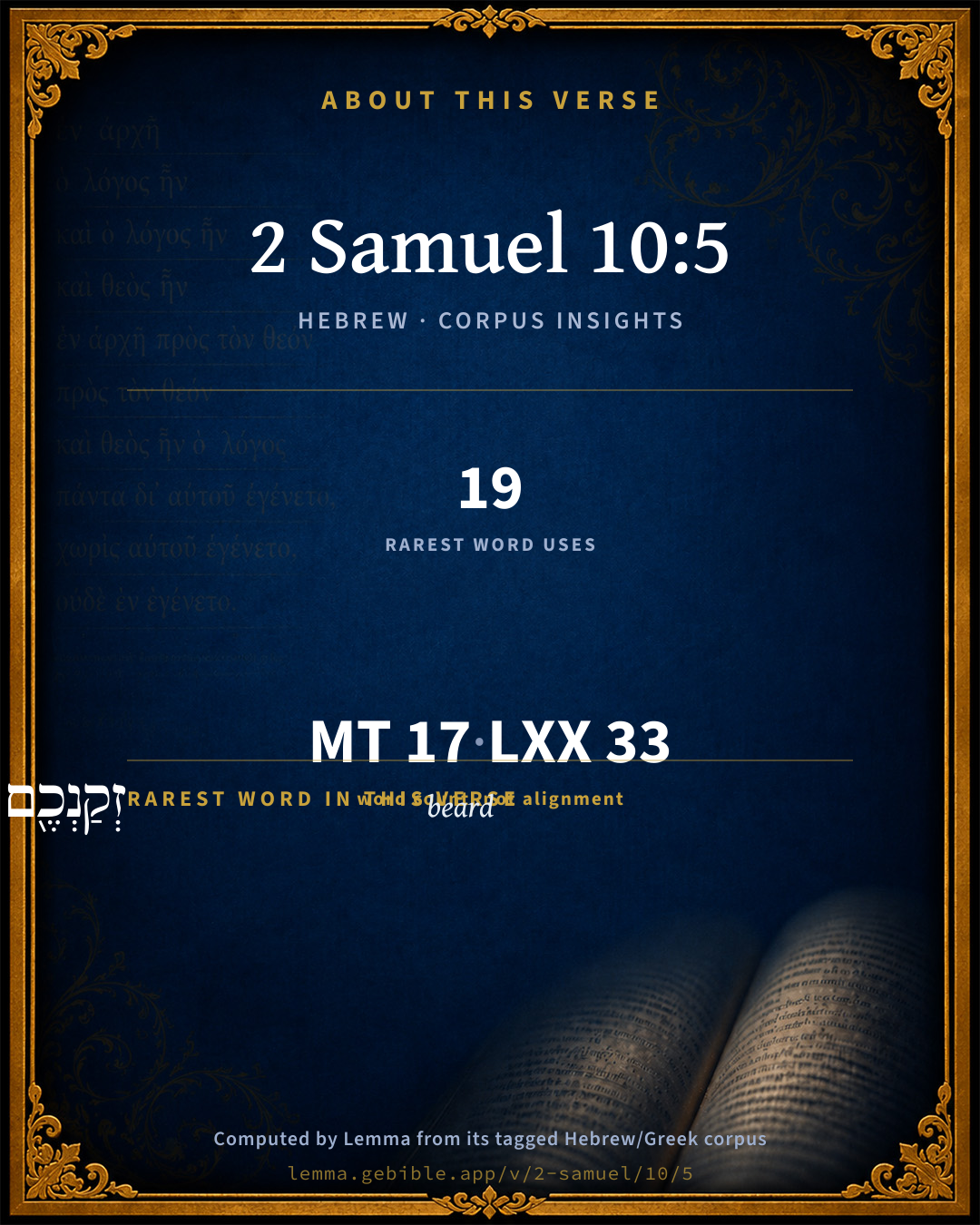
The rarest word here is זְקַנְכֶ֖ם beard H2206 — appearing just 19 times in the whole Hebrew Bible.

Shared distinctive vocabulary

זְקַנְכֶ֖ם beard H2206 occurs in 18 verses of the Hebrew Bible. Also found in:

Grammatical profile

  • 9 verbs
  • 5 nouns
  • 1 preposition
  • 1 conjunction
  • 1 adverb

Verb forms

  • וַיַּגִּ֤דוּ Hiphil · Sequential Imperfect
  • וַיִּשְׁלַ֣ח Qal · Sequential Imperfect
  • לִקְרָאתָ֔ם Qal · Infinitive Construct
  • הָי֥וּ Qal · Perfect
  • נִכְלָמִ֣ים Niphal · Participle Active
  • וַיֹּ֤אמֶר Qal · Sequential Imperfect
  • שְׁב֣וּ Qal · Imperative
  • יְצַמַּ֥ח Piel · Imperfect
  • וְשַׁבְתֶּֽם Qal · Sequential Perfect

Hebrew & Septuagint length

In English translation the verse runs 31 words from the Hebrew and 37 from the Septuagint (LXX English) — closely comparable.

A rough comparison of the two English renderings, which tokenize alike — not a word-level alignment.

Word counts can differ between the Hebrew and the Greek without any difference in meaning — e.g. the Hebrew direct-object marker אֵת has no separate Greek word, and Greek often adds the article ὁ.

In the original languages it is 17 Hebrew tokens and 33 Greek tokens — but the two are counted differently (Hebrew bundles its prefixes and suffixes into one token; the Greek is in lemma form), so that isn’t a like-for-like length.

Cross-references

3

Topical passages linked to 2 Samuel 10:5 in the Treasury of Scripture Knowledge — connected by theme and wording, ordered by reader-vote popularity; previews shown in the World English Bible.

  • 1 Chronicles 19:5 Then there went certain persons, and told David how the men were served. He sent to meet them; for the men were greatly ashamed. The king said, Stay at Jericho until your beards be grown, and then return.
  • Joshua 6:24–26 They burnt the city with fire, and all that was therein; only the silver, and the gold, and the vessels of brass and of iron, they put into the treasury of the house of Yahweh.
  • 1 Kings 16:34 In his days did Hiel the Bethelite build Jericho: he laid the foundation of it with the loss of Abiram his firstborn, and set up the gates of it with the loss of his youngest son Segub, according to the word of Yahweh, which he spoke by Joshua the son of Nun.

Cross-references courtesy of OpenBible.info (CC BY 4.0).

Hebrew and Greek witnesses Masoretic Hebrew ↔ Greek Septuagint

The same verse in the two great witnesses to the Old Testament, shown verse-for-verse.

These are two independent witnesses, not word-aligned to each other, and the Septuagint is shown in lemma (dictionary) form.

Hebrew 2 Samuel 10:5 Masoretic · Westminster Leningrad Codex

וַיַּגִּ֤דוּ לְדָוִד֙ וַיִּשְׁלַ֣ח לִקְרָאתָ֔ם כִּֽי הָי֥וּ הָאֲנָשִׁ֖ים נִכְלָמִ֣ים מְאֹ֑ד וַיֹּ֤אמֶר הַמֶּ֨לֶךְ֙ שְׁב֣וּ בִֽירֵח֔וֹ עַד יְצַמַּ֥ח זְקַנְכֶ֖ם וְשַׁבְתֶּֽם

When they told it to David, he sent to meet them; for the men were greatly ashamed. The king said, Wait at Jericho until your beards be grown, and then return.

World English Bible · Public Domain

Greek LXX 2 Samuel 10:5 Septuagint · lemma form

καί ἀναἀγγέλλω ὁ δαυίδ ὑπέρ ὁ ἀνήρ καί ἀποστέλλω εἰς ἀπαντή αὐτός ὅτι εἰμί ὁ ἀνήρ ἀτιμάζω σφόδρα καί εἶπον ὁ βασιλεύς καταἵζω ἐν ιεριχω ἕως ὁ ἀνατέλλω ὁ πώγων σύ καί ἐπιστρέφω

And they brought David word concerning the men; and he sent to meet them, for the men were greatly dishonored: and the king said, Remain in Jericho till your beards have grown, and then you⌃ shall return.

LXX2012 (modern English Septuagint) · Public Domain

Hebrew: Westminster Leningrad Codex (CC BY 4.0). Greek: Septuagint (public domain); English from LXX2012 (modern English Septuagint) (Public Domain). How the Septuagint differs from the Hebrew →

Targum (Aramaic paraphrase)

1

The Targum is the ancient Jewish Aramaic paraphrase of the Hebrew Scriptures — an interpretive translation, not the Hebrew text itself. Onkelos (literal) and Pseudo-Jonathan (expansive) render the Torah, and Jonathan the Prophets. Coverage is partial: where no permissively-licensed English translation exists for a verse, only the Aramaic is shown. This is verse-level text, not a word-by-word alignment to the Hebrew.

  1. Targum Jonathan Prophets (Joshua–Malachi)
    וְחַוִיאוּ לְדָוִד וּשְׁלַח לָקֳדָמוּתְהוֹן אֲרֵי הֲווֹ גַבְרַיָא מִתְכַּלְמִין לַחֲדָא וַאֲמַר מַלְכָּא תְּבוּ בִירֵיחוֹ עַד דְיִצְמַח דִקְנֵיכוֹן וּתְתוּבוּן:

    (no public-domain English translation for this verse)

    Targum Jonathan — Aramaic: “Mikraot Gedolot” (public domain). English: “Sefaria Community Translation” (CC0 1.0 (public-domain dedication)); “London "Chaldee Paraphrase," 1871” (public domain). Text via Sefaria.

Commentary

Notes on 2 Samuel 10:5 from classic Christian and Jewish commentators (each source and its license shown beneath its notes). The classic Christian expositions comment on the surrounding passage and are grouped to its opening verse, so a note may address several verses; the Jewish commentaries on the Tanakh (Rashi and others) are per-verse, so they appear only where the commentator wrote on this verse.

Lemma curates 59 commentaries, every one of them public domain or Creative Commons licensed, each selected and text-cleaned for this edition rather than reprinted as found. About our sources →

Trapp's Complete Commentary

John Trapp

2Sa 10:5 When they told [it] unto David, he sent to meet them, because the men were greatly ashamed: and the king said, Tarry at Jericho until your beards be grown, and [then] return.

Ver. 5. When they told it unto David.] Who could not but feel his own cheeks shaven, and his own coat cut in his ambassadors, who did but carry his person to Hanun: like as also Christ’s faithful ministers do his to the world, {2Co 5:20} which is therefore charged to "do his prophets no harm."

Tarry at Jericho.] In some cottage or village thereabouts: for Jericho was not rebuilt till long after. {1Ki 16:34}

John Trapp, A Commentary or Exposition upon All the Books of the Old and New Testament (1647–1656) — public domain. Text from a community e-Sword module.

Joseph Benson's Commentary

2Sa 10:5. Tarry at Jericho — Which was the first place to which they came in the land of Canaan, and then a private village, where they might remain obscure till they were fit to appear in public. Until your beards be grown — For though it was well known how they came to be deprived of them, yet it was not fit that persons of their quality should appear unlike all other men.

Joseph Benson's Commentary on the Old and New Testaments (1811–1818) — public domain. Text from a community e-Sword module.

Tyndale Open Study Notes

Tyndale Open Resources

10:5 The city of Jericho had not yet been formally reconstructed (see 1 Kgs 16:34), but the site was located adjacent to the largest and most plentiful spring in the land, so people continued to dwell in the area. Anyone traveling from Ammon to Jerusalem would pass right by it. It was a place of seclusion from the men’s humiliation.

Tyndale Open Study Notes — © Tyndale Open Resources, licensed CC BY-SA 4.0. Text via the HelloAO Bible API.

Jamieson, Fausset & Brown

Robert Jamieson, A. R. Fausset & David Brown

Tarry at Jericho--or in the neighborhood, after crossing the fords of the Jordan.

Jamieson, Fausset & Brown — Commentary Critical and Explanatory on the Whole Bible (1871) — public domain (CC PDM 1.0). Text via the HelloAO Bible API.

Adam Clarke's Commentary

Verse 5. Tarry at Jericho] This city had not been rebuilt since the time of Joshua; but there were, no doubt, many cottages still remaining, and larger dwellings also, but the walls had not been repaired. As it must have been comparatively a private place, it was proper for these men to tarry in, as they would not be exposed to public notice.

Adam Clarke's Commentary on the Bible (1810–1826) — public domain. Text from a community e-Sword/MySword module.

Ellicott's Commentary for English Readers

(5) Tarry at Jericho.—In consideration for his mortified ambassadors, David directs them to remain at Jericho, which lay directly on their road. Jericho had been destroyed on the first entrance of the Israelites into Canaan, and a solemn curse pronounced upon whoever “riseth up and buildeth this city Jericho.” This curse fell upon Hiel, more than a century after the time of David (1Ki_16:34). But “buildeth” is here, as often, to be understood of “fortifying”; and Jericho, under the name of “the city of palm trees” (Jdg_1:16; Jdg_3:13), appears to have been all along an inhabited place.

A Bible Commentary for English Readers, edited by Charles John Ellicott (1878–1897) — public domain. Text from a community e-Sword module.

The Cambridge Bible for Schools and Colleges

gen. ed. J. J. S. Perowne

5. Tarry at Jericho] Jericho was on their direct way back to Jerusalem. David wished to spare them the mortification of returning to Jerusalem in such a ridiculous plight.

The Cambridge Bible for Schools and Colleges (gen. ed. J. J. S. Perowne; Cambridge University Press, 1878–1918) — public domain. Text from a community e-Sword module.

John Gill's Exposition

When they told it unto David,.... Not the ambassadors, for they were not yet arrived, but some of their servants, perhaps, they sent before them to acquaint David of the usage they had met with:

he sent to meet them: he sent men to meet them with proper garments to put on, and to assure them how much he resented the indignity done to them and him, and would avenge it in due and proper time, and to direct them where to go for the present, as follows:

because the men were greatly ashamed: to proceed on their journey, and come to court in the condition they were:

and the king said; gave orders by the messengers he sent to them:

tarry at Jericho until your beards be grown, or "bud" (t):

and then return; that is, to Jerusalem; Jericho, though not yet built, might have some cottages at or near the spot on which it had stood, for the convenience of shepherds, and gatherers of fruit, in the plains of it; here the ambassadors were directed to go, it being the first place they came to when they had passed over Jordan, from the country of Ammon; and being a place where there were scarcely any inhabitants, or very few, was very proper for them in their present circumstances; and this confirms what is before observed, that it was now the custom of the Israelites not to shave their whole beards; or otherwise it was but shaving off the other half, and being now provided with other clothes, they would have had no need to have stayed at Jericho, but might have proceeded on in their journey.

(t) "germinet", Pagninus, Montanus.

John Gill's Exposition of the Whole Bible (1746–1763) — public domain (CC PDM 1.0). Text via the HelloAO Bible API.

Matthew Poole's English Annotations

He sent to meet them; he sent them clothes and other necessaries.

Tarry at Jericho; both because this was one of the first places which they came to in Canaan; and because it was now a very obscure village, and therefore fittest for them in their circumstances; for it was not built as a city till after this time, 1Ki 16:34.

Until your beards be grown; for the want or loss of beards was esteemed a reproach among the Israelites.

Matthew Poole's English Annotations on the Holy Bible (1683–1685) — public domain. Text from a community e-Sword/MySword module.

Whedon's Commentary on the Bible

Daniel D. Whedon

5. Tarry at Jericho — The king knew that for these men to appear among their acquaintances before the marks of their dishonour were entirely gone would be to expose them to lasting ridicule and infamy; for all who might see them in that shameful plight would ever after, in their minds, associate them with that misfortune.

Daniel D. Whedon (gen. ed.), Commentary on the Old and New Testaments (1874–1909) — public domain. Text from a community e-Sword module.

Lesson kit

Teaching starters — assembled from the data on this page, not authored interpretation. Every prompt links to the verse data it draws on. Edit before teaching.

2 Samuel, in the Historical, opens this verse with 17 words (17 distinct Hebrew lemmas). Its most distinctive word is zâqân (“beard”). A historical commentator’s framing appears above. Read the whole chapter for the surrounding context.

Discussion questions

  1. The word zâqân carries the sense “beard.” How does it shape the verse?
  2. How does Leviticus 13:29, which shares the word «beard», read alongside this verse?
  3. These translations render this verse differently. What is at stake in choosing one wording over another?
  4. «וַיַּגִּ֤דוּ» is a Hiphil Sequential Imperfect verb. How does that grammatical form shape the action described?
  5. Compare how Trapp's Complete Commentary and Joseph Benson's Commentary read this verse. Where do they agree or differ?

Things to notice

Reading settings

Reading text

Shown beneath each verse's original-language words.

Old Testament
Old Testament edition

Read the OT as the Masoretic Hebrew (MT) or the Greek Septuagint (LXX).

English shown for the Greek Septuagint (in the Hebrew ↔ Greek comparison).

Comparing translations? Open the Compare panel on any verse page to stack up to four side by side.