Hebrews 10:12

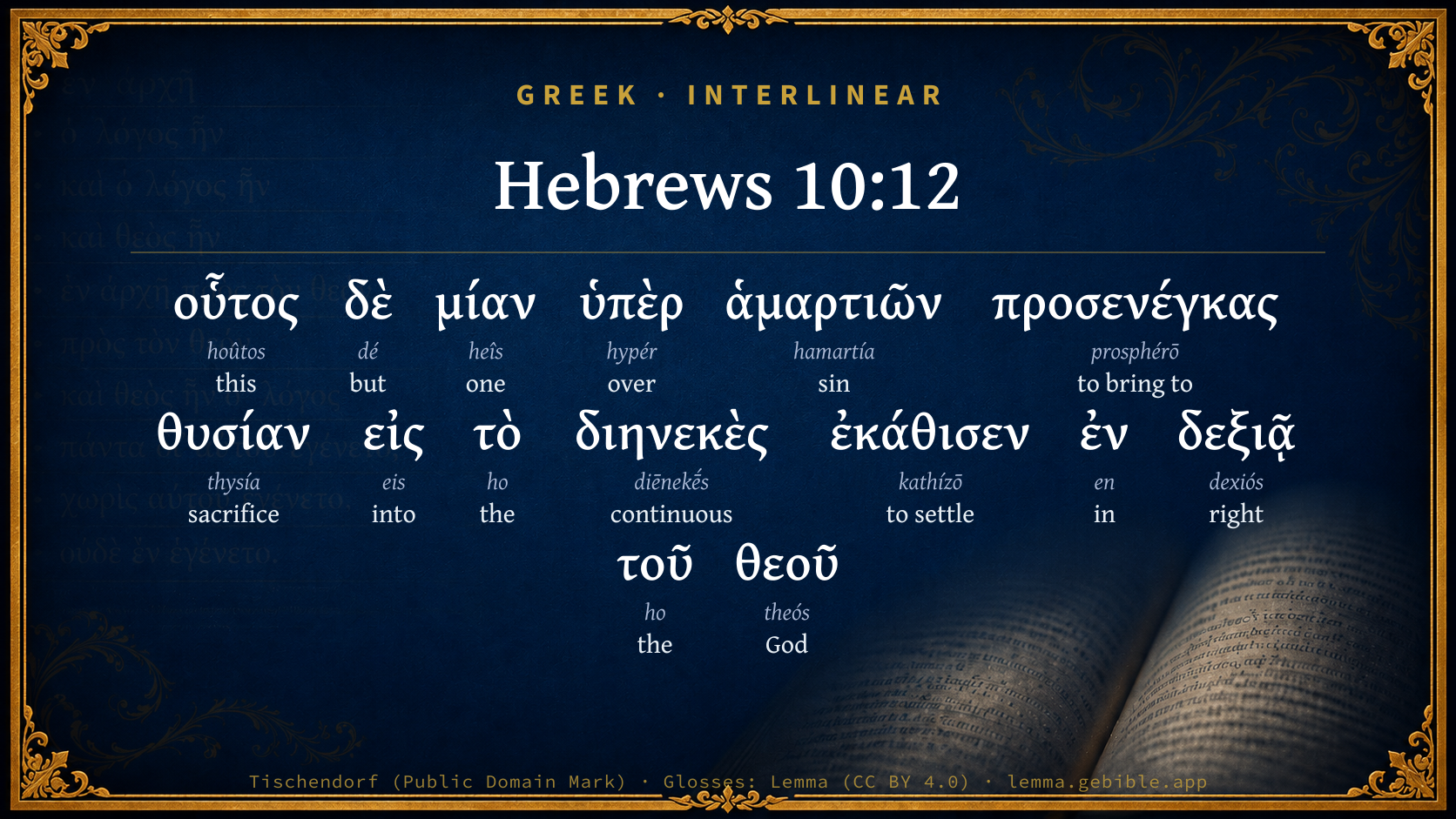
Greek (Tischendorf 8th ed.) Hebrews 10:12 appears in the Greek New Testament. The text above is from the Tischendorf 8th edition. Each word links to its Strong’s number and a concise gloss. Click any word for its full Thayer’s Greek Lexicon entry.
Download image
Cite this verse

Hebrews 10:12 (World English Bible). Public Domain. Lemma interlinear Bible study tool, https://lemma.gebible.app/v/hebrews/10/12.

Show BibTeX & RIS
BibTeX
RIS
English Translation
but he, when he had offered one sacrifice for sins for ever, sat down on the right hand of God;
World English Bible · Public Domain
Download a study sheet

One document with this verse’s original text, its word-by-word gloss line, the meaning frame, cross-references with their text, attributed commentary, and full source and license credits — printable, and it pastes into notes with its structure intact.

This verse Autodidact and up

Study sheet (.html) Plain text (.txt)

A passage Seminary Student

Up to 50 verses in one chapter. A passage sheet keeps up to 6 commentary sources and 12 cross-references per verse, in the order this page ranks them, and says so on the sheet whenever that leaves anything out. Ask for a single verse and you get the Autodidact verse sheet above.

Everything on this page stays free to read, with no account — the sheet is a download of what is already on screen, not access to it.

Want to remove ads? Support Godless Engineer
Compare translations 3

The same verse in 3 English versions, stacked beneath the original-language interlinear above. Click any original word for its lexicon entry.

Each is an independent rendering of the whole verse — the interlinear is not word-aligned to these translations.

Highlighted words mark where these versions differ — a whole-verse word diff, not a word-by-word alignment.

  • World English Bible Public Domain
    but he, when he had offered one sacrifice for sins for ever, sat down on the right hand of God;
  • King James Version Public Domain
    But this man, after he had offered one sacrifice for sins for ever, sat down on the right hand of God;
  • unfoldingWord Literal Text CC BY-SA 4.0
    But he, having offered for all time one sacrifice for sins, sat down at the right hand of God,

unfoldingWord Literal Text — © unfoldingWord, licensed CC BY-SA 4.0. Word-aligned USFM3 via Door43 (git.door43.org/unfoldingWord/en_ult).

Versions to compare (up to 4)

3 of 4 selected

Show all 19 translations

Every available English version of this verse, each an independent rendering of the whole verse.

  • World English Bible Public Domain
    but he, when he had offered one sacrifice for sins for ever, sat down on the right hand of God;
  • Berean Standard Bible Public Domain
    But when this Priest had offered for all time one sacrifice for sins, He sat down at the right hand of God.
  • Majority Standard Bible Public Domain
    But when this Priest had offered for all time one sacrifice for sins, He sat down at the right hand of God.
  • King James Version Public Domain
    But this man, after he had offered one sacrifice for sins for ever, sat down on the right hand of God;
  • American Standard Version (1901) Public Domain
    but he, when he had offered one sacrifice for sins for ever, sat down on the right hand of God;
  • Revised Version (1885) Public Domain
    but he, when he had offered one sacrifice for sins for ever, sat down on the right hand of God;
  • Geneva Bible (1599) Public Domain
    But this man after he had offered one sacrifice for sinnes, sitteth for euer at the right hand of God,
  • Douay-Rheims (1899) Public Domain
    But this man offering one sacrifice for sins, for ever sitteth on the right hand of God,
  • Young's Literal Translation Public Domain
    And He, for sin one sacrifice having offered -- to the end, did sit down on the right hand of God, --
  • Literal Standard Version CC BY-SA 4.0
    But He, having offered one sacrifice for sin—to the end, sat down at the right hand of God—
  • Unlocked Literal Bible CC BY-SA 4.0
    But when Christ offered for all time one sacrifice for sins, he sat down at the right hand of God.
  • unfoldingWord Literal Text CC BY-SA 4.0
    But he, having offered for all time one sacrifice for sins, sat down at the right hand of God,
  • Darby Bible Public Domain
    But *he*, having offered one sacrifice for sins, sat down in perpetuity at [the] right hand of God,
  • World Messianic Bible Public Domain
    but he, when he had offered one sacrifice for sins forever, sat down on the right hand of God,
  • Webster's Bible Public Domain
    But this man, after he had offered one sacrifice for sins, for ever sat down on the right hand of God;
  • Free Bible Version CC BY-SA 4.0
    But this Priest, after he had offered for sins a single sacrifice that lasts forever, sat down at God's right hand.
  • Bible in Basic English Public Domain
    But when Jesus had made one offering for sins for ever, he took his place at the right hand of God;
  • Text-Critical English NT CC BY 4.0
    But when Christ had offered for all time one sacrifice for sins, he sat down at the right hand of God,
  • Tyndale New Testament (1534) Public Domain
    But this man after he had offered one sacrifyce for synnes sat him doune for ever on the right honde of god

Literal Standard Version (2020), Covenant Press — licensed CC BY-SA 4.0. Text via the HelloAO Bible API (eBible.org). Unlocked Literal Bible (unfoldingWord) — licensed CC BY-SA 4.0. Text via the HelloAO Bible API (eBible.org). unfoldingWord Literal Text — © unfoldingWord, licensed CC BY-SA 4.0. Word-aligned USFM3 via Door43 (git.door43.org/unfoldingWord/en_ult). Free Bible Version, Dr. Jonathan Gallagher — licensed CC BY-SA 4.0. Text via the HelloAO Bible API (eBible.org).

Word by word

More ways to search: Search by grammar → Find every occurrence → Compare this word →

Practice this passage: Drill this verse → Learn its vocabulary →

διηνεκὲς
diēnekḗs
G1336
“continuous”
Adjective, Accusative, Singular, Neuter
Part of Speech
Adjective
Case
Accusative
Number
Singular
Gender
Neuter
Full Thayer's Definition

Origin: neuter of a compound of G1223 and a derivative of an alternate of G5342

TDNT: None

1. continuously, continuous
  1. οὗτος hoûtos G3778 “this” Demonstrative pronoun, Nominative, Singular, Masculine
  2. δὲ dé G1161 “but” Conjunction
  3. μίαν heîs G1520 “one” Adjective, Accusative, Singular, Feminine
  4. ὑπὲρ hypér G5228 “over” Preposition
  5. ἁμαρτιῶν hamartía G266 “sin” Noun, Genitive, Plural, Feminine
  6. προσενέγκας prosphérō G4374 “to bring to” Verb, Aorist, Active, Participle, Nominative, Singular, Masculine
  7. θυσίαν thysía G2378 “sacrifice” Noun, Accusative, Singular, Feminine
  8. εἰς eis G1519 “into” Preposition
  9. τὸ ho G3588 “the” Article, Accusative, Singular, Neuter
  10. ἐκάθισεν kathízō G2523 “to settle” Verb, Aorist, Active, Indicative, 3rd person, Singular
  11. ἐν en G1722 “in” Preposition
  12. δεξιᾷ dexiós G1188 “right” Adjective, Dative, Singular, Feminine
  13. τοῦ ho G3588 “the” Article, Genitive, Singular, Masculine
  14. θεοῦ theós G2316 “God” Noun, Genitive, Singular, Masculine

About this verse

These counts appear in no published source. They are computed here, from the morphology-tagged text and Lemma’s own curated glosses. What Lemma adds →

15
words
14
distinct lemmas
General Epistles
section

Notable vocabulary

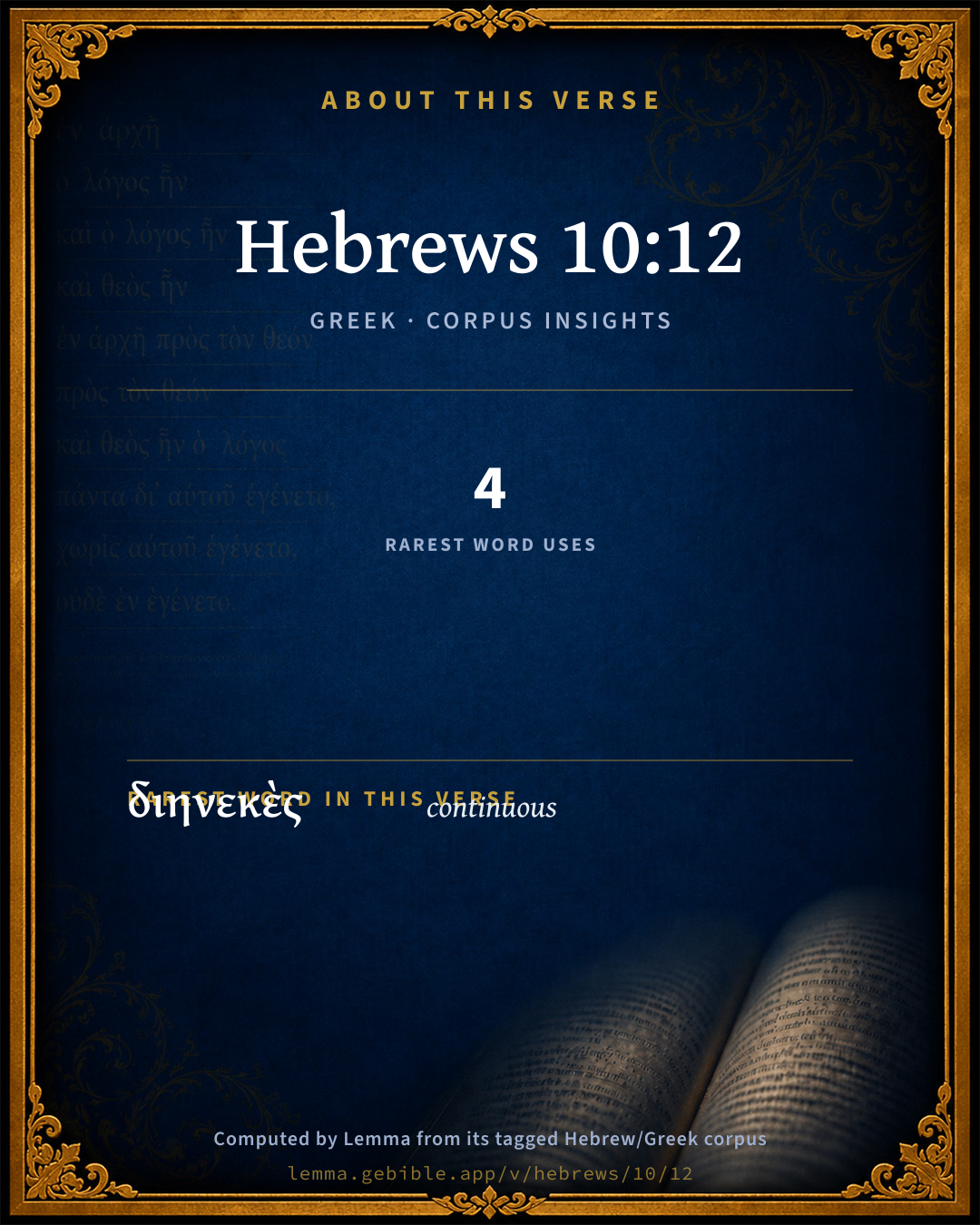
The rarest word here is διηνεκὲς continuous G1336 — appearing just 4 times in the whole Greek New Testament.

Shared distinctive vocabulary

διηνεκὲς continuous G1336 occurs in 4 verses of the Greek New Testament. Also found in:

Repetition

A word recurs within this verse:

Cross-references

6

Topical passages linked to Hebrews 10:12 in the Treasury of Scripture Knowledge — connected by theme and wording, ordered by reader-vote popularity; previews shown in the World English Bible.

  • Hebrews 1:3 His Son is the radiance of his glory, the very image of his substance, and upholding all things by the word of his power, when he had by himself made purification for our sins, sat down on the right hand of the Majesty on high;
  • Colossians 3:1 If then you were raised together with Christ, seek the things that are above, where Christ is, seated on the right hand of God.
  • Romans 8:34 Who is he who condemns? It is Christ who died, yes rather, who was raised from the dead, who is at the right hand of God, who also makes intercession for us.
  • Hebrews 8:1 Now in the things which we are saying, the main point is this. We have such a high priest, who sat down on the right hand of the throne of the Majesty in the heavens,
  • Acts 2:33–34 Being therefore exalted by the right hand of God, and having received from the Father the promise of the Holy Spirit, he has poured out this, which you now see and hear.
  • Hebrews 9:12 nor yet through the blood of goats and calves, but through his own blood, entered in once for all into the Holy Place, having obtained eternal redemption.

Cross-references courtesy of OpenBible.info (CC BY 4.0).

Commentary

Notes on Hebrews 10:12 from classic Christian and Jewish commentators (each source and its license shown beneath its notes). The classic Christian expositions comment on the surrounding passage and are grouped to its opening verse, so a note may address several verses; the Jewish commentaries on the Tanakh (Rashi and others) are per-verse, so they appear only where the commentator wrote on this verse.

Lemma curates 59 commentaries, every one of them public domain or Creative Commons licensed, each selected and text-cleaned for this edition rather than reprinted as found. About our sources →

Jamieson, Fausset & Brown

Robert Jamieson, A. R. Fausset & David Brown

this man--emphatic (Heb 3:3).

for ever--joined in English Version with "offered one sacrifice"; offered one sacrifice, the efficacy of which endures for ever; literally. "continuously," (compare Heb 10:14). "The offering of Christ, once for all made, will continue the one and only oblation for ever; no other will supersede it" [BENGEL]. The mass, which professes to be the frequent repetition of one and the same sacrifice of Christ's body, is hence disproved. For not only is Christ's body one, but also His offering is one, and that inseparable from His suffering (Heb 9:26). The mass would be much the same as the Jewish sacrifices which Paul sets aside as abrogated, for they were anticipations of the one sacrifice, just as Rome makes masses continuations of it, in opposition to Paul's argument. A repetition would imply that the former once-for-all offering of the one sacrifice was imperfect, and so would be dishonoring to it (Heb 10:2, Heb 10:18). Heb 10:14, on the contrary, says, "He hath PERFECTED FOR EVER them that are sanctified." If Christ offered Himself at the last supper, then He offered Himself again on the cross, and there would be two offerings; but Paul says there was only one, once for all. Compare Note, see on Heb 9:26. English Version is favored by the usage in this Epistle, of putting the Greek "for ever" after that which it qualifies. Also, "one sacrifice for ever," stands in contrast to "the same sacrifices oftentimes" (Heb 10:11). Also, Co1 15:25, Co1 15:28, agrees with Heb 10:12-13, taken as English Version, not joining, as ALFORD does, "for ever" with "sat down," for Jesus is to give up the mediatorial throne "when all things shall be subdued unto Him," and not to sit on it for ever.

Jamieson, Fausset & Brown — Commentary Critical and Explanatory on the Whole Bible (1871) — public domain (CC PDM 1.0). Text via the HelloAO Bible API.

MacLaren's Expositions of Holy Scripture

Alexander MacLaren

Hebrews

THE ENTHRONED CHRIST

Heb 10:12

To that tremendous assertion the whole New Testament is committed. Peter, Paul, John, the writer of this book - all teach that the Jesus who died on Calvary now sits at the right hand of God. This is no case of distance casting a halo round the person of a simple teacher, for six weeks after Calvary, on the Day of Pentecost, Peter declared that Jesus, ‘exalted at the right hand of God,’ had ‘shed forth this,’ the gift of that Divine Spirit. This is no case of enthusiastic disciples going beyond their Master’s teaching, for all the evangelists who record our Lord’s trial before the Sanhedrin concur in saying that the turning-point of it, which led to His condemnation, was the declaration, ‘Ye shall see the Son of Man sitting at the right hand of power.’ The rulers interpreted the assertion to mean an assertion of divinity, and therefore condemned Him to death. Christ was silent, and the silence witnessed that they interpreted His meaning aright. So, then, for good or evil, we have Jesus making the tremendous assertion, which His followers but repeated. Let us try to look at these words, and draw from them some of the rich fulness of their meaning. Communion, calm repose, participation in divine power and dominion, and much besides, are implied in this great symbol. And I desire to dwell upon the various aspects of it for a-few moments now.

I. Here we have the attestation of the completeness, the sufficiency, and the perpetuity of Christ’s sacrifice.

Look at the context. Mark the strong words which immediately precede the last clause of my text. ‘This Man, after He had offered one sacrifice for sins for ever, sat down on the right hand of God.’ The writer has just been arguing that all Jewish sacrifice, which he regarded as being of divine-appointment, was inadequate, and derived its whole importance from being a prophetic shadow of the perfect sacrifice of Jesus Christ. And he points, first, in proof of his thesis, to the entire disparity of the two things - the taking away of sin, and the blood of bulls and of goats. And then he adds a subsidiary consideration, saying in effect, The very fact that day after day the sacrifices are continued, shows that they had no power to do the thing for which they were offered - viz. ‘to quiet consciences.’ For, if the consciences were quieted, then the sacrifice would cease to be offered. And so he draws a sharp contrast between the priests who stand daily ministering and ‘offering oftentimes the same sacrifice,’ which by their very repetition are demon-strafed to be inadequate to effect their purpose, and Jesus. Instead of these priests standing, offering, and doing over and over again their impotent sacrifices, ‘this Man’ offered His once. That was enough, and for ever. And the token that the one sacrifice was adequate, really could take away sin, would never, through all the rolling ages of the world’s history, lose its efficacy, lies here-He sits at the right hand of God. Brethren, in that session, which the Lord Himself commanded us to believe, is the divine answer and endorsement of the triumphant cry upon the Cross, ‘It is finished,’ and it is God’s last, loudest, and ever- reverberating proclamation to all the world, in all its generations, ‘This is My beloved Son, in whom I am well pleased.’

Do you think of Christ’s mission and Christ’s work as this writer thought of it, finding the vital centre in its sacrificial efficacy, seeing it as being mainly a work caused by, in relation to, and victorious over, man’s sin and my sin, and as attested as sufficient for all sin, for the sins of the world, in all generations, by the fact that, having offered it once, the High Priest, as this same writer says in another place, sat at the right hand of God? These two things, the high Scriptural notion of the essential characteristic and efficacy of Christ’s work as being sacrificial, and the high Scriptural notion of His present session at the right hand of God; these two things are correlated and bound inseparably together. If you only think of Jesus Christ as being a great teacher, a blessed example, the very flower and crown of immaculate humanity, if you listen to His words, and rejoice over the beauty of His character, but do not see that the thing which He, and He alone, does, is to deal with the tremendous reality of human transgression, and to annihilate it, both in regard of its guilt and of its power, then the notion of His session at the right hand of God becomes surplusage and superstition. But if we see, as I pray God that we may each see for ourselves, that when He came, He ‘came not to be ministered unto, but to minister,’ and that even that does not. exhaust the significance of His Person, and the purpose of His mission, but that He came ‘to give His life a ransom for many,’ then, oh! then, when my conscience asks in agony, ‘Is there a way of getting rid of my transgressions?’ and when my weak will asks, in tremulous indecision, ‘Is there a way by which I can shake off the tyranny of this usurping evil power that has fixed its claws in my character and my habits?’ then I turn and look to the Christ enthroned at the right hand of power, and I say, ‘This Man has offered one sacrifice for sins for over’; and there, in that calm session at God’s right hand, is the attestation that His sacrifice is complete, is sufficient, and is perpetual.

II. We have here the revelation of our Lord’s calm repose.

That is expressed, of course, by the very attitude in which, in the symbol, He is represented. Away down in the Egyptian desert there sit, moulded in colossal calm, two giant figures, with hands laid restfully in their laps, and wide-open eyes gazing out over the world. There they have sat for millenniums, the embodiment of majestic repose. So Christ ‘sitteth at the right hand of God’ rapt in the fulness of eternal calm. But that tranquillity is parallel with the Scriptural representation of the rest of God after creation, which neither indicates previous exhaustion nor connotes present idleness, but expresses the completion of the work and the correspondence of the reality with the ideal which was in the Maker’s mind.

In like manner, as I have been trying to point out to you, Christ’s rest means the completeness of His finished work, and carries along with it, as that divine rest after creation does in its region, the conception of continuous activity, for just as little as the continuous phenomena of nature can be conceived of apart from the immanent activity of the ever-working God, and just as the last word of all physical science is that, beneath the so-celled causes and so-called forces there must lie a personal will, the only cause known to man, and preservation is a continuous creation, and the changes in nature are the result of the will of the active God, so the past work of Christ, of which He said, when He died, ‘It is finished!’ is prolonged into, and carried on through, the ages by the continuous activity of the ever-working Christ.

‘He sitteth at the right hand of God’; and to that session may be applied in full truth what He said Himself, in the vindication of His work on the Sabbath day - ‘My Father worketh hitherto, and I work.’

So the dying martyr looked up in the council chamber, and beyond the vaulted roof saw the heavens opened, and with a significant variation in the symbolical attitude, saw ‘the Son of Man standing at the right hand of God.’ The seated Christ, we might say, had sprung to His feet, in answer to the dying martyr’s faith and prayer, and granted him the vision, not of calm repose, but of intensest activity for his help and sustaining.

The appendix to Mark’s Gospel, in like manner, unites these two conceptions of undisturbed tranquillity and of energetic work. For he says that the Lord ‘was received up into heaven, and sat at the right hand of God, and they went... everywhere preaching the word.’ Then did the Commander-in-chief send His soldiers out into the battlefield, and Himself retire to the safe shelter of the hill? By no means. For the two halves of the picture which look so unlike one another - the Lord seated there, and the servants wandering about and toiling here-are brought together into the one solid reality, ‘they went forth and preached everywhere, the Lord’ - seated up yonder - ‘working with them.’ So constant activity is the very essence and inseparable accompaniment of the undisturbed tranquillity of the seated Christ. In other places in Scripture we get the same blending together of the two ideas, as, for instance, when Paul says ‘It is Christ that died, yea, rather, that is risen again, who is even at the right hand of God, who also maketh intercession for us.’ And in like manner, in Peter’s utterance Upon Pentecost, already referred to, you find the same idea.

‘Being at the right hand of God exalted, He hath showed forth this which ye now see and hear.’ So, working with us, working in us, working for us, working through us, the ever active Christ is with His people, and seated at the right hand of God, shares in all their labours, in all their difficulties, in all their warfare.

III. Lastly, we have here the revelation of Christ’s participation in divine power and dominion.

There is a very remarkable and instructive variety in the forms of expression conveying this idea in various parts of the New Testament. We read from His own lips, ‘seated at the right hand of power.’ We read usually ‘at the right hand of God.’ We read in this Epistle ‘at the right hand of the Majesty of the Highest,’ and also ‘at the right hand of the throne of the Majesty in the heavens.’ So you see our Lord Himself dwelt mainly on the conception of participation in power. And these other passages which I have quoted deal mainly with the conception of the participation in royal authority and dominion. And these two go together.

Then there is another observation to be made, and that in that this sitting at God’s right hand is to be interpreted as purely symbolical. For you cannot localize ‘the right hand of God.’ That ‘right hand’ is everywhere, wherever the divine power is working. So that, though I, for my part, believe that the human corporeity of Jesus Christ, with which He ascended into the heavens, does abide in a locality, it is not that localization which is meant by this great symbol of my text, but it is the declaration of a state, rather than of a place - participation in the power that belongs to God, and not a session in a given locality.

There is another remark also to be made, and that is that, according to the full-toned belief of the Christian Church when Jesus Christ in His ascension returned to the Father, from whom He had come, He carried with Him this great difference between His then - that is to say, His present - state, and the pre-incarnate state, viz., that now He has carried into unity with the Father the glorified manhood which He assumed on earth, and there is no difference between the glory which He had with the Father before the world was, and the glory in which He now sits. Humanity is thus gathered into divinity.

Now, brethren, I am not going to dwell upon these thoughts, for they go far beyond the powers of my speech; but I am bound by my own conceptions of what Christ Himself has taught us, to reiterate that here we have the plainest teaching, founded on His own express statement, that He is participant of divine fellowship, so close as that it is represented either by being in the bosom of the Father, or by sitting at the right hand of God, and that ‘all power is given unto Him in heaven and on earth,’ so as that He is the Administrator of the universe. The hands that were pierced with the nails, and into one of which was thrust, in mockery, the reed for a sceptre, now carry the sceptre of the universe, and He is ‘King of kings and Lord of lords.’ ‘He sitteth at the right hand of the Throne of the Majesty in the heavens.’

Now all this should have a very strong practical effect upon us. ‘If ye then be risen with Christ, seek the things where Christ is, sitting at the right hand of God.’ Oh, brethren! if we carried with us day by day into all our difficulties and struggles, and amidst the glittering fascinations and temptations of this earthly life that great thought, and if we kept the heavens open - for we can do so - and keep before our eyes that vision, how small the difficulties, what molehills the mountains, and how void of charm the seducing temptations would then be! Christ seen - like the popular idea of the sunshine streaming down upon a coal fire - puts out the fuliginous flame of earth’s temptations, and dims the kindled brightness of earth’s light. And if we really, and not as a mere dogma, had incorporated this faith into our lives, how different that last moment, and what lies beyond it, would look. I do not know how it may be with others, but to me the conception of eternity is chill and awful and repellent; it seems no blessing to live for ever. But if we people the waste future with the one figure of the living Christ exalted for us, it all becomes different, and, like the sunrise on snowy summits, the chill heights, not to be trodden by human foot, flash up into rosy beauty that draws men’s desires. ‘I go to prepare a place for you’; and He prepares it by being there Himself, for then, then it becomes Home. ‘And if I go to prepare a place for you I will come again, and receive you to Myself, that where I am there ye may be also’ - ‘sitting on My throne, as I overcame, and am sat down with My Father on His throne.’

Alexander MacLaren, Expositions of Holy Scripture (1904–1910) — public domain. Text from a community e-Sword module.

Tyndale Open Study Notes

Tyndale Open Resources

10:12-13 Christ’s sacrifice contrasts with that of the earthly high priests in that he offered himself to God as a . . . sacrifice, rather than offering animal sacrifices. • After the sacrifice was accomplished, he sat down in the place of honor (see Ps 110:1). Instead of standing daily like the priests of the old covenant (Heb 10:11), he waits until his enemies are humbled and made a footstool under his feet (Ps 110:1).

Tyndale Open Study Notes — © Tyndale Open Resources, licensed CC BY-SA 4.0. Text via the HelloAO Bible API.

Bengel's Gnomon

Johann Albrecht Bengel

Heb 10:12. [61] ΟὝΤΟς) So ch. Heb 3:3. Others read ΑὐΤῸς by an easy alliteration.[62]—ΜΊΑΝ, one) The antithesis is, the same sacrifices often, Heb 10:11.—εἰς τὸ διηνεκὲς, continually) The offering of Christ, once for all made, will continue the one and only oblation for ever: no other will supersede it.—ἐκάθισεν, sat down) The antithesis is ἕστηκε, is wont to stand or standeth, Heb 10:11. The sacrifice of the mass is inconsistent with sitting at the right hand of GOD: for the sacrifice of Christ is neither continued nor repeated in the mass. The apostle not only urges the identity, but also the word ἅπαξ, once, once for all, concerning the sacrifice of Christ, in antithesis to the Levitical sacrifices, often offered, although they were the same. A sacrifice which is often repeated, although it be the same, does not satisfy or make atonement to GOD. Not only is the body of Christ one, but also His offering is one, and that too inseparable from His passion: ch. Heb 9:26. Every later oblation shows that the former is of no value; every former one proves that the later one is superfluous: ch. Heb 10:2; Heb 10:18.

[61] Heb 10:11. πᾶς ἱερεὺς, every priest) especially every high priest.—V. g.

[62] The older Ed. had preferred αὐτὸς, but the margin of the 2d Ed. and the Germ. Vers. agree with the Gnomon.—E. B.

ACD(Δ) corrected f Vulg. read οὗτος: and so Lachm. Tisch., with no good authority, reads αὐτὸς, as Rec. Text.—ED.

Bengel's Gnomon of the New Testament — English translation (T&T Clark, Edinburgh, 1860) — public domain. Text from a community e-Sword module.

Meyer's Critical & Exegetical Commentary

Heinrich August Wilhelm Meyer

Heb_10:12. Οὗτος] comp. Heb_3:3.

εἰς τὸ διηνεκές] belongs to ἐκάθισεν.

With that which precedes is it conjoined by Oecumenius, Theophylact, Luther, Bengel, Böhme, Stein, Ewald, and others; whereby, however, the manifest antithesis, which εἰς τὸ διηνεκὲς ἐκάθισεν forms to ἕστηκεν καθʼ ἡμέραν, Heb_10:11, is destroyed, and the symmetry of the proposition, Heb_10:12, is lost.

Meyer — Critical and Exegetical Commentary on the New Testament — English translation by Peter Christie, edited by Frederick Crombie (T&T Clark, 1880) — public domain. Text from a community e-Sword module.

Ellicott's Commentary for English Readers

(12) But this man.—Rather, but He. In the main this verse is a combination of Heb_7:27 (Heb_9:26) and Heb_8:1. One addition is made, in the words, “for ever.” These words (which occur in three other places, Heb_7:3; Heb_10:1; Heb_10:14) are by many joined with what precedes, by others with the latter part of the sentence, “it down on the right hand of God.” The different editions of our Bible and Prayer Book (Epistle for Good Friday) are divided, some (including the earliest) having a comma at the word “ever,” others at “sins.” In most of our earlier English versions the construction adopted was shown by the arrangement of the words. Thus Tyndale has, “sat him down for ever;” and the Bishops’ Bible, “is set down for ever.” Coverdale (following Luther) is very clear on the other side: “when He had offered for sins one sacrifice which is of value for ever.” Most modern commentators seem to adopt the latter view (“for ever sat down”), but hardly, perhaps, with sufficient reason. The analogy of Heb_10:14 is distinctly on the other side; and the Greek phrase rendered “for ever” is more suitably applied to the offering of a sacrifice than to the thought of the following words. The contrast to Heb_10:11 is strongly marked. The sacrificial work has been performed, and the High Priest no longer “standeth ministering.” The words “sat down” (Psa_110:1) add to the priestly imagery that of kingly state.

A Bible Commentary for English Readers, edited by Charles John Ellicott (1878–1897) — public domain. Text from a community e-Sword module.

The Cambridge Bible for Schools and Colleges

gen. ed. J. J. S. Perowne

12. on the right hand of God] Heb_8:1, Heb_1:13.

The Cambridge Bible for Schools and Colleges (gen. ed. J. J. S. Perowne; Cambridge University Press, 1878–1918) — public domain. Text from a community e-Sword module.

John Gill's Exposition

But this man,.... Jesus Christ, for he is a man, though not a mere man; or this great high priest, who came to do the will of God, and whose body was offered once for all:

after he had offered one sacrifice for sins; the sacrifice of himself, body and soul, and this but once:

for ever sat down on the right hand of God; as having done his work effectually, and that with acceptance; and therefore is placed as a token of honour at the right hand of God, where he sits enjoying rest, ease, and pleasure, and that for ever; all which is opposed to the priests under the law; they were many, he but one; they offered many sacrifices, he but one; they offered theirs often, every day, he but once; they stood ministering, he sat down; his sacrifice being effectual to take away sin, when theirs was not.

John Gill's Exposition of the Whole Bible (1746–1763) — public domain (CC PDM 1.0). Text via the HelloAO Bible API.

Trapp's Complete Commentary

John Trapp

12 But this man, after he had offered one sacrifice for sins for ever, sat down on the right hand of God;

Ver. 12. But this man] Opposed to the plurality of Levitical priests. One sacrifice, and once for ever, not many and often, as they. And he sat down, when as they stood daily offering oftentimes. Note the antithesis, and Christ’s precellency.

On the right hand of God] Which he could not have done if he had not expiated our sins. Joh 16:10, "Of righteousness, because I go to my Father." He could not have gone to his Father if he had not first fulfilled all righteousness, and fully acquitted us of all our iniquities.

John Trapp, A Commentary or Exposition upon All the Books of the Old and New Testament (1647–1656) — public domain. Text from a community e-Sword module.

Albert Barnes' Notes on the Bible

But this man - The Lord Jesus. The word “man” is not in the original here. The Greek is literally “but this;” to wit, this priest. The apostle does not state here whether he was a man, or a being of a higher order. He merely mentions him as a priest in contradistinction from the Jewish priests.

After he had offered one sacrifice for sins - By dying on the cross. This he did but once; this could not be repeated; and need not be repeated, for it was sufficient for the sins of the world.

For ever sat down - That is, he sat down then to return no more for the purpose of offering sacrifice for sin. He will no more submit himself to scenes of suffering and death to expiate human guilt.

On the right hand of God - see the notes on Mar 16:19; compare the notes on Eph 1:20-22.

Albert Barnes' Notes on the Bible (1834–1885) — public domain. Text from a community e-Sword/MySword module.

Matthew Poole's English Annotations

But this man, after he had offered one sacrifice for sins: opposed to the legal priests is this Priest, God-man, an almighty Minister, having once offered, and no more, one sacrifice of his body for the sins of others, (he had none of his own, as every other priest had), that they might be pardoned and remembered no more, it being of eternal virtue and efficacy.

For ever must be joined to the sacrifice to complete the opposition, Heb 10:11. The legal one could never take away sins, but his one sacrifice could take them away for ever.

Sat down on the right hand of God; he ceased from sacrificing any more, and ascended up to heaven, and there he sat himself down (having abolished sin, and finished his work as a servant for ever) in the highest place of dominion and power at God’s right hand, while the Aaronites stood trembling and waiting at God’s foot-stool: and thence he powerfully and efficaciously commands the blotting out of sins, applieth his merits, and dispenseth to his servants the covenant mercies which he purchased by his own blood for them, Heb 1:3; 2:9; 8:2.

Matthew Poole's English Annotations on the Holy Bible (1683–1685) — public domain. Text from a community e-Sword/MySword module.

The Pulpit Commentary

Vers. 12, 13. The sacrifice and sovereignty of Christ. But this Man, after he had offered one sacrifice," etc.

I THE SACRIFICE OFFERED BY CHRIST.

1. Self-sacrifice. The Jewish priests offered goats, lambs, etc. But Jesus Christ gave himself." The whole of his life upon earth was a sacrifice. The sufferings of the closing scenes were sacrificial. His death was sacrificial. In all he acted with entire spontaneity. (Joh_10:17, Joh_10:18) All was the outcome of the infinite love wherewith he loved us. It is of the very nature of love to sacrifice self for the beloved. No sacrifice is so Divine as that of self. "Greater love hath no man than this," etc. (Joh_15:13)

2. Self-sacrifice for sin. The death of Jesus was neither

(1) a mere martyrdom; nor

(2) an offering to pacify the wrath of God; but

(3) it was a "sacrifice for sins." "He appeared to put away sin by the sacrifice of himself." "Christ also suffered for sins once, the righteous for the unrighteous," etc.

3. Self-sacrifice for sin of perpetual efficacy. "He offered one sacrifice for sins for ever." Christ"s sacrifice was offered once for all It needs no repetition. It is completely efficacious for all sins of all men for ever. (cf. Heb_9:25-28) It seems to us that to speak of "offering Christ upon the altar" in the Lord"s Supper is utterly unscriptural, and a reflection on the sufficiency of the "one sacrifice for sins forever" which our Lord offered.

II THE POSITION OCCUPIED BY CHRIST. "Sat down on the right hand of God." This position is suggestive of:

1. Rest. The sitting down is opposed to the standing of the preceding verse. Christ"s sacrificial work is completed. The sufferings of his earthly life are over forever. The toil and conflict are all past. He has finished the work that was given him to do. (cf. Heb_1:3)

2. Honor. "The right hand" is the position of honor. He is "crowned with glory and honor". (Heb_2:9; cf. Php_2:6-11) The glory of redemption is his.

3. His exaltation is a guarantee that all who are one with hire in sacrifice shall be one with him in sovereignty. There is a cross for each of his disciples; there is also a crown for every one who faithfully bears that cross. (Mat_16:24 Joh_12:26 Rom_8:17 Rev_3:21)

III THE EXPECTATION ENTERTAINED BY CHRIST. "From henceforth expecting till his enemies be made the footstool of his feet." The foes of our Lord are rebellious angels and rebellious men. All persons and all things which are opposed to his character and sovereignty are his enemies. Ignorance, the darkness of the mind, is opposed to him as "the Light" and "the Truth." Tyranny is opposed to him as the great Emancipator. He proclaimed the universal brotherhood of men. Sin is opposed to him as the Savior and the Sovereign of men. Death is opposed to him as the Life and the Lifegiver. All these he will completely and for ever vanquish. "He must reign till he hath put all his enemies under his feet." Let us endeavor to realize the certainty of this.

1. History points to it. During nearly nineteen centuries the spirit and the principles of Christ have been advancing and gaining strength in the world. Tyrannical despotisms passing away; free governments spreading; slavery losing its place and power; liberty and the recognition of human brotherhood constantly growing; cruelties and oppressions ever decreasing; Christian charities and generosities ever increasing; the night of ignorance receding ; the day of intelligence advancing and brightening. The past is prophetic of the complete triumph of Christ.

2. The spirit of the age points to it. There is much of evil in the age; but there are also many good and hope-inspiring things. The age is one of broadening freedom, earnest inquiry, growing intelligence, and many and ever-increasing charities. All these are in harmony with Christianity, results of Christianity; and as men advance in them they will be the more fitted and disposed to embrace Christianity.

3. God"s Word assures it. (See Psa_2:8 Psa_72:8-17 Dan_7:13, Dan_7:14)

4. Christ is waiting for it. "From henceforth expecting implying his undoubted assurance of it. He cannot be disappointed. W.J.

The Pulpit Commentary (1880–1919), ed. H.D.M. Spence-Jones & Joseph S. Exell — public domain. Text from a community e-Sword module.

John Wesley's Explanatory Notes

But he - The virtue of whose one sacrifice remains for ever. Sat down - As a son, in majesty and honour.

John Wesley, Explanatory Notes Upon the Whole Bible (1754–1765) — public domain. Text via the GEBible commentary corpus.

The People's New Testament

B. W. Johnson

12. But this man. Jesus, after … one sacrifice, himself on the cross, sat down, which implies that he needeth to make no more offering. On the right hand of God. Honored forever.

B. W. Johnson's The People's New Testament with Notes (1889–1891) — public domain. Electronic text from the Christian Classics Ethereal Library (CCEL) ThML edition.

Cambridge Greek Testament for Schools and Colleges

12. ἐν δεξιᾷ. Heb 1:13; Heb 8:1.

Cambridge Greek Testament for Schools and Colleges (Cambridge University Press, 1896; 21 vols, various authors incl. Carr, Maclear, Plummer, Farrar, Lumby, Moule, M. R. James, Simcox) — public domain. Text from a community e-Sword module.

Alford’s Greek Testament

Henry Alford

12.] but He (‘this (man),’ or, (priest): but such rendering should be avoided if possible, as should all renderings which import a new generic idea into the text, as always causing confusion: cf. for a notable example, 1Co 2:11 end in E. V.) having offered one sacrifice for sins (on the punctuation, see below) for ever (εἰς τὸ διηνεκές may be joined either with the preceding or with the following words. If with the preceding, as Thl. (θυσίαν … εἰς τὸ δ. ἀρκοῦσαν ἡμῖν, and so Œc.), Luther, Castellio, Beza b, Chr. F. Schmid, Bengel, Böhme, Stein, al., we observe the usage of the Epistle, which is to place εἰς τὸ διηνεκές after that which it qualifies (reff.): we have μία θυσία εἰς τὸ διηνεκές opposed to τὰς αὐτὰς θυσίας πολλάκις; and we keep the propriety of the sense, according to what follows, τὸ λοιπὸν ἐκδεχόμενος ἕως κ.τ.λ., and according to 1Co 15:28, where we are expressly told, that the session of our triumphant Saviour will have its end as such. If we join the words with the following, as Syr., D-lat., Faber Stap., Erasm., Calvin, Schlichting, Grot., Wolf, al., Schulz, De Wette, Bleek, Lünem., Ebrard, Hofmann, Delitzsch, al., we more thoroughly satisfy the construction, in which εἰς τὸ διηνεκές seems to refer better to an enduring state than to a past act, or at all events not to this last without a harsh ellipsis, “having offered one sacrifice (the virtue of which will endure) for ever:” we preserve the contrast between ἕστηκεν καθʼ ἡμέραν and εἰς τὸ διηνεκὲς ἐκάθισεν: we preserve also the balance between the clauses ending προσφέρων θυσίας, and προσενέγκας θυσίαν: and we are in full accordance with the ἱερεὺς εἰς τὸν αἰῶνα so often insisted on. And to this latter arrangement I incline, not however laying it down as certain. The objection taken above, as to the change in the nature of Christ’s session at the end, when all things shall have been put under His feet, may be met by saying that such change, being obviously included in His ultimate state of reception into God’s presence in heaven, does not here count as a change, where the question is of renewal of sacrifice, with regard to which that session is eternal) sat down on the right hand of God,

Henry Alford, The Greek Testament (1849–1861) — public domain. Text from a community e-Sword module.

Vincent's Word Studies in the New Testament

Marvin R. Vincent

Forever [εις το διηνεκες] . Const. with offered. The reason appears in ver. 14. It is according to the usage of the epistle to place this phrase after that which it qualifies. Thus one sacrifice forever is contrasted with the same sacrifices often. This agrees also with what follows. He offered one sacrifice forever, and then sat down, awaiting its eternal result. 219

Marvin R. Vincent, Word Studies in the New Testament (1887–1900) — public domain. Text from a community e-Sword/MySword module.

Westcott on Hebrews & the Epistles of John

Brooke Foss Westcott

12. οὗτος δὲ μίαν... εἰς τὸ διηνεκές, ἐκάθισεν... Ele, when He had offered one sacrifice fur sins for over, sat down...; O.L. una oblata hostiain sempiterno sedit ; Vulg. hic autem unam offerens hostiam in sempiiernum.... The sacrifice was efficacious for over, through all time, being appropriated by each believer (v. 14). The con-

nexion of εἰς τὸ διηνεκές with the following ἐκάθισεν (for ever sat down) is contrary to the usage of the Epistle; it obecures the idea of the perpetual efficacy of Christ’s one sacrifice; it weakens the contrast with ἕστηκεν; and it imports a foreign idea into the image of the assumption (ἐκάθισεν) of royal dignity by Obrist.

for ἐκάθισεν, ο. i. 3 note. Tho word ἐκάθισεν is in sharp opposition to ἕστηκεν λειτουργῶν (0. 11). Throughout tho Kpiatle (oxcopt i. 13 καθοῦ from tho Lxx.) the rofuronco is uniformly to the act of taking the royal scat («adiviii, 1; xii. 2). Oompare Eph. i. 20: Apoc. iii. 21; and contrast the phrase of the Apocalypse ὁ καθήμενος ἐπὶ τ. θρώνον (iv. 9 f.) On the general thought Chrysostom says teraely: τὸ ἑστάναι τοῦ λειτουργεῖν ἐστὶ σημεῖον, οὐκοῦν τὸ καθῆσθαι τοῦ λειτουργεῖσθαι.

Brooke Foss Westcott (1825–1901), The Epistle to the Hebrews (1889) and The Epistles of St John (1883) — public domain (pre-1929). Text recovered from Internet Archive / Google Books OCR scans. Westcott’s Gospel of John commentary is not included (its OCR lost the chapter running-heads required for reliable verse-keying). Some Greek quoted in the Hebrews volume is imperfectly rendered by the OCR.

Lesson kit

Teaching starters — assembled from the data on this page, not authored interpretation. Every prompt links to the verse data it draws on. Edit before teaching.

Hebrews, in the General Epistles, opens this verse with 15 words (14 distinct Greek lemmas). Its most distinctive word is diēnekḗs (“continuous”). A historical commentator’s framing appears above. Read the whole chapter for the surrounding context.

Discussion questions

  1. What does “continuous” (diēnekḗs) contribute to the verse as a whole?
  2. Hebrews 7:3 shares the word «continuous» with this verse. How do the two illuminate each other?
  3. “the” occurs 2× in this one verse. What is the effect of the repetition?
  4. These translations render this verse differently; the difference is in the English rendering, not the original. What questions does that raise?
  5. Reading how Jamieson, Fausset & Brown and MacLaren's Expositions of Holy Scripture read this verse, where do the two commentators agree and where do they part?

Things to notice

Reading settings

Reading text

Shown beneath each verse's original-language words.

Old Testament
Old Testament edition

Read the OT as the Masoretic Hebrew (MT) or the Greek Septuagint (LXX).

English shown for the Greek Septuagint (in the Hebrew ↔ Greek comparison).

Comparing translations? Open the Compare panel on any verse page to stack up to four side by side.