
2 Corinthians 12:15

Greek (Tischendorf 8th ed.) 2 Corinthians 12:15 appears in the Greek New Testament. The text above is from the Tischendorf 8th edition. Each word links to its Strong’s number and a concise gloss. Click any word for its full Thayer’s Greek Lexicon entry.
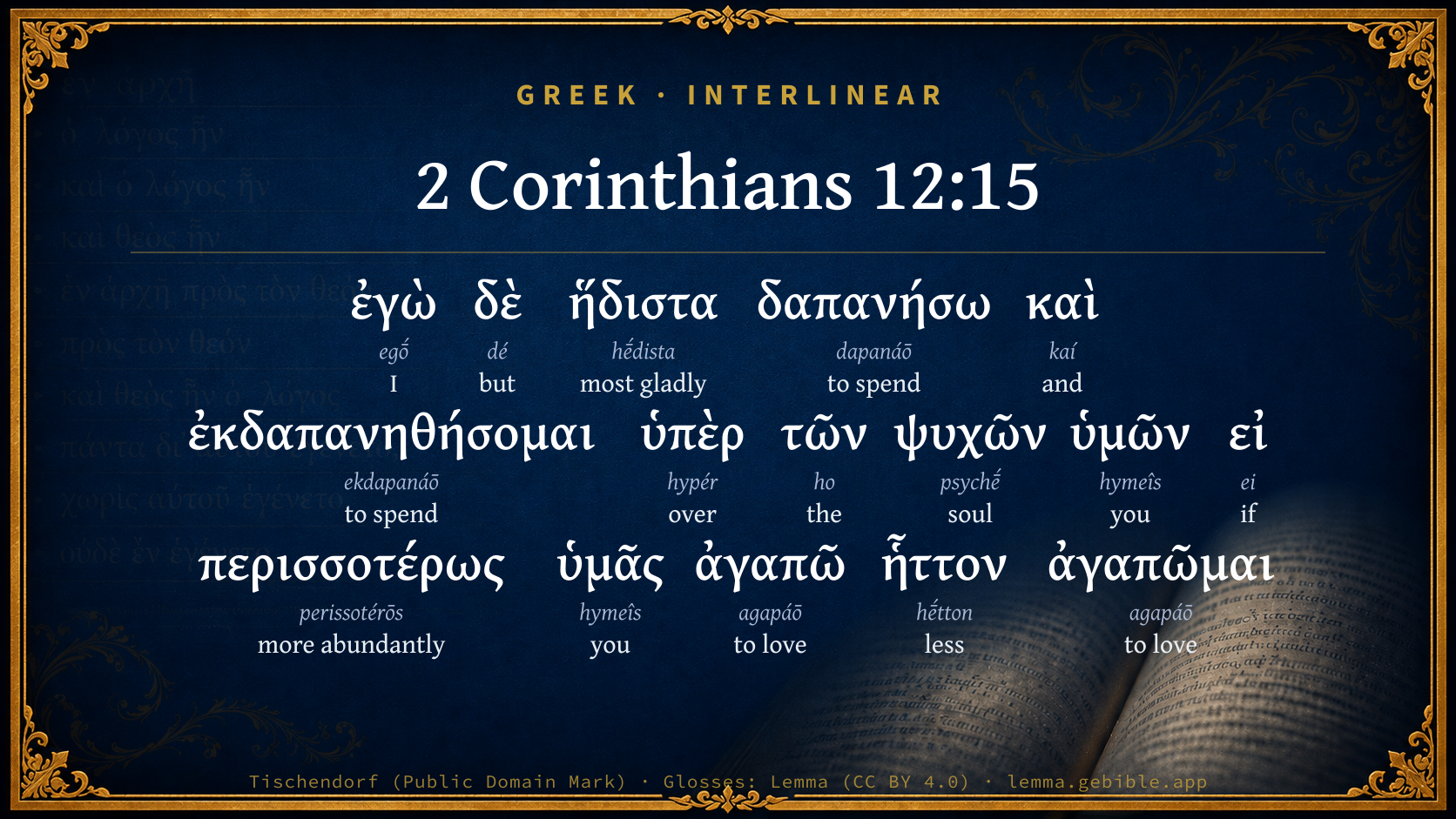
Download image
Cite this verse

2 Corinthians 12:15 (World English Bible). Public Domain. Lemma interlinear Bible study tool, https://lemma.gebible.app/v/2-corinthians/12/15.

Show BibTeX & RIS
BibTeX
RIS
English Translation
I will most gladly spend and be spent for your souls. If I love you more abundantly, am I loved the less?
World English Bible · Public Domain
Highlights
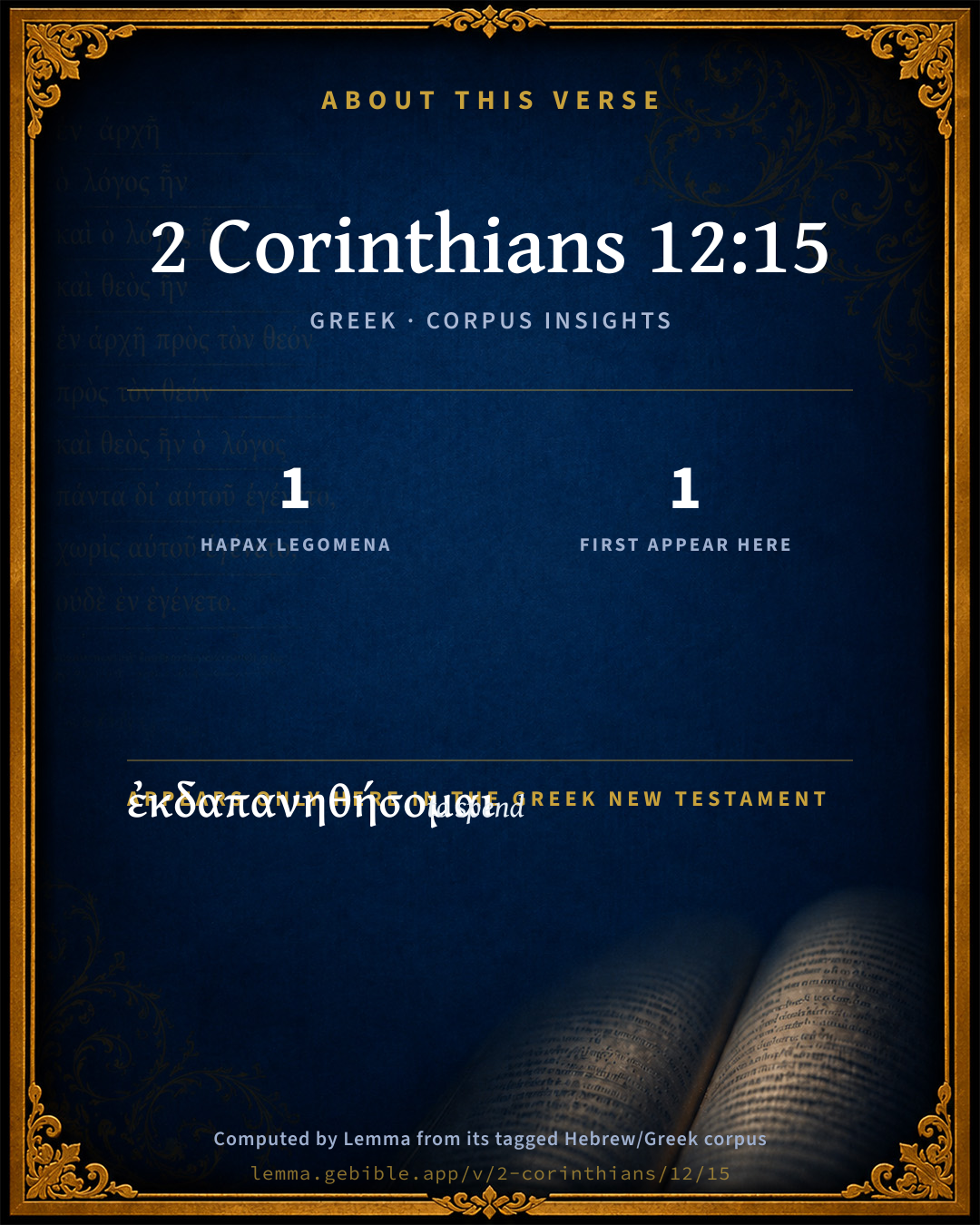
  • 1 hapax legomenon — only here in the Greek New Testament
  • 1 first appearance in the Greek New Testament
Full analysis ↓
Download a study sheet

One document with this verse’s original text, its word-by-word gloss line, the meaning frame, cross-references with their text, attributed commentary, and full source and license credits — printable, and it pastes into notes with its structure intact.

This verse Autodidact and up

Study sheet (.html) Plain text (.txt)

A passage Seminary Student

Up to 50 verses in one chapter. A passage sheet keeps up to 6 commentary sources and 12 cross-references per verse, in the order this page ranks them, and says so on the sheet whenever that leaves anything out. Ask for a single verse and you get the Autodidact verse sheet above.

Everything on this page stays free to read, with no account — the sheet is a download of what is already on screen, not access to it.

Want to remove ads? Support Godless Engineer
Compare translations 3

The same verse in 3 English versions, stacked beneath the original-language interlinear above. Click any original word for its lexicon entry.

Each is an independent rendering of the whole verse — the interlinear is not word-aligned to these translations.

Highlighted words mark where these versions differ — a whole-verse word diff, not a word-by-word alignment.

  • World English Bible Public Domain
    I will most gladly spend and be spent for your souls. If I love you more abundantly, am I loved the less?
  • King James Version Public Domain
    And I will very gladly spend and be spent for you; though the more abundantly I love you, the less I be loved.
  • unfoldingWord Literal Text CC BY-SA 4.0
    Now I will most gladly spend and be completely spent for the sake of your souls. If loving you more abundantly, am I to be loved less?

unfoldingWord Literal Text — © unfoldingWord, licensed CC BY-SA 4.0. Word-aligned USFM3 via Door43 (git.door43.org/unfoldingWord/en_ult).

Versions to compare (up to 4)

3 of 4 selected

Show all 19 translations

Every available English version of this verse, each an independent rendering of the whole verse.

  • World English Bible Public Domain
    I will most gladly spend and be spent for your souls. If I love you more abundantly, am I loved the less?
  • Berean Standard Bible Public Domain
    And for the sake of your souls, I will most gladly spend my money and myself. If I love you more, will you love me less?
  • Majority Standard Bible Public Domain
    And for the sake of your souls, I will most gladly spend my money and myself, even if the more I love you, the less you love me.
  • King James Version Public Domain
    And I will very gladly spend and be spent for you; though the more abundantly I love you, the less I be loved.
  • American Standard Version (1901) Public Domain
    And I will most gladly spend and be spent for your souls. If I love you more abundantly, am I loved the less?
  • Revised Version (1885) Public Domain
    And I will most gladly spend and be spent for your souls. If I love you more abundantly, am I loved the less?
  • Geneva Bible (1599) Public Domain
    And I will most gladly bestow, and will be bestowed for your soules: though the more I loue you, the lesse I am loued.
  • Douay-Rheims (1899) Public Domain
    But I most gladly will spend and be spent myself for your souls; although loving you more, I be loved less.
  • Young's Literal Translation Public Domain
    and I most gladly will spend and be entirely spent for your souls, even if, more abundantly loving you, less I am loved.
  • Literal Standard Version CC BY-SA 4.0
    and I will most gladly spend and be entirely spent for your souls, even if, loving you more abundantly, I am loved less.
  • Unlocked Literal Bible CC BY-SA 4.0
    I will most gladly spend and be spent for your souls. If I love you more, am I to be loved less?
  • unfoldingWord Literal Text CC BY-SA 4.0
    Now I will most gladly spend and be completely spent for the sake of your souls. If loving you more abundantly, am I to be loved less?
  • Darby Bible Public Domain
    Now *I* shall most gladly spend and be utterly spent for your souls, if even in abundantly loving you I should be less loved.
  • World Messianic Bible Public Domain
    I will most gladly spend and be spent for your souls. If I love you more abundantly, am I loved the less?
  • Webster's Bible Public Domain
    And I will very gladly spend and be spent for you; though the more abundantly I love you, the less I am loved.
  • Free Bible Version CC BY-SA 4.0
    I will happily spend myself, and be spent, for you. If I love you so much more, will you love me even less?
  • Bible in Basic English Public Domain
    And I will gladly give all I have for your souls. If I have the more love for you, am I to be loved the less?
  • Text-Critical English NT CC BY 4.0
    So I will most gladly spend and be entirely spent for the sake of your souls, even if the more I love you, the less I am loved.
  • Tyndale New Testament (1534) Public Domain
    I will very gladly bestowe and wilbe bestowed for youre soules: though the moare I love you the lesse I am loved agayne.

Literal Standard Version (2020), Covenant Press — licensed CC BY-SA 4.0. Text via the HelloAO Bible API (eBible.org). Unlocked Literal Bible (unfoldingWord) — licensed CC BY-SA 4.0. Text via the HelloAO Bible API (eBible.org). unfoldingWord Literal Text — © unfoldingWord, licensed CC BY-SA 4.0. Word-aligned USFM3 via Door43 (git.door43.org/unfoldingWord/en_ult). Free Bible Version, Dr. Jonathan Gallagher — licensed CC BY-SA 4.0. Text via the HelloAO Bible API (eBible.org).

Word by word

More ways to search: Search by grammar → Find every occurrence → Compare this word →

Practice this passage: Drill this verse → Learn its vocabulary →

ἐκδαπανηθήσομαι
ekdapanáō
G1550
“to spend”
Verb, Future, Passive, Indicative, 1st person, Singular
Part of Speech
Verb
Tense
Future
Voice
Passive
Mood
Indicative
Person
1st person
Number
Singular
Full Thayer's Definition

Origin: from G1537 and G1159

TDNT: None

1. to exhaust by expending, to spend wholly, use up, 2. to spend one's self wholly
  1. ἐγὼ egṓ G1473 “I” Personal pronoun, 1st person, Nominative, Singular
  2. δὲ dé G1161 “but” Conjunction
  3. ἥδιστα hḗdista G2236 “most gladly” Adverb, Superlative
  4. δαπανήσω dapanáō G1159 “to spend” Verb, Future, Active, Indicative, 1st person, Singular
  5. καὶ kaí G2532 “and” Conjunction
  6. ὑπὲρ hypér G5228 “over” Preposition
  7. τῶν ho G3588 “the” Article, Genitive, Plural, Feminine
  8. ψυχῶν psychḗ G5590 “soul” Noun, Genitive, Plural, Feminine
  9. ὑμῶν hymeîs G5210 “you” Personal pronoun, 2nd person, Genitive, Plural
  10. εἰ ei G1487 “if” Conditional
  11. περισσοτέρως perissotérōs G4056 “more abundantly” Adverb, Comparative
  12. ὑμᾶς hymeîs G5210 “you” Personal pronoun, 2nd person, Accusative, Plural
  13. ἀγαπῶ agapáō G25 “to love” Verb, Present, Active, Indicative, 1st person, Singular
  14. ἧττον hḗtton G2276 “less” Adjective, Accusative, Singular, Neuter, Comparative
  15. ἀγαπῶμαι agapáō G25 “to love” Verb, Present, Passive, Indicative, 1st person, Singular

About this verse

These counts appear in no published source. They are computed here, from the morphology-tagged text and Lemma’s own curated glosses. What Lemma adds →

16
words
14
distinct lemmas
Pauline Epistles
section

Notable vocabulary

1 hapax legomenon — a word that appears only here in the entire Greek New Testament:

  • ἐκδαπανηθήσομαι to spend G1550

First appearance in Scripture

This word makes its first canonical appearance in the Greek New Testament here:

  • ἐκδαπανηθήσομαι to spend G1550

Shared distinctive vocabulary

ἥδιστα most gladly G2236 occurs in 2 verses of the Greek New Testament. Also found in:
Repetition

Words recur within this verse:

  • ἀγαπῶ to love G25 ×2
  • ὑμῶν you G5210 ×2

Cross-references

18

Topical passages linked to 2 Corinthians 12:15 in the Treasury of Scripture Knowledge — connected by theme and wording, ordered by reader-vote popularity; previews shown in the World English Bible.

  • 1 Thessalonians 2:8 Even so, affectionately longing for you, we were well pleased to impart to you, not the Gospel of God only, but also our own souls, because you had become very dear to us.
  • 2 Corinthians 1:6 But if we are afflicted, it is for your comfort and salvation. If we are comforted, it is for your comfort, which produces in you the patient enduring of the same sufferings which we also suffer.
  • Philippians 2:17 Yes, and if I am poured out on the sacrifice and service of your faith, I rejoice, and rejoice with you all.
  • Colossians 1:24 Now I rejoice in my sufferings for your sake, and fill up on my part that which is lacking of the afflictions of Christ in my flesh for his body's sake, which is the assembly;
  • 2 Timothy 2:10 Therefore I endure all things for the chosen ones' sake, that they also may obtain the salvation which is in Christ Jesus with eternal glory.
  • 2 Corinthians 2:3 And I wrote this very thing to you, so that, when I came, I wouldn't have sorrow from them of whom I ought to rejoice; having confidence in you all, that my joy would be shared by all of you.
  • 2 Corinthians 6:12–13 You are not restricted by us, but you are restricted by your own affections.
  • Hebrews 13:17 Obey your leaders and submit to them, for they watch on behalf of your souls, as those who will give account, that they may do this with joy, and not with groaning, for that would be unprofitable for you.
  • John 10:10–11 The thief only comes to steal, kill, and destroy. I came that they may have life, and may have it abundantly.
  • 1 Corinthians 4:8–18 You are already filled. You have already become rich. You have come to reign without us. Yes, and I wish that you did reign, that we also might reign with you.
  • 2 Corinthians 1:14 as also you acknowledged us in part, that we are your boasting, even as you also are ours, in the day of our Lord Jesus.
  • 2 Corinthians 12:9 He has said to me, "My grace is sufficient for you, for my power is made perfect in weakness." Most gladly therefore I will rather glory in my weaknesses, that the power of Christ may rest on me.
  • 2 Corinthians 12:14 Behold, this is the third time I am ready to come to you, and I will not be a burden to you; for I seek not your possessions, but you. For the children ought not to save up for the parents, but the parents for the children.
  • 2 Samuel 17:1–4 Moreover Ahithophel said to Absalom, Let me now choose out twelve thousand men, and I will arise and pursue after David this night:
  • 2 Corinthians 7:3 I say this not to condemn you, for I have said before, that you are in our hearts to die together and live together.
  • 2 Samuel 13:39 [the soul of] king David longed to go forth to Absalom: for he was comforted concerning Amnon, seeing he was dead.
  • 2 Samuel 18:33 The king was much moved, and went up to the chamber over the gate, and wept: and as he went, thus he said, my son Absalom, my son, my son Absalom! would I had died for you, Absalom, my son, my son!
  • Galatians 4:10 You observe days, months, seasons, and years.

Cross-references courtesy of OpenBible.info (CC BY 4.0).

Commentary

Notes on 2 Corinthians 12:15 from classic Christian and Jewish commentators (each source and its license shown beneath its notes). The classic Christian expositions comment on the surrounding passage and are grouped to its opening verse, so a note may address several verses; the Jewish commentaries on the Tanakh (Rashi and others) are per-verse, so they appear only where the commentator wrote on this verse.

Lemma curates 59 commentaries, every one of them public domain or Creative Commons licensed, each selected and text-cleaned for this edition rather than reprinted as found. About our sources →

Bengel's Gnomon

Johann Albrecht Bengel

2Co 12:15. Ἐγὼ δὲ, but I) The δὲ makes an Epitasis [emphatic addition to the enunciation already made].—δαπανήσω) I will spend what belongs to me.—ἐκδαπανηθήσομαι, I myself will be spent)—ἧττον, less) Love rather descends, than ascends. [It is unworthy to repay the most devoted love with a scanty measure of love.—V. g.]

Bengel's Gnomon of the New Testament — English translation (T&T Clark, Edinburgh, 1860) — public domain. Text from a community e-Sword module.

Meyer's Critical & Exegetical Commentary

Heinrich August Wilhelm Meyer

2Co_12:15. Paul applies what was said generally in 2Co_12:14 : οὐ γὰρ ὀφείλει κ.τ.λ., to himself (ἐγώ, I on my part): I, however, will very willingly spend and be spent for the good of your souls, in order, namely, to prepare them for the salvation of eternal life (Heb_10:39; Heb_13:17; 1Pe_1:9; Jam_1:21). Theodoret rightly says: ἐγὼ δὲ τῶν φύσει πατέρων καὶ πλέον τι ποιεῖν ἐπαγγέλλομαι.

For examples of δαπανᾶκ (ἐκ strengthens, Polyb. xxv. 8. 4, xxi. 8. 9, xvii. 11. 10) used of the life, see Kypke, II. p. 272. On the subject-matter, comp. Horace, Od. i. 12. 38 f.: animaeque magnae prodigum Paullum.

εἰ περισσοτ. ὑμᾶς ἀγαπῶν ἧττον ἀγαπῶμαι] εἰ does not stand for εἰ καί (which is read by Elzevir and Tischendorf), for which Rückert takes it, but is the simple if, and that not even in the sense of ἐπεί or ὅτι, as it is used ne quid confidentius, directius affirmetur (Dissen, ad Dem, de Cor. p. 195), but, as is here most in keeping with tender delicacy in the expression of a harsh thought, in the purely hypothetical sense: if, which I leave undecided, etc. In view of the possible case, that he finds the less love among his readers, the more he loves them (this is implied in the mutual reference of the two comparatives, see Matthiae, § 455, Rem. 7),[381] the apostle will most gladly sacrifice his own (what he has from others, or even by his own work) and himself (comp. Rom_9:3; Php_2:17) for their souls, in order that thus he may do his utmost to overcome this supposedand possibly existingdisproportion between his loving and being loved by stimulating and increasing the latter (Rom_12:21; 1Co_13:4-7). Hofmann, not observing the clever turn of the hypothetical expression of the thought, without reason finds this view absurd, and with sufficient crudeness and clumsiness takes εἰ to ἀγαπῶμαι as an independent question, to which Paul himself makes answer with ἔστω δέ (in the sense: be it so withal, I will let it rest there). To this interrogative view Hofmann ought all the less to have resorted, seeing that interrogation in such an indirect form (Winer, p. 474 [E. T. 639], and see on Mat_12:10; Luk_13:23) is wholly without example in Paul, often as he has had an opportunity for using it. It is found often in Luke, more rarely in Matthew and Mark. Except in the writings of these three, the N. T. does not present that independent use of the indirectly interrogative εἰ.

[381] In opposition to Hofmann, who, not attending to the correspondence of the two comparatives, supplies with περισσ.: than others, and with ἧττον: than by others.

Meyer — Critical and Exegetical Commentary on the New Testament — English translation by Peter Christie, edited by Frederick Crombie (T&T Clark, 1880) — public domain. Text from a community e-Sword module.

Expositor's Greek Testament

ed. W. Robertson Nicoll

2Co 12:15 . ἐγὼ δὲ ἥδιστα κ . τ . λ .: and I will most gladly spend and be wholly spent for your souls’ sake ( cf. chap. 2Co 1:6 , Rom 9:3 , Phi 2:17 , 1Th 2:8 , 2Ti 2:10 for the like expressions of unselfish devotion). ψυχή is here used (as at Heb 13:17 , 1Pe 2:11 ) of the spiritual part of man, the interests of which are eternal. εἰ περισσοτέρως ὑμᾶς ἀγαπῶ κ . τ . λ .: if I loved you more abundantly, i.e. , than I love other Churches of my foundation ( cf. 2Co 11:11 ), am I loved less ( sc. , than I am loved by other Churches)? Is it thus that you requite my affection?

The Expositor's Greek Testament, edited by W. Robertson Nicoll (1897–1910) — public domain. Text from a community e-Sword module.

Jamieson, Fausset & Brown

Robert Jamieson, A. R. Fausset & David Brown

I will . . . spend--all I have.

be spent--all that I am. This is more than even natural parents do. They "lay up treasures for their children." But I spend not merely my treasures, but myself.

for you--Greek, "for your souls"; not for your mere bodies.

the less I be loved--Love rather descends than ascends [BENGEL]. Love him as a true friend who seeks your good more than your good will.

Jamieson, Fausset & Brown — Commentary Critical and Explanatory on the Whole Bible (1871) — public domain (CC PDM 1.0). Text via the HelloAO Bible API.

Adam Clarke's Commentary

Verse 15. And I will very gladly spend and be spent for you] I will continue to act as a loving father, who spends all he has upon his children, and expends his own strength and life in providing for them the things necessary for their preservation and comfort.

Though the more abundantly I love you] I will even act towards you with the most affectionate tenderness, though it happen to me, as it often does to loving fathers, that their disobedient children love them less, in proportion as their love to them is increased. Does it not frequently happen that the most disobedient child in the family is that one on which the parents' tenderness is more especially placed? See the parable of the prodigal son. It is in the order of God that it should be so, else the case of every prodigal would be utterly deplorable. The shepherd feels more for the lost sheep than for the ninety-nine that have not gone astray.

If I be asked, "Should Christian parents lay up money for their children?" I answer: It is the duty of every parent who can, to lay up what is necessary to put every child in a condition to earn its bread. If he neglect this, he undoubtedly sins against God and nature. "But should not a man lay up, besides this, a fortune for his children, if he can honestly?" I answer: Yes, if there be no poor within his reach; no good work which he can assist; no heathen region on the earth to which he can contribute to send the Gospel of Jesus; but not otherwise. God shows, in the course of his providence, that this laying up of fortunes for children is not right; for there is scarcely ever a case where money has been saved up to make the children independent and gentlemen, in which God has not cursed the blessing. It was saved from the poor, from the ignorant, from the cause of God; and the canker of his displeasure consumed this ill-saved property.

Adam Clarke's Commentary on the Bible (1810–1826) — public domain. Text from a community e-Sword/MySword module.

John Calvin's Commentaries

15. And I will most gladly spend This, certainly, was an evidence of a more than fatherly affection — that he was prepared to lay out in their behalf not merely his endeavors, and everything in his power to do, but even life itself. Nay more, while he is regarded by them with coldness, he continues, nevertheless, to cherish this affection. What heart, though even as hard as iron, would such ardor of love not soften or break, especially in connection with such constancy? Paul, however, does not here speak of himself, merely that we may admire him, but that we may, also, imitate him. Let all Pastors, therefore, learn from this, what they owe to their Churches.

John Calvin's Commentaries (1540-1563) — public domain. Text from the Calvin Translation Society English edition (1840s-50s) via the Christian Classics Ethereal Library (ccel.org). Calvin's coverage is partial (roughly two-thirds of the Bible); uncommented books and verses are honest gaps, never fabricated. The 19th-century editor's footnotes and remarks are omitted so the notes are faithfully Calvin's own voice.

Ellicott's Commentary for English Readers

(15) And I will very gladly spend and be spent.—The pronoun is emphatic, I, for my part. The latter verb implies spending to the last farthing. As he sought not theirs, but them, so he is ready to spend for them not only all that he has, but even, as if to the verge of exhaustion, all that he is. And yet with all this there was the painful consciousness of toiling without adequate return. It seemed to him, in his intense craving for affection, as if their love varied inversely with his own.

A Bible Commentary for English Readers, edited by Charles John Ellicott (1878–1897) — public domain. Text from a community e-Sword module.

The Cambridge Bible for Schools and Colleges

gen. ed. J. J. S. Perowne

15. very gladly] Or most gladly.

spend and be spent] St Paul regards himself but as a gift of Christ’s love, in that he has been made a channel of His grace. Simply as such, as a means whereby Christ is enriching them with Himself, he will not only spend himself, but be spent by others, just as money is, which is worthless in itself, and is only valuable for what it enables us to obtain.

though the more abundantly I love you] This passage shews us how the man valued and yearned for affection, even while the Apostle knew it to be right to do his duty, without expecting the least return of any kind.

The Cambridge Bible for Schools and Colleges (gen. ed. J. J. S. Perowne; Cambridge University Press, 1878–1918) — public domain. Text from a community e-Sword module.

John Gill's Exposition

Did I make a gain of you,.... He appeals to the Corinthians against such calumnies and false insinuations, whether ever he had circumvented them in such a manner, or had ever used such artful methods to pillage them; or whether ever he had discovered any covetous disposition towards anything of theirs; or had employed any persons to draw out their substance from them, and get it for himself: he owns he had sent some persons to them on different errands, and asks if he had dealt fraudulently with them,

by any of them whom, says he,

I have sent to you: he desires them to name one single person of the many who came to them from him, that had received any money from them for him; or that they had any reason to believe he had employed for such purposes; and if they could not pitch on a single instance, they ought therefore to look upon this as a downright slander and calumny.

John Gill's Exposition of the Whole Bible (1746–1763) — public domain (CC PDM 1.0). Text via the HelloAO Bible API.

Trapp's Complete Commentary

John Trapp

15 And I will very gladly spend and be spent for you; though the more abundantly I love you, the less I be loved.

Ver. 15. Spend and be spent] If like clouds we do sweat ourselves to death, so souls may be brought home to God, it is a blessed way of dying. Mr Samuel Cook’s motto was Impendam et expendar, I will spend and be spent; this he cheerfully verified.

The less I be loved] This is many a good man’s grief, but his reward is nevertheless with God. The nurse looks not for her wages from the child, but from the parent.

John Trapp, A Commentary or Exposition upon All the Books of the Old and New Testament (1647–1656) — public domain. Text from a community e-Sword module.

Albert Barnes' Notes on the Bible

And I will very gladly spend - I am willing to spend my strength, and time, and life, and all that I have, for your welfare, as a father cheerfully does for his children. Any expense which may be necessary to promote your salvation I am willing to submit to. The labor of a father for his children is cheerful and pleasant. Such is his love for them that he delights in toil for their sake, and that he may make them happy. The toil of a pastor for his flock should be cheerful. He should be willing to engage in unremitted efforts for their welfare; and if he has any right feeling he will find a pleasure in that toil He will not grudge the time demanded; he will not be grieved that it exhausts his strength, or his life, anymore than a father will who toils for his family. And as the pleasures of a father who is laboring for his children are among the purest and most pleasant which people ever enjoy, so it is with a pastor. Perhaps, on the whole, the pleasantest employment in life is that connected with the pastoral office; the happiest moments known on earth are the duties, arduous as they are, of the pastoral relation. God thus, as in the relation of a father, tempers toil and pleasure together; and accompanies most arduous labors with present and abundant reward.

Be spent - Be exhausted and worn out in my labors. So the Greek word means. Paul was willing that his powers should be entirely exhausted and his life consumed in this service.

For you - Margin, as in the Greek, for your souls. So it should have been rendered. So Tyndale renders it. The sense is, that he was willing to become wholly exhausted if by it he might secure the salvation of their souls.

Though the more abundantly I love you ... - This is designed doubtless as a gentle reproof. It refers to the fact that notwithstanding the tender attachment which he had evinced for them, they had not manifested the love in return which he had a right to expect. It is possible that there may be an allusion to the case of a fond, doting parent. It sometimes happens that a parent fixes his affections with undue degree on some one of his children; and in such cases it is not uncommon that the child evinces special ingratitude and lack of love. Such may be the allusion here - that Paul had fixed his affections on them like a fond, doting father, and that he had met with a return by no means corresponding with the fervour of his attachment; yet still he was willing, like such a father, to exhaust his time and strength for their welfare. The doctrine is, that we should be willing to labor and toil for the good of others, even when they evince great ingratitude. The proper end of laboring for their welfare is not to excite their gratitude, but to obey the will of God; and no matter whether others are grateful or not; whether they love us or not; whether we can promote our popularity with them or not, let us do them good always. It better shows the firmness of our Christian principle to endeavor to benefit others when they love us the less for all our attempts, than it does to attempt to do good on the swelling tide of popular favor.

Albert Barnes' Notes on the Bible (1834–1885) — public domain. Text from a community e-Sword/MySword module.

Haydock's Catholic Bible Commentary

I most gladly will spend [2] all, and even my life, for your sake, and so as to be spent, and even sacrificed, for your souls; though the more I love you, the less you or some of you love me, a kind and modest reproach. (Witham)

===============================

[BIBLIOGRAPHY]

Libentissime impendam, & superimpendar, Greek: edista dapaneso, kai ekdapanethesomai, comsumam, & consumar.

George Leo Haydock (1774–1849), Haydock's Catholic Family Bible and Commentary, 1859 edition — public domain. Excludes Psalms (Douay-Rheims chapter numbering differs from Protestant) and Deuterocanonical books (Catholic canon only).

Matthew Poole's English Annotations

And I will very gladly spend and be spent for you; I am so far from desiring your money, that, if I had it, I would willingly spend it for you; and I do spend my strength for you, willing to die in your service, labouring for the good of your immortal souls.

Though the more abundantly I love you, the less I be loved; but I am very unhappy as to some of you, who will not rightly understand me, but love me the less, the more they see my love to them.

Matthew Poole's English Annotations on the Holy Bible (1683–1685) — public domain. Text from a community e-Sword/MySword module.

Whedon's Commentary on the Bible

Daniel D. Whedon

15. Very gladly—A rich, hearty flow of unselfishness. Others joy in gaining and taking, I in expending and giving.

Spend—Expend what I possess.

Be spent—All I am.

Less I be loved—A repayment, at least in love, would be grateful; but this is no condition to my expenditure of all I have and am. Nay, though the more I expend the less be your love, I still joy in the sacrifice.

Daniel D. Whedon (gen. ed.), Commentary on the Old and New Testaments (1874–1909) — public domain. Text from a community e-Sword module.

The Pulpit Commentary

Spend and be spent; rather, spend and be outspent, or spent to the uttermost. (Php_2:17)

Ministerial devotion.

Paul rejoices and boasts that, however the Corinthians may misunderstand him, he cannot be accused of having acted towards them in a mercenary spirit. Disinterestedness at all events he must claim, and they must concede. They are the debtors, not he. He is the parent who lays up for the children. This he does cheerfully, and is resolved that he will do in the future as in the past. His determination is to spend and to be spent for their souls.

I A SINCERE PROFESSION. Had Paul been a stranger to his correspondents he could not have used such language as this. But he was well known to them, having lived and laboured in Corinth, working with his own hands for his maintenance, and putting forth every effort for the spiritual enlightenment and salvation of the citizens.

1. The minister of Christ spends for the enrichment of his people"s souls. He has "treasure," though in earthen vessels. He has "the true riches" committed to his keeping. His sire is to bestow the choicest and most precious blessings upon the spiritually necessitous. All he has he longs to part with.

2. The minister of Christ is willing to be spent for his people"s souls. Labour often involves suffering. Bodily powers may be exhausted; even the mind itself may give way under the strain of a toilsome, emotional, prolonged ministry. The missionary may sink beneath the burden of climate, of unrequited toil, of persecution. Every faithful minister must lay his account, not only with effort, but with self-denial and self-sacrifice.

II AN ARDENT APPEAL. The Revisers adopt a rendering of the latter part of this verse which harmonizes with what we may well believe to have been the sentiment of the apostle.

1. Paul has proved the abundance of his love; and every true minister,animated by the love of Christ and by pity for souls, has shown himself to be a true lover and friend of his fellow men.

2. Shall it, then, be the ease that those whom the Christian minister loves,and whose welfare he seeks, shall be indifferent and ungrateful? It is sometimes so; the very faithfulness and earnestness of the minister may occasion the aversion of those who desire that he should "prophesy smooth things," and leave them to their sinful pursuits and pleasures uninterrupted. Yet the affection and devotion of spiritual workers deserve a very different return. T.

Self-expenditure.

I A SPLENDID ILLUSTRATION OF CHRISTIAN SERVICE. The apostle is carried beyond the thought of giving some time, or strength, or property, for his beloved Corinthians; he expresses his perfect willingness to give himself . He will not count it a grief, but a gladness, to expend himself for them. Whilst many find great difficulty in giving a little for others, the apostle seems to find none in giving all. Here we have:

1. Whole-souled devotion. Nothing can transcend the apostle"s offer. And the voluntariness and the joy of the devotion place it in the first rank of excellence.

2. Earnest desire for welfare. The love of Paul for the Corinthians could not have been more forcibly expressed. Men gauge our love for them by what we are willing to give up for them; when we are willing to give up ourselves for them, they cannot but be convinced of our sincerity.

3. Indication of the importance of Christian work. For nothing else in the world would Paul have willingly spent himself. But Christian service more than justified the self-sacrifice. In his judgment nothing could compare with it for a moment. We may remember that in all departments of life we can render Christian service; spheres of labour become insignificant and mean only when Christian service is excluded from them.

4. A striking imitation of Christ. Paul has caught his Master"s spirit. His Lord laid down his life for him; he will now lay down his life for his Lord. Christ gave himself." The Lord"s servant is most fitted to do his Lord"s work when he is most like his Lord.

5. A secret of success. When we labour for Christ in such a spirt as this we are certain to prosper. Failure is the child of half heartedness and selfishness. Christ honour an entire consecration to his service.

II SELF-EXPENDING CHRISTIAN SERVICE PROMPTED BY A HIGH MOTIVE. The apostle was willing to spend himself for the souls of the Corinthians be spent for your souls" (New Version). In this labour he was seeking at the same time the highest glory of God and Christ, and the truest welfare of men. These objects unite in Christian service, which aims pre-eminently to do good to the souls of men. The saving and perfecting of souls redounds supremely to the glory of the Divine Being, whilst it secures the highest good for humanity. So dominated was the apostle by the desire to do good to the souls of men, that what is usually a very strong motive for action, viz. the love of others for us, was quite swept away. He declares that he will expend himself for the Corinthians, though this strongest indication of his love to them should produce a decreasing love for him on their part. The disinterested character of true Christian service is here very strikingly displayed. It was by such self-expenditure as that of Paul"s that early Christianity won its triumphs; it is for such self-expenditure that later Christianity pathetically calls. God is always thoroughly in earnest, but men are not. When men become so then "the arm of the Lord is revealed. H.

The Pulpit Commentary (1880–1919), ed. H.D.M. Spence-Jones & Joseph S. Exell — public domain. Text from a community e-Sword module.

John Wesley's Explanatory Notes

I will gladly spend - All I have. And be spent - Myself.

John Wesley, Explanatory Notes Upon the Whole Bible (1754–1765) — public domain. Text via the GEBible commentary corpus.

McGarvey & Pendleton's Commentaries

J. W. McGarvey

And I will most gladly spend and be spent for your souls. If I love you more abundantly, am I loved the less?

J. W. McGarvey (with Philip Y. Pendleton), Commentaries on the New Testament (The Fourfold Gospel, 1914; Acts; and the epistles) — public domain. Text from a community e-Sword/MySword module.

The People's New Testament

B. W. Johnson

15. I will gladly spend, etc. As a loving father, he will gladly spend and be spent for them; even without the return of his love.

B. W. Johnson's The People's New Testament with Notes (1889–1891) — public domain. Electronic text from the Christian Classics Ethereal Library (CCEL) ThML edition.

Cambridge Greek Testament for Schools and Colleges

15. εἰ (אABFG 17, Copt.) rather than εἰ καί (א3D2D3KLP, f Vulg. Syrr. Arm. Aeth.): D, d g omit both εἰ and καί. Perhaps ἀγαπῶ (אA 17, Copt.) rather than ἀγαπῶν (א3BDFGKLP, Latt.). See notes ad loc. Both here and 1Co 11:17 ἧσσον (אABD) rather than ἧττον (D3KL) or ἔλασσον (FG). But in Rom 11:12 and 1Co 6:7 the form ἥττημα is unquestioned.

15. ἐγὼ δὲ ἥδιστα δαπανήσω καὶ ἐκδαπανηθήσομαι. But I will most gladly (2Co 12:9) spend and be spent utterly (be wholly spent) for your souls. Strong emphasis on ἐγώ: all parents should provide for their children; but he will do more. He will spend his possessions and spend himself also to the uttermost, to save their souls. ‘For you’ (A.V.) is much too vague for ὑπὲρ τῶν ψυχῶν ὑμῶν. “The writer chooses this fuller phrase in place of the simple ὑπὲρ ὑμῶν to suggest the manifold sum of vital powers which the Christian has to make his own: Luk 21:19” (Westcott on Heb 13:17, which illustrates this passage). S. Paul here uses ψυχὴ for the whole of man’s inner nature or true life, which is its common meaning in Greek philosophy, in Gospels and Acts, and in 1 Peter. He is not using it here for a special faculty of man’s immaterial nature distinct from πνεῦμα or νοῦς (1Co 15:45-46; 1Th 5:23; comp. 1Co 14:14-15). See Hort, and Bigg, on 1Pe 1:9; also Hatch, Biblical Greek, pp. 101, 113, 130; and, for S. Paul’s self-sacrifice, Php 2:17; Rom 9:3. Comp. animaeque magnae prodigum Paulum (Hor. Od. I. xii. 36). The rare comp. ἐκδαπανᾷν, ‘to spend to the last farthing,’ occurs here only in Biblical Greek. It occurs Joseph. Ant. XV. 2Co 12:1, and in Polybius. ‘I will spend my substance and the last fragment of myself for your salvation.’

εἰ περισσοτέρως ὑμᾶς ἀγαπῶ, ἦσσον ἀγαπῶμαι; See critical note. The καί after εἰ should certainly be omitted: whether the sentence depends upon what precedes, or should be independent and interrogative, is more doubtful: comp. 2Co 12:19, 2Co 10:7. Both arrangements make good sense; but the latter is more vigorous. If I love you more abundantly, am I loved the less? This is not an instance of εἰ introducing a direct question, as in Luk 13:23; Luk 22:49; Act 1:6; Act 19:2; &c. The εἰ belongs to the first clause only, not to the sentence. ‘If I show my special love for you by working among you for nothing, are you going to allow that very thing to estrange you from me?’

Cambridge Greek Testament for Schools and Colleges (Cambridge University Press, 1896; 21 vols, various authors incl. Carr, Maclear, Plummer, Farrar, Lumby, Moule, M. R. James, Simcox) — public domain. Text from a community e-Sword module.

Alford’s Greek Testament

Henry Alford

15.] ἐγὼ δὲ τῶν φύσει πατέρων καὶ πλέον τι ποιεῖν ἐπαγγέλλομαι, Theodoret: and similarly Chrys. and Theophyl. They lay up treasures: I will spend them:—καὶ τί λέγω, χρήματα δαπανήσω; αὐτὸς ἐγώ ἐκδαπανηθήσομαι· τουτέστι, κἂν τὴν σάρκα δέῃ δαπανῆσαι ὑπὲρ τῆς σωτηρίας τῶν ψυχῶν ὑμῶν, οὐ φείσομαι, Theophyl. Cf. Hor. Od. i. 12. 38: ‘animæque magnæ prodigum Paullum.’

εἰ is less strong than εἰ καί, which has been apparently a gloss on it. It assumes the case, but does not bring out the contrast between the course of action and the state of circumstances so strongly. Here, it appears as if ἧσσον ἀγαπῶμαι were by the εἰ connected with ἐκδαπανηθήσομαι,—‘and will be spent, used up, in the service of your souls, if, the more abundantly I love you, the less I be loved:’ implying, that such a return for his love was leading to, and would in time accomplish, the ἐκδαπανηθήσομαι.

Henry Alford, The Greek Testament (1849–1861) — public domain. Text from a community e-Sword module.

International Critical Commentary

15. ἐλὼ δὲ ἥδιστα δαπανήσω καὶ ἐκδαπανηθήσομαι ὑπὲρ τῶν ψυχῶν ὑμῶν. ‘But I, I will most gladly (v. 9), spend and be utterly spent for the good of your souls’; ἐγὼ δὲ τῶν φύσεζ πατέρων καὶ πλέον τι ποιεῖν ἐπαγγέλλομαι (Thdrt.). The ἐλώ is very emphatic; he is ready to do more than a parent’s duty, and to do it with delight. He will spend all he has, and exhaust all his strength, for his children; he is willing to ‘be spent right out’ for them. This is his answer to the question raised in 11:11; and he intimates that his love will not be extinguished, if it meets with no response. Cf. Mar 10:45; Joh 10:11, Joh 10:15. With the rhetorical antithesis between δαπανήσω and ἐκδαπανηθήομαι comp. that between ἔξεστιν and ἐξουσιασθήσομαι, ‘I may make free with all things, but I shall not let anything make free with me’; see on 1Co 6:12. The δέ is ‘But’ rather than ‘And’ (AV, RV); he contrasts his own. personal intentions with ordinary parental duties.

ἐι περισσοτέρως ὑμᾶς ἀγαπως, ἧσσον ἀγαπῶμαι; ‘If I love you more abundantly, am I loved the less?’ ‘Are you going to let your love diminish as fast as my love increases? That would be a strange kind of return to make, a strange instance of inverse proportion! ‘It is not quite certain that the sentence is interogative, but to take it as a question gives it more life and vigour. We may make it dependent on the previous sentence; ‘I will most gladly be utterly spent for your souls, if the more abundantly I love you, the less I am loved.’ Reading ἀγαπῶν the meaning would be, ‘But I for my part will most gladly spend and be wholly spent for your salvation, if, loving you the more, I am loved the less.’ Alford quotes; animaeque magnae prodigum Paulium (Hor. Oba 1:1. xii. 38). The καί after εἰ is doubtless an interpolation, and therefore ‘though’ (AV) is not admissible. There is no need to understand anything with περισσοτέρως, ‘more abundantly than I love other Churches’; ὐμᾶς is not emphatic. And the rendering, ‘If I love you more than the false teachers do, am I loved less than they are, is almost grotesque. In these intensely affectionate verses the Apostle’s opponents are quite forgotten.

εἰ (א A B F G 17, Copt.) rather than εἰ καί (א3 D3 K L P, f Vulg. Syrr. Arm. Aeth.): D, d g omit both εἰ and καί. Note the divergence between F and f and between G and g. It is difficult to decide between ἀγαπῶ (א A 17, Copt.) and ἀγαπῶν (א3 B D F G K L P, Latt.). As in 1Co 11:17, ἡσσον (א A B D*) rather than ἦττον (D3 K L) or ἔλασσον (F G).

International Critical Commentary — older volumes (1896–1929), various authors — public domain. Text from a community e-Sword module.

Vincent's Word Studies in the New Testament

Marvin R. Vincent

Be spent [εκδαπανηθησομαι] . Only here in the New Testament. To spend utterly. Later Greek writers use the simple verb dapanaw to expend, of the consumption of life.

Marvin R. Vincent, Word Studies in the New Testament (1887–1900) — public domain. Text from a community e-Sword/MySword module.

Lesson kit

Teaching starters — assembled from the data on this page, not authored interpretation. Every prompt links to the verse data it draws on. Edit before teaching.

2 Corinthians, in the Pauline Epistles, opens this verse with 16 words (14 distinct Greek lemmas). Its most distinctive word is ekdapanáō (“to spend”). A historical commentator’s framing appears above. Read the whole chapter for the surrounding context.

Discussion questions

  1. How does “to spend” (ekdapanáō) shape what this verse is saying?
  2. 1 word here appears nowhere else in the Greek New Testament. Why might the author reach for such rare wording?
  3. This is the first place “to spend” appears in Scripture (first appears here). What does its debut here establish?
  4. How does 2 Corinthians 12:9, which shares the word «most gladly», read alongside this verse?
  5. What does the repetition of “to love” (2× in this one verse) do in this verse?
  6. These translations render this verse differently. What is at stake in choosing one wording over another?
  7. Compare how Bengel's Gnomon and Meyer's Critical & Exegetical Commentary read this verse. Where do they agree or differ?

Things to notice

  • 1 word in this verse appears nowhere else in the Greek New Testament.
  • 1 word makes its first canonical appearance in Scripture here.
  • These translations choose different wording for 10 words in this verse.
  • “to love” occurs 2× in this single verse.
  • 14 distinct Greek lemmas span 16 words in this verse.

Reading settings

Reading text

Shown beneath each verse's original-language words.

Old Testament
Old Testament edition

Read the OT as the Masoretic Hebrew (MT) or the Greek Septuagint (LXX).

English shown for the Greek Septuagint (in the Hebrew ↔ Greek comparison).

Comparing translations? Open the Compare panel on any verse page to stack up to four side by side.