
2 Corinthians 9:2

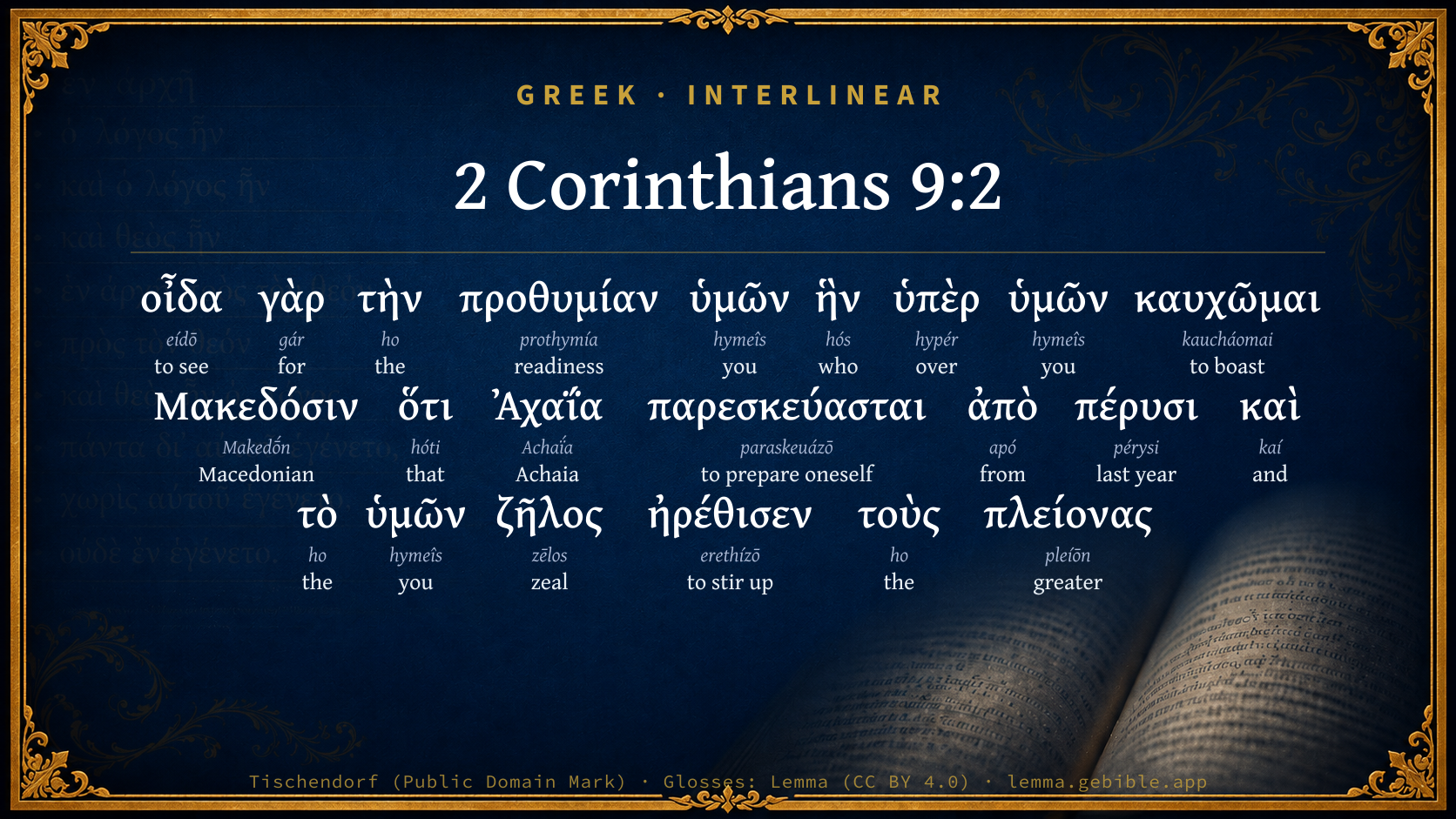
Greek (Tischendorf 8th ed.) 2 Corinthians 9:2 appears in the Greek New Testament. The text above is from the Tischendorf 8th edition. Each word links to its Strong’s number and a concise gloss. Click any word for its full Thayer’s Greek Lexicon entry.
Download image
Cite this verse

2 Corinthians 9:2 (World English Bible). Public Domain. Lemma interlinear Bible study tool, https://lemma.gebible.app/v/2-corinthians/9/2.

Show BibTeX & RIS
BibTeX
RIS
English Translation
for I know your readiness, of which I boast on your behalf to them of Macedonia, that Achaia has been prepared for a year past. Your zeal has stirred up very many of them.
World English Bible · Public Domain
Highlights
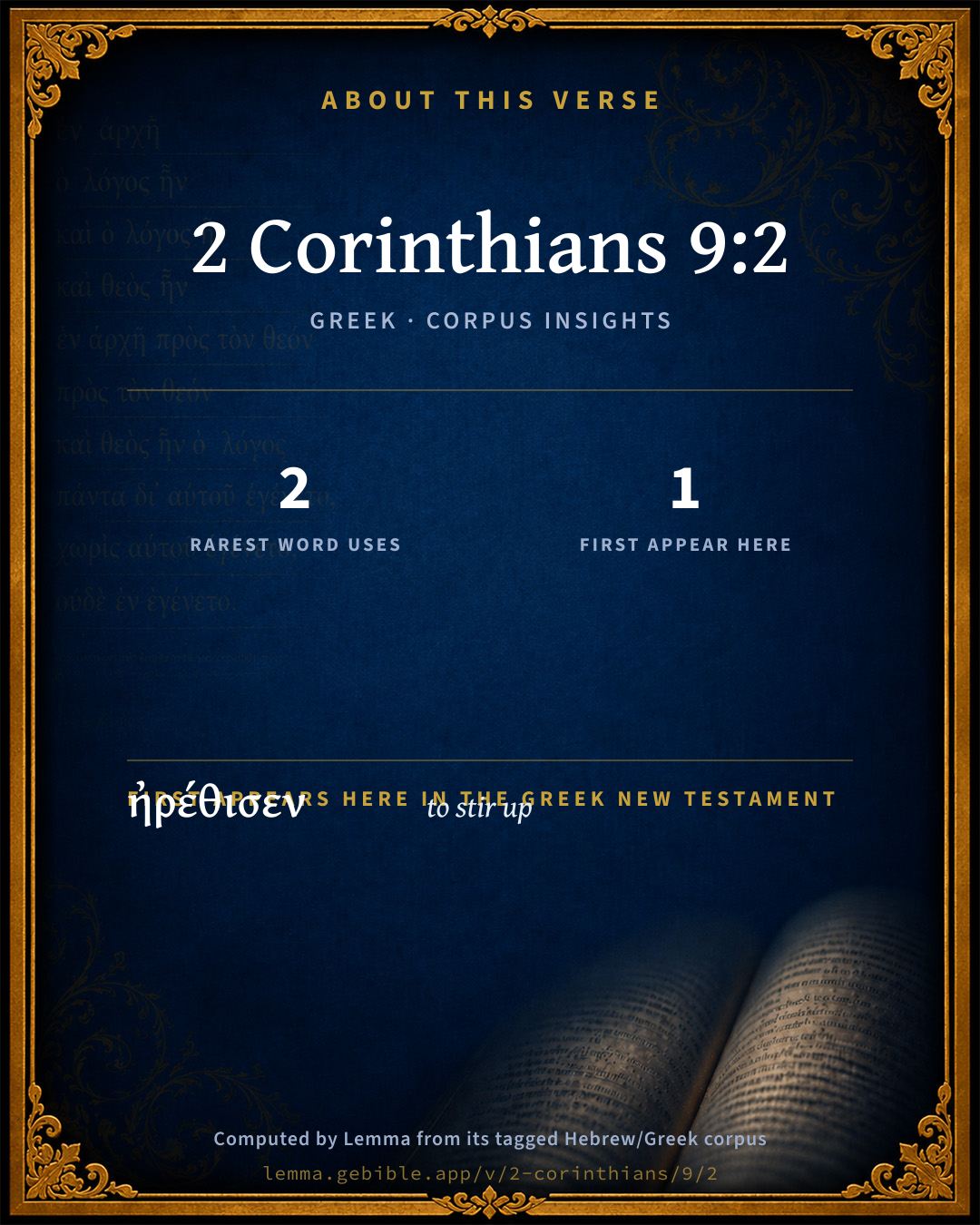
  • 1 first appearance in the Greek New Testament
Full analysis ↓
Download a study sheet

One document with this verse’s original text, its word-by-word gloss line, the meaning frame, cross-references with their text, attributed commentary, and full source and license credits — printable, and it pastes into notes with its structure intact.

This verse Autodidact and up

Study sheet (.html) Plain text (.txt)

A passage Seminary Student

Up to 50 verses in one chapter. A passage sheet keeps up to 6 commentary sources and 12 cross-references per verse, in the order this page ranks them, and says so on the sheet whenever that leaves anything out. Ask for a single verse and you get the Autodidact verse sheet above.

Everything on this page stays free to read, with no account — the sheet is a download of what is already on screen, not access to it.

Want to remove ads? Support Godless Engineer
Compare translations 3

The same verse in 3 English versions, stacked beneath the original-language interlinear above. Click any original word for its lexicon entry.

Each is an independent rendering of the whole verse — the interlinear is not word-aligned to these translations.

Highlighted words mark where these versions differ — a whole-verse word diff, not a word-by-word alignment.

  • World English Bible Public Domain
    for I know your readiness, of which I boast on your behalf to them of Macedonia, that Achaia has been prepared for a year past. Your zeal has stirred up very many of them.
  • King James Version Public Domain
    For I know the forwardness of your mind, for which I boast of you to them of Macedonia, that Achaia was ready a year ago; and your zeal hath provoked very many.
  • unfoldingWord Literal Text CC BY-SA 4.0
    For I know your readiness, which I boast to the Macedonians concerning you, that Achaia has been ready since last year, and your zeal stirred up most.

unfoldingWord Literal Text — © unfoldingWord, licensed CC BY-SA 4.0. Word-aligned USFM3 via Door43 (git.door43.org/unfoldingWord/en_ult).

Versions to compare (up to 4)

3 of 4 selected

Show all 19 translations

Every available English version of this verse, each an independent rendering of the whole verse.

  • World English Bible Public Domain
    for I know your readiness, of which I boast on your behalf to them of Macedonia, that Achaia has been prepared for a year past. Your zeal has stirred up very many of them.
  • Berean Standard Bible Public Domain
    For I know your eagerness to help, and I have been boasting to the Macedonians that since last year you in Achaia were prepared to give. And your zeal has stirred most of them to do likewise.
  • Majority Standard Bible Public Domain
    For I know your eagerness to help, and I have been boasting to the Macedonians that since last year you in Achaia were prepared to give. And your zeal has stirred most of them to do likewise.
  • King James Version Public Domain
    For I know the forwardness of your mind, for which I boast of you to them of Macedonia, that Achaia was ready a year ago; and your zeal hath provoked very many.
  • American Standard Version (1901) Public Domain
    for I know your readiness, of which I glory on your behalf to them of Macedonia, that Achaia hath been prepared for a year past; and your zeal hath stirred up very many of them.
  • Revised Version (1885) Public Domain
    for I know your readiness, of which I glory on your behalf to them of Macedonia, that Achaia hath been prepared for a year past; and your zeal hath stirred up very many of them.
  • Geneva Bible (1599) Public Domain
    For I knowe your readinesse of minde, whereof I boast my selfe of you vnto them of Macedonia, and say, that Achaia was prepared a yeere agoe, and your zeale hath prouoked many.
  • Douay-Rheims (1899) Public Domain
    For I know your forward mind: for which I boast of you to the Macedonians. That Achaia also is ready from the year past, and your emulation hath provoked very many.
  • Young's Literal Translation Public Domain
    for I have known your readiness of mind, which in your behalf I boast of to Macedonians, that Achaia hath been prepared a year ago, and the zeal of you did stir up the more part,
  • Literal Standard Version CC BY-SA 4.0
    for I have known your readiness of mind, which in your behalf I boast of to Macedonians, that Achaia has been prepared a year ago, and your zeal stirred up the greater part,
  • Unlocked Literal Bible CC BY-SA 4.0
    I know about your desire, which I boasted about to the people of Macedonia. I told them that Achaia has been getting ready since last year. Your eagerness has motivated most of them to action.
  • unfoldingWord Literal Text CC BY-SA 4.0
    For I know your readiness, which I boast to the Macedonians concerning you, that Achaia has been ready since last year, and your zeal stirred up most.
  • Darby Bible Public Domain
    For I know your readiness, which I boast of as respects you to Macedonians, that Achaia is prepared since a year ago, and the zeal [reported] of you has stimulated the mass [of the brethren].
  • World Messianic Bible Public Domain
    for I know your readiness, of which I boast on your behalf to those of Macedonia, that Achaia has been prepared for the past year. Your zeal has stirred up very many of them.
  • Webster's Bible Public Domain
    For I know the forwardness of your mind, for which I boast of you to them of Macedonia, that Achaia was ready a year ago; and your zeal hath incited very many.
  • Free Bible Version CC BY-SA 4.0
    I know how keen you are to help—I was boasting about this to those in Macedonia that you in Achaia have been ready for over a year, and your enthusiasm has encouraged many of them to give.
  • Bible in Basic English Public Domain
    For I have before made clear to those of Macedonia my pride in your ready mind, saying to them that Achaia has been ready for a year back; and a great number have been moved to do the same by your example.
  • Text-Critical English NT CC BY 4.0
    For I know how eager you are to help, and I keep boasting about you to the Macedonians, saying that Achaia has been prepared to give since last year; and your zeal has stirred up most of them.
  • Tyndale New Testament (1534) Public Domain
    for I knowe youre redynes of mide wherof I bost my silfe vnto them of Macedonia and saye that Achaia was prepared a yeare a goo and youre ferventnes hath provoked many.

Literal Standard Version (2020), Covenant Press — licensed CC BY-SA 4.0. Text via the HelloAO Bible API (eBible.org). Unlocked Literal Bible (unfoldingWord) — licensed CC BY-SA 4.0. Text via the HelloAO Bible API (eBible.org). unfoldingWord Literal Text — © unfoldingWord, licensed CC BY-SA 4.0. Word-aligned USFM3 via Door43 (git.door43.org/unfoldingWord/en_ult). Free Bible Version, Dr. Jonathan Gallagher — licensed CC BY-SA 4.0. Text via the HelloAO Bible API (eBible.org).

Word by word

More ways to search: Search by grammar → Find every occurrence → Compare this word →

Practice this passage: Drill this verse → Learn its vocabulary →

πέρυσι
pérysi
G4070
“last year”
Adverb
Part of Speech
Adverb
Full Thayer's Definition

Origin: from G4009

TDNT: None

1. last year 2. the year just past a. for a year past, a year ago
  1. οἶδα eídō G1492 “to see” Verb, Perfect, Active, Indicative, 1st person, Singular
  2. γὰρ gár G1063 “for” Conjunction
  3. τὴν ho G3588 “the” Article, Accusative, Singular, Feminine
  4. προθυμίαν prothymía G4288 “readiness” Noun, Accusative, Singular, Feminine
  5. ὑμῶν hymeîs G5210 “you” Personal pronoun, 2nd person, Genitive, Plural
  6. ἣν hós G3739 “who” Relative pronoun, Accusative, Singular, Feminine
  7. ὑπὲρ hypér G5228 “over” Preposition
  8. ὑμῶν hymeîs G5210 “you” Personal pronoun, 2nd person, Genitive, Plural
  9. καυχῶμαι kaucháomai G2744 “to boast” Verb, Present, Middle or Passive deponent, Indicative, 1st person, Singular
  10. Μακεδόσιν Makedṓn G3110 “Macedonian” Noun, Dative, Plural, Masculine
  11. ὅτι hóti G3754 “that” Conjunction
  12. Ἀχαΐα Achaḯa G882 “Achaia” Noun, Nominative, Singular, Feminine
  13. παρεσκεύασται paraskeuázō G3903 “to prepare oneself” Verb, Perfect, Passive, Indicative, 3rd person, Singular
  14. ἀπὸ apó G575 “from” Preposition
  15. καὶ kaí G2532 “and” Conjunction
  16. τὸ ho G3588 “the” Article, Nominative, Singular, Neuter
  17. ὑμῶν hymeîs G5210 “you” Personal pronoun, 2nd person, Genitive, Plural
  18. ζῆλος zēlos G2205 “zeal” Noun, Nominative, Singular, Neuter
  19. ἠρέθισεν erethízō G2042 “to stir up” Verb, Aorist, Active, Indicative, 3rd person, Singular
  20. τοὺς ho G3588 “the” Article, Accusative, Plural, Masculine
  21. πλείονας pleíōn G4119 “greater” Adjective, Accusative, Plural, Masculine, Comparative

About this verse

These counts appear in no published source. They are computed here, from the morphology-tagged text and Lemma’s own curated glosses. What Lemma adds →

22
words
18
distinct lemmas
Pauline Epistles
section

Notable vocabulary

The rarest word here is πέρυσι last year G4070 — appearing just 2 times in the whole Greek New Testament.

First appearance in Scripture

This word makes its first canonical appearance in the Greek New Testament here:

  • ἠρέθισεν to stir up G2042

Shared distinctive vocabulary

πέρυσι last year G4070 occurs in 2 verses of the Greek New Testament. Also found in:
Repetition

Words recur within this verse:

Cross-references

10

Topical passages linked to 2 Corinthians 9:2 in the Treasury of Scripture Knowledge — connected by theme and wording, ordered by reader-vote popularity; previews shown in the World English Bible.

  • 2 Corinthians 8:10 I give a judgment in this: for this is expedient for you, who were the first to start a year ago, not only to do, but also to be willing.
  • 2 Corinthians 8:8 I speak not by way of commandment, but as proving through the earnestness of others the sincerity also of your love.
  • 2 Corinthians 8:24 Therefore show the proof of your love to them in front of the assemblies, and of our boasting on your behalf.
  • 1 Corinthians 16:15 Now I beg you, brothers (you know the house of Stephanas, that it is the first fruits of Achaia, and that they have set themselves to minister to the saints),
  • Hebrews 10:24 Let us consider how to provoke one another to love and good works,
  • Acts 18:12 But when Gallio was proconsul of Achaia, the Jews with one accord rose up against Paul and brought him before the judgment seat,
  • 2 Corinthians 1:1 Paul, an apostle of Christ Jesus through the will of God, and Timothy our brother, to the assembly of God which is at Corinth, with all the saints who are in the whole of Achaia:
  • 2 Corinthians 7:4 Great is my boldness of speech toward you. Great is my boasting on your behalf. I am filled with comfort. I overflow with joy in all our affliction.
  • 2 Corinthians 8:19 Not only so, but who was also appointed by the assemblies to travel with us in this grace, which is served by us to the glory of the Lord himself, and to show our readiness.
  • 1 Thessalonians 1:7 so that you became an example to all who believe in Macedonia and in Achaia.

Cross-references courtesy of OpenBible.info (CC BY 4.0).

Commentary

Notes on 2 Corinthians 9:2 from classic Christian and Jewish commentators (each source and its license shown beneath its notes). The classic Christian expositions comment on the surrounding passage and are grouped to its opening verse, so a note may address several verses; the Jewish commentaries on the Tanakh (Rashi and others) are per-verse, so they appear only where the commentator wrote on this verse.

Lemma curates 59 commentaries, every one of them public domain or Creative Commons licensed, each selected and text-cleaned for this edition rather than reprinted as found. About our sources →

Bengel's Gnomon

Johann Albrecht Bengel

2Co 9:2. Καυχῶμαι, I boast) The present tense. Paul was still in Macedonia.—[54] ὁ ἐξ ὑμῶν ζῆλος) the zeal, which was propagated from you to the Macedonians.—τοὺς πλείονας) most [not merely very many, as Engl. V.] of the Macedonians.

[54] Ἀπὸ πέρυσι, since last year) owing to the former exhortation of Paul, 1Co 16:1.—V. g.

Bengel's Gnomon of the New Testament — English translation (T&T Clark, Edinburgh, 1860) — public domain. Text from a community e-Sword module.

Meyer's Critical & Exegetical Commentary

Heinrich August Wilhelm Meyer

2Co_9:2. Τὴν προθυμ. ὑμῶν] Rückert infers from the whole contents of the two chapters that the inclination is only assumed as still existing, and no longer existed in reality; but his inference is unjust, and at variance with the apostles character. Already, ἀπὸ πέρυσι (2Co_8:10) have the readers begun to collect, and the work of love, in fact, needed only the carrying out, which Paul intends by chap. 8 and 9 to procur.

ἣν ὑπὲρ ὑμ. καυχ. Μακεδ.] of which I make my boast in your favour (in your recommendation) to the Macedonians; for the Corinthians were made by Paul to favour the collection. On καυχάομαι, with the accusative of the object, comp. 2Co_7:14, 2Co_10:8, 2Co_11:30; LXX. Pro_27:1; Lucian, Ocyp. 120; Athen. xiv. p. 627 C. On the present Bengel rightly remarks: Adhuc erat P. in Macedonia.

ὅτι Ἀχαΐα παρεσκ. ἀπὸ πέρυσι] so ran the καυχῶμαι: that Achaia has been in readiness (to give pecuniary aid to promote it) since the previous year. Paul says Ἀχαΐα, not ὑμεῖς (comp. 2Co_9:3), because he repeats words actually used by him. These concerned not only Corinth, but the whole Province, in which, however, the Corinthian was the central church. Comp. on 2Co_1:1.

καὶ ὁ ἐξ ὑμῶν ζῆλος[286] Κ.Τ.Λ.] is, by way of attraction, an expression of the thought: your zeal wrought forth from you as stimulating to them. Comp. from the N. T. Mat_24:17; Luk_11:13. See on Matt. l.c., and Hermann, ad Viger. p. 893; Kühner, ad Xen. Anab. i. 1. 5.

ΤΟῪς ΠΛΕΊΝΑς] the majority of the Macedonians, so that only the minority remained uninfluenced.

[286] The form τὸ ζῆλος is found here in B א (Lachm. ed. min.); it has much stronger attestation in Php_3:6. Running counter to the usage of the whole N. T., it must be considered as an error of the copyists, though it really occurs in Clem. Cor. i. 4 (thrice) and 6, and Ignatius, Trall. 4 (Dressel), and hence was doubtless known to the copyists.

REMARK.

Paul might with perfect truth stimulate (1) the Macedonians by the zeal of the Corinthians, because the latter had begun the work earlier than the former, and were already ἀπὸ πέρυσι in readiness; and then (2) the Corinthians, again, by the example of the Macedonians (2Co_8:1 ff.), since the latter, after having followed the Corinthians in the prosecution of the work, had shown such extraordinary activity as in turn to serve the Corinthians a model and a stimulus to further beneficence. Is it not possible that in the very same affair first A should be held up as a model to B, and then, according to the measure of the success, conversely B to A? Hence Theodoret and many (comp. also Chrysostom) have rightly remarked on the wisdom in the apostles conduct; whereas Rückert declares this conduct of his to be unwise (of its morality he prefers to be silent), unjustly taking it for granted that his καυχᾶσθαι regarding the Corinthians was untrue. See 2Co_7:14. De Wette also thinks that the apostle is not free from human error here.

That in αὐθαίρετοι, at 2Co_8:3, there is no contradiction with 2Co_9:2, see on 2Co_8:3.

Meyer — Critical and Exegetical Commentary on the New Testament — English translation by Peter Christie, edited by Frederick Crombie (T&T Clark, 1880) — public domain. Text from a community e-Sword module.

Expositor's Greek Testament

ed. W. Robertson Nicoll

2Co 9:2 . οἷδα γὰρ τὴν προθ . κ . τ . λ .: for I know your readiness, of which I glory (for constr. cf. 2Co 11:30 , Pro 27:1 ) on your behalf ( cf. 2Co 7:14 ) to the Macedonians, that Achaia (not ὑμεῖς , he reports the actual words in which he made his boast; for “Achaia” see on 2Co 1:1 ) has been prepared since last year (see on 2Co 8:10 above), i.e. , to make its contribution. It would seem that the Apostle feared that he had somewhat overstated the case, as he is evidently anxious about the Corinthian collection. The use of the present tense, καυχῶμαι Μακεδόσιν , shows that he is writing from Macedonia (see Introd. , p. 12). καὶ τὸ ὑμῶν ζῆλος κ . τ . λ .: and your zeal (see on 2Co 7:7 ) has provoked the majority of them (see on 2Co 2:6 ), sc. , to contribute ( cf. 2Co 8:10 ).

The Expositor's Greek Testament, edited by W. Robertson Nicoll (1897–1910) — public domain. Text from a community e-Sword module.

Jamieson, Fausset & Brown

Robert Jamieson, A. R. Fausset & David Brown

ready a year ago--to send off the money, owing to the apostle's former exhortation (Co1 16:1-2).

your zeal--Greek, "the zeal from you," that is, on your part; propagated from you to others.

provoked--that is, stimulated.

very many--Greek, "the greater number," namely, of the Macedonians.

Jamieson, Fausset & Brown — Commentary Critical and Explanatory on the Whole Bible (1871) — public domain (CC PDM 1.0). Text via the HelloAO Bible API.

Adam Clarke's Commentary

Verse 2. I know the forwardness of your mind] You have already firmly purposed to contribute to the support of the poor and suffering saints.

That Achaia was ready a year ago] The whole of the Morea was anciently called Achaia, the capital of which was Corinth. The apostle means, not only Corinth, but other Churches in different parts about Corinth; we know there was a Church at Cenchrea, one of the ports on the Corinthian Isthmus.

Your zeal hath provoked very many.] Hearing that the Corinthians were so intent on the relief of the sufferers in Palestine, other Churches, and especially they of Macedonia, came forward the more promptly and liberally.

Adam Clarke's Commentary on the Bible (1810–1826) — public domain. Text from a community e-Sword/MySword module.

John Calvin's Commentaries

2. For which I have boasted. He shows the good opinion that he had of them from this, that he had, in a manner, stood forward as their surety by asserting their readiness. But what if he rashly asserted more than the case warranted? For there is some appearance of this, inasmuch as he boasted, that they had been ready a year before with it, while he is still urging them to have it in readiness. I answer, that his words are not to be understood as though Paul had declared, that what they were to give was already laid aside in the chest, but he simply mentioned what had been resolved upon among them. This involves no blame in respect of fickleness or mistake. It was, then, of this promise that Paul spoke.

John Calvin's Commentaries (1540-1563) — public domain. Text from the Calvin Translation Society English edition (1840s-50s) via the Christian Classics Ethereal Library (ccel.org). Calvin's coverage is partial (roughly two-thirds of the Bible); uncommented books and verses are honest gaps, never fabricated. The 19th-century editor's footnotes and remarks are omitted so the notes are faithfully Calvin's own voice.

Ellicott's Commentary for English Readers

(2) For I know the forwardness of your mind.—This was the boast to which he had referred in 2Co_8:24. Achaia (i.e., Corinth, and perhaps Cenchreæ also) had been ready last year. The urgency of his present appeal indicates a latent misgiving whether he had not unconsciously over-stated the fact, and had mistaken the “will” that had shown itself for an actual readiness to send off the money whenever it was called for. (See Note on 2Co_9:3.) The word for “provoke,” used here in a good sense, is found in Col_3:21, in a bad sense, as “irritating.” This was another reason for prompt and generous action. It would be a permanent disgrace to them if, after having been held up as a pattern to others, they afterwards fell short of their excellence.

Very many.—Literally, the greater number.

A Bible Commentary for English Readers, edited by Charles John Ellicott (1878–1897) — public domain. Text from a community e-Sword module.

The Cambridge Bible for Schools and Colleges

gen. ed. J. J. S. Perowne

2. for I know the forwardness of your mind] Rather, readiness (your redynesse of minde. Tyndale). See note on ch. 2Co_8:12. And therefore I need not write about the collection.

I boast] The Apostle, then, says Bengel, was already in Macedonia.

Achaia] See note on ch. 2Co_1:1.

a year ago] Rather, last year. See ch. 2Co_8:10. The Vulgate renders here by ab anno praeterito.

and your zeal hath provoked very many] “We did not advise, we did not exhort; we only praised you, we only boasted of you; and this was enough for exhortation of them.” Chrysostom. For zeal, see notes on ch. 2Co_7:7; 2Co_7:11. Perhaps the Apostle means to say here the emulation arising from your conduct, since the word rendered ‘your’ is literally, arising from you. The word here translated ‘provoke’ is used in a bad sense in Col_3:21. The English word provoke, from the Latin provoco, to call forth, is usually in these days used in a bad sense. But it was not so at the time when the A. V. was made. Cf. Heb_10:24. The meaning here is stirred up. For very many, the original has the majority.

The Cambridge Bible for Schools and Colleges (gen. ed. J. J. S. Perowne; Cambridge University Press, 1878–1918) — public domain. Text from a community e-Sword module.

John Gill's Exposition

For I know the forwardness of your mind,.... How that they were willing of themselves to engage in this good work; how readily they came into it; what a cheerful disposition of mind they showed towards it; and how forward they were to begin the collection:

for which I boast of you to them of Macedonia; he had one it before, which had put them upon the like service, and he still continued to boast of them,

that Achaia was ready a year ago: not that their collection was ready made so long ago; but they had shown a readiness of mind, as to every good work, so to this of communicating to the saints a year ago, when they made a beginning, though as yet had not finished. By Achaia is meant, the inhabitants of Achaia. The Arabic version renders it, the citizens of Achaia; of this country; see Gill on Act 18:12. It is sometimes taken in a large sense, and designs Greece, and includes the countries of Doris, Hellas, Aetolia, Locri, Phocis, Boeotia, Attica, and Megaris; and had its name, as some say, from the frequent inundation of waters; and others, from one of the three generals of the Pelasgi, who were of this name; and sometimes it is taken strictly and properly for the country of the Peloponnesus, or the Morea. And so Drusius, out of Hesychius, has observed, that the Achaeans were Greeks; but properly they were they that inhabited that part of Peloponnesus, called Achaia; and these seem to be intended here. The Gospel was preached in these parts with success; Epaenetus, whom the Apostle Paul salutes, Rom 16:5 and the house of Stephanas he mentions, Co1 16:15 were the firstfruits of it; and in process of time several churches were here gathered, and which continued for several ages. In the "second" century there was a synod in Achaia, concerning the time of keeping Easter, in which Bacchylus, bishop of Corinth, presided; in the beginning of the "fourth" century, the bishops of Achaia were present at the council of Nice, and in the same century bishops out of this country assisted at the synod in Sardica; in the "fifth" century there were many churches in Achaia, and the bishops of them were present in the Chalcedon synod; out of this country went several bishops, in the "seventh" century, to Constantinople, and were in the sixth synod there; and in the "eighth" century there were bishops of Achaia in the Nicene synod (d): here by Achaia are designed the churches of Christ, which were in that part of Greece in which Corinth stood, and of which that was the metropolis; so that when the apostle says Achaia was ready, his meaning is more particularly, that the Corinthians were ready:

and, adds he,

your zeal hath provoked very many: or "the zeal which is of you"; which sprung from, and was occasioned by them; for not the zeal of the Corinthians is here intended, as seems at first view, but that emulation which was stirred up in some of the leading persons among the Macedonians, upon hearing how ready they at Corinth were to minister to the necessitous brethren; and the zeal which appeared in these principal men, which was very warm, and yet prudent and seasonable, wrought very much on the minds of others, who, led by their example, contributed in a very generous and unexpected manner. In the Greek text it is, "the zeal out of you"; or, as the Arabic version renders it, "the zeal that arose from you", which was occasioned by them.

(d) Hist. Eccles. Magdeburg. cent. 2. c. 9. p. 125. cent. 4. c. 2. p. 5. c. 9. p. 425. cent. 5. c. 2. p. 6. cent. 7. c. 10. p. 258. cent. 9. c. 2. p. 7.

John Gill's Exposition of the Whole Bible (1746–1763) — public domain (CC PDM 1.0). Text via the HelloAO Bible API.

Trapp's Complete Commentary

John Trapp

2 For I know the forwardness of your mind, for which I boast of you to them of Macedonia, that Achaia was ready a year ago; and your zeal hath provoked very many.

Ver. 2. Was ready] To wit, in their resolutions; for the collection was not yet made.

And your zeal] i.e. Your liberal contribntion out of deep affection, and a holy emulation to exceed others in bounty.

John Trapp, A Commentary or Exposition upon All the Books of the Old and New Testament (1647–1656) — public domain. Text from a community e-Sword module.

Albert Barnes' Notes on the Bible

For I know the forwardness of your mind - I know your promptitude, or your readiness to do it; see 2Co 8:10. Probably Paul here means that he had had opportunity before of witnessing their readiness to do good, and that he had learned in particular of Titus that they had formed the plan to aid in this contribution.

For which I boast of you to them of Macedonia - To the church in Macedonia; see 2Co 8:1. So well assured was he that the church at Corinth would make the collection as it had proposed, that he boasted of it to the churches of Macedonia as if it were already done, and made use of this as an argument to stimulate them to make an effort.

That Achaia was ready a year ago - Achaia was that part of Greece of which Corinth was the capital; see the note, Act 18:12. It is probable that there were Christians in other parts of Achaia besides Corinth, and indeed it is known that there was a church in Cenchrea (see Rom 16:1). which was one of the ports of Corinth. Though the contribution would be chiefly derived from Corinth, yet it is probable that the others also would participate in it. The phrase “was ready” means that they had been preparing themselves for this collection, and doubtless Paul had stated that the collection was already made and was waiting. He had directed them 1Co 16:1 to make it on the first day of the week, and to lay it by in store, and he did not doubt that they had complied with his request.

And your zeal - Your ardor and promptitude. The readiness with which you entered into this subject, and your desire to relieve the needs of others.

Hath provoked - Has roused, excited, impelled to give. We use the word “provoke” commonly now in the sense of to irritate, but in the Scriptures it is confined to the signification of exciting, or rousing. The ardor of the Corinthians would excite others not only by their promptitude, but because Corinth was a splendid city, and their example would be looked up to by Christians at a distance. This is one instance of the effect which will be produced by the example of a church in a city.

Albert Barnes' Notes on the Bible (1834–1885) — public domain. Text from a community e-Sword/MySword module.

Haydock's Catholic Bible Commentary

That Achaia also was ready. Corinth was the capital of Achaia. St. Paul had formerly exhorted the Macedonians to contribute to the utmost of their power, informing them, that Corinth and all Achaia were prepared a year ago to collect alms, and now the apostle, speaking to the Corinthians, encourages them by the example of the faithful of Macedon, and informs them of the greatness of their charitable contributions, and the greatness of their zeal. (Theo.)

George Leo Haydock (1774–1849), Haydock's Catholic Family Bible and Commentary, 1859 edition — public domain. Excludes Psalms (Douay-Rheims chapter numbering differs from Protestant) and Deuterocanonical books (Catholic canon only).

Matthew Poole's English Annotations

He gives them the reason why he judgeth it superfluous to write to them, because they had a forward mind of themselves, and needed not to be spurred on. This the apostle tells them that he knew, (he had told them of it, 2Co 8:10), he knew it either from themselves, or from some that came from them unto him; and he had boasted of them for this their forwardness in this good work to the churches of Macedonia.

And your zeal hath provoked very many; he tells them, that their warmth unto, and in, this work, had kindled a heat in many in those parts where he was. Having therefore been so forward in this good work, and so good instruments to kindle a heat in others, he would not have them now come behind others, or grow cold in it.

Matthew Poole's English Annotations on the Holy Bible (1683–1685) — public domain. Text from a community e-Sword/MySword module.

Whedon's Commentary on the Bible

Daniel D. Whedon

2. Achaia—The Grecian province of which Corinth was the capital, sometimes including all Southern Greece.

A year ago—See note, 2Co_7:10.

Provoked very many—The apostle arouses each by the example of the other. Poor Macedonia was wealthy in her heart of benevolence, 2Co_8:1-4; and richer Achaia was inspiring her with her early leadership.

Daniel D. Whedon (gen. ed.), Commentary on the Old and New Testaments (1874–1909) — public domain. Text from a community e-Sword module.

The Pulpit Commentary

Ver. 2. I boast of you; literally, I am boasting. The tense shows that he is writing from Macedonia, probably from Philippi. (2Co_8:24) Achaia. (see 2Co_1:1) Was ready a year ago; has been prepared since last year. Your zeal hath provoked very many; literally, zeal from you hath stimulated the majority. "Zeal from you" means zeal which emanated from the Corinthians and aroused emulation in others.

HOMILIES BY J.R. THOMSON Ver. 2.

The contagion of zeal.

The interest which Christians living in distant lands learned, under apostolic guidance and by the spiritual tuition of the indwelling love of Christ, to take in one another"s welfare, was an evidence of the introduction into humanity of a new moral power, a principle of universal love and brotherhood. It is very instructive to see the congregations of Macedonia and of Corinth rivalling one another in the benevolent enterprise of relieving the wants of the mother Church at Jerusalem. Paul evidently encourages this beneficial emulation.

I ZEAL IN CHRISTIAN BENEVOLENCE IS IN ITSELF GOOD. The languid and unemotional, the cold and calculating, however they may pride themselves upon their justice and reasonableness, are not the people who do the good, the benevolent work of the world. It is good to be zealously affected in a good cause.

II THE CONTAGIOUSNESS OF ZEAL IS FOUNDED UPON THE SOCIAL NATURE OF MAN. We are members one of another, and it is not desirable, it is not possible, for any person, for any community, to be indifferent to the welfare of others. And the conduct of each has some influence upon the conduct of others. It is not easy to be zealous when all around are unconcerned and inactive, whilst, on the other hand, the spectacle of zealous devotion and self-denial is stimulating and encouraging.

III THIS EMULATION MAY BE CARRIED TO A PREJUDICIAL EXTENT. It cannot but be acknowledged that emulation may lead to ostentation. Who can question that the motive of some givers to charitable and religious instutions is impure? One wishes to excel another, for the pleasure of triumphing over him, or of cutting a more important figure in the eyes of his fellow men. And thus the true motive is lost sight or, and a moral injury is wrought.

IV YET IT IS WELL TO FEEL THE FORCE OF A GOOD EXAMPLE AS A PRACTICAL MOTIVE TO ZEALOUS SERVICE. We may learn from the case of others what may be done where there is consecration, self-denial, and prayerful effort. Our apathy may be rebuked, our flagging benevolence revived. It is when the coals are not only kindled, but put together, that the fire burns clear and bright, and gives forth its genial warmth. T.

HOMILIES BY E. HURNDALL

Ver. 2.

The contagion of charity.

I AN INDISPUTABLE FACT. Man is imitative, even in generosity. Example is often potent when appeal falls flat. Many do not see that they can afford to give until others in similar circumstances demonstrate the possibility. Men do not like to be outdone in good works; a friend"s beneficence is a spur to our own.

II A SUGGESTIVE FACT. When we give we often think only of the direct good which our contribution will effect, but much other good may follow. Our charity may be stimulative. Should lead us:

1. To give promptly. Delayed gift may be in time for the special object, but may be too late to induce others to give in time. Our charity must have time to work; some people take hints slowly. Bis dat, qui cito dat, is true in more ways than one.

2. To give liberally. We may curtail the charity of others. On the other hand, a liberal gift may draw forth liberal responses.

3. To give joyfully. If we give with evident gladness, others may desire to share our happiness. Joyful giving is more contagious than any other, since all men naturally crave for joy.

4. To give to suitable objects only. We may misdirect the charity of others. There is not a little responsibility attaching to benevolence. Some seem to think that, if they give, it is little matter how or to what they give.

III A COMFORTING FACT. The truly liberal are often distressed because they can give so little. But small gifts may have large issues. The small rudder directs the great ship. The little weight often turns the scale. Our gift, of little value, may call forth large help from those wealthier than ourselves. This is likely if men see that, though we give little, we give as much as we can.

IV A USEFUL FACT. To be made use of according to the example set by Paul. A legitimate instrument for moving sluggish natures. Whilst we may be silent respecting our own charity, we may often profitably speak of the charity of others. H.

HOMILIES BY R. TUCK Ver. 2.

Fowardness in good works.

Very remarkable is the tenderness, consideration, and delicacy of feeling with which St. Paul addresses the better, the more spiritual, part of the Church at Corinth. He was very anxious that they should stand well in the matter of the collection, and therefore he had sent messengers to collect their gifts; but he gives them notice of their coming, and heartily expresses his confidence in the ready and willing mind of these Corinthian saints, In such expressions "there was no subtle policy; there was no attempt to get at their purses by their weak side. St. Paul was above such means. It was natural, instinctive, real delicacy; and yet it was the surest way of obtaining what he wished, and that which the deepest knowledge of the human heart would have counselled. For thereby he appealed, not to their selfish, but to their most unselfish, feelings. This is a great principle one of the deepest you can have for life and action. Appeal to the highest motives; appeal, whether they be there or no, for you make them where you cannot find them. Let men say what they will of human nature"s evil, a generous, real, unaffected confidence never fails to elicit the Divine spark." Consider

I ST. PAUL"S CONFIDENCE IN THEIR GOOD HEARTEDNESS. "I know the forwardness of your "mind.

1. So far as tidings had reached him, and so far as he knew their Christiandisposition and character, he felt sure that they were thinking rightly about the matter, cherishing proper sentiments concerning Christian brotherhood and charity, and the duty of the strong to bear the infirmities of the weak. This would be the matter of first importance to the apostle, for mere gifts are of no more acceptableness to God nowadays than mere sacrifices were in older days. God reads hearts and motives, and accepts the spirit of generosity and brotherly kindness which may find expression through gifts. So God could send this gracious message to David, "Thou didst well that it was in thy heart.

2. The Corinthians also planned to meet the apostle"s wishes. There hadbeen consideration and consultation and united endeavour to form good schemes for the regular devotement of gifts, for the storing and the ingathering of the moneys. In such signs of thought and care and wise arrangement St. Paul could but unfeignedly rejoice.

3. It seems that the Corinthians had actually made a good and hopefulbegriming. They had been "forward" in advance of other Churches; to use a familiar figure, they had "taken time by the forelock." This the apostle could not fail to regard as a most encouraging and hopeful sign of earnestness, as well as of the preparedness to act upon principle rather than upon mere impulse and excitement.

II ST. PAUL"S USE OF THEM FOR THE INSPIRATION OF OTHERS. "For which I boast of you to them of Macedonia." Probably St. Paul had been setting their example before the Churches of Macedonia previous to his receiving news of the trouble at Corinth over the incestuous member, and the disturbance of the Church by St. Paul"s personal energies and traducers. Show that whenever a Church of Christ, or a Christian individual, affords prominent illustration of any grace or duty, they properly become, in such matters, models and examples for the inspiration of others. All who attain above an average level in Christian living ought to be used for the permanent raising of the average. It is a somewhat difficult question, how far lesser motives, such as emulation and rivalry and ambition to be topmost, may be appealed to in Christian life and work.

Certainly it must be admitted that they can only be secondary motives, buttresses of a building that is well founded on the one great motive of loyalty and love to Christ.

III ST. PAUL"S FEARS LEST THEY SHOULD COME SHORT OF HIS HOPE. "His boasting of them might be in vain in this behalf." He was very properly anxious "lest haply if they of Macedonia come with me, and find you unprepared, we (that we say not, ye) should be ashamed in this same confident boasting." The ground of fear was the influence which the troubles and conflicts through which the Corinthian Church had been passing would have upon such a matter of external interest. Churches whose peace is disturbed are seldom found zealous in good works. The energy of the Church which is turned into dissension and strife is taken from its proper spheres of growth, witness, and charity. But St. Paul had further cause for his fears. Enemies at Corinth were so earnestly endeavouring to undermine his authority and destroy his influence that it seemed likely the Church would throw up this collection for the Jerusalem saints as a merely Pauline affair, with which they had better have nothing to do. The apostle opposes this malign influence by his delicate pleading, and by sending messengers who would testify that the collection was a matter of public concern, not one of personal interest to the apostle, and not one which was left in his hands. It was the united contribution of the Gentile Churches to the mother Church in her distress, and the matter was wholly under the regulation of those Churches. Impress how important is manifest clean handedness for all who have to do with Church moneys. No man must blame us concerning the gifts which we administer.

IV ST. PAUL"S ANXIETY TO SECURE THE PRACTICAL RESULTS OF RIGHT FEELING. He had been made glad by the report which he had received concerning the more spiritually minded Corinthians. They had received his reproofs and counsels with right feeling. They had cleared themselves of all complicity with the doings of the unworthy member; and the apostle felt that now all that was needed, as a sign of their right heartedness, was the resumption of this collecting scheme. If they would earnestly take that up and carry it through, in a generous and self-denying way, it would be the all-sufficient and outward proof that they had come well through the stormy and troubled periods of their Church history. R.T.

The Pulpit Commentary (1880–1919), ed. H.D.M. Spence-Jones & Joseph S. Exell — public domain. Text from a community e-Sword module.

John Wesley's Explanatory Notes

I boast to them of Macedonia - With whom he then was.

John Wesley, Explanatory Notes Upon the Whole Bible (1754–1765) — public domain. Text via the GEBible commentary corpus.

McGarvey & Pendleton's Commentaries

J. W. McGarvey

for I know your readiness, of which I glory on your behalf to them of Macedonia, that Achaia hath been prepared for a year past; and your zeal hath stirred up very many of them . [It is needless for me to urge upon you the fact that it is a becoming thing in you to minister to the poor in the churches, for you have long since acknowledged the becomingness of the deed by pledging yourself to do it. And this readiness on your part I have used with great effect in Macedonia, for I told them how last year you consented to take this collection, so that many of them, feeling their tardiness in comparison with you, have been stirred to great activity and zeal in this matter.]

J. W. McGarvey (with Philip Y. Pendleton), Commentaries on the New Testament (The Fourfold Gospel, 1914; Acts; and the epistles) — public domain. Text from a community e-Sword/MySword module.

The People's New Testament

B. W. Johnson

2. I know the forwardness of your mind. This is why it seemed superfluous to write. Achaia was ready a year ago. The churches of the province of Achaia, of which Corinth was the capital. The province embraced all southern Greece, including Athens and Cenchreæ. They had begun the collection “a year ago” (8:10).

B. W. Johnson's The People's New Testament with Notes (1889–1891) — public domain. Electronic text from the Christian Classics Ethereal Library (CCEL) ThML edition.

Cambridge Greek Testament for Schools and Colleges

2. τό before ὑμῶν (אB, 17) rather than ὁ (CDFGKLP); and ὑμῶν (אBCP, f Vulg. Copt. Arm.) rather than ἐξ ὑμῶν (DFGKL, d e).

2. οἶδα γὰρ τ. προθυμίαν. For I know your readiness, of which I am glorying on your behalf to the Macedonians. He is still in Macedonia. Excepting Act 17:11, προθυμία is peculiar to 2 Cor. (2Co 8:11-12; 2Co 8:19); and καυχῶμαι is specially frequent (2Co 5:12, 2Co 10:13; 2Co 10:15-17, 2Co 11:12; 2Co 11:16, &c.); with an acc. of the thing gloried in (2Co 7:14, 2Co 10:8, 2Co 11:30). The present tense covers his action since Titus brought the good news. See Mayor on Jas 1:9.

Ἀχαία παρεσκεύασται ἀπὸ πέρυσι. Achaia has been prepared since last year, or ‘for a year past’ (R.V.). When 1Co 16:1-3 was written, Achaia was by no means ready. The troubles in Corinth would put an end to the collection for a time; but now that they are over, the Apostle is glorying of their earlier readiness. For ἀπὸ πέρυσι see on 2Co 8:10. For ὑμῶν between art. and noun see on 2Co 12:19.

Cambridge Greek Testament for Schools and Colleges (Cambridge University Press, 1896; 21 vols, various authors incl. Carr, Maclear, Plummer, Farrar, Lumby, Moule, M. R. James, Simcox) — public domain. Text from a community e-Sword module.

Alford’s Greek Testament

Henry Alford

2.] For (ground of περισσόν ἐστι) I am aware of your readiness of which (reff.) I am in the habit of boasting concerning you to Macedonians (Bengel remarks on the pres., ‘adhuc erat Paulus in Macedonia’) that Achaia (not ὑμεῖς—he relates his own words to the Macedonians) has been ready (viz. to send off the money: καὶ οὐδὲν λείπει εἰ μὴ τὸ ἐλθεῖν τοὺς δεξομένους τὰ χρήματα, Theophyl. The Apostle, judging by their readiness, had made this boast concerning them, supposing it was really so. That this is the sense is shewn by ἀπαρασκευάστους below, ver. 4) from last year (reff.):—and the zeal which proceeds from you (‘which has its source in you and whose influence goes forth from you:’ so ὁ ἐκ Πελοποννήσου πόλεμος, οἱ ἐκεῖθεν, and the like) stirred up the greater number of them (but not only the example of your zeal: see ch. 8:1).

Henry Alford, The Greek Testament (1849–1861) — public domain. Text from a community e-Sword module.

International Critical Commentary

2. οἶδα γὰρ τὴν προθυμίαν ὑμῶν. He has stated that he knows that they thought of doing something and began to do something in the previous year, and he assumes that they are still anxious to do something; solet enim se meliorem praebere ille, de quo bene sentitur ab alio (Herveius). But we are not to suppose that St Paul deliberately gave the Corinthians praise which he knew that they did not deserve, in order to induce them to be liberal; still less that this is a right thing to do.

ἥν ὑπὲρ ὑμῶν καυχῶμαι Μακέδοσιν. ‘Of which I am continually glorying on your behalf to the Macedonians.’ He is staying in Macedonia, and habitually praises the Corinthians to them. As Theodoret remarks, Διὰ μὲν Κορινθίων τοὺς Μακεδόνας, δὶα δὲ Μακεδόνων τοὺς Κορινθίους, ἐπὶ τὴν ἀγαθὴν ἐργασίαν προέτρεψεν. It would be grievous indeed, if the Corinthians now failed to imitate the Macedonians, to whom the Corinthians had been held up as a pattern. ‘See that you who taught them do not fall behind your own disciples.’ Καυχῶμαι with acc. of the thing gloried in is not rare (7:14, 10:8, 11:30). Often in Paul καυχῶμαι is used in a good sense, not merely when the glorying is in God or in Christ (Rom 5:11, Rom 5:15:17; 1Co 1:31; etc.), but also when it is in men (here, 7:14; 2Th 1:4; Php 2:16). The Apostle also glories in his own infirmities and afflictions (12:9; Rom 5:3). Here he seems to have some misgivings as to whether he may not have praised the Corinthians to the Macedonians somewhat too warmly. The report which Titus brought from Corinth had delighted him so greatly, that his glorying about the collection may have been somewhat in excess of the facts.

Ἁχαῒα παρεσκεύασται ἀπὸ πέρυσι. He is quoting what he says to the Macedonians; ‘Achaia has been prepared since last year’ (see on 8:10). As in 1:1, ‘Achaia’ probably means Corinth and the neighbouring district; he purposely includes Christians outside Corinth, perhaps to avoid exaggeration. Corinth had done something the previous year, but apparently not very much.

τὸ ὑμῶν ζῆλος. Again we have the Pauline arrangement of ὑμῶν between art. and noun; cf. 1:6, 7:7, 15, 8:13, 14, etc. In N.T., as in LXX and in class. Grk., ζῆλος is usually masc., but here and Php 3:6 the neut. form is well attested. It is found also in Ign. Tral. 4. Clem. Rom. Cor. 3-6 uses both masc. and neut. indifferently. Here the meaning is uncertain, but ‘your zeal’ is more probable than ‘emulation of you,’ guae ex vobis est aemulatio (Aug.).

ἠρέθισε. ‘Stimulated.’ In Col 3:21, the only other place in N.T. in which the verb occurs, it is used in a bad sense, ‘provoke,’ ‘irritate.’ In LXX and in class. Grk. the latter sense prevails. ‘Provoke’ has both meanings, but commonly the bad one. Aldis Wright (Bible Word Book, p. 482) gives examples of the good meaning.

τό (א B 17) rather than ό (C D F G K L P). ὑμῶν (א B C P f Vulg. Copt. Arm.) rather than ἐξ ὑμῶν (D E F G K L, d e Goth.).

International Critical Commentary — older volumes (1896–1929), various authors — public domain. Text from a community e-Sword module.

Lesson kit

Teaching starters — assembled from the data on this page, not authored interpretation. Every prompt links to the verse data it draws on. Edit before teaching.

2 Corinthians, in the Pauline Epistles, opens this verse with 22 words (18 distinct Greek lemmas). Its most distinctive word is pérysi (“last year”). A historical commentator’s framing appears above. Read the whole chapter for the surrounding context.

Discussion questions

  1. What does “last year” (pérysi) contribute to the verse as a whole?
  2. This is the first place “to stir up” appears in Scripture (first appears here). What does its debut here establish?
  3. How does 2 Corinthians 8:10, which shares the word «last year», read alongside this verse?
  4. What does the repetition of “the” (3× in this one verse) do in this verse?
  5. These translations render this verse differently. What is at stake in choosing one wording over another?
  6. Compare how Bengel's Gnomon and Meyer's Critical & Exegetical Commentary read this verse. Where do they agree or differ?

Things to notice

  • 1 word makes its first canonical appearance in Scripture here.
  • These translations choose different wording for 22 words in this verse.
  • “the” occurs 3× in this single verse.
  • 18 distinct Greek lemmas span 22 words in this verse.

Reading settings

Reading text

Shown beneath each verse's original-language words.

Old Testament
Old Testament edition

Read the OT as the Masoretic Hebrew (MT) or the Greek Septuagint (LXX).

English shown for the Greek Septuagint (in the Hebrew ↔ Greek comparison).

Comparing translations? Open the Compare panel on any verse page to stack up to four side by side.