2 Corinthians 1:6

Greek (Tischendorf 8th ed.) 2 Corinthians 1:6 appears in the Greek New Testament. The text above is from the Tischendorf 8th edition. Each word links to its Strong’s number and a concise gloss. Click any word for its full Thayer’s Greek Lexicon entry.
Download image
Cite this verse

2 Corinthians 1:6 (World English Bible). Public Domain. Lemma interlinear Bible study tool, https://lemma.gebible.app/v/2-corinthians/1/6.

Show BibTeX & RIS
BibTeX
RIS
English Translation
But if we are afflicted, it is for your comfort and salvation. If we are comforted, it is for your comfort, which produces in you the patient enduring of the same sufferings which we also suffer.
World English Bible · Public Domain
Download a study sheet

One document with this verse’s original text, its word-by-word gloss line, the meaning frame, cross-references with their text, attributed commentary, and full source and license credits — printable, and it pastes into notes with its structure intact.

This verse Autodidact and up

Study sheet (.html) Plain text (.txt)

A passage Seminary Student

Up to 50 verses in one chapter. A passage sheet keeps up to 6 commentary sources and 12 cross-references per verse, in the order this page ranks them, and says so on the sheet whenever that leaves anything out. Ask for a single verse and you get the Autodidact verse sheet above.

Everything on this page stays free to read, with no account — the sheet is a download of what is already on screen, not access to it.

Want to remove ads? Support Godless Engineer
Compare translations 3

The same verse in 3 English versions, stacked beneath the original-language interlinear above. Click any original word for its lexicon entry.

Each is an independent rendering of the whole verse — the interlinear is not word-aligned to these translations.

Highlighted words mark where these versions differ — a whole-verse word diff, not a word-by-word alignment.

  • World English Bible Public Domain
    But if we are afflicted, it is for your comfort and salvation. If we are comforted, it is for your comfort, which produces in you the patient enduring of the same sufferings which we also suffer.
  • King James Version Public Domain
    And whether we be afflicted, it is for your consolation and salvation, which is effectual in the enduring of the same sufferings which we also suffer: or whether we be comforted, it is for your consolation and salvation.
  • unfoldingWord Literal Text CC BY-SA 4.0
    But if we are afflicted, for your comfort and salvation; if we are comforted, for your comfort you are experiencing in endurance of the same sufferings that we ourselves also suffer.

unfoldingWord Literal Text — © unfoldingWord, licensed CC BY-SA 4.0. Word-aligned USFM3 via Door43 (git.door43.org/unfoldingWord/en_ult).

Versions to compare (up to 4)

3 of 4 selected

Show all 19 translations

Every available English version of this verse, each an independent rendering of the whole verse.

  • World English Bible Public Domain
    But if we are afflicted, it is for your comfort and salvation. If we are comforted, it is for your comfort, which produces in you the patient enduring of the same sufferings which we also suffer.
  • Berean Standard Bible Public Domain
    If we are afflicted, it is for your comfort and salvation; if we are comforted, it is for your comfort, which accomplishes in you patient endurance of the same sufferings we experience.
  • Majority Standard Bible Public Domain
    If we are afflicted, it is for your comfort and salvation, which accomplishes in you patient endurance of the same sufferings we experience.
  • King James Version Public Domain
    And whether we be afflicted, it is for your consolation and salvation, which is effectual in the enduring of the same sufferings which we also suffer: or whether we be comforted, it is for your consolation and salvation.
  • American Standard Version (1901) Public Domain
    But whether we are afflicted, it is for your comfort and salvation; or whether we are comforted, it is for your comfort, which worketh in the patient enduring of the same sufferings which we also suffer:
  • Revised Version (1885) Public Domain
    But whether we be afflicted, it is for your comfort and salvation; or whether we be comforted, it is for your comfort, which worketh in the patient enduring of the same sufferings which we also suffer:
  • Geneva Bible (1599) Public Domain
    And whether we be afflicted, it is for your consolation and saluation, which is wrought in the induring of the same sufferings, which we also suffer: or whether we be comforted, it is for your consolation and saluation.
  • Douay-Rheims (1899) Public Domain
    Now whether we be in tribulation, it is for your exhortation and salvation: or whether we be comforted, it is for your consolation: or whether we be exhorted, it is for your exhortation and salvation, which worketh the enduring of the same sufferings which we also suffer.
  • Young's Literal Translation Public Domain
    and whether we be in tribulation, `it is' for your comfort and salvation, that is wrought in the enduring of the same sufferings that we also suffer; whether we are comforted, `it is' for your comfort and salvation;
  • Literal Standard Version CC BY-SA 4.0
    and whether we be in tribulation, [it is] for your comfort and salvation, that is worked in the enduring of the same sufferings that we also suffer; whether we are comforted, [it is] for your comfort and salvation;
  • Unlocked Literal Bible CC BY-SA 4.0
    But if we are afflicted, it is for your comfort and salvation; and if we are comforted, it is for your comfort. Your comfort is working effectively when you patiently share in the same sufferings that we also suffer.
  • unfoldingWord Literal Text CC BY-SA 4.0
    But if we are afflicted, for your comfort and salvation; if we are comforted, for your comfort you are experiencing in endurance of the same sufferings that we ourselves also suffer.
  • Darby Bible Public Domain
    But whether we are in tribulation, [it is] for your encouragement and salvation, wrought in the endurance of the same sufferings which *we* also suffer,
  • World Messianic Bible Public Domain
    But if we are afflicted, it is for your comfort and salvation. If we are comforted, it is for your comfort, which produces in you the patient enduring of the same sufferings which we also suffer.
  • Webster's Bible Public Domain
    And whether we are afflicted, it is for your consolation and salvation, which is effectual in the enduring of the same sufferings which we also suffer: or whether we are comforted, it is for your consolation and salvation.
  • Free Bible Version CC BY-SA 4.0
    If we are in distress, it is for your comfort and salvation. If we are being comforted, it is for your comfort, which results in you patiently bearing the same sufferings that we suffer.
  • Bible in Basic English Public Domain
    But if we are troubled, it is for your comfort and salvation; or if we are comforted, it is for your comfort, which takes effect through your quiet undergoing of the same troubles which we undergo:
  • Text-Critical English NT CC BY 4.0
    If we are afflicted, it is for your comfort and salvation, which helps you patiently endure the same sufferings that we suffer. And our hope for you is steadfast. If we are comforted, it is also for your comfort and salvation,
  • Tyndale New Testament (1534) Public Domain
    Whether we be troubled for youre consolacion and salvacion which salvacion sheweth her power in that ye soffre the same affliccions which we also suffre: or whether we be conforted for youre consolacion and salvacion:

Literal Standard Version (2020), Covenant Press — licensed CC BY-SA 4.0. Text via the HelloAO Bible API (eBible.org). Unlocked Literal Bible (unfoldingWord) — licensed CC BY-SA 4.0. Text via the HelloAO Bible API (eBible.org). unfoldingWord Literal Text — © unfoldingWord, licensed CC BY-SA 4.0. Word-aligned USFM3 via Door43 (git.door43.org/unfoldingWord/en_ult). Free Bible Version, Dr. Jonathan Gallagher — licensed CC BY-SA 4.0. Text via the HelloAO Bible API (eBible.org).

Word by word

More ways to search: Search by grammar → Find every occurrence → Compare this word →

Practice this passage: Drill this verse → Learn its vocabulary →

βεβαία
bébaios
G949
“firm”
Adjective, Nominative, Singular, Feminine
Part of Speech
Adjective
Case
Nominative
Number
Singular
Gender
Feminine
Full Thayer's Definition

Origin: from the base of G939 (through the idea of basality)

TDNT: 11:00,1

1. stable, fast, firm 2. metaph. sure, trusty
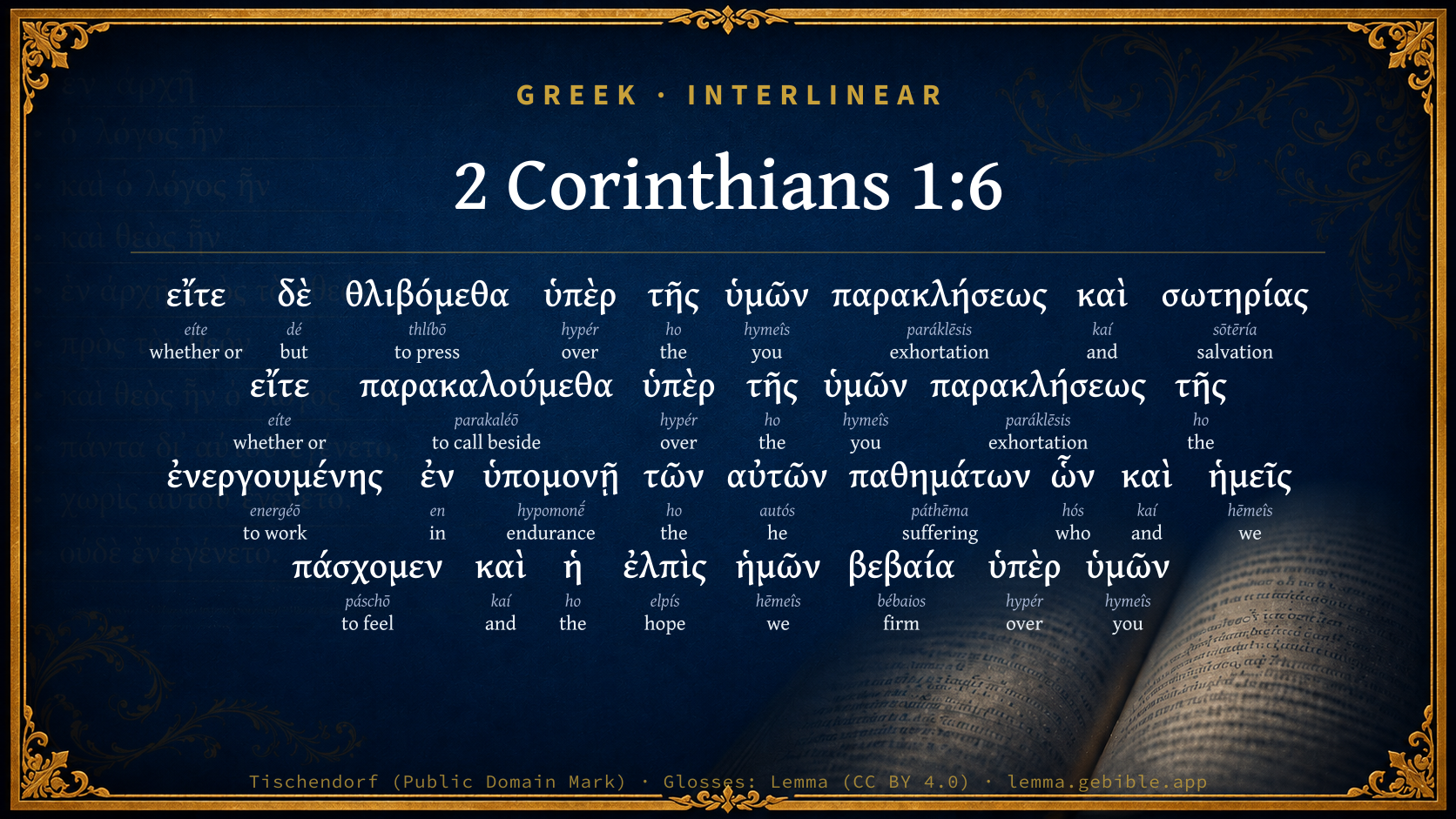
  1. εἴτε eíte G1535 “whether or” Conjunction
  2. δὲ dé G1161 “but” Conjunction
  3. θλιβόμεθα thlíbō G2346 “to press” Verb, Present, Passive, Indicative, 1st person, Plural
  4. ὑπὲρ hypér G5228 “over” Preposition
  5. τῆς ho G3588 “the” Article, Genitive, Singular, Feminine
  6. ὑμῶν hymeîs G5210 “you” Personal pronoun, 2nd person, Genitive, Plural
  7. παρακλήσεως paráklēsis G3874 “exhortation” Noun, Genitive, Singular, Feminine
  8. καὶ kaí G2532 “and” Conjunction
  9. σωτηρίας sōtēría G4991 “salvation” Noun, Genitive, Singular, Feminine
  10. εἴτε eíte G1535 “whether or” Conjunction
  11. παρακαλούμεθα parakaléō G3870 “to call beside” Verb, Present, Passive, Indicative, 1st person, Plural
  12. ὑπὲρ hypér G5228 “over” Preposition
  13. τῆς ho G3588 “the” Article, Genitive, Singular, Feminine
  14. ὑμῶν hymeîs G5210 “you” Personal pronoun, 2nd person, Genitive, Plural
  15. παρακλήσεως paráklēsis G3874 “exhortation” Noun, Genitive, Singular, Feminine
  16. τῆς ho G3588 “the” Article, Genitive, Singular, Feminine
  17. ἐνεργουμένης energéō G1754 “to work” Verb, Present, Middle, Participle, Genitive, Singular, Feminine
  18. ἐν en G1722 “in” Preposition
  19. ὑπομονῇ hypomonḗ G5281 “endurance” Noun, Dative, Singular, Feminine
  20. τῶν ho G3588 “the” Article, Genitive, Plural, Neuter
  21. αὐτῶν autós G846 “he” Personal pronoun, Genitive, Plural, Neuter
  22. παθημάτων páthēma G3804 “suffering” Noun, Genitive, Plural, Neuter
  23. ὧν hós G3739 “who” Relative pronoun, Genitive, Plural, Neuter
  24. καὶ kaí G2532 “and” Conjunction
  25. ἡμεῖς hēmeîs G2249 “we” Personal pronoun, 1st person, Nominative, Plural
  26. πάσχομεν páschō G3958 “to feel” Verb, Present, Active, Indicative, 1st person, Plural
  27. καὶ kaí G2532 “and” Conjunction
  28. ἡ ho G3588 “the” Article, Nominative, Singular, Feminine
  29. ἐλπὶς elpís G1680 “hope” Noun, Nominative, Singular, Feminine
  30. ἡμῶν hēmeîs G2249 “we” Personal pronoun, 1st person, Genitive, Plural
  31. ὑπὲρ hypér G5228 “over” Preposition
  32. ὑμῶν hymeîs G5210 “you” Personal pronoun, 2nd person, Genitive, Plural

About this verse

These counts appear in no published source. They are computed here, from the morphology-tagged text and Lemma’s own curated glosses. What Lemma adds →

33
words
20
distinct lemmas
Pauline Epistles
section

Notable vocabulary

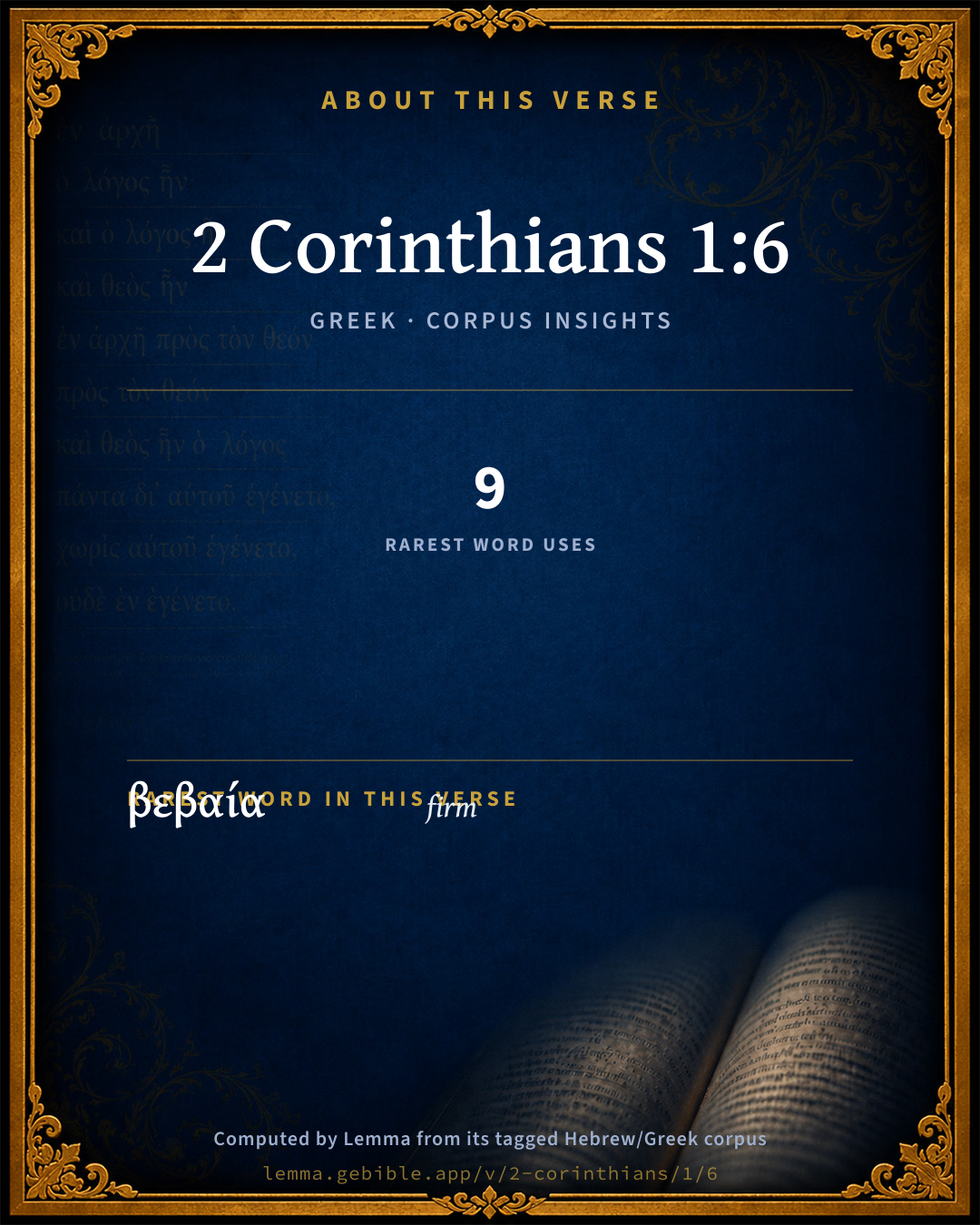
The rarest word here is βεβαία firm G949 — appearing just 9 times in the whole Greek New Testament.

Shared distinctive vocabulary

βεβαία firm G949 occurs in 9 verses of the Greek New Testament. Also found in:

Repetition

Words recur within this verse:

  • ὑπὲρ over G5228 ×3
  • εἴτε whether or G1535 ×2
  • παρακλήσεως exhortation G3874 ×2
  • τῆς the G3588 ×5
  • ὑμῶν you G5210 ×3
  • καὶ and G2532 ×3
  • ἡμεῖς we G2249 ×2

Cross-references

12

Topical passages linked to 2 Corinthians 1:6 in the Treasury of Scripture Knowledge — connected by theme and wording, ordered by reader-vote popularity; previews shown in the World English Bible.

  • 2 Timothy 2:10 Therefore I endure all things for the chosen ones' sake, that they also may obtain the salvation which is in Christ Jesus with eternal glory.
  • 2 Corinthians 4:15–18 For all things are for your sakes, that the grace, being multiplied through the many, may cause the thanksgiving to abound to the glory of God.
  • 2 Corinthians 1:4 who comforts us in all our affliction, that we may be able to comfort those who are in any affliction, through the comfort with which we ourselves are comforted by God.
  • Romans 8:28 We know that all things work together for good for those who love God, to those who are called according to his purpose.
  • Ephesians 3:13 Therefore I ask that you may not lose heart at my troubles for you, which are your glory.
  • Philippians 1:19 For I know that this will turn out to my salvation, through your supplication and the supply of the Spirit of Jesus Christ,
  • 2 Corinthians 5:5 Now he who made us for this very thing is God, who also gave to us the down payment of the Spirit.
  • 2 Corinthians 12:15 I will most gladly spend and be spent for your souls. If I love you more abundantly, am I loved the less?
  • Hebrews 12:10–11 For they indeed, for a few days, punished us as seemed good to them; but he for our profit, that we may be partakers of his holiness.
  • Romans 5:3–5 Not only this, but we also rejoice in our sufferings, knowing that suffering works perseverance;
  • 1 Corinthians 3:21–23 Therefore let no one boast in men. For all things are yours,
  • Acts 21:5 When it happened that we had accomplished the days, we departed and went on our journey. They all, with wives and children, brought us on our way until we were out of the city. Kneeling down on the beach, we prayed.

Cross-references courtesy of OpenBible.info (CC BY 4.0).

Where the printed editions differ

2 variants

Places in this verse where the major printed Greek editions disagree on the wording in a way that affects the translation — a comparison of editions, not a manuscript-by-manuscript collation. The editions are the modern critical texts (Nestlé-Aland 28/27, SBL, Westcott-Hort, Tregelles, Tyndale House) and the traditional texts behind the KJV (the Textus Receptus and the Byzantine/Majority text). It is not a claim about which reading is original.

  1. Extra text
    και

    “and”

    In Tyn»19Treg»12TR»12Byz»12 Not in NA28NA27TynSBLWHTregTRByz
  2. Extra text
    σωτηριας

    “salvation”

    In Tyn»18Treg»11TR»11Byz»11 Not in NA28NA27TynSBLWHTregTRByz

    και σωτηριας (kai sōtērias) 'and salvation' is only in traditional manuscripts (Tyn+Treg+TR+Byz)

Textual data: Translators Amalgamated Greek New Testament (STEPBible TAGNT) · CC BY 4.0.

Commentary

Notes on 2 Corinthians 1:6 from classic Christian and Jewish commentators (each source and its license shown beneath its notes). The classic Christian expositions comment on the surrounding passage and are grouped to its opening verse, so a note may address several verses; the Jewish commentaries on the Tanakh (Rashi and others) are per-verse, so they appear only where the commentator wrote on this verse.

Lemma curates 59 commentaries, every one of them public domain or Creative Commons licensed, each selected and text-cleaned for this edition rather than reprinted as found. About our sources →

The Biblical Illustrator

Joseph S. Exell

2Co_1:6-11

And whether we be afflicted … or whether we be comforted, it is for your consolation and salvation.

--

Personal sufferings

I. Are often experienced in the rest of enterprises (2Co_11:23; 2Co_11:29).

II. Are ever necessary for the rendering of the highest service to mankind (verse6).

III. Their detailment purely for the good of others is justifiable (2Co_1:8).

IV. Their experience often proves a blessing to the sufferer. They seem to have done two things for Paul--

1. To have transferred his trust in himself to God (2Co_1:9).

2. To have awakened the prayers of others on his behalf (2Co_1:11). (D. Thomas, D. D.)

The peculiar afflictions of Gods people

I. God suffers his children to fall into great extremities.

1. To try what mettle they are made of. Light afflictions will not try them thoroughly, great ones will. What we are in great afflictions, we are indeed.

2. To try the sincerity of our estate, to make us known to the world and known to ourselves. A man knows not what a deal of looseness he hath in his heart, and what a deal of falseness, till we come to extremity.

3. To set an edge upon our desires and our prayers (Psa_130:1).

4. To exercise our faith and patience.

5. To perfect the work of mortification.

6. To prepare us for greater blessings. Humility doth empty the soul, and crosses do breed humility. The emptiness of the soul fits it for receipt. Why doth the husbandman rend his ground with the plough? Is it because he hath an ill mind to the ground? No. He means to sow good seed there, and he will not plough a whir longer than may serve to prepare the ground (Isa_28:24). So likewise the goldsmith, the best metal that he hath, he tempers it, he labours to consume the dross of it, and the longer it is in the fire the more pure it comes forth.

7. That we might set a price upon the comforts when they come.

8. Learn, then--

(1) Not to pass a harsh, rigid censure upon ourselves or others for any great affliction or abasement in this world.

(2) Not to build overmuch confidence on earthly things.

II. As Gods children are brought to this estate, so they are sensible of it. They are flesh and not steel (Job_6:12). They are men and not stones. They are Christians and not Stoics.

III. We may triumph over death by faith and grace. That we may not fear death overmuch, let us look upon it in the glass of the gospel as it is now in Christ, and meditate on the two terms, from whence and whither. What a blessed change it is if we be in Christ! (R. Sibbes, D. D.)

But we had the sentence of death in ourselves, that we should not trust in ourselves, but in God which raiseth the dead.--

Death a sentence

Death is--

I. A sentence.

1. Universal.

2. Just.

3. Irrevocable.

II. As a sentence in man. We have the sentence of death in ourselves.

1. The sentence of death is in mans body. It is born with him, and it continues to work within until the organisation falls back to its original dust. The moment we begin to live we all begin to die.

2. The sentence of death is in mans mind. There it dwells as a dark thought spreading a gloom over the whole of his life. It haunts the memory, it terrifies the conscience. It is in us, we cannot get rid of it. No science can expel it from the body, no reason can argue it from the soul.

III. As a sentence in man for useful ends. What are the spiritual uses it is designed to answer?

1. Nontrust in self. Not trust in ourselves. There is a self-reliance that is a duty. But there is a self-confidence that is sinful and ruinous. Now the sentence of death tends to check this. It makes man feel his frailty. Thank God for death, it keeps down the arrogant spirit of humanity.

2. Devout trust in God. But in God that raiseth the dead. Mans well-being is essentially dependent upon trust in God. (Homilist.)

Sentence of death, the death of self-trust

1. We are justified in speaking about our own experience when it will be for the benefit of others. Especially is this the case with leaders in the Church such as Paul. As to our own experience of trial and delivering mercy, it is sent for our good, and we should endeavour to profit to the utmost by it; but it was never intended that it should end with our private benefit. We are bound to comfort others by the comfort wherewith the Lord hath comforted us.

2. The particular experience of which Paul speaks was a certain trial, or probably series of trials, which he endured in Asia. You know how he was stoned at Lystra, and how he was followed by his malicious countrymen from town to town. You recollect the uproar at Ephesus, and the constant danger to which Paul was exposed from perils of all kinds; but he appears to have been suffering at the same time grievous sickness of body, and the whole together caused very deep depression of mind. His tribulations abounded.

Note--

I. The disease--the tendency to trust in ourselves is--

1. One to which all men are liable, for even Paul was in danger of it. Where a sharp preventive is used it is clear that a strong liability exists. I should have thought that Paul was the last man to be in this danger. Self-confidence he is always disclaiming. He looks upon his own righteousness as dross, and By the grace of God, saith he, I am what I am. It is plain, then, that no clearness of knowledge, no purity of intent, and no depth of experience can altogether kill the propensity to self-reliance.

2. Evil in all men, since it was evil in an apostle. Paul speaks of it as a fault which God in mercy prevented. At first sight it seems that there was somewhat in him whereof he might glory. What folly would be ours, then, if we became self-sufficient! If a lions strength be insufficient, what can the dogs do? If the oak trembles, how can the brambles boast?

3. Highly injurious, since God Himself interposed to prevent His servant from falling into it by sending a great trouble. Depend upon it, He is doing the same for us, since we have even greater need. Anything is better than vain-glory and self-esteem.

4. Very hard to cure; for to prevent it in Paul it was necessary for the Great Physician to go the length of making him feel the sentence of death in himself.

II. The treatment. We had the sentence of death in ourselves, which means that--

1. He seemed to hear the verdict of death passed upon him by the conditions which surrounded him. So continually hounded by his malicious countrymen, etc., he felt certain that one day or other they would compass his destruction. The original conveys the idea, not only of a verdict from without, but of an answer of assent from within, a sort of presentiment that he was soon to die. And yet it was not so: he survived all the designs of the foe. We often feel a thousand deaths in fearing one. Into a low state of spirit was Paul brought, and this prevented his trusting in himself. The man who feels that he is about to die is no longer able to trust in himself. What earthly thing can help us when we are about to die? Paul felt as every dying Christian must, that he must commit his spirit unto Christ and watch for His appearing.

2. The sentence of death which he heard outside wrought within his soul a sense of entire helplessness. He was striving to fight for the kingdom of Christ, but he saw that he must be baffled if he had nothing to rely upon but himself. Pauls mind was so struck with death within himself that he could not stem the torrent, and would have drifted to despair had he not given himself up into the hands of grace Divine.

III. The cure. It was sharp medicine, but it worked well with Paul.

1. He argued, If I die, what matters it? God can raise me from the dead. I know that my Redeemer liveth.

2. He inferred, also, that if God could raise him from the dead He could preserve him from a violent death. Immortal is every believer till his work is done.

3. He argued yet further that if God can raise the dead He could take his fainting powers, over which the sentence of death has passed, and He could use them for His own purposes. (C. H. Spurgeon.)

Who delivered us from so great a death.--

Gods deliverances

1. God hath a time, as for all things, so for our deliverance.

2. Gods time is the best time. He is the best discerner of opportunities.

3. This shall be when He hath wrought His work upon our souls, specially when He hath made us trust in Him. As here, when Paul had learned to trust in God, then He delivered him. (R. Sibbes, D. D.)

A great deliverance

First, we have here the terms of the deliverance, or the thing delivered from--so great a death. For the evil itself--death, and for the aggravation of it--a great death. Chrysostom, together with some others, gives it in the plural number, so great deaths. And, indeed, there are more deaths than one which God does undertake to deliver His servants from, and from which He delivered St. Paul and his companions. First, from spiritual death, the death of sin; that is a very great death, not only as exposing to wrath and future condemnation, but likewise as disabling to the actions of grace and holiness, depriving us of that life of God which should be in us (Eph_4:18). And this death of sin is to be numbered among great deaths, and the deliverance from it reckoned among great deliverances. Secondly, eternal death, the death of wrath and condemnation, that is another great death also, and such as follows likewise upon the former without recovery from it. The third, and that which is here particularly aimed at, is temporal death, which is the least death of all. The greater aggravations we may take in these following particulars. First, from the nature and kind of it, a violent death, not a natural. This is a great death, and so consequently a great mercy to be delivered from it, to be kept from accidents. As for wicked men, it is threatened as a judgment upon them that a tempest shall steal them away (Job_27:20). The second is, from the quality and manner of it, a painful death, not a gentle and easy. Death is unpleasing in itself; but when to this we shall add pain and torture, this makes it to be so much the more. This was that which the many of godly martyrs endured (Heb_11:35). Thirdly, take in another from the coming and proceeding of it--a sudden death and not an expected. Fourthly, from the time and season of it, when it is an hastened death, not a mature one (Ecc_7:17; Psa_55:23). It is said of bloody and deceitful men that they shall not live out half their days; for men not to live out half their days is reckoned in the catalogue of great deaths. Fifthly, the greatness of death has an aggravation of it from its latitude and extent. That is a great death which devours multitudes at once. And then what kind of us were they? Take in, secondly, the quality of persons, such as were especially useful--an apostle and the ministers of Christ; for these to be delivered from death, it was to be delivered from a great death. The death of none is to be slighted, though never so mean; but the death of men who are eminent for their gifts and graces is much to be set by. Sixthly, a great death in regard of the proximity and nearness of the evil itself. It was, as it were, at the very next door. A great death, that is, indeed, a great danger, so some read the words. Lastly, a great death also in regard of the apprehensions of those which were in danger of it. That which is great in our thoughts, to us it is great. And so was this here to the Apostle Paul and his company, as we may see in the verse before the text, We had the sentence of death in ourselves, that is, we gave ourselves for dead men. So great a death! Here is now the nature of thankfulness, to extend the mercies of God, and to make them as great as may be. The second particular is the preservation or deliverance itself, And doth deliver, etc. And here again take notice of two things more. First, for the thing itself; this is that which we may here observe how ready God is to deliver His people from death, and from great death (Psa_57:13; Psa_116:8; Psa_118:18). And so in like manner other of the saints. There are many gracious promises to this purpose, as Job_5:20, He shall redeem thy soul from death. First, out of pity and compassion towards them. Look how much sweetness there is in life, so much mercy in preservation from death. Secondly, He has work for them to do, and some service which He requires from them. When we put ourselves out of service we put ourselves out of protection. When we lay ourselves aside as to our work, we do in a manner hasten our end, and ring our own passing bell. Thirdly, God does further delight to frustrate the attempts of enemies, and those that conspire the death of His servants, and for this cause will deliver them from it. We may in the second place look upon it in the reflection, as coming from the apostle, God had delivered him, and he did not now let it pass without notice. This is a duty, to take notice of those deliverances which God at any time has vouchsafed unto us. Thankfulness is the least which we can return upon God for deliverance. That God has delivered us, and from a great death. First, for the person delivering, it was God. Secondly, for the persons delivered, we may add also us, it is we which are delivered. The deliverance of others has cause for joy. But when ourselves are interested in any deliverance, this should more work upon us. Thirdly, for the terms also of deliverance, so great a death, so great as it is hard to declare how great it was. The second now follows, and that is the signification of a deliverance present, in these words, And doth deliver, He that hath delivered, does deliver. It is very fitly put in the present tense, and also indefinitely, because God is never out of this work of deliverance of us. This may be made good according to a twofold explication. First, God does still deliver so far forth as He does confirm and make good His former deliverance. God, when He delivers His people, but He still pursues them with His deliverance further. As there is preventing and antecedent grace, so there is following and subsequent grace. And as there is the grace of conversion, so there is likewise the grace of confirmation. Thus, for example, when God delivered the Israelites from the Egyptians at the Red Sea. What, did He only deliver them in that juncture of time? No, but even all the time after they did reap the fruit of that deliverance till they came to Canaan. Secondly, God does deliver, even after that He has delivered already. In renewing upon us the like mercies again, and in vouchsafing the same deliverances for kind as He has formerly done. So likewise for spiritual deliverances, God does deliver after deliverances. The efficacy of Christs death is extended beyond the time of His sufferings to all following generations. The third and last is the prognostication of a deliverance to come, In whom we trust also, that He will yet deliver us. We see this excellent gradation how the apostle proceeds from one thing to another, from time past to time present, and from time present to time to come. What we may observe from hence. That deliverances which are past are a very good ground for expecting of deliverances to come; or if ye will thus, God that has delivered hitherto He will likewise deliver again. This is the sweetest heavenly reasoning of the saints and servants of God, even to argue thus with themselves and to draw deductions of expectation from former experience. What God will do from what He has done, and that also upon weighty considerations. First, His ability and power. In men this is many times defective, so that we cannot so happily conclude of the one from the other, of future goodness from former, because their power and opportunity may be gone. And then further, here is an argument likewise from the greater to the less, He that has done the one He can do the other too; He that has delivered from so great a death He can much more deliver from a smaller danger. Secondly, there is in God a perpetuity of affection too. It is of the Lords mercy that we are not consumed, because His compassions fail not (Lam_3:22). Thirdly, there is in God exactness and a desire to perfect His own work; now this He should not be able to do, if together with deliverances which are past He should not join deliverances to come. The improvement of it may be in a double way of application. First, for our own private and particular, we should learn from this present doctrine to treasure up unto ourselves ground of expectation of more from God in a way of deliverance and preservation, by considering what He has done for us heretofore in like exigencies. Thus the mariner or traveller by sea may reason, God has delivered me in such a storm and in such a tempest, I am now in the same lawful way and He will deliver me again. So likewise in the second place we may also carry it (as more pertinent to the occasion) to the Church and State in general, and reason so for that. He has delivered and does deliver, and we trust that He will yet deliver us. God does not do things all at once, but by time and degrees, He makes one thing a preparation to another, and a ground and argument for the expectation of it, and so as we may in a manner see His footsteps in it. (Thomas Horton, D. D.)

The tenses

The text--

I. Suggests three trains of thought.

1. Memory tells of deliverance in the past. From--

(1) Violent death.

(2) Our death in sin: So great a death, indeed.

(3) Fierce despair when under conviction.

(4) Total overthrow when tempted by Satan.

(5) Faintness under daily tribulation.

(6) Destruction by slander and the like. The Lord has graciously delivered us hitherto. Let us express our gratitude.

2. Observation calls attention to present deliverance. By the good hand of the Lord we are at this time preserved from--

(1) Unseen dangers to life.

(2) The subtle assaults of Satan.

(3) The rampant errors of the times.

(4) Inbred sin and natural corruption.

(5) The sentence of death within, and the greater danger of self-trust (verse 9).

Our present standing is wholly due to the grace of God, and, trusting in that grace, we may indulge a happy confidence.

3. Expectation looks out of the window upon the future.

(1) Faith rests alone in God, in whom we trust, and through Him she looks for future deliverance.

(a) From all future common trials.

(b) From coming losses and afflictions, and from sicknesses, which may be coming upon us.

(c) From the infirmities and wants of age.

(d) From the peculiar glooms of death.

(2) This expectation makes us march on with cheerfulness.

II. Supplies three lines of argument. That the Lord will preserve us to the end is most sure. We can say of Him, In whom we trust that He will yet deliver us.

1. From the Lords beginning to deliver we argue that He will yet deriver, for--

(1) There was no reason in us for His beginning to love us. If His love arises out of His own nature it will continue.

(2) He has obtained no fresh knowledge. He foreknew all our misbehaviours: hence there is no reason for casting us off.

(3) The reason which moved Him at first is operating now, and none better can be required.

2. From the Lords continuing to deliver we argue that He will yet deliver; for--

(1) His deliverances have been so many.

(2) They have displayed such wisdom and power.

(3) They have come to us when we have been so unworthy.

(4) They have continued in such an unbroken line. That we feel sure He will never leave nor forsake us.

3. From the Lord Himself--In whom we trust: we argue that He will yet deliver; for--

(1) He is as loving and strong now as aforetime.

(2) He will be the same in the future.

(3) His purpose never changes, and it is to His glory to complete what He has begun.

III. Is open to three inferences.

1. That we shall always be so in danger as to need to be delivered; wherefore we are not high-minded, but fear.

2. Our constant need of Gods own interposition. He alone has met our case in the past, and He only can meet it in the future; wherefore we would ever abide near our Lord.

3. That our whole life should be filled with the praise of God, who, for past, present, and future, is our Deliverer. (C. H. Spurgeon.)

The Biblical Illustrator, edited by Joseph S. Exell (c. 1880s–1900s) — public domain. Text from a community e-Sword module.

Tyndale Open Study Notes

Tyndale Open Resources

1:6 it is for your comfort and salvation! Paul’s sharing in their troubles and offering of encouragement promotes their spiritual well-being.

Tyndale Open Study Notes — © Tyndale Open Resources, licensed CC BY-SA 4.0. Text via the HelloAO Bible API.

Bengel's Gnomon

Johann Albrecht Bengel

2Co 1:6. Εἴτε δὲ θλιβόμεθα, κ.τ.λ., and, whether we be afflicted, etc.) The meaning is this, εἴτε δὲ θλιβόμεθα (θλιβόμεθα) ὑπὲρ τῆς ὑμῶν παρακλήσεως καὶ σωτηρίας· εἰτε παρακαλούμεθα (παρακαλούμεθα) ὑπὲρ κτλ, and whether we be afflicted (we are afflicted) for your consolation and salvation; or whether we be comforted (we are comforted) for your consolation, which operates in enabling you to endure the same adversities which we also endure, and our hope for you is stedfast; knowing that as you are partakers of the sufferings (adversities), so also of the consolation. As in Php 1:16; Php 1:19, θλίψις and σωτηρία are opposed to each other; so here θλίψις, the affliction of the ministers of the Gospel, and the consolation and salvation of the Corinthians, are opposed to each other, in the same way as the death of the former [the ministers] and the life of the latter [the Corinthians], 2Co 4:12. Furthermore, as though consolation and salvation of the Corinthians depend on the affliction of the ministers of the Gospel; so the consolation of the Corinthians, and the hope of the ministers in their behalf, depend on the consolation of the ministers. The participle knowing depends on the verbs, we are afflicted, and we are comforted, understood. Thus the members of this period are consistent with one another, of which the various transpositions are noticed in the Apparatus.[1] We shall now explain some of these words in particular.—ΕἼΤΕ, whether) sometimes we are more sensible of adversities, sometimes of consolation.—ὑμῶν, your) The communion of saints, cultivated in the heart of Paul, Titus, the Corinthians, and other Churches, is admirably represented in this epistle, 2Co 2:3, 2Co 4:15, 2Co 6:12, 2Co 7:7; 2Co 7:13, 2Co 9:12. These hearts were, so to speak, mirrors reflecting the likenesses of each other; comp. Php 2:26-27.—παρακλήσεως, consolation) in the soul.—σωτηρίας, salvation) in fact [in reality].—τῆς ἐνεργουμένης) in the Middle voice, 2Co 4:12; Rom 7:5.—ΤῶΝ ΑὐΤῶΝ) the same, in point of number. The adversities [sufferings] of Paul were the same as those of the Corinthians, who were in the heart of Paul: 2Co 6:12; and the fruit of those sufferings redounded to their advantage, although they [the sufferings] had prevented him from coming to Corinth. A mutual participation [in sufferings and consolation] is declared.—πάσχομεν, ΚΑῚ Ἡ ἘΛΠῚς, we suffer, and the hope) Hope is usually joined with the mention of afflictions and patience, 2Co 1:10; Rom 5:3-4; Rom 15:4.—βεβαία, is stedfast) It obtained stedfastness through adversity.

[1] BD (Λ) Gfg Syr. later, place εἲτε παρακαλούμεθα ὑπὲρ τῆς ὑμῶν παρακλήσεως καὶ σωτηρίας after ὑπὲρ ὑμῶν, and before εἰδότες. AC Vulg. Syr. Memph. omit καὶ σωτηριας. (Many MSS. of Vulg. have the et Salute), and place the rest of the words before τῆς ἐνεργουμένης. Rec. Text without good authority, places the words before καὶ ἡ ἐλπὶς.—ED.

Bengel's Gnomon of the New Testament — English translation (T&T Clark, Edinburgh, 1860) — public domain. Text from a community e-Sword module.

Meyer's Critical & Exegetical Commentary

Heinrich August Wilhelm Meyer

2Co_1:6-7. Δέ] leading on to the gain, which the two, this affliction and this comforting, bring to the readers.

Be it that we are afflicted, we are afflicted for the sake of YOUR consolation and salvation; it redounds to this, that you are to be comforted and advanced in the attainment of Messianic salvation. In how far? According to Erasmus, Calvin, Estius, Calovius, Wetstein, and many, including Rosenmüller, Flatt, Emmerling, Reiche: through the example of the apostle in his confidence toward God, etc. But the context has as little of this as of what is imported by Billroth and Olshausen: in so far as I suffer in the service of the gospel, through which comfort and salvation come to you; so also Hofmann. Rückert, without ground, gives up all attempt at explanation. Paul himself has given the explanation in 2Co_1:4 by εἰς τὸ δύνασθαι ἡμᾶς παρακαλεῖν κ.τ.λ. Hence the sense of the definition of the aim ὑπὲρ τῆς ὑμῶν παρακλ. κ. σωτ.: in order that we may be enabled to comfort you, when ye come into affliction, and to further your salvation. For this end we are put in a position by experience of suffering, as well as by that, which is its other side, by our experience of comfort in the school of suffering (εἵτε παρακαλούμεθα κ.τ.λ.).

ὑπὲρ τῆς ὑμ. παρακλ. τῆς ἐνεργ. κ.τ.λ.] i.e. in order to be able to give you the comfort, which is efficacious, etc. Paul does not again add κ. σωτηρίας here, because he has still to append to παρακλήσεως a more precise and detailed explanation, after which it was impracticable to bring in καὶ σωτηρίας; and it could be left out all the more readily, as it did not belong essentially to the representatio.

τῆς ἐνεργουμ. ἐν ὑπομ. κ.τ.λ.] which is efficacious in patient endurance of the same sufferings, which we also suffer. ἐνεργουμ., as in the whole N. T. (2Co_4:12; Rom_7:5; Gal_5:6; Eph_3:20; Col_1:29; 1Th_2:13; 2Th_2:7; Jam_5:16), is middle, not passive (3 Esdr. 2:20; Polyb. i. 13. 5, ix. 12. 3), as it is here erroneously taken by Oecumenius, Theophylact, Castalio, Piscator, Calvin, Grotius, Estius, and others, including Rosenmüller, Emmerling, Billroth, Rückert, Ewald.[123] For the distinction between active (personal efficacy) and middle in Paul, see Winer, p. 242 [E. T. 273].

ἐν ὑπομονῇ] denotes that by virtue of providing which the παράκλησις is efficacious. It is therefore the working of the Christian ΠΑΡΆΚΛΗΣΙς, which we experience when Ἡ ΘΛΊΨΙς ὙΠΟΜΟΝῊΝ ΚΑΤΕΡΓΆΖΕΤΑΙ, Rom_5:3.

ΤῶΝ ΑὐΤῶΝ ΠΑΘΗΜΆΤΩΝ, ὯΝ Κ.Τ.Λ.] in so far, namely, as they are likewise sufferings of Christ. The sufferings appointed to the readers are meant, which do not differ in kind from the sufferings of Paul (and Timothy) (ὧν κ. ἡμεῖς πάσχομεν). Billroth, Olshausen, Neander understand the sufferings of the apostle himself, in so far as these were jointly felt by all believers as their own in virtue of their fellowship of love with him. Compare Chrysostom on 2Co_1:7, also de Wette, who refers it partly to the foreboding, partly to the sympathetic joint-suffering. But, then, Paul would have been utterly illogical in placing the καί before ἩΜΕῖς; for it would, in fact, be sufferings which the readers also had suffered (with Paul through their loving sympathy). How erroneous this exposition is, is shown, besides, by 2Co_1:4. It does not appear from this passage, we may add, that at that time the Corinthians had otherwise to endure affliction for the gospels sake. Paul has rather in view the case of such affliction occurring in the future, as the following καὶ ἡ ἐλπὶς κ.τ.λ. proves. Comp. on 2Co_13:11.

ΚΑῚ Ἡ ἘΛΠ. ἩΜ. ΒΕΒ. ὙΠ. ὙΜ.] is not to be placed in a parenthesis, with Griesbach and others, since ΕἸΔΌΤΕς is connected not with ΠΆΣΧΟΜΕΝ, but with Ἡ ἘΛΠῚς ἩΜῶΝ. The contents of 2Co_1:6, namely, is not the expression of a present experience undergone by the readers, but the expression of good hope as to the readers for the future, that what is said by εἴτε δὲ θλιβόμεθα … πάσχομεν will be verified in their case in afflictions which would come on them for Christs sake, so that they would in that case obtain from the apostle, out of his experience of suffering and consolation, the comfort which through patience is efficacious in such sufferings. Therefore he continues: and our hope is firm on account of you. ὑπὲρ ὑμῶν does not belong either simply to Ἡ ἘΛΠ. ὙΜ., or simply to ΒΕΒΑΊΑ (Billroth), but to the whole thought of Ἡ ἘΛΠ. ὙΜ. ΒΕΒ. On ὙΠΈΡ, comp. Polyb. xi. 20. 6, xiv. 1. 5, and the contrary expression ΦΟΒΕῖΣΘΑΙ ὙΠΈΡ ΤΙΝΟς, propter aliquem in metu esse.

εἰδότες] refers, according to a common anacolouthon, to Ἡ ἘΛΠῚς ἩΜ., in which ἩΜΕῖς is the logical subject.[124] See Stall-baum, ad Apol. p. 21 C, Phaedr. p. 241 D, Phaedo, p. 81 A; Fritzsche, Dissert. II. p. 49. Comp. on Eph_4:2; Col_2:2. It introduces the certainty on which rests the hope just expressed: for we know that you, as you are sharers of the sufferings, are sharers also of the consolation. To have a share in the sufferings, and also in the consolation, to be excepted neither from the one nor from the other, is the appointed lot of the Christian. Paul knows this in regard to his readers, and he grounds on it the firm hope for them, that if they shall have their share in bearing sufferings, they will in that case not lack the effectual consolation; to impart which consolation he is himself qualified (2Co_1:4) and destined (2Co_1:6) by his own experience of suffering and consolation. Accordingly, κοινωνοὶ κ.τ.λ. is contextually not to be explained of an ideal, sympathetic communion, and that in the sufferings and consolation of Paul (ὥσπερ γὰρ τὰ παθήματα τὰ ἡμέτερα ὑμέτερα εἶναι νομίζετε, οὕτω καὶ τὴν παράκλησιν τὴν ἡμετέραν ὑμετέραν, Chrysostom. Comp. Theodoret, Grotius, Billroth, Olshausen, and others), but τὰ παθήματα and ἡ παράκλησις are to be taken generically. In both kinds of experience the Christian has a share; he must suffer; but he is not excluded from the consolation, on the contrary, he partakes also in it.

[123] The passive interpretation would be necessary with the reading of Lachmann, since salvation is the goal of the state of grace, and hence is wrought (Php_2:12-13; Mat_10:22; Jam_1:12); but nowhere is it conceived and represented as working in patience, and the like. This tells against that reading.

[124] With Lachmanns reading it is referred by Reiche and Ewald to the Corinthians (ὑμῶν); since you know, etc.

Meyer — Critical and Exegetical Commentary on the New Testament — English translation by Peter Christie, edited by Frederick Crombie (T&T Clark, 1880) — public domain. Text from a community e-Sword module.

Expositor's Greek Testament

ed. W. Robertson Nicoll

2Co 1:6-7 . We follow the reading of the Revisers (see crit. note) and translate: But whether we be afflicted, it is for your comfort and salvation; or whether we be comforted, it is for your comfort, which worketh in the patient endurance of the same things which we also suffer: and our hope for you is steadfast; knowing that as ye are partakers of the sufferings, so also are ye of the comfort . This is an expansion of the εἰς τὸ δύνασθαι κ . τ . λ . of 2Co 1:4 : the Apostle’s afflictions and consolations alike are for the sake of his converts; they and he have a common fellowship in Christ, with all which that involves of sympathy with each other. The nearest parallel (see reff.) is Eph 3:13 , διὸ αἰτοῦμαι μὴ ἐνκακεῖν ἐν ταῖς θλίψεσίν μου ὑπὲρ ὑμῶν , ἥτις ἐστὶν δόξα ὑμῶν . For the constr. εἴτε … εἴτε cf. chap. 2Co 5:13 and 1Co 12:26 . Note that ἐνεργεῖσθαι is always in the N.T. middle , not passive , and is used intransitively (see Rom 7:5 , chap. 2Co 4:12 , Gal 5:6 , Eph 3:20 , Col 1:29 , 1Th 2:13 ); when the verb is used of God it is always in the active voice (1Co 12:6 , Gal 2:8 , etc.). ἐν ὑπομονῇ : ὑπομονή means expectation or hopeful waiting in the canonical books of the LXX; but is often used for steadfast endurance in Ecclus. and in 4 Macc. (see 4Ma 17:12 ). It is a favourite word with St. Paul in this latter sense, in which it is always used in the N.T. ( cf., e.g. , Luk 21:19 , 1Ti 6:11 ); for the juxtaposition of ὑπομονή and παράκλησις see Rom 15:5 . τῶν f1αὐτῶν παθημάτων : the sufferings which the Corinthian brethren must endure are here represented as the same as those of the Apostle; i.e. , the reference is not to any special affliction such as that alluded to in 2Co 1:8 , but to the troubles which came upon him in the general discharge of his Apostolic office and upon all those who were engaged in the struggle against Judaism on the one side and heathendom on the other.

The Expositor's Greek Testament, edited by W. Robertson Nicoll (1897–1910) — public domain. Text from a community e-Sword module.

Geneva Bible (1599)

Geneva Bible translators

Although salvation be given us freely, yet because there is a way appointed us wherewith we must come to it, which is the race of an innocent and upright life, which we must run, therefore we are said to work our salvation, Philippians 2:12. And because it is God only that of his free good will worketh all things in us, therefore is he said to work the salvation in us by those selfsame things by which we must pass to everlasting life, after that we have once overcome all encumbrances.

He denieth that either his afflictions wherewith he was often afflicted, or the consolations which he received of God, may justly be despised, seeing that the Corinthians both might and ought to take great occasion to be confirmed by either of them.

Geneva Bible (1599) marginal notes — public domain. Text via Bolls.life.

Jamieson, Fausset & Brown

Robert Jamieson, A. R. Fausset & David Brown

we . . . afflicted . . . for your consolation--exemplifying the communion of saints. Their hearts were, so to speak, mirrors reflecting the likenesses of each other (Phi 2:26-27) [BENGEL]. Alike the afflictions and the consolations of the apostle tend, as in him so in them, as having communion with him, to their consolation (Co2 1:4; Co2 4:15). The Greek for "afflicted" is the same as before, and ought to be translated, "Whether we be in tribulation."

which is effectual--literally, "worketh effectually."

in the enduring, &c.--that is, in enabling you to endure "the same sufferings which we also suffer." Here follows, in the oldest manuscripts (not as English Version in the beginning of Co2 1:7), the clause, "And our hope is steadfast on your behalf."

Jamieson, Fausset & Brown — Commentary Critical and Explanatory on the Whole Bible (1871) — public domain (CC PDM 1.0). Text via the HelloAO Bible API.

Adam Clarke's Commentary

Verse 6. And whether we be afflicted] See note on 2Co 1:4.

Which is effectual] There is a strange and unusual variation in the MSS. and versions in this passage. Perhaps the whole should be read thus: For if we be afflicted, it is for your encouragement and salvation; and if we be comforted, it is also for your encouragement, which exerted itself by enduring the same sufferings which we also suffer.

This transposition of the middle and last clauses is authorized by the best MSS. and versions. The meaning seems to be this: While ye abide faithful to God, no suffering can be prejudicial to you; on the contrary, it will be advantageous; God having your comfort and salvation continually in view, by all the dispensations of his providence: and while you patiently endure, your salvation is advanced; sufferings and consolations all becoming energetic means of accomplishing the great design, for all things work together for good to them that love God. See the variations in Griesbach.

Adam Clarke's Commentary on the Bible (1810–1826) — public domain. Text from a community e-Sword/MySword module.

John Calvin's Commentaries

6. Whether we are afflicted. From the circumstance that before the clause our hope of you is steadfast, there is introduced the connecting particle and, Erasmus has conceived the idea, that some word must be understood to correspond with those words — for your consolation and salvation — in this way, whether we are afflicted, IT IS for your consolation. I think it, however, more probable, that the connecting particle and is used here as meaning: Thus also, or in both cases. He had already stated, that he received consolation in order that he might communicate it to others. Now he goes a step farther, and says, that he has a steadfast hope, that they would be partakers of the consolation Besides, some of the most ancient Greek manuscripts introduce immediately after the first clause this statement — and our hope of you is steadfast. This reading removes all ambiguity. For when it is introduced in the middle, we must necessarily refer it to the latter clause, equally as to the former. At the same time, if any one wishes to have a complete sentence in each clause, by supplying some verb, there will be no great harm in this, and there will be no great difference as to the meaning. For if you read it as one continued statement, you must, at the same time, explain the different parts in this manner — that the Apostle is afflicted, and is refreshed with consolation for the advantage of the Corinthians; and that he entertains, therefore, the hope, that they will be at length partakers of the same consolation, with what is in reserve for himself. For my own part, I have adopted the way that I have judged the more suitable.

It is, however, to be observed, that the word afflicted here refers not merely to outward misery, but also to that of the mind, so as to correspond with the opposite term comforted. (παρακαλεῖσθαι ) Thus the meaning is, that the person’s mind is pressed down with anxiety from a feeling of misery. What we render consolation, is in the Greek παράκλησις, — a term which signifies also exhortation. If, however, you understand that kind of consolation, by which a person’s mind is lightened of grief, and is raised above it, you will be in possession of Paul’s meaning. For example, Paul himself would well-nigh have fallen down dead under the pressure of so many afflictions, had not God encouraged him, by raising him up by means of his consolation. Thus, too, the Corinthians derive strength and fortitude of mind from his sufferings, while they take comfort from his example. Let us now sum up the whole matter briefly. As he saw that his afflictions were made by some an occasion of holding him in contempt, with the view of calling back the Corinthians from an error of this nature, he shows in the first place that he ought to be in high esteem among them, in consideration of advantage redounding to themselves; and then afterwards he associates them with himself, that they may reckon his afflictions to be in a manner their own. “Whether I suffer afflictions, or experience consolation, it is all for your benefit, and I cherish an assured hope, that you will continue to enjoy this advantage.”

For such were Paul’s afflictions, and his consolations also, that they would have contributed to the edification of the Corinthians, had not the Corinthians of their own accord deprived themselves of the advantage redounding from it. He, accordingly, declares his confidence in the Corinthians to be such, that he entertains the assured hope that it will not be vain, that he has been afflicted, and has received consolation for their advantage. The false apostles made every effort to turn to Paul’s reproach everything that befell him. Had they obtained their wish, the afflictions which he endured for their salvation, had been vain and fruitless; they would have derived no advantage from the consolations with which the Lord refreshed him. To contrivances of this nature he opposes his present confidence. His afflictions tended to promote the comfort of believers, as furnishing them with occasion of confirmation, on their perceiving that he suffered willingly, and endured with fortitude so many hardships for the sake of the gospel. For however we may acknowledge that afflictions ought to be endured by us for the sake of the gospel, we, nevertheless, tremble through a consciousness of our weakness, and think ourselves not prepared for it. In that case, we should call to mind the examples of the saints, which should make us more courageous.

On the other hand, his personal consolation flowed out to the whole Church, inasmuch as they concluded, that God who had sustained and refreshed him in his emergency, would, in like manner, not be wanting to them. Thus their welfare was promoted in both ways, and this is what he introduces as it were by way of parenthesis, when he says — which is made effectual in the endurance, etc. For he wished to add this clause, by way of explanation, that they might not think that they had nothing to do with the afflictions which he alone endured. Erasmus takes the participle γουμένης in an active sense, but a passive signification is more suitable, as Paul designed simply to explain in what respect everything that befell him was for their salvation. He says, accordingly, that he suffers, indeed, alone, but that his sufferings are of use for promoting their salvation — not as though they were expiations or sacrifices for sins, but as edifying them by confirming them. Hence he conjoins consolation and salvation, with the view of pointing out the way in which their salvation was to be accomplished.

John Calvin's Commentaries (1540-1563) — public domain. Text from the Calvin Translation Society English edition (1840s-50s) via the Christian Classics Ethereal Library (ccel.org). Calvin's coverage is partial (roughly two-thirds of the Bible); uncommented books and verses are honest gaps, never fabricated. The 19th-century editor's footnotes and remarks are omitted so the notes are faithfully Calvin's own voice.

Ellicott's Commentary for English Readers

(6) And whether we be afflicted . . .—The better MSS. present some variations in the order of the clauses, some of them giving the words “and our hope of you is steadfast” after “which we also suffer” in this verse. The variation hardly affects the sense in any appreciable degree. That sense is that each stage of the Apostle’s experience, that of affliction no less than that of consolation, tended to make others sharers in the latter and not in the former.

For your consolation and salvation.—The latter word is added as presenting, in modern phrase, the objective side of the result of which St. Paul speaks, while the former gives prominence to the subjective. There was not only the sense of being comforted: there was also the actual deliverance from all real evil, expressed by the word “salvation.” But this deliverance is seen, not in a mere escape from, or avoidance of, sufferings, but in a patient, steadfast endurance of them.

Which is effectual.—Better, which worketh. The word is the same as in “faith working by love” in Gal_5:6.

Which we also suffer.—What these are has not yet been specifically stated. It is assumed that the sufferings of all Christians have much in common. All have to suffer persecution from without (Act_14:22). All have anxieties, sorrows, disappointments, which bring a keener pain than the ills that threaten the spoiling of goods or even life itself.

A Bible Commentary for English Readers, edited by Charles John Ellicott (1878–1897) — public domain. Text from a community e-Sword module.

The Cambridge Bible for Schools and Colleges

gen. ed. J. J. S. Perowne

6. And whether we be afflicted, it is for your consolation and salvation] The same may be said of every kind of suffering endured for the cause of God and of truth. It is not merely, as in Heb_12:6 (Cf. Deu_8:5), that ‘whom the Lord loveth, He chasteneth’ for his own sake, but that the sufferings one man endures for a good cause are the source of profit to others. Cf. chap. 2Co_4:15-16; Eph_3:13; 2Ti_2:10.

which is effectual in the enduring of the same sufferings which we also suffer] Is effectual may either be translated passively (as Chrysostom and the margin of A. V.) is wrought out, or, with most commentators, as middle, works actively in you. That is either (1) consolation and safety from the power of evil are wrought in you by the endurance of suffering, or (2) that consolation (or rather encouragement) and safety from evil work themselves out by the endurance of suffering. The former gives the simpler meaning, the latter is more according to the usus loquendi of the N. T.

The Cambridge Bible for Schools and Colleges (gen. ed. J. J. S. Perowne; Cambridge University Press, 1878–1918) — public domain. Text from a community e-Sword module.

John Gill's Exposition

And whether we be afflicted it is for your consolation,.... The apostle repeats and explains the end of both his comforts and his troubles, and shows, by a dilemma, a strong way of arguing, that the afflictions and consolations, the adversity and prosperity of him, and the other ministers of the Gospel, were for the good of the saints: and it is as if he should say, when you see us continue to preach the Gospel with so much boldness and cheerfulness, amidst so many reproaches, afflictions, and persecutions, you must be the more established in the faith, and confirmed in the truth of the Gospel; and this cannot fail of ministering much peace, satisfaction, and comfort to your minds. This animates you to hold fast the rejoicing of your hope, and the profession of your faith firm unto the end; and with the greater cheerfulness and pleasure meet with, and endure afflictions yourselves for the sake of Christ, and his Gospel: nay, he says, that the afflictions of Christ's ministers were not only for their consolation, but also for their

salvation, which is effectual, or is effectually wrought

in, or by

the enduring, patient bearing,

of the same sufferings which we also suffer. Not that the afflictions of the saints, or of others, and their patient enduring of them, are the cause of their salvation; for Christ is only the efficient cause, he is the sole author of spiritual and eternal salvation; but these are means the Spirit of God makes use of, as he does of the word and ordinances, to bring the saints to a satisfaction as to their interest in it, and are the ordinary way in which they are brought to the possession of it.

Or whether we be comforted it is for your consolation and salvation: for whatsoever comfort God is pleased to communicate to us, it is not kept in our breasts, and for our own use, but we immediately and readily impart it to you, that you may share with us the advantage of it, and be comforted together with us; that your faith in the doctrine of salvation may be established, your hope of it increased, and that you may be more comfortably assured you are in the way to it, and shall enjoy it.

John Gill's Exposition of the Whole Bible (1746–1763) — public domain (CC PDM 1.0). Text via the HelloAO Bible API.

Trapp's Complete Commentary

John Trapp

6 And whether we be afflicted, it is for your consolation and salvation, which is effectual in the enduring of the same sufferings which we also suffer: or whether we be comforted, it is for your consolation and salvation.

Ver. 6. And whether we be afflicted] Let the wind sit in what corner soever it will, it blows good to. the saints, Son 3:10. Though north and south be of contrary qualities, yet they make the Church’s spices to flow and give forth their scent.

John Trapp, A Commentary or Exposition upon All the Books of the Old and New Testament (1647–1656) — public domain. Text from a community e-Sword module.

Albert Barnes' Notes on the Bible

And whether we be afflicted - If we are afflicted; or, our affliction is for this purpose. This verse is designed to show one of the reasons of the sufferings which the apostles had endured; and it is a happy specimen of Paul’s skill in his epistles. He shows that all his trials were for their welfare and would turn to their benefit. He suffered that they might be comforted; he was afflicted for their advantage. This assurance would tend to conciliate their favor, and strengthen their affection for him, as it would show them that he was disinterested. We are under the deepest obligations of gratitude to one who suffers for us; and there is nothing that will bind us more tenderly to anyone than the fact that he has been subjected to great calamity and trial on our account. This is one of the reasons why the Christian feels so tenderly his obligation to the Lord Jesus Christ.

It is for your consolation and salvation - It will be useful for your consolation; or it is endured in order to secure your com fort, and promote your salvation. Paul had suffered in Ephesus, and it is to this that he here particularly refers. He does not mean to say that his sufferings there were particularly for the comfort of the Corinthians; but that they had been endured in the general purpose of promoting the salvation of people, and that they, together with others, would reap the benefit of his trials. He endured them in order to spread the true religion, and they would be benefitted by that, and be sides, he would be the better able by his trials to administer to them the true consolations of the gospel in their sufferings; and his example, and experience, and counsel, would enable them to bear up under their own trials in a proper manner.

Which is effectual ... - Margin, “wrought.” The Greek word ἐνεργουμένης energoumenēs denotes here “efficacious, operating to, producing;” and the phrase denotes that their salvation would be effected, worked out, or secured by the patient endurance of such sufferings. Those sufferings were necessary; and a patient endurance of them would tend to promote their salvation. The doctrine that the patient endurance of affliction tends to promote salvation, is every where taught in the Bible; see the notes on Rom 5:3-5.

In the enduring - By your enduring; or by your patience in such sufferings. You are called to endure the same kind of sufferings; and patience in such trials will tend to promote your salvation.

Or whether we be comforted ... - One design of our being comforted is, that we may be able to impart consolation to you in the times of similar trial and calamity; see 2Co 1:4. The sentiment of the whole passage is, that their eternal welfare would be promoted by the example of the apostles in their trials, and by the consolations which they would be able to impart as the result of their afflictions.

Albert Barnes' Notes on the Bible (1834–1885) — public domain. Text from a community e-Sword/MySword module.

Haydock's Catholic Bible Commentary

Or whether we be exhorted,[1] for your exhortation and salvation. These words are not in the present Greek copies; the omission is not of moment, being in a manner a repetition of what is in the same verse: the sense is, that this happens to us for your instruction, and that you may be exhorted, or comforted by our example. This is also signified by the following words, which makes you bear (literally, which worketh the enduring) the like tribulations, as we suffer. (Witham) --- Whatever happens to us, it will always be to your advantage. And certainly it is the greatest comfort when the faithful are in affliction, to see their pastors preaching and planting the faith of Christ, in the midst of afflictions and persecutions. This gives them the greatest courage to bear patiently all adversity, being convinced after the example of their divine master, that by many tribulations we are to enter into the kingdom of heaven. (Cajetan)

===============================

[BIBLIOGRAPHY]

In the Greek we only read, Greek: eite de thlibometha, uper tes umon paraklesewos, kai soterias, tes energoumenes en upomone ton auton pathematon, on kai emeis paschomen eite parakaloumetha, uper tes umon parakleseos kai soterias.

George Leo Haydock (1774–1849), Haydock's Catholic Family Bible and Commentary, 1859 edition — public domain. Excludes Psalms (Douay-Rheims chapter numbering differs from Protestant) and Deuterocanonical books (Catholic canon only).

Matthew Poole's English Annotations

And whether we be afflicted, it is for your consolation and salvation; our sufferings tend to your consolation and salvation, your souls being upheld and supported by the sight of our boldness, and courage, and confidence in our sufferings: thus, Phi 1:13,14; My bonds in Christ are manifest in all the palace, and in all other places; and many of the brethren in the Lord, waxing confident by my bonds, are much more bold to speak the word without fear. And his sufferings also were for their salvation, as they encouraged them to suffer also; and, if we suffer with him, we shall reign with him; and our light and momentary afflictions shall work for us a far more exceeding and eternal weight of glory, 2Co 4:17.

Which is effectual in the enduring of the same sufferings which we also suffer; and (saith the apostle) our suffering hath had a good effect amongst you, while you, with faith and patience, endure sufferings of the same sort which we endure and suffer.

Or whether we be comforted, it is for your consolation and salvation; and if we be supported, upheld, and comforted under our sufferings, the advantage of this also redoundeth to you, as you are encouraged to suffer for the gospel and profession of Christ, from seeing how God supporteth us under our sufferings.

Matthew Poole's English Annotations on the Holy Bible (1683–1685) — public domain. Text from a community e-Sword/MySword module.

Whedon's Commentary on the Bible

Daniel D. Whedon

6. For your—St. Paul, in 2Co_1:4, says that being divinely consoled with that divine consolation he can console others; he now assures the Corinthians that those others whom he would console thus are themselves. Whether afflicted or comforted, that affliction or comfort shall redound to the blessing of his dear Corinthians. Which refers to consolation and salvation; for they are effectual in producing in the Corinthians a firm endurance of the same sufferings as Paul himself underwent in Christ’s service. A like spiritual blessedness produces a like spiritual endurance.

Daniel D. Whedon (gen. ed.), Commentary on the Old and New Testaments (1874–1909) — public domain. Text from a community e-Sword module.

The Pulpit Commentary

And; rather, but. The verse expresses the additional thought that the comfort (i.e. encouragement and strengthening) of the apostle, as well as his affliction, was not only designed for his own spiritual training, but was the source of direct blessing to his converts, because it enabled him, both by example (Php_1:14) and by the lessons of experience, to strengthen others in affliction, and so to further their salvation by teaching them how to endure. (Rom_5:3-4) The affliction brings encouragement, and so works endurance in us, and, by our example and teaching, in you.

Vers. 6-11.

Personal sufferings.

whether we be afflicted, it is for your consolation," etc. The words suggest a few remarks concerning personal sufferings.

I THEY ARE OFTEN EXPERIENCED IN THE BEST OF ENTERPRISES. What a glorious enterprise Paul and his fellow apostles were engaged in! nothing less than the restoration of mankind to the knowledge, image, and friendship of the great God. Yet how great their sufferings! "We were pressed out of measure, above strength, insomuch that we despaired even of life.

II THEY ARE EVER NECESSARY FOR THE RENDERING OF THE HIGHEST SERVICE TO MANKIND. "Whether we be afflicted, it is for your consolation and salvation, which is effectual in the enduring of the same sufferings which we also suffer." The apostle here teaches that his sufferings and those of his colleagues were vicarious. He and his colabourers incurred them in their endeavours to extend the gospel, and they had the "consolations" which came to him, qualified him to sympathize with and administer comfort to all who were in the same trying condition. Paul could say to the sufferers at Corinth We were in sufferings and were comforted; you are in sufferings and may participate in the same comfort. If you are partakers of the same kind of suffering, that is, suffering on account of your religion, you shall also be partakers of the same comfort. Suppose a man who had been restored from a certain disease by a certain specific were to meet another suffering under a complaint in all respects identical, and were to say to the man I can not only sympathize with you, but I can assure you of that which will cure you, for it has cured me; this, perhaps, may serve as an illustration of the apostle"s meaning here; and this every true Christian man who has suffered can say to all I was in your condition, I was restored; I can sympathize with you, and I urge the same means of restoration,

III THEIR DETAILMENT PURELY FOR THE GOOD OF OTHERS IS JUSTIFIABLE. Paul says, "We would not, brethren, have you ignorant of our trouble." There is a wonderful tendency in men to parade their sufferings and their trials, to spread them out before men, in order to enlist their sympathy and excite commiseration. This is selfish, is not justifiable. Christ perhaps the greatest of all sufferers never did this: in rids respect, "he opened not his mouth." But to declare sufferings in order to benefit others, to give them courage and comfort, and to establish between you and them a holy unity in the Divine cause, this is right, this is what Paul does here. He does it that they may believe in his sympathy and seek the comfort which he himself experienced.

IV THEIR EXPERIENCE OFTEN PROVES A BLESSING TO THE SUFFERER. They seem to have done two things for Paul.

1. To have transferred his trust in himself to trust in God. "We had the sentence of death in ourselves, that we should not trust in ourselves, but in God." Paul no doubt felt that he was brought near unto death, to the very extreme of suffering, and that led him to look away from self, to put his trust in God. When affliction does this it is indeed a blessing in disguise. When it detaches us from the material and links us to the spiritual, takes us away from self and centres us on God, then, indeed, it worketh out for us a "far more exceeding and eternal weight of glory.

2. To have awakened prayers by others on his behalf. "Ye also helping together by prayer for us, that for the gift bestowed upon us by the means of many persons thanks may be given by many on our own behalf."

The Pulpit Commentary (1880–1919), ed. H.D.M. Spence-Jones & Joseph S. Exell — public domain. Text from a community e-Sword module.

John Wesley's Explanatory Notes

And whether we are afflicted, it is for your comfort and salvation - For your present comfort, your present and future salvation. Or whether we are comforted, it is for your comfort - That we may be the better able to comfort you. Which is effectual in the patient enduring the same sufferings which we also suffer - Through the efficacy of which you patiently endure the same kind of sufferings with us.

John Wesley, Explanatory Notes Upon the Whole Bible (1754–1765) — public domain. Text via the GEBible commentary corpus.

Scofield Reference Notes

C. I. Scofield

salvation

(See Scofield "Rom 1:16").

The Scofield Reference Bible (1917 edition), notes by C. I. Scofield — public domain. Text from a community e-Sword module.

Burkitt's Expository Notes on the New Testament

William Burkitt

As if the apostle had said, "What sufferings soever I have met with in my ministerial office, you have the benefit of them, and special advantage by them; and therefore you ought not to despise me upon the account of my sufferings, (as do the false prophets, and would have you do,) byt you ought the more to honour me for them, and be encouraged yourselves by them; and when I am comforted, it is beneficial for your consolation, inasmuch as you may confidently expect the same relief."

Learn hence, That the sufferings and afflictions which we endure for Christ, do not only turn to our own good, but redound greatly to the good and benefit of the church of God, and consequently should not disanimate or dishearten our fellow-Christians, but rather be matter of comfort or consolation to them. If we be afflicted, it is for your consolation and salvation: he adds, If we be comforted, it is for your consolation also; thereby plainly intimating to us, that Almighty God doth by all his dispensations, both of mercy and correction, promote and carry on the salvation of his own children and people.

William Burkitt's Expository Notes on the New Testament (1700–1703) — public domain. Text from a community e-Sword module.

McGarvey & Pendleton's Commentaries

J. W. McGarvey

But whether we are afflicted, it is for your comfort and salvation; or whether we are comforted, it is for your comfort, which worketh in the patient enduring of the same sufferings which we also suffer [if, therefore, we are afflicted, it is for your comfort and salvation which is accomplished through the influence of our teaching and example; or if we are comforted, the comfort is given to us for your benefit and profit, that you may receive from us that comfort which causes you to endure with patience the same suffering which we also suffer]:

J. W. McGarvey (with Philip Y. Pendleton), Commentaries on the New Testament (The Fourfold Gospel, 1914; Acts; and the epistles) — public domain. Text from a community e-Sword/MySword module.

The People's New Testament

B. W. Johnson

6. And whether we be afflicted. These words concerning suffering are introductory to an allusion to what he had so recently suffered at Ephesus (verse 8). His example under affliction would help them in affliction to endure, and his deliverance would fill them with hope of a like deliverance.

B. W. Johnson's The People's New Testament with Notes (1889–1891) — public domain. Electronic text from the Christian Classics Ethereal Library (CCEL) ThML edition.

Cambridge Greek Testament for Schools and Colleges

6. The text is much confused as to the order of the clauses. Our choice lies between εἲτε δὲ θλιβόμεθα, ὑπὲρ τῆς ὑμῶν παρακλήσεως [καὶ σωτηρίας] τῆς ἐνεργουμένης ἐν ὑπομονῇ τῶν αὐτῶν παθημάτων ὦν καὶ ἡμεῖς πάσχομεν καὶ ἡ ἐλπὶς ἡμῶν βεβαία ὑπὲρ ὑμῶν· εἴτε παρακαλούμεθα ὑπὲρ τῆς ὑμῶν παρακλήσεως καὶ σωτηρίας (BDFGKL) and εἴτε δὲ θλιβόμεθα, ὑπὲρ τῆς ὑμῶν παρακλήσεως καὶ σωτηρίας· εἴτε παρακαλούμεθα, ὑπὲρ τῆς ὑμῶν παρακλήσεως τῆς ἐνεργουμένης ἐν ὑπομονῇ τῶν αὐτῶν παθημάτων ὦν καὶ ἡμεῖς πάσχομεν, καὶ ἡ ἐλπὶς ἡμῶν βεβαία ὑπὲρ ὑμῶν (אACMP). The latter arrangement is preferable.

6. Respecting the text see critical note. It is possible that τῆς σωτηρίας is a gloss, which has got into the text in two different places; but no authority omits it in both places. But whether we be afflicted, it is for your comfort and salvation; or whether we be comforted, it is for your comfort, which worketh in the endurance of the same sufferings which we also suffer. But rather than ‘and’ for δέ, because the connexion is that the Corinthians are gainers whichever be considered, the affliction or the comfort. So far from being a self-seeking and domineering pretender, as the Apostle’s enemies said, both his suffering and his consolation were for the good of his flock. Whenever the sufferings of the Christ abound in them, i.e. when they have to suffer in the conflict with evil, the Apostle’s afflictions will be a help to them. This is a real communio sanctorum. For ὑμῶν see on 2Co 12:19.

The alternative εἴτε … εἴτε … is common in all the groups of the Pauline Epistles, excepting the Pastorals; 2Co 5:9-10; 2Co 5:13, 2Co 8:23, 2Co 12:2-3; 1 Cor. twelve times; Rom 12:6-8; Eph 6:8; Php 1:18; Php 1:20; Php 1:27; Col 1:16; Col 1:20; 1Th 5:10; 2Th 2:15; elsewhere in N.T. 1Pe 2:13 only. The passive of ἐνεργεῖν does not occur in the N.T., the middle only in S. Paul (2Co 4:12; Gal 5:6; Eph 3:20; Col 1:29; 1Th 2:13; 2Th 2:7) and S. James (2Co 5:16). Which worketh means ‘which makes itself felt in the patient enduring (R.V.) of the same sufferings.’ Mere enduring of what cannot be avoided may be barren pain or worse. It is endurance without rebellion or reproach that is meant by ὑπομονή (2Co 6:4, 2Co 12:12). Comp. ἐν τῇ ὑπομονῆ ὑμῶν κτήσεσθε τὰς ψυχὰς ὑμῶν (Luk 21:19), and τὴν ὑπομονὴν Ἰὼβ ἠκούσατε (Jas 5:11). And there is no endurance without affliction (Rom 5:3).

Cambridge Greek Testament for Schools and Colleges (Cambridge University Press, 1896; 21 vols, various authors incl. Carr, Maclear, Plummer, Farrar, Lumby, Moule, M. R. James, Simcox) — public domain. Text from a community e-Sword module.

Alford’s Greek Testament

Henry Alford

6.] And all this for your benefit. But whether we are afflicted, (it is) on behalf of your comfort (εἰς τὸ δύνασθαι κ.τ.λ. ver. 4, only now applied to the Corinthians) and salvation (the great end of the παράκλησις), which (viz. παράκλησις and σωτηρία) is working (not, as Chrys., Theophyl., Estius, Beza, al., ‘being worked:’ the passive does not occur in St. Paul) in the endurance of the same sufferings which we also suffer;—and our hope is stedfast on your behalf (that you will endure hardness, and be consoled and saved);—or whether we are comforted, (it is) for your comfort and salvation. This place of the words καὶ—ὑμῶν agrees best with the sense, besides being in accordance with the best mss. Their position has perhaps been altered to bring the two parts of the dilemma closer together, and because ἐλπὶς ἡμῶν seemed to suit the part. εἰδότες, and the future supposed to be implied after οὕτως καί (as in E. V.). The objection to this is (as De W.) that the ἐλπίς clearly must be referred to σωτηρία, which however is not hinted at in ver. 7.

Henry Alford, The Greek Testament (1849–1861) — public domain. Text from a community e-Sword module.

International Critical Commentary

6. εἴτε δὲ θλιβόμεθα. ‘But whether we be afflicted, it is for your comfort [and salvation].’ How this is the case, has been shown in v. 4. The teachers’ sufferings and subsequent consolations have taught them how to comfort others; so that all their experiences, whether painful or pleasing, prove profitable to the Corinthians.

τῆς ὑμῶν παρακλήσεως. We have ὑμῶν between article and substantive twice in this verse. The arrangement is peculiar to Paul (7:7, 15, 8:13, 14, 12:19, 13:9, etc.). The alternatives, εἴτε … εἴτε, are almost peculiar to Paul, and are very frequent in 1 and 2 Cor. Elsewhere in N.T., 1Pe 2:3 only.

εἴτε παρακαλούμεθα. ‘Or whether we be comforted, it is for your comfort, which is made effective in the endurance of the same sufferings which we also suffer’; i.e. the comfort which their teachers receive overflows to them, when the sufferings of both are similar.

Are we to suppose that there had been persecution of the Christians at Corinth? The πειρασμός in 1Co 10:13 might mean that some who had refused to take part in idolatrous practices had been denounced as disloyal. But, if there is a reference to persecution at all, it is more probable that St Paul is thinking of the possibility of future trouble, as ἡ ἐλπίς indicates. The fact that ἐνεργουμένης and ἐστε are presents must not be pressed; they are timeless and refer to what is normal. St Paul expected further persecution for himself (v. 10): he would neither cease to preach, nor preach a rigid Gospel pleasing to Judaizers, nor preach an elastic Gospel pleasing to freethinking Hellenists and Gentiles.

ἐνεργουμένης. Lightfoot has sanctioned the view that the passive of ἐνεργε͂ν does not occur in N.T. J. A. Robinson (Eph. p. 245) has given reasons for doubting this. The instances, with the exception of Jas 5:16, are all in Paul (4:12; 1Th 2:13; 2Th 2:7; Gal 5:6; Rom 7:5; Eph 3:20; Col 1:29). In all of them it is difficult to decide between the middle and the passive, and even in Jas 5:16 the passive is not impossible. Here Chrys. seems to regard the participle as passive, for he points out that St Paul says ἐνεργουμένης and not ἐνεργούσης. The comfort does not work of itself, but ‘is made to work’ by him who bestows it. If we regard it as middle, the meaning will be ‘which makes itself felt.’ See Blass, § 55. 1.

ἐν ὑπομονῇ. Manly endurance without cowardly shrinking (6:4, 12:12) is meant. The word is found in all groups of the Pauline Epp. Cf. ἡ θλίψις ὑπομονὴν κατεργάζεται (Rom 5:3). In LXX it generally means patient expectation and hope, a meaning which prevails even in Ecclus. (2:14, 16:13, 17:24, 41:2); but in 4 Macc., which was written not long before this Epistle, the N.T. meaning is found: τῇ ἀνδρείᾳ καὶ τῇ ὑπομονῇ (1:11), τῆσδε τῆς κακοπαθείας καὶ ὑπομονῆς (9:8), ἀρετὴ διʼ ὑπομονῆς δοκιμάζονσα (17:12; also 17, 23). See on Luk 8:15; Trench, Syn. § liii.

τῶν αὐτῶν παθημάτων. Note the attraction of ὧν. Not the identical sufferings, as if the Corinthians were pained whenever the Apostle was pained, in which case the καί would be meaningless; but the same in kind, arising out of devotion to Christ. Communio sanctorum egregie representatur in hac epistola (Beng.).

The text is confused as to the order of the clauses. The received Text, which is followed in AV, was made by Erasmus without MS. authority. The two arrangements, between which the choice lies, are given by WH., one in the text and one in a foot-note. The former, which is preferable, runs thus; εἴτε δὲ θλιβόμεθα, ὑπὲρ τῆς ὐμῶν παρακλήσεως καὶ σωτηρίας· εἴτε παρακαλούμεθα, ὑπὲρ τῆς ὐμῶν παρακλήσεως τῆς ἐνεργουμένης ἐν ὑπομονῇ τῶν αὐτῶν παθημάτων ὧν καὶ ἡμεῖς πάσχομεν, καὶ ἡ ἐλπὶς ἡμῶν βεβαία ὑπὲρ ὑμῶν (א A C M P). The other runs thus; εἴτε δὲ θλιβόμεθα, ὑπὲρ τῆς ὑμῶν παρακλήσεως [καὶ σωτηρίας] τῆς ἐνεργουμένης ἐν ὑπομονῇ τῶν αὐτῶν παθημάτων ὧν καὶ ἡμεῖς πάσχομεν καὶ ἡ ἐλπὶς ἡμῶν βεβαία ὐπὲρ ὑμῶν· εἴτε παρακαλούμεθα, ὑπὲρ τῆς ἡμῶν παρακλήσεως καὶ σωτηρίας (B D E F G K L). B 17, 176 omit the first καὶ σωτηρίας. Assuming that the text of א A C M P is original, we may explain the origin of the other arrangement by supposing that, owing to homoeoteleuton (παρακλήσεως to παρακλήσεως), the words καὶ σωτηρίας εἴτε παρακαλούμεθα ὑπὲρ τῆς ὑμῶν παρακλήσεως were accidentally omitted and afterwards written in the margin, and that the next copyist inserted them in the wrong place.

Editors differ as to the punctuation and the division of the verses, according as they regard ἡ ἐλπὶς ἡμῶν as connected with what precedes or with what follows. Some place only a comma at πάσχομεν and a colon or full stop at ὑπὲρ ὑμῶν. Others place a colon or full stop at πάσχομεν and only a comma at ὑπὲρ ὑμῶν. The latter is better, and καὶ ἡ ἐλπὶς κ.τ.λ. is rightly assigned to v. 7.

International Critical Commentary — older volumes (1896–1929), various authors — public domain. Text from a community e-Sword module.

Vincent's Word Studies in the New Testament

Marvin R. Vincent

And whether we be, etc. The MSS. differ in their arrangement of this verse. The main points of difference may be seen by comparing the A. V. and Rev. The sense is not affected by the variation.

Is effectual [ενεργουμενης] . See on Mr 6:14; Jas 5:16.

Marvin R. Vincent, Word Studies in the New Testament (1887–1900) — public domain. Text from a community e-Sword/MySword module.

Lesson kit

Teaching starters — assembled from the data on this page, not authored interpretation. Every prompt links to the verse data it draws on. Edit before teaching.

2 Corinthians, in the Pauline Epistles, opens this verse with 33 words (20 distinct Greek lemmas). Its most distinctive word is bébaios (“firm”). A historical commentator’s framing appears above. Read the whole chapter for the surrounding context.

Discussion questions

  1. The word bébaios carries the sense “firm.” How does it shape the verse?
  2. How does Romans 4:16, which shares the word «firm», read alongside this verse?
  3. What does the repetition of “over” (3× in this one verse) do in this verse?
  4. These translations render this verse differently; the difference is in the English rendering, not the original. What questions does that raise?
  5. Compare how The Biblical Illustrator and Tyndale Open Study Notes read this verse. Where do they agree or differ?

Things to notice

Reading settings

Reading text

Shown beneath each verse's original-language words.

Old Testament
Old Testament edition

Read the OT as the Masoretic Hebrew (MT) or the Greek Septuagint (LXX).

English shown for the Greek Septuagint (in the Hebrew ↔ Greek comparison).

Comparing translations? Open the Compare panel on any verse page to stack up to four side by side.