Colossians 4:12

Greek (Tischendorf 8th ed.) Colossians 4:12 appears in the Greek New Testament. The text above is from the Tischendorf 8th edition. Each word links to its Strong’s number and a concise gloss. Click any word for its full Thayer’s Greek Lexicon entry.
Download image
Cite this verse

Colossians 4:12 (World English Bible). Public Domain. Lemma interlinear Bible study tool, https://lemma.gebible.app/v/colossians/4/12.

Show BibTeX & RIS
BibTeX
RIS
English Translation
Epaphras, who is one of you, a servant of Christ, salutes you, always striving for you in his prayers, that you may stand perfect and complete in all the will of God.
World English Bible · Public Domain
Download a study sheet

One document with this verse’s original text, its word-by-word gloss line, the meaning frame, cross-references with their text, attributed commentary, and full source and license credits — printable, and it pastes into notes with its structure intact.

This verse Autodidact and up

Study sheet (.html) Plain text (.txt)

A passage Seminary Student

Up to 50 verses in one chapter. A passage sheet keeps up to 6 commentary sources and 12 cross-references per verse, in the order this page ranks them, and says so on the sheet whenever that leaves anything out. Ask for a single verse and you get the Autodidact verse sheet above.

Everything on this page stays free to read, with no account — the sheet is a download of what is already on screen, not access to it.

Want to remove ads? Support Godless Engineer
Compare translations 3

The same verse in 3 English versions, stacked beneath the original-language interlinear above. Click any original word for its lexicon entry.

Each is an independent rendering of the whole verse — the interlinear is not word-aligned to these translations.

Highlighted words mark where these versions differ — a whole-verse word diff, not a word-by-word alignment.

  • World English Bible Public Domain
    Epaphras, who is one of you, a servant of Christ, salutes you, always striving for you in his prayers, that you may stand perfect and complete in all the will of God.
  • King James Version Public Domain
    Epaphras, who is one of you, a servant of Christ, saluteth you, always labouring fervently for you in prayers, that ye may stand perfect and complete in all the will of God.
  • unfoldingWord Literal Text CC BY-SA 4.0
    Epaphras greets you. He from among you, a servant of Christ Jesus, always striving on behalf of you in prayers so that you may stand complete and fully assured in all the will of God.

unfoldingWord Literal Text — © unfoldingWord, licensed CC BY-SA 4.0. Word-aligned USFM3 via Door43 (git.door43.org/unfoldingWord/en_ult).

Versions to compare (up to 4)

3 of 4 selected

Show all 19 translations

Every available English version of this verse, each an independent rendering of the whole verse.

  • World English Bible Public Domain
    Epaphras, who is one of you, a servant of Christ, salutes you, always striving for you in his prayers, that you may stand perfect and complete in all the will of God.
  • Berean Standard Bible Public Domain
    Epaphras, who is one of you and a servant of Christ Jesus, sends you greetings. He is always wrestling in prayer for you, so that you may stand mature and fully assured in the full will of God.
  • Majority Standard Bible Public Domain
    Epaphras, who is one of you and a servant of Christ, sends you greetings. He is always wrestling in prayer for you, so that you may stand mature and complete in the full will of God.
  • King James Version Public Domain
    Epaphras, who is one of you, a servant of Christ, saluteth you, always labouring fervently for you in prayers, that ye may stand perfect and complete in all the will of God.
  • American Standard Version (1901) Public Domain
    Epaphras, who is one of you, a servant of Christ Jesus, saluteth you, always striving for you in his prayers, that ye may stand perfect and fully assured in all the will of God.
  • Revised Version (1885) Public Domain
    Epaphras, who is one of you, a servant of Christ Jesus, saluteth you, always striving for you in his prayers, that ye may stand perfect and fully assured in all the will of God.
  • Geneva Bible (1599) Public Domain
    Epaphras the seruant of Christ, which is one of you, saluteth you, and alwayes striueth for you in prayers, that ye may stand perfect, and full in all the will of God.
  • Douay-Rheims (1899) Public Domain
    Epaphras saluteth you, who is one of you, a servant of Christ Jesus, who is always solicitous for you in prayers, that you may stand perfect, and full in all the will of God.
  • Young's Literal Translation Public Domain
    Salute you doth Epaphras, who `is' of you, a servant of Christ, always striving for you in the prayers, that ye may stand perfect and made full in all the will of God,
  • Literal Standard Version CC BY-SA 4.0
    Epaphras greets you, who [is] of you, a servant of Christ, always striving for you in the prayers, that you may stand perfect and made full in all the will of God,
  • Unlocked Literal Bible CC BY-SA 4.0
    Epaphras greets you. He is one of you and a slave of Christ Jesus. He always strives for you in prayer, so that you may stand complete and fully assured in all the will of God.
  • unfoldingWord Literal Text CC BY-SA 4.0
    Epaphras greets you. He from among you, a servant of Christ Jesus, always striving on behalf of you in prayers so that you may stand complete and fully assured in all the will of God.
  • Darby Bible Public Domain
    Epaphras, who is [one] of you, [the] bondman of Christ Jesus, salutes you, always combating earnestly for you in prayers, to the end that ye may stand perfect and complete in all [the] will of God.
  • World Messianic Bible Public Domain
    Epaphras, who is one of you, a servant of Messiah, salutes you, always striving for you in his prayers, that you may stand perfect and complete in all the will of God.
  • Webster's Bible Public Domain
    Epaphras, who is one of you, a servant of Christ, saluteth you, always laboring fervently for you in prayers, that ye may stand perfect and complete in all the will of God.
  • Free Bible Version CC BY-SA 4.0
    Epaphras who is one of you and a servant of Christ Jesus, sends his greetings. He's always passionate in his prayers on your behalf, praying that you'll stand firm as grown-up Christians, totally convinced about everything as God would want.
  • Bible in Basic English Public Domain
    Epaphras, who is one of you, a servant of Christ Jesus, sends you his love, ever taking thought for you in his prayers, that you may be complete and fully certain of all the purpose of God.
  • Text-Critical English NT CC BY 4.0
    Epaphras, who is one of you and a servant of Christ, greets you, always striving for you in his prayers, so that you may stand mature and complete in all the will of God.
  • Tyndale New Testament (1534) Public Domain
    Epaphras the servaut of Christ which is one of you saluteth you and all wayes laboreth fervently for you in prayers that ye maye stonde perfect and full in all that is the will of god.

Literal Standard Version (2020), Covenant Press — licensed CC BY-SA 4.0. Text via the HelloAO Bible API (eBible.org). Unlocked Literal Bible (unfoldingWord) — licensed CC BY-SA 4.0. Text via the HelloAO Bible API (eBible.org). unfoldingWord Literal Text — © unfoldingWord, licensed CC BY-SA 4.0. Word-aligned USFM3 via Door43 (git.door43.org/unfoldingWord/en_ult). Free Bible Version, Dr. Jonathan Gallagher — licensed CC BY-SA 4.0. Text via the HelloAO Bible API (eBible.org).

Word by word

More ways to search: Search by grammar → Find every occurrence → Compare this word →

Practice this passage: Drill this verse → Learn its vocabulary →

Ἐπαφρᾶς
Epaphrâs
G1889
“Aphroditus”
Noun, Nominative, Singular, Masculine
Part of Speech
Noun
Case
Nominative
Number
Singular
Gender
Masculine
Full Thayer's Definition

Origin: contracted from G1891

TDNT: None

Epaphras = "lovely" 1. a Christian man mentioned in Paul's epistles
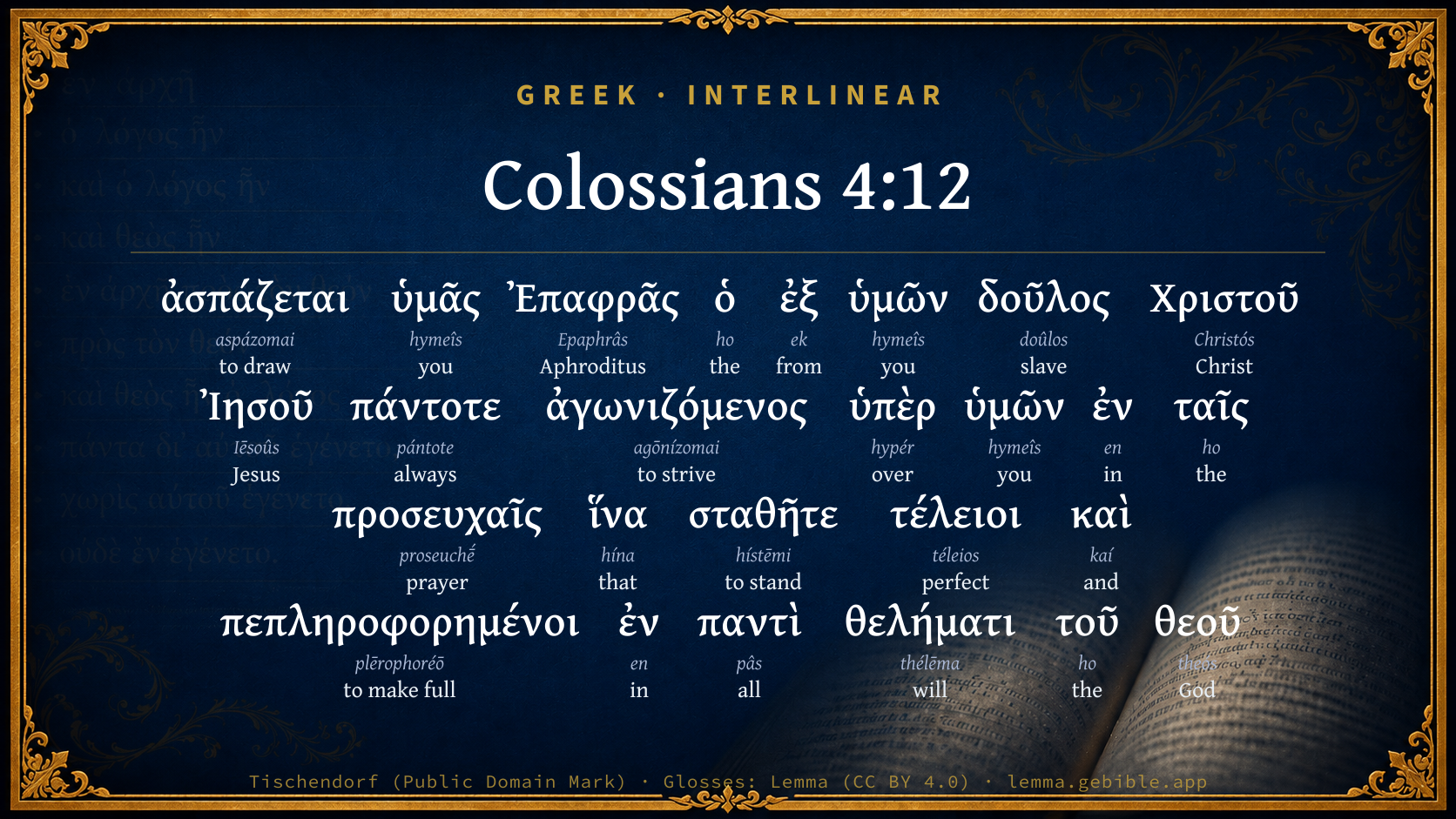
  1. ἀσπάζεται aspázomai G782 “to draw” Verb, Present, Middle or Passive deponent, Indicative, 3rd person, Singular
  2. ὑμᾶς hymeîs G5210 “you” Personal pronoun, 2nd person, Accusative, Plural
  3. ὁ ho G3588 “the” Article, Nominative, Singular, Masculine
  4. ἐξ ek G1537 “from” Preposition
  5. ὑμῶν hymeîs G5210 “you” Personal pronoun, 2nd person, Genitive, Plural
  6. δοῦλος doûlos G1401 “slave” Noun, Nominative, Singular, Masculine
  7. Χριστοῦ Christós G5547 “Christ” Noun, Genitive, Singular, Masculine
  8. Ἰησοῦ Iēsoûs G2424 “Jesus” Noun, Genitive, Singular, Masculine
  9. πάντοτε pántote G3842 “always” Adverb
  10. ἀγωνιζόμενος agōnízomai G75 “to strive” Verb, Present, Middle or Passive deponent, Participle, Nominative, Singular, Masculine
  11. ὑπὲρ hypér G5228 “over” Preposition
  12. ὑμῶν hymeîs G5210 “you” Personal pronoun, 2nd person, Genitive, Plural
  13. ἐν en G1722 “in” Preposition
  14. ταῖς ho G3588 “the” Article, Dative, Plural, Feminine
  15. προσευχαῖς proseuchḗ G4335 “prayer” Noun, Dative, Plural, Feminine
  16. ἵνα hína G2443 “that” Conjunction
  17. σταθῆτε hístēmi G2476 “to stand” Verb, Aorist, Passive, Subjunctive, 2nd person, Plural
  18. τέλειοι téleios G5046 “perfect” Adjective, Nominative, Plural, Masculine
  19. καὶ kaí G2532 “and” Conjunction
  20. πεπληροφορημένοι plērophoréō G4135 “to make full” Verb, Perfect, Passive, Participle, Nominative, Plural, Masculine
  21. ἐν en G1722 “in” Preposition
  22. παντὶ pâs G3956 “all” Adjective, Dative, Singular, Neuter
  23. θελήματι thélēma G2307 “will” Noun, Dative, Singular, Neuter
  24. τοῦ ho G3588 “the” Article, Genitive, Singular, Masculine
  25. θεοῦ theós G2316 “God” Noun, Genitive, Singular, Masculine

About this verse

These counts appear in no published source. They are computed here, from the morphology-tagged text and Lemma’s own curated glosses. What Lemma adds →

26
words
21
distinct lemmas
Pauline Epistles
section

Notable vocabulary

The rarest word here is Ἐπαφρᾶς Aphroditus G1889 — appearing just 3 times in the whole Greek New Testament.

Shared distinctive vocabulary

Ἐπαφρᾶς Aphroditus G1889 occurs in 3 verses of the Greek New Testament. Also found in:

Repetition

Words recur within this verse:

Cross-references

25

Topical passages linked to Colossians 4:12 in the Treasury of Scripture Knowledge — connected by theme and wording, ordered by reader-vote popularity; previews shown in the World English Bible.

  • Romans 15:30 Now I beg you, brothers, by our Lord Jesus Christ, and by the love of the Spirit, that you strive together with me in your prayers to God for me,
  • Colossians 1:9 For this cause, we also, since the day we heard this, don't cease praying and making requests for you, that you may be filled with the knowledge of his will in all spiritual wisdom and understanding,
  • Colossians 1:7 even as you learned of Epaphras our beloved fellow servant, who is a faithful minister of Christ on our behalf,
  • Colossians 1:28 whom we proclaim, admonishing every man and teaching every man in all wisdom, that we may present every man perfect in Christ Jesus;
  • Philemon 1:23 Epaphras, my fellow prisoner in Christ Jesus, greets you,
  • Romans 15:14 I myself am also persuaded about you, my brothers, that you yourselves are full of goodness, filled with all knowledge, able also to admonish others.
  • Galatians 4:19 My little children, of whom I am again in travail until Christ is formed in you--
  • 2 Peter 1:1 Simon Peter, a servant and apostle of Jesus Christ, to those who have obtained a like precious faith with us in the righteousness of our God and Savior, Jesus Christ:
  • Matthew 5:48 Therefore you shall be perfect, just as your Father in heaven is perfect.
  • John 12:26 If anyone serves me, let him follow me. Where I am, there will my servant also be. If anyone serves me, the Father will honor him.
  • 1 Corinthians 2:6 We speak wisdom, however, among those who are full grown; yet a wisdom not of this world, nor of the rulers of this world, who are coming to nothing.
  • 1 Corinthians 14:20 Brothers, don't be children in thoughts, yet in malice be babies, but in thoughts be mature.
  • 2 Corinthians 13:11 Finally, brothers, rejoice. Be perfected, be comforted, be of the same mind, live in peace, and the God of love and peace will be with you.
  • Galatians 1:10 For am I now seeking the favor of men, or of God? Or am I striving to please men? For if I were still pleasing men, I wouldn't be a servant of Christ.
  • Colossians 1:22 yet now he has reconciled in the body of his flesh through death, to present you holy and without blemish and blameless before him,
  • Hebrews 5:7 He, in the days of his flesh, having offered up prayers and petitions with strong crying and tears to him who was able to save him from death, and having been heard for his godly fear,
  • Hebrews 5:14–6:1 But solid food is for those who are full grown, who by reason of use have their senses exercised to discern good and evil.
  • Jude 1:24 Now to him who is able to keep them from stumbling, and to present you faultless before the presence of his glory in great joy,
  • Luke 22:44 Being in agony he prayed more earnestly. His sweat became like great drops of blood falling down on the ground.
  • Philippians 3:12–15 Not that I have already obtained, or am already made perfect; but I press on, if it is so that I may take hold of that for which also I was taken hold of by Christ Jesus.
  • Colossians 2:1–23 For I desire to have you know how greatly I struggle for you, and for those at Laodicea, and for as many as have not seen my face in the flesh;
  • Colossians 4:1–2 Masters, give to your servants that which is just and equal, knowing that you also have a Master in heaven.
  • James 1:1 James, a servant of God and of the Lord Jesus Christ, to the twelve tribes which are in the Dispersion: Greetings.
  • James 5:16 Confess your offenses to one another, and pray one for another, that you may be healed. The effective, earnest prayer of a righteous man is powerfully effective.
  • 1 Thessalonians 5:23 May the God of peace himself sanctify you completely. May your whole spirit, soul, and body be preserved blameless at the coming of our Lord Jesus Christ.

Cross-references courtesy of OpenBible.info (CC BY 4.0).

Where the printed editions differ

1 variant

Places in this verse where the major printed Greek editions disagree on the wording in a way that affects the translation — a comparison of editions, not a manuscript-by-manuscript collation. The editions are the modern critical texts (Nestlé-Aland 28/27, SBL, Westcott-Hort, Tregelles, Tyndale House) and the traditional texts behind the KJV (the Textus Receptus and the Byzantine/Majority text). It is not a claim about which reading is original.

  1. Extra text
    Ἰησοῦ,

    “Jesus,”

    In NA28NA27TynWHTreg Not in SBLTRByz

    Ἰησοῦ, (Iēsou) 'Jesus,' is only in older manuscripts (NA28+NA27+Tyn+WH+Treg)

Textual data: Translators Amalgamated Greek New Testament (STEPBible TAGNT) · CC BY 4.0.

Commentary

Notes on Colossians 4:12 from classic Christian and Jewish commentators (each source and its license shown beneath its notes). The classic Christian expositions comment on the surrounding passage and are grouped to its opening verse, so a note may address several verses; the Jewish commentaries on the Tanakh (Rashi and others) are per-verse, so they appear only where the commentator wrote on this verse.

Lemma curates 59 commentaries, every one of them public domain or Creative Commons licensed, each selected and text-cleaned for this edition rather than reprinted as found. About our sources →

The Biblical Illustrator

Joseph S. Exell

Col_4:12-13

Epaphras, who is one of you.

The sympathy of Christianity

1. If you think of Christianity as a great thought, a transcendental doctrine, a grand conception, you are right; and if you think the preacher is called upon to speak the language of earth in she accent of heaven and expound celestial mysteries, you are right. But this is not all. A man who would describe the present scene as all firmament would be wrong; but a man who omitted the firmament from a landscape would be a fool. It is the sky in a landscape painting that often first attracts attention. There could be no landscape were there no sky. So with this great Christian truth: it is firmamental, but it is the sky out of which our landscape comes--the immeasurable, out of which our units and definite lines are given to us. Christianity is not only the highest metaphysic, it is the most absolute practical teaching and sympathy.

2. What have these personal salutations to do in the Bible? When the apostle began this great letter, he seemed to strike a grand key, and to call the universe to hear. He speaks of One who is the image of the invisible God, etc. That is grand music. Let that organ roll out its rythmic thunders, and while they charm us make us solemn; but here at the end he begins to talk about Aristarchus, etc. Is he out of tune at last? Does the anthem die off into a mean piping, or is there still sweet music in it, encompassing, not shaking, the high heavens, but making the household glad, filling every room of it with sacred glee.

3. The more Christianity is understood the more will manhood go up in value. Christianity takes us all in charge--women, poor people, the sick. It goes to the merchant and says: I have seen to-day many poor, sick ones, who want kindly treatment and practical sympathy, and you must give it. Any religion that talks so about men and to men is presumptively a true religion. Christianity has a message from every-man to every other man.

I. Epaphras, who is one of you.

1. Being a native of Colossae he carries it in his heart to Rome. The idea of the Church is domestic. We do not realize that. Our idea of it is approximation without identity, proximity without sympathy, a hebdomadal meeting and a week-long parting, a cold how do? without answer being waited for. The poor, simple soul thought you meant it, and was just about to ten you how be did when you jumped into your chariot and drove off. Christs idea was that of a house, and Paul that of a family--in whom the whole family, etc. See how these Christians love one another. They have a great respect for one another, a marvellous respect, an official respect; but the old apostolic unity and downright warm love--where is it? And echo answers where?

2. One of you, though not at home. We think that going from home deprives a man of his proper belongings in the Church. A young man leaves us and goes to New Zealand. Is he no longer one of us? The poor lads heart ached when the good-bye was forced out of him; but now that he is fifteen thousand miles away we say, He once belonged to us. We want a warmer language and a more affectionate fellowship in God. How large a Church would be if we interpreted its membership in this way, that a man who is in a far-off city is still one of us, and still claims us, wonders what hymns we are singing, and what the text is. We are in danger of degrading the church into a meeting-house, a place of casual association, and of cutting off all those fine living bonds which ought to be independent of time and place, which make Rome Colossae and Colossae Rome, every land a home, and every Christian a brother.

II. A servant of Christ.

1. Are you fond of titles? This is the one the King will give you. It is select, and yet might be universal. Let the noblest envy you. Other titles are sounds, sometimes sounds and fury, signifying nothing. But this signifies to be the slave of Him who though He was rich, etc.

2. What are the signs by which a servant of Christ is known? Those who are skilled in such things can go through a picture gallery and say, This picture is after So-and-so. There is a manner that can be but feebly imitated by the most skilful hands. So you cannot mistake a man who has been with Christ. In the early days there were those who took knowledge of disciples that they had been with Jesus. You have been in a garden of spices; I know it; you bring the fragrance with you. You have seen some solemn sight; I know it; vulgarity is ironed out of your face, and it is transfigured. You have heard strange music, and all the meaner elements have been taken out of you. You have been with Christ, and I know it by the tenderness and simplicity of your speech, by the diligence of your service, by the lavishness of your liberality.

III. saluteth you. That would not do now. I get letters from Christian friends that I would not send to a day labourer whom I had never seen in my life before. They are too correct to be true, too proper to be good.

IV. Always labouring fervently for you in prayer.

1. I do not know that Epaphras was an eloquent preacher, but he was mighty in intercession. He threw his arms around his native Church, and toiled in prayer for them till his brow was bedewed as with agony, and his whole face lighted up with saintly expectation that he might see the descending blessing. That I can do for my friends. I may not be able to write elaborate letters, but I can pray for them. That you can do for me.

2. What did Epaphras pray for? That ye may stand perfect--like a ship in full gale. Let that be my posture; no harsh, bitter wind striking me in the face, and making my sea-faring difficult, but a great favouring gale, bearing me onward, all sail set, towards the will of God. (J. Parker, D. D.)

The ministry of Epaphras

I. His object: that the Colossians might stand perfect, etc. The will of God has reference--

1. To our perfection in the knowledge of revealed truth. The Bible is a revelation of Gods will with respect to us, and is able to make us wise unto salvation. Why has God put it before us but that we should study it. Our Lord reproved His disciples because of their want of due attention to His teaching, and the Hebrews are rebuked for their want of proficiency, and are exhorted to go on to perfection. This perfect knowledge is necessary--

(1) To religious usefulness.

(2) To progressive and entire sanctification. Sanctify them through Thy truth.

2. To our salvation from sin. This must be complete before we can enter heaven; but provision is made in the blood which cleanseth from all sin, and in the grace of the Spirit who sanctifies wholly.

3. To the graces of the Spirit.

(1) Faith. This admits of degrees. There is the weak faith of babes; the strong faith of young men; the ripe faith of fathers, when it is perfect.

(2) Love. This admits of degrees. I may have a sincere love for God, and yet not love Him with all my heart; a sincere love of man, and yet not as myself. But the love set forth in Scripture is perfect love.

(3) Hope. All Christians have this, but not all in an equal degree. It is not every believer who can say with John, Even so; come, Lord Jesus. That is, however, the full assurance of hope for which we should all strive.

(4) The passive graces, such as patience, which is to have her perfect work that ye may be perfect, etc.

4. To our actual conduct in the world. Christs religion is a practical religion (Tit_2:11-12), and is to assume a perfect form (Heb_13:20-21). To bring up His people to this standard God has said, My grace is sufficient for thee.

5. To our stability and perseverance. Epaphras is anxious not only that the Colossians should be perfect in their conformity to the Divine will, but that they should stand in that state to the end of life. It is the end which crowns the work. It is not he who runs well for a season, but he who continues to the end, to whom the promise of life is given.

II. The means of securing this object--Prayer. From this we learn--

1. That Christians can only be brought to this high standard by Gods grace and blessing. Had they been able of themselves, prayer would have been presumptuous. We do not ask God to do for us what we can do for ourselves. But we never can be made Christians but by God--and God can make perfect Christians; and the power of Christ and the Holy Spirit must not be limited.

2. That prayer is available with God for obtaining needful grace. There are some who restrict the power of prayer to its subjective influence. If this were true, prayer for others would be of no avail. I might pray for one whom I love, and my prayer might exercise my benevolent feelings, but the person for whom I pray will receive no benefit. Away with so God-dishonouring a notion. Some of you, perhaps, have near relatives across the sea. Take encouragement. Gods arm of power and mercy can reach them. Bring their cases before Him.

(1) Notice the earnestness and importunity of his prayer. True prayer is a labour. We ought in prayer to labour for a just apprehension of the Divine character, of the mediation of Christ, of the import of the promises.

(2) Notice the connection of prayer with this object--the fulfilment of Gods will. The glory of God is dear to every pious heart. Our Lord, therefore, taught us to pray, Thy will be done, etc.

3. That the honour of true religion is connected with the perfection of Christian character. The world judges of Christians by their conduct

4. That the welfare of Christians is connected with their perfection of character. Spiritual as well as bodily happiness depends on the state of the health. (T. Jackson.)

Labouring fervently for you in prayers.

Prayer the noblest form of work

I. Prayer is religion in action, and is the noblest kind of human exertion. It is the one department of action in which man realizes the highest privilege and capacities of his being. And in doing this he is enriched and ennobled almost indefinitely.

2. That this view of prayer is not universal is notorious. It is thought an excellent thing for clergymen, recluses, sentimentalists, and women and children generally; that it has its uses as a form of desultory occupation, an outlet for feel ing, a means of discipline, but altogether less worthy of the energies of a thinking man than hard work in study or business.

3. In response to this let those speak who have really prayed. They sometimes describe prayer with Jacob, as a wrestling together with an unseen power, which may last even to the break of day (Gen_32:24)

, or with Paul, as a concerted struggle (Rom_15:30). They have their eyes fixed on the Great Intercessor in Gethsemane (Luk_22:44). Importunity is of the essence of successful prayer (Luk_11:8; Luk_18:5; Mat_15:27-28; Mar_7:28-29); and importunity means not dreaminess, but sustained work, and of an energetic character (Mat_11:12). Bishop Hamilton, of Salisbury, once said that no man was likely to do much good in prayer who did not begin by looking upon it in the light of a work, to be prepared for and persevered in with all the earnestness which we bring to bear on subjects which are the most interesting and necessary. This will appear if we take an act of prayer to pieces. To pray is--

I. To put the understanding in motion, and to direct it upon the highest object to which it Can address itself. How overwhelming are the truths which pass before us--a boundless Power, an eternal Existence. Then the substance of the petition, its motives, the issues which depend on its being granted or refused present them selves to the mind, as does the Intercessor who presents our prayers.

II. To put the affections is motion. The object of prayer is the uncreated Love, and to be in His presence is to be conscious of heart expansion; and when the matter of prayer is blessing for others and not for self, all the best emotions and sentiments are called into play (Mat_15:8; 1Jn_3:21-22).

III. To put the will in motion, just as decidedly as we do when we sit down to read hard, or to walk up a steep hill against time (Joh_9:31; Mat_7:21; Jam_4:7-8; all of which imply that prayer in which the will is not engaged is worthless. That sovereign power does not merely impel us to make the first necessary mental effort, but enters most penetratingly and vitally into the very action of prayer itself (Gen_32:26). These three ingredients of prayer are ingredients in all real work, whether of the brains or the hands. The difference is that in prayer they are more equally balanced. Study may in time become intellectual habit, which scarcely demands any effort of will; handiwork may in time become so mechanical as to require little or no guidance from thought; each may exist without the co-operation of the affections. Not so prayer. It is always the joint act of the will and the understanding, impelled by the affections; and when either will or intelligence is wanting, prayer at once ceases to be itself, by degenerating into a barren, intellectual exercise, or into a mechanical and unspiritual routine. (Canon Liddon.)

Fervent labour in prayer

The word here used signifies to strive, or wrestle, as those do who strive for mastery; it notes the vehemency and fervency of this mans prayers for the Colossians. As the wrestlers do bend and writhe and stretch and strain every joint of their bodies, so did Epaphras every joint of his soul that he might be victorious with God upon the Colossians account. So Jacob when alone with God (Gen_32:24-27; Hos_12:4-5)

wrestles and weeps, and weeps and wrestles; he holds his hold, and will not let God go, till as a Prince he has prevailed. (T. Brooks.)

The value of intercessory prayer

This was no passing wish, sentimental desire, transient emotion. The burden of Epaphras heart was the good of the Church, and in proportion to the fervency of his affection was the importunity of his petition. There may be no help more needed, no succour more sure, than that obtained through prayer. Who can tell what good may come to the wilful and wayward boy far away at sea, or in some distant land, from the unceasing intercessions of his mother, wrestling for him with God? You have a dear friend in sorrow at a distance. You cannot reach him to comfort him, but you can reach him by prayer more effectively than if you could see him face to face. Many a time has Gods work revived, and rich spiritual blessing come to a congregation, through the earnest supplication of some obscure member. We do not ourselves know all that we owe to the prayers of others. There are circumstances in which we can do nothing but pray for those in whom we are deeply interested. Especially is it so with pastors. Some may seem ready to faint in the conflict; some fair blossoms of spiritual promise may be going up as dust; some often warned and entreated may be becoming more callous, or on the point of making shipwreck of faith, etc.; what can be done for such? The mightiest resource is persevering prayer. It is God alone whose help is all powerful, and this prayer can secure. (J. Spence, D. D.)

The power of prayer

A spoonful of water sets a hydraulic press in motion, and brings into operation a force of tons weight; so a drop of prayer at one end may move an influence at the other which is omnipotent. (A. Maclaren, D. D.)

That ye may stand perfect and complete in all the will of God.--

Standing in perfectness

1. There is no kind of qualification to this, no hint that Paul thought that Epaphras was asking with an extravagant expectation. They were no sham prayers; struggles after impossible attainments, but those that he and Paul thought might be realized. Such prayers are in conflict with modern notions, which regard perfection as beyond the range of practical Christianity.

2. What made Epaphras believe that he might ask this?

(1)

Pauls teaching. We pray for this, even your perfection. That we may present every man perfect.

(2) Christs words, Be ye perfect, etc.

3. Was this an attainment to be expected in this life or the next? In this. Paul wrote that he had not attained, etc., but he appealed to the Philippians on the supposition that he and they were perfect. And so Christ teaches us to pray, Thy will be done on earth as it is in heaven, i.e., perfectly. There is no difficulty here. It is our duty to be entirely conformed to the will of God, and yet see a point beyond our highest attainments, and say, We must reach that also. Let us consider the purpose of these prayers.

I. Negatively.

1. It is not that full knowledge and obedience may be achieved at once. This is impossible under the conditions imposed by the flesh, and both will be progressive under heavenly conditions. But we are to act according to our several ability. A child in the alphabet class must not be expected to do the work of the higher forms, either in the school of nature or of grace. It is enough that each does thoroughly what is allotted to it. An infant is perfect, but not in the same sense as a man. So it is in the kingdom of God.

2. It is not that temptation will be absent. Both Paul and Christ were fiercely tempted.

3. It is not that there will be an unbroken flow of joy and peace. No person is capable of being continuously under the same emotions, and alternations of joy and gloom make no difference to our spiritual standing, so long as under both we abide in God. There were changes of feeling in Paul and Christ.

II. Positively. It is that we may do the will of God as far as we know it. We are not to ordain an impossible standard. Our King distributes to us a variety of talents. Hence the young act differently from the old; men from women; sickly from healthy, and yet in each the love of God may be perfected, viz., in the keeping of His commandments. And these commandments have a wonderful variety, and relate to secular as well as spiritual employments, since all life by the Christian is devoted to God. Do you say that this is an easy kind of perfection? Try it--Or that it is inconspicuous? True, so was Christs generally. Only on occasions did His divinity flash forth.

2. It is that we may use the means for our fulfilling the will of God perfectly. Epaphras laboured in prayers, which denotes the power from which we are to derive our ability. We must go to God and He will supply all our need: in faith in His faithfulness who has promised, who also will do it, even sanctify us wholly. (D. G. Watt, M. A.)

Christian perfection

A Christian may be said to be perfect in respect--

I. Of the cause or fountain of holiness; so good gifts are said to be perfect (Jam_1:17)

, as they are from God.

II. Of consecration (Heb_1:10; Heb_5:9). Christ was perfect because set apart to a perfect calling which He fulfilled perfectly.

III. Of acceptation, not in respect of operation, the Lord accounting our confession of imperfection for perfection.

IV. Of parts, though not in respect of degrees; he is perfect in that he hath holiness in every part, though not in such measure. Thus to be perfect is to be sanctified throughout.

V. Comparatively, not positively. A Christian that makes conscience of all his ways, and can love his enemies, is perfect (Mat_5:48), in comparison of carnal men, that follow the swing of their own corruptions and affections.

VI. Of truth, though not in respect of absoluteness. Thus he is perfect, because he desires and endeavours after perfection, though in act he attains it not.

VII. Of men or common estimation, and so he is perfect that is unrebukable.

VIII. Of the end, and so he may be said to be perfect--

1. In intention, because he sets perfection as a mark to shoot at (Php_3:1.)

2. In respect of duration, because he holds out to the end.

3. In respect of accomplishment, because he finisheth what he under taketh in godliness, or mortification, he doth it not by halves, or in some parts of it, for so to perfect is translated to finish (Act_20:24; Joh_4:34; Joh_17:4). (N. Byfield.)

All the will of God

There are people who would be content to do some part of what God wills, provided they might be excused the rest; as, for example, to believe the truth which God has revealed, but not to do the good works which He has commanded; or to exercise some of them, but utterly fail in others: as they who live fair with men, but remain in impiety, and in the profession of error; or those, on the contrary, who make profession of error; or those, again, who make open profession of the pure service of God, but spare not either the goods or honour of their neighbours; or who, abstaining from one vice, license themselves to others; who are chaste, but covetous; or liberal and beneficial to the poor, but corrupt and incontinent. This partition is unjust, injurious to God, impossible in truth, and incompatible with the nature of the things themselves. (J. Daille.)

He hath a great zeal for you.--

The nature of zeal

Zeal is an intense earnestness for the accomplishment of its object. It is defined in our latest dictionary as a passionate ardour in the pursuit and accomplishment of it. It is not, therefore, a great excitement of feeling, mere demonstrative warmth of expression, mere quickness of the motion, but something far more deep and en during. It is a working, practical energy; a power which may be directed to things indifferent, good or bad. (E. Garbett, M. A.)

Fervent zeal

A little before his death Gregory Thaumaturgus made a strict inquiry whether there were any persons in the city and neighbourhood still strangers to Christianity. Being told there were about seventeen in all, he sighed, and lifting up his eyes to heaven, appealed to God how much it troubled him that any of his fellow-townsmen should still remain unacquainted with salvation. (Milner.)

It is said of Holy Bradford, preaching, reading, and prayer, was his whole life. I rejoice, said Bishop Jewel, that my body is exhausted in the labours of my holy calling.… Let racks, fires, pulleys, and all manner of torments come, so I may win Christ, said Ignatius. (Watson.)

Reinerius, their adversary, declares that a certain Waldensian heretic, with a view of turning a person from the Catholic faith (for such he calls the Romish errors), swam over a river in the night, and in the winter, to come to him, and to teach him the novel doctrines. (Milner.)

Laodicea (see on Col_2:1). Hierapolis.--On the north side of the valley of Lycus, opposite to the sloping hills which mark the site of Laodicea, is a broad level terrace jutting out from the mountain side, and overhanging the plain with almost precipitous sides. On this plateau are scattered the vast ruins of Hierapolis. It is here that the remarkable physical features which distinguish the valley display themselves in the fullest perfection. Over the steep cliffs which support the plateau of the city tumble cascades of pure white stone, the deposit of calcareous matter from the streams which, after traversing this upper level, are precipitated over the ledge into the plain beneath, and assume the most fantastic shapes in their descent. At one time overhanging in cornices fringed with stalactites, at another hollowed out into basins or broken up with ridges, they mark the site of the city at a distance, glistening on the mountain side like foaming cataracts frozen in the fall. Like Laodicea, Hierapolis was at this time an important and a growing city, though not like Laodicea, holding Metropolitan rank. Besides the trade in dyed wools, which it shared in common with the neighbouring towns, it had a source of wealth peculiar to itself. The streams to which the scenery owes its remarkable features are endowed with valuable medicinal qualities, while at the same time they are so copious that the ancient city is described as full of self-made baths. An inscription still legible celebrates their virtues, Hail, fairest soil in all broad Asias realm; hail, golden city, nymph Divine, bedecked with flowing rills, thy jewels, and (Esculapius and Hygeia appear on still extant coins. To the ancient magnificence of Hierapolis its ruins bear ample testimony. A city which combined the pursuit of health and gaiety had fitly chosen as its patron deity Apollo, the god alike of medicine and festivity, here worshipped as Archegetes, the founder. But more important, as illustrating its religious temper, is the fact, that there was a spot called the Plutonium, a hot well or spring, from whose hot mouth issued a fatal memphitic vapour, from the effects of which the mutilated priests of Cybele alone, so it was believed, were free. Indeed this city appears to have been a chief centre of the passionate mystical devotion of ancient Phrygia. But in addition to this religious rites were borrowed from other parts of the East, more especially from Egypt. By the multitude of her temples Hierapolis established her right to the title of the sacred city which she bore. Though, at this time, we have no record of her famous citizens, such as graced the annals of Laodicea, yet a generation or two later she numbered among her sons one nobler far than the rhetoricians, sophists, millionaires, and princes, of whom her neighbour could boast. The lame slave, Epictetus, the loftiest of heathen moralists, must have been growing up to manhood when the first rumours of the gospel reached his native city. Did any chance throw him across the path of Epaphras, or of St. Paul? We should be glad to think that the greatest of Christian and the greatest of heathen preachers met together face to face. Such a meeting would solve more than one riddle, and explain some strange coincidences in their writings. Drawn by trade, and by its charms as a gay watering-place, a very considerable colony of Jews settled down in Hierapolis, which gave point to a Talmudic complaint, The wines and baths of Phrygia have separated the ten tribes from Israel. After the destruction of Jerusalem one of the chief settlements of the Christian dispersion was here, which explains how the Phrygian Churches assumed such a prominence in the ecclesiastical history of the second century. Here settled Philip of Bethsaida, the early friend and fellow-townsman of St. John, who took up his abode in Ephesus, and the first apostle who held communication with the Gentiles (Joh_12:20). Here he died and was buried; and here, after his decease, lived his two virgin daughters, from whom Papias heard several stories of the first preachers of the gospel, which he transmitted to posterity in his work. Papias was, probably, a native of Hiera-polls, of which he afterwards became bishop. He was succeeded by Abercius, and Abercius by the great controversialist and apologist, Claudius Apollinaris, and presided at a council in this city at which Montanism was condemned. At a later ate the influence of both Hierapolis and Laodicea declined. They take no great art in the great controversies of the fourth and fifth centuries. Among their bishops there is not one who has left his mark on history. They take only a silent art in the great councils, and more than once wavered in their allegiance to the othodox faith. (Bishop Lightfoot.)

The Biblical Illustrator, edited by Joseph S. Exell (c. 1880s–1900s) — public domain. Text from a community e-Sword module.

Joseph Benson's Commentary

Col 4:12-15. Epaphras, always labouring — Αγωνιζομενος, striving, or agonizing; for you in prayers — The word properly denotes contending, or combating in the games; here it signifies the greatest fervency of desire and affection in prayer: that ye may stand perfect — Perfectly instructed in all Christian graces, and performing all Christian duties. See 1Jn 4:17; Heb 13:21. And complete — Πεπληρωμενοι, filled with; all the will of God — As being no longer babes, but grown up to the measure of the stature of Christ, being filled with light and wisdom, grace and holiness. See on Col 2:10. He hath great zeal for you — A great concern for your growth in grace and holiness, and your eternal salvation. And them that are in Laodicea and Hierapolis — Neighbouring cities in the Greater Phrygia, in which were Christian churches. The latter “was named Hierapolis, that is, the holy city, from the multitude of its temples. But it is not known what particular deity was its tutelary god. Its coins bear the images of Apollo, of the Ephesian Diana, of Esculapius, and of Hygeia. The two last-mentioned idols were worshipped in Hierapolis, on account of the medicinal springs with which it abounded. There was likewise a Mephitis, or opening in the earth, here, from which a pestilential vapour issued, which killed any animals which happened to breathe in it.” — Macknight. Luke, the beloved physician — Luke was deservedly beloved by St. Paul. He was not only an intelligent and sincere disciple of Christ, but the apostle’s affectionate and faithful friend, as appears from his attending him in several of his journeys through the Lesser Asia and Greece. (See the preface to St. Luke’s gospel, and the note on Act 27:1.) And when the apostle was sent a prisoner to Italy, Luke accompanied him in the voyage, and remained with him till he was released. He was also with the apostle during his second imprisonment in the same city; on which occasion, when his other assistants deserted him, through fear, Luke abode with him, and ministered to him, 2Ti 4:11. Salute the brethren in Laodicea and Nymphas — It seems Nymphas was an eminent Christian at Laodicea; and the church which is in his house — The society or congregation which assembled there for social or public worship.

Joseph Benson's Commentary on the Old and New Testaments (1811–1818) — public domain. Text from a community e-Sword module.

The Preacher's Complete Homiletical Commentary

Joseph S. Exell (gen. ed.)

CRITICAL AND EXPLANATORY NOTES

Col_4:12. Always labouring fervently for you.—R.V. “always striving.” Lit. “agonising.” Like the mighty wrestler who held the Angel till daybreak, Epaphras intercedes for his Colossian brethren. Complete in all the will of God.—R.V. “fully assured.” “From the tenor of the letter it appears that the Colossians needed a deeper Christian insight and more intelligent and well-grounded convictions respecting the truth ‘as in Jesus’ ” (Findlay).

Col_4:13. Zeal … for them that are in Laodicea.—Here then is one who differs from the Laodicean spirit of St. John’s time.

MAIN HOMILETICS OF THE PARAGRAPH.—Col_4:12-13

The Model Pastor.

Nothing is known of Epaphras beyond the few but significant notices which connect him with Colossæ, of which city he was a native. Acting under the direction of St. Paul, probably when the apostle was residing for three years at Ephesus, Epaphras was the honoured agent in introducing the gospel into Colossæ and the neighbouring cities of Laodicea and Hierapolis; and it is evident he regarded himself as responsible for the spiritual well-being of all these places. The dangerous condition of the Colossian and neighbouring Churches at this time filled the mind of Epaphras with a holy jealousy and alarm. A strange form of heresy had appeared among them—a mixture of Jewish formalism with the speculations of an Oriental philosophy—and was rapidly spreading. The distress of the faithful evangelist was extreme. He journeyed to Rome in order to lay this state of things before the apostle, and to seek his counsel and assistance. The apostle bears testimony to his profound anxiety for the spiritual condition of the newly founded Churches on the banks of the Lycus. He had much toil for them, and was ever fervently wrestling in prayer on their behalf, that they might stand fast and not lose the simplicity of their earlier faith, but might advance to a more perfect knowledge of the divine will. In the verses now under consideration we have Epaphras brought before us as the model pastor.

I. The model pastor is distinguished by a suggestive designation.—“A servant of Christ” (Col_4:12). This title, which the apostle uses several times for himself, is not elsewhere conferred on any other individual, except once on Timothy (Php_1:1), and probably points to exceptional services in the cause of the gospel on the part of Epaphras (Lightfoot). A true pastor is not the servant of the Church to echo its decisions and do its bidding; but he is the servant for the Church to influence its deliberations and decisions, to mould its character and direct its enterprises. He is a servant of Christ, receiving his commission from Him, ever anxious to ascertain His will, and ready to carry out that will at whatever sacrifice. Such a service involves no loss of self-respect or manliness, no degradation, but is free, honourable, and rich in blessing.

II. The model pastor is incessant in zealous labour.—“For I bear him record, that he hath a great zeal for you, and them that are in Laodicea and them in Hierapolis” (Col_4:13). The zeal of Epaphras urged him to extend his Christian labours beyond the limits of Colossæ: he visited the adjoining cities, which were much larger in population and wealthier in commerce. Laodicea, rising from obscurity, had become, two or three generations before the apostle wrote, a populous and thriving city, and was then the metropolis of the cities on the banks of the Lycus. Hierapolis was an important and growing city, and, in addition to its trade in dyed wools, had a reputation as a fashionable watering-place, where the seekers of pleasure and of health resorted to partake of its waters which possessed valuable medicinal qualities. The rare virtues of the city have been celebrated in song:

“Hail, fairest soil in all broad Asia’s realm;

Hail, golden city, nymph divine, bedeck’d

With flowing rills, thy jewels.”

Into the midst of these populations the fervent Epaphras introduced the gospel, and spared no pains in his endeavour to establish and confirm the believers. It was on their behalf he undertook the journey to Rome to confer with St. Paul as to their state; and the apostle testifies to the unceasing exercise of his great and holy zeal for his distant but ever-remembered flock. When the heart is interested and moved, labour is a delight; and it is the way in which the heart is affected towards any work that gives to it significance and worth. Canon Liddon writes: “Are we not very imperfectly alive to the moral meaning of work and the moral fruits of work as work?” The true pastor, with a heart overflowing with zeal for the glory of God and the good of men, cheerfully undertakes labour from which the ordinary worker would timidly shrink.

III. The model pastor is intensely exercised in prayer for the people of God.—“Always labouring fervently [wrestling, agonising] for you in prayers” (Col_4:12). The faithful minister has not only to teach his flock—a task which involves vigilant observation, extensive reading, and anxious study—but he has also to plead earnestly at the throne of grace on their behalf. In times of spiritual dearth, disappointment, embarrassment, and distress, prayer is the all-efficacious resource. There are circumstances in which the minister can do nothing but pray. Difficulties that defied all other means have vanished before the irresistible power of persistent and believing intercession. Prayer attains what the most conclusive reasoning, the most eloquent appeal, the most diligent personal attention, sometimes fail to accomplish. It sets in silent but stupendous operation the mightiest spiritual agencies of the universe. It opens the fountain of divine grace, and its streams flow in full-tide velocity through the hitherto arid wilderness of human hearts, and life, freshness, fertility, and beauty spring up in its reviving course. It is God only whoso help is omnipotent, and on this help faithful prayer lays hold and uses it in effecting its wondrous transformations.

IV. The model pastor is constantly solicitous that the people of God should be firmly established in the highest good.—“That ye may stand perfect and complete in all the will of God” (Col_4:12)—perfectly instructed and fully convinced in everything willed by God. The great aim of all ministerial anxiety is not only to instruct his people in the full and accurate knowledge of the divine will, but to produce such a persuasion of the supreme majesty and authority of that will as to induce steadfast continuance in practical obedience. The will of God and the highest good of man are always in harmony. Whatever threatens to disturb the stability of the believer, or to retard his development towards the highest moral excellence, whether it arises from his personal unwatchfulness and indifference or from the subtle attacks of error, is always a subject of keen solicitude to the faithful pastor. He knows that if his converts fall away they are lost and the truth itself is disgraced. To be established in an unswerving obedience it is necessary to be filled with the knowledge of God’s will. This blessedness is the grand scope and crowning glory of the Christian life.

Lessons.—

1. The office of pastor is fraught with endless anxieties, great responsibilities, and rare opportunities.

2. The true pastor finds his purest inspirations, his most potent spiritual weapon, and his grandest successes in prayer.

The Preacher's Complete Homiletical Commentary (gen. ed. Joseph S. Exell; Funk & Wagnalls, c. 1892) — public domain (pre-1929). A full-Bible homiletical/sermon-outline anthology covering 65 of 66 books (2 John is absent from the source module). Text from a community e-Sword module.

Bengel's Gnomon

Johann Albrecht Bengel

Col 4:12. Τέλειοι καὶ πεπληρωμένοι, perfect and complete) This is introduced from the former discussion.[33]—ἐν παντὶ, in all) Construe with, ye may stand.

[33] Ch. Col 1:28, Col 2:2, Col 3:14.—ED.

Bengel's Gnomon of the New Testament — English translation (T&T Clark, Edinburgh, 1860) — public domain. Text from a community e-Sword module.

Meyer's Critical & Exegetical Commentary

Heinrich August Wilhelm Meyer

Col_4:12. Ἐπαφρᾶς] See Col_1:7 and Introd.

It is to be observed that, according to Col_4:11, Epaphras, Luke, and Demas (Col_4:14) were no Jewish-Christians, whereas Tiele in the Stud. u. Krit. 1858, p. 765, holding Luke to be by birth a Jew, has recourse to forced expedients, and wishes arbitrarily to read between the lines. Hofmann, refining groundlessly (see on Col_4:14), but with a view to favour his presupposition that all the N. T. writings were of Israelite origin,[175] thinks that our passage contributes nothing towards the solution of the question as to Lakes descent; comp. on Luke, Introd. § 1.

ὁ ἐξ ὑμῶν] as in Col_4:9, exciting the affectionate special interest of the readers; ὑπὲρ ὑμῶν afterwards thoughtfully corresponds.

δοῦλος Χ. is to be taken together with πάντοτε ἀγωνιζ., but ὁ ἐξ ὑμῶν is not to be connected with δοῦλος (Hofmann); on the contrary, it is to be taken by itself as a special element of recommendation (as in Col_4:9): Epaphras, your own, a servant of Christ who is always striving, etc.

ἀγωνιζ.] Comp. Rom_15:30. The more fervent the prayer for any one is, the more is it a striving for him, namely, in opposition to the dangers which threaten him, and which are present to the vivid conception of him who wrestles in prayer. Comp. also Col_2:1. The striving of Epaphras in prayer certainly had reference not merely to the heretical temptations to which the Colossians, of whose church he was a member, were exposed, butas is evident from ἵνα στῆτε κ.τ.λ. (purpose of the ἀγωνιζ. κ.τ.λ.)to everything generally, which endangered the right Christian frame in them.

στῆτε] designation of stedfast perseverance; in which there is neither wavering, nor falling, nor giving way. To this belongs ἐν παντὶ θελήμ τ. Θ., expressing wherein (comp. 1Pe_5:12) they are to maintain stedfastness; in every will of God, that is, in all that God wills. Comp. on στῆναι ἐν in this sense, Joh_8:44; Rom_5:2; 1Co_15:1; 1Co_16:13. This connection (comp. Bengel and Bleek) recommends itself on account of its frequent occurrence, and because it completes and rounds off the whole expression; for στῆτε now has not merely a modal definition, τέλ. κ. πεπληρ., but also a local definition, which admirably corresponds to the figurative conception of standing. This applies, at the same time, in opposition to the usual mode of construction with τέλ. κ. πεπληρ., followed also by Hofmann, according to which ἐν π. θελ. τ. Θ. would be the moral sphere, within which the perfection and firm conviction are to take place, Huther.[176]

ΤΈΛΕΙΟΙ ΚΑῚ ΠΕΠΛΗΡΟΦΟΡΗΜΈΝΟΙ] perfect and with full conviction, (comp. Col_2:2; Rom_4:21; Rom_14:5; and see on Luk_1:1) obtain through the context (στῆτε ἐν π. θελ. τ. Θ.) their more definite meaning; the former as moral perfection, such as the true Christian ought to have (Col_1:28); and the latter, as stedfastness of conscience, which excludes all scruples as to what Gods will requires, and is of decisive importance for the τελειότης of the Christian life; comp. Rom_14:5; Rom_14:22 f.

[175] This postulate, wholly without proof, is also assumed by Grau, Entwickelungsgesch. d. neutest. Schriftth. I. p. 54.

[176] If we follow the Recepta πεπληρωμένοι (see the critical remarks), on the other hand, we must join, as is usually done, following Chrysostom and Luther, ἐν π. θελ. τ. Θεοῦ to πεπληρωμ.: filled with every will of God, which, instead of being transformed into voluntatis divinae verae et integrae cognitio (Reiche, comp. Beza), is rather to be understood as denoting that the heart is to be full of all that God wills, and that in no matter, consequently, is any other will than the divine to role in the believer. Respecting ἐν, comp. on Eph_5:18. Bähr incorrectly renders: by virtue of the whole counsel of God, which is not possible on account of the very absence of the article in the case of παντί. Grotius, Heinrichs, Flatt, and others, erroneously hold that ἐν is equivalent to εἰς.

Meyer — Critical and Exegetical Commentary on the New Testament — English translation by Peter Christie, edited by Frederick Crombie (T&T Clark, 1880) — public domain. Text from a community e-Sword module.

Expositor's Greek Testament

ed. W. Robertson Nicoll

Col 4:12 . Ἐπαφρᾶς : see on Col 1:7 . He was either a native of Colossæ or had settled there. δοῦλος Χριστοῦ Ἰησοῦ . Paul uses this term often of himself, but of no one else except here and Phi 1:1 , where he calls himself and Timothy δοῦλοι Χ . Ἰ . Meyer and Alford connect with ὁ ἐξ ὑμ ., but it is better to place a comma after ὑμῶν . πεπληροφορημένοι : see on Col 2:2 . Usually it is translated here “fully assured”. Haupt thinks that after τέλειοι this is unsuitable. But if we translate “complete” or “filled,” this is tautological, and it is not clear that τέλ . covers full assurance. ἐν παντὶ θελήματι Θεοῦ : “in everything that God wills”. Meyer and Alford connect with σταθῆτε (or as they read στῆτε ), but it is better to connect with the two participles.

The Expositor's Greek Testament, edited by W. Robertson Nicoll (1897–1910) — public domain. Text from a community e-Sword module.

Jamieson, Fausset & Brown

Robert Jamieson, A. R. Fausset & David Brown

Christ--The oldest manuscripts add "Jesus."

labouring fervently--As the Greek, is the same, translate, "striving earnestly" (see on Col 1:29 and Col 2:1), literally, "striving as in the agony of a contest."

in prayers--Translate as Greek, "in his prayers."

complete--The oldest manuscripts read, "fully assured." It is translated, "fully persuaded," Rom 4:21; Rom 14:5. In the expression "perfect," he refers to what he has already said, Col 1:28; Col 2:2; Col 3:14. "Perfect" implies the attainment of the full maturity of a Christian. BENGEL joins "in all the will of God" with "stand."

Jamieson, Fausset & Brown — Commentary Critical and Explanatory on the Whole Bible (1871) — public domain (CC PDM 1.0). Text via the HelloAO Bible API.

Adam Clarke's Commentary

Verse 12. Epaphras, who is one of you] A native of some part of Phrygia, and probably of Colosse itself.

A servant of Christ] A minister of the Gospel.

Labouring fervently for you] αγωνιζομενος. Agonizing; very properly expressed by our translators, labouring fervently.

That ye may stand perfect and complete] ινα στητε τελειοι και πεπληρμενοι. That ye may stand firm, perfectly instructed, and fully persuaded of the truth of those doctrines which have been taught you as the revealed will of God: this I believe to be the meaning of the apostle.

Instead of πεπληρωμενοι, complete or filled up, almost all the MSS. of the Alexandrian rescension, which are considered the most authentic and correct, have πεπληροφορημενοι, that ye may be fully persuaded. The word πληροφορια signifies such a complete persuasion of the certainty of a thing, as leaves the mind which has it neither room nor inclination to doubt; and πληροφορεω, the verb, has the same meaning, viz., to be thus persuaded, or to persuade thus, by demonstrative argumentation and exhibition of unquestionable facts.

This is such a persuasion as the Spirit of God, by means of the Gospel, gives to every sincere and faithful man; and from which arises the solid happiness of the genuine Christian. They who argue against it, prove, at least, that they have not got it.

Adam Clarke's Commentary on the Bible (1810–1826) — public domain. Text from a community e-Sword/MySword module.

John Calvin's Commentaries

12 Always striving. Here we have an example of a good pastor, whom distance of place cannot induce to forget the Church, so as to prevent him from taking the care of it with him beyond the sea. We must notice, also, the strength of entreaty that is expressed in the word striving. For although the Apostle had it in view here to express intensity of affection, he at the same time admonishes the Colossians not to look upon the prayers of their pastor as useless, but, on the contrary, to reckon that they would afford them no small assistance. Lastly, let us infer from Paul’s words, that the perfection of Christians is, when they stand complete in the will of God, that they may not suspend their scheme of life upon anything else.

John Calvin's Commentaries (1540-1563) — public domain. Text from the Calvin Translation Society English edition (1840s-50s) via the Christian Classics Ethereal Library (ccel.org). Calvin's coverage is partial (roughly two-thirds of the Bible); uncommented books and verses are honest gaps, never fabricated. The 19th-century editor's footnotes and remarks are omitted so the notes are faithfully Calvin's own voice.

Ellicott's Commentary for English Readers

(12) Epaphras.—See Note on Col_1:7.

Servant of Christ.—A title assumed by St. James and St. Judo, as well as by St. Paul himself, but given by him only to Timothy (Php_1:1) and to Epaphras here. Of course, all Christians are “servants of Christ.” But the name, as applied here, is no doubt distinctive of some peculiar character of service.

Labouring fervently.—Properly, wrestling in agony of prayer. (See Rom_15:30.)

Perfect and complete.—The word here found in the best MSS. for “complete” is used in Rom_4:21; Rom_14:5, for “fully convinced” or “persuaded.” This is probably, though not perhaps necessarily, its meaning here. In the two epithets—perfect and fully established in conviction—we may again trace, as before, reference to the pretensions of the Gnostic teachers to exclusive perfection in wisdom. St. Paul’s true fellow-worker, like himself, prays that this perfection may belong to all, and that it may have its basis not is the secrets of heavenly knowledge, but in the revealed “will of God.”

A Bible Commentary for English Readers, edited by Charles John Ellicott (1878–1897) — public domain. Text from a community e-Sword module.

The Cambridge Bible for Schools and Colleges

gen. ed. J. J. S. Perowne

12. Epaphras] Cp. Col_1:7, and note.

who is one of you] Cp. Col_4:9, and note.

a servant of Christ] A designation true of all Christians; see Eph_6:6. Here it seems to denote a man in whom the holy “bondservice” was markedly illustrated; perhaps specially in his pastoral or missionary character. Cp. 2Ti_2:24.

“Of Christ”:—read, of Christ Jesus.

labouring] Wrestling; “as Jacob of old with the Angel.”—See notes on Col_1:29, Col_2:2; and cp. Rom_15:30.—Epaphras prayed as one who grappled with trials to faith and perseverance in the work of prayer.—The word “fervently” is inserted in the A.V. (as in older English Versions) to express the intensity of a wrestle.—The Latin Versions, somewhat weakly, have semper sollicitus pro vobis; Wyclif, better (though rendering from them), “euer bisie for you.”

in prayers] Lit., “in the prayers,” almost as if, “in his prayers.” Epaphras was Paul’s true scholar in the school of intercession. See Col_1:9.

stand] Stand fast better represents the best-supported reading here.

perfect] See note on the word, Col_1:28. And cp. Php_3:15, and note.

complete] I.e., “filled full.” So Old Latin, adimpleti; Vulgate, pleni; all English Versions before A.V., “full.” R.V., fully assured; adopting another and better supported reading, which gives the verb used also in e.g. Rom_4:21; Rom_14:5; and cognate to the noun used ch. Col_2:2, where see note. The usage of this verb (see Lightfoot’s note) leaves the rendering “filled” still possible; but the parallels in St Paul are in favour of R.V.—Epaphras prayed, in effect, that their Christian consistency might be mature (“perfect”) and consciously decided.

in all the will] More lit., “in every will”; in every part of the will. The thought is the attentive obedience which holds sacred each detail of the Master’s orders. Cp. Eph_5:15-17; and see above ch. Col_1:10.

The Cambridge Bible for Schools and Colleges (gen. ed. J. J. S. Perowne; Cambridge University Press, 1878–1918) — public domain. Text from a community e-Sword module.

John Gill's Exposition

Epaphras, who is one of you,.... A native of Colosse, and one of their faithful ministers; see Col 1:7.

A servant of Christ; not merely in the same sense as every believer is, but as he was a preacher of the Gospel, in which he faithfully served his Lord and master, Christ:

saluteth you; sends his Christian respects to you, for whom he bore a sincere love and hearty affection, as appears by what follows:

always labouring fervently for you in prayers; in all his prayers, which were many and frequent, he never forgot his dear flock at Colosse, of which he was pastor, but strove with God for them, even to an agony, as the word signifies; he wrestled with the Lord as Jacob did, nor, as he, would he let him go without a blessing for this church; he was incessant, importunate, and fervent in prayer for them: and what he prayed in particular for them was,

that ye may stand perfect; in Christ Jesus their head, and in his spotless righteousness; see Col 1:28 and continue believing in him, and looking to him for righteousness and strength, in whom all the fulness, the perfection of grace dwells; and where the saints only are, and can continue to be perfect:

and complete in all the will of God; or "be filled" in it, have a perfect knowledge of the revealed will of God, both as to doctrine and practice, and be enabled to act according to it.

John Gill's Exposition of the Whole Bible (1746–1763) — public domain (CC PDM 1.0). Text via the HelloAO Bible API.

Trapp's Complete Commentary

John Trapp

12 Epaphras, who is one of you, a servant of Christ, saluteth you, always labouring fervently for you in prayers, that ye may stand perfect and complete in all the will of God.

Ver. 12. Epaphras, who is one of you] See Col 1:7. {See Trapp on "Col 1:7"} This Epaphras is thought to be the same with Epaphroditus; as Sylvanus is called Silas, and Jehoshuah is called Joshua, by an abbreviature.

Always labouring fervently] Constant and instant in prayer, according to that Col 4:2.

Complete in all the will of God] Gr. πεπληρωμενοι, carried on end by it, with full career; as a ship is by a full gale.

That ye may stand perfect] In his absence especially, for then the devil is most busy, as he was with the people when Moses was but a while in the mount, Exo 32:1-6.

John Trapp, A Commentary or Exposition upon All the Books of the Old and New Testament (1647–1656) — public domain. Text from a community e-Sword module.

Albert Barnes' Notes on the Bible

Epaphras - Notes, Col 1:7.

Always laboring fervently for you in prayers - Margin, “or striving.” Greek: “agonizing.” The word denotes the intense desire which he had for their salvation; his fervent, earnest pleading for their welfare.

That ye may stand perfect and complete - Margin, as in Greek, filled. The desire was, that they might maintain their Christian principles unadulterated by the mixture of philosophy and error, and completely perform the will of God in every respect. This is the expression of a pious wish in regard to them, without any affirmation that any had been absolutely perfect, or that they would be perfect in this world. It is, however, a command of God that we should be perfect (see Mat 5:48), and it is the highest wish of benevolence in reference to anyone that he may be complete in moral character, and may do all the will of God; compare the notes at 1Co 13:9.

Albert Barnes' Notes on the Bible (1834–1885) — public domain. Text from a community e-Sword/MySword module.

Haydock's Catholic Bible Commentary

Epaphras. He was apostle and bishop of the Colossians, as has been observed. It was he who engaged St. Paul to write to them, fearing lest they should give themselves up to the novelties of the false apostles, after having received the gospel from him in all its purity. (Calmet)

George Leo Haydock (1774–1849), Haydock's Catholic Family Bible and Commentary, 1859 edition — public domain. Excludes Psalms (Douay-Rheims chapter numbering differs from Protestant) and Deuterocanonical books (Catholic canon only).

Matthew Poole's English Annotations

Epaphras, who is one of you, a servant of Christ, saluteth you: after he had given them the good wishes of some of the Jews, he doth here give the like from some of the Gentiles, beginning with Epaphras, whom he had before commended, Col 1:7,8, and doth here recommend him as born and bred amongst them, devoted to their service, in being the servant of Christ, as Paul, separated to the preaching of the gospel, Rom 1:1, yea, a fellow prisoner with the apostle upon that account, Phm 1:23.

Always labouring fervently for you in prayers; and, as it became such a one, faithful in his office, not diverted by distance of place or length of time, was night and day contending zealously with prayers to God for their spiritual, temporal, and eternal welfare, as Rom 15:30.

That ye may stand perfect and complete in all the will of God; that they might attain a sufficient perfection in all that which God would have them reach to: See Poole on "Col 1:28,29". See Poole on "Phi 3:15". The distance between Colosse and Philippi, &c. render it improbable, whatever a learned man conceits, that Epaphras should be the same with Epaphroditus.

Matthew Poole's English Annotations on the Holy Bible (1683–1685) — public domain. Text from a community e-Sword/MySword module.

Whedon's Commentary on the Bible

Daniel D. Whedon

12. Epaphras—See on Col_1:7. He bore them in his heart, not only at home, but in distant Rome, as is attested by his anxious prayers in their behalf. He agonized in prayer.

Stand—They were in a warfare with the heathenism around them, and especially in danger from the errors which called out this epistle. While Paul argued, Epaphras prayed; the aim of both was that the Colossians might stand firm in the gospel which they had received, rejecting every admixture of error.

Perfect—In knowledge of the truth.

Complete—We ought unquestionably to read πεπληροφορημενοι, fully assured.

Daniel D. Whedon (gen. ed.), Commentary on the Old and New Testaments (1874–1909) — public domain. Text from a community e-Sword module.

The Pulpit Commentary

Epaphras, who is (one) of you, saluteth you, a servant (bondman) of Christ Jesus (Rom_1:1; Php_1:1; Tit_1:1; Gal_1:10; 2Co_4:5; 1Co_7:22; 1Th_1:9; 2Ti_2:24; Jam_1:1; 2Pe_1:1 Jud_1:1; Rev_1:1 Rev_22:3, Rev_22:6) "Of you," like Onesimus (ver. 9). He was a native of Colossae, as well as evangelist and minister of the Church there. (Col_1:7, Col_1:8) "Bondman of Christ Jesus" is the title the apostle so often claims for himself (see references), only here put by him on any one else. Is there an implied reference to Onesimus (ver. 9), who was "a bondman after the flesh," but "the Lord"s freedman" (Phm_1:16), while Epaphras, "the freeman," is "Christ"s bondman"? (comp. 1Co_7:22) We are reminded again of Col_2:6 (see note) Always striving on your behalf in his prayers, that ye may stand fast, (being) perfect and fully assured in all the will of God (Col_1:9, Col_1:23, 29 2:1, 2, 5; Rom_15:30; Eph_6:11-14; Php_1:27 4:1; 1Co_16:13; 1Th_3:8; 2Th_2:15) Epaphras "strives" ("wrestles") for his spiritual charge, like the apostle himself, (zomai Col_1:29) see note on ajgwni (Col_2:1; Rom_15:30; Luk_22:44) Proskarterew in ver. 2 denotes the patient persistence, this word the intense energy, of prevailing prayer. For "stand" (where Lightfoot, Westcott and Hort, and other critical editors read the stronger staqhte for sthte), comp. Col_1:23 Col_2:7; it is four times repeated in the stirring appeal of Eph_6:11-14. For Churches threatened by the attacks of heresy it was above all things needful "that they should stand fast." On "perfect," see Col_1:28; also Col_3:14; the word bears a primary reference to "knowledge," and implies a fully instructed and enlightened condition (Php_3:15; 1Co_14:20; Heb_5:14 Heb_6:1) attended with corresponding spiritual advancement. (Eph_4:13) "Fully assured" (peplhroforhmenoi, Revised Text) carries us back to Col_2:2 (see notes; on this verb, compare Lightfoot"s exhaustive note). It bears the same sense in Rom_4:21 Rom_14:5; a slightly different one in Luk_1:1. From the tenor of the letter it appears that the Colossians needed a deeper Christian insight and more intelligent and well-grounded convictions respecting the truth "as in Jesus." "All (the) will" is strictly distributive (every will); qelhma" (Col_1:9) differs from our will in having a concrete rather than abstract sense, denoting an act or expression of will.

Vers. 12-14.

Greetings from three Gentile friends of the apostle.

I EPAPHRAS.

1. His relation to the Colossians. "Who is one of you." A native of their city, like Onesimus.

2. His office. "A servant of Jesus Christ a title often applied to the apostle by himself, and once applied to Timothy (Php_1:1) to indicate his considerable services in the cause of Christ"s gospel. He was the founder of the Church at Colossae.

3. His love to them. "Always wrestling for you in prayers that ye may stand fast, perfect and fully assured in all the will of God." His love was manifest in his constant and anxious prayers for his flock. Consider:

(1) The manner of his prayers. "Always wrestling for you in prayers.

(a) He was in an agony of prayer for them

(a) because of the greatness of the dangers that encompassed them;

(b) because of the fear of his prayers being lost;

(c) because of the tenderness of his love for them. He was truly "fervent in spirit.

(b) He was always wrestling in prayer for them,

(a) We must be constant in prayer. (1Th_5:16)

(b) It maintains fervency of spirit.

(c) It has the greater prospect of a favourable answer.

(2) The matter of his prayers. "That ye may stand fast, perfect and fully assured in all the will of God." It is a prayer for the stability of the Colossians, in view of the possible dangers of apostasy. "Let him that thinketh he standeth take heed lest he felt". (1Co_10:12) "God is able to establish us". (1Co_15:1) This stability is manifest in two things.

(a) Maturity. "Perfect." Epaphras prays that the flock may stand fast in a complete and universal obedience. This they cannot do without labouring for much knowledge, (1Co_14:20) exercising themselves in the Word of righteousness, (Heb_5:14) allowing patience to have her perfect work. (Jam_3:1 Jam_1:5)

(b) Firm persuasion. "Fully assured in all the will of God." There was to be no vacillation or falling away, but a sure conviction of the truth of God"s will. The Judaeo-Gnostics made a pretension to a perfection of wisdom, and found its sphere in the secrets of heavenly existence. Believers find it in the sphere of God"s will.

4. His zealous labours for the welfare of all the Churches in the Lycus valley. "For I bear him witness, that he hath much labour for you, and for them in Laodicea, and for them in Hierapolis." He was probably the founder of all three Churches, which were within a short distance of each other. The apostle commends him to the Colossians that he may increase their respect and love for him on his return from Rome.

II LUKE. "The beloved physician." This was the evangelist, who had travelled with the apostle on his last journey to Jerusalem, (Act_21:1) and then from Jerusalem to Rome two years later, (Act_27:2) and now again was in his company. He was apparently the apostle"s only companion at the end of his second imprisonment: (2Ti_4:11) "Only Luke is with me." He was doubly beloved, both as physician and evangelist, for the weak health of the apostle, both in prison and out of it, needed his professional care.

III DEMAS.

1. He was probably a Thessalonian. (2Ti_4:10) Twice again his name occurs in company with that of Luke. (Phm_1:24; 2Ti_4:10)

2. There is here a bare mention of his name, without a word of commendation. Perhaps the apostle had an insight into his real character. His name occurs significantly last of all among the six who greet the Colossians.

3. He deserts the apostle in the near prospect of his end. "Demas hath forsaken me, having loved this present world". (2Ti_4:10) Yet, at present, he keeps his standing among the companions of the apostle and receives a due recognition. T.C.

The Pulpit Commentary (1880–1919), ed. H.D.M. Spence-Jones & Joseph S. Exell — public domain. Text from a community e-Sword module.

John Wesley's Explanatory Notes

Perfect - Endued with every Christian grace. Filled - As no longer being babes, but grown up to the measure of the stature of Christ; being full of his light, grace, wisdom, holiness.

John Wesley, Explanatory Notes Upon the Whole Bible (1754–1765) — public domain. Text via the GEBible commentary corpus.

Scofield Reference Notes

C. I. Scofield

Epaphras

A touching illustration of priestly service, (See Scofield "1Pe 2:9") as distinguished from ministry of gift. Shut up in prison, no longer able to preach, Epaphras was still, equally with all believers, a priest. No prison could keep him from the throne of grace, so he gave himself wholly to the priestly work of intercession.

perfect (See Scofield "Mat 5:48") .

The Scofield Reference Bible (1917 edition), notes by C. I. Scofield — public domain. Text from a community e-Sword module.

Burkitt's Expository Notes on the New Testament

William Burkitt

Our apostle next mentions the particular salutation sent from Rome to the church at Colosse by Epaphras, who is described from his country; he is one of you, that is, a citizen of Colosse; by his office, a servant of Christ, that is, a minister of the gospel; by his fervour of affection towards these Colossians, evidenced by his prayers for them, he labours fervently for you in his prayers.

The word signifies to strive as in an agony, pointing out our ministerial duty to us, not only to preach unto, and to pray with, but fervently to pray for our people. God forgave our forgetfulness of, our backwardness to, our remissness in, this part of our duty. Too seldom do we bear our people upon our hearts, when we go in and out before the Lord: Oh! how far are we from praying ourselves into an agony for them, when our petitions freeze within our lips, which we put up for our own souls!

One thing might here be noted further concerning Epaphras, he was minister of (some think bishop of) Colosse; yet was he born there, he is one of you, that is, of your city. Now, Christ tells us, a minister is in hazard to meet with disrespect in his own country, he is usually of no honour there: However, Epaphras being called to the work of God in the place where he was born embraces it, and God give him reputation with the people for his faithfulness in his place.

Observe, lastly, What was the subject matter of Epaphras’s prayer for his people at Colosse, namely, That they might stand perfect and complete in all the will of God: it is the desire and prayer, the care and endeavour of every faithful minister of Christ, that his people may stand fast in their obedience, in universal obedience, in perfect and complete obedience to the will, the whole will of God, in all things; yet one thing more is observable in Epaphras, he had not only a great zeal for his own people at Colosse, but for them at Laodicea and Hierapolis, which were neighbouring churches.

Learn thence, That the ministers of Christ are to look upon themsleves, as ministers of the whole church; and although they take care of a particular congregation, yet is it their duty to desire and endeavour, that all Christians within the reach of their ministerial labours, may find some special benefit and advantage by them. Epaphras had a fervent zeal for the churches in Laodicea and Hierapolis, as well as at Colosse, and it was his commendation that he had so.

William Burkitt's Expository Notes on the New Testament (1700–1703) — public domain. Text from a community e-Sword module.

Godbey's Commentary on the New Testament

William B. Godbey

ARGUMENT 18

EPAPHRAS DEFINES PERFECTION

12. “Epaphras, who is from you, salutes you.” Epaphras was one of Paul’s juvenile evangelists, who had in his peregrination visited the Colossian saints, and preached for them. He avails himself of this opportunity to salute them through the pen of Paul’s amanuensis. “Slave of Jesus Christ.” Doulos means slave, and oiketes, hired servant. They are both translated servant in E. V., Doulos, slave, being invariably used for the apostles and saints, who thus constantly subscribe themselves the slaves of God; tacitly referring to the Old Testament institution, in which all went free at jubilee, except those who preferred to abide as love slaves forever, who must have their ears bored and be nailed to the doorpost. All sinners are Satan’s slaves. All sanctified people are God’s love slaves, delighted in perfect submission and joyful obedience for pure love alone; while the unsanctified Christians are hired servants in the kingdom of God; e.g., preachers and others working for salary. The holiness evangelist blows the jubilee trumpet, proclaiming a new departure. The slaves must either go free; i.e., go back to the devil, who will allow them the full freedom of a sinful life— i.e., they backslide under the preaching of entire sanctification, because they reject the call of the Holy Ghost, their sanctifier—or they must come up to the doorpost, have their ears bored, and abide with their Master forever; i.e., old Adam must be nailed to the cross, bleed and die, thus consummating the experience of entire sanctification, which makes you God’s love slave for time and eternity; perfectly free from every care, as the slave has not the slightest concern as to food, clothing, lodging, medical attention when sick, nor anything else. All this and a thousand more interests, of which he has never dreamed, devolve on his master. Hence, if the master is sufficiently able and appreciative, the slave is the happiest being in the world. Glory to God! My Master owns the universe, and loves me enough to die for me. Hence, I would rather be his slave than the incumbent of Alexander’s throne.

“Always agonizing for you in his prayers, that you may stand perfect, truly having been fully carried away in all the will of God, and more so now than ever.” It is a signal blessing to have a clear lexical definition given to the great, salient words of God’s revealed will. Here it is our privilege, in the ministry of Paul’s boy preacher, Epaphras, to have a straight, clear, and infallible definition of that wonderful word, “perfection,” so climacteric in the Scriptures, and utterly invisible in the plan of salvation. Now, what is that definition, as the E.V. is deficient in this passage? “Truly having been fully carried away in the whole will of God, and more so now than ever.” What a wonderful, copious, glorious, beautiful, sublime, and charming definition of Christian perfection! Be sure you verify it. The last clause of this definition, “more so now than ever,” is a circumlocution to bring the full meaning of the Greek idiom, expository of the perfect tense. This tense is defined in your grammars as revealing an action complete in past time, developing a state which continues down to the present. While this definition appertains both to the Greek and English, in the latter the emphasis is laid on the past, whereas in the former it is on the present. This idiomatic truth peculiar to the Greek grammar, justifies and authenticates the subjoined circumlocution, “Better now than ever.” Now, I hope you will commit to memory, and never forget this inspired definition of Christian perfection, “Truly having been fully carried away in all the will of God, and more so now than ever.” This love-inspired definition will personally fortify you against wreckage, simultaneously making you a tower of strength in the leadership and establishment of others. God help you to utilize this fortunate definition!

13,14. Luke, the amanuensis, along with Epaphras and others, sends fraternal greetings. Demas is here catalogued with the prominent salutatory saints; though sad to say he afterward backslid, and goes out under a cloud.

William B. Godbey, Commentary on the New Testament (1896–1900) — public domain. Text from a community e-Sword module.

The People's New Testament

B. W. Johnson

12. Epaphras. See note on Col. 1:7. He is thought to have founded the church at Colosse. One of you. A member of the Colossian church. For you in prayers. In his absence from you he continues to labor fervently for you in his prayers.

B. W. Johnson's The People's New Testament with Notes (1889–1891) — public domain. Electronic text from the Christian Classics Ethereal Library (CCEL) ThML edition.

unfoldingWord translationNotes

Door43 World Missions Community

General Information:

Laodicea and Hierapolis were towns close to Colossae.

Epaphras

Epaphras was the man who had preached the good news to the people in Colossae. (See: Colossians 1:7)

one of you

"from your city" or "your fellow townsman"

a slave of Christ Jesus

"a committed disciple of Christ Jesus"

always strives for you in prayer

"earnestly prays for you"

you may stand complete and fully assured

"you may stand mature and confident"

I bear witness of him, that he works hard for you

"I have observed that he has worked very hard for you"

Demas

This is another co-worker with Paul.

translationWords

servant

pray

will of God

testimony

Luke

unfoldingWord translationNotes — © Distant Shores Media and the Door43 World Missions Community, licensed CC BY-SA 4.0. Source: git.door43.org/Door43/en_tn.

Cambridge Greek Testament for Schools and Colleges

12. σταθῆτε. So א*B. στῆτε Text. Rec. with אcACD, etc., the commoner form.

πεπληροφορημένοι אABCD*G Syr.Harcl.mg. πεπληρωμένοι Text. Rec. with DcKLP Pesh. Syr.Harcl.text Syr.pal. Chr. commoner and easier.

12. ἀσπάζεται ὑμᾶς (Col 4:10) Ἐπαφρᾶς (Col 1:7, Phm 1:23). Epaphras is mentioned separately from the three preceding, perhaps because he was not so continuously with St Paul, perhaps because he was, as it seems, a Gentile, or perhaps only because of his special relation to the Colossians.

δοῦλος Χριστοῦ Ἰησοῦ. Doubtless to be taken alone, neither with ὁ ἐξ ὑμῶν (Weiss), nor with ἀγωνιζόμενος (Meyer).

Observe that although the phrase (δοῦλος κυρίου, δοῦλ. Χρ., δοῦλ. Χρ. Ἰησ.) is used sometimes of Christians generally (2Ti 2:24), and especially of Christians who are also slaves of men (1Co 7:22; Eph 6:6), it is employed by St Paul as a designation of individuals only of himself, Timothy (Php 1:1), and here Epaphras. He apparently, that is to say, implies by it here a special consecration to Christ’s service.

ἀγωνιζόμενος. See note on Col 1:29 (notice τέλειος, Col 1:28) and compare Col 2:1 (notice πληροφορία, Col 2:2); “wrestling,” though but a partial translation, at least preserves the figure of the athlete.

ὑπὲρ ὑμῶν (Col 2:1) ἐν ταῖς προσευχαῖς. “Epaphras was Paul’s true scholar in the school of intercession. See Col 1:9” (Moule). The article is probably possessive.

ἵνα. Not the contents of the prayers, but the aim of his wrestling (cf. Col 2:2).

σταθῆτε. See notes on Textual Criticism. It = stand up, firm and unshaken (compare Luk 18:11, of the Pharisee with ἑστώς of the Publican, 13). What time is meant? Probably any time that may be chosen for examination. But possibly with special reference to the Judgment; cf. Luk 21:36.

τέλειοι, Col 1:28, note. Perfect in Christian growth.

καὶ πεπληροφορημένοι. See notes on Textual Criticism. Cf. πληροφορία, Col 2:2 and note. πληροφορέω never = “fill” in the N.T. (though BG read πληροφορήσαι in Rom 15:13, and πεπληροφορημένος ἀγάπης in Clem. Rom. § 54 must have this sense), but = (1) fulfil, accomplish, 2Ti 4:5; 2Ti 4:17; (2) fully persuade, convince. So Rom 4:21; Rom 14:5.

Of these two meanings the latter alone is suitable here. With some remembrance of the false teaching to which they were exposed he wishes them to be free “from all doubts and scrupulosity” (Ell).

ἐν παντὶ. (cf. ἐν πάσῃ, Col 1:9, note) θελήματι τοῦ θεοῦ. Hardly to be joined with σταθῆτε, and probably with πεπληρ. only, and not with τέλειοι as well.

For θέλημα meaning not the will of God as a whole, but the expression of it so far as it is made known in any particular, see 1Th 4:3. See also 1Th 5:18 and probably Rom 12:2, and compare Act 13:22. “The thought is the attentive obedience which holds sacred each detail of the Master’s orders” (Moule). Observe that the flesh has its θελήματα also, Eph 2:3.

Cambridge Greek Testament for Schools and Colleges (Cambridge University Press, 1896; 21 vols, various authors incl. Carr, Maclear, Plummer, Farrar, Lumby, Moule, M. R. James, Simcox) — public domain. Text from a community e-Sword module.

Alford’s Greek Testament

Henry Alford

12.] On Epaphras, see ch. 1:7 note. The sentence is better without a comma at ὑμῶν, both as giving more spirit to the δοῦλος χ. Ἰ., and setting the ἐξ ὑμ. in antithesis to the ὑπὲρ ὑμῶν below. On ἀγων. besides reff., see Rom 15:30. By mentioning Epaphras’s anxious prayers for them, he works further on their affections, giving them an additional motive for stedfastness, in that one of themselves was thus striving in prayer for them, ἵνα here gives the direct aim of ἀγωνιζ. See above on ver. 3—that ye may stand,—perfect and fully persuaded (see reff.),—in (be firmly settled in, without danger of vacillating or falling) all the (lit. ‘in every:’ but we cannot thus express it in English) will of God. This connexion, of στῆτε with ἐν, as Mey., seems better than, as ordinarily (so also De W. and Ellic.), to join ἐν with the participles. Eadie characterizes it as needless refinement in Mey. to assert that thus not only a modal-beftimmung but a local-beftimmung is attached to στῆτε: but the use of στῆναι ἐν in the reff. seems to justify it.

Henry Alford, The Greek Testament (1849–1861) — public domain. Text from a community e-Sword module.

Vincent's Word Studies in the New Testament

Marvin R. Vincent

Laboring fervently [αγωνιζομενος] . Rev., striving. See on ch. Col 1:29; Col 2:1. Compare Rom 14:30.

Perfect [τελειοι] . See on 1Co 2:6, 7; ch. 1 28.

Complete [πεπληροφορημενοι] . See on most surely believed, Luk 1:1; and compare full assurance, ch. 2 2. Rev., fully assured.

In all the will [εν παντι θεληματι] . Lit., in every will. Will means the thing willed, as Luk 12:47; Jas 5:3 0; 1Th 5:18. Hence used sometimes in the plural, as Act 13:22, shall do all my will [θεληματα] , i e., perform all the things willed by me. Eph 2:3, desires, strictly willings. So here the sense is, everything willed by God. The connection is apparently with staqhte ye may stand. For a similar construction see Joh 8:44; Rom 5:2; 1Co 14:1; 1Co 16:13. As Meyer observes, this connection gives stand both a modal definition (perfect and fully assured) and a local definition (in all the will).

Marvin R. Vincent, Word Studies in the New Testament (1887–1900) — public domain. Text from a community e-Sword/MySword module.

Lightfoot's Colossians and Philemon

J. B. Lightfoot

τὴν βασιλείαν κ.τ.λ.] See the note on i. 13.

οἵτινες κ.τ.λ.] ‘men whom I found etc.’; comp. Acts xxviii. 15 οὓς ἰδὼν ὁ Παῦλος εὐχαριστήσας τῷ Θεῷ ἔλαβεν θάρσος, and see Philippians p. 17. For οἵτινες, not specifying the individuals, but referring them to their class characteristics, see the notes on Gal. iv. 24, v. 19, Phil. iii. 7, iv. 3.

παρηγορία] ‘encouragement’, ‘comfort’. The range of meaning in this word is even wider than in παραμυθία or παράκλησις (see the note Phil. ii. 1). The verb παρηγορεῖν denotes either (1) ‘to exhort, encourage’ (Herod. v. 104, Apoll. Rhod. ii. 64); (2) ‘to dissuade’ (Herod. ix. 54, 55); (3) ‘to appease’, ‘quiet’ (Plut. Vit. Pomp. 13, Mor. p. 737 C); or (4) ‘to console, comfort’ (Æsch. Eum. 507). The word however, and its derivates παρηγορία, παρηγόρημα, παρηγορικός, παρηγορητικός, were used especially as medical terms, in the sense of ‘assuaging’, ‘alleviating’; e.g. Hippocr. pp. 392, 393, 394, Galen XIV. p. 335, 446, Plut. Mor. pp. 43 D, 142 D; and perhaps owing to this usage, the idea of consolation, comfort, is on the whole predominant in the word; e.g. Plut. Mor. p. 56 A τὰς ἐπὶ τοῖς ἀτυχήμασι παρηγοπίας, p. 118 A τοῖς ἀφαιρουμένοις τὰς λύπας διὰ τῆς γενναίας καὶ σεμνῆς παρηγορίας, Vit. Cim. 4 ἐπὶ παρηγορίᾳ τοῦ πένθους. In Plut. Mor. p. 599 B παρηγορία and συνηγορία are contrasted, as the right and wrong method of dealing with the sorrows of the exile; and the former is said to be the part of men παρῥησιαζομένων καὶ διδασκόντων ὅτι τὸ λυπεῖσθαι καὶ ταπεινοῦν ἑαυτὸν ἐπὶ παντὶ μὲν ἄχρηστόν ἐστι κ.τ.λ.

12. Ἐπαφρᾶς] His full name would be Epaphroditus, but he is always called by the shortened form Epaphras, and must not be confused with the Philippian Epaphroditus (see Philippians p. 60), who also was with St Paul at one period of his Roman captivity. Of Epaphras, as the evangelist of Colossæ, and perhaps of the neighbouring towns, see above, pp. 29 sq., 34 sq.

ὁ ἐξ ὑμῶν] ‘who belongs to you’, ‘who is one of you’, i.e. a native, or at least an inhabitant, of Colossæ, as in the case of Onesimus ver. 9; comp. Acts iv. 6, xxi. 8, Rom. xvi. 10, 11, 1 Cor. xii. 16, Phil. iv. 22, etc.

δοῦλος Χ. Ἰ.] This title, which the Apostle uses several times of himself, is not elsewhere conferred on any other individual, except once on Timothy (Phil. i. 1), and probably points to exceptional services in the cause of the Gospel on the part of Epaphras.

ἀγωνιζόμενος] ‘wrestling’; comp. Rom. xv. 30 συναγωνίσασθαί μοι ἐν ταῖς προσευχαῖς. See also the great ἀγωνία of prayer in Luke xxii. 44. Comp. Justin Apol. ii. 13 (p. 51 B) καὶ εὐχόμενος καὶ παμμάχως ἀγωνιζόμενος. See also i. 29, ii. 1, with the notes.

σταθῆτε] ‘stand fast’, doubtless the correct reading rather than στῆτε which the received text has; comp. Matt. ii. 9, xxvii. 11, where also the received text substitutes the weaker word.

J. B. Lightfoot, St Paul's Epistles to the Colossians and Philemon: a revised text with introductions, notes and dissertations (London: Macmillan, 1875) — public domain. Electronic text from Project Gutenberg (ebook #50857). Covers Colossians and Philemon only (the verse-by-verse notes; introductions and dissertations are omitted); Lightfoot's companion Galatians and Philippians volumes are not included, as the available public-domain scans carry garbled Greek that cannot be faithfully reproduced.

Lesson kit

Teaching starters — assembled from the data on this page, not authored interpretation. Every prompt links to the verse data it draws on. Edit before teaching.

Colossians, in the Pauline Epistles, opens this verse with 26 words (21 distinct Greek lemmas). Its most distinctive word is Epaphrâs (“Aphroditus”). A historical commentator’s framing appears above. Read the whole chapter for the surrounding context.

Discussion questions

  1. What does “Aphroditus” (Epaphrâs) contribute to the verse as a whole?
  2. How does Colossians 1:7, which shares the word «Aphroditus», read alongside this verse?
  3. What does the repetition of “you” (3× in this one verse) do in this verse?
  4. These translations render this verse differently; the difference is in the English rendering, not the original. What questions does that raise?
  5. Compare how The Biblical Illustrator and Joseph Benson's Commentary read this verse. Where do they agree or differ?

Things to notice

Reading settings

Reading text

Shown beneath each verse's original-language words.

Old Testament
Old Testament edition

Read the OT as the Masoretic Hebrew (MT) or the Greek Septuagint (LXX).

English shown for the Greek Septuagint (in the Hebrew ↔ Greek comparison).

Comparing translations? Open the Compare panel on any verse page to stack up to four side by side.