Luke 6:40

Greek (Tischendorf 8th ed.) Luke 6:40 appears in the Greek New Testament. The text above is from the Tischendorf 8th edition. Each word links to its Strong’s number and a concise gloss. Click any word for its full Thayer’s Greek Lexicon entry.
Download image
Cite this verse

Luke 6:40 (World English Bible). Public Domain. Lemma interlinear Bible study tool, https://lemma.gebible.app/v/luke/6/40.

Show BibTeX & RIS
BibTeX
RIS
English Translation
A disciple is not above his teacher, but everyone when he is fully trained will be like his teacher.
World English Bible · Public Domain
Download a study sheet

One document with this verse’s original text, its word-by-word gloss line, the meaning frame, cross-references with their text, attributed commentary, and full source and license credits — printable, and it pastes into notes with its structure intact.

This verse Autodidact and up

Study sheet (.html) Plain text (.txt)

A passage Seminary Student

Up to 50 verses in one chapter. A passage sheet keeps up to 6 commentary sources and 12 cross-references per verse, in the order this page ranks them, and says so on the sheet whenever that leaves anything out. Ask for a single verse and you get the Autodidact verse sheet above.

Everything on this page stays free to read, with no account — the sheet is a download of what is already on screen, not access to it.

Want to remove ads? Support Godless Engineer
Compare translations 3

The same verse in 3 English versions, stacked beneath the original-language interlinear above. Click any original word for its lexicon entry.

Each is an independent rendering of the whole verse — the interlinear is not word-aligned to these translations.

Highlighted words mark where these versions differ — a whole-verse word diff, not a word-by-word alignment.

  • World English Bible Public Domain
    A disciple is not above his teacher, but everyone when he is fully trained will be like his teacher.
  • King James Version Public Domain
    The disciple is not above his master: but every one that is perfect shall be as his master.
  • unfoldingWord Literal Text CC BY-SA 4.0
    A disciple is not above his teacher, but everyone having been fully trained will be like his teacher.

unfoldingWord Literal Text — © unfoldingWord, licensed CC BY-SA 4.0. Word-aligned USFM3 via Door43 (git.door43.org/unfoldingWord/en_ult).

Versions to compare (up to 4)

3 of 4 selected

Show all 19 translations

Every available English version of this verse, each an independent rendering of the whole verse.

  • World English Bible Public Domain
    A disciple is not above his teacher, but everyone when he is fully trained will be like his teacher.
  • Berean Standard Bible Public Domain
    A disciple is not above his teacher, but everyone who is fully trained will be like his teacher.
  • Majority Standard Bible Public Domain
    A disciple is not above his teacher, but everyone who is fully trained will be like his teacher.
  • King James Version Public Domain
    The disciple is not above his master: but every one that is perfect shall be as his master.
  • American Standard Version (1901) Public Domain
    The disciple is not above his teacher: but every one when he is perfected shall be as his teacher.
  • Revised Version (1885) Public Domain
    The disciple is not above his master: but every one when he is perfected shall be as his master.
  • Geneva Bible (1599) Public Domain
    The disciple is not aboue his master: but whosoeuer will be a perfect disciple, shall bee as his master.
  • Douay-Rheims (1899) Public Domain
    The disciple is not above his master: but every one shall be perfect, if he be as his master.
  • Young's Literal Translation Public Domain
    A disciple is not above his teacher, but every one perfected shall be as his teacher.
  • Literal Standard Version CC BY-SA 4.0
    A disciple is not above his teacher, but everyone perfected will be as his teacher.
  • Unlocked Literal Bible CC BY-SA 4.0
    A disciple is not greater than his teacher, but everyone when he is fully trained will be like his teacher.
  • unfoldingWord Literal Text CC BY-SA 4.0
    A disciple is not above his teacher, but everyone having been fully trained will be like his teacher.
  • Darby Bible Public Domain
    The disciple is not above his teacher, but every one that is perfected shall be as his teacher.
  • World Messianic Bible Public Domain
    A disciple is not above his rabbi, but everyone when he is fully trained will be like his rabbi.
  • Webster's Bible Public Domain
    The disciple is not above his master: but every one that is perfect, shall be as his master.
  • Free Bible Version CC BY-SA 4.0
    Do students know more than the teacher? Only when they've learned everything: then they will be like their teacher.
  • Bible in Basic English Public Domain
    The disciple is not greater than his master, but everyone whose learning is complete will be like his master.
  • Text-Critical English NT CC BY 4.0
    A disciple is not above his teacher, but everyone who is fully trained will be like his teacher.
  • Tyndale New Testament (1534) Public Domain
    The disciple is not above his master. Every man shalbe perfecte even as his master is.

Literal Standard Version (2020), Covenant Press — licensed CC BY-SA 4.0. Text via the HelloAO Bible API (eBible.org). Unlocked Literal Bible (unfoldingWord) — licensed CC BY-SA 4.0. Text via the HelloAO Bible API (eBible.org). unfoldingWord Literal Text — © unfoldingWord, licensed CC BY-SA 4.0. Word-aligned USFM3 via Door43 (git.door43.org/unfoldingWord/en_ult). Free Bible Version, Dr. Jonathan Gallagher — licensed CC BY-SA 4.0. Text via the HelloAO Bible API (eBible.org).

Word by word

More ways to search: Search by grammar → Find every occurrence → Compare this word →

Practice this passage: Drill this verse → Learn its vocabulary →

κατηρτισμένος
katartízō
G2675
“to complete”
Verb, Perfect, Passive, Participle, Nominative, Singular, Masculine
Part of Speech
Verb
Tense
Perfect
Voice
Passive
Mood
Participle
Case
Nominative
Number
Singular
Gender
Masculine
Full Thayer's Definition

Origin: from G2596 and a derivative of G739

TDNT: 08:55,8

1. to render, i.e. to fit, sound, complete a. to mend (what has been broken or rent), to repair 1. to complete b. to fit out, equip, put in order, arrange, adjust 1. to fit or frame for one's self, prepare c. ethically: to strengthen, perfect, complete, make one what he ought to be
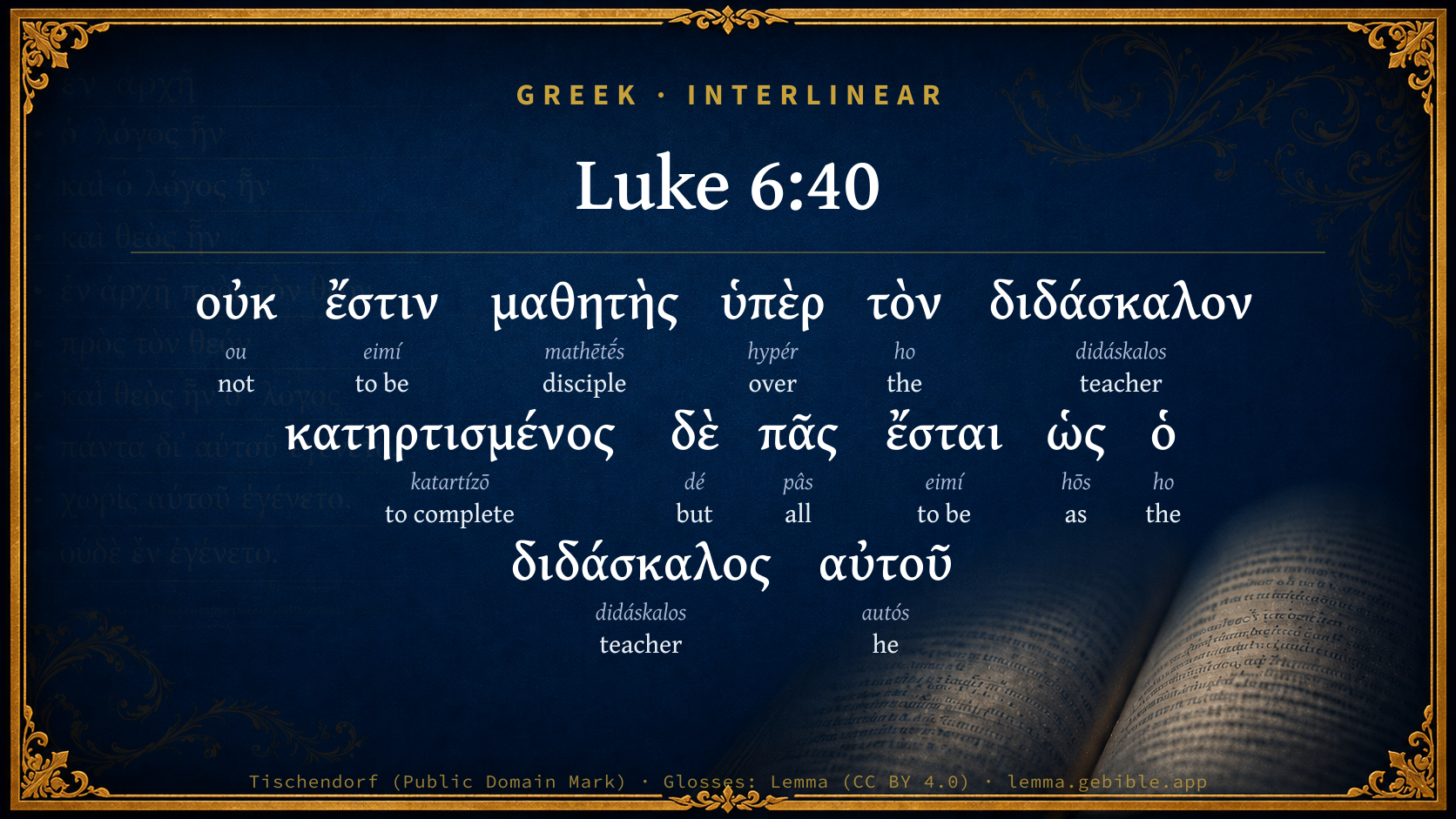
  1. οὐκ ou G3756 “not” Particle, Negative
  2. ἔστιν eimí G1510 “to be” Verb, Present, Active, Indicative, 3rd person, Singular
  3. μαθητὴς mathētḗs G3101 “disciple” Noun, Nominative, Singular, Masculine
  4. ὑπὲρ hypér G5228 “over” Preposition
  5. τὸν ho G3588 “the” Article, Accusative, Singular, Masculine
  6. διδάσκαλον didáskalos G1320 “teacher” Noun, Accusative, Singular, Masculine
  7. δὲ dé G1161 “but” Conjunction
  8. πᾶς pâs G3956 “all” Adjective, Nominative, Singular, Masculine
  9. ἔσται eimí G1510 “to be” Verb, Future, Middle deponent, Indicative, 3rd person, Singular
  10. ὡς hōs G5613 “as” Adverb
  11. ὁ ho G3588 “the” Article, Nominative, Singular, Masculine
  12. διδάσκαλος didáskalos G1320 “teacher” Noun, Nominative, Singular, Masculine
  13. αὐτοῦ autós G846 “he” Personal pronoun, Genitive, Singular, Masculine

About this verse

These counts appear in no published source. They are computed here, from the morphology-tagged text and Lemma’s own curated glosses. What Lemma adds →

14
words
11
distinct lemmas
Gospels
section

Notable vocabulary

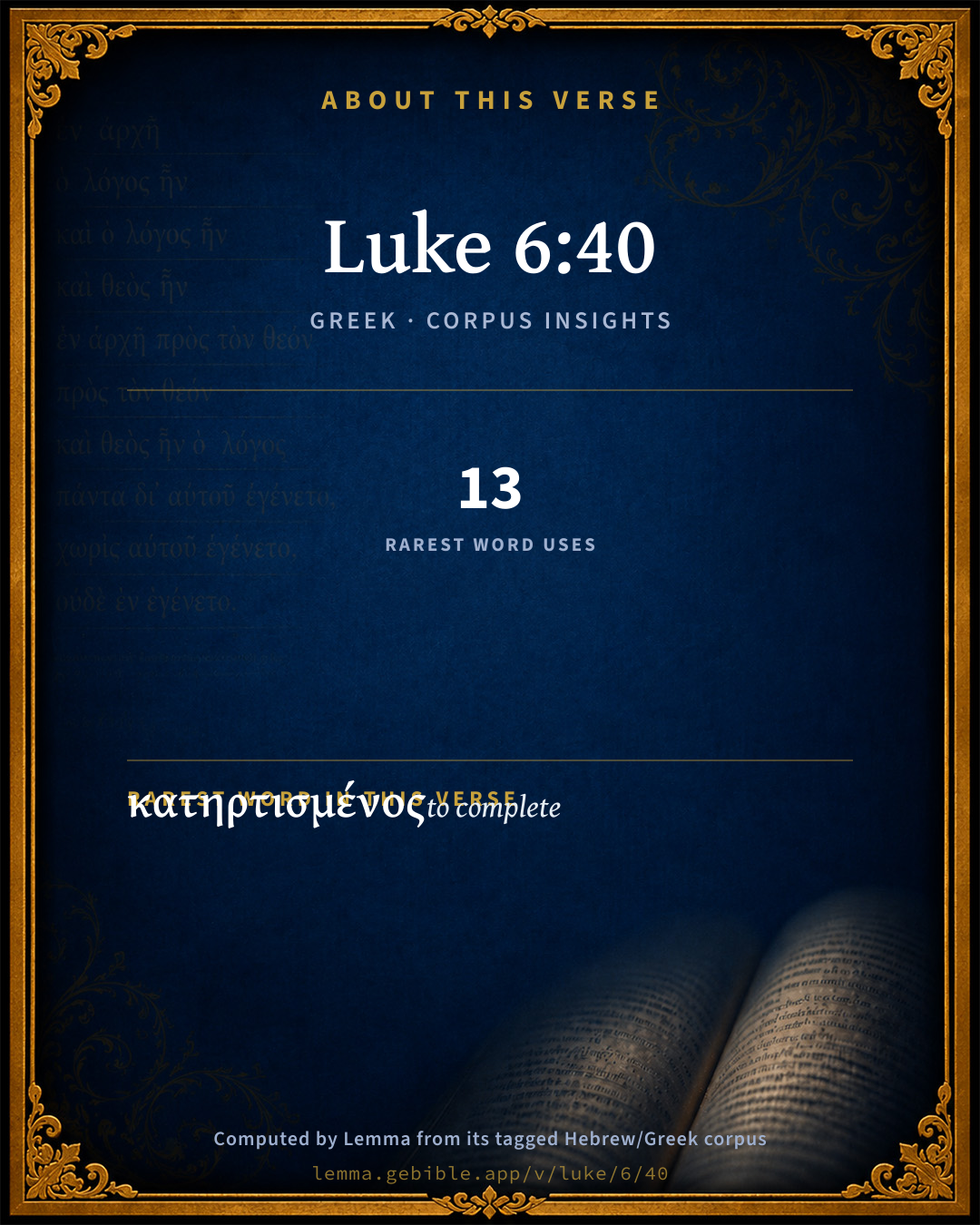
The rarest word here is κατηρτισμένος to complete G2675 — appearing just 13 times in the whole Greek New Testament.

Shared distinctive vocabulary

κατηρτισμένος to complete G2675 occurs in 13 verses of the Greek New Testament. Also found in:

Repetition

Words recur within this verse:

  • ἔστιν to be G1510 ×2
  • διδάσκαλον teacher G1320 ×2
  • τὸν the G3588 ×2

Cross-references

4

Topical passages linked to Luke 6:40 in the Treasury of Scripture Knowledge — connected by theme and wording, ordered by reader-vote popularity; previews shown in the World English Bible.

  • John 13:16 Most assuredly I tell you, a servant is not greater than his lord, neither one who is sent greater than he who sent him.
  • Matthew 10:24–25 "A disciple is not above his teacher, nor a servant above his lord.
  • John 15:20 Remember the word that I said to you: 'A servant is not greater than his lord.' If they persecuted me, they will also persecute you. If they kept my word, they will keep yours also.
  • Matthew 23:15 Woe to you, scribes and Pharisees, hypocrites! For you travel around by sea and land to make one proselyte; and when he becomes one, you make him twice as much of a son of Gehenna as yourselves.

Cross-references courtesy of OpenBible.info (CC BY 4.0).

Commentary

Notes on Luke 6:40 from classic Christian and Jewish commentators (each source and its license shown beneath its notes). The classic Christian expositions comment on the surrounding passage and are grouped to its opening verse, so a note may address several verses; the Jewish commentaries on the Tanakh (Rashi and others) are per-verse, so they appear only where the commentator wrote on this verse.

Lemma curates 59 commentaries, every one of them public domain or Creative Commons licensed, each selected and text-cleaned for this edition rather than reprinted as found. About our sources →

The Biblical Illustrator

Joseph S. Exell

Luk_6:40

The disciple is not above his Master: but every one that is perfect shall be as his Master

The disciple not above his master

This saying was already a proverb in the time of our Lord, or He made it a proverb by His frequent use of it Mat_10:24-25; Joh_13:12-16; Joh_15:20).

On the occasion referred to by St. Luke, He uses it in its widest, its most general scope; for here He is speaking of any and every master, of any and every disciple. No disciple, He says, while he remains a disciple, can reasonably expect to be wiser than his master, whoever his master may be. On every other occasion our Lord limits the scope of the proverb by applying it to Himself and to the disciples who followed Him. Here it follows a parable with which it seems to many to have little connection, to some no connection at all although it is not easy to see how any attentive reader should have missed it. Surely the meaning of the entire passage, and its sequence of thought, are obvious enough. If a teacher be blind, if, that is, he lack intellectual or spiritual discernments, if he therefore frame partial and erroneous conclusions, what can be expected but that his disciples should fall into the very same errors, and fall into them all the more surely in proportion as they are faithful disciples? The disciple is not above his master; the learner is not wiser than the teacher. It is a question whether the disciple will ever rise to the level of his master. He will have done much if he do so much as that. From our Lords use of this proverb here we may infer some lessons of no small practical importance, and, in learning them, still further develop its meaning.

I. THE IMMENSE IMPORTANCE OF BOTH HAVING AND PRESENTING A TRUE AIM, A TRUE IDEAL, OF LIFE. What is our aim then? What should it be? The old catechism answer, rightly understood, is surely as good as any: Mans chief end is to glorify God, and to enjoy Him for ever. But it is of the last importance that we should set a single aim before us, and that the highest of which we are capable.

II. How HAPPY ARE WE, AND HOW GREATLY ASSISTED IN OUR PURSUIT OF IT, SHOULD THIS AIM, THIS ABSTRACT IDEAL, CLOTHE ITSELF IN FLESH AND BLOOD, AND STAND BEFORE US IN THE PERSON OF A MAN OF LIKE PASSIONS WITH OURSELVES! An embodied ideal, a realized and incarnate ideal, is worth a thousand pale abstractions. It is much to have a noble aim before us; but, oh, how much more to have it clothed in the loveliness of a perfect life. The lofty but abstract ideals of character which men have framed incarnate themselves, clothe themselves, with life and power and loveliness, in Christ, the Son of Man.

III. If it be important that we should have it for ourselves, it is also important that WE SHOULD PRESENT A TRUE IDEAL OF LIFE TO OTHERS. We may seek even the highest good selfishly; but, in proportion as we find it, we shall cease to be selfish: we shall seek to be good for the sake of others as well as for our own sake. Let us remember that if in any respect--national, commercial, intellectual, social, spiritual--we are above any of our neighbours, to them, without our permission being asked, we have become masters, i.e., teachers and examples. And therefore we should seek and strive for grace to set them a good example, that our influence may be stimulating and helpful to them. Above all, we should try so to follow Christ as that we may lead them to the Perfect Example, and make them disciples of the only Master who can never mislead them. (S. Cox, D. D.)

The force of example

This is true as an observation: men do grow up into the likeness of what they admire. It is seldom that any come quite up to it. Great philosophers, men of science, divines, soldiers, statesmen--these are taken as models, and each one has shaped the lives of many others. It is not always a conscious imitation. But we do grow like those we admire or love: even mere association shapes us. A man may be known by his associates. If he is not like them he soon will be. They are his masters in some degree, and he will be like them. We should take care, then, whom we imitate. In very many eases men forget to notice what was the end of those they admire. Statesmen have thought of Alexander, Caesar, Napoleon, without considering their deaths, and the ruin they left behind them. Fame and power draw great men to seek them, and lead them into the ditch into which their masters fell before them. Our leaders are not generally people who have made a name in history, but some one not far off our own station in life, who has made himself a name, and got on in the world. It is a very good thing to have examples; we all want lifting, and want fresh thoughts to be given us. But before we give ourselves up to follow, we had better consider our masters as a whole. We may never come up to them, but we cannot hope to fare better than they. Are they exactly what we should like to be; did they end as we should like to end? Now, we find mostly some drawback, something we hope to avoid. We must remember that it began far back in their career. There is many a man of business who buys success at the cost of health and life, or of truth and honesty, Or of family and duty, or of eternity. If that is what he paid, he is no master for us to follow. There is nothing in the world that cannot be bought too dear. And of our masters in social life, pleasant companions, friends, clever fellows: look at them well--do we want to be like them? One and another of our old acquaintances are gone; what has become of them? Take the man who has gone farthest, and then you will see what the road leads to. If it leads to peace, and honour, and health--follow it. If it leads at last only to some filthy ditch--stop while you can. You say, I can stop short; do it then. It will not grow easier, it will cost you more every day. Many a man says, I was a great fool to begin, but now I cannot help it. It is always easiest to go downwards. It is not very difficult, if we deal honestly with ourselves, to see to what our mode of life has led, and we may feel sure we shall be no exception to the general law. But then there is another sense in which these same words were used; they are a comfort and support. We must not expect to be free from the losses, trials, difficulties, which have harassed those who went before us. No man ever grew without patient years of work. Our Lord told His disciples to look at Him, and not expect to be better treated. There has never been a time when there has been no undeserved ill-will. God does not make us perfect by always giving us what we wish for. Others have been tried, and where are they? Those who sought rest and pleasure, those who faced difficulty and kept right and truth--where are they? (Joh_16:33.) A good Christian is not known in the world by his good fortune, but by a hope that does not make ashamed. If we choose the highest model, even Christ, what must we expect? Troubles and difficulties enough, and after them-to be as our Master. Here, indeed, is a glorious future worth all the effort it costs. To be like God Himself in heaven! What other service can give such a reward as this? (Bishop E. Steere.)

The use of a great leader

During one of the campaigns in the American Civil War, when the winter weather was very severe, some of Stonewall Jacksons men having crawled out in the morning from their snowladen blankets, half-frozen, began to curse him as the cause of their sufferings. He lay close by under a tree, also snowed under, and heard all this: but without noticing it, presently crawled out too, and, shaking off the snow, made some jocular remark to the nearest men, who had no idea he had ridden up in the night and lain down amongst them I The incident ran through the army in a few hours, and reconciled his followers to all the hardships of the expedition, and fully re-established his popularity. (Mackay.)

Perfect as the Master

The explanation of this verse seems to turn upon the word translated perfect, a word entirely different from that which is so translated in other passages, e.g., Mat_5:48. The meaning is this: complete in discipline, finished or perfect in the sense in which we should speak of a piece of workmanship as perfect, when it has received the last touch of the workmans hand. [R. V., every one when he is perfected.] So that when our Lord speaks of a man who is perfect being like his master, He means to describe the condition of a person who has received from his master, whoever that master may be, all the teaching and discipline which the master can give him, and He asserts that all that can be expected from such a finished disciple is that he shall be equal to his master; his master cannot raise him above himself; his masters acquirements are (as it were), the limit towards which the growth of the disciple tends. If this be the meaning of our Lords words, we find in them an important warning not to His apostles only but to all teachers. The words show the necessity of those who would teach others growing in grace themselves; they must not expect that they can be worldly-minded and their disciples spiritual, that they can serve Mammon and their disciples serve God; and conversely, they may expect that as they grow more in the knowledge of their God and Saviour, their own growth in knowledge will reflect itself in their disciples, and tend to raise them to that point of spiritual life to which they themselves have already attained. (Bishop H. Goodwin.)

The Biblical Illustrator, edited by Joseph S. Exell (c. 1880s–1900s) — public domain. Text from a community e-Sword module.

Bengel's Gnomon

Johann Albrecht Bengel

Luk 6:40. Κατηρτισμένος, perfect, perfected) Every disciple who has reached the highest goal of a particular discipline, whether that discipline be a perfect one or imperfect, will be as his Master: moreover, in so far as he is a disciple, he will not exceed his Master. For which reason a disciple who has gotten a blind master, will with him fall into the pit. [He who evinces the desire to instruct others with admonitions concerning salvation, must by all means see clearly the way of life, be free from the “beam in the eye,” be a good tree? and lay up and keep good treasure in his heart.—V. g.]

Bengel's Gnomon of the New Testament — English translation (T&T Clark, Edinburgh, 1860) — public domain. Text from a community e-Sword module.

Meyer's Critical & Exegetical Commentary

Heinrich August Wilhelm Meyer

Luk_6:40. The rationale of the preceding statement: Both shall fall into a ditch,therefore not merely the teacher, but the disciple also. Otherwise the disciple must surpass his teachera result which, even in the most fortunate circumstances, is not usually attained. This is thus expressed: A disciple is not above his teacher, but every one that is fully prepared shall be AS his teacher, i.e. when he has received the complete preparation in the school of his teacher he will be equal to his teacher. He will not surpass him. But the disciple must surpass his teacher (in knowledge, wisdom, disposition, etc.) if he were not to fall into perdition along with him. The view: he will be trained as his teacher (Kuinoel, de Wette, Bleek, and others), i.e. he will be like him in knowledge, disposition, etc., satisfies neither the idea of the specially chosen word κατηρτ., nor its emphatic position, nor the correlation of ὑπέρ and ὡς. As to κατηρτισμ., see on 1Co_1:10. The saying in Mat_10:24 f. has a different significance and reference, and cannot be used to limit the meaning here (in opposition to Linders misinterpretation in the Stud. u. Krit. 1862, p. 562).

Meyer — Critical and Exegetical Commentary on the New Testament — English translation by Peter Christie, edited by Frederick Crombie (T&T Clark, 1880) — public domain. Text from a community e-Sword module.

Expositor's Greek Testament

ed. W. Robertson Nicoll

Luk 6:40 . The connection here also is obscure; the adage might be taken as directed against the conceit of scholars presuming to criticise their teachers, which is checked by the reminder that the utmost height that can be reached by the fully equipped ( κατηρτισμένος , a Pauline word, 1Co 1:10 , cf. 2Ti 3:17 , ἐξηρτισμένος ) scholar is to be on a level with his teacher.

The Expositor's Greek Testament, edited by W. Robertson Nicoll (1897–1910) — public domain. Text from a community e-Sword module.

Jamieson, Fausset & Brown

Robert Jamieson, A. R. Fausset & David Brown

The disciple, &c.--that is, "The disciple aims to come up to his master, and he thinks himself complete when he does so: if you then be blind leaders of the blind, the perfection of one's training under you will only land him the more certainly in one common ruin with yourselves."

Jamieson, Fausset & Brown — Commentary Critical and Explanatory on the Whole Bible (1871) — public domain (CC PDM 1.0). Text via the HelloAO Bible API.

Adam Clarke's Commentary

Verse 40. Every one that is perfect] Or, thoroughly instructed, κατηρτισμενος: - from καταρτιζω, to adjust, adapt, knit together, restore, or put in joint. The noun is used by the Greek medical writers to signify the reducing a luxated or disjointed limb. It sometimes signifies to repair or mend, and in this sense it is applied to broken nets, Mt 4:21; Mr 1:19; but in this place, and in He 13:21; 2Ti 3:17, it means complete instruction and information. Every one who is thoroughly instructed in Divine things, who has his heart united to God, whose disordered tempers and passions are purified and restored to harmony and order; every one who has in him the mind that was in Christ, though he cannot be above, yet will be as, his teacher - holy, harmless, undefiled, and separate from sinners.

"The disciple who perfectly understands the rules and sees the example of his master, will think it his business to tread exactly in his steps, to do and suffer upon like occasions, as his master did: and so he will be like his master." WHITBY.

Adam Clarke's Commentary on the Bible (1810–1826) — public domain. Text from a community e-Sword/MySword module.

Ellicott's Commentary for English Readers

(40) The disciple is not above his master.—See Notes on Mat_10:24, Joh_15:20. Here the application of the proverb is obviously very different. The connection of thought is somewhat obscure, and we may not unreasonably believe that some links have been omitted. As it is, however, we can infer something from what precedes and follows. We are still in that section of the discourse which warns the disciples against taking on themselves the office of a judge. They were in this to follow the example of their Master. He, in His work on earth, taught, but did not judge (Joh_8:11-15; Joh_12:47; perhaps, also, Luk_12:14). Were they above their Master that they should do what He had refrained from doing?

Every one that is perfect.—Better, every one that is perfected. The marginal rendering, “Every one shall be perfected,” is hardly tenable grammatically The implied thought is that the disciple or scholar who has been perfected by the education through which his Master has led him, will be like the Master in character and temper, i.e., in this special application of the maxim, will abstain from needless, or hasty, or uncharitable judgment.

A Bible Commentary for English Readers, edited by Charles John Ellicott (1878–1897) — public domain. Text from a community e-Sword module.

The Cambridge Bible for Schools and Colleges

gen. ed. J. J. S. Perowne

40. every one that is perfect shall be as his master] Rather, who has been perfected, 2Ti_3:17. A favourite quotation of St John’s, Luk_13:16, Luk_15:20. See Mat_10:25.

The Cambridge Bible for Schools and Colleges (gen. ed. J. J. S. Perowne; Cambridge University Press, 1878–1918) — public domain. Text from a community e-Sword module.

John Gill's Exposition

And why beholdest thou the mote that is in thy brother's eye,.... A lesser sin in comparison of others; for all sins are not alike, as the Stoics asserted: and though none are to be countenanced and indulged, yet some are not so severely to be animadverted upon as others, the nature, occasions, circumstances, and aggravations considered; for no man is perfect, or wholly free from sin; nor are the words preceding to be understood of such a perfection; for which reason perhaps these words, with what follow, are mentioned:

but perceivest not the beam that is in thine own eye? meaning a greater sin, such are guilty of, who are inquisitive searchers into the faults of others, and severe animadverters on them; and yet are blind to their own iniquities, and take no notice of them. These proverbial expressions were delivered by Christ on the mount, and are the same with those in Mat 7:3. See Gill on Mat 7:3. See Gill on Mat 7:4. See Gill on Mat 7:5.

John Gill's Exposition of the Whole Bible (1746–1763) — public domain (CC PDM 1.0). Text via the HelloAO Bible API.

Trapp's Complete Commentary

John Trapp

40 The disciple is not above his master: but every one that is perfect shall be as his master.

Ver. 40. See Mat 10:24.

John Trapp, A Commentary or Exposition upon All the Books of the Old and New Testament (1647–1656) — public domain. Text from a community e-Sword module.

Matthew Poole's English Annotations

This was another common saying, which our Saviour applies, Mat 10:24; Joh 15:20, to comfort his disciples concerning their sufferings, because he was first in suffering: here he applies it to signify their duty in doing. Some apply this with reference to the Pharisees, and so make a connexion between this and the former verse, where he had said, If the blind lead the blind, they shall both fall into the ditch; for

the disciple is not above his master, none must look to learn of another more than the teacher knoweth himself. But it is better applied to Christ, and is as much as if our Lord had said, I am your Master, you are my disciples, and by that relation engaged to learn of me, and to follow me. I have taught you no more than I am ready to practise; I am merciful, I forgive, I give, looking for nothing again. I do not look that you should do any thing above me, any thing as to which I have not set you, or shall not set you, an example; but your perfection lieth in coming as near to me as you can, in being as your Master.

Matthew Poole's English Annotations on the Holy Bible (1683–1685) — public domain. Text from a community e-Sword/MySword module.

Whedon's Commentary on the Bible

Daniel D. Whedon

40. Disciple… master—A similar expression, but for a different purpose, occurs in Mat_10:25. Here the inferiority of the servant is affirmed in regard to his moral perfection; there it is mentioned to show that the servant must expect persecutions as well as his master.

Daniel D. Whedon (gen. ed.), Commentary on the Old and New Testaments (1874–1909) — public domain. Text from a community e-Sword module.

The Pulpit Commentary

The disciple is not above his master: but every one that is perfect shall be as his master. "Both," he went on to say, "will be lost hopelessly. You cannot expect the disciples of these mistaken men, surely, to be wiser than their teachers; for you know the oft-repeated saying, "Every one that is perfect better rendered, that has been perfected shall be as his master;" in other words, the pupils of these censorious, evil-judging, narrow-minded, bitter men will grow up as they become perfected in this teaching in their turn equally narrow-minded and bitter as their masters." The conclusion, felt though not expressed, of course, is, "But my followers must be something different to these; another and nobler spirit, nobler because more generous, must rule in their hearts."

The Pulpit Commentary (1880–1919), ed. H.D.M. Spence-Jones & Joseph S. Exell — public domain. Text from a community e-Sword module.

John Wesley's Explanatory Notes

Matt. x, 24; John xv, 20.

John Wesley, Explanatory Notes Upon the Whole Bible (1754–1765) — public domain. Text via the GEBible commentary corpus.

Burkitt's Expository Notes on the New Testament

William Burkitt

The application of these words, no doubt, our Saviour intended to his own disciples, partly to comfort them under sufferings, and partly to encourage them to obedience. Did they suffer hard things from an unkind world? The remembrance of what their master suffered before them may support them. Did they meet with hard and difficult duties, such as loving enemies, doing good to them that hate and persecute them? Their Lord’s example may encourage and instruct them, who loved them when they were enemies, who prayed for his murderers, and offered up his blood to God on behalf of them that shed it.

Learn hence, that the perfection of a Christian in this world, consists in the imitation of Christ Jesus, in being as our Master; in coming as near his example as it is possible for persons clothed with flesh and blood to arrive at. Every one that is perfect must be as his Master.

William Burkitt's Expository Notes on the New Testament (1700–1703) — public domain. Text from a community e-Sword module.

The People's New Testament

B. W. Johnson

40. The disciple is not above his master. See note on Matt. 10:24.

B. W. Johnson's The People's New Testament with Notes (1889–1891) — public domain. Electronic text from the Christian Classics Ethereal Library (CCEL) ThML edition.

Cambridge Greek Testament for Schools and Colleges

40. κατηρτισμένος. ‘Who has been perfected,’ 2Ti 3:17. A favourite quotation of St John’s, Luk 13:16, Luk 15:20. See Mat 10:25.

Cambridge Greek Testament for Schools and Colleges (Cambridge University Press, 1896; 21 vols, various authors incl. Carr, Maclear, Plummer, Farrar, Lumby, Moule, M. R. James, Simcox) — public domain. Text from a community e-Sword module.

Alford’s Greek Testament

Henry Alford

40.] See above. κατηρτισμένος (see reff.)—fully instructed—perfect, in the sense of ‘well-conditioned,’ knowing what is his duty, and consistently endeavouring to do it. De Wette, Kuinoel, &c., have given a strange rendering of this clause, making κατηρτ. ὡς ὁ δ. αὐτ. the predicate—‘every disciple will be instructed as his Master.’ But if I mistake not, the position of κατηρτ. as first in the sentence forbids this rendering.

Henry Alford, The Greek Testament (1849–1861) — public domain. Text from a community e-Sword module.

International Critical Commentary

40. This again is one of Christ’s frequent sayings. Here the connexion seems to be that disciples will not get nearer to the truth than the teacher does, and therefore teachers must beware of being blind and uninstructed, especially with regard to knowledge of self. In 22:27 and in Joh 13:16 the meaning is that disciples must not set themselves above their master. In Mat 10:24 the point is that disciples must not expect better treatment than their master. So also in Joh 15:20, which was a different occasion.

κατηρτισμένος δὲ πᾶς ἔσται ὡς ὁ διδάσκαλος αὐτοῦ. The sentence may be taken in various (ways. 1. Every well instructed disciple shall be as his master (AV.). 2. Every disciple, when he has been well instructed, shall be as his master. 3. Every disciple shall be as well instructed as his master (Tyn. Cran.). But Perfectus autem omnis erit, si sit sicut magister ejus (Vulg.), “Every one shall be perfect, if he be as his master” (Rhem.), Wenn der Juünger ist wie sein Meister, so ist er vollkommen (Luth.), is impossible. The meaning is that the disciple will not excel his master; at the best he will only equal him. And, if the master has faults, be disciple will be likely to copy them. Syr-Sin. omits.

For καταρτίζω “make ἄρτιος equip,” comp. Mat 4:21; Mar 1:19; 1Th 3:10; Gal 6:1; Heb 10:5, Heb 11:3, Heb 13:21. It is a surgical word, used of setting a bone or joint: for examples see Wetst. on Mat 4:21. There is no πᾶς in Mat 10:24, Mat 10:25; see on ver. 30.

International Critical Commentary — older volumes (1896–1929), various authors — public domain. Text from a community e-Sword module.

Vincent's Word Studies in the New Testament

Marvin R. Vincent

Perfect [κατηρτισμενος] . Rev., rendering the participle more literally, perfected. See on Mt 4:21. The word signifies to readjust, restore, set to rights, whether in a physical or a moral sense. See 1Co 1:10, where Paul exhorts to be perfectly joined together [κατηρτισμενοι] in opposition to being divided. In Gal 6:1, it is used of restoring a brother taken in a fault. Hence the meaning to perfect, as Eph 4:12. Used in medical language of setting a bone or joint.

Marvin R. Vincent, Word Studies in the New Testament (1887–1900) — public domain. Text from a community e-Sword/MySword module.

Lesson kit

Teaching starters — assembled from the data on this page, not authored interpretation. Every prompt links to the verse data it draws on. Edit before teaching.

Luke, in the Gospels, opens this verse with 14 words (11 distinct Greek lemmas). Its most distinctive word is katartízō (“to complete”). A historical commentator’s framing appears above. Read the whole chapter for the surrounding context.

Discussion questions

  1. How does “to complete” (katartízō) shape what this verse is saying?
  2. How does Matthew 4:21, which shares the word «to complete», read alongside this verse?
  3. What does the repetition of “to be” (2× in this one verse) do in this verse?
  4. These translations render this verse differently. What is at stake in choosing one wording over another?
  5. Compare how The Biblical Illustrator and Bengel's Gnomon read this verse. Where do they agree or differ?

Things to notice

Reading settings

Reading text

Shown beneath each verse's original-language words.

Old Testament
Old Testament edition

Read the OT as the Masoretic Hebrew (MT) or the Greek Septuagint (LXX).

English shown for the Greek Septuagint (in the Hebrew ↔ Greek comparison).

Comparing translations? Open the Compare panel on any verse page to stack up to four side by side.