2 Corinthians 12:10

Greek (Tischendorf 8th ed.) 2 Corinthians 12:10 appears in the Greek New Testament. The text above is from the Tischendorf 8th edition. Each word links to its Strong’s number and a concise gloss. Click any word for its full Thayer’s Greek Lexicon entry.
Download image
Cite this verse

2 Corinthians 12:10 (World English Bible). Public Domain. Lemma interlinear Bible study tool, https://lemma.gebible.app/v/2-corinthians/12/10.

Show BibTeX & RIS
BibTeX
RIS
English Translation
Therefore I take pleasure in weaknesses, in injuries, in necessities, in persecutions, in distresses, for Christ's sake. For when I am weak, then am I strong.
World English Bible · Public Domain
Download a study sheet

One document with this verse’s original text, its word-by-word gloss line, the meaning frame, cross-references with their text, attributed commentary, and full source and license credits — printable, and it pastes into notes with its structure intact.

This verse Autodidact and up

Study sheet (.html) Plain text (.txt)

A passage Seminary Student

Up to 50 verses in one chapter. A passage sheet keeps up to 6 commentary sources and 12 cross-references per verse, in the order this page ranks them, and says so on the sheet whenever that leaves anything out. Ask for a single verse and you get the Autodidact verse sheet above.

Everything on this page stays free to read, with no account — the sheet is a download of what is already on screen, not access to it.

Want to remove ads? Support Godless Engineer
Compare translations 3

The same verse in 3 English versions, stacked beneath the original-language interlinear above. Click any original word for its lexicon entry.

Each is an independent rendering of the whole verse — the interlinear is not word-aligned to these translations.

Highlighted words mark where these versions differ — a whole-verse word diff, not a word-by-word alignment.

  • World English Bible Public Domain
    Therefore I take pleasure in weaknesses, in injuries, in necessities, in persecutions, in distresses, for Christ's sake. For when I am weak, then am I strong.
  • King James Version Public Domain
    Therefore I take pleasure in infirmities, in reproaches, in necessities, in persecutions, in distresses for Christ's sake: for when I am weak, then am I strong.
  • unfoldingWord Literal Text CC BY-SA 4.0
    Therefore, I take delight in weaknesses, in insults, in hardships, in persecutions and distresses for the sake of Christ; for whenever I am weak, then I am powerful.

unfoldingWord Literal Text — © unfoldingWord, licensed CC BY-SA 4.0. Word-aligned USFM3 via Door43 (git.door43.org/unfoldingWord/en_ult).

Versions to compare (up to 4)

3 of 4 selected

Show all 19 translations

Every available English version of this verse, each an independent rendering of the whole verse.

  • World English Bible Public Domain
    Therefore I take pleasure in weaknesses, in injuries, in necessities, in persecutions, in distresses, for Christ's sake. For when I am weak, then am I strong.
  • Berean Standard Bible Public Domain
    That is why, for the sake of Christ, I delight in weaknesses, in insults, in hardships, in persecutions, in difficulties. For when I am weak, then I am strong.
  • Majority Standard Bible Public Domain
    That is why, for the sake of Christ, I delight in weaknesses, in insults, in hardships, in persecutions, in difficulties. For when I am weak, then I am strong.
  • King James Version Public Domain
    Therefore I take pleasure in infirmities, in reproaches, in necessities, in persecutions, in distresses for Christ's sake: for when I am weak, then am I strong.
  • American Standard Version (1901) Public Domain
    Wherefore I take pleasure in weaknesses, in injuries, in necessities, in persecutions, in distresses, for Christ's sake: for when I am weak, then am I strong.
  • Revised Version (1885) Public Domain
    Wherefore I take pleasure in weaknesses, in injuries, in necessities, in persecutions, in distresses, for Christ’s sake: for when I am weak, then am I strong.
  • Geneva Bible (1599) Public Domain
    Therefore I take pleasure in infirmities, in reproches, in necessities, in persecutions, in anguish for Christes sake: for when I am weake, then am I strong.
  • Douay-Rheims (1899) Public Domain
    For which cause I please myself in my infirmities, in reproaches, in necessities, in persecutions, in distresses, for Christ. For when I am weak, then am I powerful.
  • Young's Literal Translation Public Domain
    wherefore I am well pleased in infirmities, in damages, in necessities, in persecutions, in distresses -- for Christ; for whenever I am infirm, then I am powerful;
  • Literal Standard Version CC BY-SA 4.0
    for this reason I am well pleased in weaknesses, in damages, in necessities, in persecutions, in distresses—for Christ; for whenever I may be weak, then I am powerful;
  • Unlocked Literal Bible CC BY-SA 4.0
    Therefore I am content for Christ's sake in weaknesses, in insults, in troubles, in persecutions and distressing situations. For whenever I am weak, then I am strong.
  • unfoldingWord Literal Text CC BY-SA 4.0
    Therefore, I take delight in weaknesses, in insults, in hardships, in persecutions and distresses for the sake of Christ; for whenever I am weak, then I am powerful.
  • Darby Bible Public Domain
    Wherefore I take pleasure in weaknesses, in insults, in necessities, in persecutions, in straits, for Christ: for when I am weak, then I am powerful.
  • World Messianic Bible Public Domain
    Therefore I take pleasure in weaknesses, in injuries, in necessities, in persecutions, and in distresses, for Messiah’s sake. For when I am weak, then am I strong.
  • Webster's Bible Public Domain
    Therefore I take pleasure in infirmities, in reproaches, in necessities, in persecutions, in distresses for Christ's sake: for when I am weak, then am I strong.
  • Free Bible Version CC BY-SA 4.0
    So I appreciate weaknesses, insults, troubles, persecutions, and difficulties that I suffer for Christ's sake. For when I'm weak, then I'm strong!
  • Bible in Basic English Public Domain
    So I take pleasure in being feeble, in unkind words, in needs, in cruel attacks, in troubles, on account of Christ: for when I am feeble, then am I strong.
  • Text-Critical English NT CC BY 4.0
    So I delight in weaknesses, in insults, in hardships, in persecutions, and in distresses for the sake of Christ. For when I am weak, then I am strong.
  • Tyndale New Testament (1534) Public Domain
    Therfore have I delectacion in infirmities in rebukes in nede in persecucions in anguyshe for Christis sake. For when I am weake then am I stronge.

Literal Standard Version (2020), Covenant Press — licensed CC BY-SA 4.0. Text via the HelloAO Bible API (eBible.org). Unlocked Literal Bible (unfoldingWord) — licensed CC BY-SA 4.0. Text via the HelloAO Bible API (eBible.org). unfoldingWord Literal Text — © unfoldingWord, licensed CC BY-SA 4.0. Word-aligned USFM3 via Door43 (git.door43.org/unfoldingWord/en_ult). Free Bible Version, Dr. Jonathan Gallagher — licensed CC BY-SA 4.0. Text via the HelloAO Bible API (eBible.org).

Word by word

More ways to search: Search by grammar → Find every occurrence → Compare this word →

Practice this passage: Drill this verse → Learn its vocabulary →

ὕβρεσιν
hýbris
G5196
“insult”
Noun, Dative, Plural, Feminine
Part of Speech
Noun
Case
Dative
Number
Plural
Gender
Feminine
Full Thayer's Definition

Origin: from G5228

TDNT: 12:55,1

1. insolence a. impudence, pride, haughtiness 2. a wrong springing from insolence, an injury, affront, insult 3. mental injury and wantonness of its infliction being prominent 4. injury inflicted by the violence of a tempest
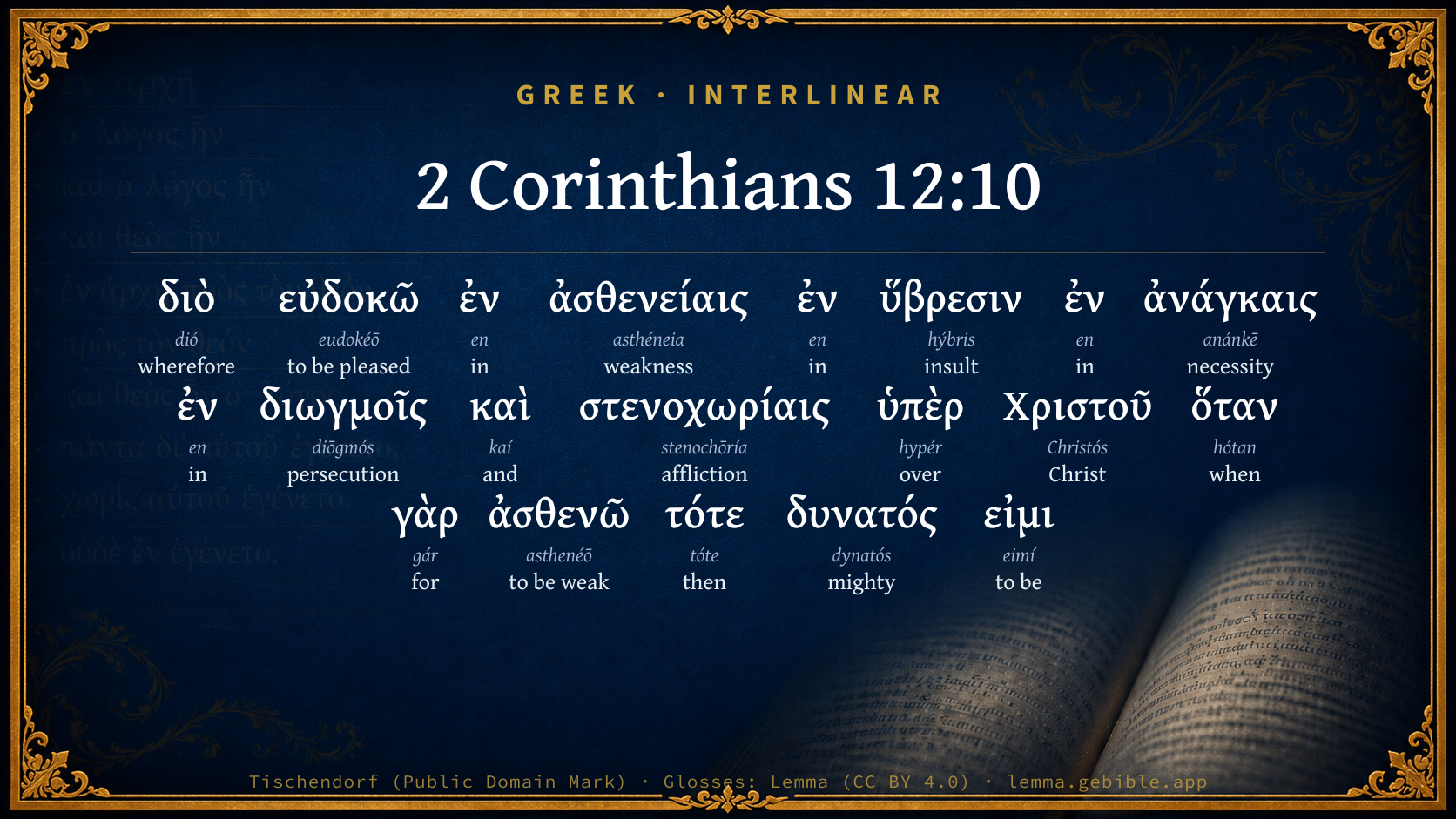
  1. διὸ dió G1352 “wherefore” Conjunction
  2. εὐδοκῶ eudokéō G2106 “to be pleased” Verb, Present, Active, Indicative, 1st person, Singular
  3. ἐν en G1722 “in” Preposition
  4. ἀσθενείαις asthéneia G769 “weakness” Noun, Dative, Plural, Feminine
  5. ἐν en G1722 “in” Preposition
  6. ἐν en G1722 “in” Preposition
  7. ἀνάγκαις anánkē G318 “necessity” Noun, Dative, Plural, Feminine
  8. ἐν en G1722 “in” Preposition
  9. διωγμοῖς diōgmós G1375 “persecution” Noun, Dative, Plural, Masculine
  10. καὶ kaí G2532 “and” Conjunction
  11. στενοχωρίαις stenochōría G4730 “affliction” Noun, Dative, Plural, Feminine
  12. ὑπὲρ hypér G5228 “over” Preposition
  13. Χριστοῦ Christós G5547 “Christ” Noun, Genitive, Singular, Masculine
  14. ὅταν hótan G3752 “when” Conjunction
  15. γὰρ gár G1063 “for” Conjunction
  16. ἀσθενῶ asthenéō G770 “to be weak” Verb, Present, Active, Subjunctive, 1st person, Singular
  17. τότε tóte G5119 “then” Adverb
  18. δυνατός dynatós G1415 “mighty” Adjective, Nominative, Singular, Masculine
  19. εἰμι eimí G1510 “to be” Verb, Present, Active, Indicative, 1st person, Singular

About this verse

These counts appear in no published source. They are computed here, from the morphology-tagged text and Lemma’s own curated glosses. What Lemma adds →

20
words
17
distinct lemmas
Pauline Epistles
section

Notable vocabulary

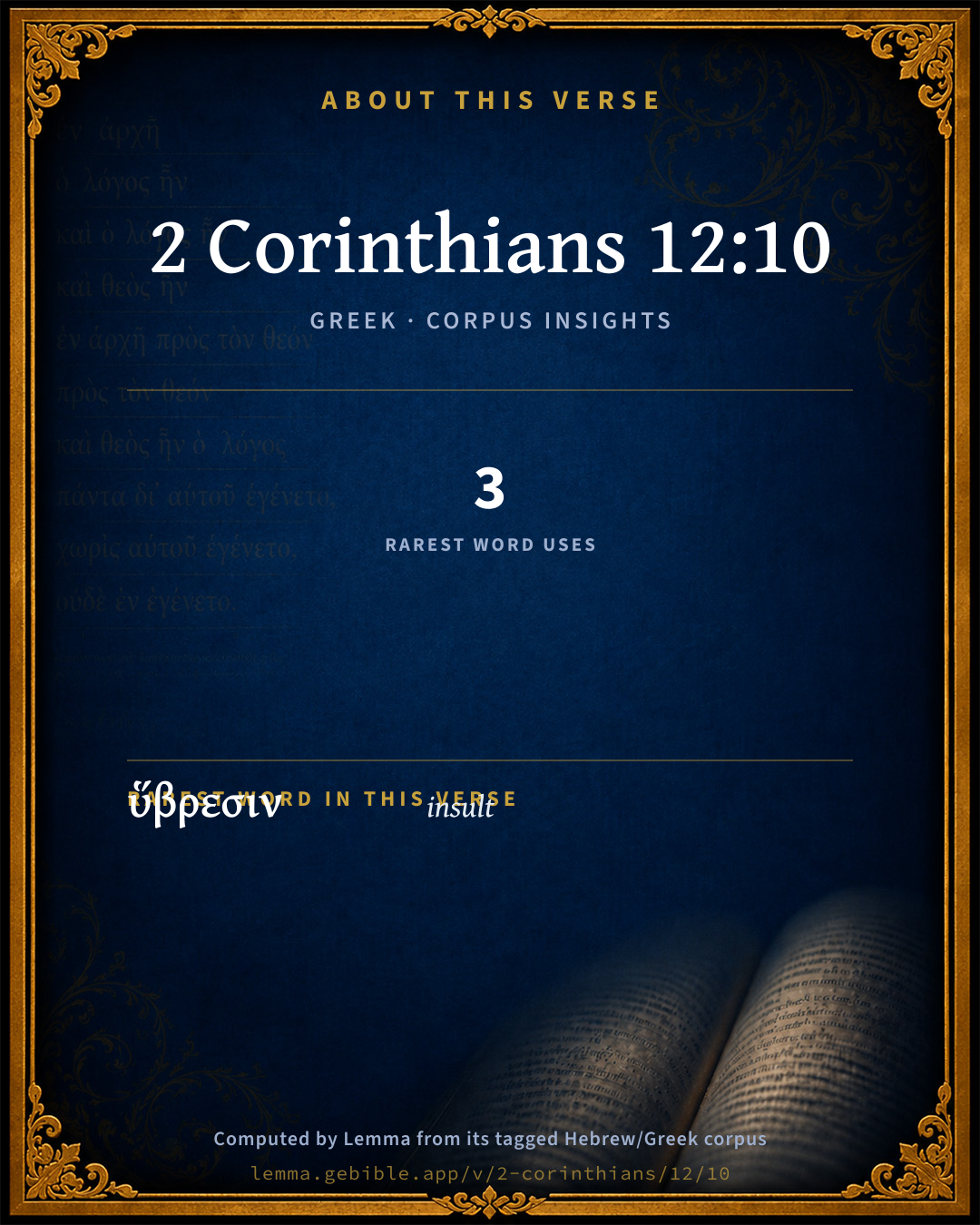
The rarest word here is ὕβρεσιν insult G5196 — appearing just 3 times in the whole Greek New Testament.

Shared distinctive vocabulary

ὕβρεσιν insult G5196 occurs in 3 verses of the Greek New Testament. Also found in:

Repetition

A word recurs within this verse:

Cross-references

27

Topical passages linked to 2 Corinthians 12:10 in the Treasury of Scripture Knowledge — connected by theme and wording, ordered by reader-vote popularity; previews shown in the World English Bible.

  • 2 Corinthians 12:9 He has said to me, "My grace is sufficient for you, for my power is made perfect in weakness." Most gladly therefore I will rather glory in my weaknesses, that the power of Christ may rest on me.
  • Ephesians 6:10 Finally, be strong in the Lord, and in the strength of his might.
  • Romans 5:3 Not only this, but we also rejoice in our sufferings, knowing that suffering works perseverance;
  • 2 Corinthians 13:4 For he was crucified through weakness, yet he lives through the power of God. For we also are weak in him, but we will live with him through the power of God toward you.
  • James 1:2 Count it all joy, my brothers, when you fall into various temptations,
  • 1 Peter 1:6–7 Wherein you greatly rejoice, though now for a little while, if need be, you have been put to grief in various trials,
  • 2 Corinthians 6:4 but in everything commending ourselves, as servants of God, in great endurance, in afflictions, in hardships, in distresses,
  • Luke 6:22 Blessed are you when men shall hate you, and when they shall exclude and mock you, and throw out your name as evil, for the Son of Man's sake.
  • 2 Corinthians 1:4 who comforts us in all our affliction, that we may be able to comfort those who are in any affliction, through the comfort with which we ourselves are comforted by God.
  • John 15:21 But all these things will they do to you for my name's sake, because they don't know him who sent me.
  • Acts 5:41 They therefore departed from the presence of the council, rejoicing that they were counted worthy to suffer dishonor for Jesus' name.
  • 2 Corinthians 13:9 For we rejoice when we are weak and you are strong. And this we also pray for, even your perfecting.
  • 2 Corinthians 4:17 For our light affliction, which is for the moment, works for us more and more exceedingly an eternal weight of glory;
  • 1 Corinthians 4:10 We are fools for Christ's sake, but you are wise in Christ. We are weak, but you are strong. You have honor, but we have dishonor.
  • 2 Corinthians 5:15 He died for all, that those who live should no longer live to themselves, but to him who for their sakes died and rose again.
  • 2 Corinthians 10:18 For it isn't he who commends himself who is approved, but whom the Lord commends.
  • Philippians 1:29 Because it has been granted to you on behalf of Christ, not only to believe in him, but also to suffer on his behalf,
  • Revelation 2:3 You have perseverance and have endured for my name's sake, and have not grown weary.
  • Romans 8:35–39 Who shall separate us from the love of Christ? Could oppression, or anguish, or persecution, or famine, or nakedness, or peril, or sword?
  • 2 Thessalonians 1:4 so that we ourselves boast about you in the assemblies of God for your patience and faith in all your persecutions and in the afflictions which you endure.
  • 1 Peter 4:13–14 But because you are partakers of Christ's sufferings, rejoice; that at the revelation of his glory also you may rejoice with exceeding joy.
  • 2 Corinthians 4:5 For we don't preach ourselves, but Christ Jesus as Lord, and ourselves as your servants for Jesus' sake;
  • 2 Corinthians 4:8–11 We are pressed on every side, yet not crushed; perplexed, yet not to despair;
  • 2 Corinthians 7:4 Great is my boldness of speech toward you. Great is my boasting on your behalf. I am filled with comfort. I overflow with joy in all our affliction.
  • Philippians 2:17–18 Yes, and if I am poured out on the sacrifice and service of your faith, I rejoice, and rejoice with you all.
  • Colossians 1:24 Now I rejoice in my sufferings for your sake, and fill up on my part that which is lacking of the afflictions of Christ in my flesh for his body's sake, which is the assembly;
  • 2 Corinthians 11:23–30 Are they servants of Christ? (I speak as one beside himself) I am more so; in labors more abundantly, in prisons more abundantly, in stripes above measure, in deaths often.

Cross-references courtesy of OpenBible.info (CC BY 4.0).

Commentary

Notes on 2 Corinthians 12:10 from classic Christian and Jewish commentators (each source and its license shown beneath its notes). The classic Christian expositions comment on the surrounding passage and are grouped to its opening verse, so a note may address several verses; the Jewish commentaries on the Tanakh (Rashi and others) are per-verse, so they appear only where the commentator wrote on this verse.

Lemma curates 59 commentaries, every one of them public domain or Creative Commons licensed, each selected and text-cleaned for this edition rather than reprinted as found. About our sources →

The Biblical Illustrator

Joseph S. Exell

2Co_12:10

Therefore I take pleasure in infirmities … for Christs sake.

The use of infirmities

Some of the arable land along the shore on the south-east coast of Sutherland is almost covered with shore stones, from the size of a turkeys egg to eight pounds weight. Several experiments have been made to collect these off the land, expecting a better crop; but in every case the land proved less productive by removing them; and on some small spots of land it was found so evident, that they were spread on the land again, to ensure their usual crop of oats or pease. We would fain be rid of all our infirmities which, to our superficial conceptions, appear to be great hindrances to our usefulness, and yet it is most questionable if we should bring forth any fruit unto God without them. Much rather, therefore, will I glory in infirmities that the power of Christ may rest upon me. (C. H. Spurgeon.)

The sanctifying power of sorrow

For Christs sake, that is the main point: the apostle took pleasure in pain, not as pain, but for Christs sake. In itself sorrow is not sanctifying. It is like fire, whose effect depends upon the substance with which it comes in contact. Fire melts wax, inflames straw, and hardens clay. So it is only in afflictions borne for Christs sake, that is, in Christs name, and with Christs spirit, that we can rejoice. Forasmuch as Christ hath suffered in the flesh, arm yourself likewise with the same mind. The Cross alone extracts life out of pain; without this it is death-giving. (F. W. Robertson, M. A.)

For when I am weak, then am I strong.--

Weakness a source of strength

I. Pauls weakness. That is a quality which we are not accustomed to associate with the apostle, knowing what we do of his labours; but when we go deeper we discover that one of the most distinctive preparations for the work which he accomplished was his feebleness. Wherein, then, did it consist?

1. It was not intellectual. Even his vilest detractors could not deny his mental superiority.

2. It was not moral. There was no vacillation about him.

3. It was physical. Paul had to contend with some distressing bodily infirmity.

II. The connection of Pauls weakness with his strength.

1. There was a strength in his weakness. In the Divine administration there is a wonderful law of compensation.

2. There was strength as the result of his weakness.

(1) The consciousness of his own weakness led him to cast himself unreservedly upon the Divine help.

(2) But looking toward man, the result of this weakness was in Paul a great outflow of tenderness. One cannot read his letters without feeling the heart-beat of his sympathy.

3. But there was, also, strength surmounting his weakness. In spite of his infirmity, he laboured on just as though he had nothing of the kind about him. He was impelled to do this.

(1) By his faith. Men as they looked on Dante when he walked the streets after he had written his Inferno, and marked the intensity of his earnest face, said one to another, See the man who has been in hell. The apostle moved in the midst of unseen realities.

(2) By gratitude. Never was consecration more thorough than his. He felt that he owed everything to Jesus, and to Jesus he yielded all. Conclusion:

1. Here is a use of explanation. You wonder, perhaps, why you have such feebleness. When you see others with robust frames and unbroken health, you are apt to say, Ah, if I had but their strength how much more might I do for my Saviour! But you are mistaken. If you had their strength you might not really be so strong as you are now.

2. A use of consolation. You wish to work for the Lord, and think you can do nothing because of your feebleness. Then see in Pauls life how much can be accomplished, weakness notwithstanding. Nor is he a solitary instance. Think of Calvin and his irritable temper and a fragile and diseased body.

3. A use of direction. We can overcome our weakness only through a faith and a consecration like Pauls. The one answer that will avail to the cry Who is sufficient for these things? is this: My sufficiency is of God. Out of Saul, what has made Paul? Faith. (W. M. Taylor, D. D.)

Strength in weakness

Note--

I. This general law apart from its religious bearings.

1. Weakness is sometimes perfected in strength. Its greatest manifestations are constantly seen in those whom the world deems the strongest. A strong man is likely to be a self-reliant man, and such a man is morally certain to display some weakness. A man, again, who is consciously strong at some point, is likely to think that his strength at that point will make up for his carelessness at other points. For instance, you often see men of great intellect who are morally weak and loose, and who count on their intellectual strength to cover their moral deficiency. The man who is financially strong is now and then tempted to believe that money can carry him over the lack of courtesy or consideration for others. The strong men of the Bible are also its weak men. Abrahams falsehood, Noahs excess, Jacobs worldliness, Moses unhallowed zeal, Elijahs faithless despair, Davids lust and murder, Solomons luxuriousness and sensuality all tell the same story which we read in the biographies of the scholars, statesmen, monarchs, and generals of later times.

2. On the other hand, strength is perfected in weakness. Let an ignorant but conceited man go to a foreign city. He says, A guide is a nuisance, and I will have none of them. I will find out the objects of interest for myself. And so he goes blundering along, exposing himself to insult and even to danger, wasting hours in his search for a palace or an art-gallery--a sorry exhibition of weakness. Another man goes into the same city, quite as ignorant, but follows a trustworthy and intelligent guide. He gains new ideas, while the strong man, so independent of help, is standing at street corners and painfully studying his guide-book. When they return home, the man who was weak enough to accept guidance is the stronger man in knowledge. Can you imagine any object more weak and helpless than a blind child, and yet what a strength it wins from that very weakness! Out of weakness the child is made strong. And then there is the familiar fact of the increased power imparted to touch and ear by the very infirmity. Then, again, the consciousness of infirmity often makes its subject so cautious that he really accomplishes more than another who is free from infirmity. The man whose health and strength are exuberant, is likely to be careless of them; while he who rarely knows what it is to be without an aching head or a feverish pulse, therefore works by rule and economises minutes and brings discipline to bear on rebellious nerves and muscles. It is this power of self-mastery wrought out through weakness, which gives such power over other minds and hearts.

II. The truth on its religious side.

1. Real strength comes only out of that weakness which, distrustful of itself, gives itself up to God.

(1) Take the case of Paul. Here is a man beset with various infirmities. And yet at this distance we can see that that very weakness of Paul was his strength. For it gave Gods power its full opportunity. It is a strange gift that we have of preventing God from doing for us all that He would. God often sees fit to use the very elements you and I would throw away. We do not count weakness among the factors of success. The world is at a loss what to do with it; but when God takes hold of weakness it becomes another thing and works under another law. So then Paul, having abandoned the idea of doing anything by himself, God took this weakness and wrought out victory for Christs cause and for Paul by means of it.

(a) Take the impression which the character and history of Paul make on your own minds. You know something of the power which Lukes record of his life and labours exerts in stimulating Christian zeal and in educating character. Do not all these things get a stronger hold on you through the very sympathy which the apostles sufferings call out? Did not his very infirmities endear him to the churches in his own day? Had not these somewhat to do with the liberal supplies from Philippi, and with the heart-breaking sorrow of the Ephesian elders at Miletus?

(b) After all that we read of Paul, we rise from his story and from his writings with a stronger impression of Christ than of him. The radiance of the light eclipses the wonder of the lamp. That is as Paul would have had it.

(2) Or go farther back. Christ called Peter a rock; and yet at that stage Peter reminds us rather of those rocks which one meets with in clay-soil regions, which crumble at the touch, and are, least of all stones, fit for foundations. Peter, blustering, forward, boastful, with a great deal of strength of his own, which crumbled into weakness at the first touch of danger--and yet--On this rock will I build My Church, etc. The Church which began under the ministry of weak Peter is surely no feeble factor in to-days society: but the Peter of Pentecost was not the Peter of Gethsemane. Between these two he had learned a great deal about the weakness of human strength and the strength which God makes perfect in human weakness. The consequence is that whereas in Gethsemane Peter asserts himself, at Pentecost he asserts Jesus. Where he asserts himself the issue is a coward and a traitor. Where he passes out of sight behind Jesus, he is the hero of the infant Church, whom we love and honour.

2. The text is no encouragement to cherish weakness. The object of Christian training is to make men strong: and Paul can do all things, but only through Christ that strengtheneth him. How beautifully the context brings out this thought! What was the ark of the covenant? Nothing but a simple box overlaid with gold, such a thing as any skilful workman could make. And yet, when it fell into the hands of Israels enemies, the priest declared the glory is departed from Israel. What gave it this importance and meaning? It was that which rested upon it--the glory which made its resting-place the holiest spot in the world. And so, when the power of Christ rests upon a life, all its commonplace, its weakness, are transfigured, and the weak things of the world confound the things which are mighty. Thus it comes to pass that out of the mouth of babes and sucklings God ordains strength.

3. The truth of the text is wider than some of us have been wont to think. It asserts not only that God will assist our weakness, but that He will make our weakness itself an element of strength. We are, naturally, like one who carries round with him a rough precious-stone, ignorant of its value, and ready to throw it away or to part with it for a trifle, This thing, weakness, we should be glad to throw away. Christ comes like a skilful lapidary and shows us its value. I remember a little church among the mountains, which sprang up through the labours of a man the best of whose life was spent in trouble--a church founded among a population little better than heathen; and in the church building there was framed and hung up a magnificent rough agate which he had picked up somewhere among the hills, with the inscription, And such were some of you. And that stone tells the story of our text--the story of the Church on earth; a weak, erring church, its leaders stained and scarred with human infirmity, yet with a line of victory and spiritual power running through it like a track of fire: rough stones hewn out of the mountains, carved into polished pillars in the temple of the Lord. (M. R. Vincent, D. D.)

The Biblical Illustrator, edited by Joseph S. Exell (c. 1880s–1900s) — public domain. Text from a community e-Sword module.

Bengel's Gnomon

Johann Albrecht Bengel

2Co 12:10. Εὐδοκῶ, I am well contented [Engl. V. too strongly, I take pleasure]) He does not say here, I rejoice, which would denote more than he meant.—ἐν ἀσθενείαις, in infirmities) This is the genus; hence we have immediately after, I am weak; two pairs of species follow.—ἐν ὕβρεσιν, ἐν ἀνάγκαις, in reproaches, in necessities) which also the messenger of Satan occasions.—ἐν διωγμοῖς, ἐν στενοχωρίαις, in persecutions, in distresses) which were caused by men.—ὑπὲρ, for the sake of) construed with εὐδοκῶ, I am well contented.—τότε) then, in particular [then and then only].—δυνατὸς, strong) in the power of Christ.

Bengel's Gnomon of the New Testament — English translation (T&T Clark, Edinburgh, 1860) — public domain. Text from a community e-Sword module.

Meyer's Critical & Exegetical Commentary

Heinrich August Wilhelm Meyer

2Co_12:10. Διό] because, namely, in such circumstances with such a mood the power of Christ joins itself with m.

εὐδοκῶ ἐν ἀσθεν.] I take pleasure in weaknesses, bear them with inward assent and willingly, when they befall me. Comp. 2Co_7:4. Contumax enim adversus tormenta fides, Tacitus, Hist. i. 3; Seneca, de prov. iv. 4. ἀσθ. are here, as in the whole context, situations of human powerlessness, brought about by allotted experiences of suffering. Afterwards four, partly more, partly less special, kinds of such situations are adduced. Rückert, quite at variance with the context, understands diseases to be mean.

ἐν ὕβρεσιν] passive: in cases of arrogant treatment, which I experience. On the plural, comp. Plato, Legg. i. p. 627 A; Dem. 522. 13; Sir_10:8. They bring into necessities (ἀναγκ.); and persecutions drive into straitened positions (στενοχ.), out of which no issue is apparent (comp. on 2Co_4:8).

ὑπὲρ Χριστοῦ] belongs neither to all five elements (so usually), nor simply to the last four points (Hofmann), but to εὐδοκῶ: for Christs sake, because by such sufferings His honour and His work are promoted. That Paul meant sufferings for Christ, was, indeed, self-evident. But he wishes to assign the specific motive for his εὐδοκῶ.

τότε δύνατός εἰμι] inwardly through Christs power. See 2Co_12:8-9. τότε, then, is emphatic, here with the feeling of victoriousness. Comp. 1Co_15:54; Col_3:4; Hom. Il. xi. 191 f., 206 f.; Plato, Phil. p. 17 D, Conv. p. 192 B. On the idea, comp. the expression on of Moses in Philo, Vit. M. 1, p. 613 B: τὸ ἀσθενὲς ὑμῶν δύναμίς ἐστιν.

Meyer — Critical and Exegetical Commentary on the New Testament — English translation by Peter Christie, edited by Frederick Crombie (T&T Clark, 1880) — public domain. Text from a community e-Sword module.

Expositor's Greek Testament

ed. W. Robertson Nicoll

2Co 12:10 . διὸ εὐδοκῶ κ . τ . λ .: wherefore I am well content in (for εὐδοκεῖν ἐν cf. 2Sa 22:20 , Mat 3:17 , 1Co 10:5 ) weaknesses, in insults ( ὕβρις is used for “injury” to a ship in Act 27:10 ; Act 27:21 ; it does not occur elsewhere in N.T.; but cf. ὑβρίζειν , Act 14:5 , 1Th 2:2 ), in necessities, in persecutions and distresses, for Christ’s sake ( cf. Mat 5:11 ); for whenever I am weak, then am I strong . Wetstein compares Philo’s τὸ ἀσθενὲς ὑμῶν δύναμίς ἐστι ( Vit. Mos. , i., § 13). St. Paul’s words are more than a verbal paradox: they express the fact, to which history abundantly testifies, that the world’s throne is the Cross.

The Expositor's Greek Testament, edited by W. Robertson Nicoll (1897–1910) — public domain. Text from a community e-Sword module.

Geneva Bible (1599)

Geneva Bible translators

I do not only take them patiently and with a good heart, but also I take great pleasure in them.

Geneva Bible (1599) marginal notes — public domain. Text via Bolls.life.

Jamieson, Fausset & Brown

Robert Jamieson, A. R. Fausset & David Brown

take pleasure in--too strongly. Rather as the Greek, "I am well contented in."

infirmities--the genus. Two pairs of species follow, partly coming from "Satan's messenger," partly from men.

reproaches--"insults."

when--in all the cases just specified.

then--then especially.

strong--"powerful" in "the power of Christ" (Co2 12:9; Co2 13:4; Heb 11:34).

Jamieson, Fausset & Brown — Commentary Critical and Explanatory on the Whole Bible (1871) — public domain (CC PDM 1.0). Text via the HelloAO Bible API.

Adam Clarke's Commentary

Verse 10. Therefore I take pleasure] I not only endure them patiently, but am pleased when they occur; for I do it for Christ's sake-on his account; for on his account I suffer. For when I am weak-most oppressed with trials and afflictions, then am I strong; God supporting my mind with his most powerful influences, causing me to rejoice with joy unspeakable and full of glory.

Adam Clarke's Commentary on the Bible (1810–1826) — public domain. Text from a community e-Sword/MySword module.

John Calvin's Commentaries

10. I take pleasure in infirmities There can be no doubt, that he employs the term weakness in different senses; for he formerly applied this name to the punctures that he experienced in the flesh. He now employs it to denote those external qualities, which occasion contempt in the view of the world. Having spoken, however, in a general way, of infirmities of every kind, he now returns to that particular description of them, that had given occasion for his turning aside into this general discourse. Let us take notice, then, that infirmity is a general term, and that under it is comprehended the weakness of our nature, as well as all tokens of abasement. Now the point in question was Paul’s outward abasement. He proceeded farther, for the purpose of showing, that the Lord humbled him in every way, that, in his defects, the glory of God might shine forth the more resplendently, which is, in a manner, concealed and buried, when a man is in an elevated position. He now again returns to speak of his excellences, which, at the same time, made him contemptible in public view, instead of procuring for him esteem and commendation.

For when I am weak, that is — “The more deficiency there is in me, so much the more liberally does the Lord, from his strength, supply me with whatever he sees to be needful for me.” For the fortitude of philosophers is nothing else than contumacy, or rather a mad enthusiasm, such as fanatics are accustomed to have. “If a man is desirous to be truly strong, let him not refuse to be at the same time weak Let him,” I say, “be weak in himself that he may be strong in the Lord.” (Ephesians 6:10.) Should any one object, that Paul speaks here, not of a failure of strength, but of poverty, and other afflictions, I answer, that all these things are exercises for discovering to us our own weakness; for if God had not exercised Paul with such trials, he would never have perceived so clearly his weakness. Hence, he has in view not merely poverty, and hardships of every kind, but also those effects that arise from them, as, for example, a feeling of our own weakness, self-distrust, and humility.

John Calvin's Commentaries (1540-1563) — public domain. Text from the Calvin Translation Society English edition (1840s-50s) via the Christian Classics Ethereal Library (ccel.org). Calvin's coverage is partial (roughly two-thirds of the Bible); uncommented books and verses are honest gaps, never fabricated. The 19th-century editor's footnotes and remarks are omitted so the notes are faithfully Calvin's own voice.

Ellicott's Commentary for English Readers

(10) Therefore I take pleasure in infirmities.—The thoughts of the Apostle go back to the sufferings of which he had spoken fully in 2 Corinthians 11 and elsewhere. One new word is added, “reproaches” (better, insults), which elsewhere in the New Testament meets us only in Act_27:10; Act_27:21, in the sense of material damage. Here the reference is probably to the taunts and sneers to which we have traced allusions in 2Co_1:17; 2Co_3:1; 2Co_7:8; 2Co_8:2; 2Co_10:10; 2Co_11:6; 2Co_11:8; 2Co_11:16. He was able to bear even these with satisfaction when he felt that he was bearing them for the sake of Christ. He had learnt to add another paradox to those of 2Co_6:9-10, and to feel that the greatest weakness was not only compatible with the highest strength, but might be the very condition of its energy.

A Bible Commentary for English Readers, edited by Charles John Ellicott (1878–1897) — public domain. Text from a community e-Sword module.

The Cambridge Bible for Schools and Colleges

gen. ed. J. J. S. Perowne

10. in reproaches] Rather, perhaps, insults.

in distresses] See note on ch. 2Co_6:4.

for Christ’s sake] This refers to all the preceding list of things endured.

strong] Perhaps better, powerful (migty, Wiclif), as the word is cognate with power above. The word strong is scarcely adequate.

The Cambridge Bible for Schools and Colleges (gen. ed. J. J. S. Perowne; Cambridge University Press, 1878–1918) — public domain. Text from a community e-Sword module.

John Gill's Exposition

Truly the signs of an apostle were wrought among you,.... Not only the doctrine which he preached, the power that attended it, and the success it met with among them, were clear signs and evident proofs of his being sent by Christ; not only they themselves, who were converted under his ministry, were testimonials and seals of his apostleship, but also the many other wonderful works done by him confirmed the same, and showed him to be an apostle, and that he was not a whit behind, but equal to the chiefest of them: nor does he refer them to signs that were wrought by him, among others, and in other places, which were many; but to those which they themselves were witnesses of, and therefore might and ought to have spoken of them in defence of him; and in order to stop the mouths of the false apostles, a particular enumeration of these signs follows:

in all patience; it is one sign, and what is here mentioned in the first place of an apostle and minister of Christ, that he patiently bears all injuries and indignities, reproaches, persecutions, and all manner of afflictions, for Christ's sake and the Gospel's; and this the apostle did; and had he not been sent by Christ, it is not reasonable to imagine that he would have exposed himself to so many evils and dangers; or would have bore with so much patience the ill usage of men, and particularly the unkindness and ingratitude he met with at Corinth; but he took all patiently, having their good and the glory of Christ at heart:

in signs and wonders, and mighty deeds; meaning preternatural and miraculous performances; such as raising the dead, healing the sick, cleansing lepers, casting out devils, speaking with divers tongues, and the like, which were confirming evidences of apostleship; so , "wonders and powers", or "mighty deeds", are mentioned together by the Jews (i), as the same things.

(i) Zohar in Exod. fol. 96. 2. & 97. 1.

John Gill's Exposition of the Whole Bible (1746–1763) — public domain (CC PDM 1.0). Text via the HelloAO Bible API.

Trapp's Complete Commentary

John Trapp

10 Therefore I take pleasure in infirmities, in reproaches, in necessities, in persecutions, in distresses for Christ’s sake: for when I am weak, then am I strong.

Ver. 10. Therefore I take pleasure] ευδοκω, I am well paid by them, I reckon them among God’s love tokens, pledges of his love, and badges of my sonship.

For when I am weak, then, &c.] This is a seeming contradiction. God, saith Luther, doth most of his works in mediis contrariis, by contraries. Δια των εναντιων εναντια οικονομειται. He hath a way by himself, saith Nazianzen, that he may be the more admired.

John Trapp, A Commentary or Exposition upon All the Books of the Old and New Testament (1647–1656) — public domain. Text from a community e-Sword module.

Albert Barnes' Notes on the Bible

Therefore I take pleasure - Since so many benefits result from trials; since my afflictions are the occasion of obtaining the favor of Christ in so eminent a degree, I rejoice in the privilege of suffering. There is often real pleasure in affliction, paradoxical as it may appear. Some of the happiest persons I have known are those who have been deeply afflicted; some of the purest joys which I have witnessed have been manifested on a sick-bed, and in the prospect of death. And I have no doubt that Paul, in the midst of all his infirmities and reproaches, had a joy above that which all the wealth and honor of the world could give. See here the power of religion. It not only supports, it comforts. It not only enables one to bear suffering with resignation, but it enables him to rejoice. Philosophy blunts the feelings: infidelity leaves people to complain and repine in trial; the pleasures of this world have no power even to support or comfort in times of affliction; but Christianity furnishes positive pleasure in trial, and enables the sufferer to smile through his tears.

In infirmities - In my weaknesses; see the note on 2Co 11:30.

In reproaches - In the contempt and scorn with which I meet as a follower of Christ, note, 2Co 11:21.

In necessities - In want: see the notes on 2Co 6:4-5.

In distresses for Christ’s sake - note, 2Co 6:4. In the various needs and difficulties to which I am exposed on account of the Saviour, or which I suffer in his cause.

For when I am weak, then am I strong - When I feel weak; when I am subjected to trial, and nature faints and fails, then strength is imparted to me, and I am enabled to bear all. The more I am borne down with trials, the more do I feel my need of divine assistance, and the more do I feel the efficacy of divine grace. Such was the promise in Deu 33:25; “As thy days, so shall thy strength be.” So in Heb 11:24; “Who out of weakness were made strong.” What Christian has not experienced this, and been able to say that when he felt himself weak and felt like sinking under the accumulation of many trials, he has found his strength according to his day, and felt an arm of power supporting him? It is then that the Redeemer manifests himself in a special manner; and then that the excellency of the religion of Christ is truly seen and its power appreciated and felt.

Albert Barnes' Notes on the Bible (1834–1885) — public domain. Text from a community e-Sword/MySword module.

Matthew Poole's English Annotations

Amongst other reasons why I rather choose to glory in what I suffer for Christ, (which is what he here calleth

infirmities, and further openeth by reproaches, necessities, persecutions, and distresses for Christ’s sake), this is one; that I never find myself more strong in the habits and acts of the grace that is in me, than when I am thus made weak. What the apostle here saith of himself, the people of God have ever since his time ordinarily experienced: then it is that they are made strong in the exercises of faith, and patience, and love to God. A child of God seldom walks so much in the view of God as his God, and in the view of his own sincerity, as when, as to his outward condition and circumstances in the world, he walks in the dark and seeth no light.

Matthew Poole's English Annotations on the Holy Bible (1683–1685) — public domain. Text from a community e-Sword/MySword module.

Whedon's Commentary on the Bible

Daniel D. Whedon

10. Take pleasure—All his sufferings and disgraces were a joy for Christ’s sake.

Reproaches—Insulting words.

Necessities—Compulsions to what I would not.

Persecutions—From the enemies of Christ.

Distresses—Narrow circumstances. All four points are endurances, or under-goings of evil.

Weak—In myself.

Strong—Through a divine strength; and to what divine results!

Daniel D. Whedon (gen. ed.), Commentary on the Old and New Testaments (1874–1909) — public domain. Text from a community e-Sword module.

The Pulpit Commentary

I take pleasure in; I am content to bear them cheerfully (2Co_7:4; Rom_5:3) Strong; rather, powerful, mighty. The resemblance to Philo ("Vit. Mos.," Opp., 1:613, "Your weakness is might") is probably accidental (see 1Co_15:54; Col_3:4)

The Pulpit Commentary (1880–1919), ed. H.D.M. Spence-Jones & Joseph S. Exell — public domain. Text from a community e-Sword module.

John Wesley's Explanatory Notes

Weaknesses - Whether proceeding from Satan or men. For when I am weak - Deeply conscious of my weakness, then does the strength of Christ rest upon me.

John Wesley, Explanatory Notes Upon the Whole Bible (1754–1765) — public domain. Text via the GEBible commentary corpus.

Burkitt's Expository Notes on the New Testament

William Burkitt

Observe here, 1. The high and heroic pitch which St. Paul’s spirit was raised to: He took pleasure in reproaches and persecutions. Pleasure is a degree beyond joy; though these sufferings were painful to the flesh, yet were they pleasing to the spirit. A Christian may not love that which he bears, yet may he love to bear: to bear, is the patience of necessity; to love to bear, is the patience of virtue: to delight to bear reproach or persecution for Christ, is expressive of the highest affection towards Christ, and lowest subjection to him, If nature suffers not a saint to take pleasure in reproaches, as such, yet grace enables him to take pleasure in what he is reproached for.

Observe, 2. The cause assigned why the apostle took such pleasure in his sufferings and abasements, because they gave him such experience of the power of Christ; insomuch that when he was most weak in himself, he was then most strong in Him. When I am weak, then am I strong; which words are a divine paradox or riddle.

The apostle affirms one contrary of another: weakness is contrary to strength; how then can a weak man be strong, when he is weak? The meaning is, That when a Christian is most sensible of his own weakness, and most diffident and distrustful of his own strength, then the power of Christ rests upon him, and he experiences divine strength coming in unto him. Christ fills none but the hungry, nor doth he strengthen any but the weak; only by going out of our strength, do we get strength; when in an humble sense of our weaknesses we rest upon Christ, the power of Christ rests upon us.

William Burkitt's Expository Notes on the New Testament (1700–1703) — public domain. Text from a community e-Sword module.

McGarvey & Pendleton's Commentaries

J. W. McGarvey

Wherefore I take pleasure in weaknesses, in injuries, in necessities, in persecutions, in distresses, for Christ's sake: for when I am weak, then am I strong . [God so orders it that the times of my weakness are the very hours when my strength is revealed, and thus each period of death is turned into a season of resurrection-- 2Co_4:10 ]

J. W. McGarvey (with Philip Y. Pendleton), Commentaries on the New Testament (The Fourfold Gospel, 1914; Acts; and the epistles) — public domain. Text from a community e-Sword/MySword module.

The People's New Testament

B. W. Johnson

10–13. Therefore I take pleasure, etc. The unparalleled distress, sufferings and persecutions, described in 11:24–27, even give him pleasure because they bring him to a sense of his helplessness and then God makes him strong.

B. W. Johnson's The People's New Testament with Notes (1889–1891) — public domain. Electronic text from the Christian Classics Ethereal Library (CCEL) ThML edition.

Cambridge Greek Testament for Schools and Colleges

10. Here also (comp. 2Co 12:5; 2Co 12:9) F, Vulg. (but not f) insert μου after ἀσθενείαις. ἐν ἀνάγκαις (א3ABCDFGKLP &c.) rather than καὶ ἀνάγκαις (א, Orig.), but perhaps καὶ στενοχωρίαις (Bא1) rather than ἐν στ. (א3DFGKLP, Latt.). Origen’s evidence is divided: 74, a Arm. have καὶ ἐν στεν. A omits ἐν διωγμοῖς.

10. διὸ εὐδοκῶ ἐν ἀσθ. Wherefore (because Christ’s strength is most plainly manifested in weakness) I am well pleased in weaknesses. With εὐδοκῶ comp. 2Co 5:8; 1Th 2:8; 1Th 3:1), and with εὐδ. ἐν comp. 1Co 5:5; Mat 3:17; Mat 17:5.

ἐν ὕβρεσιν, ἐν ἀνάγκαις, κ.τ.λ. See critical note. Only here and Act 27:10; Act 27:21 is ὕβρις found in the N.T., while in the LXX., as in classical Greek, it is very frequent. For the plural comp. Sir 10:8. In all three places ‘injury’ is the best translation: but the word implies wanton infliction of injury, just because it pleases one to inflict it; it is insolent maltreatment. Its use in Acts of the storm is metaphorical: comp. Joseph. Ant. III. vi. 4. Similarly, ὑβριστής is rare in the N.T. (Rom 1:30; 1Ti 1:13), but frequent in the LXX. Comp. ὑβρίζειν (1Ti 2:2; Act 14:5; Mat 22:6; Luk 11:45; Luk 18:32). This word and the three plurals which follow are special kinds of ἀσθένειαι. For διωγμοῖς comp. 2Th 1:4; 2Ti 3:11; for στενοχωρίαις see on 2Co 6:4; for the asyndeton comp. 2Co 11:13; 2Co 11:20, 2Co 13:11.

ὑπὲρ Χριστοῦ. To be taken with εὐδοκῶ. It is for Christ’s sake that he is well pleased in weaknesses: comp. 2Co 5:20; also ἕνεκεν ἐμοῦ (Mat 5:11), and ἕνεκεν τοῦ υἱοῦ τοῦ ἀνθρώπου (Luk 6:22). To take ὑπὲρ Χρ. with ἑν ὕβρεσιν κ.τ.λ. has less point; it might be assumed that these things were endured for Christ’s sake; but taking pleasure in them is more than endurance, and the Apostle adds the motive which enabled him to do that. Comp. ἑμοὶ γὰρ τὸ ζῆν Χριστός (Php 1:21).

ὅταν γὰρ ἀσθενῶ, τότε δυνατός εἰμι. For whenever I am weak, then I am strong. The translation of δυνατός should correspond with that of δύναμις in 2Co 12:9; for it is through the δύναμις τοῦ χρ. that he is δυνατός. Therefore, if ‘strength’ there, ‘strong’ here; and if ‘power’ there, ‘powerful’ here.

The paradox sums up the Apostle’s estimate of his own achievements. From the special ἀσθένεια of the σκόλοψ he has slipped back to the catalogue of τὰ τῆς ἀσθενείας (2Co 11:23-30); and this is the triumphant cry with which the paragraph concludes: it is precisely when he is weak that he is strong. At such times he feels, and others see, that he is weak: and he knows, and they know, what he accomplishes in spite of the weakness. There can, therefore, be no mistake as to the source of the strength. Christ’s strength, in His minister’s weakness, τελεῖται. Augustine (Conf. X. iii. 4) reverses this: dulcedine gratiae Tuae, qua potens est omnia infirmus, qui sibi per ipsam fit conscius infirmitatis suae. It is not the grace that makes him conscious of his own weakness, but his weakness which makes him conscious of the grace.

Pliny tells us that the sickness of a friend taught him that we are at our best when we are ill. The sick man is not troubled by his passions, or about honours and possessions which he is soon to leave; he remembers the gods, and that he himself is a man; invidet nemini, neminem miratur, neminem despicit, ac ne sermonibus quiden malignis aut attendit, aut alitur (Ep. 7:26).

2Co 12:11 to 2Co 13:10. RETROSPECT OF HIS GLORYING, AND WARNINGS IN CONNEXION WITH HIS APPROACHING VISIT

Cambridge Greek Testament for Schools and Colleges (Cambridge University Press, 1896; 21 vols, various authors incl. Carr, Maclear, Plummer, Farrar, Lumby, Moule, M. R. James, Simcox) — public domain. Text from a community e-Sword module.

Alford’s Greek Testament

Henry Alford

10.] Wherefore (because of this relation to human weakness and divine power) I am well content [cf. the same expression Mat 3:17] in infirmities (four kinds of which are then specified,—all coming also, as well as ἀσθ. proper, under the category of ἀσθένειαι, as hindrances and bafflings of human strength),—in insults, in necessities, in persecutions, in distresses,—on behalf of Christ: for whenever I am weak (applying to all five situations above), then I am mighty. Wetst. quotes from Philo, Vita Mosis, i. 13, vol. ii. p. 92, μὴ ἀναπίπτετε. τὸ ἀσθενὲς ὑμῶν δύναμίς ἐστι.

Henry Alford, The Greek Testament (1849–1861) — public domain. Text from a community e-Sword module.

International Critical Commentary

10. διὸ εὐδοκῶ ἐν ἀσθενείαις. ‘Wherefore I am well pleased in weaknesses,’ because it is precisely in them that the strength of Christ is conspicuous. Polybius and other secular authors write εὐδοκῶ τινι. In LXX and N.T. we commonly have εὐδ. ἐν, but the simple dat. occurs 2Th 2:12 (according to the best texts); 1 Macc. 1:43; 1 Esdr. 4:39; cf. Rom 1:32. See Abbott, Johannine Grammar, p. 387. In Mat 12:18 and Heb 10:6 we have the acc. Now follow four kinds of ‘weaknesses.’

ἰν ὕβρεσιν. In LXX, as in class. Grk., the word is freq.; in N.T. only here and Act 27:10, Act 27:12. The plur. is comparatively rare; in LXX, only Ecclus. 10:8; ‘Sovereignty is transferred from one nation to another διὰ ὕβρεις.’ The word implies wanton injury, insolent maltreatment, and therefore it is occasionally used of the apparently wanton damage done by storms, as in Acts. Josephus (Ant. III. vi. 4) says that the Tabernacle was protected by coverings against τὴν ἀπὸ τῶν ὄμΒρων ὕΒριν. For στενο ωρίαις see on 6:4; in Rom 8:35, as here, the word is connected with διωγμός.

ὑπὲρ χριστοῦ. It is for Christ’s sake (v. 20) that he is well pleased in weaknesses. This is better than taking ὑπὲρ Χριστοῦ with each of the four datives, although the difference in meaning is not great. When he knows that it is not the Lord’s will that he should be freed from his afflictions, he not only does not grieve, but for Christ’s sake is well pleased.

ὅταν γὰρ ἀσθενῳ τότε δυνατός εἰμι. ‘For whenever I am weak, then I am strong.’ Cf. βοῶσα τοῖς ἐν σνμφοραῖς, Μὴ ἀναπίπτετε, τό ἀσθενὲς ὑμῶν δύναμίς ἐστιν (Philo, Vita Moys. i. 13, p. 92, Mang.). The γάρ introduces the reason why he rejoices in his weaknesses. In his letter to Eustochium (Ep. cviii. 19), Jerome writes; quando infirmor tunc fortior sum. With this paradoxical outburst of triumph this paragraph closes. Experience has taught him, and has taught those who have been witnesses of his work, how much he can accomplish when he is apparently disabled by his infirmities and afflictions; that shows how amply the Divine declaration is justified, Ἀρκεῖ σοι ἡ χάρις μου. To glory in these things is to glory in the strength of Christ.

F, Vulg, but not f, insert μου after ἀσθενείαις, as these and other authorities do in v. 5, and some in v. 9. ἐν ἀνάλκαις rather than καὶ ἀναλ. (א, Orig.); but καὶ στενοχωρίαις (א* B) rather than ἐν στεν. (א3 D E G K L P, Latt.). A omits ἐν διωγμοῖς.

12:11-18. The Credentials of an Apostle; Exceptional Signs and Exceptional Love

That I have become a fool by glorying is your fault; for you have not been loyal to one whom you might know to be an Apostle by the mighty works and the exceeding love which he showed to you.

11I have been making a fool of myself by writing in this glorying fashion. but I am not to blame for it. It was you who drove me to do it; for you gave support to my opponents, when you ought loyally to have commended me. I had a right to expect this from you for in no single thing was I inferior to those pre-eminent apostles of yours, although as a matter of fact I am nothing. 12 The signs, yes, the signs which mark the true Apostle, were wrought out in your midst,—and the endurance of all that they cost me never failed,—in works of significance, works of wonder, and works of power. 13You think that I have treated you badly. Well, in what respect were you put in a position of inferiority to my other Churches, except it be that I myself did not ‘sponge’ on you? Of your generosity, pray forgive me this dreadful wrong!

14Behold that I am ready to come to you now for the third time; and you will find that, as on the two former visits, I shall not ‘sponge’ on you. For what I am seeking is not your possessions for myself, but yourselves for Christ. Do you ask why I refuse your possessions? Because you are my children, and there is no such obligation on children to provide for their parents as on parents to provide for their children.15That is generally admitted; but as for myself, most gladly will I spend what I have, and be utterly spent myself, for the good of your souls. Then, if my love for you exceeds that of fathers, am I to be loved less? That would indeed be a strange requital. 16 But you say, “We let that pass.” You admit that I did not myself come down on you for maintenance, but you insinuate that, like the cunning knave that I am always supposed to be, I entrapped you in other ways by the crafty employment of agents. 17Did I? By means of any of those whom I sent to you did I take unfair advantage of you? 18I asked Titus to visit you, and with him I sent the brother whom you know. Did Titus take any unfair advantage of you? No one would venture to insinuate that. And was there any difference between his guiding principle and mine? Was there any difference between his conduct and mine?

International Critical Commentary — older volumes (1896–1929), various authors — public domain. Text from a community e-Sword module.

Lesson kit

Teaching starters — assembled from the data on this page, not authored interpretation. Every prompt links to the verse data it draws on. Edit before teaching.

2 Corinthians, in the Pauline Epistles, opens this verse with 20 words (17 distinct Greek lemmas). Its most distinctive word is hýbris (“insult”). A historical commentator’s framing appears above. Read the whole chapter for the surrounding context.

Discussion questions

  1. How does “insult” (hýbris) shape what this verse is saying?
  2. Acts 27:10 shares the word «insult» with this verse. How do the two illuminate each other?
  3. “in” occurs 4× in this one verse. What is the effect of the repetition?
  4. These translations render this verse differently; the difference is in the English rendering, not the original. What questions does that raise?
  5. Reading how The Biblical Illustrator and Bengel's Gnomon read this verse, where do the two commentators agree and where do they part?

Things to notice

Reading settings

Reading text

Shown beneath each verse's original-language words.

Old Testament
Old Testament edition

Read the OT as the Masoretic Hebrew (MT) or the Greek Septuagint (LXX).

English shown for the Greek Septuagint (in the Hebrew ↔ Greek comparison).

Comparing translations? Open the Compare panel on any verse page to stack up to four side by side.