Ephesians 6:20

Greek (Tischendorf 8th ed.) Ephesians 6:20 appears in the Greek New Testament. The text above is from the Tischendorf 8th edition. Each word links to its Strong’s number and a concise gloss. Click any word for its full Thayer’s Greek Lexicon entry.
Download image
Cite this verse

Ephesians 6:20 (World English Bible). Public Domain. Lemma interlinear Bible study tool, https://lemma.gebible.app/v/ephesians/6/20.

Show BibTeX & RIS
BibTeX
RIS
English Translation
for which I am an ambassador in chains; that in it I may speak boldly, as I ought to speak.
World English Bible · Public Domain
Download a study sheet

One document with this verse’s original text, its word-by-word gloss line, the meaning frame, cross-references with their text, attributed commentary, and full source and license credits — printable, and it pastes into notes with its structure intact.

This verse Autodidact and up

Study sheet (.html) Plain text (.txt)

A passage Seminary Student

Up to 50 verses in one chapter. A passage sheet keeps up to 6 commentary sources and 12 cross-references per verse, in the order this page ranks them, and says so on the sheet whenever that leaves anything out. Ask for a single verse and you get the Autodidact verse sheet above.

Everything on this page stays free to read, with no account — the sheet is a download of what is already on screen, not access to it.

Want to remove ads? Support Godless Engineer
Compare translations 3

The same verse in 3 English versions, stacked beneath the original-language interlinear above. Click any original word for its lexicon entry.

Each is an independent rendering of the whole verse — the interlinear is not word-aligned to these translations.

Highlighted words mark where these versions differ — a whole-verse word diff, not a word-by-word alignment.

  • World English Bible Public Domain
    for which I am an ambassador in chains; that in it I may speak boldly, as I ought to speak.
  • King James Version Public Domain
    For which I am an ambassador in bonds: that therein I may speak boldly, as I ought to speak.
  • unfoldingWord Literal Text CC BY-SA 4.0
    (for which I am an ambassador in chains), so that in it I may speak boldly, as it is necessary for me to speak.

unfoldingWord Literal Text — © unfoldingWord, licensed CC BY-SA 4.0. Word-aligned USFM3 via Door43 (git.door43.org/unfoldingWord/en_ult).

Versions to compare (up to 4)

3 of 4 selected

Show all 19 translations

Every available English version of this verse, each an independent rendering of the whole verse.

  • World English Bible Public Domain
    for which I am an ambassador in chains; that in it I may speak boldly, as I ought to speak.
  • Berean Standard Bible Public Domain
    for which I am an ambassador in chains. Pray that I may proclaim it fearlessly, as I should.
  • Majority Standard Bible Public Domain
    for which I am an ambassador in chains. Pray that I may proclaim it fearlessly, as I should.
  • King James Version Public Domain
    For which I am an ambassador in bonds: that therein I may speak boldly, as I ought to speak.
  • American Standard Version (1901) Public Domain
    for which I am an ambassador in chains; that in it I may speak boldly, as I ought to speak.
  • Revised Version (1885) Public Domain
    for which I am an ambassador in chains; that in it I may speak boldly, as I ought to speak.
  • Geneva Bible (1599) Public Domain
    Whereof I am the ambassadour in bonds, that therein I may speake boldely, as I ought to speake.
  • Douay-Rheims (1899) Public Domain
    For which I am an ambassador in a chain, so that therein I may be bold to speak according as I ought.
  • Young's Literal Translation Public Domain
    for which I am an ambassador in a chain, that in it I may speak freely -- as it behoveth me to speak.
  • Literal Standard Version CC BY-SA 4.0
    for which I am an ambassador in a chain, that in it I may speak freely—as it is necessary for me to speak.
  • Unlocked Literal Bible CC BY-SA 4.0
    It is for the gospel that I am an ambassador who is kept in chains, so that I may declare it boldly, as I ought to speak.
  • unfoldingWord Literal Text CC BY-SA 4.0
    (for which I am an ambassador in chains), so that in it I may speak boldly, as it is necessary for me to speak.
  • Darby Bible Public Domain
    for which I am an ambassador [bound] with a chain, that I may be bold in it as I ought to speak.
  • World Messianic Bible Public Domain
    for which I am an ambassador in chains; that in it I may speak boldly, as I ought to speak.
  • Webster's Bible Public Domain
    For which I am an embassador in bonds: that therein I may speak boldly, as I ought to speak.
  • Free Bible Version CC BY-SA 4.0
    I'm an imprisoned ambassador for the sake of the good news, so please pray that I will speak fearlessly, as I should.
  • Bible in Basic English Public Domain
    For which I am a representative in chains, and that I may say without fear the things which it is right for me to say.
  • Text-Critical English NT CC BY 4.0
    for which I am an ambassador in chains. Pray that I may declare it boldly, as I should.
  • Tyndale New Testament (1534) Public Domain
    whereof I am a messenger in bondes that therin I maye speake frely as it becommeth me to speake.

Literal Standard Version (2020), Covenant Press — licensed CC BY-SA 4.0. Text via the HelloAO Bible API (eBible.org). Unlocked Literal Bible (unfoldingWord) — licensed CC BY-SA 4.0. Text via the HelloAO Bible API (eBible.org). unfoldingWord Literal Text — © unfoldingWord, licensed CC BY-SA 4.0. Word-aligned USFM3 via Door43 (git.door43.org/unfoldingWord/en_ult). Free Bible Version, Dr. Jonathan Gallagher — licensed CC BY-SA 4.0. Text via the HelloAO Bible API (eBible.org).

Word by word

More ways to search: Search by grammar → Find every occurrence → Compare this word →

Practice this passage: Drill this verse → Learn its vocabulary →

πρεσβεύω
presbeúō
G4243
“to be elder”
Verb, Present, Active, Indicative, 1st person, Singular
Part of Speech
Verb
Tense
Present
Voice
Active
Mood
Indicative
Person
1st person
Number
Singular
Full Thayer's Definition

Origin: from the base of G4245

TDNT: 17:21,9

1. to be older, prior by birth or in age 2. to be an ambassador, act as an ambassador
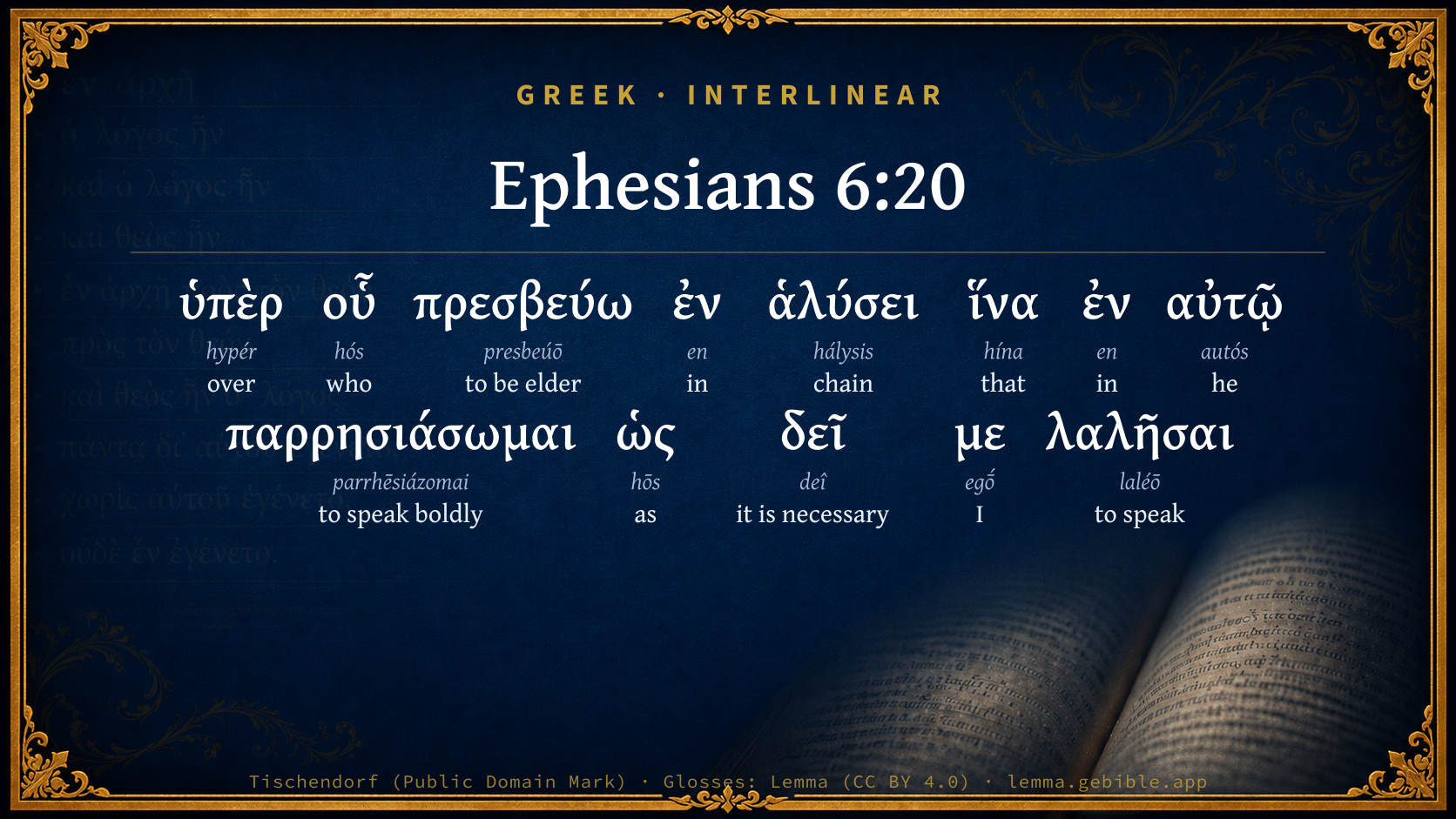
  1. ὑπὲρ hypér G5228 “over” Preposition
  2. οὗ hós G3739 “who” Relative pronoun, Genitive, Singular, Neuter
  3. ἐν en G1722 “in” Preposition
  4. ἁλύσει hálysis G254 “chain” Noun, Dative, Singular, Feminine
  5. ἵνα hína G2443 “that” Conjunction
  6. ἐν en G1722 “in” Preposition
  7. αὐτῷ autós G846 “he” Personal pronoun, Dative, Singular, Neuter
  8. παρρησιάσωμαι parrhēsiázomai G3955 “to speak boldly” Verb, Aorist, Middle deponent, Subjunctive, 1st person, Singular
  9. ὡς hōs G5613 “as” Adverb
  10. δεῖ deî G1163 “it is necessary” Verb, Present, Active, Indicative, 3rd person, Singular
  11. με egṓ G1473 “I” Personal pronoun, 1st person, Accusative, Singular
  12. λαλῆσαι laléō G2980 “to speak” Verb, Aorist, Active, Infinitive

About this verse

These counts appear in no published source. They are computed here, from the morphology-tagged text and Lemma’s own curated glosses. What Lemma adds →

13
words
12
distinct lemmas
Pauline Epistles
section

Notable vocabulary

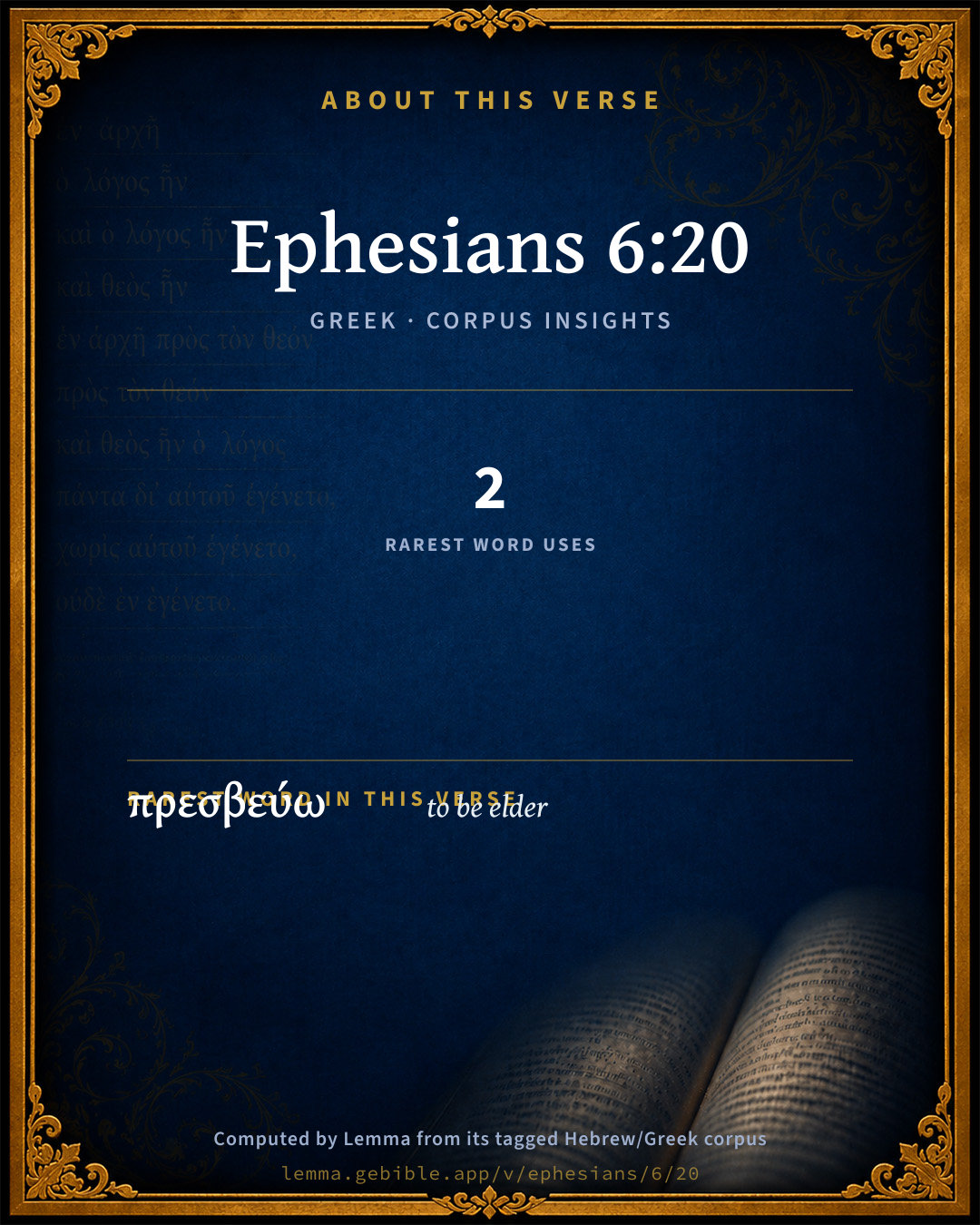
The rarest word here is πρεσβεύω to be elder G4243 — appearing just 2 times in the whole Greek New Testament.

Shared distinctive vocabulary

πρεσβεύω to be elder G4243 occurs in 2 verses of the Greek New Testament. Also found in:

Repetition

A word recurs within this verse:

Cross-references

27

Topical passages linked to Ephesians 6:20 in the Treasury of Scripture Knowledge — connected by theme and wording, ordered by reader-vote popularity; previews shown in the World English Bible.

  • 2 Corinthians 5:20 We are therefore ambassadors on behalf of Christ, as though God were entreating by us. We beg you on behalf of Christ, be reconciled to God.
  • Colossians 4:4 that I may reveal it as I ought to speak.
  • 2 Timothy 2:9 in which I suffer hardship to the point of chains as a criminal. But God's word isn't chained.
  • 1 Thessalonians 2:2 but having suffered before and been shamefully treated, as you know, at Philippi, we grew bold in our God to tell you the Gospel of God in much conflict.
  • Acts 26:29 Paul said, "I pray to God, that whether with little or with much, not only you, but also all that hear me this day, might become such as I am, except for these bonds."
  • Philippians 1:7 It is even right for me to think this way on behalf of all of you, because I have you in my heart, because, both in my bonds and in the defense and confirmation of the Gospel, you all are partakers with me of grace.
  • Philippians 1:20 according to my earnest expectation and hope, that I will in no way be disappointed, but with all boldness, as always, now also Christ will be magnified in my body, whether by life, or by death.
  • 1 John 3:16 By this we know love, because he laid down his life for us. And we ought to lay down our lives for the brothers.
  • Proverbs 13:17 A wicked messenger falls into trouble, But a trustworthy envoy gains healing.
  • Acts 5:29 But Peter and the apostles answered, "We must obey God rather than men.
  • Acts 28:20 For this cause therefore I asked to see you and to speak with you. For because of the hope of Israel I am bound with this chain."
  • Acts 28:31 preaching the Kingdom of God, and teaching the things concerning the Lord Jesus Christ with all boldness, without hinderance.
  • Ephesians 3:1 For this cause I, Paul, am the prisoner of Christ Jesus on behalf of you Gentiles,
  • Ephesians 4:1 I therefore, the prisoner in the Lord, beg you to walk worthily of the calling with which you were called,
  • Ephesians 6:19 on my behalf, that utterance may be given to me in opening my mouth, to make known with boldness the mystery of the Gospel,
  • Philippians 1:13–14 so that it became evident to the whole praetorian guard, and to all the rest, that my bonds are in Christ;
  • 2 Timothy 1:16 May the Lord grant mercy to the house of Onesiphorus, for he often refreshed me, and was not ashamed of my chain,
  • Isaiah 58:1 Cry aloud, don't spare, lift up your voice like a trumpet, and declare to my people their disobedience, and to the house of Jacob their sins.
  • Jeremiah 1:7–8 But Yahweh said to me, Don't say, I am a child; for to whoever I shall send you, you shall go, and whatever I shall command you, you shall speak.
  • Ezekiel 2:4–7 The children are impudent and stiff-hearted: I do sent you to them; and you shall tell them, Thus says the Lord Yahweh.
  • Matthew 10:27–28 What I tell you in the darkness, speak in the light; and what you hear whispered in the ear, proclaim on the housetops.
  • Acts 21:33 Then the commanding officer came near, arrested him, commanded him to be bound with two chains, and inquired who he was and what he had done.
  • Philemon 1:10 I beg you for my child, whom I have become the father of in my chains, Onesimus,
  • Jude 1:3 Beloved, while I was very eager to write to you about our common salvation, I was constrained to write to you exhorting you to contend earnestly for the faith which was once for all delivered to the saints.
  • 2 Samuel 10:2–6 David said, I will show kindness to Hanun the son of Nahash, as his father shown kindness to me. So David sent by his servants to comfort him concerning his father. David's servants came into the land of the children of Ammon.
  • Isaiah 33:7 Behold, their valiant ones cry outside; the ambassadors of peace weep bitterly.
  • Jeremiah 1:17 You therefore gird up your loins, and arise, and speak to them all that I command you: don't be dismayed at them, lest I dismay you before them.

Cross-references courtesy of OpenBible.info (CC BY 4.0).

Commentary

Notes on Ephesians 6:20 from classic Christian and Jewish commentators (each source and its license shown beneath its notes). The classic Christian expositions comment on the surrounding passage and are grouped to its opening verse, so a note may address several verses; the Jewish commentaries on the Tanakh (Rashi and others) are per-verse, so they appear only where the commentator wrote on this verse.

Lemma curates 59 commentaries, every one of them public domain or Creative Commons licensed, each selected and text-cleaned for this edition rather than reprinted as found. About our sources →

The Biblical Illustrator

Joseph S. Exell

Eph_6:20

I may speak boldly,

Bold preaching

1.

A bold preaching of the gospel is needed, because of what the gospel is in itself. It is nothing short of this: Glory to God in the highest; and on earth peace, goodwill towards men. Now, such a message cannot be, and should not be, delivered with doubt and hesitation. The preacher who stands up to preach the gospel timidly and apologetically, we often feel almost it were better he did not preach it at all.

2. Bold preaching of the gospel is needed, because of the tendency of the times. From all quarters the cry comes, Speak to us smooth things, and prophesy deceit.

3. Boldness is needed, because of the opposition that is offered. In proportion to the zeal and earnestness with which the gospel is proclaimed, we may conclude that the virulence of the opposition will increase. The whole world wilt soon be divided into two camps. It will be manifested in which of the two God is. (J. B. Forrest.)

Boldness of faithful preachers

I. Faithful ministers feel that they ought to preach the gospel boldly.

1. This will appear, if we consider that they really believe the gospel is true.

2. Their knowledge, as well as belief of the gospel, carries conviction to their minds that they ought to preach it boldly.

3. Faithful ministers feel the sacred obligation of their sacred office, to preach the gospel boldly.

II. Why they desire Christians to pray for them that they may preach the gospel boldly as they feel in conscience bound to preach it.

1. Here the first reason that occurs is, because they are sensible of their own insufficiency to surmount the difficulties that they expect to find in their way of preaching the gospel with Christian freedom and confidence.

2. They desire Christians to pray for them because they feel their own insufficiency to preach the gospel successfully. Though they should preach the truth plainly and boldly as they ought to preach it, yet they cannot command success. They can only speak to the ear; they cannot speak to the conscience or to the heart.

(1) Though the success of the apostles was partly owing to their preaching boldly, yet their preaching boldly must be ascribed partly to the Christians who perpetually prayed for them, that a Divine blessing might accompany their bold and faithful exertions.

(2) This subject teaches Christians that they may do a great deal to assist their ministers in their laborious and arduous work.

(3) Since faithful ministers need as well as desire the prayers of their fellow Christians, it is their privilege as well as duty to pray for them.

(4) Since faithful ministers desire and request the professors of religion to pray for them, they must be extremely ungrateful and inconsistent if, instead of complying with such a reasonable desire and request, they complain of them for preaching boldly as they ought to preach. (N. Emmons, D. D.)

Ministerial boldness

A minister, without boldness, is like a smooth file, a knife without an edge, a sentinel that is afraid to let off his gun. If men will be bold in sin, ministers must be bold to reprove. (W. Gurnall, M. A.)

Zeal in preaching Christ

When liberty was offered to John Bunyan, then in prison, on condition of abstaining from preaching, he constantly replied, If you let me out today I shall preach again tomorrow.

Zeal in rebuke

While Augustine acted as a presbyter at Hippo, under Valerius, his bishop, he was appointed by him to preach to the people, in order to reclaim them from riotous feasting on solemn days. He opened the Scriptures, and read to them the most vehement rebukes. He besought them, by the ignominy and sorrow which they brought upon themselves, and by the blood of Christ, not to destroy themselves, to pity him who spake to them with so much affection, and to show some regard to their venerable old bishop, who, out of tenderness to them, had charged him to instruct them in the truth. I did not make them weep, says he, by first weeping over them, but while I was preaching their tears prevented mine. Then I own I could not restrain myself. After we had wept together I began to entertain great hope of their amendment. He now varied from the discourse he had prepared, because the present softness of their minds seemed to require something different. In fine, he had the satisfaction to find the evil redressed from that very day. (Milner.)

Bold preaching

On one occasion the Rev. Frederick Robertson had been asked to preach at a church where the congregation was chiefly composed of those whom Pope describes as passing from a youth of frolics to an old age of cards. His text was, Love not the world, nor the things of the world. If any man love the world, the love of the Father is not in him. The sermon was most impressive and eloquent, and bold in its denunciation. Returning home, he asked a gentleman if he thought he was right in preaching it. The gentleman replied, It was very truthful, but, considering the character of the clergyman whose pulpit you occupied by courtesy, and the character of the congregation, not a discreet sermon. It might have been as truthful without apparently setting both minister and people at defiance. You are quite right, he answered; but the truth was this: I took two sermons with me into the pulpit, uncertain which to preach; but just as I had fixed upon the other, something seemed to say to me, Robertson, you are a craven, you dare not speak here what you believe; and I immediately pulled out the sermon that you heard, and preached it as you heard it.

Ambassador

John Basilowitz, the Czar of Russia, perceiving Sir Jeremy Bowes, the ambassador of Queen Elizabeth, with his hat on in his presence, thus rebuked him: Have you not heard, sir, of the person I have punished for such an insult? He had, in fact, punished him very savagely, by causing his hat to be nailed to his head. Sir Jeremy answered, Yes, sir; but I am the Queen of Englands ambassador, who never yet stood bareheaded to any prince whatever. Her I represent, and on her justice I depend to do me right if I am insulted. A brave fellow this, replied the Czar, to his nobles, a brave fellow this, who dares thus to act and talk for his sovereigns honour. Which of you would do so for me? (G. Ramsay.)

A courageous missionary

Some of the Indian chiefs having become the open enemies of the gospel, Mr. Elliot, sometimes called the Apostle of the American Indians, when in the wilderness, without the company of any other Englishman, was at various times treated in a threatening and barbarous manner by some of those men; yet his Almighty Protector inspired him with such resolution that he said, I am about the work of the Great God, and my God is with me; so that I fear neither you nor all the Sachims (or chiefs) in the country. I will go on, and do you touch me if you dare. They heard him, and shrank away. (Baxendales Anecdotes.)

The Biblical Illustrator, edited by Joseph S. Exell (c. 1880s–1900s) — public domain. Text from a community e-Sword module.

Bengel's Gnomon

Johann Albrecht Bengel

Eph 6:20. Πρεσβεύω ἐν ἁλύσει, I am an ambassador in bonds) A paradox [an ambassador, yet in bonds]. The world has its ambassadors surrounded with outward splendour. Ἵνα, that, which immediately follows, depends on this expression.[106]—ἐν αὐτῷ, in it) in the mystery.—ὡς, as) construed with to make known.

[106] Engl. V. by the stopping connects ἵνα rather with προσευχόμενοι, Eph 6:18 Praying—that therein I may speak boldly.—ED.

Bengel's Gnomon of the New Testament — English translation (T&T Clark, Edinburgh, 1860) — public domain. Text from a community e-Sword module.

Meyer's Critical & Exegetical Commentary

Heinrich August Wilhelm Meyer

Eph_6:20. For which (to conduct its cause) I discharge the office of ambassador in a chain. Comp. on 2Co_5:20. It is to be explained neither as though ὑπὲρ οὗ πρεσβεύων ἐν ἁλύσει εἰμί (Zachariae, Rückert, Matthies) were written, nor as though ὑπὲρ οὗ καὶ ἐν ἁλύσει πρεσβεύω were the reading (Grotius: nunc quoque non desino legationem, etc.); nor is οὗ to be referred, as is usually the case, merely to τοῦ εὐαγγελ., but to τὸ μυστήριον τοῦ εὐαγγ., seeing that this was the object of γνωρίσαι, and to this γνωρίσαι the πρεσβεύω significantly corresponds. Comp. Col_4:3 : λαλῆσαι τὸ μυστήριον τοῦ Χριστοῦ, διʼ ὃ καὶ δέδεμαι.

πρεσβεύω] whose ambassador he is, was at once understood by the reader, namely, Christs; and equally so to whom his embassy was addressed, namely, to all peoples, specially the Gentiles (Act_9:15; Act_22:15; Rom_1:14; Rom_11:13; Gal_2:9). The opinion of Michaelis, that Paul designates himself as delegate of Christ to the Roman court, would, even if he had written the Epistle in Rome, be imported, since no reader could find anything else than the apostle denoted by πρεσβεύω without more precise definition.

ἐν ἁλύσει] On ἐν, comp. phrases like εἰς τὴν ἅλυσιν ἐμπίπτειν, Polyb. xxi. 3. 3. Wetstein, we may add, aptly observes: alias legati, jure gentium sancti et inviolabiles, in vinculis haberi non poterant. To infer, however, from the use of the singular (Baumgarten, Paley, Flatt, Steiger) the custodia militaris, in which Paul was at Rome (Act_28:20; 2Ti_1:16), is too hasty; partly for the general reason that the singular must by no means be urged, but may be taken collectively (Bernhardy, p. 58 f.), and partly for the special reason that we have to think of Paul at Caesarea too, and that from the very beginning of his captivity there (see on Act_24:23), as in the custodia militaris; Act_24:27; Act_26:29.[315] The significant bearing of the addition ἐν ἁλύσει is to make palpable the so much greater need of the παῤῥησία, and so the more fully to justify the longing for the intercessory prayer of the readers.

ἽΝΑ ἘΝ ΑὐΤῷ ΠΑῤῬΗΣ. Ὡς ΔΕῖ ΜΕ ΛΑΛ.] Parallel to the ἵνα μοι δοθῇ … εὐαγγελίου, Eph_6:19, and indeed not tautological (in opposition to Harless), but, by means of Ὡς ΔΕῖ ΜΕ ΛΑΛῆΣΑΙ, more precisely defining the thought already expressed. As similar parallels by means of a second ἵνα, comp. Rom_7:13; Gal_3:14; 1Co_12:20; 2Co_9:3. Harless regards this second ἽΝΑ as subordinate to the first. Thus the words would express not the aim on account of which Paul summons his readers to prayer, as stated by Harless, but the aim of the δοθῇ λόγος κ.τ.λ. But this would be inappropriate, since ΔΟΘῇ ΛΌΓΟς Κ.Τ.Λ. has already the definition of aim appropriate to it, namely, in ἐν παῤῥ. γνωρ. κ.τ.λ. Bengel and Meier make ἽΝΑ dependent on ΠΡΕΣΒΕΎΩ ἘΝ ἉΛΎΣΕΙ (in which case Meier imports the sense, as if the words were ἽΝΑ ΚΑῚ ἘΝ ΑὐΤῇ ΠΑῤῬ.); but the clause expressive of the aim: in order that I may therein speak as boldly as I am bound to speak, does not logically correspond to the πρεσβεύω ἐν ἁλύσει, because without any reference to ἘΝ ἉΛΎΣΕΙ. Had Paul merely written: ἽΝΑ ΠΑῤῬΗΣΙΆΣΩΜΑΙ ἘΝ ΑὐΤῷ (without Ὡς ΔΕῖ ΜΕ ΛΑΛῆΣΑΙ), by which the ΠΑῤῬΗΣ. would have become emphatic,[316] or: ἽΝΑ ΠΟΛΛῷ ΜᾶΛΛΟΝ ΠΑῤῬΗΣ. ἘΝ ΑὐΤῷ, the logical relation would be satisfied.

ἘΝ ΑὐΤῷ] namely, in the mystery of the gospel, i.e. occupied therewith, in the proclamation thereof (Matthiae, p. 1342). Comp. Act_9:27. Harless understands ἐν of the source or ground of the παῤῥησία, which has its basis in the message itself [rather: in the mystery of the gospel; see on ὙΠῈΡ ΟὟ]. But the context represents the ΜΥΣΤΉΡΙΟΝ ΤΟῦ ΕὐΑΓΓ. as the object of the bold discourse (Eph_6:19); and the source of the παῤῥησία is in God (see 1Th_2:2), which is not indeed here expressed, but is implied in the fact that it is to be obtained for the apostle by prayer on the part of the readers.

ὡς δεῖ με λαλῆσαι] to be taken together (comp. Col_4:4); and after με there is not to be put any comma, by which ΛΑΛῆΣΑΙ would be connected with ΠΑῤῬΗΣ. (Koppe),a course, which is impossible just because ΠΑῤῬΗΣ. already expresses the bold speaking; and thus λαλῆσαι, if it were to be more precisely defining, could not but of necessity have with it a modal definition (comp. 1Th_2:2). See Fritzsche, Diss. II. in 2 Cor. p. 100 f.

[315] In the latter passage the plural τῶν δεσμ. τούτων is not at variance with this view, as it is rather the categoric plural, and leaves the question entirely undecided, whether Paul was bound with one or more chains.

[316] This seems also to have been felt by Bengel, who connected ὡς δεῖ με λαλ. with γνωρίσαι, which certainly could not occur to any reader.

Meyer — Critical and Exegetical Commentary on the New Testament — English translation by Peter Christie, edited by Frederick Crombie (T&T Clark, 1880) — public domain. Text from a community e-Sword module.

Expositor's Greek Testament

ed. W. Robertson Nicoll

Eph 6:20 . ὑπὲρ οὗ πρεσβεύω ἐν ἁλύσει : in behalf of which I am an ambassador in a chain . The οὗ is best referred, not to τοῦ εὐαγγελίου , but to τὸ μυστήριον , the mystery contained in the Gospel being the thing that Paul desired to make known ( γνωρίσαι ). So in Col 4:3 it is this μυστήριον that the writer is to utter ( λαλῆσαι ) and on account of which he is bound ( δέδεμαι ). πρεσβεύω = “I act as ambassador,” only here and in 2Co 5:20 . The ὑπὲρ Χριστοῦ of the latter passage is left to be understood here. The legation or embassage in Christ’s cause, which Paul here ascribes to himself, is not to be limited to the Roman Court (Mich.), but is to be understood as to the whole Gentile world, in the wide sense of the commission given (Act 9:15 ; Act 17:15 ); the debt professed (Rom 1:14 ); the office claimed (Rom 11:13 ), and recognised (Gal 2:9 ). The noun ἅλυσις , which is not of frequent occurrence in classical Greek, means there a chain (Herod., ix., 74; Eurip., Or. , 984); also a woman’s ornament, a bracelet (Aristoph., Frag. , Mem., ii., p. 1079). It is taken by some to be a word of general application, denoting a chain or bond by which any part of the body may be bound, and it is questioned ( e.g. , by Mey.), whether it is distinguished from πέδη as hand -fetter from foot -fetter. But, while in such passages as Rev 20:1 the specific sense may not be required, it seems clear that the distinction between manacle and fetter does obtain ( cf. Polyb., iii., 82, 8); that this distinction is made in Mar 5:4 ; and that ἅλυσις is used of the “handcuff” by which a prisoner was attached to his guard (Joseph., Antiq. , xviii., 6, 7, 10; Act 12:6 ; Act 21:33 , etc.; cf. Light., Phil. , p. 8). This may be its meaning here, and there will be no necessity for taking it to be a collective sing. = bonds; of which use indeed, though possible ( cf. Bernh., Synt. , ii., 1, p. 58), there does not appear to be any clear example in the NT itself. And such phrases as εἰς τὴν ἅλυσιν ἐμπίπτειν (Polyb., iv., 76, 5, xxi., 3, 3) are inconclusive, the article giving the word the generic sense. It has been thought that the expression points to the custodia militaris endured by Paul in Rome (Act 28:16 ; Act 28:20 ; cf. 2Ti 1:16 ; Beza, Grot., Paley, Steyer, etc.). That is possible, and indeed even probable, so far as the custodia is concerned. But the description might apply to the imprisonment in Cæsarea as well as to that in Rome. The real point of the clause is in the view it gives of the need of the παρρησία and of the intercessions that should bring that gift. ἵνα ἐν αὐτῷ παρρησιάσωμαι ὡς δεῖ με λαλῆσαι : in order that therein I may speak boldly, as I ought to speak . How is this purpose-clause to be connected? Some attach it to the πρεσβεύω (Beng., Meyer, Von Soden), as if = “I act as ambassador in a chain with the object of speaking boldly,” etc. Others connect it with the whole foregoing clause, making it subordinate to that, and an explanation of the object of the gift of utterance , = “that utterance may be given to me to make known the mystery, with the view that I should speak boldly” (Harl.). But ἵνα is repeatedly used to introduce something that is not subordinate to, but coordinate with, what is stated in a former ἵνα clause (Rom 8:13 ; Gal 3:14 ; 1Co 12:20 ; 2Co 9:3 ). It is best, therefore, to take it so here, and to understand the clause as giving a second object contemplated in the προσευχόμενοι and ἀγρυπνοῖντες , etc. First the gift of utterance , and now secondly the gift more particularly of a boldness or freedom ( παρρησιάσωμαι ) in preaching such as became the Apostle’s office and responsibility ( ὡς δεῖ με λαλῆσαι ). The αὐτῷ refers to the μυστήριον which was to be preached. The ἐν is taken by some ( e.g. , Harl.) to denote the source or ground of the boldness in speaking ( παρρησιάσωμαι ). But it is God who is named as the source of such boldness ( ἐπαρρησιασάμεθα ἐν τῷ Θεῷ , 1Th 2:2 ). It might be an instance of ἐν expressing that on which a certain power operates or in which it shows itself (as in ἵνα οὕτω γένηται ἐν ἐμοί , 1Co 9:15 ; ἐν ἡμῖν μάθητε , 1Co 4:6 ; cf. Thayer-Grimm, Lex. , p. 210). But it is best understood as the note of that in which one is busied ( cf. Act 22:12 ; 1Ti 4:15 ; Col 4:2 , etc.), and so = “that, occupied with that mystery, i.e. , in proclaiming it, I may speak boldly” (Mey.).

The Expositor's Greek Testament, edited by W. Robertson Nicoll (1897–1910) — public domain. Text from a community e-Sword module.

Cambridge Greek Testament for Schools and Colleges

B. Eph 4:1 to Eph 6:20. THE FRUITS OF SONSHIP TO BE LOOKED FOR FROM THE NATIONS

The foundation for the exhortations that follow is now securely laid in the vision of truth unfolded both by direct exposition and by prayer, the prayer being no digression but an integral part of the exposition. So at this point we pass to the second main division of the Epistle.

Eph 4:1-16. EXHORTATIONS TO UNITY

Eph 4:1. Παρακαλῶ οὖν ὑμᾶς. Cf. the transition in Rom 12:1.

ἐγὼ ὁ δέσμιος. Cf. on Eph 3:1.

ἐν κυρίῳ. Probably qualifying ὁ δέσμιος, cf. Php 1:13, though it may be taken with παρακαλῶ, cf. Eph 4:17; 1Th 4:1; 2Th 3:12. παρακαλῶ however is often used without qualification in St Paul, and the connexion with ὁ δέσμιος is favoured by the order.

ἀξίως περιπατῆσαι τῆς κλήσεως. Cf. Col 1:10; 1Th 2:12; Php 1:27. On περιπατῆσαι cf. Eph 2:2; τῆς κλήσεως Eph 4:4; see on Eph 1:18. Cf. Php 3:14.

20. ὑπὲρ οὗ πρεσβεύω ἐν ἁλύσει. Cf. Phm 1:9 and Lightfoot’s note. πρεσβεύω and πρεσβευτὴς ‘were the proper terms, in the Greek East, for the Emperor’s Legatio.’ See Deissmann, Fresh Light, p. 379.

ἐν ἁλύσει. Act 28:20; 2Ti 1:16.

ἴνα ἐν αὐτῷ παρρησιάσωμαι. Cf. Act 9:27 f.

ὡς δεῖ με λαλῆσαι. Col 4:6.

Cambridge Greek Testament for Schools and Colleges (Cambridge University Press, 1896; 21 vols, various authors incl. Carr, Maclear, Plummer, Farrar, Lumby, Moule, M. R. James, Simcox) — public domain. Text from a community e-Sword module.

Hodge's Commentary on Romans, Ephesians & First Corinthians

Charles Hodge

Eph_6:20

Ὑπὲρ οὗ, for the sake of which Gospel, πρεσβεύω ἐν ἁλύσει εἰμί, I am an ambassador in bonds. An ambassador is one through whom a sovereign speaks. We are ambassadors for Christ:, as though God did beseech you by us: we pray you in Christs stead be ye reconciled with God; 2Co_5:20. The apostles, as sent by Christ with authority to speak in his name, and to negotiate with men, proposing the terms of reconciliation and urging their acceptance, were in an eminent sense his ambassadors. As all ministers are sent by Christ and are commissioned by him to propose the terms of salvation, they too are entitled to the same honorable designation. Paul was an ambassador in bonds, and yet he did not lose his courage but preached with as much boldness as ever.

Ἵνα ἐν αὐτῷ παῤῥησιάσωμαι, that therein I may speak boldly. This may be taken as depending on ἵνα δοθῇ; of Eph_6:19. The sense would then be, That utterance may be given to me that I may speak boldly. But the preceding ἐν παῤῥησίᾳ γνωρίσαι depends on ἵνα δοθῇ, The two clauses are rather parallel. Paul desired that the Ephesians should pray, That utterance should be given him that is, that he might preach boldly ὡς δεῖ με λαλῆσαι, as I ought to speak. It becomes the man who is an ambassador of God, to speak with boldness, assured of the truth and importance of the message which he has to deliver. That even Paul should solicit the prayers of Christians that he might be able to preach the Gospel aright, shows the sense he had at once of the difficulty and of the importance of the work.

Charles Hodge — Commentary on Romans (1835), First Corinthians (1857), and Ephesians (1856) — public domain. Text from a community e-Sword module.

Jamieson, Fausset & Brown

Robert Jamieson, A. R. Fausset & David Brown

For--Greek, as in Eph 6:19, "On behalf of which."

an ambassador in bonds--a paradox. Ambassadors were held inviolable by the law of nations, and could not, without outrage to every sacred right, be put in chains. Yet Christ's "ambassador is in a chain!" The Greek is singular. The Romans used to bind a prisoner to a soldier by a single chain, in a kind of free custody. So Act 28:16, Act 28:20, "I am bound with this chain." The term, "bonds" (plural), on the other hand, is used when the prisoner's hands or feet were bound together (Act 26:29); compare Act 12:6, where the plural marks the distinction. The singular is only used of the particular kind of custody described above; an undesigned coincidence [PALEY].

Jamieson, Fausset & Brown — Commentary Critical and Explanatory on the Whole Bible (1871) — public domain (CC PDM 1.0). Text via the HelloAO Bible API.

Adam Clarke's Commentary

Verse 20. An ambassador in bonds] An ambassador being the representative of his king, his person was in all civilized countries held sacred. Contrary to the rights of nations, this ambassador of the King of heaven was put in chains! He had however the opportunity of defending himself, and of vindicating the honour of his Master. See above.

As I ought to speak.] As becomes the dignity and the importance of the subject.

Adam Clarke's Commentary on the Bible (1810–1826) — public domain. Text from a community e-Sword/MySword module.

John Calvin's Commentaries

20. As I ought to speak; meaning, that to proclaim the truth of the gospel as it ought to be proclaimed, is a high and rare attainment. Every word here deserves to be carefully weighed. Twice he uses the expression boldly, — “that I may open my mouth boldly,” “that therein I may speak boldly.” Fear hinders us from preaching Christ openly and fearlessly, while the absence of all restraint and disguise in confessing Christ is demanded from his ministers. Paul does not ask for himself the powers of an acute debater, or, I should rather say, of a dexterous sophist, that he might shield himself from his enemies by false pretences. It is, that I may open my mouth, to make a clear and strong confession; for when the mouth is half shut, the sounds which it utters are doubtful and confused. To open the mouth, therefore, is to speak with perfect freedom, without the smallest dread.

But does not Paul discover unbelief, when he entertains doubts as to his own stedfastness, and implores the intercession of others? No. He does not, like unbelievers, seek a remedy which is contrary to the will of God, or inconsistent with his word. The only aids on which he relies are those which he knows to be sanctioned by the Divine promise and approbation. It is the command of God, that believers shall pray for one another. How consoling then must it be to each of them to learn that the care of his salvation is enjoined on all the rest, and to be informed by God himself that the prayers of others on his behalf are not poured out in vain! Would it be lawful to refuse what the Lord himself has offered? Each believer, no doubt, ought to have been satisfied with the Divine assurance, that as often as he prayed he would be heard. But if, in addition to all the other manifestations of his kindness, God were pleased to declare that he will listen to the prayers of others in our behalf, would it be proper that this bounty should be slighted, or rather, ought we not to embrace it with open arms?

Let us therefore remember that Paul, when he resorted to the intercessions of his brethren, was influenced by no distrust or hesitation. His eagerness to obtain them arose from his resolution that no privilege which the Lord had given him should be overlooked. How absurdly then do Papists conclude from Paul’s example, that we ought to pray to the dead! Paul was writing to the Ephesians, to whom he had it in his power to communicate his sentintents. But what intercourse have we with the dead? As well might they argue that we ought to invite angels to our feasts and entertainments, because among men friendship is promoted by such kind offices.

John Calvin's Commentaries (1540-1563) — public domain. Text from the Calvin Translation Society English edition (1840s-50s) via the Christian Classics Ethereal Library (ccel.org). Calvin's coverage is partial (roughly two-thirds of the Bible); uncommented books and verses are honest gaps, never fabricated. The 19th-century editor's footnotes and remarks are omitted so the notes are faithfully Calvin's own voice.

Ellicott's Commentary for English Readers

(20) In bonds.—Rightly, as in the margin, in a chain. The word is the same which is used in Act_28:20, “For the hope of Israel I am bound in this chain.” It occurs also in Mar_5:4, Luk_8:29, where it is distinguished from a “fetter” properly so called, as binding the feet, and therefore obviously signifies a “manacle” binding the hand. Both are included (see Luk_8:29) in the general word “bonds.” The allusion is undoubtedly to the custom of chaining the prisoner by the hand to the soldier who kept him. Thus in Act_12:6 we read that Peter “was sleeping between two soldiers,” and therefore “bound with two manacles;” and in Act_21:33 that a similar precaution was used on the first apprehension of St. Paul. Here the singular number is probably to be understood literally. St. Paul was free except for the one chain, which the soldier was responsible for holding, and perhaps did not always think it needful to hold. That chain he seems to speak of as the badge of his ambassadorial dignity. To ambassadors, indeed, it belongs to be safe from imprisonment; but it was his greater glory to wear the chain for Christ.

That therein . . .—This is simply an enforcement of the previous phrase, in “plainness of speech.” The same word is used, and with the same signification of simplicity, as well as boldness, which (St. Paul here adds) alone befits his office.

A Bible Commentary for English Readers, edited by Charles John Ellicott (1878–1897) — public domain. Text from a community e-Sword module.

The Cambridge Bible for Schools and Colleges

gen. ed. J. J. S. Perowne

20. for which] On behalf of which, in the interests of which. The Gospel is, so to speak, the Power whose envoy he is. Cp. 2Co_5:20 for the same phrase and image with express mention of the Sovereign, Christ, represented by His envoys.

an ambassador] Cp. 2 Cor. just quoted. And see Phm_1:8, where Bp Lightfoot renders (and so R. V. margin) “an ambassador, and now also a prisoner, of Jesus Christ;” giving this passage, so closely parallel and exactly contemporary, as a main reason for the rendering. See his note there. This is not the place to discuss the question.

in bonds] Lit., in a chain. The Gr. word occurs elsewhere in St Paul’s speech or writings, Act_28:20; 2Ti_1:16.—Prisoners detained upon appeal to the Emperor, as was St Paul, were sometimes “coupled by a slight chain round the right wrist to the left of a soldier, and, thus shackled … if they could afford it, were at liberty to hire a lodging for themselves without the walls, but within the prescribed limits” (Lewin, Life, &c., of St Paul, ii. 236. See too Bp Lightfoot, Philippians, p. 8). Cp. Josephus, Antiquities, xviii. c. 6, for similar custody (though not upon appeal) in the case of Agrippa, the Herod of Acts 12, in his earlier life in Italy in the reign of Tiberius. For St Paul’s allusions to the “bonds” of this Roman imprisonment, see Php_1:7; Php_1:13-14; Php_1:16; Col_4:18; Phm_1:10; Phm_1:13; and above, Eph_3:1, Eph_4:1.

Wetstein calls attention here to the paradox; “an ambassador in chains.”

therein] I.e., in “the mystery of the Gospel.” This was the field or sphere of his speech. The Gr. makes it plain that the reference is to this, and not to the “bonds.”

speak boldly] The verb is cognate to the noun in Eph_6:19. See note above on “boldly” there. The tense is aorist, and suggests that he prays for grace to take, as it were, a “new departure” in outspoken testimony and exposition.

I ought] under the holy obligation of my commission. Cp. 1Co_9:16.

speak] The Gr. verb indicates specially the wording of the message. He prays for grace to be perfectly explicit in terms.—The tense is aorist; see last note but one.

The Cambridge Bible for Schools and Colleges (gen. ed. J. J. S. Perowne; Cambridge University Press, 1878–1918) — public domain. Text from a community e-Sword module.

John Gill's Exposition

For which I am an ambassador in bonds,.... The character the apostle bore was that of an ambassador; and he was an ambassador from and for Christ, in his room and stead; he represented him, he was sent by him, and entrusted by him with the Gospel; he gave him it, and a commission to preach it, and furnished him with qualifications for it; such as knowledge and faithfulness wisdom and prudence, courage and greatness of mind; and made his embassy successful: and he was chiefly an ambassador to the Gentiles, which showed great condescension in Christ to send him to them, and base ingratitude in the despisers and rejecters of the Gospel, for which he was an ambassador; for the embassy Christ's ministers are sent on, is the embassy of the Gospel of peace: their business is to declare that men by nature are enemies to God; that peace is made by the blood of Christ for such; by which means they are made useful to conciliate the minds of men to God's way of salvation and to bring them to submit to his government and laws: and when he adds, "in bonds", or "in a chain", he means, that he was in such circumstances, not for any crime, but for the Gospel, for which he was an ambassador; and therefore was not ashamed of his bonds, or chain, but rather gloried in them; and he makes mention of them to engage persons to a regard to him as an ambassador, and to his embassy; for an ambassador, especially an ambassador of Christ, that comes with his Gospel, and more especially that is suffering for it, ought to be received, heard, and honoured.

That therein I may speak boldly as I ought to speak; that is, the apostle beseeches the saints to pray for him, that since he was an ambassador for the Gospel, and in bonds, that he might speak in it, or rather of it boldly and freely; that he might have both liberty from his bonds, and liberty in his soul, and freedom of speech; and that he might use boldness in delivering his message, as became an ambassador of Jesus Christ.

John Gill's Exposition of the Whole Bible (1746–1763) — public domain (CC PDM 1.0). Text via the HelloAO Bible API.

Trapp's Complete Commentary

John Trapp

20 For which I am an ambassador in bonds: that therein I may speak boldly, as I ought to speak.

Ver. 20. I am an ambassador] Venerable for mine age and authority, as the word πρεσβευω signifieth. The ancient and the honourable are usually employed as ambassadors. Cognata sunt γηρας and γερας. Old age and honour are akin in the Greek tongue.

In bonds] Gr. In a chain; instead of a chain of gold (worn commonly by ambassadors), and far more glorious, I bear about my bonds (saith Ignatius in his Epistle likewise to the Ephesians), as so many spiritual jewels or ensigns of honour. {a} Oh, said Alice Driver, here is a goodly neckerchief, blessed be God for it, when the chain was put about her neck.

That therein I may speak boldly] He saith not that I may be freed from my chain, but that I may do my office well in my chain. Let God serve himself upon us, and then no matter what becomes of us. Martinas decumbens, Domine, dixit, si adhuc populo tuo sum necessarius, non recuso laborem. (Sever. Epist. iii.)

{a} τα δεσμα περιφερω τους πνευματικους μαργαριτας

John Trapp, A Commentary or Exposition upon All the Books of the Old and New Testament (1647–1656) — public domain. Text from a community e-Sword module.

Albert Barnes' Notes on the Bible

For which I am an ambassador in bonds - In chains (see the margin); or in confinement. There is something especially touching in this. He was “an ambassador” - sent to proclaim peace to a lost world. But he was now in chains. An ambassador is a sacred character. No greater affront can be given to a nation than to put its ambassadors to death, or even to throw them into prison. But Paul says here that the unusual spectacle was witnessed of an ambassador seized, bound, confined, imprisoned; an ambassador who ought to have the privileges conceded to all such people, and to be permitted to go everywhere publishing the terms of mercy and salvation. See the word “ambassador” explained in the notes on 2Co 5:20.

That therein - Margin, or “thereof.” Greek, ἐν αὐτῷ en autō - “in it;” that is, says Rosenmuller, in the gospel. It means that in speaking the gospel he might be bold.

I may speak boldly - Openly, plainly, without fear; see the notes on Act 4:13; Act 9:27, note; Act 13:46, note; Act 14:3, note; Act 18:26, note; Act 19:8, note; Act 26:26, note.

As I ought to speak - Whether in bonds or at large. Paul felt that the gospel ought always to be Spoken with plainness, and without the fear of man. It is remarkable that he did not ask them to pray that he might be released. “Why” he did not we do not know; but perhaps the desire of release did not lie so near his heart as the duty of speaking the gospel with boldness It may be of much more importance that we perform our duty aright when we are afflicted, or are in trouble, than that we should be released.

Albert Barnes' Notes on the Bible (1834–1885) — public domain. Text from a community e-Sword/MySword module.

Matthew Poole's English Annotations

For which I am an ambassador in bonds; for which gospel I still continue, though a prisoner, in the embassy committed to me by Christ.

That therein I may speak boldly; this may imply not only free speaking, but free acting in all things whereby the gospel may be propagated.

Matthew Poole's English Annotations on the Holy Bible (1683–1685) — public domain. Text from a community e-Sword/MySword module.

Whedon's Commentary on the Bible

Daniel D. Whedon

20. For which—Namely, the mystery of the gospel, the revealed offer of peace to men.

In bonds—Literally, in a chain. Alluding, perhaps, to the single chain by which he was connected to a Roman soldier. An ambassador, not in robes, but in bonds. His insignia a chain, his retinue a Roman sentinel, his residence a prison; yet a palace, made a palace by the visitations of his Master, the King of kings and the Lord of lords. The apostle means the noble antithesis. He is asserting his own official dignity, not courting sympathy. Hence Wetstein’s note, quoted so often with admiration by commentators, (as Meyer, Eadie, Braune,) “usually ambassadors are by the law of nations sacred and inviolable, and cannot be held in chains,” is below the apostle’s strain. He is by his chain honoured and exalted above all earthly ambassadors. It was language like this that inspired the heroic and martyr spirit in the Church; and caused it, not only to glow so brightly, but to rise to such a height that Christian prudence was obliged to check its sometimes too earthly enthusiasm. It was in the rare character of Paul, “the apostle in a basket,” (Act_9:25,) the ambassador in a chain, to raise humiliations into sublimities. He is indeed an ambassador, but from what court? From the throne of Christ. To what court? Not to the court of Rome, as one commentator suggests; but to the human race, whose head is Adam. What is his mission? To unfold the mystery of the gospel, in which are terms of reconciliation to the sons of Adam now engaged in the rebellion of Satan.

Ought—A term of self-assertion; yet not as a self, but as an apostle and ambassador.

Daniel D. Whedon (gen. ed.), Commentary on the Old and New Testaments (1874–1909) — public domain. Text from a community e-Sword module.

The Pulpit Commentary

For which I am an ambassador in chains. Thereby not only physically helpless, but in danger of being subdued into tameness, the ordinary effect of captivity, and thus reduced to a spirit not befitting the bearer of a great message from the King of kings. That in it i.e., in the matter of it, of the gospel I may speak boldly, as I ought to speak.

The Pulpit Commentary (1880–1919), ed. H.D.M. Spence-Jones & Joseph S. Exell — public domain. Text from a community e-Sword module.

John Wesley's Explanatory Notes

An ambassador in bonds - The ambassadors of men usually appear in great pomp. How differently does the ambassador of Christ appear!

John Wesley, Explanatory Notes Upon the Whole Bible (1754–1765) — public domain. Text via the GEBible commentary corpus.

The People's New Testament

B. W. Johnson

20. For which. The gospel. An ambassador in bonds. As an ambassador is sent to a foreign court to declare the will of the king, so Paul, though in chains, was Christ's ambassador sent to Rome to declare the will of his King.

B. W. Johnson's The People's New Testament with Notes (1889–1891) — public domain. Electronic text from the Christian Classics Ethereal Library (CCEL) ThML edition.

International Critical Commentary

20. ὑρὲρ οὗ πρεσβεύω ἐν ἁλύσει. οὗ refers to τὸ μυστ., for this is the object of γνωρίσαι, and γνωρίσαι is in substance connected with πρεσβεύω Compare Col 4:3, λαλῆσαι τὸ μυστ. τοῦ Χριστοῦ διʼ ὃ καὶ δέδεμαι. The simplest view is probably the best: “I am an ambassador in chains”; but Grotius understands the words to mean: “nunc quoque non desino legationem”; but this would require some emphasis on ἁλύσει, as, for example, καὶ ἐν ἁλ. πρεσβεύω: and there is no reference here, as in Php 1:12 ff., to the good effects of his imprisonment. The oxymoron is noted by Bengel and Wetstein: “alias legati, jure gentium sancti et inviolabiles, in vinculis haberi non poterant.” So, indeed, Theoph., τοὺς πρέσβεις νόμος μηδὲν πάσχειν κακόν. ἐν ἁλύσει is in distinct opposition to ἐν παρρησίᾳ.

Paley and others have drawn attention to the use of ἅλυσις here as referring to the “custodia militaris” in which St. Paul was kept at Rome, Act 28:16, Act 28:20; cf. 2Ti 1:16. It is true the singular might possibly be used in a general sense, although the instances cited from Polyb. of εἰς τὴν ἅλυσιν ἐμπίπτειν (xxi. 3. 3, iv. 76. 5) are not parallel, since the article there is generic. Still it can hardly be denied that the term has a special suitability to the circumstances of this imprisonment, or rather custody. Of course, δεσμοί as the general term might also be used, and therefore the fact that it is used, Col 4:18, is no objection.

ἵνα ἐν αὐτῷ παρρησιάσωμαι. Co-ordinate with the preceding ἵνα. Soden, however, takes the clause as depending on the πρεσβεύω ἐν ἁλ., the meaning according to him being that St. Paul might have been set at liberty on condition that he did not preach the gospel, but remained in custody in hope that the result of the trial would be that he would be at liberty to preach. This, he adds, corresponds to ὡς δεῖ με λαλῆσαι, and escapes the tautology involved in the other interpretations.

International Critical Commentary — older volumes (1896–1929), various authors — public domain. Text from a community e-Sword module.

Vincent's Word Studies in the New Testament

Marvin R. Vincent

I am an ambassador in bonds [πρεσβευω εν αλυσει] . The verb to be an ambassador occurs only here and 2Co 5:20. See on Phl 1:9. In bonds, lit., in a chain : the particular word for the coupling - chain by which he was bound to the hand of his guard.

Marvin R. Vincent, Word Studies in the New Testament (1887–1900) — public domain. Text from a community e-Sword/MySword module.

Lesson kit

Teaching starters — assembled from the data on this page, not authored interpretation. Every prompt links to the verse data it draws on. Edit before teaching.

Ephesians, in the Pauline Epistles, opens this verse with 13 words (12 distinct Greek lemmas). Its most distinctive word is presbeúō (“to be elder”). A historical commentator’s framing appears above. Read the whole chapter for the surrounding context.

Discussion questions

  1. What does “to be elder” (presbeúō) contribute to the verse as a whole?
  2. 2 Corinthians 5:20 shares the word «to be elder» with this verse. How do the two illuminate each other?
  3. “in” occurs 2× in this one verse. What is the effect of the repetition?
  4. The translations on this page render this verse differently — a whole-verse word diff, not a word-by-word alignment. What might account for the different wordings?
  5. Reading how The Biblical Illustrator and Bengel's Gnomon read this verse, where do the two commentators agree and where do they part?

Things to notice

Reading settings

Reading text

Shown beneath each verse's original-language words.

Old Testament
Old Testament edition

Read the OT as the Masoretic Hebrew (MT) or the Greek Septuagint (LXX).

English shown for the Greek Septuagint (in the Hebrew ↔ Greek comparison).

Comparing translations? Open the Compare panel on any verse page to stack up to four side by side.