
2 Corinthians 12:13

Greek (Tischendorf 8th ed.) 2 Corinthians 12:13 appears in the Greek New Testament. The text above is from the Tischendorf 8th edition. Each word links to its Strong’s number and a concise gloss. Click any word for its full Thayer’s Greek Lexicon entry.
Download image
Cite this verse

2 Corinthians 12:13 (World English Bible). Public Domain. Lemma interlinear Bible study tool, https://lemma.gebible.app/v/2-corinthians/12/13.

Show BibTeX & RIS
BibTeX
RIS
English Translation
For what is there in which you were made inferior to the rest of the assemblies, unless it is that I myself was not a burden to you? Forgive me this wrong.
World English Bible · Public Domain
Highlights
  • 1 first appearance in the Greek New Testament
Full analysis ↓
Download a study sheet

One document with this verse’s original text, its word-by-word gloss line, the meaning frame, cross-references with their text, attributed commentary, and full source and license credits — printable, and it pastes into notes with its structure intact.

This verse Autodidact and up

Study sheet (.html) Plain text (.txt)

A passage Seminary Student

Up to 50 verses in one chapter. A passage sheet keeps up to 6 commentary sources and 12 cross-references per verse, in the order this page ranks them, and says so on the sheet whenever that leaves anything out. Ask for a single verse and you get the Autodidact verse sheet above.

Everything on this page stays free to read, with no account — the sheet is a download of what is already on screen, not access to it.

Want to remove ads? Support Godless Engineer
Compare translations 3

The same verse in 3 English versions, stacked beneath the original-language interlinear above. Click any original word for its lexicon entry.

Each is an independent rendering of the whole verse — the interlinear is not word-aligned to these translations.

Highlighted words mark where these versions differ — a whole-verse word diff, not a word-by-word alignment.

  • World English Bible Public Domain
    For what is there in which you were made inferior to the rest of the assemblies, unless it is that I myself was not a burden to you? Forgive me this wrong.
  • King James Version Public Domain
    For what is it wherein ye were inferior to other churches, except it be that I myself was not burdensome to you? forgive me this wrong.
  • unfoldingWord Literal Text CC BY-SA 4.0
    For what is that you were worse than the remaining churches, except that I myself did not burden you? Forgive me this injustice!

unfoldingWord Literal Text — © unfoldingWord, licensed CC BY-SA 4.0. Word-aligned USFM3 via Door43 (git.door43.org/unfoldingWord/en_ult).

Versions to compare (up to 4)

3 of 4 selected

Show all 19 translations

Every available English version of this verse, each an independent rendering of the whole verse.

  • World English Bible Public Domain
    For what is there in which you were made inferior to the rest of the assemblies, unless it is that I myself was not a burden to you? Forgive me this wrong.
  • Berean Standard Bible Public Domain
    In what way were you inferior to the other churches, except that I was not a burden to you? Forgive me this wrong!
  • Majority Standard Bible Public Domain
    In what way were you inferior to the other churches, except that I was not a burden to you? Forgive me this wrong!
  • King James Version Public Domain
    For what is it wherein ye were inferior to other churches, except it be that I myself was not burdensome to you? forgive me this wrong.
  • American Standard Version (1901) Public Domain
    For what is there wherein ye were made inferior to the rest of the churches, except `it be' that I myself was not a burden to you? forgive me this wrong.
  • Revised Version (1885) Public Domain
    For what is there wherein ye were made inferior to the rest of the churches, except it be that I myself was not a burden to you? forgive me this wrong.
  • Geneva Bible (1599) Public Domain
    For what is it, wherein yee were inferiours vnto other Churches, except that I haue not bene slouthfull to your hinderance? forgiue me this wrong.
  • Douay-Rheims (1899) Public Domain
    For what is there that you have had less than the other churches, but that I myself was not burthensome to you? Pardon me this injury.
  • Young's Literal Translation Public Domain
    for what is there in which ye were inferior to the rest of the assemblies, except that I myself was not a burden to you? forgive me this injustice!
  • Literal Standard Version CC BY-SA 4.0
    for what is there in which you were inferior to the rest of the assemblies, except that I myself was not a burden to you? Forgive me this injustice!
  • Unlocked Literal Bible CC BY-SA 4.0
    For how were you less important than the rest of the churches, except that I was not a burden to you? Forgive me for this wrong!
  • unfoldingWord Literal Text CC BY-SA 4.0
    For what is that you were worse than the remaining churches, except that I myself did not burden you? Forgive me this injustice!
  • Darby Bible Public Domain
    For in what is it that ye have been inferior to the other assemblies, unless that I myself have not been in laziness a charge upon you? Forgive me this injury.
  • World Messianic Bible Public Domain
    For what is there in which you were made inferior to the rest of the assemblies, unless it is that I myself was not a burden to you? Forgive me this wrong!
  • Webster's Bible Public Domain
    For what is that in which ye were inferior to other churches, except that I myself was not burdensome to you? forgive me this wrong.
  • Free Bible Version CC BY-SA 4.0
    In what way were you inferior to the other churches except I wasn't any burden to you? Please forgive me for doing you wrong!
  • Bible in Basic English Public Domain
    For what is there in which you were made less than the other churches, but in the one thing that I was not a trouble to you? Let me have forgiveness for this wrong.
  • Text-Critical English NT CC BY 4.0
    In what way were you treated as inferior to the rest of the churches, except that I myself did not burden you? Forgive me this injustice!
  • Tyndale New Testament (1534) Public Domain
    For what is it wherin ye were inferiors vnto other congregacions except it be therin that I was not greveous vnto you. Forgeve me this wronge done vnto you.

Literal Standard Version (2020), Covenant Press — licensed CC BY-SA 4.0. Text via the HelloAO Bible API (eBible.org). Unlocked Literal Bible (unfoldingWord) — licensed CC BY-SA 4.0. Text via the HelloAO Bible API (eBible.org). unfoldingWord Literal Text — © unfoldingWord, licensed CC BY-SA 4.0. Word-aligned USFM3 via Door43 (git.door43.org/unfoldingWord/en_ult). Free Bible Version, Dr. Jonathan Gallagher — licensed CC BY-SA 4.0. Text via the HelloAO Bible API (eBible.org).

Word by word

More ways to search: Search by grammar → Find every occurrence → Compare this word →

Practice this passage: Drill this verse → Learn its vocabulary →

ἡσσώθητε
hēttáō
G2274
“to diminish”
Verb, Aorist, Passive, Indicative, 2nd person, Plural
Part of Speech
Verb
Tense
Aorist
Voice
Passive
Mood
Indicative
Person
2nd person
Number
Plural
Full Thayer's Definition

Origin: from the same as G2276

TDNT: None

1. to make less, inferior, to overcome a. to be made inferior b. to overcome, worsted, to be conquered by one, forced to yield to one c. to hold a thing inferior, set below
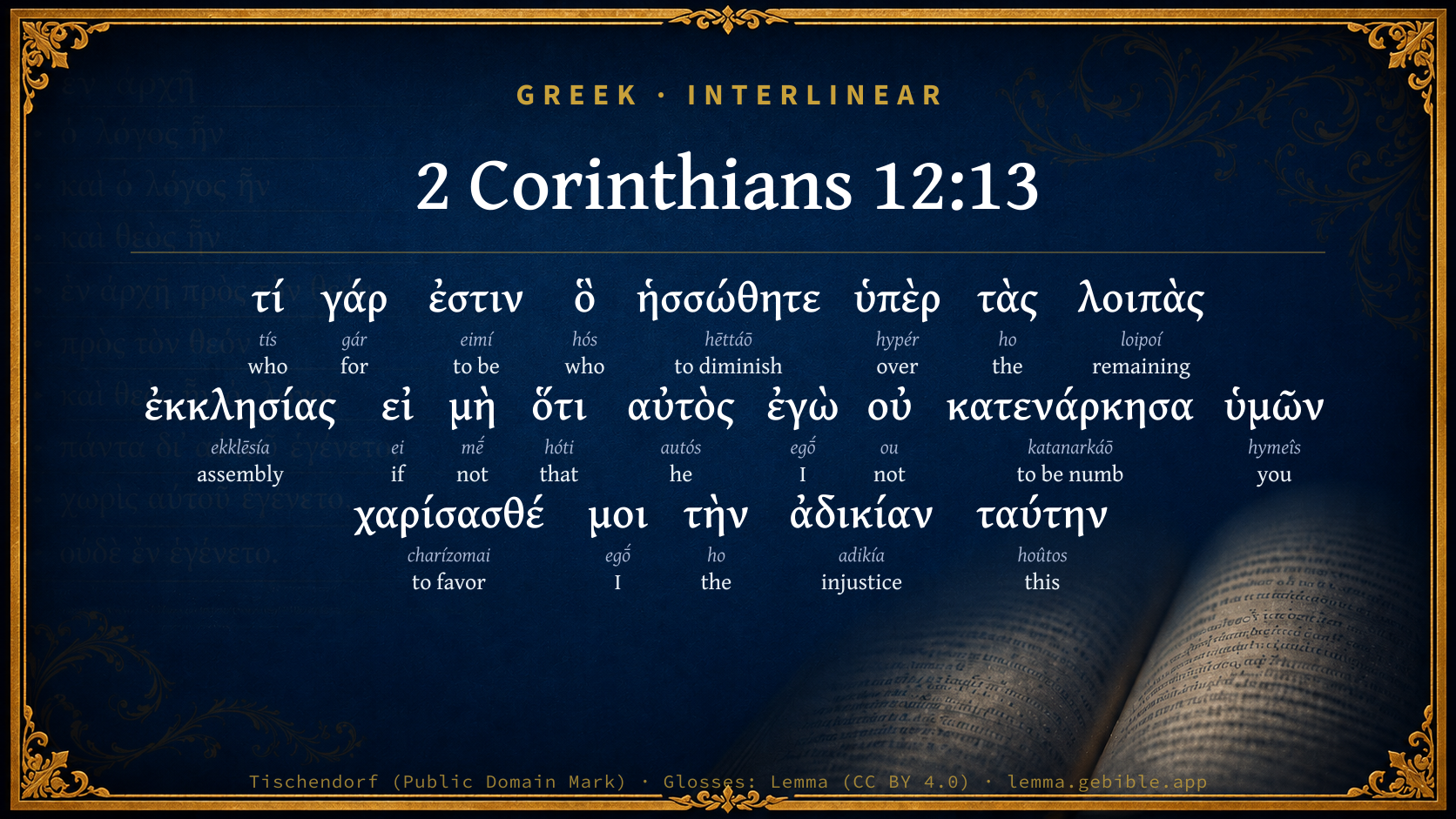
  1. τί tís G5101 “who” Interrogative pronoun, Nominative, Singular, Neuter
  2. γάρ gár G1063 “for” Conjunction
  3. ἐστιν eimí G1510 “to be” Verb, Present, Active, Indicative, 3rd person, Singular
  4. ὃ hós G3739 “who” Relative pronoun, Accusative, Singular, Neuter
  5. ὑπὲρ hypér G5228 “over” Preposition
  6. τὰς ho G3588 “the” Article, Accusative, Plural, Feminine
  7. λοιπὰς loipoí G3062 “remaining” Adjective, Accusative, Plural, Feminine
  8. ἐκκλησίας ekklēsía G1577 “assembly” Noun, Accusative, Plural, Feminine
  9. εἰ ei G1487 “if” Conditional
  10. μὴ mḗ G3361 “not” Particle, Negative
  11. ὅτι hóti G3754 “that” Conjunction
  12. αὐτὸς autós G846 “he” Personal pronoun, Nominative, Singular, Masculine
  13. ἐγὼ egṓ G1473 “I” Personal pronoun, 1st person, Nominative, Singular
  14. οὐ ou G3756 “not” Particle, Negative
  15. κατενάρκησα katanarkáō G2655 “to be numb” Verb, Aorist, Active, Indicative, 1st person, Singular
  16. ὑμῶν hymeîs G5210 “you” Personal pronoun, 2nd person, Genitive, Plural
  17. χαρίσασθέ charízomai G5483 “to favor” Verb, Aorist, Middle deponent, Imperative, 2nd person, Plural
  18. μοι egṓ G1473 “I” Personal pronoun, 1st person, Dative, Singular
  19. τὴν ho G3588 “the” Article, Accusative, Singular, Feminine
  20. ἀδικίαν adikía G93 “injustice” Noun, Accusative, Singular, Feminine
  21. ταύτην hoûtos G3778 “this” Demonstrative pronoun, Accusative, Singular, Feminine

About this verse

These counts appear in no published source. They are computed here, from the morphology-tagged text and Lemma’s own curated glosses. What Lemma adds →

22
words
20
distinct lemmas
Pauline Epistles
section

Notable vocabulary

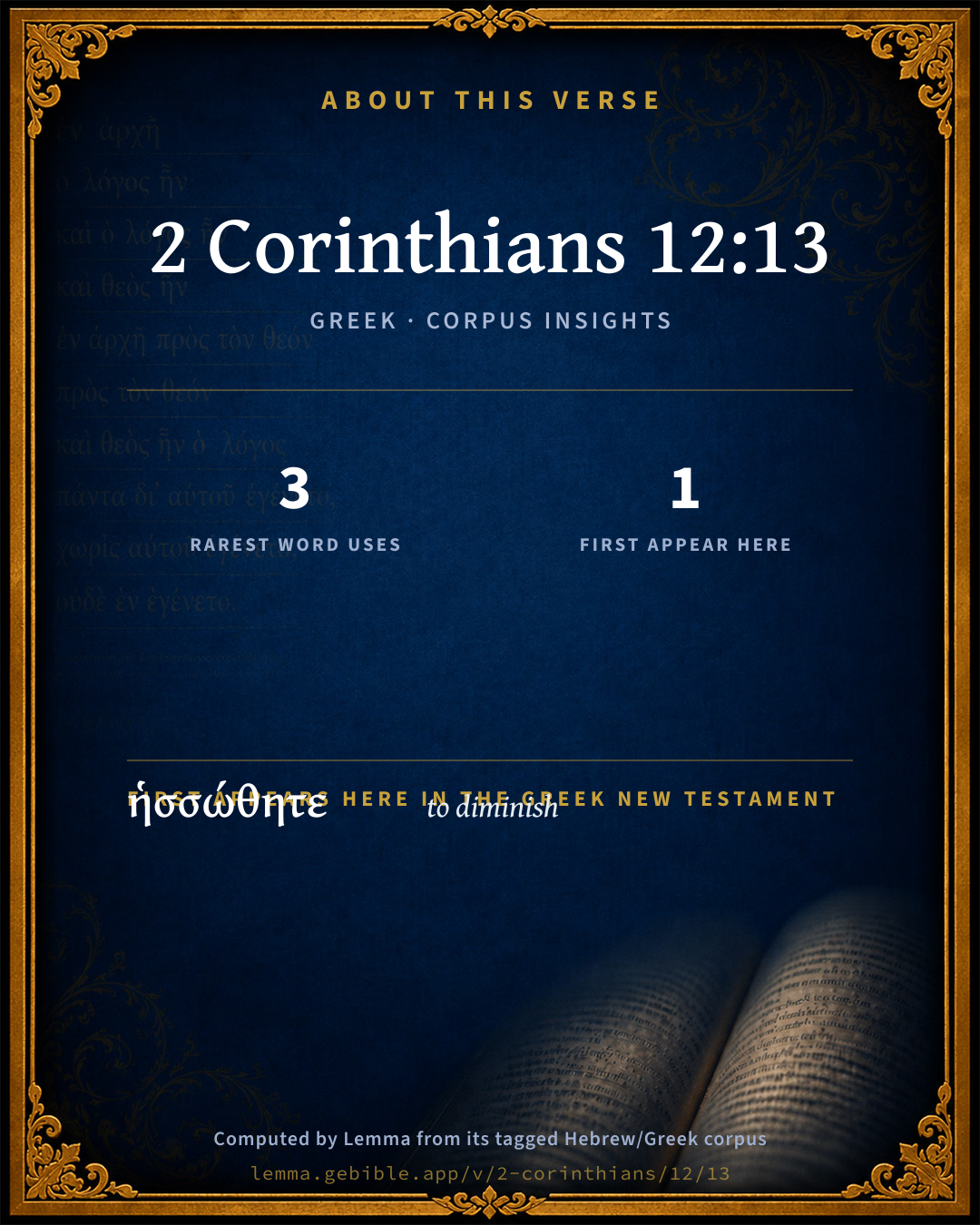
The rarest word here is ἡσσώθητε to diminish G2274 — appearing just 3 times in the whole Greek New Testament.

First appearance in Scripture

This word makes its first canonical appearance in the Greek New Testament here:

  • ἡσσώθητε to diminish G2274

Shared distinctive vocabulary

ἡσσώθητε to diminish G2274 occurs in 3 verses of the Greek New Testament. Also found in:
Repetition

Words recur within this verse:

Cross-references

5

Topical passages linked to 2 Corinthians 12:13 in the Treasury of Scripture Knowledge — connected by theme and wording, ordered by reader-vote popularity; previews shown in the World English Bible.

  • 1 Corinthians 9:6 Or have only Barnabas and I no right to not work?
  • 1 Corinthians 9:12 If others partake of this right over you, don't we yet more? Nevertheless we did not use this right, but we bear all things, that we may cause no hindrance to the Gospel of Christ.
  • 1 Corinthians 9:15–18 But I have used none of these things, and I don't write these things that it may be done so in my case; for I would rather die, than that anyone should make my boasting void.
  • 2 Corinthians 11:7–9 Or did I commit a sin in humbling myself that you might be exalted, because I preached to you God's Gospel free of charge?
  • 2 Corinthians 12:14 Behold, this is the third time I am ready to come to you, and I will not be a burden to you; for I seek not your possessions, but you. For the children ought not to save up for the parents, but the parents for the children.

Cross-references courtesy of OpenBible.info (CC BY 4.0).

Commentary

Notes on 2 Corinthians 12:13 from classic Christian and Jewish commentators (each source and its license shown beneath its notes). The classic Christian expositions comment on the surrounding passage and are grouped to its opening verse, so a note may address several verses; the Jewish commentaries on the Tanakh (Rashi and others) are per-verse, so they appear only where the commentator wrote on this verse.

Lemma curates 59 commentaries, every one of them public domain or Creative Commons licensed, each selected and text-cleaned for this edition rather than reprinted as found. About our sources →

Whedon's Commentary on the Bible

Daniel D. Whedon

4. By disinterestedness, both in declining compensation (2Co_12:13-15) and in using no guile for gain, (2Co_12:16-18,) 2Co_12:13-18.

From his powerful apostolate among them to his declining to accept, St. Paul makes a very graceful transition. His apostolate had placed the Corinthians at the highest eminence among the Churches; but there is this drawback—He had declined to be pecuniarily obligated to them. Under vail of apologizing for this slight, He asserts, gently, as if in view of his detractors, his own disinterestedness.

13. What is it—My labours and signs had placed you in a rank equal to the best.

Inferior—But you complain, and I admit, that to labour for you and to place you on the gratuitous level, when I was aided by other Churches, was disparaging.

Burdensome—See note on 2Co_11:9.

Forgive me this wrong—As truly and persistently putting the Church in a disparaged position, there was a wrong justified by the facts, yet requiring some overlooking by the Corinthians. Their equivocal course towards their noble founder in dallying with his detractors had obliged him to place himself on high, independent ground.

Daniel D. Whedon (gen. ed.), Commentary on the Old and New Testaments (1874–1909) — public domain. Text from a community e-Sword module.

Tyndale Open Study Notes

Tyndale Open Resources

12:13 The only thing I failed to do refers to his not taking payment for his services (see 11:7-11). • Please forgive me for this wrong! This request is ironic and tongue-in-cheek.

Tyndale Open Study Notes — © Tyndale Open Resources, licensed CC BY-SA 4.0. Text via the HelloAO Bible API.

Bengel's Gnomon

Johann Albrecht Bengel

2Co 12:13. Τί, what) This word refers both to the antecedents and the consequents.—λοιπὰς, other churches) planted either by me or by the other apostles.—εἰ μὴ—ταύτην, unless—this) a striking Asteismus [instance of refined pleasantry].—αὐτὸς, I myself) The antithesis follows, nor by others, 2Co 12:16-17. I did not burden you myself, nor make a gain of you by those others whom I sent, Titus, etc.—ἀδικίαν, wrong) The apostle might rightly [as opposed to ἀδικίαν] have accepted his maintenance from the Corinthians, and when he did not avail himself of this right, he imputes it to himself, as a wrong; and he gives it this name, not in the way of irony, with which the language of the apostle is inconsistent, but in the way of amphibology, for he uses ἀδικίαν in this passage, in a very unusual sense, which may be expressed in Latin by non-jus, and it has a in the privative sense, as ἄνομος, ἀνόμως, are sometimes used [without law; not contrary to law], Rom 2:12; 1Co 9:21: so ἀνυπότακτον [not subjected, instead of insubordinate], Heb 2:8: and yet it admits at the same time the idea of injustice, deprecating thereby all suspicion of want of love to the Corinthians [in his not accepting maintenance from them]; forgive me, comp. 2Co 11:11.

Bengel's Gnomon of the New Testament — English translation (T&T Clark, Edinburgh, 1860) — public domain. Text from a community e-Sword module.

Meyer's Critical & Exegetical Commentary

Heinrich August Wilhelm Meyer

2Co_12:13. Τί γάρ ἐστιν … ὑμῶν] Bitterly ironical justification of what was said in 2Co_12:12. For what is there, in which you were placed at a disadvantage towards the other churches (in which I wrought), except, etc.? that is to say: for in nothing have you come behind, as compared with the other churches, except, etc. Quite arbitrarily Grotius limits this question, which embraces the whole blissful apostolic working, to the communication of gifts by the laying on of hands.

ὑπέρ] means nothing else than beyond, but in the direction downward (reference to the minus) which ἡττήθητε specifies. Comp. Winer, p. 376 [E. T. 502]. Rückert, overlooking the comparative sense of ἡττήθητε, says: there is here an ironical confession that all churches had disadvantage from Paul, and it is only denied that the disadvantage of the Corinthian was greater than that of the other churches. This would not suit at all as assigning a reason for 2Co_12:12. In assigning a reason, Paul could not but say: ye have in nothing come off worse; but to say, for your disadvantage has not been greater, would, with all its irony, be inappropriate. On the accusative of more precise definition with ἡττήθητε, comp. Xen. Cyr. i. 4. 5 : ἃ ἡττῷτο. The more usual construction ᾧ or ἐν ᾧ.

εἰ μὴ ὅτι κ.τ.λ.] In this exception (specie exceptionis firmat quod dieit, Grotius) lies the painful bitterness of the passage, which in the request that follows χαρίσασθε κ.τ.λ. becomes still sharper. It is the love, deeply hurt in its pure consciousness, that speak.

αὐτὸς ἐγώ] I myself; this places his own person over against the apostolic services indicated in τί … ἡττήθητε. Comp. in general on Rom_9:3. Rückert (so also Bengel) holds that Paul has already had in his mind what he subjoins in 2Co_12:16-18. Such an arbitrary prolepsis of the reference is the more untenable, seeing that with 2Co_12:14-15 another train of ideas intervene.

οὐ κατενάρκησα ὑμῶν] See on 2Co_11:8. Only by the fact that he has not been burdensome to them in accepting payment and the like, has Paul asserted himself as an apostle less among them than among the other churches! For this injustice they are to pardon him!

Meyer — Critical and Exegetical Commentary on the New Testament — English translation by Peter Christie, edited by Frederick Crombie (T&T Clark, 1880) — public domain. Text from a community e-Sword module.

Expositor's Greek Testament

ed. W. Robertson Nicoll

2Co 12:13 . τί γάρ ἐστιν ὃ ἡσσ . κ . τ . λ .: for what is there wherein ye were treated as inferior ( cf. 2Pe 2:19 ) to the rest of the churches, except indeed that I myself did not burden you? Cf. Act 20:33 , 1Co 9:12 and 2Co 12:16 . The emphatic αὐτὸς ἐγώ may indicate that it was only he himself (and not his colleagues) who refused maintenance (see on 2Co 11:12 ). This was the only σημεῖον τοῦ ἀποστόλου which he did not exhibit at Corinth, and he ironically adds, Forgive me this wrong .

The Expositor's Greek Testament, edited by W. Robertson Nicoll (1897–1910) — public domain. Text from a community e-Sword module.

Geneva Bible (1599)

Geneva Bible translators

I was not slothful in getting my living with mine own hands, that I might not be burdensome to you.

Geneva Bible (1599) marginal notes — public domain. Text via Bolls.life.

Jamieson, Fausset & Brown

Robert Jamieson, A. R. Fausset & David Brown

wherein you were inferior--that is, were treated with less consideration by me than were other churches.

I myself--I made a gain of you neither myself, nor by those others whom I sent, Titus and others (Co2 12:17-18).

wrong--His declining support from the Corinthians might be regarded as the denial to them of a privilege, and a mark of their spiritual inferiority, and of his looking on them with less confidence and love (compare Co2 11:9, Co2 11:11).

Jamieson, Fausset & Brown — Commentary Critical and Explanatory on the Whole Bible (1871) — public domain (CC PDM 1.0). Text via the HelloAO Bible API.

Adam Clarke's Commentary

Verse 13. For what is it wherein you were inferior] This is a fine, forcible, yet delicate stroke. It was your duty and your interest to have supported your apostle; other Churches have done so: I did not require this from you; in this respect all other Churches are superior to you. I am the cause of your inferiority, by not giving you an opportunity of ministering to my necessities: forgive me the wrong I have done you. It is the privilege of the Churches of Christ to support the ministry of his Gospel among them. Those who do not contribute their part to the support of the Gospel ministry either care nothing for it, or derive no good from it.

Adam Clarke's Commentary on the Bible (1810–1826) — public domain. Text from a community e-Sword/MySword module.

John Calvin's Commentaries

13. What is there in which. Here is an aggravation of their ingratitude — that he had been distinguished, that they might receive benefit — that they had derived advantage from the attestation furnished of his Apostleship, and had, notwithstanding, given their concurrence to the slanders of the false Apostles. He subjoins one exception — that he had not been burdensome to them; and this, by way of irony, for in reality this was over and above so many acts of kindness, which he had conferred upon them — that he had served them gratuitously. To busy themselves after this, as they did, in pouring contempt upon him, what was this but to insult his modesty? Nay, what cruelty there was in it! Hence, it is not without good reason, that he sharply reproves pride so frantic. Forgive me this wrong, says he. For they were doubly ungrateful, inasmuch as they not only contemned the man, by whose acts of kindness they had been brought under obligation, but even turned his kind disposition into an occasion of reproach. Chrysostom is of opinion, that there is no irony implied, and that, instead of this, there is an expression of apology; but, if any one examines the entire context more narrowly, he will easily perceive, that this gloss is quite foreign to Paul’s intention.

John Calvin's Commentaries (1540-1563) — public domain. Text from the Calvin Translation Society English edition (1840s-50s) via the Christian Classics Ethereal Library (ccel.org). Calvin's coverage is partial (roughly two-thirds of the Bible); uncommented books and verses are honest gaps, never fabricated. The 19th-century editor's footnotes and remarks are omitted so the notes are faithfully Calvin's own voice.

Ellicott's Commentary for English Readers

(13) What is it wherein ye were inferior to other churches?—His mind travels back to the insinuation that he cared less for them than he did for the churches of Macedonia, because he had maintained his independence and had received no gifts from them. If they complained of this, they should, at least, remember that this was the only point of inferiority. They had experienced fully all the advantages that flowed from his special power as an Apostle. For that wrong, so far as it was a wrong, he asks their forgiveness.

That I myself was not burdensome.—He uses here, and in the next verse, the same characteristic word for “sponging” on them, which has been commented on in the Note on 2Co_11:9. He obviously dwells on it with a touch of irony, as a word that had been used of him by some of his rivals.

A Bible Commentary for English Readers, edited by Charles John Ellicott (1878–1897) — public domain. Text from a community e-Sword module.

The Cambridge Bible for Schools and Colleges

gen. ed. J. J. S. Perowne

13. For what is it wherein ye were inferior to other churches] (hadden lesse than, Wiclif). There is no need to regard this, with some commentators, as “bitter irony.” There is nothing bitter about it. Ironical indeed it is, but it is irony of the very gentlest kind. ‘Everything that an Apostle can do has been done amongst you, except the throwing himself upon you for his maintenance’ (which had been made by the Apostle’s opponents one of the ‘signs of an Apostle;’ see 1Co_9:5-6). ‘Surely this is an offence which you might very readily forgive.’

I myself] St Paul’s resolution to decline maintenance at the hands of the Corinthians seems to have concerned himself alone, and not to have extended to his companions.

burdensome] See ch. 2Co_11:9.

The Cambridge Bible for Schools and Colleges (gen. ed. J. J. S. Perowne; Cambridge University Press, 1878–1918) — public domain. Text from a community e-Sword module.

John Gill's Exposition

And I will gladly spend,.... Meaning all his time, talents, and strength, which God had bestowed upon him for their spiritual profit and advantage; yea, all that small pittance of worldly goods that he enjoyed: he not only determined to take nothing from them, but was willing to communicate his little substance to them, or spend it in their service; and not only so, but be spent for them:

and be spent for you, or "for your souls": for the good of them; his sense is, either that he was willing to have his whole substance expended, if it would be of any use to them; or his whole strength exhausted, in laborious preaching to them; or even his life to be laid down for them, was it necessary; which sense is favoured by the Syriac and Arabic versions; all which expressed his tender affection as a spiritual father for them: adding,

though the more abundantly I love you, the less I be loved; though he loved them more than he did other churches, or than the false apostles loved them, and yet were loved by them less than he was by other churches; or by them, than the false apostles were; or rather the meaning is, that though he increased in his love, and in the expressions of it to them, and they grew colder and more indifferent to him, yet this should not hinder his warmest desires and most earnest endeavours after their spiritual and eternal welfare. This way of speaking strongly expresses his love to them, and tacitly implies the lukewarmness of theirs to him; and yet that it should be no discouragement to him to proceed in doing them all the service he was capable of.

John Gill's Exposition of the Whole Bible (1746–1763) — public domain (CC PDM 1.0). Text via the HelloAO Bible API.

Trapp's Complete Commentary

John Trapp

13 For what is it wherein ye were inferior to other churches, except it be that I myself was not burdensome to you? forgive me this wrong.

Ver. 13. Forgive me this wrong] A pleasant irony, such as whereof this Epistle is full. It is said of a wise man, Quod obiecta probra ut visus nocturnos, et vanas somniorum imagines digno supplicio puniat, festive scilicet contemptu et oblivione, vel si tanti est, misericordia elevet. (John Wover in Polymath.)

John Trapp, A Commentary or Exposition upon All the Books of the Old and New Testament (1647–1656) — public domain. Text from a community e-Sword module.

Albert Barnes' Notes on the Bible

For what is it ... - This verse contains a striking mixture of sarcasm and irony, not exceeded, says Bloomfield, by any example in Demosthenes. the sense is,” I have given among you the most ample proof of my apostolic commission. I have conferred on you the highest favors of the apostolic office. In these respects you are superior to all other churches. In one respect only are you inferior - it is in this, that you have not been burdened with the privilege of supporting me. If you had had this, you would have been inferior to no others. But this was owing to me; and I pray that you will forgive me this I might have urged it; I might have claimed it; I might have given you the privilege of becoming equal to the most favored in all respects. But I have not pressed it, and you have not done it, and I ask your pardon.” There is a delicate insinuation that they had not contributed to his needs (see the note, 2Co 11:8); an intimation that it was a privilege to contribute to the support of the gospel, and that Paul might have been “burdensome to them” (see the notes on 1Co 9:1-12); and an admission that he was in part to blame for this, and had not in this respect given them an opportunity to equal other churches in all respects.

Was not burdensome to you - see this explained in the notes on 2Co 10:8.

Forgive me this wrong - “If it be a fault, pardon it. Forgive me that I did not give you this opportunity to be equal to other churches. It is a privilege to contribute to the support of the gospel, and they who are permitted to do it should esteem themselves highly favored. I pray you to pardon me for depriving you of any of your Christian privileges.” What the feelings of the Corinthians were about forgiving Paul for this we know not; but most churches would be as ready to forgive a minister for this as for any other offence.

Albert Barnes' Notes on the Bible (1834–1885) — public domain. Text from a community e-Sword/MySword module.

Matthew Poole's English Annotations

Wherein have not you been used as any other gospel churches were, where Peter, or James, or any other of the apostles have laboured? Hath not the same doctrine been preached to you? Have not as great miracles been wrought amount you? Hath not the Holy Ghost been as plentifully shed abroad amongst you, to enrich you with all spiritual gifts, so as you have come behind in no gospel benefit? I know of nothing in which it hath not fared with you as with other churches, except in this; that whereas in other churches the apostles, or their pastors, have been burdensome to them, taking stipends and salaries for their pains, I have forborne it, and have not at all charged you. If this be a wrong to you, I hope it is not of that nature, but I may obtain a pardon for it. The reasons of the apostle’s thus sparing the church of Corinth more than some other churches, we have before guessed at.

Matthew Poole's English Annotations on the Holy Bible (1683–1685) — public domain. Text from a community e-Sword/MySword module.

The Pulpit Commentary

I was not burdensome. The same word as in 2Co_11:9. Forgive me this wrong. There is an exquisite dignity and pathos mixed with the irony of this remark.

The Pulpit Commentary (1880–1919), ed. H.D.M. Spence-Jones & Joseph S. Exell — public domain. Text from a community e-Sword module.

McGarvey & Pendleton's Commentaries

J. W. McGarvey

For what is there wherein ye were made inferior to the rest of the churches, except it be that I myself was not a burden to you? forgive me this wrong . [And you are without excuse in thus compelling me to defend myself by proving my apostleship, for it was proved long since among you by the miracles which I wrought among you as signs and evidences of it (evidences which his enemies wholly lacked); and also by the patient spirit in which I wrought the miracles, for I have again and again forborne to use my power to crush my wicked opposers ( 2Co_1:1-3 ; 1Co_4:21 ). And I so fully proved my apostleship among you, that you showed to no disadvantage whatever when compared with other churches founded by any others, for you had all the signs, gifts, graces, etc., which they had, unless it be that I myself did not aid my opposers in the good work of extorting wages from you--forgive me for thus wronging you! These last words, though ironical, are superbly dignified and pathetic. By his disinterested kindness to them, the apostle had favored them above all other churches-- 2Co_11:8 ]

J. W. McGarvey (with Philip Y. Pendleton), Commentaries on the New Testament (The Fourfold Gospel, 1914; Acts; and the epistles) — public domain. Text from a community e-Sword/MySword module.

The People's New Testament

B. W. Johnson

13. What is it wherein ye were inferior, etc.? They had enjoyed every privilege of the most highly favored churches, and, perhaps, complained that he had preached without charge to them. See notes on 11:7–12. If this was a wrong, he asked forgiveness.

B. W. Johnson's The People's New Testament with Notes (1889–1891) — public domain. Electronic text from the Christian Classics Ethereal Library (CCEL) ThML edition.

Cambridge Greek Testament for Schools and Colleges

13. ἡσσώθητε (אBD), after the analogy of ἐλασσόω, rather than ἡττήθητε (א3AD2D3KLP), from ἡττάω.

13. The Corinthians had had the distinction of these miracles and supernatural gifts; and in nothing had any Church been more honoured. In nothing,—with one possible exception: he had never taken from them either maintenance or reward. Yet this very thing, which ought to have earned their gratitude, had been urged against him as a reproach. So he sarcastically, or perhaps playfully, states this exceptional benefit to them as if it were an injury, and asks their forgiveness for it.

τὶ γάρ ἐστιν …; For what is there wherein ye were made inferior to the rest of the Churches, except it be that I myself was not a burden (see on 2Co 11:9) to you? Forgive me this wrong. Note that in this letter there is no mention of the Church as a whole: except 2Co 1:1, ἐκκλησία̇ is always in the plural (2Co 8:1; 2Co 8:18-19; 2Co 8:23-24, 2Co 11:8; 2Co 11:28), and the Churches are local Churches. In 2Co 1:1 ‘the Church of God’ is expressly limited to Corinth. Here, as in 2Co 11:8, the mention of other Churches shows that he is addressing the Corinthian Church as a whole, and not a mere party in it. The αὐτὸς ἐγώ (comp. 2Co 10:1) perhaps implies that his colleagues did not all refuse maintenance. For ὑπέρ = ‘beyond’ after words implying comparison comp. Gal 1:14; Luk 16:8; Heb 4:12; Sir 30:17. On ἡσσώθητε see critical note and WH. App. p. 166: comp. Hdt. 7:146. 2, 8:75, 1. For χαρίσασθε comp. 2Co 2:10; Col 2:13.

Cambridge Greek Testament for Schools and Colleges (Cambridge University Press, 1896; 21 vols, various authors incl. Carr, Maclear, Plummer, Farrar, Lumby, Moule, M. R. James, Simcox) — public domain. Text from a community e-Sword module.

Alford’s Greek Testament

Henry Alford

13-15.] His disinterestedness, shewn in his past, and resolved in his future dealings with them. The question τί γὰρ κ.τ.λ. is asked in bitter irony. It is an illustration of ἐν πάσῃ ὑπομονῇ, and of the distinction conferred on them by so long manifestation of the signs of an Apostle among them. ‘Was this endurance of working which I shewed, marred by the fact that I worked gratuitously among you?’ ἡσς. ὑπέρ does not imply that all churches suffered loss, and that the loss of the Corinthians was only not greater than that of other churches: but the comparative, implied in. ἡσς is carried out by the ὑπέρ,—‘ye suffered loss in comparison with the other Churches.’

13. εἰ μὴ ὅτι] except that one point, in which of all others they had least reason to complain. This one is put forward to indicate their deep ingratitude, if they did complain, seeing that the only point of difference in their treatment had been a preference: ‘die ties gefránfte Liebe redet.’ Meyer.

On κατενάρκ. see ref.

χαρ. μ. τ. ἀδ. ταύτην] The irony here reaches its height.

Henry Alford, The Greek Testament (1849–1861) — public domain. Text from a community e-Sword module.

International Critical Commentary

13. τί γάρ ἐστιν ὅ ἡσσώθητε … οὐ κατενάρκησα ὑμῶν; ‘For what is there wherein ye were made inferior to the rest of the Churches, except it be that I myself did not burden you by claiming maintenance?’ See on 11:9. He comes back to the subject of his refusing to take money or maintenance from them owing to the mention of ‘the overmuch apostles’ in v. 11. It was one of the undeniable contrasts between them and him, that they claimed and took maintenance, while he refused it when offered. See on 1Co 9:12. On the form ἡσσώθητε see WH. App. p. 166b, and cf. Hdt. vii. 166, viii. 75. For ὑπέρ in the sense of ‘beyond’ after verbs of comparison see on Luk 16:8, and cf. Gal 1:14; Heb 4:12; Jdg 11:25; 1Ki 19:4. As in 10:1, the force of αὐτὸς ἐγώ is not clear. It may mean ‘I myself,’ as distinct from ‘the signs of an Apostle’; his critics contended that it was the sign of an Apostle to receive maintenance. Or, less probably, it may mean that some of his colleagues had accepted maintenance; see on 1Co 9:6. The Churches are local Churches (8:1, 18, 11:8, 28, etc.).

χαρίσασθέ μοι τὴν ἀδικίαν ταύτην. Of course his refusing to be supported by them was an advantage to the Corinthians. With playful irony he treats it as if it were an injury, and asks them to forgive it. * Cf. 2:10; Col 2:13; Luk 7:21, where Bengel calls ἐχαρίσατο magnificum verbum. In what follows he affectionately warns them that he will have to continue to inflict this ‘injury’ on them. All this shows that he is addressing the whole Corinthian Church. The change of tone in these chapters cannot be explained by the supposition that 1-19. is addressed to the loyal members, while 10-13. is addressed to the rebellious, for the supposition is untenable.

ἡσσώθητε (א* B D*) after the analogy of ἐλασσόω, rather than ἡττήθητε (א3 A D3 K L P), from ἡττάω, or ἐλατώθηται (G).

13. 1 I am now for the third time coming to you. Remember the Scripture which says, At the mouth of two witnesses and of three shall every word be established. That implies a strict investigation. 2 I gave a warning, when I was with you a second time, to those who clung to their old sins then, and now being absent I give a warning to all the rest who may need it now,—that if I come again, as I am, preparing to do, I will not spare. 3 I could not do so, seeing that you are seeking to make me give a proof that it is the Christ who is speaking in me, the Christ who in His dealings with you is not weak, but exhibits His power among you. 4 For though it is true that He was crucified through weakness, yet He is alive for evermore through the power of God. And you will find the same kind of thing in me. By union with Christ I share His weakness; yet through that same power of God and in fellowship with Christ. I shall be full of life and vigour for dealing with you. 5 You seek a proof from me that Christ is in me. It is your own selves that you ought to be testing, whether you are in the faith that saves; it is your own selves that you ought to be proving. Or are you so ignorant about your state as not to know that Christ is in you? Of course He is, unless (as I will not believe) you have failed to stand this test. 6 But I trust that you will come to know that I have not failed. 7 But my prayer unto God is that you may not in any way go wrong; not in order that in this way I may be shown to have stood the test, but that you may do what is noble and right, even though I may seem to have failed. 8 For of course I cannot, even to secure my position as an Apostle, do anything that would be prejudicial to the Gospel; all that I do must be in furtherance of the Gospel. 9 Indeed, I rejoice when it is owing to your Christian strength of character that I am weakened by losing an opportunity of proving my authority; and this I not only rejoice over but pray for,—I mean the perfecting of your characters. 10This is my reason for writing as I do while I am away from you, so that, when I am present, I may not have to act sharply, according to the authority which the Lord gave me for building up and not for demolition.

International Critical Commentary — older volumes (1896–1929), various authors — public domain. Text from a community e-Sword module.

Vincent's Word Studies in the New Testament

Marvin R. Vincent

Except that I was not a burden. Alluding to the possible objection that his refusal to receive pay was a sign either of his want of power to exact it, or of his want of affection for them (ch. 11 7).

Forgive, etc. Ironical.

Marvin R. Vincent, Word Studies in the New Testament (1887–1900) — public domain. Text from a community e-Sword/MySword module.

Lesson kit

Teaching starters — assembled from the data on this page, not authored interpretation. Every prompt links to the verse data it draws on. Edit before teaching.

2 Corinthians, in the Pauline Epistles, opens this verse with 22 words (20 distinct Greek lemmas). Its most distinctive word is hēttáō (“to diminish”). A historical commentator’s framing appears above. Read the whole chapter for the surrounding context.

Discussion questions

  1. The word hēttáō carries the sense “to diminish.” How does it shape the verse?
  2. This is the first place “to diminish” appears in Scripture (first appears here). What does its debut here establish?
  3. How does 2 Peter 2:19, which shares the word «to diminish», read alongside this verse?
  4. What does the repetition of “the” (2× in this one verse) do in this verse?
  5. The translations on this page render this verse differently — a whole-verse word diff, not a word-by-word alignment. What might account for the different wordings?
  6. Compare how Whedon's Commentary on the Bible and Tyndale Open Study Notes read this verse. Where do they agree or differ?

Things to notice

  • 1 word makes its first canonical appearance in Scripture here.
  • These translations choose different wording for 18 words in this verse.
  • “the” occurs 2× in this single verse.
  • 20 distinct Greek lemmas span 22 words in this verse.

Reading settings

Reading text

Shown beneath each verse's original-language words.

Old Testament
Old Testament edition

Read the OT as the Masoretic Hebrew (MT) or the Greek Septuagint (LXX).

English shown for the Greek Septuagint (in the Hebrew ↔ Greek comparison).

Comparing translations? Open the Compare panel on any verse page to stack up to four side by side.