
2 Corinthians 1:11

Greek (Tischendorf 8th ed.) 2 Corinthians 1:11 appears in the Greek New Testament. The text above is from the Tischendorf 8th edition. Each word links to its Strong’s number and a concise gloss. Click any word for its full Thayer’s Greek Lexicon entry.

Download image
Cite this verse

2 Corinthians 1:11 (World English Bible). Public Domain. Lemma interlinear Bible study tool, https://lemma.gebible.app/v/2-corinthians/1/11.

Show BibTeX & RIS
BibTeX
RIS
English Translation
you also helping together on our behalf by your supplication; that, for the gift bestowed on us by means of many, thanks may be given by many persons on your behalf.
World English Bible · Public Domain
Highlights
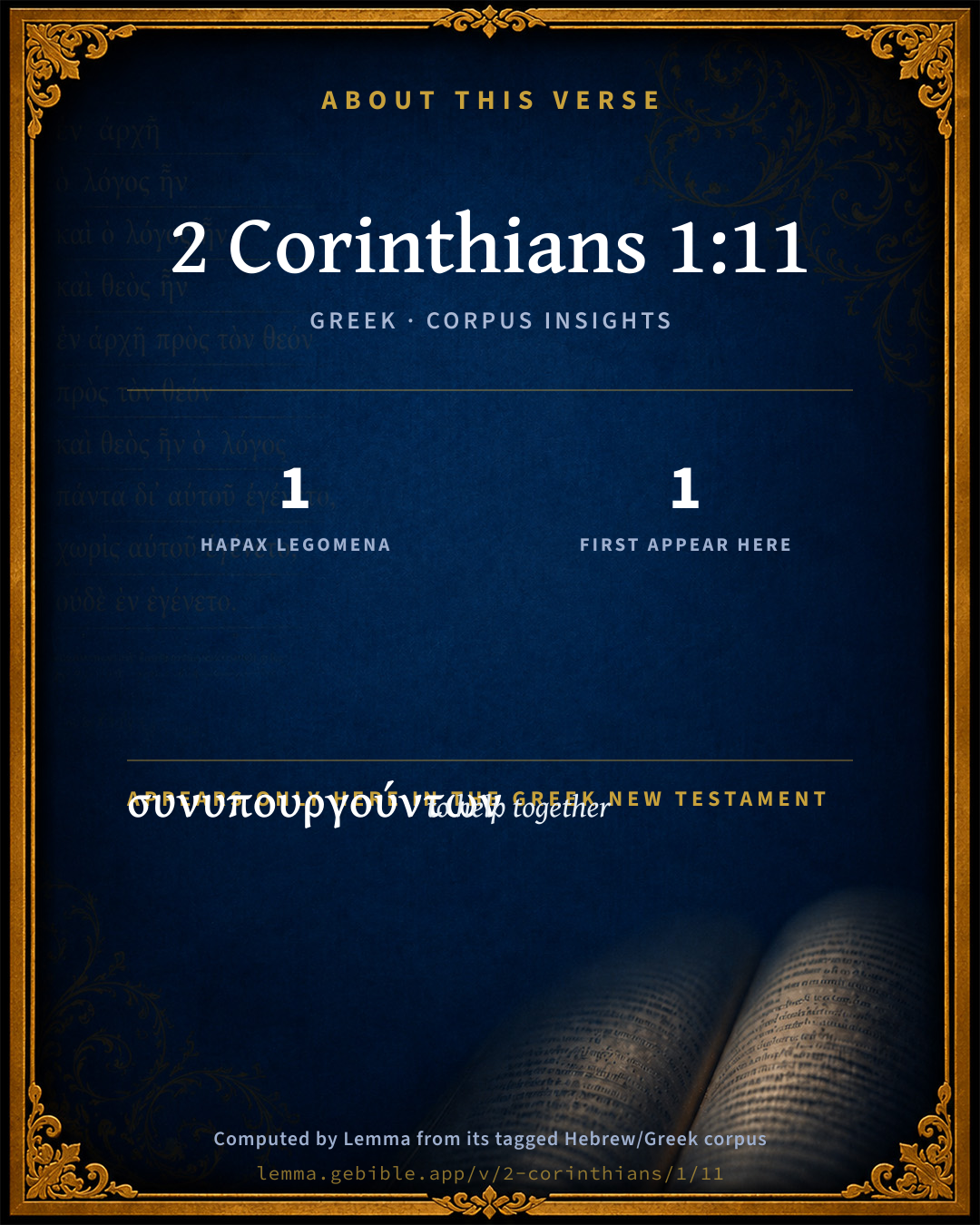
  • 1 hapax legomenon — only here in the Greek New Testament
  • 1 first appearance in the Greek New Testament
Full analysis ↓
Download a study sheet

One document with this verse’s original text, its word-by-word gloss line, the meaning frame, cross-references with their text, attributed commentary, and full source and license credits — printable, and it pastes into notes with its structure intact.

This verse Autodidact and up

Study sheet (.html) Plain text (.txt)

A passage Seminary Student

Up to 50 verses in one chapter. A passage sheet keeps up to 6 commentary sources and 12 cross-references per verse, in the order this page ranks them, and says so on the sheet whenever that leaves anything out. Ask for a single verse and you get the Autodidact verse sheet above.

Everything on this page stays free to read, with no account — the sheet is a download of what is already on screen, not access to it.

Want to remove ads? Support Godless Engineer
Compare translations 3

The same verse in 3 English versions, stacked beneath the original-language interlinear above. Click any original word for its lexicon entry.

Each is an independent rendering of the whole verse — the interlinear is not word-aligned to these translations.

Highlighted words mark where these versions differ — a whole-verse word diff, not a word-by-word alignment.

  • World English Bible Public Domain
    you also helping together on our behalf by your supplication; that, for the gift bestowed on us by means of many, thanks may be given by many persons on your behalf.
  • King James Version Public Domain
    Ye also helping together by prayer for us, that for the gift bestowed upon us by the means of many persons thanks may be given by many on our behalf.
  • unfoldingWord Literal Text CC BY-SA 4.0
    you also joining in helping in supplication on our behalf—so that thanks may be given on our behalf from many faces for the gracious gift to us through many.

unfoldingWord Literal Text — © unfoldingWord, licensed CC BY-SA 4.0. Word-aligned USFM3 via Door43 (git.door43.org/unfoldingWord/en_ult).

Versions to compare (up to 4)

3 of 4 selected

Show all 19 translations

Every available English version of this verse, each an independent rendering of the whole verse.

  • World English Bible Public Domain
    you also helping together on our behalf by your supplication; that, for the gift bestowed on us by means of many, thanks may be given by many persons on your behalf.
  • Berean Standard Bible Public Domain
    as you help us by your prayers. Then many will give thanks on our behalf for the favor shown us in answer to their prayers.
  • Majority Standard Bible Public Domain
    as you help us by your prayers. Then many will give thanks on your behalf for the favor shown us in answer to their prayers.
  • King James Version Public Domain
    Ye also helping together by prayer for us, that for the gift bestowed upon us by the means of many persons thanks may be given by many on our behalf.
  • American Standard Version (1901) Public Domain
    ye also helping together on our behalf by your supplication; that, for the gift bestowed upon us by means of many, thanks may be given by many persons on our behalf.
  • Revised Version (1885) Public Domain
    ye also helping together on our behalf by your supplication; that, for the gift bestowed upon us by means of many, thanks may be given by many persons on our behalf.
  • Geneva Bible (1599) Public Domain
    So that ye labour together in prayer for vs, that for the gift bestowed vpon vs for many, thankes may be giuen by many persons for vs.
  • Douay-Rheims (1899) Public Domain
    You helping withal in prayer for us: that for this gift obtained for us, by the means of many persons, thanks may be given by many in our behalf.
  • Young's Literal Translation Public Domain
    ye working together also for us by your supplication, that the gift through many persons to us, through many may be thankfully acknowledged for us.
  • Literal Standard Version CC BY-SA 4.0
    you also working together for us by your supplication, that the gift through many persons to us, through many, may be thankfully acknowledged for us.
  • Unlocked Literal Bible CC BY-SA 4.0
    He will do this as you also help us by your prayer. Then many will give thanks on our behalf for the gracious favor given to us through the prayers of many.
  • unfoldingWord Literal Text CC BY-SA 4.0
    you also joining in helping in supplication on our behalf—so that thanks may be given on our behalf from many faces for the gracious gift to us through many.
  • Darby Bible Public Domain
    ye also labouring together by supplication for us that the gift towards us, through means of many persons, may be the subject of the thanksgiving of many for us.
  • World Messianic Bible Public Domain
    you also helping together on our behalf by your supplication; that, for the gift given to us by means of many, thanks may be given by many persons on your behalf.
  • Webster's Bible Public Domain
    Ye also helping together by prayer for us, that for the gift bestowed upon us by the means of many persons, thanks may be given by many on our behalf.
  • Free Bible Version CC BY-SA 4.0
    You help us by praying for us. In this way many will thank God for us because of the blessing that God will give us in response to the prayers of many.
  • Bible in Basic English Public Domain
    You at the same time helping together by your prayer for us; so that for what has been given to us through a number of persons, praise may go up to God for us from all of them.
  • Text-Critical English NT CC BY 4.0
    as you join in helping us by your prayers. Then many will give thanks on your behalf for the favor granted to us through the prayers of many.
  • Tyndale New Testament (1534) Public Domain
    by the helpe of youre prayer for vs: that by the meanes of many occasions thankes maye be geven of many on oure behalfe for the grace geven vnto vs.

Literal Standard Version (2020), Covenant Press — licensed CC BY-SA 4.0. Text via the HelloAO Bible API (eBible.org). Unlocked Literal Bible (unfoldingWord) — licensed CC BY-SA 4.0. Text via the HelloAO Bible API (eBible.org). unfoldingWord Literal Text — © unfoldingWord, licensed CC BY-SA 4.0. Word-aligned USFM3 via Door43 (git.door43.org/unfoldingWord/en_ult). Free Bible Version, Dr. Jonathan Gallagher — licensed CC BY-SA 4.0. Text via the HelloAO Bible API (eBible.org).

Word by word

More ways to search: Search by grammar → Find every occurrence → Compare this word →

Practice this passage: Drill this verse → Learn its vocabulary →

συνυπουργούντων
synypourgéō
G4943
“to help together”
Verb, Present, Active, Participle, Genitive, Plural, Masculine
Part of Speech
Verb
Tense
Present
Voice
Active
Mood
Participle
Case
Genitive
Number
Plural
Gender
Masculine
Full Thayer's Definition

Origin: from G4862 and a derivative of a compound of G5259 and the base of G2041

TDNT: None

1. to help together
  1. καὶ kaí G2532 “and” Conjunction
  2. ὑμῶν hymeîs G5210 “you” Personal pronoun, 2nd person, Genitive, Plural
  3. ὑπὲρ hypér G5228 “over” Preposition
  4. ἡμῶν hēmeîs G2249 “we” Personal pronoun, 1st person, Genitive, Plural
  5. τῇ ho G3588 “the” Article, Dative, Singular, Feminine
  6. δεήσει déēsis G1162 “need” Noun, Dative, Singular, Feminine
  7. ἵνα hína G2443 “that” Conjunction
  8. ἐκ ek G1537 “from” Preposition
  9. πολλῶν polýs G4183 “many” Adjective, Genitive, Plural, Neuter
  10. προσώπων prósōpon G4383 “face” Noun, Genitive, Plural, Neuter
  11. τὸ ho G3588 “the” Article, Nominative, Singular, Neuter
  12. εἰς eis G1519 “into” Preposition
  13. ἡμᾶς hēmeîs G2249 “we” Personal pronoun, 1st person, Accusative, Plural
  14. χάρισμα chárisma G5486 “divine grace” Noun, Nominative, Singular, Neuter
  15. διὰ diá G1223 “through” Preposition
  16. πολλῶν polýs G4183 “many” Adjective, Genitive, Plural, Neuter
  17. εὐχαριστηθῇ eucharistéō G2168 “to give thanks” Verb, Aorist, Passive, Subjunctive, 3rd person, Singular
  18. ὑπὲρ hypér G5228 “over” Preposition
  19. ἡμῶν hēmeîs G2249 “we” Personal pronoun, 1st person, Genitive, Plural

About this verse

These counts appear in no published source. They are computed here, from the morphology-tagged text and Lemma’s own curated glosses. What Lemma adds →

20
words
15
distinct lemmas
Pauline Epistles
section

Notable vocabulary

1 hapax legomenon — a word that appears only here in the entire Greek New Testament:

  • συνυπουργούντων to help together G4943

First appearance in Scripture

This word makes its first canonical appearance in the Greek New Testament here:

  • συνυπουργούντων to help together G4943

Shared distinctive vocabulary

χάρισμα divine grace G5486 occurs in 17 verses of the Greek New Testament. Also found in:
Repetition

Words recur within this verse:

  • ὑπὲρ over G5228 ×2
  • πολλῶν many G4183 ×2
  • ἡμῶν we G2249 ×3
  • τῇ the G3588 ×2

Cross-references

15

Topical passages linked to 2 Corinthians 1:11 in the Treasury of Scripture Knowledge — connected by theme and wording, ordered by reader-vote popularity; previews shown in the World English Bible.

  • Philippians 1:19 For I know that this will turn out to my salvation, through your supplication and the supply of the Spirit of Jesus Christ,
  • 2 Corinthians 4:15 For all things are for your sakes, that the grace, being multiplied through the many, may cause the thanksgiving to abound to the glory of God.
  • Acts 12:5 Peter therefore was kept in the prison, but constant prayer was made by the assembly to God for him.
  • Colossians 4:3 praying together for us also, that God may open to us a door for the word, to speak the mystery of Christ, for which I am also in bonds;
  • 2 Thessalonians 3:1 Finally, brothers, pray for us, that the word of the Lord may spread rapidly and be glorified, even as also with you;
  • Philemon 1:22 Also, prepare a guest room for me, for I hope that through your prayers I will be restored to you.
  • Hebrews 13:18 Pray for us, for we are persuaded that we have a good conscience, desiring to live honorably in all things.
  • Romans 15:30–32 Now I beg you, brothers, by our Lord Jesus Christ, and by the love of the Spirit, that you strive together with me in your prayers to God for me,
  • Ephesians 6:18–19 with all prayer and requests, praying at all times in the Spirit, and being watchful to this end in all perseverance and requests for all the saints:
  • James 5:16–18 Confess your offenses to one another, and pray one for another, that you may be healed. The effective, earnest prayer of a righteous man is powerfully effective.
  • Isaiah 37:4 It may be Yahweh your God will hear the words of Rabshakeh, whom the king of Assyria his master has sent to defy the living God, and will rebuke the words which Yahweh your God has heard. Therefore lift up your prayer for the remnant that is left.
  • Isaiah 62:6–7 I have set watchmen on your walls, Jerusalem; they shall never hold their peace day nor night: you who call on Yahweh, take no rest,
  • 2 Corinthians 9:11–12 you being enriched in everything to all liberality, which works through us thanksgiving to God.
  • 2 Corinthians 9:14 while they themselves also, with supplication on your behalf, yearn for you by reason of the exceeding grace of God in you.
  • 1 Thessalonians 5:25 Brothers, pray for us.

Cross-references courtesy of OpenBible.info (CC BY 4.0).

Where the printed editions differ

1 variant

Places in this verse where the major printed Greek editions disagree on the wording in a way that affects the translation — a comparison of editions, not a manuscript-by-manuscript collation. The editions are the modern critical texts (Nestlé-Aland 28/27, SBL, Westcott-Hort, Tregelles, Tyndale House) and the traditional texts behind the KJV (the Textus Receptus and the Byzantine/Majority text). It is not a claim about which reading is original.

  1. Different wording
    ἡμῶν.

    “us.”

    In NA28NA27TynSBLWHTregTR Not in Byz

    ὑμῶν (humōn) 'you' occurs in a few manuscripts (Byz) instead of ἡμῶν. (hēmōn) 'us.' in older manuscripts (NA28+NA27+Tyn+SBL+WH+Treg+TR)

Textual data: Translators Amalgamated Greek New Testament (STEPBible TAGNT) · CC BY 4.0.

Commentary

Notes on 2 Corinthians 1:11 from classic Christian and Jewish commentators (each source and its license shown beneath its notes). The classic Christian expositions comment on the surrounding passage and are grouped to its opening verse, so a note may address several verses; the Jewish commentaries on the Tanakh (Rashi and others) are per-verse, so they appear only where the commentator wrote on this verse.

Lemma curates 59 commentaries, every one of them public domain or Creative Commons licensed, each selected and text-cleaned for this edition rather than reprinted as found. About our sources →

The Biblical Illustrator

Joseph S. Exell

2Co_1:11

Ye also helping together by prayer for us.

Helping together

You have four girls; Mary does the work of the rest--such help is not good. All help is dangerous for any of us when there is absence of mutuality. I am not allowed to think of myself as in one of those boat excursions, where some sit idle at the stern while some one else rows. There is nothing healthy or wholesome unless we work together.

I. We must not hinder. What a dreadful thing it is to read concerning the Pharisees, that they not only did not enter in themselves, but hindered those that were entering in. That may be done by ill-temper and by indifference.

II. Nerve yourself to triumph over hindrances. The river comes leaping on. Well, you say you cannot get over that rock, it is so high! Oh! yes, the river says, I am going round that side. Your life and mine ought to mean conquest.

III. It is pleasant to help. But when you are helping together then the critics come. Look at Nehemiahs work. These are the things that test your strength! Go on with the work, helping together!

IV. Note the variety of work. There is a great deal to be said for the numerous ways in which we may help.

V. This helping together will be rewarded in ways we little think of.

VI. The influence of work upon the worker. We are all disciplined by it. (W. M. Statham.)

Christians prayers the ministers help

I. The objects at which Christian ministers aim.

1. The destruction of the empire of Satan.

2. To restore order and happiness to the world.

3. To bring glory to Christ.

4. To prepare souls for heaven.

II. The influence which your prayers will have on their attainment. They will--

1. Awaken the attention of beholders.

2. Honour the Holy Spirit, who is the great agent in the success of the gospel.

3. Prepare the Church for its safe enjoyment of prosperity.

4. Fall in with the will of God, as made known to us in His Word.

III. The motives which should engage you to the performance of this duty.

1. It will tend to your own good.

2. There will be the use of other means to secure the good of the Church. He who prays as he ought will endeavour to live as he prays.

3. The great Lord of the Church hath set the example of prayer.

4. The Divine approbation it will surely receive. (Essex Congregational Remembrancer.)

The power of prayer and the pleasure of praise

Although our apostle thus acknowledged Gods hand alone in his deliverance, yet he did not undervalue the second causes. Having first praised the God of all comfort, he now remembers with gratitude the earnest prayers of the many loving intercessors. Let us--

I. Acknowledge the power of united prayer.

1. God has been pleased to command us to pray, for prayer--

(1) Glorifies God, by putting man in the humblest posture of worship.

(2) Teaches us our unworthiness, which is no small blessing to such proud beings as we are. While it is an application to Divine wealth, it is a confession of human emptiness.

(3) Apart from the answer which it brings, a great benefit to the Christian. As the runner gains strength for the race by daily exercise, so for the great race of life we acquire energy by the hallowed labour of prayer.

2. As many mercies are conveyed from heaven in the ship of prayer, so there are many choice and special favours which can only be brought to us by the fleets of united prayer. Many are the good things which God will give to His Elijahs and Daniels, but if two of you agree, etc., there is no limit to Gods bountiful answers. Peter might never have been brought out of prison if it had not been that prayer was made without ceasing by all the Church for him. Pentecost might never have come if all the disciples had not been with one accord in one place. Thus our gracious Lord sets forth His own esteem for the communion of saints. We cannot all preach, rule, or give gold and silver, but we can all contribute our prayers.

3. This united prayer should specially be made for the ministers of God.

(1) Their position is most perilous. Satan knows if he can once smite one of these there will be a general confusion, for if the champion be dead then the people fly. On returning from Rotterdam, when we were crossing the bar at the mouth of the Mass, where by reason of a neap tide and a bad wind the navigation was exceedingly dangerous, orders were issued--All hands on deck! So the life of a minister is so perilous, that I may well cry--All hands on deck; every man to prayer.

(2) A solemn weight of responsibility rests on them. The captain as we crossed that bar threw the lead himself into the sea; and when one asked why, he said, At this point I dare not trust any man to heave the lead, for we have hardly six inches between our ship and the bottom.

(3) Their preservation is one of the most important objects to the Church. You may lose a sailor from the ship, and that is very bad, but if the captain should be smitten, what is the vessel to do?

(4) How much more is asked of them than of you.

4. I find that in the original the word for helping together implies very earnest work. Some peoples prayers have no work in them. Melancthon derived great comfort from the information that certain poor weavers, woman and children, had met together to pray for the Reformation. It was not Luther only, but the thousands of poor persons who offered supplications, that made the Reformation what it was.

II. Excite you to praise.

1. Praise should always follow answered prayer, the mist of earths gratitude should rise as the sun of heavens love warms the ground. Tongue-tied Christians are a sad dishonour to the Church.

2. United praise has a very special commendation, it is like music in concert. It is a volume of harmony. The praise of one Christian is accepted before God like a grain of incense; but the praise of many is like a censer full of frankincense smoking up before the Lord.

3. As united prayer should be offered specially for ministers, so should united praise. We ought to praise God for good ministers--

(1) That they live, for when they die much of their work dies with them.

(2) For preserved character, for when a minister falls, what a disgrace it is!

(3) If the minister be kept well supplied with goodly matter, and if he be kept sound. (C. H. Spurgeon.)

The Biblical Illustrator, edited by Joseph S. Exell (c. 1880s–1900s) — public domain. Text from a community e-Sword module.

Bengel's Gnomon

Johann Albrecht Bengel

2Co 1:11. Συνυπουργούντων, you helping with) ὑπουργεῖν is from ἔργον, a work: ἔργον, the work of effectual help, belongs to God; ὑπουργεῖν, to help subordinately, belongs to the apostles; συνυπουργεῖν, to help subordinately along with, belongs to the Corinthians.—καὶ) you also, not merely others.—[2] ἐκ πολλῶν προσωπῶν, in many respects [But Engl. Vers. “By the means of many persons”]) πρόσωπωον, face, respect [point of view.] In respect, viz., of the past, present and future. He has delivered, delivers, will deliver. We do not translate it, of many persons, for that is included in the words, διὰ πολλῶν, by many.—τὸ εἰς ἡμᾶς χάρισμα) the assistance, which is vouchsafed to us by grace.—διὰ πολλῶν εὐχαριστηθῇ) thanksgiving may be given by many. χάρισμα and εὐχαριστία are correlatives; 2Co 4:15.—ὑπὲρ ὑμῶν,[3] for you) Just now he had said, for us, in respect of prayers; now, he says, for you, in respect of thanksgiving. The fruit redounded to the Corinthians. Nor was it necessary, after εἰς ἡμᾶς, again to say, ὙΠῈΡ ἩΜῶΝ.[4]

[2] Τῆ δεήσει—εὐχαριστηθῇ, that thanksgiving might be poured forth by prayer). He who enjoys the communion of saints, will never want an opportunity for prayer; although he should have nothing remaining in relation to himself, for which he should feel any anxiety—[i.e. the concerns of his fellow-saints will always afford him ample subject for prayer and praise.]—V. g.

[3] Therefore the reading ἡμῶν, at the end of the verse, is disapproved by the margin of both Ed., and seems to have slipped inadvertently into the Germ. Ver.—E. B.

[4] All the oldest MSS. and Versions have ἡμῶν. Only a few MSS. of Vulg. have vobis.—ED.

Bengel's Gnomon of the New Testament — English translation (T&T Clark, Edinburgh, 1860) — public domain. Text from a community e-Sword module.

Meyer's Critical & Exegetical Commentary

Heinrich August Wilhelm Meyer

2Co_1:11. A trustful and conciliatory mention of the intercessions of the readers. This is regarded as not so much conditioning (Erasmus, Rosenmüller, Rückert, and others), as rather furthering the καὶ ἔτι ῥύσεται: he will also still save us, since ye also are helpful together for us, etc. On the idea of the efficacy of intercession, comp. especially Php_1:19; Rom_15:30 f.

The reference of the συν in συνυπουργ. is to the apostles own work of prayer, with which that of the readers is joined by way of help: similar help on the part of other churches is just hinted by the καί before ὑμῶν.

ὑπὲρ ἡμῶν] on our behalf. A transposition for τῇ δεήσει ὑπὲρ ἡμ. would indeed be grammatically possible (Bernhardy, p. 461), but is in the highest degree superfluous (in opposition to Erasmus, Grotius, Schulz, Rosenmüller).

ἵνα ἐκ πολλ. προσώπ. κ.τ.λ.] divinely-appointed aim of the συνυπουργ. κ.τ.λ. The correlations are to be noted: 1. ἐκ πολλῶν προσώπ. and τὸ εἰς ἡμᾶς χάρ.; 2. διὰ πολλῶν and ὑπὲρ ἡμῶν; 3. χάρισμα and εὐχαριστηθῇ. Accordingly, there stand parallel to one another ἐκ πολλ. προσώπ. and then διὰ πολλῶν; as also τὸ εἰς ἡμᾶς χάρισμα and then ὑπὲρ ἡμῶν. Hence, it is to be connected and taken thus: that from many countenances for the gift of grace made to us thanks may be rendered by means of many on our behalf. Paul means that the thanksgiving for his (and Timothys) rescue (i.e. τὸ εἰς ἡμ. χάρ.[126]) is not to be offered to God by himself (and Timothy) alone, but that it is to be a rendering of thanks made for him by many through the mediation of many. The many are the same in ἐκ πολλ. προσώπ. as in διὰ πολλῶν; but there they are conceived of as those who give thanks, and in διὰ π. it. as those who have been the procuring means of the thanksgiving, in so far as through their prayer they have aided in obtaining the apostles rescue.[127] πρόσωπον, according to the use of the later Greek (see Lobeck, ad Phryn. p. 380; Schweigh., Lex. Polyb. p. 540; Wahl, Clav. Apocr. p. 430), is taken as person by Luther and most others (already in codd. of the Italic version). But it is nowhere used thus in the N. T., not even in passages like Jud_1:16; and, if Paul had had person in mind, there would have been no motive for choosing ἐκ instead of ὙΠΌ. Hence we must abide by the literal signification, countenance (Billroth, Ewald, Osiander, Hofmann): the expression ἐκ πολλ. προσώπ. is pictorial, for on the merry countenance the feeling of gratitude is displayed (Pro_15:30); it is mirrored therein, and goes out from it and upward to God in the utterance of thanksgiving. Fritzsche, ad Rom. III. p. 53, in the same way rightly joins ἐκ πολλ. προσώπ. as well as ΔΙᾺ ΠΟΛΛ. with ΕὐΧΑΡ., but he takes ἘΚ ΠΟΛΛ. ΠΡ. of those who have besought the rescue and have thereby become the causers of the thanksgiving, and ΔΙᾺ ΠΟΛΛῶΝ of the thanksgivers themselves. So also Neander. But by this view justice is not done to the mediating sense of διά, and the pictorial reference of προσώπων (see above) can, according to the text, be found only in the act of thanksgiving itself. It is obvious from what has already been said, that neither can ΔΙᾺ ΠΟΛΛ. be joined to ΤῸ ΕἸς ἩΜ. ΧΆΡΙΣΜΑ (Theophylact and others, Billroth, Olshausen, Osiander, Kling), nor can ἘΚ ΠΟΛΛ. ΠΡΟΣΏΠ. be connected with ΤῸ ΕἸς ἩΜ. ΧΆΡ. as if it stood: ΤῸ ἘΚ ΠΟΛΛ. ΠΡΟΣΏΠ. ΕἸς ἩΜᾶς ΧΆΡΙΣΜΑ (Ambrosiaster, Valla, Beza, Calvin, Grotius, Estius, and many others, including Flatt, Fritzsche, Diss., Rückert, de Wette). Only on our view does the simple construction, as given by the order of the words, remain without dislocation, and the meaning of the words themselves uninjured. Whether, further, in ἐκ πολλ. προσώπ. the ΠΟΛΛῶΝ is masculine (Hofmann and Vulgate, ex multorum facie) or neuter, cannot be decide.

ὑπὲρ ἡμῶν] on our behalf, superfluous in itself, but suitable to the fulness of the representation.

The time in which the thanksgiving is to happen is after the beginning of the ῥύσεται, not on the last day (Ewald).

The passive expression ΕὐΧΑΡΙΣΤΕῖΣΘΑΙ (comp. Hipp. Ep. p. 1284, 31) is conceived like ἀχαριστεῖσθαι (Polyb. xxiii. 11. 8), to experience ingratitude, to be recompensed with ingratitude. Comp. Buttmann, neut. Gr. p. 130 [E. T. 148].

[126] Not the apostolic office (Ewald, Osiander), which here lies far from the context. So also Hofmann: the gift of God, to preach Christ to those who do not yet know Him. In the ordinary interpretation, there was not the least need of a demonstrative: the article and εἰς ἡμᾶς is from the context demonstrative enough.

[127] It was quite unsuitable, and contrary to the construction purposely carried out by the correlate stated above, to take ἐκ πολλ. προσώπ. προσώπ. or διὰ πολλ. as neuter, and either to explain the former, ex multis respectibus (Bengel, comp. Melanchthonnot even justifiable in the usage of the language), or the latter, prolixe (Castalio: ingentes gratiae, Wolf, Clericus, Semler, Storr, Rosenmüller). Comp. Luther. So also Hofmann takes διὰ πολλ. abundant thanksgiving. The Vulgate renders rightly: per multos.

Meyer — Critical and Exegetical Commentary on the New Testament — English translation by Peter Christie, edited by Frederick Crombie (T&T Clark, 1880) — public domain. Text from a community e-Sword module.

Expositor's Greek Testament

ed. W. Robertson Nicoll

2Co 1:11 . συνυπουργούντων καὶ ὑμῶν κ . τ . λ .: ye also helping together on our behalf by your supplication; i.e. , apparently, “helping me ”. St. Paul claims that the sympathy of his converts with him shall be exhibited by their prayers for him. δέησις is prayer for a particular object, as contrasted with the more general προσευχή (Eph 6:18 ). ἵνα ἐκ πολλῶν προσώπων κ . τ . λ : that from many faces ( sc. , as if upturned in thanksgiving) thanks be given on our behalf through many for the gift bestowed on us . πρόσωπον came to mean “person” in later Greek, but it never can be thus translated in the N.T., save in the phrase λαμβάνειν πρόσωπον (Luk 20:21 , Gal 2:6 ) or θαυμάζειν πρόσωπα (Jud 1:16 ), “to respect the person” of anyone. Even in these passages λαμβάνεις πρόσωπον is a Hebraism which originally meant “raise the face” (see Plummer on Luk 20:21 ). πρόσωπον is used ten times elsewhere in this Epistle in its ordinary sense of “face” (chap. 2Co 2:10 , 2Co 3:7 ; 2Co 3:13 ; 2Co 3:18 , 2Co 4:6 , 2Co 5:12 , 2Co 8:24 , 2Co 10:1 ; 2Co 10:7 , 2Co 11:20 ; cf. also 1Co 13:12 ; 1Co 14:25 , Gal 1:22 ). Hence we cannot follow the English versions in translating ἐκ πολλῶν προσώπων “by many persons” in this verse, an additional difficulty in the way of such a rendering being that it would require ὑπό , not ἐκ . πρόσωπον is a face , and the image in the writer’s mind is that of faces upturned in prayer, the early Christian (and the Jewish) attitude of prayer being one of standing with uplifted eyes and outstretched arms ( cf. Psa 27:2 , Mat 6:5 , 1Ti 2:8 , and Clem. Rom., § 29). The general thought, of the united thanksgivings of many persons, is found twice again in the Epistle in somewhat similar contexts (see reff.). χάρισμα and εὐχαριστεῖν (the passive is found here only in N.T.) are favourite words with St. Paul, the former occurring sixteen times in his Epistles and only once elsewhere in the N.T. (1Pe 4:10 ).

The Expositor's Greek Testament, edited by W. Robertson Nicoll (1897–1910) — public domain. Text from a community e-Sword module.

Geneva Bible (1599)

Geneva Bible translators

That he may not seem to boast himself, he attributeth all to God, and therewith also confesseth that he attributeth much to the prayers of the faithful.

The end of the afflictions of the Saints, is the glory of God, and therefore they ought to be precious unto us.

Geneva Bible (1599) marginal notes — public domain. Text via Bolls.life.

Jamieson, Fausset & Brown

Robert Jamieson, A. R. Fausset & David Brown

helping together by prayer for us--rather, "helping together on our behalf by your supplication"; the words "for us" in the Greek following "helping together," not "prayer."

that for the gift, &c.--literally, "That on the part of many persons the gift (literally, 'gift of grace'; the mercy) bestowed upon us by means of (that is, through the prayers of) many may be offered thanks for (may have thanks offered for it) on our behalf."

Jamieson, Fausset & Brown — Commentary Critical and Explanatory on the Whole Bible (1871) — public domain (CC PDM 1.0). Text via the HelloAO Bible API.

Adam Clarke's Commentary

Verse 11. Ye also helping together by prayer] Even an apostle felt the prayers of the Church of God necessary for his comfort and support. What innumerable blessings do the prayers of the followers of God draw down on those who are the objects of them!

The gift bestowed - by the means of many persons] The blessings communicated by means of their prayers.

Thanks may be given by many] When they who have prayed hear that their prayers are so particularly answered, then all that have prayed will feel themselves led to praise God for his gracious answers. Thus, the prayers of many obtain the gift; and the thanksgiving of many acknowledge the mercy.

The gift, or χαρισμα, which the apostle mentions, was his deliverance from the dangers and deaths to which he was exposed.

Adam Clarke's Commentary on the Bible (1810–1826) — public domain. Text from a community e-Sword/MySword module.

John Calvin's Commentaries

11. That the gift bestowed upon us through means of many persons. As there is some difficulty in Paul’s words, interpreters differ as to the meaning. I shall not spend time in setting aside the interpretations of others, nor indeed is there any need for this, provided only we are satisfied as to the true and proper meaning. He had said, that the prayers of the Corinthians would be an assistance to him. He now adds a second advantage that would accrue from it — a higher manifestation of God’s glory. “For whatever God will confer upon me,” says he, “being as it were obtained through means of many persons, will, also, by many be celebrated with praises:” or in this way — “Many will give thanks to God in my behalf, because, in affording help to me, he has favorably regarded the prayers, not merely of one but of many.” In the first place, while it is our duty to allow no favor from God to pass without rendering praise, it becomes us, nevertheless, more especially when our prayers have been favorably regarded by him, to acknowledge his mercy with thanksgiving, as he commands us to do in Psalm 50:15. Nor ought this to be merely where our own personal interest is concerned, but also where the welfare of the Church in general, or that of any one of our brethren is involved. Hence when we mutually pray one for another, and obtain our desire, the glory of God is so much the more set forth, inasmuch as we all acknowledge, with thanksgiving, God’s benefits — both those that are conferred publicly upon the whole Church, and also those that are bestowed privately upon individuals.

In this interpretation there is nothing forced; for as to the circumstance that in the Greek the article being introduced between the two clauses by many persons, and the gift conferred upon me appears to disjoin them, that has no force, as it is frequently found introduced between clauses that are connected with each other. Here, however, it is with propriety introduced in place of an adversative particle; for although it had come forth from many persons, it was nevertheless peculiar to Paul. To take the phrase διὰ πολλῶν (by means of many) in the neuter gender, as some do, is at variance with the connection of the passage.

It may, however, be asked, why he says From many persons, rather than From many men, and what is the meaning of the term person here? I answer, it is as though he had said — With respect to many. For the favor was conferred upon Paul in such a way, that it might be given to many. Hence, as God had respect to many, he says on that account, that many persons were the cause of it. Some Greek manuscripts have ὑπὲρ ὑμῶν — on your account; and although this appears to be at variance with Paul’s design, and the connection of the words, it may, nevertheless, be explained with propriety in this manner: “When God shall have heard you in behalf of my welfare, and that too for your own welfare, thanks will be given by many on your account.”

John Calvin's Commentaries (1540-1563) — public domain. Text from the Calvin Translation Society English edition (1840s-50s) via the Christian Classics Ethereal Library (ccel.org). Calvin's coverage is partial (roughly two-thirds of the Bible); uncommented books and verses are honest gaps, never fabricated. The 19th-century editor's footnotes and remarks are omitted so the notes are faithfully Calvin's own voice.

Ellicott's Commentary for English Readers

(11) Ye also helping together by prayer . . .—They too to whom he writes can help him as he helps them. Indirectly he asks their prayers for him, but he does so with a refined delicacy of feeling, by assuming that they are already praying, and that their prayers are helpful.

That for the gift bestowed upon us by the means of many persons.—The Greek word for “person” (prosôpon) is elsewhere throughout the New Testament translated “face” or “countenance,” or “person” in the sense of “outward appearance.” It has been suggested that that may be its meaning even here: that thanksgiving may be offered from many upturned faces. The use of the word prosopopœia, however, for “personifying,” and of prosôpon for the characters in a drama, indicates that the noun was beginning to be used in a different sense, and this must clearly have been well established when it came to be used in theological language for the three “persons” of the Godhead. It is interesting to note, however, as a fact in the history of language, that, if this be its meaning here, it is probably one of the earliest extant instances of its being so used.

The “gift,” in this instance, is the deliverance from danger and suffering spoken of in the previous verse. Safety and health deserved the name not less truly than prophecy and the gift of tongues. He assumes, with the same subtle refinement as before, that they will be as ready to give thanks for his recovery or deliverance as they were to pray for it.

A Bible Commentary for English Readers, edited by Charles John Ellicott (1878–1897) — public domain. Text from a community e-Sword module.

The Cambridge Bible for Schools and Colleges

gen. ed. J. J. S. Perowne

11. You also helping … by prayer for us] Cf. 1Th_5:25; 2Th_3:1; Heb_13:18; Jas_5:15-16. “For the right understanding of this Epistle, the identity of feeling between the Apostle and his converts must be borne in mind throughout … It is the liveliest instance of the real community of feeling introduced by Christianity into the world.”—Stanley. Cf. ch. 2Co_4:15, 2Co_9:12. Also Act_12:5; Act_12:11; Rom_15:30-31; Php_1:19; 2Th_3:1-2; Phm_1:22.

the gift] χάρισμα. See 1Co_12:4 (note).

persons] Literally, faces. The word originally, perhaps, signifies a mask. Hence it came (see note on ch. 2Co_2:10) to mean ‘face’ or ‘presence,’ and thus, as in the present passage, it comes to mean ‘person.’ But the signification face occurs in Homer.

The Cambridge Bible for Schools and Colleges (gen. ed. J. J. S. Perowne; Cambridge University Press, 1878–1918) — public domain. Text from a community e-Sword module.

John Gill's Exposition

You also helping together by prayer for us,.... Though the apostle ascribes their deliverance solely to God, as the author and efficient cause of it; yet he takes notice of the prayers of the saints for them, as helping causes or means of their obtaining it. It was a very laudable practice in the churches, and worthy of imitation, to pray for the ministers of the Gospel, and especially when under affliction and persecution; see Act 12:5, and the prayers of those righteous ones were heard by God, and often effectual for the deliverance of them, as they were in the present case: for

by the means of many persons, who wrestled together in prayer with God,

the gift of deliverance from so great a death, which the apostle looked upon as a wonderful mercy, "a free grace gift", was "bestowed upon" them, which was granted for this end,

that thanks may be given by many on our behalf; which is but reasonable, and ought to be observed; for since many were concerned in asking for, and obtaining the mercy, they ought to join in thanksgiving for it: and the apostle's view in this is to stir them up to a joint acknowledgment of the deliverance with them, which better became them than to side with the false apostles in their charge against him.

John Gill's Exposition of the Whole Bible (1746–1763) — public domain (CC PDM 1.0). Text via the HelloAO Bible API.

Trapp's Complete Commentary

John Trapp

11 Ye also helping together by prayer for us, that for the gift bestowed upon us by the means of many persons thanks may be given by many on our behalf.

Ver. 11. You also helping together] The best may have benefit by the prayers of the meanest. Melancthon was much cheered and confirmed by the prayers of certain women and children, whom he found tugging with God in a corner for the settling of the reformation in Germany. (Selneccer. Paedagog. Christian.)

John Trapp, A Commentary or Exposition upon All the Books of the Old and New Testament (1647–1656) — public domain. Text from a community e-Sword module.

Albert Barnes' Notes on the Bible

Ye also helping together by prayer for us - Tyndale renders this in connection with the close of the previous verse; “we trust that yet hereafter he will deliver us, by the help of your prayer for us.” The word rendered “helping together,” means cooperating, aiding, assisting; and the idea is, that Paul felt that his trials might be turned to good account, and give occasion for thanksgiving; and that this was to be accomplished by the aid of the prayers of his fellow Christians. He felt that the church was one, and that Christians should sympathize with one another. He evinced deep humility and tender regard for the Corinthians when he called on them to aid him by their prayers. Nothing would be better calculated to excite their tender affection and regard than thus to call on them to sympathize with him in his trials, and to pray that those trials might result in thanksgiving throughout the churches.

That for the gift bestowed upon us - The sentence which occurs here is very perplexing in the original, and the construction is difficult. But the main idea is not difficult to he seen. The “gift” here referred to (τὸ χάρισμα to charisma) means doubtless the favor shown to him in his rescue from so imminent a peril; and he felt that this was owing to the prayers of many persons on his behalf He believed that he had been remembered in the petitions of his friends and fellow Christians, and that his deliverance was owing to their supplications.

By the means of many persons - Probably meaning that the favor referred to had been imparted by means of the prayers of many individuals who had taken a deep interest in his welfare. But it may also imply perhaps that he had been directly assisted, and had been rescued from the impending danger by the interposition of many friends who had come to his relief. The usual interpretation is, however, that it was by the prayers of many in his behalf.

Thanks may be given by many on our behalf - Many may be induced also to render thanks for my deliverance. The idea is, that as he had been delivered from great peril by the prayers of many persons, it was proper also that thanksgiving should be offered by as many in his behalf, or on account of his deliverance. “Mercies that have been obtained by prayer should be acknowledged by praise” - Doddridge. God had mercifully interposed in answer to the prayers of his people; and it was proper that his mercy should be as extensively acknowledged. Paul was desirous that God should not be forgotten: and that those who had sought his deliverance should render praise to God, perhaps intimating here that those who had obtained mercies by prayer are prone to forget their obligation to return thanks to God for his gracious and merciful interposition.

Albert Barnes' Notes on the Bible (1834–1885) — public domain. Text from a community e-Sword/MySword module.

Haydock's Catholic Bible Commentary

That for this gift,[3] or favour, obtained for us by many persons, &c. The words and construction are obscure, both in the Latin and Greek. It would seem a tautology if translated, that by may persons thanks may be rendered by many. Therefore the sense must be, that God must now be thanked by many persons for the benefit in preserving my life, and hearing the prayers of many persons, who before had prayed for my life. (Witham) --- St. Paul in soliciting the prayers of the Corinthians, did not suppose that this was derogatory to Christ’s mediation, nor to the hope he had in God. And can it be more dishonourable to God to solicit the aid of saints in heaven than of sinners on earth? Or is it to be supposed, asks St. Jerome, that the intercession of our fellow-men beneath, is more available with God, than the prayers of those, who enjoy the beatific vision above. (Cont. Vigil.)

===============================

[BIBLIOGRAPHY]

Ut ex multorum personis, ejus, quæ in nobis est donationis, per multos gratiæ agantur pro nobis. The Greek is clearer, Greek: ina ek pollon prosopo, ton eis emas charisma, dia pollon eucharistethe uper emon.

George Leo Haydock (1774–1849), Haydock's Catholic Family Bible and Commentary, 1859 edition — public domain. Excludes Psalms (Douay-Rheims chapter numbering differs from Protestant) and Deuterocanonical books (Catholic canon only).

Matthew Poole's English Annotations

Ye also helping together by prayer for us: faith ought; not to hinder prayer; nor doth God’s principal efficiency, as to any mercy or deliverance bestowed upon us, give a supersedeas to us, as to the use of any means, whether natural or spiritual, by which the mercy may be obtained. Nor are the prayers of the meanest saints useless for the greatest, or beneath their desires; men and women’s favour with God depends not upon their order, station, and repute in the world.

That for the gift bestowed upon us by the means of many persons thanks may be given by many on our behalf: by the gift here he means the deliverance before mentioned; which he calls a gift, to denote, not only God’s principal efficiency in it, but his free bestowing of it: this gift (saith he) is

bestowed by the means of many, because obtained upon the intercession or prayers of many. God doth therefore bestow mercies upon particular persons at the intercession of many others on their behalf, that he may not only have the praises of those persons upon whom he so bestoweth the mercy, but of those who have been so praying. The apostle hereby hinteth to us, that we ought no more to forget to give thanks for others, for whom God hath heard us, than to pray for them when in distress.

Matthew Poole's English Annotations on the Holy Bible (1683–1685) — public domain. Text from a community e-Sword/MySword module.

Whedon's Commentary on the Bible

Daniel D. Whedon

11. Helping… by prayer for us—It would seem that although, according to 2Co_1:8, the Corinthians knew nothing of this particular collapse, yet Paul’s general predisposition was known to them, and was the subject of intercession in his behalf.

By the means—That is, by the intercession of many persons in the Corinthian Church.

Gift—Restoration from the attack of disease. Says Doddridge, “Nothing is more reasonable than that mercies obtained by prayer should be owned by praise.”

Daniel D. Whedon (gen. ed.), Commentary on the Old and New Testaments (1874–1909) — public domain. Text from a community e-Sword module.

The Pulpit Commentary

Ye also helping together by prayer for us. St. Paul had a deep conviction of the efficacy of intercessory prayer (Rom_15:30; Php_1:19; Phm_1:22) By the means of many persons; literally, from many faces. Probably the word prosopon here has its literal meaning. The verse, then, means "that from many faces the gift to us may be thankfully acknowledged by many on our behalf." God, he implies, will be well pleased when he sees the gratitude beaming from the many countenances of those who thank him for his answer to their prayers on his behalf. The word for gift" is charisma, which means a gift of grace, a gift of the Spirit. (1Co_12:4)

Intercessory prayer.

The grateful mind of the apostle recognized in the deliverance which had come to him at Ephesus the answer to the intercessions of the Corinthians on his behalf. Looking back upon affliction, illness, danger, he sees that a Divine hand has brought him out of adversity; yet he acknowledges his debt to those who had pleaded for him at the throne of grace. "Prayer moves the arm that moves the universe." Seeking the continuance of this intercessory application, he hopes great things from it in his future life and ministry.

I FOR WHOM SHOULD INTERCESSORY PRAYER BE OFFERED? For all men doubtless, yet especially for certain classes.

1. For those who represent their brethren in devoted labour in Christ"scause.

2. Especially for all the public officers of the Church, for bishops andpastors, evangelists and teachers. They need it; for their responsibility is great and their difficulties are many, whilst their discouragements and disappointments are often sore.

II WHO SHOULD OFFER INTERCESSORY PRAYER? The answer is emphatic and instructive: the many," i.e. the whole Church in the person of all its members privately, in the family, and in an especial manner in the great public and solemn assemblies upon the Lord"s day and other appointed seasons. The gatherings of worshippers should be composed of "the many," and everything should be done to secure the attendance of large numbers at the services of the Church.

III WHAT BLESSINGS SHOULD BE SOUGHT IN INTERCESSORY PRAYER? Surely that the Christian labourers, whose case is remembered, may be made devoted, efficient, and successful. That they may be diligent in toil, faithful to their trust; that they may be cheered and comforted amidst their difficulties; and that their labour may not be in vain in the Lord.

IV WHAT ADVANTAGES MAY BE EXPECTED FROM INTERCESSORY PRAYER? The expression, "helping together," seems to point to good results widely diffused.

1. To him who labours, the strength which comes from sympathy and thestrength that comes from the abundant bestowal and outpouring of the Holy Spirit.

2. To him who prays, reflected blessings, such as ever abound to thosewho live, not for themselves, but for others. There is a reaction, a rebound of spiritual blessing, and they who water others themselves are watered.

3. To the world, a hallowed impression, as it sees how its salvation is nearto the hearts both of those who labour and of those who pray for its enlightenment.

V WHAT ULTIMATE RESULT MAY BE ANTICIPATED AS CERTAIN TO FOLLOW INTERCESSORY PRAYER? Thanksgiving on the part of many; thanksgiving to God, who alike prompts the petition, qualifies the labourer, and gives his benediction to make all effort successful. Thanksgiving, here sincerely though imperfectly on earth, and hereafter perfectly, eternally in heaven. T.

Vers. 11, 12.

The gracious influence of prayerfulness and sympathy on suffering souls.

The apostle wanted his friends to know of his sufferings so that he might have

I THEIR SYMPATHY IN THE TROUBLES. Very tenderly beautiful is the way in which St. Paul, while turning to God for his great consolations, yet yearns for the sympathy of those among whom he laboured. He liked to have some of them with him. He was a most brotherly and sympathetic man, and could neither suffer nor rejoice alone. In this he illustrates what is the great want of all warm natures; they yearn for sympathy, and we may render noble service who can give such sympathy in response to them. It is help and healing for stricken ones that we can "weep with those who weep.

II THEIR PRAYERS FOR HIS PRESERVATION. A man in trouble longs for the feeling at which men may easily scoff, but which is nevertheless a most real and helpful feeling that he is upheld by the prayers of those that love him. None of the difficulties about prayer in relation to material changes need meet us when we speak of prayer in relation to spiritual influences. We ought to pray for the preservation of our friend"s life when he is in peril from disease, but we do this with uncertainty as to what the will of God is, and so with full submission to whatever the decisions of that will may be. We pray that our suffering friends may be inwardly upheld, comforted, and strengthened, and in such prayers we know what the will of God must be. Sympathizing prayers have a really gracious influence on suffering souls, and surely bring down Divine blessings on them.

III THEIR THANKSGIVINGS WHEN HE WAS RESTORED. The apostle could not rejoice alone. He wanted others to help him sing both of "mercy and judgment." From this subject arises, as the point of practical impression, the question How can we help our suffering brothers and sisters? Even the Lord Jesus wanted sympathy, and the uplifting of others" prayers for him, when he was in the agony of Gethsemane; and so do his brethren. In what ways can such sympathy and help find expression? Neither utterances of sympathy nor earnest prayers can suffice instead of, and as an excuse for, not rendering practical helpings, but they will be found to inspire such practical efforts; for those whom we take on our hearts to pray for we are most likely to take into our hands to help. R.T.

The Pulpit Commentary (1880–1919), ed. H.D.M. Spence-Jones & Joseph S. Exell — public domain. Text from a community e-Sword module.

John Wesley's Explanatory Notes

You likewise - As well as other churches. Helping with us by prayer, that for the gift - Namely, my deliverance. Bestowed upon us by means of many persons - Praying for it, thanks may be given by many.

John Wesley, Explanatory Notes Upon the Whole Bible (1754–1765) — public domain. Text via the GEBible commentary corpus.

Burkitt's Expository Notes on the New Testament

William Burkitt

Our apostle having commemorated the goodness and power of God in former deliverances, and expressed his assurance of present and future deliverances, doth in this verse excite and exhort the faithful at Corinth to help and further him with their prayers. You also helping together by prayer for us.

Where observe, The humility of the apostle in desiring the people’s prayers for himself. Such as are most eminent in gifts and office, yea, and in grace too, do really want, and heartily desire, the help and benefits of their prayers who are far inferior to them in the church of God. And verily the people do owe unto their spiritual guides, as a debt of service, their earnest prayers for them; herein they are not only serviceable to them, but kind to themselves.

Observe farther, The great reason why St. Paul was so desirous of the Corinthians prayers; that deliverance and mercy being obtained by us, it is our duty by praise and thanksgiving to acknowledge the same to God. What is obtained by prayer, should be owned by thankfulness; God forbid we should be clamorous in asking favours, and dumb and tongue-tied in returning thanks.

William Burkitt's Expository Notes on the New Testament (1700–1703) — public domain. Text from a community e-Sword module.

McGarvey & Pendleton's Commentaries

J. W. McGarvey

ye also helping together on our behalf by your supplication; that, for the gift [of special deliverance] bestowed upon us by means of many [who prayed for us], thanks may be given by many persons on our behalf . [Your prayers aided to save our life; and our life, thus saved, may save and bless many, and so cause them to glorify God. The troubles to which the apostle here refers as befalling him in Asia, were evidently those which culminated in the riot at Ephesus ( Act_19:23-41 ; Act_20:1 ). Since Paul was accustomed to make light of ordinary physical danger, and since he did not go into the theater, and since they find nothing on the face of Luke's record which indicates that Paul suffered any anguish or any other discomfiture at that time, some commentators have sought to find some other danger or distress assailing him, and, failing to find it, they have set about inventing it. This has led to all manner of extravagant and unseemly absurdities, and to assertions that the apostle had cancer, paralysis, epileptic fits, etc. Those learned in books are very often deficient in the knowledge of human nature; but one skilled in the latter knows that no man could pass through Paul's experience at Ephesus without undergoing immense excitement, constant anxieties and most depressing nervous reaction. If Luke makes no mention of such things as part of the incidents at Ephesus, neither does he mention them elsewhere. He busied himself with the external, not with the consequent distresses of the apostle. One searches his writings in vain for most of that long list of hardships which Paul gives in chapter 11. But Paul himself tells of these anxieties and sufferings ( Act_20:19 ; Act_20:27 ; Act_20:31 ; 1Co_15:32 and note). Had it been any sickness he would likely have mentioned it, and he would hardly in that case have used the expression "so great a death" when referring to it. Death by any natural means was not sufficiently repugnant to Paul for him to use such language ( 2Co_5:2 ; Phi_1:23 ). That he contents himself with describing his troubles in this general way is itself significant, for it shows that the apostle thought it would be amply sufficient for the information of the Corinthians. The gossip of merchants and travelers would have acquainted Corinth with the great hubbub which had been raised about Diana and idolatry in Ephesus, and it was prudent in Paul to speak of and commit himself as to his part in it in just such indefinite terms; for his letter would be widely circulated. Having spoken of his life as worth saving, he next takes up that thought, and tells why he dares to speak of himself in this apparently boastful or glorifying manner.]

J. W. McGarvey (with Philip Y. Pendleton), Commentaries on the New Testament (The Fourfold Gospel, 1914; Acts; and the epistles) — public domain. Text from a community e-Sword/MySword module.

The People's New Testament

B. W. Johnson

11. Ye also helping, etc. He recognizes the aid he had received from the prayers of the Corinthian church raised on his behalf. The prayers of many persons secured the gift of his deliverance. Hence many could give thanks for his escape.

B. W. Johnson's The People's New Testament with Notes (1889–1891) — public domain. Electronic text from the Christian Classics Ethereal Library (CCEL) ThML edition.

unfoldingWord translationNotes

Door43 World Missions Community

He will do this as you also help us

"God will rescue us from danger as you, the people of the church of Corinth, also help us"

the gracious favor given to us

This can be stated in active form. AT: "the gracious favor which God has given to us" (See: Active or Passive)

translationWords

pray

grace

favor

unfoldingWord translationNotes — © Distant Shores Media and the Door43 World Missions Community, licensed CC BY-SA 4.0. Source: git.door43.org/Door43/en_tn.

Cambridge Greek Testament for Schools and Colleges

11. συνυπουργούντων καὶ ὑμῶν ὑπὲρ ἡμῶν τῇ δεήσει. Ye also helping together on our behalf by your supplication (R.V.). For different words for ‘prayer’ see Php 4:6; 1Ti 2:1: δέησις is often used of intercession; 2Co 9:14; Rom 10:1; Php 1:4; Php 1:19; 2Ti 1:3; Heb 5:7. See Trench, Synonyms of the N.T. § li. The misconduct of the Corinthians had nearly killed the Apostle: but, now that he has the good news brought by Titus, he feels sure of their help; and he tells them that his future deliverance from similar danger depends upon their intercessions cooperating with his own prayers. The participle means ‘while ye help’ rather than ‘if ye help.’

ἴνα ἐκ πολλῶν προσώπων. The general meaning of this clause is evident, however we may explain the details. Thankfulness for their deliverance is not to be confined to Paul and Timothy: their preservation will be recognized as a blessing by many, who will thank God for it. The ἵνα depends upon συνυπουργούντων ὑμῶν rather than upon ῥύσεται. If διὰ πολλῶν is neuter, it means ‘by many words’; but it is probably masculine, and yet is not the same group of persons as ἐκ πολλῶν προσώπων. Rather, the latter refers to those who by their intercessions won the gift for the Apostle, while διὰ πολλῶν refers to those who give thanks for it (A. V., R.V.). Probably πρόσωπον is here ‘person’ rather than ‘face,’ like persona = (1) ‘mask’; (2) ‘person.’ See on 2Co 2:10. But it is possible to keep the literal meaning in the sense of the expression of gratitude beaming ‘out from many faces.’ In that case ‘the many faces,’ or mouths, are those of the many by whom thanks are given: that out of many lips thanks may be given by many on our behalf for the blessing bestowed upon us. It is unlikely that the first πολλῶν is the genitive after προσώπων, although the Vulgate takes it so: ut ex multorum personis ejus quae in nobis est donationis per multos gratiae agantur pro nobis. In the N.T. χάρισμα is peculiar to S. Paul, excepting 1Pe 4:10. Here, as there, it is used of an external blessing. It commonly means an internal gift of grace, especially some extraordinary power; 1Co 1:7; 1Co 12:4; 1Co 12:31, &c. For πρόσωπα comp. ὀλίγα πρόσωπα (Clem. Rom. i. 1), and ἐν τοῖς προγεγραμμένοις προσώποις (Ign. Magn. vi., where see Lightfoot’s note.) Chrysostom twice reads ἐν πολλῷ προσώπῳ with FGM, d g.

εὐχαριστηθῇ. This passive has two uses; (1) of the person thanked (Philo, Quis rer. div. heres § 36), and (2) of the thing for which thanks are given (here only in the N.T. Comp. Just. Apol. i. 65).

2Co 1:12 to 2Co 7:16. APOLOGIA PRO VITA SUA

This is the first of the two (or three?) main divisions of the letter. In it he reminds the Corinthians of his relations with them, and enters into a variety of explanations of his conduct. He vindicates his apostolic walk and character, shows what the office, sufferings, and life of an Apostle are, and what claims he has upon them. Titus has convinced him that the Corinthians now recognize these claims, and that he may consider himself to be entirely reconciled to them.

For convenience we may break up this first division into three sections; 2Co 1:12 to 2Co 2:17; 2Co 3:1 to 2Co 6:10; 2Co 6:11 to 2Co 7:16.

2Co 1:12 to 2Co 2:17. VINDICATION OF HIS CONDUCT, ESPECIALLY WITH REGARD TO THE CHARGE OF LIGHTNESS AND TO THE CASE OF THE GRIEVOUS OFFENDER

Cambridge Greek Testament for Schools and Colleges (Cambridge University Press, 1896; 21 vols, various authors incl. Carr, Maclear, Plummer, Farrar, Lumby, Moule, M. R. James, Simcox) — public domain. Text from a community e-Sword module.

Alford’s Greek Testament

Henry Alford

11.] συνυπουργούντων—with whom? From the similar passage Rom 15:30, συναγωνίσασθαί μοι ἐν ταῖς προσευχαῖς ὑπὲρ ἐμοῦ, it would seem as if μοι should be supplied;—but he himself could hardly be said ὑπουργεῖν, though he well might ἀγωνίσασθαι. We must therefore understand the preposition either with Chrys., Hom. ii. p. 432, τουτέστιν, εὐχομένων πάντων ὑμῶν ὑπὲρ ἡμῶν,—or as merely signifying coincidence with the purpose to be accomplished, as in μὴ προσεῶντος ἡμᾶς τοῦ ἀνέμου, Act 27:7, where see note.

ἵνα ἐκ πολλῶν προσώπων.…] “Three constructions of this verse are possible: (1) to take ἐκ πολλ. προσώπ. as well as διὰ πολλῶν with, εὐχαριστηθῇ—‘in order that the mercy shewn to me may be given thanks for on my behalf by many persons with many words’ (Storr, Opusc. ii. 253): but the rendering ‘with many words,’ is objectionable, see Mat 6:7:—(2) to take ἐκ πολλ. προσώπ. with εὐχαρ., and διὰ πολλῶν with τὸ εἰς ἡμ. χάρ.—‘in order that the mercy shewn to me by means of (the intercession of) many, may be given thanks for by many persons on my behalf’ (Theophyl., Billroth, Meyer, who explain ἐκ π. προσώπ. ‘ex multis oribus:’ Stanley, ‘from many upturned faces’): but the position of the words is against this,—and it is more natural that the mention of the effect of the intercession should precede that of the thanksgiving. (3) Consequently, the best method is to take ἐκ πολλ. προσώπ. with τὸ εἰς ἡμ. χάρ., and διὰ πολλῶν with εὐχαρ. (Beza, Calov., Estius, Fritz., Rückert, al.):—in order that the mercy shewn to us by the intercession of many persons, may by many be given thanks for on our behalf.” De Wette.

The emphasis of the whole being on the ἐκ πολλῶν προσώπων, he places it first, even before the art., after which it would naturally come.

προσώπων, ‘persons,’ a later meaning, which Phrynichus (see Wetst.) blames as used by οἱ ἀμφὶ τὰς δίκας ῥήτορες.

Henry Alford, The Greek Testament (1849–1861) — public domain. Text from a community e-Sword module.

International Critical Commentary

11. συνυπουργούντων καὶ ὑμῶν κ.τ.λ. ‘Ye also helping together on our behalf by your supplication,’ which may mean either ‘provided you help’ or ‘while you help.’* The latter is more probably right; the Apostle is as secure of the intercession of the Corinthians as he is of God’s protection, and the one will contribute to the other. With whom do the Corinthians cooperate? Various answers have been given to this question. ‘With the Apostle, in his hope or in his prayers’ (Rom 15:30); or, ‘with one another’; or, ‘with the particular purpose.’ He has just said that God will rescue, and he adds that the Corinthians will help. Their intercessions are part of the machinery which God has provided for preserving His Apostle from deadly peril. “Even if God doeth anything in mercy, yet prayer doth mightily contribute thereto” (Chrys., who, however, takes συνυπουργ. of the Corinthians uniting with one another in intercession). We need not take ὑπὲρ ἡμῶν after τῇ δεήσει: it goes well with συνυπουργ.

As a word for ‘prayer,’ δέησις is almost as general as προσευχή, with which it is often joined. It is commonly an expression of personal need (see on Luk 1:13), but is often used of intercession; 9:14; Rom 10:1; Php 1:4 (see Lightfoot); 2Ti 1:3; Heb 5:7. Cf. the letter of Agrippa in Philo, Leg. ad Caium, § 36 sub init. (2. p. 586); γραφὴ δὲ μηνύσει μου τὴν δέησιν, ἥν ἀνθʼ ἱκετηρίας προτείνω … δέομαι ὑπὲρ ἁπάντων.

ἵνα ἐκ πολλῶν προσώπων … ὑπὲρ ἡμῶν. A perplexing sentence. Among the doubtful points are (1) whether πολλῶν qualifies προσώπων or is the gen. after προσώπων (ex multorum personis, Vulg.); (2) whether τὸ εἰς χάρισμα refers to God’s rescue of the Apostle from death or to the Corinthians’ intercessions for him; (3) whether διὰ πολλῶν is masc. or neut.; (4) the meaning of προσώπων. (1) The meaning is much the same whether we say ‘many πρόσωπα’ or ‘the πρόσωπα of many,’ but the former is almost certainly right. (2) The context strongly suggests that τὸ εἰς ἡμας χάρισμα means the Divine favour in delivering St Paul from death. That deliverance had already taken place, and was a more conspicuous subject for thanksgiving than the intercessions of the Corinthians on his behalf. Here, as in 1Pe 4:10, χάρισμα means an external blessing. All the other passages in N.T. in which χάρισμα occurs are in Paul (1 Cor., Rom., 1 and 2 Tim.), and it is commonly used of a spiritual gift, especially of some extraordinary power. (3) It is true that, if διὰ πολλῶν is masc., it is superfluous after ἐκ πολλῶν προσώπων. But St Paul is dictating, and such repetitions as ῥύσεται … ῥύσεται (v. 10) and ἐκ π. πρ … διὰ π are quite natural. Similarly, ὑπὲρ ἡμῶν is superfluous after τὸ εἰς ἡμ. χαρ, and yet is quite natural. Moreover, it is not easy to find a satisfactory meaning for διὰ πολλῶν, if πολλῶν if is neut. ‘With many thanks’ (ingentes gratias), or ‘with many words’ (prolixe), makes poor sense, even if such a translation is possible. We may safely regard διὰ πολλῶν as meaning ‘through many people’ (per multos, Vulg.). (4) The meaning of πρόσωπον is less easily determined. The word occurs twelve times in this letter; in eight places it certainly means ‘face,’ 3:7 (bis), 13, 18, 8:24, 10:1, 7, 11:20; in one it means ‘face’ in the sense of outward appearance (5:12); in three it may mean either ‘face’ or ‘person’ (here, 2:10, 4:6). Herveius renders ex personis multarum facierum and interprets homines multarum aetatum et qualitatum diversarum. Ambrosiaster has multorum faciebus. Bengel is much less happy than usual in giving the impossible ex multis respectibus. The conjectural emendation, προσευχῶν for προσώπων, has not found much support. ‘From many persons’ makes excellent sense, and this late use of πρόσωπον is abundantly illustrated in the Greek of the period. But the literal sense is more probable and more attractive. It is difficult to explain ἐκ, if persons are meant; and we can well believe that the Apostle, as he dictates, sees in thought the many upturned faces, lighted up with thankfulness, as praises for this preservation rise up from their lips. Some, however, while giving this meaning to ἑκ π. προσώπων, understand it of the intercessions for the Apostle’s protection; others (AV, RV) give this meaning to διὰ πολλῶν.

Certainty is unattainable; but the following renderings are intelligible; (1) ‘that from many mouths, for the favour shown to us, thanks may be offered by means of many on our behalf’; or (2) ‘that the benefit accruing to us from the intercessions of many persons may through many be a matter of thanksgiving on our account’; or (3) ‘that for the gift bestowed upon us by means of many, thanks may be given by many persons on our behalf’ (RV). The last is questionable; it involves taking τὸ εἰς ἡμ. χαρ. διὰ πολ as if it were τὸ διὰ πολ. εἰς ἡμ. χαρ. The second is still more questionable; it involves taking π. προς. τὸ εἰς ἡμ. χαρ as if it were τὸ ἐκ π. προς. εἰς ἡμ. χαρ. The first is more accurate and makes equally good sense. But in any case the words show what an impression this great affliction had made on St Paul, as if “even in a life of peril this peril in Asia had marked an era” (J. Agar Beet, p. 322).

διὰ πολλῶν εὐχαριστηθῇ. Lit. ‘may be thanked for by many,’ i.e. may be made a subject of thanksgiving through the instrumentality of many thankful persons. The passive occurs nowhere else in either N.T. or LXX. By Justin it is used of the eucharistic bread which has been dedicated with thanks (Apol. i. 65).

For ὑμῶν ὑπὲρ ἡμῶν, A has ἡμῶν ὑπὲρ ὐμῶν, while D* F have ὐμῶν περὶ ἡμῶν and G has ὑμῶν περὶ ὑμῶν. For ἐκ πολλῶν προσώπων, F G M have ἐν πολλῷ προσώπῳ, g in multa facie. For εὐχαρ. ὑπὲρ ἡμῶν (א A C D* G M 17, Vulg. Syrr. Copt. Arm. Goth.), B D3 E F K L P Chrys. have εὑχαρ. ὑπὲρ ὑμῶν. Baljon would omit both διὰ πολλῶν and the second ὑπὲρ ἡμῶν as glosses. Neither of them has the look of a gloss, but both might be omitted without injury to the meaning.

1:12-7:16. REVIEW OF RECENT RELATIONS WITH THE CORINTHIANS

This is the first of the main divisions of the Epistle, and it may be divided into three sections; 1:12-2:17, 3:1-6:10, 6:11-7:16. But the Second Epistle does not present such clearly marked divisions as the First. There the Apostle takes up the matters which had been reported to him and the questions which had been asked, disposes of them one by one, and passes on. Here it is his strong feeling rather than any deliberate arrangement that suggests the order of his utterances. Nevertheless, although exact analysis is seldom possible owing to digressions and repetitions, yet some divisions are fairly clear, and the letter becomes more intelligible when they are noted.

The headings given to the different sections are tentative: they are offered, not as adequate summaries of the contents of each section, but as stating what seems to be its dominant thought, or one of its dominant thoughts. In each section we have often to be content with highly conjectural explanations of the language used, seeing that we are in complete ignorance of the circumstances to which the Apostle alludes, and about which he perhaps sometimes writes, from feelings of delicacy, with studied vagueness. In some cases the meaning of individual words is uncertain.

1:12-2:17. DEFENCE OF HIS CONDUCT WITH REGARD TO HIS INTENDED VISIT AND THE GREAT OFFENDER

The first verses (12-14) are transitional, being closely connected (γάρ) with the preceding expression of thanksgiving and hope, and at the same time preparing the way for the vindication of his character and recent actions. He can conscientiously say that in all his dealings he has endeavoured to be straightforward. Some editors attach these verses to what precedes, and treat them as the concluding part of the Thanksgiving. But a new note is struck by the words ἐν ἁγιότητι κ. εἰλικρινία, which anticipate ταύτῃ τῇ πεποιθήσει in v. 15, and on the whole it seems better to regard the verses as introductory to what follows.

My motives have been disinterested, and I believe that you are willing to admit this.

12 For if we have any right to glory, it is because our conscience bears testimony that whatever we did was done in purity of motive and in a sincerity which had its source in God, in reliance, not on worldly cleverness, but on the gracious help of God. This is true of all our conduct in the world, and it is more abundantly so of our relations to you. 13 Do not believe for a moment that I write one thing at one time and another at another. I write nothing different from what I have written before. My meaning lies on the surface; you read it and you recognize it as true; and I hope that the time will never come when you will refuse to recognize it as such: 14 just as, in fact, you have recognized about us—some of you, at any rate—that you have good reason to glory in us, even as we also look forward to glorying in you in the Day of the Lord Jesus.

International Critical Commentary — older volumes (1896–1929), various authors — public domain. Text from a community e-Sword module.

Vincent's Word Studies in the New Testament

Marvin R. Vincent

Persons [προσωπων] . Face is the usual rendering of the word in the New Testament. Even when rendered person the usage is Hebraistic for face. See on Jas 2:1 There is no reason for abandoning that sense here. The expression is pictorial; that thanksgiving may be given from many faces; the cheerful countenances being an offering of thanks to God.

Marvin R. Vincent, Word Studies in the New Testament (1887–1900) — public domain. Text from a community e-Sword/MySword module.

Lesson kit

Teaching starters — assembled from the data on this page, not authored interpretation. Every prompt links to the verse data it draws on. Edit before teaching.

2 Corinthians, in the Pauline Epistles, opens this verse with 20 words (15 distinct Greek lemmas). Its most distinctive word is synypourgéō (“to help together”). A historical commentator’s framing appears above. Read the whole chapter for the surrounding context.

Discussion questions

  1. What does “to help together” (synypourgéō) contribute to the verse as a whole?
  2. 1 word here appears nowhere else in the Greek New Testament. Why might the author reach for such rare wording?
  3. This is the first place “to help together” appears in Scripture (first appears here). What does its debut here establish?
  4. How does Romans 1:11, which shares the word «divine grace», read alongside this verse?
  5. What does the repetition of “over” (2× in this one verse) do in this verse?
  6. The translations on this page render this verse differently — a whole-verse word diff, not a word-by-word alignment. What might account for the different wordings?
  7. Compare how The Biblical Illustrator and Bengel's Gnomon read this verse. Where do they agree or differ?

Things to notice

  • 1 word in this verse appears nowhere else in the Greek New Testament.
  • 1 word makes its first canonical appearance in Scripture here.
  • These translations choose different wording for 13 words in this verse.
  • “over” occurs 2× in this single verse.
  • 15 distinct Greek lemmas span 20 words in this verse.

Reading settings

Reading text

Shown beneath each verse's original-language words.

Old Testament
Old Testament edition

Read the OT as the Masoretic Hebrew (MT) or the Greek Septuagint (LXX).

English shown for the Greek Septuagint (in the Hebrew ↔ Greek comparison).

Comparing translations? Open the Compare panel on any verse page to stack up to four side by side.