
Colossians 4:13

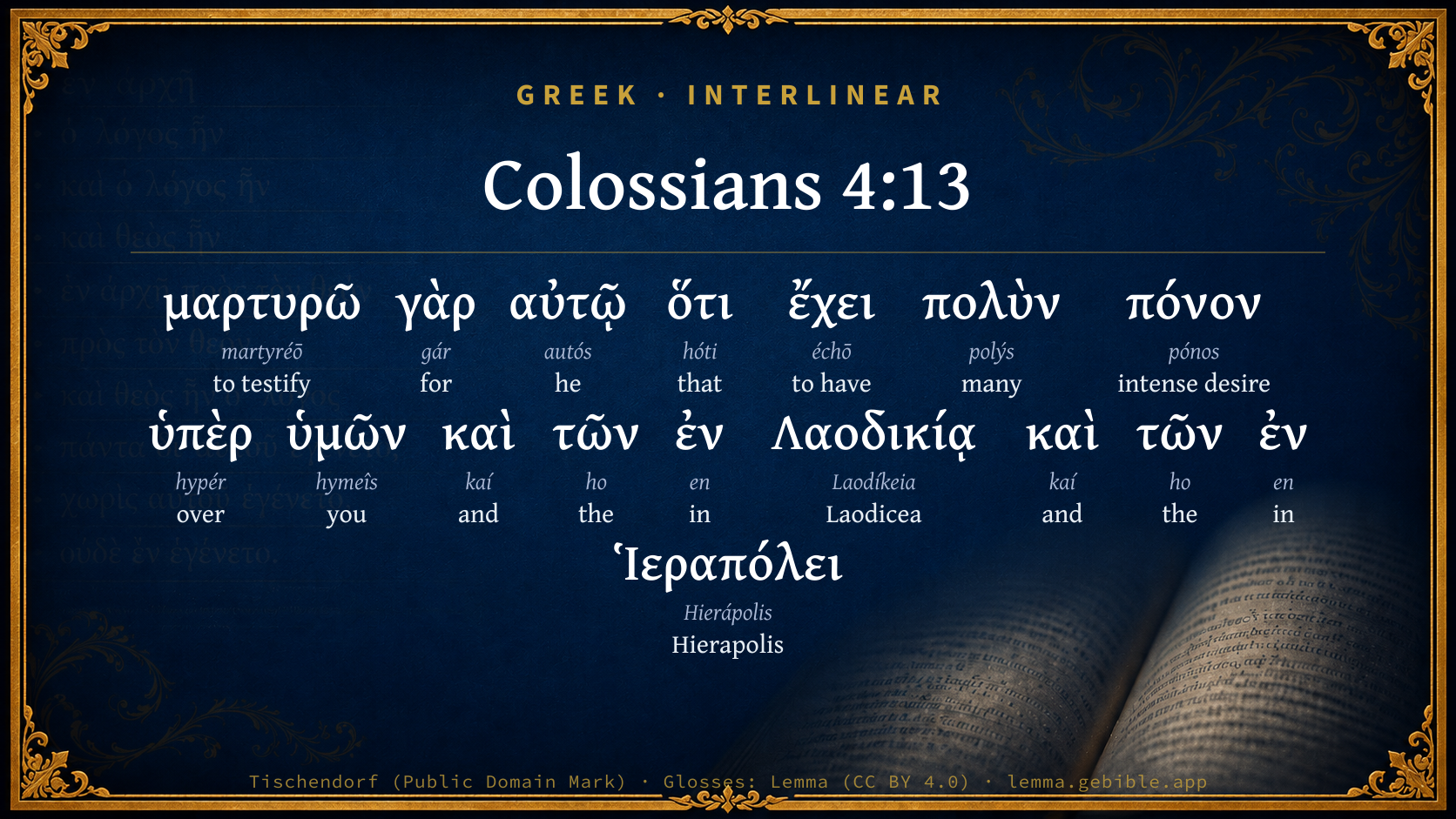
Greek (Tischendorf 8th ed.) Colossians 4:13 appears in the Greek New Testament. The text above is from the Tischendorf 8th edition. Each word links to its Strong’s number and a concise gloss. Click any word for its full Thayer’s Greek Lexicon entry.
Download image
Cite this verse

Colossians 4:13 (World English Bible). Public Domain. Lemma interlinear Bible study tool, https://lemma.gebible.app/v/colossians/4/13.

Show BibTeX & RIS
BibTeX
RIS
English Translation
For I testify about him, that he has great zeal for you, and for those in Laodicea, and for those in Hierapolis.
World English Bible · Public Domain
Highlights
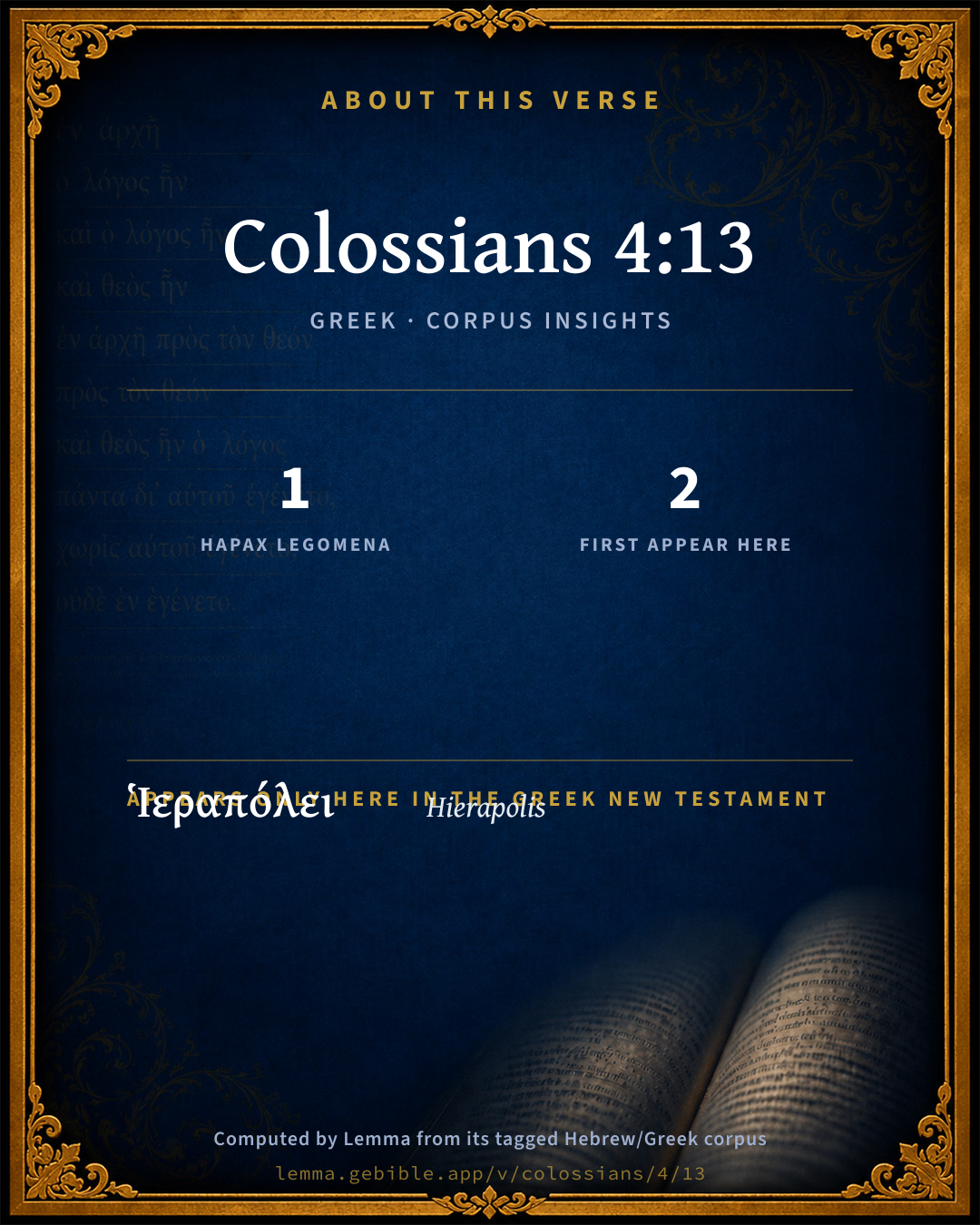
  • 1 hapax legomenon — only here in the Greek New Testament
  • 2 first appearances in the Greek New Testament
Full analysis ↓
Download a study sheet

One document with this verse’s original text, its word-by-word gloss line, the meaning frame, cross-references with their text, attributed commentary, and full source and license credits — printable, and it pastes into notes with its structure intact.

This verse Autodidact and up

Study sheet (.html) Plain text (.txt)

A passage Seminary Student

Up to 50 verses in one chapter. A passage sheet keeps up to 6 commentary sources and 12 cross-references per verse, in the order this page ranks them, and says so on the sheet whenever that leaves anything out. Ask for a single verse and you get the Autodidact verse sheet above.

Everything on this page stays free to read, with no account — the sheet is a download of what is already on screen, not access to it.

Want to remove ads? Support Godless Engineer
Compare translations 3

The same verse in 3 English versions, stacked beneath the original-language interlinear above. Click any original word for its lexicon entry.

Each is an independent rendering of the whole verse — the interlinear is not word-aligned to these translations.

Highlighted words mark where these versions differ — a whole-verse word diff, not a word-by-word alignment.

  • World English Bible Public Domain
    For I testify about him, that he has great zeal for you, and for those in Laodicea, and for those in Hierapolis.
  • King James Version Public Domain
    For I bear him record, that he hath a great zeal for you, and them that are in Laodicea, and them in Hierapolis.
  • unfoldingWord Literal Text CC BY-SA 4.0
    For I testify for him that he has much hard labor on behalf of you and of the ones in Laodicea and of the ones in Hierapolis.

unfoldingWord Literal Text — © unfoldingWord, licensed CC BY-SA 4.0. Word-aligned USFM3 via Door43 (git.door43.org/unfoldingWord/en_ult).

Versions to compare (up to 4)

3 of 4 selected

Show all 19 translations

Every available English version of this verse, each an independent rendering of the whole verse.

  • World English Bible Public Domain
    For I testify about him, that he has great zeal for you, and for those in Laodicea, and for those in Hierapolis.
  • Berean Standard Bible Public Domain
    For I testify about him that he goes to great pains for you and for those at Laodicea and Hierapolis.
  • Majority Standard Bible Public Domain
    For I testify about him that he has great zeal for you and for those at Laodicea and Hierapolis.
  • King James Version Public Domain
    For I bear him record, that he hath a great zeal for you, and them that are in Laodicea, and them in Hierapolis.
  • American Standard Version (1901) Public Domain
    For I bear him witness, that he hath much labor for you, and for them in Laodicea, and for them in Hierapolis.
  • Revised Version (1885) Public Domain
    For I bear him witness, that he hath much labour for you, and for them in Laodicea, and for them in Hierapolis.
  • Geneva Bible (1599) Public Domain
    For I beare him record, that he hath a great zeale for you, and for them of Laodicea, and them of Hierapolis.
  • Douay-Rheims (1899) Public Domain
    For I bear him testimony that he hath much labour for you, and for them that are at Laodicea, and them at Hierapolis.
  • Young's Literal Translation Public Domain
    for I do testify to him, that he hath much zeal for you, and those in Laodicea, and those in Hierapolis.
  • Literal Standard Version CC BY-SA 4.0
    for I testify to him that he has much zeal for you, and those in Laodicea, and those in Hierapolis.
  • Unlocked Literal Bible CC BY-SA 4.0
    For I bear witness of him, that he works hard for you, for those in Laodicea, and for those in Hierapolis.
  • unfoldingWord Literal Text CC BY-SA 4.0
    For I testify for him that he has much hard labor on behalf of you and of the ones in Laodicea and of the ones in Hierapolis.
  • Darby Bible Public Domain
    For I bear him witness that he labours much for you, and them in Laodicea, and them in Hierapolis.
  • World Messianic Bible Public Domain
    For I testify about him that he has great zeal for you, and for those in Laodicea, and for those in Hierapolis.
  • Webster's Bible Public Domain
    For I bear him testimony, that he hath a great zeal for you, and them that are in Laodicea, and them in Hierapolis.
  • Free Bible Version CC BY-SA 4.0
    For the record I can tell you that he's done a lot for you, and for those in Laodicea and Hierapolis as well.
  • Bible in Basic English Public Domain
    For I give witness of him that he has undergone much trouble for you and for those in Laodicea and in Hierapolis.
  • Text-Critical English NT CC BY 4.0
    For I testify about him that he has much zeal for you and for those in Laodicea and Hierapolis.
  • Tyndale New Testament (1534) Public Domain
    I beare him recorde that he hath a fervet mynde towarde you and towarde them of Laodicia and them of Hierapolis.

Literal Standard Version (2020), Covenant Press — licensed CC BY-SA 4.0. Text via the HelloAO Bible API (eBible.org). Unlocked Literal Bible (unfoldingWord) — licensed CC BY-SA 4.0. Text via the HelloAO Bible API (eBible.org). unfoldingWord Literal Text — © unfoldingWord, licensed CC BY-SA 4.0. Word-aligned USFM3 via Door43 (git.door43.org/unfoldingWord/en_ult). Free Bible Version, Dr. Jonathan Gallagher — licensed CC BY-SA 4.0. Text via the HelloAO Bible API (eBible.org).

Word by word

More ways to search: Search by grammar → Find every occurrence → Compare this word →

Practice this passage: Drill this verse → Learn its vocabulary →

Ἱεραπόλει
Hierápolis
G2404
“Hierapolis”
Noun, Dative, Singular, Feminine
Part of Speech
Noun
Case
Dative
Number
Singular
Gender
Feminine
Full Thayer's Definition

Origin: from G2413 and G4172

TDNT: None

Hierapolis = "holy city" 1. a city of Phrygia, situated above the junction of the rivers Lycus and Maeander, near Colosse and Laodicea
  1. μαρτυρῶ martyréō G3140 “to testify” Verb, Present, Active, Indicative, 1st person, Singular
  2. γὰρ gár G1063 “for” Conjunction
  3. αὐτῷ autós G846 “he” Personal pronoun, Dative, Singular, Masculine
  4. ὅτι hóti G3754 “that” Conjunction
  5. ἔχει échō G2192 “to have” Verb, Present, Active, Indicative, 3rd person, Singular
  6. πολὺν polýs G4183 “many” Adjective, Accusative, Singular, Masculine
  7. πόνον pónos G4192 “intense desire” Noun, Accusative, Singular, Masculine
  8. ὑπὲρ hypér G5228 “over” Preposition
  9. ὑμῶν hymeîs G5210 “you” Personal pronoun, 2nd person, Genitive, Plural
  10. καὶ kaí G2532 “and” Conjunction
  11. τῶν ho G3588 “the” Article, Genitive, Plural, Masculine
  12. ἐν en G1722 “in” Preposition
  13. Λαοδικίᾳ Laodíkeia G2993 “Laodicea” Noun, Dative, Singular, Feminine
  14. καὶ kaí G2532 “and” Conjunction
  15. τῶν ho G3588 “the” Article, Genitive, Plural, Masculine
  16. ἐν en G1722 “in” Preposition

About this verse

These counts appear in no published source. They are computed here, from the morphology-tagged text and Lemma’s own curated glosses. What Lemma adds →

17
words
14
distinct lemmas
Pauline Epistles
section

Notable vocabulary

1 hapax legomenon — a word that appears only here in the entire Greek New Testament:

  • Ἱεραπόλει Hierapolis G2404

First appearance in Scripture

These words make their first canonical appearance in the Greek New Testament here:

  • πόνον intense desire G4192
  • Ἱεραπόλει Hierapolis G2404

Shared distinctive vocabulary

πόνον intense desire G4192 occurs in 4 verses of the Greek New Testament. Also found in:
Repetition

Words recur within this verse:

Cross-references

6

Topical passages linked to Colossians 4:13 in the Treasury of Scripture Knowledge — connected by theme and wording, ordered by reader-vote popularity; previews shown in the World English Bible.

  • Colossians 2:1 For I desire to have you know how greatly I struggle for you, and for those at Laodicea, and for as many as have not seen my face in the flesh;
  • Romans 10:2 For I testify about them that they have a zeal for God, but not according to knowledge.
  • 2 Corinthians 8:3 For according to their power, I testify, yes and beyond their power, they gave of their own accord,
  • Colossians 4:15–16 Greet the brothers who are in Laodicea, and Nymphas, and the assembly that is in his house.
  • Revelation 1:11 saying, "What you see, write in a book and send to the seven assemblies: to Ephesus, Smyrna, Pergamum, Thyatira, Sardis, Philadelphia, and to Laodicea."
  • Revelation 3:14–18 "To the angel of the assembly in Laodicea write: "The Amen, the Faithful and True Witness, the Head of God's creation, says these things:

Cross-references courtesy of OpenBible.info (CC BY 4.0).

Where the printed editions differ

1 variant

Places in this verse where the major printed Greek editions disagree on the wording in a way that affects the translation — a comparison of editions, not a manuscript-by-manuscript collation. The editions are the modern critical texts (Nestlé-Aland 28/27, SBL, Westcott-Hort, Tregelles, Tyndale House) and the traditional texts behind the KJV (the Textus Receptus and the Byzantine/Majority text). It is not a claim about which reading is original.

  1. Different wording
    πόνον

    “labour”

    In NA28NA27TynSBLWHTreg Not in TRByz

    ζῆλον (zēlon) 'zeal' occurs in traditional manuscripts (TR+Byz) instead of πόνον (ponon) 'labour' in older manuscripts (NA28+NA27+Tyn+SBL+WH+Treg)

Textual data: Translators Amalgamated Greek New Testament (STEPBible TAGNT) · CC BY 4.0.

Commentary

Notes on Colossians 4:13 from classic Christian and Jewish commentators (each source and its license shown beneath its notes). The classic Christian expositions comment on the surrounding passage and are grouped to its opening verse, so a note may address several verses; the Jewish commentaries on the Tanakh (Rashi and others) are per-verse, so they appear only where the commentator wrote on this verse.

Lemma curates 59 commentaries, every one of them public domain or Creative Commons licensed, each selected and text-cleaned for this edition rather than reprinted as found. About our sources →

Tyndale Open Study Notes

Tyndale Open Resources

4:13 Laodicea and Hierapolis were the two most important cities in the Lycus River valley. The fact that Epaphras prayed for the believers in Colosse and in these nearby cities suggests that he was the pioneering evangelist in all three cities.

Tyndale Open Study Notes — © Tyndale Open Resources, licensed CC BY-SA 4.0. Text via the HelloAO Bible API.

Bengel's Gnomon

Johann Albrecht Bengel

Col 4:13. Γὰρ, for) The reason (ætiologia: see Append.) is properly in, he hath. The verb, I bear him record, is modal.[34]—ζῆλον, zeal) lest you should be seduced, ch. Col 2:4: comp. 2Co 11:2.

[34] Expression of feeling; opposed to categorical. See Append, on ‘modus,’ ‘modalis.’—ED.

Bengel's Gnomon of the New Testament — English translation (T&T Clark, Edinburgh, 1860) — public domain. Text from a community e-Sword module.

Meyer's Critical & Exegetical Commentary

Heinrich August Wilhelm Meyer

Col_4:13. General testimony in confirmation of the particular statement made regarding Epaphras in πάντοτε κ.τ.λ.; on which account there is the less reason to ascribe to the interpolator the more precise definition of ἀγωνιζ. ὑπ. ὑμ., which is given by ἐν ταῖς προσευχ. (Holtzmann). The γάρ is sufficiently clear and logical.

πολὺν πόνον (see the critical remarks); much toil, which is to be understood of the exertion of mental activityof earnest working with its cares, hopes, wishes, fears, temptations, dangers, and so forth. The word is purposely chosen, in keeping with the conception of the conflict (Col_4:12); for πόνος is formally used of the toil and trouble of conflict. See Herod, vi. 114, viii. 89; Plat. Phaedr. p. 247 B; Dem. 637. 18; Eur. Suppl. 317; Soph. Track. 21. 169; often so in Homer as Il. i. 467, and Nägelsbach in loc.; comp. Rev_21:4.

καὶ τῶν ἐν Λαοδ. κ. τ. ἐν Ἱεραπ.] Epaphras had certainly laboured in these adjoining towns, as in Colossae, which was probably his headquarters, as founder, or, at least, as an eminent teacher of the churches.

Meyer — Critical and Exegetical Commentary on the New Testament — English translation by Peter Christie, edited by Frederick Crombie (T&T Clark, 1880) — public domain. Text from a community e-Sword module.

Expositor's Greek Testament

ed. W. Robertson Nicoll

Col 4:13 . The anxiety of Epaphras for these Churches was probably due to his connexion with them, either as founder or teacher.

The Expositor's Greek Testament, edited by W. Robertson Nicoll (1897–1910) — public domain. Text from a community e-Sword module.

Jamieson, Fausset & Brown

Robert Jamieson, A. R. Fausset & David Brown

a great zeal--The oldest manuscripts and Vulgate have "much labor."

for you--lest you should be seduced (Col 2:4); a motive why you should be anxious for yourselves.

them that are in Laodicea . . . Hierapolis--churches probably founded by Epaphras, as the Church in Colosse was. Laodicea, called from Laodice, queen of Antiochus II, on the river Lycus, was, according to the subscription to First Timothy, "the chiefest city of Phrygia Pacatiana" (Ti1 6:21). All the three cities were destroyed by an earthquake in A.D. 62 [TACITUS, Annals, 14.27]. Hierapolis was six Roman miles north of Laodicea.

Jamieson, Fausset & Brown — Commentary Critical and Explanatory on the Whole Bible (1871) — public domain (CC PDM 1.0). Text via the HelloAO Bible API.

Adam Clarke's Commentary

Verse 13. He hath a great zeal for you] Instead of ζηλον πολυν, much zeal, ABCD**, several others, with versions and fathers, read πολυν πονον, much labour; they are here nearly of the same meaning, though the latter appears to be the better and genuine reading.

Laodicea, and-Hierapolis] These were both cities of Phrygia, between which Colosse, or the city of Colassa, was situated. See Col 2:1. The latter was called Hierapolis, or the holy city, from the multitude of its temples. Apollo, Diana, AEsculapius, and Hygeia, were all worshipped here, as appears by the coins of this city still extant.

Adam Clarke's Commentary on the Bible (1810–1826) — public domain. Text from a community e-Sword/MySword module.

Ellicott's Commentary for English Readers

(13) On the natural union of Laodicea and Hierapolis with Colossæ, partly local and historical, partly, no doubt, having reference to their conversion by the same instrumentality (of Epaphras), see Note on Col_2:1 and Introduction. Epaphras is said to have great “zeal” (properly, great labour) of anxiety—finding vent in the wrestling in prayer noted above—for all three cities, for which he evidently still felt himself responsible. In such responsibility, as in the charges of Timothy and Titus, we see the link between the apostolate of this period and the episcopacy of the future.

A Bible Commentary for English Readers, edited by Charles John Ellicott (1878–1897) — public domain. Text from a community e-Sword module.

The Cambridge Bible for Schools and Colleges

gen. ed. J. J. S. Perowne

13. zeal] Labour, R.V. (so Latin Versions; Wyclif, “traveil”), adopting a somewhat better supported reading, of which that represented in A.V. is probably a transcriber’s explanation.

Laodicea] See on Col_2:1; and Introd. p. 13.

Hierapolis] The third mission-station in the valley of the Lycus, looking across the river, southward, a distance of about six miles, to Laodicea. See Introd., ch. 1.

The Cambridge Bible for Schools and Colleges (gen. ed. J. J. S. Perowne; Cambridge University Press, 1878–1918) — public domain. Text from a community e-Sword module.

John Gill's Exposition

For I bear him record,.... The apostle was an eye and ear witness of his fervent prayers, his labour of love, and zealous affection for these saints and others; and therefore, as he judged he ought, he bears a testimony for him,

that he hath a great zeal for you; for their spiritual welfare, that the Gospel might continue with them, and they in that, against false teachers, and their attempts to subvert them; that they might grow in the grace of the Gospel, and walk worthy of it, and be at peace among themselves:

and them that are in Laodicea, and them in Hierapolis; cities in Phrygia, which lay near to Colosse, the one being situated by the river Lycus, and the other by the Maeander; here were many believers, for whom Epaphras had a like zeal and affections as for the Colossians, and to whom very likely he had been useful, either in conversion or edification, or both. The apostle takes no notice to the Colossians of Epaphras being his fellow prisoner, as, he does in his epistle to Plm 1:23 it may be for this reason, lest they should be over much distressed and cast down with it.

John Gill's Exposition of the Whole Bible (1746–1763) — public domain (CC PDM 1.0). Text via the HelloAO Bible API.

Trapp's Complete Commentary

John Trapp

13 For I bear him record, that he hath a great zeal for you, and them that are in Laodicea, and them in Hierapolis.

Ver. 13. And them that are in Laodicea] A minister must be like the sun, that shineth not only within its own orb, but illighteneth all round about it and within the reach of it.

John Trapp, A Commentary or Exposition upon All the Books of the Old and New Testament (1647–1656) — public domain. Text from a community e-Sword module.

Albert Barnes' Notes on the Bible

For I bear him record - Paul had had abundant opportunity to know what were his feelings in regard to these churches.

A great zeal for you - A great desire to promote your welfare.

And them that are in Laodicea - Laodicea was the capital of Phrygia, and not far from Colossae, There was a church there. See the Introduction, and the notes at Col 4:16.

And them in Hierapolis - This was also a city in Phrygia, and not far from Laodicea and Colossae. It was situated under a hill to the north, and had on the south a large plain about five miles over. On the south of that plain, and opposite to Hierapolis, was Laodicea, with the river Lycus running between them, nearer to Laodicea than to Hierapolls. This place is now called by the Turks Pambuck-Kulasi, or the Cotton-Tower, on account of the white cliffs which lie round about it. It is now utterly forsaken and desolate, but the ruins are so magnificent as to show that it was once one of the most splendid cities in the East. It was celebrated for the hot springs in its vicinity; and on account of the numerous temples erected there, it received the name of Hierapolis, or the holy city. The principal deity worshipped there was Apollo. See Travels by T. Smith. B. D. 1678. Compare the notes at Col 4:16. From the allusion to it here, it would seem that there were Christians there in the time of Paul, though there is no mention of a church there. It is nowhere else mentioned in the New Testament.

Albert Barnes' Notes on the Bible (1834–1885) — public domain. Text from a community e-Sword/MySword module.

Matthew Poole's English Annotations

For I bear him record, that he hath a great zeal for you; for, saith the apostle, though I am not privy to his secret prayers, yet I can bear him witness, and do give him mine own testimony, that he hath a most ardent and special affection for you Christians at Colosse.

And them that are in Laodicea, and them in Hierapolis; yea, and for those also in your neighbour cities; see the argumeut, and Col 2:1; viz. Laodicea, the last of the seven churches, to whom excellent epistles were written, recorded by John the divine, Rev 1:11; 3:14; and Hierapolis, or the holy city, about six miles distant from the former, say geographers.

Matthew Poole's English Annotations on the Holy Bible (1683–1685) — public domain. Text from a community e-Sword/MySword module.

Whedon's Commentary on the Bible

Daniel D. Whedon

13. Record—This testimony of the apostle was calculated to tenderly touch their hearts and move them to fidelity.

Laodicea—See on Col_2:1.

Hierapolis—Sacred city—so called from the multitude of its temples. It is a city of Phrygia, about six miles north of Laodicea, and about twenty northwest of Colosse. The three were all in the basin of the Maeander. The Church there was probably founded by Epaphras, and exposed to about the same influences with that at Colosse. The place was destroyed by an earthquake A.D. 62, at the same time with Laodicea, and afterward restored. Its modern name is Pambouk-Kalessi, “Cotton Castle,” so called from its beautiful calcareous deposits, that have the appearance of frozen cascades. Mr. Riggs, an American missionary, describes them as consisting of a “deposit of carbonate of lime, white as the driven snow, assuming, when closely examined, various forms, and covering nearly the whole southern and western declivities of the elevation on which Pambouk-Kalessi is built.”

Daniel D. Whedon (gen. ed.), Commentary on the Old and New Testaments (1874–1909) — public domain. Text from a community e-Sword module.

The Pulpit Commentary

For I hear witness to him that he hath much labour (ponon for zhlon, Revised Text) for you (Col_1:29 Col_2:1; Php_2:19-23; 1Th_5:12, 1Th_5:13; 1Co_16:15, 1Co_16:16) Ponov occurs in the New Testament besides only in Rev_16:10, 11 21:4, where it means "pain;" in classical Greek it implies "painful, distressful exertion". (comp. kopiw, Col_1:29) It indicates the deep anxiety of Epaphras for this beloved and endangered Church. There is nothing here to point to "outward toil" (Lightfoot), any more than in Col_2:1. The apostle loves to commend his fellow labourers (Col_1:7; Php_2:20-22, 25, 26; 2Co_8:16-23) And for those in Laodicea and those in Hierapolis. (vers. 15-17; Col_2:1) The Church in Hierapolis is added to that of Laodicea, singled out in Col_2:1 as a special object of the apostle"s concern (on these cities, see Introduction, Whether Epaphras were the official head of these Churches or not, he could not but be deeply concerned in their welfare. Ver. 17 indicates the existence of a personal link between the Churches of Colossus and of Laodicea.

The Pulpit Commentary (1880–1919), ed. H.D.M. Spence-Jones & Joseph S. Exell — public domain. Text from a community e-Sword module.

The People's New Testament

B. W. Johnson

13. Them that are in Laodicea. The sister city near at hand across the valley of the Lycus. Hierapolis. Another city close at hand, in which a church had been planted. Probably Epaphras planted it also.

B. W. Johnson's The People's New Testament with Notes (1889–1891) — public domain. Electronic text from the Christian Classics Ethereal Library (CCEL) ThML edition.

Cambridge Greek Testament for Schools and Colleges

13. πολὺν πὸνον אABCP Syrpal (ut vid.). πολὺν κόνον D*G. ζῆλον πολὺν Text. Rec. with KL, etc. Other readings are πολὺν ζῆλον Dbc; πολὺν πόθον 10. 31 al.; πολὺν ἀγῶνα 6. 67**. External evidence determines for the first, and ζῆλον would not have caused such variations.

13. μαρτυρῶ γὰρ αὐτῷ. The only parallels to this in St Paul’s Epistles are Rom 10:2, and Gal 4:15, in both of which passages the phrase contains something of the unexpected under the circumstances. Here there seems no apparent reason for so strong a phrase. Perhaps there was something about Epaphras with which we are not acquainted that made St Paul insist on the fact of his toil for them.

ὅτι ἔχει πολὺν πόνον. See notes on Textual Criticism.

πόνον ἔχειν occurs only here in the Greek Bible (contrast κοπιῶ ἀγωνιζόμενος, Col 1:29), but is used frequently of the toil of conflict from Homer downwards; cf. Il. VI. 525, οἷ ἔχουσι πολὺν πόνον εἵνεκα σεῖο. “In Pindar also of exertions in the games, N. 4. 1, I. 4. 79 (3. 65),” Lidd. and Scott. It carries on the figure of ἀγωνιζόμενος.

ὑπὲρ ὑμῶν (Col 4:12) καὶ τῶν ἐν Λαοδικίᾳ (Col 2:1) καὶ τῶν ἐν Ἱερᾷ Πόλει. On these two towns and their relation to Colossae see Introd. p. x. For the separation Ἱερᾷ Πόλει cf. Act 16:11. They are mentioned here because probably this letter would be read in both, as it certainly would be in one (Col 4:16). We have no knowledge of the relation in which Epaphras stood to Laodicea and Hierapolis, but probably he had taught in both, perhaps also he had founded both Churches. In any case as a native of Colossae he must have been interested in the two neighbouring towns.

Cambridge Greek Testament for Schools and Colleges (Cambridge University Press, 1896; 21 vols, various authors incl. Carr, Maclear, Plummer, Farrar, Lumby, Moule, M. R. James, Simcox) — public domain. Text from a community e-Sword module.

Alford’s Greek Testament

Henry Alford

13.] πόνος,—an unusual word in the N. T., hence the var. readd.,—is usual in the toil of conflict in war, thus answering to ἀγωνιζόμ. above: so Herod. vi. 114, ἐν τούτῳ τῷ πόνῳ ὁ πολέμαρχος Καλλίμαχος διαφθείρεται: similarly viii. 89. Plato, Phædr. 247 b, ἔνθα δὴ πόνος τε κ. ἀγὼν ἔσχατος ψυχῇ πρόκειται: Demosth. 637. 18, εἰ δʼ ἐκεῖνος ἀσθενέστερος ἦν τὸν ὑπὲρ τῆς νίκης ἐνεγκεῖν πόνον.

On account of this mention of Laodicea and Hierapolis, some have thought that Epaphras was the founder of the three churches. See Prolegg. § ii. 2, 7.

Λαοδικείᾳ] Laodicea was a city of Phrygia Magna (Strabo xii. 8, Plin. v. 29: according to the subscription (rec.) of 1 Tim., the chief city of Phrygia Pacatiana), large (ἡ τῆς χώρας ἀρετὴ κ. τῶν πολιτῶν τινες εὐτυχήσαντες, μεγάλην ἐποιήσαντο αὐτήν, Strabo) and rich (Rev 3:17; and Prolegg. to Rev. § iii. 13. Tac. Ann. xiv. 27: ‘Laodicea, tremore terræ prolapsa, nullo a nobis remedio, propriis opibus revaluit:’ δυνατωτέρα τῶν ἐπὶ θαλάττῃ, Philostr. Soph. i. 25), on the river Lycus (hence called Λ. ἡ ἐπὶ Λύκῳ or πρὸς τῷ Λύκῳ, see Strabo, ib.), formerly called Diospolis, and afterwards Rhoas; its subsequent name was from Laodice queen of Antiochus II. (Steph. Byz.) In a.d. 62, Laodicea, with Hierapolis and Colossæ, was destroyed by an earthquake (Tacit. l. c.), to which visitations the neighbourhood was very subject (εἰ γάρ τις ἄλλη κ. ἡ Λαοδίκεια εὔσειστος, κ. τῆς πλησιοχώρου πλέον, Plin. ib.). There is now on the spot a desolate village called Eski-hissar, with some ancient ruins (Arundel, Seven Churches). Winer, Realw.

Ἱεραπόλει] Six Roman miles north from Laodicea: famed for many mineral springs (Strabo, xiii. 4, describes them at length, also the caverns which exhale noxious vapour. See also Plin. ii. 95), which are still flowing (Schubert, i. 283). Winer, Realw.

Henry Alford, The Greek Testament (1849–1861) — public domain. Text from a community e-Sword module.

Vincent's Word Studies in the New Testament

Marvin R. Vincent

Zeal [ζηλον] . Read ponon labor, which occurs elsewhere only in Rev 16:10, 11; Rev 21:4, in the sense of pain. Ponov labor is from the root of penomai to work for one's daily bread, and thence to be poor. Ponov toil, penhv one who works for his daily bread, and ponhrov wicked, have a common root. See on wickedness, Mr 7:22. In their original conceptions, kopov labor (1Co 14:58; 2Co 6:5) emphasizes the fatigue of labor : mocqov hard labor (2Co 11:27; 1Th 2:9), the hardship : ponov the effort, but ponov has passed, in the New Testament, in every instance but this, into the meaning of pain. Hierapolis. The cities are named in geographical order. Laodicaea and Hierapolis faced each other on the north and south sides of the Lycus valley, about six miles apart. Colossae was ten or twelve miles farther up the stream. Hierapolis owed its celebrity to its warm mineral springs, its baths, and its trade in dyed wools. It was a center of the worship of the Phrygian goddess Cybele, 207 whose rites were administered by mutilated priests known as Galli, and of other rites representing different oriental cults. Hence the name Hierapolis or sacred city.

Marvin R. Vincent, Word Studies in the New Testament (1887–1900) — public domain. Text from a community e-Sword/MySword module.

Lightfoot's Colossians and Philemon

J. B. Lightfoot

πεπληροφορημένοι] ‘fully persuaded’. The verb πληροφορεῖν has several senses. (1) ‘To fulfil, accomplish’; 2 Tim. iv. 5 τὴν διακονίαν σου πληροφόρησον, ib. ver. 17 τὸ κήρυγμα πληροφορηθῇ, Clem. Hom. xix. 24 πεπληροφορημένον νῦν ἤδη τριῶν ἡμερῶν. So perhaps Hermas Sim. 2 πληροφοροῦσι τὸν πλοῦτον αὐτῶν ... πληροφοροῦσι τὰς ψυχὰς αὐτῶν, though it is a little difficult to carry the same sense into the latter clause, where the word seems to signify rather ‘to satisfy’. (2)‘To persuade fully, to convince’; Rom. iv. 21 πληροφορηθὲις ὅτι ὃ ἐπήγγελται δυνατός ἐστιν καὶ ποιῆσαι, xiv. 5 ἐν τῷ ἰδίῳ νοὶ πληροφορέισθω, Clem. Rom. 42 πληροφορηθέυτες διὰ τῆς ἀναστάσεως κ.τ.λ., Ign. Magn. 8 εἰς τὸ πληροφορηθῆναι τοὺς ἀπειθοῦντας, ib. 11 πεπληροφορῆσθαι ἐν τῇ γεννὴσει κ.τ.λ., Philad. inscr. ἐν τῇ ἀναστάσει αὐτοῦ πεπληροφορημένη ἐν παντὶ ἐλέει, Smyrn. 1 πεπληροφορημένους εἰς τὸν Κύριον ἡμῶν, Mart. Ign. 7 πληροφορῆσαι τοὺς ἀσθενεῖς ἡμᾶς ἐπὶ τοῖς προγεγονόσιν, Clem. Hom. Ep. ad Iac. 10 πεπληροφορημένος ὅτι ἐκ Θεοῦ δικαίου, ib. xix. 24 συνετιθέμην ὡς πληροφορούμενος. So too LXX Eccles. viii. 11 ἐπληροφορήθη καρδία τοῦ ποιῆσαι τὸ πονηρόν. (3) ‘To fill’; Rom. xv. 13 πληροφορήσαι ὑμᾶς πάσης χαρᾶς (a doubtful v. l.), Clem. Rom. 54 τίς πεπληροφορημένος ἀγάπης; Test. xii Patr. Dan 2 τῇ πλεονεξίᾳ ἐπληροφορήθην τῆς ἀναιρέσεως αὐτοῦ, where it means ‘I was filled with’, i.e. ‘I was fully bent on’, a sense closely allied to the last. From this account it will be seen that there is in the usage of the word no justification for translating it ‘most surely believed’ in Luke i. 1 τῶν πεπληροφορημένων ἐν ἡμῖν πραγμάτων, and it should therefore be rendered ‘fulfilled, accomplished’. The word is almost exclusively biblical and ecclesiastical; and it seems clear that the passage from Ctesias in Photius (Bibl. 72) πολλοῖς λόγοις καὶ ὅρκοις πληροφορήσαντες Μεγάβυζον is not quoted with verbal exactness. In Isocr. Trapez. § 8 the word is now expunged from the text on the authority of the MSS. For the substantive πληροφορία see the note on ii. 2 above. The reading of the received text here, πεπληρωμένοι, must be rejected as of inferior authority.

ἐν παντὶ κ.τ.λ.] ‘in every thing willed by God’; comp. 1 Kings ix. 11. So the plural τὰ θελήματα in Acts xiii. 22, Ephes. ii. 3, and several times in the LXX. The words are best connected directly with πεπληροφορημένοι. The passages quoted in the last note amply illustrate this construction. The preposition may denote (1) The abode of the conviction, as Rom. xiv. 5 ἐν τῷ ἰδίῳ νοΐ; or (2) The object of the conviction, as Ign. Magn. II ἐν τῇ γεννήσει, Philad. inscr. ἐν τῇ ἀναστάσει; or (3) The atmosphere, the surroundings, of the conviction, as Philad. inscr. ἐν παντὶ )ελέει. This last seems to be its sense here. The connexion σταθῆτε ... ἐν, though legitimate in itself (Rom. v. 2, 1 Cor. xv. 1), is not favoured by the order of the words here.

13. πολὺν πόνον] ‘much toil’, both inward and outward, though from the connexion the former notion seems to predominate, as in ἀγῶνα ii. 1; comp. Plat. Phædr. p. 247 B πόνος τε καὶ ἀγὼν ἔσχατος ψυχῇ πρόκειται. Of the two variations which transcribers have substituted for the correct reading, ζῆλον emphasizes the former idea and κόπον the latter. The true reading is more expressive than either. The word πόνος however is very rare in the New Testament (occurring only Rev. xvi. 10, 11, xxi. 4, besides this passage), and was therefore liable to be changed.

καὶ τῶν κ.τ.λ.] The neighbouring cities are taken in their geographical order, commencing from Colossæ; see above, p. 2. Epaphras, though a Colossian, may have been the evangelist of the two larger cities also.

J. B. Lightfoot, St Paul's Epistles to the Colossians and Philemon: a revised text with introductions, notes and dissertations (London: Macmillan, 1875) — public domain. Electronic text from Project Gutenberg (ebook #50857). Covers Colossians and Philemon only (the verse-by-verse notes; introductions and dissertations are omitted); Lightfoot's companion Galatians and Philippians volumes are not included, as the available public-domain scans carry garbled Greek that cannot be faithfully reproduced.

Lesson kit

Teaching starters — assembled from the data on this page, not authored interpretation. Every prompt links to the verse data it draws on. Edit before teaching.

Colossians, in the Pauline Epistles, opens this verse with 17 words (14 distinct Greek lemmas). Its most distinctive word is Hierápolis (“Hierapolis”). A historical commentator’s framing appears above. Read the whole chapter for the surrounding context.

Discussion questions

  1. The word Hierápolis carries the sense “Hierapolis.” How does it shape the verse?
  2. This verse holds 1 word here found nowhere else in the Greek New Testament. What might the rare word draw attention to?
  3. 2 words here appear for the first time in Scripture. What is being introduced at this debut?
  4. Revelation 16:10 shares the word «intense desire» with this verse. How do the two illuminate each other?
  5. “and” occurs 2× in this one verse. What is the effect of the repetition?
  6. These translations render this verse differently. What is at stake in choosing one wording over another?
  7. Reading how Tyndale Open Study Notes and Bengel's Gnomon read this verse, where do the two commentators agree and where do they part?

Things to notice

  • 1 word in this verse appears nowhere else in the Greek New Testament.
  • 2 words make their first canonical appearance in Scripture here.
  • These translations choose different wording for 12 words in this verse.
  • “and” occurs 2× in this single verse.
  • 14 distinct Greek lemmas span 17 words in this verse.

Reading settings

Reading text

Shown beneath each verse's original-language words.

Old Testament
Old Testament edition

Read the OT as the Masoretic Hebrew (MT) or the Greek Septuagint (LXX).

English shown for the Greek Septuagint (in the Hebrew ↔ Greek comparison).

Comparing translations? Open the Compare panel on any verse page to stack up to four side by side.