Ephesians 1:16

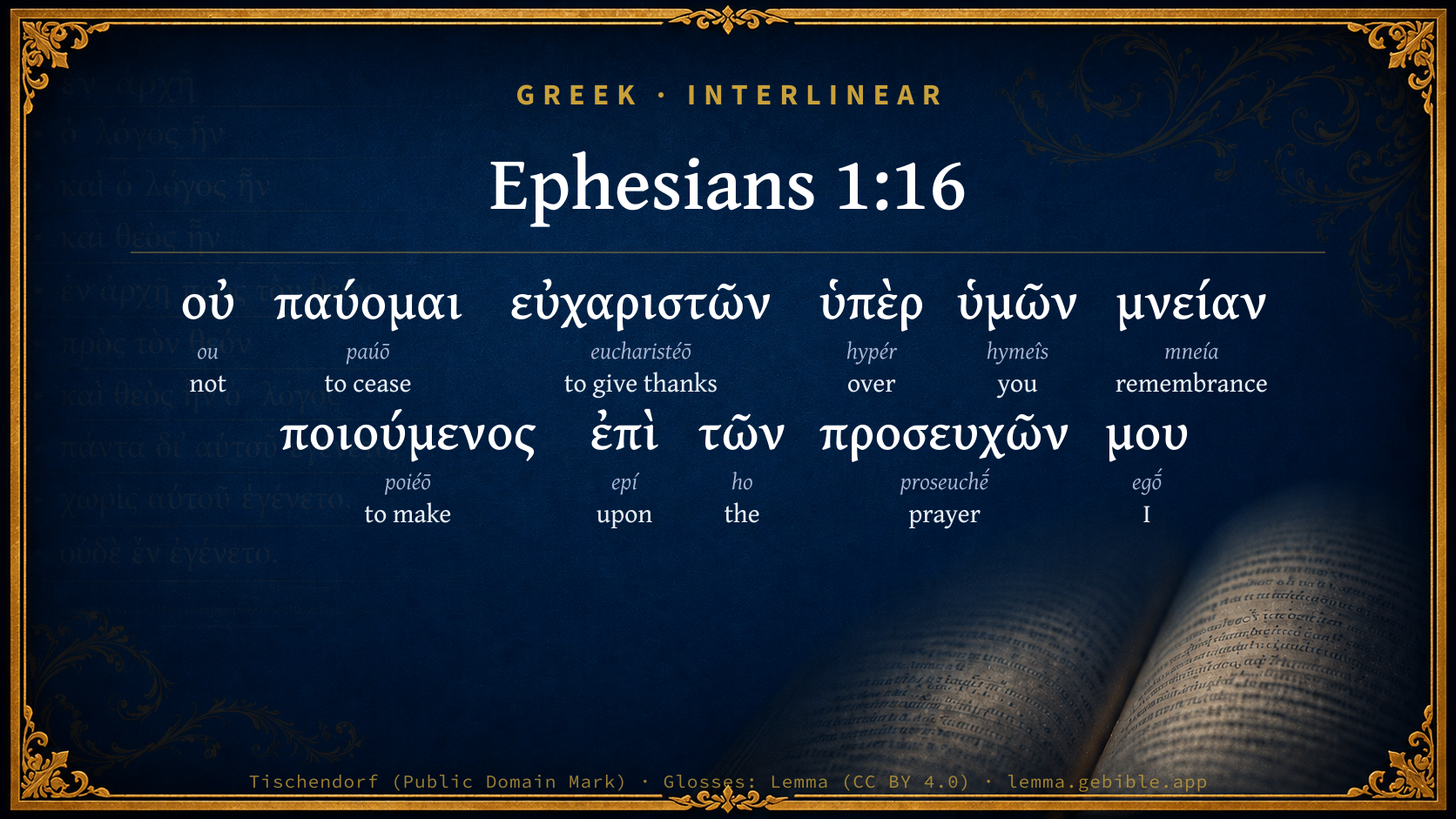
Greek (Tischendorf 8th ed.) Ephesians 1:16 appears in the Greek New Testament. The text above is from the Tischendorf 8th edition. Each word links to its Strong’s number and a concise gloss. Click any word for its full Thayer’s Greek Lexicon entry.
Download image
Cite this verse

Ephesians 1:16 (World English Bible). Public Domain. Lemma interlinear Bible study tool, https://lemma.gebible.app/v/ephesians/1/16.

Show BibTeX & RIS
BibTeX
RIS
English Translation
don't cease to give thanks for you, making mention of you in my prayers,
World English Bible · Public Domain
Download a study sheet

One document with this verse’s original text, its word-by-word gloss line, the meaning frame, cross-references with their text, attributed commentary, and full source and license credits — printable, and it pastes into notes with its structure intact.

This verse Autodidact and up

Study sheet (.html) Plain text (.txt)

A passage Seminary Student

Up to 50 verses in one chapter. A passage sheet keeps up to 6 commentary sources and 12 cross-references per verse, in the order this page ranks them, and says so on the sheet whenever that leaves anything out. Ask for a single verse and you get the Autodidact verse sheet above.

Everything on this page stays free to read, with no account — the sheet is a download of what is already on screen, not access to it.

Want to remove ads? Support Godless Engineer
Compare translations 3

The same verse in 3 English versions, stacked beneath the original-language interlinear above. Click any original word for its lexicon entry.

Each is an independent rendering of the whole verse — the interlinear is not word-aligned to these translations.

Highlighted words mark where these versions differ — a whole-verse word diff, not a word-by-word alignment.

  • World English Bible Public Domain
    don't cease to give thanks for you, making mention of you in my prayers,
  • King James Version Public Domain
    Cease not to give thanks for you, making mention of you in my prayers;
  • unfoldingWord Literal Text CC BY-SA 4.0
    I have not stopped giving thanks for you, making mention in my prayers,

unfoldingWord Literal Text — © unfoldingWord, licensed CC BY-SA 4.0. Word-aligned USFM3 via Door43 (git.door43.org/unfoldingWord/en_ult).

Versions to compare (up to 4)

3 of 4 selected

Show all 19 translations

Every available English version of this verse, each an independent rendering of the whole verse.

  • World English Bible Public Domain
    don't cease to give thanks for you, making mention of you in my prayers,
  • Berean Standard Bible Public Domain
    I have not stopped giving thanks for you, remembering you in my prayers,
  • Majority Standard Bible Public Domain
    I have not stopped giving thanks for you, remembering you in my prayers,
  • King James Version Public Domain
    Cease not to give thanks for you, making mention of you in my prayers;
  • American Standard Version (1901) Public Domain
    cease not to give thanks for you, making mention `of you' in my prayers;
  • Revised Version (1885) Public Domain
    cease not to give thanks for you, making mention of you in my prayers;
  • Geneva Bible (1599) Public Domain
    I cease not to giue thankes for you, making mention of you in my prayers,
  • Douay-Rheims (1899) Public Domain
    Cease not to give thanks for you, making commemoration of you in my prayers,
  • Young's Literal Translation Public Domain
    do not cease giving thanks for you, making mention of you in my prayers,
  • Literal Standard Version CC BY-SA 4.0
    do not cease giving thanks for you, making mention of you in my prayers,
  • Unlocked Literal Bible CC BY-SA 4.0
    I have not stopped thanking God for you as I mention you in my prayers.
  • unfoldingWord Literal Text CC BY-SA 4.0
    I have not stopped giving thanks for you, making mention in my prayers,
  • Darby Bible Public Domain
    do not cease giving thanks for you, making mention [of you] at my prayers,
  • World Messianic Bible Public Domain
    don’t cease to give thanks for you, making mention of you in my prayers,
  • Webster's Bible Public Domain
    Cease not to give thanks for you, making mention of you in my prayers;
  • Free Bible Version CC BY-SA 4.0
    why I never stop thanking God for you and remember you in my prayers.
  • Bible in Basic English Public Domain
    Give praise without end for you, keeping you in mind in my prayers;
  • Text-Critical English NT CC BY 4.0
    I have not ceased giving thanks for you as I remember you in my prayers.
  • Tyndale New Testament (1534) Public Domain
    cease not to geve thankes for you makynge mencion of you in my prayers

Literal Standard Version (2020), Covenant Press — licensed CC BY-SA 4.0. Text via the HelloAO Bible API (eBible.org). Unlocked Literal Bible (unfoldingWord) — licensed CC BY-SA 4.0. Text via the HelloAO Bible API (eBible.org). unfoldingWord Literal Text — © unfoldingWord, licensed CC BY-SA 4.0. Word-aligned USFM3 via Door43 (git.door43.org/unfoldingWord/en_ult). Free Bible Version, Dr. Jonathan Gallagher — licensed CC BY-SA 4.0. Text via the HelloAO Bible API (eBible.org).

Word by word

More ways to search: Search by grammar → Find every occurrence → Compare this word →

Practice this passage: Drill this verse → Learn its vocabulary →

About this verse

These counts appear in no published source. They are computed here, from the morphology-tagged text and Lemma’s own curated glosses. What Lemma adds →

11
words
11
distinct lemmas
Pauline Epistles
section

Notable vocabulary

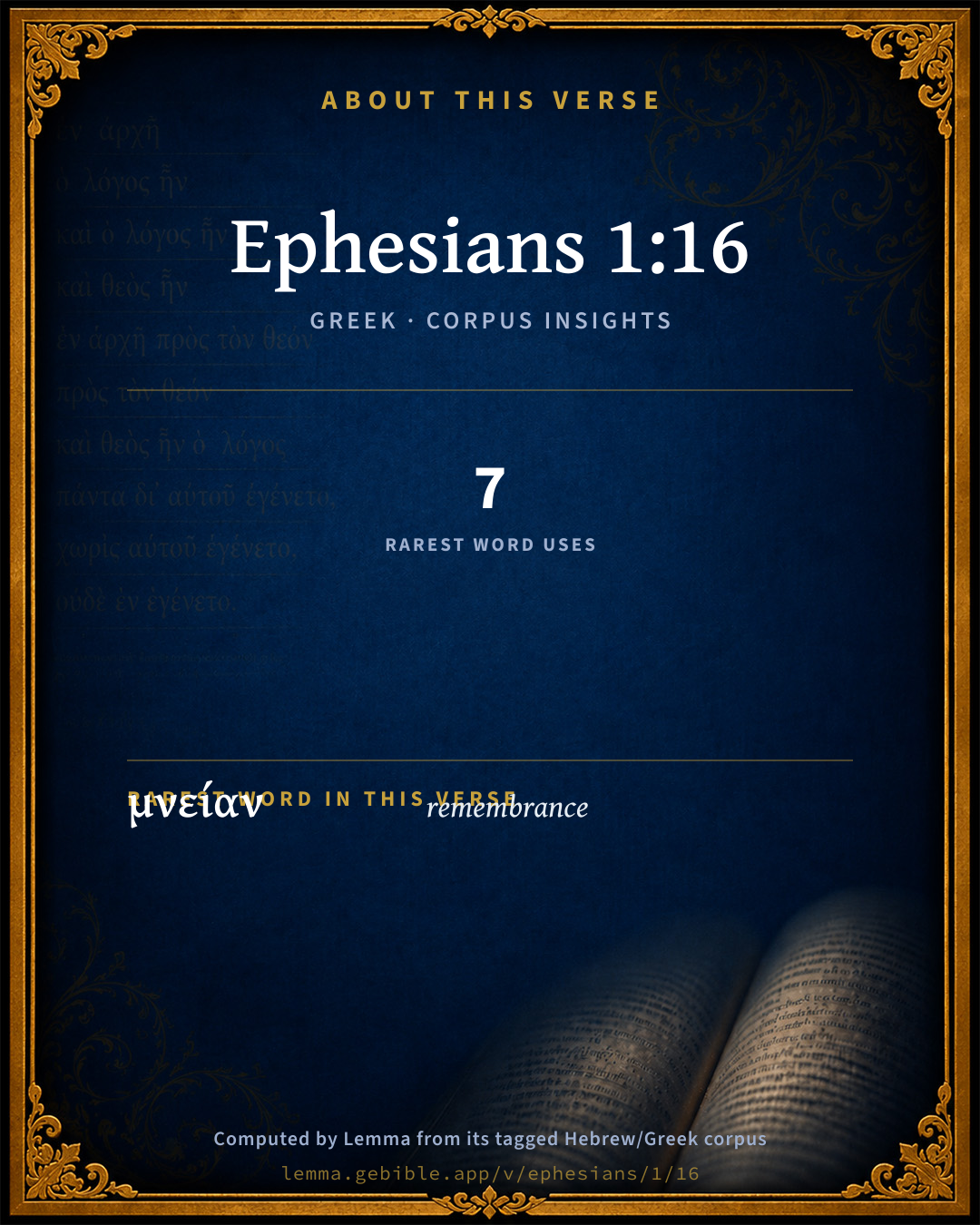
The rarest word here is μνείαν remembrance G3417 — appearing just 7 times in the whole Greek New Testament.

Shared distinctive vocabulary

μνείαν remembrance G3417 occurs in 7 verses of the Greek New Testament. Also found in:

Cross-references

11

Topical passages linked to Ephesians 1:16 in the Treasury of Scripture Knowledge — connected by theme and wording, ordered by reader-vote popularity; previews shown in the World English Bible.

  • Romans 1:8–9 First, I thank my God through Jesus Christ for all of you, that your faith is proclaimed throughout the whole world.
  • Colossians 1:9 For this cause, we also, since the day we heard this, don't cease praying and making requests for you, that you may be filled with the knowledge of his will in all spiritual wisdom and understanding,
  • Colossians 1:3 We give thanks to God the Father of our Lord Jesus Christ, praying always for you,
  • 2 Thessalonians 1:3 We are bound to always give thanks to God for you, brothers, even as it is appropriate, because your faith grows exceedingly, and the love of each and every one of you towards one another abounds;
  • 1 Samuel 12:23 Moreover as for me, far be it from me that I should sin against Yahweh in ceasing to pray for you: but I will instruct you in the good and the right way.
  • Philippians 1:3–4 I thank my God whenever I remember you,
  • 1 Samuel 7:8 The children of Israel said to Samuel, "Don't cease to cry to Yahweh our God for us, that he will save us out of the hand of the Philistines."
  • Isaiah 62:6 I have set watchmen on your walls, Jerusalem; they shall never hold their peace day nor night: you who call on Yahweh, take no rest,
  • 1 Thessalonians 1:2 We always give thanks to God for all of you, mentioning you in our prayers,
  • 1 Thessalonians 5:17 Pray without ceasing.
  • Genesis 40:14 But remember me when it will be well with you, and show kindness, please, to me, and make mention of me to Pharaoh, and bring me out of this house.

Cross-references courtesy of OpenBible.info (CC BY 4.0).

Commentary

Notes on Ephesians 1:16 from classic Christian and Jewish commentators (each source and its license shown beneath its notes). The classic Christian expositions comment on the surrounding passage and are grouped to its opening verse, so a note may address several verses; the Jewish commentaries on the Tanakh (Rashi and others) are per-verse, so they appear only where the commentator wrote on this verse.

Lemma curates 59 commentaries, every one of them public domain or Creative Commons licensed, each selected and text-cleaned for this edition rather than reprinted as found. About our sources →

Bengel's Gnomon

Johann Albrecht Bengel

Eph 1:16. Οὐ παύομαι, I do not cease) Paul made mention of all the churches in his prayers; Col 1:9.

Bengel's Gnomon of the New Testament — English translation (T&T Clark, Edinburgh, 1860) — public domain. Text from a community e-Sword module.

Meyer's Critical & Exegetical Commentary

Heinrich August Wilhelm Meyer

Eph_1:16. Οὐ πσύομαι] a popular form of hyperbole. My thanksgivingso full and urgent is itcan find no end. Comp. 1Th_1:2; Luk_2:37; Herod, vii. 107: τοῦτον δὲ αἰνέων οὐκ ἐπαύετο.

εὐχαριστῶν ὑπὲρ ὑμῶν] to give thanks on your account. On the participle, see Herm. ad Viger. p. 771; Bernhardy, p. 477; and on ὑπέρ (super vobis), comp. Eph_5:20; Rom_1:8, Elz.; 1Ti_2:1.

μνείαν ποιούμενος ἐπὶ τῶν προσευχ. μου] accompanying definition to εὐχαριστῶν: while I make mention in my prayers. Comp. Rom_1:9; 1Th_1:2; Php_1:3; Phm_1:4. What Paul makes mention of is learned from the context, which furnishes not merely ὑμῶν (Elz.; see the critical remarks), but a more precise definition, namely: of what he has heard concerning the faith and love of the readers, and for which he gives thanks on their account. This μνείαν ποιούμενος κ.τ.λ., however, is not superfluous, and after εὐχαρ. ὑπὲρ ὑμ. self-evident; but it serves, through the close joining on to it of the following ἵνα κ. τ. λ. (after Eph_1:16 only a comma is to be placed), as a means of leading over from the thanksgiving to the intercession connected with it, and is thereby accounted for.

ἐπί] of the prevailing relations and circumstances, in or under which anything takes place. See on Rom_1:10.

Meyer — Critical and Exegetical Commentary on the New Testament — English translation by Peter Christie, edited by Frederick Crombie (T&T Clark, 1880) — public domain. Text from a community e-Sword module.

Expositor's Greek Testament

ed. W. Robertson Nicoll

Eph 1:16 . οὐ παύομαι εὐχαριστῶν ὑπὲρ ὑμῶν : cease not to give thanks for you . The παύομαι is most naturally connected with the nearer participle. There is no reason why the remoter participle should be made the leading term, as some construe it, rendering it so “I cease not, while giving thanks for you, to make mention,” etc. (Abbott). The verb εὐχαριστεῖν , which is used in later Greek both in the sense of feeling thankful and in that of giving thanks , occurs in none of the NT Epistles except in that bearing Paul’s name. In these it is found some twenty-six times. It also appears once in Revelation, twice in Acts, and more frequently in the Gospels. μνείαν ὑμῶν ποιούμενος : making mention of you . Documentary evidence is against the insertion of ὑμῶν . Though it is supported by considerable authorities ( [88] [89] [90] [91] , Vulg., Syr., Boh., Orig., etc.), it has no place in [92] [93] [94] [95] 1 , etc., and is omitted by LTTrWH and the Revisers. The subject of the μνεία , therefore, must be understood. It may be ὑμῶν , or it may rather be the preceding πίστιν and ἀγάπην . In the phrase μνείαν ποιεῖσθαι the noun seems to have the sense of mention . In other connections it has the sense of mindfulness ( μνείαν ἔχειν τινός , 1Th 3:6 ) or that of remembrance (Phi 1:3 ). ἐπὶ τῶν προσευχῶν μου : in my prayers , On ἐπί as here = in see Blass, Gram. of N. T. Greek , p. 137; Win.-Moult., p. 470; Bernh., Synt. , p. 246. The local reference proper to ἐπί (as the preposition answering the question Where?), however, is not wholly sunk in the temporal sense. See Ell. on 1Th 1:2 . Winer takes it to express the idea of something attaching itself to something else. The word for prayer used here is one of frequent occurrence in the NT, sometimes joined with δέησις ( e.g. , Eph 6:18 ; Phi 4:6 , etc.), and sometimes with ἔντευξις as well (1Ti 2:1 ). The most general term is προσευχή = precatio , and that term is not used but of prayer to God . Δέησις , which can be used also of addresses to men, has the more definite sense of petitio, rogatio ; while ἔντευξις , which means a falling in with, conference, conversation , and goes beyond the idea of intercession (as our AV renders it), expresses prayer as the converse of the soul with God, with the notion of urgency and filial confidence. See Huther and Ell. on 1Ti 2:1 ; Win.-Moult., sub δέησις ; Light. on Phi 4:6 ; Trench, Syn., sub voce.

[88] Codex Claromontanus (sæc. vi.), a Græco-Latin MS. at Paris, edited by Tischendorf in 1852.

[89] Codex Mosquensis (sæc. ix.), edited by Matthæi in 1782.

[90] Codex Angelicus (sæc. ix.), at Rome, collated by Tischendorf and others.

[91] Codex Porphyrianus (sæc. ix.), at St. Petersburg, collated by Tischendorf. Its text is deficient for chap. Eph 2:13-16 .

[92] Codex Sinaiticus (sæc. iv.), now at St. Petersburg, published in facsimile type by its discoverer, Tischendorf, in 1862.

[93] Codex Vaticanus (sæc. iv.), published in photographic facsimile in 1889 under the care of the Abbate Cozza-Luzi.

[94] Codex Alexandrinus (sæc. v.), at the British Museum, published in photographic facsimile by Sir E. M. Thompson (1879).

[95] Codex Claromontanus (sæc. vi.), a Græco-Latin MS. at Paris, edited by Tischendorf in 1852.

The Expositor's Greek Testament, edited by W. Robertson Nicoll (1897–1910) — public domain. Text from a community e-Sword module.

Hodge's Commentary on Romans, Ephesians & First Corinthians

Charles Hodge

Eph_1:16

I cease not giving thanks for you, making mention of you, etc. This does not mean, praying I give thanks; but two things are mentioned constant thanksgiving on their account, and intercession.

Charles Hodge — Commentary on Romans (1835), First Corinthians (1857), and Ephesians (1856) — public domain. Text from a community e-Sword module.

Jamieson, Fausset & Brown

Robert Jamieson, A. R. Fausset & David Brown

(Col 1:9).

of you--omitted in the oldest manuscripts. Then the translation may be as English Version still, or as ALFORD, "making mention of them" (your "faith and love").

Jamieson, Fausset & Brown — Commentary Critical and Explanatory on the Whole Bible (1871) — public domain (CC PDM 1.0). Text via the HelloAO Bible API.

Adam Clarke's Commentary

Verse 16. Cease not to give thanks] The apostle intimates, so fully satisfied was he of the genuineness of their conversion, and of their steadiness since their conversion, that it was to him a continual cause of thanksgiving to God, who had brought them into that state of salvation; and of prayer, that they might be preserved blameless to the end.

Making mention of you] While praying for the prosperity of the Christian cause generally, he was led, from his particular affection for them, to mention them by name before God.

Adam Clarke's Commentary on the Bible (1810–1826) — public domain. Text from a community e-Sword/MySword module.

John Calvin's Commentaries

16. Making mention of you. To thanksgiving, as his custom is, he adds prayer, in order to excite them to additional progress. It was necessary that the Ephesians should understand that they had entered upon the proper course. But it was equally necessary that they should not turn aside to any new scheme of doctrine, or become indifferent about proceeding farther; for nothing is more dangerous than to be satisfied with that measure of spiritual benefits which has been already obtained. Whatever, then, may be the height of our attainments, let them be always accompanied by the desire of something higher.

John Calvin's Commentaries (1540-1563) — public domain. Text from the Calvin Translation Society English edition (1840s-50s) via the Christian Classics Ethereal Library (ccel.org). Calvin's coverage is partial (roughly two-thirds of the Bible); uncommented books and verses are honest gaps, never fabricated. The 19th-century editor's footnotes and remarks are omitted so the notes are faithfully Calvin's own voice.

Ellicott's Commentary for English Readers

(16) Cease not to give thanks for you, making mention of you in my prayers.—Almost all St. Paul’s Epistles are introduced by this union of thanksgiving and prayer, which is, indeed, characteristic of the right harmony of all Christian worship. (See Rom_1:8-9; Php_1:3-4; Col_1:3-4; 1Th_1:2-3; 2Ti_1:3; Phm_1:4.) In the Galatian Epistle the omission of both is characteristic; in the two Epistles to the Corinthians thanksgiving alone is explicit, though prayer may be implied. But the proportion of the two elements varies. Here the thanksgiving has already been offered, although in the widest generality. Accordingly all that follows is prayer. In the parallel Colossian Epistle (Col_1:3-13), which has no corresponding preface of thanksgiving, both elements are co-ordinate, with perhaps a slight predominance of thanksgiving.

A Bible Commentary for English Readers, edited by Charles John Ellicott (1878–1897) — public domain. Text from a community e-Sword module.

The Cambridge Bible for Schools and Colleges

gen. ed. J. J. S. Perowne

16. cease not, &c.] For similar thanksgivings cp. Rom_1:8; 1Co_1:4; Php_1:3; Col_1:3; 1Th_1:2; 1Th_2:13; 2Th_1:3; 2Th_2:13; Phm_1:4. The thanks were literally “unceasing” in principle, and, in practice, came out on every fit occasion.

making mention of you] For parallels, see the contexts of the passages just quoted, and 2Ti_1:3. The phrase implies the expression of individual remembrance. It might be literally “by name,” or not. How much of the Apostle’s work for his converts consisted in the holy labour of special intercessory prayer, with thanksgiving! In his Roman lodging this was the case, perhaps, even more than ever.

The recorded prayers of St Paul form in themselves one of the richest of Scripture studies. Most observable in them is their almost invariable intercessory direction. He thinks of others, not of self, upon his knees.—On that which now follows Bengel remarks, “Argumentum precum pro veris Christianis,” “heads of prayer for true Christians.”

The Cambridge Bible for Schools and Colleges (gen. ed. J. J. S. Perowne; Cambridge University Press, 1878–1918) — public domain. Text from a community e-Sword module.

John Gill's Exposition

Cease not to give thanks for you,.... On account of their faith and love; which were gifts of grace bestowed upon them, and not the produce of their own free will and power; and therefore thanks are given to God for them:

making mention of you in my prayers; which shows the apostle to be a praying person, and that he was constant at the throne of grace, where he prayed for others as well as for himself; and it points out the time and way, when, and in which he gave thanks to God for them; and is mentioned, not only to testify his great affection for them, but also to excite them, by his example, to the practice of those duties themselves.

John Gill's Exposition of the Whole Bible (1746–1763) — public domain (CC PDM 1.0). Text via the HelloAO Bible API.

Trapp's Complete Commentary

John Trapp

16 Cease not to give thanks for you, making mention of you in my prayers;

Ver. 16. Making mention of you] Whether a minister shall do more good to others by his prayers or preaching, I will not determine (saith a grave divine), but he shall certainly by his prayers reap more comfort to himself.

John Trapp, A Commentary or Exposition upon All the Books of the Old and New Testament (1647–1656) — public domain. Text from a community e-Sword module.

Albert Barnes' Notes on the Bible

Cease not to give thanks for you - In the prosperity of the church at Ephesus he could not but feel the deepest interest, and their welfare he never forgot.

Making mention of you in my prayers - Paul was far distant from them, and expected to see them no more. But he had faith in prayer, and he sought that they might advance in knowledge and in grace. What was the particular subject of his prayers, he mentions in the following verses.

Albert Barnes' Notes on the Bible (1834–1885) — public domain. Text from a community e-Sword/MySword module.

Matthew Poole's English Annotations

Cease not to give thanks for you; for your faith and love, and all the spiritual blessings God hath bestowed upon you.

Making mention of you in my prayers; I not only acknowledge what ye have received, but pray that what is yet lacking in you may be made up.

Matthew Poole's English Annotations on the Holy Bible (1683–1685) — public domain. Text from a community e-Sword/MySword module.

Whedon's Commentary on the Bible

Daniel D. Whedon

16. Cease not—This implies three things: 1. That the apostle was incessant in prayer. 2. That individual objects dear to his heart were specially introduced into his prayers; and, 3. That his Ephesians were, after his hearing of their faith had aroused his interest and hope, among those special objects.

Daniel D. Whedon (gen. ed.), Commentary on the Old and New Testaments (1874–1909) — public domain. Text from a community e-Sword module.

The Pulpit Commentary

Cease not to give thanks for you. This clause expresses the continuation of a former action the giving thanks for them had begun before the hearing of their faith and love from the days, in short, of his personal intercourse. We notice as a remarkable feature of Paul"s personal religion, as well as his pastoral care, the frequency of his thanksgiving, indicating the prevalence in him of a bright, joyous state of mind, and tending to increase and perpetuate the same. Constantly to recognize God"s goodness in the past begets a larger expectation of it in the future. Making mention of you in my prayers. This seems additional to his giving thanks. "Prayers" (proseucwn) refers more to supplication and entreaty. While thankful for them, his heart was not satisfied regarding them; he wished them to forget the things behind, and reach forth to those before. The apostle"s prayers for his spiritual charge are always remarkable. They are very short, but wonderfully deep and comprehensive; very rich and sublime in aspiration; powerful in their pleas, whether expressed or implied; and exhaustive in the range of blessings which they implore.

The Pulpit Commentary (1880–1919), ed. H.D.M. Spence-Jones & Joseph S. Exell — public domain. Text from a community e-Sword module.

John Wesley's Explanatory Notes

I cease not - In all my solemn addresses to God. To give thanks for you, making mention of you in my prayers - So he did of all the churches, Col. i, 9.

John Wesley, Explanatory Notes Upon the Whole Bible (1754–1765) — public domain. Text via the GEBible commentary corpus.

Godbey's Commentary on the New Testament

William B. Godbey

16. “Do not cease giving thanks in your behalf, making mention of you in my prayers.” The globe of salvation contains two hemispheres; i.e., faith, which is the human side; and love, the Divine. Faith is the only human condition of salvation; it is the only hand competent to receive the things of God, — repentance on the part of the sinner, to put him on believing ground for justification by faith, while entire consecration is the sine qua non indispensable to put the Christian on believing ground, where he can be sanctified by faith. The sinner can not exercise faith for pardon unless he is on believing ground, which is the utter and eternal abnegation of all his sins; while it is equally true that no Christian can be sanctified by faith till he gets on believing ground, which is a radical and unequivocal consecration of all to God for time and eternity. “Love” here is agape, divine love, in contradistinction to philia, human love, which is peculiar to fallen humanity, and destitute of saving grace. The rich man had it in hell; so he wanted to send a missionary to his brothers, to keep them out of that awful doom. This love is the Divine nature (1Jn 4:16), and is only native in the heart of God, transmitted to us by the Holy Ghost by regeneration. (Rom 5:5.) Hence this love is exotic in the human heart, while the philia is indigenous. Popular religion stops with this human love, which is utterly destitute of salvation, and lets the people fall into hell like Dives. It is utterly impossible for any one to possess this Divine love till the Holy Ghost pours it out in the heart.

William B. Godbey, Commentary on the New Testament (1896–1900) — public domain. Text from a community e-Sword module.

The People's New Testament

B. W. Johnson

16. Cease not to give thanks. Because he heard so favorable a report.

B. W. Johnson's The People's New Testament with Notes (1889–1891) — public domain. Electronic text from the Christian Classics Ethereal Library (CCEL) ThML edition.

Cambridge Greek Testament for Schools and Colleges

16. εὐχαριστῶν. As Robinson points out (p. 279 note), fresh illustrations of this use of the word as of μνείαν ποιούμενος are to be found in the papyri.

Cambridge Greek Testament for Schools and Colleges (Cambridge University Press, 1896; 21 vols, various authors incl. Carr, Maclear, Plummer, Farrar, Lumby, Moule, M. R. James, Simcox) — public domain. Text from a community e-Sword module.

Alford’s Greek Testament

Henry Alford

16.] Introduction to the prayer. Wherefore (i.e., on account of what has gone before since ver. 3: but especially of what has been said since ver. 13, where καὶ ὑμεῖς first came in:—because ye are in Christ, and in Him were sealed, &c.) I also (κἀγώ, either as resuming the first person after the second, going back to the ἐκληρώθημεν ver. 11,—or as corresponding to καὶ ὑμεῖς above:—not, as Mey., al., because he is sensible that in thus praying for them he is helping their prayers for themselves) having heard of (on the indication supposed to be furnished by this respecting the readers, see Prolegg. § ii. 12) the faith among you in the Lord Jesus (καθʼ ὑμᾶς is not = ὑμετέραν, as ordinarily rendered (even by Meyer), either here or any where else: cf. the example which Mey. quotes from Thuc. vi. 16, τῷ κατʼ αὐτοὺς βίῳ, ‘the life which prevails among them:’ Ellic. compares, for the distinction, τῷ νόμῳ τῷ ὑμετέρῳ, addressed to Pharisees, Joh 8:17, with νόμου τοῦ καθʼ ὑμᾶς, said with reference to Jews in Achaia, Act 18:15: nor is ‘among you’ merely local (chez vous), but is partitive, implying the possibility of some not having this faith, and thus intensifying the prayer which follows) and [your love which is] towards all the saints (on the reading, see digest. Taking the bracketed words as genuine, τήν specifies τὴν ἀγ- which might be general: τ. καθʼ ὑμπίστιν wants no such specification, all our faith being ἐν τ. κυρ. Ἰησ., grounded in Him. Chrys. remarks: πανταχοῦ συνάπτει κ. συγκολλᾷ τ. πίστιν κ. τ. ἀγάπην θαυμαστήν τινα ξυνωρίδα) cease not giving thanks for you, making mention (of them,—viz. your faith and love) in (see reff. ‘In ἐπί with a genitive, the apparent temporal reference partakes somewhat of the local reference of juxtaposition.’ Bernhardy, p. 216) my (ordinary, see Rom 1:9 note) prayers.

Henry Alford, The Greek Testament (1849–1861) — public domain. Text from a community e-Sword module.

Vincent's Word Studies in the New Testament

Marvin R. Vincent

Making mention, etc. As I make mention. The same expression occurs Rom 1:9; Phi 1:4; Phl 1:4.

Marvin R. Vincent, Word Studies in the New Testament (1887–1900) — public domain. Text from a community e-Sword/MySword module.

Lesson kit

Teaching starters — assembled from the data on this page, not authored interpretation. Every prompt links to the verse data it draws on. Edit before teaching.

Ephesians, in the Pauline Epistles, opens this verse with 11 words (11 distinct Greek lemmas). Its most distinctive word is mneía (“remembrance”). A historical commentator’s framing appears above. Read the whole chapter for the surrounding context.

Discussion questions

  1. How does “remembrance” (mneía) shape what this verse is saying?
  2. Romans 1:9 shares the word «remembrance» with this verse. How do the two illuminate each other?
  3. The translations on this page render this verse differently — a whole-verse word diff, not a word-by-word alignment. What might account for the different wordings?
  4. Reading how Bengel's Gnomon and Meyer's Critical & Exegetical Commentary read this verse, where do the two commentators agree and where do they part?

Things to notice

Reading settings

Reading text

Shown beneath each verse's original-language words.

Old Testament
Old Testament edition

Read the OT as the Masoretic Hebrew (MT) or the Greek Septuagint (LXX).

English shown for the Greek Septuagint (in the Hebrew ↔ Greek comparison).

Comparing translations? Open the Compare panel on any verse page to stack up to four side by side.