
Ephesians 6:19

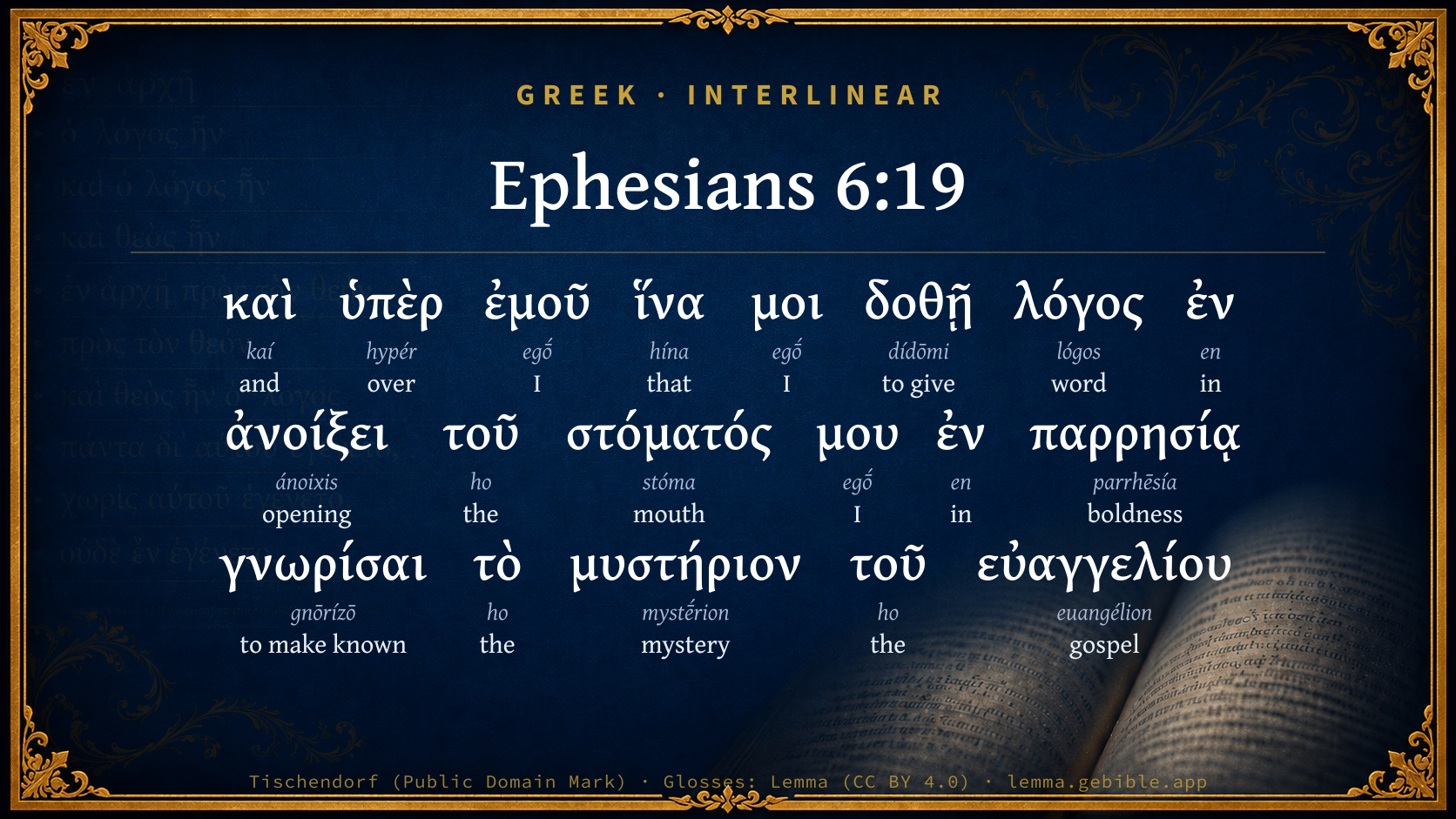
Greek (Tischendorf 8th ed.) Ephesians 6:19 appears in the Greek New Testament. The text above is from the Tischendorf 8th edition. Each word links to its Strong’s number and a concise gloss. Click any word for its full Thayer’s Greek Lexicon entry.
Download image
Cite this verse

Ephesians 6:19 (World English Bible). Public Domain. Lemma interlinear Bible study tool, https://lemma.gebible.app/v/ephesians/6/19.

Show BibTeX & RIS
BibTeX
RIS
English Translation
on my behalf, that utterance may be given to me in opening my mouth, to make known with boldness the mystery of the Gospel,
World English Bible · Public Domain
Highlights
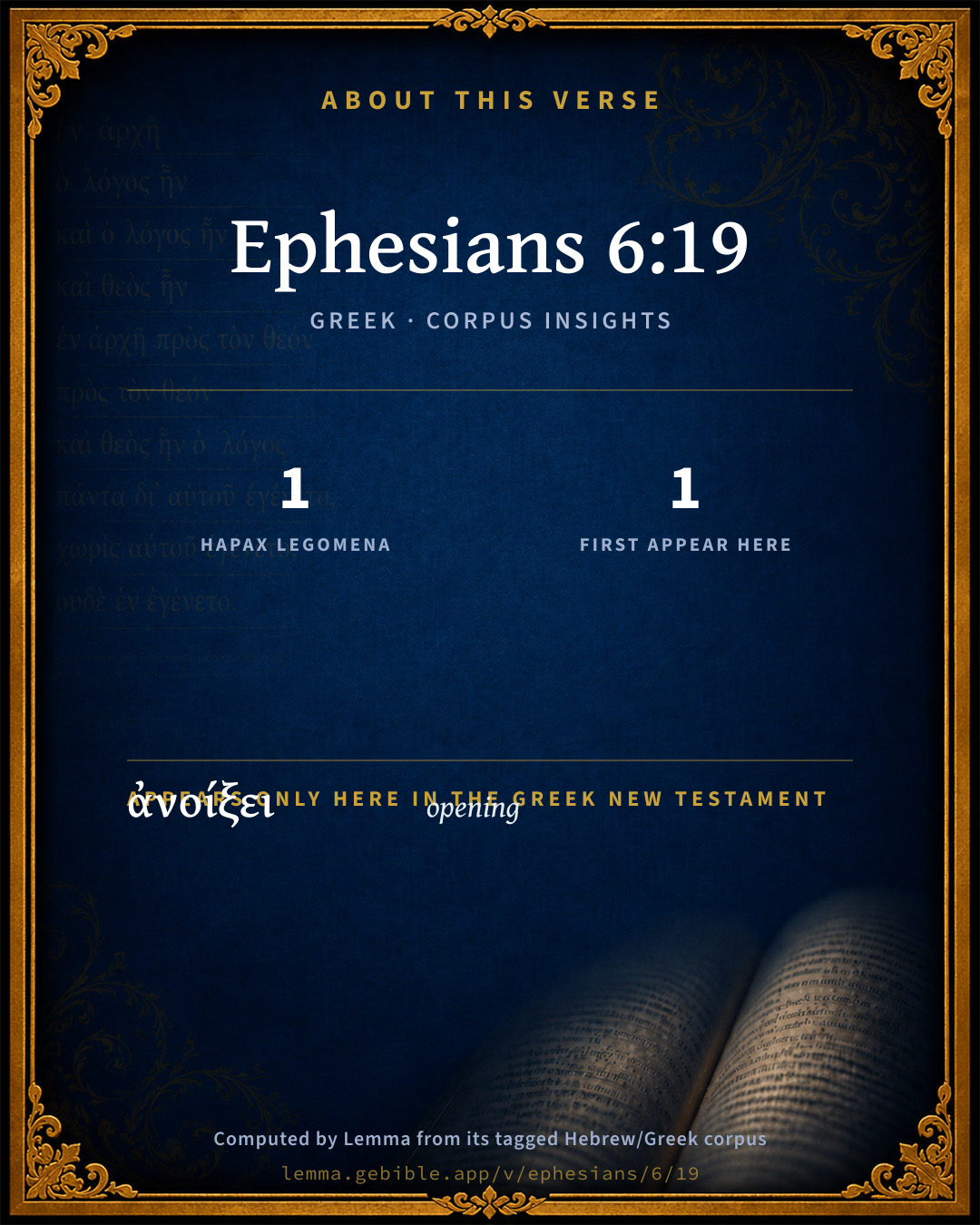
  • 1 hapax legomenon — only here in the Greek New Testament
  • 1 first appearance in the Greek New Testament
Full analysis ↓
Download a study sheet

One document with this verse’s original text, its word-by-word gloss line, the meaning frame, cross-references with their text, attributed commentary, and full source and license credits — printable, and it pastes into notes with its structure intact.

This verse Autodidact and up

Study sheet (.html) Plain text (.txt)

A passage Seminary Student

Up to 50 verses in one chapter. A passage sheet keeps up to 6 commentary sources and 12 cross-references per verse, in the order this page ranks them, and says so on the sheet whenever that leaves anything out. Ask for a single verse and you get the Autodidact verse sheet above.

Everything on this page stays free to read, with no account — the sheet is a download of what is already on screen, not access to it.

Want to remove ads? Support Godless Engineer
Compare translations 3

The same verse in 3 English versions, stacked beneath the original-language interlinear above. Click any original word for its lexicon entry.

Each is an independent rendering of the whole verse — the interlinear is not word-aligned to these translations.

Highlighted words mark where these versions differ — a whole-verse word diff, not a word-by-word alignment.

  • World English Bible Public Domain
    on my behalf, that utterance may be given to me in opening my mouth, to make known with boldness the mystery of the Gospel,
  • King James Version Public Domain
    And for me, that utterance may be given unto me, that I may open my mouth boldly, to make known the mystery of the gospel,
  • unfoldingWord Literal Text CC BY-SA 4.0
    and for me, so that a message might be given to me in the opening of my mouth, to make known with boldness the mystery of the gospel

unfoldingWord Literal Text — © unfoldingWord, licensed CC BY-SA 4.0. Word-aligned USFM3 via Door43 (git.door43.org/unfoldingWord/en_ult).

Versions to compare (up to 4)

3 of 4 selected

Show all 19 translations

Every available English version of this verse, each an independent rendering of the whole verse.

  • World English Bible Public Domain
    on my behalf, that utterance may be given to me in opening my mouth, to make known with boldness the mystery of the Gospel,
  • Berean Standard Bible Public Domain
    Pray also for me, that whenever I open my mouth, words may be given me so that I will boldly make known the mystery of the gospel,
  • Majority Standard Bible Public Domain
    Pray also for me, that whenever I open my mouth, words may be given me so that I will boldly make known the mystery of the gospel,
  • King James Version Public Domain
    And for me, that utterance may be given unto me, that I may open my mouth boldly, to make known the mystery of the gospel,
  • American Standard Version (1901) Public Domain
    And on my behalf, that utterance may be given unto me in opening my mouth, to make known with boldness the mystery of the gospel,
  • Revised Version (1885) Public Domain
    And on my behalf, that utterance may be given unto me in opening my mouth, to make known with boldness the mystery of the gospel,
  • Geneva Bible (1599) Public Domain
    And for me, that vtterance may be giuen vnto me, that I may open my mouth boldly to publish the secret of the Gospel,
  • Douay-Rheims (1899) Public Domain
    And for me, that speech may be given me, that I may open my mouth with confidence, to make known the mystery of the gospel.
  • Young's Literal Translation Public Domain
    and in behalf of me, that to me may be given a word in the opening of my mouth, in freedom, to make known the secret of the good news,
  • Literal Standard Version CC BY-SA 4.0
    and in behalf of me, that to me may be given a word in the opening of my mouth, in freedom, to make known the secret of the good news,
  • Unlocked Literal Bible CC BY-SA 4.0
    And pray for me, that a message might be given to me when I open my mouth. Pray that I might make known with boldness the hidden truth about the gospel.
  • unfoldingWord Literal Text CC BY-SA 4.0
    and for me, so that a message might be given to me in the opening of my mouth, to make known with boldness the mystery of the gospel
  • Darby Bible Public Domain
    and for me in order that utterance may be given to me in [the] opening of my mouth to make known with boldness the mystery of the glad tidings,
  • World Messianic Bible Public Domain
    Pray for me, that utterance may be given to me in opening my mouth, to make known with boldness the mystery of the Good News,
  • Webster's Bible Public Domain
    And for me, that utterance may be given to me, that I may open my mouth boldly, to make known the mystery of the gospel,
  • Free Bible Version CC BY-SA 4.0
    Pray for me too so that I'll be given the right words to say, and that I'll be able to explain confidently the hidden truths of the good news.
  • Bible in Basic English Public Domain
    And for me, that words may be given to me in the opening of my mouth, to make clear without fear the secret of the good news,
  • Text-Critical English NT CC BY 4.0
    Pray also for me, so that when I open my mouth to speak, a message may be given to me to make known with boldness the mystery of the gospel,
  • Tyndale New Testament (1534) Public Domain
    and for me that vttraunce maye be geve vnto me that I maye open my mouth boldly to vtter the secretes of the gospell

Literal Standard Version (2020), Covenant Press — licensed CC BY-SA 4.0. Text via the HelloAO Bible API (eBible.org). Unlocked Literal Bible (unfoldingWord) — licensed CC BY-SA 4.0. Text via the HelloAO Bible API (eBible.org). unfoldingWord Literal Text — © unfoldingWord, licensed CC BY-SA 4.0. Word-aligned USFM3 via Door43 (git.door43.org/unfoldingWord/en_ult). Free Bible Version, Dr. Jonathan Gallagher — licensed CC BY-SA 4.0. Text via the HelloAO Bible API (eBible.org).

Word by word

More ways to search: Search by grammar → Find every occurrence → Compare this word →

Practice this passage: Drill this verse → Learn its vocabulary →

ἀνοίξει
ánoixis
G457
“opening”
Noun, Dative, Singular, Feminine
Part of Speech
Noun
Case
Dative
Number
Singular
Gender
Feminine
Full Thayer's Definition

Origin: from G455

TDNT: None

1. an opening
  1. καὶ kaí G2532 “and” Conjunction
  2. ὑπὲρ hypér G5228 “over” Preposition
  3. ἐμοῦ egṓ G1473 “I” Personal pronoun, 1st person, Genitive, Singular
  4. ἵνα hína G2443 “that” Conjunction
  5. μοι egṓ G1473 “I” Personal pronoun, 1st person, Dative, Singular
  6. δοθῇ dídōmi G1325 “to give” Verb, Aorist, Passive, Subjunctive, 3rd person, Singular
  7. λόγος lógos G3056 “word” Noun, Nominative, Singular, Masculine
  8. ἐν en G1722 “in” Preposition
  9. τοῦ ho G3588 “the” Article, Genitive, Singular, Neuter
  10. στόματός stóma G4750 “mouth” Noun, Genitive, Singular, Neuter
  11. μου egṓ G1473 “I” Personal pronoun, 1st person, Genitive, Singular
  12. ἐν en G1722 “in” Preposition
  13. παρρησίᾳ parrhēsía G3954 “boldness” Noun, Dative, Singular, Feminine
  14. γνωρίσαι gnōrízō G1107 “to make known” Verb, Aorist, Active, Infinitive
  15. τὸ ho G3588 “the” Article, Accusative, Singular, Neuter
  16. μυστήριον mystḗrion G3466 “mystery” Noun, Accusative, Singular, Neuter
  17. τοῦ ho G3588 “the” Article, Genitive, Singular, Neuter
  18. εὐαγγελίου euangélion G2098 “gospel” Noun, Genitive, Singular, Neuter

About this verse

These counts appear in no published source. They are computed here, from the morphology-tagged text and Lemma’s own curated glosses. What Lemma adds →

19
words
14
distinct lemmas
Pauline Epistles
section

Notable vocabulary

1 hapax legomenon — a word that appears only here in the entire Greek New Testament:

  • ἀνοίξει opening G457

First appearance in Scripture

This word makes its first canonical appearance in the Greek New Testament here:

  • ἀνοίξει opening G457

Shared distinctive vocabulary

γνωρίσαι to make known G1107 occurs in 24 verses of the Greek New Testament. Also found in:
Repetition

Words recur within this verse:

Cross-references

31

Topical passages linked to Ephesians 6:19 in the Treasury of Scripture Knowledge — connected by theme and wording, ordered by reader-vote popularity; previews shown in the World English Bible.

  • Colossians 4:3 praying together for us also, that God may open to us a door for the word, to speak the mystery of Christ, for which I am also in bonds;
  • Acts 4:29 Now, Lord, look at their threats, and grant to your servants to speak your word with all boldness,
  • 2 Thessalonians 3:1 Finally, brothers, pray for us, that the word of the Lord may spread rapidly and be glorified, even as also with you;
  • 1 Thessalonians 5:25 Brothers, pray for us.
  • Hebrews 13:18 Pray for us, for we are persuaded that we have a good conscience, desiring to live honorably in all things.
  • Acts 4:31 When they had prayed, the place was shaken where they were gathered together. They were all filled with the Holy Spirit, and they spoke the word of God with boldness.
  • 1 Thessalonians 2:2 but having suffered before and been shamefully treated, as you know, at Philippi, we grew bold in our God to tell you the Gospel of God in much conflict.
  • Acts 13:46 Paul and Barnabas spoke out boldly, and said, "It was necessary that God's word should be spoken to you first. Since indeed you thrust it from you, and judge yourselves unworthy of eternal life, behold, we turn to the Gentiles.
  • Acts 19:8 He entered into the synagogue, and spoke boldly for a period of three months, reasoning and persuading about the things concerning the Kingdom of God.
  • Acts 28:31 preaching the Kingdom of God, and teaching the things concerning the Lord Jesus Christ with all boldness, without hinderance.
  • 2 Corinthians 8:7 But as you abound in everything, in faith, utterance, knowledge, all earnestness, and in your love to us, see that you also abound in this grace.
  • 1 Corinthians 4:1 So let a man think of us as Christ's servants, and stewards of God's mysteries.
  • Ephesians 1:9 making known to us the mystery of his will, according to his good pleasure which he purposed in him
  • Acts 9:27 But Barnabas took him, and brought him to the apostles, and declared to them how he had seen the Lord in the way, and that he had spoken to him, and how at Damascus he had preached boldly in the name of Jesus.
  • Acts 14:3 Therefore they stayed there a long time, speaking boldly in the Lord, who testified to the word of his grace, granting signs and wonders to be done by their hands.
  • 1 Corinthians 1:5 that in everything you were enriched in him, in all speech and all knowledge;
  • 2 Corinthians 3:12 Having therefore such a hope, we use great boldness of speech,
  • Colossians 2:2 that their hearts may be comforted, they being knit together in love, and gaining all riches of the full assurance of understanding, that they may know the mystery of God, both of the Father and of Christ,
  • Philemon 1:22 Also, prepare a guest room for me, for I hope that through your prayers I will be restored to you.
  • Acts 2:4 They were all filled with the Holy Spirit, and began to speak with other languages, as the Spirit gave them the ability to speak.
  • Acts 4:13 Now when they saw the boldness of Peter and John, and had perceived that they were unlearned and ignorant men, they marveled. They recognized that they had been with Jesus.
  • Acts 18:26 He began to speak boldly in the synagogue. But when Priscilla and Aquila heard him, they took him aside, and explained to him the way of God more accurately.
  • Romans 15:30 Now I beg you, brothers, by our Lord Jesus Christ, and by the love of the Spirit, that you strive together with me in your prayers to God for me,
  • 1 Corinthians 2:7 But we speak God's wisdom in a mystery, the wisdom that has been hidden, which God foreordained before the worlds for our glory,
  • 2 Corinthians 1:11 you also helping together on our behalf by your supplication; that, for the gift bestowed on us by means of many, thanks may be given by many persons on your behalf.
  • 2 Corinthians 7:4 Great is my boldness of speech toward you. Great is my boasting on your behalf. I am filled with comfort. I overflow with joy in all our affliction.
  • Philippians 1:19–20 For I know that this will turn out to my salvation, through your supplication and the supply of the Spirit of Jesus Christ,
  • 1 Timothy 3:16 Without controversy, the mystery of godliness is great: God was revealed in the flesh, Justified in the spirit, Seen by angels, Preached among the nations, Believed on in the world, And received up in glory.
  • Acts 9:29 preaching boldly in the name of the Lord. He spoke and disputed against the Grecian Jews, but they were seeking to kill him.
  • Ephesians 3:3–4 how that by revelation the mystery was made known to me, as I wrote before in few words,
  • Colossians 1:26–27 the mystery which has been hidden for ages and generations. But now it has been revealed to his saints,

Cross-references courtesy of OpenBible.info (CC BY 4.0).

Commentary

Notes on Ephesians 6:19 from classic Christian and Jewish commentators (each source and its license shown beneath its notes). The classic Christian expositions comment on the surrounding passage and are grouped to its opening verse, so a note may address several verses; the Jewish commentaries on the Tanakh (Rashi and others) are per-verse, so they appear only where the commentator wrote on this verse.

Lemma curates 59 commentaries, every one of them public domain or Creative Commons licensed, each selected and text-cleaned for this edition rather than reprinted as found. About our sources →

Matthew Henry's Commentary

Here, I. He desires their prayers for him, Eph 6:19. Having mentioned supplication for all saints, he puts himself into the number. We must pray for all saints, and particularly for God's faithful ministers. Brethren, pray for us, that the word of the Lord may run and be glorified. Observe what it is he would have them pray for in his behalf: "That utterance may be given unto me; that I may be enlarged from my present restraints, and so have liberty to propagate the faith of Christ; that I may have ability to express myself in a suitable and becoming manner; and that I may open my mouth boldly, that is, that I may deliver the whole counsel of God, without any base fear, shame, or partiality." To make known the mystery of the gospel; some understand it of that part of the gospel which concerns the calling of the Gentiles, which had hitherto, as a mystery, been concealed. But the whole gospel was a mystery, till made known by divine revelation; and it is the work of Christ's ministers to publish it. Observe, Paul had a great command of language; they called him Mercury, because he was the chief speaker (Act 14:12), and yet he would have his friends ask of God the gift of utterance for him. He was a man of great courage, and often signalized himself for it; yet he would have them pray that God would give him boldness. He knew as well what to say as any man; yet he desires them to pray for him, that he may speak as he ought to speak. The argument with which he enforces his request is that for the sake of the gospel he was an ambassador in bonds, Eph 6:20. He was persecuted and imprisoned for preaching the gospel; though, notwithstanding, he continued in the embassy committed to him by Christ, and persisted in preaching it. Observe, 1. It is no new thing for Christ's ministers to be in bonds. 2. It is a hard thing for them to speak boldly when that is their case. 3. The best and most eminent ministers have need of, and may receive advantage by, the prayers of good Christians; and therefore should earnestly desire them. Having thus desired their prayers,

II. He recommends Tychicus unto them, Eph 6:21, Eph 6:22. He sent him with this epistle, that he might acquaint them with what other churches were informed of, namely, how he did, and what he did; how he was used by the Romans in his bonds, and how he behaved himself in his present circumstances. It is desirable to good ministers both that their Christian friends should know their state and that they should be acquainted with the condition of their friends; for by this means they may the better help each other in their prayers. - And that he might comfort their hearts, by giving such an account of his sufferings, of the cause of them, and of the temper of his mind and his behaviour under them, as might prevent their fainting at his tribulations and even minister matter of joy and thanksgiving unto them. He tells them that Tychicus was a beloved brother and faithful minister in the Lord. He was a sincere Christian, and so a brother in Christ: he was a faithful minister in the work of Christ, and he was very dear to Paul, which makes Paul's love to these Christian Ephesians the more observable, in that he should now part with so good and dear a friend for their sakes, when his company and conversation must have been peculiarly delightful and serviceable to himself. But the faithful servants of Jesus Christ are wont to prefer the public good to their own private or personal interests.

III. He concludes with his good wishes and prayers for them, and not for them only, but for all the brethren, Eph 6:23, Eph 6:24. His usual benediction was, Grace and peace; here it is, Peace be to the brethren, and love with faith. By peace we are to understand all manner of peace - peace with God, peace with conscience, peace among themselves: and all outward prosperity is included in the word; as if he had said, "I wish the continuance and increase of all happiness to you." And love with faith. This in part explains what he means in the following verse by grace; not only grace in the fountain, or the love and favour of God, but grace in the streams, the grace of the Spirit flowing from that divine principle, faith and love including all the rest. It is the continuance and increase of these that he desires for them, in whom they were already begun. It follows, from God the Father, etc. All Grace and blessings are derived to the saints from God, through the merit and intercession of Jesus Christ our Lord. The closing benediction is more extensive than the former; for in this he prays for all true believers at Ephesus, and every where else. It is the undoubted character of all the saints that they love our Lord Jesus Christ. Our love to Christ is not acceptable, unless it be in sincerity: indeed there is no such thing as love to Christ, whatever men may pretend, where there is not sincerity. The words may be read, Grace be with all those who love our Lord Jesus Christ in incorruption, who continue constant in their love to him, so as not to be corrupted out of it by any baits or seductions whatsoever, and whose love to him is uncorrupted by any opposite lust, or the love of any thing displeasing to him. Grace, that is, the favour of God, and all good (spiritual and temporal), that is, the product of it, are and shall be with all those who thus love our Lord Jesus Christ. And it is, or ought to be, the desire and prayer of every lover of Christ that it may be so with all his fellow-christians. Amen, so be it.

Matthew Henry's Commentary on the Whole Bible (1708–1710) — public domain (CC PDM 1.0). Text via the HelloAO Bible API.

The Biblical Illustrator

Joseph S. Exell

Eph_6:19

And for me, that utterance may be given unto me.

Ministers dependent on the peoples prayers

You come to listen to me on Sunday, and I have nothing to say that adds vigour to faith, or fervour to love, or that enlarges your knowledge of duty or of God. It is plain that during the week I have had no clear vision of spiritual truth, or that, if I have, the vision has faded away. You are naturally disappointed, perhaps discontented. It is partly my fault. But is it not possible that the fault is as much yours as mine? If you had prayed for me with earnestness and faith, might not the vision of God bare come to me, and the revelation of spiritual truth and the baptism of fire? In the absence of your intercessions, God may have given me truth for myself, but not for you. Suppose that in the course of a few weeks after the Ephesian Christians received this Epistle Paul had been called to appear before the Roman emperor, and that his courage had failed, or that, if his courage had not failed, no wise and vigorous and penetrating words had occurred to him in defence of the honour of Christ and in illustration of the glory of the Christian redemption. The Ephesian Christians, when they heard of his failure, would have wondered how it could have happened that the great apostle had even momentarily lost his fearlessness and his power. But if they had forgotten to pray that utterance might be given to him to make known with boldness the mystery of the gospel, the apostles failure might have been the result of their neglect. (R. W. Dale, LL. D.)

The Biblical Illustrator, edited by Joseph S. Exell (c. 1880s–1900s) — public domain. Text from a community e-Sword module.

Joseph Benson's Commentary

Eph 6:19-20. And for me also — See on Col 4:3; that utterance may be given unto me — Free liberty of expression, every inward and every outward hinderance being removed; that I may open my mouth boldly — May deliver the whole truth without any base fear, shame, or diffidence, considering how important it is to the glory of God, and the salvation of mankind, that it should be so delivered; to make known the mystery of the gospel — In the clearest and most effectual manner. For which I am an ambassador in bonds — The ambassadors of men usually appear in great pomp: in what a different state does the ambassador of Christ appear! The Greek, πρεσβευω εν αλυσει, is literally, I execute the office of an ambassador in a chain. See on Act 28:16. As the persons of ambassadors were always sacred, the apostle, in speaking thus, seems to refer to the outrage that was done to his Divine Master in this violation of his liberty.

Joseph Benson's Commentary on the Old and New Testaments (1811–1818) — public domain. Text from a community e-Sword module.

The Expositor's Bible

Chapter 30

THE CONCLUSION

Eph_6:19-24.

REQUEST: COMMENDATION: BENEDICTION

Eph_6:19-22

The apostle has bidden his readers apply themselves with wakeful and incessant earnestness to prayer (Eph_6:18). For this is, after all, the chief arm of the spiritual combat. By this means the soul draws reinforcements of mercy and hope from the eternal sources (Eph_6:10). By this means the Asian Christians will be able not only to carry on their own conflict with vigour, but to help all the saints (Eph_6:18); and through their aid the whole Church of God will be sustained in its war with the prince of this world.

The apostle Paul himself stood in the forefront of this battle. He was suffering for the cause of common Christendom; he was a mark for the attack of the enemies of the gospel. On him, more than on any other man, the safety and progress of the Church depended. {Php_1:25} In this position he naturally says: "Watching unto prayer in all perseverance and supplication for all the saints-and for me." If his heart should fail him, or his mouth be closed, if the word of inspiration ceased to be given him and the great teacher of the Gentiles in faith and truth no longer spoke as he ought to speak, it would be a heavy blow and sore discouragement to the friends of Christ throughout the world. "My afflictions are your glory. {Eph_3:13} My unworthy testimony to Christ is showing forth His praise to all men and angels. Pray for me then, that I may speak and act in this hour of trial in a manner worthy of the dispensation given to me." Strong and confident as the apostle Paul was, he tier himself to be nothing without prayer. It is his habit to expect the support of the intercessions of all who love him in Christ. He knew that he was heaped by this means, on numberless occasions and in wonderful ways. He asks his present readers to entreat that "the word may be given me when I open my mouth, so that I may freely make known the mystery of the gospel, on which behalf I serve as ambassador in bonds, that in it I may speak freely, as I ought to speak." This sentence hangs upon the verb "may-be-given." Jesus said to His apostles: "It shall be given you in that hour what you shall speak, when brought before rulers and kings". {Mat_10:18-20} The apostle stands now before the Roman world. He has appealed to Caesar, and awaits his trial. If he has not yet appeared at the Emperors tribunal, he will shortly have to do so. Christs ambassador is about to plead in chains before the highest of human courts. It is not his own life or freedom that he is concerned about; the ambassador has only to consider how he shall represent his Sovereigns interests. The importance which Paul attached to this occasion is manifest from the words written to Timothy {2Ti_4:17} referring to his later trial. St. Paul has this special need in his thoughts, in addition to the help from above continually required in the discharge of his ministry, under the hampering conditions of his imprisonment. {comp. Col_4:3-4}

The Church must entreat on Pauls behalf that the word he utters may be Gods, and not his own. It is in vain to "open the mouth," unless there is this higher prompting and through the gates of speech there issues a Divine message, unless the speaker is the mouthpiece of the Holy Spirit rather than of his individual thought and will. "The words that I speak unto you," Jesus. said, "I speak not of myself." The bold apostle intends to open his mouth; but he must have the true "word given" him to say. We should pray for Christs ambassadors, and especially for the more public and eloquent pleaders of the Christian cause, that it may be thus with them. Rash and vain words, that bear the stamp of the mere man who utters them and not of the Spirit of his Master, do a hurt to the cause of the gospel proportioned to the blessing that comes from such lips when they speak the word given to them.

Such inspiration would enable the apostle to "make known the mystery of the gospel with freedom and confidence of speech": the expression rendered "with boldness" means all this. Before the emperor Nero, or the slave Onesimus, he will be able with the same aptness and dignity and self-command to declare his message and to vindicate his Masters name. "The mystery of the gospel" is no other secret than that which this epistle unfolds, {Eph_3:3-9} the great fact that Jesus Christ is the Saviour and the Lord of the whole world. Jesus proclaimed Himself to Pilate, who represented at Jerusalem the imperial rule, as the King of all who are of the truth; and the apostle Paul has the like message to convey to the head of the Empire. It needed the greatest boldness and the greatest wisdom in the ambassador of the Messianic King to play his part at Rome; an unwise word might make his own life forfeit, and bring incalculable dangers on the Church.

St. Pauls trial, we suppose, passed off successfully, as he at this time anticipated. The Roman government was perfectly aware that the political charge against their prisoner was frivolous; and Nero, if he personally gave Paul a hearing on this earlier trial, in all probability viewed his spiritual pretensions on his Masters behalf with contemptuous tolerance. If he did so, the toleration was not due to any want of courage or clearness on the defendants part. It is possible even that the courage and address of the advocate of the "new superstition" pleased the tyrant, who was not without his moments of good humour nor without the instincts of a man of taste. The apostle, we may well believe, made an impression on the supreme court at Rome similar to that made on his judges in Caesarea.

St. Pauls bonds in Christ have now become widely "manifest" in Rome. {Php_1:13} He pleads in circumstances of disgrace. But God brings good for His servants out of evil. As he said at a later time, so he could say now: "They have bound me; but they cannot bind the word of God." He was "not ashamed of the gospel" in the prospect of coming to Rome years before; {Rom_1:16} and he is not ashamed now, though he has come in chains as an evil-doer. Through the intercessions of Christs people all these injuries of Satan are turning to his salvation and to the "furtherance of the gospel"; and Paul rejoices and triumphs in them, well assured that Christ will be magnified whether by his life or death, whether by his freedom or his chains. {Php_1:12-26} The prayers which the imprisoned apostle asks from the Church were fulfilled. For we read in the last verses of the Acts of the Apostles, which put into a sentence the history of this period: "He received all that came to him, preaching the kingdom and teaching the things concerning the Lord Jesus Christ, with all boldness, none forbidding him."

The paragraph relating to Tychicus is almost identical with that of Col_4:7-8. It begins with a "But" connecting what follows with the statement the apostle has just made respecting his position at Rome. As much as to say: "I want your prayers, set as I am for the defence of the gospel and in circumstances of difficulty and peril. But Tychicus will tell you more about me than I can convey by letter. I am sending him, in fact, for this very purpose."

St. Paul knew the great anxiety of the Christians of Asia on his account. Epaphras of Colossae had "shown him the love in the Spirit" that was felt towards him even by those in this region who had never seen him in the Col_1:8. The tender heart of the apostle is touched by this assurance. So he sends Tychicus to visit as many of the Asian Churches as he may be able to reach, bringing news that will cheer their hearts and relieve their discouragement. {Eph_3:13} The note sent at this time to Philemon indicates the hopeful tidings that Tychicus was able to convey to Pauls friends in the East: "I trust that through your prayers I shall be given to you". {Phm_1:22} To the Philippians he writes, perhaps a little later, in the same strain: "I trust in the Lord that I myself shall come shortly". {Php_2:24} He anticipates, with some confidence, his speedy acquittal and release: it is not likely that this expectation, on the part of such a man as St. Paul, was disappointed. The good news went round the Asian and Macedonian Churches: "Paul is likely soon to be free, and we shall see and hear him again!"

In the parallel epistle he writes, "that you may know"; {Col_4:8} here it is, "that you also may know my affairs." The added word is significant. The writer is imagining his letter read in the various assemblies which it will reach. He has the other epistle in his mind, and remembering that he there introduced Tychicus in similar terms, he says to this wider circle of Asian disciples: "That you also, as well as the Churches of the Lycus valley, may know how things are with me, I send Tychicus to give you a full report." It is not necessary, however, to look beyond the last two verses for the reference of the also of Eph_6:21 : "I have asked your prayers on my behalf; and I wish you in turn to know how things go with me." Possibly, there were some matters connected with St. Pauls trial at Rome that could not be fitly or safely communicated by letter. Hence he adds: "He shall make known unto you all things." When he writes "that ye may know my affairs, how I do," we gather that Tychicus was to communicate to those he visited everything about the beloved apostle that would be of interest to his Asian brethren.

The apostle commends Tychicus in language identical in the two letters, except that in Colossians "fellow-servant" is added to the honourable designations of "beloved brother and faithful minister," under which he is here introduced. We find him first associated with St. Paul in Act_20:4, where "Tychicus and Trophimus" represent Asia in the number of those who accompanied the apostle on his voyage to Jerusalem, when he carried the contributions of his Gentile Churches to the relief of the Christian poor in Jerusalem. Trophimus, his companion, is called a "Greek" and an "Ephesian". {Act_21:28-29} Whether Tychicus belonged to the same city or not, we cannot tell. He was almost certainly a Greek. The Pastoral epistles show Tychicus still in the apostles service in his last years. He appears to have joined St. Pauls staff and remained with him from the time that he accompanied him to Jerusalem in the year 59. From 2Ti_4:9-12 we gather that Tychicus was sent to Ephesus to relieve Timothy, when St. Paul desired the presence of the latter at Rome. It is evident that he was a man greatly valued by the apostle and endeared to him. Tychicus was well known in the Asian Churches, and suitable therefore to be sent upon this errand. And the commendation given to him would be very welcome to the circle to which he belonged. The apostle has great tact in these personal matters, the tact which belongs to delicate feeling and a generous mind. He calls his messenger "the beloved brother" in his relation to the Church in general, and "faithful minister in the Lord" in his special relation to himself. So he describes Epaphroditus to the Philippians as "your apostle and minister of my need." In conveying these letters and messages, this worthy man was Pauls apostle and minister of his need in regard to the Asian Churches. He is a "minister in the Lord, " inasmuch as this office lies within the range of his service to the Lord Christ.

We observe that in writing to the Colossians the apostle applies to Onesimus, the converted slave, the honourable epithets applied here to this long-tried friend: "the faithful and beloved brother" {Col_4:9} -Every Christian believer should be in the eyes of his fellows a "beloved brother." And every true servant of Christ and His people is a "faithful minister in the Lord," be his rank high or low, and whether official hands have been laid upon his head or not. We are apt, by a trick of words, to limit to the order which we suitably call "the ministry" expressions that the New Testament applies to the common ministry of Christs saints. {comp. Col_4:12} This devoted servant of Christ is employed just now as a newsman and letter-carrier. But what a high responsibility it was, to be the bearer to the Asian cities, and to the Church for all time, of the epistles of Paul the apostle to the Ephesians, Colossians, and Philemon. Had Tychicus been careless or dishonest, had he lost these precious documents or tampered with them, how great the loss to mankind! We cannot read them without feeling our debt to this beloved brother and faithful servant of the Church. Those who travel upon Christs business, who link distant communities to each other and convey from one to another the Holy Spirits fellowship and grace, are "the messengers of the Churches and the glory of Christ". {2Co_8:23}

William Robertson Nicoll, ed., The Expositor's Bible (London: Hodder & Stoughton, 1887–1910) — public domain. 65 of 66 books (1 Corinthians is not separately keyed, as that volume carries no machine-parseable verse references); section-level commentary keyed to the opening verse. Introductory and overview sections not keyed to a specific passage are excluded.

Tyndale Open Study Notes

Tyndale Open Resources

6:19-20 Paul’s missionary calling was primarily to help Gentiles realize that they are now accepted by God and welcomed into his church. • mysterious plan: See study notes on 1:8-10; 3:3. • I am in chains now: Though writing as a prisoner (see 3:1; 4:1), Paul knew that his calling as God’s ambassador (cp. 2 Cor 5:20) was to keep on speaking boldly for him.

Tyndale Open Study Notes — © Tyndale Open Resources, licensed CC BY-SA 4.0. Text via the HelloAO Bible API.

Bengel's Gnomon

Johann Albrecht Bengel

Eph 6:19. Δοθῇ, may be given) Paul did not depend on his natural and acquired power.—ἀνοίξει τοῦ στόματος) פתחון פה.—ἐν παῤῥησιᾳ γνωρίσαι, to make known with boldness) Therefore boldness [plainness] of speech is required, because it is a mystery.

Bengel's Gnomon of the New Testament — English translation (T&T Clark, Edinburgh, 1860) — public domain. Text from a community e-Sword module.

Meyer's Critical & Exegetical Commentary

Heinrich August Wilhelm Meyer

Eph_6:19. Καὶ ὑπὲρ ἐμοῦ] καί: and in particular. See Fritzsche, ad Marc. p. 11, 713. The special point which, in connection with the intercession embracing all Christians, he would have to be made matter of supplication for himself, is stated in what follows. ὑπέρ expresses, as previously the περί in current use, the sense in commodum (see Schaefer, App. ad Dem. I. p. 190; Buttmann, Ind. ad Mid. p. 188); and only the form of sensuous perception, which underlies the two prepositions, is different, as in the case of the Germ. über and um; comp. 1Pe_3:18. It is wrongly assumed by Harless that only ὑπέρ expresses in itself the relation of care for, and not περί. The notion of the latterthat of encirclingin fact sensuously embodies such care; hence with classical writers too, especially with Demosthenes, περί and ὑπέρ are interchanged without any difference of sense, e.g. phil. ii. p. 74, 35: μὴ περὶ τῶν δικαίων μηδʼ ὑπὲρ τῶν ἔξω πραγμάτων εἶναι τὴν βουλήν, ἀλλʼ ὑπὲρ τῶν ἐν τῇ χώρᾳ, 10. 16: οὐ περὶ δόξης οὐδʼ ὑπὲρ μέρους χώρας πολεμοῦσι, Xen. Mem. i. 1. 17: ὑπὲρ τούτων περὶ αὐτοῦ παραγνῶναι, Thucyd. vi. 78. Ephesians 1 : ὑπέρ γε τῆς ἐμῆς κινδυνεύειν, ἐνθυμηθήτω οὐ περὶ τῆς ἐμῆς μᾶλλον.

ἵνα μοι δοθῇ κ.τ.λ.] Aim of the καὶ ὑπὲρ ἐμοῦ, and consequently contents of the intercession for the apostle (comp. on Eph_3:16): in order that utterance may be given to me on the opening of my mouth, i.e. that there may not be withheld from me by God, but may on the contrary be conferred, that which I ought to speak when I open my mouth. That Paul means the speaking with a view to the proclamation of the gospel, is from the context (see ἐν παῤῥησ. γνωρ. κ.τ.λ.) clear. The emphasis, however, is upon δοθῇ, to which, in the sequel, ἐν παῤῥησίᾳ significantly corresponds; for this freedom of speech is the consequence wished for by Paul from that bestowal. Comp. Luk_21:15. As to ἀνοίγειν τὸ στόμα, which in itself represents nothing else than the opening of the mouth to speak, comp. on Mat_5:2; 2Co_6:11; on the substantive ἄνοιξις, comp. Thuc. iv. 67. 3. The expression is graphic, and has here something of a pathetic nature, without, however, containing a qualitative feature of the discourse itself, not even the character of unpremeditated utterance (Oecumenius: ἐν αὐτῷ τῷ ἀνοῖξαι ὁ λόγος προήει), which would have been expressed by ἐν αὐτῇ τῇ ἀνοίξει τοῦ στ., or in a similar significant way. This at the same time in opposition to Calvin, Boyd, Zanchius, Michaelis, Zachariae, and others, including Koppe, Rückert, Matthies, Meier, Baumgarten-Crusius, de Wette, Bleek, Schenkel, who explain: unreservedly, frankly, which would have to be attached not to what follows (see below), but closely to λόγος, and thereby, again, the ἐν παῤῥησίᾳ γνωρ. would be unwarrantably anticipated. Following Bullinger, Calovius, Cornelius a Lapide, and others,[313] Harless and Olshausen understand the ἌΝΟΙΞΙς ΤΟῦ ΣΤΌΜΑΤΟς as the act of God (comp. Eze_3:27; Eze_29:21; Eze_32:22; Psa_51:17), holding it to denote: the bestowed capacity of speaking in contrast to an earlier bound state of the tongue. Paul would thus have said: in order that utterance may be given unto me through my mouth being opened. But what needless diffuseness of expression, since ΔΟΘῇ ΛΌΓΟς and ἌΝΟΙΞΙς ΤΟῦ ΣΤΌΜΑΤΟς would be just the same thing! Kypke and Koppe attach ἐν ἀνοίξει τοῦ στ. μ. to what follows; in which case Kypke regards ἐν παῤῥησίᾳ as epexegesis of ἀνοίξει τ. στ. μ., and Koppe, following Grotius,[314] refers ἐν παῤῥ. to the outward freedom: non vinculis constrictus in carcere latens. The latter explanation is logically erroneous, since, thus understood, ἐν παῤῥησ. would be something quite other than the ἄνοιξις τοῦ στόματος, and thus could not be added by way of apposition, without καί; and linguistically erroneous, since παῤῥησία never denotes outward freedom, and here especially its signification of boldness is rendered clear by the παῤῥησιάσωμαι of Eph_6:20. Comp. Fritzsche, Diss. II. in 2 Cor. p. 99 f. In opposition to Kypke, it may be urged that an addition of so purely exegetical a character, as ἐν παῤῥ. would be to ἐν ἀνοίξ. τ. στόμ. μ., would not be in keeping with the elevated style of the discourse, which is not couched in anything like a didactic tone. Köster (in the Stud. u. Krit. 1854, p. 317), with whom, in the main, Bleek agrees, attaches ἐν ἀνοίξ. τ. στόμ. μ. to what follows, and takes δοθῇ λόγος in the well-known classical sense: to allow one to come to speech, to let him speak (Dem. 26, 18; 27, 9; 508, 16; 1220, 20; comp. λόγου τυχεῖν, 229, 13); so that Paul is supposed to say: that opportunity to speak may be given to me, namely, at the opening of my mouth (that is, when I wish to speak) frankly to proclaim, etc. But even in this way ἐν ἀνοίξει τοῦ στόμ. μου. would be only a needless and cumbrous addition.

ἐν παῤῥησίᾳ γνωρίσαι κ.τ.λ.] with frankness to make known the mystery of the gospel, i.e. the mystery (see on Eph_1:9) which forms the contents of the gospel. The opportunity of preaching was not taken from the apostle in his captivity at Caesarea (Act_24:23), nor yet afterwards at Rome (Act_28:30 f.). Should we attach ἐν παῤῥ. to what precedes (Vatablus: ut detur mihi aperto ore loqui libere, ut notum faciam, etc.), γνωρίσαι would be without a necessary modal definition.

[313] Grotius also regards the ἄνοιξις τοῦ στόματος as the act of God: sic Deus labia aperire dicitur, ubi materiam suppeditat sibi gratias agendi, Psa_51:15, yet makes out of it, after the Rabbinical פתחון פה (see Capell. Spicileg. p. 112; Buxtorf, Lex. Talm. p. 1872), occasione (loquendi) data. But the sense, opportunity to speak, could only so be brought out in the event of the words running thus: ἵνα μοι δοθῇ ἄνοιξις τοῦ στόματός μου.

[314] Ut ab hac custodia militari liber per omnem urbem perferre possem sermonem evang., etc.

REMARK.

If the Recepta δοθείη were genuine, the statement of aim, introduced by ἵνα, would be adduced from the mind of the persons praying, thus in the character of the oratio obliqua. See on Eph_1:17.

Meyer — Critical and Exegetical Commentary on the New Testament — English translation by Peter Christie, edited by Frederick Crombie (T&T Clark, 1880) — public domain. Text from a community e-Sword module.

Expositor's Greek Testament

ed. W. Robertson Nicoll

Eph 6:19 . καὶ ὑπὲρ ἐμοῦ : and for me . καί has here its adjunctive force, in the special form of appending the particular to the general (Win.-Moult., p. 544), = “and for me in particular”. Paul passes from the requirement of intercession for all to that of intercession for himself, and that with a view to a special gift from God, to wit, freedom of utterance in preaching. The περί of the former clause becomes ὑπέρ in the present. This suggests the existence of some distinction between the two preps., and some have attempted to show that ὑπέρ alone expresses the idea of care for one, while περί denotes a more distant relation (Harl., etc.). But it is impracticable to establish either that or any other tangible distinction. ὑπέρ may be, generally speaking, more applicable to persons , and περί to things . But here both are used of persons. Even in classical Greek they were often used as if interchangeable ( e.g. , Demosth., Phil. , ii., p. 74, 35), and in later Greek, both biblical and non-biblical, they seem to have lost any distinction they once may have had. ἵνα μοι δοθείῃ [ δοθῇ ] λόγος : that to me may be given utterance . The δοθείῃ of the TR rests on very slender cursive evidence; δοθῇ is read by [854] [855] [856] [857] [858] [859] [860] [861] [862] [863] , etc., and must be substituted. A few authorities place μοι after δοθῇ ( [864] [865] , d, e, f, vg, Victor., etc.); but in most it is inserted before it. δοθῇ has the position of emphasis the utterance for which they were to pray in Paul’s behalf is regarded as a gift from God. For this use of λόγος cf. 1Co 1:5 ; 2Co 11:2 . ἐν ἀνοίξει τοῦ στόματός μου : in opening my mouth . Not “ that I may open my mouth” (AV), but “ when I open my mouth”. The ἐν marks the occasion of the action, and the action itself is that in which the gift ( δοθῇ ) of Divine help is sought. The phrase ἀνοίγειν τὸ στόμα does not of itself denote any special kind of utterance, whether unreserved (Calv., De Wette, etc.), unpremeditated (Oec.), or other. If it conveys in any case the idea of a certain quality of speech, that is due to the context; as in 2Co 6:11 , where it is conjoined with the phrase ἡ καρδία ἡμῶν πεπλάτυνται . It means simply the opening of the mouth to speak, or the act of speaking; but both in the OT and in the NT it appears to have a certain pathetic (Mey.), or rather solemn force (Ell.), being used of grave and important utterances on which much depended (Job 3:1 ; Dan 10:16 ; Mat 5:2 ; Act 8:33 ; Act 18:14 ). ἐν παρρησίᾳ : with boldness . Statement of the thing specially sought, and recognised as to be obtained only by the gift of God, to wit, fearless, confident freedom whenever occasion came to preach the Gospel. παρρησία primarily = freedom in speaking (Act 4:13 ; 2Co 3:12 ); then frankness, unreserve , or plainness in speaking (Mar 8:32 ; Joh 10:24 ; Joh 11:14 ; Joh 16:25 , etc.); and boldness, assurance , as opposed, e.g. , to αἰσχύνεσθαι (Phi 1:20 ; 1Jn 3:21 ; 1Jn 5:14 ); and with the fundamental idea of freedom or confidence in speaking again suggesting itself (1Jn 2:28 ; 1Jn 4:17 ; see also under Eph 3:12 above). γνωρίσαι τὸ μυστήριον [ τοῦ εὐαγγελίου ]: to make known the mystery [ of the Gospel ]. The τοῦ εὐαγγελίου of the TR has large support ( [866] [867] [868] [869] [870] [871] [872] , Vulg., Syr., Copt., etc.). It is omitted by [873] [874] gr [875] , Victor., etc., and is deleted by LWH. The gen. is probably that of contents , or one of the various forms of the gen. possess. , = the mystery contained in the Gospel or belonging to it. On μυστήριον see under Eph 1:9 above. The connection of the several clauses in this verse is variously understood. Some connect ἐν ἀνοίξει τοῦ στόματός μου with the following ἐν παρρησίᾳ . So Grotius, who explains it thus “ut ab hac custodia militari liber per omnem urbem perferre possem sermonem”; but παρρησία does not apply to freedom of movement , and here it has a sense in harmony with the following παῤῥησιάσωμαι . Others attach the ἐν ἀνοίξει closely with the λόγος as a definition of it, = “that utterance may be given me by the opening of my mouth” (Cornel. à Lap., Harl., Olsh., Von Soden, Abb., etc.). This makes the “opening of the mouth” the act of God ; in support of which interpretation appeal is made to the terms in Eze 3:27 ; Eze 29:21 ; Eze 32:22 ; Psa 51:15 . The absence of the article, and the analogous passage in Col 4:3 are also thought to favour this. But the terms in Col 4:3 are different ἵνα Θεὸς ἀνοίξῃ ἡμῖν θύραν τοῦ λόγου , and the construction makes the δοθῇ and the ἄνοιξις τοῦ στόματος practically one and the same thing. The simplest constructions are these two (1) to connect ἐν παρρησίᾳ with what precedes , and with the λόγος not the ἄνοιξις , = “that utterance, and that with boldness, may be given to me when I undertake to open my mouth with a view to make known the mystery of the Gospel”; and (2) to connect ἐν παρρησίᾳ with what follows, to wit, the γνωρίσαι , = “that to me utterance may be given when I open my mouth, that with boldness I may make known the mystery of the Gospel”. The latter is preferred by Meyer, Ell., WH, etc. It is followed by the RV text, “in opening my mouth, to make known with boldness,” etc.; while the RV margin gives “in opening my mouth with boldness, to make known the mystery,” etc. The former construction gives a good sense for each particular term and a simple connection, if the ἐν παρρησίᾳ is taken to define not the opening of the mouth , but the utterance , the λόγος , which is the main thought. On the whole the latter is perhaps to be preferred, the need of utterance , power of speech, when occasion offers itself to preach, being first mentioned, and this gift of utterance being next defined in respect of its object, viz. , to give fearless confidence in making the Gospel known.

[854] Codex Vaticanus (sæc. iv.), published in photographic facsimile in 1889 under the care of the Abbate Cozza-Luzi.

[855] Codex Sinaiticus (sæc. iv.), now at St. Petersburg, published in facsimile type by its discoverer, Tischendorf, in 1862.

[856] Codex Alexandrinus (sæc. v.), at the British Museum, published in photographic facsimile by Sir E. M. Thompson (1879).

[857] Codex Claromontanus (sæc. vi.), a Græco-Latin MS. at Paris, edited by Tischendorf in 1852.

[858] Codex Sangermanensis (sæc. ix.), a Græco-Latin MS., now at St. Petersburg, formerly belonging to the Abbey of Saint-Germain-des-Prés. Its text is largely dependent upon that of D. The Latin version, e (a corrected copy of d), has been printed, but with incomplete accuracy, by Belsheim (18 5).

[859] Codex Augiensis (sæc. ix.), a Græco-Latin MS., at Trinity College, Cambridge, edited by Scrivener in 1859. Its Greek text is almost identical with that of G, and it is therefore not cited save where it differs from that MS. Its Latin version, f, presents the Vulgate text with some modifications.

[860] Codex Boernerianus (sæc. ix.), a Græco-Latin MS., at Dresden, edited by Matthæi in 1791. Written by an Irish scribe, it once formed part of the same volume as Codex Sangallensis ( δ ) of the Gospels. The Latin text, g, is based on the O.L. translation.

[861] Codex Mosquensis (sæc. ix.), edited by Matthæi in 1782.

[862] Codex Angelicus (sæc. ix.), at Rome, collated by Tischendorf and others.

[863] Codex Porphyrianus (sæc. ix.), at St. Petersburg, collated by Tischendorf. Its text is deficient for chap. Eph 2:13-16 .

[864] Autograph of the original scribe of א .

[865] Autograph of the original scribe of א .

[866] Codex Sinaiticus (sæc. iv.), now at St. Petersburg, published in facsimile type by its discoverer, Tischendorf, in 1862.

[867] Codex Alexandrinus (sæc. v.), at the British Museum, published in photographic facsimile by Sir E. M. Thompson (1879).

[868] Codex Claromontanus (sæc. vi.), a Græco-Latin MS. at Paris, edited by Tischendorf in 1852.

[869] Codex Sangermanensis (sæc. ix.), a Græco-Latin MS., now at St. Petersburg, formerly belonging to the Abbey of Saint-Germain-des-Prés. Its text is largely dependent upon that of D. The Latin version, e (a corrected copy of d), has been printed, but with incomplete accuracy, by Belsheim (18 5).

[870] Codex Mosquensis (sæc. ix.), edited by Matthæi in 1782.

[871] Codex Angelicus (sæc. ix.), at Rome, collated by Tischendorf and others.

[872] Codex Porphyrianus (sæc. ix.), at St. Petersburg, collated by Tischendorf. Its text is deficient for chap. Eph 2:13-16 .

[873] Codex Vaticanus (sæc. iv.), published in photographic facsimile in 1889 under the care of the Abbate Cozza-Luzi.

[874] Codex Augiensis (sæc. ix.), a Græco-Latin MS., at Trinity College, Cambridge, edited by Scrivener in 1859. Its Greek text is almost identical with that of G, and it is therefore not cited save where it differs from that MS. Its Latin version, f, presents the Vulgate text with some modifications.

[875] Codex Boernerianus (sæc. ix.), a Græco-Latin MS., at Dresden, edited by Matthæi in 1791. Written by an Irish scribe, it once formed part of the same volume as Codex Sangallensis ( δ ) of the Gospels. The Latin text, g, is based on the O.L. translation.

The Expositor's Greek Testament, edited by W. Robertson Nicoll (1897–1910) — public domain. Text from a community e-Sword module.

Hodge's Commentary on Romans, Ephesians & First Corinthians

Charles Hodge

Eph_6:19

The importance which the apostle attributed to intercessory prayer and his faith in its efficacy are evident from the frequency with which he enjoins the duty, and from the earnestness with which he solicits such prayers in his own behalf. What the apostle wishes the Ephesians to pray for, was not any temporal blessing, not even his deliverance from bonds, that he might be at liberty more freely to preach the Gospel, but that God would enable him to preach with the freedom and boldness with which he ought to preach: ἵνα μοι δοθῇ λόγος ἐν ἀνοίξει τοῦ στόματός μου ἐν παρρησίᾳ γνωρίσαι, κτλ. Our translators have paraphrased this clause thus, that utterance may be given me, that I may open my mouth boldly to make known, etc. The literal translation is, that utterance may be given me in opening my mouth, with boldness to make known, etc. What Paul desired was divine assistance in preaching. He begs his reader to pray ἵνα μοι δοθῇ λόγος, that the power of speech, or freedom of utterance, might be given to him, when he opened his mouth. Paul says, 2Co_11:6, that he was ἰδιώτης τῷ λόγῳ, rude in speech. The word λόγος itself has at times the metonymical sense here given to it, and therefore ἐν ἀνοίξει τοῦ στόματός is most naturally taken without emphasis as equivalent to, when I open my mouth, i.e. when called upon to speak. Calvin and many others lay the principal stress on those words, and make with opening of the mouth equivalent to with open mouth, pleno ore et intrepida lingua, as Calvin expresses it. Os opertum cupit, quod erumpet in liquidam et firmam confessionem. Ore enim semiclauso proferuntur ambigua et perplexa responsa. This, however is to anticipate what is expressed by ἐν παῤῥησίᾳ γνωρίσαι. Others connect both ἐν ἀνοίξει τοῦ στόματός and ἐν παῤῥησίᾳ with γνωρίσαι, to make known with the opening of the mouth, with boldness the mystery, etc. This is the construction which our translators seemed to have assumed. But this is very unnatural, from the position of the words and relation of the clauses. Παῤῥησίᾳ (πᾶν ῥῆσις) the speaking out all, freespokenness. Here the dative with ἐν may be taken adverbially, freely, boldly; keeping nothing back, but making an open, undisguised declaration of the Gospel. This includes, however, the idea of frankness and boldness of spirit, of which this unrestrained declaration of the truth is the expression. Μυστήριον τοῦ εὐαγγελίου, mystery of the Gospel; the Gospel itself is the mystery, or divine revelation. It is that system of truth which had been kept secret with God, but which is now revealed unto our glory; 1Co_2:7.

Charles Hodge — Commentary on Romans (1835), First Corinthians (1857), and Ephesians (1856) — public domain. Text from a community e-Sword module.

Jamieson, Fausset & Brown

Robert Jamieson, A. R. Fausset & David Brown

for me--a different Greek preposition from that in Eph 6:18; translate, therefore, "on my behalf."

that I may open my mouth boldly--rather, "that there may be given to me 'utterance,' or 'speech' in the opening of my mouth (when I undertake to speak; a formula used in set and solemn speech, Job 3:1; Dan 10:16), so as with boldness to make known," &c. Bold plainness of speech was the more needed, as the Gospel is a "mystery" undiscoverable by mere reason, and only known by revelation. Paul looked for utterance to be given him; he did not depend on his natural or acquired power. The shortest road to any heart is by way of heaven; pray to God to open the door and to open your mouth, so as to avail yourself of every opening (Jer 1:7-8; Eze 3:8-9, Eze 3:11; Co2 4:13).

Jamieson, Fausset & Brown — Commentary Critical and Explanatory on the Whole Bible (1871) — public domain (CC PDM 1.0). Text via the HelloAO Bible API.

Adam Clarke's Commentary

Verse 19. And for me, that utterance may be given unto me] ινα μοι δοθειη λογος. Kypke has proved by many examples that λογον διδοναι signifies permission and power to defend one's self in a court of justice; and this sense of the phrase is perfectly applicable to the case of St. Paul, who was an ambassador in bonds, (Eph 6:20,) and expected to be called to a public hearing, in which he was not only to defend himself, but to prove the truth and excellency of the Christian religion. And we learn, from Php 1:12-14, that he had his desire in this respect; for the things which happened to him fell out to the furtherance of the Gospel, so that his bonds in Christ were manifest in all the palace, and in all other places. Thus God had enabled him to make a most noble defence, by which the Gospel acquired great credit.

The mystery of the Gospel] The whole doctrine of Christ, not fully revealed previously to that time.

Adam Clarke's Commentary on the Bible (1810–1826) — public domain. Text from a community e-Sword/MySword module.

John Calvin's Commentaries

19. And for me. For himself, in a particular manner, he enjoins the Ephesians to pray. Hence we infer that there is no man so richly endowed with gifts as not to need this kind of assistance from his brethren, so long as he remains in this world. Who will ever be better entitled to plead exemption from this necessity than Paul? Yet he entreats the prayers of his brethren, and not hypocritically, but from an earnest desire of their aid. And what does he wish that they should ask for him? That utterance may be given to me. What then? Was he habitually dumb, or did fear restrain him from making an open profession of the gospel? By no means; but there was reason to fear lest his splendid commencement should not be sustained by his future progress. Besides, his zeal for proclaiming the gospel was so ardent that he was never satisfied with his exertions. And indeed, if we consider the weight and importance of the subject, we shall all acknowledge that we are very far from being able to handle it in a proper manner. Accordingly he adds,

John Calvin's Commentaries (1540-1563) — public domain. Text from the Calvin Translation Society English edition (1840s-50s) via the Christian Classics Ethereal Library (ccel.org). Calvin's coverage is partial (roughly two-thirds of the Bible); uncommented books and verses are honest gaps, never fabricated. The 19th-century editor's footnotes and remarks are omitted so the notes are faithfully Calvin's own voice.

Ellicott's Commentary for English Readers

(19) That utterance may be given me, that I may open my mouth . . .—This hardly renders the original “that word may be given me in opening my mouth.” The “opening the mouth”—an expression always used of solemn and deliberate utterance—seems taken for granted. What the Apostle desires them to pray for is that “word may be given him”—“the word of wisdom and the word of knowledge, by the Spirit” (1Co_12:8), according to our Lord’s promise (Mat_10:19-20), “It shall be given you in the same hour what you shall speak; for it is not ye that speak, but the Spirit of your Father that speaketh in you.” Then he adds as a consequence of this—to make known in plainness of speech the mystery of the gospel. For to make known a mystery in simplicity needs not only boldness to speak, but also the knowledge of the true word of God.

The mystery of the gospel.—The word “gospel” being used emphatically is, of course, the mystery of the new and universal grace of God to the Gentiles of which he speaks at large in Eph_3:1-10. This was “made known to him;” he desires inspiration “to make it known” to others.

A Bible Commentary for English Readers, edited by Charles John Ellicott (1878–1897) — public domain. Text from a community e-Sword module.

The Cambridge Bible for Schools and Colleges

gen. ed. J. J. S. Perowne

19. for me] Lit., on behalf of me. This change of phrase, by change of preposition, is perhaps due to the Apostle’s strong personal sense of his need of the help of intercessory prayer.—He wisely covets for his apostolic work the prayers of the obscurest militant believer. Cp. Rom_15:30; 2Co_1:11; Php_1:19; Col_4:3; 2Th_3:1; Phm_1:22; Heb_13:18.

utterance] Lit., “word” (logos; Latin versions, sermo); a special deliverance of the Gospel. Cp. 1Co_1:5.

given] by the inspiring and enabling Spirit. Cp. Act_2:4; 1Co_12:8. The Apostle was still as entirely dependent on the heavenly Gift as when his work began.

that I may open] Lit., “in opening of.” “In” such “opening,” as opportunity came by God’s providence, and power came by His grace, the “gift” would be seen.

boldly] Lit., in boldness of speech. The Gr. word has occurred Eph_3:12, where see note. Cp. Php_1:20. St Paul was not insensible to the difficulty of a full and open utterance of the Gospel, not least in the Capital of the world. Cp. Rom_1:15-16, and notes in this Series.

the mystery] The sixth occurrence of the word in the Epistle; cp. Eph_1:9, Eph_3:3-4; Eph_3:9, Eph_5:32. On the meaning, see on Eph_1:9. The special reference here is fixed by the previous occurrences; it is to Divine Redemption in its world-wide scope and eternal issues. Cp. 1Ti_3:16.

The Cambridge Bible for Schools and Colleges (gen. ed. J. J. S. Perowne; Cambridge University Press, 1878–1918) — public domain. Text from a community e-Sword module.

John Gill's Exposition

And for me,.... This shows the great humility of the apostle, and the sense he had of the greatness of the work of the ministry; and that it is the duty of people to pray for their ministers; and that no man is perfect in this life; and that the more superior members need the assistance of the inferior ones; for this request is made by the apostle not in dissimulation, or as feigning humility and modesty; but in the sincerity of his heart, and from a real sense of his need of fresh supplies of gifts and grace, to fit him for the work and service of Christ:

that utterance may be given unto me, or "that the word"; meaning not the subject matter of the ministry, the word of the Gospel, the word of faith, truth, and reconciliation, for that was committed to him; unless he should mean an increase of light and knowledge in it; but rather a faculty of speaking it freely and aptly, and what is commonly called elocution; not speaking with the enticing words of man's wisdom, but with the words of the Holy Ghost: or else an opportunity of preaching the word, and liberty to do it, as follows;

that I may open my mouth boldly; or "in the opening of my mouth"; the phrase is Rabbinical. The Jews (w) say, that when Moses came to write that passage, "let us make man in our image", &c. Gen 1:26, he said before the Lord of the world, why dost thou give , "opening of the mouth", to heretics? i.e. an occasion to them of speaking, objecting to us, and of reproving and convincing us with respect to a plurality of persons in the Deity: and a little after they say,

"wherever you , "an opening of the mouth to heretics", you will find an answer by its side, or along with it.''

Now the apostle desired he might have something to say, to object to, and to reprove and convince the unbelieving Jews; that he might do this with boldness, with all faithfulness with Courage, and intrepidity, and with freedom of speech; or "openly" and "publicly", as the Syriac version renders it:

to make known, the mystery of the Gospel; or the mysterious doctrines of it, such as the doctrines of a trinity of persons, of the union of the two natures in Christ, justification by his righteousness, regeneration by his Spirit and grace, the saints' union to Christ, and communion with him, the resurrection of the dead, &c. which are called mysteries, because they were hid until revealed; and though revealed, the "modus" and "ratio" of them are not to be accounted for. Now the apostle's work was to make known these mysteries, to prove the truth of them from the word of God, and to defend them against the opposers of them; and that he might be able to do this he entreats the prayers of the saints.

(w) Bereshit Rabba, sect. 8. fol. 7. 1. & Vajikra Rabba, sect. 21. fol. 163. 1. Megillat Esther, fol. 94. 1, 3.

John Gill's Exposition of the Whole Bible (1746–1763) — public domain (CC PDM 1.0). Text via the HelloAO Bible API.

Trapp's Complete Commentary

John Trapp

19 And for me, that utterance may be given unto me, that I may open my mouth boldly, to make known the mystery of the gospel,

Ver. 19. And for me] Ministers must be especially prayed for, that they may have a door not only of utterance, but of entrance to men’s hearts, and so be able to save themselves and those that hear them. In praying for such, we pray for ourselves.

John Trapp, A Commentary or Exposition upon All the Books of the Old and New Testament (1647–1656) — public domain. Text from a community e-Sword module.

Albert Barnes' Notes on the Bible

And for me - Paul was then a prisoner at Rome. He specially needed the prayers of Christians:

(1) That he might be sustained in his afflictions; and,

(2) That he might be able to manifest the spirit which he ought, and to do good as he had opportunity. Learn hence that we should pray for the prisoner, the captive, the man in chains, the slave. There are in this land (the United States) about ten thousand prisoners - husbands, fathers, sons, brothers; or wives, mothers, daughters. True, they are the children of “crime,” but they are also the children of sorrow; and in either case or both they need our prayers. There are in this land not far from three million of slaves - and they need our prayers. They are children of misfortune and of many wrongs; they are sunk in ignorance and want and we; they are subjected to trials, and exposed to temptations to the lowest vices. But many of them, we trust, love the Redeemer; and whether they do or do not, they need an interest in the prayers of Christians.

That utterance may be given unto me - Paul, though a prisoner, was permitted to preach the gospel; see the notes, Act 28:30-31.

That I may open my mouth boldly - He was in Rome. He was almost alone. He was surrounded by multitudes of the wicked. He was exposed to death. Yet he desired to speak boldly in the name of the Lord Jesus, and to invite sinners to repentance. A Christians in chains, and surrounded by the wicked, may speak boldly, and “may” have hope of success - for Paul was not an unsuccessful preacher even when a captive at Rome; see the notes on Phi 4:22.

The mystery of the gospel - notes, Eph 1:9.

Albert Barnes' Notes on the Bible (1834–1885) — public domain. Text from a community e-Sword/MySword module.

Matthew Poole's English Annotations

Utterance, or speech, viz. both the things I am to speak, and the faculty of speaking as becomes the matter I deliver.

That I may open my mouth; or, in or unto the opening of my mouth, i.e. full and free profession of the truth, without shame or fear.

Boldly; either, freely and confidently, the same as before in other words; or, openly and plainly, in opposition to speaking closely and in secret, Mar 8:32; Joh 11:14; and so it may have respect to the removing of his bonds, which were the present impediment of his so speaking.

Matthew Poole's English Annotations on the Holy Bible (1683–1685) — public domain. Text from a community e-Sword/MySword module.

Whedon's Commentary on the Bible

Daniel D. Whedon

19. For me—Gradually and modestly the apostle brings them to the individual point, himself. The for before all saints is rather concerning; the for before me is a different word, in behalf of. Pray in regard to the saints in general; but pray especially for your apostle. But though he asks prayer for himself it is for no selfish object. He asks not for freedom from his chain, rescue from the axe, or restoration to his friends, but for greater efficiency in revealing Christ.

Utterance—Chrysostom and many others refer this to emancipation from silence imposed by Roman power. Thus he says, (as quoted by Braune,) “My chain suppresses my free utterance, but your prayer opens my mouth, that I may boldly speak.” But by utterance (Gr., word) we rather understand the divine furnishing or prompting of both thought and language, for which, in a degree, every true minister may look. Said Henry Longden, “Prepare your sermon as faithfully as if there were no Holy Spirit: and then preach as trustingly in the Holy Spirit as if you had made no preparation.”

I… mouth—Literally, that word may be given me in the opening of my mouth. The Giver of the word is the Opener of the mouth. He does the former by inspiring impulse; he does the latter, first, by providentially opening the way, and then inspiringly by opening the mouth.

Boldly—For he who speaks from the divine Opener of the mouth will very likely speak with a free, bold, divine fluency.

Mystery—The body of truths contained in the gospel, which are a mystery, unknown to the world until revealed now by Christ and his apostles. Mat_13:11; note on Col_1:26.

Daniel D. Whedon (gen. ed.), Commentary on the Old and New Testaments (1874–1909) — public domain. Text from a community e-Sword module.

The Pulpit Commentary

And for me. Mark the un-priestly idea; so far from Paul having a store of grace for all the Galatians, he needed their prayers that, out of the one living store, the needful grace might be given to him. That utterance may be given to me, in the opening of my mouth, to make known with boldness the mystery of the gospel. With all his practice in preaching, he felt that every instance of right utterance was a gift "may be given to me;" especially when great matters were involved the opening of my mouth." To open the mouth denotes an authoritative act of teaching (comp.; (Mat_5:2) on such occasions he especially desired boldness, not stormy vehemence, but earnestness, fearlessness in making known the destination of the gospel, once secret, now designed for all. (comp. Eph 2) Boldness was needed because the message was so hateful to some and so contemptible to others.

Vers. 19, 20.

Prayer for an ambassador in bonds.

The apostle feels his need of the prayers of the saints, because he has a true appreciation of the difficulty and importance of his work.

I THE BLESSING HE ASKS FOR. It is no temporal blessing, not even release from imprisonment that he might more widely preach the gospel. It is simply that "utterance might be given to him" to preach the mystery of the gospel with boldness. This implies:

(1) that courage was needed for the declaration of a gospel which was an offence to the world;

(2) that even an apostle was dependent upon God for simple utterance.

II A DOUBLE ARGUMENT TO BESPEAK AN AFFECTIONATE INTEREST IN THEIR PRAYERS.

"For which I am an ambassador in bonds.

1. He was an ambassador. The apostle never forgets the dignity of his office. He knows he is the representative of a great King, though he is immured in Roman prisons. Ministers are Christ"s ambassadors. "We are ambassadors for Christ, as though God did beseech you by us: we pray you in Christ"s stead, be ye reconciled to God". (2Co_5:20)

2. He was an ambassador in bonds. The ambassadors of earthly sovereigns come with pomp and splendor. Their persons are sacred and inviolable; to touch them is to declare war. But this ambassador of Christ is in prison and afflicted. Brave ambassador in bonds! He is worthy of the prayers of the saints. T.C.

The Pulpit Commentary (1880–1919), ed. H.D.M. Spence-Jones & Joseph S. Exell — public domain. Text from a community e-Sword module.

John Wesley's Explanatory Notes

By the opening my mouth - Removing every inward and every outward hindrance.

John Wesley, Explanatory Notes Upon the Whole Bible (1754–1765) — public domain. Text via the GEBible commentary corpus.

Scofield Reference Notes

C. I. Scofield

mystery

(See Scofield "Mat 13:11") .

The Scofield Reference Bible (1917 edition), notes by C. I. Scofield — public domain. Text from a community e-Sword module.

Burkitt's Expository Notes on the New Testament

William Burkitt

Our apostle having directed the Ephesians to the duty of prayer in general, desires them here to pray for himself in particular.

Where observe, 1. His exhortation and direction to pray for himself, and all the ministers of the gospel: And for me. Learn hence, That the ministers of Christ are and ought in a special manner to be remembered in the saints’ prayers.

Observe, 2. The mercy which he desires them to pray for: That utterance may be given: namely a readiness to deliver to others what God has handed unto us. Ministers depend upon God for utterance, and it is their people’s duty to be earnest with God to give it to them.

Observe, 3. The end why he desires this utterance: That he may open his mouth boldly to make known the ministry of the gospel.

Where note, 1. The sublime nature of the gospel minister: and that is, to make known that gospel-mystery.

2. The manner how he is to perform this work: That I may open my mouth boldly; namely, in asserting truth, and in reproving sin, with a wise and prudent, with a meek and humble, with an active and zealous boldness.

Observe 4. A double argument to back and enforce his request to pray for him:

1. From his office: For which I am an ambassador. The ministers of the gospel are God’s ambassadors; and shall not their people pray for the success of their embassies?

2. From his afflicted state: He was an ambassador in bonds; his zeal for God, and his truth, confined him to a prison; he preached himself into a gaol. Well, therefore, might they pray for him, who had now lost his liberty, and soon after was to lose his life, for them: no prayers can be too much to strengthen the hands, and to encourage the hearts, of such as suffer tribulation and persecution for the sake of Christ: Pray for me, that I may make known the mysteries of the gospel, for which I am an ambassadsor in bonds.

William Burkitt's Expository Notes on the New Testament (1700–1703) — public domain. Text from a community e-Sword module.

The People's New Testament

B. W. Johnson

19. And for me. He especially felt the need of the supplication of his own spiritual children. He was in bonds and enduring fiery trials. Yet he does not desire prayers in behalf of his life or comfort, but for the gospel's sake, that though a prisoner he may still open his mouth boldly. Mystery of the gospel. See notes on 1:9 and 3:9.

B. W. Johnson's The People's New Testament with Notes (1889–1891) — public domain. Electronic text from the Christian Classics Ethereal Library (CCEL) ThML edition.

unfoldingWord translationNotes

Door43 World Missions Community

Connecting Statement:

In his closing, Paul asks them to pray for his boldness in telling the gospel while he is in prison and says he is sending Tychicus to comfort them.

that a message might be given to me

This can be stated in active form. AT: "that God might give me the word" or "God might give me the message" (See: Active or Passive)

when I open my mouth. Pray that I might make known with boldness

"when I speak. Pray that I boldly explain"

open my mouth

This is a metonym for speaking. AT: "speak" (See: Idiom)

It is for the gospel that I am an ambassador who is kept in chains

The words "in chains" are a metonym for being in prison. AT: "I am now in prison because I am a representative of the gospel" (See: Metonymy)

so that I may declare it boldly, as I ought to speak

The word "pray" is understood from verse 19. AT: "so pray that whenever I teach the gospel, I will speak it as boldly as I should" or "pray that I may speak the gospel as boldly as I should" (See: Assumed Knowledge and Implicit Information)

translationWords

pray

know

bold

mystery

good news

ambassador

unfoldingWord translationNotes — © Distant Shores Media and the Door43 World Missions Community, licensed CC BY-SA 4.0. Source: git.door43.org/Door43/en_tn.

Cambridge Greek Testament for Schools and Colleges

19. καὶ ὑπὲρ ἐμοῦ. From 1Th 5:25 onwards St Paul shows how he values the intercessions of his friends. See esp. 2Th 3:1 f. Rom 15:30 f.; Col 4:3 f.

ἴνα μοι δοθῇ λόγος. Here St Paul is seeking the help of their prayers to enable him to grasp the sword of the Spirit and claim the fulfilment. Cf. Mat 10:20; Luk 21:15.

ἐν ἀνοίξει τοῦ στόματός μου. The associations of this phrase in O. and N.T. connect it with utterances either directly prophetic or of critical significance. See Exo 4:12; Eze 24:27 etc.; Job 3:1 etc.; Psalms 50(51):17; Sir 15:5 etc.; Luk 1:64; Mat 5:2; Mat 13:35; Act 8:35; Act 10:34. In some cases stress is laid on the personal responsibility of the speaker for giving vent to the pent-up feeling. But in a number of passages, as here, the opening of the mouth is the work of the Lord. In Col 4:3 ἀνοίξῃ θύραν τοῦ λόγου we have the correlative thought of the removal of impediments in the hearts of the hearers.

ἐν παρρησίᾳ to be connected with γνωρίσαι. So Origen. This phrase is best illustrated from Acts, see esp. Eph 4:29; Eph 4:31. The notice in Act 28:31 μετὰ πάσης παρρησίας ἀκωλύτως records the removal of all restraint from within and from without to the preaching of the Lord, for which St Paul here and in Col. asks his friends to intercede.

γνωρίσαι τὸ μυστήριον τοῦ εὐαγγελίου. See on Eph 1:9.

Cambridge Greek Testament for Schools and Colleges (Cambridge University Press, 1896; 21 vols, various authors incl. Carr, Maclear, Plummer, Farrar, Lumby, Moule, M. R. James, Simcox) — public domain. Text from a community e-Sword module.

International Critical Commentary

19, 20. The apostle’s request for their prayers for himself, that he may have freedom to proclaim the mystery of the gospel for which he is an ambassador.

ἵνα μοι δοθῇ λόγς ἐν ἀνοίξει τοῦ στόματός μου. Λόγος, in the sense of utterance, as 2Co 11:2, ἰδιώτης τῷ λόγῳ. The words ἐν ἀνλοίξει τοῦ στ. are by some connected with the following. Thus Grotius: “ut ab hac custodia militari liber per omnem urbem perferre possem sermonem,” etc., but παρρησία never refers to external freedom, and its meaning here is further determined by παρρησιάσωμαι, ver. 20. To take παρρησίᾳ as merely epexegetical of ἀνοίξει τ. στ. would be very flat.

Taken with the preceding, the words may mean the opening of the mouth by God, as in Psa 51:17. Or they may mean, “when I open my mouth.” The latter is the interpretation adopted by Alford, Ellicott, Eadie, Meyer. But so understood, the words are superfluous, not to say trivial.

On the other hand, with the former interpretation they give a fulness of expression to the idea in δοθῇ λόγος, which is in harmony with the gravity of the thought; they complete from the subjective side what is expressed on the objective side in δοθῇ λόγος. This is the view of Harless, Olsh., Soden. The absence of the article is also in its favour. Compare Col 4:3, although there it is ἵνα ὁ Θεὸς ἀνοίξῃ ήμῖν θύραν τοῦ λόγου. “Opening the mouth” is an expression used only where some grave utterance is in question.

ἐν παρρησίᾳ γνωρίσαι. “To make known with openness of speech “; cf. Php 1:20. The margin of RV. connects ἐν παρρησίᾳ with the preceding words, as the AV. had done. This involves a tautology with παρρησιάσωμαι.

δοθείη of Rec. rests on very slight evidence.

τὸ μυστήριον τοῦ εὐαγγ. See ch. 1:9.

International Critical Commentary — older volumes (1896–1929), various authors — public domain. Text from a community e-Sword module.

Vincent's Word Studies in the New Testament

Marvin R. Vincent

Boldly. Connect with to make known, as Rev.; not with open my mouth, as A. V.

Mystery. See on Rom 11:25; Col 1:26.

Marvin R. Vincent, Word Studies in the New Testament (1887–1900) — public domain. Text from a community e-Sword/MySword module.

Lesson kit

Teaching starters — assembled from the data on this page, not authored interpretation. Every prompt links to the verse data it draws on. Edit before teaching.

Ephesians, in the Pauline Epistles, opens this verse with 19 words (14 distinct Greek lemmas). Its most distinctive word is ánoixis (“opening”). A historical commentator’s framing appears above. Read the whole chapter for the surrounding context.

Discussion questions

  1. How does “opening” (ánoixis) shape what this verse is saying?
  2. This verse holds 1 word here found nowhere else in the Greek New Testament. What might the rare word draw attention to?
  3. The word “opening” first appears here in Scripture. What is being introduced at this debut?
  4. Luke 2:15 shares the word «to make known» with this verse. How do the two illuminate each other?
  5. “I” occurs 3× in this one verse. What is the effect of the repetition?
  6. The translations on this page render this verse differently — a whole-verse word diff, not a word-by-word alignment. What might account for the different wordings?
  7. Reading how Matthew Henry's Commentary and The Biblical Illustrator read this verse, where do the two commentators agree and where do they part?

Things to notice

  • 1 word in this verse appears nowhere else in the Greek New Testament.
  • 1 word makes its first canonical appearance in Scripture here.
  • These translations choose different wording for 10 words in this verse.
  • “I” occurs 3× in this single verse.
  • 14 distinct Greek lemmas span 19 words in this verse.

Reading settings

Reading text

Shown beneath each verse's original-language words.

Old Testament
Old Testament edition

Read the OT as the Masoretic Hebrew (MT) or the Greek Septuagint (LXX).

English shown for the Greek Septuagint (in the Hebrew ↔ Greek comparison).

Comparing translations? Open the Compare panel on any verse page to stack up to four side by side.