Philippians 1:29

Greek (Tischendorf 8th ed.) Philippians 1:29 appears in the Greek New Testament. The text above is from the Tischendorf 8th edition. Each word links to its Strong’s number and a concise gloss. Click any word for its full Thayer’s Greek Lexicon entry.
Download image
Cite this verse

Philippians 1:29 (World English Bible). Public Domain. Lemma interlinear Bible study tool, https://lemma.gebible.app/v/philippians/1/29.

Show BibTeX & RIS
BibTeX
RIS
English Translation
Because it has been granted to you on behalf of Christ, not only to believe in him, but also to suffer on his behalf,
World English Bible · Public Domain
Download a study sheet

One document with this verse’s original text, its word-by-word gloss line, the meaning frame, cross-references with their text, attributed commentary, and full source and license credits — printable, and it pastes into notes with its structure intact.

This verse Autodidact and up

Study sheet (.html) Plain text (.txt)

A passage Seminary Student

Up to 50 verses in one chapter. A passage sheet keeps up to 6 commentary sources and 12 cross-references per verse, in the order this page ranks them, and says so on the sheet whenever that leaves anything out. Ask for a single verse and you get the Autodidact verse sheet above.

Everything on this page stays free to read, with no account — the sheet is a download of what is already on screen, not access to it.

Want to remove ads? Support Godless Engineer
Compare translations 3

The same verse in 3 English versions, stacked beneath the original-language interlinear above. Click any original word for its lexicon entry.

Each is an independent rendering of the whole verse — the interlinear is not word-aligned to these translations.

Highlighted words mark where these versions differ — a whole-verse word diff, not a word-by-word alignment.

  • World English Bible Public Domain
    Because it has been granted to you on behalf of Christ, not only to believe in him, but also to suffer on his behalf,
  • King James Version Public Domain
    For unto you it is given in the behalf of Christ, not only to believe on him, but also to suffer for his sake;
  • unfoldingWord Literal Text CC BY-SA 4.0
    For it has been freely given to you on behalf of Christ not only to believe in him, but also to suffer on behalf of him,

unfoldingWord Literal Text — © unfoldingWord, licensed CC BY-SA 4.0. Word-aligned USFM3 via Door43 (git.door43.org/unfoldingWord/en_ult).

Versions to compare (up to 4)

3 of 4 selected

Show all 19 translations

Every available English version of this verse, each an independent rendering of the whole verse.

  • World English Bible Public Domain
    Because it has been granted to you on behalf of Christ, not only to believe in him, but also to suffer on his behalf,
  • Berean Standard Bible Public Domain
    For it has been granted to you on behalf of Christ not only to believe in Him, but also to suffer for Him,
  • Majority Standard Bible Public Domain
    For it has been granted to you on behalf of Christ not only to believe in Him, but also to suffer for Him,
  • King James Version Public Domain
    For unto you it is given in the behalf of Christ, not only to believe on him, but also to suffer for his sake;
  • American Standard Version (1901) Public Domain
    because to you it hath been granted in the behalf of Christ, not only to believe on him, but also to suffer in his behalf:
  • Revised Version (1885) Public Domain
    because to you it hath been granted in the behalf of Christ, not only to believe on him, but also to suffer in his behalf:
  • Geneva Bible (1599) Public Domain
    For vnto you it is giuen for Christ, that not onely ye should beleeue in him, but also suffer for his sake,
  • Douay-Rheims (1899) Public Domain
    For unto you it is given for Christ, not only to believe in him, but also to suffer for him.
  • Young's Literal Translation Public Domain
    because to you it was granted, on behalf of Christ, not only to believe in him, but also on behalf of him to suffer;
  • Literal Standard Version CC BY-SA 4.0
    because to you it was granted, on behalf of Christ, not only to believe in Him, but also to suffer on behalf of Him;
  • Unlocked Literal Bible CC BY-SA 4.0
    For it has been granted to you, for the sake of Christ, not only to believe in him, but also to suffer for his sake,
  • unfoldingWord Literal Text CC BY-SA 4.0
    For it has been freely given to you on behalf of Christ not only to believe in him, but also to suffer on behalf of him,
  • Darby Bible Public Domain
    because to you has been given, as regards Christ, not only the believing on him but the suffering for him also,
  • World Messianic Bible Public Domain
    Because it has been granted to you on behalf of Messiah, not only to believe in him, but also to suffer on his behalf,
  • Webster's Bible Public Domain
    For to you it is given in the behalf of Christ, not only to believe on him, but also to suffer for his sake;
  • Free Bible Version CC BY-SA 4.0
    For you have been given the privilege not only of trusting in Jesus, but suffering for him as well.
  • Bible in Basic English Public Domain
    Because to you it has been given in the cause of Christ not only to have faith in him, but to undergo pain on his account:
  • Text-Critical English NT CC BY 4.0
    For it has been granted to you on behalf of Christ not only to believe in him, but also to suffer for him,
  • Tyndale New Testament (1534) Public Domain
    For vnto you it is geven that not only ye shulde beleve on Christ: but also suffre for his sake

Literal Standard Version (2020), Covenant Press — licensed CC BY-SA 4.0. Text via the HelloAO Bible API (eBible.org). Unlocked Literal Bible (unfoldingWord) — licensed CC BY-SA 4.0. Text via the HelloAO Bible API (eBible.org). unfoldingWord Literal Text — © unfoldingWord, licensed CC BY-SA 4.0. Word-aligned USFM3 via Door43 (git.door43.org/unfoldingWord/en_ult). Free Bible Version, Dr. Jonathan Gallagher — licensed CC BY-SA 4.0. Text via the HelloAO Bible API (eBible.org).

Word by word

More ways to search: Search by grammar → Find every occurrence → Compare this word →

Practice this passage: Drill this verse → Learn its vocabulary →

ἐχαρίσθη
charízomai
G5483
“to favor”
Verb, Aorist, Passive, Indicative, 3rd person, Singular
Part of Speech
Verb
Tense
Aorist
Voice
Passive
Mood
Indicative
Person
3rd person
Number
Singular
Full Thayer's Definition

Origin: middle voice from G5485

TDNT: 15:12,1

1. to do something pleasant or agreeable (to one), to do a favour to, gratify a. to show one's self gracious, kind, benevolent b. to grant forgiveness, to pardon c. to give graciously, give freely, bestow 1. to forgive 2. graciously to restore one to another 3. to preserve for one a person in peril
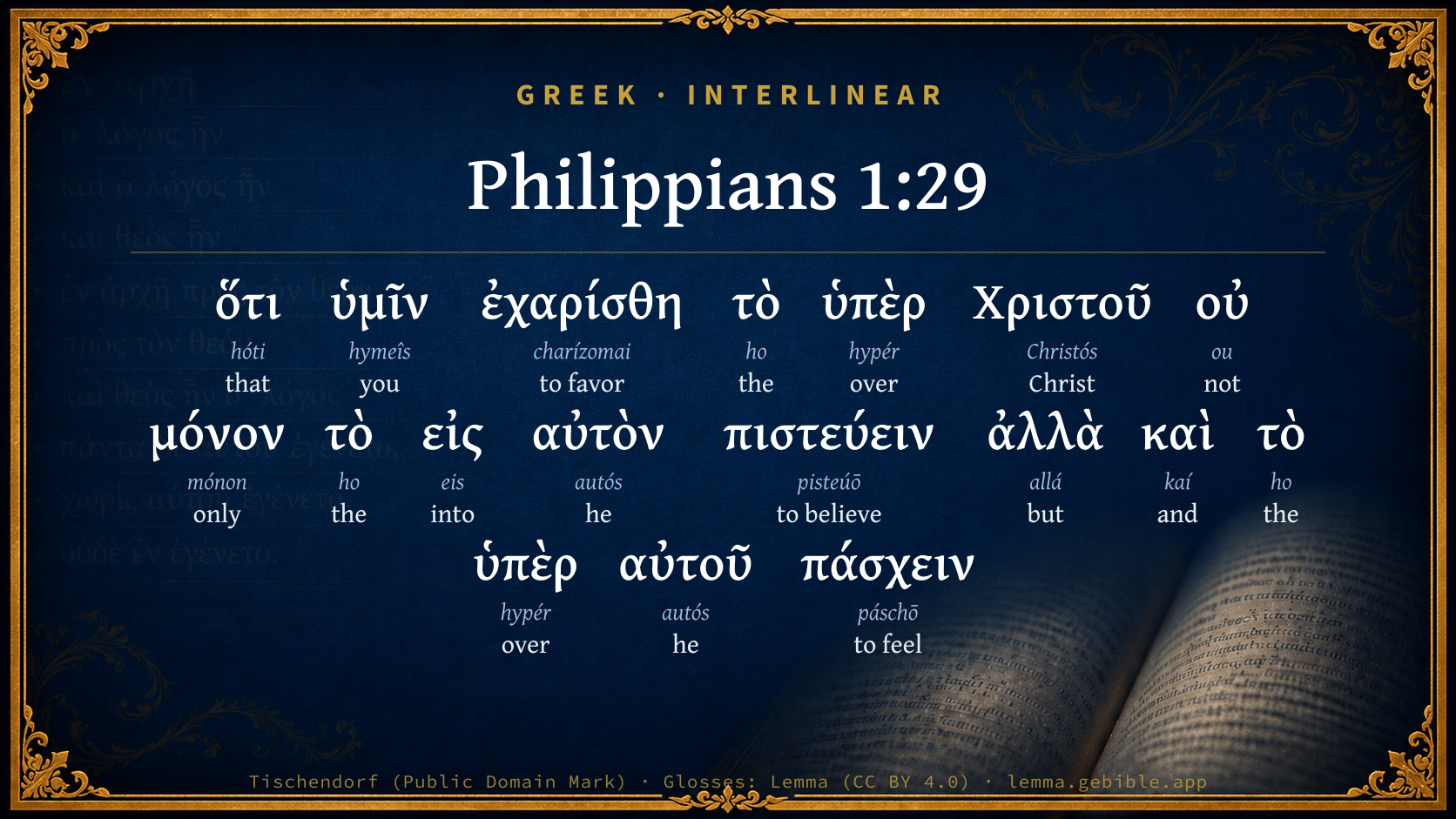
  1. ὅτι hóti G3754 “that” Conjunction
  2. ὑμῖν hymeîs G5210 “you” Personal pronoun, 2nd person, Dative, Plural
  3. τὸ ho G3588 “the” Article, Accusative, Singular, Neuter
  4. ὑπὲρ hypér G5228 “over” Preposition
  5. Χριστοῦ Christós G5547 “Christ” Noun, Genitive, Singular, Masculine
  6. οὐ ou G3756 “not” Particle, Negative
  7. μόνον mónon G3440 “only” Adverb
  8. τὸ ho G3588 “the” Article, Accusative, Singular, Neuter
  9. εἰς eis G1519 “into” Preposition
  10. αὐτὸν autós G846 “he” Personal pronoun, Accusative, Singular, Masculine
  11. πιστεύειν pisteúō G4100 “to believe” Verb, Present, Active, Infinitive
  12. ἀλλὰ allá G235 “but” Conjunction
  13. καὶ kaí G2532 “and” Conjunction
  14. τὸ ho G3588 “the” Article, Accusative, Singular, Neuter
  15. ὑπὲρ hypér G5228 “over” Preposition
  16. αὐτοῦ autós G846 “he” Personal pronoun, Genitive, Singular, Masculine
  17. πάσχειν páschō G3958 “to feel” Verb, Present, Active, Infinitive

About this verse

These counts appear in no published source. They are computed here, from the morphology-tagged text and Lemma’s own curated glosses. What Lemma adds →

18
words
14
distinct lemmas
Pauline Epistles
section

Notable vocabulary

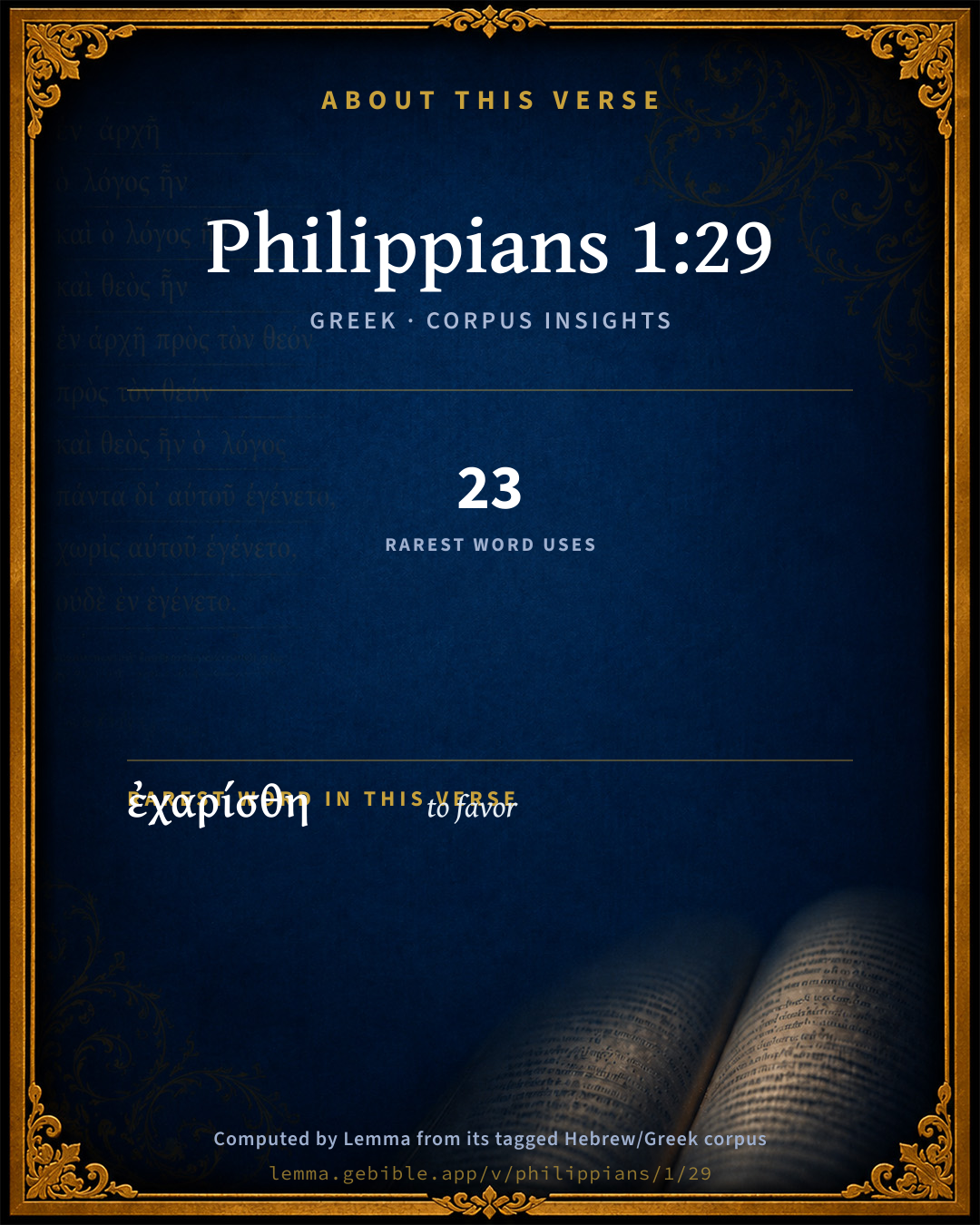
The rarest word here is ἐχαρίσθη to favor G5483 — appearing just 23 times in the whole Greek New Testament.

Shared distinctive vocabulary

ἐχαρίσθη to favor G5483 occurs in 19 verses of the Greek New Testament. Also found in:

Repetition

Words recur within this verse:

  • ὑπὲρ over G5228 ×2
  • τὸ the G3588 ×3
  • αὐτὸν he G846 ×2

Cross-references

14

Topical passages linked to Philippians 1:29 in the Treasury of Scripture Knowledge — connected by theme and wording, ordered by reader-vote popularity; previews shown in the World English Bible.

  • James 1:2 Count it all joy, my brothers, when you fall into various temptations,
  • 1 Peter 4:13 But because you are partakers of Christ's sufferings, rejoice; that at the revelation of his glory also you may rejoice with exceeding joy.
  • Acts 5:41 They therefore departed from the presence of the council, rejoicing that they were counted worthy to suffer dishonor for Jesus' name.
  • Romans 5:3 Not only this, but we also rejoice in our sufferings, knowing that suffering works perseverance;
  • Acts 14:22 confirming the souls of the disciples, exhorting them to continue in the faith, and that through many afflictions we must enter into the Kingdom of God.
  • Matthew 5:11–12 "Blessed are you when people reproach you, persecute you, and say all kinds of evil against you falsely, for my sake.
  • Ephesians 2:8 for by grace you have been saved through faith, and that not of yourselves; it is the gift of God,
  • John 6:44–45 No one can come to me unless the Father who sent me draws him, and I will raise him up in the last day.
  • James 1:17–18 Every good gift and every perfect gift is from above, coming down from the Father of lights, with whom can be no variation, nor turning shadow.
  • Colossians 2:12 having been buried with him in baptism, in which you were also raised with him through faith in the working of God, who raised him from the dead.
  • John 1:12–13 But as many as received him, to them he gave the right to become God's children, to those who believe in his name:
  • Acts 14:27 When they had arrived, and had gathered the assembly together, they reported all the things that God had done with them, and that he had opened a door of faith to the Gentiles.
  • Matthew 16:17 Jesus answered him, "Blessed are you, Simon Bar Jonah, for flesh and blood has not revealed this to you, but my Father who is in heaven.
  • Acts 13:39 and by him everyone who believes is justified from all things, from which you could not be justified by the law of Moses.

Cross-references courtesy of OpenBible.info (CC BY 4.0).

Commentary

Notes on Philippians 1:29 from classic Christian and Jewish commentators (each source and its license shown beneath its notes). The classic Christian expositions comment on the surrounding passage and are grouped to its opening verse, so a note may address several verses; the Jewish commentaries on the Tanakh (Rashi and others) are per-verse, so they appear only where the commentator wrote on this verse.

Lemma curates 59 commentaries, every one of them public domain or Creative Commons licensed, each selected and text-cleaned for this edition rather than reprinted as found. About our sources →

The Biblical Illustrator

Joseph S. Exell

Php_1:29-30

Unto you it is given in the behalf of Christ

Fellowship with the martyrs and confessors

I.

Like faith.

II. Like conflicts.

III. Like honour. (J. Lyth, D. D.)

The Christians life is

I. A life of faith. This faith is--

1. The gift of God--is given you.

2. A particular gift bestowed on a particular people, distinguishing them from all others. The Christian knows and enjoys what no one else does.

II. A life of suffering.

1. Christs life was full of it, and so, therefore, is the believers.

2. Some sufferings he shares with the humanity to which he belongs,

3. Some trials are peculiar to the Christian arising from

(1) sin;

(2) the inherent difficulty of the Christian life;

(3) profession before the world;

(4) self-denial;

(5) consistency in business, etc.;

(6) the opposition of the enemies of the gospel.

III. The life of suffering proves the life of faith. Others are rebellious, or stoically resigned; the Christian bows out of love to Christ, and is supported by Christ in response to faith. (J. W. Reeve, M. A.)

The gifts of God

I. What they are. The power to believe--to suffer.

II. Their inestimable value.

1. Faith brings peace, joy, righteousness.

2. Patient suffering brings deliverance, conquest, glory. (J. Lyth, D. D.)

Unto you it is given to believe

I. Faith is the gift of God. He supplies the ground, the means, the power.

II. It is given to you. You can accept the ground, use the means, exercise the power.

III. How far have you improved it? You cannot reach the higher standpoint before the lower; every one has a measure of ability; therefore repent, believe. (J. Lyth, D. D.)

Unto you it is given to suffer

God gives you--

I. The opportunity.

II. The power.

III. The honour.

IV. The reward of suffering for Christ. (J. Lyth, D. D.)

Suffering for Christ

It is said that men learned to despise pain before Christ. This is true. But where, save in Christian literature and history, do you find suffering converted into joy, esteemed as an honour, and borne as a badge of royalty. As a king grants charters and honours, so Christ as our Sovereign gives His disciples the privilege of faith and alliance to Him. And he still further honours them by permitting them to suffer on His behalf. Let us see what kind of sufferings are included in this charter.

I. All inflicted directly for our adhesion to the name and worship of Christ. Physical persecution, social, domestic.

II. All arising from the effectual preaching of truth, whether by ministers or private disciples. We are not to count the suffering which comes from our own headstrong rashness in speech or administration, but that which comes from a calm inflexible advocacy of the truth as it is in Jesus. For this it is an honour to suffer.

III. All which arises from the application of Christian truth to human disposition and conduct, to the manners of society, to the selfishness and injustice of men. Labourers in this harvest field will have their bosom full of sheaves, and their head crowned with thorns. Let a man have a conscience, and he will perforce find himself a warrior. What affinity is there between generosity and greed.

IV. All suffering not of the nature of obloquy. All self-denials, watchings, labours, cares, weariness, incident to a life devoted to the cause of God. Those whose parish is the dungeon, the hospital, the purlieus of vice.

V. All consequent upon a strife with self and circumstances for the purpose of augmenting Christian dispositions. Our internal conflicts are often greater than our external. What suffering is involved in our strife with the world, the flesh, and the devil; in our endeavour to be patient under sickness and misfortune, resigned in the midst of sorrows and bereavement.

VI. All arising from the service we perform on behalf of others. Mothers with their children in hearing and up-bringing, friends, philanthropists. Conclusion: I remark in view of this exposition--

1. We are not to seek suffering on purpose. Suffering without moral impulse is of no account.

2. It is a shame for a man to entertain an ideal of Christian life which is ease and freedom from inconvenience.

3. All true education consists in preparation for and endurance of suffering Let parents see to this.

4. We may form a proper judgment of those who are called to labour for God Those prepared to regard suffering as an honour, and to count the victory as worth any price. (H. W. Beecher.)

The value of suffering

To this refiners fire may doubtless be ascribed in part the lustre and purity of their faith as compared with other Churches. (Bishop Lightfoot.)

Persecutions only raked away the ashes, so that the spiritual flame was steady and brilliant. (Professor Eadie.)

The grace and honour of suffering

The men whom a general, at the critical moment of a great battle, specially appoints to hold the key of his position, or whom, in the assault of a besieged city, he sends on a forlorn hope, are, by his choice of them for peril and probable suffering, marked out as in his judgment the bravest of the brave. Their comrades, even while rejoicing in their hearts, it may be, that the selection has left themselves out, feel that those on whom the choice has fallen are honoured. Similarly, is there not grace shown in the choice made by the Captain of salvation, when in His providence He calls this soldier of the cross, and that, to suffer or die under the standard? In the old persecuting times in our country, men who bore in their bodies the marks of the Lord Jesus, in limbs crushed by the iron boot or torn by the rack--looking back in after days upon the patience which the Saviour had given them amid their anguish, and the increase of spiritual wisdom and energy which had come through the trial to themselves, and to some extent also to others, could not but esteem the suffering for Christ as a gift of grace. When under sentence of death, good Bishop Ridley wrote thus to his relatives: I warn you all, my beloved kinsfolk, that ye be not amazed or astonished at the kind of my departure or dissolution; for I assure you I think it the most honour that ever I was called unto in all my life. And therefore I thank God heartily for it, that it hath pleased Him to call me, of His great mercy, unto this high honour, to suffer death willingly for His sake and in His cause; unto the which honour He called the holy prophets, and His dearly beloved apostles, and His blessed chosen martyrs. And when the end came, and Latimer and he were burned at the same stake--whilst the persecutors could see only the flame which consumed the flesh, the faith of the martyrs could discern for themselves a chariot of fire waiting to bear them home to their Lord, and for their country a fire of pious zeal lighted up, which all the arts of the wicked one should never be able to put out. There was great grace there. (R. Johnstone, LL. B.)

The service of suffering

Dr. Tronchin, talking one day with the son of Caesar Malan about his father, who was lying on his deathbed, said, How often have I not heard even his friends say, when I spoke with admiration of the work of your father, Malan serves God with fire, courage, and perseverance, because the service which God requires of him is an active service, and consists in an activity which responds to his tastes and talents. But wait before judging him definitely until God calls him to a passive service of suffering. God is doing this under our eyes at this hour, and under our eyes also His servant is found faithful. (J. F. B. Tinling, B. A.)

The honor of suffering for Christ

One of the witnesses for the truth when imprisoned for conscience sake in the days of Queen Mary, is said to have thus written to a friend: A prisoner for Christ! What is this for a poor worm! Such honour have not all the saints. Both the degrees which I took at the University have not set me so high as the honour of becoming a prisoner of the Lord.

The mystery of suffering

Unaccountable this! said the Wax, as from the flame it dropped melting upon the Paper beneath. Do not grieve, said the Paper; I am sure it is all right. I was never in such agony! exclaimed the Wax, still dropping. It is not without a good design, and will end well, replied the Paper. The Wax was unable to reply at once, owing to a strong pressure; and when it again looked up it bore a beautiful impression, the counterpart of the seal which had been applied to it. Ah! I comprehend now, said the Wax, no longer in suffering. I was softened in order to receive this lovely durable impress. Yes; I see now it was all right, because it has given to me the beautiful likeness which I could not otherwise have obtained. (Mrs. Prosser.)

.

The Biblical Illustrator, edited by Joseph S. Exell (c. 1880s–1900s) — public domain. Text from a community e-Sword module.

Joseph Benson's Commentary

Php 1:29-30. For unto you it is given — Εχαρισθη, it is granted as a favour, in the behalf of Christ, on account of his merits and intercession, and for the promotion of his cause and interest, not only to believe on him, (faith itself, as well as Christ and his truth, the objects of it, being the free gift of God,) but also to suffer for his sake — This, as well as your faith, and the blessings which you receive by faith, is granted you as a special token of God’s love to you, and of your being in the way of salvation. The apostle wished the Philippians to consider their sufferings for Christ as an honour, and an important means of good, and to rejoice in them. Thus it is said of Peter and John, Act 5:41; They departed from the council rejoicing that they were counted worthy to suffer shame for his name. Having the same kind of conflict with your adversaries. The word αγωνα, here rendered conflict, is the general name by which the Greeks expressed all the different combats in their games. And because in these contests the contenders struggled long and hard for victory, the word was applied to express any sort of trial or trouble, to which men exposed themselves in the course of their pursuits: which ye saw in me when I was with you, Act 16:12-19, &c. For the apostle seems principally to allude to the conflict which he sustained at Philippi, on account of the damsel out of whom he had cast the spirit of divination, and whose masters got him scourged, and put in the stocks. Besides this, however, on his second coming to Philippi, after his long residence at Ephesus, he suffered other afflictions, of which the Philippians also were witnesses, 2Co 7:5. And now hear to be in me — It seems the Philippians had received an account from some of the brethren, who had come from Rome to Philippi, of the apostle’s present conflict with the unbelieving Jews, the Judaizing teachers, and the heathen magistrates. A similar conflict the Philippians themselves sustained, being persecuted for the gospel, and their bitterest persecutors being their own countrymen.

Joseph Benson's Commentary on the Old and New Testaments (1811–1818) — public domain. Text from a community e-Sword module.

Tyndale Open Study Notes

Tyndale Open Resources

1:29 the privilege of suffering: What the world considers dishonorable, Christians consider an honor because it is for him—it honors Christ.

Tyndale Open Study Notes — © Tyndale Open Resources, licensed CC BY-SA 4.0. Text via the HelloAO Bible API.

Bengel's Gnomon

Johann Albrecht Bengel

Php 1:29. Ὅτι, because) The force of the declaration falls upon the word ἐχαρίσθη, God bestowed it of grace. The gift of grace is a sign of salvation.—τὸ ὑπὲρ) It is repeated after the intervening clause, τὸ ὑπὲρ αὐτοῦ πάσχειν.—πιστεύειν· πάσχειν, to believe—to suffer) Php 1:27, at the end.

Bengel's Gnomon of the New Testament — English translation (T&T Clark, Edinburgh, 1860) — public domain. Text from a community e-Sword module.

Meyer's Critical & Exegetical Commentary

Heinrich August Wilhelm Meyer

Php_1:29. Ὅτι is argumentative. Καὶ τοῦτο ἀπὸ Θεοῦ, I say, since indeed to you it was granted, etc. This grant distinguishing you is the practical proof, that the just expressed ἀπὸ Θεοῦ is indubitably right, and that consequently the ἔνδειξις of your final salvation which is afforded to the adversaries in your undauntedness is a divine ἔνδειξις, a token given by God.[83] Hofmanns view, that ὅτι specifies the reason why God imparts to them what has been before stated, is based upon the erroneous reading ὑμῖν in Php_1:28; and is itself erroneous, because ὅτι would introduce merely the self-evident thought that they had not sought out their suffering wilfully, but had had it given to them by God, and because, for the purpose of marking the alleged contrast to the wilfulness, not ὑμῖν, but ἀπὸ Θεοῦ again would have been emphatically prefixed, and consequently Paul must have written: ὅτι ἀπὸ Θεοῦ ὑμῖν ἐχαρίσθη κ.τ.λ. Hofmann curiously explains the emphasized ὑμῖν, as if Paul meant to say that with respect to their sufferings the case stood exactly as with his own. In that case he must at least have written, in prospect of Php_1:30, καὶ ὑμῖν, to you also.

ὑμῖν] emphatically put first, corresponding to the previous ὑμῶν δὲ σωτηρίας.

ἐχαρίσθη] donatum est; by whom, is self-evident. 1Co_2:12.

τὸ ὑπὲρ Χριστοῦ] as if the πάσχειν was immediately to follow. The apostle does not leave this unwritten purposely, in order to bring into prominence in the first place the idea of ὑπέρ, as Hofmann artificially explains. But here his full heart interposes, after τ. ὑπὲρ Χριστοῦ, and before he writes πάσχειν, the fresh thought οὐ μόνον τὸ εἰς αὐτ. πιστεύειν, so that ἀλλὰ καὶ must now be also added; and, on account of the different prepositional relation (εἰς) introduced, the τὸ ὑπὲρ Χριστοῦ already expressed is again taken up by τὸ ὑπὲρ αὐτοῦ. Thus οὐ μόνον … ὑπὲρ αὐτοῦ appears as a parenthesis of more special definition, after which the πάσχειν, which had been prepared for by τὸ ὑπὲρ Χριστοῦ, but is only now introduced, is to be dwelt upon with emphasis: to you the gift of grace is granted, in behalf of Christnot only to believe on Him, but also for Himto suffer. Plat. Legg. x. p. 802 C: εἰ δὲ φανήσεται ψυχὴ πρῶτον, οὐ πῦρ οὐδὲ ἀὴρ, ψυχὴ δὲ ἐν πρώτοις γεγενημένη. See also Dissen, ad Dem. de cor. p. 431; Fritzsche, ad Matth. p. 501. It is an awkward construction, to take τὸ ὑπὲρ Χ. absolutely and (notwithstanding the subsequent ὑπὲρ αὐτοῦ) in the sense: as to what concerns Christ (Beza, Camerarius, Calovius, and others, including Matthies and Rilliet). For the conception of suffering for Christ as a high divine distinction, see already Act_5:41; comp. Mat_5:11 f. Comp. on Php_1:7.

[83] At the same time it is to be observed here also (comp. on ver. 28) that this divine pointing to the final salvation of believers was in fact before the adversaries, and that their non-recognition of it altered nothing in this objective relation.

Meyer — Critical and Exegetical Commentary on the New Testament — English translation by Peter Christie, edited by Frederick Crombie (T&T Clark, 1880) — public domain. Text from a community e-Sword module.

Expositor's Greek Testament

ed. W. Robertson Nicoll

Phi 1:29 . ὅτι … ἐχαρίσθη . We are inclined to join this clause immediately to μὴ πτυρόμενοι (so also Hpt [81] ). The prospect of suffering was apt to terrify them. But when they view suffering in its true light, they will discover that it is a gift of God’s grace ( ἐχαρ .) instead of an evil. τὸ ὑπὲρ κ . τ . λ . The Apostle intended to insert πάσχειν after Χρ ., but for a moment he pauses. To emphasise the real value of suffering for Christ’s sake, he compares it with that which they all acknowledge as the crowning blessing of their lives, faith in Him. As to the form of the sentence, this is a favourite rhetorical device of Paul’s. See J. Weiss, Beiträge , p. 11 n. οὐ μόνον . μή might have been expected. “When a limitation of an infinitive or of its subject is to be negatived rather than the infinitive itself, the negative οὐ is used instead of μή . This principle applies esp [82] in the case of the adverb μόνον ” (Burton, MT [83] , p. 183). εἰς αὐτόν . The deepest aspect of faith, the intimate union into which the soul is brought.

[81] Haupt.

[82] especially.

[83] Moods and Tenses (Burton, Goodwin).

The Expositor's Greek Testament, edited by W. Robertson Nicoll (1897–1910) — public domain. Text from a community e-Sword module.

Geneva Bible (1599)

Geneva Bible translators

He proveth that his saying, that persecution is a token of our salvation, because it is a gift of God to suffer for Christ, which gift he bestoweth upon his own, as he doth the gift of faith.

Geneva Bible (1599) marginal notes — public domain. Text via Bolls.life.

Jamieson, Fausset & Brown

Robert Jamieson, A. R. Fausset & David Brown

For--rather, a proof that this is an evident token from God of your salvation, "Because," &c.

it is given--Greek, "it has been granted as a favor," or "gift of grace." Faith is the gift of God (Eph 2:8), not wrought in the soul by the will of man, but by the Holy Ghost (Joh 1:12-13).

believe on him--"To believe Him," would merely mean to believe He speaks the truth. "To believe on Him," is to believe in, and trust through, Him to obtain eternal salvation. Suffering for Christ is not only not a mark of God's anger, but a gift of His grace.

Jamieson, Fausset & Brown — Commentary Critical and Explanatory on the Whole Bible (1871) — public domain (CC PDM 1.0). Text via the HelloAO Bible API.

Adam Clarke's Commentary

Verse 29. Unto you it is given in the behalf of Christ] Ὑμιν εχαρισθη· To you it is graciously given; it is no small privilege that God has so far honoured you as to permit you to suffer on Christ's account. It is only his most faithful servants that he thus honours. Be not therefore terrified by your enemies; they can do nothing to you which God will not turn to your eternal advantage. We learn from this that it is as great a privilege to suffer for Christ as to believe on him; and the former in certain cases (as far as the latter in all cases) becomes the means of salvation to them who are thus exercised.

Adam Clarke's Commentary on the Bible (1810–1826) — public domain. Text from a community e-Sword/MySword module.

John Calvin's Commentaries

29. To believe. He wisely conjoins faith with the cross by an inseparable connection, that the Philippians may know that they have been called to the faith of Christ on this condition — that they endure persecutions on his account, as though he had said that their adoption can no more be separated from the cross, than Christ can be torn asunder from himself. Here Paul clearly testifies, that faith, as well as constancy in enduring persecutions, is an unmerited gift of God. And certainly the knowledge of God is a wisdom that is too high for our attaining it by our own acuteness, and our weakness shews itself in daily instances in our own experience, when God withdraws his hand for a little while. That he may intimate the more distinctly that both are unmerited, he says expressly — for Christ’s sake, or at least that they are given to us on the ground of Christ’s grace; by which he excludes every idea of merit.

This passage is also at variance with the doctrine of the schoolmen, in maintaining that gifts of grace latterly conferred are rewards of our merit, on the ground of our having made a right use of those which had been previously bestowed. I do not deny, indeed, that God rewards the right use of his gifts of grace by bestowing grace more largely upon us, provided only you do not place merit, as they do, in opposition to his unmerited liberality and the merit of Christ.

John Calvin's Commentaries (1540-1563) — public domain. Text from the Calvin Translation Society English edition (1840s-50s) via the Christian Classics Ethereal Library (ccel.org). Calvin's coverage is partial (roughly two-thirds of the Bible); uncommented books and verses are honest gaps, never fabricated. The 19th-century editor's footnotes and remarks are omitted so the notes are faithfully Calvin's own voice.

Ellicott's Commentary for English Readers

(29) For (or, because) unto you it is given in the behalf of Christ.—The force lies, first, in the phrase “it is given” (rather, it was given, from the beginning)—for the original signifies “it was granted as a privilege” or “favour” (as in Act_27:24; 1Co_2:12; Gal_3:18)—and next in the words “on behalf of Christ.” The fearlessness of the Christian is a gift of God, not an inherent stoic self-sufficiency. It rests indeed upon the sense that it is a privilege to suffer (see Act_5:41) in the cause of truth, yet still more on the belief that such suffering is for no abstract principle, but on behalf of Christ and with Christ. (See Php_2:17-18.)

Not only to believe . . .—The original shows that St. Paul speaks as if he originally intended simply to say “it is given on behalf of Christ to suffer.” But to show whence the impulse of that brave willingness to suffer proceeds, he inserts “not only to believe on Him,” and then finishes the sentence, “but on His behalf to suffer.”

A Bible Commentary for English Readers, edited by Charles John Ellicott (1878–1897) — public domain. Text from a community e-Sword module.

The Cambridge Bible for Schools and Colleges

gen. ed. J. J. S. Perowne

29. For, &c.] He carries out the statement just made (see last note but one), by saying that not only the grounds of faith in Christ, and the power to believe, but the occasion of suffering for Christ, and the power to meet the suffering, are things of Divine grant and gift.

it is given] Lit. “it was given.” But the A.V. is true to English idiom. The verb rendered “give” denotes specially a grant of free favour or kindness. It is thus often used of free forgiveness, e.g. Luk_7:42; 2Co_2:7; 2Co_2:10; Eph_4:32; sometimes of the work of free grace and salvation, e.g. Rom_8:32; 1Co_2:12. (In Act_3:14; Act_25:11; Act_25:16, it is used of an arbitrary, extra-legal, giving up of a prisoner to others, either for liberation or penalty.) Thus the word here, with its associations of sovereignty, favour, boon, forms a noble paradox.

on the behalf of Christ] The structure of the Greek indicates that the Apostle was about to write simply, “it is granted you to suffer on behalf of Christ”, but that he suspended the thought and phrase to insert, “not only to believe on Him but to suffer on His behalf.” Thus “on the behalf of Christ” anticipates here the close of the verse, where it is repeated.

to believe on him] Lit., “into Him,” a phrase suggesting the directness and holdfast of saving faith. But this speciality of meaning must not be pressed far, for the phrase occurs here and there in connexions not naturally adapted to such thought; e.g. Joh_2:23; Joh_12:42.—The Greek verb is in the present tense, and points to the continuousness of the action of faith. The Christian, having once believed, lives by still believing. See Rom_11:20; Gal_2:20; Heb_10:38.—Faith in Christ is here incidentally spoken of as a grant of Divine grace. See further on this, Eph_2:8, and note in this Series.

for his sake] Better with R.V., in His behalf, to mark the connexion of thought with the “in the behalf of Christ” just above.

The Cambridge Bible for Schools and Colleges (gen. ed. J. J. S. Perowne; Cambridge University Press, 1878–1918) — public domain. Text from a community e-Sword module.

John Gill's Exposition

For unto you it is given in the behalf of Christ,.... For the sake of his Gospel, for the good of his interest, and the glory of his name. The Alexandrian copy reads, "to us it is given", &c,

not only to believe in him; for faith in Christ, which is not merely believing that he is the Christ, and all that is said of him, or all that he himself says, but is a seeing of the Son, a going to him, receiving, embracing, leaning, relying, and living upon him, as God's salvation, is a pure gift of grace; it is not in nature, nor in every man, and in whom it is, it is not of themselves, it is the gift of God; the first implantation of it, all its acts and exercise, its increase, and the performance of it at last with power, are all owing to the grace of God; and this is only given to the elect, for it is a distinguishing gift; it is given to them, and them alone, and, therefore called the faith of God's elect:

but also to suffer for his sake; for the sake of Christ personal; for the sake of Christ mystical, for his body's sake the church; for the sake of his Gospel, and for the sake of his cause and interest in the world: now to suffer in name and character, in estate or person, not as an evildoer, but as a Christian, is a gift of God, as faith in Christ is; all the sufferings of the saints are appointed by God; their being called forth to suffer shame for the sake of Christ, is an high honour conferred upon them; all the grace and strength by which they are supported under sufferings for Christ are given to them; and all the glory consequent upon them is not merited by them, which are by no meant to be compared with it, but is the free gift of God through Christ. The same persons to whom it is given to believe in Christ, to them it is given to suffer for him; and they all do in some shape or another, though some more, others less; yet all are partakers of sufferings for Christ, and so are conformed to him their head, and hereby enter the kingdom: now all this is said, as containing so many reasons to encourage believers to have their conversation as becomes the Gospel of Christ, by a steady adherence to it, and a joint contention and striving for it, without being intimidated by their enemies.

John Gill's Exposition of the Whole Bible (1746–1763) — public domain (CC PDM 1.0). Text via the HelloAO Bible API.

Trapp's Complete Commentary

John Trapp

29 For unto you it is given in the behalf of Christ, not only to believe on him, but also to suffer for his sake;

Ver. 29. For unto you it is given] As a high honour not only to believe (though that is a great matter; for he that believeth hath set to his seal that God is true, hath given God a testimonial, such as is that Deu 32:4), but also (as a further favour) to suffer for his sake: this is the lowest subjection that can be to God, but the highest honour both to him and us. This made Latimer, after the sentence pronounced on him, cry out, "I thank God most heartily for this honour." Saunders said, "I am the unmeetest man for this high office that ever was appointed to it." "Such an honour it is," said Careless, martyr, "as the greatest angel in heaven is not permitted to have. God forgive me mine unthankfulness."

John Trapp, A Commentary or Exposition upon All the Books of the Old and New Testament (1647–1656) — public domain. Text from a community e-Sword module.

Albert Barnes' Notes on the Bible

For unto you - Unto you as Christians. This favor is granted unto you in your present circumstances.

It is given - God concedes to you this privilege or advantage.

In the behalf of Christ - In the cause of Christ, or with a view to honor Christ. Or, these things are brought on you in consequence of your being Christians.

Not only to believe on him - It is represented here as a privilege to be permitted to believe on Christ. It is so:

(1) It is an honor to a man to believe one who ought to be believed, to trust one who ought to be trusted, to love one who ought to be loved.

(2) It is a privilege to believe on Christ, because it is by such faith that out sins are forgiven; that we become reconciled to God, and have the hope of heaven.

(3) It is a privilege, because it saves the mind from the tortures and the deadly influence of unbelief - the agitation, and restlessness, and darkness, and gloom of a skeptic.

(4) It is a privilege, because we have then a friend to whom we may go in trial, and on whom we may roll all our burdens. If there is anything for which a Christian ought to give unfeigned thanks, it is that he has been permitted to believe on the Redeemer. Let a sincere Christian compare his peace, and joy, and hope of heaven, and support in trials, with the restlessness, uneasiness, and dread of death, in the mind of an unbeliever; and he will see abundant occasion for gratitude.

But also to suffer for his sake - Here it is represented as a privilege to suffer in the cause of the Redeemer - a declaration which may sound strange to the world. Yet this sentiment frequently occurs in the New Testament. Thus, it is said of the apostles Act 5:41, that “they departed from the presence of the council, rejoicing that they were counted worthy to suffer shame for his name;” Col 1:24. “Who now rejoice in my sufferings for you;” 1Pe 4:13. “But rejoice, inasmuch as ye are partakers of Christ’s sufferings;” compare Jam 1:2; Mar 10:30; see the notes at Act 5:41. It is a privilege thus to suffer in the cause of Christ:

(1)Because we then resemble the Lord Jesus, and are united with him in trials;

(2)Because we have evidence that we are his, if trials come upon us in his cause;

(3)Because we are engaged in a good cause, and the privilege of maintaining such a cause is worth much of suffering; and,

(4)Because it will be connected with a brighter crown and more exalted honor in heaven.

Albert Barnes' Notes on the Bible (1834–1885) — public domain. Text from a community e-Sword/MySword module.

Matthew Poole's English Annotations

For unto you it is given; he adds a further argument to move them unto that he had exhorted, from God’s freely bestowing, of his mere grace, what he had required of them.

In the behalf of Christ; upon the account of Christ’s merit and mediation; not that they could have either evangelical faith, or patience, by virtue of their own strength, Phi 4:13.

Not only to believe on him; that they did not only believe Christ, but believe on him, was not from any power of their own, Joh 6:37,44, but of God’s free gift, Eph 2:8, as they had an instance amongst them in Lydia, Act 16:14; unto her and others was this victorious grace of faith freely given by the hearing of the word, which was not unto many others that heard, Mat 13:11; 2Th 3:2; Tit 1:1; and as the grace itself was given, so was the exercise of it.

But also to suffer for his sake; upon the account of Christ, patience was given; so that to suffer, here, doth not only import a power to suffer, but actual suffering; not only the habit of faith, but the act of believing, even as the fruits of trees at the first creation were produced, as well as the trees which had a power to bear them: wherefore, if, by the grace of God, and Spirit of faith, they were empowered actually to believe, Mar 9:24; 1Co 15:10; 2Co 4:13, having trust through Christ God-ward, 2Co 3:4; and upon the same account they were continually enabled to suffer, not simply, but in bearing testimony to Christ, Act 5:41; 1Pe 3:14; 4:16; they might be of good comfort and courage, to the daunting of their adversaries.

Matthew Poole's English Annotations on the Holy Bible (1683–1685) — public domain. Text from a community e-Sword/MySword module.

Whedon's Commentary on the Bible

Daniel D. Whedon

29. For unto you—Steadfastness in suffering foreshadows eternal glory, because they are called to the grace of suffering as well as the grace of believing.

Given—At conversion, as a free bestowment of grace for Christ’s sake, as are all spiritual gifts. It is a double gift: (1) to believe in Jesus, which saves, and (2) to suffer for his sake. It is as truly a privilege to suffer for Christ as it is to believe in him; and blessed are they who can receive both as given in the behalf of Christ.

Daniel D. Whedon (gen. ed.), Commentary on the Old and New Testaments (1874–1909) — public domain. Text from a community e-Sword module.

The Pulpit Commentary

For unto you it is given in the behalf of Christ, not only to believe on him, but also to suffer for his sake. On you it was conferred (ecarisyh) as a gracious gift, a free spontaneous act of Divine bounty. Faith in Christ is the gift of God, so is "the fellowship of his sufferings." It is not a burden, but a privilege:" In all these things we are more than conquerors through him that loved us.

Vers. 29, 30. The privilege of suffering.

There is reason given, by way of encouragement, for their steadfastness in suffering. "For unto you it was freely given on the behalf of Christ, not only to believe upon him, but also to suffer for his sake.

I THE DISPENSATION OF SUFFERING ASSIGNED TO THE SAINTS. Their sufferings fall not cut by chance. They are divinely ordered. They are even divinely given.

1. Their ability to endure these sufferings is the gift of Christ. "In the world ye shall have tribulation; in me ye shall have peace." "I can do all things through Christ which strengtheneth me.

2. Their comforts in sufferings are the gift of Christ. Thus they are led to rejoice in tribulation, for he has sent his Comforter to dwell in their hearts.

3. The sufferings in question are profitable to themselves as well as honoring to the Lord. He doth not afflict willingly, but for our profit. Through our suffering we may glorify the Lord by encouraging and confirming the faith of others.

4. The sufferings will not be without, reward. "If we suffer with him, we shall also reign with him". (2Ti_2:12) "Blessed are you when men persecute you... for great is your reward in heaven". (Mat_5:11, Mat_5:12)

II FAITH IN CHRIST MUST GO BEFORE SUFFERING FOR HIM, "Unto you it is given... to believe upon him.

1. Faith is Gods gift, as it is the first effect of regeneration, which is God"s work. Christ purchased for us, not merely salvation, but all the means thereunto. It is the Lord who opens our eyes, renews our wills, and persuades and enables us to accept Christ in the gospel.

2. It is by this faith we are enabled to suffer patiently. Without the shield of faith we could not resist the anger of persecutors. By faith we are made strong at the root like the seaweed that grows on the rock, no matter how much it may be lashed hither and thither by the ceaseless action of the waves.

III ENCOURAGEMENT TO PATIENT PERSEVERANCE BY THE EXAMPLE OF THE APOSTLE. "Having the same conflict which ye saw in me, and now hear to be in me." There must be a right spirit as well as a good cause to suffer for.

1. The similarity between the sufferings of the apostle and those of his converts.

(1) It was in the same place Philippi. (Act_16:19)

(2) It was, probably, from the same adversaries, Gentiles and Jews.

(3) It was a conflict in both cases trying to flesh and blood.

2. The sufferings of the ministers of Christ ought to encourage their people to like patience and firmness. T.C.

Suffering in behalf of Christ.

St. Paul feels peculiar sympathy for the Philippians on account of the fact that they are like himself in suffering persecution on account of Christ. Common sufferings promote common sympathies. Only they who have suffered themselves can understand the sufferings of others. Thus it seems to be part of the mission of pain to enlarge and deepen our sympathies.

I CHRISTIANS MAY BE CALLED TO SUFFER IN BEHALF OF CHRIST. Let a man count the cost. To be a Christian is not only to believe on Christ. It may involve loss, pain, death.

1. We may suffer through our connection with Christ. Thus was it with the persecuted. Now, we may have to give up lucrative but un-Christlike occupations, and to meet with ridicule or opposition in our attempt to serve Christ faithfully.

2. We may suffer for the cause of Christ. We may serve him by our suffering. Faithful endurance is itself a grand witness to Christ. The martyr preaches Christ as truly as the missionary. Even the patient endurance of pain because it is Christ"s will that we should bear it does honor to Christ. Many a helpless sufferer, who thinks his life a useless burden to others, teaches such high lessons by the spirit of faith and love with which he endures, that he serves Christ more effectually in his sick-chamber than others by the most vigorous activity in wide fields of enterprise.

II IT IS A REAL BLESSING TO BE PERMITTED TO SUFFER IN BEHALF OF CHRIST. St. Paul regards the fact with joy.

1. It is proof of fidelity. Not being "affrighted by the adversaries," the presented have their faith confirmed in their trials.

2. It is means of serving Christ. It is an honor and a joy to serve Christ in any way, and most of all where the service is most effective.

3. It is a proof of peculiar distinction. The best soldiers are selected for the hardest service. The martyrs are the flower of the Christian army. It will lead to the greatest reward,

(1) because the most arduous task will justly receive the richest recompense; and

(2) because the peace and joy of heaven will be intensified by contrast with the pain and war of earth. Only the toiler can know the true sweetness of rest, and only the sufferer the deep blessedness of heaven. W.F.A.

The Pulpit Commentary (1880–1919), ed. H.D.M. Spence-Jones & Joseph S. Exell — public domain. Text from a community e-Sword module.

John Wesley's Explanatory Notes

For to you it is given - As a special token of God's love, and of your being in the way of salvation.

John Wesley, Explanatory Notes Upon the Whole Bible (1754–1765) — public domain. Text via the GEBible commentary corpus.

Burkitt's Expository Notes on the New Testament

William Burkitt

These words come in by the way of encouragement to the practice of the fore-mentioned duty, namely, of courageous suffering for the gospel of Christ; he tells them, that as ability to believe on Christ, so likewise power to suffer for Christ, were both the gift of God, and as such purchased by Christ for them, and freely bestowed upon them.

Learn hence, 1. That it is the duty of all the disciples and followers of Jesus, not only to believe in him, but cheerfully to suffer for him, when he calls them to it;--not only to believe, but to suffer.

Learn, 2. That suffering for Christ is the gift of God, as well as faith in Christ: Unto you it is given, not only to believe but to suffer.

1. Ability to suffer is his gift; it is the purchase of his merits, it is the fruit of his mediation. Preparation for suffering, and patience under suffering, are the gift of Christ.

2. As abilities for suffering, so the comforts of suffering, are the gift of Christ; through him it is that his saints glory in tribulation, and their trials are not only tolerable, but joyous.

In short, to suffer for Christ, is,

1. A free gift; and,

2. An honourable gift; and,

3. A special and peculiar gift; it is a gift peculiar to saints; yea, peculiar only to some saints.

It is only peculiar to saints; the angels glorify Christ by doing, but not by suffering. I doubt not, but had the angels bodies of flesh, as saints have, they would be glad to lay their necks on the block for Christ, as saints do. But this is the peculiar privilege of believers; unto you it is given, and not to them. And although a suffering disposition, a readiness and preparation of mind to glorify Christ by suffering, is given to all believers; yet the honour of actually suffering death for Christ is given but to a few.

Learn, 3. That faith in Christ must go before suffering for Christ; it must first be given to us to believe on him, before we can suffer for his sake; then only are sufferings truly Christian, and an evidence of salvation, when the sufferer is first a believer: without the shield of faith, we can no more resist the fury of the persecutors, than we can repel the fiery darts of the destroyer; Unto you it is given, on the behalf of Christ, not only to believe on him, but, &c.

William Burkitt's Expository Notes on the New Testament (1700–1703) — public domain. Text from a community e-Sword module.

The People's New Testament

B. W. Johnson

29. For to you it is given. Two things were granted: (1) The privilege of believing in Christ. (2) That of suffering for Christ. Such was the lot of all ancient Christians. See Heb. 12:3, 4, and 1 Peter 4:16.

B. W. Johnson's The People's New Testament with Notes (1889–1891) — public domain. Electronic text from the Christian Classics Ethereal Library (CCEL) ThML edition.

Cambridge Greek Testament for Schools and Colleges

29. ὅτι … ἐχαρίσθη. The link of thought (ὅτι) is that their trying circumstances, and the benefits of them, were, as he has just hinted, no evil, but a gift of love (ἐχαρίσθη) from their Divine Friend.

ὑμῖν. Slightly emphatic by position. As if to say, “Yes, it is you whose ‘salvation’ is thus ‘indicated,’ whatever doubts and fears your trials may suggest.” They were to take fully home the concealed token of final blessing.

ἐχαρίσθη. The verb denotes specially a grant of free favour, and thus often the grant of gratuitous forgiveness, as 2Co 2:7; 2Co 2:10; Eph 4:32; sometimes the work of free grace and salvation at large, as Rom 8:32; 1Co 2:12. (In Act 3:14, ᾐτήσασθε ἄνδρα φονέα χαρισθῆναι ὑμῖν, we still have the word used of a grant “free” in the sense of its being arbitrary, extra-legal.)

τὸ ὑπὲρ Χριστοῦ. The article τὸ is explained when we see that the sentence rose first in the writer’s mind thus:—ὑμῖν ἐχαρίσθη τὸ ὑπὲρ Χριστοῦ πάσχειν, “To you was given the boon of suffering for Christ.” Then, with characteristic wealth of thought, he brought in also the boon of faith in Christ; and the present somewhat complex grammar is the result, in which the words οὐ μόνον τὸ εἰς αὐτὸν πιστεύειν ἀλλὰ καὶ are parenthetical, and ὑπὲρ αὐτοῦ redundant.

εἰς αὐτὸν πιστεύειν. The phrase indicates the directness and intensity of saving faith; not that this explanation is to be pressed everywhere, for see e.g. Joh 2:23, where the ἐπίστευσαν εἰς τὸ ὄνομα αὐτοῦ refers to a faith not wholly satisfactory.—Faith in Christ is here incidentally viewed as a gift of Divine grace. See Eph 2:8, and note in the Camb. Bible for Schools.

ὑπὲρ αὐτοῦ πάσχειν. Alike the call, and the power, to “suffer for Him” were a glorious boon; not only because of the coming results in glory (Rom 8:17; 1Pe 4:13), but because of the profound communion with the Crucified Lord conveyed in and with the suffering.

Cambridge Greek Testament for Schools and Colleges (Cambridge University Press, 1896; 21 vols, various authors incl. Carr, Maclear, Plummer, Farrar, Lumby, Moule, M. R. James, Simcox) — public domain. Text from a community e-Sword module.

International Critical Commentary

29. ὅτι: ‘because,’ justifies the preceding statement, but with special reference to σωτηρία. The evidence that your courage is a divine token of salvation lies in the fact that God has graciously bestowed on you, along with faith in Christ, the privilege of suffering with him. For faith implies oneness with Christ, and therefore fellowship with his sufferings (Rom 8:17; 2Th 1:5; 2Ti 2:12; Php 3:10). That you suffer with Christ proves your union with him, and your union with Christ insures your salvation.

Ὑμῖν has an emphatic position corresponding with that of ὑμῶν in vs. 28.

ἐχαρίσθη: ‘it hath been granted’; freely bestowed as a gracious gift. The word is significant as opening the conception of suffering from the Christian point of view. God rewards and indorses believers with the gift of suffering. In Paul’s bonds the Philippians are partakers with him of grace (vs. 7. Comp. Act 5:41). The aorist points to the original bestowment of the gift. (See Mat 5:11; Mar 10:38, Mar 10:39.)

τὸ ὑπὲρ Χριστοῦ: ‘on behalf of Christ.’ Τὸ belongs to πάσχειν, but the connection is broken by οὐ μόνον … πιστεύειν, after which τὸ is repeated. With the whole passage, comp. 2Th 1:4-10.

International Critical Commentary — older volumes (1896–1929), various authors — public domain. Text from a community e-Sword module.

Vincent's Word Studies in the New Testament

Marvin R. Vincent

It is given - to suffer for His sake [εχαρισθη το υπερ - αυοτυ πασχειν] . Every word here is significant. Suffering is a gift of grace. "It is given" should be "it was given," referring to the gift bestowed when they became Christians. Suffering was the marriage - gift when they were espoused to Christ : the bounty when they enlisted in His service.

Becoming one with Him they entered into the fellowship of His suffering (ch. 3 10). The gift was not suffering as such. Its meaning and value lay in its being for His sake. The Macedonian churches, and the Philippian church especially, were preeminently suffering churches. See 2Co 8:2.

Marvin R. Vincent, Word Studies in the New Testament (1887–1900) — public domain. Text from a community e-Sword/MySword module.

Lesson kit

Teaching starters — assembled from the data on this page, not authored interpretation. Every prompt links to the verse data it draws on. Edit before teaching.

Philippians, in the Pauline Epistles, opens this verse with 18 words (14 distinct Greek lemmas). Its most distinctive word is charízomai (“to favor”). A historical commentator’s framing appears above. Read the whole chapter for the surrounding context.

Discussion questions

  1. What does “to favor” (charízomai) contribute to the verse as a whole?
  2. How does Luke 7:21, which shares the word «to favor», read alongside this verse?
  3. What does the repetition of “over” (2× in this one verse) do in this verse?
  4. The translations on this page render this verse differently — a whole-verse word diff, not a word-by-word alignment. What might account for the different wordings?
  5. Compare how The Biblical Illustrator and Joseph Benson's Commentary read this verse. Where do they agree or differ?

Things to notice

  • These translations choose different wording for 7 words in this verse.
  • “over” occurs 2× in this single verse.
  • 14 distinct Greek lemmas span 18 words in this verse.

Reading settings

Reading text

Shown beneath each verse's original-language words.

Old Testament
Old Testament edition

Read the OT as the Masoretic Hebrew (MT) or the Greek Septuagint (LXX).

English shown for the Greek Septuagint (in the Hebrew ↔ Greek comparison).

Comparing translations? Open the Compare panel on any verse page to stack up to four side by side.