1 Timothy 2:6

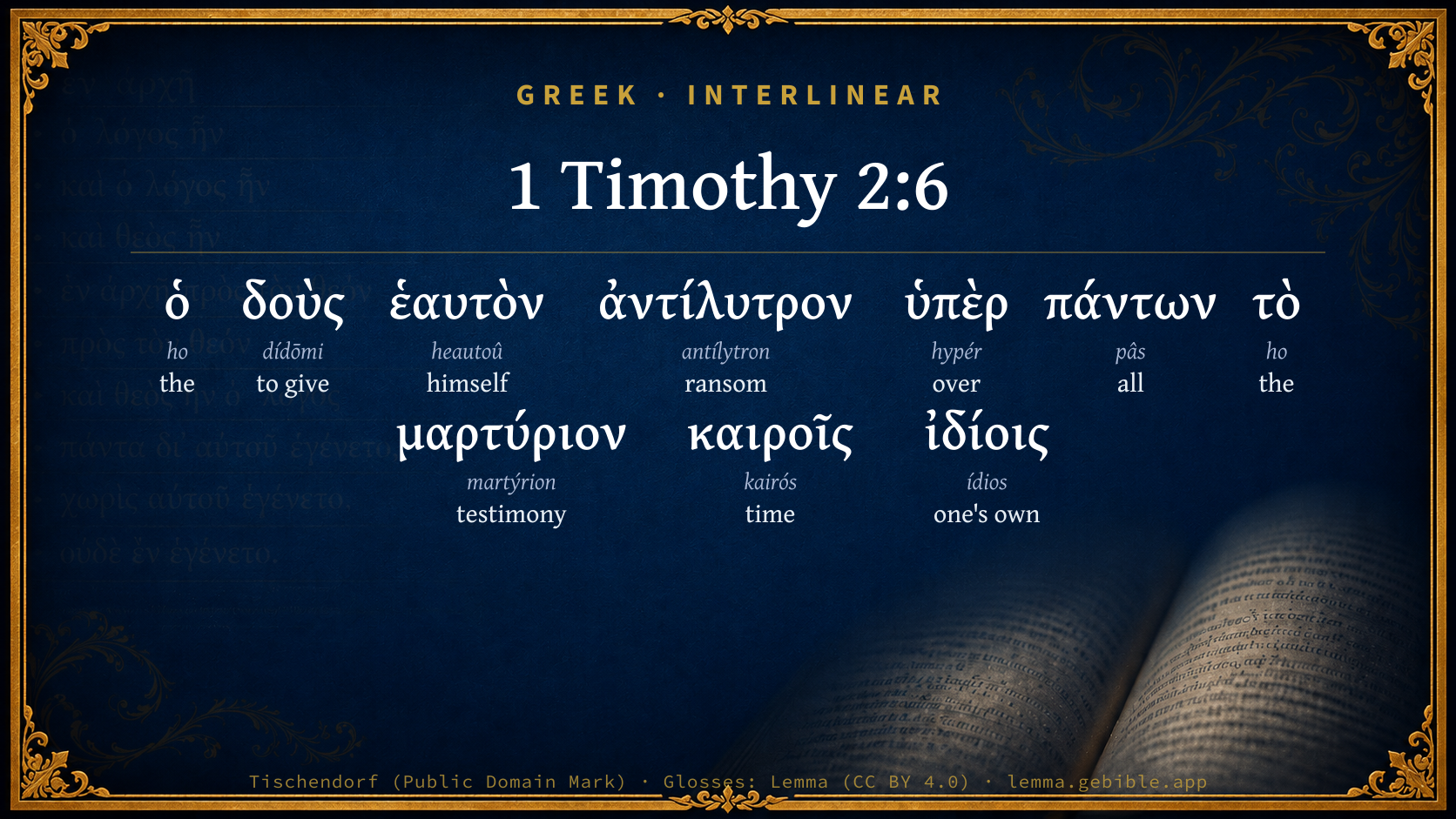
Greek (Tischendorf 8th ed.) 1 Timothy 2:6 appears in the Greek New Testament. The text above is from the Tischendorf 8th edition. Each word links to its Strong’s number and a concise gloss. Click any word for its full Thayer’s Greek Lexicon entry.
Download image
Cite this verse

1 Timothy 2:6 (World English Bible). Public Domain. Lemma interlinear Bible study tool, https://lemma.gebible.app/v/1-timothy/2/6.

Show BibTeX & RIS
BibTeX
RIS
English Translation
who gave himself as a ransom for all; the testimony in its own times;
World English Bible · Public Domain
Highlights
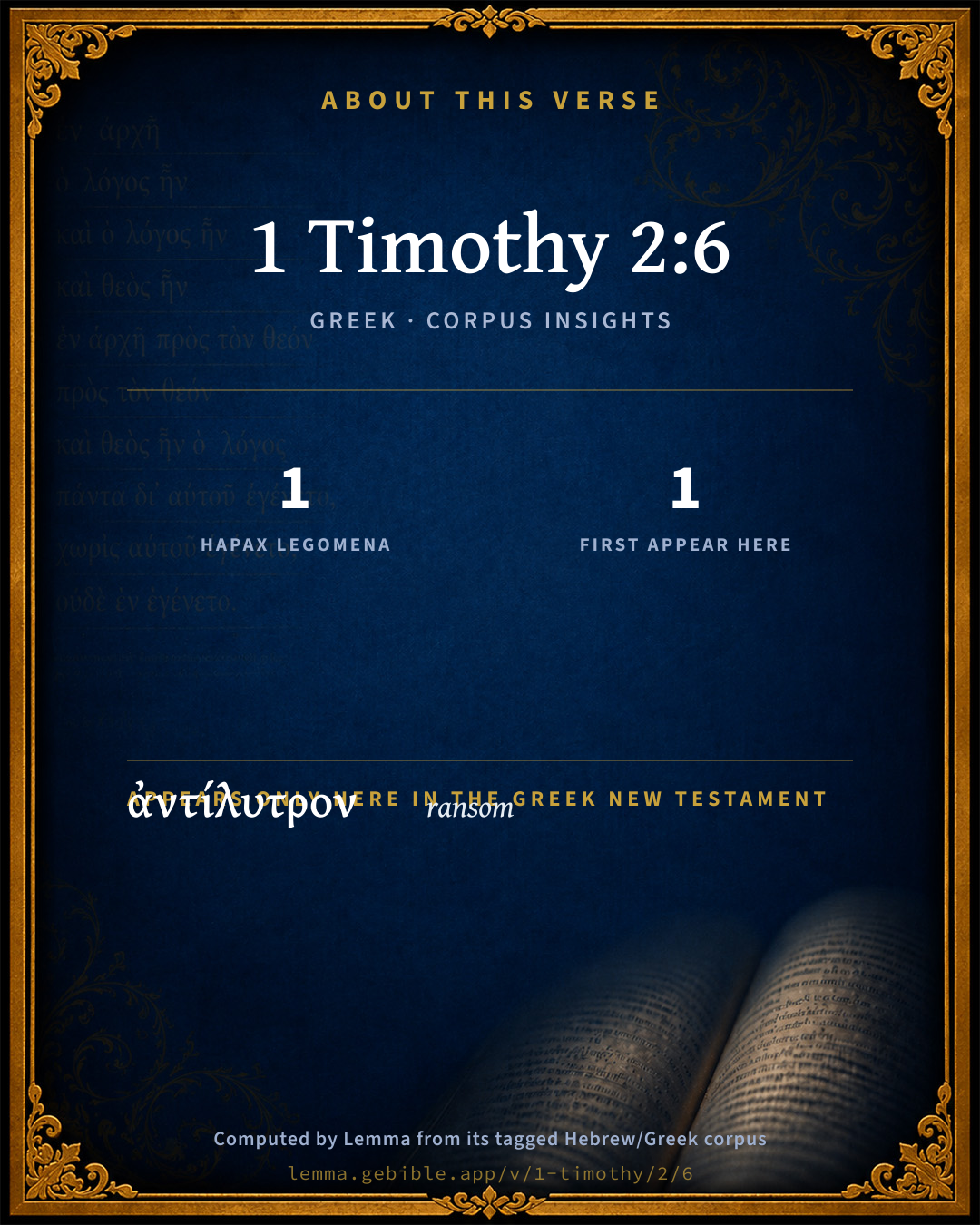
  • 1 hapax legomenon — only here in the Greek New Testament
  • 1 first appearance in the Greek New Testament
Full analysis ↓
Download a study sheet

One document with this verse’s original text, its word-by-word gloss line, the meaning frame, cross-references with their text, attributed commentary, and full source and license credits — printable, and it pastes into notes with its structure intact.

This verse Autodidact and up

Study sheet (.html) Plain text (.txt)

A passage Seminary Student

Up to 50 verses in one chapter. A passage sheet keeps up to 6 commentary sources and 12 cross-references per verse, in the order this page ranks them, and says so on the sheet whenever that leaves anything out. Ask for a single verse and you get the Autodidact verse sheet above.

Everything on this page stays free to read, with no account — the sheet is a download of what is already on screen, not access to it.

Want to remove ads? Support Godless Engineer
Compare translations 3

The same verse in 3 English versions, stacked beneath the original-language interlinear above. Click any original word for its lexicon entry.

Each is an independent rendering of the whole verse — the interlinear is not word-aligned to these translations.

Highlighted words mark where these versions differ — a whole-verse word diff, not a word-by-word alignment.

  • World English Bible Public Domain
    who gave himself as a ransom for all; the testimony in its own times;
  • King James Version Public Domain
    Who gave himself a ransom for all, to be testified in due time.
  • unfoldingWord Literal Text CC BY-SA 4.0
    the one having given himself a ransom for all, the testimony in its own times,

unfoldingWord Literal Text — © unfoldingWord, licensed CC BY-SA 4.0. Word-aligned USFM3 via Door43 (git.door43.org/unfoldingWord/en_ult).

Versions to compare (up to 4)

3 of 4 selected

Show all 19 translations

Every available English version of this verse, each an independent rendering of the whole verse.

  • World English Bible Public Domain
    who gave himself as a ransom for all; the testimony in its own times;
  • Berean Standard Bible Public Domain
    who gave Himself as a ransom for all—the testimony that was given at just the right time.
  • Majority Standard Bible Public Domain
    who gave Himself as a ransom for all—the testimony that was given at just the right time.
  • King James Version Public Domain
    Who gave himself a ransom for all, to be testified in due time.
  • American Standard Version (1901) Public Domain
    who gave himself a ransom for all; the testimony `to be borne' in its own times;
  • Revised Version (1885) Public Domain
    who gave himself a ransom for all; the testimony to be borne in its own times;
  • Geneva Bible (1599) Public Domain
    Who gaue himselfe a ransome for all men, to be that testimonie in due time,
  • Douay-Rheims (1899) Public Domain
    Who gave himself a redemption for all, a testimony in due times.
  • Young's Literal Translation Public Domain
    who did give himself a ransom for all -- the testimony in its own times --
  • Literal Standard Version CC BY-SA 4.0
    who gave Himself [as] a ransom for all—the testimony in its own times—
  • Unlocked Literal Bible CC BY-SA 4.0
    He gave himself as a ransom for all, as the testimony at the right time.
  • unfoldingWord Literal Text CC BY-SA 4.0
    the one having given himself a ransom for all, the testimony in its own times,
  • Darby Bible Public Domain
    who gave himself a ransom for all, the testimony [to be rendered] in its own times;
  • World Messianic Bible Public Domain
    who gave himself as a ransom for all, the testimony at the proper time,
  • Webster's Bible Public Domain
    Who gave himself a ransom for all, to be testified in due time.
  • Free Bible Version CC BY-SA 4.0
    He gave himself so we could all be won back, demonstrating the evidence at the right time.
  • Bible in Basic English Public Domain
    Who gave himself as an offering for all; witness of which was to be given at the right time;
  • Text-Critical English NT CC BY 4.0
    who gave himself as a ransom for all, which is the testimony given at the proper time.
  • Tyndale New Testament (1534) Public Domain
    which gave him silfe a raunsome for all men that it shuld be testified at his tyme

Literal Standard Version (2020), Covenant Press — licensed CC BY-SA 4.0. Text via the HelloAO Bible API (eBible.org). Unlocked Literal Bible (unfoldingWord) — licensed CC BY-SA 4.0. Text via the HelloAO Bible API (eBible.org). unfoldingWord Literal Text — © unfoldingWord, licensed CC BY-SA 4.0. Word-aligned USFM3 via Door43 (git.door43.org/unfoldingWord/en_ult). Free Bible Version, Dr. Jonathan Gallagher — licensed CC BY-SA 4.0. Text via the HelloAO Bible API (eBible.org).

Word by word

More ways to search: Search by grammar → Find every occurrence → Compare this word →

Practice this passage: Drill this verse → Learn its vocabulary →

About this verse

These counts appear in no published source. They are computed here, from the morphology-tagged text and Lemma’s own curated glosses. What Lemma adds →

10
words
9
distinct lemmas
Pauline Epistles
section

Notable vocabulary

1 hapax legomenon — a word that appears only here in the entire Greek New Testament:

  • ἀντίλυτρον ransom G487

First appearance in Scripture

This word makes its first canonical appearance in the Greek New Testament here:

  • ἀντίλυτρον ransom G487

Shared distinctive vocabulary

μαρτύριον testimony G3142 occurs in 20 verses of the Greek New Testament. Also found in:

Repetition

A word recurs within this verse:

Cross-references

31

Topical passages linked to 1 Timothy 2:6 in the Treasury of Scripture Knowledge — connected by theme and wording, ordered by reader-vote popularity; previews shown in the World English Bible.

  • Matthew 20:28 even as the Son of Man came not to be served, but to serve, and to give his life as a ransom for many."
  • 1 Peter 3:18 Because Christ also suffered for sins once, the righteous for the unrighteous, that he might bring you to God; being put to death in the flesh, but made alive in the spirit;
  • 1 John 2:1–2 My little children, I write these things to you so that you may not sin. If anyone sins, we have a Counselor with the Father, Jesus Christ, the righteous.
  • Galatians 4:4 But when the fullness of the time came, God sent out his Son, born to a woman, born under the law,
  • 1 John 4:10 In this is love, not that we loved God, but that he loved us, and sent his Son as the atoning sacrifice for our sins.
  • Revelation 1:5 and from Jesus Christ, the faithful witness, the firstborn of the dead, and the ruler of the kings of the earth. To him who loves us, and washed us from our sins by his blood;
  • 1 Corinthians 1:6 even as the testimony of Christ was confirmed in you:
  • Ephesians 5:2 Walk in love, even as Christ also loved you, and gave himself up for us, an offering and a sacrifice to God for a sweet-smelling fragrance.
  • Titus 2:14 who gave himself for us, that he might redeem us from all iniquity, and purify for himself a people for his own possession, zealous for good works.
  • Job 33:24 Then God is gracious to him, and says, 'Deliver him from going down to the pit, I have found a ransom.'
  • 2 Corinthians 5:21 For him who knew no sin he made to be sin on our behalf; so that in him we might become the righteousness of God.
  • 1 Timothy 6:15 which in its own times he will show, who is the blessed and only Ruler, the King of kings, and Lord of lords;
  • Isaiah 53:6 All we like sheep have gone astray; everyone has turned to his own way; and Yahweh has laid on him the iniquity of us all.
  • Mark 10:45 For the Son of Man also came not to be served, but to serve, and to give his life as a ransom for many."
  • John 6:51 I am the living bread which came down out of heaven. If anyone eats of this bread, he will live forever. Yes, the bread which I will give for the life of the world is my flesh."
  • John 10:15 even as the Father knows me, and I know the Father. I lay down my life for the sheep.
  • 2 Corinthians 5:14–15 For the love of Christ constrains us; because we judge thus, that one died for all, therefore all died.
  • Titus 1:3 but in his own time revealed his word in the message with which I was entrusted according to the commandment of God our Savior;
  • 1 Peter 1:18–19 knowing that you were redeemed, not with corruptible things, with silver or gold, from the useless way of life handed down from your fathers,
  • 1 Peter 2:24 who his own self bore our sins in his body on the tree, that we, having died to sins, might live to righteousness; by whose stripes you were healed.
  • Romans 16:26
  • Ephesians 1:7 in whom we have our redemption through his blood, the forgiveness of our trespasses, according to the riches of his grace,
  • Ephesians 1:9–10 making known to us the mystery of his will, according to his good pleasure which he purposed in him
  • 2 Thessalonians 1:10 when he comes to be glorified in his saints, and to be admired among all those who have believed (because our testimony to you was believed) in that day.
  • 2 Timothy 1:8 Therefore don't be ashamed of the testimony of our Lord, nor of me his prisoner; but endure hardship for the Gospel according to the power of God,
  • Hebrews 9:12 nor yet through the blood of goats and calves, but through his own blood, entered in once for all into the Holy Place, having obtained eternal redemption.
  • 1 John 5:11–12 The testimony is this, that God gave to us eternal life, and this life is in his Son.
  • Revelation 5:9 They sang a new song, saying, "You are worthy to take the book, And to open its seals: For you were killed, And bought us for God with your blood, Out of every tribe, language, people, and nation,
  • Romans 5:6 For while we were yet weak, at the right time Christ died for the ungodly.
  • Ephesians 1:17 that the God of our Lord Jesus Christ, the Father of glory, may give to you a spirit of wisdom and revelation in the knowledge of him;
  • Ephesians 3:5 which in other generations was not made known to the children of men, as it has now been revealed to his holy apostles and prophets in the Spirit;

Cross-references courtesy of OpenBible.info (CC BY 4.0).

Commentary

Notes on 1 Timothy 2:6 from classic Christian and Jewish commentators (each source and its license shown beneath its notes). The classic Christian expositions comment on the surrounding passage and are grouped to its opening verse, so a note may address several verses; the Jewish commentaries on the Tanakh (Rashi and others) are per-verse, so they appear only where the commentator wrote on this verse.

Lemma curates 59 commentaries, every one of them public domain or Creative Commons licensed, each selected and text-cleaned for this edition rather than reprinted as found. About our sources →

Ellicott's Commentary for English Readers

(6) Who gave himself a ransom for all.—The declaration (of 1Ti_2:5) that there was one God for fallen man would have been scarcely a joyful proclamation had it not been immediately followed by the announcement that between that one God and sinning man there was a mediator, Now (in 1Ti_2:6) we have in a few words the inspired description of the manner in which the Mediator performed His office and work; of His own free sovereign will; He yielded up Himself to death as the price of the redemption of all mankind—His life in exchange for their forfeited lives.

St. Paul’s teaching here is very definite, and is utterly irreconcilable with much of the popular (so-called) theology of the day, which rejects this great Christian doctrine, so clearly taught here by St. Paul, of a “satisfactio vicaria.” This teaching asserts, that without pleading the death of Christ, we may, if we please, approach and find access to the Father, and such teaching as this passage shows is irreconcilable with gospel truth.

To be testified in due time.—Better rendered, “witness of which was to be borne in its own times. The meaning of the words is,” Jesus Christ in the eternal counsels, gave Himself to death as the price of the redemption of fallen man; at the appointed and fitting season He endured this death—this death was the witness to the truth of the tremendous offering made in the counsels of the eternal and ever-blessed Trinity. So St. Chrysostom, who asserts that “the witness to be borne” was given in the death and suffering of the Lord.

A Bible Commentary for English Readers, edited by Charles John Ellicott (1878–1897) — public domain. Text from a community e-Sword module.

Bengel's Gnomon

Johann Albrecht Bengel

1Ti 2:6. Τὸ μαρτύριον, the testimony) The accusative absolute, as ἔνδειγμα, 2Th 1:5. A word suited to the character which Paul and Timothy sustained; for they were witnesses. The testimony of universal redemption is intended.—καιροῖς ἰδίοις, in its own due times, or His own due times) ch. 1Ti 6:15, note.

Bengel's Gnomon of the New Testament — English translation (T&T Clark, Edinburgh, 1860) — public domain. Text from a community e-Sword module.

Meyer's Critical & Exegetical Commentary

Heinrich August Wilhelm Meyer

1Ti_2:6. Ὁ δοὺς ἑαυτὸν ἀντίλυτρον ὑπὲρ πάντων] The word ἀντίλυτρον, which occurs only here, is synonymous with ἀντάλλαγμα in Mat_16:26; it is distinguished from the simple λύτρον, as Matthies rightly remarks, only in this, that the preposition makes the idea of exchange still more emphatic. According to the usage of the N. T., there can be no doubt that the apostle here alludes to Christs reconciling death; comp., besides Tit_2:14, Mat_20:28, etc., especially 1Pe_1:18-19, where the τίμιον αἷμα is mentioned as the means by which we are redeemed. The expression δοὺς ἑαυτόν has herewhere ἀντίλυτρον is added by way of apposition to ἑαυτόν (as in Mat_20:28, λύτρον is in apposition to τὴν ψυχὴν αὐτοῦ)the emphatic meaning of self-surrender to death, as in Tit_2:14, Gal_1:4 (comp. also in Joh_6:51, ἣν [τὴν σάρκα μου] δώσω, which, indeed, is uncertain critically), where δοὺς ἑαυτόν has the same meaning as παραδοὺς ἑαυτόν in Gal_2:20; Eph_5:25 (comp., too, Rom_8:32). He gave Himself as a ransom by giving Himself up to death. The thought on which it is based is this: men were held ἐν τῇ ἐξουσίᾳ τοῦ σκότους (Col_1:13); from this they could not free themselves (τί δώσει ἄνθρωπος ἀντάλλαγμα τῆς ψυχῆς αὑτοῦ, Mat_16:26); Christ therefore gave the ἀντίλυτρον necessary to free them; this ransom is Himself (δοὺς ἑαυτόν), i.e. His life: τὴν ψυχὴν αὐτοῦ, Mat_20:28; so that by this, σωτηρία is purchased for them. This, however, was done for the benefit not of some, but of all. Hence Paul adds expressly ὑπὲρ (equivalent to: in commodum[92]) ΠΆΝΤΩΝ, which is emphatic, and with which he returns to the beginning of 1Ti_2:4. In this, as at 1Ti_1:15, the apostle revealed the substance of the ὙΓΙΑΊΝΟΥΣΑ ΔΙΔΑΣΚΑΛΊΑ, only that here he defines his former expression more precisely.

In order, however, that this act of love on the Lords part may bring forth its fruit, it must be proclaimed to the world; this is indicated in the words that follow.

ΤῸ ΜΑΡΤΎΡΙΟΝ ΚΑΙΡΟῖς ἸΔΊΟΙς] ΤῸ ΜΑΡΤΎΡΙΟΝ is not to be taken as in apposition to ἈΝΤΊΛΥΤΡΟΝ, and explained of the death of Christ (Chrysostom: ΜΑΡΤΎΡΙΟΝ ΤῸ ΠΆΘΟς); it is to be regarded as in apposition to the thought contained in the previous words of this verse (not to the whole of what was previously said, Hofmann). This does not mean, however, that τὸ μαρτύριον denotes Christs gift of Himself as a ransom (or Christs sacrifice), to be the witness of salvation set forth at the appointed time, the historical fact that the divine purpose of salvation is realized (Matthies);[93] for ΜΑΡΤΎΡΙΟΝ is not the deed itself, but the attestation, the proclamation of the deed; comp. 1Co_1:6; 1Co_2:1. Nor does it mean that by ΜΑΡΤΎΡΙΟΝ we are to understand the testimonium, quod Deus per Christi vitam, doctrinam et mortem protulit, vera esse ea omnia et rata, quae V. T. prophetae fore divinaverant (Heinrichs), for there is nothing to indicate an allusion to O. T. prophecy. The act of Christ already mentioned is called ΤῸ ΜΑΡΤΎΡΙΟΝ, in so far as this was its meaning and purpose. Bengel: ΤῸ ΜΑΡΤΎΡΙΟΝ acc. absol. ut ἜΝΔΕΙΓΜΑ, 2Th_1:5, innuitur testimonium redemtionis universalis.[94] The reason why the preaching of the gospel is called ΜΑΡΤΎΡΙΟΝ, is that its subject is an historical fact, the importance of which becomes known only by individual experience.

ΚΑΙΡΟῖς ἸΔΊΟΙς] is to be connected with ΤῸ ΜΑΡΤΎΡΙΟΝ, just as if it were connected with ΤῸ ΜΑΡΤΥΡΟΎΜΕΝΟΝ (Hofmann); the same expression is found in 1Ti_6:15; Tit_1:3; also Gal_6:9 (Act_17:26 : ΚΑΙΡΟῚ ΠΡΟΤΕΤΑΓΜΈΝΟΙ); Chrysostom: ΤΟῖς ΠΡΟΣΉΚΟΥΣΙ ΚΑΙΡΟῖς.

[92] Van Oosterzee asserts, without reason, that ὑπέρ here is to be taken in the sense of substitution.

[93] Leos explanation is substantially the same as this: Quae Christus, inquit apostolus, ad homines servandos fecit, ea sunt ipsius Dei testimonium. Quid vero testatus est Deus eo, quod Jesum Christum mori passus est? Quid aliud, quam amorem suum in genus humanum plane incomparabilem?

[94] Van Oosterzee believes that μαρτύριον here must be taken as in apposition to ἀντίλυτρον, the apostle calling the Lords surrender of Himself the great μαρτύριον, with special reference to the truth mentioned in ver. 4. But against this it is to be remarked, that this explanation does not give a right definition of the relation of apposition, nor of the meaning and purpose of the μαρτύριον.

Meyer — Critical and Exegetical Commentary on the New Testament — English translation by Peter Christie, edited by Frederick Crombie (T&T Clark, 1880) — public domain. Text from a community e-Sword module.

Expositor's Greek Testament

ed. W. Robertson Nicoll

1Ti 2:6 . ὁ δοὺς ἑαυτόν : The Evangelists record our Lord’s own declarations that His death was a spontaneous and voluntary sacrifice on His part, Mat 20:28 = Mar 10:45 , δοῦναι τὴν ψυχὴν αὐτοῦ λύτρον ἀντὶ πολλῶν . Cf. Joh 10:18 ; and St. Paul affirms it, Gal 1:4 , τοῦ δόντος έαυτὸν ὑπὲρ τῶν ἁμαρτιῶν ἡμῶν ; Tit 2:14 , ὃς ἔδωκεν ἑαυτὸν ὑπὲρ ἡμῶν κ . τ . λ . ( παραδίδωμι is used in Gal 2:20 , Eph 5:2 ; Eph 5:25 ). We may note that this statement necessarily implies not only the pre-existence of our Lord, but also His co-operation in the eternal counsels and purpose of the Father as regards the salvation of man.

Alford is probably right in saying that δοῦναι ἑαυτόν , as St. Paul expresses it, suggests more than δοῦναι τὴν ψυχὴν αὐτοῦ . The latter might naturally be limited to the sacrifice of His death; the former connotes the sacrifice of His lifetime, the whole of the humiliation and self-emptying of the Incarnation. The soundness of this exegesis is not impaired by the probability that τὴν ψυχὴν αὐτοῦ may be nothing more than a Semitic periphrasis for ἑαυτόν . See J. H. Moulton, Grammar , vol. i. p. 87, who compares Mar 8:36 , ζημιωθῆναι τὴν ψυχὴν αὐτοῦ , with Luk 9:25 , ἑαυτὸν δὲ ἀπολέσας ἢ ζημιωθείς .

ἀντίλυτρον ὑπὲρ πάντων : If we are to see any special force in the ἀντί , we may say that it expresses that the λύτρον is equivalent in value to the thing procured by means of it. But perhaps St. Paul’s use of the word, if he did not coin it, is due to his desire to reaffirm our Lord’s well-known declaration in the most emphatic way possible. λύτρον ἀντὶ merely implies an exchange; ἀντίλυτρον ὑπέρ implies that the exchange is decidedly a benefit to those on whose behalf it is made. As far as the suggestion of vicariousness is concerned, there does not seem to be much difference between the two phrases.

τὸ μαρτύριον , as Ellicott says, “is an accusative in apposition to the preceding sentence,” or rather clause, ὁ δοὺς … πάντων . So R.V. Bengel compares ἔνδειγμα , 2Th 1:5 ; cf. also Rom 12:1 . The great act of self-sacrifice is timeless; but as historically apprehended by us, the testimony concerning it must be made during a particular and suitable period of history, i.e. , from the descent of the Holy Spirit upon the apostolic company (Act 1:8 ) until the Second Coming (2Th 1:10 ). The temporal mission of the Son of God took place “when the fulness of the time came” (Gal 4:4 ); it was an οἰκονομία τοῦ πληρώματος τῶν καιρῶν (Eph 1:10 ). The testimony is of course borne by God (1Jn 5:9-11 ), but He uses human agency, the preachers of the Gospel.

καιροῖς ἰδίοις : See reff. The analogy of Gal 6:9 , καιρῷ γὰρ ἰδίῳ θερίσομεν , suggests that we should render it always in due season . The plural expresses the fact that the bearing of testimony extends over many seasons; but each man reaps his own harvest only once. In any case, the seasons relate both to the Witness and that whereof He is a witness: “ his own times” and “ its own times” (R.V.).

The dative is that “of the time wherein the action takes place,” Ell., who compares Rom 16:25 , χρόνοις αἰωνίοις σεσιγημένου .

The Expositor's Greek Testament, edited by W. Robertson Nicoll (1897–1910) — public domain. Text from a community e-Sword module.

Geneva Bible (1599)

Geneva Bible translators

A confirmation, because that even to the Gentiles in the secret of salvation now opened and made manifest the Apostle himself being appointed properly to this office, which he doth faithfully and sincerely execute.

Geneva Bible (1599) marginal notes — public domain. Text via Bolls.life.

Jamieson, Fausset & Brown

Robert Jamieson, A. R. Fausset & David Brown

gave himself-- (Tit 2:14). Not only the Father gave Him for us (Joh 3:16); but the Son gave Himself (Phi 2:5-8).

ransom--properly of a captive slave. Man was the captive slave of Satan, sold under sin. He was unable to ransom himself, because absolute obedience is due to God, and therefore no act of ours can satisfy for the least offense. Lev 25:48 allowed one sold captive to be redeemed by one of his brethren. The Son of God, therefore, became man in order that, being made like unto us in all things, sin only excepted, as our elder brother He should redeem us (Mat 20:28; Eph 1:7; Pe1 1:18-19). The Greek implies not merely ransom, but a substituted or equivalent ransom: the Greek preposition, "anti," implying reciprocity and vicarious substitution.

for all--Greek, "in behalf of all": not merely for a privileged few; compare Ti1 2:1 : the argument for praying in behalf of all is given here.

to be testified--Greek, "the testimony (that which was to be testified of, Jo1 5:8-11) in its own due times," or seasons, that is, in the times appointed by God for its being testified of (Ti1 6:15; Tit 1:3). The oneness of the Mediator, involving the universality of redemption (which faith, however, alone appropriates), was the great subject of Christian testimony [ALFORD] (Co1 1:6; Co1 2:1; Th2 1:10).

Jamieson, Fausset & Brown — Commentary Critical and Explanatory on the Whole Bible (1871) — public domain (CC PDM 1.0). Text via the HelloAO Bible API.

Adam Clarke's Commentary

Verse 6. Who gave himself a ransom] The word λυτρον signifies a ransom paid for the redemption of a captive; and αντιλυτρον, the word used here, and applied to the death of Christ, signifies that ransom which consists in the exchange of one person for another, or the redemption of life by life; or, as Schleusner has expressed it in his translation of these words, Qui morte sua omnes liberavit a vitiositatis vi et poenis, a servitute quassi et miseria peccatorum. "He who by his death has redeemed all from the power and punishment of vice, from the slavery and misery of sinners." As God is the God and father of all, (for there is but one God, 1Ti 2:5), and Jesus Christ the mediator of all, so he gave himself a ransom for all; i.e., for all that God made, consequently for every human soul; unless we could suppose that there are human souls of which God is not the Creator; for the argument of the apostle is plainly this: 1. There is one God; 2. This God is the Creator of all; 3. He has made a revelation of his kindness to all; 4. He will have all men to be saved, and come unto the knowledge of the truth; and 5. He has provided a mediator for all, who has given himself a ransom for all. As surely as God has created all men, so surely has Jesus Christ died for all men. This is a truth which the nature and revelation of God unequivocally proclaim.

To be testified in due time.] The original words, το μαρτυριον καιροις ιδιοις, are not very clear, and have been understood variously. The most authentic copies of the printed Vulgate have simply, Testimonium temporibus suis; which CALMET translates: Rendant ainsi temoignage au tems marqué; "Thus rendering testimony at the appointed time." Dr. MACKNIGHT thus: Of which the testimony is in its proper season. WAKEFIELD thus: "That testimony reserved to its proper time" ROSENMULLEN: Haec est doctrina, temporibus suis reservata. "This is the doctrine which is reserved for its own times;" that is, adds he, quoe suo tempore in omni terrarum orbe tradetur, "the doctrine which in its own time shall be delivered to all the inhabitants of the earth." Here he translates μαρτυριον, doctrine; and contends that this, not testimony, is its meaning, not only in this passage, but in 1Co 1:6; 1Co 2:1, c. Instead of μαρτυριον, testimony, one MS., Cod. Kk., vi. 4, in the public library, Cambridge, has, μυστηριον, mystery but this is not acknowledged by any other MS., nor by any version. In D*FG the whole clause is read thus: οὑ το μαρτυριον καιροις ιδιοις εδοθη· The testimony of which was given in its own times. This is nearly the reading which was adopted in the first printed copies of the Vulgate. One of them now before me reads the passage thus: Cujus testimonium temporibus suis confirmatum est. "The testimony of which is confirmed in its own times." This reading was adopted by Pope Sixtus V., in the famous edition published by him; but was corrected to the reading above, by Pope Clement VIII. And this was rendered literally by our first translator: Whos witnessinge is confermyd in his timis. This appears to be the apostle's meaning: Christ gave himself a ransom for all. This, in the times which seemed best to the Divine wisdom, was to be testified to every nation, and people, and tongue. The apostles had begun this testimony; and, in the course of the Divine economy, it has ever since been gradually promulgated; and at present runs with a more rapid course than ever.

Adam Clarke's Commentary on the Bible (1810–1826) — public domain. Text from a community e-Sword/MySword module.

John Calvin's Commentaries

6 Who gave himself a ransom for all The mention of redemption in this passage is not superfluous; for there is a necessary connection between the two things, the sacrifice of the death of Christ, and his continual intercession. (Romans 8:34.) These are the two parts of his priesthood; for, when Christ is called our priest, it is in this sense, that he once made atonement for our sins by his death, that he might reconcile us to God; and now having entered into the sanctuary of heaven, he appears in presence of the Father, in order to obtain grace for us, that we may be heard in his name. (Psalm 110:4; Hebrews 7:17.) So much the more does he expose the wicked sacrilege of the Papists, who, by making dead saints to be companions of Christ in this affair, transfer to them likewise the glory of the priesthood. Read the fourth chapter of the Epistle to the Hebrews, towards the conclusion, and the beginning of the fifth chapter, [Hebrews 4:14-5:10,] and you will find what I maintain, that the intercession by which God is reconciled to us is founded on the sacrifice; which, indeed, is demonstrated by the whole system of the ancient priesthood. It follows, therefore, that it is impossible to take from Christ any part of the office of intercession, and bestow it on others, without stripping him of the title of priesthood.

Besides, when the Apostle calls him ἀντίλυτρον, “a ransom,” he overthrows all other satisfactions. Yet I am not ignorant of the injurious devices of the Papists, who pretend that the price of redemption, which Christ paid by his death, is applied to us in baptism, so that original sin is effaced, and that afterwards we are reconciled to God by satisfactions. In this way they limit to a small period of time, and to a single class, that benefit which was universal and perpetual. But a full illustration of this subject will be found in the Institutes.

That there might be a testimony in due time; that is, in order that this grace might be revealed at the appointed time. The phrase, for all, which the Apostle had used, might have given rise to the question, “Why then had God chosen a peculiar people, if he revealed himself as a reconciled Father to all without distinction, and if the one redemption through Christ was common to all?” He cuts off all ground for that question, by referring to the purpose of God the season for revealing his grace. For if we are not astonished that in winter, the trees are stripped of their foliage, the fields are covered with snow, and the meadows are stiff with frost, and that, by the genial warmth of spring, what appeared for a time to be dead, begins to revive, because God appointed the seasons to follow in succession; why should we not allow the same authority to his providence in other matters? Shall we accuse God of instability, because he brings forward, at the proper time, what he had always determined, and settled in his own mind?

Accordingly, although it came upon the world suddenly and was altogether unexpected, that Christ was revealed as a Redeemer to Jews and Gentiles, without distinction; let us not think that it was sudden with respect to God but, on the contrary, let us learn to subject all our sense to his wonderful providence. The consequence will be, that there will be nothing that comes from him which shall not appear to us to be highly seasonable. On that account this admonition frequently occurs in the writings of Paul and especially when he treats of the calling of the Gentiles, by which, at that time, on account of its novelty, many persons were startled and almost confounded. They who are not satisfied with this solution, that God, by his hidden wisdom, arranged the succession of the seasons, will one day feel, that, at the time when they think that he was idle, he was framing a hell for inquisitive persons.

John Calvin's Commentaries (1540-1563) — public domain. Text from the Calvin Translation Society English edition (1840s-50s) via the Christian Classics Ethereal Library (ccel.org). Calvin's coverage is partial (roughly two-thirds of the Bible); uncommented books and verses are honest gaps, never fabricated. The 19th-century editor's footnotes and remarks are omitted so the notes are faithfully Calvin's own voice.

The Cambridge Bible for Schools and Colleges

gen. ed. J. J. S. Perowne

6. a ransom] The word is a compound naturally formed, as time passed, to represent Christ’s own teaching, antilutron thus recalling the lutron anti of Mat_20:28; Mar_10:45. On this last verse Maclear distinguishes, from Trench’s Syn., p. 276, the three great circles of images in Scripture used to represent the purport of Christ’s death:

(a) sin offering or propitiation, 1Jn_2:2; 1Jn_4:10.

(b) atonement, i.e. at-one-ment, reconciliation with an offended friend, Rom_5:11; Rom_11:15; 2Co_5:18-19.

(c) ransom, or the price paid for the redemption of a captive from slavery, Rom_3:24; Eph_1:7.

This third image, which is St Paul’s latest love, occurs again, Tit_2:14, ‘that he might redeem us from all iniquity,’ and is chosen by St Peter, 1Pe_1:18, and the writer to the Hebrews, Heb_9:12.

Our Article II. like this creed, and unlike the Apostles’, Nicene and Athanasian Creeds, adds a statement of the purport of Christ’s death to its statement of the fact; but takes the first and second of these images to express it; “who truly suffered, was crucified, dead and buried, to reconcile His Father to us, and to be a sacrifice not only for original guilt but also for all actual sins of men.” Cf. Art. XV.: ‘He came to be the Lamb without spot, who by sacrifice of Himself once made should take away the sins of the world.’

to be testified in due time] R.V. the testimony to be borne in its proper seasons; the neuter substantive having its proper sense, ‘that which was to be testified of.’ The word may well have come into this creed from the familiarity of the Jewish Christians with its use (as Wordsworth suggests) in the Pentateuch, where it occurs 30 times in connexion with the Holy of Holies, the Tables of the law, the Tabernacle and the Ark. Cf. Act_7:44, ‘Our fathers had the tabernacle of the testimony in the wilderness.’ ‘The redemption made by the Blood of Christ was the True Testimony which was reserved for its full revelation in its own appointed season,’ Eph_1:10, ‘a dispensation of the fulness of the seasons to sum up all things in Christ.’

The reading is not doubtful, though from the apparent abruptness (sufficiently accounted for if part of a brief creed) the scribes in the mss. seem to have stumbled at the clause, each giving some variety for smoothness. See note on 1Ti_2:5 for the connexion; which makes the force and relevance of the familiar phrases strong and clear.

The Cambridge Bible for Schools and Colleges (gen. ed. J. J. S. Perowne; Cambridge University Press, 1878–1918) — public domain. Text from a community e-Sword module.

John Gill's Exposition

Whereunto I am ordained a preacher, and an apostle,.... He was ordained or appointed to be a preacher of the Gospel from all eternity, and was separated or set apart unto it in time, and was put into the ministry of it by Christ himself, and was not a common or ordinary preacher of the word, but an apostle, an extraordinary officer in the Gospel church.

I speak the truth in Christ, and lie not; which are a sort of an oath, or an appeal to Christ the omniscient God, for the truth of what he said, concerning his ordination to the Gospel; see a like phrase in Rom 9:1. The phrase, "in Christ", is left out in the Alexandrian copy, and in three of Beza's ancient copies, and in some others, and in the Vulgate Latin, Syriac, Arabic, and Ethiopic versions;

a teacher of the Gentiles in faith and verity; the Gospel of the uncircumcision, or which was to be preached to the uncircumcised Gentiles, was committed to this apostle; and his work and ministry lay among them, and therefore he is called the apostle of the Gentiles: and so he was in faith and verity; which may regard the subject matter of his teachings and ministry; it was the faith and truth of the Gospel, even the whole of it, the faith which was once delivered to the saints, and the truth as it is in Jesus; or else the character of the apostle, as a teacher, that he was a true and faithful one, who with all integrity and veracity, fully and faithfully preached the Gospel; and since he was appointed a teacher of it to the Gentiles, this is another argument why they, as well as the Jews, should be prayed for.

John Gill's Exposition of the Whole Bible (1746–1763) — public domain (CC PDM 1.0). Text via the HelloAO Bible API.

Trapp's Complete Commentary

John Trapp

6 Who gave himself a ransom for all, to be testified in due time.

Ver. 6. A ransom] Gr. αντιλυτρον, a counterprice; such as we could never have paid, but must have remained, and even rotted in prison, but for our all-sufficient surety and Saviour.

John Trapp, A Commentary or Exposition upon All the Books of the Old and New Testament (1647–1656) — public domain. Text from a community e-Sword module.

Albert Barnes' Notes on the Bible

Who gave himself a ransom for all - This also is stated as a reason why prayer should be offered for all, and a proof that God desires the salvation of all. The argument is, that as Christ died for all, it is proper to pray for all, and that the fact that he died for all is proof that God desired the salvation of all. Whatever proof of his desire for their salvation can be derived from this in relation to any of the race, is proof in relation to all. On the meaning of the phrase “he gave himself a ransom,” see the Mat 20:28 note; Rom 3:25 note; on the fact that it was for “all,” see the notes on 2Co 5:14.

See also the Supp. note on the same passage.

To be testified in due time - Margin, “a testimony.” The Greek is, “the testimony in its own times,” or in proper times - τὸ μαρτύριον καιροῖς ἰδίοις to marturion kairois idiois. There have been very different explanations of this phrase. The common interpretation, and that which seems to me to be correct, is, that “the testimony of this will be furnished in the proper time; that is, in the proper time it shall be made known through all the world;” see Rosenmuller. Paul affirms it as a great and important truth that Christ gave himself a ransom for all mankind - for Jews and Gentiles; for all classes and conditions of people alike. This truth had not always been understood. The Jews had supposed that salvation was designed exclusively for their nation, and denied that it could be extended to others, unless they became Jews. According to them, salvation was not provided for, or offered to pagans as such, but only on condition that they became Jews. In opposition to this, Paul says that it was a doctrine of revelation that redemption was to be provided for all people, and that it was intended that the testimony to this should be afforded at the proper time. It was not fully made known under the ancient dispensation, but now the period had come when it should be communicated to all; compare Rom 5:6 note, and Gal 4:4 note.

Albert Barnes' Notes on the Bible (1834–1885) — public domain. Text from a community e-Sword/MySword module.

Haydock's Catholic Bible Commentary

===============================

[BIBLIOGRAPHY]

See St. Augustine (lib. de Spi. et Lit. tom. x. chap. 33. p. 118) Vult Deus omnes homines salvos fieri....non sic tamen, ut eis adimat Liberum Arbitruim, quo vel bene, vel male utentes, justissime judicentur. Quod cum fit, infideles quidem contra voluntatem Dei faciunt, cum ejus Evangelio non credunt.

===============================

[BIBLIOGRAPHY]

St. Chysostom (Greek: om. z. p. 277) Greek: kai o men Christos kai apethanen uper ellauon....[]s oun, phesin ouk episteusan, oti ouk ethelesan, to de autou moros egeneto.

George Leo Haydock (1774–1849), Haydock's Catholic Family Bible and Commentary, 1859 edition — public domain. Excludes Psalms (Douay-Rheims chapter numbering differs from Protestant) and Deuterocanonical books (Catholic canon only).

Matthew Poole's English Annotations

’ Antilutron, the word here translated ransom, is very emphatical; it signifies the exchanging of condition with another, the laying down of one’s life to save another’s. This our Saviour has done for us. The Scripture discovers to us, that by nature we are the children of wrath, and guilty of many rebellious sins, and devoted to eternal death: being in this deplorable state, the Son of God, moved by his Divine love, undertook our restoring to the favour of God; and voluntarily endured the punishment due to our sins, and gave his most precious blood and life the price of our redemption, Mat 20:28. If it be objected: How is it consistent with Christ giving

himself a ransom for all, that so many perish in their sins? The answer is clear: We must distinguish between the sufficiency of his ransom and the efficacy of it; he paid a ransom worthy to obtain the salvation of all men, and has done whatever was requisite to reconcile God, and make men capable of salvation; but only those who by a lively faith depend upon him, and obey him, are actual partakers of salvation: that is, no person but may be saved in believing; and if men perish, it is not from a defect of righteousness in the Mediator, but from the love of their lusts, and their obstinate rejecting their own mercies. And it is unjust that the glory of his Divine compassion and love should be obscured or lessened for their ungrateful neglect of it.

Matthew Poole's English Annotations on the Holy Bible (1683–1685) — public domain. Text from a community e-Sword/MySword module.

Whedon's Commentary on the Bible

Daniel D. Whedon

6. Gave himself—So that his death was voluntary. Note, Joh_10:15; Joh_10:18. While God gave his son, (Joh_3:16,) the son concurrently yet freely gave himself.

A ransom—A very expressive substitutive term, αντιλυτρον, antilutron. Lutron (from λυω, luo, to release) is the loosing-money by which a person is ransomed from durance. It is the term applied to Jesus by himself in Mat_20:28, and Mar_10:45. But the present is not only lutron, but, with the prefix anti, instead, is more explicitly a lutron placed instead of the person in durance.

For all—The all a third time presented. The emphatic insisting on a universal atonement, limited, not by divine circumscription, but by human rejection.

To be testified in due time—The translation gives accurately the general sense. But the Greek literally is, the testimony in its own times. The noun, the testimony, is in apposition not with ransom, but with the entire preceding clause. The giving himself a ransom was itself the testimony.

Own times—In that period of human history to which it providentially belongs.

Daniel D. Whedon (gen. ed.), Commentary on the Old and New Testaments (1874–1909) — public domain. Text from a community e-Sword module.

The Pulpit Commentary

The testimony to be borne in its own times for to be testified in due time, A.V Torion kairoiv ijdioiv. This phrase is somewhat obscure, and is differently explained. But the most literal rendering and the best sense seems to be: The testimony, at its proper time, to which I was appointed a preacher and an apostle," meaning that the mediation and redemption of Jesus Christ was the subject-matter of that testimony which he Paul was appointed to bear at the proper time. Torion eijv o must be taken together, without any intervening stop. This accounts for the article to. The exactly parallel place isav. Tit_1:1, Tit_1:2, as a close comparison of the two passages will show. A further proof of the identity of thought in the two passage"s is the recurrence in both of the phrase, ejpignwsiv ajlhqei A ransom (ajntilutron); here only in the New Testament, but it is used perhaps by Symmachus in Psa_48:9 (49., A.V), where the LXX, have Ghn timhsewv thv yuchv aujtou, following the reading rqy, instead of rqye as in the Hebrew text.

What means a ransom? They were about to perish, but in their stead he gave his Son, and sent us as heralds to proclaim the cross" (Chrysostom).

The equivalent word in the Gospels is ajntallagma (Mat_16:26; Mar_8:7) jAntilutron does,at seem to differ materially in me, ulna from lutron, the common classical word for "ransom" (i.e. redemption money), and used by our Lord of his own life given as a ransom for many (Mat_20:28; Mar_10:45) It is the price given as an equivalent for setting free the prisoner, or sparing the forfeited life; lutrow, (Luk_24:21, etc.) lutrwsiv, (Luk_1:68, etc.) lutrwthv, (Act_7:35) ajpolutrwsiv (Luk_21:28; Rom_3:24, and passim) have all the sense of "redeem," "redemption," and the like. In its own times. The notion of a time specially appointed for Christ"s coming into the world is frequently dwelt upon in Scripture; e.g. Gal_4:4; Eph_1:10; Heb_1:2 (comp. Act_17:30, Act_17:31; 2Co_6:2) (See the same phrase, 1Ti_6:15)

The self-giving of Christ.

gave himself a Ransom for all, to be testified in due time." We are indebted to the slavery of St. Paul"s time for the use of the word "ransom." So literature, in its words, enshrines history. We cannot make a perfect theory of the Atonement. Many have tried. Some have taken the idea of slavery; some have taken the idea of debt. There has been the commercial" theory, and the "legal" theory; but no theory is complete that does not contain all the ideas. The idea of "ransom" has had its false theory; for in the seventh century some theologians said, "It was a price paid to the devil." That we are the slaves of sin, and that Christ ransoms us, is the great doctrine of the gospel.

I CHRIST GAVE HIMSELF. The humanity of that age gave others. What is the great study of the dying Roman age? Selfishness. The patricians, wrapped up in togas, saw, in the Colosseum, the gladiators fall to amuse them. The great generals brought home as slaves physicians, musicians, and workmen, and used them as good investments. Rome bore away the native art of Greece to decorate its own homes. Not only the humanity of that age, but the humanity of every age without Christ tends to self-ism. The philosophy of the cross is the only social philosophy. It does not take. It leaves men to the personal use of their gifts and possessions; but it says, "Give yourself your purest ideals, your best impulses, your noblest powers, for the good of others.

II THE CAESARS OF THAT AGE HAD NO TRUE POWER. They held men by the throat, and not by the heart; and they were lifted to Caesarship by the Praetorian guards. They rose and fell by the sword; and the dagger or the Tiber saw the last of them. The words were a satire on the Savior, saying that he also himself is Christ, a King an unconscious prophecy, and yet how true! His kingdom came without observation; it was an empire within the heart; it was not in word, but in power; it was not with observation, but it silently grew like the mustard seed. Its foundation was in this, He gave himself his exquisite sensibilities, his sacred energies, his unwearied endurance, his contact with shame and scorn; and then, on the cross, he died, "the Just for the unjust, to bring us to God. W.M.S.

The Pulpit Commentary (1880–1919), ed. H.D.M. Spence-Jones & Joseph S. Exell — public domain. Text from a community e-Sword module.

John Wesley's Explanatory Notes

Who gave himself a ransom for all - Such a ransom, the word signifies, wherein a like or equal is given; as an eye for an eye, or life for life: and this ransom, from the dignity of the person redeeming, was more than equivalent to all mankind. To be testified of in due season - Literally, in his own seasons; those chosen by his own wisdom.

John Wesley, Explanatory Notes Upon the Whole Bible (1754–1765) — public domain. Text via the GEBible commentary corpus.

The People's New Testament

B. W. Johnson

6. Who gave himself a ransom for all. Not for an elect nation, like the Jews, or for the elect individuals arbitrarily selected, but for all men. All men have been redeemed by his blood, if they will accept the ransom. To be testified. The testimony, or preaching of this ransom, was to be given at due seasons.

B. W. Johnson's The People's New Testament with Notes (1889–1891) — public domain. Electronic text from the Christian Classics Ethereal Library (CCEL) ThML edition.

International Critical Commentary

6. ὁ δοὺς ἑαυτόν] prob. a reminiscence of the Lord’s own saying, Mar 10:45 δοῦναι τὴν ψυχὴν αὐτοῦ λύτρον ἀντὶ πολλῶν: cf. Tit 2:14 note.

ἀντίλυτρον Here only in N.T.: in Psa 48:9 it is an alternative rendering for τὴν τιμὴν τῆς λυτρωσέως (Field, Hexapla), a vicarious ransom: for the form, cf. ἀντιμισθία, Rom 1:27, 2Co 6:13; for the thought, Tit 2:14 note, and cf. Eleazar’s prayer that the sacrifice of his own life may save his nation, καθάρσιον αὐτῶν ποίησον τὸ ἐμὸν αἷμα καὶ ἀντίψυχον αὐτῶν λάβε τὴν ἐμὴν ψυχήν, 4 Mac 6:29. These verses 5, 6 may be quoted from some formula (Dibelius), cf. 1Co 8:6, but they spring naturally out of the context.

τὸ μαρτύριον] acc. in apposition to the preceding statement, cf. Rom 12:1, 2Th 1:5: the great truth revealed in God’s own time. But by whom? It may include the whole chain of witnesses. (a) The law and the prophets pointing to it, cf. Rom 3:21 μαρτυρουμένη ὑπὸ τοῦ νόμου καὶ τῶν προφητῶν, and 1 P 1:11. (b) The witness of the Lord Himself in His Life (cf. 6:13 and Joh 18:37 ἵνα μαρτυρήσω τῇ ἀληθείᾳ and 1 P 1:11. “Sanctae vitæ dedit exemplum,” Pelagius), His passion (μαρτύριον τὸ πάθος, Chrys.), and resurrection (“tempore quo resurrexit,” Thd.). (c) The witness which the writer and all future teachers have to give, cf. 1Co 1:6, 2Th 1:10. (“This is the fact to which we are to bear our testimony, as opportunities present themselves,” Twentieth Century N.T. “The outlook is to the future of the Church,” Bernard. This suits the context, ordering prayers for all men that so the message of salvation may reach to all: and this will need time. But Tit 1:3 makes any reference to the future doubtful.

καιροῖς ἰδίοις, cf. Tit 1:3 note.

7. εἰς ὃ ἐτέθην] 2Ti 1:11, and supra, 1:13 note.

κήρυξ] The word was associated not only with the games (1Co 9:27) but also with the Eleusinian mysteries; cf. τοῦ Ἐλευσινίου ἱεροῦ κῆρυξ, Philostratus, Vit. Soph. ii. 33, and other instances, ap. M.M. s.v.

ἀληθ. λέγω] Rom 9:1, 2Co 11:31, Gal 1:20. The language of one whose authority and whose truthfulness have been attacked in the past, and who is still face to face with opposition.

ἐν πίστει. (cf. 1:2) καὶ ἀληθείᾳ.] The sphere and the subjects in which he teaches; corresponding to the two purposes of God in 4, faith in salvation and knowledge of Him. It may include his own loyalty (1:12) and truthfulness (cf. ἀληθείαν λέγω) (so Wohlenberg); but only by implication.

International Critical Commentary — older volumes (1896–1929), various authors — public domain. Text from a community e-Sword module.

Vincent's Word Studies in the New Testament

Marvin R. Vincent

Who gave himself [ο δους εαυτον] . The phrase with the simple verb only here, Gal 1:4, and Tit 2:14. Paul uses the compound verb paradidonai, Gal 2:20; Eph 5:2, 25. Comp. Rom 8:32. Ransom [αντιλυτρον] . N. T. o. o LXX o Class. Lutron ransom, Mt 20:28; Mr 10:45, applied to Christ 's life given for many. But neither this nor any of its kindred words is used by Paul. He uses ajpolutrwsiv, but that means the act not the means of redemption.

For all [υπερ] . Uper does not mean instead of [αντι] . See on Rom 5:6. Any idea of exchange or substitution which may be implied, resides in ajntilutron; but it is pressing that unique word too far to find in it the announcement of a substitutional atonement.

To be testified in due time [το μαρτυριον καιροις ιδιοις] . Lit. (gave himself a ransom) the testimony in its own times. That is, the gift of Christ as a ransom was to be the substance or import of the testimony which was to be set forth in its proper seasons. Thus marturion testimony is in apposition with the whole preceding sentence, and not with ransom only. Marturion is used sometimes simply as witness or testimony (Mt 8:4; Mr 6:11) : sometimes specially of the proclamation of the gospel, as Mt 24:14; Act 4:33; 1Th 1:10. The apostles are said, marturein to bear witness, as eye or ear witnesses of the sayings, deeds, and sufferings of Jesus (1Co 14:15). In 1Co 1:6, marturion tou Cristou is practically = the gospel. In 2Th 1:10, to marturion hJmwn ejf' uJmav our testimony among you is our public attestation of the truth of the gospel. The idea of witness is a favorite one with John. See Joh 1:7. The exact phrase kairoiv ijdioiv in its own times, only in the Pastorals, here, ch. 6 15; Tit 1:3. In Gal 6:9 kairw ijdiw in due time. Comp. Gal 4:4.

Marvin R. Vincent, Word Studies in the New Testament (1887–1900) — public domain. Text from a community e-Sword/MySword module.

Lesson kit

Teaching starters — assembled from the data on this page, not authored interpretation. Every prompt links to the verse data it draws on. Edit before teaching.

1 Timothy, in the Pauline Epistles, opens this verse with 10 words (9 distinct Greek lemmas). Its most distinctive word is antílytron (“ransom”). A historical commentator’s framing appears above. Read the whole chapter for the surrounding context.

Discussion questions

  1. How does “ransom” (antílytron) shape what this verse is saying?
  2. 1 word here appears nowhere else in the Greek New Testament. Why might the author reach for such rare wording?
  3. This is the first place “ransom” appears in Scripture (first appears here). What does its debut here establish?
  4. How does Matthew 8:4, which shares the word «testimony», read alongside this verse?
  5. What does the repetition of “the” (2× in this one verse) do in this verse?
  6. These translations render this verse differently. What is at stake in choosing one wording over another?
  7. Compare how Ellicott's Commentary for English Readers and Bengel's Gnomon read this verse. Where do they agree or differ?

Things to notice

  • 1 word in this verse appears nowhere else in the Greek New Testament.
  • 1 word makes its first canonical appearance in Scripture here.
  • These translations choose different wording for 11 words in this verse.
  • “the” occurs 2× in this single verse.
  • 9 distinct Greek lemmas span 10 words in this verse.

Reading settings

Reading text

Shown beneath each verse's original-language words.

Old Testament
Old Testament edition

Read the OT as the Masoretic Hebrew (MT) or the Greek Septuagint (LXX).

English shown for the Greek Septuagint (in the Hebrew ↔ Greek comparison).

Comparing translations? Open the Compare panel on any verse page to stack up to four side by side.