Colossians 1:7

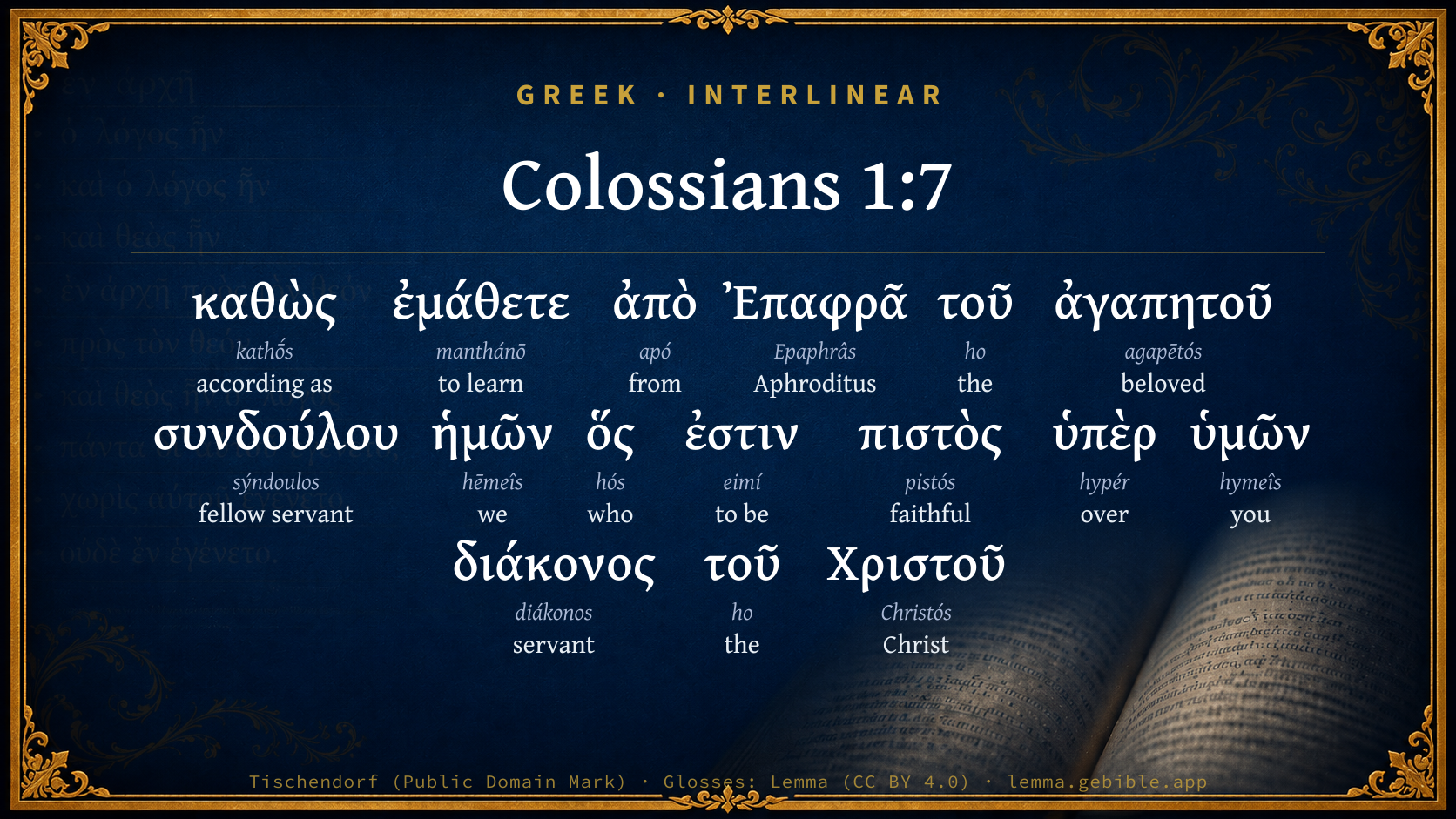
Greek (Tischendorf 8th ed.) Colossians 1:7 appears in the Greek New Testament. The text above is from the Tischendorf 8th edition. Each word links to its Strong’s number and a concise gloss. Click any word for its full Thayer’s Greek Lexicon entry.
Download image
Cite this verse

Colossians 1:7 (World English Bible). Public Domain. Lemma interlinear Bible study tool, https://lemma.gebible.app/v/colossians/1/7.

Show BibTeX & RIS
BibTeX
RIS
English Translation
even as you learned of Epaphras our beloved fellow servant, who is a faithful minister of Christ on our behalf,
World English Bible · Public Domain
Highlights
  • 1 first appearance in the Greek New Testament
Full analysis ↓
Download a study sheet

One document with this verse’s original text, its word-by-word gloss line, the meaning frame, cross-references with their text, attributed commentary, and full source and license credits — printable, and it pastes into notes with its structure intact.

This verse Autodidact and up

Study sheet (.html) Plain text (.txt)

A passage Seminary Student

Up to 50 verses in one chapter. A passage sheet keeps up to 6 commentary sources and 12 cross-references per verse, in the order this page ranks them, and says so on the sheet whenever that leaves anything out. Ask for a single verse and you get the Autodidact verse sheet above.

Everything on this page stays free to read, with no account — the sheet is a download of what is already on screen, not access to it.

Want to remove ads? Support Godless Engineer
Compare translations 3

The same verse in 3 English versions, stacked beneath the original-language interlinear above. Click any original word for its lexicon entry.

Each is an independent rendering of the whole verse — the interlinear is not word-aligned to these translations.

Highlighted words mark where these versions differ — a whole-verse word diff, not a word-by-word alignment.

  • World English Bible Public Domain
    even as you learned of Epaphras our beloved fellow servant, who is a faithful minister of Christ on our behalf,
  • King James Version Public Domain
    As ye also learned of Epaphras our dear fellowservant, who is for you a faithful minister of Christ;
  • unfoldingWord Literal Text CC BY-SA 4.0
    just as you learned from Epaphras, our beloved fellow servant, who is a faithful servant of Christ on our behalf,

unfoldingWord Literal Text — © unfoldingWord, licensed CC BY-SA 4.0. Word-aligned USFM3 via Door43 (git.door43.org/unfoldingWord/en_ult).

Versions to compare (up to 4)

3 of 4 selected

Show all 19 translations

Every available English version of this verse, each an independent rendering of the whole verse.

  • World English Bible Public Domain
    even as you learned of Epaphras our beloved fellow servant, who is a faithful minister of Christ on our behalf,
  • Berean Standard Bible Public Domain
    You learned it from Epaphras, our beloved fellow servant, who is a faithful minister of Christ on our behalf,
  • Majority Standard Bible Public Domain
    You also learned it from Epaphras, our beloved fellow servant, who is a faithful minister of Christ on your behalf,
  • King James Version Public Domain
    As ye also learned of Epaphras our dear fellowservant, who is for you a faithful minister of Christ;
  • American Standard Version (1901) Public Domain
    even as ye learned of Epaphras our beloved fellow-servant, who is a faithful minister of Christ on our behalf,
  • Revised Version (1885) Public Domain
    even as ye learned of Epaphras our beloved fellow-servant, who is a faithful minister of Christ on our behalf,
  • Geneva Bible (1599) Public Domain
    As yee also learned of Epaphras our deare fellowe seruaunt, which is for you a faithfull minister of Christ:
  • Douay-Rheims (1899) Public Domain
    As you learned of Epaphras, our most beloved fellow servant, who is for you a faithful minister of Christ Jesus;
  • Young's Literal Translation Public Domain
    as ye also learned from Epaphras, our beloved fellow-servant, who is for you a faithful ministrant of the Christ,
  • Literal Standard Version CC BY-SA 4.0
    as you also learned from Epaphras, our beloved fellow-servant, who is a faithful servant of the Christ for you,
  • Unlocked Literal Bible CC BY-SA 4.0
    This is the gospel as you learned it from Epaphras, our beloved fellow servant, who is a faithful servant of Christ on our behalf.
  • unfoldingWord Literal Text CC BY-SA 4.0
    just as you learned from Epaphras, our beloved fellow servant, who is a faithful servant of Christ on our behalf,
  • Darby Bible Public Domain
    even as ye learned from Epaphras our beloved fellow-bondman, who is a faithful minister of Christ for you,
  • World Messianic Bible Public Domain
    even as you learned from Epaphras our beloved fellow servant, who is a faithful servant of Messiah on your behalf,
  • Webster's Bible Public Domain
    As ye also learned from Epaphras our dear fellow-servant, who is for you a faithful minister of Christ;
  • Free Bible Version CC BY-SA 4.0
    Our dear friend and fellow-worker Epaphras, who is a trustworthy minister of Christ on our behalf, taught you about this.
  • Bible in Basic English Public Domain
    As it was given to you by Epaphras, our well-loved helper, who is a true servant of Christ for us,
  • Text-Critical English NT CC BY 4.0
    You learned it from Epaphras, our beloved fellow servant, who is a faithful minister of Christ on your behalf
  • Tyndale New Testament (1534) Public Domain
    as ye learned of Epaphra oure deare felowe servaunt which is for you a faythfull minister of Christ

Literal Standard Version (2020), Covenant Press — licensed CC BY-SA 4.0. Text via the HelloAO Bible API (eBible.org). Unlocked Literal Bible (unfoldingWord) — licensed CC BY-SA 4.0. Text via the HelloAO Bible API (eBible.org). unfoldingWord Literal Text — © unfoldingWord, licensed CC BY-SA 4.0. Word-aligned USFM3 via Door43 (git.door43.org/unfoldingWord/en_ult). Free Bible Version, Dr. Jonathan Gallagher — licensed CC BY-SA 4.0. Text via the HelloAO Bible API (eBible.org).

Word by word

More ways to search: Search by grammar → Find every occurrence → Compare this word →

Practice this passage: Drill this verse → Learn its vocabulary →

Ἐπαφρᾶ
Epaphrâs
G1889
“Aphroditus”
Noun, Genitive, Singular, Masculine
Part of Speech
Noun
Case
Genitive
Number
Singular
Gender
Masculine
Full Thayer's Definition

Origin: contracted from G1891

TDNT: None

Epaphras = "lovely" 1. a Christian man mentioned in Paul's epistles
  1. καθὼς kathṓs G2531 “according as” Adverb
  2. ἐμάθετε manthánō G3129 “to learn” Verb, Aorist, Active, Indicative, 2nd person, Plural
  3. ἀπὸ apó G575 “from” Preposition
  4. τοῦ ho G3588 “the” Article, Genitive, Singular, Masculine
  5. ἀγαπητοῦ agapētós G27 “beloved” Adjective, Genitive, Singular, Masculine
  6. συνδούλου sýndoulos G4889 “fellow servant” Noun, Genitive, Singular, Masculine
  7. ἡμῶν hēmeîs G2249 “we” Personal pronoun, 1st person, Genitive, Plural
  8. ὅς hós G3739 “who” Relative pronoun, Nominative, Singular, Masculine
  9. ἐστιν eimí G1510 “to be” Verb, Present, Active, Indicative, 3rd person, Singular
  10. πιστὸς pistós G4103 “faithful” Adjective, Nominative, Singular, Masculine
  11. ὑπὲρ hypér G5228 “over” Preposition
  12. ὑμῶν hymeîs G5210 “you” Personal pronoun, 2nd person, Genitive, Plural
  13. διάκονος diákonos G1249 “servant” Noun, Nominative, Singular, Masculine
  14. τοῦ ho G3588 “the” Article, Genitive, Singular, Masculine
  15. Χριστοῦ Christós G5547 “Christ” Noun, Genitive, Singular, Masculine

About this verse

These counts appear in no published source. They are computed here, from the morphology-tagged text and Lemma’s own curated glosses. What Lemma adds →

16
words
15
distinct lemmas
Pauline Epistles
section

Notable vocabulary

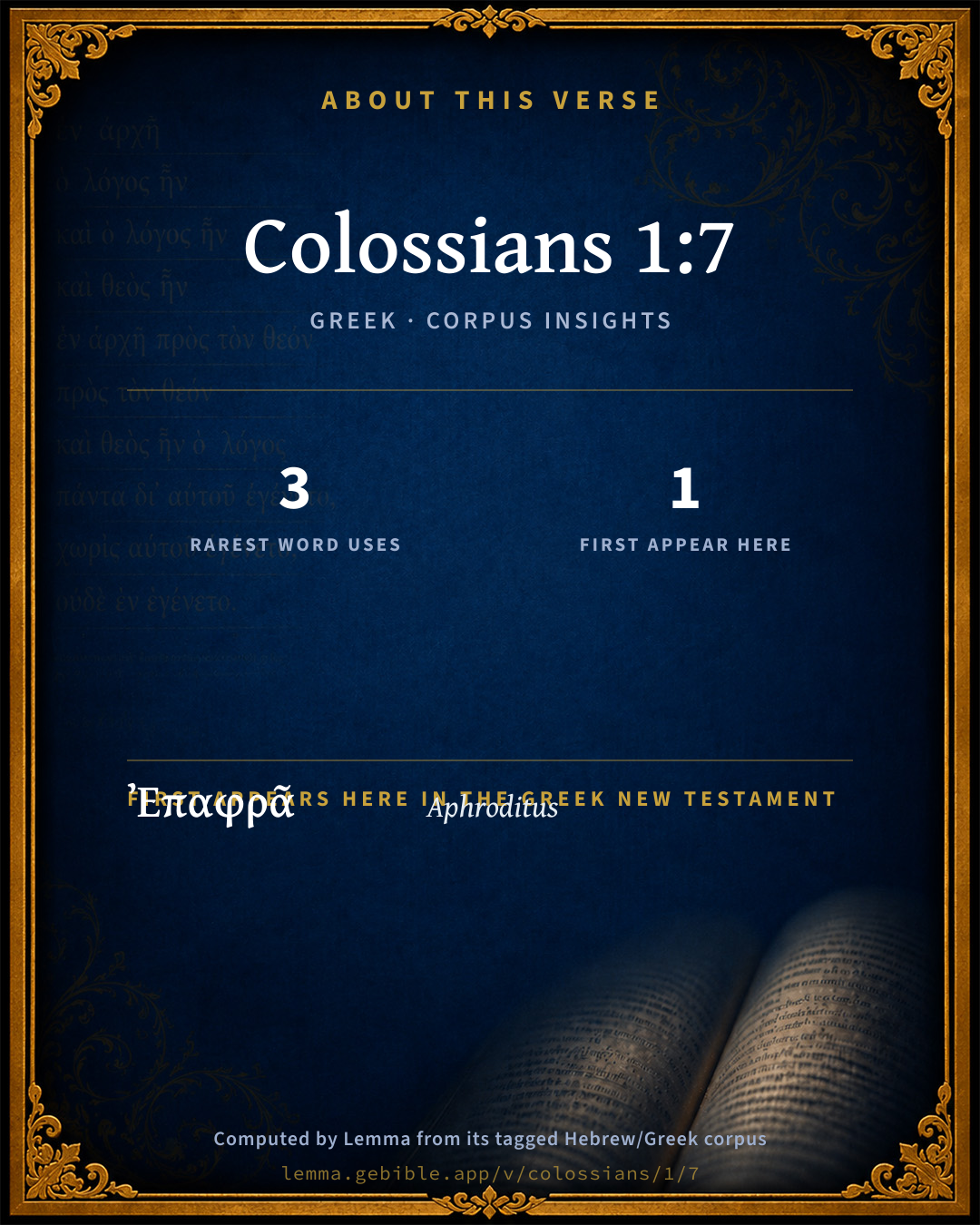
The rarest word here is Ἐπαφρᾶ Aphroditus G1889 — appearing just 3 times in the whole Greek New Testament.

First appearance in Scripture

This word makes its first canonical appearance in the Greek New Testament here:

  • Ἐπαφρᾶ Aphroditus G1889

Shared distinctive vocabulary

Ἐπαφρᾶ Aphroditus G1889 occurs in 3 verses of the Greek New Testament. Also found in:

Repetition

A word recurs within this verse:

Cross-references

17

Topical passages linked to Colossians 1:7 in the Treasury of Scripture Knowledge — connected by theme and wording, ordered by reader-vote popularity; previews shown in the World English Bible.

  • Colossians 4:12 Epaphras, who is one of you, a servant of Christ, salutes you, always striving for you in his prayers, that you may stand perfect and complete in all the will of God.
  • Philemon 1:23 Epaphras, my fellow prisoner in Christ Jesus, greets you,
  • Colossians 4:7 All my affairs will be made known to you by Tychicus, the beloved brother, faithful servant, and fellow bondservant in the Lord.
  • Hebrews 2:17 Therefore he was obligated in all things to be made like his brothers, that he might become a merciful and faithful high priest in things pertaining to God, to make atonement for the sins of the people.
  • 1 Corinthians 4:2 Here, moreover, it is required of stewards, that they be found faithful.
  • Philippians 2:25 But I counted it necessary to send to you Epaphroditus, my brother, fellow worker, fellow soldier, and your apostle and minister to my need;
  • 2 Timothy 2:2 The things which you have heard from me among many witnesses, commit the same to faithful men, who will be able to teach others also.
  • Hebrews 3:2 who was faithful to him who appointed him, as also was Moses in all his house.
  • 2 Corinthians 11:23 Are they servants of Christ? (I speak as one beside himself) I am more so; in labors more abundantly, in prisons more abundantly, in stripes above measure, in deaths often.
  • Numbers 12:7 My servant Moses is not so; he is faithful in all my house:
  • Matthew 24:45 "Who then is the faithful and wise servant, whom his lord has set over his household, to give them their food in due season?
  • Matthew 25:21 "His lord said to him, 'Well done, good and faithful servant. You have been faithful over a few things, I will set you over many things. Enter into the joy of your lord.'
  • 1 Corinthians 4:17 Because of this I have sent Timothy to you, who is my beloved and faithful child in the Lord, who will remind you of my ways which are in Christ, even as I teach everywhere in every assembly.
  • 1 Corinthians 7:25 Now concerning virgins, I have no commandment from the Lord, but I give my judgment as one who has obtained mercy from the Lord to be trustworthy.
  • Ephesians 5:21 subjecting yourselves one to another in the fear of Christ.
  • Philippians 2:19–22 But I hope in the Lord Jesus to send Timothy to you soon, that I also may be cheered up when I know how you are doing.
  • 1 Timothy 4:6 If you instruct the brothers of these things, you will be a good servant of Christ Jesus, nourished in the words of the faith, and of the good doctrine which you have followed.

Cross-references courtesy of OpenBible.info (CC BY 4.0).

Where the printed editions differ

1 variant

Places in this verse where the major printed Greek editions disagree on the wording in a way that affects the translation — a comparison of editions, not a manuscript-by-manuscript collation. The editions are the modern critical texts (Nestlé-Aland 28/27, SBL, Westcott-Hort, Tregelles, Tyndale House) and the traditional texts behind the KJV (the Textus Receptus and the Byzantine/Majority text). It is not a claim about which reading is original.

  1. Different wording
    ὑμῶν

    “of you”

    In NA28NA27TRByz Not in TynSBLWHTreg

    ἡμῶν (hēmōn) 'of us' occurs in a few manuscripts (Tyn+SBL+WH+Treg) instead of ὑμῶν (humōn) 'of you' in older manuscripts (NA28+NA27+TR+Byz)

Textual data: Translators Amalgamated Greek New Testament (STEPBible TAGNT) · CC BY 4.0.

Commentary

Notes on Colossians 1:7 from classic Christian and Jewish commentators (each source and its license shown beneath its notes). The classic Christian expositions comment on the surrounding passage and are grouped to its opening verse, so a note may address several verses; the Jewish commentaries on the Tanakh (Rashi and others) are per-verse, so they appear only where the commentator wrote on this verse.

Lemma curates 59 commentaries, every one of them public domain or Creative Commons licensed, each selected and text-cleaned for this edition rather than reprinted as found. About our sources →

The Biblical Illustrator

Joseph S. Exell

Col_1:7

As ye also learned of Epaphras.

Epaphras

To commend Epaphras to the Colossians and secure to him their heart, Paul bears a strong testimony to his fidelity and goodness.

1. Paul knew how very important it is that churches should have a good opinion of their pastors; and with what artifices the enemy labours to ruin their reputation among their flocks; on this account he here exalts Epaphras as his piety deserved; and, to remove from the Colossians all suspicion against the purity of his teachings, expressly assures them that the doctrine which they had learned of him was the same gospel of which he had spoken.

2. And from this anxiety of the apostle ministers should learn the necessity of insuring the esteem of their people; abstaining not from evil only, but also from its appearances. It is not enough to obtain the approval of our own conscience, we should also be prepared to satisfy the judgment of our neighbours. Innocence is necessary for ourselves, and reputation for others.

3. And since it serves to edify them, we are evidently bound to preserve, not only our own, but also the reputation of our brethren. Who does not see that if we bite and rend one another, the disgraceful conduct of individuals will involve us all in one common infamy and ruin?

4. And see also that as the reputation of pastors is a public good, each believer owes it a peculiar respect, and that the crime of those who unjustly violate it is a kind of sacrilege. It is robbing the Church, stealing from it its means of edification. To return to Epaphras; the apostle calls him--

I. His Dear Fellow-Servant. Admire--

1. His ingenuousness; for whereas there is commonly a jealousy between persons of the same profession, St. Paul acknowledges and exalts the gifts and piety of this servant of God.

2. His kindness; for he loves him, and shows that of all men there were none whom he more tenderly esteemed than the faithful ministers of the gospel.

3. His humility; in that being raised to the throne of apostolic dignity, the highest in the Church, he makes Epaphras, as it were, to sit there with him, owning him for his fellow.

II. A Minister of Christ. It was much to be fellow-servant with St. Paul, but it is much more to be the minister of Christ, the Head of the Church.

III. A Faithful Minister. the apellation of minister was his in common with many others, the praise of faithfulness with few. It is all that the apostle required in a good steward of the house of God (1Co_4:1-2). To have this praise the minister of God must--

1. Seek the glory of his Master, and not his own.

2. He must keep close to his orders; not parsimoniously concealing from his sheep any of the things committed to him for their edification; and without setting before them anything of his own invention beyond, or contrary to, the will of the chief Shepherd.

IV. A faithful minister of Christ for you. They ought therefore to love him both for the dignity of his office, and for the profit that thereby came to them. For though we are bound to love and respect all the faithful servants of God in general, yet, doubtless, we owe them particular affection and reverence who specially consecrate their ministry to our edification. (J. Daille.)

The praise of service

It is a beautiful though a faint image which shines out on us from these fragmentary notices of this Colossian Epaphras--a true Christian bishop, who had come all the long way from his quiet valley in the depths of Asia Minor to get guidance about his flock from the great apostle, and who bore them on his heart day and night, and prayed much for them while so far away from them. How strange the fortune which has made his name and his solicitudes and prayers immortal! How little he dreamed that such embalming was to be given to his little services, and that they were to be crowned with such exuberant praise! The smallest work done for Jesus Christ lasts for ever, whether it abide in mens memories or no. Let us ever live as those who, like painters in fresco, have with swift hand to draw lines and lay on colours which will never fade; and let us by humble faith and holy life earn such a character from Pauls Master. The Masters well done will out-weigh labours and toils, and the depreciating tongues of fellow-servants, or of the Masters enemies. (A. Maclaren, D. D.)

A faithful minister of Christ

I. The characteristics of a faithful minister of Christ.

1. A sincere and manifest attachment to our Lord and Saviour.

2. He receives his doctrines and his views of truth from the pure fountain of Divine revelation. Moses was ordered to make all things according to the pattern shown him on the mount; and every faithful minister of Christ is extremely cautious that everything he delivers corresponds with the rule laid down by his Master. He makes the Scriptures his guide--the Holy Word of God his instructor.

3. While he knows the truth, he without reserve honestly delivers the Lords message. Jeremiah was commanded by God to deliver all the message which the Lord gave him, and not to be afraid of man. He will not hesitate to warn sinners to flee from the wrath to come, and will be equally faithful in comforting and strengthening believers--in showing to them their privileges, and the great mercy bestowed upon them through their covenant-head.

4. While he preaches a whole gospel, giving to saints and sinners their portion in due season, he is willing, and does suffer, if need be, for righteousness sake.

5. Perseverance to the end: Be thou faithful, etc.

II. Such a minister is a great blessing to the people to whom he is sent by God.

1. Because he leads them from the greatest of misery to the greatest of blessedness.

(1) He conducts them from sin, impenitence, self-righteousness, and unbelief; and the man who does this is our true friend.

(2) He leads us to the enjoyment of the most distinguished favours, into green pastures--a state of favour with God, of union with Jesus Christ, of holy communion with the Father, Son, and Holy Spirit, upon earth, and a state of happiness when we die, enabling us to rejoice in the hope of the glory of God.

2. Inasmuch as he brings to their knowledge those holy and exalted truths that fortifiy a man for the sufferings of time and the hour of death.

3. Inasmuch as by opening to them the gospel, he presents them with--what?--ah! with what philosophy cannot do--with what the reason of man cannot unfold--with what science can never explore--with what all the pride of learning can never bring to light:--he brings life and immortality to their view.

III. God will put honour on a faithful ministry.

1. By the witness of the Spirit in the ministers own soul.

2. Where the gospel is fully preached God is generally pleased to add the seal of His approbation to it by means of the talents of His minister.

3. The Lord puts honour on His faithful ministers, both in the Church and in the world.

4. The faithful minister of God will be honoured at the day of judgment, when his Master shall say to him, Well done, good and faithful servant, etc., not Well done, learned, zealous, eloquent, successful servant.

Conclusion--

1. A faithful minister of Jesus Christ is the gift of God.

2. When a faithful minister of the Lord Jesus Christ dies he goes to give in His account.

3. If the faithful minister goes at death to give an account to his Lord and Master, then the congregation he leaves behind ought to reflect and think what account he will give of them. (R. McAll, D. D.)

Ministerial responsibility

I am angry when I hear people talk about the awful responsibility of being a minister. People sometimes say to me, I should think you would shudder when you stand up before your congregation. I shudder? what should I shudder for? Do you shudder when you stand up before a garden of flowers? Do you shudder when you go into an orchard of fruit in October? Do you shudder when you stand up in the midst of all the richness and grandeur of nature? I shudder in your midst? But the responsibility! I have no responsibility. I am willing to do my duty; and what more is there than that? I will not stand for the consequences. I will do the best I can. I will say the best things I can every Sunday; I will bring the truth home to you, and I will do it in the spirit of love. Even when I say the severest things, it is because I am faithful to love. But your care! I have not a bit of care. I forget the sermon a great deal quicker than you do. Your burden! I have no burden. I take up the battle, and I lay the battle aside again as soon as it is over. And I shall sleep to night as sweetly as any man that is here. And every man that is in the ministry, and is willing to love men, and to be faithful to them, will find joy in it from day to day. (H. W. Beecher.)

Ministers must be faithful

A dying nobleman once sent for the clergyman on whose ministry he had attended, and said to him, Do you not know that my life has been licentious, and that I have violated the commandments of God? Yet you never warned me of my danger! The clergyman was silent. When the nobleman repeated the question, he replied, Yes, my lord, your manner of living was not unknown to me; but your kindness, and my fear of offending you, deterred me from reproving you. How cruel! how wicked said the dying man. The provision I made for you and your family ought to have induced care and fidelity. You have neglected to warn and instruct me, and now my soul will be lost.

A picture of a faithful minister

Come in; I will show thee that which may be profitable to thee. So he commanded his man to light the candle, and bid Christian follow him; so he had him into a private room, and bid his man open a door, the which when he had done, Christian saw the picture of a very grave person hung up against the wall, and this was the fashion of it:--It had eyes lifted up to heaven, the best of books in his hand, the law of truth was written upon its lips, the world was behind his back, it stood as if it pleaded with men, and a crown of gold did hang over his head. Then said Christian, What means this? Interpreter: The man whose picture this is, is one of a thousand; he can beget children (1Co_4:5), travail in birth with children (Gal_4:19), and nurse them himself when they are born (1Th_2:7). And, whereas thou seest him with his eyes lifted up to heaven, the best of books in his hand, and the law of truth writ on his lips, it is to show thee that his work is to know and unfold dark things to sinners, even as also thou seest him stand as if he pleaded with men; and whereas thou seest the world as cast behind him, and that a crown hangs over his head, that is to show thee that slighting and despising the things that are present, for the love that he hath to his Masters service, he is sure in the world that comes next to have glory for his reward. (Bunyans Pilgrims Progress.)

The Biblical Illustrator, edited by Joseph S. Exell (c. 1880s–1900s) — public domain. Text from a community e-Sword module.

Tyndale Open Study Notes

Tyndale Open Resources

1:7 Epaphras (see also 4:12-13; Phlm 1:23) was probably converted when Paul ministered in Ephesus (see Acts 19:10) and then returned to Colosse to bring the Good News to his own town.

Tyndale Open Study Notes — © Tyndale Open Resources, licensed CC BY-SA 4.0. Text via the HelloAO Bible API.

Bengel's Gnomon

Johann Albrecht Bengel

Col 1:7. Καθὼς, even as) Paul thus confirms and approves the doctrine of Epaphras, which perhaps some had despised. It was Paul’s duty to write rather than Epaphras.—ἡμῶν, our) Paul and Timothy.—ὑπὲρ ὑμῶν) for you, on your account.—ἀγάπην ἑν Πνεύματι, love in the Spirit) Love, the fruit of the Spirit; spiritual love; comp. Col 1:9, at the end.

Bengel's Gnomon of the New Testament — English translation (T&T Clark, Edinburgh, 1860) — public domain. Text from a community e-Sword module.

Meyer's Critical & Exegetical Commentary

Heinrich August Wilhelm Meyer

Col_1:7 f. Καθώς] not quandoquidem (Flatt, comp. Bähr), but the as of the manner in which. So, namely, as it had just been affirmed by ἐν ἀληθείᾳ that they had known the divine grace, had they learned it (comp. Php_4:9) from Epaphras. Notwithstanding this appropriate connection, Holtzmann finds in this third καθώς a trace of the interpolator.

Nothing further is known from any other passage as to Epaphras the Colossian (Col_4:12); according to Phm_1:23, he was συναιχμάλωτος of the apostle. That the latter circumstance is not mentioned in our Epistle is not to be attributed to any special design (Estius: that Paul was unwilling to make his readers anxious). See, on the contrary, on Col_4:10. Against the identity of Epaphras with Epaphroditus, see on Php_2:25. The names even are not alike (contrary to the view of Grotius and Ewald, who look upon Epaphras as an abbreviation); Ἐπαφρᾶς and the corresponding feminine name Ἐπαφρώ are found on Greek inscriptions.

συνδούλου] namely, of Christ (comp. Php_1:1). The word, of common occurrence, is used elsewhere by Paul in Col_4:7 only.

ὅς ἐστιν κ.τ.λ.] This faithfulness towards the readers, and also, in the sequel, the praise of their love, which Epaphras expressed to the apostle, are intended to stir them up ne a doctrina, quam ab eo didicerant, per novos magistros abduci se patiantur, Estius. The emphasis is on πιστός.

ὑπὲρ ὑμῶν] for, as their teacher, he is the servant of Christ for them, for their benefit. The interpretation, instead of you (in prison he serves me in the gospel, Michaelis, Böhmer), would only be possible in the event of the service being designated as rendered to the apostle (διάκονός μου ἐν Χριστῷ, or something similar). Comp. Phm_1:13. Even with Lachmanns reading, ὑπ. ἡμῶν (Steiger, Olshausen, Ewald), it would not be necessary to take ὑπέρ as instead; it might equally well be taken as for in the sense of interest, as opposite of the anti-Pauline working (comp. Luk_9:50). The present ἐστί (Paul does not put ἦν) has its just warrant in the fact, that the merit, which the founder of the church has acquired by its true instruction, is living and continuous, reaching in its efficacy down to the present time. This is an ethical relation, which is quite independent of the circumstance that Epaphras was himself a Colossian (in opposition to Hofmann), but also makes it unnecessary to find in ἐστι an indirect continuance of Epaphras work for the Colossians (in opposition to Bleek).

ὁ καὶ δηλώσας κ.τ.λ] who also (in accordance with the interest of this faithful service) has made us to know; comp. 1Co_1:11. The ἀγάπη is here understood either of the love of the Colossians to Paul (and Timothy), as, following Chrysostom, most, including Huther, Bleek, and Hofmann,[15] explain it, or of the brotherly love already commended in Col_1:4 (de Wette, Olshausen, Ellicott, and others). But both these modes of taking it are at variance with the emphatic position of ὑμῶν (comp. 1Co_9:12; 2Co_1:6; 2Co_7:7; 2Co_8:13, et al.), which betokens the love of the readers to Epaphras as meant. There had just been expressed, to wit, by ὑ̔πὲρ ὑμῶν, the faithful, loving position of this servant of Christ towards the Colossians, and correlative to this is now the love which he met with from them, consequently the counter-love shown to him, of which he has informed the apostle. A delicate addition out of courtesy to the readers.

ἐν πνεύματι] attaches itself closely to ἈΓΆΠΗΝ, so as to form one idea, denoting the love as truly holynot conditioned by anything outward, but divinely upheldwhich is in the Holy Spirit as the element which prompts and animates it; for it is the fruit of the Spirit (Gal_5:22; Rom_15:30), οὐ σαρκικὴ, ἀλλὰ πνευματική (Oecumenius). Comp. ΧΑΡᾺ ἘΝ ΠΝ., Rom_14:17.

[15] Who, at the same time, makes the ἐν πνεύματι suggest the reference, that the ἁγάπη took place in a manner personally unknownwhich must have been conveyed in the context.

REMARK.

Since ἀφʼ ἧς ἡμέρας ἠκούσατε κ.τ.λ., Col_1:6, refers the readers back to the first commencement of their Christianity, and καθὼς ἐμάθετε ἀπὸ Ἐπαφρᾶ κ.τ.λ., Col_1:7, cannot, except by pure arbitrariness, be separated from it as regards time and regarded as something later, it results from our passage that Epaphras is to be considered as the first preacher of the gospel at Colossae, and consequently as founder of the church. This exegetical result remains even if the Recepta καθὼς καί is retained. This καί would not, as Wiggers thinks (in the Stud. u. Krit. 1838, p. 185), place the preaching of Epaphras in contradistinction to an earlier one, and make it appear as a continuation of the latter (in this case καθὼς καὶ ἀπὸ Ἐπαφρ. ἐμάθετε or καθὼς ἐμάθετε καὶ ἀπὸ Ἐπαφρ. would have been employed); but it is to be taken as also, not otherwise, placing the ἐμάθετε on a parity with the ἐπέγνωτε. This applies also in opposition to Vaihinger, in Herzogs Encykl. iv. p. 79 f.

Meyer — Critical and Exegetical Commentary on the New Testament — English translation by Peter Christie, edited by Frederick Crombie (T&T Clark, 1880) — public domain. Text from a community e-Sword module.

Expositor's Greek Testament

ed. W. Robertson Nicoll

Col 1:7 . καθὼς , i.e. , in the manner in which. Paul thus sets the seal of his approval on the form of the Gospel which they had learnt from their teacher, and also on the teacher himself. Ἐπαφρᾶ . Epaphras was apparently the founder of the Colossian Church, ἐμάθετε referring to the same time as ἠκούσατε . He had remained in connexion with it (Col 4:12 ), and seems to have come to Paul to inform him of the teaching that was threatening its welfare. He is not to be identified with Epaphroditus (Phi 2:25 sq. , Phi 4:18 ), who was connected with Philippi. The name was common. ὑπὲρ ἡμῶν . This is probably the correct reading; Epaphras is a minister to the Colossians on Paul’s behalf, since he has accomplished a task which belonged to Paul’s sphere as the Apostle of the Gentiles. The reading ὑπὲρ ὑμῶν may be taken in two ways, either (preferably) that he was a minister of Christ for the sake of the Colossians, in which case we should probably have had ὑμῖν or ἐν ὑμῖν or simply ὑμῶν ; or that he ministered to Paul as the representative of the Colossians, for which we should have expected “my minister” instead of “minister of Christ”.

The Expositor's Greek Testament, edited by W. Robertson Nicoll (1897–1910) — public domain. Text from a community e-Sword module.

Jamieson, Fausset & Brown

Robert Jamieson, A. R. Fausset & David Brown

As ye also learned--"Also" is omitted in the oldest manuscripts. The insertion implied that those inserting it thought that Paul had preached the Gospel to the Colossians as well as Epaphras, Whereas the omission in the oldest manuscripts implies that Epaphras alone was the founder of the Church at Colosse.

of--"from Epaphras."

dear--Greek, "beloved."

fellow servant--namely, of Christ. In Plm 1:23 he calls him "my fellow prisoner." It is possible that Epaphras may have been apprehended for his zealous labors in Asia Minor; but more probable that Paul gave him the title; as his faithful companion in his imprisonment (compare Note, see on Col 4:10, as to MEYER'S conjecture).

who is for you, &c.--Translate, "who is faithful in your behalf as a minister of Christ"; hinting that he is one not to be set aside for the new and erroneous teachers (Col. 2:1-23). Most of the oldest manuscripts read, "for (or 'in behalf of') US." Vulgate, however, with one of the oldest manuscripts, supports English Version.

Jamieson, Fausset & Brown — Commentary Critical and Explanatory on the Whole Bible (1871) — public domain (CC PDM 1.0). Text via the HelloAO Bible API.

Adam Clarke's Commentary

Verse 7. As ye also learned of Epaphras - who is for you] Who this Epaphras was we cannot tell; only it is likely that he was a Colossian, and became, by the call and grace of Christ, a deacon of this Church, faithfully labouring with the apostle, to promote its best interests. Some think that he is the same with Epaphroditus, Epaphras being a contraction of that name, as Demas is of Demetrius; and it is remarkable that one of the Slavonic versions has Epaphroditus in this place. That he was a Colossian is evident from Col 4:12: Epaphras, who is one of you, οεξυμων. some think that he was the first who preached the Gospel among this people, and hence called an apostle. He was raised up among themselves to be their minister in the absence of the apostle, and he showed himself to be worthy of this calling by a faithful discharge of his ministry, and by labouring fervently for them all, and pressing them forward, that they might stand perfect and complete in all the will of God.

Adam Clarke's Commentary on the Bible (1810–1826) — public domain. Text from a community e-Sword/MySword module.

Ellicott's Commentary for English Readers

(7) Ye also learned of Epaphras.—Of Epaphras we know nothing, except what we gather from this passage, and from Col_4:12; Phm_1:23. The name is a shortened form of Epaphroditus, but it is most unlikely that he is the same as the Epaphroditus of Php_2:25; Php_4:18. Being, it seems, a native of Colossæ itself, he was apparently its first evangelist, and is afterwards described as feeling some responsibility for it and its neighbouring cities, Laodicea and Hierapolis (Col_4:13). His work could not have been transient, for under him the Colossians are said not only to have “heard,” but also to have “known” (come to know perfectly) “the grace of God.” St. Paul here gives emphatic testimony to his faithfulness, and to his preaching to them “in truth.” That he was, then or afterwards. Bishop of Colossæ is probably a mere guess of tradition. But he may have had some such charge as that which was afterwards more formally committed to Timothy at Ephesus, and Titus in Crete. At this time, however, he remained with St. Paul (Col_4:12-13), and apparently shared his captivity, for he is called (in Phm_1:23) his “fellow-prisoner.”

Who is for you a faithful minister of Christ.—(1) “For you” is, properly, on your behalf. This has been supposed to mean that Epaphras, like his Philippian namesake, had been a representative of the Colossian Church, in ministry to the Apostle; but this is hardly compatible with the entire absence of any personal reference in the sentence. Contrast Phm_1:13, “that on thy behalf he might minister to me.” If this reading, therefore, is to stand, “on your behalf” must be taken to signify generally “for your benefit,” which is doubtless the meaning of our version. (2) But there is considerable, perhaps preponderating, MS. authority for the reading “on our behalf,” that is, in our stead. This makes Epaphras a representative, perhaps an actual messenger, of St. Paul, for the conversion of the church at Colossæ; sent probably at the time when the Apostle had his head-quarters at Ephesus, and when “all that dwelt in Asia heard the word of the Lord Jesus” (Act_19:10). This interpretation not only gives greater force to this passage, but explains also the attitude of authority here assumed by St. Paul toward a church which he had not seen, differing so markedly from the tone of his Epistle to the Romans in a like case.

A Bible Commentary for English Readers, edited by Charles John Ellicott (1878–1897) — public domain. Text from a community e-Sword module.

The Cambridge Bible for Schools and Colleges

gen. ed. J. J. S. Perowne

7. as ye also learned] In the word “as” he refers to the “truth” just spoken of (Lightfoot). So, and not otherwise, had Epaphras phrased his message.

The word rendered “also” should certainly be omitted, on documentary evidence. As it stands, it simply emphasizes the fact; “as you actually learned from Epaphras.” But its omission leaves the English reader less likely to misunderstand the sentence, as if it implied some other informant of the Colossians, besides Epaphras.

Epaphras] Named also below, Col_4:12, and Phm_1:23. The name is an abbreviation of Epaphroditus, and it has been guessed that the Epaphroditus of Php_2:25; Php_4:18, and this Epaphras, are the same person. But both name-forms were very common at the time; and nothing but the name tends to an identification in this case, unless indeed the warm and devoted Christian character indicated in both Philippians 2 and Colossians 4 does so. And this happily was not so rare in the Church as to make an argument.

From the notices in this Epistle and in Philemon we gather that he was a Colossian by birth, or at least by abode; that he had been the first, or at least chief, evangelist of Colossæ (see further, Introd., p. 21), and that he was now at Rome, arrived from Asia, and was St Paul’s “fellow-prisoner of war;” i.e. either actually imprisoned with him on some charge connected with the Gospel, or so incessantly with him in his captivity as practically to share it. The latter is more probable.—For his character, see further, on Col_4:12.—Tradition makes Epaphras first bishop of Colossæ, and a martyr there.

fellowservant] Strictly, fellow-bondservant, fellow-slave. He uses the word again, of Tychicus, Col_4:7, and not elsewhere. It occurs Rev_6:11; Rev_19:10; Rev_22:9; and, of non-spiritual servitude, Mat_18:28-33; Mat_24:49.—To the Christian, in a life of humble surrender to his Lord, the fact of his own holy bondservice is inexpressibly dear; and so the thought of his association in it with others is an endearing and uniting thought.

for you] Another reading is for us, on our behalf (so R.V.). For this there is weighty documentary evidence, though it cannot be called overwhelming. It is however supported internally by the evidence in the context that Epaphras was, so to speak, vice-evangelist “for” St Paul at Colossæ.

minister] Greek, diâconos; so Eph_6:21, and below, Col_1:23; Col_1:25, Col_4:7. The word essentially implies activity and subordination. In Php_1:1; 1Ti_3:8-12; the word denotes holders of a subordinate and active office in the organized Christian ministry (and cp. Rom_16:1). See our notes on Php_1:1, and Appendix C. to that Epistle. But such a reference here is unlikely, if only because of the wording, “diaconos of Christ.” Epaphras, whatever his church-office, was the loving worker under Christ for Paul and Colossæ. For such a use of the word cp. Joh_12:26; 1Co_3:5 (a close parallel); 2Co_6:4; 2Co_11:23; 1Th_3:2.—The Latin Versions render, minister.

The Cambridge Bible for Schools and Colleges (gen. ed. J. J. S. Perowne; Cambridge University Press, 1878–1918) — public domain. Text from a community e-Sword module.

John Gill's Exposition

As ye also learned of Epaphras,.... To know the grace of God, believe the truth of the Gospel, and to own and profess it sincerely,

Our dear fellow servant; a "servant" of Christ he was, and a "fellow" servant of the apostles, jointly engaged with them in preaching the Gospel; which character, as it greatly commends Epaphras, and shows him to be a very considerable preacher of the word, so it expresses the great humility and condescension of the apostle, in putting him upon a level with himself, though he was not in that high office of the apostleship he was. And "dear" this precious servant of Christ was to him, and his fellow ministers, on account of the grace and gifts bestowed on him, because of his usefulness in the ministry, and his faithfulness and integrity in the discharge of it; and whose company and conversation in the prison greatly endeared him to them, for he was a fellow prisoner, as well as a fellow servant, Plm 1:23. It follows,

who is for you a faithful minister of Christ; one whom Christ had made a "minister" and not man, who was qualified, and sent forth, and made successful by him in his service; and who preached none but Christ, and him crucified, in the business of salvation: and he was a "faithful" one; one that sought not his own glory, but the glory of him that sent him; nor to please men, but his master; who concealed no part of his message, but freely and fully declared the whole; he was faithful to Christ, who put him into the ministry, and to the souls of men, to whom he ministered: and therefore it is said, he was such an one "for you"; for them, not for himself; for their spiritual good and advantage; he sought not theirs, but them; he had a great zeal for them, dearly loved them, and spent his time and strength, and made use of his gifts and talents while among them, for their use and benefit.

John Gill's Exposition of the Whole Bible (1746–1763) — public domain (CC PDM 1.0). Text via the HelloAO Bible API.

Trapp's Complete Commentary

John Trapp

7 As ye also learned of Epaphras our dear fellowservant, who is for you a faithful minister of Christ;

Ver. 7. Who is for you a faithful minister] Epaphras was their city preacher; whom therefore the apostle here so highly commendeth. Luther is much blamed by his best friends for opposing and disparaging Carolostadius among his own charge at Orlamund, A.D. 1524. (Scultet. Annul.) A faithful minister should have all good respect, before his own people especially.

John Trapp, A Commentary or Exposition upon All the Books of the Old and New Testament (1647–1656) — public domain. Text from a community e-Sword module.

Albert Barnes' Notes on the Bible

As ye also learned of Epaphras - Epaphras was then with Paul. Phm 1:23. He had probably been sent to him by the church at Colossae to consult him in reference to some matters pertaining to the church there. It is evident from this, that Epaphras was a minister of the church at Colossae, though there is no evidence, as has been often supposed, that he was the founder of the church. The apostle here says, that they had learned from Epaphras the true nature of the gospel, and he designs undoubtedly to confirm what he had taught them in opposition to the teachings of errorists; see the Introduction, Section 4. He had doubtless conferred with Epaphras respecting the doctrines which he had taught there.

Our dear fellow-servant - This shows that Paul had contracted a strong friendship for Epaphras. There is no reason to believe that he had known him before, but his acquaintance with him now had served to attach him strongly to him. It is possible, as has been conjectured (see the Introduction), that there was a party in the church at Colossae opposed to Epaphras and to the doctrines which he preached, and if this were so, Paul’s strong expression of attachment for him would do much to silence the opposition.

Who is for you a faithful minister of Christ - “For you,” when he is with you, and in managing your interests here.

Albert Barnes' Notes on the Bible (1834–1885) — public domain. Text from a community e-Sword/MySword module.

Haydock's Catholic Bible Commentary

Of Epaphras, who seems to have been their first apostle, and their bishop. (Witham)

George Leo Haydock (1774–1849), Haydock's Catholic Family Bible and Commentary, 1859 edition — public domain. Excludes Psalms (Douay-Rheims chapter numbering differs from Protestant) and Deuterocanonical books (Catholic canon only).

Matthew Poole's English Annotations

As ye also learned of Epaphras: to maintain the truth, it did much concern them to have a good opinion of him, who was an eminent instrument in communicating it to them, and therefore Paul doth here very opportunely commend Epaphras, in opposition to those false teachers, who likely might insinuate somewhat to his disparagement.

Our dear fellow servant; the respect they bare, and relation he stood in to them, being dearly beloved of him for his sincerity in promulgating the gospel; and being engaged with them in the service of the same Master, Col 4:7; Rev 6:11.

Who is for you a faithful minister of Christ; his office, which he discharged with fidelity and affection unto them. He did with all honesty and integrity, as became one intrusted by his Master Christ, discharge what was incumbent on him for their good, Col 4:13; Joh 12:26; 1Co 4:1,2; Eph 4:12; 1Ti 4:6; Heb 13:17.

Matthew Poole's English Annotations on the Holy Bible (1683–1685) — public domain. Text from a community e-Sword/MySword module.

Whedon's Commentary on the Bible

Daniel D. Whedon

7. Epaphras—A Colossian by birth, and the founder of that Church. This would be doubtful if the word also were genuine. He may have met the apostle at Ephesus, been converted, and sent home to evangelize the city. At the present time he was at Rome, Paul’s “fellow prisoner.” Phm_1:23. He is by some thought identical with the Epaphroditus of the epistle to the Philippians; but this is quite improbable. The high character given him here, as the apostle’s helper, and the full ratification of his teaching, are his authoritative endorsement as against the errorists who would supplant him at Colosse and subvert the gospel. See also on Col_4:12-13.

Daniel D. Whedon (gen. ed.), Commentary on the Old and New Testaments (1874–1909) — public domain. Text from a community e-Sword module.

The Pulpit Commentary

As ye learned from Epaphras, our beloved fellow servant; literally, bondman (Eph_4:20; 2Ti_3:14) Only in Col_4:7 does the epithet "fellow-bondman" appear again in St. Paul (the Revisers in these two places omit their marginal "bondservant The dominant thought of Christ Jesus "the Lord" (Col_2:6 Col_3:22-25; Col_4:1) possibly dictates this expression. That the Colossians had received the gospel in this way from Epaphras, a disciple of St. Paul, was a striking proof of its fruitfulness, and a further cause for thanksgiving on his own part. Who is a faithful minister of Christ on our (or, your) behalf (Col_4:12, Col_4:13; 2Co_8:22; Php_2:22) He puts his seal upon the ministry of Epaphras, and vindicates it against all questioning at home. Textual evidence for "on our" or "your behalf" is pretty evenly balanced: most older Greek copies read the first person, while the ancient versions generally adopted the second; and the critical editors are similarly divided. The Revisers, with Tregelles, Alford, Lightfoot, Westcott and Hort, prefer "our," which gives a finer and more fitting sense. It was as St. Paul"s representative that Epaphras had ministered in Colossae, and to him he now reported his success; and this justified the apostle in claiming the Colossians as his own charge, and in writing to them in the terms of this letter (Col_2:1, Col_2:2, 5-7: Rom_15:20; 2Co_10:13-16) "Minister" (diakonov, deacon, in its official sense found in St. Paul first in Php_1:1, then in 1 Timothy) is to be distinguished from the "servant" (doulov, slave) of the last clause, and from "assistant": (uJphrethv 1Co_4:1; Act_13:5 Act_26:16) and "attendant": (qerapwn; Heb_3:5) see Trench"s "Synonyms of the New Testament." It is a favourite word of St. Paul"s, and points to the service rendered, while other terms indicate the status of the servant.

The Pulpit Commentary (1880–1919), ed. H.D.M. Spence-Jones & Joseph S. Exell — public domain. Text from a community e-Sword module.

John Wesley's Explanatory Notes

The fellowservant - Of Paul and Timotheus.

John Wesley, Explanatory Notes Upon the Whole Bible (1754–1765) — public domain. Text via the GEBible commentary corpus.

Burkitt's Expository Notes on the New Testament

William Burkitt

Observe here, 1. The person who first preached the gospel of Christ to the Colossians, and converted them to the Christian faith, it was Epaphras; As ye learned of Epaphras.

Observe, 2. The commendation given to Epaphras, and his character by St. Paul; he was regularly called to the work, and a diligent fellow-labourer with St. Paul in the work of preaching and dispensing the mysteries of the everlasting gospel to a lost world; who is for you a faithful minister of Christ.

Learn hence, That the knowledge of life and salvation is ordinarily wrought in persons by the preaching of the gospel, by men called of God to that sacred function.

Observe, 3. A particular instance of the faithfulness of Epaphras towards the Colossians, he declared unto St. Paul their love in the Spirit; that is, their spiritual love and fervent affection to him, though they had never seen his face nor heard his voice.

The faithful ministers and members of Jesus Christ do affectionately love one another though they see not the face of each other; there is no such loadstone of love as the grace of God. This will draw forth the heart and affections of a believer to the ends of the earth, to pray for, to mourn over, and to rejoice with such of their brethren as they never saw, but of whose condition they have heard.

Observe, 4. The kind return which St. Paul makes to them, for their love in the Spirit towards him; For this cause we do not cease to pray for you: there is no such way to attain an interest in, and to obtain constant benefit and advantage by the prayers of the ministers of God, as to be expressive of our love and affection both to God and them.

Observe, 5. The especial blessings which he prays for on the Colossians’ behalf, namely, that they might be filled with the knowledge of his will, that is, attain to a more perfect and comprehensive knowledge of God’s will and their duty, furnished with all divine wisdom and spiritual understanding, to regulate their lives according to their knowledge.

Learn from hence, That there is a fulness of divine knowledge, which is attained by none, but should be aimed at by all, seeing they that know most of God’s word and revealed will, come far short of what they should know.

Learn, 2. That the knowledge wisdom, and understanding, which Christians should especially labour after, and attain unto, is of things spiritual: that ye be filled with knowledge and spiritual understanding.

O let divine and spiritual knowledge be our chief care and principal business! It is called here spiritual understanding, because it is from the holy spirit, and conversant about spiritual things, which far exceeds the most refined notions concerning other things; and Christ tells us, that eternal life depends upon it, Joh 17:3.

Spiritual knowledge fits us for the service of God on earth, for the sight of God in heaven: And Christ has told us, that he will take a second journey from heaven, to render vengeance on them which know not God, and on them which do know (notionally) but obey not practically the gospel of our Lord Jesus, 2Th 1:8.

William Burkitt's Expository Notes on the New Testament (1700–1703) — public domain. Text from a community e-Sword module.

The People's New Testament

B. W. Johnson

7. As ye also learned of Epaphras. “Also” in Common Version is not found in the best MSS. They had learned of the gospel, its truth, its hope, and fruit from Epaphras, who probably planted the church under Paul's direction. Where he was converted we are not informed, but possibly at Ephesus, the capital of the province, during Paul's stay of three years there. Some have held that he is the same as the Epaphroditus of Phil. 2:25; 4:18, but this is not probable. He is highly commended here and in 4:12, and in the latter place is identified with the Colossian church.

B. W. Johnson's The People's New Testament with Notes (1889–1891) — public domain. Electronic text from the Christian Classics Ethereal Library (CCEL) ThML edition.

unfoldingWord translationNotes

Door43 World Missions Community

our beloved ... our behalf ... to us

The words "our" and "us" do not include the Colossians. (See: Exclusive and Inclusive "We")

gospel as you learned it from Epaphras, our beloved fellow servant, who

"gospel. It is exactly what you learned from Epaphras, who is our beloved fellow servant and who" or "gospel. It is exactly what Epaphras, our beloved fellow servant, taught you. He"

Epaphras, our beloved fellow servant, who is a faithful servant of Christ on our behalf

Here "on our behalf" means that Epaphras was doing work for Christ that Paul himself would have done if he were not in prison.

Epaphras

the man who preached the gospel to the people in Colossae (See: How to Translate Names)

your love in the Spirit

Paul speaks of the Holy Spirit as if he were a place in which the believers were located. AT: "how the Holy Spirit has enabled you to love believers" (See: Metaphor)

translationWords

faithful

servant

Christ

love

Holy Spirit

unfoldingWord translationNotes — © Distant Shores Media and the Door43 World Missions Community, licensed CC BY-SA 4.0. Source: git.door43.org/Door43/en_tn.

Cambridge Greek Testament for Schools and Colleges

7. ἐμάθετε. To be given its full force, implying some continuance of instruction. Compare 2Ti 3:14; Php 4:9; Mat 11:29. Compare also infra, Col 2:7.

ἀπὸ Ἐπαφρᾶ, Col 4:12, Phm 1:23†. Doubtless a short form of the word Ἐπαφρόδιτος (“lovely,” Lat. Venustus); cf. Παρμενᾶς for Παρμενίδης, Ἀρτεμᾶς for Ἀρτεμίδωρος, Ἀλεξᾶς for Ἀλέξανδρος (see Winer, § xvi end).

Yet both forms of the name are said to be so common that strong evidence would be required for us to identify this Epaphras with the Epaphroditus of Php 2:25; Php 4:18†. And, as far as it goes, the evidence is the other way. For Epaphroditus is connected only with Philippi, to which he is sent by St Paul, and from which he brings back presents; Epaphras, on the other hand, is connected only with Colossae, of which he is either a native (as seems most probable) or an inhabitant of long standing (Col 4:12), and which he had evangelised (here), and the believers of which he greets both generally (Col 4:12) and in the person of one of their leaders (Phm 1:23). Both indeed were at Rome, but, so far as reference is made to them, at periods many months, or perhaps even one or two years, apart (see Introd., p. xlviii).

τοῦ ἀγαπητοῦ. Col 4:7; Col 4:9; Col 4:14; Phm 1:1; Phm 1:16; 3Jn 1:1. Hort, on 1Pe 2:11, says, “Not St Paul only, but all the other writers of Epistles in the N.T., make use of it. It refers back to our Lord’s test of discipleship to Himself, the mutual love of those who believe in Him (Joh 13:34 f., Joh 15:12; Joh 15:17); and is thus combined emphatically with πιστοί, faithful, in 1Ti 6:2 (q.v.): cf. Col 4:9.”

Certainly in our passage at least it serves to emphasize the satisfactory character of him who first preached the Gospel to the Colossians, and thus strengthens St Paul’s argument.

τοῦ ἀγαπητοῦ. Elsewhere in St Paul only Col 4:7 (Tychicus). Compare συνεργός, Col 4:11, Phm 1:24 and συναιχμάλωτος, Col 4:10.

If, as it seems, δοῦλος, like ‘ebed in the O.T., regards the servant not merely as a member of the household bat as one entrusted with work, σύνδουλος here probably refers to Epaphras not merely as a fellow-Christian, but as one engaged in work. He shared with St Paul the privilege of carrying out the duty assigned him by their common Master.

ἡμῶν. Probably including Timothy, avoiding egotism, Col 1:1, note.

ὅς ἐστιν πιστὸς ὑπὲρ ἡμῶν διάκονος τοῦ χριστοῦ, “who is a faithful minister of Christ on our behalf,” R.V. On the reading see the notes on Textual Criticism. The position of ὑπὲρ ἡμῶν is curious, and apparently lays stress on his faithfulness (not his ministry) on behalf of us. Probably the ministry is regarded as exercised towards St Paul. Christian work done among the Gentiles in its measure freed him from his debt to them (Rom 1:14).

διάκονος. Doubtless in its wide and non-official sense. So also Col 1:23; Col 1:25, and Col 4:7 where see note. Its essential thought is “activity and subordination.” “Epaphras, whatever his church-office, was the loving worker under Christ for Paul and Colossae” (Moule).

τοῦ χριστοῦ. The article (contrast 2Co 11:23, διάκονοι Χριστοῦ εἰσίν;) suggests the office and position of our Lord in His relation to the dispensation to Jew and Gentile rather than His personality.

Therefore also χριστοῦ is printed without a capital letter, i.e. it is, in the opinion of W.H. (ii. § 415), here not so much a proper name as an appellative, “the Messiah.” Compare also Hort, The Christian Ecclesia, p. 111 sq.

τοῦ Ἰησοῦ would not have been so apposite to St Paul’s argument (contrast Eph 4:21); St Paul, half unconsciously no doubt, uses the term that will best meet the claims of the false teachers.

Cambridge Greek Testament for Schools and Colleges (Cambridge University Press, 1896; 21 vols, various authors incl. Carr, Maclear, Plummer, Farrar, Lumby, Moule, M. R. James, Simcox) — public domain. Text from a community e-Sword module.

Alford’s Greek Testament

Henry Alford

7.] as (scil, ἐν ἀληθείᾳ—‘in which truth’) ye learnt from Epaphras (mentioned again ch. 4:12 as of Colossæ, and Phm 1:23, as then a fellow-prisoner with the Apostle. The name may be (hardly as Conyb., is) identical with Epaphroditus. A person of this latter name is mentioned, Php 2:25, as sent by St. Paul to the church at Philippi, and ib. 4:18, as having previously brought to him offerings from that church. There is no positive reason disproving their identity: but probability is against it) our (not ‘my’) beloved fellow-servant (of Christ, Php 1:1: not necessarily ‘fellow-bondsman,’ as Conyb.: συναιχμάλωτος, Phm 1:23), who is a minister of Christ faithful on our behalf (the stress of the predicatory sentence is on πιστὸς ὑπὲρ ἡμῶν, which ought therefore in the translation not to be sundered. He was one acting faithfully “vice Apostoli” (Ambrst.), and therefore not lightly to be set aside in favour of the new and erroneous teachers), who also made known to as your love in the Spirit (viz. the ἀγάπη of which he described himself in ver. 4 as having heard; their love εἰς πάντας τοὺς ἁγίους. This love is emphatically a gift, and in its full reference the chief gift of the Spirit (Gal 5:22; Rom 15:30), and is thus in the elemental region of the Spirit,—as distinct from those unspiritual states of mind which are ἐν σαρκί. This love of the Colossians he lays stress on, as a ground for thankfulness, a fruit of the hope laid up for them,—as being that side of their Christian character where he had no fault (or least fault, see ch. 3:12-14) to find with them. He now proceeds, gently and delicately at first, to touch on matters needing correction).

Henry Alford, The Greek Testament (1849–1861) — public domain. Text from a community e-Sword module.

International Critical Commentary

7. καθὼς ἐμάθετε ἀπὸ Ἐπαφρᾶ. This gives them a further assurance as to the source of their Christianity; the apostle gives his seal to the teaching of Epaphras, which conveyed the full gospel of the grace of God, so that having received this in truth as they did, they had no need to listen to strange teachers.

Epaphras appears from 4:12 to have been a Colossian; either a native, or now reckoned as an inhabitant of Colossae. From the present passage we gather that he was the founder of the Church there (compare the καθώς and ἀφʼ ἧς ἡμέρας.) He was at this time a fellow-prisoner of St. Paul (Phm 1:23): or perhaps συναιχμάλωτος there only means that he was so constantly with St. Paul as practically to share his captivity. As the name is a shortened form of Epaphroditus, it was natural to conjecture that the Epaphroditus of Php 2:25 was the same person. But the names were common, occurring frequently in inscriptions; and as Epaphroditus appears to be in close connexion with the Philippians (whose ἀπόστολος he was), there is no sufficient ground for the identification.

τοῦ ἀγαπητοῦ συνδούλου ἡμῶν. So Tychicus (4:7) is called σύνδουλος, the servitude being, of course, to Christ. This designation appears intended to command high respect for Epaphras, who is thus placed as near as possible to the apostle.

ὅς ἐστι πιστὸς ὑπὲρ ἡμῶν διάκονος τοῦ Χριστοῦ. See note on the reading. The reading ἡμῶν makes Epaphras a representative of St. Paul in preaching the gospel at Colossae; probably at the time when the apostle was dwelling for two years at Ephesus, at which time “all that dwelt in Asia heard the word of the Lord Jesus” (Act 19:10). This would explain the attitude of authority which St. Paul assumes in this Epistle towards a Church which he had not himself seen.

διάκονος has clearly its general meaning “minister,” not the special sense “deacon,” as the genitive τοῦ Χριστοῦ shows. This designation of him as πιστὸς ὑπὲρ ἡμῶν, κ.τ.λ., serves still further to confirm the confidence of the Colossians in their first teacher. If ὑμῶν is read, ὑπέρ ὑμῶν would mean “for your benefit,” not “instead of you,” for there is no personal reference here, as in Phm 1:13, ἵνα ὑπὲρ σοῦ μοι διακονῇ. The genitive τοῦ Χριστοῦ is, indeed, decisive of this, for this implies that his ministry was one of spiritual benefit, which would not be suitable to a messenger from the Colossians to St. Paul.

There are two rather important varieties of reading in ver. 7. The Rec. Text has καί after καθώς on comparatively weak authority, viz. Do 37 47 K L Syr-Harcl., Arm., against א A B C D * G 17 P Vulg., SyrPesh1;, and other Vers. καί was doubtless added from assimilation to the two preceding καθὼς καί. καθὼς ἐμάθετε without καί can only mean that Epaphras was their first teacher.

The other important variation is between ὑπὲρ ἡμῶν and ὑπὲρ ὑμῶν, and with respect to this there is a remarkable conflict between MSS. and versions. ἡμῶν is read by א* A B D * G.

Ambrosiaster (Comm. “qui eis ministravit gratiam Christi vice Apostoli”).

ὐμῶν by אc C Dbc K L P and most MSS.

The versions, however, are nearly all on the side of ὑμῶν, Vulg., Syr. (both), Boh., Arm., Eth., Goth., Chrys. also interprets ὑμῶν. The other Greek comm. are silent as to the word in their comments, and the reading in their texts, which is ὑμῶν, may be due to editors. Of the old Latin, d (and e) with f have “vobis” (against the Greek D F), while g has “nobis” (agreeing with G).

Internal evidence favours ἡμῶν. First, “for your benefit” would hardly be expressed by ὑπὲρ ὑμῶν, but either by ὑμῶν, cf. διάκονον περιτομῆς, Rom 15:8, or ὑμῖν, as in 1Pe 1:12. The form of expression does not indicate that any emphasis on “for your benefit” is intended, as if the apostle meant to impress on the Col. that whatever Epaphars had done was for their good. Secondly, it is easy to understand how ὑμῶν might be substituted for ἡμῶν partly on account of the recurrence of ὑπὲρ ὑμῶν in the neighbouring context (vv. 3, 9) and in connexion with this, from the significance of ἡμῶν not being understood. The two words being pronounced alike, these circumstances would naturally lead to ὑμῶν being written by mistake in the first instance, and the second to its preference when both readings were deliberately compared. On the other hand, Meyer thinks that ἡμῶν is due to the influence of the preceding ἡμῶν and the following ἡμῶν. Editors differ in their judgment; Lachm., Treg., WH., Lightfoot, RV., Barry, Moule adopt ἡμῶν, ὑμῶν being given a place in the margin by WH., RV.

On the other hand, Tisch., Meyer, Ell. Eadie, Soden prefer ὑμῶν. Eadie in support of this points out that ἡμῶν would include Timothy. But there is no reason why Timothy should be so pointedly excluded, as would have been the case had ἐμοῦ been used, any more than with συνδούλου and δηλώσας.

International Critical Commentary — older volumes (1896–1929), various authors — public domain. Text from a community e-Sword module.

Vincent's Word Studies in the New Testament

Marvin R. Vincent

Fellow - servant. Used by Paul only here and ch. 4 7.

Minister [διακονος] . See on Mt 20:26; Mr 9:35.

For you [υπερ υμων] . Read hJmwn, us as Rev., on our behalf : as Paul 's representative.

Marvin R. Vincent, Word Studies in the New Testament (1887–1900) — public domain. Text from a community e-Sword/MySword module.

Lightfoot's Colossians and Philemon

J. B. Lightfoot

ἐν ἀληθείᾳ i.e. ‘in its genuine simplicity, without adulteration’: see the note on τῆς ἀληθείας τοῦ εὐαγγελίου, ver. 5.

7. καθὼς ἐμάθετε] ‘even as ye were instructed in it,’ the clause being an explanation of the preceding ἐν ἀληθείᾳ; comp. ii. 7 καθὼς ἐδιδάχθητε. On the insertion of καὶ before ἐμάθετε in the received text, and the consequent obscuration of the sense, see above, p. 29 sq. The insertion however was very natural, inasmuch as καθὼς καὶ is an ordinary collocation of particles and has occurred twice in the preceding verse.

Ἐπαφρᾶ] On the notices of Epaphras, and on his work as the evangelist of the Colossians, see above, p. 29 sq., p. 34 sq., and the note on iv. 12.

συνδούλου] See iv. 7. The word does not occur elsewhere in St Paul.

ὑπὲρ ἡμῶν] As the evangelist of Colossæ, Epaphras had represented St Paul there and preached in his stead; see above, p. 30. The other reading ὑπὲρ ὑμῶν might be interpreted in two ways: either (1) It might describe the personal ministrations of Epaphras to St Paul as the representative of the Colossians (see a similar case in Phil. ii. 25, iv. 18), and so it might be compared with Philem. 13 ἵνα ὑπὲρ σοῦ μοι διακονῇ; but this interpretation is hardly consistent with τοῦ Χριστοῦ. Or (2) It might refer to the preaching of Epaphras for the good of the Colossians; but the natural construction in this case would hardly be ὑπὲρ ὑμῶν (of which there is no direct example), but either ὑμῶν (Rom. xv. 8) or ὑμῖν (1 Pet. i. 12). The balance of external authority however is against it. Partly by the accidental interchange of similar sounds, partly by the recurrence of ὑπὲρ ὑμῶν in the context (vv. 3, 9), and partly also from ignorance of the historical circumstances, ὑμῶν would readily be substituted for ἡμῶν. See the detached note on various readings.

J. B. Lightfoot, St Paul's Epistles to the Colossians and Philemon: a revised text with introductions, notes and dissertations (London: Macmillan, 1875) — public domain. Electronic text from Project Gutenberg (ebook #50857). Covers Colossians and Philemon only (the verse-by-verse notes; introductions and dissertations are omitted); Lightfoot's companion Galatians and Philippians volumes are not included, as the available public-domain scans carry garbled Greek that cannot be faithfully reproduced.

Lesson kit

Teaching starters — assembled from the data on this page, not authored interpretation. Every prompt links to the verse data it draws on. Edit before teaching.

Colossians, in the Pauline Epistles, opens this verse with 16 words (15 distinct Greek lemmas). Its most distinctive word is Epaphrâs (“Aphroditus”). A historical commentator’s framing appears above. Read the whole chapter for the surrounding context.

Discussion questions

  1. The word Epaphrâs carries the sense “Aphroditus.” How does it shape the verse?
  2. The word “Aphroditus” first appears here in Scripture. What is being introduced at this debut?
  3. Colossians 4:12 shares the word «Aphroditus» with this verse. How do the two illuminate each other?
  4. “the” occurs 2× in this one verse. What is the effect of the repetition?
  5. These translations render this verse differently; the difference is in the English rendering, not the original. What questions does that raise?
  6. Reading how The Biblical Illustrator and Tyndale Open Study Notes read this verse, where do the two commentators agree and where do they part?

Things to notice

  • 1 word makes its first canonical appearance in Scripture here.
  • These translations choose different wording for 10 words in this verse.
  • “the” occurs 2× in this single verse.
  • 15 distinct Greek lemmas span 16 words in this verse.

Reading settings

Reading text

Shown beneath each verse's original-language words.

Old Testament
Old Testament edition

Read the OT as the Masoretic Hebrew (MT) or the Greek Septuagint (LXX).

English shown for the Greek Septuagint (in the Hebrew ↔ Greek comparison).

Comparing translations? Open the Compare panel on any verse page to stack up to four side by side.