1 Thessalonians 3:2

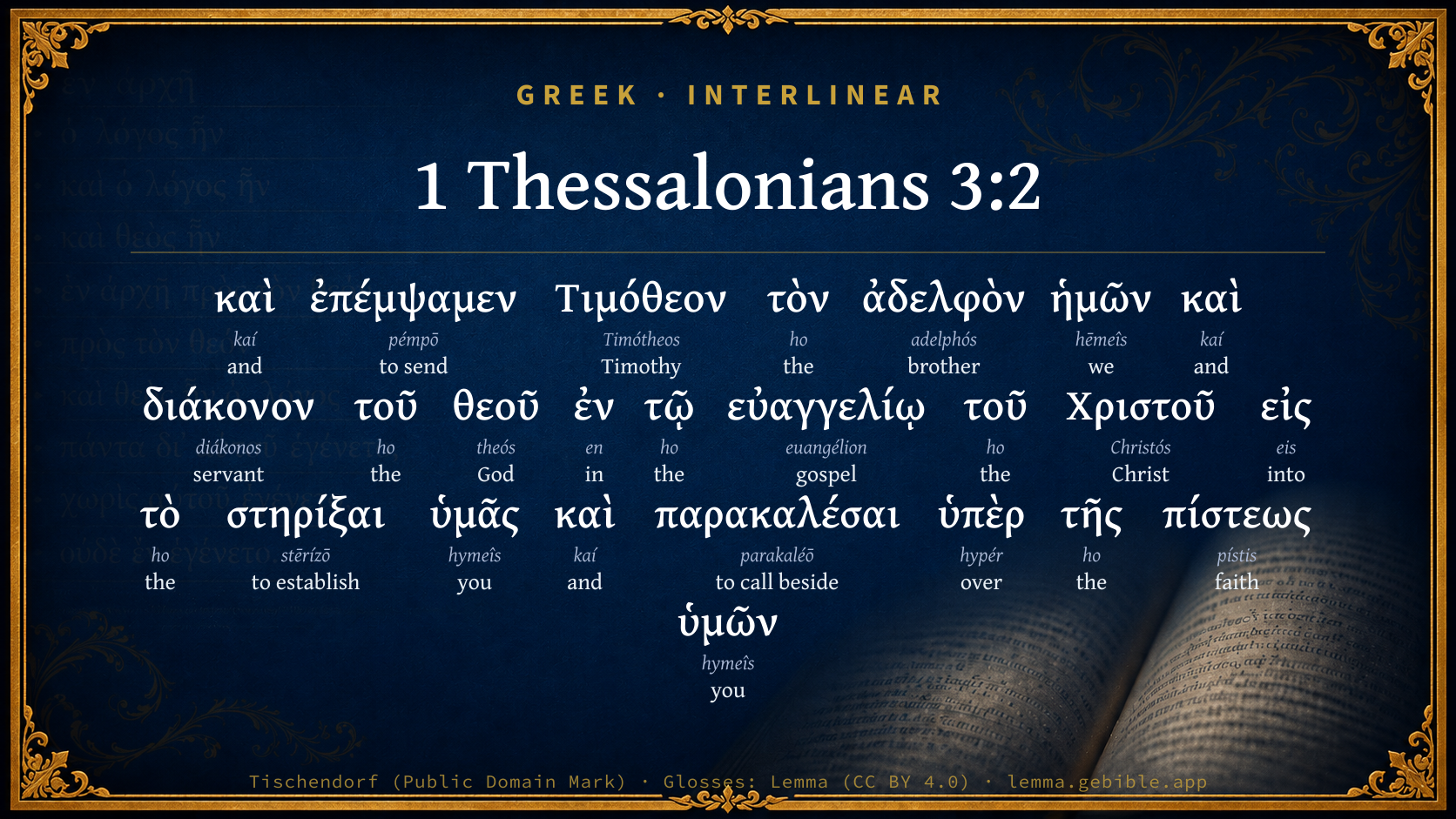
Greek (Tischendorf 8th ed.) 1 Thessalonians 3:2 appears in the Greek New Testament. The text above is from the Tischendorf 8th edition. Each word links to its Strong’s number and a concise gloss. Click any word for its full Thayer’s Greek Lexicon entry.
Download image
Cite this verse

1 Thessalonians 3:2 (World English Bible). Public Domain. Lemma interlinear Bible study tool, https://lemma.gebible.app/v/1-thessalonians/3/2.

Show BibTeX & RIS
BibTeX
RIS
English Translation
and sent Timothy, our brother and God's servant in the Gospel of Christ, to establish you, and to comfort you concerning your faith;
World English Bible · Public Domain
Download a study sheet

One document with this verse’s original text, its word-by-word gloss line, the meaning frame, cross-references with their text, attributed commentary, and full source and license credits — printable, and it pastes into notes with its structure intact.

This verse Autodidact and up

Study sheet (.html) Plain text (.txt)

A passage Seminary Student

Up to 50 verses in one chapter. A passage sheet keeps up to 6 commentary sources and 12 cross-references per verse, in the order this page ranks them, and says so on the sheet whenever that leaves anything out. Ask for a single verse and you get the Autodidact verse sheet above.

Everything on this page stays free to read, with no account — the sheet is a download of what is already on screen, not access to it.

Want to remove ads? Support Godless Engineer
Compare translations 3

The same verse in 3 English versions, stacked beneath the original-language interlinear above. Click any original word for its lexicon entry.

Each is an independent rendering of the whole verse — the interlinear is not word-aligned to these translations.

Highlighted words mark where these versions differ — a whole-verse word diff, not a word-by-word alignment.

  • World English Bible Public Domain
    and sent Timothy, our brother and God's servant in the Gospel of Christ, to establish you, and to comfort you concerning your faith;
  • King James Version Public Domain
    And sent Timotheus, our brother, and minister of God, and our fellowlabourer in the gospel of Christ, to establish you, and to comfort you concerning your faith:
  • unfoldingWord Literal Text CC BY-SA 4.0
    and we sent Timothy, our brother and a servant of God in the gospel of Christ, to strengthen and encourage you regarding your faith,

unfoldingWord Literal Text — © unfoldingWord, licensed CC BY-SA 4.0. Word-aligned USFM3 via Door43 (git.door43.org/unfoldingWord/en_ult).

Versions to compare (up to 4)

3 of 4 selected

Show all 19 translations

Every available English version of this verse, each an independent rendering of the whole verse.

  • World English Bible Public Domain
    and sent Timothy, our brother and God's servant in the Gospel of Christ, to establish you, and to comfort you concerning your faith;
  • Berean Standard Bible Public Domain
    We sent Timothy, our brother and fellow worker for God in the gospel of Christ, to strengthen and encourage you in your faith,
  • Majority Standard Bible Public Domain
    We sent Timothy, our brother and minister for God, and our fellow worker in the gospel of Christ, to strengthen and encourage you in your faith,
  • King James Version Public Domain
    And sent Timotheus, our brother, and minister of God, and our fellowlabourer in the gospel of Christ, to establish you, and to comfort you concerning your faith:
  • American Standard Version (1901) Public Domain
    and sent Timothy, our brother and God's minister in the gospel of Christ, to establish you, and to comfort `you' concerning your faith;
  • Revised Version (1885) Public Domain
    and sent Timothy, our brother and God’s minister in the gospel of Christ, to establish you, and to comfort you concerning your faith;
  • Geneva Bible (1599) Public Domain
    And haue sent Timotheus our brother and minister of God, and our labour felow in the Gospel of Christ, to stablish you, and to comfort you touching your faith,
  • Douay-Rheims (1899) Public Domain
    And we sent Timothy, our brother, and the minister of God in the gospel of Christ, to confirm you and exhort you concerning your faith:
  • Young's Literal Translation Public Domain
    and did send Timotheus -- our brother, and a ministrant of God, and our fellow-workman in the good news of the Christ -- to establish you, and to comfort you concerning your faith,
  • Literal Standard Version CC BY-SA 4.0
    and sent Timotheus—our brother, and a servant of God, and our fellow-workman in the good news of the Christ—to establish you, and to comfort you concerning your faith,
  • Unlocked Literal Bible CC BY-SA 4.0
    We sent Timothy, our brother and fellow worker for God in the gospel of Christ, to strengthen and comfort you regarding your faith.
  • unfoldingWord Literal Text CC BY-SA 4.0
    and we sent Timothy, our brother and a servant of God in the gospel of Christ, to strengthen and encourage you regarding your faith,
  • Darby Bible Public Domain
    and sent Timotheus, our brother and fellow-workman under God in the glad tidings of Christ, to confirm you and encourage [you] concerning your faith,
  • World Messianic Bible Public Domain
    and sent Timothy, our brother and God’s servant in the Good News of Messiah, to establish you and to comfort you concerning your faith,
  • Webster's Bible Public Domain
    And sent Timothy, our brother, and minister of God, and our fellow-laborer in the gospel of Christ, to establish you, and to comfort you concerning your faith:
  • Free Bible Version CC BY-SA 4.0
    and send Timothy on to you. He is our brother and God's co-worker in spreading the good news of Christ. We sent him to strengthen and encourage you in your trust in God
  • Bible in Basic English Public Domain
    We sent Timothy, our brother and God's servant in the good news of Christ, to give you strength and comfort in your faith;
  • Text-Critical English NT CC BY 4.0
    and we sent Timothy, our brother, who is a servant of God and our fellow worker in the gospel of Christ, to establish you and encourage you in your faith,
  • Tyndale New Testament (1534) Public Domain
    and sent Timotheus oure brother and minister of god and oure laboure felowe in the gospell of Christ to stablysshe you and to comforte you over youre fayth

Literal Standard Version (2020), Covenant Press — licensed CC BY-SA 4.0. Text via the HelloAO Bible API (eBible.org). Unlocked Literal Bible (unfoldingWord) — licensed CC BY-SA 4.0. Text via the HelloAO Bible API (eBible.org). unfoldingWord Literal Text — © unfoldingWord, licensed CC BY-SA 4.0. Word-aligned USFM3 via Door43 (git.door43.org/unfoldingWord/en_ult). Free Bible Version, Dr. Jonathan Gallagher — licensed CC BY-SA 4.0. Text via the HelloAO Bible API (eBible.org).

Word by word

More ways to search: Search by grammar → Find every occurrence → Compare this word →

Practice this passage: Drill this verse → Learn its vocabulary →

στηρίξαι
stērízō
G4741
“to establish”
Verb, Aorist, Active, Infinitive
Part of Speech
Verb
Tense
Aorist
Voice
Active
Mood
Infinitive
Full Thayer's Definition

Origin: from a presumed derivative of G2476 (like G4731 )

TDNT: 17:53,1

1. to make stable, place firmly, set fast, fix 2. to strengthen, make firm 3. to render constant, confirm, one's mind
  1. καὶ kaí G2532 “and” Conjunction
  2. ἐπέμψαμεν pémpō G3992 “to send” Verb, Aorist, Active, Indicative, 1st person, Plural
  3. Τιμόθεον Timótheos G5095 “Timothy” Noun, Accusative, Singular, Masculine
  4. τὸν ho G3588 “the” Article, Accusative, Singular, Masculine
  5. ἀδελφὸν adelphós G80 “brother” Noun, Accusative, Singular, Masculine
  6. ἡμῶν hēmeîs G2249 “we” Personal pronoun, 1st person, Genitive, Plural
  7. καὶ kaí G2532 “and” Conjunction
  8. διάκονον diákonos G1249 “servant” Noun, Accusative, Singular, Masculine
  9. τοῦ ho G3588 “the” Article, Genitive, Singular, Masculine
  10. θεοῦ theós G2316 “God” Noun, Genitive, Singular, Masculine
  11. ἐν en G1722 “in” Preposition
  12. τῷ ho G3588 “the” Article, Dative, Singular, Neuter
  13. εὐαγγελίῳ euangélion G2098 “gospel” Noun, Dative, Singular, Neuter
  14. τοῦ ho G3588 “the” Article, Genitive, Singular, Masculine
  15. Χριστοῦ Christós G5547 “Christ” Noun, Genitive, Singular, Masculine
  16. εἰς eis G1519 “into” Preposition
  17. τὸ ho G3588 “the” Article, Accusative, Singular, Neuter
  18. ὑμᾶς hymeîs G5210 “you” Personal pronoun, 2nd person, Accusative, Plural
  19. καὶ kaí G2532 “and” Conjunction
  20. παρακαλέσαι parakaléō G3870 “to call beside” Verb, Aorist, Active, Infinitive
  21. ὑπὲρ hypér G5228 “over” Preposition
  22. τῆς ho G3588 “the” Article, Genitive, Singular, Feminine
  23. πίστεως pístis G4102 “faith” Noun, Genitive, Singular, Feminine
  24. ὑμῶν hymeîs G5210 “you” Personal pronoun, 2nd person, Genitive, Plural

About this verse

These counts appear in no published source. They are computed here, from the morphology-tagged text and Lemma’s own curated glosses. What Lemma adds →

25
words
17
distinct lemmas
Pauline Epistles
section

Notable vocabulary

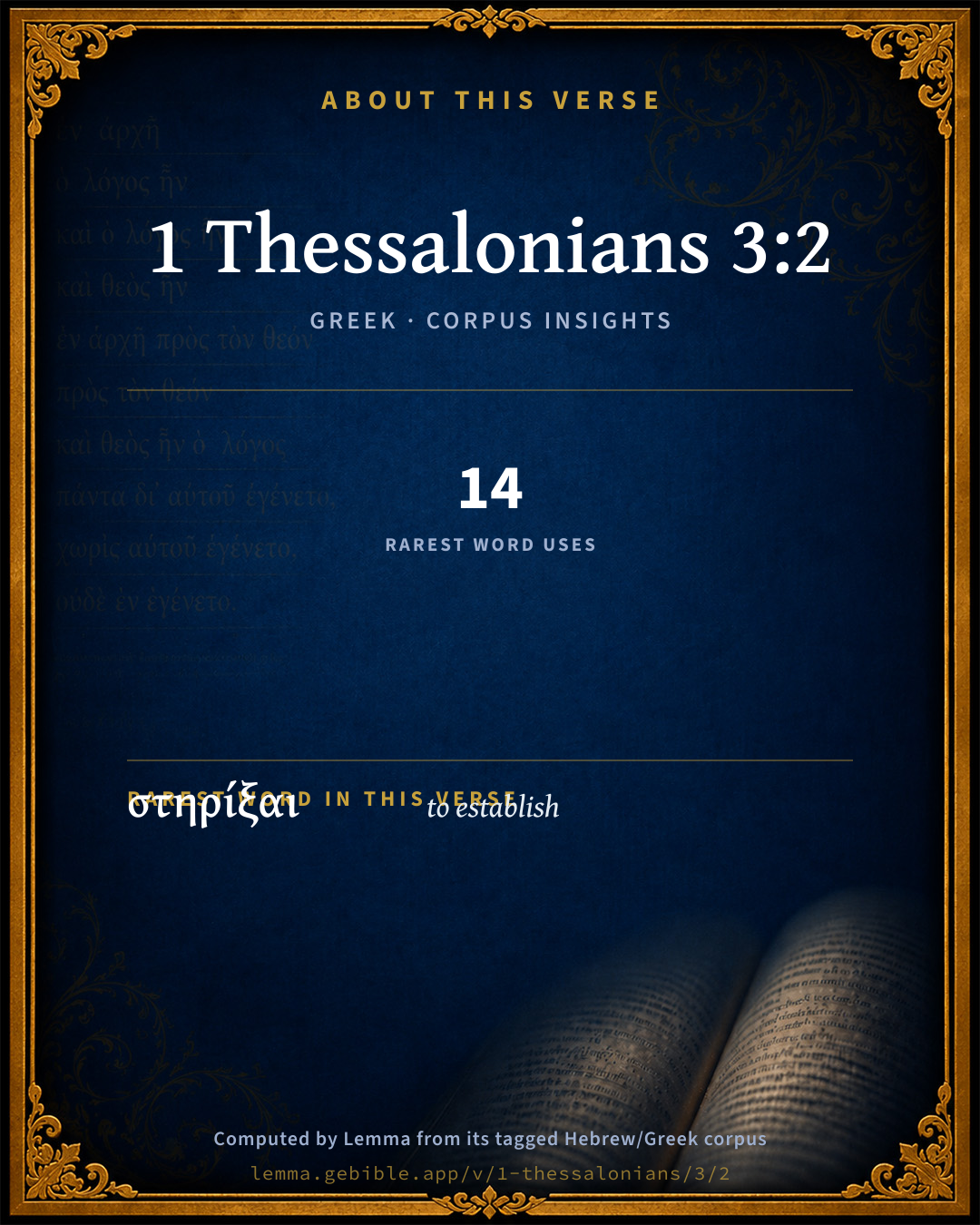
The rarest word here is στηρίξαι to establish G4741 — appearing just 14 times in the whole Greek New Testament.

Shared distinctive vocabulary

στηρίξαι to establish G4741 occurs in 14 verses of the Greek New Testament. Also found in:

Repetition

Words recur within this verse:

Cross-references

20

Topical passages linked to 1 Thessalonians 3:2 in the Treasury of Scripture Knowledge — connected by theme and wording, ordered by reader-vote popularity; previews shown in the World English Bible.

  • Acts 14:22–23 confirming the souls of the disciples, exhorting them to continue in the faith, and that through many afflictions we must enter into the Kingdom of God.
  • Ephesians 6:21–22 But that you also may know my affairs, how I am doing, Tychicus, the beloved brother and faithful servant in the Lord, will make known to you all things;
  • Philippians 2:19–25 But I hope in the Lord Jesus to send Timothy to you soon, that I also may be cheered up when I know how you are doing.
  • Acts 16:1 He came to Derbe and Lystra: and behold, a certain disciple was there, named Timothy, the son of a Jewess who believed; but his father was a Greek.
  • Acts 17:14–15 Then the brothers immediately sent out Paul to go as far as to the sea, and Silas and Timothy still stayed there.
  • Romans 16:21 Timothy, my fellow worker, greets you, as do Lucius, Jason, and Sosipater, my relatives.
  • 1 Corinthians 16:10–12 Now if Timothy comes, see that he is with you without fear, for he does the work of the Lord, as I also do.
  • 2 Corinthians 1:1 Paul, an apostle of Christ Jesus through the will of God, and Timothy our brother, to the assembly of God which is at Corinth, with all the saints who are in the whole of Achaia:
  • 2 Corinthians 1:19 For the Son of God, Jesus Christ, who was preached among you by us, by me, Silvanus, and Timothy, was not "Yes and no," but in him is "Yes."
  • 2 Corinthians 8:23 As for Titus, he is my partner and fellow worker for you. As for our brothers, they are the apostles of the assemblies, the glory of Christ.
  • Acts 16:5 So the assemblies were strengthened in the faith, and increased in number daily.
  • Acts 18:5 But when Silas and Timothy came down from Macedonia, Paul was compelled by the Spirit, testifying to the Jews that Jesus was the Christ.
  • 1 Corinthians 4:17 Because of this I have sent Timothy to you, who is my beloved and faithful child in the Lord, who will remind you of my ways which are in Christ, even as I teach everywhere in every assembly.
  • 2 Corinthians 2:13 I had no relief for my spirit, because I didn't find Titus, my brother, but taking my leave of them, I went out into Macedonia.
  • Philippians 1:25 Having this confidence, I know that I will remain, yes, and remain with you all, for your progress and joy in the faith,
  • Colossians 1:1 Paul, an apostle of Christ Jesus through the will of God, and Timothy our brother,
  • Colossians 1:7 even as you learned of Epaphras our beloved fellow servant, who is a faithful minister of Christ on our behalf,
  • Colossians 4:9 together with Onesimus, the faithful and beloved brother, who is one of you. They will make known to you everything that is going on here.
  • Colossians 4:12 Epaphras, who is one of you, a servant of Christ, salutes you, always striving for you in his prayers, that you may stand perfect and complete in all the will of God.
  • 1 Thessalonians 3:13 to the end he may establish your hearts blameless in holiness before our God and Father, at the coming of our Lord Jesus with all his saints.

Cross-references courtesy of OpenBible.info (CC BY 4.0).

Where the printed editions differ

3 variants

Places in this verse where the major printed Greek editions disagree on the wording in a way that affects the translation — a comparison of editions, not a manuscript-by-manuscript collation. The editions are the modern critical texts (Nestlé-Aland 28/27, SBL, Westcott-Hort, Tregelles, Tyndale House) and the traditional texts behind the KJV (the Textus Receptus and the Byzantine/Majority text). It is not a claim about which reading is original.

  1. Extra text
    διάκονον

    “servant”

    In TynWHTregTRByz Not in NA28NA27SBL
  2. Extra text
    καὶ

    “and”

    In TRByz Not in NA28NA27TynSBLWHTreg

    διάκονον καὶ (diakonon kai) 'servant and' is only in traditional manuscripts (Tyn+WH+Treg+TR+Byz)

  3. Extra text
    ἡμῶν

    “of us”

    In TRByz Not in NA28NA27TynSBLWHTreg

    ἡμῶν (hēmōn) 'of us' is only in traditional manuscripts (TR+Byz)

Textual data: Translators Amalgamated Greek New Testament (STEPBible TAGNT) · CC BY 4.0.

Commentary

Notes on 1 Thessalonians 3:2 from classic Christian and Jewish commentators (each source and its license shown beneath its notes). The classic Christian expositions comment on the surrounding passage and are grouped to its opening verse, so a note may address several verses; the Jewish commentaries on the Tanakh (Rashi and others) are per-verse, so they appear only where the commentator wrote on this verse.

Lemma curates 59 commentaries, every one of them public domain or Creative Commons licensed, each selected and text-cleaned for this edition rather than reprinted as found. About our sources →

The Cambridge Bible for Schools and Colleges

gen. ed. J. J. S. Perowne

2. and sent Timotheus] Timothy: see note on this name, ch. 1Th_1:1.

The Acts of the Apostles traces St Paul’s footsteps from Thessalonica to Berœa, and on from Berœa to Athens: read Act_17:10-16; and consult the map in regard to the route. But its account of the movements of his companions appears at first sight inconsistent with what we read here. For in Act_17:14-16 we find Silas and Timothy both left behind at Berœa, while Paul goes on to Athens, instructing them to follow and rejoin him there as soon as possible. “Paul waited for them at Athens;” but they do not seem to have arrived. The two comrades of the Apostle are not mentioned by St Luke again until he tells us of their return together from Macedonia, when they find him at Corinth (Act_18:1-5). St Paul interpolates between the time of his leaving the two at Berœa and of their return in company from Macedonia reported by Luke a distinct mission of Timothy by himself to Thessalonica. There is, after all, no conflict between the Apostle and his historian and friend. He relates an incident which St Luke in his general and cursory narrative passed over, either as unimportant for his purpose, or because he was unaware of it. Since we have good reason to believe in the accuracy of both, we must adjust their statements to each other. This may be done In two ways: It is possible that Paul on arriving at Athens and finding that he could not return to Thessalonica from that city, sent directions to Timothy to go back in his place to the Macedonian capital, instead of coming on to Athens, while Silas still remained in Macedonia; and that, after Timothy had made this visit, they both rejoined their leader at Corinth. Or it may be—and this agrees better with the words “left behind”—that Timothy did come to Athens from Berœa, and was immediately despatched again to Thessalonica, so that the Apostle was practically alone from the time he left Berœa until Silas and Timothy rejoined him at Corinth.

The “we” of 1Th_3:1-2; 1Th_3:6 appears to refer to the Apostle himself; comp. 2 Corinthians 10, 13 for the interchange of “I” and “we” in St Paul’s manner of referring to himself. He may write we representatively, where others are joined with him in sympathy, though not in act. If Silas was now with Paul at Athens, he also must shortly have returned to Macedonia (see Act_18:5); but the words “left alone” would seem in that case to be pointless. It was a trial to St Paul at this time to be “left alone.” But his anxiety about the Thessalonians compels him, notwithstanding, to send his young helper to them.

our brother, and minister of God, and our fellowlabourer in the gospel of Christ] This description of Timothy is given in varying forms by the ancient MSS. The Revisers prefer to read, our brother and God’s minister, &c.; but they say in the margin, “Some ancient authorities read fellow-worker with God.” Possibly this is what the Apostle wrote: our brother and a fellow-worker with God. The other variations can best be explained by it; and copyists would scarcely have substituted by this bold expression the easy phrase “minister of God,” which occurs in other Epistles, had the latter been the original reading. “God’s fellow-worker” expresses a thoroughly Pauline idea (see 1Co_3:9; 2Co_6:1), and would serve to exalt Timothy in the eyes of the Church. It agrees with what the Apostle says of him in 1Co_16:10 : “Timothy worketh the work of the Lord, as I also do; let no one therefore despise him.” The Received Text, as in many other instances, results from the combination of two earlier and briefer readings of the passage. Codex B, the best of the Greek MSS, reads simply, our brother and fellow-worker in the gospel of Christ.

to establish you, and to comfort you concerning your faith] Establish is stablish in 1Th_3:13 and elsewhere; the same word is rendered “strengthen thy brethren” in Luk_22:32, also Rev_3:2; it signifies to make stable, fix firmly.

For comfort exhort or encourage is a preferable rendering. St Paul employed another and quite different verb for “comfort,” in express distinction from that here used, in ch. 1Th_2:11 (see note). The Greek verb has a wide range of meaning; but all its uses in these two Epp. may be brought, with that of the cognate noun, under the ideas of appeal (ch. 1Th_2:3; 1Th_2:11, 1Th_4:1; 1Th_4:10, 1Th_5:11; 1Th_5:14; 2Th_3:12), or encouragement (ch. 1Th_3:2; 1Th_3:7; 2Th_2:16-17). This latter was indeed an older sense of comfort in English (Latin confortare).

The Apostle sends Timothy to do what he wished to do himself, and continues to do by this letter—what, above all, he prays God to do for them; see 1Th_3:13, 2Th_2:16-17 : “May He encourage your hearts, and stablish you.” (Comp. Introd. p. 35.) They were afflicted, and needed “encouragement;” they were new to the Christian life, and needed “establishment.”

Concerning is, more strictly, on behalf of (in furtherance of) your faith. In ch. 1Th_1:3 faith, love, and hope; in 1Th_3:6 faith and love; here faith alone stands for the whole religion of a Christian.

The Cambridge Bible for Schools and Colleges (gen. ed. J. J. S. Perowne; Cambridge University Press, 1878–1918) — public domain. Text from a community e-Sword module.

The Biblical Illustrator

Joseph S. Exell

1Th_3:2-3

And send Timotheus

Timothy and his mission

This is the first of a long series of similar missions.

As the context shows, the youthful evangelist gave full proof of his ministry from the first.

I. The qualifications of the messenger.

1. Brotherhood. The man sent on an errand of mercy must have--

(1) Brotherly relations with his fellow messengers. There are extraordinary circumstances in which a man may legitimately break through all the trammels of ecclesiastical order and discipline in order to save souls. The prophets and apostles were examples of this; so were Luther and Wesley. But generally the messenger must sustain close relations of amity and colleagueship, if not of subordination, with those who hold a similar office. This gives--

(a) Might to his utterances, when his solitary authority would be questioned or ignored.

(b) Comfort in hours of despondency and loneliness, in the thought that he has sympathy and has brethren to fall back upon.

(2) A brotherly feeling towards those to whom he goes: Our brother--mine and yours. The brotherly feeling in the Christian worker avoids the evils of--

(a) Haughty superiority: Lord over Gods heritage. His office may be more dignified, but his spiritual nature is the same: One is your Master, etc.

(b) Feminine weakness--such as would pander to tastes and humours; fear to rebuke; suppress unpalatable truth. Brotherliness is the manly love of anothers soul.

(c) Selfish motives. The minister is to save men, not make money out of them: I seek not yours, but you. As brothers our interests are common.

2. Divine ministry. A true minister is--

(1) Called of God. No ecclesiastical sanction can compensate for the want of this. A man may be able to trace his uninterrupted succession, and be instituted to an illustrious office, but unless he is inwardly moved by God he is an intruder and no minister of God.

(2) Qualified by God. This does not, of course, dispense with human qualifications. Indeed, gifts of learning and eloquence carefully cultivated and employed are required as signs that qualifications essentially Divine are prized and made the most of. But the Divine qualification is distinct. It is the enduement of power for the conversion of souls. Without this a man may be a profound philosopher, a skilful dialectician; his mind may be stored with masses of erudition, and his tongue nimble with the most bewitching oratory. But without the Holy Ghost he is a sounding brass and a tinkling cymbal, and no minister of God.

(3) Supported by God. Hence--

(a) Courage: I have made thy face as a flint.

(b) Expectation of success: My word shall not return unto Me void.

(4) Owned of God, in the conversion of souls.

(5) Rewarded by God: Well done, good and faithful servant.

3. Labour. The ministry is a work involving--

(1) Mental preparation;

(2) pecuniary sacrifice;

(3) abnegation of comfort;

(4) consuming zeal.

II. The purpose of his errand.

1. Establishment.

(1) To base moral life upon Christ: Other foundation can no man lay, etc. Then men are basing their lives on no foundation at all. Morality, good intentions, hope in Gods clemency, are castles in the air which the labourer for God must destroy, that he may induce men to build on the only foundation. This foundation is stable and everlasting (Mat_7:24, etc.).

(2) To build up moral life in Christ by promoting the growth of the Christian graces. Is Christian life a building? Then love, joy, peace, gentleness, etc., are stones and rafters. Is it a tree? Then these are the fruits.

2. Comfort.

(1) Encouragement concerning the faith. Such is afforded when faith--

(a) Is shown to be well grounded: We have not followed cunningly devised fables.

(b) Is stimulated into vigorous exercise--

(c) When its end, the salvation of your souls, is kept steadily before the eye.

(2) Consolation in trouble. Tribulation affects the body in times of persecution, as here; the mind in times of scepticism and denial; the soul in times of spiritual darkness. Comfort comes from the Divine promises, the Divine sympathy, and the Divine support. (J. W. Burn.)

Ministers of joy

Some men move through life as a band of music moves down the street, flinging out pleasure on every side through the air to every one, far and near, that can listen. Some men fill the air with their presence and sweetness, as orchards in October days fill the air with perfume of ripe fruit. Some women cling to their own houses, like the honeysuckle over the door, yet, like it, sweeten all the region with the subtle fragrance of their goodness. There are trees of righteousness which are ever dropping precious fruit around them. There are lives that shine like star beams, or charm the heart like songs sung upon a holy day. How great a bounty and a blessing it is to hold the royal gifts of the soul go that they shall be music to some and fragrance to others, and life to all! It would be no unworthy thing to live for, to make the power which we have within us the breath of other mens joy; to scatter sunshine where only clouds and shadows reign; to fill the atmosphere where earths weary toilers must stand with a brightness which they cannot create for themselves, and which they long for, enjoy, and appreciate. (H. W. Beecher.)

To comfort you concerning your faith--

Comforted concerning the faith

1. These Epistles may preeminently be called letters of comfort. There are many streams of consolation which are shallow and apt to run dry. They are good as far as they go and as long as they last. God has filled life for us with consolations--the ministries of nature; many little things that happen every day. The lesser consolations, however, do not supersede the necessity for the greater. After drinking of the former we thirst again, but the latter spring up into everlasting life.

2. Does the apostle refer to faith as objective truth, or the affection which embraces the truth? Both. The faith that comforts must not only be true, but must be accepted and become a heart possession. We are comforted concerning the faith--

I. By the persuasion that the faith is true; that it is a real revelation of grace and salvation spoken by God to man.

1. Any doubt on this fundamental point will affect essentially all forms of comfort. Say that the gospel is false or fallacious, or, although historically true, that it is yet largely mythical, and it is bereft of all its consolation. The old words would remain, such as God hath given us everlasting consolation, Comfort one another, etc.; but a dead tree, although still rooted, casts no shadow, yields no fruit; a well may be deep, and have no water in it. With a sorrow deeper than that of Mary might the Church, and even the world, exclaim in that ease, They have taken away my Lord, and I know not where they have laid Him.

2. Are any of you in this sore trouble--intellectually at sea about the gospel? I shall make no attempt to meet your doubts intellectually. Doubts are solved by faith, prayer, Providence, time, love. But it may do no harm, but good, to speak out our own faith (Heb_1:1; Joh_1:1; Joh_3:16; 1Jn_2:1-2, etc.). You may question, but we know whom we have believed; and He will take your souls in trust also, and keep them against that day.

II. By the fact that to the humble and sincere, doubt runs its course, and then subsides and passes away. The experiences of this changeful, troubled life explain the gospel wonderfully to some. The experiences of the heart explain it, reveal the need of it, make it welcome; and then doubting Thomas is found among the rest, exclaiming, as He falls at His Masters feet, My Lord and my God.

III. Inasmuch as it will bear the strain and pressure of life, howsoever heavy. The faith will bear it, although it is borne by persons. What we believe and know enables us to bear and pass through what would otherwise overwhelm us. Human nature, in itself, as the work of God, will do and bear a great deal. Heroic deeds are done and sufferings endured even without Divine help. If it were a matter of stern silent endurance, the old Stoics, Roman soldiers, and the Red Indians could set us an example. But such a state of mind is attained by almost uprooting the finer sensibilities of our nature, by shutting out the future, by putting all our strength into mere obstinate resolution. But that is not moral greatness; for this we must have our nature unabridged, nay, developed and enlarged, made responsive, sensitive, to spiritual things. It is not a question of getting through this life, but of getting through it worthily. Christ comes to elevate and transform all. The Man of Sorrows reproduces Himself in His followers; but though the sufferings of Christ abound in us, our consolation also aboundeth by Christ.

IV. Because our faith will bear all the burden and strain which come by the enlargement and intense action of the powers of our being. The pain of life which is increased by Christian sensibility will be assuaged by the Christian consolation and borne by the Christian courage. We have tried the plan of no faith, and that has failed. The new faith brings new pain, because it draws to us the pain of others; but it brings the promise that all things shall work together for good, etc. We have put that to the proof, and, resting upon it, have found it firm. Pain has been shown to have a Divine mission to bless and sanctify us. By the sorrow of the Saviours soul all the Church is redeemed; and by the sorrows of individual souls, when they are touched with grace, are those souls purified as they could be in no other way. Only if we suffer with Him in some way can we be glorified together. Believing this, we are to go on the simple way of duty, whatever may be the difficulty of it, trusting all the while to the sustaining power of faith in Christ. My grace is sufficient for thee, etc.

V. In that our faith teaches us that a time and state are coming when there shall be no more pain. In His presence is fulness of joy. Conclusion: We must remember that however strong and firm the objective truth may be, and whatever its power to carry us through the straits of life and its adaptation to lift us towards a life to come, it will be and do none of these things if we have not the subjective principle by which we embrace what is true, trust what is strong, and rise to what is high and pure. The gospel, as a practical power and abiding consolation, is in our hearts, or it is nowhere for us. (A. Raleigh, D. D.)

The Biblical Illustrator, edited by Joseph S. Exell (c. 1880s–1900s) — public domain. Text from a community e-Sword module.

Bengel's Gnomon

Johann Albrecht Bengel

1Th 3:2. Ἐπέμψαμεν, we sent) I and Sylvanus sent.

Bengel's Gnomon of the New Testament — English translation (T&T Clark, Edinburgh, 1860) — public domain. Text from a community e-Sword module.

Meyer's Critical & Exegetical Commentary

Heinrich August Wilhelm Meyer

1Th_3:2. Τὸν ἀδελφὸν ἡμῶν καὶ συνεργὸν τοῦ Θεοῦ ἐν τ. εὐαγγ. τοῦ Χριστοῦ] our brother (Christian brother) and fellow-labourer of God in the gospel of Christ. The συν in συνεργὸν τοῦ Θεοῦ refers not to man, but to God, the chief ruler of the church; comp. Meyer on 1Co_3:9. In this apposition attached to Τιμόθεον, Theophylact, Musculus, and most critics (comp. already Chrysostom) discover the design, that Paul wished thereby to indicate what a great sacrifice he put himself to for the sake of the Thessalonians, as he surrendered to them at once his faithful assistant, whom he himself so much required, in order that he might minister to their wants.[44] Such a view is remote from the apostle. The epithets which he gives to Timotheus are nothing more than a commendation of his apostolic associate, which the apostle felt himself constrained spontaneously to express, on account of the faithfulness and zeal which he displayed for the sake of the gospel; and we are the less to look for any ulterior design, as it was the constant practice of the apostle, when he had occasion specially to mention his faithful associates, to designate them by some honourable appellation.

ἐν τῷ εὐαγγελίῳ] Statement of the sphere in which he was a συνεργός. Comp. Rom_1:9; Php_4:3.

εἰς τὸ στηρίξαι ὑμᾶς] not that we (the senders) might (by the instrumentality of Timotheus) strengthen you (Cornelius a Lapide, Grotius), but that he (Timotheus) might strengthen you. But erroneously (comp. already Chrysostom) Oecumenius, whom Theophylact, Estius, Luc. Osiander, Fromond., Nat. Alexander, Macknight, and others follow: ὡς σαλευομένους, ἐφʼ οἷς ἦν ὁ διδάσκαλος ἐν πειρασμοῖς· μέγας γὰρ ὄντως θόρυβος τοῖς μαθηταῖς τὸ εἶναι τὸν διδάσκαλον ἐν πειρασμοῖς.

Grotius and others understand παρακαλέσαι in the sense of to comfort. More correctly (on account of 1Th_3:3), it is to be taken in the meaning of to exhort or encourage. Schott erroneously unites both ideas. Also, arbitrarily separating the words, Olshausen refers στηρίξαι to patience in persecution, and παρακαλέσαι to growth in faith.

ὑπὲρ τῆς πίστεως ὑμῶν] not equivalent to περὶ τῆς πίστεως ὑμῶν (de Wette and others), as if it were a mere statement of the object, but: for the good of your faith, i.e. in order that you might preserve it.[45]

[44] Thus also Hofmann, only he finds the reason of the honourable appellation in this: that the Christians of Thessalonica who longed for the apostle himself might be tempted to undervalue this mission of a subordinate associate!

[45] That Calvin here speaks of a fides Pauli ubique adversus Satanam et mundum victrix, is because, in the oldest Greek editions of the N. T., τίστεως ἡμῶν was put in place of πίστεως ὑμῶν.

Meyer — Critical and Exegetical Commentary on the New Testament — English translation by Peter Christie, edited by Frederick Crombie (T&T Clark, 1880) — public domain. Text from a community e-Sword module.

International Critical Commentary

2. Τιμόθεο … συνεργὸν τοῦ θεοῦ κτλ. Timothy, who has already been called an apostle (2:7), is here described not only as “our brother” (cf. 2Co 1:1, Col 1:1) but also, if the reading of D d e Ambst be accepted, “God’s fellow-labourer.” The sphere in which (Rom 1:9, Php 4:3) he works with God is the gospel which Christ inspires (see on 1:4). The choice of such a representative honours the converts (Chrys.) and proves Paul’s inclination to consult their welfare (Calv.).

The reading of B (καὶ συνεργό), which Weiss and Find. prefer, yields excellent sense and attaches itself nicely to ἡμῶ (cf. Php 2:25, Rom 16:21). But if it is original, it is difficult to account for τοῦ θεου in the other readings. If D is original, it is easy to understand (cf. Dob. 131) the suppression of the bold designation συνεργὸς τοῦ θεου (elsewhere only 1Co 3:9) by the omission of τοῦ θεου, the substitution of διάκονο for συνεργό in אAP, Vulg (διάκονον τοῦ θεου; fuld. domini), and the conflated readings of GF (καὶ διάκονον καὶ συνεργὸν τοῦ θεου) and DcKL, Pesh (καὶ διάκονον τοῦ θεοῦ καὶ συνεργὸν ἡμῶ).—συνεργό, outside of Paul, appears in Gk. Bib. only 3Jn 1:8, 3Jn 1:2 Mac. 8:7, 14:5; in Paul it is used with μο (Rom 16:3, Rom 16:21, Phm 1:24, Php 4:3) or ἡμῶ (Rom 16:9, Phm 1:1; cf. 2Co 8:23), with a thing (2Co 1:24, Col 4:11), and with θεου (only here and 1Co 3:9). Timothy is thus not simply “our fellow-worker” (Rom 16:21) but “God’s fellow-worker.” Apart from אAPKL, et al., here, Paul does not call Timothy a διάκονος τοῦ θεου

2-3a. εἰς τὸ στηρίξα … τὸ μηδένα σαίνεσθαι κτλ. The primary purpose (εἰς το) of Timothy’s mission is to strengthen and encourage the converts in reference to (ὑπέ = περι) their faith (1:8). The secondary purpose, dependent on the fulfilment of the primary, is to prevent any person (τὸ μηδέν) from being beguiled in the midst of these their afflictions. Under the stress of persecutions, some of the converts might be coaxed away from the Christian faith by the insinuations of the Jews. In the phrase ἐν ταῖς θλίψεσιν ταύταις, ἐ is primarily local, though a temporal force may also be felt. Since Paul says not ἡμῶ but ταύται it is evident that he is thinking not of his own but of his converts’ afflictions, as indeed ὑμᾶ and ὑμῶ (v. 2) intimate. Zahn (Introd. I, 218) observes: “The Tempter, who was threatening to destroy the Apostle’s entire work in Thessalonica (3:5), assumed not only the form of a roaring lion (1Pe 5:8), but also that of a fawning dog (Php 3:2) and a hissing serpent (1Co 11:3).”

Paul uses πέμπει with εἰς το and infin. elsewhere v. 5, II 2:11, with infin. of purpose (1Co 16:3; cf. 1 Mac. 13:17 (אV) 2 Mac. 14:19), and with ἵν (2Co 9:3, Php 2:19, Php 2:28; cf. Col 4:8, Eph 6:22). It is a small matter who is the subject of στηρίξα (cf. γνῶνα v. 5), whether Paul or Timothy, for in the last resort Timothy is the agent of Paul’s purpose.—The collocation στηρίζει and παρακαλεῖ occurs in the reverse order also in II 2:17; cf. Rom 1:11, Act 14:22, Act 15:32.—ὑπέ here and II 2:1 = περι (which DcL here read); on παρακαλεῖν ὑπέ, cf. 2Co 12:8.—ὑμᾶ to be supplied after παρακαλέσα, is expressed by DcKL.—τὸ μη with infin., a good Pauline construction, is used appositively (Rom 14:13, 2Co 2:1), predicatively (Rom 14:21 with adjective), and as the object of δεῖσθα (2Co 10:2). Here τὸ μηδέν with infin. may be either in apposition with τὸ στηρίξα (Lün., Born, Find.), or the object of παρακαλέσα (Ell., Schmiedel, Wohl., Dob.), or the infin. of purpose (Bl 71:2), or better still, as in 4:6, the infin. after an unexpressed verb of hindering (GMT 811).

The meaning of σαίνεσθα (only here in Gk. Bib.) is uncertain. (1) The usual view, that of the Fathers and Versions, interprets it to mean “to be moved” (κινεῖσθαι, σαλεύεσθα) or “to be disturbed” (ταράττεσθαι, θορυβεῖσθα); for the latter rendering, cf. Dob. who contrasts στηρίζει (v. 2) and στήκει (v. 8). (2) Lachmann (see Thay sub voc.) conjectures from the reading of G (μηδεν ασι ενεσθα) ἀσαίνει = not λυπεῖ (Hesychius) but ἀσάει = ἄκθεσθα (3) Nestle (ZNW 1906, 361 f. and Exp. Times, July, 1907, 479) assumes σιένεσθα = σιαίνεσθα (cf. Mercati, ZNW 1907, 242) and notes in Butler’s Lausiac Hist. of Palladius (TS VI,2 1904) the variant σχανδαλισθεί for σιανθεί The meaning “to cause or feel loathing” fits all the passages noted by Nestle and Mercati (Dob.), but is not suitable to our passage. (4) Faber Stapulensis (apud Lillie: adulationi cederet) and others down to Zahn (Introd. I, 222 f.), starting from the Homeric literal sense of σαίνει “to wag the tail,” interpret σαίνει in the derivative sense of “flatter,” “cajole,” “beguile,” “fawn upon” (cf. Æschylus, Choeph. 194 (Dindorf): σαίνομαι δʼ ὑπʼ ἐλπίδο and Polyb. I, 806: οἱ πλεῖστοι συνεσαίνοντο τῇ διαλέκτῳ). This meaning is on the whole preferable; it fits admirably the attitude of the Jews (cf. also Mill. ad loc.). Parallels to σαίνεσθα were gathered by Elsner (II, 275 f.) and Wetstein (ad loc.).

3b-4. αὐτοὶ γὰρ οἴδατε κτλ. “I mention these persecutions of yours, for (γά) you yourselves are aware (cf. 2:1) that we Christians are destined to suffer persecution (κείμεθ ; Calv. ac si dixisset hac lege nos esse Christianos). And I say you are aware that suffering is a principle of our religion, for (καὶ γά v. 4 resuming and further explaining γά v. 3) when we three missionaries were with you, we stated this principle in the form of a prediction repeatedly declared: “We Christians are certain to be afflicted.” And the prophecy has proved true of us all as you know (2:5).” It is to be observed that Paul not only states the prophecy and its fulfilment, but also appeals to the knowledge of the readers in confirmation of his statement. This appeal, in the light of the similar appeals in 2:1-12, suggests that Paul is intending not only to encourage the converts but also at the same time to rebut the cajoling insinuations of the Jews who would coax the converts away from the new faith on the pretence that persecution is evidence that the gospel which they welcomed is a delusion.

εἰς τοῦτ = εἰς τὸ θλίβεσθα κεῖμαι εἰ (Php 1:16, Luk 2:34) does not occur in Lxx (Jos 4:6 is not a parallel); it is equivalent to τέθειμαι εἰ (Bl 23:7; cf. Luk 23:53 with Joh 19:41). Christians as such are “set,” “appointed,” “destined” to suffer persecution (cf. Act 14:22). In εἶναι πρό (II 2:5, 3:10) as in παρεῖναι πρό (Gal 4:18, Gal 4:20, 2Co 11:9), πρό = “with,” “bei,” “chez” (cf. Bl 43:7). The phrase καὶ γὰρ ὅτ … ἦμε recurs in II 3:10. The imperfect προελέγομε denotes repeated action; προ is predictive as μέλλομε shows; cf. Gal 5:21, 2Co 13:2, Isa 41:26; and below 4:6. The ὅτ before μέλλομε may be recitative or may introduce indirect discourse unchanged. μέλλομε is followed by the present infin. here and Rom 4:24, Rom 8:13. It is uncertain whether μέλλομε = κείμεθ “are certain to” or is a periphrasis for the future (Bl 62:4), “are going to.” The construction καθὼς και … και is similar to that in 4:6; “as also has happened,” corresponding to the prediction, “and as you know,” corresponding to their knowledge. The και is implied in καθώ and is sometimes expressed (4:1, 6, 13, 5:11, II 3:1), sometimes not (1:5, 2:2, etc.).

International Critical Commentary — older volumes (1896–1929), various authors — public domain. Text from a community e-Sword module.

Jamieson, Fausset & Brown

Robert Jamieson, A. R. Fausset & David Brown

minister of God and our fellow labourer--Some oldest manuscripts read, "fellow workman with God"; others, "minister of God." The former is probably genuine, as copyists probably altered it to the latter to avoid the bold phrase, which, however, is sanctioned by Co1 3:9; Co2 6:1. The English Version reading is not well supported, and is plainly compounded out of the two other readings. Paul calls Timothy "our brother" here; but in Co1 4:17, "my son." He speaks thus highly of one so lately ordained, both to impress the Thessalonians with a high respect for the delegate sent to them, and to encourage Timothy, who seems to have been of a timid character (Ti1 4:12; Ti1 5:23). "Gospel ministers do the work of God with Him, for Him, and under Him" [EDMUNDS].

establish--Greek, "confirm." In Th2 3:3, GOD is said to "stablish": He is the true establisher: ministers are His "instruments."

concerning--Greek, "in behalf of," that is, for the furtherance of your faith. The Greek for "comfort" includes also the idea, "exhort." The Thessalonians in their trials needed both (Th1 3:3; compare Act 14:22).

Jamieson, Fausset & Brown — Commentary Critical and Explanatory on the Whole Bible (1871) — public domain (CC PDM 1.0). Text via the HelloAO Bible API.

Adam Clarke's Commentary

Verse 2. Timotheus, our brother] It appears that Timothy was but a youth when converted to God; he had now however been some years in the work of God; Paul therefore calls him his brother, being one of the same Christian family, a son of God by adoption: elsewhere he calls him his own son, 1Ti 1:2; and his dearly beloved son, 2Ti 1:2; because he was brought to the knowledge of the true God, and to salvation by Christ, through the apostle's instrumentality. See the preface to the First Epistle to Timothy.

Minister of God] Employed by God to preach the Gospel; this was God's work, and he had appointed Timothy to do it, and to do it at this time in conjunction with St. Paul; and therefore he calls him his fellow labourer. There were no sinecures then; preaching the Gospel was God's work; the primitive preachers were his workmen, and laboured in this calling. It is the same still, but who works?

Adam Clarke's Commentary on the Bible (1810–1826) — public domain. Text from a community e-Sword/MySword module.

John Calvin's Commentaries

2 Our brother. He assigns to him these marks of commendation, that he may shew the more clearly how much inclined he was to consult their welfare: for if he had sent them some common person, it could not have afforded them much assistance; and inasmuch as Paul would have done this without inconvenience to himself, he would have given no remarkable proof of his fatherly concern in regard to them. It is, on the other hand, a great thing that he deprives himself of a brother and fellow-laborer, and one to whom, as he declares in Philippians 2:20, he found no equal, inasmuch as all aimed at the promotion of their own interests. In the mean time, he procures authority for the doctrine which they had received from Timothy, that it may remain the more deeply impressed upon their memory.

It is, however, with good reason that he says that he had sent Timothy with this view — that they might receive a confirmation of their faith from his example. They might be intimidated by unpleasant reports as to persecutions; but Paul’s undaunted constancy was fitted so much the more to animate them, so as to keep them from giving way. And, assuredly, the fellowship which ought to subsist between the saints and members of Christ extends even thus far — that the faith of one is the consolation of others. Thus, when the Thessalonians heard that Paul was going on with indefatigable zeal, and was by strength of faith surmounting all dangers and all difficulties, and that his faith continued everywhere victorious against Satan and the world, this brought them no small consolation. More especially we are, or at least ought to be, stimulated by the examples of those by whom we were instructed in the faith, as is stated in the end of the Epistle to the Hebrews. (Hebrews 13:7) Paul, accordingly, means that they ought to be fortified by his example, so as not to give way under their afflictions. As, however, they might have been offended if Paul had entertained a fear lest they should all give way under persecutions, (inasmuch as this would have been an evidence of excessive distrust,) he mitigates this harshness by saying — lest any one, or, that no one. There was, however, good reason to fear this, as there are always some weak persons in every society.

John Calvin's Commentaries (1540-1563) — public domain. Text from the Calvin Translation Society English edition (1840s-50s) via the Christian Classics Ethereal Library (ccel.org). Calvin's coverage is partial (roughly two-thirds of the Bible); uncommented books and verses are honest gaps, never fabricated. The 19th-century editor's footnotes and remarks are omitted so the notes are faithfully Calvin's own voice.

Ellicott's Commentary for English Readers

(2) Sent.—It may possibly mean that a message was despatched to him at Berœa, ordering him to go, but is far more naturally understood if Timothy were at Athens at the time.

And minister . . .—The text here, according to the judgment of most of the best editors (though Tischendorf in his last edition has modified his opinion), is interpolated, and the verse should run: “our brother, and God’s fellow-worker in the gospel of Christ.” Timothy being a person so well known at Thessalonica, it is difficult to see why he should be thus particularised, unless he was the bearer of the letter, and St. Paul wished to insist upon their paying him due deference in spite of his youth.

To establish, perhaps in the sense of perfecting their organisation.

To comfort is here equivalent to “to encourage.”

A Bible Commentary for English Readers, edited by Charles John Ellicott (1878–1897) — public domain. Text from a community e-Sword module.

John Gill's Exposition

And sent Timotheus our brother,.... In a spiritual relation, having the same heavenly Father, and belonging to the same Jerusalem, which is free, and the mother of us all; of the same household and in the same relation to Christ, the firstborn among many brethren; or their brother in the ministry, who was employed in the same business, and did the same work they did; or he is so called, on account of that strict and intimate friendship which subsisted between them, by virtue of which they stuck as close as brethren, or closer to one another than brethren usually do:

and minister of God; of his making, and not man's; of his calling and sending, and of his blessing and succeeding; and who was a minister of the things of God, of the mysteries of God, of the truths of his Gospel; and who ministered according to the ability God gave him, and was faithful to him:

and our fellow labourer in the Gospel of Christ; he was a labourer, and not a loiterer in the Lord's vineyard; one that laboured in the word and doctrine, that studied to show himself a workman, that gave himself wholly to meditation, reading, exhortation, and doctrine, and preached the word in season and out of season and was a fellow labourer with him who laboured more abundantly than any of the apostles; and not in the law, but in the Gospel, even in the Gospel of Christ, of which he is the sum and substance, author and preacher. The Vulgate Latin and Ethiopic versions leave out these words, and so do Beza's ancient copy and the Alexandrian manuscript, "and our fellow labourers", reading the latter part of the clause in connection with the former thus, "a minister of God in the Gospel of Christ", as the former of these versions, "in the doctrine of Christ", as the latter. These characters are given of Timothy, partly to show what honour was done the Thessalonians, in sending such a messenger to them; and partly that they might receive him with the greater respect, and treat him according to his character, office, and dignity; and chiefly to observe to them the apostle's great affection for them, in parting with so dear and useful a minister for their good and advantage, as follows:

to establish you; which though the work of God, it is usually done by the ministry of the word; and then is the end of the Gospel ministration answered to the churches, when they are established by it; for notwithstanding the saints are in a stable condition, as in the arms of love, and in the hands of Christ, and in the covenant of grace, and upon the rock of ages, and in a state of regeneration, justification, and adoption, from whence they can never fall totally and finally; yet they are often very unstable in their hearts and frames, in the exercise of grace, and discharge of duty, and in their adherence to the cause and interest, Gospel and ordinances of Christ, through the prevalence of corruption, the temptations of Satan, and the reproaches and persecutions of men: and these Thessalonians were young converts, and just planted together as a church; and at their first setting out, sustained a considerable shock of afflictions, which made the apostle concerned for their establishment in the faith which they had received:

and to comfort you concerning your faith. This is another end of the Gospel ministry, to comfort afflicted minds, and distressed consciences; it is the will of God that his people should be spoke comfortably to; the doctrines of the Gospel are calculated for that purpose, and the ministers of it should be Barnabases, sons of consolation. These saints might be in some doubt about the grace of faith, whether it was right or not, or about the doctrine of faith they had received; and therefore Timothy is sent to comfort them under their afflictions, which might have created these doubts, and to remove them, by showing them that their faith was like precious faith with the apostles; and that the doctrine of faith they embraced was the faith once delivered to the saints, and was the true faith of Christ: the words will bear to be rendered, "to exhort you concerning your faith", as the Vulgate Latin version renders them; that is, to exhort you to continue in the faith, to stand fast in it, in the exercise of the grace of faith, and in the doctrine of faith, and in the profession of both. The Syriac version renders it, "to ask", or inquire of you concerning your faith, being willing to know how it stood, since they left them, as in Th1 3:5.

John Gill's Exposition of the Whole Bible (1746–1763) — public domain (CC PDM 1.0). Text via the HelloAO Bible API.

Trapp's Complete Commentary

John Trapp

2 And sent Timotheus, our brother, and minister of God, and our fellowlabourer in the gospel of Christ, to establish you, and to comfort you concerning your faith:

Ver. 2. To establish you] Who haply are somewhat unsettled by the troubles that befell me among you. But as young trees shaken, root the better, so should you. Capito in an epistle to the brethren at Basil, writeth thus, Pauciores vobiscum perimuntur, quod ita Domino visum est ut stabiliantur seu lenibns pluviis, ac sementis mollioribus, plantulae in arbores maximas proditurae.

John Trapp, A Commentary or Exposition upon All the Books of the Old and New Testament (1647–1656) — public domain. Text from a community e-Sword module.

Albert Barnes' Notes on the Bible

And sent Timotheus - That is, evidently, he sent him from Athens - for this is the fair construction of the passage. But in the history Acts 17 there is no mention that Timothy came to Athens at all, and it may be asked how this statement is reconcilable with the record in the Acts ? It is mentioned there that “the brethren sent away Paul (from Berea) to go, as it were, to the sea: but Silas and Timotheus abode there still. And they that conducted Paul brought him to Athens;” Act 17:14-15. The history further states, that after Paul had remained some time at Athens, he went to Corinth, where he was joined by Timothy and Silas, who came to him “from Macedonia;” Act 18:5. But in order to reconcile the account in the Acts with the statement before us in the Epistle, it is necessary to suppose that Timothy had come to Athens. In reconciling these accounts, we may observe, that though the history does not expressly mention the arrival of Timothy at Athens, yet there are circumstances mentioned which render this extremely probable.

First, as soon as Paul reached Athens, he sent a message back to Silas and Timothy to come to him as soon as possible, and there is every probability that this request would be obeyed; Act 17:15. Secondly, his stay at Athens was on purpose that they might join him there. “Now while Paul waited for them at Athens, his spirit was stirred within him;” Act 17:16. Thirdly, his departure from Athens does not appear to have been in any sort hastened or abrupt. He had an opportunity of seeing the city Act 17:23; he disputed in the synagogue and in the market “daily” Act 17:17; he held a controversy with the philosophers Act 17:18-22; he made converts there Act 17:24, and “after these things” he calmly went to Corinth. There was no tumult or excitement, and it is not suggested that he was driven away, as in other places, because his life was in danger. There was, therefore, ample time for Timothy to come to him there - for Paul was at liberty to remain as long as he pleased, and as he stayed there for the express purpose of having Timothy and Silas meet him, it is to be presumed that his wish was in this respect accomplished.

Fourthly, the sending back of Timothy to Macedonia, as mentioned in the Epistle, is a circumstance which will account for the fact mentioned in Act 18:5, that Timothy came to him “at Corinth,” instead of at Athens. He had given directions for him to meet him at Athens Act 17:15, but the history mentions only that he met him, after a long delay, at Corinth. This delay, and this change of place, when they rejoined each other for the purpose of laboring together, can only be accounted for by the supposition that Timothy had come to him at Athens, and had been immediately sent back to Macedonia, with instructions to join him again at Corinth. This is one of the “undesigned coincidences” between the history in the Acts of the Apostles and the epistles of Paul, of which Paley (Hor. Paul.) has made so good use in demonstrating the genuineness of both. “The epistle discloses a fact which is not preserved in the history; but which makes what is said in the history more significant, probable, and consistent. The history bears marks of an omission; the epistle furnishes a circumstance which supplies that omission.”

Our brother - See the notes at Col 1:1. The mention of his being a “brother” is designed to show his interest in the church there. He did not send one whose absence would be no inconvenience to him, or for whom he had no regard. He sent one who was as dear to him as a brother.

And minister of God - Another circumstance showing his affection for them. He did not send a layman, or one who could not be useful with him or to them, but he sent one fully qualified to preach to them, and to break to them the bread of life. One of the richest tokens of affection which can be shown to any people, is to send to them a faithful minister of God.

And our fellow-labourer in the gospel of Christ - A third token of affectionate interest in their welfare. The meaning is, “I did not send one whom I did not want, or who could be of no use here, but one who was a fellow-laborer with me, and whose aid would have been of essential service to me. In parting with him, therefore, for your welfare I showed a strong attachment for you. I was willing to endure personal inconvenience, and additional toil, in order to promote your welfare.”

To establish you - To strengthen you; to make you firm - στηρίξαι stērixai This was to be done by presenting such considerations as would enable them to maintain their faith steadfastly in their trials.

And to comfort you concerning your faith - It is evident that they were suffering persecution on account of their faith in the Lord Jesus; that is, for their belief in him as a Saviour. The object of sending Timothy was to suggest such topics of consolation as would sustain them in their trials - that is, that he was the Son of God; that the people of God had been persecuted in all ages; that God was able to support them, etc.

Albert Barnes' Notes on the Bible (1834–1885) — public domain. Text from a community e-Sword/MySword module.

Matthew Poole's English Annotations

(To see numbers 1 and 2: See Poole on "1Th 3:1".)

3. By the description he gives of him in the text: a man dear to him, and as his right hand in the service of the gospel. And his care of them is commended the more by sending so eminent a person to them.

4. From his end in sending him; which was to establish them, that through the fear of suffering, or any temptations, they might not forsake the faith they had received; and to comfort them concerning their faith: the word sometimes signifies to exhort, and the sense is good if we so read it; but because the faith they had embraced presented much matter of comfort to them, therefore our translation; well renders the word.

Matthew Poole's English Annotations on the Holy Bible (1683–1685) — public domain. Text from a community e-Sword/MySword module.

Whedon's Commentary on the Bible

Daniel D. Whedon

2. Brother… minister… fellow labourer—Such are the terms in which St. Paul commends Timothy to Thessalonica. While at Philippi and Thessalonica Timothy seems to have been a silent servitor to the apostle. But he was every day growing. In spite of youth and modesty, St. Paul knew that he was competent to be not only a messenger, but a gentle confirmer of the waning faith of the tried Thessalonians.

Daniel D. Whedon (gen. ed.), Commentary on the Old and New Testaments (1874–1909) — public domain. Text from a community e-Sword module.

The Pulpit Commentary

And sent Timotheus. This was a great act of self-sacrifice on the part of Paul; because to be without an assistant and fellow-laborer in the gospel in such a city as Athens, the very center and strong hold of heathenism, full of temples and idols, must necessarily have brought upon him many discomforts; and yet his anxiety for the Thessalonians overcame all motives of personal convenience. Our brother, and minister of God, and our fellow-laborer. The reading of manuscripts here varies. Some important manuscripts read, "our brother and fellow-worker with God a phrase which is elsewhere employed by the apostle: "for we are laborers together with God". (1Co_3:9) Retaining, however, the reading of the text, Paul here calls Timothy his brothel expressing his esteem and fraternal affection for him; "a minister of God," expressing Timothy"s official position and the honor conferred on him by Christ; and his "fellow-laborer," expressing his laborious work in preaching the gospel, and reminding the Thessalonians of his labors among them. Different reasons have been assigned for this eulogy pronounced by Paul on Timothy. Some suppose that it was to show how eagerly he consulted the welfare of the Thessalonians, by sending to them a person of such importance and of such use to himself as Timothy (Calvin); others think that it was to recommend Timothy to the favorable regard of the Thessalonians in the absence of himself (Chrysostom); but it appears to be the natural outburst of affection for his favorite disciple. In the gospel of Christ. Timothy had labored with Paul and Silas in the publication of the gospel at Thessalonica, and was consequently well known to the Thessalonians, and favorably regarded by them. To establish you, and to comfort you; or rather, to exhort you, as the matter of exhortation follows. Concerning your faith; in order to the continuance and furtherance of your faith. The purpose of the mission of Timothy; namely, to confirm the Thessalonians in the faith, to exhort them to perseverance in Christianity, notwithstanding the persecutions to which they were exposed.

The Pulpit Commentary (1880–1919), ed. H.D.M. Spence-Jones & Joseph S. Exell — public domain. Text from a community e-Sword module.

McGarvey & Pendleton's Commentaries

J. W. McGarvey

and sent Timothy, our brother and God's minister in the gospel of Christ, to establish you, and to comfort you concerning your faith [fearful lest the infant church should succumb to temptation or to persecution, and unable longer to endure his want of information concerning it, Paul had sent Timothy, from Athens, that he might visit the Thessalonians, and bring him word as to their spiritual condition; though in so doing he had deprived himself of all brotherly fellowship and ministerial assistance in Athens, the seat of idolatry and vain philosophy];

J. W. McGarvey (with Philip Y. Pendleton), Commentaries on the New Testament (The Fourfold Gospel, 1914; Acts; and the epistles) — public domain. Text from a community e-Sword/MySword module.

The People's New Testament

B. W. Johnson

2. And sent Timothy, our brother. Acts 18:5 shows that Paul had been left alone at Athens, went to Corinth alone, and was there joined by Silas and Timothy, who came from Macedonia. Timothy had been sent to strengthen the new church at Thessalonica.

B. W. Johnson's The People's New Testament with Notes (1889–1891) — public domain. Electronic text from the Christian Classics Ethereal Library (CCEL) ThML edition.

Cambridge Greek Testament for Schools and Colleges

2. The verse presents a complicated and difficult problem:

(a) τον αδελφον ημων και διακονον του θεου is the reading of אAP 67** 71 and several other minn., vg cop basm syrhel txt, Bas Euthal Pelag; the sah and the Harleian* copy of the vg omit dei.

(b) τον αδελφον ημων κ. συνεργον του θεου: so D*d e, Ambrst—clearly the Western reading. B gives, barely, τον αδελφον ημων κ. συνεργον (minus του θεου). C is wanting here.

(c) G contains a conflate text: τον αδελφον ημων κ. διακονον κ. συνεργον του θεου; while the T.R. (Syrian) furnishes another combination, τον αδελφον ημων κ. διακονον του θεου κ. συνεργον ημων—so in DcKL, most minn., syrr, Chr Thdrt, &c.

Manifestly (a) and (b) are the parents of the two forms of (c). Which of the former is the original, it is hard to say. The substitution of συνεργον for the smooth and unexceptionable διακονον in conjunction with του θεου is not transcriptionally likely; and אAP (אBP in Tischendorf8 is a misprint), with the cop, have the look of an Alexandrian group. 1Co 3:9 may have suggested the added genitive, του θεου after συνεργον (as in D), which is less relevant here (see Expository Note); and the Syrian reading points to an earlier συνεργον unqualified by του θεου; observe also the absence of dei in sah and harl*, under (a) above. It is noticeable that in the other ten Pauline instances of συνεργος, the συν- refers to the writer himself (see the Concordance); cf. also 1Co 16:16, συνεργουντι. The history of the text may thus be construed: B preserves the original reading, that intrinsically probable here, viz. Τιμοθεον τον αδελφον ημων κ. συνεργον. The Western scribe, or editor, added του θεου, recalling 1Co 3:9. The Alexandrian editor, reasonably stumbling at this, smoothed down συνεργον του θεου into διακονον του θεου. The copyist of G combined the 3rd and 2nd, the Syrian editors the 3rd and 1st of the above readings. See on this passage B. Weiss, Textkritik der Paulinischen Briefe, p. 13.

2. καὶ ἐπέμψαμεν Τιμόθεον, τὸν ἀδελφὸν ἡμῶν κ. διάκονον τοῦ θεοῦ. For the name Τιμόθεος, see note on 1Th 1:1. This description of Timothy—our brother, and God’s minister (or fellow-worker, συνεργόν)—raises the question whether he had been at Thessalonica; for it looks as though he were being introduced to the readers, and only Paul and Silas are actually named in St Luke’s account of the mission at Thessalonica in Act 17:1-10, Timothy appearing on the scene at Berœa just when Paul is departing for Athens (v. 14 f.). On the other hand, Timothy shares in the greeting, from which point the Epistle proceeds in the 1st pers. plural; and there is no hint of his exclusion from the reminiscences of chaps. 1 and 2. The sending of this young and somewhat timid helper probably dictates the commendation, designed to obviate any disparagement of Timothy on the part of the Church: cf. 1Co 16:10; 1Ti 4:12. It seems that in Thessalonica, as previously in Philippi, Timothy had not been marked out for attack in the same way as his leaders; he could return when they could not. Cf. the eulogy upon Epaphroditus (Php 2:25), who is going back to Philippi; also 2Co 8:23, referring to Titus, who was already well known to the Corinthian Church.

The surpassingly high epithet συνεργὸν τοῦ θεοῦ (cf. 2Co 6:1) was calculated (if this reading be genuine: see the Textual Note) to exalt Timothy in the eyes of the readers and to silence complaint about his being sent. But the adjunct ἐν τῷ εὐαγγελίῳ τοῦ χριστοῦ hardly suits συνεργὸν τοῦ θεοῦ, since God’s part has been emphatically contrasted with that of His servants “in the good news of the Christ” (see 1Th 2:4; 1Co 12:6): the reading διάκονον τοῦ θεοῦ ἐν τῷ εὐαγγ. is preferable, assuming τοῦ θεοῦ authentic; cf. Rom 1:9; Php 2:22; Phm 1:13. For the bare συνεργόν (without τοῦ θεοῦ), see 2Co 8:23; in 1Co 3:9 συν-probably conjoins Paul and Apollos, and θεοῦ is genitive of possession. For διάκ. τοῦ θεοῦ, cf. 1Co 3:5; 2Co 6:4. As distinguished from δοῦλος, expressing the personal relation binding the “slave” to his master, διάκονος connotes the help or service rendered.

Τὸ εὐαγγέλιον τοῦ χριστοῦ, “the good news about the Christ,” who is the object of the Divine proclamation (see Rom 1:3; 1Co 1:23; &c.); previously τὸ εὐαγγέλιον τοῦ θεοῦ in this Epistle (1Th 2:2, &c.; see note), with the subjective genitive. The phrase “servant of God,” or “our fellow-worker,” requires the definition ἐν τῷ εὐαγγ. (see Rom 1:1 f., Rom 1:9, Rom 15:16; Rom 15:19; and Php 2:22; Php 4:3), which reminds the Thessalonians of their indebtedness to Timothy.

The elder missionaries had sent Timothy εἰς τὸ στηρίξαι ὑμᾶς καὶ παρακαλέσαι ὑπὲρ τῆς πίστεως ὑμῶν, in order to establish you and encourage (you) in furtherance of your faith. The two infinitives (στηρίξαι κ. παρακαλέσαι), with a single article, form one idea, the latter being the means to the former: they are coupled in the reverse order in 2Th 2:17; cf. also 1Th 3:13 below. On παρακαλέω, see notes to 1Th 2:12, and παράκλησις, 1Th 2:3. Timothy’s presence and exhortations, it was expected, would steady and strengthen the buffeted faith of the Thessalonians. In its primary meaning (cf. Luk 16:26), στηρίζω goes back to Homer; its ethical use belongs to later Greek, occurring e.g. in Epictetus, Gnomologium Stobœi, 39 (ed. Schenkl), τοὺς ἐνοικοῦντας εὐνοίᾳ κ. πίστει κ. φιλίᾳ στήριζε. For εἰς τό with infin., see note on 1Th 2:12. Ὑπέρ signifies more than about (περί, as in 1Th 1:9, 1Th 3:9, &c.), rather on behalf of, in the interest of (cf. 2Th 1:5; 2Th 2:1); somewhat differently used in 2Th 1:4.

Cambridge Greek Testament for Schools and Colleges (Cambridge University Press, 1896; 21 vols, various authors incl. Carr, Maclear, Plummer, Farrar, Lumby, Moule, M. R. James, Simcox) — public domain. Text from a community e-Sword module.

Alford’s Greek Testament

Henry Alford

2.] and sent Timotheus our brother and fellow-worker with God (ref. and Ellic.’s note here) in (the field of his working) the Gospel of Christ (there does not appear to be any special reason for this honourable mention of Timotheus (as Chrys., τοῦτο οὐ τὸν Τιμόθεον ἐπαίρων φησίν, ἀλλʼ αὐτοὺς τιμῶν), further than the disposition to speak thus highly of him on the part of the Apostle. Such is the more natural view, when we take into account the fervid and affectionate heart of the writer. See, however, note on 1Ti 5:23; with which timid character of Timotheus such designations as this may be connected), in order to confirm you, and exhort on behalf of (in order for the furtherance of) your faith,

Henry Alford, The Greek Testament (1849–1861) — public domain. Text from a community e-Sword module.

Vincent's Word Studies in the New Testament

Marvin R. Vincent

Our brother. Comp. 2Co 1:1; Col 1:1; Phl 1:1; Rom 16:23; 1Co 1:1; 1Co 16:12.

Minister [διακονον] . See on Mt 20:26; Mr 9:35. Not in the official sense of deacon which occurs only in the Pastorals. Diakonov minister and diakonia ministry or service are common expressions of service to Christ or to men. Paul habitually uses them in this way. See Act 1:25; Act 6:4. Diakonoi is used of ministers of Satan, 2Co 11:15, and diakonov of the civil magistrate, Rom 13:4. See Introduction to the Pastoral Epistles. 23 Fellow laborer. Omit from text. 24 To establish [στηριξαι] . See on Luk 22:32; Introd. to Catholic Epistles, Vol. 1, p. 625; 1Pe 5:10; 2Pe 1:12.

Marvin R. Vincent, Word Studies in the New Testament (1887–1900) — public domain. Text from a community e-Sword/MySword module.

Lesson kit

Teaching starters — assembled from the data on this page, not authored interpretation. Every prompt links to the verse data it draws on. Edit before teaching.

1 Thessalonians, in the Pauline Epistles, opens this verse with 25 words (17 distinct Greek lemmas). Its most distinctive word is stērízō (“to establish”). A historical commentator’s framing appears above. Read the whole chapter for the surrounding context.

Discussion questions

  1. How does “to establish” (stērízō) shape what this verse is saying?
  2. Luke 9:51 shares the word «to establish» with this verse. How do the two illuminate each other?
  3. “the” occurs 6× in this one verse. What is the effect of the repetition?
  4. The translations on this page render this verse differently — a whole-verse word diff, not a word-by-word alignment. What might account for the different wordings?
  5. Reading how The Cambridge Bible for Schools and Colleges and The Biblical Illustrator read this verse, where do the two commentators agree and where do they part?

Things to notice

Reading settings

Reading text

Shown beneath each verse's original-language words.

Old Testament
Old Testament edition

Read the OT as the Masoretic Hebrew (MT) or the Greek Septuagint (LXX).

English shown for the Greek Septuagint (in the Hebrew ↔ Greek comparison).

Comparing translations? Open the Compare panel on any verse page to stack up to four side by side.