2 Corinthians 7:4

Greek (Tischendorf 8th ed.) 2 Corinthians 7:4 appears in the Greek New Testament. The text above is from the Tischendorf 8th edition. Each word links to its Strong’s number and a concise gloss. Click any word for its full Thayer’s Greek Lexicon entry.
Download image
Cite this verse

2 Corinthians 7:4 (World English Bible). Public Domain. Lemma interlinear Bible study tool, https://lemma.gebible.app/v/2-corinthians/7/4.

Show BibTeX & RIS
BibTeX
RIS
English Translation
Great is my boldness of speech toward you. Great is my boasting on your behalf. I am filled with comfort. I overflow with joy in all our affliction.
World English Bible · Public Domain
Download a study sheet

One document with this verse’s original text, its word-by-word gloss line, the meaning frame, cross-references with their text, attributed commentary, and full source and license credits — printable, and it pastes into notes with its structure intact.

This verse Autodidact and up

Study sheet (.html) Plain text (.txt)

A passage Seminary Student

Up to 50 verses in one chapter. A passage sheet keeps up to 6 commentary sources and 12 cross-references per verse, in the order this page ranks them, and says so on the sheet whenever that leaves anything out. Ask for a single verse and you get the Autodidact verse sheet above.

Everything on this page stays free to read, with no account — the sheet is a download of what is already on screen, not access to it.

Want to remove ads? Support Godless Engineer
Compare translations 3

The same verse in 3 English versions, stacked beneath the original-language interlinear above. Click any original word for its lexicon entry.

Each is an independent rendering of the whole verse — the interlinear is not word-aligned to these translations.

Highlighted words mark where these versions differ — a whole-verse word diff, not a word-by-word alignment.

  • World English Bible Public Domain
    Great is my boldness of speech toward you. Great is my boasting on your behalf. I am filled with comfort. I overflow with joy in all our affliction.
  • King James Version Public Domain
    Great is my boldness of speech toward you, great is my glorying of you: I am filled with comfort, I am exceeding joyful in all our tribulation.
  • unfoldingWord Literal Text CC BY-SA 4.0
    Great my confidence in you; great my boasting on your behalf. I have been filled with encouragement. I overflow with this joy in all our afflictions.

unfoldingWord Literal Text — © unfoldingWord, licensed CC BY-SA 4.0. Word-aligned USFM3 via Door43 (git.door43.org/unfoldingWord/en_ult).

Versions to compare (up to 4)

3 of 4 selected

Show all 19 translations

Every available English version of this verse, each an independent rendering of the whole verse.

  • World English Bible Public Domain
    Great is my boldness of speech toward you. Great is my boasting on your behalf. I am filled with comfort. I overflow with joy in all our affliction.
  • Berean Standard Bible Public Domain
    Great is my confidence in you; great is my pride in you; I am filled with encouragement; in all our troubles my joy overflows.
  • Majority Standard Bible Public Domain
    Great is my confidence in you; great is my pride in you; I am filled with encouragement; in all our troubles my joy overflows.
  • King James Version Public Domain
    Great is my boldness of speech toward you, great is my glorying of you: I am filled with comfort, I am exceeding joyful in all our tribulation.
  • American Standard Version (1901) Public Domain
    Great is my boldness of speech toward you, great is my glorying on your behalf: I am filled with comfort, I overflow with joy in all our affliction.
  • Revised Version (1885) Public Domain
    Great is my boldness of speech toward you, great is my glorying on your behalf: I am filled with comfort, I overflow with joy in all our affliction.
  • Geneva Bible (1599) Public Domain
    I vse great boldnesse of speach toward you: I reioyce greatly in you: I am filled with comfort, and am exceeding ioyous in all our tribulation.
  • Douay-Rheims (1899) Public Domain
    Great is my confidence for you, great is my glorying for you. I am filled with comfort: I exceedingly abound with joy in all our tribulation.
  • Young's Literal Translation Public Domain
    great `is' my freedom of speech unto you, great my glory on your behalf; I have been filled with the comfort, I overabound with the joy on all our tribulation,
  • Literal Standard Version CC BY-SA 4.0
    great [is] my freedom of speech to you, great my glory on your behalf; I have been filled with the comfort, I hyper-abound with the joy on all our tribulation,
  • Unlocked Literal Bible CC BY-SA 4.0
    I have great confidence in you, and I am proud of you. I am filled with comfort. I overflow with joy even in all our afflictions.
  • unfoldingWord Literal Text CC BY-SA 4.0
    Great my confidence in you; great my boasting on your behalf. I have been filled with encouragement. I overflow with this joy in all our afflictions.
  • Darby Bible Public Domain
    Great [is] my boldness towards you, great my exulting in respect of you; I am filled with encouragement; I overabound in joy under all our affliction.
  • World Messianic Bible Public Domain
    Great is my boldness of speech toward you. Great is my boasting on your behalf. I am filled with comfort. I overflow with joy in all our affliction.
  • Webster's Bible Public Domain
    Great is my boldness of speech towards you, great is my glorying concerning you: I am filled with comfort, I am exceeding joyful in all our tribulation.
  • Free Bible Version CC BY-SA 4.0
    I speak up very strongly for you because I am so proud of you. You are such an encouragement to me. I am so happy for you despite all our troubles.
  • Bible in Basic English Public Domain
    My words to you are without fear, I am full of pride on account of you: I have great comfort and joy in all our troubles.
  • Text-Critical English NT CC BY 4.0
    Great is my boldness toward you; great is my boasting on your behalf. I am filled with comfort; I am overflowing with joy in all our affliction.
  • Tyndale New Testament (1534) Public Domain
    I am filled with comforte and am excadinge ioyouse in all oure tribulacions.

Literal Standard Version (2020), Covenant Press — licensed CC BY-SA 4.0. Text via the HelloAO Bible API (eBible.org). Unlocked Literal Bible (unfoldingWord) — licensed CC BY-SA 4.0. Text via the HelloAO Bible API (eBible.org). unfoldingWord Literal Text — © unfoldingWord, licensed CC BY-SA 4.0. Word-aligned USFM3 via Door43 (git.door43.org/unfoldingWord/en_ult). Free Bible Version, Dr. Jonathan Gallagher — licensed CC BY-SA 4.0. Text via the HelloAO Bible API (eBible.org).

Word by word

More ways to search: Search by grammar → Find every occurrence → Compare this word →

Practice this passage: Drill this verse → Learn its vocabulary →

ὑπερπερισσεύομαι
hyperperisseúō
G5248
“to abound greatly”
Verb, Present, Middle, Indicative, 1st person, Singular
Part of Speech
Verb
Tense
Present
Voice
Middle
Mood
Indicative
Person
1st person
Number
Singular
Full Thayer's Definition

Origin: from G5228 and G4052

TDNT: 06:58,8

1. to abound beyond measure, abound exceedingly 2. to overflow, to enjoy abundantly
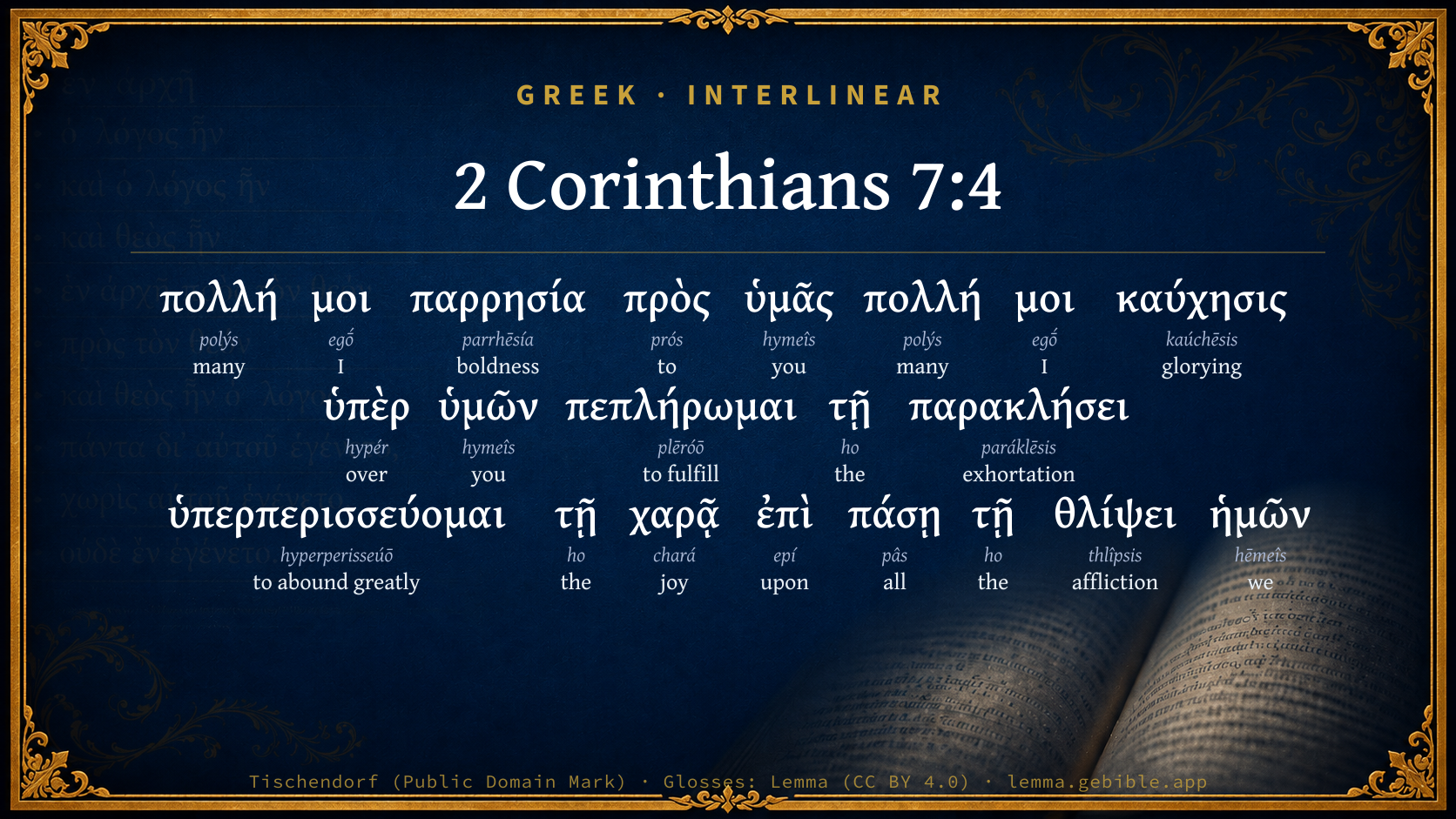
  1. πολλή polýs G4183 “many” Adjective, Nominative, Singular, Feminine
  2. μοι egṓ G1473 “I” Personal pronoun, 1st person, Dative, Singular
  3. παρρησία parrhēsía G3954 “boldness” Noun, Nominative, Singular, Feminine
  4. πρὸς prós G4314 “to” Preposition
  5. ὑμᾶς hymeîs G5210 “you” Personal pronoun, 2nd person, Accusative, Plural
  6. πολλή polýs G4183 “many” Adjective, Nominative, Singular, Feminine
  7. μοι egṓ G1473 “I” Personal pronoun, 1st person, Dative, Singular
  8. καύχησις kaúchēsis G2746 “glorying” Noun, Nominative, Singular, Feminine
  9. ὑπὲρ hypér G5228 “over” Preposition
  10. ὑμῶν hymeîs G5210 “you” Personal pronoun, 2nd person, Genitive, Plural
  11. πεπλήρωμαι plēróō G4137 “to fulfill” Verb, Perfect, Passive, Indicative, 1st person, Singular
  12. τῇ ho G3588 “the” Article, Dative, Singular, Feminine
  13. παρακλήσει paráklēsis G3874 “exhortation” Noun, Dative, Singular, Feminine
  14. τῇ ho G3588 “the” Article, Dative, Singular, Feminine
  15. χαρᾷ chará G5479 “joy” Noun, Dative, Singular, Feminine
  16. ἐπὶ epí G1909 “upon” Preposition
  17. πάσῃ pâs G3956 “all” Adjective, Dative, Singular, Feminine
  18. τῇ ho G3588 “the” Article, Dative, Singular, Feminine
  19. θλίψει thlîpsis G2347 “affliction” Noun, Dative, Singular, Feminine
  20. ἡμῶν hēmeîs G2249 “we” Personal pronoun, 1st person, Genitive, Plural

About this verse

These counts appear in no published source. They are computed here, from the morphology-tagged text and Lemma’s own curated glosses. What Lemma adds →

21
words
16
distinct lemmas
Pauline Epistles
section

Notable vocabulary

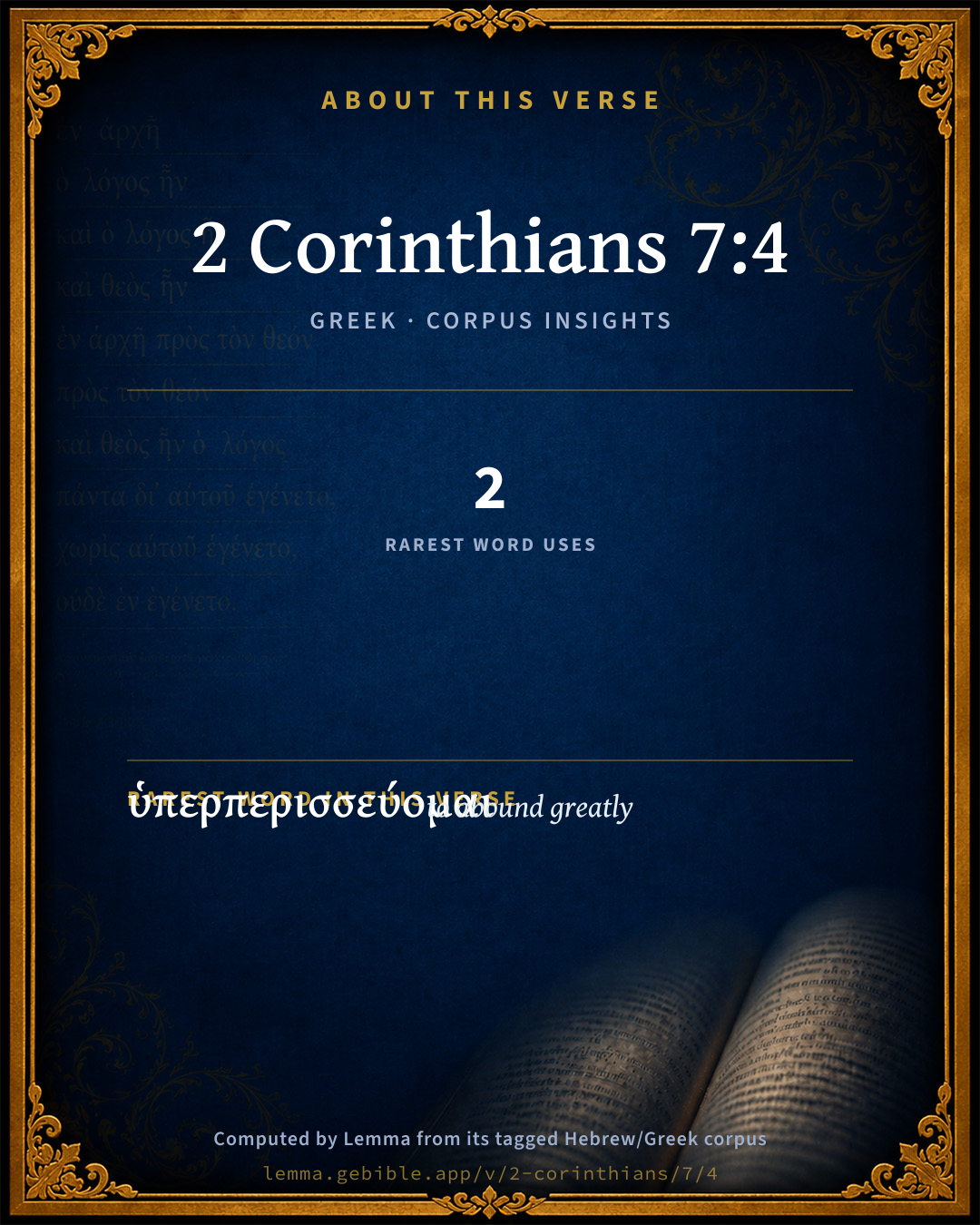
The rarest word here is ὑπερπερισσεύομαι to abound greatly G5248 — appearing just 2 times in the whole Greek New Testament.

Shared distinctive vocabulary

ὑπερπερισσεύομαι to abound greatly G5248 occurs in 2 verses of the Greek New Testament. Also found in:

Repetition

Words recur within this verse:

Cross-references

21

Topical passages linked to 2 Corinthians 7:4 in the Treasury of Scripture Knowledge — connected by theme and wording, ordered by reader-vote popularity; previews shown in the World English Bible.

  • 2 Corinthians 1:4 who comforts us in all our affliction, that we may be able to comfort those who are in any affliction, through the comfort with which we ourselves are comforted by God.
  • 2 Corinthians 3:12 Having therefore such a hope, we use great boldness of speech,
  • James 1:2 Count it all joy, my brothers, when you fall into various temptations,
  • Romans 5:3 Not only this, but we also rejoice in our sufferings, knowing that suffering works perseverance;
  • 1 Corinthians 1:4 I always thank my God concerning you, for the grace of God which was given you in Christ Jesus;
  • Philippians 2:17 Yes, and if I am poured out on the sacrifice and service of your faith, I rejoice, and rejoice with you all.
  • Colossians 1:24 Now I rejoice in my sufferings for your sake, and fill up on my part that which is lacking of the afflictions of Christ in my flesh for his body's sake, which is the assembly;
  • Acts 5:41 They therefore departed from the presence of the council, rejoicing that they were counted worthy to suffer dishonor for Jesus' name.
  • 2 Corinthians 1:14 as also you acknowledged us in part, that we are your boasting, even as you also are ours, in the day of our Lord Jesus.
  • 2 Corinthians 2:14 Now thanks be to God, who always leads us in triumph in Christ, and reveals through us the sweet aroma of his knowledge in every place.
  • 2 Corinthians 6:10–11 as sorrowful, yet always rejoicing; as poor, yet making many rich; as having nothing, and yet possessing all things.
  • 2 Corinthians 7:6–7 Nevertheless, he who comforts the lowly, God, comforted us by the coming of Titus;
  • 2 Corinthians 8:24 Therefore show the proof of your love to them in front of the assemblies, and of our boasting on your behalf.
  • 2 Corinthians 9:2–4 for I know your readiness, of which I boast on your behalf to them of Macedonia, that Achaia has been prepared for a year past. Your zeal has stirred up very many of them.
  • 2 Corinthians 11:21 I speak by way of disparagement, as though we had been weak. Yet however any is bold (I speak in foolishness), I am bold also.
  • Ephesians 6:19–20 on my behalf, that utterance may be given to me in opening my mouth, to make known with boldness the mystery of the Gospel,
  • Philippians 1:20 according to my earnest expectation and hope, that I will in no way be disappointed, but with all boldness, as always, now also Christ will be magnified in my body, whether by life, or by death.
  • 1 Thessalonians 2:2 but having suffered before and been shamefully treated, as you know, at Philippi, we grew bold in our God to tell you the Gospel of God in much conflict.
  • 1 Thessalonians 2:19 For what is our hope, or joy, or crown of rejoicing? Isn't it even you, before our Lord Jesus at his coming?
  • 1 Thessalonians 3:7–9 for this cause, brothers, we were comforted over you in all our distress and affliction through your faith.
  • 2 Corinthians 10:1–2 Now I Paul, myself, entreat you by the humility and gentleness of Christ; I who in your presence am lowly among you, but being absent am of good courage toward you.

Cross-references courtesy of OpenBible.info (CC BY 4.0).

Commentary

Notes on 2 Corinthians 7:4 from classic Christian and Jewish commentators (each source and its license shown beneath its notes). The classic Christian expositions comment on the surrounding passage and are grouped to its opening verse, so a note may address several verses; the Jewish commentaries on the Tanakh (Rashi and others) are per-verse, so they appear only where the commentator wrote on this verse.

Lemma curates 59 commentaries, every one of them public domain or Creative Commons licensed, each selected and text-cleaned for this edition rather than reprinted as found. About our sources →

Tyndale Open Study Notes

Tyndale Open Resources

7:4 All our troubles might refer to Paul’s many hardships (6:5) or his problems with the Corinthians themselves. Either way, he was filled with joy because the church’s response had greatly encouraged him (as he explains in 7:5-16).

Tyndale Open Study Notes — © Tyndale Open Resources, licensed CC BY-SA 4.0. Text via the HelloAO Bible API.

Bengel's Gnomon

Johann Albrecht Bengel

2Co 7:4. Παῤῥησία, boldness of speech) 2Co 7:16, ch. 2Co 6:11.—ὑπὲρ ὑμῶν, in behalf of you) to others, the antithesis is πρὸς ὑμᾶς, to [toward] you.—παρακλήσει, with comfort) concerning which, see 2Co 7:6-7: concerning joy, 2Co 7:7-8; 2Co 7:16: concerning both, 2Co 7:13: comfort relieves [‘refreshes,’ 2Co 7:13], joy entirely frees us from, sorrow.—ὑπερπερισσεύομαι, I exceedingly [over and above] abound) above [ὑπὲρ] all adversity.—θλίψει, in [‘tribulation’] affliction) of which, 2Co 7:5, θλιβόμενοι, [‘troubled’] afflicted. To this belong all those trials which he has mentioned at ch. 2Co 4:7-8, 2Co 6:4-5.

Bengel's Gnomon of the New Testament — English translation (T&T Clark, Edinburgh, 1860) — public domain. Text from a community e-Sword module.

Meyer's Critical & Exegetical Commentary

Heinrich August Wilhelm Meyer

2Co_7:4. A further, and that a psychological, proof for the οὐ πρ. κατάκρ. λέγω.

παῤῥησία is the internal frame of mind, the good joyous confidence (see on Eph_3:12), without which no καύχησις, no self-boasting for the sake of the readers, would outwardly take place (ὑπέρ, as in 2Co_5:12, 2Co_8:24). To take it of the libertas loquendi (Pelagius, Beza, Luther, Vatablus, Cornelius a Lapide, and many others, including Schrader and Ewald) is inappropriate, because by the παῤῥησία in this sense there would be no negation of πρὸς κατάκρ. λέγειν. And the taking the καύχησις of inward boasting before God (Osiander), ought to have been precluded by 2Co_7:14, comp. 2Co_9:3.

πεπληρ. κ.τ.λ.] The two clauses form a climax, so that πεπλ. is correlative with ὑπερπερ. and παρακλ. with χαρᾃ. In the use of the article with παρακλ. and χαρᾷ Paul already looks to the special comfort and joy, of which he intends to speak further (2Co_7:7). The dative of the instrument (as at 2Ma_5:5; 2Ma_7:21; 3Ma_4:10) is used with πληρ. in the N. T. also at Rom_1:29, and in classic Greek, though seldom. See Elmsley, ad Soph. Oed. Col. 16; Blomfield, Gloss. Aesch. Agam. 163; Bernhardy, p. 168. Comp. also Jacobs, ad Anthol. XI. p. 209.

ὑπερπερισσεύομαι] I am exceeding richly provided with, Mosch. vi. 13; comp. the passive in Mat_13:12; Mat_25:29. The present sets forth the thing as still continuously taking plac.

ἐπὶ πάσῃ τῇ θλίψει ἡμ.] does not belong to τῇ χαρᾷ, but to the two whole affirmations πεπληρ. τῇ παρακλ. and ὑπερπερισσ. τῇ χαρᾷ; and ἐπί is not, as Grotius thought, post, as in Herod. i. 45: ἐπʼ ἐκείνῃ τῇ συμφορῇ (see, generally, Wurm, ad Dinarch. p. 39 f.), since (comp. 2Co_1:3-11) the tribulation still continues, but in, at. See Winer, p. 367 [E. T. 490].

Meyer — Critical and Exegetical Commentary on the New Testament — English translation by Peter Christie, edited by Frederick Crombie (T&T Clark, 1880) — public domain. Text from a community e-Sword module.

Expositor's Greek Testament

ed. W. Robertson Nicoll

2Co 7:4 . πολλή μοι παρρησία κ . τ . λ .: great is my boldness of speech towards you ( cf. 2Co 6:11 ), great is my glorying on your behalf, sc. , on account of the good news of their conduct ( cf. 2Co 1:14 , 2Co 3:2 ), I am filled with comfort (for the constr. cf. Luk 2:40 , Rom 1:29 , 2Ma 7:21 ), sc. , with the comfort (note the article) which Titus had brought, I overflow with joy ( cf. Phi 2:17 , Col 1:24 ) in all our affliction (see 2Co 6:10 ).

The Expositor's Greek Testament, edited by W. Robertson Nicoll (1897–1910) — public domain. Text from a community e-Sword module.

Jamieson, Fausset & Brown

Robert Jamieson, A. R. Fausset & David Brown

boldness of speech--(compare Co2 6:11).

glorying of you--Not only do I speak with unreserved openness to you, but I glory (boast) greatly to others in your behalf, in speaking of you.

filled with comfort--at the report of Titus (Co2 7:6-7, Co2 7:9, Co2 7:13; Co2 1:4).

exceeding joyful--Greek, I overabound with joy (Co2 7:7, Co2 7:9, Co2 7:16).

our tribulation--described in Co2 7:5; also in Co2 4:7-8; Co2 6:4-5.

Jamieson, Fausset & Brown — Commentary Critical and Explanatory on the Whole Bible (1871) — public domain (CC PDM 1.0). Text via the HelloAO Bible API.

Adam Clarke's Commentary

Verse 4. Great is my boldness of speech] He seems to refer to the manner in which he spoke of them to others.

Great is my glorying of you] They had probably been very loving and affectionate previously to the time in which they were perverted by their false apostle. He therefore had boasted of them in all the Churches.

I am filled with comfort] My affection for you has still the most powerful ascendancy in my soul. Here we may see the affection of the most tender father to his children.

I am exceeding joyful] υπερπερισσευομαι. I superabound in joy; I have a joy beyond expression. υπερπερισσευω is an extremely rare verb. I have not met with it in any Greek author; and it occurs no where in the New Testament but here and in Ro 5:20.

In all our tribulation.] Perhaps επι here should be rendered under instead of in, as it signifies, Mr 2:26; Lu 3:2; Ac 11:28. Under all our tribulations, I feel inexpressible joy on your account.

Adam Clarke's Commentary on the Bible (1810–1826) — public domain. Text from a community e-Sword/MySword module.

John Calvin's Commentaries

4. Great is my boldness. Now, as if he had obtained the enlargement of heart that he had desired on the part of the Corinthians, he leaves off complaining, and pours out his heart with cheerfulness. “What need is there that I should expend so much labor upon a matter already accomplished? For I think I have already what I asked. For the things that Titus has reported to me respecting you are not merely sufficient for quieting my mind, but afford me also ground of glorying confidently on your account Nay more, they have effectually dispelled the grief, which many great and heavy afflictions had occasioned me.” He goes on step by step, by way of climax; for glorying is more than being of an easy and quiet mind; and being freed from grief occasioned by many afflictions, is greater than either of those. Chrysostom explains this boldness somewhat differently, in this manner — “If I deal with you the more freely, it is on this account, that, relying on the assurance of your good will towards me, I think I may take so much liberty with you.” I have stated, however, what appeared to me to be the more probable meaning — that the report given by Titus had removed the unfavorable impression, which had previously racked his mind.

John Calvin's Commentaries (1540-1563) — public domain. Text from the Calvin Translation Society English edition (1840s-50s) via the Christian Classics Ethereal Library (ccel.org). Calvin's coverage is partial (roughly two-thirds of the Bible); uncommented books and verses are honest gaps, never fabricated. The 19th-century editor's footnotes and remarks are omitted so the notes are faithfully Calvin's own voice.

Ellicott's Commentary for English Readers

(4) Great is my boldness of speech.—The context shows that he is not apologising for bold and plain speaking, but uses the word as implying confidence (1Ti_3:13; Phm_1:8). He can speak without reticence now, because he is going to express his comfort and joy at what had been reported to him.

I am exceeding joyful.—Literally, I exceedingly abound (or, overflow) in joy. The verb is the same as in Rom_5:20, and answers to the “pressed above measure” which he had used in 2Co_1:8, in speaking of his troubles.

A Bible Commentary for English Readers, edited by Charles John Ellicott (1878–1897) — public domain. Text from a community e-Sword module.

The Cambridge Bible for Schools and Colleges

gen. ed. J. J. S. Perowne

4. Great is my boldness of speech toward you] Cf. note on ch. 2Co_3:12.

great is my glorying of you] See notes on ch. 2Co_1:14 and ch. 2Co_5:12. The word here signifies not the ground of rejoicing or boasting, but, as A. V., the act itself. St Paul explains his boldness of speech by the confidence he has that it will not be misplaced. This is another instance of the delicate tact of the Apostle referred to above.

comfort] For this word and tribulation, see notes on ch. 2Co_1:3-4. So also below in 2Co_7:6-7.

I am exceeding joyful] Literally, I abound overmuch with Joy. The English word exceedingly has lost much of its original force.

The Cambridge Bible for Schools and Colleges (gen. ed. J. J. S. Perowne; Cambridge University Press, 1878–1918) — public domain. Text from a community e-Sword module.

John Gill's Exposition

Great is my boldness of speech towards you,.... Or "liberty of speaking", which I use with you; I very freely, and without any disguise, open my mind to you; I faithfully tell you your faults; I am free in my exhortations and counsels to you, as in the case of the incestuous person, and in other instances, which is a sign of true friendship; for had I any suspicion of you, or not cordial affection for you, I should have been more reserved, more upon my guard, and have spoke and wrote with more caution: besides,

great is my glorying, or "boasting of you"; of your faith in Christ, your love to the people of God, respect to the ministers of the Gospel, obedience to us, and very great liberality to the poor saints, of which the apostle frequently boasts in this epistle: now as speaking freely to them when present with them, or in writing to them, so glorying in them, and speaking well of them when absent, clearly showed what an opinion he had of them, and what true hearty respect he had for them:

I am filled with comfort, says he; not only with divine and spiritual consolations from God, but with the news Titus brought of the state of this church, of the good effect the apostle's reproof and advice had both upon them, and the offender among them, and of their tender and affectionate regard to him: this filled him brimful of comfort, yea, adds he,

I am exceeding joyful; I abound, I over abound in joy; such is the joy that possesses my soul, at the tidings brought me, that it superabounds all the sorrow and anguish of spirit, out of which I wrote unto you, occasioned by the unhappy affair among you: yea, it makes me inexpressibly joyful in all our tribulation; which is not small we meet with, wherever we go, in preaching the Gospel of Christ.

John Gill's Exposition of the Whole Bible (1746–1763) — public domain (CC PDM 1.0). Text via the HelloAO Bible API.

Trapp's Complete Commentary

John Trapp

4 Great is my boldness of speech toward you, great is my glorying of you: I am filled with comfort, I am exceeding joyful in all our tribulation.

Ver. 4. I am exceeding joyful] Gr. υπερπερισσενομαι, I do overbound exceedingly with joy. Others may revel, the godly only rejoice: they have an exuberance of joy, such as no good can match, no evil out match. Witness the martyrs, ancient and modern. Oh, how my heart leapeth for joy, said one of them, that I am so near the apprehension of eternal bliss! God forgive me mine unthankfulness and unworthiness of so great glory. In all the days of my life I was never so merry as now I am in this dark dungeon. Believe me there is no such joy in the world as the people of Christ have under the cross. Thus and much more Mr Philpot, martyr. (Acts and Mon.)

John Trapp, A Commentary or Exposition upon All the Books of the Old and New Testament (1647–1656) — public domain. Text from a community e-Sword module.

Albert Barnes' Notes on the Bible

Great is my boldness of speech toward you - This verse seems designed to soften the apparent harshness of what he had said 2Co 6:12, when he intimated that there was a lack of love in them toward him (Bloomfield), as well as to refer to the plainness which he had used all along in his letters to them. He says, therefore, that he speaks freely; he speaks as a friend; he speaks with the utmost openness and frankness; he conceals nothing from them. He speaks freely of their faults, and he speaks freely of his love to them; and he as frankly commends them and praises them. It is the open, undisguised language of a friend, when he throws open his whole soul and conceals nothing.

Great is my glorying of you - I have great occasion to commend and praise you, and I do it freely. He refers here to the fact that he had boasted of their liberality in regard to the proposed collection for the poor saints of Judea 2Co 9:4; that he had formerly boasted much of them to Titus, and of their readiness to obey his commands 2Co 7:14; and that now he had had abundant evidence, by what he had heard from Titus (verses 5ff), that they were disposed to yield to his commands, and obey his injunctions. He had probably often had occasion to boast of their favorable regard for him.

I am filled with comfort - That is, by the evidence which I have received of your readiness to obey me.

I am exceeding joyful - I am overjoyed. The word used here occurs nowhere else in the New Testament except in Rom 5:20. It is not found in the classic writers; and is a word which Paul evidently compounded (from ὑπὲρ huper and περισσεύω perisseuō), and means to superabound over, to superabound greatly, or exceedingly. It is a word which would be used only when the heart was full, and when it would be difficult to find words to express its conceptions. Paul’s heart was full of joy; and he pours forth his feelings in the most fervid and glowing language. I have joy which cannot be expressed.

In all our tribulation - see the note, 2Co 1:4.

Albert Barnes' Notes on the Bible (1834–1885) — public domain. Text from a community e-Sword/MySword module.

Matthew Poole's English Annotations

Great is my boldness of speech toward you; because I so dearly love you, therefore I speak so boldly and freely to you (as men use to speak most freely to those whom they most love).

Great is my glorying of you; I boast of your obedience to others, and therefore would be far from exposing you. And this I do not feignedly, for

I am filled with comfort on your behalf (a further account of this he giveth us afterward).

I am exceeding joyful in all our tribulation; yea, (saith he), the report I have received of your carriage and behaviour, upon your receipt of my former Epistle, hath filled me with a joy that balanceth all the affliction and tribulation that I meet with for the gospel. So good news to a faithful minister is the repentance and reformation of any member or members that belong to his flock; whereas the hireling, or false teacher, is not much concerned whether the souls of his people do well or ill.

Matthew Poole's English Annotations on the Holy Bible (1683–1685) — public domain. Text from a community e-Sword/MySword module.

Whedon's Commentary on the Bible

Daniel D. Whedon

4. Great—Paul cannot directly address the Corinthians (as at 2Co_6:1) without breaking into exultation.

Boldness—The fearlessness of a friendship that dares say any thing it pleases.

Great… glorying—A climax; as is also comfort and exceeding joyful. Paul was lovingly bold in speaking to them, and boastful in speaking of them. He spake to them in fearless love; he spake to them in (if we may so say) holy pride.

Tribulation—In every crisis of danger and damage, joy over his Corinthian Church was a cheer and an exultation.

Daniel D. Whedon (gen. ed.), Commentary on the Old and New Testaments (1874–1909) — public domain. Text from a community e-Sword module.

The Pulpit Commentary

Boldness of speech. St. Paul feels that he may address them with perfect frankness and openness. (2Co_3:12) My glorying of you. "My boasting on your account" (2Co_1:14 2Co_5:12 2Co_8:14; comp. 1Co_1:4-7) I am filled with comfort. "I have been filled with the consolation." "Consolation" is the word which occurs so frequently in 2Co_1:3, 2Co_1:4. I am exceeding joyful. "I superabound in my joy". (2Co_2:2-14) In all our tribulation. The clause belongs to both the preceding clauses. Joy in the very midst of affliction was an essentially Christian blessing. (Php_2:17)

Thou shalt have joy in sadness soon; The pure calm hope be thine Which brightens the Eastern moon, When day"s wild lights decline. (2Co_6:10; Gal_5:22; Rom_14:17; Joh_15:11)

A minister"s joy in tribulation.

The intensity of the apostle"s language is explained by the intensity of his feelings in relation to the Corinthians. He loved them greatly, and was ready to make any sacrifices for them. And he was proportionately grieved when the news came, through Titus, of the way in which evil men were trying to destroy his character and his influence. The tribulation he here refers to is chiefly this mental distress and the bodily suffering which it involved. His great relief in circumstances of so much distress was that the Corinthian Church, as a whole, had received his first letter in a right spirit. He could be joyful in this, even amidst his tribulation. Two points may receive illustration.

I THE TRIBULATION COMES FROM ANXIETY CONCERNING SPIRITUAL WELL BEING. Precisely this is the minister"s sphere. His interest is in the moral and spiritual condition of those who are set in his charge. But this is the most serious and overwhelming of all burdens that can be laid upon a man"s heart and effort. If we estimate what the due maintenance and culture of our own spiritual life involves, we may understand how great is the anxiety of Christian ministers who watch over souls as well as watch for souls. Illustrate by Samuel Rutherford"s intense expression of feeling, "God is my witness that your salvation would be two salvations to me, and your heaven two heavens to me." Show what a strain upon nervous constitutions the pressure of the ministry becomes in these our days.

II THE JOY COMES FROM DUE RESPONSE MADE TO EFFORTS FOR SPIRITUAL WELL BEING. Compare other expressions by apostles: e.g. "I have no greater joy than to hear that my children walk in truth;" "What is our joy or crown of rejoicing? Are not even ye in the presence of our Lord Jesus at his coming? For ye are our glory and our joy." The minister has, in the culture of spiritual life, to use truth, warnings, threatenings, as well as comfortings and inspirings; and his joy is ever this his people are open-hearted to receive, are humble enough to regardwhat he may say, and. earnest enough to obey. No earthly joy is like that which they know who help their brethren to truth and purity and God. R.T.

The Pulpit Commentary (1880–1919), ed. H.D.M. Spence-Jones & Joseph S. Exell — public domain. Text from a community e-Sword module.

John Wesley's Explanatory Notes

I am filled with comfort - Of this he treats, 2 Cor. vii, 6, &c.; of his joy, 2 Cor. vii, 7, &c.; of both, 2 Cor. vii, 13.

John Wesley, Explanatory Notes Upon the Whole Bible (1754–1765) — public domain. Text via the GEBible commentary corpus.

McGarvey & Pendleton's Commentaries

J. W. McGarvey

Great is my boldness of speech toward you, great is my glorying on your behalf: I am filled with comfort, I overflow with joy in all our affliction . [This verse tells of Paul's restored confidence in the Corinthians, and his consequent freedom of speech and joyfulness of heart. The next few verses show us that these changes were wrought in him by the report which he received from Titus concerning affairs at Corinth.]

J. W. McGarvey (with Philip Y. Pendleton), Commentaries on the New Testament (The Fourfold Gospel, 1914; Acts; and the epistles) — public domain. Text from a community e-Sword/MySword module.

The People's New Testament

B. W. Johnson

4. Great is my boldness of speech, etc. This verse declares that he is overflowing with joyful feeling. The next section explains its cause.

B. W. Johnson's The People's New Testament with Notes (1889–1891) — public domain. Electronic text from the Christian Classics Ethereal Library (CCEL) ThML edition.

Cambridge Greek Testament for Schools and Colleges

4. πολλή μοι παρρησία πρὸς ὑμᾶς, πολλή μοι καύχησις ὑπὲρ ἱμῶν. If παρρησία means ‘boldness of speech’ (2Co 3:2), what is here expressed is, ‘am very frank in dealing with you; ‘I am full of boasting when I talk to others about you.’ If it means ‘confidence’ (1Ti 3:13; Heb 10:19), the thought is, ‘I am full of confidence in respect of yon; full of boasting on your behalf’ (2Co 5:12, 2Co 8:24); i.e. the internal feeling of confidence produces the external act of glorying. This is better. If the two clauses expressed a contrast, πρὸς ὑμᾶς and ὑπὲρ ὑμῶν would probably have stood first. For παρρησία in the secondary sense of ‘confidence’ comp. Wis 5:1; 1Ma 4:18. In this verse we have three of the key-words of this letter, καύχησις, παράκλησις, and θλίψις.

πεπλήρωμαι. ‘I have been filled and remain so.’ This is surpassed by ὑπερπερισσεύομαι, as τῇ παρακλήσει by τῇ χαρᾷ: the second clause is a balanced advance on the first. I am filled with comfort, I am overflowing with joy. In Rom 5:20 we have ὑπερεπερίσσευσεν ἡ χάρις: the verb is not found elsewhere in Biblical Greek. With the alliteration (π) comp. 2Co 8:22, 2Co 9:8, 2Co 10:6.

ἐπὶ πάσῃ τῇ θλίψει. This belongs to both clauses, as is shown by 2Co 7:6-7. The ἐπί indicates the occasions on which the comfort and joy were felt (Php 1:3). The thought of comfort and joy sends him back to the recent cause of these emotions.

Cambridge Greek Testament for Schools and Colleges (Cambridge University Press, 1896; 21 vols, various authors incl. Carr, Maclear, Plummer, Farrar, Lumby, Moule, M. R. James, Simcox) — public domain. Text from a community e-Sword module.

Alford’s Greek Testament

Henry Alford

4.] παῤῥησία, as in reff., confidence, which leads to and justifies καύχησις: not here liberty of speech,’ as Chrys., al.

καύχ., to others, in speaking of them.

τῇ παρ., the consolation (which I have received), viz. that furnished by the intelligence from you. Though this is anticipating what follows vv. 7, 9, I cannot but believe it to have been already before the Apostle’s mind, and to have been referred to by the articles before παρακλ. and χαρ.

On the construction of πληρόω with an instrumental dative, see reff., and Winer, edn. 6, § 31. 7. So Eurip. Herc. Fur. 372, πεύκαισιν χέρας πληροῦντες,—and Bacchæ 18, μιγάσιν Ἕλλησι βαρβάροις θʼ ὁμοῦ πλήρεις ἔχουσα καλλιπυργώτους πόλεις.

ὑπερπ.] I am made exceedingly to abound, see Mat 13:12. The pres. indicates the abiding of the effect.

τῇ χαρᾷ, with the joy; see above.

ἐπὶ πάς. τῇ θλ. ἡμ., in (reff.) all our tribulation: refers to both preceding clauses. What θλῖψις he means, is explained in the next verse.

πάσῃ here not of all tribulation, at all times, which the special reference of παρακλ. and χαρά forbids: but of various sorts of tribulation as specified (ἐν παντί) below.

Henry Alford, The Greek Testament (1849–1861) — public domain. Text from a community e-Sword module.

International Critical Commentary

4. πολλή μοι παρρησία πρὸς ὑμᾶς κ.τ.λ. Note the alliteration, of which St Paul is fond, esp. with the letter π. It is probable that παρρησία here means ‘confidence’ (1Ti 3:13; Heb 10:19), rather than ‘boldness of speech’ (3:2). ‘Great is my confidence respecting you; great is my glorying on your behalf.’ * The confidence is the result of their obedience and affection as reported by Titus, and this feeling of confidence manifests itself in glorying. He is very proud of them and is not afraid to say so, for they will not come short of his praise. He has told them (v. 12) that they ought to glory on behalf of their teachers, and he tells them (here and 8:24) that he is ready to glory respecting his converts. Καύχησος (see on 1:12), παράκλησις (see on 1:3), and θλίΨις (see on 1:4) are specially freq. in this Epistle, and the frequency should be marked in translation.

πεπλήπωμαι τῇ παρακλήσει. ‘I am filled with the comfort’; ‘I was then and I am still’ (perf.). The usual constr. is with the gen. (Act 2:28, Act 2:13:52; Rom 15:13; etc.); but the dat. occurs in late Greek; ὁ βασιλενῦς χαπᾷ πεπληρωμένος (3 Macc. 4:16). Cf. 2 Macc. 6:5, 7:21; Rom 1:29.

ὑπερπερισσεύομαι τῇ χαρᾷ. ‘I am overflowing with the joy.’ A double climax; ‘overflowing’ is more than ‘filled,’ and ‘joy’ is more than ‘comfort.’ The article should probably be translated; it points to the comfort and the joy caused by the report brought by Titus. The compound verb is very rare; only here and Rom 5:20; not in LXX. We have similar alliterations with π in 8:22, 9:5, 13:2.

ἐπὶ πάση τῇ θλίΨει. ‘Amid all my affliction.’ The ἐπί does not mean that the affliction was the basis of the comfort and joy, a paradox (12:10) which here would have no point; but that, in all his great trouble, he was able to have abundant comfort and joy. He at once goes on to explain the cause of this happiness.

En qualiter affectos esse omnes pastores conveniat (Calvin).

7:5-16. The Reconciliation Completed

This part of the chapter is all of one piece; but for convenience we may divide it into three, according to the subject matter. The Apostle speaks first of his longing for the arrival of Titus, and of his relief at the tidings which he brought (5-7), especially about the great offender and the Apostle’s painful letter (8-12); and finally he speaks of the joy of Titus at being able to bring such good tidings (13-16).

The close parallel with the description of Timothy’s mission to Thessalonica, and the Apostle’s anxiety, followed by joy at the happy result (1Th 3:1-9), should be noted.

5 For indeed, even after I had got as far as Macedonia, my poor suffering frame found no relief, but at every turn I found something to distress me; round about me were bitter conflicts for and against me, within, me were haunting fears as to how it would all end. 6 I was almost in despair; but God, who is ever ready to comfort the depressed, comforted me then by the arrival and company of Titus. 7 Yes, and not only by his arrival and company, but also by the comfort, with which you comforted him in his intercourse with you; for he gave a most welcome report of how you longed for reconciliation with me, how you lamented the trouble that you had caused, how eagerly you espoused my cause; so that this still further increased my joy.

8 Because, although I know that I gave you pain by the letter which I sent you, I cannot bring myself to regret it. When I saw that that letter gave you pain, although only for a season, I was inclined to regret it; 9 but now I am very glad,—not glad because you were pained, but because your pain issued in repentance. For you were pained in God’s way and not in the world’s way, and it was His will that you should not be the worse for anything that we did. 10 For the pain which is directed in God’s way leads to a repentance whose fruit is salvation, a repentance which can never be regarded with regret; whereas the pain which the heathen world inflicts on those who belong to it works out into moral ruin. 11 For see! it was this very thing, your being pained in God’s way, and not anything else, which did so much for you. See what earnestness it worked out in you, how keen you were to clear yourselves from just reproach, how indignant with the chief offender, how alarmed as to what the consequences might be, how eager for my forgiveness and return, how zealous in condemning evil, how stern in punishing it. In every one of these points you put yourselves right and purged yourselves from complicity in this distressing matter. 12 So then, although I did not let things slide but wrote severely to you, it was not in order to get the wrong-doer punished, nor yet to have the wronged man avenged. No, I wrote in order to bring out clearly before you all what a genuine interest you do take in us; I wrote as in God’s sight, with a full sense of responsibility. 13 It is this right conduct of yours and my own consciousness of having meant well that is such a comfort to me.

But over and above our own comfort we were the more exceedingly glad at the gladness of Titus; for refreshment and repose have come to his spirit, thanks to all of you. 14 For I told him how I gloried in you, how proud I was of you, and I have had no reason to be ashamed of what I said. You have not come short of my commendation of you. Just as all that we said to you was said in truth, so all that we said before Titus in praise of you has turned out to be quite true. 15 And he feels as we do. His inmost heart goes out the more abundantly towards you, as often as he recalls the ready obedience of all of you, and how timidly and nervously anxious you were in the reception which you gave him. 16 I am indeed glad that in every particular I can be of good courage in respect of you.

International Critical Commentary — older volumes (1896–1929), various authors — public domain. Text from a community e-Sword module.

Vincent's Word Studies in the New Testament

Marvin R. Vincent

My boldness. Note the change for the first time to the first person singular.

Comfort. The Greek has the comfort, the article apparently pointing to the special comfort he had received through the coming of Titus (ver. 6). I am exceeding joyful [υπερπερισσευμαι τη χαρα] . Lit., I superabound with the joy. Rev., I overflow with joy. Note the article again, the joy.

Marvin R. Vincent, Word Studies in the New Testament (1887–1900) — public domain. Text from a community e-Sword/MySword module.

Lesson kit

Teaching starters — assembled from the data on this page, not authored interpretation. Every prompt links to the verse data it draws on. Edit before teaching.

2 Corinthians, in the Pauline Epistles, opens this verse with 21 words (16 distinct Greek lemmas). Its most distinctive word is hyperperisseúō (“to abound greatly”). A historical commentator’s framing appears above. Read the whole chapter for the surrounding context.

Discussion questions

  1. The word hyperperisseúō carries the sense “to abound greatly.” How does it shape the verse?
  2. How does Romans 5:20, which shares the word «to abound greatly», read alongside this verse?
  3. What does the repetition of “many” (2× in this one verse) do in this verse?
  4. These translations render this verse differently; the difference is in the English rendering, not the original. What questions does that raise?
  5. Compare how Tyndale Open Study Notes and Bengel's Gnomon read this verse. Where do they agree or differ?

Things to notice

Reading settings

Reading text

Shown beneath each verse's original-language words.

Old Testament
Old Testament edition

Read the OT as the Masoretic Hebrew (MT) or the Greek Septuagint (LXX).

English shown for the Greek Septuagint (in the Hebrew ↔ Greek comparison).

Comparing translations? Open the Compare panel on any verse page to stack up to four side by side.