Hebrews 6:20

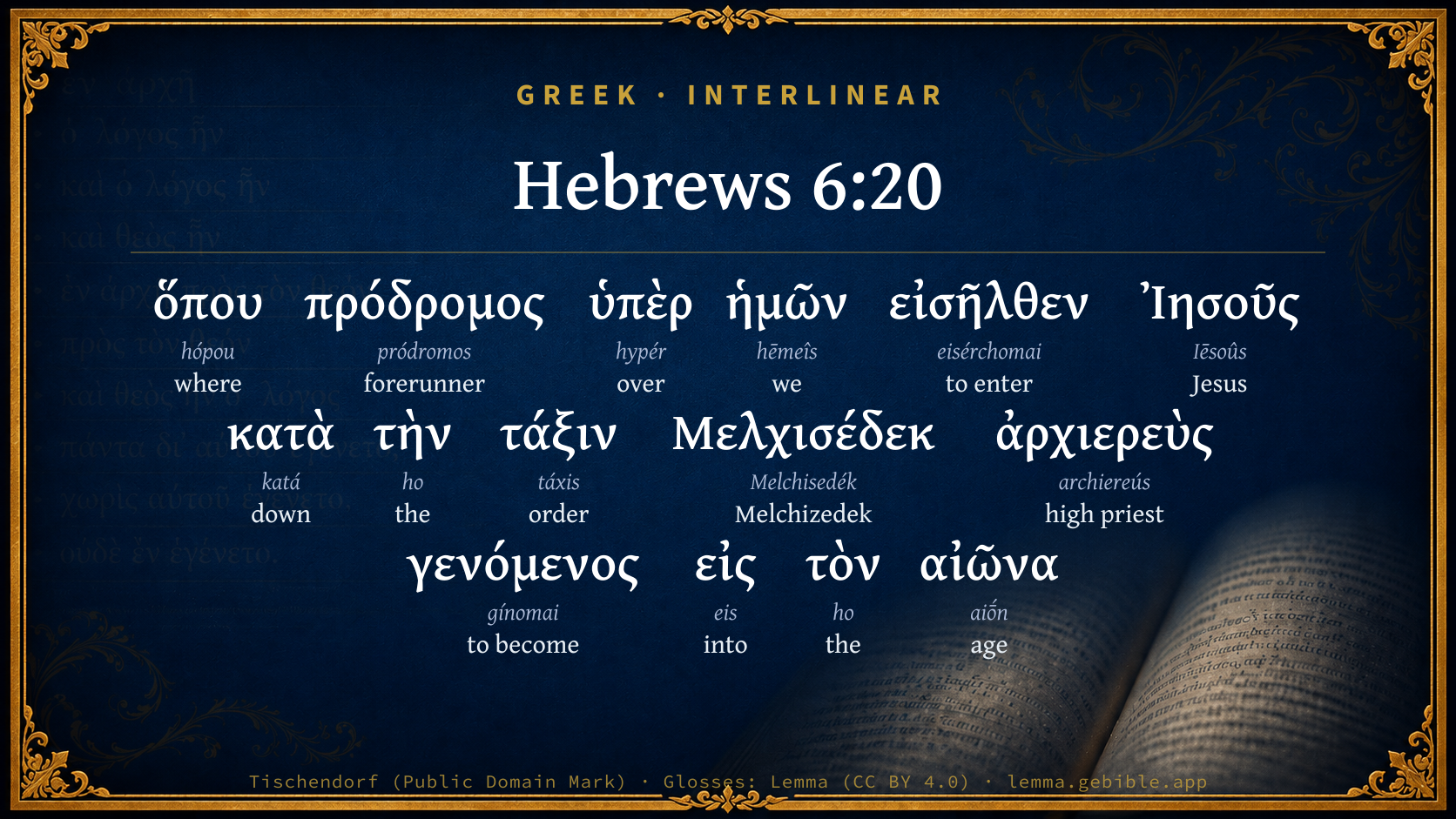
Greek (Tischendorf 8th ed.) Hebrews 6:20 appears in the Greek New Testament. The text above is from the Tischendorf 8th edition. Each word links to its Strong’s number and a concise gloss. Click any word for its full Thayer’s Greek Lexicon entry.
Download image
Cite this verse

Hebrews 6:20 (World English Bible). Public Domain. Lemma interlinear Bible study tool, https://lemma.gebible.app/v/hebrews/6/20.

Show BibTeX & RIS
BibTeX
RIS
English Translation
where as a forerunner Jesus entered for us, having become a high priest forever after the order of Melchizedek.
World English Bible · Public Domain
Highlights
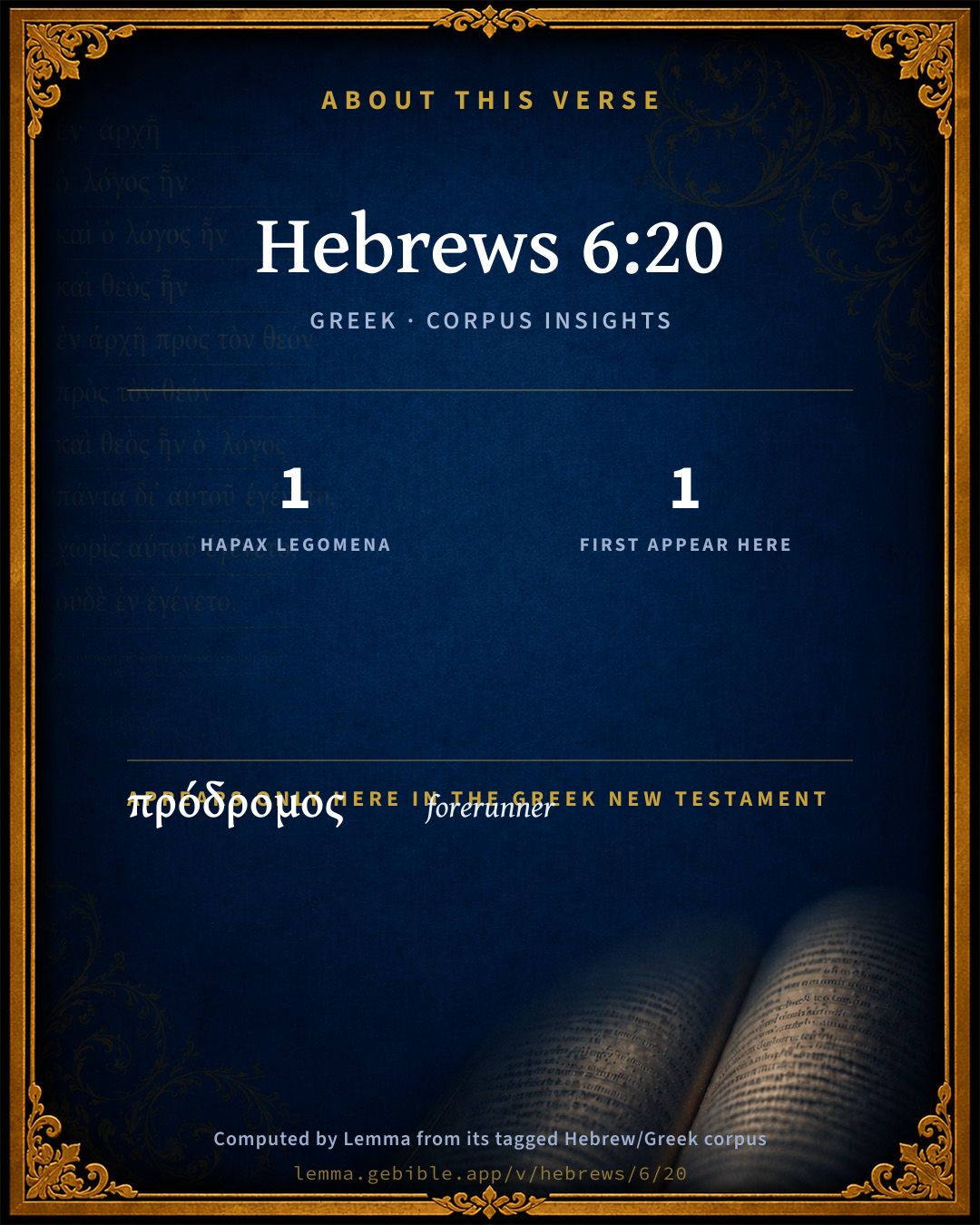
  • 1 hapax legomenon — only here in the Greek New Testament
  • 1 first appearance in the Greek New Testament
Full analysis ↓
Download a study sheet

One document with this verse’s original text, its word-by-word gloss line, the meaning frame, cross-references with their text, attributed commentary, and full source and license credits — printable, and it pastes into notes with its structure intact.

This verse Autodidact and up

Study sheet (.html) Plain text (.txt)

A passage Seminary Student

Up to 50 verses in one chapter. A passage sheet keeps up to 6 commentary sources and 12 cross-references per verse, in the order this page ranks them, and says so on the sheet whenever that leaves anything out. Ask for a single verse and you get the Autodidact verse sheet above.

Everything on this page stays free to read, with no account — the sheet is a download of what is already on screen, not access to it.

Want to remove ads? Support Godless Engineer
Compare translations 3

The same verse in 3 English versions, stacked beneath the original-language interlinear above. Click any original word for its lexicon entry.

Each is an independent rendering of the whole verse — the interlinear is not word-aligned to these translations.

Highlighted words mark where these versions differ — a whole-verse word diff, not a word-by-word alignment.

  • World English Bible Public Domain
    where as a forerunner Jesus entered for us, having become a high priest forever after the order of Melchizedek.
  • King James Version Public Domain
    Whither the forerunner is for us entered, even Jesus, made an high priest for ever after the order of Melchisedec.
  • unfoldingWord Literal Text CC BY-SA 4.0
    where Jesus has entered a forerunner on our behalf, having become a high priest forever according to the order of Melchizedek.

unfoldingWord Literal Text — © unfoldingWord, licensed CC BY-SA 4.0. Word-aligned USFM3 via Door43 (git.door43.org/unfoldingWord/en_ult).

Versions to compare (up to 4)

3 of 4 selected

Show all 19 translations

Every available English version of this verse, each an independent rendering of the whole verse.

  • World English Bible Public Domain
    where as a forerunner Jesus entered for us, having become a high priest forever after the order of Melchizedek.
  • Berean Standard Bible Public Domain
    where Jesus our forerunner has entered on our behalf. He has become a high priest forever in the order of Melchizedek.
  • Majority Standard Bible Public Domain
    where Jesus our forerunner has entered on our behalf. He has become a high priest forever in the order of Melchizedek.
  • King James Version Public Domain
    Whither the forerunner is for us entered, even Jesus, made an high priest for ever after the order of Melchisedec.
  • American Standard Version (1901) Public Domain
    whither as a forerunner Jesus entered for us, having become a high priest for ever after the order of Melchizedek.
  • Revised Version (1885) Public Domain
    whither as a forerunner Jesus entered for us, having become a high priest for ever after the order of Melchizedek.
  • Geneva Bible (1599) Public Domain
    Whither the forerunner is for vs entred in, euen Iesus that is made an hie Priest for euer after the order of Melchi-sedec.
  • Douay-Rheims (1899) Public Domain
    Where the forerunner Jesus is entered for us, made a high priest for ever according to the order of Melchisedech.
  • Young's Literal Translation Public Domain
    whither a forerunner for us did enter -- Jesus, after the order of Melchisedek chief priest having become -- to the age.
  • Literal Standard Version CC BY-SA 4.0
    to where a forerunner entered for us—Jesus, having become Chief Priest throughout the age after the order of Melchizedek.
  • Unlocked Literal Bible CC BY-SA 4.0
    where Jesus, who went before us, has entered into that place on our behalf. He has become a high priest forever after the order of Melchizedek.
  • unfoldingWord Literal Text CC BY-SA 4.0
    where Jesus has entered a forerunner on our behalf, having become a high priest forever according to the order of Melchizedek.
  • Darby Bible Public Domain
    where Jesus is entered as forerunner for us, become for ever a high priest according to the order of Melchisedec.
  • World Messianic Bible Public Domain
    where as a forerunner Yeshua entered for us, having become a high priest forever after the order of Melchizedek.
  • Webster's Bible Public Domain
    Whither the forerunner hath for us entered, even Jesus, made a high priest for ever after the order of Melchisedec.
  • Free Bible Version CC BY-SA 4.0
    That's where Jesus went in on our behalf, because he had become a high priest according to the order of Melchizedek.
  • Bible in Basic English Public Domain
    Where Jesus has gone before us, as a high priest for ever after the order of Melchizedek.
  • Text-Critical English NT CC BY 4.0
    where Jesus has entered as a forerunner for us, because he has become a high priest forever according to the order of Melchizedek.
  • Tyndale New Testament (1534) Public Domain
    whither the fore runner is for vs entred in I mean Iesus that is made an hye prest for ever after the order of Melchisedech.

Literal Standard Version (2020), Covenant Press — licensed CC BY-SA 4.0. Text via the HelloAO Bible API (eBible.org). Unlocked Literal Bible (unfoldingWord) — licensed CC BY-SA 4.0. Text via the HelloAO Bible API (eBible.org). unfoldingWord Literal Text — © unfoldingWord, licensed CC BY-SA 4.0. Word-aligned USFM3 via Door43 (git.door43.org/unfoldingWord/en_ult). Free Bible Version, Dr. Jonathan Gallagher — licensed CC BY-SA 4.0. Text via the HelloAO Bible API (eBible.org).

Word by word

More ways to search: Search by grammar → Find every occurrence → Compare this word →

Practice this passage: Drill this verse → Learn its vocabulary →

πρόδρομος
pródromos
G4274
“forerunner”
Adjective, Nominative, Singular, Masculine
Part of Speech
Adjective
Case
Nominative
Number
Singular
Gender
Masculine
Full Thayer's Definition

Origin: from the alternate of G4390

TDNT: 11:55,1

1. a forerunner a. esp. one who is sent before to take observations or act as a spy, a scout, a light armed soldier b. one who comes in advance to a place where the rest are to follow
  1. ὅπου hópou G3699 “where” Adverb
  2. ὑπὲρ hypér G5228 “over” Preposition
  3. ἡμῶν hēmeîs G2249 “we” Personal pronoun, 1st person, Genitive, Plural
  4. εἰσῆλθεν eisérchomai G1525 “to enter” Verb, Aorist, Active, Indicative, 3rd person, Singular
  5. Ἰησοῦς Iēsoûs G2424 “Jesus” Noun, Nominative, Singular, Masculine
  6. κατὰ katá G2596 “down” Preposition
  7. τὴν ho G3588 “the” Article, Accusative, Singular, Feminine
  8. τάξιν táxis G5010 “order” Noun, Accusative, Singular, Feminine
  9. Μελχισέδεκ Melchisedék G3198 “Melchizedek” Noun, Proper, indeclinable
  10. ἀρχιερεὺς archiereús G749 “high priest” Noun, Nominative, Singular, Masculine
  11. γενόμενος gínomai G1096 “to become” Verb, Aorist, Middle deponent, Participle, Nominative, Singular, Masculine
  12. εἰς eis G1519 “into” Preposition
  13. τὸν ho G3588 “the” Article, Accusative, Singular, Masculine
  14. αἰῶνα aiṓn G165 “age” Noun, Accusative, Singular, Masculine

About this verse

These counts appear in no published source. They are computed here, from the morphology-tagged text and Lemma’s own curated glosses. What Lemma adds →

15
words
14
distinct lemmas
General Epistles
section

Notable vocabulary

1 hapax legomenon — a word that appears only here in the entire Greek New Testament:

  • πρόδρομος forerunner G4274

First appearance in Scripture

This word makes its first canonical appearance in the Greek New Testament here:

  • πρόδρομος forerunner G4274

Shared distinctive vocabulary

Μελχισέδεκ Melchizedek G3198 occurs in 8 verses of the Greek New Testament. Also found in:

Repetition

A word recurs within this verse:

Cross-references

18

Topical passages linked to Hebrews 6:20 in the Treasury of Scripture Knowledge — connected by theme and wording, ordered by reader-vote popularity; previews shown in the World English Bible.

  • Hebrews 4:14 Having then a great high priest, who has passed through the heavens, Jesus, the Son of God, let us hold tightly to our confession.
  • Hebrews 3:1 Therefore, holy brothers, partakers of a heavenly calling, consider the Apostle and High Priest of our confession, Jesus;
  • Hebrews 5:6 As he says also in another place, "You are a priest forever, After the order of Melchizedek."
  • Hebrews 5:10 named by God a high priest after the order of Melchizedek.
  • John 14:2–3 In my Father's house are many mansions. If it weren't so, I would have told you. I am going to prepare a place for you.
  • Romans 8:34 Who is he who condemns? It is Christ who died, yes rather, who was raised from the dead, who is at the right hand of God, who also makes intercession for us.
  • Hebrews 1:3 His Son is the radiance of his glory, the very image of his substance, and upholding all things by the word of his power, when he had by himself made purification for our sins, sat down on the right hand of the Majesty on high;
  • Hebrews 2:10 For it became him, for whom are all things, and through whom are all things, in bringing many children to glory, to make the author of their salvation perfect through sufferings.
  • Hebrews 8:1 Now in the things which we are saying, the main point is this. We have such a high priest, who sat down on the right hand of the throne of the Majesty in the heavens,
  • Hebrews 9:12 nor yet through the blood of goats and calves, but through his own blood, entered in once for all into the Holy Place, having obtained eternal redemption.
  • Hebrews 9:24 For Christ hasn't entered into holy places made with hands, which are representations of the true, but into heaven itself, now to appear in the presence of God for us;
  • Ephesians 1:3 Blessed be the God and Father of our Lord Jesus Christ, who has blessed us with every spiritual blessing in the heavenly places in Christ;
  • Ephesians 1:20–23 which he worked in Christ, when he raised him from the dead, and made him to sit at his right hand in the heavenly places,
  • Hebrews 2:17 Therefore he was obligated in all things to be made like his brothers, that he might become a merciful and faithful high priest in things pertaining to God, to make atonement for the sins of the people.
  • Hebrews 7:1–21 For this Melchizedek, king of Salem, priest of God Most High, who met Abraham returning from the slaughter of the kings and blessed him,
  • Hebrews 12:2 looking to Jesus, the author and perfecter of faith, who for the joy that was set before him endured the cross, despising shame, and has sat down at the right hand of the throne of God.
  • 1 Peter 3:22 who is at the right hand of God, having gone into heaven, angels and authorities and powers being made subject to him.
  • 1 John 2:12 I write to you, little children, because your sins are forgiven you for his name's sake.

Cross-references courtesy of OpenBible.info (CC BY 4.0).

Commentary

Notes on Hebrews 6:20 from classic Christian and Jewish commentators (each source and its license shown beneath its notes). The classic Christian expositions comment on the surrounding passage and are grouped to its opening verse, so a note may address several verses; the Jewish commentaries on the Tanakh (Rashi and others) are per-verse, so they appear only where the commentator wrote on this verse.

Lemma curates 59 commentaries, every one of them public domain or Creative Commons licensed, each selected and text-cleaned for this edition rather than reprinted as found. About our sources →

Joseph Benson's Commentary

Heb 6:20. Whither the forerunner — Προδρομος, a forerunner, is one who goes before to do some service for another who is to follow: in which sense also the Latin word ante-cursor is used. A forerunner uses to be less in dignity than those that are to follow him: but it is not so here; for Christ, who is gone before us, is infinitely superior to us; is for us entered — Namely, for our good. 1st, To prepare a place for us, Joh 14:2. 2d, To make continual intercession for us. 3d, To make us partakers of his own glory, Joh 17:24; Rev 3:21. 4th, To take possession of heaven for us, Joh 14:3. What an honour is it to believers to have so glorious a forerunner now appearing in the presence of God for them! Made a High-Priest for ever — Christ ascended to heaven, 1st, To open it to us by the sacrifice of himself, and to plant our hope of eternal life there as an anchor of the soul. 2d, Because having opened heaven, he remains there as the High-Priest of that holy place, to introduce all believers into the presence of God. This shows in what sense Jesus is a High-Priest for ever. He is so, not by offering sacrifice for ever in behalf of his people, but by interceding for them always, Rom 8:34; and by introducing them into the presence of God by the merit of the one sacrifice of himself, which he offered to God without spot.

Joseph Benson's Commentary on the Old and New Testaments (1811–1818) — public domain. Text from a community e-Sword module.

Bengel's Gnomon

Johann Albrecht Bengel

Heb 6:20. Πρόδρομος, forerunner) swift. A very significant word: a forerunner has those who follow him. He is elsewhere called the first, the first fruits, the first-begotten.—κατὰ, according to) is put at the beginning of the clause for the sake of emphasis.

—————

Bengel's Gnomon of the New Testament — English translation (T&T Clark, Edinburgh, 1860) — public domain. Text from a community e-Sword module.

Meyer's Critical & Exegetical Commentary

Heinrich August Wilhelm Meyer

Heb_6:20. Close of the digression made from v. 11 onwards, and apt return to v. 10.

ὅπου] whither. Inexact, as Luk_9:57, Joh_8:21 f., and often, instead of the ὅποι, which is never used in the N. T. (see Winer, Gramm., 7 Aufl. p. 439); yet more significant than the latter, since it contains, in addition to the notion of having entered, the additional notion of remaining.

πρόδρομος] as harbinger. The expression, in the N. T. only here, characterizes Christ as the first member in a series, thus glances at the fact that those who believe in Him shall attain to the Most Holy Place. Comp. Joh_14:2-3.

ὑπὲρ ἡμῶν] in our interest, or for our eternal welfare, namely, to obtain pardon for us (Heb_9:12), to represent us in the presence of God (Heb_9:24), and to open up for us an entrance into heaven itself (Heb_10:19 f.). ὑπὲρ ἡμῶν is to be construed, not with πρόδρομος (Heinrichs, Böhme, Tholuck, Ebrard, and others), but (as already the Peshito) with εἰσῆλθεν.

In that which follows the emphasis rests upon κατὰ τὴν τάξιν Μελχισεδέκ (Böhme, Delitzsch, Alford, Maier, Hofmann), which on that account is preposed; not upon εἰς τὸν αἰῶνα (Bleek, Woerner), which latter, on the contrary, as an additional note of definition is derived only from the κατὰ τὴν τάξιν Μελχις.

Meyer — Critical and Exegetical Commentary on the New Testament — English translation by Peter Christie, edited by Frederick Crombie (T&T Clark, 1880) — public domain. Text from a community e-Sword module.

Expositor's Greek Testament

ed. W. Robertson Nicoll

Heb 6:20 . The holding-ground of the anchor of hope, the real presence of God, is further described in the words ὅπου πρόδρομος ὑπὲρ ἡμῶν εἰσῆλθεν Ἰησοῦς , “whither as forerunner for us entered Jesus”. ὅποι does not occur in N.T. or LXX, ὅπου taking its place, as in English “where” often stands for “whither”; see Mat 8:19 , Luk 9:57 , Jas 3:4 . So, too, occasionally, in Attic; examples in Bleek. πρόδρομος as an adjective, “running forward with headlong speed,” see Jebb’s note on Soph., Antig. , 107; as a substantive “scouts” or “advanced guard” of an army, Herodot., i. 60, and Wis 12:8 , ἀπέστειλάς τε προδρόμους τοῦ στρατοπέδου σου σφῆκας . The more general meaning is found in Num 13:21 , ἡμέραι ἔαρος , πρόδρομοι σταφυλῆς . Isa 28:4 . The idea may be illustrated by Heb 2:10 , Col 1:18 , 1Co 15:23 . ὑπὲρ ἡμῶν goes better with πρόδρομος which requires further definition than with εἰσῆλθεν , although Bleek, Weiss and others prefer to join it to the verb. Ἰησοῦς , the human name is used, because it is as man and having passed through the whole human experience that Jesus ascends as our forerunner. His superiority to the Levitical priest is disclosed in the word πρόδρομος . When the Levitical High Priest passed within the veil he went as the representative, not as the forerunner of the people. Hence indeed the veil. In Christ the veil is abolished. He enters God’s presence as the herald and guarantee of our entrance. The ground of this is given in the concluding clause, κατὰ τὴν τάξιν … αἰῶνα , “having become [becoming] an High Priest for ever after the order of Melchizedek”. Jesus carries our hope with Him to the realities which lie within the veil, because it is as our High Priest who has made atonement for sin that He is now at God’s right hand. By His death He secured for us power to enter, to follow where He has gone before. The participle does not determine the precise point at which He became High Priest, before or contemporaneously with His passing through the veil.

The Expositor's Greek Testament, edited by W. Robertson Nicoll (1897–1910) — public domain. Text from a community e-Sword module.

Geneva Bible (1599)

Geneva Bible translators

He repeateth David’s words, wherein all those comparisons whereof he hath before made mention, are signified, as he declareth in all the next chapter.

Geneva Bible (1599) marginal notes — public domain. Text via Bolls.life.

Jamieson, Fausset & Brown

Robert Jamieson, A. R. Fausset & David Brown

The absence of the Greek article requires ALFORD'S translation, "Where. As forerunner for us (that is, in our behalf), entered Jesus" [and is now: this last clause is implied in the 'where' of the Greek, which implies being IN a place: 'whither' is understood to 'entered,' taken out of 'where'; whither Jesus entered, and where He is now]. The "for us" implies that it was not for Himself, as God, He needed to enter there, but as our High Priest, representing and introducing us, His followers, opening the way to us, by His intercession with the Father, as the Aaronic high priest entered the Holiest Place once a year to make propitiation for the people. The first-fruits of our nature are ascended, and so the rest is sanctified. Christ's ascension is our promotion: and whither the glory of the Head has preceded, thither the hope of the body, too, is called. We ought to keep festal day, since Christ has taken up and set in the heavens the first-fruit of our lump, that is, the human flesh [CHRYSOSTOM]. As John Baptist was Christ's forerunner on earth, so Christ is ours in heaven.

Next: Hebrews Chapter 7

Jamieson, Fausset & Brown — Commentary Critical and Explanatory on the Whole Bible (1871) — public domain (CC PDM 1.0). Text via the HelloAO Bible API.

Adam Clarke's Commentary

Verse 20. Whither the forerunner] The word προδρομος, prodromos, does not merely signify one that goes or runs before another, but also one who shows the way, he who first does a particular thing; also the first fruits. So in the Septuagint, Isa 28:4, προδρομος συκου signifies the first fruits of the fig tree, or the first ripe figs.

To this meaning of the word Pliny refers, Hist. Nat., lib. xvi., c. 26: Ficus et praecoces habet, quas Athenis PRODROMOS (προδρομος,) vocant. "The fig tree produces some figs which are ripe before the rest, and these are called by the Athenians prodromos, forerunner." The word is interpreted in the same way by Hesychius; it occurs in no other part of the New Testament, but may be found in Ecclus. 12:8, and in Isa 28:4, quoted above from the Septuagint. From this we may at once perceive the meaning of the phrase: Jesus is the first fruits of human nature that has entered into the heavenly kingdom; the first human body that was ripe for glory, and ripe long before the rest of the children who are partakers of flesh and blood. And he is entered for us, as the first fruits of all who have found redemption in his blood. Compare Joh 14:2; 1Co 15:20; 1Co 15:23; and the notes there.

The metaphorical allusion is to the person who carries the anchor within the pier head, because there is not yet water sufficient to carry the ship in; and to this I have already referred.

After the order of Melchisedec.] After a long digression the apostle resumes his explanation of Ps 110:4, which he had produced, Heb 5:6; Heb 5:10, in order to prove the permanency of the high priesthood of Christ.

1. WE have in this chapter a very solemn warning against backsliding and apostasy, and that negligence and sloth which are their forerunners. A man cannot be careless about God and heaven, till he has lost his relish for sacred things; and this relish he cannot lose while he is diligent and faithful. The slightest departure from truth and purity may ultimately lead to a denying, and even reviling, of the Lord who bought him.

2. Every obedient believer in Christ Jesus has both the oath and promise of God that he will make all grace abound towards him, for in blessing God will bless him; he may be greatly agitated and distressed, but, while he continues in the obedience of faith, he will ride out the storm. His anchor is within the veil while his heart is right with God. Jesus is gone before to prepare a place for him; and where the first fruits are, there will soon be the whole lump. He who perseveres unto death shall as surely see God as Jesus Christ now does. God's oath and promise cannot fail.

Adam Clarke's Commentary on the Bible (1810–1826) — public domain. Text from a community e-Sword/MySword module.

Ellicott's Commentary for English Readers

(20) Whither the forerunner.—Rather, Whither, as forerunner, Jesus entered for us, having become High Priest after the order of Melchizedek for ever. The Jewish high priest entered the Holiest Place by himself—a representative but not a leader. Jesus has entered the true sanctuary (Heb_9:24) that He may give His people entrance there (Heb_10:19; Joh_14:2-3). With this renewed mention of the great high-priestly act (Heb_4:14), the writer returns to the words of Scripture on which he was about to dwell (Heb_5:10), when the painful thought of the unpreparedness of his readers for higher Christian teaching forced itself upon his mind. In this verse the order of the words taken from the Psalm is changed; in the last words “for ever” is declared with unequalled impressiveness the permanence of our Christian hope.

A Bible Commentary for English Readers, edited by Charles John Ellicott (1878–1897) — public domain. Text from a community e-Sword module.

The Cambridge Bible for Schools and Colleges

gen. ed. J. J. S. Perowne

20. whither the forerunner is … entered] Lit. “where a forerunner entered … Jesus;” or “where, as a forerunner” (or harbinger) “Jesus entered.”

for us] “on our behalf.” This explains the introduction of the remark. Christ’s Ascension is a pledge that our Hope will be fulfilled. He is gone to prepare a place for us (Joh_14:2-3). His entrance into the region behind the veil proves the reality of the hidden kingdom of glory into which our Hope has cast its anchor (Ahlfeld). This is evidently a prominent thought with the writer (Heb_4:14, Heb_9:24).

made] Rather, “having become,” as the result of His earthly life.

after the order of Melchisedec] By repeating this quotation, as a sort of refrain, the writer once more resumes the allusion of Heb_5:10, and brings us face to face with the argument to which he evidently attached extreme importance as the central topic of his epistle. In the dissertation which follows there is nothing which less resembles St Paul’s manner of “going off at a word” (as in Eph_5:12-15, &c.) The warning and exhortation which ends at this verse, so far from being “a sudden transition” (or “a digression”) “by which he is carried from the main stream of his argument” belongs essentially to his whole design. The disquisition on Melchisedek—for which he has prepared the way by previous allusions and with the utmost deliberation—is prefaced by the same kind of solemn strain as those which we find in Heb_2:1-3, Heb_3:2; Heb_3:12-14, Heb_12:15-17. So far from being “hurried aside by the violence of his feelings” into these appeals, they are strictly subordinated to his immediate design, and enwoven into the plan of the Epistle with consummate skill. “Hurry” and “vehemence” may often describe the intensity and impetuosity of St Paul’s fervent style which was the natural outcome of his impassioned nature; but faultless rhetoric, sustained dignity, perfect smoothness and elaborate eloquence are the very different characteristics of the manner of this writer.

for ever] The words in the Greek come emphatically at the end, and as Dr Kay says strike the keynote of the next chapter (Heb_7:3; Heb_7:16-17; Heb_7:21; Heb_7:24-25; Heb_7:28).

The Cambridge Bible for Schools and Colleges (gen. ed. J. J. S. Perowne; Cambridge University Press, 1878–1918) — public domain. Text from a community e-Sword module.

Trapp's Complete Commentary

John Trapp

20 Whither the forerunner is for us entered, even Jesus, made an high priest for ever after the order of Melchisedec.

Ver. 20. Whither the forerunner] Like as the high priest once a year entered into the holy of holies to pray for the people.

John Trapp, A Commentary or Exposition upon All the Books of the Old and New Testament (1647–1656) — public domain. Text from a community e-Sword module.

Albert Barnes' Notes on the Bible

Whither - To which most holy place - heaven.

The forerunner - The word used here occurs nowhere else in the New Testament. A “forerunner” - πρόδρομος prodromos - is one who goes before others to prepare the way. The word is applied to light troops sent forward as scouts; Diod. Sic. 17, 17; compare “Wisdom of Solomon” (apoc) 12:8. “Thou didst send wasps, forerunners of thy host, to destroy them by little and little.” The meaning here is, that Jesus went first into the heavenly sanctuary. He led the way. He has gone there on our account, to prepare a place for us; Joh 14:3. Having such a friend and advocate there, we should be firm in the hope of eternal life, and amidst the storms and tempests around us, we should be calm.

Made an high priest forever - see the notes on Heb 5:6, Heb 5:10. To illustrate this fact, was the object for which this discussion was introduced, and which had been interrupted by the remarks occurring in this chapter on the danger of apostasy. Having warned them of this danger, and exhorted them to go on to make the highest attainments possible in the divine life, the apostle resumes the discussion respecting Melchizedek, and makes the remarks which he intended to make respecting this remarkable man; see Heb 5:11.

Remarks

1. We should aim at perfection in order that we may have evidence of piety; Heb 6:1. No man can be a Christian who does not do this, or who does not desire to be perfect as God is perfect. No one can be a Christian who is “satisfied” or “contented” to remain in sin; or who would not “prefer” to be made at once as holy as an angel - as the Lord Jesus - as God.

2. We should aim at perfection in order to make great attainments; Heb 6:1. No man makes any great advance in anything, who does not set his standard high. Men usually accomplish about what they expect to accomplish, If a man expects to be a quack physician, he becomes such; if he is satisfied to be a fourth-rate lawyer, he becomes such; if he is willing to be an indifferent mechanic, he advances no higher; if he has no intention or expectation of being a firstrate farmer, he will never become one. If he sincerely aims, however, to excel, he usually accomplishes his object. And it is so in religion. If a man does not intend to be an eminent Christian, he may be certain he never will be. Religion is not produced by chance - any more than fine fruit is, or than a good harvest is. One of the principal reasons why President Edwards became so eminent a Christian, was, that in early life he adopted the following resolution, to which he appears always to have adhered, that “on the supposition that there never was to be but one individual in the world, at any one time, who was properly a complete Christian, in all respects of a right stamp, having Christianity always shining in its true lustre, and appearing excellent and lovely, from whatever part, and under whatever character viewed: Resolved, To act just as I would do, if I strove with all my might to be that one, who should live in my time.” Life, by S. E. Dwight, D. D., p. 72.

3. We should aim to acquire as much “knowledge” of religious truth as we possibly can; Heb 6:1-2. True piety is “principle.” It is not fancy, or dreaming, or visions, or enthusiasm. It is based on knowledge, and does not go “beyond” that. No man has any more religion than he has “knowledge” of the way of salvation. He cannot force his religion to overstep the bounds of his knowledge; for “ignorance” contributes nothing to devotion. There may be knowledge where there is no piety; but there can be no true religion where there is no knowledge. If, therefore, a Christian wishes to make advances, he must gain a knowledge of the truth. He must understand the great doctrines of his religion. And in like manner, if we wish the next generation to be intelligent and solid Christians, we must train them up to “understand” the Bible.

4. The consequences of the judgment will be eternal; Heb 6:2. No truth is more solemn than this. It is this which makes the prospect of the judgment so awful. If the consequences of the sentence were to continue for a few years, or ages, or centuries only, it would be of much less importance. But who can abide the thought of “eternal judgment?” Of an “eternal sentence?” Here the most fearful and solemn sentence is for a short period. The sentence will soon expire; or it is mitigated by the hope of a change. Pain here is brief. Disgrace, and sorrow, and heaviness of heart, and all the woes that man can inflict, soon come to an end. There is an outer limit of suffering, and no severity of a sentence, no ingenuity of man, can prolong it far. The man disgraced, and whose life is a burden, will soon die. On the cheeks of the solitary prisoner, doomed to the dungeon for life, a “mortal paleness” will soon settle down, and the comforts of an approaching release by death may soothe the anguish of his sad heart.

The rack of torture cheats itself of its own purpose, and the exhausted sufferer is released. “The excess (of grief,) makes it soon mortal.” But in the world of future woe the sentence will never expire; and death will never come to relieve the sufferer. I may ask, then, of my reader, Are you prepared for the “eternal” sentence? Are you ready to hear a doom pronounced which can never be changed? Would you be willing to have God judge you just as you are, and pronounce such a sentence as ought to be pronounced now, and have the assurance that it would be eternal? You seek worldly honor. Would you be willing to be doomed “always” to seek that? You aspire after wealth. Would you be willing to be doomed to aspire after that “always?” You seek pleasure - in the frivolous and giddy world. Would you be willing to be doomed “always” to seek after that? You have no religion; perhaps desire to have none. Yet would you be willing to be doomed to be always without religion? You are a stranger to the God that made you. Would you be willing to be sentenced to be “always” a stranger to God? You indulge in passion, pride, envy, sensuality. Would you be willing to be sentenced always to the raging of these passions and lusts? How few are they who would be willing to have an “eternal” sentence passed on them, or to be doomed to pursue their present employments, or to cherish their present opinions for ever! How few who would “dare” to meet a sentence which should be in strict accordance with what was “just,” and which was never to change!

5. With the righteous it should be matter of rejoicing that the judgment is to be eternal; Heb 6:2. They can desire no change of the sentence which will assign them to heaven; and it will be no small part of the joy of the heavenly world, that the results of the judgment will be everlasting. There will be no further trial; no reversing of the sentence; no withdrawing of the crown of glory. The righteous are the only ones who have not reason to dread a “just eternal sentence;” and they will rejoice when the time shall come which will fix their doom forever.

6. We should dread apostasy from the true religion; Heb 6:4. We should habitually feel that if we should deny our Lord, and reject his religion, there would be no hope. The die would be cast; and we must then perish for ever. By this solemn consideration God intends to preserve his people, and it is a consideration which has been so effectual that there is not the least reason to suppose that anyone who has ever had any true religion, has fallen away and perished. Many have been “almost” Christians, and have then turned back to perdition Mat 7:2, Mat 7:23; Act 26:28, but there is no reason to suppose that any who have been true Christians have thus apostatized and been lost. Yet Christians are not kept without watchfulness; they cannot be kept without the most sincere and constant endeavors to preserve themselves from failing.

7. If the sin of apostasy is so great, then every approach to it is dangerous; and then every sin should be avoided. He that habitually indulges in sin “cannot” be a Christian; and every sin which a sincere Christian commits should be measured by the guilt which “would” exist should it become final, and should he wholly fall away. No man can indulge in sin and be safe; and no professed Christian who finds himself disposed to indulge in sin, should cherish the expectation of reaching heaven; Heb 6:4-6.

8. It is a matter of devout gratitude that God “has” kept all his true people from apostasy; Heb 6:4-6. If it is true that no one who has been regenerated has ever fallen away; if the means which God has used have been effectual in a world so full of temptations, and when we have hearts so prone to evil; and if it is the intention of God to keep all to eternal salvation who are truly converted, then it should be to us a subject of devout thankfulness and of encouragement. In view of this, we should admire the wisdom of the plan which thus secures salvation; we should look to him with the firm assurance that he “will keep” what we have committed to him to the final day.

9. We should improve the privileges which we enjoy so as to receive a blessing from God; Heb 6:7-8. It is desirable that a farm should be well cultivated so as not to be overrun with briars and thorns; desirable that it should produce an abundant harvest, and not exhibit mere barrenness and desolation. Yet, alas, there are many professing Christians who resemble such a field of thorns, and such a scene of desolation. They produce no fruits of righteousness; they do nothing to extend the kingdom of the Redeemer! What can such expect but the “curse” of God? What can the end of such be but to be “burned?”

10. God will not fail to reward his faithful people; Heb 6:10. What we have done in his service, and with a sincere desire to promote his glory, unworthy of his notice as it may seem to us to be, he will not fail to reward. It may be unobserved or forgotten by the world; nay, it may pass out of our own recollection, but it will never fail from the mind of God. Whether it be “two mites” contributed to his cause, or a “cup of cold water given to a disciple,” or a life consecrated to his service, it will be alike remembered. What encouragement there is, therefore, to labor in the promotion of his glory, and to do all we can for the advancement of his kingdom!

11. Let us follow those who have inherited the promises; Heb 6:12. They are worthy examples. When from their lofty seats in heaven they look back on the journey of life, though to them attended with many trials, they never regret the “faith and patience” by which they were enabled to persevere. We have most illustrious examples to imitate. They are numerous as the drops of dew, and bright as the star of the morning. It is an honor to tread in the footsteps of the holy men who have inherited the promises; an honor to feel that we are walking in the same path, and are reaching out the hand to the same crown.

12. It is the privilege of those who are truly the children of God to enjoy strong consolation; Heb 6:13-18. Their hope is based on what cannot fail. God cannot lie. And when we have evidence that he has promised us eternal life, we may open our hearts to the full influence of Christian consolation. It may be asked, perhaps, how we may have that evidence? Will God speak to us from heaven and assure us that we are his children? Will he reveal our names as written in his book? Will he come to us in the night watches and address us by name as his? I answer, No. None of these things are we to expect. But if we have evidence that we have true repentance, and sincere faith in the Redeemer; if we love holiness and desire to lead a pure life; if we delight in the Bible and in the people of God, then we may regard him as addressing us in the promises and oaths of his word, and assuring us of salvation. These promises belong to us, and we may apply them to ourselves. And if we have evidence that God “promises” us eternal life, why should we doubt? We may feel that we are unworthy; our consciences may reproach us for the errors and follies of our past lives; but on the unchanging word and oath of God we may rely, and there we may feel secure.

13. How invaluable is the Christian hope! Heb 6:19. To us it is like the anchor to a vessel in a storm. We are sailing along the voyage of life. We are exposed to breakers, and tempests. Our bark is liable to be tossed about, or to be shipwrecked. In the agitations and troubles of life, how much we need some anchor of the soul; something that shall make us calm and serene! Such an anchor is found in the hope of the gospel. While that hope is firm we need fear nothing. All is then safe, and we may look calmly on, assured that we shall ride out the storm, and come at last safely into the haven of peace. Happy they who have fled for refuge to the faith of the gospel; whose hope like a steady anchor has entered into heaven and binds the soul to the throne of God; whose confidence in the Redeemer is unshaken in all the storms of life, and who have the assurance that when the tempest shall have beaten upon them a little longer they will be admitted to a haven of rest, where storms and tempests are forever unknown. With such a hope we may well bear the trials of this life for the few days appointed to us on earth - for what are the longest trials here compared with that eternal rest which remains for all who love God in a brighter world?

Albert Barnes' Notes on the Bible (1834–1885) — public domain. Text from a community e-Sword/MySword module.

Matthew Poole's English Annotations

Whither the forerunner is for us entered: this heaven is actually possessed for us already by a harbinger, who came at his Father’s word to fit and prepare us for it, and then again returned in our nature, and as our Head and Representative he hath entered, made the way open, and paved the coast for us thither, and made it plain and safe; and having taken real and full possession, is making ready our mansions; and when he hath completed his work in us, will come and take and carry us thither, and put us into the full possession of it in our persons, Heb 9:24; Joh 14:2-4.

Even Jesus, made an High Priest for ever after the order of Melchisedec: he describeth the forerunner to be God the Son incarnate, the Saviour of believers, he that will keep them safe for it, and set them safe in it. Their Jesus, who as to his office is the great gospel High Priest, had fulfilled his type, and put an end to it by his entering within the veil into the holy of holiest in heaven, being constituted by his Father a royal High Priest, superior to all other orders and persons, a High Priest for ever after the order of Melchisedec, mentioned before, Heb 5:10, where the Spirit begun a digression, and having here ended it, repeats the description of it again, as the thing to be immediately handled and pursued, as he doth in the next chapter.

Matthew Poole's English Annotations on the Holy Bible (1683–1685) — public domain. Text from a community e-Sword/MySword module.

Whedon's Commentary on the Bible

Daniel D. Whedon

20. Through the firmamental veil Jesus has penetrated even to the right-hand of God. Thither he has ascended as our forerunner, our pioneer, our goer-before; opening an ascending pathway through which we are to follow him.

For us—In our behalf; assuring us that as he has entered so we shall enter.

Melchizedek—Coming around from ch. Heb_5:10 again to Melchizedek, who forms now the future subject.

Daniel D. Whedon (gen. ed.), Commentary on the Old and New Testaments (1874–1909) — public domain. Text from a community e-Sword module.

John Wesley's Explanatory Notes

A forerunner used to be less in dignity than those that are to follow him. But it is not so here; for Christ who is gone before us is infinitely superior to us. What an honour is it to believers, to have so glorious a forerunner, now appearing in the presence of God for them.

John Wesley, Explanatory Notes Upon the Whole Bible (1754–1765) — public domain. Text via the GEBible commentary corpus.

Burkitt's Expository Notes on the New Testament

William Burkitt

Observe here, The person spoken of, Christ: the subject matter spoken of him, his entering into heaven; and the quality in which he entered heaven; namely, as our forerunner.

This denotes, 1. His public capacity, that he entered heaven in our name, and to negotiate our affairs.

2. His absolute precedency, he is our forerunner, but he himself had no forerunner, none entered before him in their own names, but in his, and upon his account, through the virtue of his merits, and by the prevalency of his mediation.

Learn hence, 1. That there is a place and state of happiness above, prepared for pious souls, which Christ is already entered into, and has taken possession of: This place may be considered in its amplitude and largeness, in its stability and firmness, in its sanctity and holiness, in its pleasure and delightfulness, in its glory and blessedness, in its eternity and everlastingness: And this place is by Christ prepared for believers; namely, by his death and satisfaction, by his resurrection and ascension, by his mediation and intercession.

Learn, 2. That our Lord Jesus Christ is not only entered into heaven, but entered as oour forerunner, to take and keep possession of it in t he name and stead of all believers. To enter heaven as our forerunner, implies, that he entered in our natures, that he keeps possession of it in our names: As sure as the Head is gone before the members, so certainly shall the members follow their Head; as a forerunner supposes others to follow after; and it implies that Christ will put us into the actual possession of heaven in his own time.

Inference, 1. Is Christ gone before to heaven, then let us be willing to follow him in the way of obedience, and in the way of suffering, as well as to meet him in the end.

2. To make haste after him. Did he fly as an eagle towards heaven, and shall we creep like a snail? Is not the bosoms of Christ more desirable than the arms of our dearest friends? Shall not we enjoy all comforts in the enjoyment of our Comforter?

3. Let our hearts at present be with him. O! Where should or hearts be, but where our Head is?

William Burkitt's Expository Notes on the New Testament (1700–1703) — public domain. Text from a community e-Sword module.

The People's New Testament

B. W. Johnson

20. Whither the forerunner. As the High Priest entered within the veil into the Holy of Holies, so our High Priest has entered for us, and before us, into the heavens. A High Priest forever, etc. See notes on chapter 7:1–10.

B. W. Johnson's The People's New Testament with Notes (1889–1891) — public domain. Electronic text from the Christian Classics Ethereal Library (CCEL) ThML edition.

Cambridge Greek Testament for Schools and Colleges

20. ὅπου πρόδρομος … εἰσῆλθεν. Lit., “where a forerunner entered … Jesus”; or better “where, as a forerunner” (or harbinger), “Jesus entered.” I see no reason to depart from the normal force of the aorist by rendering it (as in the A.V.) “is entered,” which would rather require the perfect εἰσελήλυθεν. The aorist calls attention to the single act, and is therefore, here, a vivid picture.

ὑπὲρ ἡμῶν, “on our behalf.” This explains the introduction of the remark. Christ’s Ascension is a pledge that our Hope will be fulfilled. He is gone to prepare a place for us (Joh 14:2-3). His entrance into the region behind the veil proves the reality of the hidden kingdom of glory into which our Hope has cast its anchor (Ahlfeld). This is evidently a prominent thought with the writer (Heb 4:14, Heb 9:24).

κατὰ τὴν τάξιν Μελχισεδέκ. Melchisedek resembled Christ in his twofold τάξις of kingly rank, and priestly office. By repeating this quotation, as a sort of refrain, the writer once more resumes the allusion of Heb 5:10, and brings us face to face with the argument to which he evidently attached extreme importance as the central topic of his epistle. In the dissertation which follows there is nothing which less resembles St Paul’s manner of “going off at a word” (as in Eph 5:12-15, &c.). The warning and exhortation which ends at this verse, so far from being “a sudden transition” (or “a digression”) “by which he is carried from the main stream of his argument,” belongs essentially to his whole design. The disquisition on Melchisedek—for which he has prepared the way by previous allusions and with the utmost deliberation—is prefaced by the same kind of solemn strain as those which we find in Heb 2:1-3, Heb 3:12-14, Heb 12:15-17. So far from being “hurried aside by the violence of his feelings” into these appeals, they are strictly subordinated to his immediate design, and inwoven into the plan of the Epistle with consummate skill. “Hurry” and “vehemence” may often describe the intensity and impetuosity of St Paul’s fervent style which was the natural outcome of his impassioned nature; but faultless rhetoric, sustained dignity, perfect smoothness and elaborate eloquence are the very different characteristics of the manner of this writer.

γενόμενος, “haviny become,” as the result of His earthly life.

εἰς τὸν αἰῶνα. The words come emphatically at the end, and as Dr Kay says strike the keynote of the next chapter (Heb 7:3; Heb 7:16-17; Heb 7:21; Heb 7:24-25; Heb 7:28). St Luke in the same way begins his Gospel and ends his Acts of the Apostles with a sonorous antispastus ( ἐπειδήπερ) and epitrite ( ἀκωλύτως).

Cambridge Greek Testament for Schools and Colleges (Cambridge University Press, 1896; 21 vols, various authors incl. Carr, Maclear, Plummer, Farrar, Lumby, Moule, M. R. James, Simcox) — public domain. Text from a community e-Sword module.

Alford’s Greek Testament

Henry Alford

20.] where (ὅπου is found in places where ὅποι ought rightly to stand, as in our own common phrase, ‘Where are you going?’ It is in fact a constructio prægnans, become a familiar idiom. So Xen. Ages. vi. 6, ἄδηλος γιγνόμενος, ὅπου τε εἴη καὶ ὅπου ἴοι. See also reff.) as forerunner (not “the forerunner” as E. V.: the omission of the art. necessarily places πρόδρομος in the situation of predicate) on our behalf (it is disputed whether ὑπὲρ ἡμῶν is to be joined with πρόδρομος or with εἰσῆλθεν. Œc. and Thl. adopt the former: Thl. explaining very fully: οὐκ ἠρκέσθη δὲ εἰπὼν πρόδρομος, ἀλλὰ προσέθηκε καὶ τὸ ὑπὲρ ἡμῶν, εἰς πλείω πίστωσιν, ὡσανεὶ τοῦτο λέγων· οὐκ αὐτὸς ἐδεῖτο τοῦ ἐκεῖσε ἐλθεῖν· πῶς γάρ, θεὸς ὤν; ἀλλʼ ὥσπερ σάρκα διʼ ἡμᾶς ἔλαβεν, οὕτω καὶ δἰ ἡμᾶς εἰσῆλθεν ἐσώτερον τοῦ οὐρανοῦ, ἵνα ἡμῖν ἀνοίξῃ τὴν ὁδόν. ὥστε ἀναγκαίως εἰσελευσόμεθα καὶ αὐτοί. ἢ τὸ ὑπὲρ ἡμῶν ἀντὶ τοῦ ἵνα ἐντυγχάνῃ ὑπὲρ ἡμῶν τῷ πατρί, ὡς καὶ ὁ ἀρχιερεὺς εἰσῄει εἰς τὸ ἅγιον ἅπαξ τοῦ ἐνιαυτοῦ, ἐξιλασκόμενος ὑπὲρ τοῦ λαοῦ. And so Thdrt., referring to Joh 14:1 ff. And similarly many moderns also. But Bleek, De Wette, Lünem., Delitzsch, al. prefer joining ὑπὲρ ἡμῶν with the verb, as more simple. One objection to this they do not seem to have seen: the emphatic position which it gives to ὑπὲρ ἡμῶν, a position certainly uncalled for here. Besides which, the predicate πρόδρομος standing alone is bald and unexpected, whereas πρόδρομος ὑπὲρ ἡμῶν fully justifies itself. And the subsequent words, κατὰ τὴν τάξιν Μ. ἀρχιερεὺς γεν. εἰς τ. αἰ., are no confirmation of the other view, as Del. maintains. The Lord’s entrance is sacerdotal, whether He is forerunner for us, or has entered for us. ὑπέρ is not pleonastic, as Œc.: but He is forerunner on our behalf, as representing, and introducing, us, who are to come after.

πρόδρομος is a good classical word, signifying ordinarily the scouts who were sent before an army, Herod. i. 60; iv. 121-2; and see many examples in Bleek: but also any others sent before, reff.; and Herod. ix. 14, ἦλθε ἀγγελίη πρόδρομος. It is a figure analogous, in its propriety, to ἀπαρχὴ τῶν κεκοιμημένων, πρωτότοκος ἐκ τῶν νεκρῶν, in theirs. And it is one full of comfort to us: as Thl., ὁ γὰρ πρόδρομος, τινῶν ἐστιν ἀκολουθούντων πρόδρομος· καὶ οὐδὲ πάνυ πολὺ τὸ μέσον τοῦ προδρόμου καὶ τῶν ἑπομένων, ὥσπερ οὐδὲ Ἰωάννου καὶ χριστοῦ. μὴ τοίνυν ἀσχάλλετε. ὁσονούπω εἰσελευσόμεθα ὅπου ὁ πρόδρομος ἡμῶν) entered Jesus, having become (see on ch. 2:17) a High Priest for ever after the order of Melchisedek (the stress is on the words κατὰ τὴν τάξιν Μελχισεδέκ, which on that account are taken out of their order (see ch. 5:10) and put first. And this is so, because it is this particular point to which the Writer wishes to return in what follows. He assumes for the present ἀρχ. γεν. εἰς τὸν αἰῶνα as conceded, and takes up the mysterious point which he left at ch. 5:10, for elucidation. And thus ends the digression which began there).

Henry Alford, The Greek Testament (1849–1861) — public domain. Text from a community e-Sword module.

Vincent's Word Studies in the New Testament

Marvin R. Vincent

Whither the forerunner is for us entered [οπου προδρομος υπερ ημων ιεσηλθεν] . %Opou, strictly where, instead of opoi whither (not in N. T.), but more significant as indicating an abiding there. Prodromov forerunner, N. T. o. It expresses an entirely new idea, lying completely outside of the Levitical system. The Levitical high priest did not enter the sanctuary as a forerunner, but only as the people's representative. He entered a place into which none might follow him; in the people's stead, and not as their pioneer. The peculiarity of the new economy is that Christ as high priest goes nowhere where his people cannot follow him. He introduces man into full fellowship with God. The A. V. entirely misses this point by rendering "the forerunner," as if the idea of a high priest being a forerunner were perfectly familiar. Rend. whither as a forerunner Jesus entered. Comp. ch. Heb 10:19.

Made a high priest [αρχιερευς γενομενος] . Rend. having become a high priest, etc. Become, because his office must be inaugurated by his suffering human life and his death.

ADDITIONAL NOTE ON VERSES 4 - 6.

The passage has created much discussion and much distress, as appearing to teach the impossibility of restoration after a moral and spiritual lapse. It is to be observed :

(1) That the case stated is that of persons who once knew, loved, and believed Christian truth, and who experienced the saving, animating, and enlightening energy of the Holy Spirit, and who lapsed into indifference and unbelief.

(2) The questions whether it is possible for those who have once experienced the power of the gospel to fall away and be lost, and whether, supposing a lapse possible, those who fall away can ever be restored by repentance - do not belong here. The possibility of a fall is clearly assumed.

(3) The sin in the case supposed is the relinquishment of the spiritual gifts and powers accompanying faith in Christ, and rejecting Christ himself.

(4) The significance of this sin lies in the mental and spiritual condition which it betrays. It is the recoil of conviction from Christ and the adoption of the contrary conviction.

(5) The writer does not touch the question of the possibility of God 's renewing such to repentance. He merely puts his own hypothetical case, and says that, in the nature of such a case, the ordinary considerations and means which are applied to induce men to embrace the gospel no longer appeal to the subjects supposed. He contemplates nothing beyond such agencies, and asserts that these are powerless because the man has brought himself into a condition where they can no longer exert any power.

Whether God will ever reclaim by ways of his own is a point which is not even touched. Destruction of the faculty of spiritual discernment is the natural outcome of deliberate and persistent sin, and the instrument of its punishment. Note, "renew unto repentance." God promises pardon on penitence, but not penitence on sin. See a powerful passage in Coleridge's Moral and Religious Aphorisms, Amer. ed., Vol 1 p. 191. ===Heb7

CHAPTER VII

The Melchisedec - priesthood of Christ. - Christ can be a priest without Aaronic descent, and his priesthood is of a higher and older type than the Levitical.

Marvin R. Vincent, Word Studies in the New Testament (1887–1900) — public domain. Text from a community e-Sword/MySword module.

Lesson kit

Teaching starters — assembled from the data on this page, not authored interpretation. Every prompt links to the verse data it draws on. Edit before teaching.

Hebrews, in the General Epistles, opens this verse with 15 words (14 distinct Greek lemmas). Its most distinctive word is pródromos (“forerunner”). A historical commentator’s framing appears above. Read the whole chapter for the surrounding context.

Discussion questions

  1. The word pródromos carries the sense “forerunner.” How does it shape the verse?
  2. This verse holds 1 word here found nowhere else in the Greek New Testament. What might the rare word draw attention to?
  3. The word “forerunner” first appears here in Scripture. What is being introduced at this debut?
  4. Hebrews 5:6 shares the word «Melchizedek» with this verse. How do the two illuminate each other?
  5. “the” occurs 2× in this one verse. What is the effect of the repetition?
  6. These translations render this verse differently. What is at stake in choosing one wording over another?
  7. Reading how Joseph Benson's Commentary and Bengel's Gnomon read this verse, where do the two commentators agree and where do they part?

Things to notice

  • 1 word in this verse appears nowhere else in the Greek New Testament.
  • 1 word makes its first canonical appearance in Scripture here.
  • These translations choose different wording for 15 words in this verse.
  • “the” occurs 2× in this single verse.
  • 14 distinct Greek lemmas span 15 words in this verse.

Reading settings

Reading text

Shown beneath each verse's original-language words.

Old Testament
Old Testament edition

Read the OT as the Masoretic Hebrew (MT) or the Greek Septuagint (LXX).

English shown for the Greek Septuagint (in the Hebrew ↔ Greek comparison).

Comparing translations? Open the Compare panel on any verse page to stack up to four side by side.