Philippians 1:4

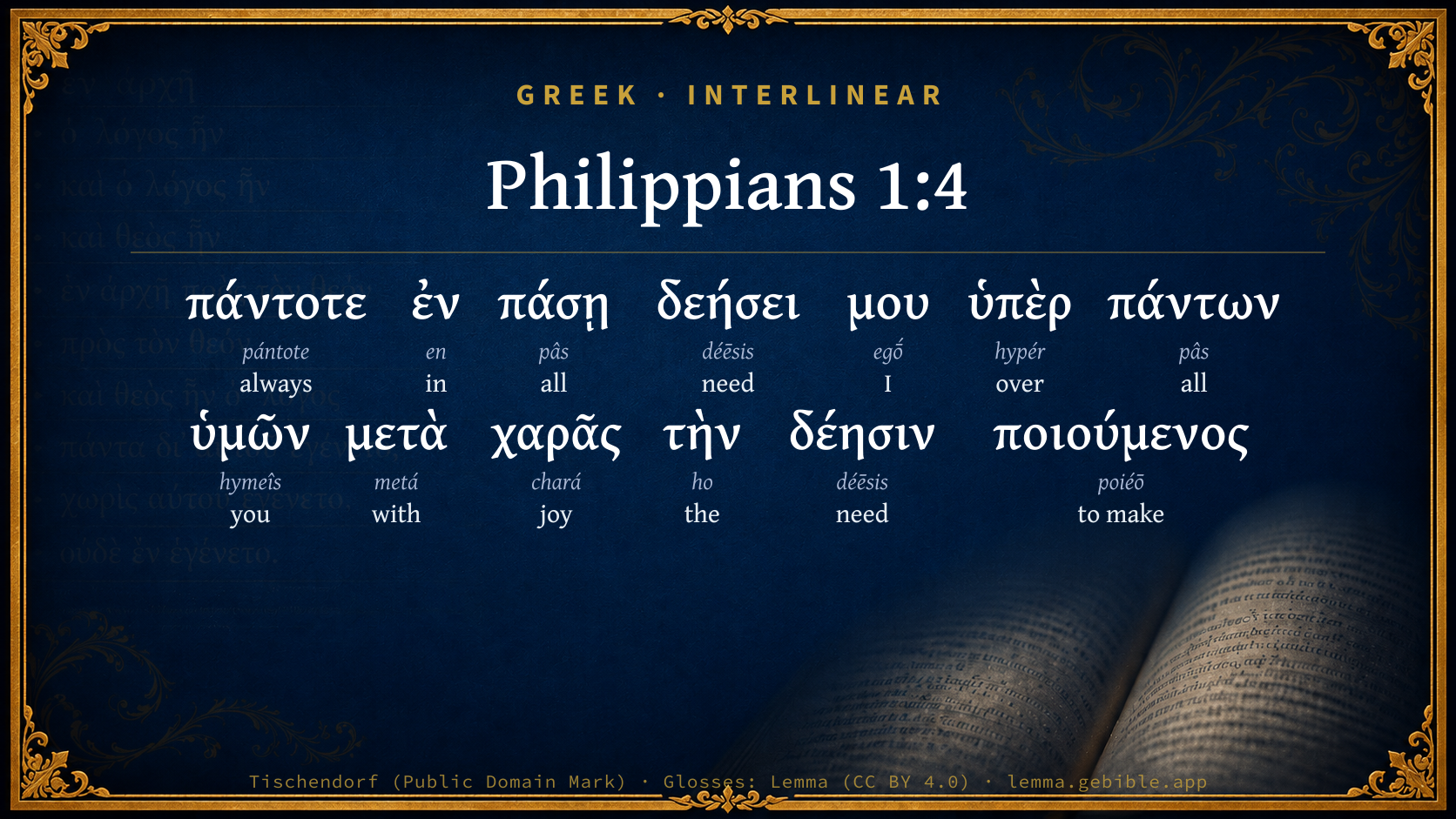
Greek (Tischendorf 8th ed.) Philippians 1:4 appears in the Greek New Testament. The text above is from the Tischendorf 8th edition. Each word links to its Strong’s number and a concise gloss. Click any word for its full Thayer’s Greek Lexicon entry.
Download image
Cite this verse

Philippians 1:4 (World English Bible). Public Domain. Lemma interlinear Bible study tool, https://lemma.gebible.app/v/philippians/1/4.

Show BibTeX & RIS
BibTeX
RIS
English Translation
always in every request of mine on behalf of you all making my requests with joy,
World English Bible · Public Domain
Download a study sheet

One document with this verse’s original text, its word-by-word gloss line, the meaning frame, cross-references with their text, attributed commentary, and full source and license credits — printable, and it pastes into notes with its structure intact.

This verse Autodidact and up

Study sheet (.html) Plain text (.txt)

A passage Seminary Student

Up to 50 verses in one chapter. A passage sheet keeps up to 6 commentary sources and 12 cross-references per verse, in the order this page ranks them, and says so on the sheet whenever that leaves anything out. Ask for a single verse and you get the Autodidact verse sheet above.

Everything on this page stays free to read, with no account — the sheet is a download of what is already on screen, not access to it.

Want to remove ads? Support Godless Engineer
Compare translations 3

The same verse in 3 English versions, stacked beneath the original-language interlinear above. Click any original word for its lexicon entry.

Each is an independent rendering of the whole verse — the interlinear is not word-aligned to these translations.

Highlighted words mark where these versions differ — a whole-verse word diff, not a word-by-word alignment.

  • World English Bible Public Domain
    always in every request of mine on behalf of you all making my requests with joy,
  • King James Version Public Domain
    Always in every prayer of mine for you all making request with joy,
  • unfoldingWord Literal Text CC BY-SA 4.0
    always, in every prayer of mine for all of you, making my prayer with joy

unfoldingWord Literal Text — © unfoldingWord, licensed CC BY-SA 4.0. Word-aligned USFM3 via Door43 (git.door43.org/unfoldingWord/en_ult).

Versions to compare (up to 4)

3 of 4 selected

Show all 19 translations

Every available English version of this verse, each an independent rendering of the whole verse.

  • World English Bible Public Domain
    always in every request of mine on behalf of you all making my requests with joy,
  • Berean Standard Bible Public Domain
    In every prayer for all of you, I always pray with joy,
  • Majority Standard Bible Public Domain
    In every prayer for all of you, I always pray with joy,
  • King James Version Public Domain
    Always in every prayer of mine for you all making request with joy,
  • American Standard Version (1901) Public Domain
    always in every supplication of mine on behalf of you all making my supplication with joy,
  • Revised Version (1885) Public Domain
    always in every supplication of mine on behalf of you all making my supplication with joy,
  • Geneva Bible (1599) Public Domain
    (Alwayes in all my praiers for all you, praying with gladnesse)
  • Douay-Rheims (1899) Public Domain
    Always in all my prayers making supplication for you all, with joy;
  • Young's Literal Translation Public Domain
    always, in every supplication of mine for you all, with joy making the supplication,
  • Literal Standard Version CC BY-SA 4.0
    always, in every supplication of mine for you all, with joy making the supplication,
  • Unlocked Literal Bible CC BY-SA 4.0
    and always in every prayer for all of you, I pray with joy.
  • unfoldingWord Literal Text CC BY-SA 4.0
    always, in every prayer of mine for all of you, making my prayer with joy
  • Darby Bible Public Domain
    constantly in my every supplication, making the supplication for you all with joy,
  • World Messianic Bible Public Domain
    always in every request of mine on behalf of you all, making my requests with joy,
  • Webster's Bible Public Domain
    Always in every prayer of mine for you all making request with joy,
  • Free Bible Version CC BY-SA 4.0
    and I'm always glad to remember all of you in my prayers,
  • Bible in Basic English Public Domain
    And in all my prayers for you all, making my request with joy,
  • Text-Critical English NT CC BY 4.0
    always praying with joy in every one of my prayers for you all
  • Tyndale New Testament (1534) Public Domain
    all wayes in all my prayers for you and praye with gladnes

Literal Standard Version (2020), Covenant Press — licensed CC BY-SA 4.0. Text via the HelloAO Bible API (eBible.org). Unlocked Literal Bible (unfoldingWord) — licensed CC BY-SA 4.0. Text via the HelloAO Bible API (eBible.org). unfoldingWord Literal Text — © unfoldingWord, licensed CC BY-SA 4.0. Word-aligned USFM3 via Door43 (git.door43.org/unfoldingWord/en_ult). Free Bible Version, Dr. Jonathan Gallagher — licensed CC BY-SA 4.0. Text via the HelloAO Bible API (eBible.org).

Word by word

More ways to search: Search by grammar → Find every occurrence → Compare this word →

Practice this passage: Drill this verse → Learn its vocabulary →

About this verse

These counts appear in no published source. They are computed here, from the morphology-tagged text and Lemma’s own curated glosses. What Lemma adds →

13
words
11
distinct lemmas
Pauline Epistles
section

Notable vocabulary

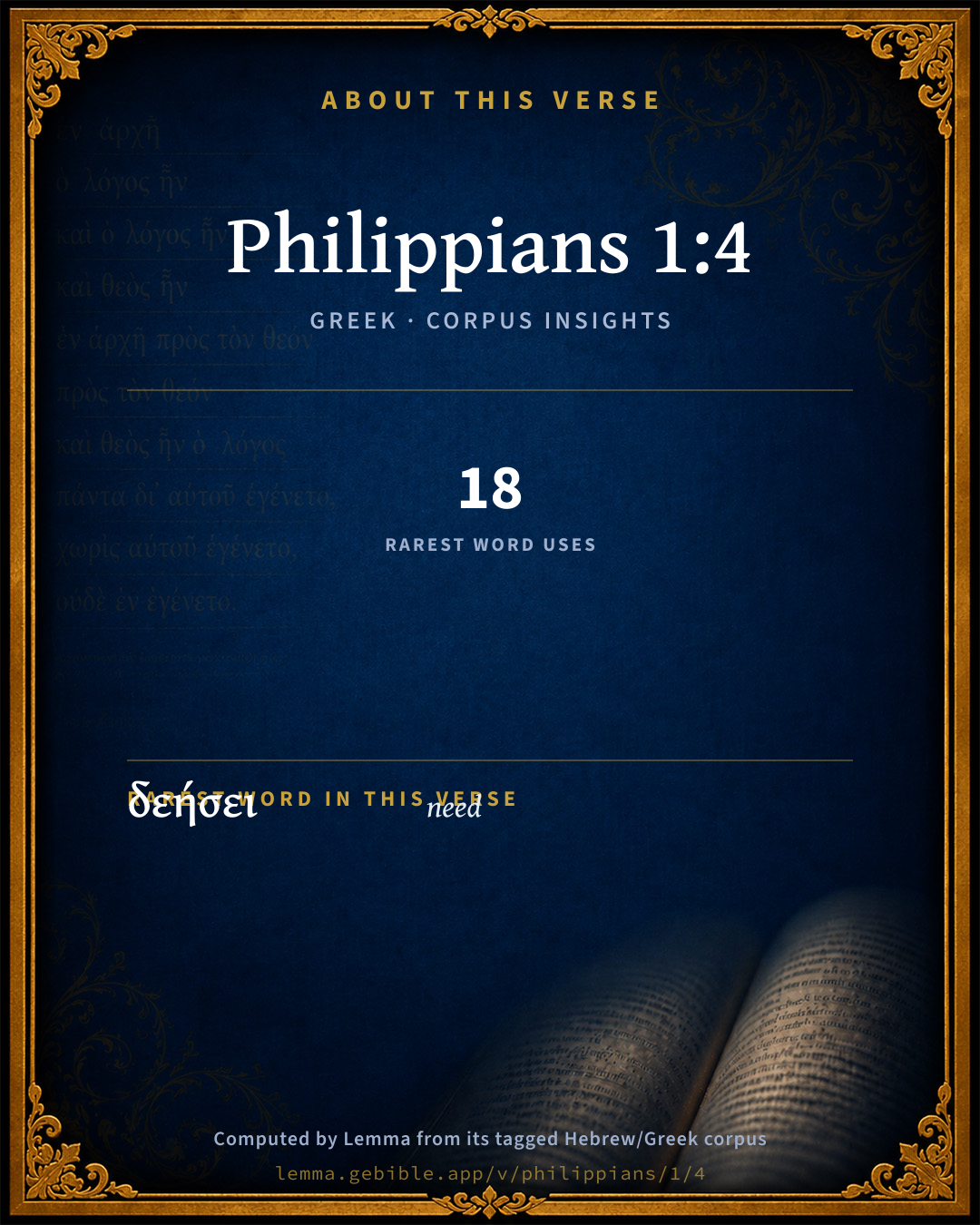
The rarest word here is δεήσει need G1162 — appearing just 18 times in the whole Greek New Testament.

Shared distinctive vocabulary

δεήσει need G1162 occurs in 16 verses of the Greek New Testament. Also found in:

Repetition

Words recur within this verse:

  • πάσῃ all G3956 ×2
  • δεήσει need G1162 ×2

Cross-references

11

Topical passages linked to Philippians 1:4 in the Treasury of Scripture Knowledge — connected by theme and wording, ordered by reader-vote popularity; previews shown in the World English Bible.

  • 1 Thessalonians 1:2 We always give thanks to God for all of you, mentioning you in our prayers,
  • Romans 1:9 For God is my witness, whom I serve in my spirit in the Gospel of his Son, how unceasingly I make mention of you always in my prayers,
  • 2 John 1:4 I rejoice greatly that I have found some of your children walking in truth, even as we have been commanded by the Father.
  • Philippians 2:2 make my joy full, by being like-minded, having the same love, being of one accord, of one mind;
  • Ephesians 1:14–23 who is a pledge of our inheritance, to the redemption of God's own possession, to the praise of his glory.
  • Philippians 1:9–11 This I pray, that your love may abound yet more and more in knowledge and all discernment;
  • Philippians 3:18 For many walk, of whom I told you often, and now tell you even weeping, as the enemies of the cross of Christ,
  • Philippians 4:1 Therefore, my brothers, beloved and longed for, my joy and crown, so stand firm in the Lord, my beloved.
  • Colossians 2:5 For though I am absent in the flesh, yet am I with you in the spirit, rejoicing and seeing your order, and the steadfastness of your faith in Christ.
  • 1 Thessalonians 2:19–20 For what is our hope, or joy, or crown of rejoicing? Isn't it even you, before our Lord Jesus at his coming?
  • Philemon 1:7 For we have much joy and comfort in your love, because the hearts of the saints have been refreshed through you, brother.

Cross-references courtesy of OpenBible.info (CC BY 4.0).

Commentary

Notes on Philippians 1:4 from classic Christian and Jewish commentators (each source and its license shown beneath its notes). The classic Christian expositions comment on the surrounding passage and are grouped to its opening verse, so a note may address several verses; the Jewish commentaries on the Tanakh (Rashi and others) are per-verse, so they appear only where the commentator wrote on this verse.

Lemma curates 59 commentaries, every one of them public domain or Creative Commons licensed, each selected and text-cleaned for this edition rather than reprinted as found. About our sources →

The Biblical Illustrator

Joseph S. Exell

Php_1:4-5

Always in every prayer of mine for you all making request with joy

I.

The quality of the apostles prayer.

1. Prayer may be varied according to the spiritual mood of the suppliant. In some instances prayer may hardly rise beyond a mere duty; in other cases it may become the supreme joy of the heart.

2. The mood need not impair the sincerity. You may pursue the same journey through a thick and troubled atmosphere, as well as through the brightness and calm of the summer light; the path is the same, the goal is the same, the purpose is the same, yet in the one case the soul may sit as a bird with folded wings, and in the other it may be soaring and singing through the streaming glory.

II. Its object. Fellowship in the gospel I take to mean unanimity, entireness of accord, and I see no reason why the apostle himself should not be included in that fellowship.

1. The centralizing influence of Gods redeeming and sanctifying idea. No agent, principle, doctrine, has done, or can do, so much in the education and consolidation of heart power as the gospel of Jesus Christ. Paul thanks God for their mutual accord, and this may exhaust the grammatical significance of his language; but the fact that he is joyfully thankful for this unanimity brings us into the presence of the sublime idea--

2. That Christianity is the most influential of all heart-uniting forces.

(1) Men who are one in Christ are united in the highest ranges of their nature. They are not one necessarily in the lower and temporary appetences of their manhood, but in the vitalities of their being.

(2) Death cannot break the seal that binds the friendships of the good.

(3) Distance cannot divide the sympathetic. Paul is in Rome; his friends are at Philippi; but in the great globe heart of the apostle Rome and Philippi are but different names of the same place. The union of the Church is guaranteed by the immortality of the principles on which it is founded. The moral is the immortal. (J. Parker, D. D.)

The joy of the faithful minister over the progress of the gospel

I. Joy always.

II. Joy is every prayer.

III. Joy overall. (J. Lyth, D. D.)

Pure joy

I. Springs from Divine communication.

II. Succeeds a previous sorrow.

III. Is superior to human surroundings.

IV. Is sustained by answered prayer. (G. C. Ballard.)

Intercession for others

I. An exalted privilege.

II. A holy duty.

III. A happy employment. (J. Lyth, D. D.)

Present rewards of Christian work

I. Work done creates grateful remembrances.

II. Grateful remembrances create a zest for prayer.

III. Prayer deepens joy. (G. G. Ballard.)

Fellowship and progress

I. Fellowship.

1. The bond of union--Christ. The attraction was irresistible to all who had come near enough to feel the force of the magnet of Divine love. This power directed all faculties, possessions, desires, in the same course. As He had not lived for Himself neither did they. The result was brotherly union. As all the rivers flow to find one common rest in the sea, so their melted hearts ran into the one fellowship--the Church. Here they found protection from the chill of the world and the storm of persecution. Weak faith was strengthened; the timid heart emboldened; unity begat strength and numbers, and augmented influence. The communal life brought together a vast capital to be invested in the cause which was so dear to their own heart.

2. Concerted action. The Christian communities existed as much, if not more, for external labour as for internal edification. As no Christian lived to himself, the whole Church could not possibly confine its wealth of power and influence within its Own circle. They lived one for another that all might live for the salvation of the world. The idea generally attached to a community is that it exists exclusively for the benefit of its own order, but the Christian society is built on the principle of give in order to receive. The Christians at Philippi met for prayer and for general improvement, in order to give the light of the knowledge of God in Christ Jesus to the world.

3. The transmission of moral influence is only possible through sympathetic media. The best cable chain would not convey an electric message any distance, but a small copper wire would do so round the globe. Divine truth must proceed from the heart of the Church, and be anointed with the unction of pure motives and tender sympathies, to accomplish its mission among men. The experimental expression of the truth is the most powerful and successful.

II. Perseverance--from the first day until now. The converts had not relapsed into idolatry, nor were any idolatrous practices incorporated in their worship. They had resisted all worldly influences. The converts held on their way, progressing in knowledge and the Christian graces. When the apostle looked towards this Church, he saw signs of growth and increased vigour.

1. True Christian fellowship absorbs the whole man, thought, desire, association, and progression. It is the family of God, with ample room for the development of human nature. Of all fruitfulness, true manhood is the greatest. The consummation of fellowship is found in the man Christ Jesus.

2. Christian fellowship absorbs all time and service. From the first day to the last, and from the last day on through eternity its bonds are unrelaxed. It is not a temporary engagement, but an everlasting covenant. Some of its forms must undergo changes, but its essence is the same, even fellowship with the Father and the Son, and communion with the saints. (Weekly Pulpit.)

Our fellowship in the gospel

I. How originated.

II. What it implies.

III. What it requires. (J. Lyth, D. D.)

True gospel fellowship

1. Lives which adorn it.

2. Hearts which beat for it.

3. Lips which testify for it.

4. Hands which work for it.

5. Gifts which extend it. (G. G. Ballard.)

Pauls activity and prayerfulness

While his life was one of unexampled activity, it was also one of continual prayerfulness. These two aspects of his life are mutually explanatory. His activity was unwearied, just because his prayerfulness was unceasing. His religion was a life, and the heart of that life was prayer. The risen and exalted Saviours words uttered regarding him at his conversion held good ever afterwards: Behold, he prayeth. As a good soldier of Jesus Christ, he had all prayer as the weapon of his warfare. (J. Hutchinson, D. D.)

The Biblical Illustrator, edited by Joseph S. Exell (c. 1880s–1900s) — public domain. Text from a community e-Sword module.

Whedon's Commentary on the Bible

Daniel D. Whedon

Devout recognition of the richness of Philemon’s Christian character, Php_1:4-7.

From this point all are forgotten but Philemon, who is addressed in the second person singular. And preparatory to the great request of Php_1:10 Paul testifies the high tone of Philemon’s Christianity, grounding the request in his Christian fellowship.

4. Prayer and request are the same word in the Greek: in every prayer making prayer for you.

Daniel D. Whedon (gen. ed.), Commentary on the Old and New Testaments (1874–1909) — public domain. Text from a community e-Sword module.

Tyndale Open Study Notes

Tyndale Open Resources

1:4-6 Paul’s joy derived from how the Philippians had joined him as partners in spreading the Good News and from his confidence that God would continue his good work in them.

Tyndale Open Study Notes — © Tyndale Open Resources, licensed CC BY-SA 4.0. Text via the HelloAO Bible API.

Bengel's Gnomon

Johann Albrecht Bengel

Php 1:4. Ὑπὲρ, for) Construe it with praying.—μετὰ χαρᾶς, with joy) The sum of the epistle is, I rejoice, rejoice ye. This epistle on joy aptly follows that to the Ephesians, where love reigns; for joy is perpetually mentioned, Php 1:18, etc.; likewise ch. Php 2:2; Php 2:19; Php 2:28, Php 3:1, Php 4:1; Php 4:4. The fruit of the Spirit is love, joy. Joy particularly gives animation to prayers.—τὴν δέησιν, [my request], the prayer) of which he had just spoken.

Bengel's Gnomon of the New Testament — English translation (T&T Clark, Edinburgh, 1860) — public domain. Text from a community e-Sword module.

Expositor's Greek Testament

ed. W. Robertson Nicoll

Phi 1:4 . Various divisions of these words have been proposed, some referring πάντοτε … ὑμῶν to the preceding verse, others taking πάντοτε … μου together, and regarding the remainder of the sentence as a connected whole. It seems least arbitrary to find in Phi 1:4 a complete thought. The prominence of πᾶς shows the exuberance of his joy in them. δεήσει . A special aspect of προσευχή , that of entreaty for the satisfaction of some known want; cf. Ell [35] on 1Ti 2:1 . μετὰ χαρᾶς . The undertone of the whole letter. δ . ποιούμενος . An interesting parallel in Papyr. of Faijûm, 172 A.D., δικαίαν δέ [ ησ ] ιν ποιούμενος (Dsm [36] , NBS [37] , p. 78), in the general sense of “asking” ( cf. δεήσεις ποιεῖσθαι , Luk 5:33 , 1Ti 2:1 ).

[35] Ellicott.

[36] Deissmann ( BS. = Bibelstudien, NBS. = Neue Bibelstudien ).

[37] Neue Bibelstudien

The Expositor's Greek Testament, edited by W. Robertson Nicoll (1897–1910) — public domain. Text from a community e-Sword module.

Jamieson, Fausset & Brown

Robert Jamieson, A. R. Fausset & David Brown

making request--Translate, "making my request."

for you all--The frequent repetition in this Epistle of "all" with "you," marks that Paul desires to declare his love for all alike, and will not recognize any divisions among them.

with joy--the characteristic feature in this Epistle, as love is in that to the Ephesians (compare Phi 1:18; Phi 2:2, Phi 2:19, Phi 2:28; Phi 3:1; Phi 4:1, Phi 4:4). Love and joy are the two first-fruits of the Spirit. Joy gives especial animation to prayers. It marked his high opinion of them, that there was almost everything in them to give him joy, and almost nothing to give him pain.

Jamieson, Fausset & Brown — Commentary Critical and Explanatory on the Whole Bible (1871) — public domain (CC PDM 1.0). Text via the HelloAO Bible API.

Adam Clarke's Commentary

Verse 4. Always in every prayer] I pray often for you, and have great pleasure in doing it, seeing what God has already wrought among you.

Adam Clarke's Commentary on the Bible (1810–1826) — public domain. Text from a community e-Sword/MySword module.

John Calvin's Commentaries

4 Always in every prayer. Connect the words in this manner: “Always presenting prayer for you all in every prayer of mine.” For as he had said before, that the remembrance of them was an occasion of joy to him, so he now subjoins, that they come into his mind as often as he prays. He afterwards adds, that it is with joy that he presents prayer in their behalf. Joy refers to the past; prayer to the future. For he rejoiced in their auspicious beginnings, and was desirous of their perfection. Thus it becomes us always to rejoice in the blessings received from God in such a manner, as to remember to ask from him those things that we are still in need of.

John Calvin's Commentaries (1540-1563) — public domain. Text from the Calvin Translation Society English edition (1840s-50s) via the Christian Classics Ethereal Library (ccel.org). Calvin's coverage is partial (roughly two-thirds of the Bible); uncommented books and verses are honest gaps, never fabricated. The 19th-century editor's footnotes and remarks are omitted so the notes are faithfully Calvin's own voice.

The Cambridge Bible for Schools and Colleges

gen. ed. J. J. S. Perowne

4. every prayer] every request. The Greek word is narrower than that, e. g. Eph_1:16, which includes the whole action of worship. See below on Php_4:6.

for you all] See, for the same phrase, or kindred words, Php_1:7-8; Php_1:25, Php_2:17; Php_2:26. We seem to see, in this emphasis on the word “all,” a gentle reference to the danger of partizanship and divisions at Philippi. See Introduction, p. 19.

request] Lit. and better, the request just mentioned.

with joy] These words strike the key-note of a main strain of the Epistle.—They are here the emphatic words of the sentence. He illustrates the assurance of his thankfulness for them by saying that every request for them is lighted up with happiness. For St Paul’s joy over his converts’ consistency cp. 2Co_2:3; 2Co_7:4; 2Co_7:13; below, Php_2:2, Php_4:1; 1Th_2:19-20; 1Th_3:9; Phm_1:7.

The Cambridge Bible for Schools and Colleges (gen. ed. J. J. S. Perowne; Cambridge University Press, 1878–1918) — public domain. Text from a community e-Sword module.

John Gill's Exposition

Always in every prayer of mine for you all,.... The apostle was a praying believer, and a praying minister: notwithstanding all his gifts, and graces, and high attainments, he was not above the work and duty of prayer, and in which he was sensible he stood in need of the assistance and direction of the Spirit of God, As soon as he was converted he prayed, and continued to do so without ceasing, as he himself directs; he was constant and assiduous at the throne of grace, and was concerned for others, as well as himself, for all the churches, and for this church, and all the saints in it,

Making request with joy; for what God had done for them, and continued with them. Requests are to be made known to God with thanksgiving. When we request a favour of him, it becomes us to return thanks for what we have received from him. Thanksgiving is a branch of prayer; as we have always mercies to ask for, we have always mercies to be thankful for.

John Gill's Exposition of the Whole Bible (1746–1763) — public domain (CC PDM 1.0). Text via the HelloAO Bible API.

Trapp's Complete Commentary

John Trapp

4 Always in every prayer of mine for you all making request with joy,

Ver. 4. Making request with joy] Those that grieve their faithful ministers, and quench the Spirit in them, do it to their own singular disadvantage.

John Trapp, A Commentary or Exposition upon All the Books of the Old and New Testament (1647–1656) — public domain. Text from a community e-Sword module.

Albert Barnes' Notes on the Bible

Always - There is much emphasis in the expressions which are used here. Paul labors to show them that he never forgot them; that he always remembered them in his prayers.

In every prayer of mine - This was a proof of particular and special affection, that while there were so many objects demanding his prayers, and so many other churches which he had founded, he never forgot them. The person or object that we remember in every prayer must be very dear to the heart.

For you all - Not for the church in general, but for the individual members. “He industriously repeats the word ‘all,’ that he might show that he loved them all equally well, and that he might the more successfully excite them to the manifestation of the same love and benevolence” - Wetstein.

Making request with joy - With joy at your consistent walk and benevolent lives - mingling thanksgiving with my prayers in view of your holy walk.

Albert Barnes' Notes on the Bible (1834–1885) — public domain. Text from a community e-Sword/MySword module.

Matthew Poole's English Annotations

As in praising of God, the Author of all that grace they had received, in every solemn prayer, so in continuing his fervent and assiduous requests unto God always, 1Th 5:17, for them all: the term all being used three times emphatically: compare Luk 2:37; Rom 1:9.

Matthew Poole's English Annotations on the Holy Bible (1683–1685) — public domain. Text from a community e-Sword/MySword module.

The Pulpit Commentary

Always in every prayer of mine for you all making request with joy. Perhaps the first part of this verse is better joined with Ver. 3, I thank my God... always in every prayer of mine for you all;" so Bishop Lightfoot The Greek word for "prayer" and "request "is the same, better rendered "my supplication," he as the R.V; it implies not merely a lifting up of the heart to God, but an earnest entreaty for a necessary gift. We meet now for the first time with that "joy" which is the keynote of this Epistle. "Summa epistolae, Gaudeo; gaudete;" so Bengel, who continues, "This Epistle of joy well follows that to the Ephesians, where love reigns. "The fruit of the Spirit is love, joy." Joy gives life to prayer.

Christian joy not dependent upon outward circumstances.

I The outward circumstances of St. Paul"s life, at the time of his writing this Epistle, were singularly joyless. A prisoner in Rome, awaiting his trial, deprived of the power of freely preaching the gospel when and where he would, compelled to be in the society of his Roman guard night and day.

1. Notwithstanding these untoward conditions he is inwardly full of joy.The key-note of the Epistle is rejoice.

2. The joy which fills him is not merely a selfish joy at his own acceptance with God; it is a sympathetic joy which rejoices in the growth of God"s kingdom. This is the joy of the angels. This is the joy of Jesus himself. This is the joy which he promises to bestow upon his disciples,. (Joh_15:11 Joh_17:13) This is the joy of the Lord into which they who have used well the talents entrusted to them are to enter. This joy is not mere selfish exultation in our own rescue from the pains of hell, but a sense of bliss at the victory which God has won, and a joy at being permitted to minister more entirely to his glory.

II We can possess this joy here and hereafter if we are filled with the unselfish desire that others should be blessed and that God should be glorified in them. We deprive ourselves of it if we are guilty of envy at the spiritual progress which they are making, and at the evident tokens of God"s grace working in them.

We can contribute to this joy. By our own steadfastness in the faith we add to the treasury of joy which is the possession of the whole Church. We give joy to the angels. We are able to increase the joy even of our Lord, who, seeing of the travail of his soul, is satisfied. VW.H.

The Pulpit Commentary (1880–1919), ed. H.D.M. Spence-Jones & Joseph S. Exell — public domain. Text from a community e-Sword module.

John Wesley's Explanatory Notes

With joy - After the epistle to the Ephesians, wherein love reigns, follows this, wherein there is perpetual mention of joy. "The fruit of the Spirit is love, joy." And joy peculiarly enlivens prayer. The sum of the whole epistle is, I rejoice. Rejoice ye.

John Wesley, Explanatory Notes Upon the Whole Bible (1754–1765) — public domain. Text via the GEBible commentary corpus.

Godbey's Commentary on the New Testament

William B. Godbey

ARGUMENT 1

CHRISTIAN PERFECTION AND THE LORD’S THE TWO HEMISPHERES CONSTITUTING THE GLOBE— APOSTOLIC INSPIRATION

4-6. “Having confidence in this very thing, that he who began a good work in you, will thoroughly perfect it unto the day of Christ Jesus.” As none but the perfect will be ready for the rapture of the Bridehood when the Lord comes, if we are in possession of Christian perfection at that time it will suffice for our admission into the marriage supper of the Lamb. Though we have our entire probation in which to get ready, the slightest postponement is very risky, as we know neither the day nor the hour when our Lord shall descend. Perfect is from facere, to make, and per, complete. Hence, it means made complete. God made us upright; i.e., perfect. Satan poisoned us with sin, thus destroying our perfection, and rendering us imperfect. Christ came to destroy the works of the devil. (1Jn 3:8.) The work of the devil is sin. It is conquered in regeneration, and destroyed in sanctification. The word here, epitelesei, is very strong; from teleoo, to complete; and epi, completely. Hence, it means to thoroughly make perfect. The Lord is liable any moment to ride down on a cloud. Are you enjoying the experience of perfect love? The Omnipotent Spirit is this moment ready to make you perfect, and prepare you for the day of the Lord. Submit to him fully, and trust him to do it this moment.

7. Paul recognizes the privilege of all the saints by their perfect consecration and recognition of the Divine will to actually participate the blessings of his persecutionary sufferings.

8. “How I long after you in all the affections of Christ Jesus.” Grace is free for all. As Paul enjoyed the affections of Christ (or, as the word means, the heart of Christ), so can we. His heart was perfectly free from sin, He came to make our hearts like his.

9. “I pray for this, that your Divine love may abound more and more in perfect knowledge and every sense.” The soul has the five senses—sight, hearing, smell, taste, and touch—like the body. A dead man has eyes, ears, nose, tongue, and nerves; yet he neither sees, hears, smells, tastes, nor feels. So the sinner is utterly destitute of spiritual sense, walking blind, deaf, and senseless into hell, till he is quickened into life by the Holy Spirit.

10. “So as to distinguish things which differ.” Animals are provided with instinct to fortify them against destructive poisons; man has no such protection till his spiritual senses are quickened into life by the Holy Spirit. Hence, the sinner, tasting the devil’s filth, whisky, tobacco, and debauchery, walks straight into hell, neither seeing the lurid flames, hearing the groans of the damned, smelling the brimstone, nor feeling the scorching flames. “In order that you may be pure and irreproachable in the day of Christ.”

The word here, which I translate “pure,” simply for the want of a stronger word, is eilikrinees, from eile, a sunbeam, and krino, to judge, from the custom of testing purity by the sunbeam. Hence, the plain meaning: God proposes to make your heart and mine so pure, that when illuminated by the infallible Sun of righteousness the omniscient eye of God will discover no impurity in it. So, spread yourself, preaching Christian purity, and rest assured you will not get the standard above the Bible. God help us to come up to the Bible standard, by which we will be judged! “In the day of Christ;” i.e., when he comes for his Bride. These two grand, salient gospel culminations were constantly moving in panorama before the illuminated spiritual eye of Paul; i.e., perfect purity and the Lord’s return to the earth, the latter the goal of probationary privilege, and the former the qualification for an eternity of holy wedlock with Christ.

William B. Godbey, Commentary on the New Testament (1896–1900) — public domain. Text from a community e-Sword module.

The People's New Testament

B. W. Johnson

4. In every prayer. The repeated assurances shows us that Paul was wont daily to carry the interests of the churches he planted to God. In the case of this faithful church he did it with joy.

B. W. Johnson's The People's New Testament with Notes (1889–1891) — public domain. Electronic text from the Christian Classics Ethereal Library (CCEL) ThML edition.

Cambridge Greek Testament for Schools and Colleges

4. δεήσει. “Request, petition”; a narrower word than προσευχή, which may and often does denote worship at large.

μετὰ χαρᾶς. Emphatic words by position. They strike a note continually repeated in the Epistle.

τὴν δέησιν. “The request” just mentioned.

ποιούμενος. The middle suggests a personal fulness in the action. The request comes from the depth of the man and relates to a welfare dear to him as his own. Only it is impossible to explain this in English without a certain exaggeration of the delicate Greek.

On the other hand ποιεῖσθαι is often used with a substantive by way of periphrasis, to express what would be more simply stated by a verb. E.g. Luk 13:22, πορείαν ποιούμενος (cf. Luk 9:51, πορεύεσθαι). Instances of ποιεῖν thus used are very rare. Thus explained the phrase here nearly equals δεόμενος, though still, surely, adding a certain fulness.

Cambridge Greek Testament for Schools and Colleges (Cambridge University Press, 1896; 21 vols, various authors incl. Carr, Maclear, Plummer, Farrar, Lumby, Moule, M. R. James, Simcox) — public domain. Text from a community e-Sword module.

Alford’s Greek Testament

Henry Alford

4.] πάντοτε—πάσῃ—πάντων—here we have the overflowings of a full heart. Render—always in every prayer of mine making my prayer for you all with joy: not, as in E. V., ‘in every prayer of mine for you all making request with joy.’ For the second δέησις, having the article, is thereby defined to be the particular request, ὑπὲρ π. ὑμ.—τὸ μετὰ χαρᾶς μεμνῆσθαι σημεῖον τῆς ἐκείνων ἀρετῆς, Thl.; so that the sense is, that every time he prayed, he joyfully offered up that portion of his prayers which was an intercession for them. See Ellic., who defends the other connexion; but has misunderstood my note.

Henry Alford, The Greek Testament (1849–1861) — public domain. Text from a community e-Sword module.

International Critical Commentary

4. πάντοτε ἐν πάσῃ δεήσει· Πάσῃ δεήσει defines πάντοτε, as πάντοτε marks the occasions of εὐχαριστῶ. On every occasion of his praying he makes request for them. Δέησις is petitionary prayer; ‘supplication.’ Paul alone joins it with προσευχὴ, which is the more general term for prayer. (See Php 4:6; Eph 6:18; 1Ti 2:1.) Προσευχὴ is limited to prayer to God, while δέησις may be addressed to man. (See Trench, N.T. Syn. li.; Schmidt, Synon. 7, 4; Ellic. on 1Ti 2:2; Eph 6:18.) Τὴν δέησιν defines the more general πάσῃ δεήσει, and is in turn defined by ὑπὲρ πάντων ὑμῶν.

μετὰ χαρᾶς: The petitions are accompanied with joy, the cause of which is indicated in vs. 5-7.

International Critical Commentary — older volumes (1896–1929), various authors — public domain. Text from a community e-Sword module.

Lesson kit

Teaching starters — assembled from the data on this page, not authored interpretation. Every prompt links to the verse data it draws on. Edit before teaching.

Philippians, in the Pauline Epistles, opens this verse with 13 words (11 distinct Greek lemmas). Its most distinctive word is déēsis (“need”). A historical commentator’s framing appears above. Read the whole chapter for the surrounding context.

Discussion questions

  1. What does “need” (déēsis) contribute to the verse as a whole?
  2. Luke 1:13 shares the word «need» with this verse. How do the two illuminate each other?
  3. “all” occurs 2× in this one verse. What is the effect of the repetition?
  4. These translations render this verse differently; the difference is in the English rendering, not the original. What questions does that raise?
  5. Reading how The Biblical Illustrator and Whedon's Commentary on the Bible read this verse, where do the two commentators agree and where do they part?

Things to notice

Reading settings

Reading text

Shown beneath each verse's original-language words.

Old Testament
Old Testament edition

Read the OT as the Masoretic Hebrew (MT) or the Greek Septuagint (LXX).

English shown for the Greek Septuagint (in the Hebrew ↔ Greek comparison).

Comparing translations? Open the Compare panel on any verse page to stack up to four side by side.