Philemon 1:13

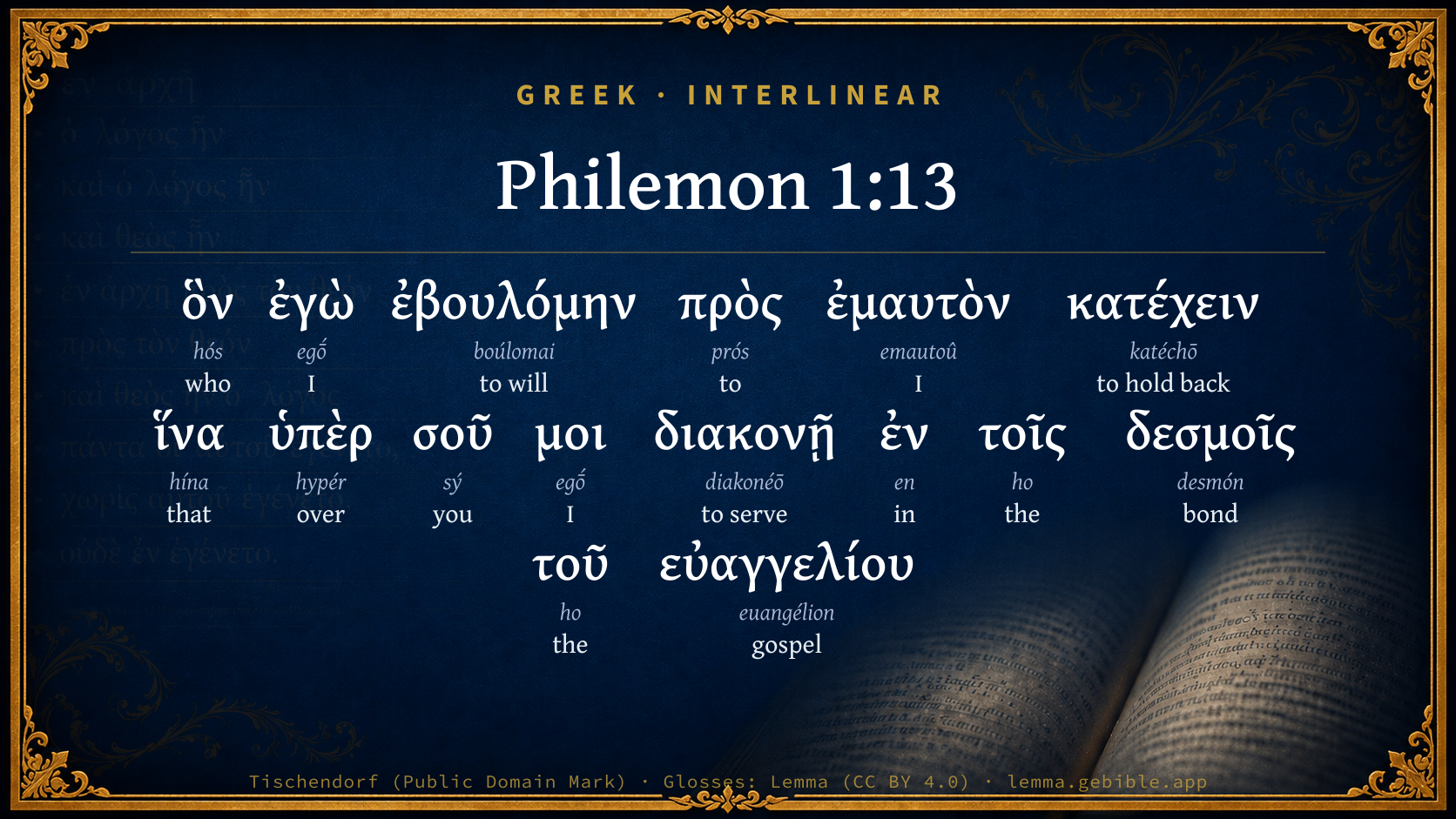
Greek (Tischendorf 8th ed.) Philemon 1:13 appears in the Greek New Testament. The text above is from the Tischendorf 8th edition. Each word links to its Strong’s number and a concise gloss. Click any word for its full Thayer’s Greek Lexicon entry.
Download image
Cite this verse

Philemon 1:13 (World English Bible). Public Domain. Lemma interlinear Bible study tool, https://lemma.gebible.app/v/philemon/1/13.

Show BibTeX & RIS
BibTeX
RIS
English Translation
whom I desired to keep with me, that on your behalf he might serve me in my chains for the Gospel.
World English Bible · Public Domain
Download a study sheet

One document with this verse’s original text, its word-by-word gloss line, the meaning frame, cross-references with their text, attributed commentary, and full source and license credits — printable, and it pastes into notes with its structure intact.

This verse Autodidact and up

Study sheet (.html) Plain text (.txt)

A passage Seminary Student

Up to 50 verses in one chapter. A passage sheet keeps up to 6 commentary sources and 12 cross-references per verse, in the order this page ranks them, and says so on the sheet whenever that leaves anything out. Ask for a single verse and you get the Autodidact verse sheet above.

Everything on this page stays free to read, with no account — the sheet is a download of what is already on screen, not access to it.

Want to remove ads? Support Godless Engineer
Compare translations 3

The same verse in 3 English versions, stacked beneath the original-language interlinear above. Click any original word for its lexicon entry.

Each is an independent rendering of the whole verse — the interlinear is not word-aligned to these translations.

Highlighted words mark where these versions differ — a whole-verse word diff, not a word-by-word alignment.

  • World English Bible Public Domain
    whom I desired to keep with me, that on your behalf he might serve me in my chains for the Gospel.
  • King James Version Public Domain
    Whom I would have retained with me, that in thy stead he might have ministered unto me in the bonds of the gospel:
  • unfoldingWord Literal Text CC BY-SA 4.0
    whom I desired to keep with me, so that he might serve me on behalf of you in the chains of the gospel.

unfoldingWord Literal Text — © unfoldingWord, licensed CC BY-SA 4.0. Word-aligned USFM3 via Door43 (git.door43.org/unfoldingWord/en_ult).

Versions to compare (up to 4)

3 of 4 selected

Show all 19 translations

Every available English version of this verse, each an independent rendering of the whole verse.

  • World English Bible Public Domain
    whom I desired to keep with me, that on your behalf he might serve me in my chains for the Gospel.
  • Berean Standard Bible Public Domain
    I would have liked to keep him with me, so that on your behalf he could minister to me in my chains for the gospel.
  • Majority Standard Bible Public Domain
    I would have liked to keep him with me, so that on your behalf he could minister to me in my chains for the gospel.
  • King James Version Public Domain
    Whom I would have retained with me, that in thy stead he might have ministered unto me in the bonds of the gospel:
  • American Standard Version (1901) Public Domain
    whom I would fain have kept with me, that in thy behalf he might minister unto me in the bonds of the gospel:
  • Revised Version (1885) Public Domain
    whom I would fain have kept with me, that in thy behalf he might minister unto me in the bonds of the gospel:
  • Geneva Bible (1599) Public Domain
    Whom I woulde haue reteined with mee, that in thy steade he might haue ministred vnto me in the bondes of the Gospel.
  • Douay-Rheims (1899) Public Domain
    Whom I would have retained with me, that in thy stead he might have ministered to me in the bands of the gospel:
  • Young's Literal Translation Public Domain
    whom I did wish to retain to myself, that in thy behalf he might minister to me in the bonds of the good news,
  • Literal Standard Version CC BY-SA 4.0
    whom I intended to retain to myself, that in your behalf he might minister to me in the bonds of the good news,
  • Unlocked Literal Bible CC BY-SA 4.0
    I wish I could have kept him with me, so he could serve me for you, while I am in chains for the sake of the gospel.
  • unfoldingWord Literal Text CC BY-SA 4.0
    whom I desired to keep with me, so that he might serve me on behalf of you in the chains of the gospel.
  • Darby Bible Public Domain
    whom *I* was desirous of keeping with myself, that for thee he might minister to me in the bonds of the glad tidings;
  • World Messianic Bible Public Domain
    whom I desired to keep with me, that on your behalf he might serve me in my chains for the Good News.
  • Webster's Bible Public Domain
    Whom I would have retained with me, that in thy stead he might have ministered to me in the bonds of the gospel:
  • Free Bible Version CC BY-SA 4.0
    I'd have preferred to keep him here with me so that he could have helped me as you would have done while I am in chains for telling the good news.
  • Bible in Basic English Public Domain
    Though my desire was to keep him with me, to be my servant in the chains of the good news, in your place:
  • Text-Critical English NT CC BY 4.0
    I wanted to keep him with me so that he could serve me in yoʋr place during my imprisonment for the gospel.
  • Tyndale New Testament (1534) Public Domain
    whom I wolde fayne have retayned with me that in thy stede he myght have ministred vnto me in the bondes of the gospell.

Literal Standard Version (2020), Covenant Press — licensed CC BY-SA 4.0. Text via the HelloAO Bible API (eBible.org). Unlocked Literal Bible (unfoldingWord) — licensed CC BY-SA 4.0. Text via the HelloAO Bible API (eBible.org). unfoldingWord Literal Text — © unfoldingWord, licensed CC BY-SA 4.0. Word-aligned USFM3 via Door43 (git.door43.org/unfoldingWord/en_ult). Free Bible Version, Dr. Jonathan Gallagher — licensed CC BY-SA 4.0. Text via the HelloAO Bible API (eBible.org).

Word by word

More ways to search: Search by grammar → Find every occurrence → Compare this word →

Practice this passage: Drill this verse → Learn its vocabulary →

κατέχειν
katéchō
G2722
“to hold back”
Verb, Present, Active, Infinitive
Part of Speech
Verb
Tense
Present
Voice
Active
Mood
Infinitive
Full Thayer's Definition

Origin: from G2596 and G2192

TDNT: 15:49,3

1. to hold back, detain, retain a. from going away b. to restrain, hinder (the course or progress of) 1. that which hinders, Antichrist from making his appearance 2. to check a ship's headway i.e. to hold or head the ship c. to hold fast, keep secure, keep firm possession of 2. to get possession of, take a. to possess
  1. ὃν hós G3739 “who” Relative pronoun, Accusative, Singular, Masculine
  2. ἐγὼ egṓ G1473 “I” Personal pronoun, 1st person, Nominative, Singular
  3. ἐβουλόμην boúlomai G1014 “to will” Verb, Imperfect, Middle or Passive deponent, Indicative, 1st person, Singular
  4. πρὸς prós G4314 “to” Preposition
  5. ἐμαυτὸν emautoû G1683 “I” Reflexive pronoun, 1st person, Accusative, Singular, Masculine
  6. ἵνα hína G2443 “that” Conjunction
  7. ὑπὲρ hypér G5228 “over” Preposition
  8. σοῦ sý G4771 “you” Personal pronoun, 2nd person, Genitive, Singular
  9. μοι egṓ G1473 “I” Personal pronoun, 1st person, Dative, Singular
  10. διακονῇ diakonéō G1247 “to serve” Verb, Present, Active, Subjunctive, 3rd person, Singular
  11. ἐν en G1722 “in” Preposition
  12. τοῖς ho G3588 “the” Article, Dative, Plural, Masculine
  13. δεσμοῖς desmón G1199 “bond” Noun, Dative, Plural, Masculine
  14. τοῦ ho G3588 “the” Article, Genitive, Singular, Neuter
  15. εὐαγγελίου euangélion G2098 “gospel” Noun, Genitive, Singular, Neuter

About this verse

These counts appear in no published source. They are computed here, from the morphology-tagged text and Lemma’s own curated glosses. What Lemma adds →

16
words
14
distinct lemmas
Pauline Epistles
section

Notable vocabulary

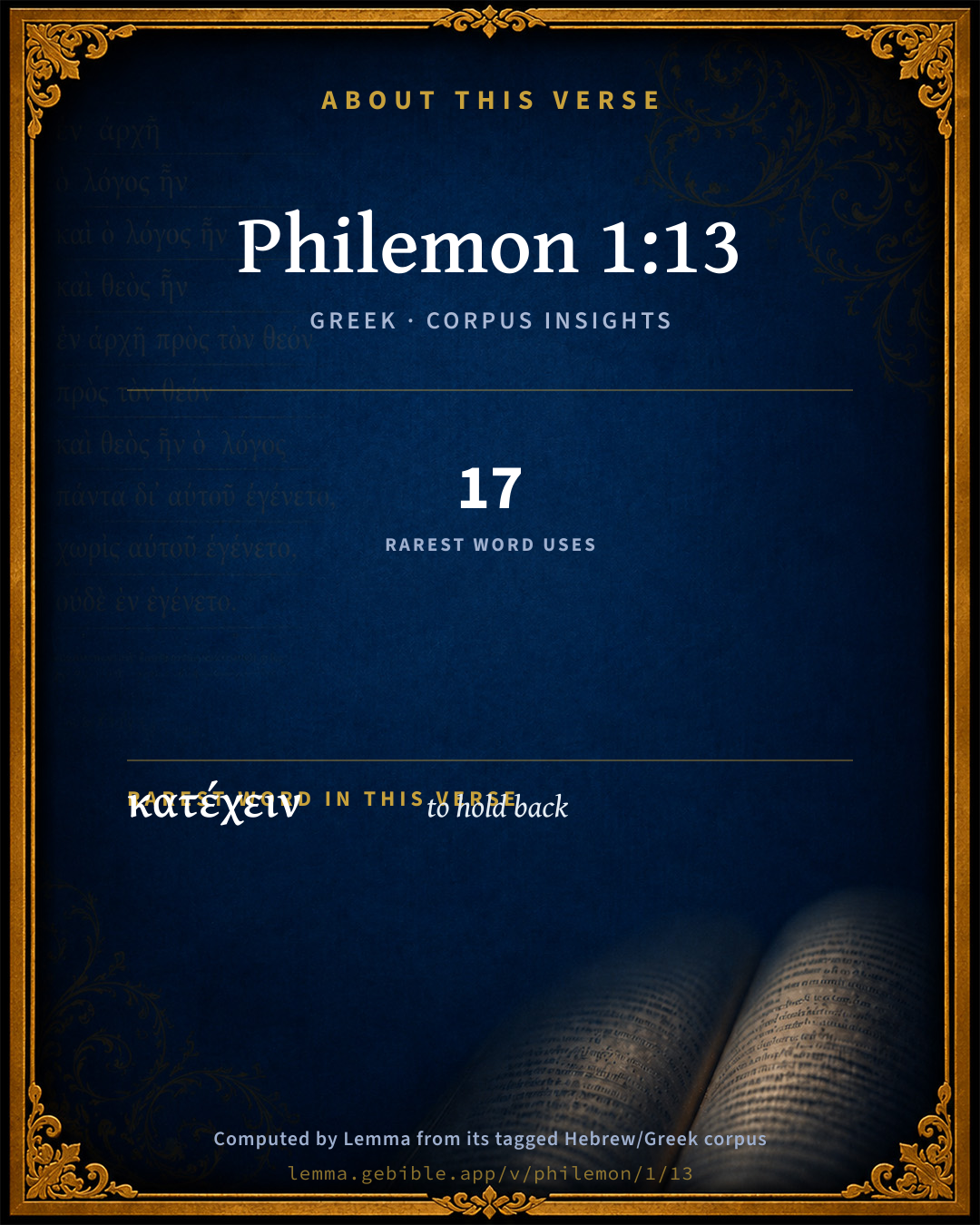
The rarest word here is κατέχειν to hold back G2722 — appearing just 17 times in the whole Greek New Testament.

Shared distinctive vocabulary

κατέχειν to hold back G2722 occurs in 17 verses of the Greek New Testament. Also found in:

Repetition

Words recur within this verse:

Cross-references

6

Topical passages linked to Philemon 1:13 in the Treasury of Scripture Knowledge — connected by theme and wording, ordered by reader-vote popularity; previews shown in the World English Bible.

  • Ephesians 3:1 For this cause I, Paul, am the prisoner of Christ Jesus on behalf of you Gentiles,
  • Philippians 1:7 It is even right for me to think this way on behalf of all of you, because I have you in my heart, because, both in my bonds and in the defense and confirmation of the Gospel, you all are partakers with me of grace.
  • 1 Corinthians 16:17 I rejoice at the coming of Stephanas, Fortunatus, and Achaicus; for that which was lacking on your part, they supplied.
  • Ephesians 4:1 I therefore, the prisoner in the Lord, beg you to walk worthily of the calling with which you were called,
  • Philippians 2:30 because for the work of Christ he came near to death, risking his life to supply that which was lacking in your service toward me.
  • Philemon 1:1 Paul, a prisoner of Christ Jesus, and Timothy our brother, to Philemon, our beloved fellow worker,

Cross-references courtesy of OpenBible.info (CC BY 4.0).

Commentary

Notes on Philemon 1:13 from classic Christian and Jewish commentators (each source and its license shown beneath its notes). The classic Christian expositions comment on the surrounding passage and are grouped to its opening verse, so a note may address several verses; the Jewish commentaries on the Tanakh (Rashi and others) are per-verse, so they appear only where the commentator wrote on this verse.

Lemma curates 59 commentaries, every one of them public domain or Creative Commons licensed, each selected and text-cleaned for this edition rather than reprinted as found. About our sources →

The Cambridge Bible for Schools and Colleges

gen. ed. J. J. S. Perowne

13. I would] Lit., “I was wishing”; the imperfect indicates a half-purpose, stopped by other considerations. Lightfoot compares for similar imperfects Rom_9:3; Gal_4:20.

me] Lit., myself.

in thy stead] On thy behalf; as thy representative, substitute, agent. He assumes the loving Philemon’s personal devotion.

ministered] as personal attendant; the habitual reference of the verb. Cp. e.g. Mat_4:11; Mat_8:15; Luk_17:8; Luk_22:26; Joh_12:2; 2Ti_1:18.

of the gospel] “For the hope of Israel,” and of the world, “he was bound with this chain” (Act_28:20). Cp. Php_1:13.

On the word “Gospel” see note on Col_1:5.

The Cambridge Bible for Schools and Colleges (gen. ed. J. J. S. Perowne; Cambridge University Press, 1878–1918) — public domain. Text from a community e-Sword module.

The Biblical Illustrator

Joseph S. Exell

Phm_1:13

In thy stead he might have ministered unto me

What is this ministering

No doubt it is aiding Paul in his ministerial work, or he would not have said, In thy stead.

It is scarcely to be supposed that Philemon would have ministered to St. Paul in the capacity of a domestic servant; and if Onesimus was to have ministered to the apostle, it was to supply the absence of Philemon in being St. Pauls deacon. There must have been something peculiarly thorough in the conversion of Onesimus, that the apostle should so desire him to be near him. (M. F. Sadler, M. A.)

A ministering friend

There is no need to enlarge on the winning courtesy of these words, so fall of happy confidence in the friends disposition, that they could not but evoke the love to which they trusted so completely. Nor need I do more than point their force for the purpose of the whole letter, the procuring a cordial reception for the returning fugitive. So dear had he become, that Paul would like to have kept him. He goes back with a kind of halo round him, now that he is not only a good-for-nothing runaway, but Pauls friend, and so much prized by him. It would be impossible to do anything but welcome him, bringing such credentials; and yet all this is done with scarcely a word of direct praise, which might have provoked contradiction. One does not know whether the confidence in Onesimus or in Philemon is the dominant note in the harmony, in the preceding clause, he was spoken of as, in some sense, part of the apostles very self. In this he is regarded as, in some sense, part of Philemon. So he is a link between them. Paul would have taken his service as if it had been his masters. Can the master fail to take him as if he were Paul? (A. Maclaren, D. D.)

Christian ministration

The gospel is the common cause, that concerns us all: if any suffer for it, we are bound from the highest to the lowest to assist them with our purses, prayers, and personal presence too if conveniently it may be; yea, though we be never so great personages. Our Saviour Himself washed His disciples feet. St. Cyprian writes to the priests and deacons, to provide all things necessary for them that were in prison, wishing that he himself were present with them, readily and willingly he would perform all obsequious duties of love unto them. Helena, the mother of Constantine, when at Jerusalem herself served meat to the virgins there. Placilla, the wife of Theodosius the Emperor, ministered to the poor in her own person; and Philemon himself should have ministered unto St. Paul. The angels minister to us, yea, when we be in prison, as to St. Peter; and shall we scorn, be we never so wealthy, worshipful, honourable, to minister to them that are in bonds for the gospel? Let us count it an honour to us. In ministering to them we minister to Christ, and He will reward it. (W. Jones, D. D.)

A welcome service

I. The apostle intimateth his desire to have retained Onesimus with him, and that he was loath to suffer him to depart from him: which declareth that the presence of those that are dear unto us in Christ is welcome, pleasant, comfortable, and much set by, and we greatly desire to keep them continually with us. For as love is the knot of conjunction that bindeth us together, though we be absent and far severed one from another, so it craveth and requireth the bodily presence of those whom we entirely love, which howsoever we cannot obtain in this life, forasmuch as our earthly affairs will not suffer it, yet we shall be sure to enjoy it perpetually and without end in the life to come, when we shall have the greatest joy and comfort one in another that can be wished or desired; such as the eye hath not seen, nor the ear heard, neither hath it entered into the heart of man to conceive.

II. Note with me the end why he desired to retain Onesimus with him, that the servant might do service to him in the masters stead. The end, then, is the ministry and attendance which Paul might of duty require of Philemon himself. If then the master be bound to do his service, and wait upon the apostle, much more the servant! Whereby we may note how great right and jurisdiction he that hath gained a man in Christ hath over him whom he hath gained, so that he may challenge not only one of his servants, but himself to minister unto him, and to help him in temporal and transitory things. For he that hath received spiritual blessings cannot without great unthankfulness deny corporal benefits, so that it cannot be expressed how well he hath deserved of that person whom he hath won by the Word of God. And delivered him by his ministry from the power of darkness, and translated him into the kingdom of His dear Son.

III. We may observe in the apostles correcting of his former grant, that as he is commended that doth his duty that is required of him, freely and willingly, so he is worthy to be praised and commended, that doth not go about to wring and wrest a benefit against a mans will, though it be due debt and a bounden duty, but laboureth by all means, that it may be voluntary, and not upon necessity; for hereby it cometh to pass oftentimes, that he not only getteth a benefit, but winneth his heart and good will that giveth it, and many times it falleth out that the mind of the giver is more to be respected than the gift itself, as we see in the poor widow mentioned in the gospel, who casting into the treasury two mites, is said to have given of her penury more than all the rich men that bestowed of their superfluity. (W. Attersoll.)

Ministering to the saints

I. Whatever gifts are bestowed upon us, to this end they are bestowed to profit withal, to help one another, and to edify that body whereof we are members.

II. It is our duty to follow the example of our Lord and Master Christ Jesus, He came to serve, not to he served: to minister, not to he ministered unto: to redeem, not to rule.

III. True religion consisteth in ministering to the saints, in helping and succouring of the poor, in employing himself to the good of others, as a candle that spendeth and wasteth itself to give light to them that are in the house. It consisteth not in bare knowledge, but in practice; not in an idle faith, but in the fruits of love. Uses:

1. This serveth to reprove those that have forgotten all true service to the faithful. Many there are that have no feeling of the troubles that fall upon the servants of God. Their eyes are closed, and their hearts are hardened; they have no bowels of compassion to minister unto them, they have no hands open to relieve them. The rich of our Churches, who have this worlds goods given unto them, are either in their unsatiable desires poor, wrongfully getting, miserably keeping, unconscionably scraping, and unjustly pulling from others without mean or measure; or else they spend their wealth and consume their substance, some in sumptuous apparel, others in excessive feastings, others in worse uses, all being unnecessary and fruitless things, unprofitable for the Church or commonwealth, so that little can be spared for the poor saints, and that which is spared is as hardly drawn from them as a piece of flesh out of their sides. These men never think of doing service to others, but of serving their own turns and commodities, which ought not so to be among them that profess Christ Jesus, who served not Himself.

2. Seeing we are servants to all, to help them by all the means we can, by comfort or counsel, by word or deed, by our wealth or authority, or whatsoever God shall enable us; from hence ariseth a great comfort unto a mans conscience, and an assurance of his peace and acceptation with God, to pray unto Him with comfort for His graces, not doubting to obtain them, if we have been serviceable and comfortable unto others, especially to the servants of God, that are as dear to Him as the apple of His eye. It is a means of excellent joy and peace to a man, to consider that he hath employed all the good things he hath to the use of Gods house and His household servants, for when any common danger shall fall, or he find anguish and affliction of conscience for sin, he may be assured of comfort, seeing God hath wrought this sincerity, and set it as a seal of His mercy in his heart.

3. Seeing God requireth of all true Christians, of what condition soever they be, according to the means afforded unto them, to use their gifts, their power, their possessions, and whatsoever benefits they have received, to use them to the comfort and service of Gods saints, it kindleth the affections of Gods people to bless and praise God for them, to speak well of them, to pray unto God for them, and to obtain greater blessings for them than they have bestowed. Thus they that do good to the Church do good to themselves; they that give much unto them do receive more themselves, and such as have been helpful and serviceable to Gods people, shall find them as their remembrancers to God, who will not forget the labour of their love, and the duty of their service.

4. Seeing God requireth service to His Church at our hands to do all good to them by all good means, it is our duty to inquire and learn the estate of the distressed Church, that we may know and be informed where and when and how it is afflicted. This is one misery of the faithful, that men do not regard them when they are in misery. The Lord hath determined that there shall be always some objects offered unto us and set before us to exercise the fruits of our faith and love. (W. Attersoll.)

The Biblical Illustrator, edited by Joseph S. Exell (c. 1880s–1900s) — public domain. Text from a community e-Sword module.

Tyndale Open Study Notes

Tyndale Open Resources

1:13-14 Paul hints at his desire that Philemon choose to free Onesimus to serve as Paul’s helper (also 1:21). The Christian life is a free response to God’s grace (Rom 12:1; Eph 4:1; Col 3:12-13).

Tyndale Open Study Notes — © Tyndale Open Resources, licensed CC BY-SA 4.0. Text via the HelloAO Bible API.

Bengel's Gnomon

Johann Albrecht Bengel

Phm 1:13. Ὃν, whom) He shows that Onesimus was now worthy to be trusted.—ὑπὲρ σοῦ, for thee) on thy account [in thy stead].

Bengel's Gnomon of the New Testament — English translation (T&T Clark, Edinburgh, 1860) — public domain. Text from a community e-Sword module.

Meyer's Critical & Exegetical Commentary

Heinrich August Wilhelm Meyer

Phm_1:13 f Ἐγώ] I for my part.

ἐβουλόμην] I was of the mind. Comp. ἠθέλησα, Phm_1:14, and observe not merely the diversity of notion (βούλομαι: deliberate self-determination, see on Mat_1:19), but also the distinction of the tenses. The apostle formerly cherished the design and the wish (imperfect ἐβουλ.) of retaining Onesimus with himself, instead of sending him back to Philemon, but has become of the mind (historical aorist ἠθέλησα), etc. Thus ἠθέλ. denotes that which supervened on the previous occurrence of the ἐβουλ., and hindered the realization of the latter. Observe that Paul has not used ἐβουλόμην ἄν; that would be vellem.

ὑπὲρ σοῦ] for thee, i.e. in gratiam tuam, that thou mightest not need thyself to serve me. ὑπέρ accordingly is not here, any more than in any other passage of the N.T., used as a precise equivalent to ἀντί, although the actual relation of representation lies at the bottom of the conception in gratiam; for Paul would have taken the service of the slave as rendered by the master, to whom the slave belonged. Comp. Hofmann. This mode of regarding and representing the matter has nothing harsh about it, nor does it convey any obligation, which Philemon, had he been on the spot, would have fulfilled (Bleek), but simply the trustful presupposition, that Philemon himself would, if Paul had desired it, have ministered to him in the prison. Of this, however, Philemon was relieved by the service of the slave, which in this way stood him in good stead. Schweizer, in the Stud. u. Krit. 1858, p. 430, explains likewise correctly: for thy benefit, but takes this in the sense: so that it would be a service rendered to thee, imputed to thee, so that I would be under obligation to thee. But this would only have the delicacy and tenderness which are found in it, if the thought: in order that he might serve me, with a view to place me under obligation to thee, contained the design of Onesimus; if, accordingly, Paul had written something after this manner: ὃς ἐβούλετο πρὸς ἐμαντὸν μένειν, ἵνα κ.τ.λ., which, however, would have asserted a self-determination incompetent to the position of a slave. No; as the passage is written, there is delicately and tenderly implied in the ὑπὲρ σοῦ the same thought, which, in accordance with Php_2:30, he might have expressed by ἵνα ἀναπληρώσῃ τὸ σοῦ ὑστέρημα; comp. 1Co_16:17. Thus ingeniously does Paul know how to justify his ἐβουλόμην κ.τ.λ.seeing that he would, in fact, otherwise have had no claim at all upon anothers bondsmanby the specification of design ἵνα ὑπὲρ σοῦ κ.τ.λ.

διακονῇ] direct representation by the subjunctive, ita quidem, ut praeteriti temporis cogitatio tanquam praesens efferatur, Kühner, ad Xen. Mem. i. 2. 2.

ἐν τοῖς δεσμοῖς τοῦ εὐαγγ.] in the bonds, into which the gospel has brought mein a position. therefore (comp. Phm_1:9) which makes me as needful as deserving of such loving service.

χωρὶς δὲ κ.τ.λ.] but without thy consent, that is, independent of it, I have wished to do nothing, and so have left that wish unexecuted, in order that thy good may be not as from constraint, but from free will. The thought of the apostle accordingly is: But as I knew not thine own opinion, and thus must have acted without it, I was disposed to abstain from the retention of thy slave, which I had in view: for the good, which thou showest, is not to be as if forced, but voluntary. If I had retained Onesimus for my service, without having thy consent to that effect, the good, which I should have had to derive from thee through the service rendered to me by thy servant ὑπὲρ σοῦ, would have been shown not from free will,that is, not in virtue of thine own self-determination,but as if compulsorily, just because independently of thy γνώμη (non enim potuisset refragari Philemon, Bengel[75]). Observe at the same time that τὸ ἀγαθόν σου, thy good, that is, the good which thou showest to others, is to be left quite in its generality, so that not the serviceable employment of the slave specially and in concreto is meant, but rather the category in general, under which, in the intended application, there falls that special ἀγαθόν, which is indicated in Phm_1:13. The restriction to the given case is impracticable on account of ἈΛΛᾺ ΚΑΤᾺ ἙΚΟΎΣΙΟΝ, since Paul in fact did not at all intend to procure the consent of Philemon and to retain Onesimus. This in opposition to the usual interpretation: τὸ ἀγαθόν, i.e. beneficium tuum hocce, quo afficior a te, si hunc mihi servum concedis, Heinrichs; comp. Bleek. But it is an error also, with de Wette, following Estius (who describes it as probable), to understand under τὸ ἀγαθ. σον the manumission[76] of the slave, or to understand it at least as also included (Bleek), of which even in Phm_1:16 there is no mention, and for suggesting which in so covert and enigmatic a fashion there would not have been any reason, if he had desired it at all (but see on 1Co_7:21). According to Hofmann (comp. his Schriftbeweis, II. 2, p. 412), τὸ ἀγαθόν σου is, like ΤῸ ΧΡΗΣΤῸΝ ΤΟῦ ΘΕΟῦ at Rom_2:4, thy goodness, and that the goodness, which Philemon will show to Onesimus when he had returned into his position as a, slave; this only then becomes an undoubtedly spontaneous goodness, when the apostle refrains from any injunction of his own, whereas Philemon could not have done otherwise than refrain from punishing the slave for his escape, if Paul had retained him to himself, in which case, therefore, Philemon might have seemed to be kind compulsorily. This explanation, brought out by the insertion of thoughts between the lines, is to be set aside as at variance with the context, since there is nothing in the connection to point to the definition of the notion of τὸ ἀγαθόν σου as goodness towards Onesimus, but on the contrary this expression can only acquire its import through the delicately thoughtful ἵνα ὑπὲρ σοῦ μοι διακονῇ κ.τ.λ.

ὡς κατὰ ἀνάγκην] emphatically prefixed, and Ὡς expresses the idea: so that it appears as constrained. Comp. Fritzsche, ad Rom. II. p. 360. On κατὰ ἀνάγκ., by way of constraint (in the passive sense), by compulsion, comp. Thucyd. vi. 10. 1; Polyb. iii. 67. 5; 2Ma_15:2; on the contrast, comp. 1Pe_5:2 : μὴ ἀναγκαστῶς, ἀλλʼ ἑκουσίως; Thucyd. viii. 27. Phm_1:3 : ΚΑΘʼ ἙΚΟΥΣΊΑΝ Ἢ ΠΆΝΥ ΓΕ ἈΝΆΓΚῌ, Plat. Prot. p. 346 B.

[75] Seneca, De Benef. ii. Phm_1:4 : Si vis scire an velim, effice ut possim nolle. Luther aptly remarks: a constrained will is not voluntas, but noluntas.

[76] That the manumission did take place, has been inferred from the tradition that Onesimus became a bishop. It may have taken place, but it is not meant here.

Meyer — Critical and Exegetical Commentary on the New Testament — English translation by Peter Christie, edited by Frederick Crombie (T&T Clark, 1880) — public domain. Text from a community e-Sword module.

Expositor's Greek Testament

ed. W. Robertson Nicoll

Phm 1:13 . ἐγὼ : a further emphatic mode of expression. ἐβουλόμην : βούλεσθαι connotes the idea of purpose, θέλειν simply that of willing. The differences between the tenses ἐβουλόμην and ἐθέλησα (Phm 1:14 ) is significant; “the imperfect implies a tentative, inchoate process; while the aorist describes a definite complete act. The will stepped in and put an end to the inclinations of the mind” (Lightfoot). κατέχειν : “to detain,” directly opposed to ἀπέχῃς in Phm 1:15 . Deissmann ( Op cit. , p. 222) points out that κατέχω is often used in papyri and on ostraka of binding , though in a magical sense. ὑπὲρ σοῦ : “in thy stead,” the implication being that Philemon is placed under an obligation to his slave; for the force of ὑπὲρ as illustrated on the papyri, etc., see Deissmann’s important remarks on pp. 105, 241 ff. of his work already quoted. διακονῇ : used in the Pauline Epistles both of Christian ministration generally (Rom 11:13 ; 1Co 12:5 ; Eph 4:12 ) and in special reference to bodily wants, such as alms can supply (1Co 16:15 ; 2Co 8:4 ). ἐν τοῖς δεσμ . τοῦ εὐαγγ .: i.e. , the bonds which the Gospel had tied, and which necessitated his being ministered unto. τοῦ εὐαγγελίου : see Mar 1:14-15 and cf. Mat 4:23 ; Christ uses the word often in reference to the Messianic Era. “The earliest instances of the use of εὐαγγέλιον in the sense of a book would be: Did. 8, 11, 15 bis ; Ign. Philad . 5, 8 (Sanday, Bampton Lectures , p. 319).

The Expositor's Greek Testament, edited by W. Robertson Nicoll (1897–1910) — public domain. Text from a community e-Sword module.

Jamieson, Fausset & Brown

Robert Jamieson, A. R. Fausset & David Brown

I--emphatical. I for my part. Since I had such implicit trust in him as to desire to keep him with me for his services, thou mayest.

I would have retained--different Greek from the "would," Plm 1:14, "I could have wished," "I was minded" here; but "I was not willing," Plm 1:14.

in thy stead--that he might supply in your place all the services to me which you, if you were here, would render in virtue of the love you bear to me (Plm 1:19).

bonds of the gospel--my bonds endured for the Gospel's sake (Plm 1:9).

Jamieson, Fausset & Brown — Commentary Critical and Explanatory on the Whole Bible (1871) — public domain (CC PDM 1.0). Text via the HelloAO Bible API.

Adam Clarke's Commentary

Verse 13. That in thy stead he might have ministered unto me] As Philemon was one of Paul's converts, he became thereby his spiritual father, and had a right to his services when in need. This was a strong argument, not only to induce Philemon to forgive his servant, but to send him back to the apostle, that he might minister to him in his master's stead.

Adam Clarke's Commentary on the Bible (1810–1826) — public domain. Text from a community e-Sword/MySword module.

John Calvin's Commentaries

13. Whom I was desirous to keep beside me. This is another argument for the purpose of appeasing Philemon, that Paul sends him back a slave, of whose services, in other respects, he stood greatly in need. It would have been extreme cruelty, to disdain so strong affection manifested by Paul. He likewise states indirectly, that it will be a gratification to himself to have Onesimus sent back to him rather than that he should be harshly treated at home.

That he might minister to me instead of thee in the bonds of the gospel. He now mentions other circumstances: first, Onesimus will supply the place of his master, by performing this service; secondly, Paul himself, through modesty, was unwilling to deprive Philemon of his right; and, thirdly, Philemon will receive more applause, if, after having had his slave restored to him, he shall willingly and generously send him back. From this last consideration we infer, that we ought to aid the martyrs of Christ by every kind office in our power, while they are laboring for the testimony of the gospel; for if exile, imprisonment stripes, blows, and violent seizing of our property, are believed by us to belong to the gospel, as Paul here calls them, whoever refuses to share and partake of them separates himself even from Christ. Undoubtedly the defense of the gospel belongs alike to all. Accordingly, he who endures persecution, for the sake of the gospel, ought not to be regarded as a private individual, but as one who publicly represents the whole Church. Hence it follows, that all believers ought to be united in taking care of it, so that they may not, as is frequently done, leave the gospel to be defended in the person of one man.

John Calvin's Commentaries (1540-1563) — public domain. Text from the Calvin Translation Society English edition (1840s-50s) via the Christian Classics Ethereal Library (ccel.org). Calvin's coverage is partial (roughly two-thirds of the Bible); uncommented books and verses are honest gaps, never fabricated. The 19th-century editor's footnotes and remarks are omitted so the notes are faithfully Calvin's own voice.

Ellicott's Commentary for English Readers

(13) Whom I would have retained.—In the original we have here a graceful distinction in two points between the two clauses. The verb in the first clause is “to wish;” in the second “to will.” The tense in the first clause is the imperfect: “I was wishing,” or “prepared to wish” (just as in Act_25:22; and, in the case of a cognate verb, Rom_9:3), implying, perhaps, a suppressed condition; in the second it is the past definite: “I willed,” or “determined” finally.

In thy stead.—Here, again, there is a certain delicacy of suggestion. A slave was his master’s property; he could act only on his master’s behalf and by his consent. St. Paul is sure that Philemon’s love for him would have gladly given that consent, and so made Onesimus an instrument of willing service to St. Paul.

A Bible Commentary for English Readers, edited by Charles John Ellicott (1878–1897) — public domain. Text from a community e-Sword module.

John Gill's Exposition

Whom I would have retained with me,.... At Rome, where the apostle was a prisoner:

that in thy stead he might have ministered unto me in the bonds of the Gospel; the apostle was in bonds, not for any crime, for any immorality he had been guilty of, but for the sake of the Gospel, for professing and preaching that; for this he was an ambassador in bonds, as he elsewhere says, Eph 6:20. Now he would have kept Onesimus with him, either to have waited upon him, in his bonds, and to have provided for him the necessaries of life; or to have assisted him in the ministration of the word, in the room of Philemon, who, had he been there, would have been employed in such service; so that if the apostle had retained him, he would have been acting not for himself, but in the room of his master, and doing what he should have done, had he been on the spot. This the apostle observes to prevent an objection that might have been made; that since Onesimus was become so profitable to him, why did he send him back? why did he not keep him for his own service? this he obviates and removes, by signifying he should have done it, but for the following reason.

John Gill's Exposition of the Whole Bible (1746–1763) — public domain (CC PDM 1.0). Text via the HelloAO Bible API.

Trapp's Complete Commentary

John Trapp

13 Whom I would have retained with me, that in thy stead he might have ministered unto me in the bonds of the gospel:

Ver. 13. In the bonds of the gospel] Which is bound after a sort, when the preachers thereof are imprisoned.

John Trapp, A Commentary or Exposition upon All the Books of the Old and New Testament (1647–1656) — public domain. Text from a community e-Sword module.

Albert Barnes' Notes on the Bible

Whom I would have retained with me, that in thy stead - “That he might render me the service which I know you would if you were here.” The Greek is: “for thee” ὑπὲρ σοῦ huper sou; that is, what he should do for Paul might be regarded as done by Philemon himself.

He might have ministered unto me - He might have rendered me assistance (διακονῇ diakonē); to wit, in such a way as one who was in bonds would need.

Albert Barnes' Notes on the Bible (1834–1885) — public domain. Text from a community e-Sword/MySword module.

Matthew Poole's English Annotations

I have such an opinion of his sincerity, that I would willingly have kept him with me, that he might, while I am a prisoner for the gospel of Christ, have done those offices for me, which thou wouldst have done hadst thou been here.

Matthew Poole's English Annotations on the Holy Bible (1683–1685) — public domain. Text from a community e-Sword/MySword module.

Whedon's Commentary on the Bible

Daniel D. Whedon

13. In thy stead—His ministry to Paul would not, therefore, be a servile one—a waiting on the apostle’s bodily wants—but such a ministry as Philemon would have rendered, namely, aid in the Gospel. Slavery in ancient times often held cultured men in its bonds. Tyro, the bondsman of Cicero, was a literary aid to the orator. And there is quite a probability that Onesimus was a more competent apostolic assistant than Philemon. This accounts, in some degree, both for St. Paul’s profound interest in his case, and for the traditions of his subsequent episcopate. The service was such a subordinate ministry as John Mark, and Timothy in his early days, rendered to Paul.

Daniel D. Whedon (gen. ed.), Commentary on the Old and New Testaments (1874–1909) — public domain. Text from a community e-Sword module.

The Pulpit Commentary

I was wishing; I would fain have kept (Revised Version). The story tells itself if we read between the lines. What steadfast adherence to principle on the part of the apostle, when the help of Onesimus would have been so welcome to him in his weak health, and his position as a prisoner! Philemon could hardly fail to think more favorably of Onesimus, when he saw how much importance the apostle attached to his services. In the bonds of the gospel. "Which I am enduring for the sake of the gospel" (see Ver. 9) a variation of phrase from Ver. 9. (and of our Lord"s words, Mar_8:35 10:29)

The Pulpit Commentary (1880–1919), ed. H.D.M. Spence-Jones & Joseph S. Exell — public domain. Text from a community e-Sword module.

John Wesley's Explanatory Notes

To serve me in thy stead - To do those services for me which thou, if present, wouldest gladly have done thyself.

John Wesley, Explanatory Notes Upon the Whole Bible (1754–1765) — public domain. Text via the GEBible commentary corpus.

Godbey's Commentary on the New Testament

William B. Godbey

13. “Whom I wish to have with me, in order that he may minister to me in thy behalf in the bonds of the gospel,

William B. Godbey, Commentary on the New Testament (1896–1900) — public domain. Text from a community e-Sword module.

The People's New Testament

B. W. Johnson

13. Whom I would have retained. Would gladly have kept him with me to render for thee the service you would be glad to give me while I am in chains, only

(14) without thy mind would I do nothing. He wished, if such a service was rendered, it might be with Philemon's free consent.

B. W. Johnson's The People's New Testament with Notes (1889–1891) — public domain. Electronic text from the Christian Classics Ethereal Library (CCEL) ThML edition.

Cambridge Greek Testament for Schools and Colleges

13. ὅν ἐγὼ, emphatic, cf. Phm 1:19-20.

ἐβουλόμην, “was minded,” cf. 2Co 1:15. Apparently βούλομαι expresses greater deliberation and less emotion than θέλω, but in St Paul the feeling of love to Philemon conquered. The imperfect is of durative and here completed action; the aor. (Phm 1:14) of punctiliar and here completed action.

πρὸς ἐμαυτόν, apud, cf. 1Th 3:4; 2Th 2:5.

κατέχειν, “detain,” Luk 4:42.

ἵνα ὑπὲρ σοῦ, cf. Col 1:7. “In thy behalf”; cf. Chrysostom Εὗρες ὅπως ἀποδῷς τὴν πρὸς ἐμὲ λειτουργίαν διʼ αὐτοῦ. While however this is in itself the most probable interpretation of ὑπέρ, and agrees most closely with St Paul’s distinction of ἀντὶ and ὑπέρ, it is possible that he uses ὑπέρ here in the same sense that occurs in the papyri ἔγραψεν ὑπὲρ αὐτοῦ N N διὰ τὸ μὴ εἰδέναι αὐτὸν τὰ γράμματα, where writing on behalf of so and so is very nearly equal to writing in his stead (see P. Ewald).

ἐν τοῖς δεσμοῖς (Phm 1:10, note).

St Paul could not say precisely “in prison,” for he was still apparently in his hired lodging (Act 28:30), but Onesimus’ ministry had to be exercised in a condition of things represented by bonds (cf. Act 28:16), therefore the more trying to both agent and recipient.

τοῦ εὐαγγελίου. Probably genitive of cause, cf. note on Χριστοῦ Ἰησοῦ, Phm 1:1. Yet the very mention of “gospel” must have cheered St Paul, and Lightfoot fittingly compares St Ignatius’ references to his bonds, e.g. Ephes. § 11, ἐν ᾧ (i.e. Χριστῷ Ἰησοῦ) τὰ δεσμᾶ περιφέρω, τοὺς πνευματικοὺς μαργαρἰτας.

Cambridge Greek Testament for Schools and Colleges (Cambridge University Press, 1896; 21 vols, various authors incl. Carr, Maclear, Plummer, Farrar, Lumby, Moule, M. R. James, Simcox) — public domain. Text from a community e-Sword module.

Alford’s Greek Testament

Henry Alford

13.] ἐγώ, emphatic, I, for my part.

ἐβουλόμην, nearly as ηὐχόμην, in Rom 9:3 (though in that place there certainly is, as Ellic. remarks, a more distinct reference to a suppressed conditional clause),—was wishing,—had a mind, = could have wished, in our idiom.

ἠθέλησα, ver. 14, differs from ἐβουλόμην, (1) in that it means simply willed, as distinguished from the stronger wished, (2) in that it marks the time immediately preceding the return of Onesimus, whereas the imperfect spreads the wish over the period previous. I was (long) minded … but (on considering) I was not willing.

ὑπὲρ σοῦ] For, wert thou here, thou wouldst minister to me: I was minded therefore to retain him in thy place. διακονῇ, pres. subj. representing the ἐβουλόμην as a still continuing wish.

ἐν τοῖς δεσμ. τοῦ εὐαγγελίου] explained wel by Thdrt., ὀφείλεις μοι διακονίαν ὡς μαθητὴς διδασκάλῳ, κ. διδασκάλῳ τὰ θεῖα κηρύττοντι: not without allusion also to the fetters which the Gospel had laid on himself.

Henry Alford, The Greek Testament (1849–1861) — public domain. Text from a community e-Sword module.

International Critical Commentary

13. ὅν ἐγὼ ἐβουλόμην πρὸς ἐμαυτὸν κατέχειν: ‘whom I was minded to keep with myself.’ The expression of an actual thought and desire entertained by Paul; ἐβουλόμην indicating deliberation with an accompanying inclination. I was inclined to keep him, and was turning over the matter in my mind. See on τὸ θέλειν, Php 2:13.

Lightf. prefers the conditional sense of the imperfect, ‘I could have wished,’ referring it to a suppressed conditional clause, ‘if circumstances had favored.’ This is a well-known use of the imperf. (See Act 25:22; Rom 9:3; Gal 4:20; and Lightf. On Revis. of N.T., under “Faults of Grammar.”) But no such conditional clause is implied; for Paul does not intimate that the fulfilment of his wish was impossible, and that therefore he did not cherish it, but only that, though he entertained the wish, he refrained from acting upon it until he should have learned Philemon’s pleasure in the matter (vs. 14).

πρὸς ἐμαυτὸν: ‘with myself.’ See on πρὸς, vs. 5; and Php 4:6.

κατέχειν: For the verb, see Luk 4:42, Luk 4:8:15; Rom 1:18; 1Th 5:21.

ἵνα ὑπὲρ σοῦ μοι διακονῇ: ‘that he might serve me on thy behalf.’ A delicate justification of ἐβουλόμην, and full of tact. The ὑπὲρσου is exquisite, assuming that his friend would delight in rendering him, through the slave, the service which he could not personally perform. Ὑπὲρ is not for ἀντὶ, ‘instead of,’ or ‘in thy place’ (Thdrt., Œc., Calv., De W., Bleek, van Oos.), but has its usual N.T. sense, ‘on behalf of,’ or ‘for thy sake.’ The expression thus gains in delicacy. Onesimus is more than a mere substitute for Philemon. In these words the relation of master and slave disappears for the moment. Both are servants for Christ’s sake in the discharge of a ministry congenial to both. The suggestion is already conveyed by εὔχρηστον that Onesimus, in becoming a Christian disciple, has passed into a new and higher sphere of service, in which he and his master are on common ground. At the same time, there is a hint that Onesimus, even as a slave, is rendering better service to the master whom he has wronged, in thus serving Philemon’s friend and teacher; serving no longer as a menial, but in hearty sympathy with his master.

ἐν τοῖς δεσμοῖς τοῦ εὐαγγελίου: ‘in the bonds of the gospel’; of which the gospel is the cause; in my imprisonment which has resulted from the preaching of the gospel. Thus a hint is added of his need of such service as that of Onesimus, which has the force of an appeal, as in vs. 9, 10. (Comp. Eph 4:1, Eph 6:20, and Ign. Trall. xii.: παρακαλεῖ ὑμᾶς τὰ δεσμά μου, ἅ ἕνεκεν Ἰησοῦ Χριστοῦ περιφέρω: “my bonds exhort you which I wear for the sake of Jesus Christ.” See also Eph. xi: Magn. i.).

International Critical Commentary — older volumes (1896–1929), various authors — public domain. Text from a community e-Sword module.

Vincent's Word Studies in the New Testament

Marvin R. Vincent

I would [εβουλομην] . Rev., I would fain. See on Mt 1:19. The imperfect tense denotes the desire awakened but arrested. See on I would, ver. 14.

With me [προς εμαυτον] . The preposition expresses more than near or beside. It implies intercourse. See on with God, Joh 1:1.

In thy stead [υπερ σου] . Rev., correctly, in thy behalf. A beautiful specimen of christian courtesy and tact; assuming that Philemon would have desired to render these services in person.

In the bonds of the Gospel. Connect with me. Bonds with which he is bound for the sake of the Gospel : with which Christ has invested him. A delicate hint at his sufferings is blended with an intimation of the authority which attaches to his appeal as a prisoner of Christ. This language of Paul is imitated by Ignatius. "My bonds exhort you" (Tralles, 12.). "He (Jesus Christ) is my witness, in whom I am bound" (Philadelphia, 7.). "In whom I bear about my bonds as spiritual pearls" (Ephesians, 11.). "In the bonds which I bear about, I sing the praises of the churches" (Magnesians, 1.).

Marvin R. Vincent, Word Studies in the New Testament (1887–1900) — public domain. Text from a community e-Sword/MySword module.

Lightfoot's Colossians and Philemon

J. B. Lightfoot

13. ἐβουλόμην] ‘I was of a mind’, distinguished from ἠθέλησα, which follows, in two respects; (1) While βούλεσθαι involves the idea of ‘purpose, deliberation, desire, mind’, θέλειν denotes simply ‘will’; Epictet. i. 12. 13 βουλόμαι γράφειν, ὡς θέλω, τὸ Δίωνος ὄνομα; οὔ ἀλλὰ διδάσκομαι θέλειν ὡς δεῖ γράφεσθαι, iii. 24, 54 τοῦτον θέλε ὁρᾷν, καὶ ὃν βούλει ὄψει. (2) The change of tenses is significant. The imperfect implies a tentative, inchoate process; while the aorist describes a definite and complete act. The will stepped in and put an end to the inclinations of the mind. Indeed the imperfect of this and similar verbs are not infrequently used where the wish is stopped at the outset by some antecedent consideration which renders it impossible, and thus practically it is not entertained at all: e.g. Arist. Ran. 866 ἐβουλόμην μὲν οὐκ ἐρίζειν ἐνθάδε, Antiph. de Herod. cæd. I (p. 129) ἐβουλόμην μὲν ... νῦν δὲ κ.τ.λ.; Isæus de Arist. hær. I (p. 79) ἐβουλόμην μὲν ... νῦν δὲ οὐκ ἐξ ἴσου κ.τ.λ., Æsch. c. Ctes. 2 (p. 53) ἐβουλόμην μὲν οὖν, ὦ )Αθηναῖοι ... ἐπειδὴ δὲ πάντα κ.τ.λ., Lucian Abd. I ἐβουλόμην μὲν οὖν τὴν ἰατρικὴν κ.τ.λ. ... νυνὶ δὲ κ.τ.λ.; see Kühner § 392 b (II. p. 177). So Acts xxv. 22 ἐβουλόμην καὶ αὐτὸς τοῦ ἀνθρώπου ἀκοῦσαι, not ‘I should wish’ (as Winer § xli. p. 353) but ‘I could have wished’, i.e. ‘if it had not been too much to ask’. Similarly ἤθελον Gal. iv. 20, ηὐχόμην Rom. ix. 3. See Revision of the English New Testament p. 96. So here a not improbable meaning would be not ‘I was desirous’, but ‘I could have desired’.

κατέχειν] ‘to detain’ or ‘retain’, opposed to the following ἀπέχῃς, ver. 15.

ὑπὲρ σοῦ κ.τ.λ.] Comp. Phil. ii. 30 ἵνα ἀναπληρώσῃ τὸ ὑμῶν ὑστέρημα τῆς πρὸς μὲ λειτουργίας, 1 Cor. xvi. 17 τὸ ὑμέτερον ὑστέρημα αὐτοὶ ἀνεπλήρωσαν. See the note on Col. i. 7. With a delicate tact the Apostle assumes that Philemon would have wished to perform these friendly offices in person, if it had been possible.

ἐν τοῖς δεσμοῖς] An indirect appeal to his compassion: see vv. 1, 9, 10. In this instance however (as in ver. 9) the appeal assumes a tone of authority, by reference to the occasion of his bonds. For the genitive τοῦ εὐαγγελίου, describing the origin, comp. Col. i. 23 τῆς ἐλπίδος τοῦ εὐαγγελίου. They were not shackles which self had riveted, but a chain with which Christ had invested him. Thus they were as a badge of office or a decoration of honour. In this respect, as in others, the language of St Paul is echoed in the epistles of St Ignatius. Here too entreaty and triumph alternate; the saint’s bonds are at once a ground for appeal and a theme of thanksgiving: Trall. 12 παρακαλεῖ ὑμᾶς τὰ δεσμά μου, Philad. 7 μάρτυς δὲ μοι ἐν ᾧ δέδεμαι, Ephes. 11 ἐν ᾧ (i.e. Χριστῷ Ἰησοῦ) τὰ δεσμὰ περιφέρω, τους πνευματικοὺς μαργαρίτας, Smyrn. 10 ἀντίψυχον ὑμῶν τὸ πνεῦμά μου καὶ τὰ δεσμά μου, Magn. 1 ἐν οἷς περιφέρω δεσμοῖς ᾄδω τὰς ἐκκλησίας; see also Ephes. 1, 3, 21, Magn. 12, Trall. 1, 5, 10, Smyrn. 4, 11, Polyc. 2, Rom. 1, 4, 5, Philad. 5.

J. B. Lightfoot, St Paul's Epistles to the Colossians and Philemon: a revised text with introductions, notes and dissertations (London: Macmillan, 1875) — public domain. Electronic text from Project Gutenberg (ebook #50857). Covers Colossians and Philemon only (the verse-by-verse notes; introductions and dissertations are omitted); Lightfoot's companion Galatians and Philippians volumes are not included, as the available public-domain scans carry garbled Greek that cannot be faithfully reproduced.

Lesson kit

Teaching starters — assembled from the data on this page, not authored interpretation. Every prompt links to the verse data it draws on. Edit before teaching.

Philemon, in the Pauline Epistles, opens this verse with 16 words (14 distinct Greek lemmas). Its most distinctive word is katéchō (“to hold back”). A historical commentator’s framing appears above. Read the whole chapter for the surrounding context.

Discussion questions

  1. What does “to hold back” (katéchō) contribute to the verse as a whole?
  2. How does Luke 4:42, which shares the word «to hold back», read alongside this verse?
  3. What does the repetition of “I” (2× in this one verse) do in this verse?
  4. These translations render this verse differently. What is at stake in choosing one wording over another?
  5. Compare how The Cambridge Bible for Schools and Colleges and The Biblical Illustrator read this verse. Where do they agree or differ?

Things to notice

Reading settings

Reading text

Shown beneath each verse's original-language words.

Old Testament
Old Testament edition

Read the OT as the Masoretic Hebrew (MT) or the Greek Septuagint (LXX).

English shown for the Greek Septuagint (in the Hebrew ↔ Greek comparison).

Comparing translations? Open the Compare panel on any verse page to stack up to four side by side.