Hebrews 7:27

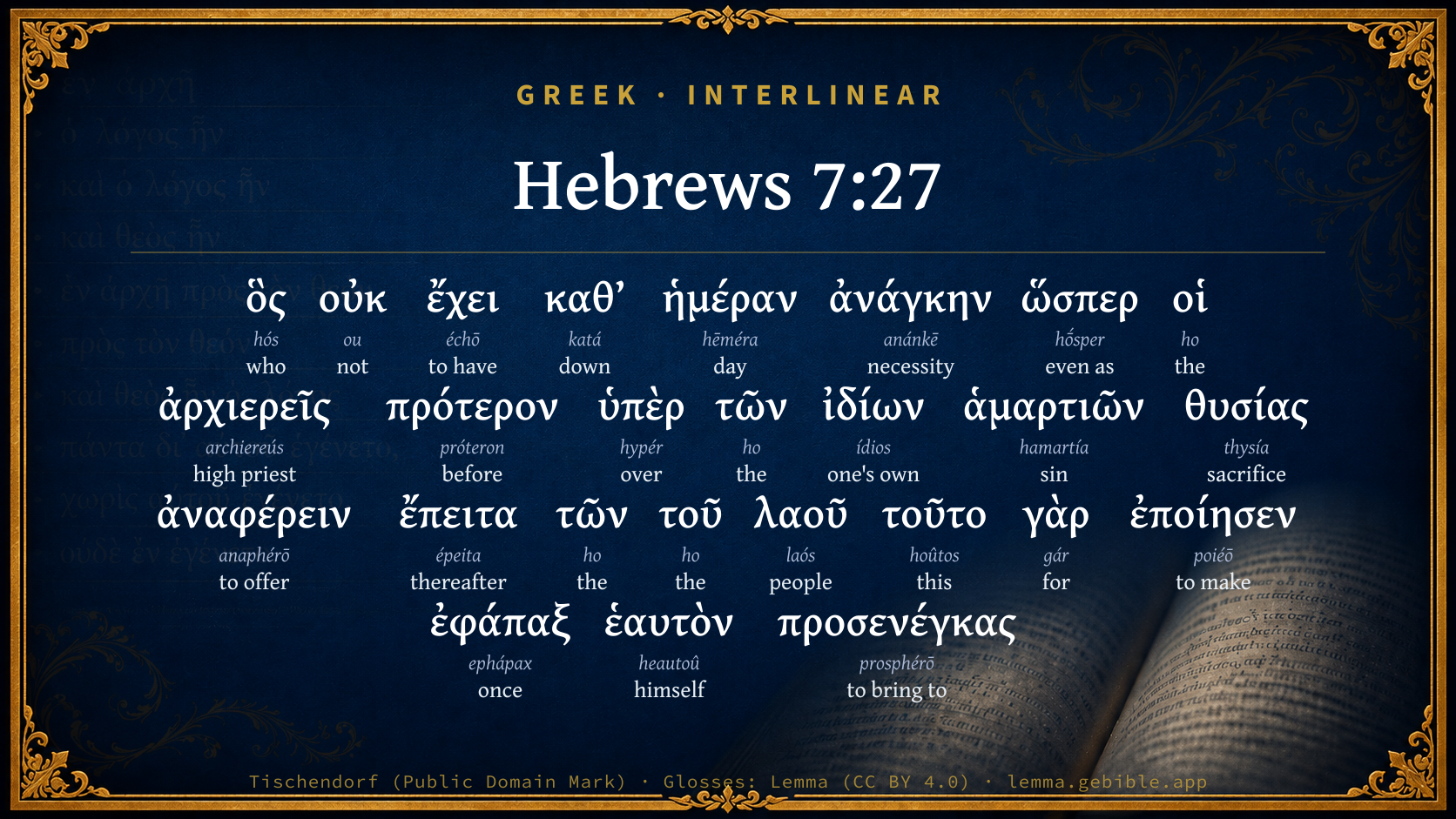
Greek (Tischendorf 8th ed.) Hebrews 7:27 appears in the Greek New Testament. The text above is from the Tischendorf 8th edition. Each word links to its Strong’s number and a concise gloss. Click any word for its full Thayer’s Greek Lexicon entry.
Download image
Cite this verse

Hebrews 7:27 (World English Bible). Public Domain. Lemma interlinear Bible study tool, https://lemma.gebible.app/v/hebrews/7/27.

Show BibTeX & RIS
BibTeX
RIS
English Translation
who doesn't need, like those high priests, to daily offer up sacrifices, first for his own sins, and then for the sins of the people. For this he did once for all, when he offered up himself.
World English Bible · Public Domain
Download a study sheet

One document with this verse’s original text, its word-by-word gloss line, the meaning frame, cross-references with their text, attributed commentary, and full source and license credits — printable, and it pastes into notes with its structure intact.

This verse Autodidact and up

Study sheet (.html) Plain text (.txt)

A passage Seminary Student

Up to 50 verses in one chapter. A passage sheet keeps up to 6 commentary sources and 12 cross-references per verse, in the order this page ranks them, and says so on the sheet whenever that leaves anything out. Ask for a single verse and you get the Autodidact verse sheet above.

Everything on this page stays free to read, with no account — the sheet is a download of what is already on screen, not access to it.

Want to remove ads? Support Godless Engineer
Compare translations 3

The same verse in 3 English versions, stacked beneath the original-language interlinear above. Click any original word for its lexicon entry.

Each is an independent rendering of the whole verse — the interlinear is not word-aligned to these translations.

Highlighted words mark where these versions differ — a whole-verse word diff, not a word-by-word alignment.

  • World English Bible Public Domain
    who doesn't need, like those high priests, to daily offer up sacrifices, first for his own sins, and then for the sins of the people. For this he did once for all, when he offered up himself.
  • King James Version Public Domain
    Who needeth not daily, as those high priests, to offer up sacrifice, first for his own sins, and then for the people's: for this he did once, when he offered up himself.
  • unfoldingWord Literal Text CC BY-SA 4.0
    who does not have each day a need, even as the high priests, to offer up sacrifices, first on behalf of his own sins then those of the people, for he did this, having offered himself once and never again.

unfoldingWord Literal Text — © unfoldingWord, licensed CC BY-SA 4.0. Word-aligned USFM3 via Door43 (git.door43.org/unfoldingWord/en_ult).

Versions to compare (up to 4)

3 of 4 selected

Show all 19 translations

Every available English version of this verse, each an independent rendering of the whole verse.

  • World English Bible Public Domain
    who doesn't need, like those high priests, to daily offer up sacrifices, first for his own sins, and then for the sins of the people. For this he did once for all, when he offered up himself.
  • Berean Standard Bible Public Domain
    Unlike the other high priests, He does not need to offer daily sacrifices, first for His own sins and then for the sins of the people; He sacrificed for sin once for all when He offered up Himself.
  • Majority Standard Bible Public Domain
    Unlike the other high priests, He does not need to offer daily sacrifices, first for His own sins and then for the sins of the people; He sacrificed for sin once for all when He offered up Himself.
  • King James Version Public Domain
    Who needeth not daily, as those high priests, to offer up sacrifice, first for his own sins, and then for the people's: for this he did once, when he offered up himself.
  • American Standard Version (1901) Public Domain
    who needeth not daily, like those high priests, to offer up sacrifices, first for his own sins, and then for the `sins' of the people: for this he did once for all, when he offered up himself.
  • Revised Version (1885) Public Domain
    who needeth not daily, like those high priests, to offer up sacrifices, first for his own sins, and then for the sins of the people: for this he did once for all, when he offered up himself.
  • Geneva Bible (1599) Public Domain
    Which needeth not daily as those hie Priests to offer vp sacrifice, first for his owne sinnes, and then for the peoples: for that did he once, when he offered vp himselfe.
  • Douay-Rheims (1899) Public Domain
    Who needeth not daily (as the other priests) to offer sacrifices first for his own sins, and then for the people's: for this he did once, in offering himself.
  • Young's Literal Translation Public Domain
    who hath no necessity daily, as the chief priests, first for his own sins to offer up sacrifice, then for those of the people; for this he did once, having offered up himself;
  • Literal Standard Version CC BY-SA 4.0
    who has no daily necessity, as the chief priests, to first offer up sacrifice for His own sins, then for those of the people; for this He did once, having offered up Himself;
  • Unlocked Literal Bible CC BY-SA 4.0
    He does not need, unlike the high priests, to offer up daily sacrifices, first for his own sins, and then for the sins of the people. He did this once for all, when he offered himself.
  • unfoldingWord Literal Text CC BY-SA 4.0
    who does not have each day a need, even as the high priests, to offer up sacrifices, first on behalf of his own sins then those of the people, for he did this, having offered himself once and never again.
  • Darby Bible Public Domain
    who has not day by day need, as the high priests, first to offer up sacrifices for his own sins, then [for] those of the people; for this he did once for all [in] having offered up himself.
  • World Messianic Bible Public Domain
    who doesn’t need, like those high priests, to offer up sacrifices daily, first for his own sins, and then for the sins of the people. For he did this once for all, when he offered up himself.
  • Webster's Bible Public Domain
    Who needeth not daily, as those high priests, to offer up sacrifice, first for his own sins, and then for the people's: for this he did once, when he offered up himself.
  • Free Bible Version CC BY-SA 4.0
    Unlike those human high priests, he doesn't need to offer a daily sacrifice for his sins and then the sins of the people. He did this once, and for everyone, when he offered himself.
  • Bible in Basic English Public Domain
    Who has no need to make offerings for sins every day, like those high priests, first for himself, and then for the people; because he did this once and for ever when he made an offering of himself.
  • Text-Critical English NT CC BY 4.0
    He has no need, like the other high priests, to offer up daily sacrifices, first for his own sins, and then for the sins of the people. For he did this once for all when he offered up himself.
  • Tyndale New Testament (1534) Public Domain
    Which nedeth not dayly (as yonder hie prestes) to offer vp sacrifice fyrst for his awne synnes and then for the peoples synnes. For that did he at once for all when he offered vp him silfe.

Literal Standard Version (2020), Covenant Press — licensed CC BY-SA 4.0. Text via the HelloAO Bible API (eBible.org). Unlocked Literal Bible (unfoldingWord) — licensed CC BY-SA 4.0. Text via the HelloAO Bible API (eBible.org). unfoldingWord Literal Text — © unfoldingWord, licensed CC BY-SA 4.0. Word-aligned USFM3 via Door43 (git.door43.org/unfoldingWord/en_ult). Free Bible Version, Dr. Jonathan Gallagher — licensed CC BY-SA 4.0. Text via the HelloAO Bible API (eBible.org).

Word by word

More ways to search: Search by grammar → Find every occurrence → Compare this word →

Practice this passage: Drill this verse → Learn its vocabulary →

ἐφάπαξ
ephápax
G2178
“once”
Adverb
Part of Speech
Adverb
Full Thayer's Definition

Origin: from G1909 and G530

TDNT: 07:23,6

1. once, at once a. all at once b. once for all
  1. ὃς hós G3739 “who” Relative pronoun, Nominative, Singular, Masculine
  2. οὐκ ou G3756 “not” Particle, Negative
  3. ἔχει échō G2192 “to have” Verb, Present, Active, Indicative, 3rd person, Singular
  4. καθ’ katá G2596 “down” Preposition
  5. ἡμέραν hēméra G2250 “day” Noun, Accusative, Singular, Feminine
  6. ἀνάγκην anánkē G318 “necessity” Noun, Accusative, Singular, Feminine
  7. ὥσπερ hṓsper G5618 “even as” Adverb
  8. οἱ ho G3588 “the” Article, Nominative, Plural, Masculine
  9. ἀρχιερεῖς archiereús G749 “high priest” Noun, Nominative, Plural, Masculine
  10. πρότερον próteron G4386 “before” Adverb, Comparative
  11. ὑπὲρ hypér G5228 “over” Preposition
  12. τῶν ho G3588 “the” Article, Genitive, Plural, Feminine
  13. ἰδίων ídios G2398 “one's own” Adjective, Genitive, Plural, Feminine
  14. ἁμαρτιῶν hamartía G266 “sin” Noun, Genitive, Plural, Feminine
  15. θυσίας thysía G2378 “sacrifice” Noun, Accusative, Plural, Feminine
  16. ἀναφέρειν anaphérō G399 “to offer” Verb, Present, Active, Infinitive
  17. ἔπειτα épeita G1899 “thereafter” Adverb
  18. τῶν ho G3588 “the” Article, Genitive, Plural, Feminine
  19. τοῦ ho G3588 “the” Article, Genitive, Singular, Masculine
  20. λαοῦ laós G2992 “people” Noun, Genitive, Singular, Masculine
  21. τοῦτο hoûtos G3778 “this” Demonstrative pronoun, Accusative, Singular, Neuter
  22. γὰρ gár G1063 “for” Conjunction
  23. ἐποίησεν poiéō G4160 “to make” Verb, Aorist, Active, Indicative, 3rd person, Singular
  24. ἑαυτὸν heautoû G1438 “himself” Reflexive pronoun, 3rd person, Accusative, Singular, Masculine
  25. προσενέγκας prosphérō G4374 “to bring to” Verb, Aorist, Active, Participle, Nominative, Singular, Masculine

About this verse

These counts appear in no published source. They are computed here, from the morphology-tagged text and Lemma’s own curated glosses. What Lemma adds →

26
words
23
distinct lemmas
General Epistles
section

Notable vocabulary

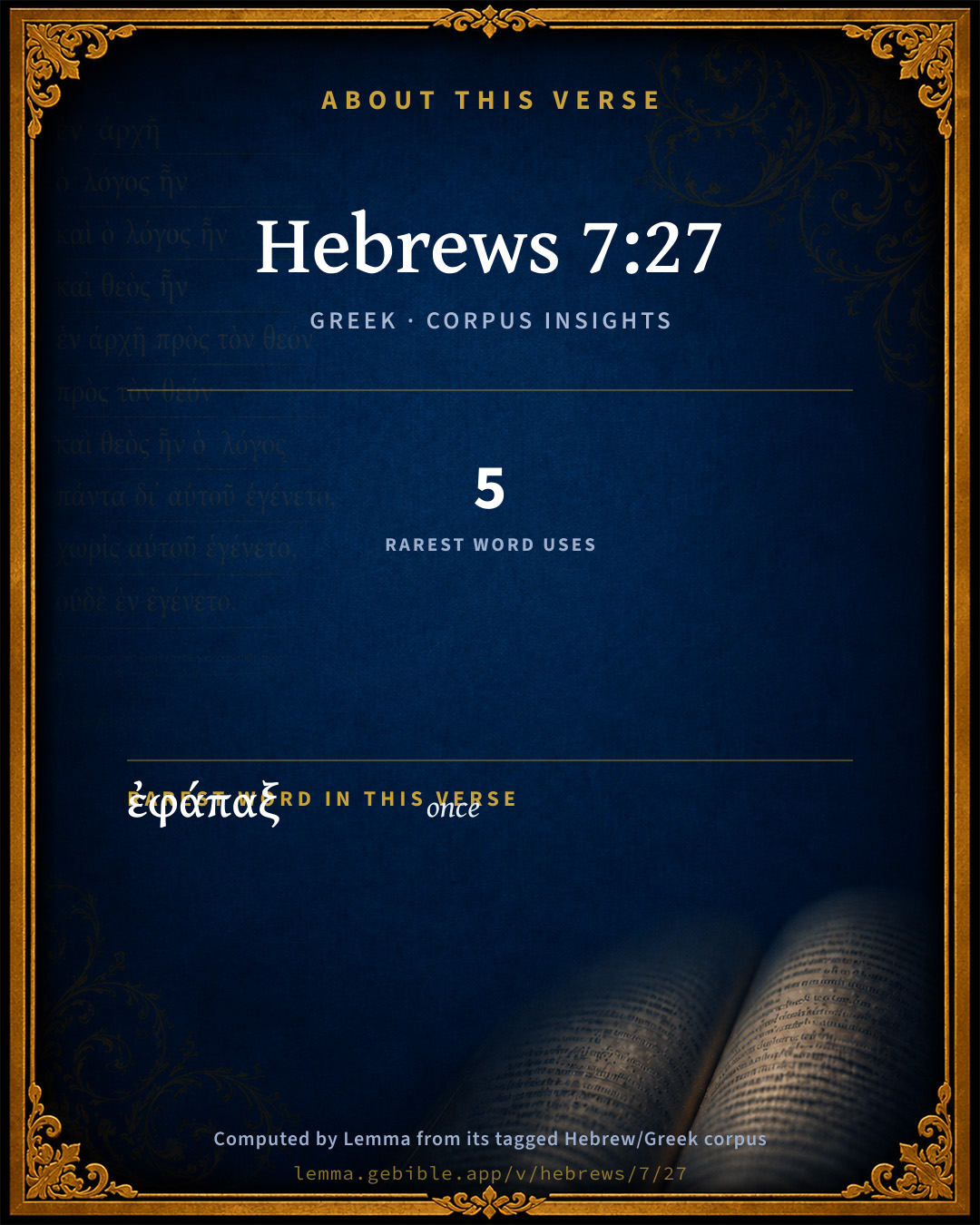
The rarest word here is ἐφάπαξ once G2178 — appearing just 5 times in the whole Greek New Testament.

Shared distinctive vocabulary

ἐφάπαξ once G2178 occurs in 5 verses of the Greek New Testament. Also found in:

Repetition

A word recurs within this verse:

Cross-references

20

Topical passages linked to Hebrews 7:27 in the Treasury of Scripture Knowledge — connected by theme and wording, ordered by reader-vote popularity; previews shown in the World English Bible.

  • Hebrews 9:12 nor yet through the blood of goats and calves, but through his own blood, entered in once for all into the Holy Place, having obtained eternal redemption.
  • Hebrews 9:28 so Christ also, having been once offered to bear the sins of many, will appear a second time, without sin, to those who are eagerly waiting for him for salvation.
  • Hebrews 9:14 how much more will the blood of Christ, who through the eternal Spirit offered himself without blemish to God, cleanse your conscience from dead works to serve the living God?
  • Ephesians 5:2 Walk in love, even as Christ also loved you, and gave himself up for us, an offering and a sacrifice to God for a sweet-smelling fragrance.
  • Hebrews 10:6–12 In whole burnt offerings and sacrifices for sin you had no pleasure.
  • Romans 6:10 For the death that he died, he died to sin one time; but the life that he lives, he lives to God.
  • Titus 2:14 who gave himself for us, that he might redeem us from all iniquity, and purify for himself a people for his own possession, zealous for good works.
  • Hebrews 5:3 Because of this, he must offer sacrifices for sins for the people, as well as for himself.
  • Hebrews 9:25 nor yet that he should offer himself often, as the high priest enters into the holy place year by year with blood not his own,
  • Leviticus 16:11 "Aaron shall present the bull of the sin offering, which is for himself, and shall make atonement for himself and for his house, and shall kill the bull of the sin offering which is for himself.
  • Leviticus 9:7–24 Moses said to Aaron, "Draw near to the altar, and offer your sin offering, and your burnt offering, and make atonement for yourself, and for the people; and offer the offering of the people, and make atonement for them; as Yahweh commanded."
  • Leviticus 16:15 "Then he shall kill the goat of the sin offering, that is for the people, and bring his blood within the veil, and do with his blood as he did with the blood of the bull, and sprinkle it on the mercy seat, and before the mercy seat:
  • Isaiah 53:10–12 Yet it pleased Yahweh to bruise him; he has put him to grief: when you shall make his soul an offering for sin, he shall see [his] seed, he shall prolong his days, and the pleasure of Yahweh shall prosper in his hand.
  • Hebrews 5:1 For every high priest, being taken from among men, is appointed for men in things pertaining to God, that he may offer both gifts and sacrifices for sins.
  • Hebrews 9:7 but into the second the high priest alone, once in the year, not without blood, which he offers for himself, and for the errors of the people.
  • Exodus 29:36–42 Every day shall you offer the bull of sin-offering for atonement: and you shall cleanse the altar, when you make atonement for it; and you shall anoint it, to sanctify it.
  • Leviticus 4:3–35 if the anointed priest sins so as to bring guilt on the people, then let him offer for his sin, which he has sinned, a young bull without blemish to Yahweh for a sin offering.
  • Leviticus 16:6 "Aaron shall offer the bull of the sin offering, which is for himself, and make atonement for himself and for his house.
  • Numbers 28:2–10 Command the children of Israel, and tell them, My offering, my food for my offerings made by fire, of a sweet savor to me, shall you observe to offer to me in their due season.
  • Ephesians 2:22 in whom you also are built together for a habitation of God in the Spirit.

Cross-references courtesy of OpenBible.info (CC BY 4.0).

Commentary

Notes on Hebrews 7:27 from classic Christian and Jewish commentators (each source and its license shown beneath its notes). The classic Christian expositions comment on the surrounding passage and are grouped to its opening verse, so a note may address several verses; the Jewish commentaries on the Tanakh (Rashi and others) are per-verse, so they appear only where the commentator wrote on this verse.

Lemma curates 59 commentaries, every one of them public domain or Creative Commons licensed, each selected and text-cleaned for this edition rather than reprinted as found. About our sources →

Bengel's Gnomon

Johann Albrecht Bengel

Heb 7:27. Οὐ, not) The Negation has a double force, and is thus to be explained: He has no necessity to offer, 1. daily: 2. for His own sins also. Not daily, for He has done that once for all. Not for His own sins, for He offered Himself, a holy sacrifice. There is besides in it an inverted Chiasmus. The first follows from the second, the second is confirmed by the 28th verse. Often in Scripture two positions (theses) are laid down, and are proved by the γὰρ, for, twice following them.—καθʼ ἡμέραν, daily) κατʼ ἐνιαυτὸν, year by year, properly, ch. Heb 10:3. The Hebrews speak of the day, instead of the day of expiation; whence some translate καθʼ ἡμέραν, on every day of expiation: but it retains here its usual meaning, so that there is as it were a kind of indignant hyperbole (such as at ch. Heb 10:1, εἰς τὸ διηνεκὲς, for ever), intimating that the high priest was of no more avail by offering yearly on a stated day, than if he had offered daily with the common priests, ch. Heb 9:6-7.—τοῦτο) this is simply to be referred to His offering, not to His offering also for Himself.—ἐφάπαξ, once) Rom 6:10, note; so below ch. Heb 9:12, Heb 10:10.

Bengel's Gnomon of the New Testament — English translation (T&T Clark, Edinburgh, 1860) — public domain. Text from a community e-Sword module.

Meyer's Critical & Exegetical Commentary

Heinrich August Wilhelm Meyer

Heb_7:27. In the πρότερον ὑπὲρ τῶν ἰδίων ἁμαρτιῶν, ἔπειτα τῶν τοῦ λαοῦ there is an apparent allusion to the sacrifice of the high priest on the great day of atonement (Leviticus 16.), comp. Heb_9:7. We are prevented, however, from referring the words to this alone (perhaps to the including of the sin-offering prescribed, Lev_4:3 ff.) by καθʼ ἡμέραν, instead of which, as at Heb_9:25, Heb_10:1; Heb_10:3, κατʼ ἐνιαυτόν must have been placed. For καθʼ ἡμέραν can signify nothing else than daily or day by day. To foist upon it the signification: yearly on a definite day (καθʼ ἡμέραν ὡρισμένην or τεταγμένην), with Schlichting (secundum diem, nempe statam ac definitam, in anniversario illo videlicet sacrificio), Piscator, Starck, Peirce, Chr. Fr. Schmid, MLean, Storr, and others; or to take it in the attenuated sense, as equivalent to saepissime, quoties res fert (Grotius, Owen), or πολλάκις (Böhme, Stein), or διὰ παντός (de Wette), or in the sense of one day after another (Ebrard, who supposes the author is overlooking a succession of centuries, and so a succession of days present themselves to his eye, in which the high priest again and again offers a sacrifice!), is linguistically unwarranted. In like manner it is a mere subterfuge and arbitrary misinterpreting of the words, when Delitzsch, Riehm (Lehrbegr. des Hebräerbr. p. 438), and Alford, concurring in the suggestion of Hofmann (Schriftbew. II. 1, p. 404 f., 2 Aufl.), seek to put into them the sense: that Christ needeth not to do daily that which the high priests do once every year, but which Heif He is to be a constant mediator of an all-embracing expiation of sinmust needs do day by day. For all that is expressed is the fact that Christ needs not to do daily that which the Levitical high priests need to do daily.[84] Nor does it avail anything that Kurtz will take καθʼ ἩΜΈΡΑΝ in conjunction only with ΟὐΚ ἜΧΕΙ ἈΝΆΓΚΗΝ, since these words do not occupy an independent position alone, and only acquire their more precise definition by that which follows. For that ΚΑΘʼ ἩΜΈΡΑΝ has nothing whatever to do with the ΘΥΣΊΑς ἈΝΑΦΈΡΕΙΝ, is a mere assertion on the part of Kurtz; and his contention, that only the daily renewal and daily pressing necessity, of the O. T. high priest on account of his daily sinning, the necessity, ere (on the great day of propitiation) he could offer for the sin of the whole people, of first presenting a sacrifice for his own sins, was to be brought into relief, is a violent perversion of the words,admitting as they do of no misapprehension,from which even the ΠΡΌΤΕΡΟΝ, ἜΠΕΙΤΑ, expressive of a relation of parity, ought to have kept him; in place of which, in order to bring out the subsidiary character of the one half of the statement, πρὸ τοῦ with the infinitive, or ΠΡΊΝ (ΠΡῚΝ Ἤ), must have been written. We have therefore to conclude, with Gerhard, Calov, Seb. Schmidt, Braun, Wolf, Carpzov, Bleek, and Tholuck, that the author had present to his mind, besides the principal sacrifice on the great day of atonement, at the same time the ordinary daily sacrifice of the Levitical priests (Exo_29:38-42; Num_28:3-8), and by reason of an inexact mode of expression blended the two together; to which he might the more easily be led, in that, according to Josephus, the high priestnot indeed always, but yet on the Sabbaths, new moons, and other festivals (according to the Mishna tr. Tamith, vii. 3 : in general as often as he was so minded)went up with the other priests into the temple, and took part in the sacrificial service. Comp. Josephus, de Bello Judaico, v. 5. 7 : Ὁ δὲ ἀρχιερεὺς ἀνῄει μὲν σὺν αὐτοῖς ἀλλʼ οὐκ ἀεί, ταῖς δʼ ἑβδομάσι καὶ νουμηνίαις, καὶ εἴ τις ἑορτὴ πάτριος ἢ πανήγυρις πάνδημος ἀγομένη διʼ ἔτους. To be compared also are the words of Philo, who, Quis rer. divin. haer. p. 505 A (with Mangey, I. p. 497), remarks that in the daily sacrifice the priests offered the oblation for themselves, but the lambs for the people (Ἀλλὰ καὶ τὰς ἐνδελεχεῖς θυσίας ὁρᾷς εἰς ἴσα διῃρημένας, ἥν τε ὑπὲρ αὑτῶν ἀνάγουσιν οἱ ἱερεῖς διὰ τῆς σεμιδάλεως καὶ τὴν ὑπὲρ τοῦ ἔθνους τῶν δυοῖν ἀμνῶν, οὓς ἀναφέρειν ΔΙΕΊΡΗΤΑΙ), and de Speciall. Legg. p. 797 E (with Mangey, II. p. 321), equally as our passage, ascribes to the high priest the offering of a daily sacrifice (οὕτω τοῦ σύμπαντος ἔθνους συγγενὴς καὶ ἀγχιστεὺς κοινὸς ὁ ἀρχιερεύς ἐστι, πρυτανεύων μὲν τὰ δίκαια τοῖς ἀμφισβητοῦσι κατὰ τοὺς νόμους, εὐχὰς δὲ καὶ θυσίας τελῶν καθʼ ἐκάστην ἡμέραν). Recently also Delitzsch (Talmudische Studien, XIII., in Rudelbach and Guerickes Zeitschr. für die luther. Theol, u. Kirche, 1860, H. 4, p. 593 f.) has further drawn attention to the fact that likewise, Jer. Chagiga, ii. 4, and Bab. Pesachim, 57a, it is said of the high priest that he offers daily.

τοῦτο] namely, ΤῸ ὙΠῈΡ ΤῶΝ ΤΟῦ ΛΑΟῦ ἉΜΑΡΤΙῶΝ ΘΥΣΊΑΝ ἈΝΑΦΈΡΕΙΝ. So rightlyas is even demanded by Heb_7:28 (comp. Heb_4:15)

Chrysostom, Oecumenius, Theophylact, Clarius, Estius, Piscator, Clericus, Seb. Schmidt, Owen, Peirce, Carpzov, Whitby, Storr, Heinrichs, Böhme, Kuinoel, Klee, Bleek, de Wette, Stengel, Bloomfield, Bisping, Delitzsch, Riehm (Lehrbegr. des Hebräerbr. p. 463), Alford, Kurtz, and others. Less suitably do Beza, Jac. Cappellus, Limborch, Bengel, and Ebrard supplement τὸ θυσίας ἀναφέρειν; while, altogether wrongly, Schlichting, Grotius, Hammond, and Hofmann (Schriftbew. II. 1, 2 Aufl. pp. 405, 401 f.) refer back τοῦτο to the whole proposition ΠΡΌΤΕΡΟΝ … ΛΑΟῦ. For in the application to Christ, to explain the ἉΜΑΡΤΊΑΙ as the dolores, qui solent peccatorum poenae esse, et quas Christus occasione etiam peccatorum humani generis toleravit, et a quibus liberatus est per mortem (Grotius), or as Christi infirmitates et perpessiones (Schlichting, Hofmann, according to which latter in connection with ἙΑΥΤῸΝ ἈΝΕΝΈΓΚΑς, besides Christs suffering of death, His prayer in Gethsemane (!) is at the same time to be thought of), becomes possible only on the arbitrary supposition of a double sense to the preceding words, and is equally much opposed to the context (Heb_7:28) as to the linguistic use of ἉΜΑΡΤΊΑΙ.

ἘΦΆΠΑΞ] once for all; comp. Heb_9:12, Heb_10:10; Rom_6:10. Belongs to ἐποίησεν, not to ἈΝΕΝΈΓΚΑς.

ἙΑΥΤῸΝ ἈΝΕΝΈΓΚΑς] in that He offered Himself. Christ is thus not only the High Priest of the New Covenant, but also the victim offered. Comp. Heb_8:3, Heb_9:12; Heb_9:14; Heb_9:25 f., Heb_10:10; Heb_10:12; Heb_10:14; Eph_5:2.

[84] The unsatisfactory character of the above exposition was afterwards acknowledged by Delitzsch himself, and the explanation retracted by him (in Rudelbach and Guerickes Zeitschr. f. diegesammte luther. Theol. u. Kirche, 1860, H. 4, p. 595).

Meyer — Critical and Exegetical Commentary on the New Testament — English translation by Peter Christie, edited by Frederick Crombie (T&T Clark, 1880) — public domain. Text from a community e-Sword module.

Geneva Bible (1599)

Geneva Bible translators

That sacrifice which he offered.

It was so done, that it needeth not be repeated or offered again anymore.

Another argument which notwithstanding he handleth afterward: The Levitical Priests offered sacrifice after sacrifice, first for themselves, and then for the people. But Christ offered not for himself, but for others, not sacrifices, but himself, not oftentimes, but once. And this ought not to seem strange; saith he, forsomuch as they are weak, but this man is consecrated an everlasting Priest, and that by an oath.

Geneva Bible (1599) marginal notes — public domain. Text via Bolls.life.

Jamieson, Fausset & Brown

Robert Jamieson, A. R. Fausset & David Brown

daily--"day by day." The priests daily offered sacrifices (Heb 9:6; Heb 10:11; Exo 29:38-42). The high priests took part in these daily-offered sacrifices only on festival days; but as they represented the whole priesthood, the daily offerings are here attributed to them; their exclusive function was to offer the atonement "once every year" (Heb 9:7), and "year by year continually" (Heb 10:1). The "daily" strictly belongs to Christ, not to the high priests, "who needeth not daily, as those high priests (year by year, and their subordinate priests daily), to offer," &c.

offer up--The Greek term is peculiarly used of sacrifices for sin. The high priest's double offering on the day of atonement, the bullock for himself, and the goat for the people's sins, had its counterpart in the TWO lambs offered daily by the ordinary priests.

this he did--not "died first for His own sins and then the people's," but for the people's only. The negation is twofold: He needeth not to offer (1) daily; nor (2) to offer for His own sins also; for He offered Himself a spotless sacrifice (Heb 7:26; Heb 4:15). The sinless alone could offer for the sinful.

once--rather as Greek, "once for all." The sufficiency of the one sacrifice to atone for all sins for ever, resulted from its absolute spotlessness.

Jamieson, Fausset & Brown — Commentary Critical and Explanatory on the Whole Bible (1871) — public domain (CC PDM 1.0). Text via the HelloAO Bible API.

Adam Clarke's Commentary

Verse 27. Who needeth not daily] Though the high priest offered the great atonement only once in the year, yet in the Jewish services there was a daily acknowledgment of sin, and a daily sacrifice offered by the priests, at whose head was the high priest, for their own sins and the sins of the people. The Jews held that a priest who neglected his own expiatory sacrifice would be smitten with death. (Sanhedr., fol. 83.) When they offered this victim, they prayed the following prayer: "O Lord, I have sinned, and done wickedly, and gone astray before thy face, I, and my house, and the sons of Aaron, the, people of thy holiness. I beseech thee, for thy name's sake, blot out the sins, iniquities, and transgressions by which I have sinned, done wickedly, and gone astray before thy face, I, and my house, and the sons of Aaron, the people of thy holiness; as it is written in the law of Moses thy servant, (Le 16:30:) On that day shall he make an atonement for you, to cleanse you, that ye may be clean from all your sins before the Lord!" To which the Levites answered: "Blessed be the name of the glory of thy kingdom, for ever and ever!"

This prayer states that the priest offered a sacrifice, first for his own sins, and then for the sins of the people, as the apostle asserts.

For this he did once] For himself he offered no sacrifice; and the apostle gives the reason-he needed none, because he was holy, harmless, undefiled, and separate from sinners: and for the people he offered himself once for all, when he expired upon the cross,

It has been very properly remarked, that the sacrifice offered by Christ differed in four essential respects from those, offered by the Jewish priests:

1. He offered no sacrifice for himself, but only for the people.

2. He did not offer that sacrifice annually, but once for all.

3. The sacrifice which he offered was not of calves and goats, but of himself.

4. This sacrifice he offered, not for one people, but for the whole human race; for he tasted death for every man.

Adam Clarke's Commentary on the Bible (1810–1826) — public domain. Text from a community e-Sword/MySword module.

John Calvin's Commentaries

27. Who needeth not, etc. He pursues the contrast between Christ and the Levitical priests; and he points out especially two defects, so to speak, in the ancient priesthood, by which it appears that it was not perfect. And here, indeed, he only touches briefly on the subject; but he afterwards explains every particular more at large, and particularly that which refers to the daily sacrifices, as the main question was respecting these. It is briefly also that I will now touch on the several points. One of the defects of the ancient priesthood was, that the high priest offered sacrifices for his own sins; how then could he have pacified God for others, who had God justly displeased with himself? Then they were by no means equal to the work of expiating for sins. The other defect was, that they offered various sacrifices daily; it hence follows, that there was no real expiation; for sins remain when purgation is repeated. The case with Christ was wholly different; for he himself needed no sacrifice, as he was sprinkled with no spot of sin; and such was the sacrifice, that it was alone sufficient to the end of the world, for he offered himself.

John Calvin's Commentaries (1540-1563) — public domain. Text from the Calvin Translation Society English edition (1840s-50s) via the Christian Classics Ethereal Library (ccel.org). Calvin's coverage is partial (roughly two-thirds of the Bible); uncommented books and verses are honest gaps, never fabricated. The 19th-century editor's footnotes and remarks are omitted so the notes are faithfully Calvin's own voice.

Ellicott's Commentary for English Readers

(27) This verse carries on the description, presenting what follows from this purity and sinlessness.

As those high priests.—The high priest’s offering up sacrifices first for himself and then for the people constituted a chief part of his duty upon the Day of Atonement. (See Heb_5:3.) The annual recurrence of that day is distinctly referred to more than once in this Epistle (see Heb_9:25; Heb_10:1; Heb_10:3): hence the words now before us, which seem to imply daily sacrifices thus offered by the high priests, have given rise to much discussion. Neither the morning and evening sacrifices nor the daily meat-offering of the high priest could have been spoken of in the terms here used, which in their natural meaning suit the ritual of the Day of Atonement, and that alone. It is true—and passages of Philo and the Talmud are appositely quoted to illustrate the fact—that, as the high priest was represented by all other priests, their actions were counted as his; but it seems impossible to think that the words have no more significance than this. Either we must take “daily” as equivalent to “day by day” (as the Jews were accustomed to speak of the Day of Atonement as “the day”),—which will give us the meaning, “on each recurrence of this sacred day;” or we must connect the word, not with the Jewish high priests, but with Jesus alone. The order of the Greek would of itself suggest this latter arrangement of the words. If it is correct, the choice of the word “daily” presents but little difficulty. There could be no question of years in regard to the ministration of the Lord Jesus in the heavenly sanctuary; and “daily” was perhaps the most natural word in such a case, when the frequently stated repetition of a sacrifice was the thought to be expressed.

For this he did once.—Rather, once for all. These words and those that follow, “when He offered up Himself,” are best understood as a parenthesis. The truth stated in the former part of the verse, that Jesus needeth not, like the high priests, to offer up sacrifices, first for His own sins and then “for those of the people,” finds its explanation in Heb_7:28, “For the Law,” &c. But, having introduced the thought of a sacrifice for the sins of the people—a thought not yet expressly mentioned in any part of the Epistle in connection with Jesus, though virtually presented, as we have seen, in many earlier words—the writer will not pass on without the most emphatic statement that such a sacrifice was offered, once for all, in the sacrifice of Himself.

A Bible Commentary for English Readers, edited by Charles John Ellicott (1878–1897) — public domain. Text from a community e-Sword module.

The Cambridge Bible for Schools and Colleges

gen. ed. J. J. S. Perowne

27. daily] A difficulty is suggested by this word, because the High Priest did not offer sacrifices daily, but only once a year on the Day of Atonement. In any case the phrase would be a mere verbal inaccuracy, since the High Priest could be regarded as potentially ministering in the daily sacrifices which were offered by the inferior Priests; or the one yearly sacrifice may be regarded as summing up all the daily sacrifices needed to expiate the High Priest’s daily sins (so that “daily” would mean “continually”). It appears however that the High Priest might if he chose take actual part in the daily offerings (Exo_29:38; Exo_29:44; Lev_6:19-22; Jos. B. J. Heb_7:5-7). It is true that the daily sacrifices and Mincha or “meat offering” had no recorded connexion with any expiatory sacrifices; but an expiatory significance seems to have been attached to the daily offering of incense (Lev_16:12-13, LXX.; Yoma, f. 44. 1). The notion that there is any reference to the Jewish Temple built by Onias at Leontopolis is entirely baseless. Both Philo (De Spec. Legg. § 53) and the Talmud use the very same expression as the writer, who seems to have been perfectly well aware that, normally and strictly, the High Priest only offered sacrifices on one day in the year (Heb_9:25, Heb_10:1; Heb_10:3). The stress may be on the necessity. Those priests needed the expiation by sacrifice for daily sins; Christ did not.

he did once] Rather, “once for all” (Heb_9:12; Heb_9:26; Heb_9:28, Heb_10:10; Rom_6:10). Christ offered one sacrifice, once offered, but eternally sufficient.

when he offered up himself] The High Priest was also the Victim, Heb_8:3, Heb_9:12; Heb_9:14; Heb_9:25, Heb_10:10; Heb_10:12; Heb_10:14; Eph_5:2 (Lünemann).

The Cambridge Bible for Schools and Colleges (gen. ed. J. J. S. Perowne; Cambridge University Press, 1878–1918) — public domain. Text from a community e-Sword module.

Trapp's Complete Commentary

John Trapp

27 Who needeth not daily, as those high priests, to offer up sacrifice, first for his own sins, and then for the people’s: for this he did once, when he offered up himself.

Ver. 27. Who needeth not daily] καθ ημεραν. Or, on a certain day of the year, so. at the feast of the expiations, Lev 16:29; see Heb 10:1.

First for his own sins] Else how could he stand before God for others? the priests therefore had their laver wherein to wash, before they offered any man’s sacrifice. The brazen altar stood without, the incense altar of gold within the sanctuary; to signify that our own lusts must be sacrificed ere we take upon us to pray for ourselves or others. David observeth this method, Psa 35:1-28 Psa 51:1-19. He first gets pardon for himself, and then makes request for Sion.

John Trapp, A Commentary or Exposition upon All the Books of the Old and New Testament (1647–1656) — public domain. Text from a community e-Sword module.

Albert Barnes' Notes on the Bible

Who needeth not daily, as those high priests - As the Jewish priests. This is an additional circumstance introduced to show the superior excellency of the High Priest of the Christian profession, and to show also how he was suited to our wants. The Jewish high priest was a sinful man. He had the same fallen and corrupt nature as others. He needed an expiatory sacrifice for his own sins as really as they did for theirs. When he approached God to offer sacrifice, it was needful to make an atonement for himself, and when all was done it was still a sacrifice offered by a sinful man. But it was not so in the case of Jesus. He was so holy that he needed no sacrifice for himself, and all that he did was in behalf of others. Besides, it was necessary that the sacrifices in the Jewish service should be constantly repeated. They were imperfect. They were mere types and shadows. They who offered them were frail, sinful men. It became necessary, therefore, to repeat them every day to keep up the proper sense of their transgressions, and to furnish a suitable acknowledgment of the tendency to sin alike among the people and the priests. Neither in the nature of the offering, nor in the character of those who made it, was there any sufficient reason why it should cease to be offered, and it was therefore repeated day by day. But it was not so with the Lord Jesus. The offering which he made, though presented but once, was so ample and perfect that it had sufficient merit for all the sins of the world, and needed never to be repeated. It is not probable that the Jewish high priest himself personally officiated at the offering of sacrifice every day; but the meaning here is, that it was done daily, and that there was need of a daily sacrifice in his behalf. As one of the Jewish people, the sacrifice was offered on his account as well as on the account of others - for he partook of the common infirmities and sinfulness of the nation.

For this he did once - That is, once for all - ἐφάπαξ ephapax. He made such an atonement that it was not needful that it should be repeated. Thus, he put an end to sacrifice, for when he made the great atonement it was complete, and there was no need that any more blood should be shed for human guilt.

Albert Barnes' Notes on the Bible (1834–1885) — public domain. Text from a community e-Sword/MySword module.

Haydock's Catholic Bible Commentary

Jesus Christ offered himself but once in a bloody manner on the cross; but, besides this bloody offering, he still continues to offer himself in an unbloody manner. This he does both in heaven and upon earth; in heaven, by presenting his sacred humanity continually to his Father; and on earth, by daily offering himself, under the appearance of bread and wine, on our altars. Hence this eucharistic sacrifice is both a commemoration and continuation of the sacrifice of the cross. To understand this, it must be observed, that the essence of a sacrifice includes several actions, the principal of which are the immolation of the victim, and the oblation of the victim when immolated. Now the sacrifice of Jesus Christ on the cross, ended only as to the bloody immolation; the same victim is still immolated mystically, by the separate consecration of the bread and wine, and continues as the oblation. Jesus Christ, in quality of the eternal high priest, has carried his victim, i.e. his body, into heaven, and there offers it continually to his Father. He continues also his sacrifice here on earth, by the ministry of his priests: who to the end of time will offer to God the same immolated victim, present on our altars under the appearance of bread and wine --- a sacrifice infinitely perfect, since a God is the priest, and a God the victim. The chief-priest who offers it is a God-man; the victim offered is a Man-God: a God the victim, offered by a God the priest! Behold a sacrifice truly worthy of God --- a sacrifice capable of atoning not only for our sins, but for the sins of ten thousand worlds. What confidence then ought Christians to have in such a sacrifice! How solicitous ought they to be to assist daily at these awful, or, to use St. John Chrysostom’s expression, these tremendous mysteries! Let us now examine the sentiments of learned Protestant divines: "It is certain," says Dr. Grabe, "that Irenæus and all the Fathers, either contemporary with the apostles, or their immediate successors, whose writings are still extant, considered the blessed Eucharist to be the sacrifice of the new law, and offered bread and wine on the altar, as sacred oblations to God the Father; and that this was not the private opinion of any particular Church or teacher, but the public doctrine and practice of the universal Church, which she received from the apostles, and they from Christ, is expressly shewn by Irenæus, and before him by Justin Martyr and Clement of Rome." (Nota in Irenæum. p. 323.) --- "The elements being really changed from ordinary bread and wine into the body and blood of Christ, mystically present, as in a sacrament, and that by virtue of the consecration, not by the faith of him that receives, I am to admit and maintain whatsoever appears duly consonant with this truth, viz. that the elements so consecrated are truly the sacrifice of Christ upon the cross, inasmuch as the body and blood of Christ are contained in them. ... And the sacrifice of the cross being necessarily propitiatory, and impetratory both, it cannot be denied that the sacrament of the Eucharist, inasmuch as it is the same sacrifice with that upon the cross, is also both propitiatory and impetratory." (Thorndike Epil. p. 44 and 46.) --- "The holy Fathers frequently say, that in the Eucharist is offered and sacrificed the very body of Christ, as is evident in almost innumerable places." (Bp. Forbes’ de Euch. lib. iii. chap. 2. sect. 10.) --- "The sacrifice of the supper is not only propitiatory, and may be offered up for the remission of our daily sins, but likewise is impetratory, and my be rightly offered for the obtaining all blessings. Although the Scripture does not plainly and in express words teach this, yet the holy Fathers with universal consent have thus understood the Scripture, as has been demonstrated by many; and ll the ancient liturgies prescribe, that in time of the oblation, prayers be offered for peace, &c. as is evident to all." (Bp. Forbes’ de Euch. lib. iii. chap. 2. sect. 12.) --- "The Church, commemorating the sacrifice of Christ with the usual rites and words, in this also sacrificeth and offereth that which is her own, given to her by Christ; that she placeth before the eyes of God; by that she beseecheth God; and it is the same sacrifice that Christ offered; the same one, true, and singular sacrifice, as St. Augustine calls it; a sacrifice of memory according to Eusebius; a spiritual sacrifice, according to others. After that the faithful offer themselves according to the example of Christ, &c. In all this what is there new, what deformed, what hurtful? But minds once distracted, distract all things into a depraved meaning, and then are glad to find a hint for it in any of the schools." (Grotius of Christian sacrifice.) --- To these we may add the authority of Ed. Burke, in his speech to the electors of Bristol: "The mass is church service in the Latin tongue, not exactly like our liturgy, but very near, and contains no offence whatever against the laws of good morals." (p. 29.)

George Leo Haydock (1774–1849), Haydock's Catholic Family Bible and Commentary, 1859 edition — public domain. Excludes Psalms (Douay-Rheims chapter numbering differs from Protestant) and Deuterocanonical books (Catholic canon only).

Matthew Poole's English Annotations

In this verse the Spirit shows the ground of his intercession work in heaven, and why he doth not sacrifice as a High Priest there; therein setting his far above the Aaronical priesthood.

Who needeth not daily, as those high priests, to offer up sacrifice; he had no necessity, being so holy as he was, to multiply sacrifices.

First for his own sins, and then for the people’s; for himself, being sinless, and having no infirmity to atone for, as the Aaronical priesthood had, who annually on the day of atonement did offer sacrifice for themselves, being sinners, and needing pardon as well as the people, Lev 9:7. And he had no need anually on a day to offer for the people’s sins, as Aaron and his successors had, and did continue to do, till his sacrifice took place and abolished them; he having once offered a sacrifice for the sins of the people, which outweighed all their multiplied sacrifices.

For this he did once, when he offered up himself; and this he did once when he himself died a sacrifice for sins, when he offered up the human nature by the eternal Spirit without spot, a propitiatory sacrifice to God, when his body hung on the cross, and his soul ascended and entered into the throne of God in the holy of holiest in heaven, with the blood of the testament, and atoned him for all his people. How transcendent was this sacrifice to all the Aaronical ones, whereby sinners were reconciled unto God for ever! Heb 9:11,12,14,24-26. On this offering was he exalted by God fitr above all heavens, confirmed by oath in his office, and his intercession became so powerful and effectual to save all his people from their sins, and the consequents of them.

Matthew Poole's English Annotations on the Holy Bible (1683–1685) — public domain. Text from a community e-Sword/MySword module.

Whedon's Commentary on the Bible

Daniel D. Whedon

27. First for his own sins—Sinlessness is the necessary condition of a perfect atonement. One sinner cannot efficiently die for another sinner; for he deserves that death for his own sin.

Once—And not daily. The Romish pretence that the daily mass is a real sacrifice is here contradicted. The divine victim can never be offered but once.

Daniel D. Whedon (gen. ed.), Commentary on the Old and New Testaments (1874–1909) — public domain. Text from a community e-Sword module.

The Pulpit Commentary

Who needeth not daily, as those high priests, to offer up sacrifice, first for his own sins, and then for the people"s: for this he did once for all, when he offered up himself. The expression "daily" (kay hmeran) is not in strictness applicable to the high priest, who did not offer the daily sacrifice. The reference throughout what follows being to the high priest"s peculiar functions on the Day of Atonement, kat eniauton might have been expected. There are two tenable solutions:

(1) that the daily offerings of the priests are regarded as made by the high priest, who represented the whole priesthood, on the principle, qui facit per altos tacit per se;

(2) that kay hmeran (as is suggested by its position in the sentence) belongs not to oi arciereiv , but only to Christ: who has no need daily, as the high priests have yearly:" for his intercession being perpetual, an offering on his part would be needed daily, if needed at all. This view is supported by the fact that the daily sacrifices are not spoken of in the Law as including a special one in the first place for the priest"s own sin. "This he did." Did what? Offer for his own sins as well as for the people"s? No; for, though it has been seen above (Heb_5:7) how the high priest"s offering for himself might have its counterpart in the agony, the Sinless One cannot be said to have offered for sins of his own. And, besides, he having offered himself (eautogkav), the offering could not be for himself. We must, therefore, take "this he did" as referring only to the latter part of the preceding clause, while eauton, prosenegkav answers to the former part; or as implying generally, "did all that was needed for atonement."

The Pulpit Commentary (1880–1919), ed. H.D.M. Spence-Jones & Joseph S. Exell — public domain. Text from a community e-Sword module.

John Wesley's Explanatory Notes

Who needeth not to offer up sacrifices daily - That is, on every yearly day of expiation; for he offered once for all: not for his own sins, for he then offered up himself "without spot to God."

John Wesley, Explanatory Notes Upon the Whole Bible (1754–1765) — public domain. Text via the GEBible commentary corpus.

Scofield Reference Notes

C. I. Scofield

sins

Sin. (See Scofield "Rom 3:23").

The Scofield Reference Bible (1917 edition), notes by C. I. Scofield — public domain. Text from a community e-Sword module.

Burkitt's Expository Notes on the New Testament

William Burkitt

That is, "As Jesus Christ, our great High Priest, had no sin of his own to expiate, like other high priests, but his business was to offer for our sins; so the oblation and offering he made upon that account, was not bullocks or rams, but himself in sacrifice, and that once, and but once upon the cross, which once offered sacrifice was abundantly sufficient to take away sin; whereas other high priests offered for their own sins, and for the people’s sins, and that often which was a token of their insufficiency and imperfection."

Learn hence, That no sacrifice could bring us to God, and save us to perfection, but that wherein the Son of God himself was both priest and offering; such and High Priest became us who offered himself once for all.

Learn, 2. That the perfection of Christ’s sacrifice makes the repetition of it needless, and the often repeating of it would argue the imperfection both of priest and sacrifice: He needeth not daily to offer up sacrifice, for this he did once, when he offered up himself.

William Burkitt's Expository Notes on the New Testament (1700–1703) — public domain. Text from a community e-Sword module.

The People's New Testament

B. W. Johnson

27. Who needeth not daily. The daily sacrifice was offered on the altar, under the direction of the high priest, for the sins of the whole nation, including himself. For this he did once. Instead of the daily offering for himself and others, Christ made but one offering, himself, when he died upon the cross. This offering was complete when he, as the high priest, ascended into the Holy of Holies above to intercede for the sins of his people. The perfect high priest had offered the perfect sacrifice and had dedicated the new and better covenant. Christ made his offering as a priest in “The true tabernacle, which the Lord pitched, and not man.”

B. W. Johnson's The People's New Testament with Notes (1889–1891) — public domain. Electronic text from the Christian Classics Ethereal Library (CCEL) ThML edition.

unfoldingWord translationNotes

Door43 World Missions Community

General Information:

Here the words "He," "his," and "himself" refer to Christ.

the law appoints as high priests men who have weaknesses

Here "the law" is a metonym for the men who appointed the high priests according to the law of Moses. The focus is not on the men who did this, but on the fact that they did this according to the law. AT: "according to the law, men appoint as high priests men who have weaknesses" or "for according to the law, men who have weaknesses are appointed as high priests" (See: Metonymy)

men who have weaknesses

"men who are spiritually weak" or "men who are weak against sin"

the word of the oath, which came after the law, appointed a Son

The "word of the oath" represents God who made the oath. AT: "God appointed a Son by his oath, which he made after he gave the law" or "after he had given the law, God swore an oath and appointed his Son" (See: Metonymy)

Son

This is an important title for Jesus, the Son of God. (See: Translating Son and Father)

who has been made perfect

This can be stated in active form. AT: "who has completely obeyed God and become mature" (See: Active or Passive)

translationWords

high priest

sacrifice

sin

law

oath

Son of God

perfect

eternity

unfoldingWord translationNotes — © Distant Shores Media and the Door43 World Missions Community, licensed CC BY-SA 4.0. Source: git.door43.org/Door43/en_tn.

Cambridge Greek Testament for Schools and Colleges

27. καθʼ ἡμέραν. A difficulty is suggested by this word, because the High Priest did not offer sacrifices daily, but only once a year on the Day of Atonement. In any case the phrase would be a mere verbal inaccuracy, since the High Priest could be regarded as potentially ministering in the daily sacrifices which were offered by the inferior Priests; or the one yearly sacrifice may be regarded as summing up all the daily sacrifices needed to expiate the High Priest’s daily sins (so that “daily” would mean “continually”). It appears however that the High Priest might if he chose take actual part in the daily offerings (Exo 29:38; Exo 29:44; Lev 6:19-22; Jos. B. J. Heb 7:5-7). It is true that the daily sacrifices and Minchah or “meat offering” had no recorded connexion with any expiatory sacrifices; but an expiatory significance seems to have been attached to the daily offering of incense (Lev 16:12-13, LXX.; Yoma, f. 44. 1). Wieseler’s notion that there is any reference to the Jewish Temple built by Onias at Leontopolis is entirely baseless. Both Philo (De Spec. Legg. § 53) and the Talmud use the very same expression as the writer, who seems to have been perfectly well aware that, normally and strictly, the High Priest only offered sacrifices on one day in the year (Heb 9:25, Heb 10:1; Heb 10:3). The stress may be on the necessity. Those priests needed the expiation by sacrifice for daily sins; Christ did not.

ἐφάπαξ, “once for all” (Heb 9:12; Heb 9:26; Heb 9:28, Heb 10:10; Rom 6:10). Christ offered one sacrifice, once offered, but eternally sufficient.

ἑαυτόν. The High Priest was also the Victim, Heb 8:3, Heb 9:12; Heb 9:14; Heb 9:25, Heb 10:10; Heb 10:12; Heb 10:14; Eph 5:2 (Lünemann).

Cambridge Greek Testament for Schools and Colleges (Cambridge University Press, 1896; 21 vols, various authors incl. Carr, Maclear, Plummer, Farrar, Lumby, Moule, M. R. James, Simcox) — public domain. Text from a community e-Sword module.

Alford’s Greek Testament

Henry Alford

27.] who hath not necessity (the ind. pres. shews, that the Writer is not setting forth the ideal of a high priest, but speaking of the actually existing attributes of our great High Priest, as He is) day by day (not, as Schlichting, al., “καθʼ ἡμέραν sc. ὡρισμένην, in anniversario illo videlicet sacrificio:” for this is inconsistent with usage: cf. κατʼ ἐνιαυτόν in reff. Had the day of atonement been here pointed out, this latter expression would have been the more natural one. Nor again must the expression be weakened to mean “sæpissime,” “quoties res fert,” as Grot.: or πολλάκις, as Böhme, al.: or διὰ παντός, as De Wette: nor with Bengel may we regard it as an “indignabunda hyperbole, innuens, nihilo plus profecisse principem sacerdotem quotannis, stato die, offerentem, quam si cum vulgo sacerdotium quotidie obtulisset, ch. 9:6, 7:” nor, worst of all, with Ebrard, think that the Writer looked down the course of centuries, and disregarding the intervals between, spoke of the days of atonement as “one day after another.” The true meaning is the simple one, held fast by Calov., Seb. Schmidt, Wolf, Bleek, Tholuck, Lünem., Delitzsch, al., that the allusion is to the daily offerings of the priests, Exo 29:38-42: Num 28:3-8, which are spoken of as offered by the high priests, though they took part in them only on festival days (see Jos. B. J. v. 5. 7), because the high priests in fact lead and represent the whole priesthood. We have the very same inaccurate way of speaking in Philo de Spec. Legg. (de Homicidis) 23, vol. ii. p. 321, where he says, οὕτω τοῦ σύμπαντος ἔθνους συγγενὴς καὶ ἀγχιστεὺς κοινὸς ὁ ἀρχιερεύς ἐστι, πρυτανεύων μὲν τὰ δίκαια τοῖς ἀμφισβητοῦσι κατὰ τοὺς νόμους, εὐχάς τε καὶ θυσίας τελῶν καθʼ ἐκάστην ἡμέραν), as the high priests, to offer (the common word in our Epistle is προσφέρειν. But ἀναφέρειν is purposely used here, as belonging more properly to sacrifices for sin. So in reff. James and 1 Pet., and Lev 4:10, Lev 4:31) sacrifices first for his own sins, then for those of the people (so Philo, speaking also of the daily sacrifices: ἀλλὰ καὶ τὰς ἐνδελεχεῖς θυσίας ὁρᾷς εἰς ἴσα διῃρημένας, ἥν τε ὑπὲρ αὑτῶν ἀνάγουσιν οἱ ἱερεῖς διὰ τῆς σεμιδάλεως, καὶ τὴν ὑπὲρ τοῦ ἔθνους, τῶν δυοῖν ἀμνῶν, οὓς ἀναφέρειν διείρηται, Quis Rer. Div. Hæres 36, vol. i. p. 497. Still it must be confessed that the application of such an idea to the daily sacrifices has no authority in the law: and it would seem probable, as Bleek suggests, that the ceremonies of the great day of atonement were throughout before the mind of the Writer, as the chief and archetypal features of the high priest’s work, but repeated in some sort in the daily sacrifices. The most probable solution of the difficulty however is that proposed by Hofmann (Schriftbeweis, ii. 1. 287) and approved by Delitzsch: that καθʼ ἡμέραν, from its situation, belongs not to οἱ ἀρχιερεῖς, but only to Christ: “who has not need day by day, as the high priests had year by year,” &c. In this, which I have seen in Delitzsch since the foregoing note was written, I find nothing forced or improbable): for this He did (what? of necessity, by the shewing of ver. 26 and of ch. 4:15, the offering for the sins of the people only. To include in τοῦτο the whole, ‘first for his own, then for those of the people,’ would be either to contradict these testimonies of the Writer himself, or to give some second and unnatural sense to ἁμαρτιῶν, as Schlichting, Grot., and Hammond, who regard it as importing only weaknesses when applied to Christ. Besides, as Del. well observes, the idea of “offering himself for his own sins” would be against all sacrificial analogy, according to which the sinless is an offering for the sinful) once for all (ἐφάπαξ, stronger than ἅπαξ. It is found in Lucian, Demosth. Encom. 21, and Dio Cassius: but not in classical Greek. It belongs to ἐποίησεν, not to what follows), when He offered (see above) Himself (this is the first place in the Epistle where mention is made of Christ’s having offered Himself. Henceforward, it becomes more and more familiar to the reader: “once struck, the note sounds on ever louder and louder:” Del.).

Henry Alford, The Greek Testament (1849–1861) — public domain. Text from a community e-Sword module.

Vincent's Word Studies in the New Testament

Marvin R. Vincent

Who needeth not daily (kaq' hJmeran). Apparently inconsistent with ch. 9 7, but the sense is, "who hath no need day by day as the high priest had (year by year) to offer sacrifices," etc. The great point is repetition, whether daily or yearly. 202 Once [εφαπαξ] . Rend. once for all. Contrasted with daily.

When he offered up himself [εαυτον ανενεγκας] . A new thought. For the first time Christ appears as victim. Comp. ch. Heb 9:12, 14; Eph 5:2.

Marvin R. Vincent, Word Studies in the New Testament (1887–1900) — public domain. Text from a community e-Sword/MySword module.

Westcott on Hebrews & the Epistles of John

Brooke Foss Westcott

27. ὃς οὐκ ἔχει καθ᾽ ἡμέραν... The comparison which is instituted here is beset at first sight with a serious difficulty. It seems to be stated that the High-priests are under the daily necoseity of offering sacrifice for their own sins and for the sins of the people.

This double sacrifice is elsewhere in the Epistle (c. ix. 7) connected with the great Day of Atonement and the ‘yearly’ work of the High-priest (ix. 25); nor is it obvious how the language can be properly used of any daily function of the High-priest.

There can be no question that caf ἡμέραν (Latt. quotidie) means only ‘day by day,’ ‘daily’ (cx. 11). And further ‘to have necessity of sacrificing’ cannot without violence be limited to the meaning of ‘feeling daily the necessity of sacrificing’ from consciousness of sin, though the sacrifice is made only once a year.

Somointerpretations thereforewhich have found favour may be at once set aside.

1. ‘Who hath not necessity, as the High Priests have on each Day of Atonement (or ‘on recurring days,’ ‘one day after another’), to offer sacrifices...’

This interpretation is ingeniously represented by Bicsenthal’s conjecture that the (assumed) Aramaic original had Ndi’, XD1', which the Greek tranelator misunderstood.

2. ‘Who hath not necessity, as the Tligh Priosts daily feel the necessity, to offer...’

At the same time the order of the words must be observed. The writer nayu ὃς οὐκ ἔχει καθ' Hp. ἀνάγκην... «θυσίας ἀναφέρειν, and not ὃς οὐκ ἔχει ἀνάγκην καθ᾽ ἡμ. O. ἀναῴφ. That is, the necessity is connected with something which is assumed to be done daily.

This peculiarity seems to suggest the true solution of the difficulty. The characteristic High-priestly office of the Lord is fulfilled ‘daily,’ ‘for ever,’ and not only, as that of the Levitical High-priest, on one day in the year. The continuity of His office marks ita superiority. But in

YDPi in connexion with ΠΟ ΘΟ in the Pentateuch.

Brooke Foss Westcott (1825–1901), The Epistle to the Hebrews (1889) and The Epistles of St John (1883) — public domain (pre-1929). Text recovered from Internet Archive / Google Books OCR scans. Westcott’s Gospel of John commentary is not included (its OCR lost the chapter running-heads required for reliable verse-keying). Some Greek quoted in the Hebrews volume is imperfectly rendered by the OCR.

Lesson kit

Teaching starters — assembled from the data on this page, not authored interpretation. Every prompt links to the verse data it draws on. Edit before teaching.

Hebrews, in the General Epistles, opens this verse with 26 words (23 distinct Greek lemmas). Its most distinctive word is ephápax (“once”). A historical commentator’s framing appears above. Read the whole chapter for the surrounding context.

Discussion questions

  1. How does “once” (ephápax) shape what this verse is saying?
  2. Romans 6:10 shares the word «once» with this verse. How do the two illuminate each other?
  3. “the” occurs 4× in this one verse. What is the effect of the repetition?
  4. These translations render this verse differently; the difference is in the English rendering, not the original. What questions does that raise?
  5. Reading how Bengel's Gnomon and Meyer's Critical & Exegetical Commentary read this verse, where do the two commentators agree and where do they part?

Things to notice

Reading settings

Reading text

Shown beneath each verse's original-language words.

Old Testament
Old Testament edition

Read the OT as the Masoretic Hebrew (MT) or the Greek Septuagint (LXX).

English shown for the Greek Septuagint (in the Hebrew ↔ Greek comparison).

Comparing translations? Open the Compare panel on any verse page to stack up to four side by side.