2 Samuel 6:8

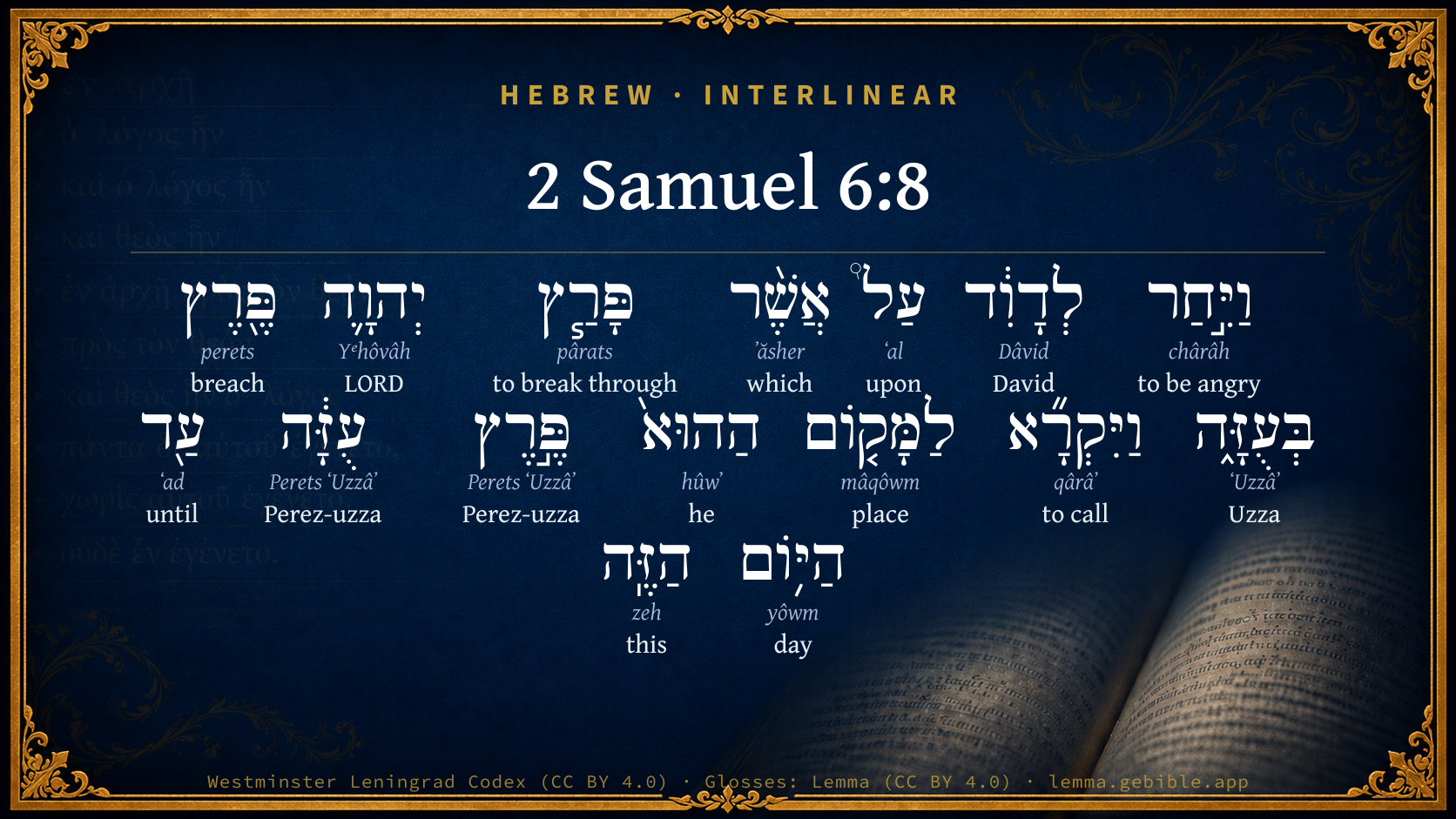
Hebrew (Westminster Leningrad Codex) 2 Samuel 6:8 appears in the Hebrew Old Testament. The text above is from the Westminster Leningrad Codex. Each word links to its Strong’s number, a concise gloss, and parsing drawn from the Open Scriptures Hebrew Bible morphology. Click any word for its full Brown-Driver-Briggs (BDB) entry.
Download image
Cite this verse

2 Samuel 6:8 (World English Bible). Public Domain. Lemma interlinear Bible study tool, https://lemma.gebible.app/v/2-samuel/6/8.

Show BibTeX & RIS
BibTeX
RIS
English Translation
David was displeased, because Yahweh had broken forth on Uzzah; and he called that place Perez Uzzah, to this day.
World English Bible · Public Domain
Highlights
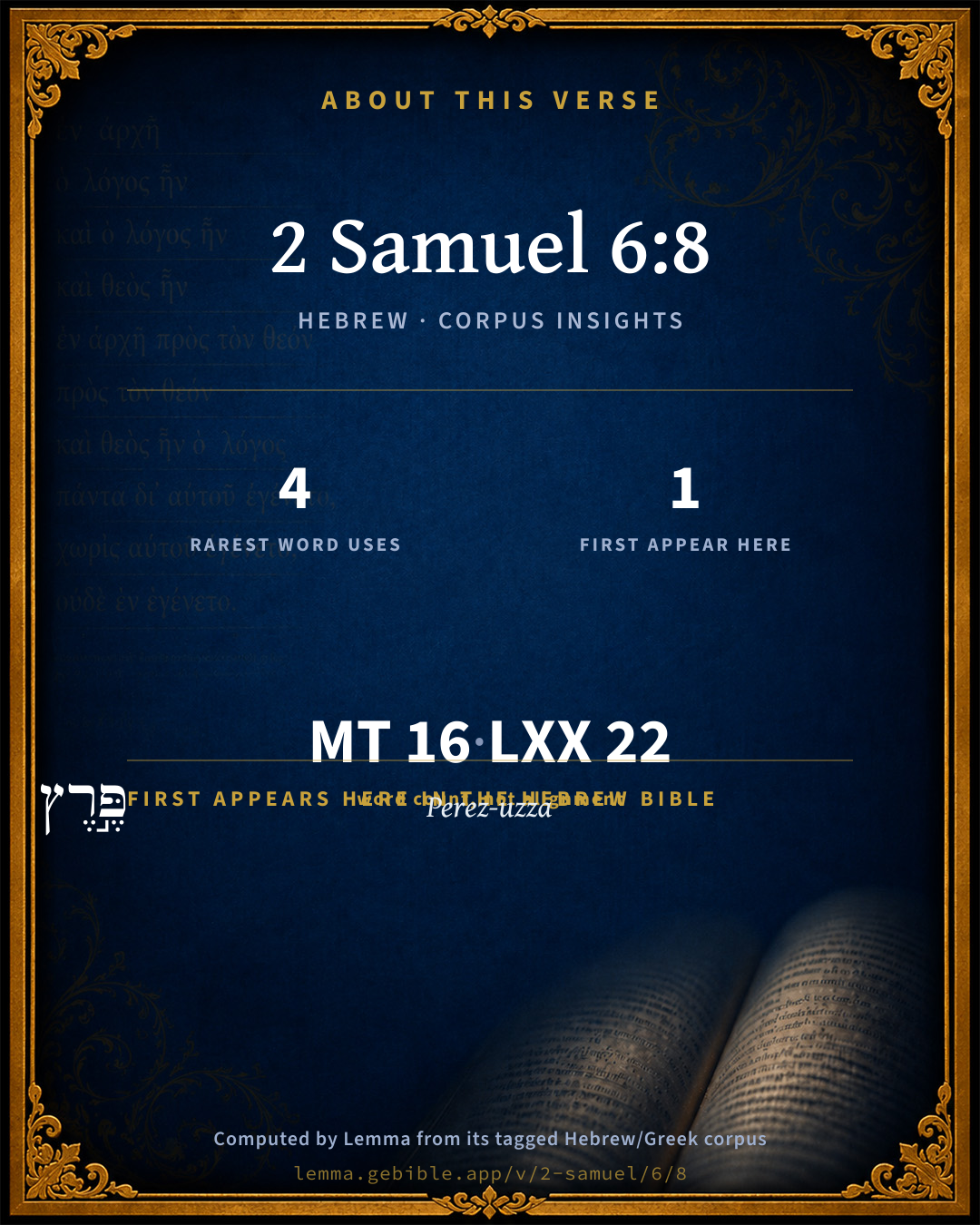
  • 1 first appearance in the Hebrew Bible
Full analysis ↓
Download a study sheet

One document with this verse’s original text, its word-by-word gloss line, the meaning frame, cross-references with their text, attributed commentary, and full source and license credits — printable, and it pastes into notes with its structure intact.

This verse Autodidact and up

Study sheet (.html) Plain text (.txt)

A passage Seminary Student

Up to 50 verses in one chapter. A passage sheet keeps up to 6 commentary sources and 12 cross-references per verse, in the order this page ranks them, and says so on the sheet whenever that leaves anything out. Ask for a single verse and you get the Autodidact verse sheet above.

Everything on this page stays free to read, with no account — the sheet is a download of what is already on screen, not access to it.

Want to remove ads? Support Godless Engineer
Compare translations 3

The same verse in 3 English versions, stacked beneath the original-language interlinear above. Click any original word for its lexicon entry.

Each is an independent rendering of the whole verse — the interlinear is not word-aligned to these translations.

Highlighted words mark where these versions differ — a whole-verse word diff, not a word-by-word alignment.

  • World English Bible Public Domain
    David was displeased, because Yahweh had broken forth on Uzzah; and he called that place Perez Uzzah, to this day.
  • King James Version Public Domain
    And David was displeased, because the LORD had made a breach upon Uzzah: and he called the name of the place Perezuzzah to this day.
  • unfoldingWord Literal Text CC BY-SA 4.0
    And it burned to David because Yahweh had broken out an outbreak against Uzzah. And he called that place Perez Uzzah, to this day.

unfoldingWord Literal Text — © unfoldingWord, licensed CC BY-SA 4.0. Word-aligned USFM3 via Door43 (git.door43.org/unfoldingWord/en_ult).

Versions to compare (up to 4)

3 of 4 selected

Show all 18 translations

Every available English version of this verse, each an independent rendering of the whole verse.

  • World English Bible Public Domain
    David was displeased, because Yahweh had broken forth on Uzzah; and he called that place Perez Uzzah, to this day.
  • Berean Standard Bible Public Domain
    Then David became angry because the LORD had burst forth against Uzzah; so he named that place Perez-uzzah, as it is called to this day.
  • Majority Standard Bible Public Domain
    Then David became angry because the LORD had burst forth against Uzzah. So he named that place Perez-uzzah, as it is called to this day.
  • King James Version Public Domain
    And David was displeased, because the LORD had made a breach upon Uzzah: and he called the name of the place Perezuzzah to this day.
  • American Standard Version (1901) Public Domain
    And David was displeased, because Jehovah had broken forth upon Uzzah; and he called that place Perez-uzzah, unto this day.
  • Revised Version (1885) Public Domain
    And David was displeased, because the LORD had broken forth upon Uzzah: and he called that place Perez-uzzah, unto this day.
  • Geneva Bible (1599) Public Domain
    And Dauid was displeased, because the Lord had smitten Vzzah: and he called the name of the place Perez Vzzah vntill this day.
  • Douay-Rheims (1899) Public Domain
    And David was grieved because the Lord had struck Oza, and the name of that place was called: The striking of Oza, to this day.
  • Young's Literal Translation Public Domain
    And it is displeasing to David, because that Jehovah hath broken forth a breach upon Uzzah, and `one' calleth that place Perez-Uzzah, unto this day;
  • Literal Standard Version CC BY-SA 4.0
    And it is displeasing to David, because that YHWH has broken forth a breach on Uzzah, and [one] calls that place Perez-Uzzah to this day;
  • Unlocked Literal Bible CC BY-SA 4.0
    David was angry because Yahweh had attacked Uzzah, and he called the name of that place Perez Uzzah. That place is called Perez Uzza to this day.
  • unfoldingWord Literal Text CC BY-SA 4.0
    And it burned to David because Yahweh had broken out an outbreak against Uzzah. And he called that place Perez Uzzah, to this day.
  • Darby Bible Public Domain
    And David was indignant, because Jehovah had made a breach upon Uzzah; and he called that place Perez-Uzzah to this day.
  • World Messianic Bible Public Domain
    David was displeased because the LORD had broken out against Uzzah; and he called that place Perez Uzzah to this day.
  • Webster's Bible Public Domain
    And David was displeased, because the LORD had made a breach upon Uzzah: and he called the name of the place Perez-uzzah to this day.
  • Free Bible Version CC BY-SA 4.0
    David was angry because of the Lord's violent outburst against Uzzah. He called the place Perez-uzzah, which is still its name today.
  • Bible in Basic English Public Domain
    And David was angry because of the Lord's outburst of wrath against Uzzah: and he gave that place the name Perez-uzzah, which is its name to this day.
  • JPS Tanakh (1917) Public Domain
    And David was displeased, because the LORD had broken forth upon Uzzah; and that place was called Perez-uzzah, unto this day

Literal Standard Version (2020), Covenant Press — licensed CC BY-SA 4.0. Text via the HelloAO Bible API (eBible.org). Unlocked Literal Bible (unfoldingWord) — licensed CC BY-SA 4.0. Text via the HelloAO Bible API (eBible.org). unfoldingWord Literal Text — © unfoldingWord, licensed CC BY-SA 4.0. Word-aligned USFM3 via Door43 (git.door43.org/unfoldingWord/en_ult). Free Bible Version, Dr. Jonathan Gallagher — licensed CC BY-SA 4.0. Text via the HelloAO Bible API (eBible.org).

Word by word

More ways to search: Search by grammar → Find every occurrence → Compare this word →

Practice this passage: Drill this verse → Learn its vocabulary →

פֶּ֣רֶץ
Perets ʻUzzâʼ
H6560
“Perez-uzza”
Noun, Proper
Part of Speech
Noun
Type
Proper
Full BDB Definition

Origin: from H6556 and H5798

TWOT: None

Perez-uzza = "breach of Uzza" - the place where Uzzah was slain by God for touching the Ark; located close to Jerusalem
  1. וַיִּ֣חַר chârâh H2734 “and · to be angry” Conjunction + Verb, Qal, Sequential Imperfect, 3rd Person, Masculine, Singular
  2. לְדָוִ֔ד Dâvid H1732 “to/for · David” Preposition + Noun, Proper
  3. עַל֩ ʻal H5921 “upon” Preposition
  4. אֲשֶׁ֨ר ʼăsher H834 “which” Particle, Relative
  5. פָּרַ֧ץ pârats H6555 “to break through” Verb, Qal, Perfect, 3rd Person, Masculine, Singular
  6. יְהוָ֛ה Yᵉhôvâh H3068 “LORD” Noun, Proper
  7. פֶּ֖רֶץ perets H6556 “breach” Noun, Common, Masculine, Singular, Absolute
  8. בְּעֻזָּ֑ה ʻUzzâʼ H5798 “in/at · Uzza” Preposition + Noun, Proper
  9. וַיִּקְרָ֞א qârâʼ H7121 “and · to call” Conjunction + Verb, Qal, Sequential Imperfect, 3rd Person, Masculine, Singular
  10. לַמָּק֤וֹם mâqôwm H4725 “to/for the · place” Preposition, Determined + Noun, Common, Masculine, Singular, Absolute
  11. הַהוּא֙ hûwʼ H1931 “the · he” Particle, Definite Article + Pronoun, Personal, 3rd Person, Masculine, Singular
  12. עֻזָּ֔ה Perets ʻUzzâʼ H6560 “Perez-uzza” Noun, Proper
  13. עַ֖ד ʻad H5704 “until” Preposition
  14. הַיּ֥וֹם yôwm H3117 “the · day” Particle, Definite Article + Noun, Common, Masculine, Singular, Absolute
  15. הַזֶּֽה zeh H2088 “the · this” Particle, Definite Article + Pronoun, Demonstrative, Masculine, Singular

About this verse

These counts appear in no published source. They are computed here, from the morphology-tagged text and Lemma’s own curated glosses. What Lemma adds →

16
words
15
distinct lemmas
Historical
section

Notable vocabulary

The rarest word here is פֶּ֣רֶץ Perez-uzza H6560 — appearing just 4 times in the whole Hebrew Bible.

First appearance in Scripture

This word makes its first canonical appearance in the Hebrew Bible here:

  • פֶּ֣רֶץ Perez-uzza H6560

Shared distinctive vocabulary

פֶּ֣רֶץ Perez-uzza H6560 occurs in 2 verses of the Hebrew Bible. Also found in:

Grammatical profile

  • 3 verbs
  • 8 nouns
  • 2 pronouns
  • 2 prepositions
  • 1 particle

Verb forms

  • וַיִּ֣חַר Qal · Sequential Imperfect
  • פָּרַ֧ץ Qal · Perfect
  • וַיִּקְרָ֞א Qal · Sequential Imperfect

Repetition

A word recurs within this verse — often emphatic in Hebrew:

  • פֶּ֣רֶץ Perez-uzza H6560 ×2

Hebrew & Septuagint length

In English translation the verse runs 20 words from the Hebrew and 24 from the Septuagint (LXX English) — closely comparable.

A rough comparison of the two English renderings, which tokenize alike — not a word-level alignment.

Word counts can differ between the Hebrew and the Greek without any difference in meaning — e.g. the Hebrew direct-object marker אֵת has no separate Greek word, and Greek often adds the article ὁ.

In the original languages it is 16 Hebrew tokens and 22 Greek tokens — but the two are counted differently (Hebrew bundles its prefixes and suffixes into one token; the Greek is in lemma form), so that isn’t a like-for-like length.

Cross-references

3

Topical passages linked to 2 Samuel 6:8 in the Treasury of Scripture Knowledge — connected by theme and wording, ordered by reader-vote popularity; previews shown in the World English Bible.

  • 1 Chronicles 13:11–12 David was displeased, because Yahweh had broken forth on Uzza; and he called that place Perez Uzza, to this day.
  • Jonah 4:1 But it displeased Jonah exceedingly, and he was angry.
  • Jonah 4:9 God said to Jonah, "Is it right for you to be angry about the vine?" He said, "I am right to be angry, even to death."

Cross-references courtesy of OpenBible.info (CC BY 4.0).

Hebrew and Greek witnesses Masoretic Hebrew ↔ Greek Septuagint

The same verse in the two great witnesses to the Old Testament, shown verse-for-verse.

These are two independent witnesses, not word-aligned to each other, and the Septuagint is shown in lemma (dictionary) form.

Hebrew 2 Samuel 6:8 Masoretic · Westminster Leningrad Codex

וַיִּ֣חַר לְדָוִ֔ד עַל֩ אֲשֶׁ֨ר פָּרַ֧ץ יְהוָ֛ה פֶּ֖רֶץ בְּעֻזָּ֑ה וַיִּקְרָ֞א לַמָּק֤וֹם הַהוּא֙ פֶּ֣רֶץ עֻזָּ֔ה עַ֖ד הַיּ֥וֹם הַזֶּֽה

David was displeased, because Yahweh had broken forth on Uzzah; and he called that place Perez Uzzah, to this day.

World English Bible · Public Domain

Greek LXX 2 Samuel 6:8 Septuagint · lemma form

καί θυμόω δαυίδ ὑπέρ ὅς διακόπτω κύριος διακοπή ἐν ὁ οζα καί καλέω ὁ τόπος ἐκεῖνος διακοπή οζα ἕως ὁ ἡμέρα οὗτος

And David was dispirited because the Lord made a breach upon Oza; and that place was called the breach of Oza until this day.

LXX2012 (modern English Septuagint) · Public Domain

Hebrew: Westminster Leningrad Codex (CC BY 4.0). Greek: Septuagint (public domain); English from LXX2012 (modern English Septuagint) (Public Domain). How the Septuagint differs from the Hebrew →

Targum (Aramaic paraphrase)

1

The Targum is the ancient Jewish Aramaic paraphrase of the Hebrew Scriptures — an interpretive translation, not the Hebrew text itself. Onkelos (literal) and Pseudo-Jonathan (expansive) render the Torah, and Jonathan the Prophets. Coverage is partial: where no permissively-licensed English translation exists for a verse, only the Aramaic is shown. This is verse-level text, not a word-by-word alignment to the Hebrew.

  1. Targum Jonathan Prophets (Joshua–Malachi)
    וּתְקֵיף לְדָוִד עַל דִתְרַע יְיָ תִּרְעֲתָא בְּעֻזָה וּקְרָא לְאַתְרָא הַהוּא אַתְרָא דְמִית בֵּיהּ עֻזָה עַד יוֹמָא הָדֵין:

    (no public-domain English translation for this verse)

    Targum Jonathan — Aramaic: “Mikraot Gedolot” (public domain). English: “Sefaria Community Translation” (CC0 1.0 (public-domain dedication)); “London "Chaldee Paraphrase," 1871” (public domain). Text via Sefaria.

Commentary

Notes on 2 Samuel 6:8 from classic Christian and Jewish commentators (each source and its license shown beneath its notes). The classic Christian expositions comment on the surrounding passage and are grouped to its opening verse, so a note may address several verses; the Jewish commentaries on the Tanakh (Rashi and others) are per-verse, so they appear only where the commentator wrote on this verse.

Lemma curates 59 commentaries, every one of them public domain or Creative Commons licensed, each selected and text-cleaned for this edition rather than reprinted as found. About our sources →

Trapp's Complete Commentary

John Trapp

2Sa 6:8 And David was displeased, because the LORD had made a breach upon Uzzah: and he called the name of the place Perezuzzah to this day.

Ver. 8. And David was displeased,] {a} He was in a pet, in a passion, in a fit of discontent, if he could have told at whom or at what: and how untowardly spake he, as if the fault were more in God than in himself! Dogs in a chase bark at their own masters sometimes. It troubled David that all the people’s joy should be so suddenly dashed and damped with this sad disaster; and he had somewhat to do to strike sail and stoop.

{a} Et exarsit Davidi, sc., nasus; quae est descriptio irae. - Pisc.

John Trapp, A Commentary or Exposition upon All the Books of the Old and New Testament (1647–1656) — public domain. Text from a community e-Sword module.

Joseph Benson's Commentary

2Sa 6:8. David was displeased — Or rather, grieved, both for the sin, and for God’s heavy judgment; whereby their hopes were dashed, and their joys interrupted. Because the Lord had made a breach upon Uzzah — He was sorry that there was any cause for such a breach or destruction, and perhaps was afraid also that he himself might suffer for not taking better care about carrying the ark. Perez-uzzah — That is, the breach of Uzzah. Thus he called the place in memory of this dreadful stroke, that thereby the Levites, and all others, might be admonished of their duty.

Joseph Benson's Commentary on the Old and New Testaments (1811–1818) — public domain. Text from a community e-Sword module.

Tyndale Open Study Notes

Tyndale Open Resources

6:8 David was angry . . . the Lord’s anger: Cp. Gen 4:5; 1 Sam 15:11; Jon 4:1; Luke 15:27-28. • Perez-uzzah: The first part of this name appears in 2 Sam 5:20 (Baal-perazim) as the place where God burst through the Philistine ranks.

Tyndale Open Study Notes — © Tyndale Open Resources, licensed CC BY-SA 4.0. Text via the HelloAO Bible API.

Geneva Bible (1599)

Geneva Bible translators

Hebrew, made a breach.

Or, the division of Uzzah.

Geneva Bible (1599) marginal notes — public domain. Text via Bolls.life.

Ellicott's Commentary for English Readers

(8) Was displeased.—More exactly, was angry. The cause of his vexation was the Divine judgment upon Uzzah; yet it does not follow that he was angry with God, but rather was simply vexed and disturbed at this most untoward interruption of his plans.

Made a breach.—Comp. Exo_19:22, where the same word is used of a sudden Divine visitation upon irreverence. The phrase “to this day” is extremely indefinite, and might have been used either ten years or centuries after the event.

A Bible Commentary for English Readers, edited by Charles John Ellicott (1878–1897) — public domain. Text from a community e-Sword module.

The Cambridge Bible for Schools and Colleges

gen. ed. J. J. S. Perowne

8. was displeased] The same word is used in 1Sa_15:11 (E. V. it grieved Samuel) to denote vexation akin to anger.

made a breach] Broke forth upon Uzzah: the same verb as in ch. 2Sa_5:20 : used in a precisely similar sense of a sudden divine judgment in Exo_19:22; Exo_19:24.

The Cambridge Bible for Schools and Colleges (gen. ed. J. J. S. Perowne; Cambridge University Press, 1878–1918) — public domain. Text from a community e-Sword module.

John Gill's Exposition

And David was afraid of the Lord that day,.... Lest he should be smitten for his error also, and especially as he had discovered some resentment at the Lord's dealing with Uzzah; when he ought to have been still and quiet, and submitted to the will of God, and owned his justice in it, confessed his own error, and been thankful for his sparing mercy vouchsafed to him:

and said, how shall the ark of the Lord come to me? the meaning of which is not, how it should be brought to the place provided by him in Jerusalem, now Uzzah was dead, for there were Levites enough to carry it, as they afterwards did; but as signifying that it would be either boldness and presumption in him to do it, since God had shown such a mark of his displeasure at their proceeding, that he might be in doubt whether it was the will of God it should come to him; or as fearing it would be dangerous to him to have it with him, since he might be guilty of such an error, of the same, or like it, that had been committed.

John Gill's Exposition of the Whole Bible (1746–1763) — public domain (CC PDM 1.0). Text via the HelloAO Bible API.

Albert Barnes' Notes on the Bible

Displeased - Grief allied to anger seems to be intended. Compare 1Sa 15:11 note. On the name of the place, compare 2Sa 5:20.

Albert Barnes' Notes on the Bible (1834–1885) — public domain. Text from a community e-Sword/MySword module.

Matthew Poole's English Annotations

David was displeased, or, grieved, both for the sin, which he acknowledgeth, 1Ch 15:2,13, and for God’s heavy judgment; whereby their hopes were dashed, and their joys interrupted, and a good subject struck dead for the circumstantial error of a pious mind, which he might possibly think harsh and very severe, and therefore be displeased or offended at this sharp providence.

Matthew Poole's English Annotations on the Holy Bible (1683–1685) — public domain. Text from a community e-Sword/MySword module.

Whedon's Commentary on the Bible

Daniel D. Whedon

8. David was displeased — Mortified and chagrined at the sudden and unhappy interruption of the triumphal procession. Various passions for the moment revelled in his soul. He was angry with himself for neglect and carelessness in allowing the ark to be removed in this way, and afterwards, according to 1Ch_15:2; 1Ch_15:13, he said: “None ought to carry the ark of God but the Levites. For because ye did it not at the first, the Lord our God made a breach upon us.”

Because the Lord had made a breach upon Uzzah — Because of the neglect and carelessness which occasioned the demand for such a judgment from the Lord. David was not angry against God, for the next verse tells us that he was afraid of him.

Made a breach — Violently interposed in a sudden stroke of Divine judgment.

Daniel D. Whedon (gen. ed.), Commentary on the Old and New Testaments (1874–1909) — public domain. Text from a community e-Sword module.

The Pulpit Commentary

David was displeased; Hebrew, David was angry. Neither David nor his people had intended any disrespect, and so severe a punishment for what was at most a thoughtless act seemed to him unjust. Uzzah"s death was probably caused by apoplexy, and the sudden effort of stretching forth his hand and seizing the ark had been its immediate cause. So tragic an event spoiled the happiness of the day, filled all present with disappointment, made them break off in haste from the grand ceremonial, and placed David before his subjects in the position of a malefactor. He had prepared a great religious festival, and Jehovah had broken in upon them as an enemy. In his first burst of displeasure he called the place Perez-Uzzah, the word "Perez," or "Breach," conveying to the Hebrews the idea of a great calamity (Jud_1:21:15) or of a sudden attack upon a foe. (2Sa_5:20) The historian adds that the place bore this name unto his day; but we cannot tell whether these are the words of the original compiler of the Book of Samuel, or, as is more probably the case, those of some subsequent editor or scribe. Many such remarks are supposed to have been inserted by Ezra and the men of the great synagogue.

The Pulpit Commentary (1880–1919), ed. H.D.M. Spence-Jones & Joseph S. Exell — public domain. Text from a community e-Sword module.

John Wesley's Explanatory Notes

Displeased - Or, grieved, both for the sin, and for God's heavy judgment; whereby their hopes were dashed, and their joys interrupted. Perez-uzzah - That is, the breach of Uzzah.

John Wesley, Explanatory Notes Upon the Whole Bible (1754–1765) — public domain. Text via the GEBible commentary corpus.

unfoldingWord translationNotes

Door43 World Missions Community

Perez Uzzah

This is the name of a place. Translator may add a footnote that says, "The name 'Perez Uzzah' means 'the punishment of Uzzah.'" (See: How to Translate Names)

to this day

This means to the time when this was being written, not to the present time in the twenty-first century.

How can the ark of Yahweh come to me?

David uses this question to emphasize that he is afraid to take the ark to Jerusalem. AT: "I am too afraid to bring the ark of Yahweh with me to Jerusalem." (See: Rhetorical Question)

translationWords

David

anger

fear

Yahweh

unfoldingWord translationNotes — © Distant Shores Media and the Door43 World Missions Community, licensed CC BY-SA 4.0. Source: git.door43.org/Door43/en_tn.

Lesson kit

Teaching starters — assembled from the data on this page, not authored interpretation. Every prompt links to the verse data it draws on. Edit before teaching.

2 Samuel, in the Historical, opens this verse with 16 words (15 distinct Hebrew lemmas). Its most distinctive word is Perets ʻUzzâʼ (“Perez-uzza”). A historical commentator’s framing appears above. Read the whole chapter for the surrounding context.

Discussion questions

  1. The word Perets ʻUzzâʼ carries the sense “Perez-uzza.” How does it shape the verse?
  2. This is the first place “Perez-uzza” appears in Scripture (first appears here). What does its debut here establish?
  3. How does 1 Chronicles 13:11, which shares the word «Perez-uzza», read alongside this verse?
  4. What does the repetition of “Perez-uzza” (2× in this one verse) do in this verse?
  5. These translations render this verse differently; the difference is in the English rendering, not the original. What questions does that raise?
  6. «וַיִּ֣חַר» is a Qal Sequential Imperfect verb. How does that grammatical form shape the action described?
  7. Compare how Trapp's Complete Commentary and Joseph Benson's Commentary read this verse. Where do they agree or differ?

Things to notice

Reading settings

Reading text

Shown beneath each verse's original-language words.

Old Testament
Old Testament edition

Read the OT as the Masoretic Hebrew (MT) or the Greek Septuagint (LXX).

English shown for the Greek Septuagint (in the Hebrew ↔ Greek comparison).

Comparing translations? Open the Compare panel on any verse page to stack up to four side by side.