2 Thessalonians 1:4

Greek (Tischendorf 8th ed.) 2 Thessalonians 1:4 appears in the Greek New Testament. The text above is from the Tischendorf 8th edition. Each word links to its Strong’s number and a concise gloss. Click any word for its full Thayer’s Greek Lexicon entry.
Download image
Cite this verse

2 Thessalonians 1:4 (World English Bible). Public Domain. Lemma interlinear Bible study tool, https://lemma.gebible.app/v/2-thessalonians/1/4.

Show BibTeX & RIS
BibTeX
RIS
English Translation
so that we ourselves boast about you in the assemblies of God for your patience and faith in all your persecutions and in the afflictions which you endure.
World English Bible · Public Domain
Download a study sheet

One document with this verse’s original text, its word-by-word gloss line, the meaning frame, cross-references with their text, attributed commentary, and full source and license credits — printable, and it pastes into notes with its structure intact.

This verse Autodidact and up

Study sheet (.html) Plain text (.txt)

A passage Seminary Student

Up to 50 verses in one chapter. A passage sheet keeps up to 6 commentary sources and 12 cross-references per verse, in the order this page ranks them, and says so on the sheet whenever that leaves anything out. Ask for a single verse and you get the Autodidact verse sheet above.

Everything on this page stays free to read, with no account — the sheet is a download of what is already on screen, not access to it.

Want to remove ads? Support Godless Engineer
Compare translations 3

The same verse in 3 English versions, stacked beneath the original-language interlinear above. Click any original word for its lexicon entry.

Each is an independent rendering of the whole verse — the interlinear is not word-aligned to these translations.

Highlighted words mark where these versions differ — a whole-verse word diff, not a word-by-word alignment.

  • World English Bible Public Domain
    so that we ourselves boast about you in the assemblies of God for your patience and faith in all your persecutions and in the afflictions which you endure.
  • King James Version Public Domain
    So that we ourselves glory in you in the churches of God for your patience and faith in all your persecutions and tribulations that ye endure:
  • unfoldingWord Literal Text CC BY-SA 4.0
    so that we ourselves boast concerning you among the churches of God about your endurance and faith in all your persecutions and afflictions that you endure,

unfoldingWord Literal Text — © unfoldingWord, licensed CC BY-SA 4.0. Word-aligned USFM3 via Door43 (git.door43.org/unfoldingWord/en_ult).

Versions to compare (up to 4)

3 of 4 selected

Show all 19 translations

Every available English version of this verse, each an independent rendering of the whole verse.

  • World English Bible Public Domain
    so that we ourselves boast about you in the assemblies of God for your patience and faith in all your persecutions and in the afflictions which you endure.
  • Berean Standard Bible Public Domain
    That is why we boast among God’s churches about your perseverance and faith in the face of all the persecution and affliction you are enduring.
  • Majority Standard Bible Public Domain
    That is why we boast among God’s churches about your perseverance and faith in the face of all the persecution and affliction you are enduring.
  • King James Version Public Domain
    So that we ourselves glory in you in the churches of God for your patience and faith in all your persecutions and tribulations that ye endure:
  • American Standard Version (1901) Public Domain
    so that we ourselves glory in you in the churches of God for your patience and faith in all your persecutions and in the afflictions which ye endure;
  • Revised Version (1885) Public Domain
    so that we ourselves glory in you in the churches of God for your patience and faith in all your persecutions and in the afflictions which ye endure;
  • Geneva Bible (1599) Public Domain
    So that we our selues reioyce of you in the Churches of God, because of your patience and faith in al your persecutions and tribulatios that ye suffer,
  • Douay-Rheims (1899) Public Domain
    So that we ourselves also glory in you in the churches of God, for your patience and faith, and in all your persecutions and tribulations, which you endure,
  • Young's Literal Translation Public Domain
    so that we ourselves do glory in you in the assemblies of God, for your endurance and faith in all your persecutions and tribulations that ye bear;
  • Literal Standard Version CC BY-SA 4.0
    so that we ourselves glory in you in the assemblies of God, for your endurance and faith in all your persecutions and tribulations that you bear—
  • Unlocked Literal Bible CC BY-SA 4.0
    So we ourselves speak proudly about you among the churches of God. We talk about your patience and faith in all your persecutions. We talk about the afflictions that you endure.
  • unfoldingWord Literal Text CC BY-SA 4.0
    so that we ourselves boast concerning you among the churches of God about your endurance and faith in all your persecutions and afflictions that you endure,
  • Darby Bible Public Domain
    so that we ourselves make our boast in you in the assemblies of God for your endurance and faith in all your persecutions and tribulations, which ye are sustaining;
  • World Messianic Bible Public Domain
    so that we ourselves boast about you in the assemblies of God for your perseverance and faith in all your persecutions and in the afflictions which you endure.
  • Webster's Bible Public Domain
    So that we ourselves glory in you in the churches of God, for your patience and faith in all your persecutions and tribulations that ye endure:
  • Free Bible Version CC BY-SA 4.0
    We speak so proudly of you among the churches of God because of your patient courage and trust in God during all the persecution and trouble you're going through.
  • Bible in Basic English Public Domain
    So that we ourselves take pride in you in the churches of God for your untroubled mind and your faith in all the troubles and sorrows which you are going through;
  • Text-Critical English NT CC BY 4.0
    As a result we ourselves boast about you in the churches of God for your perseverance and faithfulness in all the persecutions and tribulations that you are enduring.
  • Tyndale New Testament (1534) Public Domain
    so that we oureselves reioyce of you in the congregacions of God over youre pacience and fayth in all youre persecucions and tribulacions that ye suffre

Literal Standard Version (2020), Covenant Press — licensed CC BY-SA 4.0. Text via the HelloAO Bible API (eBible.org). Unlocked Literal Bible (unfoldingWord) — licensed CC BY-SA 4.0. Text via the HelloAO Bible API (eBible.org). unfoldingWord Literal Text — © unfoldingWord, licensed CC BY-SA 4.0. Word-aligned USFM3 via Door43 (git.door43.org/unfoldingWord/en_ult). Free Bible Version, Dr. Jonathan Gallagher — licensed CC BY-SA 4.0. Text via the HelloAO Bible API (eBible.org).

Word by word

More ways to search: Search by grammar → Find every occurrence → Compare this word →

Practice this passage: Drill this verse → Learn its vocabulary →

διωγμοῖς
diōgmós
G1375
“persecution”
Noun, Dative, Plural, Masculine
Part of Speech
Noun
Case
Dative
Number
Plural
Gender
Masculine
Full Thayer's Definition

Origin: from G1377

TDNT: None

1. persecution
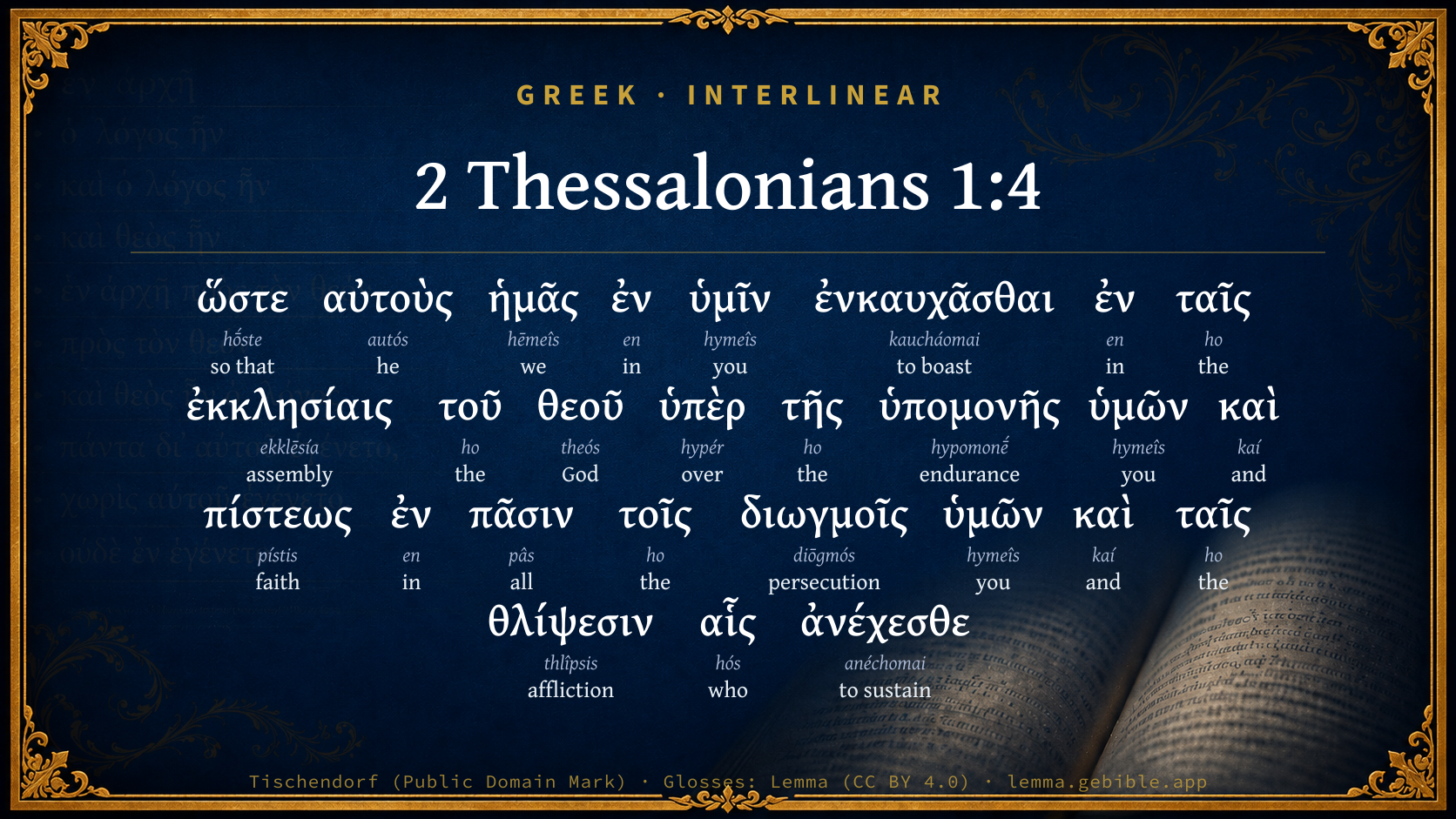
  1. ὥστε hṓste G5620 “so that” Conjunction
  2. αὐτοὺς autós G846 “he” Personal pronoun, Accusative, Plural, Masculine
  3. ἡμᾶς hēmeîs G2249 “we” Personal pronoun, 1st person, Accusative, Plural
  4. ἐν en G1722 “in” Preposition
  5. ὑμῖν hymeîs G5210 “you” Personal pronoun, 2nd person, Dative, Plural
  6. ἐνκαυχᾶσθαι kaucháomai G2744 “to boast” Verb, Present, Middle or Passive deponent, Infinitive
  7. ἐν en G1722 “in” Preposition
  8. ταῖς ho G3588 “the” Article, Dative, Plural, Feminine
  9. ἐκκλησίαις ekklēsía G1577 “assembly” Noun, Dative, Plural, Feminine
  10. τοῦ ho G3588 “the” Article, Genitive, Singular, Masculine
  11. θεοῦ theós G2316 “God” Noun, Genitive, Singular, Masculine
  12. ὑπὲρ hypér G5228 “over” Preposition
  13. τῆς ho G3588 “the” Article, Genitive, Singular, Feminine
  14. ὑπομονῆς hypomonḗ G5281 “endurance” Noun, Genitive, Singular, Feminine
  15. ὑμῶν hymeîs G5210 “you” Personal pronoun, 2nd person, Genitive, Plural
  16. καὶ kaí G2532 “and” Conjunction
  17. πίστεως pístis G4102 “faith” Noun, Genitive, Singular, Feminine
  18. ἐν en G1722 “in” Preposition
  19. πᾶσιν pâs G3956 “all” Adjective, Dative, Plural, Masculine
  20. τοῖς ho G3588 “the” Article, Dative, Plural, Masculine
  21. ὑμῶν hymeîs G5210 “you” Personal pronoun, 2nd person, Genitive, Plural
  22. καὶ kaí G2532 “and” Conjunction
  23. ταῖς ho G3588 “the” Article, Dative, Plural, Feminine
  24. θλίψεσιν thlîpsis G2347 “affliction” Noun, Dative, Plural, Feminine
  25. αἷς hós G3739 “who” Relative pronoun, Dative, Plural, Feminine
  26. ἀνέχεσθε anéchomai G430 “to sustain” Verb, Present, Middle or Passive deponent, Indicative, 2nd person, Plural

About this verse

These counts appear in no published source. They are computed here, from the morphology-tagged text and Lemma’s own curated glosses. What Lemma adds →

27
words
18
distinct lemmas
Pauline Epistles
section

Notable vocabulary

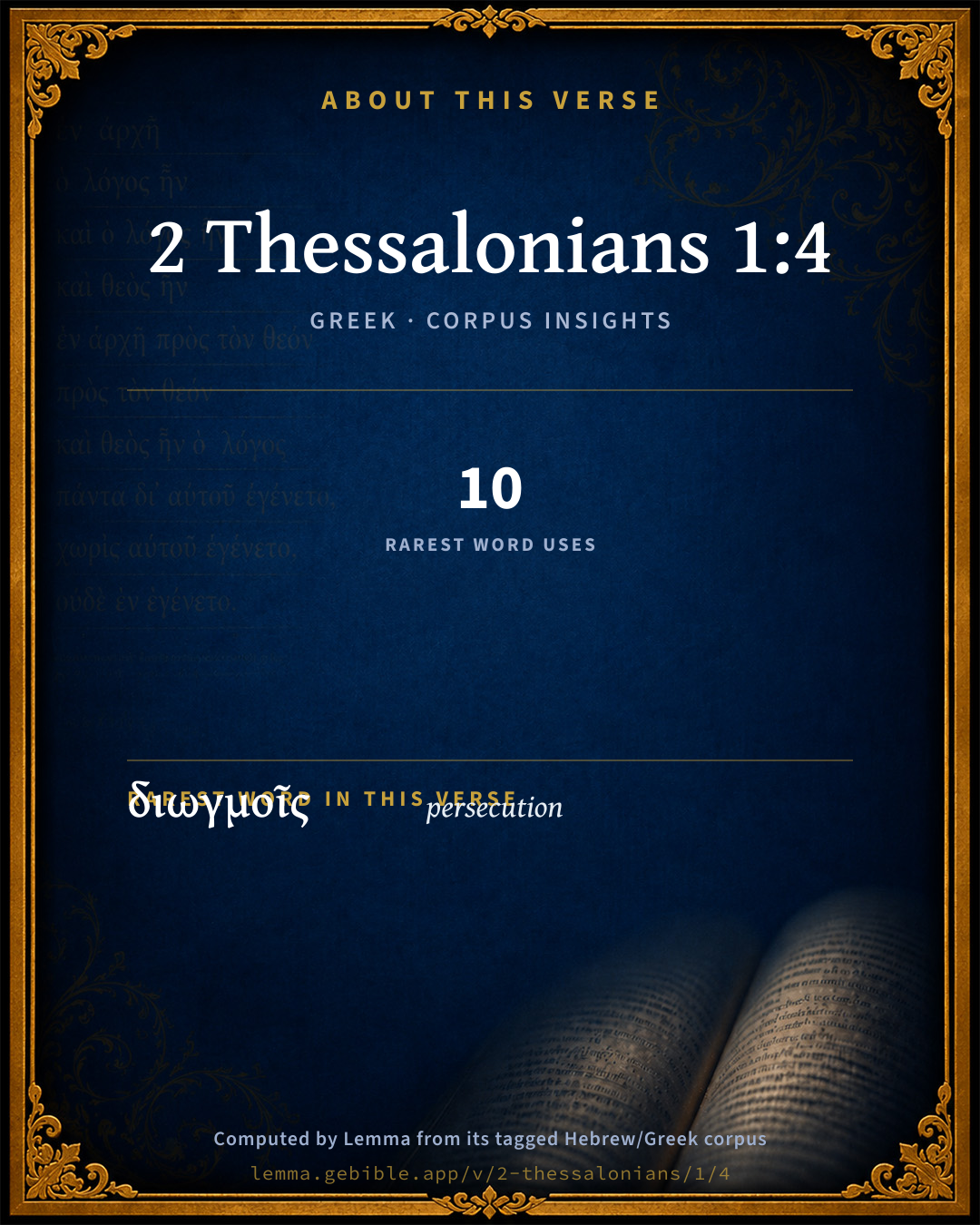
The rarest word here is διωγμοῖς persecution G1375 — appearing just 10 times in the whole Greek New Testament.

Shared distinctive vocabulary

διωγμοῖς persecution G1375 occurs in 9 verses of the Greek New Testament. Also found in:

Repetition

Words recur within this verse:

Cross-references

21

Topical passages linked to 2 Thessalonians 1:4 in the Treasury of Scripture Knowledge — connected by theme and wording, ordered by reader-vote popularity; previews shown in the World English Bible.

  • Hebrews 10:36 For you need endurance so that, having done the will of God, you may receive the promise.
  • James 5:7–8 Be patient therefore, brothers, until the coming of the Lord. Behold, the farmer waits for the precious fruit of the earth, being patient over it, until it receives the early and late rain.
  • Hebrews 12:1–3 Therefore let us also, seeing we are surrounded by so great a cloud of witnesses, lay aside every weight and the sin which so easily entangles us, and let us run with patience the race that is set before us,
  • 2 Corinthians 7:14 For if in anything I have boasted to him on your behalf, I was not disappointed. But as we spoke all things to you in truth, so our glorying also which I made before Titus was found to be truth.
  • 1 Thessalonians 2:14 For you, brothers, became imitators of the assemblies of God which are in Judea in Christ Jesus; for you also suffered the same things from your own countrymen, even as they did from the Jews;
  • 1 Thessalonians 1:3 remembering without ceasing your work of faith and labor of love and patience of hope in our Lord Jesus Christ, before our God and Father.
  • 1 Thessalonians 2:19 For what is our hope, or joy, or crown of rejoicing? Isn't it even you, before our Lord Jesus at his coming?
  • Romans 5:3–5 Not only this, but we also rejoice in our sufferings, knowing that suffering works perseverance;
  • 1 Corinthians 7:17 Only, as the Lord has distributed to each man, as God has called each, so let him walk. So I command in all the assemblies.
  • Revelation 14:12 Here is the patience of the saints, those who keep the commandments of God, and the faith of Jesus."
  • Romans 8:25 But if we hope for that which we don't see, we wait for it with patience.
  • 2 Corinthians 9:2 for I know your readiness, of which I boast on your behalf to them of Macedonia, that Achaia has been prepared for a year past. Your zeal has stirred up very many of them.
  • 2 Corinthians 9:4 so that I won't by any means, if there come with me any of Macedonia and find you unprepared, we (to say nothing of you) should be disappointed in this confident boasting.
  • 1 Thessalonians 3:2–8 and sent Timothy, our brother and God's servant in the Gospel of Christ, to establish you, and to comfort you concerning your faith;
  • 2 Thessalonians 3:5 May the Lord direct your hearts into the love of God, and into the patience of Christ.
  • Hebrews 6:15 Thus, having patiently endured, he obtained the promise.
  • James 5:11 Behold, we call them blessed who endured. You have heard of the patience of Job, and have seen the Lord in the outcome, and how the Lord is full of compassion and mercy.
  • 2 Peter 1:6 and in knowledge, self-control; and in self-control patience; and in patience godliness;
  • Romans 2:7 to those who by patience in well-doing seek for glory and honor and incorruptibility, eternal life;
  • Romans 12:12 rejoicing in hope; enduring in troubles; continuing steadfastly in prayer;
  • James 1:3–4 knowing that the testing of your faith produces endurance.

Cross-references courtesy of OpenBible.info (CC BY 4.0).

Commentary

Notes on 2 Thessalonians 1:4 from classic Christian and Jewish commentators (each source and its license shown beneath its notes). The classic Christian expositions comment on the surrounding passage and are grouped to its opening verse, so a note may address several verses; the Jewish commentaries on the Tanakh (Rashi and others) are per-verse, so they appear only where the commentator wrote on this verse.

Lemma curates 59 commentaries, every one of them public domain or Creative Commons licensed, each selected and text-cleaned for this edition rather than reprinted as found. About our sources →

The Biblical Illustrator

Joseph S. Exell

2Th_1:4

So that we ourselves glory in you in the churches of God for your patience and faith

The apostolic commendation

I.

The manner.

1. The person commending--We ourselves. In 1Th_1:8 he speaks of their faith as praised by others: here he justifies common fame by His own testimony.

(1) It is easy to deceive the credulous multitude, but to deserve esteem of those who are best able to judge is a comfort.

(2) Where grace is eminent it may be praised without suspicion of flattery.

(3) We should keep up the value of our testimony that it may be of weight to those who receive it.

2. The act of praising. Glorying imports exaltation or rejoicing of mind and the outward expression: The one comes from the apprehension of some excellency, the other from a desire that others may know how we are affected with it. This glorying became apostolic gravity for--

(1) It was for the honour of God who had wrought these graces, and not himself.

(2) For the encouragement of the Thessalonians. We ought to give a testimony to those who deserve it, not to curry favour with them, but to incite them to perseverance in the way of God.

(3) For the example of others and the edification of the Church.

(4) For his own comfort (1Th_2:20).

3. The persons before whom. Not in common meetings, but where. Gods people were met for worship and spiritual benefit. Churches of God are so called because:--

(1) God instituted and founded them (Act_20:28).

(2) There God is worshipped and acknowledged (Psa_22:3):

(3) There He manifests His power and presence (Eph_2:22).

II. The matter.

1. The graces wherein they excelled faith and patience before it was faith and love. These two are often joined (Heb_6:12; Php_1:29). Faith precedes suffering, for the sufferer must first be a believer; but when God calls to it both must go together (Heb_10:35-36).

2. The grievousness of those temptations wherewith these graces were exercised.

(1) They were many--All.

(2) They took effect: persecution worked tribulation (Rom_8:35).

(3) But the Thessalonians continued, firm, endured. (T. Manton , D. D.)

The purpose of trouble

Tribulations and persecutions often befall Gods dearest and choicest servants (2Ti_3:12; Act_14:22). It is--

I. That we may be conformed to our Lord and pledge Him in His bitter cup (Col_1:24). The sufferings of Christ personal are complete and meritorious; they need not to be filled up; but the sufferings of Christ mystical (1Co_12:12) are not complete until every member of His body have their own allotted portion and share. Christians should be animated to suffer patiently by the fact that the Captain of our Salvation was made perfect through suffering (Heb_2:10). Those who will partake with Christ in His kingdom must share with Him in sorrows. Paul counted all things but dross that he might know the fellowship of Christs sufferings (Php_3:10).

II. For our trial (1Pe_1:7). A man may be deceived at other times, and think that faith strong which a trial discovers to be weak: as Peter (Mat_26:35). A man may doubt, and think his faith weak, which a trial discovers to be strong (Heb_10:32; Heb_11:34).

III. That the excellency of our spiritual state may appear. What can be more excellent than that which affords joy under the saddest temporal condition (Joh_16:33; 2Co_1:5). This will sweeten the bitter waters, like the wood in Marsh. A drop of this honey will make our bitterest cup agreeable.

IV. Because we need them (1Pe_1:6).

1. To modify our pride.

2. To keep us close to God.

3. To tame our flesh. Great prosperity perverts the best.

Conclusion:

1. With what thoughts we should take up the stricter profession of Christianity, viz., with expectations of the Cross, Many think they may be good Christians, yet all their days live a life of ease. This is just as if we should enlist as a soldier and never expect battle, or as if a mariner should go to sea and always expect a calm.

2. What fools they are that take up religion expecting honour, ease, and plenty. You may do so for a time, but the trials will come. The summer friends of the gospel, or those painted butterflies that flutter about in the sunshine of prosperity, must expect that a winter will come. (T. Manton , D. D.)

Faith and patience

I. What is patience? A contented endurance of painful evils. It is a moral virtue when by the argument of human prudence we harden ourselves to bear the evils that befall us. The spiritual grace is the fruit of the Spirit, and we bear these evils from Divine principles to Divine ends. The latter as it is wrought in us by God (Rom_15:5) so it fetcheth its strength from Gods Word (Rom_15:4). Now scriptural arguments are fetched either from the will of God who appoints us to this conflict (1Th_3:3), or from the glory of God, which is promoted thereby (Php_1:20), or else our final happiness (Jam_1:12) or from the example of Christ (1Pe_2:21). This grace of patience may be considered--

1. Barely as tried. Some give up at the first assault (Mat_13:21). Others hold up against the first brunt, but begin to be tired and wax weary in their minds (Heb_12:3).

2. As tried with many and long afflictions (Heb_10:32; Col_1:4). Many cannot bear any evil; they have no faith. Some hold out in slighter temptations for a while; they have weak faith. But the constant and unconquered patience is the fruit of strong faith.

II. What of faith is manifested by it?

1. Assent, for we must believe the truth with a Divine faith before we can suffer for it. How can we endure afflictions for supernatural things, which merely depend on revelation, unless we are firmly persuaded of their truth? (Act_14:22).

2. Consent, or fidelity to Christ in our covenanted duty (Mat_16:24). In great afflictions we are tried whether we love anything above Christ (Mat_10:37). The resolution of this consent is the thing tried, i.e., whether we are prepared to endure anything for Christs sake (Act_21:13). It is easier to discourse of patience than to practice it, as it is easier to build a castle in time of peace than to defend it in time of war.

3. Confidence, or relying upon Gods promises, which are our support. There are two sorts of promises.

(1) That God will enable you to bear them (2Ti_1:12; 2Ti_4:18; 1Co_10:13).

(2) That He will graciously reward them (Rom_8:18; 2Co_4:17).

III. The reasons.

1. Faith is the grace that is most struck at in our tribulations (Jam_1:3); therefore if a man know the strength of it in time of tribulation, then ordinarily he has a clearer proof of the truth and strength of that grace than at other times.

2. It is the grace that is of most use to us at such times (1Pe_5:9; Eph_6:16). Three benefits we have by it--

(1) It keeps us so that we do not for these things question the love of God (Isa_49:14; Psa_77:9; Heb_12:5).

(2) So that we take no sinful course for our escape (Psa_125:3; Psa_125:5). It should not shake our constancy and persuade us to do as the wicked (Isa_28:16; Heb_11:35).

(3) So that we may not faint and grow weary of duties, even of life itself, as Jonah (4:8; see Psa_27:13; Psa_42:5).

3. In such times faith is manifested. The true and sensible discovery of faith is patience under manifold tribulations.

(1) Because then we have nothing to stick unto but the comforts and supports of faith.

(2) Its proper, genuine effect is then produced to the view of both conscience and the world. What courage our belief in Gods promises has produced in us sensibly appears by enduring the greatest extremities rather than forsake the way of the Lord. (T. Manton , D. D.)

The power of patience

Among the regular and consistent worshippers at the Bohemian Church in Berlin during the ministry of Pastor Janike was a colonel at the War Office. His brother officers mocked at his piety, and used every opportunity of turning religion into ridicule. Being unable by these means to provoke the good man to indiscretions, they determined to provoke him by a more definite act of rudeness and scorn. Accordingly one of his colleagues in the office sketched a caricature of the colonel kneeling in church and receiving the holy communion. It was plain, from the entire character of the work, that a deadly hatred against the holiness of the Lord had inspired the pen that drew it. The sketch was secretly placed on the desk of the colonel, and the perpetrators of the miserable jest watched his arrival, and counted on an outburst of wrath. However, when the good man came and saw the sketch, he gravely shook his head, folded the paper, put it in his pocket, and then went on with his work, conversing with his colleagues in the usual friendly manner. A few days after the man who had drawn the shameful sketch knocked at the colonels door. The patience of the Christian was more than his conscience could bear. He came now, and with deep emotion, to apologise for his impertinence. The colonel gave him his hand, and assured him he had forgiven him everything. Not very long after this man knelt by the colonels side to receive the Lords supper, testifying with tears of gratitude that he had found Christ. From henceforth he became one of the warmest friends of the pious and long-suffering Christian. (Sunday at Home.)

Patient endurance

I shall never forget as long as I live that day where, in the glow of the eventide, as the sun was sinking and as the mists were creeping over the land, I walked with one of our native brethren by the riverside, and saw a light in the dim distance, when he said to me, Yonder is the only Christian in all that great town. Ten years ago he received Christ into his heart; his father and mother turned him out; his friends forsook him; his neighbours persecuted him; and all these years he stood his ground, scarcely getting food to eat. During all these ten years he maintained his Christian character unspotted in the midst of the heathen around him, and the native brother said to me, Now his business is reviving, because people say he sells the best things and always means what he says. I entered his humble bamboo hut and sat down on the ground by his side, and as I discoursed about his loneliness and his sadness the tears sprang into his eyes, and he said, No, I am never lonely; for as Christ was with the Hebrew children, and as He was with Daniel in the lions den, so all these years He has been with me. (A. H. Baynes.)

The Biblical Illustrator, edited by Joseph S. Exell (c. 1880s–1900s) — public domain. Text from a community e-Sword module.

The Pulpit Commentary

So that we ourselves. "We Paul and Silas and Timothy, the founders of the Church of Thessalonica. "We ourselves," not merely we of our own accord (Hofmann), but we as well as our informants, who brought us this intelligence of the increase of your faith and love. Glory in you in the Churches of God; that is, in those Churches with which we come in contact; namely, the Church at Corinth and the Churches in Achaia. It would appear from this that several Churches had been founded in Achaia, as, for example, the Church of Cenchrea. (Rom_16:1) For your patience and faith; not to be weakened as a Hebraism for "your patient faith," or "for the patience of your faith;" nor is faith to be taken in the sense of faithfulness or fidelity (Lunemann); but, as in the previous verse, it denotes "faith in Christ." Patience is steadfast endurance, which, in order to be of any value in the sight of God, must be combined with faith; stoical endurance is not here nor anywhere else inculcated in Scripture. In all your persecutions and tribulations afflictionsthat ye endure; or, are enduring; the persecution which arose when Paul was at Thessalonica being continued. The patience and faith of the Thessalonians shone the more brilliantly amid persecution and affliction, even as the stars shine brightest in the dark night. To be a true Christian in the time of peace is a great matter; but to be a true Christian in the season of persecution is a greater; faith is then tested in the furnace.

Ver. 4.

Christian patience.

1. Its nature. It denotes steadfast endurance. Negatively, not stoical endurance or apathetic fatalism. Positively, a spirit of calm submission to the providence of God and resignation to his will.

2. Its source. It has its root in faith; it is one of the fruits of the Spirit; and it is combined with hope.

3. Means of acquiring it. Pray to God as the Giver of patience; look to Christ as the Example of patience; submit to affliction as the cause of patience; cultivate faith as the support of patience; and meditate on heaven as the goal of patience.

The apostle"s interest in the Thessalonian Church as manifested by his praises of it to other Churches.

He had formerly listened to their praises from the lips of other Churches; he could now sound their praises at Corinth and elsewhere, ascribing all the while due praise to God.

I THE GROUND OF HIS PRAISES. "For your patience and faith in all your persecutions and tribulations that ye endure.

1. Afflictions, whether in the form of sharp persecution or of more general trouble, are the lot of God"s faithful children. They are "appointed thereunto". (1Th_2:3)

2. It is the glory of a Christian to bear such afflictions with patience andfaith. The Thessalonians had not been "moved by these afflictions". (1Th_3:3)

(1) Their patience was the result of their faith. "The trial of your faith worketh patience". (Jam_1:3) Their trials did not uproot their faith. They had "the patience of hope." The faith and the patience are always closely allied. "I know thy faith and thy patience". (Rev_2:19)

(2) It is for the glory of God and for the good of believers that" patience should have its perfect work" (Jam_1:4; 1Pe_2:20)

(3) It is necessary to the inheritance of the promises. (Heb_6:12 Heb_10:36)

II IT IS NOT UNLAWFUL, BUT EXPEDIENT, THAT A MINISTER SHOULD GLORY IN HIS PEOPLE. Not in their social rank, or riches, or numbers, but in the graces of the Spirit manifested in their life. The apostle elsewhere advises us not to glory in men, but in the Lord. But in this case the glory is given to God, not to man.

III IT PROMOTES THE SPIRITUAL WELFARE OF CHURCHES TO HEAR OF THE SUCCESS OF THE GOSPEL IN OTHER CHURCHES. The example of faith, love, and patience at Thessalonica would stimulate the saints in all Greece. T.C.

The Pulpit Commentary (1880–1919), ed. H.D.M. Spence-Jones & Joseph S. Exell — public domain. Text from a community e-Sword module.

Tyndale Open Study Notes

Tyndale Open Resources

1:4 Paul’s boasting to other churches about the Thessalonians’ endurance and faithfulness would stimulate the church’s resolve to endure and remain faithful in the face of great hostility (1 Thes 2:14; 3:3-4).

Tyndale Open Study Notes — © Tyndale Open Resources, licensed CC BY-SA 4.0. Text via the HelloAO Bible API.

Bengel's Gnomon

Johann Albrecht Bengel

2Th 1:4. Ἡμᾶς αὐτοὺς, we ourselves) Paul himself, with Silvanus and Timothy, gloried, as being a witness; he not merely heard of the fact from witnesses.—ὑπὲρ, for) construed with εὐχαριστεῖν, to render thanks, 2Th 1:3. Hence at the end of 2Th 1:3 we must put a comma; comp. Col 1:5, note. The parallelism [the clauses and words in 2Th 1:3-4, standing parallel to one another] gives force.—καὶ πίστεως, and faith) Faith here denotes faithful constancy in confession of the truth.

Bengel's Gnomon of the New Testament — English translation (T&T Clark, Edinburgh, 1860) — public domain. Text from a community e-Sword module.

Meyer's Critical & Exegetical Commentary

Heinrich August Wilhelm Meyer

2Th_1:4. The progress of the Thessalonians in Christianity so rejoiced the heart of the apostle, that he expresses this joy not only in thanksgiving before God, but also in praises before men.

ὥστε] refers back to ὑπεραυξάνει … ἀλλήλους.

ἡμᾶς αὐτούς] This emphatic designation of the subject might be thus explained, that otherwise such praise was not the usual custom of the speakers, but that the glorious success of the gospel in Thessalonica caused them to forget the usual limits of moderation and reserve. This opinion is, however, to be rejected, because it would then without any reason be supposed that Paul had inaccurately written ἡμᾶς αὐτούς (we ourselves) instead of αὐτοὺς ἡμᾶς (even we).[34] It is therefore more correct to see in ἡμᾶς αὐτούς, that although it was true that the praise of the Thessalonians was already sufficiently spread abroad by others, yet that they themselves, the writers of the Epistle, in the fulness of their joy could not forbear to glory in their spiritual offspring. A reference to 1Th_1:8 (de Wette, Baumgarten-Crusius) is not to be assumed. Schott erroneously attempts to justify the emphasis on ἩΜᾶς ΑὐΤΟΎς, by understanding the same of Paul only in contrast to Silvanus and Timotheus, the subjects along with Paul of the verb ὀφείλομεν, 2Th_1:3; for to maintain such a change of subject between 2Th_1:3 and 2Th_1:4 is impossible. Equally incorrect is also the notion of Hofmann, that αὐτούς added to ἡμᾶς denotes of ourselves unprompted. For it is absurd to attempt to deny that ἡμᾶς αὐτούς must at all events contain a contrast to others.

ἐν ὑμῖν ἐγκαυχᾶσθαι] boast of you. ἘΝ ὙΜῖΝ is a preliminary object to ἘΓΚΑΥΧᾶΣΘΑΙ, which is then more completely unfolded in ὙΠῈΡ Τῆς ὙΠΟΜΟΝῆς Κ.Τ.Λ.

ἘΝ ΤΑῖς ἘΚΚΛΗΣΊΑΙς ΤΟῦ ΘΕΟῦ] in Corinth and its filiated churches. The cause which gave occasion to Pauls boasting of his readers is more specially expressed, being what was formerly represented as the motive of the apostolic thanksgiving; whilst formerly faith in Christ and brotherly love were mentioned (2Th_1:4), the latter is here left entirely unmentioned, whilst the first is named in its special operation as Christian stedfastness under persecution.

ὑπὲρ τῆς ὑπομονῆς ὑμῶν καὶ πίστεως] is not, with Grotius, Pelt, and others, to be understood as a ἓν διὰ δυοῖν, in the sense of ὑπὲρ τῆς ὑπομονῆς ὑμῶν ἐν πίστει, or ὑπὲρ τῆς πίστεως ὑμῶν ὑπομενούσης. Nor is stedfastness, as Calvin, Hemming, de Wette, Baumgarten-Crusius, Bouman, Chartae theol. Lib. I. p. 83 ff.,[35] Alford, and others think, particularly brought forward by the ΠΊΣΤΙς mentioned in 2Th_1:3; and then, in addition, ΠΊΣΤΙς is once more insisted on as the foundation on which ὙΠΟΜΟΝΉ rests, which would indeed be a strange proceeding, and would greatly interfere with the clearness of thought. But ΠΊΣΤΙς is here used in a different sense from that in 2Th_1:3. Whilst πίστις in 2Th_1:3 denoted faith in Christ, the expression here, as the article Τῆς only placed once proves, is of a similar nature with ὙΠΟΜΟΝΉ; whilst the reference to Christ as the object of faith steps into the background, and the idea of faith is transformed into the idea of fidelity. This rendering is the less objectionable as Paul elsewhere undoubtedly uses πίστις in the sense of fidelity (comp. Gal_5:22; Rom_3:3; Tit_2:10; comp. also the adjective πιστός, 1Th_5:24; 2Th_3:3; 1Co_1:9; 1Co_10:13; 2Co_1:18; 2Ti_2:13); and, besides, the notion of fidelity in this passage implies the more general notion of faith in Christ; πίστις here denoting nothing else than faith in Christ standing in a special and concrete relation, i.e. proving itself under persecutions and trials.

πᾶσιν] belongs only to ΔΙΩΓΜΟῖς ὙΜῶΝ. This is shown by the article repeated before ΘΛΊΨΕΣΙΝ, and by the additional clause ΑἿς ἈΝΈΧΕΣΘΕ, which is parallel with ὙΜῶΝ.

Clearer distinctions between ΔΙΩΓΜΟΊ and ΘΛΊΨΕΙς (as pericula, quae totum coetum concernunt and singulorum privata infortunia, Aretius; or open and hidden distress, Baumgarten-Crusius) are precarious. Only so much is certain that ΔΙΩΓΜΟΊ is speciale nomen, θλίψεις generalius (Zanchius).

αἶς ἀνέχεσθε] an attraction for ὯΝ ἈΝΈΧΕΣΘΕ (so, correctly, also Buttmann, Gramm. des neutest. Sprachgebr. p. 140 [E. T. 161]),not, as Schott, Olshausen, de Wette, and Hofmann maintain, instead of ἃς ἀνέχεσθαι; for ἈΝΈΧΟΜΑΙ always governs the genitive in the N. T., never the accusative; comp. Mat_17:17; Mar_9:19; Luk_9:41; Act_18:14; 2Co_11:1; 2Co_11:19; Eph_4:2; Col_3:13; 2Ti_4:3; Heb_13:22. Fritzsches opinion (on 2 Cor. diss. II. p. 53 ff.), that there is no attraction at all, and that ἀνέχεσθαι is here (as in Eurip. Androm. 981, συμφοραῖς ἠνειχόμην) construed with the dative, and denotes sustinendo premi calamitatibus h. e. preferre mala, is contradicted by the above N. T. usage.

The present ἈΝΈΧΕΣΘΕ represents the persecutions and the trials as belonging to the present. Accordingly a new outbreak of persecution must be meant, as the First Epistle describes the persecutions as past.[36]

[34] The latter, however, is actually found in B א and some min.

[35] But Bouman ultimately adds (p. 85): Cujus (sc. dicti Paulini) intacta vulgari utriusque substantivi significatione, explicandi alia etiam in promptu est, ab illa, quam memoravimus, paullo diversa via ac ratio. Etenim optimis quibusque scriptoribus non raro placuisse novimus, ut a singularibus ad generaliora nuncupanda progrederentur. Quidni igitur primum singularem ὑπομονῆς constantiae, virtutem celebrare potuit apostolus, atque hinc ad universae vitae Christianae moderatricem fidem, Domino habitam, praedicandam gressum facere? But also against this the non-repetition of the article before πίστεως; decides.

[36] That a critic such as Baur knows how to convert this deviation from the First Epistle into a dependence upon it is not strange (see Apostel Paulus, p. 488). This present tense evidently shows how the author transfers what had been said in 1 Thess. to his own time. Also Schrader draws from ver. 4 an objection against the authenticity of the Epistle, but for this reason: because later in the course of the Epistle the writer appears to have forgotten that at that instant the Thessalonians were in great tribulation. But Paul dwells on this subject throughout the whole of the first chapter. Why should he tarry longer on it, or recur to it anew, since it referred to a virtue of the Thessalonians already proved, whereas the chief object of his Epistle consisted in supplying the actual and considerable wants of the church in knowledge and conduct?

Meyer — Critical and Exegetical Commentary on the New Testament — English translation by Peter Christie, edited by Frederick Crombie (T&T Clark, 1880) — public domain. Text from a community e-Sword module.

Expositor's Greek Testament

ed. W. Robertson Nicoll

2Th 1:4 . The single article groups ὑπομονὴ and πίστις as a single conception = faith in its special aspect of patient endurance ( cf. on Rev 13:10 ), faithful tenacity of purpose. M. Gebhardt, in his L’Italie Mystique (pp. 318 f.), observes that “the final word of Dante’s belief, of that ‘religion of the heart’ which he mentions in the Convito , is given in the 24th canto of the Paradiso . He comes back to the very simple symbol of Paul, faith, hope and love; for him as for the apostle faith is at bottom simply hope.” Faith is more than that to Paul, but sometimes hardly more. The Thessalonians are not to fear that they are holding a forlorn outpost. Neither man nor God overlooks their courage ( cf. Plato’s Theaet. , xxv., ἀνδρικῶς ὑπομεῖναι καὶ μὴ ἀνάνδρως φεύγειν ). Their founders and friends at a distance are watching with pride their resolute faith; while in God’s sure process of providence that faith has a destiny of its own, since it is bound up with His eternal designs. Hope is only mentioned once (2Th 2:16 , cf. 2Th 3:5 ) in this epistle, for all its preoccupation with the future. Faith covers almost all its contents here. θλίψεσιν more general than διωγμοῖς . ὑπὲρ , as in I., 1Th 3:2 , is equivalent to περί , with a touch of personal interest (Abbott’s Johannine Grammar , p. 559; Meisterhans, Gramm. d. attischen Inschriften , 182).

The Expositor's Greek Testament, edited by W. Robertson Nicoll (1897–1910) — public domain. Text from a community e-Sword module.

International Critical Commentary

4. ὥστε αὐτοὺς ἡμᾶς κτλ The consequence (ὥστ) of their progress in faith and brotherly love is that Paul and his associates (ἡμᾶ) can and do boast of them everywhere. We have, however, not ἡμᾶ alone but αὐτοὺς ἡμᾶ; a contrast is intended. In I 4:9, αὐτοὶ ὑμεῖ finds its antithesis in ἡμᾶ supplied from the subject of γράφει; here no antithesis to αὐτοὺς ἡμᾶ is distinctly stated, though ἐν ὑμῖ, the emphatically placed object of καυχᾶσθα, suggests the Thessalonians. Precisely what prompts the expression is uncertain; probably Paul has in mind the utterances of the faint-hearted to the effect that their faith and love, and especially their endurance (which, as ὑπέρ κτλ shows, is the main theme of Paul’s exultation) were not worthy of the praise bestowed by the Apostle in I. To these remonstrances he replies: “So that we ourselves, contrary to your expectations, are boasting.”

Had Paul written not αὐτοὺς ἡμᾶ but καὶ ἡμᾶ, the point would have been that the converts as well as Paul found the Thess. an object of boasting; or that Paul as well as others in general or in particular the αὐτοι of I 1:9 found the Thess. an object of boasting. But αὐτοὺς ἡμᾶ indicates not a reciprocal relation but a contrast. Bacon (Introd. 74) interprets differently: “The Thess. had written that they boasted of the apostles against the slanderers; cf. 2Co 1:14.” In this “significant and inimitable ὥστε αὐτοὺς ἡμᾶ” κτλ (Bacon), Wrede (cf. Schmiedel) finds an assertion of apostolic dignity (“if we boast of any one, that means more than if others do it”), and also a literary reminiscence of I 1:8-9 ὥστ … ἡμᾶ … αὐτοι—In αὐτοὺς ἡμᾶ (Bא, et al.; cf. αὐτὸς ἐγω Rom 7:25, Rom 7:9:3, Rom 7:15:14, 2Co 10:1, 2Co 12:13), αὐτού gets the emphasis; in ἡμᾶς αὐτού (ADGFKL, et al.; cf. 1Co 5:13, 1Co 7:35, 1Co 11:13, Rom 16:2) ἡμᾶ

ἐν ὑμῖν. ἐνκαυχᾶσθαι κτλ The two clauses with ἐ specify respectively the object and the place of boasting. By putting the contrasted persons ἡμᾶ and ἐν ύμῖ side by side, and by choosing ἐνκαυχᾶσθα instead of καυχᾶσθα, he intensifies the point (cf. ὑπεραυξάνε). The place is described, as in 1Co 11:16, without geographical limitations, as “the churches of God” (I 2:14). To insist that every church founded up to this time has heard Paul boast, orally or in writing, of the Thessalonians, or to restrict the reference to the churches of God in Corinth and its vicinity (or more exactly to the church of God in Corinth and the brethren round about), is to forget the enthusiasm of Paul and the compliment which he is paying to his readers (cf. ἐνπαντὶ τόπῳ I 1:8).

On this interpretation, see Dob. For ἐνκαυχᾶσθα (BאA; ἐγκαυχᾶσθα P), DEKL, et al., have καυχᾶσθα, and GF καυχήσασθα The compound is rare in Gk. Bib. (Psa 51:3, 73:4, 96:7, 105:47; cf. Psa 100:1 Clem. 21:5); it is always construed with ἐ of the object. Of the mainly Pauline words καυχᾶσθαι, κατακαυχᾶσθαι, καύχημ and καύχησι (I 2:19), καυχᾶσθα is in Gk. Bib. usually construed with ἐ, rarely with ἐπι (Psa 5:12, Psa 48:7, Sir. 30:2, Pro 25:14); cf. Rom 5:2 with 5:3. Here, as in Gal 6:13, the clause with ἐ precedes the verb. Polycarp 11:3 has our verse in mind when he writes de vobis etenim gloriatur in omnibus ecclesiis; cf. 11:4 et non sicut inimzicos tales existimetis with 3:15 of our letter.

ὑπὲρ τῆς ὑπομονῆς κτλ The clause with ὑπέ resumes ἐν ὑηῖ, and specifies the qualities about which he boasted, namely, their endurance and faith manifested in persecutions. Though faith and persecution are inseparable, as the omission of the article before πίστεω reveals, the ethical (ὑπομονη) takes precedence of the religious (πίστι) from which it springs and of which it is the fruit and evidence (Calvin). The selection not of faith and brotherly love (v. 3) but of faith and endurance, and the position of ὑπομονη before πίστι (cf. Phm 1:5) are probably due to the utterances of the faint-hearted who had remonstrated against Paul’s praise of their endurance and faith (I 1:3) in his first epistle.

Here ὑπέ (contrast 2Co 7:14, 2Co 9:2, 2Co 12:15) is equivalent to περι (2Co 10:8; see below 2:1 and cf. I 5:10). In view of the context and of the usage elsewhere in I, II, πίστι is “faith” not “faithfulness” (Bengel, Lün., Born; cf. Gal 5:22). Unnecessary is the assumption of a hendiadys whether fidei vestrae firmitatem (Th. Mops.) or ὑπομονὴ ἐν πίστε (Grot.).

ἐν πᾶσιν τοῖς διωγμοῖς κτλ The fourth prepositional phrase in this verse (cf. I 3:7-8 for a similar heaping up of prepositions), namely, ἐν πᾶσι … ἀνέχεσθ, states the circumstances in which (I 3:3) their endurance and faith were manifested: “in all your persecutions and afflictions that you are bearing.” The ὑμῶ binds together the virtually synonymous διωγμοῖ and θλίψεσι (cf. I 2:9 τὸν κόπον ἡμῶν καὶ τὸν μόχθο); and the αἷ (attraction for ὧ), which refers to both nouns, agrees in ender with the nearer. The πᾶσι intimates that the persecutions have been repeated (“not in one but in all,” Ephr.); and the ἀνέχεσθ (cf. Gal 2:4 τὴν ἐλευθερίαν ἡμῶν ἣν ἕχομε), that they are still going on; while the emphasis on both πᾶσι and ἀνέχεσθ serves to convey rare praise for the unexceptional constancy of their endurance and faith.

The construction assumed above is on the whole the simplest. Some commentators (e. g. Lün.), forgetting that the presence of ταῖ (which DGFP omit) does not prevent ὑμῶ from uniting the synonymous words (cf. I 2:9 where there is an article before μόχθο), attach πᾶσι to διωγμοῖ alone (cf. 2Co 8:7), making αἶς ἀνέχεσθ parallel to ὑμῶ (cf. Phm 1:5, and Col 1:4 τὴν πίστιν ὑμῶν καὶ τὴν ἀγάπην ἤν ἔχετ, where faith and love are not synonymous): “in all the persecutions you have and the afflictions which you are bearing.” On the other hand, Dob., who takes ἕνδειγμ as a predicate noun after αἶς ἁνέχεσθ, breaks the rhythm by putting a comma after θλίψεσι, and is also led to understand ἀνέχεσθ of the necessity of enduring: “which you have to endure as a proof,” etc. In the Gk. Bib., διωγμό means usually not “pursuit” (2 Mac. 12:23) but “persecution” (Lam 3:19, Mar 4:17, Mat 13:21, Rom 8:35, 2Co 12:10). On the meaning of θλίψι, see I 1:6. The persecutions which marked the beginnings of Christianity in Thessalonica (I 1:6, 2:14) and which were going on when Paul wrote I (3:3; cf. 2:14 ff.) still continue, as the presents ἀνέχεσθ and πάσχετ show.—Since ἀνέχεσθα in Gk. Bib., when not used absolutely, is construed not with dat. but either with gen. (Gen 45:1, Isa 46:4, 63:15, Isa 46:2 Mac. 9:12 and N. T.) or with accus. (Job 6:26 (where A has gen.) Isa 1:13, Isa 1:3 Mac. 1:22, Mal 1:4 Mac. 13:27), αἶ is probably not directly governed by ἀνέχεσθ (Fritzsche, who notes Eurip. Androm. 981, Lft., Mill.) but is an attraction for ὦ, or less likely for ἄ Cod. B gets rid of the difficulty of the unusual attraction by reading ἐνέχεσθ, a rare word in Gk. Bib. (with dat. Gal 5:1, Gal 5:3 Mac. 6:10; with ἐ and dat. Eze 14:4, Eze 14:7). But not even Weiss (35) accepts the reading of B. On the change of ἀ— and ἐ—, see Gal 5:1 where D and a few minuscules read ἀνέχεσθ With our passage, compare 1Co 4:12 διωκόμενοι ἀνεχόμεθ The ἐ which K reads before αἷ comes from the preceding—σι (Zim).

International Critical Commentary — older volumes (1896–1929), various authors — public domain. Text from a community e-Sword module.

Jamieson, Fausset & Brown

Robert Jamieson, A. R. Fausset & David Brown

glory in you--make our boast of you, literally, "in your case." "Ourselves" implies that not merely did they hear others speaking of the Thessalonians' faith, but they, the missionaries themselves, boasted of it. Compare Th1 1:8, wherein the apostle said, their faith was so well known in various places, that he and his fellow missionaries had no need to speak of it; but here he says, so abounding is their love, combined with faith and patience, that he and his fellow missionaries themselves, make it a matter of glorying in the various churches elsewhere (he was now at Corinth in Achaia, and boasted there of the faith of the Macedonian churches, Co2 10:15-17; Co2 8:1, at the same time giving the glory to the Lord), not only looking forward to glorying thereat at Christ's coming (Th1 2:19), but doing so even now.

patience--in Th1 1:3, "patience of hope." Here hope is tacitly implied as the ground of their patience; Th2 1:5, Th2 1:7 state the object of their hope, namely, the kingdom for which they suffer.

tribulations--literally, "pressures." The Jews were the instigators of the populace and of the magistrates against Christians (Act 17:6, Act 17:8).

which ye endure--Greek, "are (now) enduring."

Jamieson, Fausset & Brown — Commentary Critical and Explanatory on the Whole Bible (1871) — public domain (CC PDM 1.0). Text via the HelloAO Bible API.

Adam Clarke's Commentary

Verse 4. We ourselves glory in you in the Churches of God] We hold you up as an example of what the grace of God, can produce when communicated to honest and faithful hearts.

For your patience and faith] From Ac 17:5; Ac 17:13, and from 1Th 2:14, we learn, that the people of Thessalonica had suffered much persecution, both from the Jews and their own countrymen; but being thoroughly convinced of the truth of the Gospel, and feeling it to be the power of God unto salvation, no persecution could turn them aside from it. And having suffered for the truth, it was precious to them. Persecution never essentially injured the genuine Church of God.

Adam Clarke's Commentary on the Bible (1810–1826) — public domain. Text from a community e-Sword/MySword module.

John Calvin's Commentaries

4 So that we ourselves glory in you. He could not have bestowed higher commendation upon them, than by saying that he sets them forward before other Churches as a pattern, for such is the meaning of those words: — We glory in you in the presence of other Churches. For Paul did not boast of the faith of the Thessalonians from a spirit of ambition, but inasmuch as his commendation of them might be an incitement to make it their endeavor to imitate them. He does not say, however, that he glories in their faith and love, but in their patience and faith. Hence it follows, that patience is the fruit and evidence of faith. These words ought, therefore, to be explained in this manner: — “We glory in the patience which springs from faith, and we bear witness that it eminently shines forth in you;” otherwise the context would not correspond. And, undoubtedly, there is nothing that sustains us in tribulations as faith does; which is sufficiently manifest from this, that we altogether sink down so soon as the promises of God leave us. Hence, the more proficiency any one makes in faith, he will be so much the more endued with patience for enduring all things with fortitude, as on the other hand, softness and impatience under adversity betoken unbelief on our part; but more especially when persecutions are to be endured for the gospel, the influence of faith in that case discovers itself.

John Calvin's Commentaries (1540-1563) — public domain. Text from the Calvin Translation Society English edition (1840s-50s) via the Christian Classics Ethereal Library (ccel.org). Calvin's coverage is partial (roughly two-thirds of the Bible); uncommented books and verses are honest gaps, never fabricated. The 19th-century editor's footnotes and remarks are omitted so the notes are faithfully Calvin's own voice.

Ellicott's Commentary for English Readers

(4) So that we ourselves.—Why was it less likely that St. Paul and his companions should thus glory in them than other friends did, or perhaps than the Thessalonians themselves? Possibly, because it seemed almost like self-praise to praise their own converts; but much more probably, because the writers had before felt and expressed misgivings on the point: this suits the thought of 2Th_1:3 better.

Glory in you in the churches of God.—Not only in thanksgiving to God (though, perhaps, outbursts of praise in the public services of “the churches” may be included), but also in talking to other men, at Corinth and elsewhere: so, in return, St. Paul “boasted” to the Thessalonians about the Corinthians (2Co_9:2).

Your patience and faith.—It was well proved that St. Paul had no more cause for misgiving, and that the tempter’s tempting by persecution had not made the apostolic labours to be in vain. (See 1Th_3:5.) “Patience,” in the New Testament, does not mean a meek submissiveness, but a heroic endurance. The “faith” here becomes almost equivalent to “hope,” except that it introduces the ground of such hope: viz., confidence in the living God; it also includes the notion of faithfulness.

Persecutions and tribulations.—The difference-between the two words is, that while “tribulation” is quite general, and implies no personal enmities, “persecution” means that a certain set of persons were organising active measures for the annoyance of the Church. Such persecution they were still “enduring” when the Letter was written.

A Bible Commentary for English Readers, edited by Charles John Ellicott (1878–1897) — public domain. Text from a community e-Sword module.

The Cambridge Bible for Schools and Colleges

gen. ed. J. J. S. Perowne

4. so that we ourselves glory in you in the churches of God] The triumph of the Gospel at Thessalonica had given peculiar gratification of the Apostle (1Th_1:8; 1Th_3:7-9; 1Th_2:20, “You are our glory and joy”). For the advantageous position of this Church and its great activity caused its testimony for Christ to spread throughout the neighbouring provinces. He is thinking now, however, of more distant Churches—those of Judæa, for example (which he calls “churches of God” in 1Th_2:14), and of Syria, with whom Silas and himself would be in correspondence. To them he had sent this cheering news, expressing his joy over the faith and devotion of the new converts in language of exultation. Similarly in 2Co_9:2 he speaks of “boasting to the Macedonians” of the liberality of Corinth. He delighted to praise one Church before another.

But why does he write “we ourselves,” laying stress on the fact that he and his companions were thus boasting? Because, surely, they were slow to boast of anything that redounded to their own credit (see Gal_6:14; 2Co_12:1-6, “It is not expedient for me, doubtless, to glory”), as the Thessalonians well knew (1Th_2:6-7); and yet they could not refrain from “boasting” over them. This unwonted and irrepressible glorying before men shows how deep and fervent was St Paul’s thanksgiving to God.

for your patience and faith] On “patience” see note to 1Th_1:3. There we find endurance of hope, here endurance and faith are linked together. For it was the persistence of the Thessalonians’ faith, the way in which it endured the severest strain, that was so wonderful and made the Apostle point them out with pride to the older Churches.

in all your persecutions and the afflictions which you are enduring: so the last clause of the verse literally reads. “Persecutions” formed the chief element in their sufferings (1Th_2:14; Act_17:5-9); but they had to endure afflictions of many kinds. Comp. Heb_10:32-33, “Ye endured a great conflict of sufferings,—being made a gazing-stock by reproaches and afflictions, … and partakers with those so used.”

Afflictions: same word as in 1Th_1:6; 1Th_3:3-4; 1Th_3:7 (see notes on the last two vv.).

The Cambridge Bible for Schools and Colleges (gen. ed. J. J. S. Perowne; Cambridge University Press, 1878–1918) — public domain. Text from a community e-Sword module.

John Gill's Exposition

So that we ourselves glory in you,.... Or "of you"; for though they were the subject concerning which, yet not the object in which they gloried; the apostle elsewhere advises not to glory in men, but only in the Lord; nor was this his practice contrary to his advice, for he did not boast of these persons with respect to their carnal things; he did not glory in their flesh, nor in their riches, nor wisdom, nor strength, nor any external gift; he gloried indeed of their graces, and of the exercise and increase of them; but of these not as of themselves, or as owing to him, and his fellow ministers, but as instances of the grace of God, and for which he gives thanks to him: and besides, he did not glory of these in the presence of God, in whose presence none should glory, but

in the churches of God; the other churches in Macedonia and Achaia, as Philippi, Berea, Corinth, &c. he gave thanks to God for them, and gloried of them before men, or among the saints, to the glory of the grace of God in them, and in order to stir up other churches to an emulation and imitation of them. And the particulars he gloried of them for were as follow,

for your patience and faith in all your persecutions and tribulations that ye endure: many and sore were the reproaches, the afflictions, and persecutions that befell them for the sake of Christ, and their profession of him, and his Gospel; and which is more or less the case of everyone that will live godly in Christ Jesus: and these they endured, they bore and stood up under, they were not shocked, and staggered, and moved from the hope of the Gospel by them; which shows that the truth of grace was in them; for where there is not the root of the matter, when tribulation and affliction arise because of the profession of the word, such are offended, stumbled, and quickly gone; but these saints endured their afflictions, and with great patience, without murmuring and repining, and with great constancy, firmness, and resolution of mind. They stood fast in the grace and doctrine of faith, and in the profession of both, which they held without wavering, and none of the things they met with could move them from it. The apostle had mentioned their faith before, and he takes notice of it again, because their patience, constancy, and perseverance in sufferings, arose from it; for the trying of faith works patience, Jam 1:3. The Ethiopic version leaves out the word "faith", but very wrongly.

John Gill's Exposition of the Whole Bible (1746–1763) — public domain (CC PDM 1.0). Text via the HelloAO Bible API.

Trapp's Complete Commentary

John Trapp

4 So that we ourselves glory in you in the churches of God for your patience and faith in all your persecutions and tribulations that ye endure:

Ver. 4. For your patience and faith] Faith patienteth the heart, by putting the head into heaven beforehand, and giving a man a glimpse of future glory. Faith drinks to a suffering saint in a cup of Nepenthes, and saith, "Be of good courage, and of good carriage under the cross." Flebile principium melior fortuna sequetur. The right hand of the Lord can mend all. Faith wraps itself in the promises, lays the soul upon Christ, and maketh it of weak to become strong, Heb 11:34. Whatsoever cross cometh upon it, faith is either as a wreath between the shoulder and the burden, that it wring not, or else a remover of it from the soul to God, by virtue of that writ or warrant, Psa 55:22; "Cast thy burden," &c.

John Trapp, A Commentary or Exposition upon All the Books of the Old and New Testament (1647–1656) — public domain. Text from a community e-Sword module.

Albert Barnes' Notes on the Bible

So that we ourselves glory in you in the churches of God - That is, we mention your example to other churches, and glory in it, as an evidence of what the gospel is suited to do; see the notes on 1Th 2:19-20; compare the notes on 2Co 9:2.

For your patience - Your patient endurance of trials.

And faith - Fidelity, or constancy. You have shown unwavering confidence in God in your afflictions.

In all your persecutions and tribulations that ye endure - See the notes on 1Th 2:14; 1Th 4:13. It would seem from this that the persecutions and trials to which the apostle referred in his First Epistle were still continued.

Albert Barnes' Notes on the Bible (1834–1885) — public domain. Text from a community e-Sword/MySword module.

Matthew Poole's English Annotations

In the former verse the apostle gave thanks for them, in this he glories in them; he gave thanks for them to God, and glories in them before men. Wherein Silvanus and Timotheus are to be understood as joined with him herein. Glorying inclndes in it high estimation of a thing, rejoicing in it, high commendation of it, and applauding ourselves in it; and it must be some great thing, either really or in opinion, and in which some way or other we ourselves are concerned. And glorying is a good or evil according to the matter or object of it. To glory in our wisdom, strength, riches, Jer 9:23; to glory in men, 1Co 3:21, in our own works, Rom 4:2, in what we have received as if not received, 1Co 4:7, after the flesh, 2Co 11:18, or in our shame, Phi 3:19; all this glorying is evil. But to glory in God, Isa 41:16, in his holy name, 1Ch 16:10, with God’s inheritance, Psa 106:5, in the knowledge of the Lord, Jer 9:24, in the cross of Christ, Gal 6:14, in tribulation, Rom 5:3, in Christ Jesus, 1Co 1:31, in hope, Heb 3:6, and of the success of the ministry in the church’s growth, and their faith and patience, as here in the text; all this glorying is good: as elsewhere he boasted or gloried in the Corinthians’ liberality, 2Co 9:2; but his glorying in them was not to exalt himself, but to magnify the grace of God, and provoke other churches to imitate them.

In the churches of God; where the excellency of grace is known, and the commendation of it will be received and imitated; and not amongst carnal men, who scoff at true goodness. And it was the apostle himself, and Silvanus and Timotheus, that thus gloried in them. It adds to persons’ commendation, when it is by men of great knowledge, wisdom, and goodness. And it was by such as well knew them, and understood their state; and being instruments in their conversion, were more concerned to glory in them than any other apostles or ministers. And their glorying in them, as it respects what he said of them in the former verse, so what he further adds in this, which is their

patience and faith in all their persecutions and tribulations. Persecutions are properly sufferings for righteousness’ sake: tribulations, any kind of suffering, as some distinguish. And it seems they had many of both, when he saith all, & c. And yet they endured them, that is, not only suffered them because they could not cast them off, but in the sense of the apostle James, Jam 5:11; Behold, we count them happy which endure; which is a suffering out of choice, and not mere necessity, as Moses did, Heb 11:25, when sufferings stand in competition with sin, or the dishonour of the Christian profession. Sufferings in themselves are not desirable, and the apostle did not glory in their sufferings, but in their faith and patience. As he before joined faith and love together, so here faith and patience; and as love springs from faith, so doth Christian patience, whereby it is distinguished from patience as a mere moral virtue found among the heathen, either that of the Stoics, Peripatetics, or Platonists. Faith and patience are well styled the two suffering graces, and therefore here mentioned by the apostle when he mentions their sufferings. Faith as it depends upon God, and sees love under afflictions, believes his promises, looks at the recompence of reward, &c., so it supports under suffering. And patience, as it keeps down passion, and quiets the soul under its burden, makes it to sit lighter, and gives advantage to the exercise of that grace and reason, whereby a Christian is strengthened under his sufferings. Now hereupon the apostle glories in them, as men are apt to do in the heroic acts of great conquerors; or the captain of an army, in the valiant performances of his soldiers.

Matthew Poole's English Annotations on the Holy Bible (1683–1685) — public domain. Text from a community e-Sword/MySword module.

John Wesley's Explanatory Notes

Which ye endure - "That ye may be accounted worthy of the kingdom."

John Wesley, Explanatory Notes Upon the Whole Bible (1754–1765) — public domain. Text via the GEBible commentary corpus.

McGarvey & Pendleton's Commentaries

J. W. McGarvey

so that we ourselves glory in you in the churches of God for your patience and faith in all your persecutions and in the afflictions which ye endure [The faith and love of the Thessalonians were such that, spontaneously, of their own accord, Paul and his companions delighted to tell of it to the churches at Corinth, Cenchreæ and in other parts of Achaia. Though the persecutions which arose while Paul was in Thessalonica were still continuing, yet they neither exhausted the patience of the Christians so as to drive them to forsake God, nor their faith so as to lead them to mistrust God. We should observe that the churches are commonly called, by Paul, as here, churches of God, though sometimes churches of Christ];

J. W. McGarvey (with Philip Y. Pendleton), Commentaries on the New Testament (The Fourfold Gospel, 1914; Acts; and the epistles) — public domain. Text from a community e-Sword/MySword module.

The People's New Testament

B. W. Johnson

4. So that we glory. On account of these things he spoke their praises in the churches, those of Achaia, where he then was. It is always a stimulus to report to the churches the good work elsewhere, Churches of God. A designation given by the apostles to the churches oftener than any other, though also spoken of as churches of Christ. Your patience. There was a patient endurance of trial for Christ.

B. W. Johnson's The People's New Testament with Notes (1889–1891) — public domain. Electronic text from the Christian Classics Ethereal Library (CCEL) ThML edition.

Cambridge Greek Testament for Schools and Colleges

4. αυτους ημας (in this order), אBP 17 73 syrhcl; ημας αυτους, in ADGKL &c.—a Western emendation, followed by the Syrians.

ενκαυχασθαι, in אABP 17 Chr Euthal (P 17 adopt the classical spelling εγ-). καυχασθαι is read by DKL, &c. (G, καυχησασθαι), discarding the exceptional compound, or omitting the initial εν- through confusion with the final -ιν of the foregoing υμιν.

ενεχεσθε is found in B alone—hence rejected by all the editors except WH (margin): a not improbable reading, since it yields a forcible and fitting sense, and constitutes a solitary usage in this connexion; whereas the smooth and obvious ανεχεσθε is common in St Paul, and is exchangeable with ενεχεσθε by an easy itacism. See Expository Note.

4. ὥστε αὐτοὺς ἡμᾶς ἐν ὑμῖν ἐνκαυχᾶσθαι ἐν ταῖς ἐκκλησίαις τοῦ θεοῦ. So that we on our own part are boasting in you in the Churches of God,—scil. in Corinth and the neighbouring Achaian Churches springing up round that city (see 2Co 1:1; 2Co 9:2; Rom 15:26; Rom 16:5); and in other Churches with which the Apostles were in communication at the time (Paul e.g. with Antioch, &c., Silvanus with Jerusalem, Timothy with S. Galatia). 2Co 8:1-6 affords an example at a later date of St Paul’s boasting over the Macedonians to their neighbours.

The emphatic αὐτούς marks this “boasting” as unusual on the writers’ part—perhaps in view of their known reluctance (cf. 1Th 2:6 f.) to dwell on anything redounding to their own credit (cf. Gal 6:14; 2Co 12:1-6; yet see Rom 15:18 f., 1Co 15:10, showing how St Paul would sometimes “glory” in his work), despite which they are bound to make God’s grace in this instance, and at this stage, known throughout the Christian brotherhood. From 1Th 1:8 f. it appears that up to a certain point the Apostles refrained from speaking publicly of the success of their mission to Thessalonica, which had advertized itself in the best possible way; but now, out of gratitude to God, and from the sense of what is due to their Thessalonian brethren, they can no longer refrain: “while others have been telling about our work, we ourselves are now constrained to glory in it.” Ἐνκαυχάομαι, another N.T. hap. leg.; but this compound is used in the LXX. Ἐνκαυχᾶσθαι ἐν, of the general ground of boast (cf. Rom 2:17; Gal 6:13, &c.); ὑπέρ, of its specific subject matter (2Co 12:5), or that in the interest of which one boasts—see παρακαλέσαι ὑπέρ, 1Th 3:2; ἐρωτῶμεν ὑπέρ, 2Th 2:1 below. But ἐνκαυχᾶσθαι ἐν may be Hebraistic (ἐν= בְּ); see Ps. 51:3, 105:47 (LXX). On “churches of God,” see 1Th 2:14.

ὑπὲρ τῆς ὑπομονῆς ὑμῶν καὶ πίστεως, over your endurance and faith. For ὑπομονή, see note to 1Th 1:3. Since πίστις follows ὑπομονή here, and under the vinculum of the single article, it might appear to denote the moral virtue of faithfulness to the Christian cause, rather than the religious principle of faith out of which the Christian life springs (2Th 1:3); so Bengel, Lünemann, and Bornemann interpret the word. But it is arbitrary to give it, with no mark of distinction, this double sense in two consecutive clauses; indeed it is questionable whether πίστις anywhere in Paul—even in Gal 5:22 or Rom 3:3—means fidelity in distinction from faith. The prepositional adjunct attached to πίστις gives appropriateness and force to the repetition of this fundamental word: the Apostles “glory,” in the case of the Thessalonians, “over” their “endurance and faith (maintained) in all” their “persecutions and afflictions”; so that πίστεως ἐν πᾶσιν τοῖς διωγμοῖς ὑμῶν κ.τ.λ. is explicative of ὑπομονῆς and forms one idea therewith; cf. Act 14:22. The maintenance of faith amid affliction was the crucial trial of this Church (see 1Th 3:2-5); and the trial was endured unflinchingly. Well might the missionaries be proud of such converts! For the anarthrous prepositional adjunct, cf. ἐν θεῷ, 1Th 1:1, ἐν Χριστῷ, 1Th 4:16, and notes.

Διωγμοῖς (cf. ἐκ-διωξάντων, in connexion with τὰ αὐτὰ ἐπάθετε, 1Th 2:13 f.; and the combination in Rom 8:35, &c.) refers to the specific attacks made on the Christians in Thessalonica, commencing with the assault on the Apostles related in Acts 17; θλίψεσιν, comprehensively, to the various injuries and vexations attending the persecution; on the latter word, see note to 1Th 1:6.

αἶς ἀνέχεσθε affords a unique example of relative attraction, supposing ἀνέχομαι to govern the genitive, as uniformly in the N.T. (see 2Co 11:1, &c.); classical rule limits such attraction to the accusative, the case governed by this verb sometimes in older Greek—a regimen conceivably occurring here for once in the N.T. (so Winer-Moulton, p. 204; and Ellicott in loc.). Since, however, the reverse attraction, from dative to genitive, occurs elsewhere, one does not see any objection of principle to the attraction here supposed upon the usual construction of ἀνέχομαι with genitive (so A. Buttmann, N. T. Grammar, and others). Probably vernacular idiom was not over nice in points like these. The grammatical anomaly may have occasioned the variant reading of B, αἶς ἐνέχεσθε (cf. Gal 5:1), in which you are involved (see Textual Note). But this gives after all a very suitable sense; and the dative would then be regularly governed by ἐν-. The present tense shows the persecution to be going on; it seems to have been continuous from the foundation of this Church.

Cambridge Greek Testament for Schools and Colleges (Cambridge University Press, 1896; 21 vols, various authors incl. Carr, Maclear, Plummer, Farrar, Lumby, Moule, M. R. James, Simcox) — public domain. Text from a community e-Sword module.

Alford’s Greek Testament

Henry Alford

4.] αὐτοὺς ἡμᾶς—as well as our Informants, and others who heard about you,—see 1Th 1:8. There is ample reason (against Jowett) for the emphasis on αὐτοὺς ἡμᾶς. The fact of an Apostle making honourable mention of them in other churches was one which deserved this marking out, to their credit and encouragement.

ἐν ὑμῖν] as the object of our ἐγκαυχ.

ἐν ταῖς ἐκκλησίαις τοῦ θεοῦ] i.e. at Corinth and in Achaia.

ὑπομονῆς καὶ πίστεως] No ἓν διὰ δυοῖν (Grot., Pelt),—nor is there the slightest necessity, with Lünem., to take πίστις here in a different sense from that in ver. 3. The same faith which was receiving so rich increase, was manifesting itself by its fruit in the midst of persecutions and afflictions.

πᾶσιν belongs only to τοῖς διωγμοῖς (ὑμῶν), as is shewn by the article before θλίψεσιν, and by αἷς ἀνέχεσθε, which is parallel with ὑμῶν.

αἷς ἀνέχεσθε] attr. for ὧν ἀν έχεσθε,—not for ἃς ἀνέχεσθε, as De W., al., for ἀνέχομαι always governs a genitive in the N. T. ἀνέχ., ye are enduring: the persecutions continued at the time of the Epistle being written.

Henry Alford, The Greek Testament (1849–1861) — public domain. Text from a community e-Sword module.

Vincent's Word Studies in the New Testament

Marvin R. Vincent

Glory [ενκαυχασθαι] . N. T. o. The simple verb kaucasqai to boast, and the kindred nouns kauchma ground of boasting, and kauchsiv act of boasting, are favorites with Paul.

Marvin R. Vincent, Word Studies in the New Testament (1887–1900) — public domain. Text from a community e-Sword/MySword module.

Lesson kit

Teaching starters — assembled from the data on this page, not authored interpretation. Every prompt links to the verse data it draws on. Edit before teaching.

2 Thessalonians, in the Pauline Epistles, opens this verse with 27 words (18 distinct Greek lemmas). Its most distinctive word is diōgmós (“persecution”). A historical commentator’s framing appears above. Read the whole chapter for the surrounding context.

Discussion questions

  1. The word diōgmós carries the sense “persecution.” How does it shape the verse?
  2. How does Matthew 13:21, which shares the word «persecution», read alongside this verse?
  3. What does the repetition of “the” (5× in this one verse) do in this verse?
  4. These translations render this verse differently; the difference is in the English rendering, not the original. What questions does that raise?
  5. Compare how The Biblical Illustrator and The Pulpit Commentary read this verse. Where do they agree or differ?

Things to notice

Reading settings

Reading text

Shown beneath each verse's original-language words.

Old Testament
Old Testament edition

Read the OT as the Masoretic Hebrew (MT) or the Greek Septuagint (LXX).

English shown for the Greek Septuagint (in the Hebrew ↔ Greek comparison).

Comparing translations? Open the Compare panel on any verse page to stack up to four side by side.