

2 Corinthians 11:23
Greek (Tischendorf 8th ed.) 2 Corinthians 11:23 appears in the Greek New Testament. The text above is from the Tischendorf 8th edition. Each word links to its Strong’s number and a concise gloss. Click any word for its full Thayer’s Greek Lexicon entry.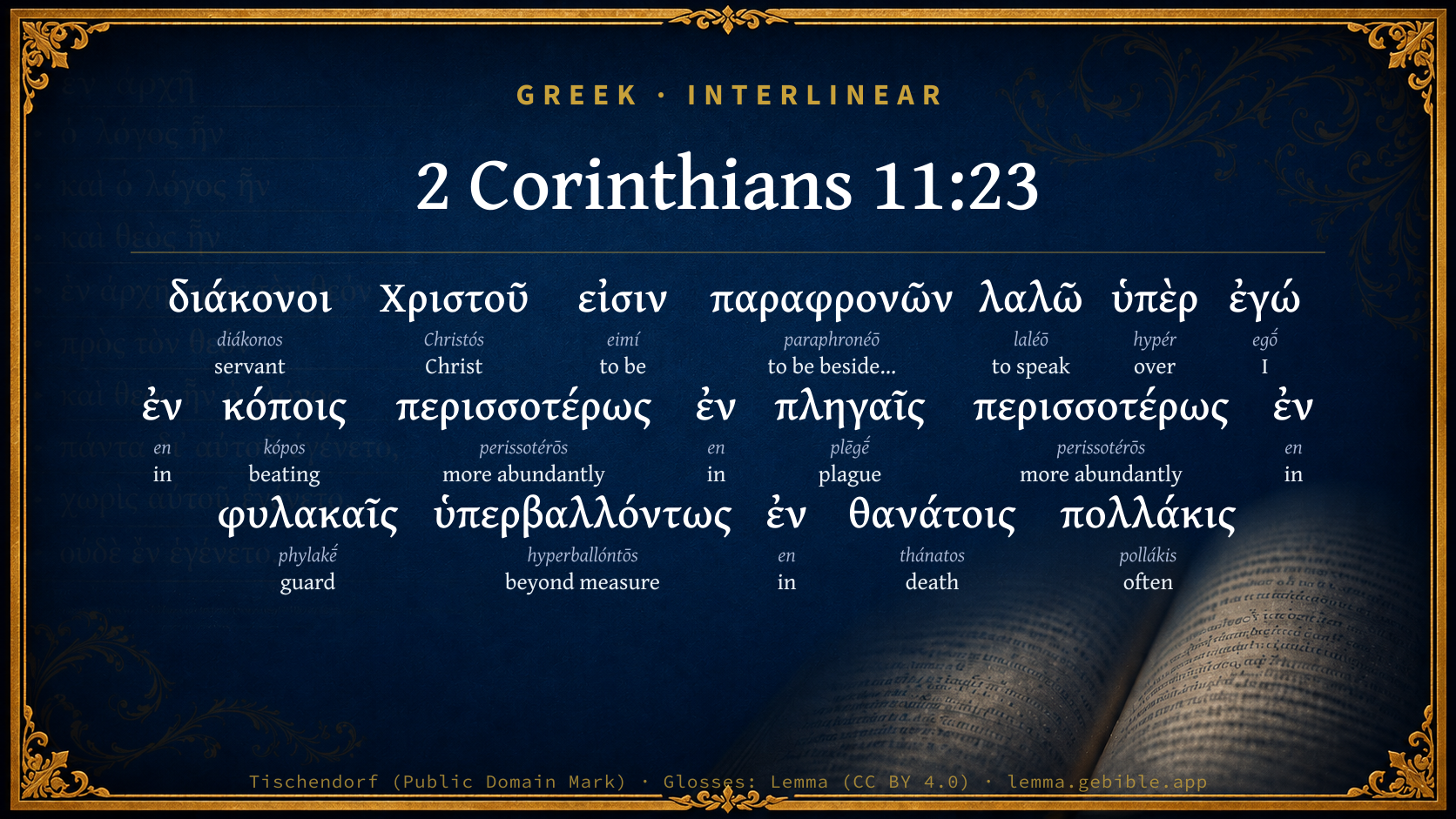
Are they servants of Christ? (I speak as one beside himself) I am more so; in labors more abundantly, in prisons more abundantly, in stripes above measure, in deaths often.
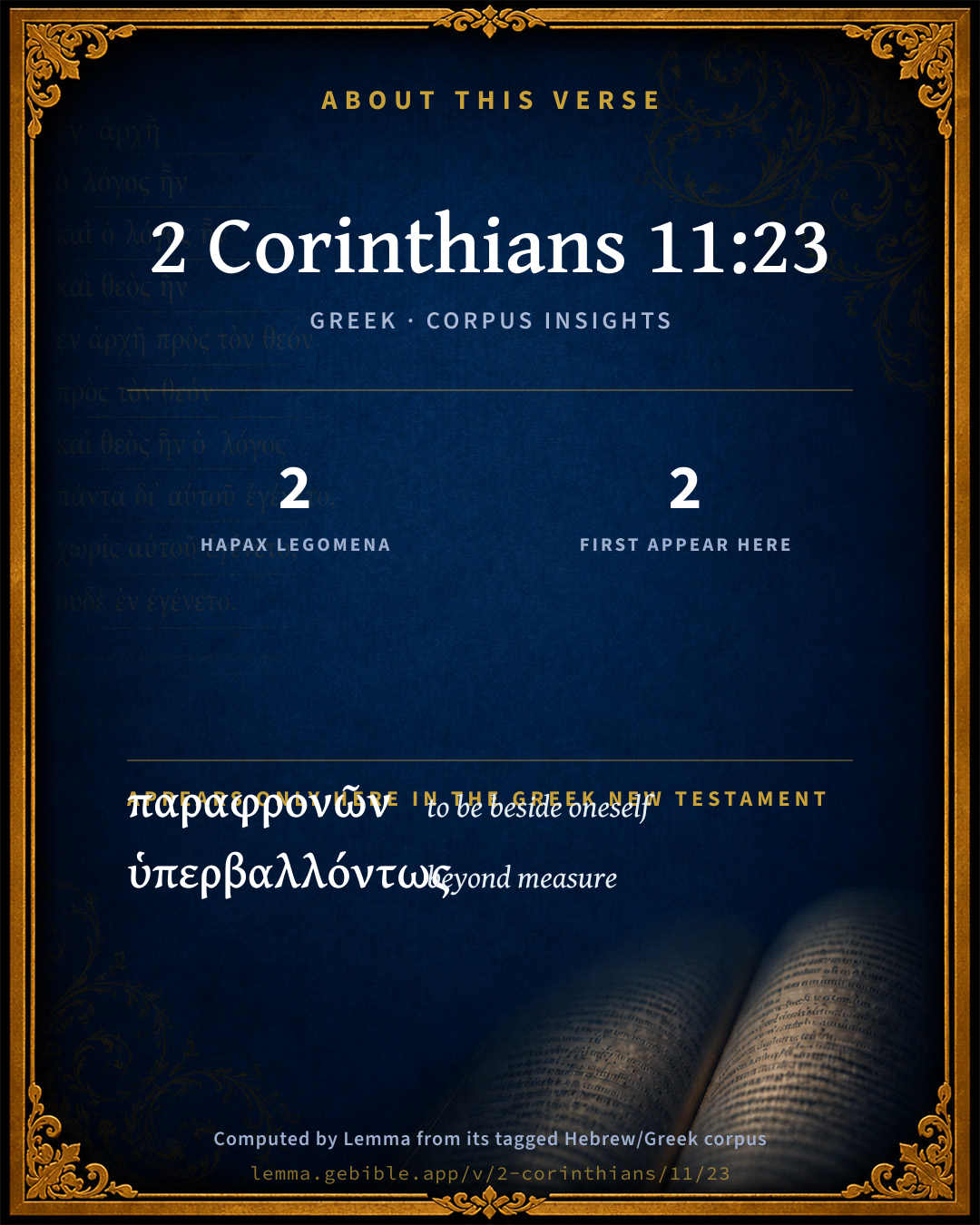
- 2 hapax legomena — only here in the Greek New Testament
- 2 first appearances in the Greek New Testament
Download a study sheet
One document with this verse’s original text, its word-by-word gloss line, the meaning frame, cross-references with their text, attributed commentary, and full source and license credits — printable, and it pastes into notes with its structure intact.
This verse Autodidact and up
A passage Seminary Student
Up to 50 verses in one chapter. A passage sheet keeps up to 6 commentary sources and 12 cross-references per verse, in the order this page ranks them, and says so on the sheet whenever that leaves anything out. Ask for a single verse and you get the Autodidact verse sheet above.
Everything on this page stays free to read, with no account — the sheet is a download of what is already on screen, not access to it.
Compare translations 3
The same verse in 3 English versions, stacked beneath the original-language interlinear above. Click any original word for its lexicon entry.
Each is an independent rendering of the whole verse — the interlinear is not word-aligned to these translations.
Highlighted words mark where these versions differ — a whole-verse word diff, not a word-by-word alignment.
-
World English Bible Public Domain
Are they servants of Christ? (I speak as one beside himself) I am more so; in labors more abundantly, in prisons more abundantly, in stripes above measure, in deaths often.
-
King James Version Public Domain
Are they ministers of Christ? (I speak as a fool) I am more; in labours more abundant, in stripes above measure, in prisons more frequent, in deaths oft.
-
unfoldingWord Literal Text CC BY-SA 4.0
Are they servants of Christ? (I speak being insane.) I more so: more abundantly in hard work, more abundantly in imprisonments, in beatings beyond measure, often in deaths.
unfoldingWord Literal Text — © unfoldingWord, licensed CC BY-SA 4.0. Word-aligned USFM3 via Door43 (git.door43.org/unfoldingWord/en_ult).
Show all 19 translations
Every available English version of this verse, each an independent rendering of the whole verse.
-
World English Bible Public Domain
Are they servants of Christ? (I speak as one beside himself) I am more so; in labors more abundantly, in prisons more abundantly, in stripes above measure, in deaths often.
-
Berean Standard Bible Public Domain
Are they servants of Christ? I am speaking like I am out of my mind, but I am so much more: in harder labor, in more imprisonments, in worse beatings, in frequent danger of death.
-
Majority Standard Bible Public Domain
Are they servants of Christ? (I am speaking as if I were out of my mind.) I am so much more: in harder labor, in worse beatings, in more imprisonments, in frequent danger of death.
-
King James Version Public Domain
Are they ministers of Christ? (I speak as a fool) I am more; in labours more abundant, in stripes above measure, in prisons more frequent, in deaths oft.
-
American Standard Version (1901) Public Domain
Are they ministers of Christ? (I speak as one beside himself) I more; in labors more abundantly, in prisons more abundantly, in stripes above measure, in deaths oft.
-
Revised Version (1885) Public Domain
Are they ministers of Christ? (I speak as one beside himself) I more; in labours more abundantly, in prisons more abundantly, in stripes above measure, in deaths oft.
-
Geneva Bible (1599) Public Domain
They are the ministers of Christ (I speake as a foole) I am more: in labours more aboundant: in stripes aboue measure: in prison more plenteously: in death oft.
-
Douay-Rheims (1899) Public Domain
They are the ministers of Christ (I speak as one less wise): I am more; in many more labours, in prisons more frequently, in stripes above measure, in deaths often.
-
Young's Literal Translation Public Domain
ministrants of Christ are they? -- as beside myself I speak -- I more; in labours more abundantly, in stripes above measure, in prisons more frequently, in deaths many times;
-
Literal Standard Version CC BY-SA 4.0
Are they servants of Christ? As [if] beside myself I speak—I [am] more; in labors more abundantly, in stripes above measure, in prisons more frequently, in deaths many times.
-
Unlocked Literal Bible CC BY-SA 4.0
Are they servants of Christ? (I speak as though I were out of my mind.) I am more. I have been in even more hard work, in far more prisons, in beatings beyond measure, in facing many dangers of death.
-
unfoldingWord Literal Text CC BY-SA 4.0
Are they servants of Christ? (I speak being insane.) I more so: more abundantly in hard work, more abundantly in imprisonments, in beatings beyond measure, often in deaths.
-
Darby Bible Public Domain
Are they ministers of Christ? (I speak as being beside myself) *I* above measure [so]; in labours exceedingly abundant, in stripes to excess, in prisons exceedingly abundant, in deaths oft.
-
World Messianic Bible Public Domain
Are they servants of Messiah? (I speak as one beside himself.) I am more so: in labors more abundantly, in prisons more abundantly, in stripes above measure, and in deaths often.
-
Webster's Bible Public Domain
Are they ministers of Christ? (I speak as a fool) I am more; in labors more abundant, in stripes above measure, in prisons more frequent, in deaths often.
-
Free Bible Version CC BY-SA 4.0
Are they servants of Christ? (I know I'll sound like I'm crazy, talking like this.) But I have done so much more. I've worked harder, been imprisoned more often, whipped more times than I can count, faced death time and again.
-
Bible in Basic English Public Domain
Are they servants of Christ? (I am talking foolishly) I am more so; I have had more experience of hard work, of prisons, of blows more than measure, of death.
-
Text-Critical English NT CC BY 4.0
Are they servants of Christ? (I am speaking like I am out of my mind!) I am even more so, with far more labors, with beatings beyond measure, with far more imprisonments, and often facing death.
-
Tyndale New Testament (1534) Public Domain
They are the ministers of Christ (I speake as a fole) I am moare: In labours moare aboundant: In strypes above measure: In preson more plenteously: In deeth ofte.
Literal Standard Version (2020), Covenant Press — licensed CC BY-SA 4.0. Text via the HelloAO Bible API (eBible.org). Unlocked Literal Bible (unfoldingWord) — licensed CC BY-SA 4.0. Text via the HelloAO Bible API (eBible.org). unfoldingWord Literal Text — © unfoldingWord, licensed CC BY-SA 4.0. Word-aligned USFM3 via Door43 (git.door43.org/unfoldingWord/en_ult). Free Bible Version, Dr. Jonathan Gallagher — licensed CC BY-SA 4.0. Text via the HelloAO Bible API (eBible.org).
Word by word
More ways to search: Search by grammar → Find every occurrence → Compare this word →
Practice this passage: Drill this verse → Learn its vocabulary →
- Appears 1× in the Greek New Testament
- First appears here
- Part of Speech
- Verb
- Tense
- Present
- Voice
- Active
- Mood
- Participle
- Case
- Nominative
- Number
- Singular
- Gender
- Masculine
Full Thayer's Definition
- διάκονοι diákonos G1249 “servant” Noun, Nominative, Plural, Masculine
- Χριστοῦ Christós G5547 “Christ” Noun, Genitive, Singular, Masculine
- εἰσιν eimí G1510 “to be” Verb, Present, Active, Indicative, 3rd person, Plural
- παραφρονῶν paraphronéō G3912 “to be beside oneself” Verb, Present, Active, Participle, Nominative, Singular, Masculine
- λαλῶ laléō G2980 “to speak” Verb, Present, Active, Indicative, 1st person, Singular
- ὑπὲρ hypér G5228 “over” Preposition
- ἐγώ egṓ G1473 “I” Personal pronoun, 1st person, Nominative, Singular
- ἐν en G1722 “in” Preposition
- κόποις kópos G2873 “beating” Noun, Dative, Plural, Masculine
- περισσοτέρως perissotérōs G4056 “more abundantly” Adverb, Comparative
- ἐν en G1722 “in” Preposition
- πληγαῖς plēgḗ G4127 “plague” Noun, Dative, Plural, Feminine
- περισσοτέρως perissotérōs G4056 “more abundantly” Adverb, Comparative
- ἐν en G1722 “in” Preposition
- φυλακαῖς phylakḗ G5438 “guard” Noun, Dative, Plural, Feminine
- ὑπερβαλλόντως hyperballóntōs G5234 “beyond measure” Adverb
- ἐν en G1722 “in” Preposition
- θανάτοις thánatos G2288 “death” Noun, Dative, Plural, Masculine
- πολλάκις pollákis G4178 “often” Adverb
About this verse
These counts appear in no published source. They are computed here, from the morphology-tagged text and Lemma’s own curated glosses. What Lemma adds →
- 19
- words
- 15
- distinct lemmas
- Pauline Epistles
- section
Notable vocabulary
2 hapax legomena — words that appear only here in the entire Greek New Testament:
First appearance in Scripture
These words make their first canonical appearance in the Greek New Testament here:
Shared distinctive vocabulary
περισσοτέρως more abundantly G4056 occurs in 11 verses of the Greek New Testament. Also found in:
Cross-references
38Topical passages linked to 2 Corinthians 11:23 in the Treasury of Scripture Knowledge — connected by theme and wording, ordered by reader-vote popularity; previews shown in the World English Bible.
- 2 Corinthians 6:4–5 but in everything commending ourselves, as servants of God, in great endurance, in afflictions, in hardships, in distresses,
- 2 Corinthians 1:9–10 Yes, we ourselves have had the sentence of death within ourselves, that we should not trust in ourselves, but in God who raises the dead,
- 2 Corinthians 6:9 as unknown, and yet well known; as dying, and behold, we live; as punished, and not killed;
- Colossians 1:24 Now I rejoice in my sufferings for your sake, and fill up on my part that which is lacking of the afflictions of Christ in my flesh for his body's sake, which is the assembly;
- 1 Corinthians 15:10 But by the grace of God I am what I am. His grace which was bestowed on me was not futile, but I worked more than all of them; yet not I, but the grace of God which was with me.
- 2 Corinthians 11:24–25 Five times from the Jews I received forty stripes minus one.
- Acts 9:16 For I will show him how many things he must suffer for my name's sake."
- 2 Corinthians 3:6 who also made us sufficient as servants of a new covenant; not of the letter, but of the Spirit. For the letter kills, but the Spirit gives life.
- Colossians 1:29 for which I also labor, striving according to his working, which works in me mightily.
- 2 Timothy 2:9 in which I suffer hardship to the point of chains as a criminal. But God's word isn't chained.
- 1 Corinthians 3:5 Who then is Apollos, and who is Paul, but servants through whom you believed; and each as the Lord gave to him?
- 1 Corinthians 15:30–32 Why do we also stand in jeopardy every hour?
- Ephesians 6:20 for which I am an ambassador in chains; that in it I may speak boldly, as I ought to speak.
- Philippians 1:13 so that it became evident to the whole praetorian guard, and to all the rest, that my bonds are in Christ;
- Philemon 1:9 yet for love's sake I rather beg, being such a one as Paul, the aged, but also a prisoner of Jesus Christ.
- Acts 14:19 But some Jews from Antioch and Iconium came there, and having persuaded the multitudes, they stoned Paul, and dragged him out of the city, supposing that he was dead.
- Acts 16:23–24 When they had laid many stripes on them, they threw them into prison, charging the jailer to keep them safely,
- Acts 20:23 except that the Holy Spirit testifies in every city, saying that bonds and afflictions wait for me.
- Acts 21:11 Coming to us, and taking Paul's belt, he bound his own feet and hands, and said, "Thus says the Holy Spirit: 'So will the Jews at Jerusalem bind the man who owns this belt, and will deliver him into the hands of the Gentiles.'"
- Acts 24:26–27 Meanwhile, he also hoped that money would be given to him by Paul, that he might release him. Therefore also he sent for him more often, and talked with him.
- Acts 25:14 As he stayed there many days, Festus laid Paul's case before the king, saying, "There is a certain man left a prisoner by Felix;
- Acts 27:1 When it was determined that we should sail for Italy, they delivered Paul and certain other prisoners to a centurion named Julius, of the Augustan band.
- Acts 28:16 When we entered into Rome, the centurion delivered the prisoners to the captain of the guard, but Paul was allowed to stay by himself with the soldier who guarded him.
- Acts 28:30 Paul stayed two whole years in his own rented house, and received all who were coming to him,
- Romans 8:36 Even as it is written, "For your sake we are killed all day long. We were accounted as sheep for the slaughter."
- 2 Corinthians 4:11 For we who live are always delivered to death for Jesus' sake, that the life also of Jesus may be revealed in our mortal flesh.
- 2 Corinthians 10:7 Do you look at things only as they appear in front of your face? If anyone trusts in himself that he is Christ's, let him consider this again with himself, that, even as he is Christ's, so also we are Christ's.
- 2 Corinthians 11:5 For I reckon that I am not at all behind the very best apostles.
- 2 Corinthians 12:11–12 I have become foolish in boasting. You compelled me, for I ought to have been commended by you, for in nothing was I inferior to the very best apostles, though I am nothing.
- Ephesians 3:1 For this cause I, Paul, am the prisoner of Christ Jesus on behalf of you Gentiles,
- Ephesians 4:1 I therefore, the prisoner in the Lord, beg you to walk worthily of the calling with which you were called,
- Philippians 2:17 Yes, and if I am poured out on the sacrifice and service of your faith, I rejoice, and rejoice with you all.
- 1 Thessalonians 3:2 and sent Timothy, our brother and God's servant in the Gospel of Christ, to establish you, and to comfort you concerning your faith;
- 1 Timothy 4:6 If you instruct the brothers of these things, you will be a good servant of Christ Jesus, nourished in the words of the faith, and of the good doctrine which you have followed.
- 2 Timothy 1:8 Therefore don't be ashamed of the testimony of our Lord, nor of me his prisoner; but endure hardship for the Gospel according to the power of God,
- 2 Timothy 1:16 May the Lord grant mercy to the house of Onesiphorus, for he often refreshed me, and was not ashamed of my chain,
- Hebrews 10:34 For you both had compassion on me in my chains, and joyfully accepted the plundering of your possessions, knowing that you have for yourselves a better possession and an enduring one in the heavens.
- 1 Corinthians 4:1 So let a man think of us as Christ's servants, and stewards of God's mysteries.
Cross-references courtesy of OpenBible.info (CC BY 4.0).
Lesson kit
Teaching starters — assembled from the data on this page, not authored interpretation. Every prompt links to the verse data it draws on. Edit before teaching.
2 Corinthians, in the Pauline Epistles, opens this verse with 19 words (15 distinct Greek lemmas). Its most distinctive word is paraphronéō (“to be beside oneself”). A historical commentator’s framing appears above. Read the whole chapter for the surrounding context.
Discussion questions
- What does “to be beside oneself” (paraphronéō) contribute to the verse as a whole?
- 2 words here appear nowhere else in the Greek New Testament. Why might the author reach for such rare wording?
- 2 words make their first appearance in Scripture here. What does this debut establish?
- How does 2 Corinthians 1:12, which shares the word «more abundantly», read alongside this verse?
- What does the repetition of “more abundantly” (2× in this one verse) do in this verse?
- These translations render this verse differently. What is at stake in choosing one wording over another?
- Compare how Joseph Benson's Commentary and Whedon's Commentary on the Bible read this verse. Where do they agree or differ?
Things to notice
- 2 words in this verse appear nowhere else in the Greek New Testament.
- 2 words make their first canonical appearance in Scripture here.
- These translations choose different wording for 24 words in this verse.
- “more abundantly” occurs 2× in this single verse.
- 15 distinct Greek lemmas span 19 words in this verse.
Commentary
Notes on 2 Corinthians 11:23 from classic Christian and Jewish commentators (each source and its license shown beneath its notes). The classic Christian expositions comment on the surrounding passage and are grouped to its opening verse, so a note may address several verses; the Jewish commentaries on the Tanakh (Rashi and others) are per-verse, so they appear only where the commentator wrote on this verse.
Lemma curates 59 commentaries, every one of them public domain or Creative Commons licensed, each selected and text-cleaned for this edition rather than reprinted as found. About our sources →
Joseph Benson's Commentary
Joseph Benson's Commentary on the Old and New Testaments (1811–1818) — public domain. Text from a community e-Sword module.
Whedon's Commentary on the Bible
Daniel D. Whedon
Daniel D. Whedon (gen. ed.), Commentary on the Old and New Testaments (1874–1909) — public domain. Text from a community e-Sword module.
Tyndale Open Study Notes
Tyndale Open Resources
Tyndale Open Study Notes — © Tyndale Open Resources, licensed CC BY-SA 4.0. Text via the HelloAO Bible API.
Bengel's Gnomon
Johann Albrecht Bengel
Bengel's Gnomon of the New Testament — English translation (T&T Clark, Edinburgh, 1860) — public domain. Text from a community e-Sword module.
Meyer's Critical & Exegetical Commentary
Heinrich August Wilhelm Meyer
Meyer — Critical and Exegetical Commentary on the New Testament — English translation by Peter Christie, edited by Frederick Crombie (T&T Clark, 1880) — public domain. Text from a community e-Sword module.
Expositor's Greek Testament
ed. W. Robertson Nicoll
The Expositor's Greek Testament, edited by W. Robertson Nicoll (1897–1910) — public domain. Text from a community e-Sword module.
Geneva Bible (1599)
Geneva Bible translators
Geneva Bible (1599) marginal notes — public domain. Text via Bolls.life.
Jamieson, Fausset & Brown
Robert Jamieson, A. R. Fausset & David Brown
Jamieson, Fausset & Brown — Commentary Critical and Explanatory on the Whole Bible (1871) — public domain (CC PDM 1.0). Text via the HelloAO Bible API.
Adam Clarke's Commentary
Adam Clarke's Commentary on the Bible (1810–1826) — public domain. Text from a community e-Sword/MySword module.
John Calvin's Commentaries
John Calvin's Commentaries (1540-1563) — public domain. Text from the Calvin Translation Society English edition (1840s-50s) via the Christian Classics Ethereal Library (ccel.org). Calvin's coverage is partial (roughly two-thirds of the Bible); uncommented books and verses are honest gaps, never fabricated. The 19th-century editor's footnotes and remarks are omitted so the notes are faithfully Calvin's own voice.
Ellicott's Commentary for English Readers
A Bible Commentary for English Readers, edited by Charles John Ellicott (1878–1897) — public domain. Text from a community e-Sword module.
The Cambridge Bible for Schools and Colleges
gen. ed. J. J. S. Perowne
The Cambridge Bible for Schools and Colleges (gen. ed. J. J. S. Perowne; Cambridge University Press, 1878–1918) — public domain. Text from a community e-Sword module.
John Gill's Exposition
John Gill's Exposition of the Whole Bible (1746–1763) — public domain (CC PDM 1.0). Text via the HelloAO Bible API.
Trapp's Complete Commentary
John Trapp
John Trapp, A Commentary or Exposition upon All the Books of the Old and New Testament (1647–1656) — public domain. Text from a community e-Sword module.
Albert Barnes' Notes on the Bible
Albert Barnes' Notes on the Bible (1834–1885) — public domain. Text from a community e-Sword/MySword module.
Haydock's Catholic Bible Commentary
George Leo Haydock (1774–1849), Haydock's Catholic Family Bible and Commentary, 1859 edition — public domain. Excludes Psalms (Douay-Rheims chapter numbering differs from Protestant) and Deuterocanonical books (Catholic canon only).
Matthew Poole's English Annotations
Matthew Poole's English Annotations on the Holy Bible (1683–1685) — public domain. Text from a community e-Sword/MySword module.
The Pulpit Commentary
The Pulpit Commentary (1880–1919), ed. H.D.M. Spence-Jones & Joseph S. Exell — public domain. Text from a community e-Sword module.
John Wesley's Explanatory Notes
John Wesley, Explanatory Notes Upon the Whole Bible (1754–1765) — public domain. Text via the GEBible commentary corpus.
McGarvey & Pendleton's Commentaries
J. W. McGarvey
J. W. McGarvey (with Philip Y. Pendleton), Commentaries on the New Testament (The Fourfold Gospel, 1914; Acts; and the epistles) — public domain. Text from a community e-Sword/MySword module.
The People's New Testament
B. W. Johnson
B. W. Johnson's The People's New Testament with Notes (1889–1891) — public domain. Electronic text from the Christian Classics Ethereal Library (CCEL) ThML edition.
Cambridge Greek Testament for Schools and Colleges
Cambridge Greek Testament for Schools and Colleges (Cambridge University Press, 1896; 21 vols, various authors incl. Carr, Maclear, Plummer, Farrar, Lumby, Moule, M. R. James, Simcox) — public domain. Text from a community e-Sword module.
Alford’s Greek Testament
Henry Alford
Henry Alford, The Greek Testament (1849–1861) — public domain. Text from a community e-Sword module.
International Critical Commentary
International Critical Commentary — older volumes (1896–1929), various authors — public domain. Text from a community e-Sword module.
Vincent's Word Studies in the New Testament
Marvin R. Vincent
Marvin R. Vincent, Word Studies in the New Testament (1887–1900) — public domain. Text from a community e-Sword/MySword module.