

Acts 9:35
Greek (Tischendorf 8th ed.) Acts 9:35 appears in the Greek New Testament. The text above is from the Tischendorf 8th edition. Each word links to its Strong’s number and a concise gloss. Click any word for its full Thayer’s Greek Lexicon entry.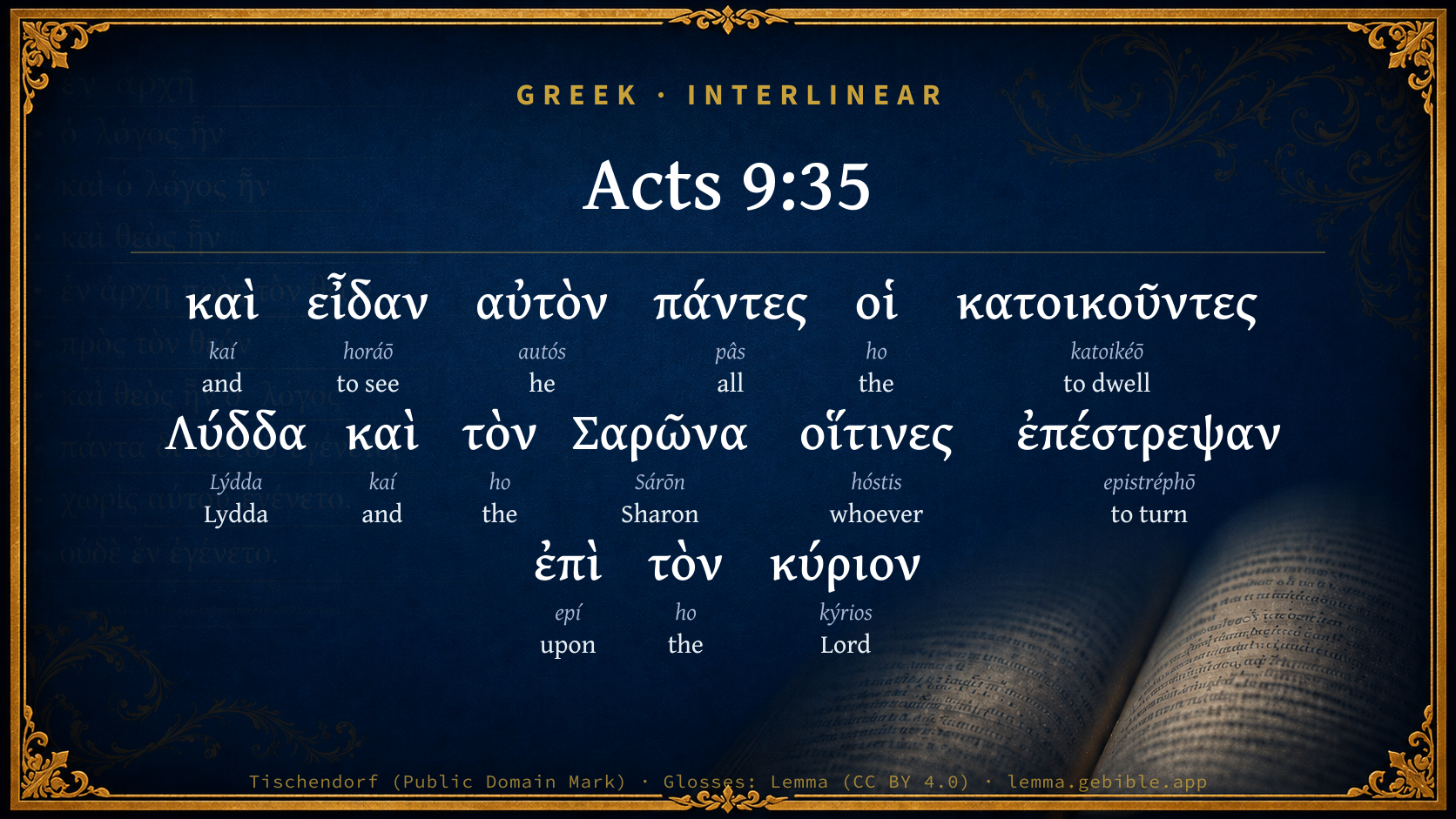
All who lived at Lydda and in Sharon saw him, and they turned to the Lord.
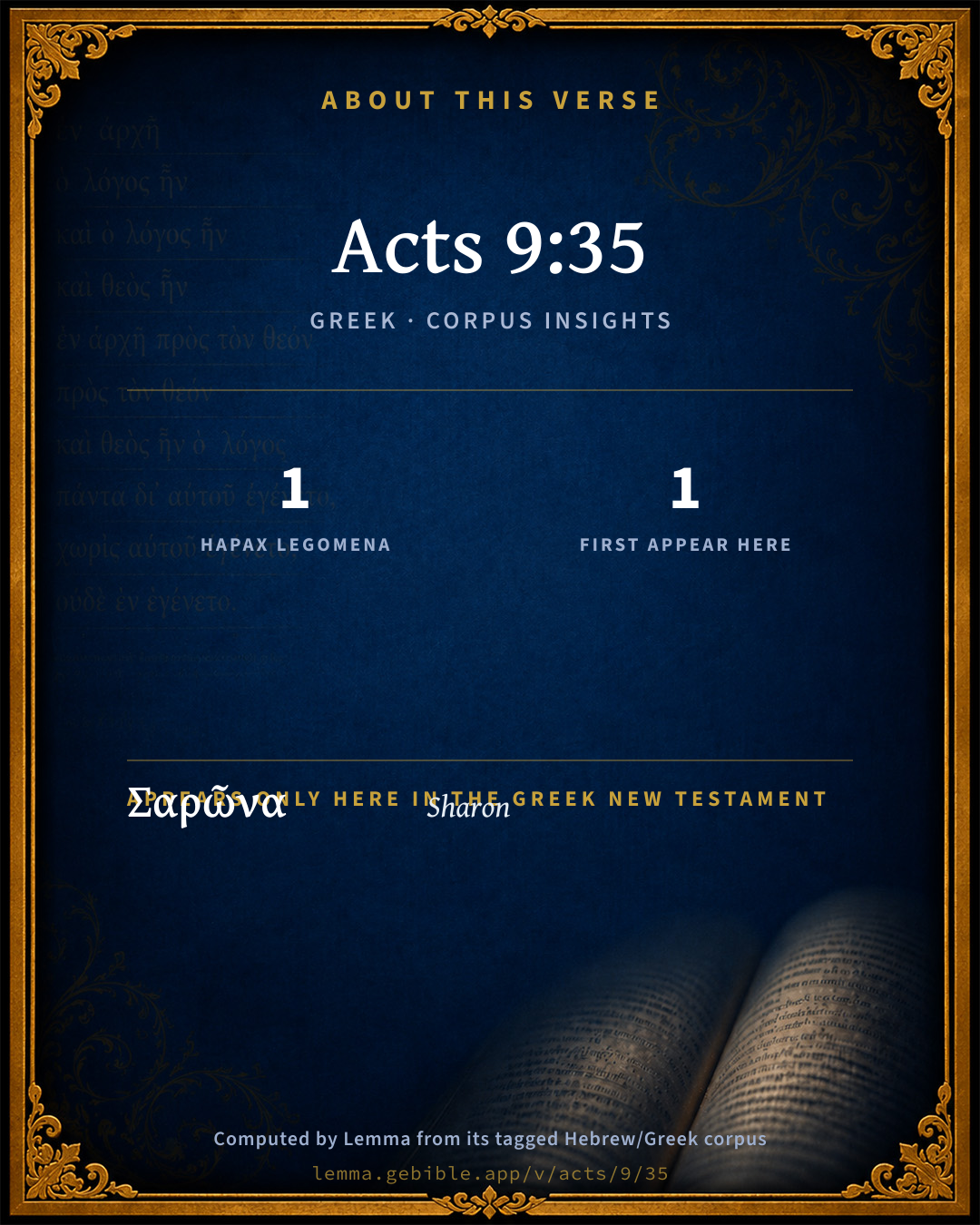
- 1 hapax legomenon — only here in the Greek New Testament
- 1 first appearance in the Greek New Testament
Download a study sheet
One document with this verse’s original text, its word-by-word gloss line, the meaning frame, cross-references with their text, attributed commentary, and full source and license credits — printable, and it pastes into notes with its structure intact.
This verse Autodidact and up
A passage Seminary Student
Up to 50 verses in one chapter. A passage sheet keeps up to 6 commentary sources and 12 cross-references per verse, in the order this page ranks them, and says so on the sheet whenever that leaves anything out. Ask for a single verse and you get the Autodidact verse sheet above.
Everything on this page stays free to read, with no account — the sheet is a download of what is already on screen, not access to it.
Compare translations 3
The same verse in 3 English versions, stacked beneath the original-language interlinear above. Click any original word for its lexicon entry.
Each is an independent rendering of the whole verse — the interlinear is not word-aligned to these translations.
Highlighted words mark where these versions differ — a whole-verse word diff, not a word-by-word alignment.
-
World English Bible Public Domain
All who lived at Lydda and in Sharon saw him, and they turned to the Lord.
-
King James Version Public Domain
And all that dwelt at Lydda and Saron saw him, and turned to the Lord.
-
unfoldingWord Literal Text CC BY-SA 4.0
And all the ones living in Lydda and in Sharon saw him, who turned to the Lord.
unfoldingWord Literal Text — © unfoldingWord, licensed CC BY-SA 4.0. Word-aligned USFM3 via Door43 (git.door43.org/unfoldingWord/en_ult).
Show all 19 translations
Every available English version of this verse, each an independent rendering of the whole verse.
-
World English Bible Public Domain
All who lived at Lydda and in Sharon saw him, and they turned to the Lord.
-
Berean Standard Bible Public Domain
and all who lived in Lydda and Sharon saw him and turned to the Lord.
-
Majority Standard Bible Public Domain
and all who lived in Lydda and Sharon saw him and turned to the Lord.
-
King James Version Public Domain
And all that dwelt at Lydda and Saron saw him, and turned to the Lord.
-
American Standard Version (1901) Public Domain
And all that dwelt at Lydda and in Sharon saw him, and they turned to the Lord.
-
Revised Version (1885) Public Domain
And all that dwelt at Lydda and in Sharon saw him, and they turned to the Lord.
-
Geneva Bible (1599) Public Domain
And all that dwelt at Lydda and Saron, sawe him, and turned to the Lord.
-
Douay-Rheims (1899) Public Domain
And all that dwelt at Lydda and Saron, saw him: who were converted to the Lord.
-
Young's Literal Translation Public Domain
and all those dwelling at Lydda, and Saron saw him, and did turn to the Lord.
-
Literal Standard Version CC BY-SA 4.0
and all those dwelling at Lydda and Saron saw him, and turned to the LORD.
-
Unlocked Literal Bible CC BY-SA 4.0
So everyone who lived in Lydda and in Sharon saw the man and they turned to the Lord.
-
unfoldingWord Literal Text CC BY-SA 4.0
And all the ones living in Lydda and in Sharon saw him, who turned to the Lord.
-
Darby Bible Public Domain
And all who inhabited Lydda and the Saron saw him, who turned to the Lord.
-
World Messianic Bible Public Domain
All who lived at Lydda and in Sharon saw him, and they turned to the Lord.
-
Webster's Bible Public Domain
And all that dwelt at Lydda and Saron saw him, and turned to the Lord.
-
Free Bible Version CC BY-SA 4.0
Everyone living in Lydda and Sharon saw him, and became believers in the Lord.
-
Bible in Basic English Public Domain
And all those living in Lydda and Sharon saw him, and were turned to the Lord.
-
Text-Critical English NT CC BY 4.0
and all who dwelt in Lydda and Sharon saw him and turned to the Lord.
-
Tyndale New Testament (1534) Public Domain
And all that dwelt at lydda and assaron sawe hym and tourned to the lorde.
Literal Standard Version (2020), Covenant Press — licensed CC BY-SA 4.0. Text via the HelloAO Bible API (eBible.org). Unlocked Literal Bible (unfoldingWord) — licensed CC BY-SA 4.0. Text via the HelloAO Bible API (eBible.org). unfoldingWord Literal Text — © unfoldingWord, licensed CC BY-SA 4.0. Word-aligned USFM3 via Door43 (git.door43.org/unfoldingWord/en_ult). Free Bible Version, Dr. Jonathan Gallagher — licensed CC BY-SA 4.0. Text via the HelloAO Bible API (eBible.org).
Word by word
More ways to search: Search by grammar → Find every occurrence → Compare this word →
Practice this passage: Drill this verse → Learn its vocabulary →
- Appears 1× in the Greek New Testament
- First appears here
- Part of Speech
- Noun
- Case
- Accusative
- Number
- Singular
- Gender
- Masculine
Full Thayer's Definition
- καὶ kaí G2532 “and” Conjunction
- εἶδαν horáō G3708 “to see” Verb, Aorist, Active, Indicative, 3rd person, Plural
- αὐτὸν autós G846 “he” Personal pronoun, Accusative, Singular, Masculine
- πάντες pâs G3956 “all” Adjective, Nominative, Plural, Masculine
- οἱ ho G3588 “the” Article, Nominative, Plural, Masculine
- κατοικοῦντες katoikéō G2730 “to dwell” Verb, Present, Active, Participle, Nominative, Plural, Masculine
- Λύδδα Lýdda G3069 “Lydda” Noun, Accusative, Singular, Feminine
- καὶ kaí G2532 “and” Conjunction
- τὸν ho G3588 “the” Article, Accusative, Singular, Masculine
- Σαρῶνα Sárōn G4565 “Sharon” Noun, Accusative, Singular, Masculine
- οἵτινες hóstis G3748 “whoever” Relative pronoun, Nominative, Plural, Masculine
- ἐπέστρεψαν epistréphō G1994 “to turn” Verb, Aorist, Active, Indicative, 3rd person, Plural
- ἐπὶ epí G1909 “upon” Preposition
- τὸν ho G3588 “the” Article, Accusative, Singular, Masculine
- κύριον kýrios G2962 “Lord” Noun, Accusative, Singular, Masculine
About this verse
These counts appear in no published source. They are computed here, from the morphology-tagged text and Lemma’s own curated glosses. What Lemma adds →
- 15
- words
- 12
- distinct lemmas
- Acts
- section
Notable vocabulary
1 hapax legomenon — a word that appears only here in the entire Greek New Testament:
- Σαρῶνα Sharon G4565
First appearance in Scripture
This word makes its first canonical appearance in the Greek New Testament here:
- Σαρῶνα Sharon G4565
Shared distinctive vocabulary
Λύδδα Lydda G3069 occurs in 3 verses of the Greek New Testament. Also found in:
Cross-references
26Topical passages linked to Acts 9:35 in the Treasury of Scripture Knowledge — connected by theme and wording, ordered by reader-vote popularity; previews shown in the World English Bible.
- Acts 11:21 The hand of the Lord was with them, and a great number believed and turned to the Lord.
- 1 Chronicles 5:16 They lived in Gilead in Bashan, and in its towns, and in all the suburbs of Sharon, as far as their borders.
- Acts 9:42 And it became known throughout all Joppa, and many believed in the Lord.
- Isaiah 35:2 It shall blossom abundantly, and rejoice even with joy and singing; the glory of Lebanon shall be given to it, the excellency of Carmel and Sharon: they shall see the glory of Yahweh, the excellency of our God.
- 1 Chronicles 27:29 and over the herds that fed in Sharon was Shitrai the Sharonite: and over the herds that were in the valleys was Shaphat the son of Adlai:
- Psalms 22:27 All the ends of the earth shall remember and turn to Yahweh. All the relatives of the nations shall worship before you.
- 2 Corinthians 3:16 But whenever one turns to the Lord, the veil is taken away.
- Deuteronomy 4:30 When you are in oppression, and all these things are come on you, in the latter days you shall return to Yahweh your God, and listen to his voice:
- Psalms 110:3 Your people offer themselves willingly in the day of your power, in holy array. Out of the womb of the morning, you have the dew of your youth.
- Isaiah 31:6 Turn you to him from whom you have deeply revolted, children of Israel.
- Isaiah 33:9 The land mourns and languishes; Lebanon is confounded and withers away; Sharon is like a desert; and Bashan and Carmel shake off [their leaves].
- Isaiah 65:10 Sharon shall be a fold of flocks, and the valley of Achor a place for herds to lie down in, for my people who have sought me.
- Isaiah 66:8 Who has heard such a thing? who has seen such things? Shall a land be born in one day? shall a nation be brought forth at once? for as soon as Zion travailed, she brought forth her children.
- Lamentations 3:40 Let us search and try our ways, and turn again to Yahweh.
- Hosea 12:6 Therefore turn to your God. Keep kindness and justice, And wait for your God continually.
- Hosea 14:2 Take words with you, and return to Yahweh. Tell him, "Forgive all our sins, And accept that which is good: So we offer like bulls our lips.
- Luke 1:16–17 He will turn many of the children of Israel to the Lord, their God.
- Acts 4:4 But many of those who heard the word believed, and the number of the men came to be about five thousand.
- Acts 5:12–14 By the hands of the apostles many signs and wonders were done among the people. They were all with one accord in Solomon's porch.
- Acts 6:7 The word of God increased and the number of the disciples multiplied in Jerusalem exceedingly. A great company of the priests were obedient to the faith.
- Acts 15:19 "Therefore my judgment is that we don't trouble those from among the Gentiles who turn to God,
- Acts 19:10 This continued for two years, so that all those who lived in Asia heard the word of the Lord Jesus, both Jews and Greeks.
- Acts 19:20 So the word of the Lord was growing and becoming mighty.
- Acts 26:18–20 to open their eyes, that they may turn from darkness to light and from the power of Satan to God, that they may receive remission of sins and an inheritance among those who are sanctified by faith in me.'
- 1 Thessalonians 1:9–10 For they themselves report concerning us what kind of a reception we had from you; and how you turned to God from idols, to serve a living and true God,
- Joel 2:13 Tear your heart, and not your garments, And turn to Yahweh, your God; For he is gracious and merciful, Slow to anger, and abundant in loving kindness, And relents from sending calamity.
Cross-references courtesy of OpenBible.info (CC BY 4.0).
Lesson kit
Teaching starters — assembled from the data on this page, not authored interpretation. Every prompt links to the verse data it draws on. Edit before teaching.
Acts, in the Acts, opens this verse with 15 words (12 distinct Greek lemmas). Its most distinctive word is Sárōn (“Sharon”). A historical commentator’s framing appears above. Read the whole chapter for the surrounding context.
Discussion questions
- What does “Sharon” (Sárōn) contribute to the verse as a whole?
- This verse holds 1 word here found nowhere else in the Greek New Testament. What might the rare word draw attention to?
- The word “Sharon” first appears here in Scripture. What is being introduced at this debut?
- Acts 9:32 shares the word «Lydda» with this verse. How do the two illuminate each other?
- “the” occurs 3× in this one verse. What is the effect of the repetition?
- These translations render this verse differently. What is at stake in choosing one wording over another?
- Reading how Bengel's Gnomon and Expositor's Greek Testament read this verse, where do the two commentators agree and where do they part?
Things to notice
- 1 word in this verse appears nowhere else in the Greek New Testament.
- 1 word makes its first canonical appearance in Scripture here.
- These translations choose different wording for 7 words in this verse.
- “the” occurs 3× in this single verse.
- 12 distinct Greek lemmas span 15 words in this verse.
Commentary
Notes on Acts 9:35 from classic Christian and Jewish commentators (each source and its license shown beneath its notes). The classic Christian expositions comment on the surrounding passage and are grouped to its opening verse, so a note may address several verses; the Jewish commentaries on the Tanakh (Rashi and others) are per-verse, so they appear only where the commentator wrote on this verse.
Lemma curates 59 commentaries, every one of them public domain or Creative Commons licensed, each selected and text-cleaned for this edition rather than reprinted as found. About our sources →
Bengel's Gnomon
Johann Albrecht Bengel
Bengel's Gnomon of the New Testament — English translation (T&T Clark, Edinburgh, 1860) — public domain. Text from a community e-Sword module.
Expositor's Greek Testament
ed. W. Robertson Nicoll
The Expositor's Greek Testament, edited by W. Robertson Nicoll (1897–1910) — public domain. Text from a community e-Sword module.
Geneva Bible (1599)
Geneva Bible translators
Geneva Bible (1599) marginal notes — public domain. Text via Bolls.life.
Jamieson, Fausset & Brown
Robert Jamieson, A. R. Fausset & David Brown
Jamieson, Fausset & Brown — Commentary Critical and Explanatory on the Whole Bible (1871) — public domain (CC PDM 1.0). Text via the HelloAO Bible API.
Adam Clarke's Commentary
Adam Clarke's Commentary on the Bible (1810–1826) — public domain. Text from a community e-Sword/MySword module.
John Calvin's Commentaries
John Calvin's Commentaries (1540-1563) — public domain. Text from the Calvin Translation Society English edition (1840s-50s) via the Christian Classics Ethereal Library (ccel.org). Calvin's coverage is partial (roughly two-thirds of the Bible); uncommented books and verses are honest gaps, never fabricated. The 19th-century editor's footnotes and remarks are omitted so the notes are faithfully Calvin's own voice.
Ellicott's Commentary for English Readers
A Bible Commentary for English Readers, edited by Charles John Ellicott (1878–1897) — public domain. Text from a community e-Sword module.
The Cambridge Bible for Schools and Colleges
gen. ed. J. J. S. Perowne
The Cambridge Bible for Schools and Colleges (gen. ed. J. J. S. Perowne; Cambridge University Press, 1878–1918) — public domain. Text from a community e-Sword module.
John Gill's Exposition
John Gill's Exposition of the Whole Bible (1746–1763) — public domain (CC PDM 1.0). Text via the HelloAO Bible API.
Trapp's Complete Commentary
John Trapp
John Trapp, A Commentary or Exposition upon All the Books of the Old and New Testament (1647–1656) — public domain. Text from a community e-Sword module.
Albert Barnes' Notes on the Bible
Albert Barnes' Notes on the Bible (1834–1885) — public domain. Text from a community e-Sword/MySword module.
Haydock's Catholic Bible Commentary
George Leo Haydock (1774–1849), Haydock's Catholic Family Bible and Commentary, 1859 edition — public domain. Excludes Psalms (Douay-Rheims chapter numbering differs from Protestant) and Deuterocanonical books (Catholic canon only).
Matthew Poole's English Annotations
Matthew Poole's English Annotations on the Holy Bible (1683–1685) — public domain. Text from a community e-Sword/MySword module.
Whedon's Commentary on the Bible
Daniel D. Whedon
Daniel D. Whedon (gen. ed.), Commentary on the Old and New Testaments (1874–1909) — public domain. Text from a community e-Sword module.
The Pulpit Commentary
The Pulpit Commentary (1880–1919), ed. H.D.M. Spence-Jones & Joseph S. Exell — public domain. Text from a community e-Sword module.
John Wesley's Explanatory Notes
John Wesley, Explanatory Notes Upon the Whole Bible (1754–1765) — public domain. Text via the GEBible commentary corpus.
Godbey's Commentary on the New Testament
William B. Godbey
William B. Godbey, Commentary on the New Testament (1896–1900) — public domain. Text from a community e-Sword module.
McGarvey & Pendleton's Commentaries
J. W. McGarvey
J. W. McGarvey (with Philip Y. Pendleton), Commentaries on the New Testament (The Fourfold Gospel, 1914; Acts; and the epistles) — public domain. Text from a community e-Sword/MySword module.
The People's New Testament
B. W. Johnson
B. W. Johnson's The People's New Testament with Notes (1889–1891) — public domain. Electronic text from the Christian Classics Ethereal Library (CCEL) ThML edition.
Cambridge Greek Testament for Schools and Colleges
Cambridge Greek Testament for Schools and Colleges (Cambridge University Press, 1896; 21 vols, various authors incl. Carr, Maclear, Plummer, Farrar, Lumby, Moule, M. R. James, Simcox) — public domain. Text from a community e-Sword module.
Alford’s Greek Testament
Henry Alford
Henry Alford, The Greek Testament (1849–1861) — public domain. Text from a community e-Sword module.
Vincent's Word Studies in the New Testament
Marvin R. Vincent
Marvin R. Vincent, Word Studies in the New Testament (1887–1900) — public domain. Text from a community e-Sword/MySword module.