

Hebrews 13:7
Greek (Tischendorf 8th ed.) Hebrews 13:7 appears in the Greek New Testament. The text above is from the Tischendorf 8th edition. Each word links to its Strong’s number and a concise gloss. Click any word for its full Thayer’s Greek Lexicon entry.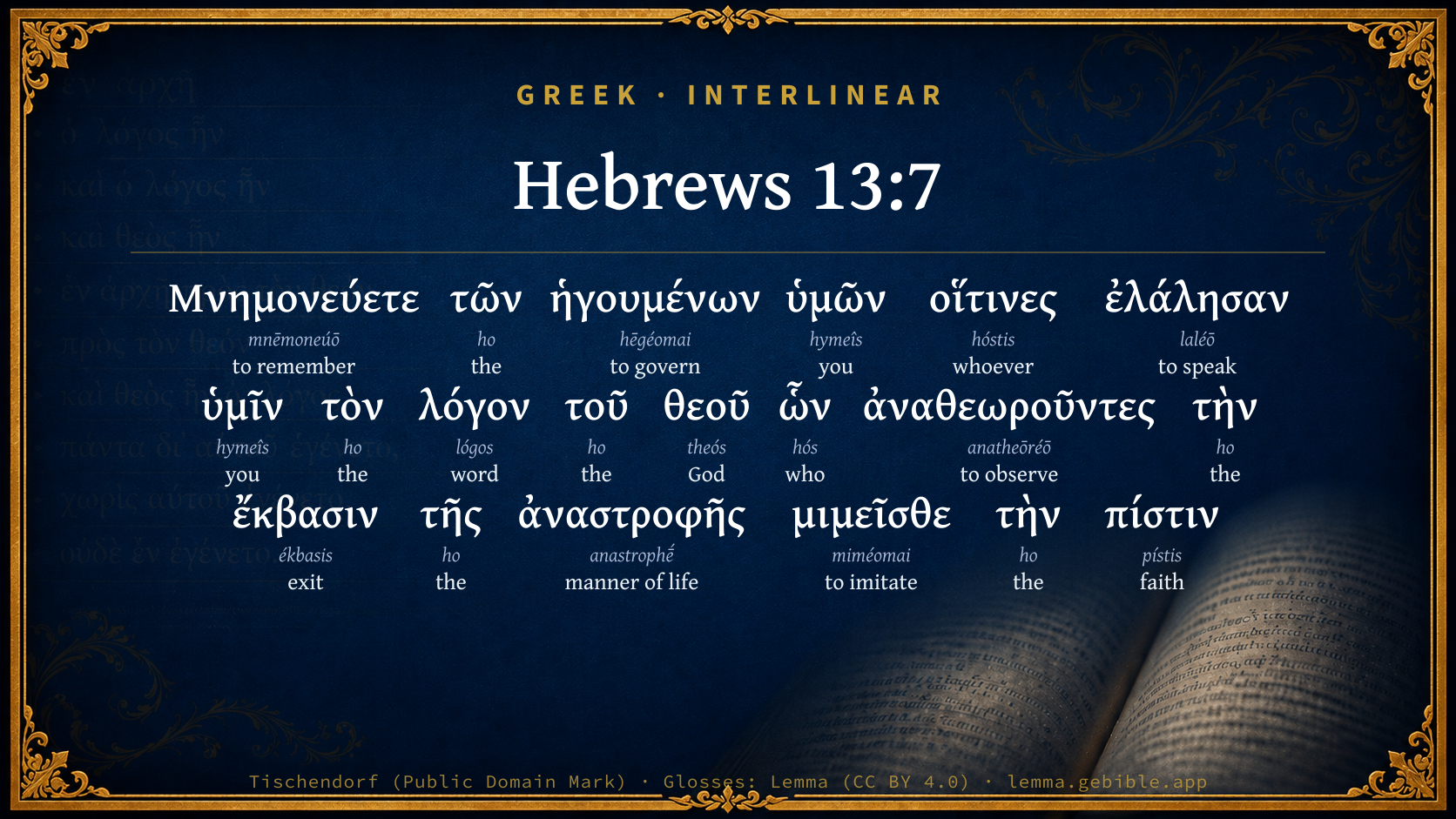
Remember your leaders, men who spoke to you the word of God, and considering the results of their conduct, imitate their faith.
Download a study sheet
One document with this verse’s original text, its word-by-word gloss line, the meaning frame, cross-references with their text, attributed commentary, and full source and license credits — printable, and it pastes into notes with its structure intact.
This verse Autodidact and up
A passage Seminary Student
Up to 50 verses in one chapter. A passage sheet keeps up to 6 commentary sources and 12 cross-references per verse, in the order this page ranks them, and says so on the sheet whenever that leaves anything out. Ask for a single verse and you get the Autodidact verse sheet above.
Everything on this page stays free to read, with no account — the sheet is a download of what is already on screen, not access to it.
Compare translations 3
The same verse in 3 English versions, stacked beneath the original-language interlinear above. Click any original word for its lexicon entry.
Each is an independent rendering of the whole verse — the interlinear is not word-aligned to these translations.
Highlighted words mark where these versions differ — a whole-verse word diff, not a word-by-word alignment.
-
World English Bible Public Domain
Remember your leaders, men who spoke to you the word of God, and considering the results of their conduct, imitate their faith.
-
King James Version Public Domain
Remember them which have the rule over you, who have spoken unto you the word of God: whose faith follow, considering the end of their conversation.
-
unfoldingWord Literal Text CC BY-SA 4.0
Remember your leaders, who spoke the Word of God to you, of whom considering the outcome of their conduct, imitate their faith.
unfoldingWord Literal Text — © unfoldingWord, licensed CC BY-SA 4.0. Word-aligned USFM3 via Door43 (git.door43.org/unfoldingWord/en_ult).
Show all 19 translations
Every available English version of this verse, each an independent rendering of the whole verse.
-
World English Bible Public Domain
Remember your leaders, men who spoke to you the word of God, and considering the results of their conduct, imitate their faith.
-
Berean Standard Bible Public Domain
Remember your leaders who spoke the word of God to you. Consider the outcome of their way of life and imitate their faith.
-
Majority Standard Bible Public Domain
Remember your leaders who spoke the word of God to you. Consider the outcome of their way of life and imitate their faith.
-
King James Version Public Domain
Remember them which have the rule over you, who have spoken unto you the word of God: whose faith follow, considering the end of their conversation.
-
American Standard Version (1901) Public Domain
Remember them that had the rule over you, men that spake unto you the word of God; and considering the issue of their life, imitate their faith.
-
Revised Version (1885) Public Domain
Remember them that had the rule over you, which spake unto you the word of God; and considering the issue of their life, imitate their faith.
-
Geneva Bible (1599) Public Domain
So that we may boldly say, The Lord is mine helper, neither will I feare what man can doe vnto me.
-
Douay-Rheims (1899) Public Domain
Remember your prelates who have spoken the word of God to you; whose faith follow, considering the end of their conversation,
-
Young's Literal Translation Public Domain
Be mindful of those leading you, who did speak to you the word of God, whose faith -- considering the issue of the behaviour -- be imitating,
-
Literal Standard Version CC BY-SA 4.0
Be mindful of those leading you, who spoke to you the word of God, who, considering the outcome of [their] behavior, imitate [their] faith:
-
Unlocked Literal Bible CC BY-SA 4.0
Consider your leaders, those who spoke God's word to you, and consider the result of their conduct. Imitate their faith.
-
unfoldingWord Literal Text CC BY-SA 4.0
Remember your leaders, who spoke the Word of God to you, of whom considering the outcome of their conduct, imitate their faith.
-
Darby Bible Public Domain
Remember your leaders who have spoken to you the word of God; and considering the issue of their conversation, imitate their faith.
-
World Messianic Bible Public Domain
Remember your leaders, men who spoke to you the word of God, and considering the results of their conduct, imitate their faith.
-
Webster's Bible Public Domain
Remember them who have the rule over you, who have spoken to you the word of God: whose faith follow, considering the end of their manner of life.
-
Free Bible Version CC BY-SA 4.0
Remember your leaders who explained God's word to you. Look again at the results of their lives, and imitate their trust in God.
-
Bible in Basic English Public Domain
Keep in mind those who were over you, and who gave you the word of God; seeing the outcome of their way of life, let your faith be like theirs.
-
Text-Critical English NT CC BY 4.0
Remember your leaders, who spoke to you the word of God. Consider the outcome of their conduct, and imitate their faith.
-
Tyndale New Testament (1534) Public Domain
Remember them which have the oversight of you which have declared vnto you the worde of god. The ende of whose conversacion se that ye looke vpon and folowe their fayth.
Literal Standard Version (2020), Covenant Press — licensed CC BY-SA 4.0. Text via the HelloAO Bible API (eBible.org). Unlocked Literal Bible (unfoldingWord) — licensed CC BY-SA 4.0. Text via the HelloAO Bible API (eBible.org). unfoldingWord Literal Text — © unfoldingWord, licensed CC BY-SA 4.0. Word-aligned USFM3 via Door43 (git.door43.org/unfoldingWord/en_ult). Free Bible Version, Dr. Jonathan Gallagher — licensed CC BY-SA 4.0. Text via the HelloAO Bible API (eBible.org).
Word by word
More ways to search: Search by grammar → Find every occurrence → Compare this word →
Practice this passage: Drill this verse → Learn its vocabulary →
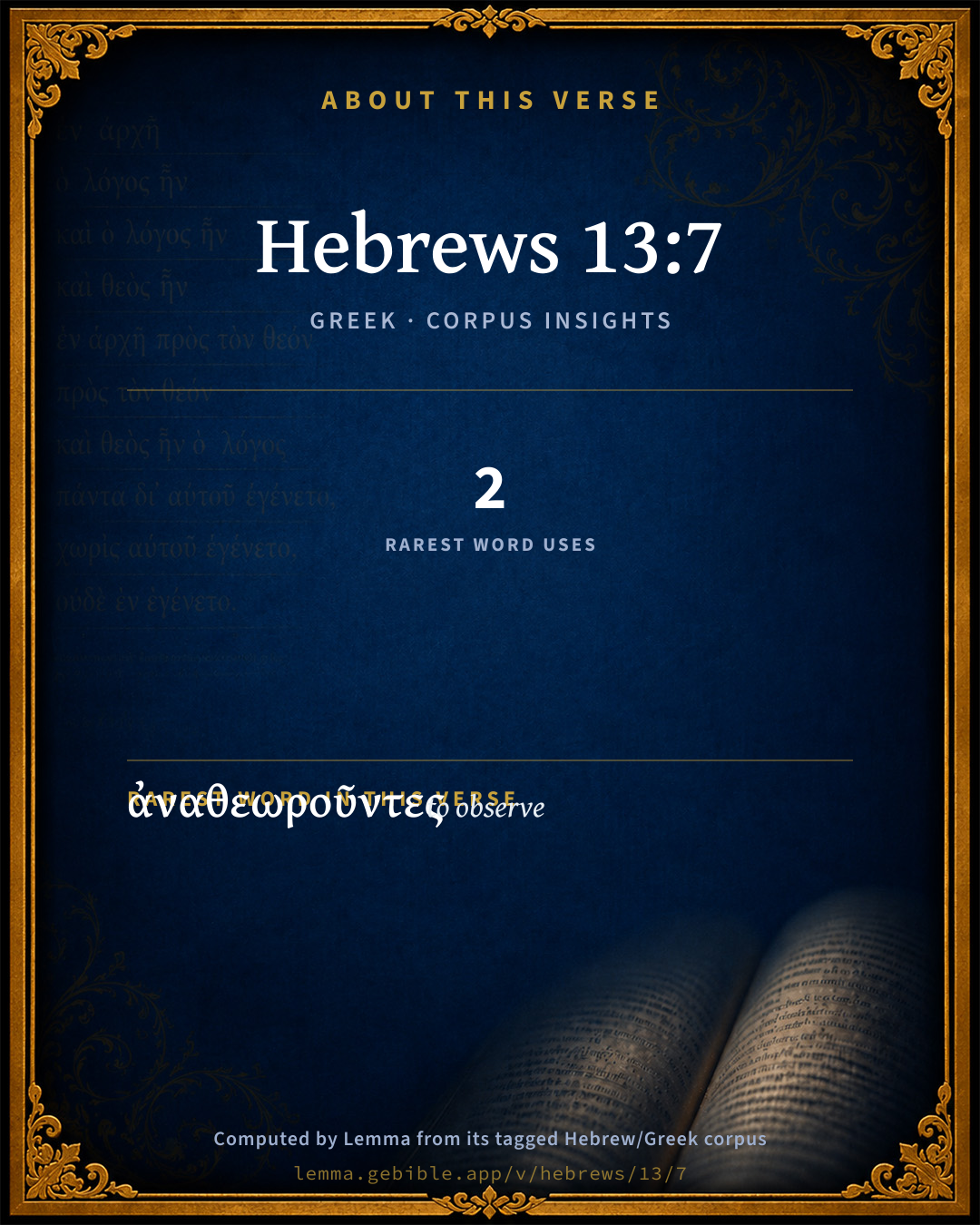
- Appears 2× in the Greek New Testament
- First appears at Acts 17:23
- Part of Speech
- Verb
- Tense
- Present
- Voice
- Active
- Mood
- Participle
- Case
- Nominative
- Number
- Plural
- Gender
- Masculine
Full Thayer's Definition
- Μνημονεύετε mnēmoneúō G3421 “to remember” Verb, Present, Active, Imperative, 2nd person, Plural
- τῶν ho G3588 “the” Article, Genitive, Plural, Masculine
- ἡγουμένων hēgéomai G2233 “to govern” Verb, Present, Middle or Passive deponent, Participle, Genitive, Plural, Masculine
- ὑμῶν hymeîs G5210 “you” Personal pronoun, 2nd person, Genitive, Plural
- οἵτινες hóstis G3748 “whoever” Relative pronoun, Nominative, Plural, Masculine
- ἐλάλησαν laléō G2980 “to speak” Verb, Aorist, Active, Indicative, 3rd person, Plural
- ὑμῖν hymeîs G5210 “you” Personal pronoun, 2nd person, Dative, Plural
- τὸν ho G3588 “the” Article, Accusative, Singular, Masculine
- λόγον lógos G3056 “word” Noun, Accusative, Singular, Masculine
- τοῦ ho G3588 “the” Article, Genitive, Singular, Masculine
- θεοῦ theós G2316 “God” Noun, Genitive, Singular, Masculine
- ὧν hós G3739 “who” Relative pronoun, Genitive, Plural, Masculine
- ἀναθεωροῦντες anatheōréō G333 “to observe” Verb, Present, Active, Participle, Nominative, Plural, Masculine
- τὴν ho G3588 “the” Article, Accusative, Singular, Feminine
- ἔκβασιν ékbasis G1545 “exit” Noun, Accusative, Singular, Feminine
- τῆς ho G3588 “the” Article, Genitive, Singular, Feminine
- ἀναστροφῆς anastrophḗ G391 “manner of life” Noun, Genitive, Singular, Feminine
- μιμεῖσθε miméomai G3401 “to imitate” Verb, Present, Middle or Passive deponent, Imperative, 2nd person, Plural
- τὴν ho G3588 “the” Article, Accusative, Singular, Feminine
- πίστιν pístis G4102 “faith” Noun, Accusative, Singular, Feminine
About this verse
These counts appear in no published source. They are computed here, from the morphology-tagged text and Lemma’s own curated glosses. What Lemma adds →
- 20
- words
- 14
- distinct lemmas
- General Epistles
- section
Cross-references
25Topical passages linked to Hebrews 13:7 in the Treasury of Scripture Knowledge — connected by theme and wording, ordered by reader-vote popularity; previews shown in the World English Bible.
- 1 Thessalonians 5:12–13 But we beg you, brothers, to know those who labor among you, and are over you in the Lord, and admonish you,
- Hebrews 13:17 Obey your leaders and submit to them, for they watch on behalf of your souls, as those who will give account, that they may do this with joy, and not with groaning, for that would be unprofitable for you.
- Philippians 3:17 Brothers, be imitators together of me, and note those who walk this way, even as you have us for an example.
- Hebrews 6:12 that you won't be sluggish, but imitators of those who through faith and patience inherited the promises.
- 1 Thessalonians 1:6 You became imitators of us, and of the Lord, having received the word in much affliction, with joy of the Holy Spirit,
- Matthew 24:45 "Who then is the faithful and wise servant, whom his lord has set over his household, to give them their food in due season?
- Acts 14:23 When they had appointed elders for them in every assembly, and had prayed with fasting, they commended them to the Lord, on whom they had believed.
- 1 Thessalonians 2:13 For this cause we also thank God without ceasing, that, when you received from us the word of the message of God, you accepted it not as the word of men, but, as it is in truth, the word of God, which also works in you who believe.
- 1 Timothy 3:5 (but if a man doesn't know how to rule his own house, how will he take care of the assembly of God?)
- Acts 4:31 When they had prayed, the place was shaken where they were gathered together. They were all filled with the Holy Spirit, and they spoke the word of God with boldness.
- Romans 10:17 So faith comes by hearing, and hearing by the word of God.
- Song of Solomon 1:8 If you don't know, most beautiful among women, Follow the tracks of the sheep. Graze your young goats beside the shepherds' tents.
- 1 Corinthians 4:16 I beg you therefore, be imitators of me.
- Hebrews 13:24 Greet all of your leaders and all the saints. The Italians greet you.
- Revelation 6:9 When he opened the fifth seal, I saw underneath the altar the souls of those who had been killed for the Word of God, and for the testimony of the Lamb which they had.
- Revelation 20:4 I saw thrones, and they sat on them, and judgment was given to them. I saw the souls of those who had been beheaded for the testimony of Jesus, and for the word of God, and such as didn't worship the beast nor his image, and didn't receive the mark on their forehead and on their hand. They lived, and reigned with Christ for the thousand years.
- Luke 8:11 Now the parable is this: The seed is the word of God.
- Luke 12:42 The Lord said, "Who then is the faithful and wise steward, whom his lord will set over his household, to give them their portion of food at the right times?
- 1 Corinthians 11:1 Be imitators of me, even as I also am of Christ.
- 2 Thessalonians 3:9 not because we don't have the right, but to make ourselves an example to you, that you should imitate us.
- Revelation 1:9 I John, your brother and partner with you in oppression, Kingdom, and perseverance in Christ Jesus, was on the isle that is called Patmos because of God's Word and the testimony of Jesus Christ.
- Acts 7:55–60 But he, being full of the Holy Spirit, looked up steadfastly into heaven, and saw the glory of God, and Jesus standing on the right hand of God,
- Acts 13:46 Paul and Barnabas spoke out boldly, and said, "It was necessary that God's word should be spoken to you first. Since indeed you thrust it from you, and judge yourselves unworthy of eternal life, behold, we turn to the Gentiles.
- 1 Corinthians 10:13 No temptation has taken you except what is common to man. God is faithful, who will not allow you to be tempted above what you are able, but will with the temptation also make the way of escape, that you may be able to endure it.
- 2 Thessalonians 3:7 For you know how you ought to imitate us. For we didn't behave ourselves rebelliously among you,
Cross-references courtesy of OpenBible.info (CC BY 4.0).
Lesson kit
Teaching starters — assembled from the data on this page, not authored interpretation. Every prompt links to the verse data it draws on. Edit before teaching.
Hebrews, in the General Epistles, opens this verse with 20 words (14 distinct Greek lemmas). Its most distinctive word is anatheōréō (“to observe”). A historical commentator’s framing appears above. Read the whole chapter for the surrounding context.
Discussion questions
- What does “to observe” (anatheōréō) contribute to the verse as a whole?
- How does Acts 17:23, which shares the word «to observe», read alongside this verse?
- What does the repetition of “the” (6× in this one verse) do in this verse?
- The translations on this page render this verse differently — a whole-verse word diff, not a word-by-word alignment. What might account for the different wordings?
- Compare how The Biblical Illustrator and Joseph Benson's Commentary read this verse. Where do they agree or differ?
Things to notice
- These translations choose different wording for 17 words in this verse.
- “the” occurs 6× in this single verse.
- 14 distinct Greek lemmas span 20 words in this verse.
Commentary
Notes on Hebrews 13:7 from classic Christian and Jewish commentators (each source and its license shown beneath its notes). The classic Christian expositions comment on the surrounding passage and are grouped to its opening verse, so a note may address several verses; the Jewish commentaries on the Tanakh (Rashi and others) are per-verse, so they appear only where the commentator wrote on this verse.
Lemma curates 59 commentaries, every one of them public domain or Creative Commons licensed, each selected and text-cleaned for this edition rather than reprinted as found. About our sources →
The Biblical Illustrator
Joseph S. Exell
The Biblical Illustrator, edited by Joseph S. Exell (c. 1880s–1900s) — public domain. Text from a community e-Sword module.
Joseph Benson's Commentary
Joseph Benson's Commentary on the Old and New Testaments (1811–1818) — public domain. Text from a community e-Sword module.
The Preacher's Complete Homiletical Commentary
Joseph S. Exell (gen. ed.)
The Preacher's Complete Homiletical Commentary (gen. ed. Joseph S. Exell; Funk & Wagnalls, c. 1892) — public domain (pre-1929). A full-Bible homiletical/sermon-outline anthology covering 65 of 66 books (2 John is absent from the source module). Text from a community e-Sword module.
Lange's Commentary on the Holy Scriptures
Lange's Commentary on the Holy Scriptures (Critical, Doctrinal, and Homiletical), ed. John Peter Lange, English translation edited by Philip Schaff (1864–1880) — public domain. Text from a community e-Sword module.
F. W. Grant's Numerical Bible
F. W. Grant, The Numerical Bible (4th ed., 1903) — public domain. Text from a community e-Sword module.
Tyndale Open Study Notes
Tyndale Open Resources
Tyndale Open Study Notes — © Tyndale Open Resources, licensed CC BY-SA 4.0. Text via the HelloAO Bible API.
Bengel's Gnomon
Johann Albrecht Bengel
Bengel's Gnomon of the New Testament — English translation (T&T Clark, Edinburgh, 1860) — public domain. Text from a community e-Sword module.
Meyer's Critical & Exegetical Commentary
Heinrich August Wilhelm Meyer
Meyer — Critical and Exegetical Commentary on the New Testament — English translation by Peter Christie, edited by Frederick Crombie (T&T Clark, 1880) — public domain. Text from a community e-Sword module.
Expositor's Greek Testament
ed. W. Robertson Nicoll
The Expositor's Greek Testament, edited by W. Robertson Nicoll (1897–1910) — public domain. Text from a community e-Sword module.
Geneva Bible (1599)
Geneva Bible translators
Geneva Bible (1599) marginal notes — public domain. Text via Bolls.life.
Jamieson, Fausset & Brown
Robert Jamieson, A. R. Fausset & David Brown
Jamieson, Fausset & Brown — Commentary Critical and Explanatory on the Whole Bible (1871) — public domain (CC PDM 1.0). Text via the HelloAO Bible API.
Adam Clarke's Commentary
Adam Clarke's Commentary on the Bible (1810–1826) — public domain. Text from a community e-Sword/MySword module.
John Calvin's Commentaries
John Calvin's Commentaries (1540-1563) — public domain. Text from the Calvin Translation Society English edition (1840s-50s) via the Christian Classics Ethereal Library (ccel.org). Calvin's coverage is partial (roughly two-thirds of the Bible); uncommented books and verses are honest gaps, never fabricated. The 19th-century editor's footnotes and remarks are omitted so the notes are faithfully Calvin's own voice.
Ellicott's Commentary for English Readers
A Bible Commentary for English Readers, edited by Charles John Ellicott (1878–1897) — public domain. Text from a community e-Sword module.
The Cambridge Bible for Schools and Colleges
gen. ed. J. J. S. Perowne
The Cambridge Bible for Schools and Colleges (gen. ed. J. J. S. Perowne; Cambridge University Press, 1878–1918) — public domain. Text from a community e-Sword module.
John Gill's Exposition
John Gill's Exposition of the Whole Bible (1746–1763) — public domain (CC PDM 1.0). Text via the HelloAO Bible API.
Trapp's Complete Commentary
John Trapp
John Trapp, A Commentary or Exposition upon All the Books of the Old and New Testament (1647–1656) — public domain. Text from a community e-Sword module.
Albert Barnes' Notes on the Bible
Albert Barnes' Notes on the Bible (1834–1885) — public domain. Text from a community e-Sword/MySword module.
Haydock's Catholic Bible Commentary
George Leo Haydock (1774–1849), Haydock's Catholic Family Bible and Commentary, 1859 edition — public domain. Excludes Psalms (Douay-Rheims chapter numbering differs from Protestant) and Deuterocanonical books (Catholic canon only).
Matthew Poole's English Annotations
Matthew Poole's English Annotations on the Holy Bible (1683–1685) — public domain. Text from a community e-Sword/MySword module.
Whedon's Commentary on the Bible
Daniel D. Whedon
Daniel D. Whedon (gen. ed.), Commentary on the Old and New Testaments (1874–1909) — public domain. Text from a community e-Sword module.
The Pulpit Commentary
The Pulpit Commentary (1880–1919), ed. H.D.M. Spence-Jones & Joseph S. Exell — public domain. Text from a community e-Sword module.
John Wesley's Explanatory Notes
John Wesley, Explanatory Notes Upon the Whole Bible (1754–1765) — public domain. Text via the GEBible commentary corpus.
Scofield Reference Notes
C. I. Scofield
The Scofield Reference Bible (1917 edition), notes by C. I. Scofield — public domain. Text from a community e-Sword module.
Kretzmann's Popular Commentary
Paul E. Kretzmann
Paul E. Kretzmann, Popular Commentary of the Bible (1921–1924) — public domain. Text from a community e-Sword module.
Burkitt's Expository Notes on the New Testament
William Burkitt
William Burkitt's Expository Notes on the New Testament (1700–1703) — public domain. Text from a community e-Sword module.
The People's New Testament
B. W. Johnson
B. W. Johnson's The People's New Testament with Notes (1889–1891) — public domain. Electronic text from the Christian Classics Ethereal Library (CCEL) ThML edition.
unfoldingWord translationNotes
Door43 World Missions Community
unfoldingWord translationNotes — © Distant Shores Media and the Door43 World Missions Community, licensed CC BY-SA 4.0. Source: git.door43.org/Door43/en_tn.
Cambridge Greek Testament for Schools and Colleges
Cambridge Greek Testament for Schools and Colleges (Cambridge University Press, 1896; 21 vols, various authors incl. Carr, Maclear, Plummer, Farrar, Lumby, Moule, M. R. James, Simcox) — public domain. Text from a community e-Sword module.
Alford’s Greek Testament
Henry Alford
Henry Alford, The Greek Testament (1849–1861) — public domain. Text from a community e-Sword module.
Vincent's Word Studies in the New Testament
Marvin R. Vincent
Marvin R. Vincent, Word Studies in the New Testament (1887–1900) — public domain. Text from a community e-Sword/MySword module.
Westcott on Hebrews & the Epistles of John
Brooke Foss Westcott
Brooke Foss Westcott (1825–1901), The Epistle to the Hebrews (1889) and The Epistles of St John (1883) — public domain (pre-1929). Text recovered from Internet Archive / Google Books OCR scans. Westcott’s Gospel of John commentary is not included (its OCR lost the chapter running-heads required for reliable verse-keying). Some Greek quoted in the Hebrews volume is imperfectly rendered by the OCR.