

Ephesians 4:19
Greek (Tischendorf 8th ed.) Ephesians 4:19 appears in the Greek New Testament. The text above is from the Tischendorf 8th edition. Each word links to its Strong’s number and a concise gloss. Click any word for its full Thayer’s Greek Lexicon entry.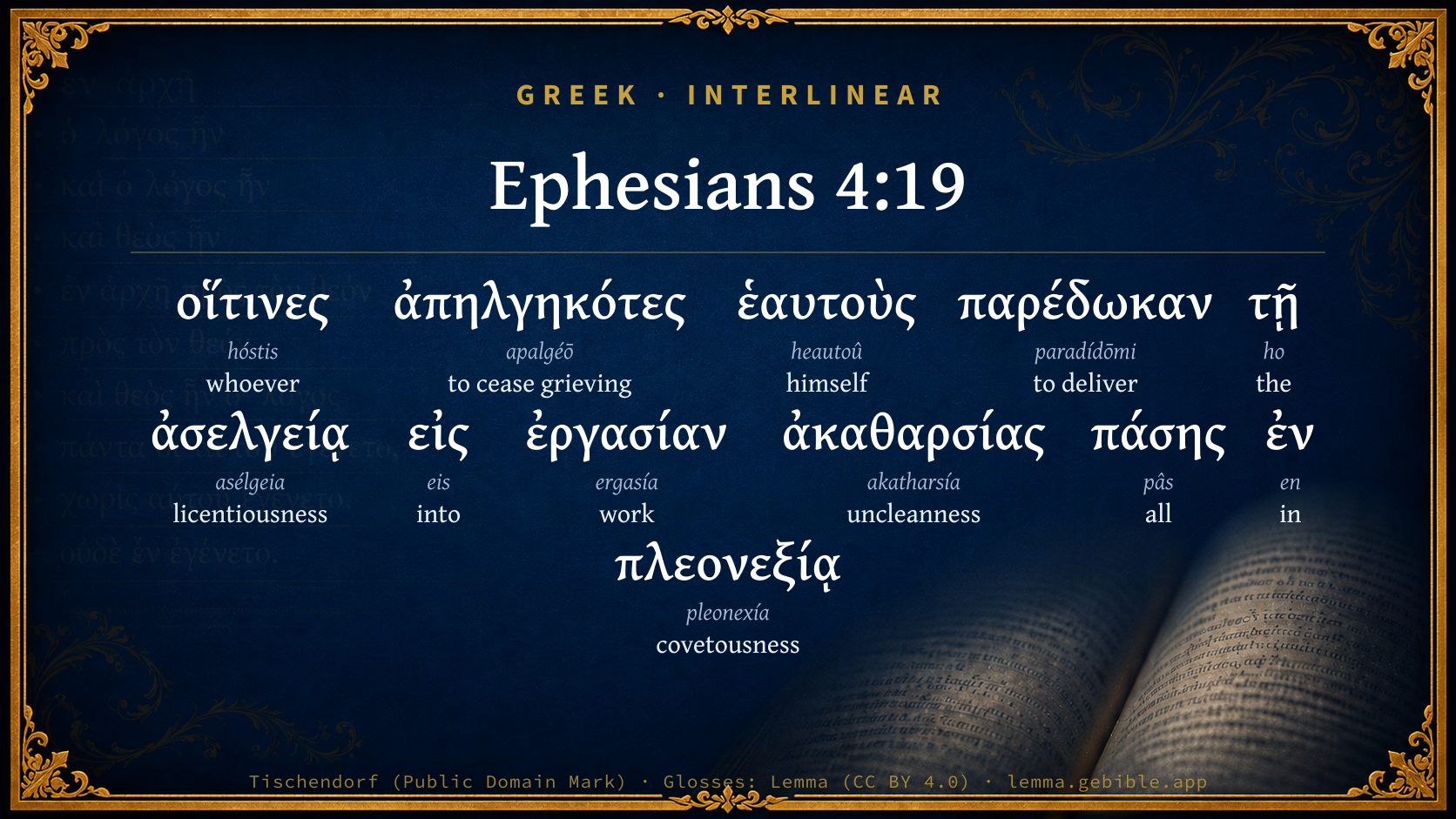
who having become callous gave themselves up to lust, to work all uncleanness with greediness.
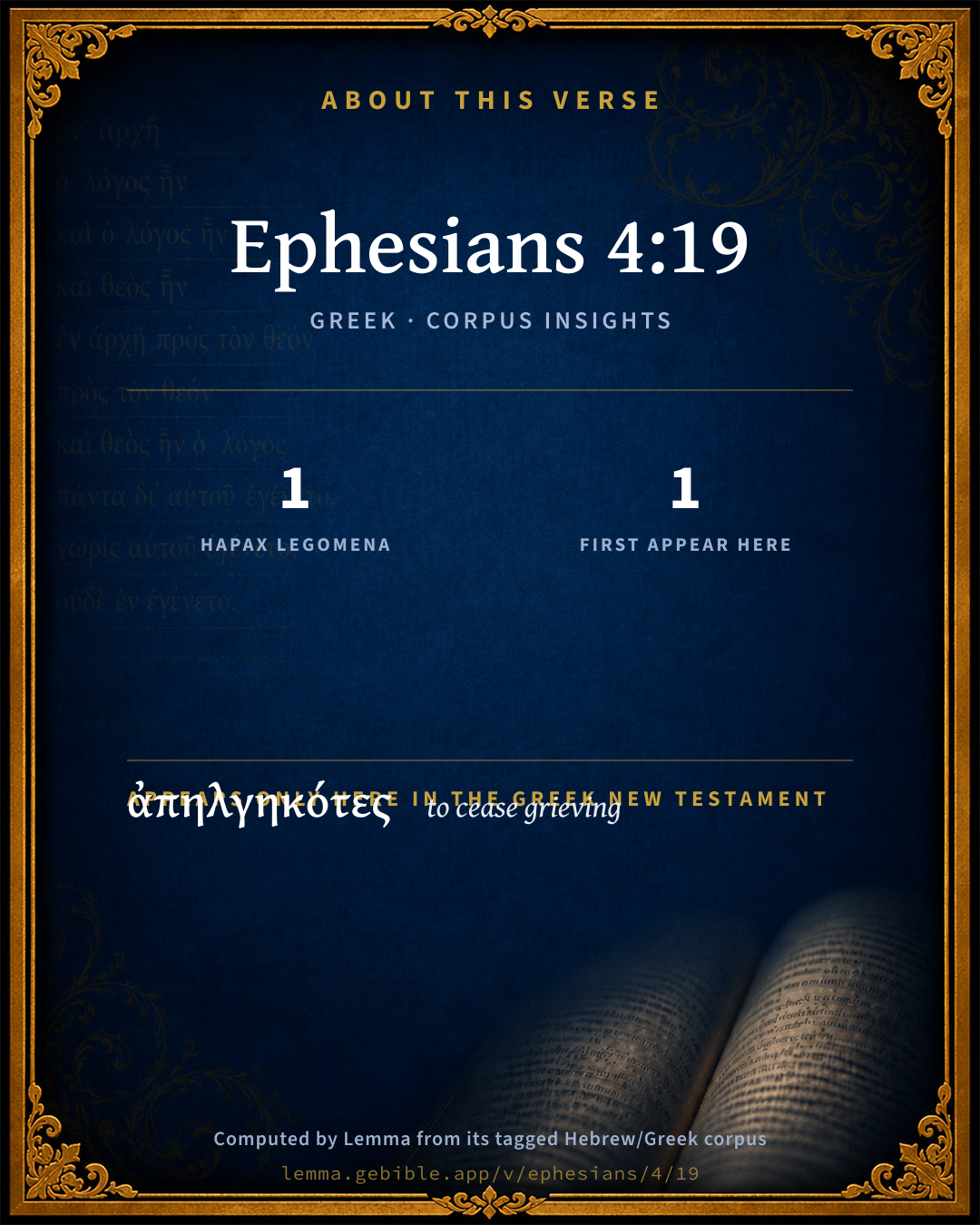
- 1 hapax legomenon — only here in the Greek New Testament
- 1 first appearance in the Greek New Testament
Download a study sheet
One document with this verse’s original text, its word-by-word gloss line, the meaning frame, cross-references with their text, attributed commentary, and full source and license credits — printable, and it pastes into notes with its structure intact.
This verse Autodidact and up
A passage Seminary Student
Up to 50 verses in one chapter. A passage sheet keeps up to 6 commentary sources and 12 cross-references per verse, in the order this page ranks them, and says so on the sheet whenever that leaves anything out. Ask for a single verse and you get the Autodidact verse sheet above.
Everything on this page stays free to read, with no account — the sheet is a download of what is already on screen, not access to it.
Compare translations 3
The same verse in 3 English versions, stacked beneath the original-language interlinear above. Click any original word for its lexicon entry.
Each is an independent rendering of the whole verse — the interlinear is not word-aligned to these translations.
Highlighted words mark where these versions differ — a whole-verse word diff, not a word-by-word alignment.
-
World English Bible Public Domain
who having become callous gave themselves up to lust, to work all uncleanness with greediness.
-
King James Version Public Domain
Who being past feeling have given themselves over unto lasciviousness, to work all uncleanness with greediness.
-
unfoldingWord Literal Text CC BY-SA 4.0
They, being dead to all feeling, handed themselves over to sensuality for the practice of every kind of impurity with greediness.
unfoldingWord Literal Text — © unfoldingWord, licensed CC BY-SA 4.0. Word-aligned USFM3 via Door43 (git.door43.org/unfoldingWord/en_ult).
Show all 19 translations
Every available English version of this verse, each an independent rendering of the whole verse.
-
World English Bible Public Domain
who having become callous gave themselves up to lust, to work all uncleanness with greediness.
-
Berean Standard Bible Public Domain
Having lost all sense of shame, they have given themselves over to sensuality for the practice of every kind of impurity, with a craving for more.
-
Majority Standard Bible Public Domain
Having lost all sense of shame, they have given themselves over to sensuality for the practice of every kind of impurity, with a craving for more.
-
King James Version Public Domain
Who being past feeling have given themselves over unto lasciviousness, to work all uncleanness with greediness.
-
American Standard Version (1901) Public Domain
who being past feeling gave themselves up to lasciviousness, to work all uncleanness with greediness.
-
Revised Version (1885) Public Domain
who being past feeling gave themselves up to lasciviousness, to work all uncleanness with greediness.
-
Geneva Bible (1599) Public Domain
Which being past feeling, haue giuen themselues vnto wantonnesse, to woorke all vncleannesse, euen with griedinesse.
-
Douay-Rheims (1899) Public Domain
Who despairing, have given themselves up to lasciviousness, unto the working of all uncleanness, unto the working of all uncleanness, unto covetousness.
-
Young's Literal Translation Public Domain
who, having ceased to feel, themselves did give up to the lasciviousness, for the working of all uncleanness in greediness;
-
Literal Standard Version CC BY-SA 4.0
who, having ceased to feel, gave themselves up to the licentiousness, for the working of all uncleanness in greediness;
-
Unlocked Literal Bible CC BY-SA 4.0
They have no shame and have handed themselves over to sensuality, and they are continually practicing every kind of impurity.
-
unfoldingWord Literal Text CC BY-SA 4.0
They, being dead to all feeling, handed themselves over to sensuality for the practice of every kind of impurity with greediness.
-
Darby Bible Public Domain
who having cast off all feeling, have given themselves up to lasciviousness, to work all uncleanness with greedy unsatisfied lust.
-
World Messianic Bible Public Domain
They, having become callous, gave themselves up to lust, to work all uncleanness with greediness.
-
Webster's Bible Public Domain
Who being past feeling have given themselves over to lasciviousness, to work all uncleanness with greediness.
-
Free Bible Version CC BY-SA 4.0
Because they are past caring they abandon themselves to sensuality, and greedily do all kinds of disgusting things.
-
Bible in Basic English Public Domain
Who having no more power of feeling, have given themselves up to evil passions, to do all unclean things with overmuch desire.
-
Text-Critical English NT CC BY 4.0
They became callous and gave themselves up to lewd behavior, greedy to engage in every kind of impurity.
-
Tyndale New Testament (1534) Public Domain
which beynge past repentaunce have geven them selves vnto wantannes to worke all manner of vnclennes even with gredynes.
Literal Standard Version (2020), Covenant Press — licensed CC BY-SA 4.0. Text via the HelloAO Bible API (eBible.org). Unlocked Literal Bible (unfoldingWord) — licensed CC BY-SA 4.0. Text via the HelloAO Bible API (eBible.org). unfoldingWord Literal Text — © unfoldingWord, licensed CC BY-SA 4.0. Word-aligned USFM3 via Door43 (git.door43.org/unfoldingWord/en_ult). Free Bible Version, Dr. Jonathan Gallagher — licensed CC BY-SA 4.0. Text via the HelloAO Bible API (eBible.org).
Word by word
More ways to search: Search by grammar → Find every occurrence → Compare this word →
Practice this passage: Drill this verse → Learn its vocabulary →
- Appears 1× in the Greek New Testament
- First appears here
- Part of Speech
- Verb
- Tense
- Perfect
- Voice
- Active
- Mood
- Participle
- Case
- Nominative
- Number
- Plural
- Gender
- Masculine
Full Thayer's Definition
- οἵτινες hóstis G3748 “whoever” Relative pronoun, Nominative, Plural, Masculine
- ἀπηλγηκότες apalgéō G524 “to cease grieving” Verb, Perfect, Active, Participle, Nominative, Plural, Masculine
- ἑαυτοὺς heautoû G1438 “himself” Reflexive pronoun, 3rd person, Accusative, Plural, Masculine
- παρέδωκαν paradídōmi G3860 “to deliver” Verb, Aorist, Active, Indicative, 3rd person, Plural
- τῇ ho G3588 “the” Article, Dative, Singular, Feminine
- ἀσελγείᾳ asélgeia G766 “licentiousness” Noun, Dative, Singular, Feminine
- εἰς eis G1519 “into” Preposition
- ἐργασίαν ergasía G2039 “work” Noun, Accusative, Singular, Feminine
- ἀκαθαρσίας akatharsía G167 “uncleanness” Noun, Genitive, Singular, Feminine
- πάσης pâs G3956 “all” Adjective, Genitive, Singular, Feminine
- ἐν en G1722 “in” Preposition
- πλεονεξίᾳ pleonexía G4124 “covetousness” Noun, Dative, Singular, Feminine
About this verse
These counts appear in no published source. They are computed here, from the morphology-tagged text and Lemma’s own curated glosses. What Lemma adds →
- 12
- words
- 12
- distinct lemmas
- Pauline Epistles
- section
Notable vocabulary
1 hapax legomenon — a word that appears only here in the entire Greek New Testament:
- ἀπηλγηκότες to cease grieving G524
First appearance in Scripture
This word makes its first canonical appearance in the Greek New Testament here:
- ἀπηλγηκότες to cease grieving G524
Shared distinctive vocabulary
ἐργασίαν work G2039 occurs in 6 verses of the Greek New Testament. Also found in:
Cross-references
12Topical passages linked to Ephesians 4:19 in the Treasury of Scripture Knowledge — connected by theme and wording, ordered by reader-vote popularity; previews shown in the World English Bible.
- Romans 1:24–26 Therefore God also gave them up in the lusts of their hearts to uncleanness, that their bodies should be dishonored among themselves,
- Colossians 3:5 Put to death therefore your members which are on the earth: sexual immorality, uncleanness, depraved passion, evil desire, and covetousness, which is idolatry;
- 1 Timothy 4:2 through the hypocrisy of men who speak lies, branded in their own conscience as with a hot iron;
- Jude 1:11 Woe to them! For they went in the way of Cain, and ran riotously in the error of Balaam for hire, and perished in Korah's rebellion.
- 1 Peter 4:3 For we have spent enough of our past time doing the desire of the Gentiles, and having walked in lewdness, lusts, drunken binges, orgies, carousings, and abominable idolatries.
- 2 Peter 2:12–14 But these, as unreasoning creatures, born natural animals to be taken and destroyed, speaking evil in matters about which they are ignorant, will in their destroying surely be destroyed,
- Revelation 18:3 For all the nations have drunk of the wine of the wrath of her sexual immorality, the kings of the earth committed sexual immorality with her, and the merchants of the earth grew rich from the abundance of her luxury."
- Isaiah 56:11 Yes, the dogs are greedy, they can never have enough; and these are shepherds who can't understand: they have all turned to their own way, each one to his gain, from every quarter.
- Ephesians 4:17 This I say therefore, and testify in the Lord, that you no longer walk as the rest of the Gentiles also walk, in the futility of their mind,
- 2 Peter 2:22 But it has happened to them according to the true proverb, "The dog turns to his own vomit again," and "the sow that had washed to wallowing in the mire."
- Job 15:16 How much less one who is abominable and corrupt, A man who drinks iniquity like water!
- Revelation 17:1–6 One of the seven angels who had the seven bowls came and spoke with me, saying, "Come here. I will show you the judgment of the great prostitute who sits on many waters,
Cross-references courtesy of OpenBible.info (CC BY 4.0).
Lesson kit
Teaching starters — assembled from the data on this page, not authored interpretation. Every prompt links to the verse data it draws on. Edit before teaching.
Ephesians, in the Pauline Epistles, opens this verse with 12 words (12 distinct Greek lemmas). Its most distinctive word is apalgéō (“to cease grieving”). A historical commentator’s framing appears above. Read the whole chapter for the surrounding context.
Discussion questions
- The word apalgéō carries the sense “to cease grieving.” How does it shape the verse?
- This verse holds 1 word here found nowhere else in the Greek New Testament. What might the rare word draw attention to?
- The word “to cease grieving” first appears here in Scripture. What is being introduced at this debut?
- Luke 12:58 shares the word «work» with this verse. How do the two illuminate each other?
- These translations render this verse differently. What is at stake in choosing one wording over another?
- Reading how The Biblical Illustrator and Tyndale Open Study Notes read this verse, where do the two commentators agree and where do they part?
Things to notice
- 1 word in this verse appears nowhere else in the Greek New Testament.
- 1 word makes its first canonical appearance in Scripture here.
- These translations choose different wording for 23 words in this verse.
- 12 distinct Greek lemmas span 12 words in this verse.
Commentary
Notes on Ephesians 4:19 from classic Christian and Jewish commentators (each source and its license shown beneath its notes). The classic Christian expositions comment on the surrounding passage and are grouped to its opening verse, so a note may address several verses; the Jewish commentaries on the Tanakh (Rashi and others) are per-verse, so they appear only where the commentator wrote on this verse.
Lemma curates 59 commentaries, every one of them public domain or Creative Commons licensed, each selected and text-cleaned for this edition rather than reprinted as found. About our sources →
The Biblical Illustrator
Joseph S. Exell
The Biblical Illustrator, edited by Joseph S. Exell (c. 1880s–1900s) — public domain. Text from a community e-Sword module.
Tyndale Open Study Notes
Tyndale Open Resources
Tyndale Open Study Notes — © Tyndale Open Resources, licensed CC BY-SA 4.0. Text via the HelloAO Bible API.
Bengel's Gnomon
Johann Albrecht Bengel
Bengel's Gnomon of the New Testament — English translation (T&T Clark, Edinburgh, 1860) — public domain. Text from a community e-Sword module.
Meyer's Critical & Exegetical Commentary
Heinrich August Wilhelm Meyer
Meyer — Critical and Exegetical Commentary on the New Testament — English translation by Peter Christie, edited by Frederick Crombie (T&T Clark, 1880) — public domain. Text from a community e-Sword module.
Expositor's Greek Testament
ed. W. Robertson Nicoll
The Expositor's Greek Testament, edited by W. Robertson Nicoll (1897–1910) — public domain. Text from a community e-Sword module.
Hodge's Commentary on Romans, Ephesians & First Corinthians
Charles Hodge
Charles Hodge — Commentary on Romans (1835), First Corinthians (1857), and Ephesians (1856) — public domain. Text from a community e-Sword module.
Geneva Bible (1599)
Geneva Bible translators
Geneva Bible (1599) marginal notes — public domain. Text via Bolls.life.
Jamieson, Fausset & Brown
Robert Jamieson, A. R. Fausset & David Brown
Jamieson, Fausset & Brown — Commentary Critical and Explanatory on the Whole Bible (1871) — public domain (CC PDM 1.0). Text via the HelloAO Bible API.
Adam Clarke's Commentary
Adam Clarke's Commentary on the Bible (1810–1826) — public domain. Text from a community e-Sword/MySword module.
John Calvin's Commentaries
John Calvin's Commentaries (1540-1563) — public domain. Text from the Calvin Translation Society English edition (1840s-50s) via the Christian Classics Ethereal Library (ccel.org). Calvin's coverage is partial (roughly two-thirds of the Bible); uncommented books and verses are honest gaps, never fabricated. The 19th-century editor's footnotes and remarks are omitted so the notes are faithfully Calvin's own voice.
Ellicott's Commentary for English Readers
A Bible Commentary for English Readers, edited by Charles John Ellicott (1878–1897) — public domain. Text from a community e-Sword module.
The Cambridge Bible for Schools and Colleges
gen. ed. J. J. S. Perowne
The Cambridge Bible for Schools and Colleges (gen. ed. J. J. S. Perowne; Cambridge University Press, 1878–1918) — public domain. Text from a community e-Sword module.
John Gill's Exposition
John Gill's Exposition of the Whole Bible (1746–1763) — public domain (CC PDM 1.0). Text via the HelloAO Bible API.
Trapp's Complete Commentary
John Trapp
John Trapp, A Commentary or Exposition upon All the Books of the Old and New Testament (1647–1656) — public domain. Text from a community e-Sword module.
Albert Barnes' Notes on the Bible
Albert Barnes' Notes on the Bible (1834–1885) — public domain. Text from a community e-Sword/MySword module.
Haydock's Catholic Bible Commentary
George Leo Haydock (1774–1849), Haydock's Catholic Family Bible and Commentary, 1859 edition — public domain. Excludes Psalms (Douay-Rheims chapter numbering differs from Protestant) and Deuterocanonical books (Catholic canon only).
Matthew Poole's English Annotations
Matthew Poole's English Annotations on the Holy Bible (1683–1685) — public domain. Text from a community e-Sword/MySword module.
Whedon's Commentary on the Bible
Daniel D. Whedon
Daniel D. Whedon (gen. ed.), Commentary on the Old and New Testaments (1874–1909) — public domain. Text from a community e-Sword module.
The Pulpit Commentary
The Pulpit Commentary (1880–1919), ed. H.D.M. Spence-Jones & Joseph S. Exell — public domain. Text from a community e-Sword module.
John Wesley's Explanatory Notes
John Wesley, Explanatory Notes Upon the Whole Bible (1754–1765) — public domain. Text via the GEBible commentary corpus.
The People's New Testament
B. W. Johnson
B. W. Johnson's The People's New Testament with Notes (1889–1891) — public domain. Electronic text from the Christian Classics Ethereal Library (CCEL) ThML edition.
Cambridge Greek Testament for Schools and Colleges
Cambridge Greek Testament for Schools and Colleges (Cambridge University Press, 1896; 21 vols, various authors incl. Carr, Maclear, Plummer, Farrar, Lumby, Moule, M. R. James, Simcox) — public domain. Text from a community e-Sword module.
Alford’s Greek Testament
Henry Alford
Henry Alford, The Greek Testament (1849–1861) — public domain. Text from a community e-Sword module.
International Critical Commentary
International Critical Commentary — older volumes (1896–1929), various authors — public domain. Text from a community e-Sword module.
Vincent's Word Studies in the New Testament
Marvin R. Vincent
Marvin R. Vincent, Word Studies in the New Testament (1887–1900) — public domain. Text from a community e-Sword/MySword module.