Ephesians 6:2

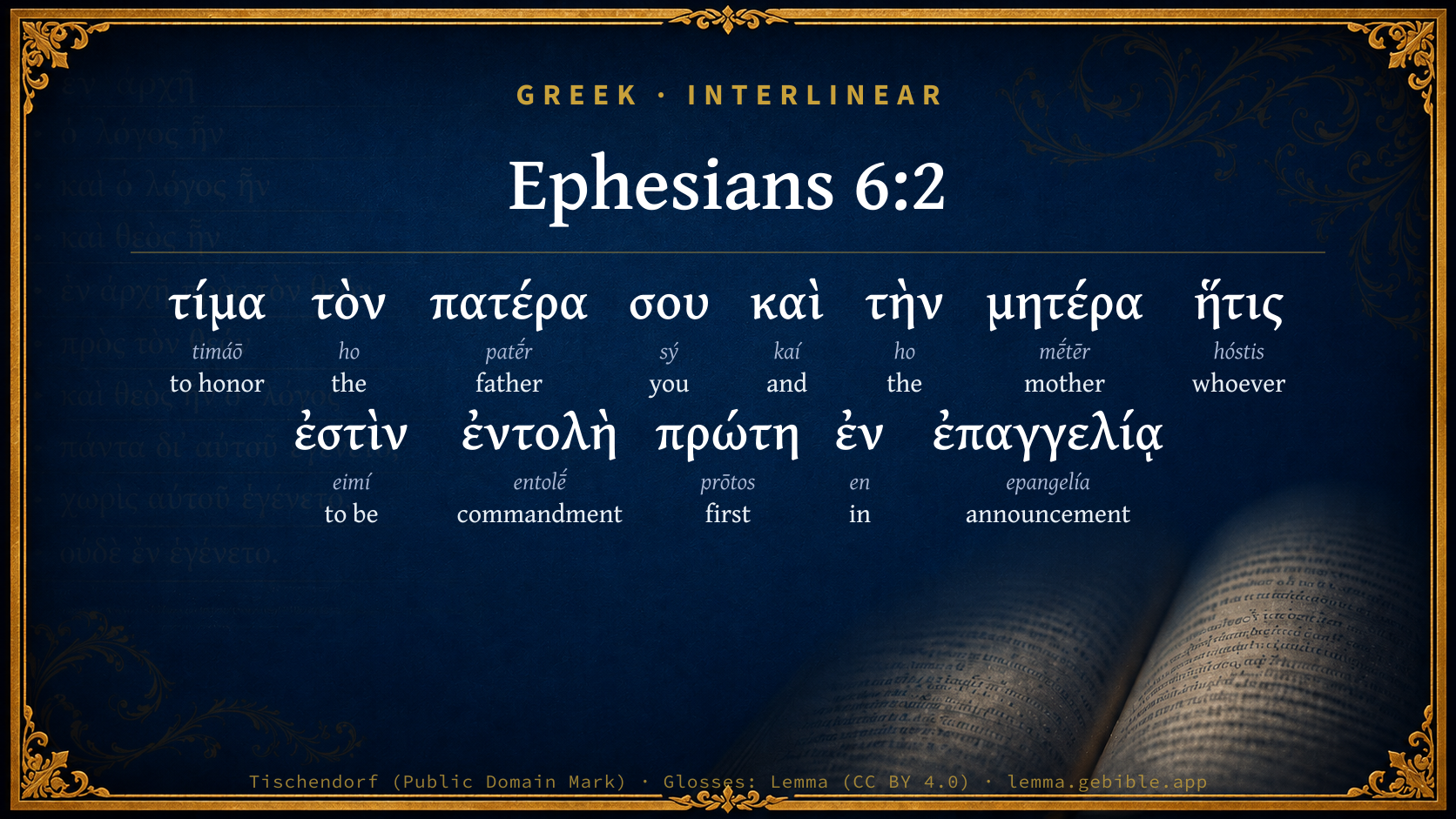
Greek (Tischendorf 8th ed.) Ephesians 6:2 appears in the Greek New Testament. The text above is from the Tischendorf 8th edition. Each word links to its Strong’s number and a concise gloss. Click any word for its full Thayer’s Greek Lexicon entry.
Download image
Cite this verse

Ephesians 6:2 (World English Bible). Public Domain. Lemma interlinear Bible study tool, https://lemma.gebible.app/v/ephesians/6/2.

Show BibTeX & RIS
BibTeX
RIS
English Translation
"Honor your father and mother," which is the first commandment with a promise:
World English Bible · Public Domain
Download a study sheet

One document with this verse’s original text, its word-by-word gloss line, the meaning frame, cross-references with their text, attributed commentary, and full source and license credits — printable, and it pastes into notes with its structure intact.

This verse Autodidact and up

Study sheet (.html) Plain text (.txt)

A passage Seminary Student

Up to 50 verses in one chapter. A passage sheet keeps up to 6 commentary sources and 12 cross-references per verse, in the order this page ranks them, and says so on the sheet whenever that leaves anything out. Ask for a single verse and you get the Autodidact verse sheet above.

Everything on this page stays free to read, with no account — the sheet is a download of what is already on screen, not access to it.

Want to remove ads? Support Godless Engineer
Compare translations 3

The same verse in 3 English versions, stacked beneath the original-language interlinear above. Click any original word for its lexicon entry.

Each is an independent rendering of the whole verse — the interlinear is not word-aligned to these translations.

Highlighted words mark where these versions differ — a whole-verse word diff, not a word-by-word alignment.

  • World English Bible Public Domain
    "Honor your father and mother," which is the first commandment with a promise:
  • King James Version Public Domain
    Honour thy father and mother; which is the first commandment with promise;
  • unfoldingWord Literal Text CC BY-SA 4.0
    “Honor your father and mother” (which is the first commandment with a promise),

unfoldingWord Literal Text — © unfoldingWord, licensed CC BY-SA 4.0. Word-aligned USFM3 via Door43 (git.door43.org/unfoldingWord/en_ult).

Versions to compare (up to 4)

3 of 4 selected

Show all 19 translations

Every available English version of this verse, each an independent rendering of the whole verse.

  • World English Bible Public Domain
    "Honor your father and mother," which is the first commandment with a promise:
  • Berean Standard Bible Public Domain
    “Honor your father and mother” (which is the first commandment with a promise),
  • Majority Standard Bible Public Domain
    “Honor your father and mother” (which is the first commandment with a promise),
  • King James Version Public Domain
    Honour thy father and mother; which is the first commandment with promise;
  • American Standard Version (1901) Public Domain
    Honor thy father and mother (which is the first commandment with promise),
  • Revised Version (1885) Public Domain
    Honour thy father and mother (which is the first commandment with promise),
  • Geneva Bible (1599) Public Domain
    Honour thy father and mother (which is the first commandement with promise)
  • Douay-Rheims (1899) Public Domain
    Honour thy father and thy mother, which is the first commandment with a promise:
  • Young's Literal Translation Public Domain
    honour thy father and mother,
  • Literal Standard Version CC BY-SA 4.0
    honor your father and mother,
  • Unlocked Literal Bible CC BY-SA 4.0
    “Honor your father and mother” (which is the first commandment with promise),
  • unfoldingWord Literal Text CC BY-SA 4.0
    “Honor your father and mother” (which is the first commandment with a promise),
  • Darby Bible Public Domain
    Honour thy father and thy mother, which is the first commandment with a promise,
  • World Messianic Bible Public Domain
    “Honor your father and mother,” which is the first commandment with a promise:
  • Webster's Bible Public Domain
    Honor thy father and mother (which is the first commandment with promise)
  • Free Bible Version CC BY-SA 4.0
    “Honor your father and mother.” This is the first commandment that has a promise attached:
  • Bible in Basic English Public Domain
    Give honour to your father and mother (which is the first rule having a reward),
  • Text-Critical English NT CC BY 4.0
    “Honor yoʋr father and mother” (which is the first commandment with a promise),
  • Tyndale New Testament (1534) Public Domain
    Honoure thy father and mother that is the fyrst commaundement that hath eny promes

Literal Standard Version (2020), Covenant Press — licensed CC BY-SA 4.0. Text via the HelloAO Bible API (eBible.org). Unlocked Literal Bible (unfoldingWord) — licensed CC BY-SA 4.0. Text via the HelloAO Bible API (eBible.org). unfoldingWord Literal Text — © unfoldingWord, licensed CC BY-SA 4.0. Word-aligned USFM3 via Door43 (git.door43.org/unfoldingWord/en_ult). Free Bible Version, Dr. Jonathan Gallagher — licensed CC BY-SA 4.0. Text via the HelloAO Bible API (eBible.org).

Word by word

More ways to search: Search by grammar → Find every occurrence → Compare this word →

Practice this passage: Drill this verse → Learn its vocabulary →

τίμα
timáō
G5091
“to honor”
Verb, Present, Active, Imperative, 2nd person, Singular
Part of Speech
Verb
Tense
Present
Voice
Active
Mood
Imperative
Person
2nd person
Number
Singular
Full Thayer's Definition

Origin: from G5093

TDNT: 10:49,1

1. to estimate, fix the value a. for the value of something belonging to one's self 2. to honour, to have in honour, to revere, venerate
  1. τὸν ho G3588 “the” Article, Accusative, Singular, Masculine
  2. πατέρα patḗr G3962 “father” Noun, Accusative, Singular, Masculine
  3. σου sý G4771 “you” Personal pronoun, 2nd person, Genitive, Singular
  4. καὶ kaí G2532 “and” Conjunction
  5. τὴν ho G3588 “the” Article, Accusative, Singular, Feminine
  6. μητέρα mḗtēr G3384 “mother” Noun, Accusative, Singular, Feminine
  7. ἥτις hóstis G3748 “whoever” Relative pronoun, Nominative, Singular, Feminine
  8. ἐστὶν eimí G1510 “to be” Verb, Present, Active, Indicative, 3rd person, Singular
  9. ἐντολὴ entolḗ G1785 “commandment” Noun, Nominative, Singular, Feminine
  10. πρώτη prōtos G4413 “first” Adjective, Nominative, Singular, Feminine, Superlative
  11. ἐν en G1722 “in” Preposition
  12. ἐπαγγελίᾳ epangelía G1860 “announcement” Noun, Dative, Singular, Feminine

About this verse

These counts appear in no published source. They are computed here, from the morphology-tagged text and Lemma’s own curated glosses. What Lemma adds →

13
words
12
distinct lemmas
Pauline Epistles
section

Notable vocabulary

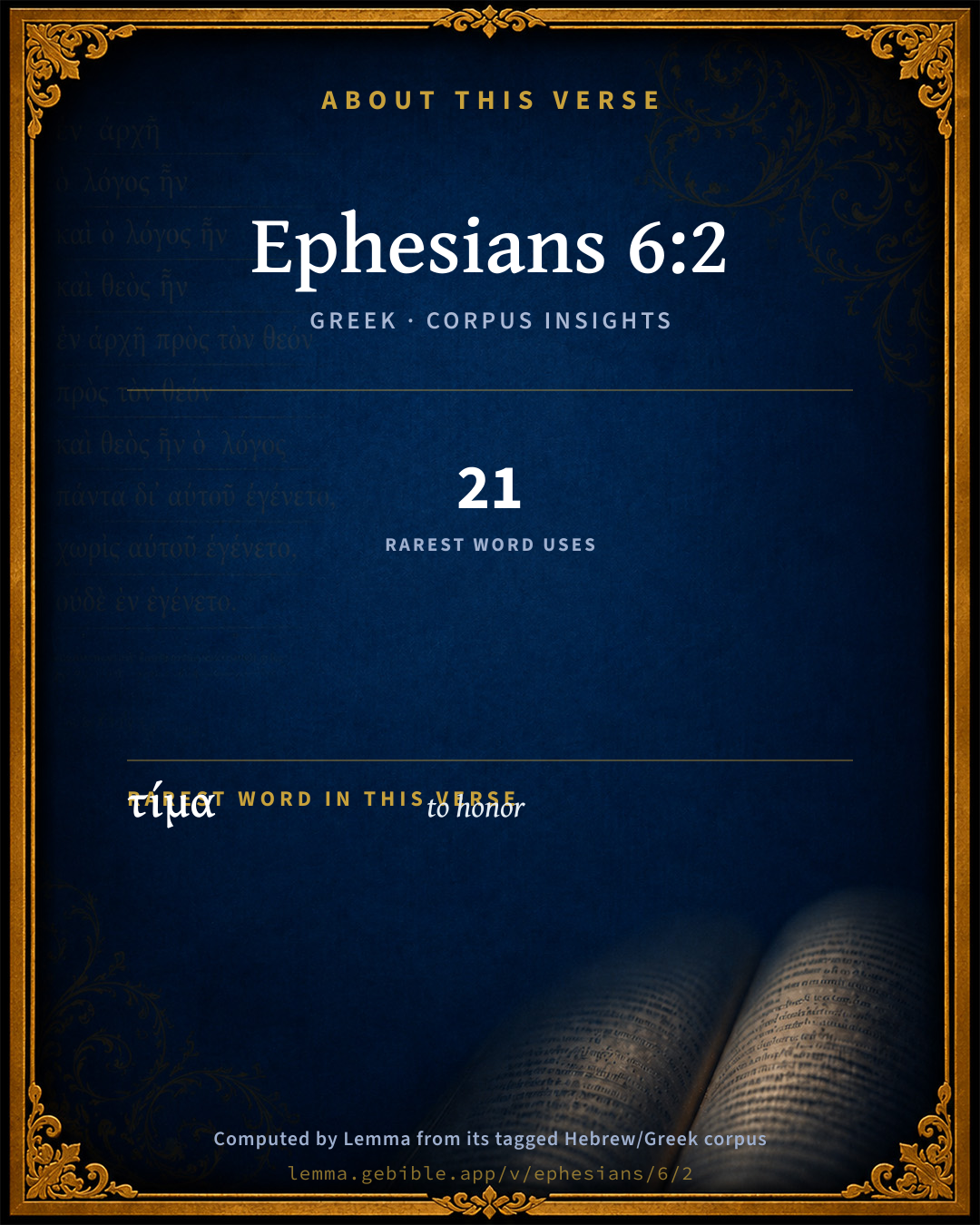
The rarest word here is τίμα to honor G5091 — appearing just 21 times in the whole Greek New Testament.

Shared distinctive vocabulary

τίμα to honor G5091 occurs in 16 verses of the Greek New Testament. Also found in:

Repetition

A word recurs within this verse:

Cross-references

9

Topical passages linked to Ephesians 6:2 in the Treasury of Scripture Knowledge — connected by theme and wording, ordered by reader-vote popularity; previews shown in the World English Bible.

  • Exodus 20:12 "Honor your father and your mother, that your days may be long in the land which Yahweh your God gives you.
  • Deuteronomy 27:16 Cursed be he who sets light by his father or his mother. All the people shall say, Amen.
  • Matthew 15:4–6 For God commanded, 'Honor your father and your mother,' and, 'He who speaks evil of father or mother, let him be put to death.'
  • Proverbs 20:20 Whoever curses his father or his mother, His lamp shall be put out in blackness of darkness.
  • Malachi 1:6 "A son honors his father, and a servant his master. If I am a father, then where is my honor? And if I am a master, where is the respect due me? Says Yahweh of Hosts to you, priests, who despise my name. You say, 'How have we despised your name?'
  • Ezekiel 22:7 In you have they set light by father and mother; in the midst of you have they dealt by oppression with the foreigner; in you have they wronged the fatherless and the widow.
  • Mark 7:9–13 He said to them, "Full well do you reject the commandment of God, that you may keep your tradition.
  • Jeremiah 35:18 Jeremiah said to the house of the Rechabites, Thus says Yahweh of Hosts, the God of Israel: Because you have obeyed the commandment of Jonadab your father, and kept all his precepts, and done according to all that he commanded you;
  • Romans 13:7 Give therefore to everyone what you owe: taxes to whom taxes are due; customs to whom customs; respect to whom respect; honor to whom honor.

Cross-references courtesy of OpenBible.info (CC BY 4.0).

Commentary

Notes on Ephesians 6:2 from classic Christian and Jewish commentators (each source and its license shown beneath its notes). The classic Christian expositions comment on the surrounding passage and are grouped to its opening verse, so a note may address several verses; the Jewish commentaries on the Tanakh (Rashi and others) are per-verse, so they appear only where the commentator wrote on this verse.

Lemma curates 59 commentaries, every one of them public domain or Creative Commons licensed, each selected and text-cleaned for this edition rather than reprinted as found. About our sources →

Tyndale Open Study Notes

Tyndale Open Resources

6:2-3 Children who honor and respect their parents also honor and respect God himself, and blessings follow.

Tyndale Open Study Notes — © Tyndale Open Resources, licensed CC BY-SA 4.0. Text via the HelloAO Bible API.

Bengel's Gnomon

Johann Albrecht Bengel

Eph 6:2. Τίμα, honour) Their duty is more expressly prescribed to children than to parents; for love rather descends than ascends; and from being children men become parents.—ἐντολὴ, commandment) Deu 5:16, Honour thy father and thy mother, as the Lord thy God ENETEIAATO, COMMANDED thee, that it may be well, etc.—πρώτη ἐν ἐπαγγελίᾳ, the first with promise) The commandment in regard to having no strange gods,[94] carries indeed a promise with it, but likewise a threatening, and of these, either the one or the other belonging to [applying to] all the commandments. The commandment respecting the profanation of the name of God has a threatening. For our duties to God are especially due, and most necessary; therefore they are guarded with such sanctions: our duties towards men are due in a less degree to men, and so far [in that point of view] are not so necessary; they have therefore a promise attached to them. The commandment about honouring parents, of which Paul is speaking, has a peculiar promise above them all, if we look at the whole Decalogue: if we look only at the second table, it also alone has a promise; moreover, it is the first with a promise, even in respect to all the commandments, subsequent to the Decalogue. And very properly so, too; for, taking for granted the pious affection of parents in training their children to submit to the commandments of God, the honour, which is shown to parents chiefly by obedience, includes obedience to all the commandments in the early period of life. This apostolic observation is a proof that the observance of the law in the New Testament is not abolished.

[94] Beng. joins in one our first and second commandment (it being the second to which a threat and a promise are attached; whereas to our first commandment there is attached neither).—ED.

Bengel's Gnomon of the New Testament — English translation (T&T Clark, Edinburgh, 1860) — public domain. Text from a community e-Sword module.

Meyer's Critical & Exegetical Commentary

Heinrich August Wilhelm Meyer

Eph_6:2. The frame of mind towards the parents, from which the ὑπακούειν just demanded of the children must proceed, is the τιμᾶν. Hence Paul continues, and that in the express hallowed words of the fourth commandment: τίμα τὸν πατέρα σου κ.τ.λ. (Exo_20:12; Deu_5:16). And as he had before subjoined the general motive of morality τοῦτο γάρ ἐστι δίκαιον, so he now subjoins the particular incitement ἥτις ἐστιν ἐντολὴ πρώτη ἐν ἐπαγγελ., so that the relation as well of the two precepts themselves, as of their motives, Eph_6:1-2, is climactic, and ἥτις … ἐπαγγελίᾳ can by no means be a parenthesis (Griesbach, Rückert, and others).

ἥτις] utpote quae, specifies a reason. See on Eph_3:13.

ἐντολὴ πρώτη ἐν ἐπαγγελ.] The article is not necessary with the πρώτη, which is in itself defining, or with the ordinal numbers generally (Kühner, ad Xen. Anab. vii. 7. 35). Comp. Act_16:12; Php_1:12, al. And the statement that the commandment first as to number in the Decalogue has a promise, is not inconsistent with the facts, since the promise, Exo_20:6, Deu_5:10, is a general one, having reference to the commandments as a whole. Just as little is it to be objected that no further commandment with a promise follows in the Decalogue; for Paul says πρώτη, having before his mind not only the Decalogue, but also the entire series of all the divine precepts, which begins with the Decalogue. Among the commandments, which God has given at the time of the Mosaic legislation and in all the subsequent period, the commandment: Honour father and mother, is the first which is given with a promise. The apparent objection is thus removed in a simple manner by our taking ἐντολή as divine commandment in general, and not restricting it to the sense commandment in the Decalogue. If Paul had had merely the Decalogue in mind, he must have written: the only commandment.[293] For the assumption that it is the first, not with regard to those which follow, but to those which have preceded (Harless), would not even be necessarily resorted to, if it were really establishedwhich, however, is assumed entirely without proofthat Paul had taken into account merely the ten commandments, seeing that he and every one of his readers knew that no other commandment of the ten had a promise. From the arbitrary presupposition, that merely the Decalogue was taken into account, it followed of necessity in the case of other expositors, either that they restricted ἐντολή simply to the commandments of the second table[294] (Ambrosiaster, Zachariae, Michaelis, the latter misconstruing the absence of the article before ἐντολὴ πρώτη as favouring his view), in connection with which Holzhausen even maintained that ἐντολή never denotes a commandment in reference to God (see Mat_22:36; Mat_22:38; Mar_12:28); or else that they tampered with the numerical sense of πρώτη, and made out of it a very important, a chief commandment (Koppe, Morus, Flatt, Matthies, Meier). What a feeble motive would thus result! and πρώτη would in fact mean the most important, which, however, the fifth commandment is not (Mat_22:38; Rom_13:9-10; Gal_5:14). Further, the proposal of Erasmus, that πρώτη ἐν ἐπαγγελ. should be held to apply to the definite promise of Eph_6:3, mention of which first occurs in the fifth commandment, is not worthy of attention (Harless), but erroneous; because the same promise occurs after the fifth commandment only with a general reference to the commandments as a whole (Deu_5:33; Deu_6:2), as it has also occurred even before the fifth commandment in such a general form (Deu_4:40); and because, besides, ἐπαγγ. could not but have the article.

ἐν ἐπαγγελ.] is to be closely attached to πρώτη, as expressing that, wherein this commandment is the first, the point in which the predicate pertains to it. Comp. Diodor. xii. 37: ἐν δὲ εὐγενείᾳ καὶ πλούτῳ πρῶτος, Soph. O. R. 33: πρῶτος ἐν συμφοραῖς. In point of promise it is the first (οὐ τῇ τάξει, Chrysostom).

[293] According to Bleek, Paul had not at the moment the form of the following commandments of the Decalogue definitely before his mind. But with such inadvertence no one is less to be charged than Paul.

[294] In opposition to this, Erasmus aptly remarks: Haec distinctio non est fundata in s. literis, sed est commentum recentiorum theologorum. In general it is to be observed that, according to Philo and Josephus, each of the two tables contained five commandments, not, as Augustine (whom Luther followed) supposed, the first three, and the second seven,and thus two sacred numbers, in which case, moreover, there was found in the first table a reference to the Trinity.

Meyer — Critical and Exegetical Commentary on the New Testament — English translation by Peter Christie, edited by Frederick Crombie (T&T Clark, 1880) — public domain. Text from a community e-Sword module.

Expositor's Greek Testament

ed. W. Robertson Nicoll

Eph 6:2 . τίμα τὸν πατέρα σου καὶ τὴν μητέρα : honour thy father and mother . Obedience is the duty; honour is the disposition of which the obedience is born. The authoritative terms of the OT Law (Exo 20:12 ; Deu 5:16 ), given in the exact words of the LXX, are adopted in order to enforce regard for that disposition. ἥτις ἐστὶν ἐντολὴ πρώτη ἐν ἐπαγγελίᾳ : which is the first commandment in point of promise , ἥτις may have here a simply explanatory force (so Ell., who renders it “the which”; Abb., “for such is”) rather than the qualitative sense, or the casual, “seeing it is”. But even its explanatory use suggests a reason for the fulfilment of the commandment. The prep. ἐν is understood by some ( e.g. , Alf.) to be the local ἐν , expressing the sphere of the commandment, and so conveying the idea of being “accompanied by”. But more probably it expresses the simple sense of relation , “in regard of,” “in point of” (Mey., Ell.; cf. Win.-Moult., p. 488). πρώτη , like other ordinals, being specific enough in itself, dispenses with the article. But what is meant by this definition of the fifth commandment as the first in point of promise? The second commandment also has a kind of promise. But if that commandment is discounted because its promise is general, not peculiar to itself, but applicable to all, and if the fifth alone has attached to it a promise relevant to itself, why is it called the “first” and not rather the “only” commandment in point of promise? Some meet the difficulty by supposing it to mean the first in the second table (Mich., etc.). But in the second table it would still be not only the first but the only one of the kind; and if the Jewish division of the Decalogue, which assigned five commandments to each of the two tables, reaches thus far back, it would not be even in the second table. Nor can πρώτη be taken in the sense of first in importance ; for it is never described as such ( cf. per contra Mat 22:38 ; Rom 13:9-10 ; Gal 5:14 ). The most probable explanation is that Paul has not the Decalogue alone in view, but the whole series of Divine Commandments, Mosaic and later (Mey., etc.). Westcott and Hort notice another possible pointing, viz. , πρώτη , ἐν ἐπαγγελίᾳ , = “the which is the first commandment, with the promise that,” etc. But this still leaves it unexplained why this commandment is called the first . The whole sentence is dealt with as a parenthesis by the RV. But this is to miss the real point of the statement, which is to advance from the duty of obedience ( ὑπακούετε ) enforced by its relation to the requirement of law (the δίκαιον ), to the higher idea of filial honour as inculcated in the highest summary of Divine Law, the Decalogue. The ἥτις clause, therefore, is an integral part of the statement, and instead of being a remark by the way conveys an advance in the thought.

The Expositor's Greek Testament, edited by W. Robertson Nicoll (1897–1910) — public domain. Text from a community e-Sword module.

Hodge's Commentary on Romans, Ephesians & First Corinthians

Charles Hodge

Eph_6:2, Eph_6:3

This consideration is enforced by a reference to the express command of God. The duty is so important as to be included in that brief summary of the moral law given by God on Mount Sinai. It was engraven by the finger of God on the tables of stone, Honor thy father and thy mother. Any flagrant breach of this command was, according to the Mosaic law, punished with death. To honor is to reverence; and, therefore, the command has reference to the inward feeling as well as to the outward conduct. This precept is said to be πρώτη ἐν ἐπαγγελίᾳ. This may mean, it is the first commandment in the decalogue which has a specific promise attached; for the promise connected with the second commandment does not relate to the observance of that particular precept, but to keeping Gods covenant. Or it may mean that it is the first commandment of the second table of the law, and has a promise annexed; or, πρώτη may be taken here as in Mar_12:28, Mar_12:30, in the sense of chief, i.e. the first in importance. The sense would then be, Honor thy father and mother; this is the prime commandment, the first in importance among those relating to our social duties; and it has the specific promise annexed. It shall be well with thee on the earth. This view of the passage is on the whole to be preferred. It is not likely that Paul would call this the first commandment with promise, when it is in fact the only command in the decalogue which has any specific promise annexed to it. And to say that it is the first in order of arrangement in the second table of the law, not only adds nothing to its importance, but supposes the apostle to refer to a distinction between the two tables of the decalogue, not elsewhere recognized in Scripture.

The promise itself has a theocratical form in the Old Testament. That is, it has specific reference to prosperity and length of days in the land which God had given to his people as their inheritance. The apostle generalizes it by leaving out the concluding words, and makes it a promise not confined to one land or people, but to obedient children everywhere. If it be asked whether obedient children are in fact thus distinguished by long life and prosperity? The answer is, that this, like all other such promises, is a revelation of a general purpose of God, and makes known what will be the usual course of his providence. That some obedient children are unfortunate and short lived, is no more inconsistent with this promise, than that some diligent men are poor, is inconsistent with the declaration, The hand of the diligent maketh rich. Diligence, as a general rule, does secure riches; and obedient children, as a general rule, are prosperous and happy. The general promise is fulfilled to individuals, just so far as it shall serve for Gods glory, and their own good.

Charles Hodge — Commentary on Romans (1835), First Corinthians (1857), and Ephesians (1856) — public domain. Text from a community e-Sword module.

Geneva Bible (1599)

Geneva Bible translators

The third argument, taken of the profit that ensueth thereby: because the Lord vouchsafed this commandment amongst the rest, of a special blessing.

A proof of the first argument.

With a special promise: for otherwise the second commandment hath a promise of mercy to a thousand generations, but that promise is general.

Geneva Bible (1599) marginal notes — public domain. Text via Bolls.life.

Jamieson, Fausset & Brown

Robert Jamieson, A. R. Fausset & David Brown

Here the authority of revealed law is added to that of natural law.

which is . . . promise--The "promise" is not made the main motive to obedience, but an incidental one. The main motive is, because it is God's will (Deu 5:16, "Honor thy father and mother, as the Lord thy God hath COMMANDED thee"); and that it is so peculiarly, is shown by His accompanying it "with a promise."

first--in the decalogue with a special promise. The promise in the second commandment is a general one. Their duty is more expressly prescribed to children than to parents; for love descends rather than ascends [BENGEL]. This verse proves the law in the Old Testament is not abolished.

Jamieson, Fausset & Brown — Commentary Critical and Explanatory on the Whole Bible (1871) — public domain (CC PDM 1.0). Text via the HelloAO Bible API.

Adam Clarke's Commentary

Verse 2. Honour thy father] See Clarke on Ex 20:12, &c., where this subject, together with the promises and threatenings connected with it, is particularly considered, and the reasons of the duty laid down at large.

Adam Clarke's Commentary on the Bible (1810–1826) — public domain. Text from a community e-Sword/MySword module.

John Calvin's Commentaries

2. Which is the first commandment with promise. The promises annexed to the commandments are intended to excite our hopes, and to impart a greater cheerfulness to our obedience; and therefore Paul uses this as a kind of seasoning to render the submission, which he enjoins on children, more pleasant and agreeable. He does not merely say, that God has offered a reward to him who obeys his father and mother, but that such an offer is peculiar to this commandment. If each of the commandments had its own promises, there would have been no ground for the commendation bestowed in the present instance. But this is the first commandment, Paul tells us, which God has been pleased, as it were, to seal by a remarkable promise. There is some difficulty here; for the second commandment likewise contains a promise,

“I am the Lord thy God, who shew mercy unto thousands of them that love me, and keep my commandments.” (Exodus 20:5,6.)

But this is universal, applying indiscriminately to the whole law, and cannot be said to be annexed to that commandment. Paul’s assertion still holds true, that no other commandment but that which enjoins the obedience due by children to their parents is distinguished by a promise.

John Calvin's Commentaries (1540-1563) — public domain. Text from the Calvin Translation Society English edition (1840s-50s) via the Christian Classics Ethereal Library (ccel.org). Calvin's coverage is partial (roughly two-thirds of the Bible); uncommented books and verses are honest gaps, never fabricated. The 19th-century editor's footnotes and remarks are omitted so the notes are faithfully Calvin's own voice.

Ellicott's Commentary for English Readers

(2) The first commandment with promise.—It is, indeed, in the Decalogue “the only commandment with promise” distinctly attached to it. But it is still the first; the Decalogue being itself the introduction to the Law, in which similar promises are repeated again and again.

(2) (18) Praying always with all prayer and Supplication.—In this verse the metaphor gives place to direct exhortation, unless, indeed, in the word “watch” there still lingers some reference to the soldier on guard. “Prayer” is the general word for “worship,” appropriated to God alone; “supplication,” used also towards man, is one element of such worship—the asking what we need from God. In Php_4:6 we have first the general word “prayer,” and then the two chief elements of worship, “supplication with thanksgiving.” It is by prayer that all the heavenly armour is put on.

In the Spirit.—That is, “in the Spirit of God” (as in Eph_6:18). Compare the relation of prayer to the inspiration of the Holy Ghost in Rom_8:26-27.

And watching thereunto with all perseverance.—These words in themselves obviously supply the other part of our Lord’s command, “Watch and pray,” naturally apposite to the consideration of the Christian warfare. “Perseverance” implies exertion, holding out against fatigue and difficulty. The corresponding verb is used in relation to all kinds of spiritual labour (see Act_2:42; Act_6:4; Act_8:13); but especially in connection with prayer (Act_1:14; Rom_12:12; Col_4:2). Perhaps from this frequent connection St. Paul is induced to add to it “supplication,” and this time “for all saints,” so leading on to his usual request for the prayers of his brethren. For this he is willing to sacrifice some part of the perfect appropriateness of idea; since the whole picture hitherto has been of the fight, waged by each for himself (although side by side with others), in the combined power of watchfulness and prayer for God’s help.

A Bible Commentary for English Readers, edited by Charles John Ellicott (1878–1897) — public domain. Text from a community e-Sword module.

The Cambridge Bible for Schools and Colleges

gen. ed. J. J. S. Perowne

2. Honour, &c.] Exo_20:12; Deu_5:16. The Gr. here is verbatim that of the LXX. On the duty, cp. Mat_19:19; Mar_7:10; Mar_10:19; Luk_18:20. The “honour” is that not of mere sentiment but of obedience. See for illustration, Mat_15:4-8.

which is] He adds a significant circumstance about the Commandment.

the first … with promise] In the Decalogue, to which here the reference plainly is, it is in fact the only “commandment with” definite “promise.” But the Decalogue is, so to speak, the first page of the whole Law-Book of Revelation.

“With”:—lit. “in”; attended, surrounded, by promise.

The Cambridge Bible for Schools and Colleges (gen. ed. J. J. S. Perowne; Cambridge University Press, 1878–1918) — public domain. Text from a community e-Sword module.

John Gill's Exposition

Honour thy father and mother,.... This explains who parents are, and points at some branches of obedience due unto them; for they are not only to be loved, and to be feared, and reverenced, their corrections to be submitted to, offences against them to be acknowledged, their tempers to be bore with, and their infirmities covered; but they are to be honoured in thought, word, and gesture; they are to be highly thought of and esteemed; they are to be spoken to, and of, very honourably, and with great veneration and to be behaved to in a very respectful manner; and they are to be relieved, assisted, and maintained in comfortable way when aged, and in necessitous circumstances; and which may be chiefly designed. So the Jews explain "the honour" due to parents, by, &c. "giving them food, drink", and "clothing", unloosing their shoes, and leading them out and in (x). Compare with this Ti1 5:4; See Gill on Mat 15:4;

which is the first commandment with promise: it is the fifth commandment in the decalogue, but the first that has a promise annexed to it: it is reckoned by the Jews (y) the weightiest of the weightiest commands of the law; and the reward bestowed on it, is length of days, as follows.

(x) T. Hieros. Kiddushin, fol. 61. 2. T. Bab. Kiddushin, fol. 31. 1, 2. Maimon. & Bartenora in Misn. Kiddushin, c. 1. sect. 7. (y) Debarim Rabba, sect. 6. fol. 241. 3.

John Gill's Exposition of the Whole Bible (1746–1763) — public domain (CC PDM 1.0). Text via the HelloAO Bible API.

Trapp's Complete Commentary

John Trapp

2 Honour thy father and mother; (which is the first commandment with promise;)

Ver. 2. First commandment with promise] To wit, with special promise of long life. {See Trapp on "Mat 15:4"}

John Trapp, A Commentary or Exposition upon All the Books of the Old and New Testament (1647–1656) — public domain. Text from a community e-Sword module.

Albert Barnes' Notes on the Bible

Honour thy father and mother - see Exo 20:12; compare notes on Mat 15:4.

Which is the first commandment with promise - With a promise annexed to it. The promise was, that their days should be long in the land which the Lord their God would give them. It is not to be supposed that the observance of the four first commandments would not be attended with a blessing, but no particular blessing is promised. It is true, indeed, that there is a “general declaration” annexed to the second commandment, that God would show mercy to thousands of generations of them that loved him and that kept his commandments. But that is rather a declaration in regard to all the commands of God than a promise annexed to that specific commandment. It is an assurance that obedience to the law of God would be followed with blessings to a thousand generations, and is given in view of the first and second commandments together, because they related particularly to the honor that was due to God. But the promise in the fifth commandment is a “special promise.” It does not relate to obedience to God in general, but it is a particular assurance that they who honor their parents shall have a particular blessing as the result of that obedience.

Albert Barnes' Notes on the Bible (1834–1885) — public domain. Text from a community e-Sword/MySword module.

Haydock's Catholic Bible Commentary

With a promise. This commandment being delivered with a special promise of a long life, which promise is to be understood conditionally, especially in regard to Christians, i.e. unless it be a greater favour to be taken out of the world young. (Witham)

George Leo Haydock (1774–1849), Haydock's Catholic Family Bible and Commentary, 1859 edition — public domain. Excludes Psalms (Douay-Rheims chapter numbering differs from Protestant) and Deuterocanonical books (Catholic canon only).

Matthew Poole's English Annotations

i.e. A special promise annexed to the particular duty commanded. There being promises added to only two commandments, viz. the second and this fifth; that which is annexed to the second commandment is a general one, and which relates to the whole law, but this a special one, and which respects this commandment in particular.

Matthew Poole's English Annotations on the Holy Bible (1683–1685) — public domain. Text from a community e-Sword/MySword module.

Whedon's Commentary on the Bible

Daniel D. Whedon

2. Honour—Venerate as your natural and divinely sanctioned superiors and controllers.

Father and mother—Regarding both parents with equal though distinctive honour; the father with more awe, the mother with more love.

The first commandment with promise—How first in the decalogue with promise? Does not the second commandment promise that God is a Being showing mercy unto thousands of them that love him, and keep his commandments? The satisfactory reply is, that though embraced in this second commandment this promise belongs alike and expressly to all the commandments, and is not peculiar to one; whereas the promise of the fifth is expressly limited to that alone. But the apostle does not, of course, mean that its being the first in order of the decalogue is in itself important; but it is important symbolizing that it is first in promissory eminence, no other decalogue command having any promise at all. It is in this respect true first, and last, and sole, and therefore signal in its promissory character.

Daniel D. Whedon (gen. ed.), Commentary on the Old and New Testaments (1874–1909) — public domain. Text from a community e-Sword module.

The Pulpit Commentary

Honor thy father and mother (which is the first commandment with a promise). The exhortation, based on natural morality (ver. 1), is here confirmed from the Decalogue. "Honor" is higher than obedience (ver. 1); it is the regard due to those who, by Divine appointment, are above us, and to whom our most respectful consideration is due. Father and mother, though not quite on a footing of equality in their relation to each other, (Eph_5:22) are equal as objects of honor and obedience to their children. It is assumed here that they are Christians; where one was a Christian and not the ether, the duty would be modified. But in these succinct verses the apostle lays down general rules, and does not complicate his exhortations with exceptions. The latter part of the verse contains a special reason for the precept; it is the first commandment with a promise attached. But obviously the apostle meant more than this; for as in ver. I he had affirmed the duty to be one of natural religion, so here he means to add that it is also part of the revealed will of God it is one of the commandments; but still further, it is the first commandment with a promise. It may, perhaps, be said that this is appealing, not to the higher, but to the lower part of our nature to our selfishness, not our goodness; but it is not an appeal to one part of our nature to the exclusion of the rest; it is an appeal to our whole nature, for it is a part of our nature to expect that in the end virtue will be rewarded and vice punished. In the case of children it is difficult to look far forward; the rewards and the punishments, to be influential, must be within the ken of vision, as it were; therefore it is quite suitable that, in writing to them, the apostle should lay emphasis on a promise which had its special fulfillment in the life that now is.

The Pulpit Commentary (1880–1919), ed. H.D.M. Spence-Jones & Joseph S. Exell — public domain. Text from a community e-Sword module.

John Wesley's Explanatory Notes

honour - That is, love, reverence, obey, assist, in all things. The mother is particularly mentioned, as being more liable to be slighted than the father. Which is the first commandment with a promise - For the promise implied in the second commandment does not belong to the keeping that command in particular, but the whole law. Exod. xx, 12

John Wesley, Explanatory Notes Upon the Whole Bible (1754–1765) — public domain. Text via the GEBible commentary corpus.

The People's New Testament

B. W. Johnson

2. Honor thy father and mother. Both of them, both alike. Which is the first. The first of the ten commandments which has a promise attached.

B. W. Johnson's The People's New Testament with Notes (1889–1891) — public domain. Electronic text from the Christian Classics Ethereal Library (CCEL) ThML edition.

Cambridge Greek Testament for Schools and Colleges

2 f. τίμα τὸν πατέρα. In the case of the children it was natural to clinch the instruction by a quotation from the Commandments which they must have been taught early.

ἥτις ἐστὶν ἐντολὴ πρώτη ἐν ἐπαγγελίᾳ, ἵνα εὖ σοι γένηται καὶ ἔσῃ μακροχρόνοις. The upshot of this sentence is perfectly clear, though there is a perplexing variety of possible punctuations. The construction is complicated by the fact that ἵνα εὖ σοι γένηται κ.τ.λ. is a continuation of the quotation already begun. It is probably best to suppose that St Paul is picking out characteristics of this commandment which would commend it specially to children. He selects two. It is ‘a primary Commandment,’ standing in the front rank. Note the absence of the article. This classification of commandments was attractive to the Jewish mind. Cf. Mar 12:28. Does not πρώτη πάντων suggest that there might be a class of ‘Primary’ Commandments? Cf. τὰ βαρύτερα τοῦ νόμου Mat 23:23. It is also ‘ἐν ἐπαγγελίᾳ,’ ‘encompassed about with a promise,’ ‘with a promise to back it up.’ ἵνα εὖ σοι γένηται is then introduced abruptly, as it were with quotation marks, out of strict construction, ‘That it may be well with thee.’ The change to the fut. ind. is remarkable. It is not due to the LXX. It may mark a change to the direct language of promise ‘And thou shalt be,’ but the fut. ind. in dependence on ἵνα is not unexampled, e.g. Rev 22:14.

Cambridge Greek Testament for Schools and Colleges (Cambridge University Press, 1896; 21 vols, various authors incl. Carr, Maclear, Plummer, Farrar, Lumby, Moule, M. R. James, Simcox) — public domain. Text from a community e-Sword module.

Alford’s Greek Testament

Henry Alford

2.] Honour thy father and thy mother, for such is (‘seeing it is,’ as Ellic., is rather too strong for ἥτις, throwing the motive to obedience too much on the fact of the promise accompanying it. Whereas the obedience rests on the fact implied in ἐντολή, and the promise comes in to shew its special acceptableness to God) the first commandment (in the decalogue, which naturally stands at the head of all God’s other commandments; and which, though not formally binding on us as Christians, is quoted, in matters of eternal obligation (not of positive enactment), as an eminent example of God’s holy will) with a promise (i.e. with a special promise attached: ‘in respect of promise’ is too vague, and does not convey any definite meaning in English. The fact certainly is so, and the occurrence of the description of God as ‘shewing mercy unto thousands, &c.’ after the second commandment, does not, as Jer., al., have thought, present any difficulty—for that is no special promise attached to the commandment. Nor does the fact that no other commandment occurs in the decalogue with a promise: see above. The ἐν, as in reff.—in the sphere or department of—characterized by—accompanied with), that it may be well with thee, and thou be long-lived upon the earth (he paraphrases the latter portion of the commandment, writing for ἵνα μακρ. γένῃ, ἔσῃ μ.,—and omitting after γῆς, (τῆς ἀγαθῆς, so in Exod., but not in Deut.) ἧς κύριος ὁ θεός σου δίδωσίν σοι: thus adapting the promise to his Christian readers, by taking away from it that which is special and peculiar to the Jewish people. It is surely a mistake, as Jer., Aq., Est., Olsh., to spiritualize the promise, and understand by τῆς γῆς the heavenly Canaan. The very fact of the omission of the special clause removes the words from the region of type into undoubted reality: and when we remember that the persons addressed are τὰ τέκνα, we must not depart from the simplest Sense of the words. For the future after ἵνα, see 1Co 9:18, note: and Joh 7:3; Rev 22:14. To consider it as such, is far better than to suppose a change of construction to the direct future—‘and thou shalt be, &c.’).

Henry Alford, The Greek Testament (1849–1861) — public domain. Text from a community e-Sword module.

International Critical Commentary

2. ἥτις ἐστὶν ἐντολὴ πρώτη ἐν ἐπαγγελίᾳ. ἥτις, “for such is,” Alf. To translate “seeing it is” would be to throw the motive to obedience too much on the fact of the promise.

πρώτη ἐν ἐπ. has caused difficulty to expositors. The second commandment has something which resembles a promise attached. Origen, who mentions this difficulty, replies, first, that all the commandments of the Decalogue were πρωταί, being given first after the coming out of Egypt; or, if this be not admitted, that the promise in the second commandment was a general one, not specially attached to the observance of that precept. The latter reply has been adopted by most modern commentators. Others have supposed “first” to mean “first in the second table”; but the Jews assigned five commandments to each table, as we learn from Philo and Josephus. See also Lev 19:3 and Rom 13:9. The position of the precept in the former passage and its omission in the latter agree with this arrangement. In either case this would be the only commandment with promise. Meyer and Ellicott suppose, therefore, that it is not the Decalogue alone that is referred to. Braune and Stier understand πρώτη as first in point of time, namely, the first which has to be learned. Compare Bengel (not adopting this view): “honor parentibus per obedientiam praesertim praestitus initio aetatis omnium praeceptorum obedientiam continet.”

ἐν ἐπαγγελίᾳ. Ellicott, Meyer, and others take this to mean “in regard of, or, in point of, promise.” “The first command we meet with which involves a promise” (Ell.). Meyer compares Diod. Sic. xiii. 37, ἐν δὲ εὐγενείᾳ καὶ πλούτῳ πρῶτος. But to make this parallel we should understand the words here: “foremost in promise,” i.e. having the greatest promise attached, or, at least, “having the advantage in point of promise,” which is not their interpretation. Chrysostom says: οὐ τῇ τάξει εἶπεν αὐτὴν πρώτην, ἀλλὰ τῇ ἐπαγγελίᾳ. But it is precisely τῇ τάξει that Ell. and Mey. make it first, only not of all the commandments. It is better, then, to take ἐν (with Alford) as = characterised by, accompanied with, so that we might translate “with a promise.” But to what purpose is it to state that this is the first command in order accompanied with a promise, especially when it would be equally true, and much to the purpose, to say that it is the only command with a promise? On the whole, therefore, remembering that it is children who are addressed, the interpretation of Stier and Braune seems preferable. Westcott and Hort give a place in their margin to a different punctuation, viz. placing the comma after πρώτη, and connecting ἐπαγγελίᾳ with ἵνα.

International Critical Commentary — older volumes (1896–1929), various authors — public domain. Text from a community e-Sword module.

Vincent's Word Studies in the New Testament

Marvin R. Vincent

Honor thy father, etc. To what is essentially right the divine ordinance is added. Compare Aeschylus : "For the reverence of parents, this is written third in the laws of much - venerated justice" (" Suppliants, "687 - 689). So Euripides :" There are three virtues which thou shouldst cultivate, my child, to honor the gods, and thy parents who gave thee being and the common laws of Hellas " (Fragment). Honor expresses the frame of mind from which obedience proceeds.

First - with promise [πρωτη εν επαγγελια] . First in point of promise, as it also is in order the first with promise.

Marvin R. Vincent, Word Studies in the New Testament (1887–1900) — public domain. Text from a community e-Sword/MySword module.

Lesson kit

Teaching starters — assembled from the data on this page, not authored interpretation. Every prompt links to the verse data it draws on. Edit before teaching.

Ephesians, in the Pauline Epistles, opens this verse with 13 words (12 distinct Greek lemmas). Its most distinctive word is timáō (“to honor”). A historical commentator’s framing appears above. Read the whole chapter for the surrounding context.

Discussion questions

  1. How does “to honor” (timáō) shape what this verse is saying?
  2. Matthew 15:4 shares the word «to honor» with this verse. How do the two illuminate each other?
  3. “the” occurs 2× in this one verse. What is the effect of the repetition?
  4. These translations render this verse differently; the difference is in the English rendering, not the original. What questions does that raise?
  5. Reading how Tyndale Open Study Notes and Bengel's Gnomon read this verse, where do the two commentators agree and where do they part?

Things to notice

Reading settings

Reading text

Shown beneath each verse's original-language words.

Old Testament
Old Testament edition

Read the OT as the Masoretic Hebrew (MT) or the Greek Septuagint (LXX).

English shown for the Greek Septuagint (in the Hebrew ↔ Greek comparison).

Comparing translations? Open the Compare panel on any verse page to stack up to four side by side.