Revelation 17:12

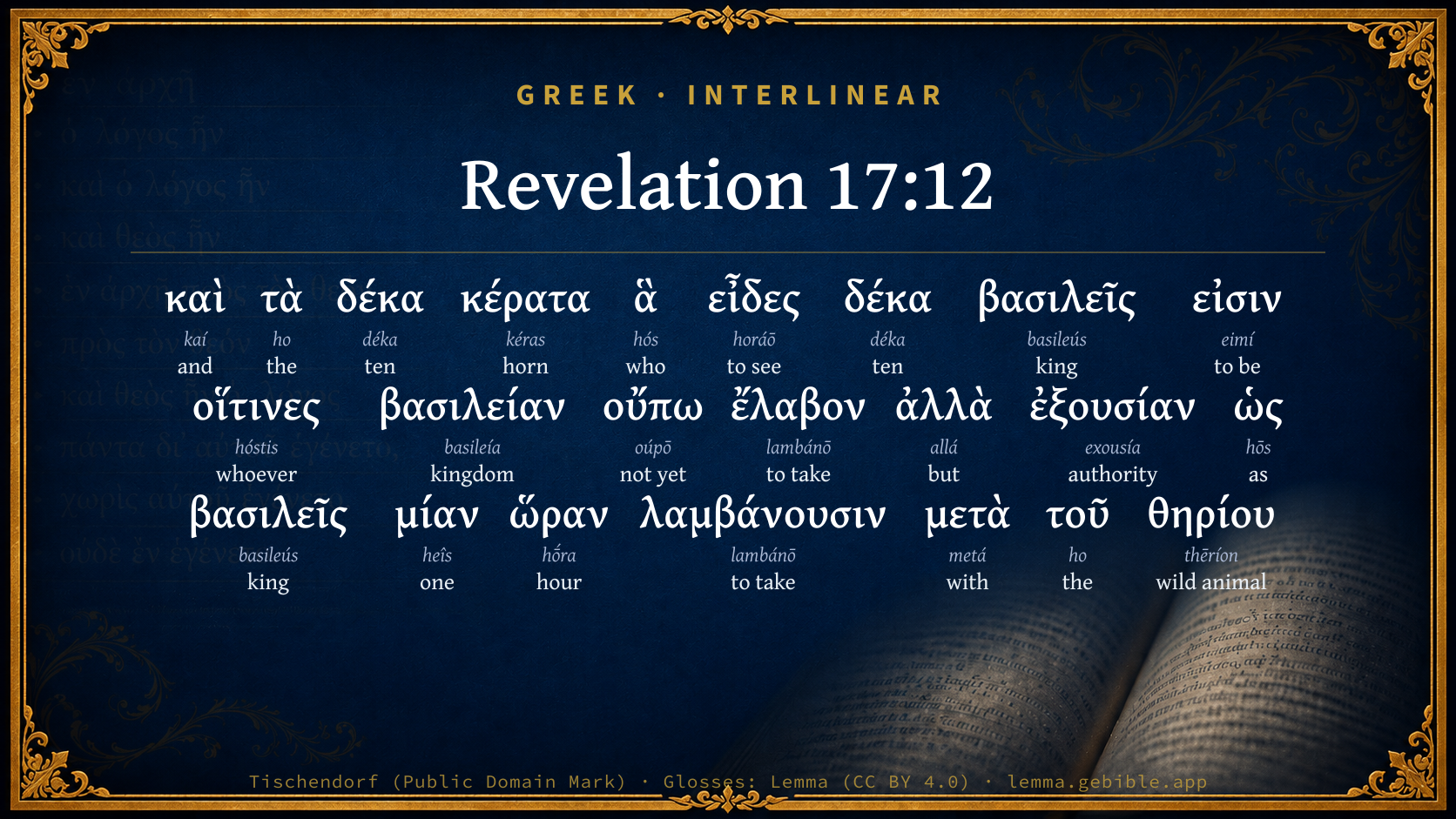
Greek (Tischendorf 8th ed.) Revelation 17:12 appears in the Greek New Testament. The text above is from the Tischendorf 8th edition. Each word links to its Strong’s number and a concise gloss. Click any word for its full Thayer’s Greek Lexicon entry.
Download image
Cite this verse

Revelation 17:12 (World English Bible). Public Domain. Lemma interlinear Bible study tool, https://lemma.gebible.app/v/revelation/17/12.

Show BibTeX & RIS
BibTeX
RIS
English Translation
The ten horns that you saw are ten kings who have received no kingdom as yet, but they receive authority as kings, with the beast, for one hour.
World English Bible · Public Domain
Download a study sheet

One document with this verse’s original text, its word-by-word gloss line, the meaning frame, cross-references with their text, attributed commentary, and full source and license credits — printable, and it pastes into notes with its structure intact.

This verse Autodidact and up

Study sheet (.html) Plain text (.txt)

A passage Seminary Student

Up to 50 verses in one chapter. A passage sheet keeps up to 6 commentary sources and 12 cross-references per verse, in the order this page ranks them, and says so on the sheet whenever that leaves anything out. Ask for a single verse and you get the Autodidact verse sheet above.

Everything on this page stays free to read, with no account — the sheet is a download of what is already on screen, not access to it.

Want to remove ads? Support Godless Engineer
Compare translations 3

The same verse in 3 English versions, stacked beneath the original-language interlinear above. Click any original word for its lexicon entry.

Each is an independent rendering of the whole verse — the interlinear is not word-aligned to these translations.

Highlighted words mark where these versions differ — a whole-verse word diff, not a word-by-word alignment.

  • World English Bible Public Domain
    The ten horns that you saw are ten kings who have received no kingdom as yet, but they receive authority as kings, with the beast, for one hour.
  • King James Version Public Domain
    And the ten horns which thou sawest are ten kings, which have received no kingdom as yet; but receive power as kings one hour with the beast.
  • unfoldingWord Literal Text CC BY-SA 4.0
    And the ten horns that you saw are ten kings who have not yet received a kingdom, but they are receiving authority as kings with the beast for one hour.

unfoldingWord Literal Text — © unfoldingWord, licensed CC BY-SA 4.0. Word-aligned USFM3 via Door43 (git.door43.org/unfoldingWord/en_ult).

Versions to compare (up to 4)

3 of 4 selected

Show all 19 translations

Every available English version of this verse, each an independent rendering of the whole verse.

  • World English Bible Public Domain
    The ten horns that you saw are ten kings who have received no kingdom as yet, but they receive authority as kings, with the beast, for one hour.
  • Berean Standard Bible Public Domain
    The ten horns you saw are ten kings who have not yet received a kingdom, but will receive one hour of authority as kings, along with the beast.
  • Majority Standard Bible Public Domain
    The ten horns you saw are ten kings who have not yet received a kingdom, but will receive one hour of authority as kings, along with the beast.
  • King James Version Public Domain
    And the ten horns which thou sawest are ten kings, which have received no kingdom as yet; but receive power as kings one hour with the beast.
  • American Standard Version (1901) Public Domain
    And the ten horns that thou sawest are ten kings, who have received no kingdom as yet; but they receive authority as kings, with the beast, for one hour.
  • Revised Version (1885) Public Domain
    And the ten horns that thou sawest are ten kings, which have received no kingdom as yet; but they receive authority as kings, with the beast, for one hour.
  • Geneva Bible (1599) Public Domain
    And the tenne hornes which thou sawest, are tenne Kings, which yet haue not receiued a kingdome, but shall receiue power, as Kings at one houre with the beast.
  • Douay-Rheims (1899) Public Domain
    And the ten horns which thou sawest, are ten kings, who have not yet received a kingdom, but shall receive power as kings one hour after the beast.
  • Young's Literal Translation Public Domain
    `And the ten horns that thou sawest, are ten kings, who a kingdom did not yet receive, but authority as kings the same hour do receive with the beast,
  • Literal Standard Version CC BY-SA 4.0
    And the ten horns that you saw are ten kings who did not yet receive a kingdom, but receive authority as kings one hour with the beast;
  • Unlocked Literal Bible CC BY-SA 4.0
    The ten horns that you saw are ten kings who have not yet received a kingdom, but they will receive authority as kings for one hour together with the beast.
  • unfoldingWord Literal Text CC BY-SA 4.0
    And the ten horns that you saw are ten kings who have not yet received a kingdom, but they are receiving authority as kings with the beast for one hour.
  • Darby Bible Public Domain
    And the ten horns which thou sawest are ten kings, which have not yet received a kingdom, but receive authority as kings one hour with the beast.
  • World Messianic Bible Public Domain
    The ten horns that you saw are ten kings who have received no kingdom as yet, but they receive authority as kings with the beast for one hour.
  • Webster's Bible Public Domain
    And the ten horns which thou sawest are ten kings, who have received no kingdom as yet; but receive power as kings one hour with the beast.
  • Free Bible Version CC BY-SA 4.0
    The ten horns that you saw are ten kings who have not begun to reign yet. However, they will be given authority to reign as kings together with the beast for one hour.
  • Bible in Basic English Public Domain
    And the ten horns which you saw are ten kings, which still have been given no kingdom; but they are given authority as kings, with the beast, for one hour.
  • Text-Critical English NT CC BY 4.0
    The ten horns that yoʋ saw are ten kings who have not yet received a kingdom, but they will receive authority as kings for one hour with the beast.
  • Tyndale New Testament (1534) Public Domain
    And the ten hornes which thou seist are ten kynges which have receaved no kyngdome but shall receave power as kynges at one houre with the beest.

Literal Standard Version (2020), Covenant Press — licensed CC BY-SA 4.0. Text via the HelloAO Bible API (eBible.org). Unlocked Literal Bible (unfoldingWord) — licensed CC BY-SA 4.0. Text via the HelloAO Bible API (eBible.org). unfoldingWord Literal Text — © unfoldingWord, licensed CC BY-SA 4.0. Word-aligned USFM3 via Door43 (git.door43.org/unfoldingWord/en_ult). Free Bible Version, Dr. Jonathan Gallagher — licensed CC BY-SA 4.0. Text via the HelloAO Bible API (eBible.org).

Word by word

More ways to search: Search by grammar → Find every occurrence → Compare this word →

Practice this passage: Drill this verse → Learn its vocabulary →

κέρατα
kéras
G2768
“horn”
Noun, Nominative, Plural, Neuter
Part of Speech
Noun
Case
Nominative
Number
Plural
Gender
Neuter
Full Thayer's Definition

Origin: from a primary kar (the hair of the head)

TDNT: 14:09,4

1. a horn a. of animals b. since animals (esp. bulls) defend themselves with their horns, the horn with the Hebrews (and other nations) is a symbol of strength and courage, and used as such in a variety of phrases 1. a mighty and valiant helper, the author of deliverance, of the Messiah c. a projecting extremity in a shape like a horn, a point, apex: as of an altar
  1. καὶ kaí G2532 “and” Conjunction
  2. τὰ ho G3588 “the” Article, Nominative, Plural, Neuter
  3. δέκα déka G1176 “ten” Adjective, Numeral (indeclinable)
  4. ἃ hós G3739 “who” Relative pronoun, Accusative, Plural, Neuter
  5. εἶδες horáō G3708 “to see” Verb, Aorist, Active, Indicative, 2nd person, Singular
  6. δέκα déka G1176 “ten” Adjective, Numeral (indeclinable)
  7. βασιλεῖς basileús G935 “king” Noun, Nominative, Plural, Masculine
  8. εἰσιν eimí G1510 “to be” Verb, Present, Active, Indicative, 3rd person, Plural
  9. οἵτινες hóstis G3748 “whoever” Relative pronoun, Nominative, Plural, Masculine
  10. βασιλείαν basileía G932 “kingdom” Noun, Accusative, Singular, Feminine
  11. οὔπω oúpō G3768 “not yet” Adverb, Negative
  12. ἔλαβον lambánō G2983 “to take” Verb, Aorist, Active, Indicative, 3rd person, Plural
  13. ἀλλὰ allá G235 “but” Conjunction
  14. ἐξουσίαν exousía G1849 “authority” Noun, Accusative, Singular, Feminine
  15. ὡς hōs G5613 “as” Adverb
  16. βασιλεῖς basileús G935 “king” Noun, Nominative, Plural, Masculine
  17. μίαν heîs G1520 “one” Adjective, Accusative, Singular, Feminine
  18. ὥραν hṓra G5610 “hour” Noun, Accusative, Singular, Feminine
  19. λαμβάνουσιν lambánō G2983 “to take” Verb, Present, Active, Indicative, 3rd person, Plural
  20. μετὰ metá G3326 “with” Preposition
  21. τοῦ ho G3588 “the” Article, Genitive, Singular, Neuter
  22. θηρίου thēríon G2342 “wild animal” Noun, Genitive, Singular, Neuter

About this verse

These counts appear in no published source. They are computed here, from the morphology-tagged text and Lemma’s own curated glosses. What Lemma adds →

23
words
19
distinct lemmas
Revelation
section

Notable vocabulary

The rarest word here is κέρατα horn G2768 — appearing just 11 times in the whole Greek New Testament.

Shared distinctive vocabulary

κέρατα horn G2768 occurs in 10 verses of the Greek New Testament. Also found in:

Repetition

Words recur within this verse:

  • δέκα ten G1176 ×2
  • βασιλεῖς king G935 ×2
  • ἔλαβον to take G2983 ×2
  • τὰ the G3588 ×2

Cross-references

11

Topical passages linked to Revelation 17:12 in the Treasury of Scripture Knowledge — connected by theme and wording, ordered by reader-vote popularity; previews shown in the World English Bible.

  • Revelation 12:3 Another sign was seen in heaven. Behold, a great red dragon, having seven heads and ten horns, and on his heads seven crowns.
  • Revelation 13:1 Then I stood on the sand of the sea. I saw a beast coming up out of the sea, having ten horns and seven heads. On his horns were ten crowns, and on his heads, blasphemous names.
  • Daniel 7:24 As for the ten horns, out of this kingdom shall ten kings arise: and another shall arise after them; and he shall be diverse from the former, and he shall put down three kings.
  • Zechariah 1:18–21 I lifted up my eyes, and saw, and, behold, four horns.
  • Revelation 17:16 The ten horns which you saw, and the beast, these will hate the prostitute, and will make her desolate, and will make her naked, and will eat her flesh, and will burn her utterly with fire.
  • Daniel 7:20 and concerning the ten horns that were on its head, and the other [horn] which came up, and before which three fell, even that horn that had eyes, and a mouth that spoke great things, whose look was more stout than its fellows.
  • Daniel 2:40–43 The fourth kingdom shall be strong as iron, because iron breaks in pieces and subdues all things; and as iron that crushes all these, shall it break in pieces and crush.
  • Daniel 7:7–8 After this I saw in the night-visions, and, behold, a fourth animal, awesome and powerful, and strong exceedingly; and it had great iron teeth; it devoured and broke in pieces, and stamped the residue with its feet: and it was diverse from all the animals that were before it; and it had ten horns.
  • Revelation 18:17 For in an hour such great riches are made desolate.' Every shipmaster, and everyone who sails anywhere, and mariners, and as many as gain their living by sea, stood far away,
  • Revelation 18:19 They cast dust on their heads, and cried, weeping and mourning, saying, 'Woe, woe, the great city, in which all who had their ships in the sea were made rich by reason of her great wealth!' For in one hour is she made desolate.
  • Revelation 18:10 standing far away for the fear of her torment, saying, 'Woe, woe, the great city, Babylon, the strong city! For your judgment has come in one hour.'

Cross-references courtesy of OpenBible.info (CC BY 4.0).

Commentary

Notes on Revelation 17:12 from classic Christian and Jewish commentators (each source and its license shown beneath its notes). The classic Christian expositions comment on the surrounding passage and are grouped to its opening verse, so a note may address several verses; the Jewish commentaries on the Tanakh (Rashi and others) are per-verse, so they appear only where the commentator wrote on this verse.

Lemma curates 59 commentaries, every one of them public domain or Creative Commons licensed, each selected and text-cleaned for this edition rather than reprinted as found. About our sources →

Tyndale Open Study Notes

Tyndale Open Resources

17:12-13 The ten horns, symbolic of the world kingdoms that follow the beast, rule simultaneously under his direction. While these verses have caused speculation concerning a ten-nation confederacy (from the client kingdoms of Rome, to the states opposed to the Holy Roman Empire, to the European Union), these conjectures are beside the point, which is that all nations opposed to God will be defeated (17:14).

Tyndale Open Study Notes — © Tyndale Open Resources, licensed CC BY-SA 4.0. Text via the HelloAO Bible API.

Bengel's Gnomon

Johann Albrecht Bengel

Rev 17:12. Τὰ δέκα κέρατα, the ten horns) The ten horns correspond with the ten toes of the kingly image: Dan 2:41-42; Dan 7:7; Dan 7:20; Dan 7:24; and since each of the feet has five toes, we must wait to see whether the ten kings are about to be divided by any means into two quinaries.—οὐκ ἔλαβον—λαμβάνουσι—ἔχουσι—διδόασιν[191]—πολεμήσουσι, they have not received: they receive, have, give: they shall make war) The past, the present, the future. They have not received, because they gave [their kingdom] to the beast: Rev 17:17. Objection: The order of the text is thus changed. Answer: Let the Chiasmus lately noticed be weighed: in accordance with which, even in Rev 17:18, present things are put before the future things noticed in Rev 17:14; and, independently of that verse, even before the future things of Rev 17:16, the slaughter of the kings is also mentioned immediately before the destruction of the beast, Rev 17:8; Rev 17:14.— ὡς βασιλεῖς, as kings) Having not received the kingdom until now.—μίαν ὥραν, one hour) comp. Rev 17:10, note. It is not said, in one hour, as ch. Rev 18:10; but for one hour. A similar use of the accusative occurs, ch. Rev 20:2.—μετὰ τοῦ θηρίου, with the beast) The beast has his followers, ten kings: antithetical to (Rev 17:14.) with Him, the Lamb, who also has His followers.

[191] So AB Vulg. Iren.; but Rec. Text, διαδιδώσουσιν, h Vulg. (Fuld. MS., not Amiat. the best MS.)—E.

Bengel's Gnomon of the New Testament — English translation (T&T Clark, Edinburgh, 1860) — public domain. Text from a community e-Sword module.

Meyer's Critical & Exegetical Commentary

Heinrich August Wilhelm Meyer

Rev_17:12-17. The interpretation of the ten horns, also (Rev_17:15) of the waters, on which the harlot sits. In conclusion, the interpretation of the harlot herself, Rev_17:18, follows the interpretation of the special points.

δέκα βασιλεῖς. Hengstenb. errs in two ways by regarding the number ten, which is analogous to the number seven, Rev_17:9 sqq., as inaccurate, and the βασιλεῖς, again, as reigns. See, besides, on Rev_17:18.

οἳτινες

θηρίου. The limitation of οὔπω ἔλαβον in Grot., viz., in the parts of the Roman Empire, is more explicit than the closing words of Rev_17:12. The text says that the ten kings in general have received no dominion at all; but they obtained authority as kings, and that, too, as associates and aids of the beast (μετὰ τ. θηρ.; cf. Rev_17:13 sq.), for one hour; for they shall be immediately abandoned by the Lord. The very brief duration (μίαν ὥρ. accus., as Rev_9:5) of their rule, designated in a schematic way,[3884] appears to correspond with the circumstance that of one of these kings it is said: ἐξυυσ. ὠς βασιλ. The βασιλεία of these βασιλεῖς would then appear, not as a complete sovereignty, but as a quickly evanescent power, which, however, because of its temporary greatness, is represented as one that is royal.[3885]

μίαν γνώμην ἔχουσιν. The words immediately following give[3886] the statement that the unanimity of these kings is intended to act in concert with the beast, and that, too, first of all, against the Lord (Rev_17:14), but then also against the harlot (Rev_17:16).

μετὰ τοῦ ἀρνίου πολεμήσουσι. Here, however, there immediately followsas the reverse of Rev_11:7, Rev_13:7the statement that not only the Lamb, because he is the Lord of all lords and King of kings,[3887] but even believers, shall conquer those kings. The νικήσει αυτ. suggests for the further designation of subject, καὶ οἱ μετʼ αὐτοῦ, κ.τ.λ.,[3888] the idea of a ΝΙΚΉΣΟΥΣΙ.[3889] The threefold designation, according to which the saints[3890] appear as those who have been called and chosen on the part of their Lord, and have, on their part, maintained their fidelity,[3891] emphasizes the inner foundation of the victory, confirming the promise, and likewise calling to mind the condition of the victory.

[3884] Cf. Rev_18:10.

[3885] Cf. Rev_9:3.

[3886] Cf. also Rev_17:17

[3887] Cf. Rev_19:16.

[3888] The στρατεύματα of the Lord, Rev_19:14; Rev_19:19.

[3889] Unnaturally, Beng.: Those who are with him are the elect, who are only to look on.

[3890] Cf. Rev_13:7.

[3891] Cf. Rev_2:10.

Meyer — Critical and Exegetical Commentary on the New Testament — English translation by Peter Christie, edited by Frederick Crombie (T&T Clark, 1880) — public domain. Text from a community e-Sword module.

Expositor's Greek Testament

ed. W. Robertson Nicoll

Rev 17:12-18 : the campaign of Nero and his vassal-kings against Rome, which is slain by an arrow feathered from her own wings.

Rev 17:12-13 . This political application of the ten horns probably means either the Parthian satraps of Rev 16:12 , reckoned in round numbers, who occupied a royal position in the estimation of the East (so, e.g. , Eichhorn, de Wette, Bleek, Bousset, Scott, J. Weiss, Baljon, Wellhausen), or (“chefs d’armée,” Havet) the governors of the (ten senatorial) provinces, holding office for ( μίαν ὥραν ) one year (so Ewald, Hilg., Hausrath, Mommsen, B. Weiss, Hirscht, Briggs, Selwyn, B. W. Henderson [“the number may be derived from Daniel. In any case it is a round number, and the seer did not go round counting the number of the Roman provinces”]), unless it is to be left as a vague description of the allies (Weizs., Holtzm., Swete). Philo ( de leg. ad Caium xxxiv.) notes the facilities possessed by proconsuls for starting revolutions, especially if they commanded powerful armies such as those stationed on the Euphrates to protect Syria.

The Expositor's Greek Testament, edited by W. Robertson Nicoll (1897–1910) — public domain. Text from a community e-Sword module.

Geneva Bible (1599)

Geneva Bible translators

The third place of this description as I said, verse 18, is a prophetical prediction of things to come which the beast should do, as in the words following S. John doth not obscurely signify, saying, which have not yet received the kingdom, etc. For there is an Antithesis or opposition between these kings, and those that went before. And first the persons are described, in this verse, then their deeds in the two verses following.

That is, arising with their kingdoms out of the Roman beast: at such time as that political Empire began by the craft of the Popes greatly to fall.

Namely, with the second beast whom we called before a false prophet, which beast, ascending out of the earth got unto himself all the authority and power of the first beast, and exerciseth the same before his face, as was said, Rev. 14:11, 12. For when the political Empire of the West began to bow downwards, there both arose those ten kings, and the second beast took the opportunity offered to usurp unto himself all the power of the former beast. These kings long ago, many have numbered and described to be ten and a great part of the events plainly testifieth the same in this our age.

Geneva Bible (1599) marginal notes — public domain. Text via Bolls.life.

Jamieson, Fausset & Brown

Robert Jamieson, A. R. Fausset & David Brown

ten kings . . . received no kingdom as yet; but receive power as kings . . . with the beast--Hence and from Rev 17:14, Rev 17:16, it seems that these ten kings or kingdoms, are to be contemporaries with the beast in its last or eighth form, namely, Antichrist. Compare Dan 2:34, Dan 2:44, "the stone smote the image upon his feet," that is, upon the ten toes, which are, in Dan 2:41-44, interpreted to be "kings." The ten kingdoms are not, therefore, ten which arose in the overthrow of Rome (heathen), but are to rise out of the last state of the fourth kingdom under the eighth head. I agree with ALFORD that the phrase "as kings," implies that they reserve their kingly rights in their alliance with the beast, wherein "they give their power and strength unto" him (Rev 17:13). They have the name of kings, but not with undivided kingly power [WORDSWORTH]. See AUBERLEN'S not so probable view, see on Rev 17:3.

one hour--a definite time of short duration, during which "the devil is come down to the inhabitant of the earth and of the sea, having great wrath, because he knoweth that he hath but a short time." Probably the three and a half years (Rev 11:2-3; Rev 13:5). Antichrist is in existence long before the fall of Babylon; but it is only at its fail he obtains the vassalage of the ten kings. He in the first instance imposes on the Jews as the Messiah, coming in his own name; then persecutes those of them who refuse his blasphemous pretensions. Not until the sixth vial, in the latter part of his reign, does he associate the ten kings with him in war with the Lamb, having gained them over by the aid of the spirits of devils working miracles. His connection with Israel appears from his sitting "in the temple of God" (Th2 2:4), and as the antitypical "abomination of desolation standing in the Holy place" (Dan 9:27; Dan 12:11; Mat 24:15), and "in the city where our Lord was crucified" (Rev 11:8). It is remarkable that IRENÆUS [Against Heresies, 5:25] and CYRIL OF JERUSALEM [RUFINUS, Historia Monachorum, 10.37] prophesied that Antichrist would have his seat at Jerusalem and would restore the kingdom of the Jews. JULIAN the apostate, long after, took part with the Jews, and aided in building their temple, herein being Antichrist's forerunner.

Jamieson, Fausset & Brown — Commentary Critical and Explanatory on the Whole Bible (1871) — public domain (CC PDM 1.0). Text via the HelloAO Bible API.

Adam Clarke's Commentary

Verse 12. And the ten horns which thou sawest are ten kings, which have received no kingdom as yet; but receive power as kings one hour with the beast.] The meaning of horns has already been defined when speaking of those of the dragon. The meaning is therefore as follows: Though the Latin empire be now in existence, the ten horns refer to ten Latin kingdoms yet in futurity, and consequently they have received no dominion AS YET; for that part of the Latin domination now in power is the sixth head, or imperial government of the heathen Caesars. But the ten states of the Latins receive dominion as monarchies μιανωραν, one time, (as it may be properly translated,) i.e., at the same time with the beast, or that which ascendeth out of the bottomless pit; consequently, the Latin empire here intended is the one which was in futurity in the apostolic age.

Adam Clarke's Commentary on the Bible (1810–1826) — public domain. Text from a community e-Sword/MySword module.

Ellicott's Commentary for English Readers

(12) And the ten horns . . .—The explanation of the ten horns. They are the kings, not necessarily, as we have seen, personal kings, but rather kingdoms or nationalities, who received not a kingdom as yet; as they are on the seventh head, the hour of their power is not yet, but comes at the fall of the sixth head: then they receive power one hour. (Comp. “short time” in Rev_17:10.) But though these are sundered powers, they are one in their subjection to the wild beast. They have one mind or judgment, and their power and authority they give to the wild beast. The universal empire idea may disappear, but the spirit and principle of mere earthliness will remain; it needs no vast power like Rome to illustrate its spirit. The ten horns are united in one mind; they move as the wild beast directs; their work and tendency of their power is hostile to Christ. They shall make war with the Lamb; and the Lamb shall conquer them because He is Lord of lords, and King of kings. When do these powers make war with the Lamb? The answer is, they make war when the direction of their policy and morals is in favour of oppression, wrong, worldliness; whenever nations or peoples allow the secular spirit to breathe through all they do, they are not with Christ, they are against Him. There are hints that some “special outbreak” of hostility may take place on the eve of the full manifestation of the righteous King and His kingdom (Rev_19:16-19); busy evil spirits, lawless utterances, unbrotherly federations, unspiritual conceptions, may pave the way for such; the great crisis will then come, when the issue will be secularity and spirituality. It is not necessary to define the ten kings; the number does not need to be pressed as literal; for in Hebrew, “when a whole was to be divided into parts, ten was the number commonly adopted” (Bähr, quoted by Dr. Currey). The war of the ten kings against the Lamb is brought out more fully in Revelation 19. There the King of kings is seen victorious; in His victory they who are with Him, the called, and chosen, and faithful, shall share. This threefold description is a brief summary of the Christian life. This is the only place where St. John employs the word translated “called.” (Comp. Mat_20:16.)

A Bible Commentary for English Readers, edited by Charles John Ellicott (1878–1897) — public domain. Text from a community e-Sword module.

The Cambridge Bible for Schools and Colleges

gen. ed. J. J. S. Perowne

12. the ten horns &c.] Comparing Daniel 7, 8, we can hardly doubt that these horns represent kingdoms related to the Roman Empire as the kingdoms of the Diadochi to that of Alexander. Such are the principal kingdoms of modern Europe: and in the recognition of this fact lies the key to mediaeval and to much of modern history. (See Sir F. Palgrave’s Normandy and England, Intr. ch. 1, English Commonwealth, chh. 10, 11, 17, 18, 19, and Dr Bryce’s Holy Roman Empire, passim). The number ten is probably to be taken as exact, but we cannot yet point to it as being definitely realised. It is remarkable that the kingdoms of Europe have (as is pointed out by Elliot, Horae Apoc. Part IV. ch. 4 § 2) tended at many periods to that number: but there are now more than ten sovereign states in Christendom, or even in Europe only. Judging from the analogy of the Macedonian kingdoms (see on Rev_16:12) we may guess that only those are included which are of considerable size and power, and have some claim to continue the imperial tradition of the common predecessor. The existing states of Germany, France, Austria, and Russia have such a claim (which they assert, more or less constantly and more or less legitimately, by the use of the imperial title): so has our own country, which has claimed rank as an empire coordinate with continental ones since the days of Edgar the Peaceable: so (more doubtfully) have Spain and Portugal in virtue of their memories, and so have the new kingdoms of Greece and Italy in virtue of their hopes. A tenth can hardly be named, for Sweden though powerful was not imperial even under Gustavus Adolphus or Charles XII., and Turkey could hardly be thus coupled with the states of Christendom: but believers will watch the developement of “the Eastern Question” with a solemn interest.

receive power as kings] It is extraordinary that St Hippolytus, (On Christ and Antichrist, ch. 27) inferred, apparently not from this passage, but from Dan_2:42, that the ten powers of the last days, among which the Roman empire is partitioned, will pass from monarchies into democracies. Few things were humanly speaking less likely in his days, few more so in ours.

one hour] Presumably for a very short time: the end will be very near when the ten horns appear in their final and unmistakeable form. It therefore ought not to surprise us, that we cannot identify them all yet, that we only see them in process of developement.

Another explanation of the horns has been suggested (Renan, L’Antechrist, pp. 433, 4)—that they are the claimants of the Empire who appeared in the “long year” (Tac. Dial. 17) after the death of Nero. It is possible to enumerate ten of these, but unfortunately not without including both Galba and Vespasian, one of whom must be reckoned among the heads, and therefore not the horns. Else, both Rome and the Roman Empire were so severely shaken in the civil wars between the rival emperors, and their actual fall in the fifth century so nearly anticipated, that this interpretation harmonises well enough with Rev_17:16. On the other hand, it fails to give meaning to Rev_17:13, or to agree with the undoubted meaning of the same symbol in Daniel.

with the beast] Yet in Dan_7:7-8 the ten horns appear before the little horn (which seems to correspond with this appearance of the Beast, no longer merely as a polity but as a person), and three of them are destroyed by him. I do not pretend to be able to reconcile the two.

The Cambridge Bible for Schools and Colleges (gen. ed. J. J. S. Perowne; Cambridge University Press, 1878–1918) — public domain. Text from a community e-Sword module.

John Gill's Exposition

And the ten horns which thou sawest are ten kings,.... Not ten Christian emperors, which are reckoned up by Brightman from Constantine to Theodosius; for these did not reign with the beast, or give their kingdoms to him, and much less did they make war with the Lamb; they are rather the angels of Michael, that fought for him, the Lamb, against the dragon, and his angels, Rev 12:7 nor ten kings that will rise up and divide the Roman empire between them, towards the end of the world, which is a sense devised by Papists to obscure and hide from men the true meaning of the passage; but the ten kingdoms which rose up, and into which the Roman empire was divided upon its being ruined, and torn to pieces by the Goths, Huns, and Vandals. They are the same with the "ten toes" of Nebuchadnezzar's image, and the "ten horns" of the fourth beast, or kingdom, in Dan 2:42. These are differently reckoned up by interpreters: by Napier thus; Spain, France, Lombardy, England, Scotland, Denmark, Sweden, Hungary, Italy, and the exarchate of Ravenna: by Mr. Mede after this manner; the Britains in Britain, under Vortimer their king; the Saxons in the same place, under Hengist; the Franks in Gallia Belgica, or Celtics, under Childeric; the Burgundians in another part of France, under Gunderic; the Wisigoths in Aquitain, and part of Spain, under Theodoric; the Sueves and Alans in Gallaecia and Portugal, under Riciarius; the Vandals in Spain and Africa, under Genseric; the Almains in that part of Germany called Rhetia, under Sumanus; the Ostrogoths in Pannonia, and after in Italy, under Theodomir; and the Greeks in the rest of the empire, under Marcianus: and by another (u) writer they are accounted for in this way; the Almains in both the Rhetia, and in Pannonia, who rose in the year 356; the Ostrogoths, first in Pannonia, and then in Italy, in 377; the Wisigoths in Pannonia, and then in Italy, afterwards in France, and last of all in Spain, in 378; the Huns in Pannonia, and for some time throughout all Europe, in 378; the Britian Romans in Britain, and afterwards the Saxons, in 406; the Sueves, first in France, and then in Spain, in 407; the Alans, first in France, and then in Spain, in 407; the Vandals, first in France, then in Spain, afterwards in Africa, in 407; the Burgundians in France, in 407; the Franks in France, in 410. And it is generally thought all these ten kingdoms were up by the year 450 at least. Though Dr. Allix makes the epocha of them A. D. 486, when the western empire was taken from the Romans, and fixes them in the following order; the Almains in Rhetia and Pannonia; the Franks in Belgica; the Anglo-Saxons in Britain; the Wisigoths in Gallia Aquitania and Hispania Tarraconensis; the Sueves and Alans in Portugal; the Vandals in Africa; the Burgundians in Gallia Sequanensis; the Ostrogoths in Pannonia, and afterwards in Italy; the Lombards in Pannonia, and the Heruli and Turcilingi, who conquered Augustulus: and though these kingdoms were thrown into different forms and shapes afterwards, yet it is remarkable they were just of this number; as, 1. Italy and Germany; 2. France; 3. Spain; 4. England with Ireland; 5. Scotland; 6. Hungary; 7. Poland with Lithuania; 8. Denmark, with Sweden and Norway, Sweden being since divided; 9. Portugal; 10. The Grecian empire seized by the Ottomans. And as these kings cannot be understood of single persons at the head of these kingdoms, or of so many kings succeeding one another; so neither is it necessary to consider these kingdoms as being in the same state, and made up of the same sort of people always; it is enough that they are in the same place, and within the empire; for we, may observe, that different things, at different times, are ascribed to them, or at least to some. They all are at first of one mind, and give their kingdom to the beast; then they, at least some of them, hate the whore, and burn her with fire; and yet others lament the destruction and burning of Rome, Rev 17:16.

Which have received no kingdom as yet: in John's time, when the Pagan empire was in being, and the beast was not risen, with whom they were to reign; hence these horns have no crowns on them, Rev 12:3.

But receive power as kings one hour with the beast; as soon as he was risen; and therefore the horns are represented with crowns upon them, Rev 13:1. Their rise was with the Papal beast, who rose not to his supreme power and dignity until the western emperor, which let and hindered, was removed out of the way; which was done by the barbarous nations, who set up these kingdoms, which made way for the lordly and tyrannical government of the pope of Rome; so that he and they rose up together: and this may he meant by the "one hour"; namely, that at one and the same hour or season he came to his supreme authority and grandeur, and they received their kingly power with him; or this may denote the time of their continuance in their honour and greatness; it was but for an hour, or a short time, as that phrase sometimes signifies, Plm 1:15 and so the Ethiopic version renders it, "for one hour"; to which agrees the Arabic version,

and their power shall be of one hour: and this shall be "as kings"; for they only have the title of kings, but not sovereign power; they are vassals to the beast, the pope, who reigns over them, Rev 17:18 and sets up kings in these kingdoms, and deposes them at pleasure; exalting himself above all that is called God, or above all civil magistrates; so that these have only the name, not the thing; they are as kings, and look like such, but are not really so; though what power they have, they receive not from the beast, but from God; the beast receives his power and authority, as well as seat, from the dragon; but civil power and magistracy is from God, who suffers these princes, and gives them up to such stupidity as to give their kingdom to the beast, and to exercise their power as he directs.

(u) De Excidio Antichristi apud Poli Synops. in loc.

John Gill's Exposition of the Whole Bible (1746–1763) — public domain (CC PDM 1.0). Text via the HelloAO Bible API.

Trapp's Complete Commentary

John Trapp

12 And the ten horns which thou sawest are ten kings, which have received no kingdom as yet; but receive power as kings one hour with the beast.

Ver. 12. Are ten kings] Of ten different kingdoms, Naples, Spain, Portugal, France, Polony, Bohemia, Hungary, Denmark, Sweden, and this of England, which as it was the first of the ten that submitted to the pope’s yoke, so was it the first that shook it off again in Henry VIII’s time.

John Trapp, A Commentary or Exposition upon All the Books of the Old and New Testament (1647–1656) — public domain. Text from a community e-Sword module.

Albert Barnes' Notes on the Bible

And the ten horns which thou sawest - On the scarlet-colored beast, Rev 17:3.

Are ten kings - Represent or denote ten kings - that is, kingdoms or powers. See the notes on Dan 7:24.

Which have received no kingdom as yet - That is, they were not in existence when John wrote. It is implied, that during the period under review they would arise, and would become connected, in an important sense, with the power here represented by the “beast.” For a full illustration respecting the ten “kings,” or kingdoms here referred to, see the notes on Dan. 7, at the close of the chapter, II. (2).

But receive power - It is not said from what source this power is received, but it is simply implied that it would in fact be conferred on them.

As kings - That is, the power would be what is usually exercised by kings.

One hour - It cannot be supposed that this is to be taken literally. The meaning clearly is, that this would be brief and temporary; that is, it was a form of administration which would be succeeded by one more fixed and permanent. Anyone can see that, in fact, this is strictly applicable to the governments, as referred to in the notes on Daniel, which sprang up after the incursion of the northern barbarians, and which were finally succeeded by the permanent forms of government in Europe. Most of them were very brief in their duration, and they were soon remodelled in the forms of permanent administration. Thus, to take the arrangement proposed by Sir Isaac Newton:

(1)The kingdom of the Vandals and Alans in Spain and Africa;

(2)The kingdom of the Suevians in Spain;

(3)The kingdom of the Visigoths;

(4)The kingdom of the Alans in Gallia;

(5)The kingdom of the Burgundians;

(6)The kingdom of the Franks;

(7)The kingdom of the Britons;

(8)The kingdom of the Huns;

(9)The kingdom of the Lombards;

(10)The kingdom of Ravenna - how temporary were most of these; how soon they passed into the more permanent forms of administration which succeeded them in Europe!

With the beast - With that rising papal power. They would exercise their authority in connection with that, and under its influence.

Albert Barnes' Notes on the Bible (1834–1885) — public domain. Text from a community e-Sword/MySword module.

Haydock's Catholic Bible Commentary

The ten horns, or ten kings, which thou sawest, as yet have received no kingdom, but shall receive power as kings one hour after the beast; or, as it is in the Greek, with the beast. According to the common interpretation, this must be referred to ten, or many kings, who are different from all the wicked kings that had been, and who should follow and live at the same time with the beast, by which here seems to be signified antichrist. Or, if by these ten kings we understand all the wicked kings, who were to come after St. John wrote, to the end of the world, they had not yet kingdoms, but the kingdoms which they should have, and all their vain happiness, would be very short, and at the same time they would be under the beast, and subject to him. (Witham) --- Ten horns. These denote ten kings or ten powers; namely, Goths, Huns, Alans, Vandals, Saxons, Burgundians, Franks, Heruli, Suevi, &c. the chief of the barbarians that invaded the Roman empire in the fifth century. --- They shall receive power as kings one hour after the beast; that is, they will serve under their own leaders, to assist pagan Rome a little against its enemies; and their one design is afterwards to take the fruitful provinces of Rome to themselves, which we know they did. (Pastorini) --- Ten kings. Ten lesser kingdoms, enemies also of the Church of Christ; which nevertheless shall be made instruments of the justice of God, for the punishment of Babylon. Some understand this of the Goths, Vandals, Huns, and other barbarous nations that destroyed the empire of Rome. (Challoner)

George Leo Haydock (1774–1849), Haydock's Catholic Family Bible and Commentary, 1859 edition — public domain. Excludes Psalms (Douay-Rheims chapter numbering differs from Protestant) and Deuterocanonical books (Catholic canon only).

Matthew Poole's English Annotations

And the ten horns which thou sawest are ten kings: possibly by ten kings here are not meant monarchs, but governments.

Which have received no kingdom as yet; which were not in being in John’s time, nor in many years after.

But receive power as kings one hour with the beast; but should, during some time of the beast’s reign, have power with the papacy, employing their power with his to establish his idolatry. But who these ten monarchs are, or what these ten governmts are, I must confess myself at a loss to determine. It is plain they should be:

1. Such as should be contemporaneous with the reign of the beast.

2. Such as employed their power in conjunction with his.

3. Such as should afterwards be instruments to ruin the papacy, Rev 17:16,17.

The beast’s reign being twelve hundred and sixty years, there hath been, and will be, such a variety of princes and governments, as it is very hard to determine who they shall be. But their being contemporaneous with the beast, makes me think it cannot be understood either of any that were in the world before the year 606, when the beast’s reign began (though the mystery of iniquity was working, and the image of the beast was making, long before); as also that the ten barbarous nations that disturbed Italy from the year 410 till near 600 could not be meant, being all before antichrist came to any reign; nor did they ever show any great love or hatred to the pope; sometimes serving, sometimes opposing him, as suited their respective civil interests. I am very inclinable to think the prophecy to concern some kings nearer the end of antichrist’s reign, who though for a while they served the papacy, yet shall at last be instruments to ruin him; but who they are shall do this, or when it shall be, I cannot determine.

Matthew Poole's English Annotations on the Holy Bible (1683–1685) — public domain. Text from a community e-Sword/MySword module.

Whedon's Commentary on the Bible

Daniel D. Whedon

12. Ten kings—That is, kingdoms.

No kingdom as yet—They exist, as yet, (that is, in John’s time,) as sections of the empire, and are not developed into nationalized independencies. But (will) receive power— Or, become sovereignties.

One hour—One season. The Greek word may signify a season of the year; a period of human life, as manhood; and in Joh_4:23, it covers the whole period of the duration of a spiritual christianity on earth. Alford insists that it shall here mean, literally, an hour; but how absurd to suppose that the concurrence of the nations with Rome should be precisely sixty minutes! The national magnitude of the matter requires a correspondent magnitude of the season.

With the beast—For a period the European sovereignties will act in alliance with, and in obedience to, the Romish spiritual empire. The bishop of bishops will be king of kings. Though a large share of these ten kings have, since the Reformation, withdrawn from Romanism, yet Pius IX, in an address to the Italians, once said, “We three millions of subjects have two hundred millions of brethren of every language and of every nation.”—Wordsworth.

Daniel D. Whedon (gen. ed.), Commentary on the Old and New Testaments (1874–1909) — public domain. Text from a community e-Sword module.

The Pulpit Commentary

And the ten horns which thou sawest are ten kings, which have received no kingdom as yet. The horns, as we have seen, are symbolical of power, (see on Rev_13:1) and ten signifies completeness and sufficiency. (Rev_13:1) By the ten horns, therefore, is expressed widespread, complete power. But this power, says the seer, has not come into existence as yet. He thus points to a coming power, hostile to God, such as is described in that part of the account of the seven kings which states "the other is not yet come" (ver. 10). If; seems probable, therefore, that in describing the forces opposed to God those past, those present, and those yet to come St. John foresees that the hostile world power will not be always pre-eminently wielded by one nation, as in his own time; but will be divided into many parts, here represented by the number ten, though not necessarily exactly ten in number. This, indeed, exactly describes what has really been the case since St. John"s time, and what, humanly speaking, seems likely to continue to the end of the world. These ten horns seem thus to be identical with the seventh king of ver. 10. Compare the account given of the horns in Da 7. But receive power as kings one hour with the beast; authority (Revised Version). One hour denotes "a short time," in which way the Bible constantly describes the period of the world"s existence, and especially that period which intervenes between the time of the writer and the judgment day. (cf. Rom_16:20 1Co_7:29 Rev_6:11 Rev_12:12 Rev_22:20, etc.) This sentence thus declares that, though in the future divided into many parts, and thus not being visibly as potential as former single united kingdoms, nevertheless this hostile world power will be still formidable, having ranged itself on the side of the beast, acting for and with him, and receiving power from him.

The Pulpit Commentary (1880–1919), ed. H.D.M. Spence-Jones & Joseph S. Exell — public domain. Text from a community e-Sword module.

John Wesley's Explanatory Notes

The ten horns are ten kings - It is nowhere said that these horns are on the beast, or on his heads. And he is said to have them, not as he is one of the seven, but as he is the eighth. They are ten secular potentates, contemporary with, not succeeding, each other, who receive authority as kings with the beast, probably in some convention, which, after a very short space, they will deliver up to the beast. Because of their short continuance, only authority as kings, not a kingdom, is ascribed to them. While they retain this authority together with the beast, he will be stronger than ever before; but far stronger still, when their power is also transferred to him.

John Wesley, Explanatory Notes Upon the Whole Bible (1754–1765) — public domain. Text via the GEBible commentary corpus.

Burkitt's Expository Notes on the New Testament

William Burkitt

Observe here, the angel farther explains to St. John this great mystery of the beast; declaring that the ten horns of the beast do signify ten kings, which should employ their power with the beast, and in conjunction with his established idolatry, to uphold his bloody religion; next their wicked unity is declared in giving their power and strength to the beast: They have one mind, Rev 17:13 that is, they unanimously concur in aiding, strengthening, and assisting the beast, in using their power, and employing their authority, to maintain him in his idolatrous and Pagan-like superstitions.

Lastly it is declared for what end they thus concur together, in giving their power and strength to the beast, namely, to make war with the Lamb; that is, to take part with antichrist, and oppose Christ in his truth and gospel, in his ministers and members, in his children and servants, But the Lamb shall overcome them.

Some shall be converted by the power of the gospel, others shall be confounded, one way or other brought into subjection: for he is Lord of lords, and King of kings, that is, clothed with divine power.

Christ though a meek Lamb, yet is a mighty Lord. The titles here given him show his godhead and omnipotency: and having such a power, he knows how to fit instruments for his purpose; and those whom he will make use of in this work, shall be chosen persons, and faithful in the discharge of the trust committed to them. All that are faithful to Christ, shall share with him in his victory.

William Burkitt's Expository Notes on the New Testament (1700–1703) — public domain. Text from a community e-Sword module.

The People's New Testament

B. W. Johnson

12–15. And the ten horns which thou sawest are ten kings. In 12:3 there are seven diadems on the heads, but none on the horns; in 13:1 there are no diadems on the heads, but there are on the horns. The diadem signifies royal power. The first reference points to a period when the powers existed of which the heads were a symbol; the second reference points forward to a time when these had mostly passed away, and when the ten royal powers signified by the horns had existed. The horn is a symbol of power, and often is used for a kingdom in prophetic language. See Dan. 7:24. This, then, implies ten powers which sprang out of Rome and supported the false church. These are given by Sir Isaac Newton as follows: 1. Kingdom of the Vandals in Spain and Africa. 2. Kingdom of the Visigoths. 3. Kingdom of the Suevi in Spain. 4. Kingdom of the Alans in France. 5. Kingdoms of the Burgundians. 6. Kingdom of the Franks. 7. Kingdom of the Britons. 8. Kingdom of the Huns. 9. Kingdom of the Lombards. 10. Kingdom of Ravenna. The Roman empire was broken up into these kingdoms, and they were all supporters of the Papacy. These ten kings or kingdoms did not exist in the time of John, but should afterwards receive authority and do the will of the beast. For one hour. For a short time. A part of these kingdoms soon passed away.

B. W. Johnson's The People's New Testament with Notes (1889–1891) — public domain. Electronic text from the Christian Classics Ethereal Library (CCEL) ThML edition.

unfoldingWord translationNotes

Door43 World Missions Community

Connecting Statement:

The angel continues speaking to John. Here he explains the meaning of the ten horns of the beast.

for one hour

If your language does not divide the day into 24 hours, you may need to use a more general expression. AT: "for a very short time" or "for a very small part of a day" (See: Translate Unknowns)

These are of one mind

"These all think the same thing" or "These all agree to do the same thing"

the Lamb

A "lamb" is a young sheep. Here is it used symbolically to refer to Christ. See how you translated this in Revelation 5:6. (See: Symbolic Language)

the called ones, the chosen ones, and the faithful ones

This refers to one group of people. The words "called" and "chosen" can be expressed in active form. AT: "the called, chosen, and faithful ones" or "the ones whom God has called and chosen, who are faithful to him" (See: Active or Passive)

translationWords

king

receive

kingdom

authority

beast

mind

power

lamb

lord

call

chosen one

faithful

unfoldingWord translationNotes — © Distant Shores Media and the Door43 World Missions Community, licensed CC BY-SA 4.0. Source: git.door43.org/Door43/en_tn.

Cambridge Greek Testament for Schools and Colleges

12. τὰ δέκα κέρατα. If the traditional view now supported by Lagarde be right, that the Fourth Beast in Daniel 7 is the Roman Empire, the ten horns, Dan 7:24, probably, though the Little Horn is their successor, represent kingdoms related to the Roman Empire as the kingdoms of the Diadochi to that of Alexander. Such are the principal kingdoms of modern Europe: and in the recognition of this fact lies the key to mediaeval and to much of modern history. (See Sir F. Palgrave’s Normandy and England, Intr. c. 1, English Commonwealth, c. 10, 11, 17, 18, 19, and Dr Bryce’s Holy Roman Empire, passim.) The number ten is probably to be taken as exact, but we cannot yet point to it as being definitely realised. It is remarkable that the kingdoms of Europe have (as is pointed out by Elliott, Horae Apoc. Part IV. c. iv. § 2) tended at many periods to that number: but there are now more than ten sovereign states in Christendom, or even in Europe only. Judging from the analogy of the Macedonian kingdoms (see on Rev 16:12) we may guess that only those are included which are of considerable size and power, and have some claim to continue the imperial tradition of the common predecessor. The existing states of Germany, France, Austria, and Russia have such a claim (which they assert, more or less constantly and more or less legitimately, by the use of the imperial title): so has our own country, which has claimed rank as an empire coordinate with continental ones since the days of Edgar the Peaceable: so (more doubtfully) have Spain and Portugal in virtue of their memories, and so have the new kingdoms of Greece and Italy in virtue of their hopes. A tenth can hardly be named, for Sweden though powerful was not imperial even under Gustavus Adolphus or Charles XII., and Turkey could hardly be thus coupled with the states of Christendom: but believers will watch the developement of “the Eastern Question” with a solemn interest.

St Hippolytus, who assumes that the ten horns here correspond exactly to the ten horns in Daniel, infers from Dan 11:43 that Egypt, Libya and Aethiopia will be three of the ten kingdoms overthrown by the Little Horn, whom he identifies with the Beast and with Antichrist. As here all ten horns take part with the Beast in executing judgement upon the whore, the correspondence cannot be exact, not to mention that in Dan 7:24 the Little Horn seems to be the successor of the Ten Horns, as here the Beast is the successor of the Seven Heads. It is therefore not impossible that here the Horns betoken the extension rather than the partition of the empire: ten new kings arise and join themselves to the Beast.

Many foreign interpreters explain this of the provincial governors who receive power as kings as soon as they throw off their allegiance to the Seventh Head and give the kingdom to the Beast on his return from the abyss. Apart from other considerations it is impossible to say which of the provincial governors are meant, and difficult to suppose that even a false prophet could employ such a figure without knowing what he meant by it. M. Renan’s theory (L’Antéchrist, pp. 433, 434), that the ten horns are the claimants of the Empire who appeared in the “long year” (Tac. Dial. 17) after the death of Nero, is less objectionable. It is possible to enumerate ten of these, but unfortunately not without including both Galba and Vespasian, one of whom must be reckoned among the heads, and therefore cannot be reckoned among the horns. Else, both Rome and the Roman Empire were so severely shaken in the civil wars between the rival emperors, and their actual fall in the fifth century was so nearly anticipated, that this interpretation harmonises well enough with Rev 17:16. On the other hand, it fails to give meaning to Rev 17:13, or to agree with the most probable meaning of the same symbol in Daniel.

οἵτινες. The pronoun introduces the explanation why they are symbolised by horns, not heads.

ἐξουσίαν ὡς βασιλεῖς. It is extraordinary that St Hippolytus (On Christ and Antichrist, ch. 27) inferred, apparently not from this passage, but from Dan 2:42, that the ten powers of the last days, among which the Roman empire is partitioned, will pass from monarchies into democracies. Few things were humanly speaking less likely in his days, few more so in ours.

μίαν ὥραν λαμβάνουσιν μετὰ τοῦ θηρίου. Their dominion is for the same short term as that of the Beast: the end will be very near when the ten horns appear in their final and unmistakeable shape. If the correspondence between Daniel and this chapter be as exact as interpreters who attempt to identify the horns suppose, this only makes their inconsistency the greater.

Cambridge Greek Testament for Schools and Colleges (Cambridge University Press, 1896; 21 vols, various authors incl. Carr, Maclear, Plummer, Farrar, Lumby, Moule, M. R. James, Simcox) — public domain. Text from a community e-Sword module.

Vincent's Word Studies in the New Testament

Marvin R. Vincent

Kings which [οιτινες] . The compound relative classifying : "of the kind which."

Marvin R. Vincent, Word Studies in the New Testament (1887–1900) — public domain. Text from a community e-Sword/MySword module.

Lesson kit

Teaching starters — assembled from the data on this page, not authored interpretation. Every prompt links to the verse data it draws on. Edit before teaching.

Revelation, in the Revelation, opens this verse with 23 words (19 distinct Greek lemmas). Its most distinctive word is kéras (“horn”). A historical commentator’s framing appears above. Read the whole chapter for the surrounding context.

Discussion questions

  1. The word kéras carries the sense “horn.” How does it shape the verse?
  2. Luke 1:69 shares the word «horn» with this verse. How do the two illuminate each other?
  3. “ten” occurs 2× in this one verse. What is the effect of the repetition?
  4. These translations render this verse differently; the difference is in the English rendering, not the original. What questions does that raise?
  5. Reading how Tyndale Open Study Notes and Bengel's Gnomon read this verse, where do the two commentators agree and where do they part?

Things to notice

Reading settings

Reading text

Shown beneath each verse's original-language words.

Old Testament
Old Testament edition

Read the OT as the Masoretic Hebrew (MT) or the Greek Septuagint (LXX).

English shown for the Greek Septuagint (in the Hebrew ↔ Greek comparison).

Comparing translations? Open the Compare panel on any verse page to stack up to four side by side.