Revelation 2:24

Greek (Tischendorf 8th ed.) Revelation 2:24 appears in the Greek New Testament. The text above is from the Tischendorf 8th edition. Each word links to its Strong’s number and a concise gloss. Click any word for its full Thayer’s Greek Lexicon entry.
Download image
Cite this verse

Revelation 2:24 (World English Bible). Public Domain. Lemma interlinear Bible study tool, https://lemma.gebible.app/v/revelation/2/24.

Show BibTeX & RIS
BibTeX
RIS
English Translation
But to you I say, to the rest who are in Thyatira, as many as don't have this teaching, who don't know what some call 'the deep things of Satan,' to you I say, I am not putting any other burden on you.
World English Bible · Public Domain
Download a study sheet

One document with this verse’s original text, its word-by-word gloss line, the meaning frame, cross-references with their text, attributed commentary, and full source and license credits — printable, and it pastes into notes with its structure intact.

This verse Autodidact and up

Study sheet (.html) Plain text (.txt)

A passage Seminary Student

Up to 50 verses in one chapter. A passage sheet keeps up to 6 commentary sources and 12 cross-references per verse, in the order this page ranks them, and says so on the sheet whenever that leaves anything out. Ask for a single verse and you get the Autodidact verse sheet above.

Everything on this page stays free to read, with no account — the sheet is a download of what is already on screen, not access to it.

Want to remove ads? Support Godless Engineer
Compare translations 3

The same verse in 3 English versions, stacked beneath the original-language interlinear above. Click any original word for its lexicon entry.

Each is an independent rendering of the whole verse — the interlinear is not word-aligned to these translations.

Highlighted words mark where these versions differ — a whole-verse word diff, not a word-by-word alignment.

  • World English Bible Public Domain
    But to you I say, to the rest who are in Thyatira, as many as don't have this teaching, who don't know what some call 'the deep things of Satan,' to you I say, I am not putting any other burden on you.
  • King James Version Public Domain
    But unto you I say, and unto the rest in Thyatira, as many as have not this doctrine, and which have not known the depths of Satan, as they speak; I will put upon you none other burden.
  • unfoldingWord Literal Text CC BY-SA 4.0
    But I say to you, to the rest in Thyatira, to as many as do not hold this teaching, whoever has not known the deep things of Satan, as they call them: ‘I do not put another burden on you,

unfoldingWord Literal Text — © unfoldingWord, licensed CC BY-SA 4.0. Word-aligned USFM3 via Door43 (git.door43.org/unfoldingWord/en_ult).

Versions to compare (up to 4)

3 of 4 selected

Show all 19 translations

Every available English version of this verse, each an independent rendering of the whole verse.

  • World English Bible Public Domain
    But to you I say, to the rest who are in Thyatira, as many as don't have this teaching, who don't know what some call 'the deep things of Satan,' to you I say, I am not putting any other burden on you.
  • Berean Standard Bible Public Domain
    But I say to the rest of you in Thyatira, who do not hold to her teaching and have not learned the so-called deep things of Satan: I will place no further burden upon you.
  • Majority Standard Bible Public Domain
    But I say to the rest of you in Thyatira, who do not hold to her teaching and have not learned the so-called deep things of Satan: I will place no further burden upon you
  • King James Version Public Domain
    But unto you I say, and unto the rest in Thyatira, as many as have not this doctrine, and which have not known the depths of Satan, as they speak; I will put upon you none other burden.
  • American Standard Version (1901) Public Domain
    But to you I say, to the rest that are in Thyatira, as many as have not this teaching, who know not the deep things of Satan, as they are wont to say; I cast upon you none other burden.
  • Revised Version (1885) Public Domain
    But to you I say, to the rest that are in Thyatira, as many as have not this teaching, which know not the deep things of Satan, as they say; I cast upon you none other burden.
  • Geneva Bible (1599) Public Domain
    And vnto you I say, the rest of them of Thyatira, As many as haue not this learning, neither haue knowen the deepenes of Satan (as they speake) I will put vpon you none other burden.
  • Douay-Rheims (1899) Public Domain
    And to the rest who are at Thyatira: Whosoever have not this doctrine, and who have not known the depths of Satan, as they say, I will not put upon you any other burthen.
  • Young's Literal Translation Public Domain
    `And to you I say, and to the rest who are in Thyatira, as many as have not this teaching, and who did not know the depths of the Adversary, as they say; I will not put upon you other burden;
  • Literal Standard Version CC BY-SA 4.0
    And to you I say, and to the rest who are in Thyatira, as many as do not have this teaching, and who did not know the depths of Satan, as they say—I will not put on you another burden,
  • Unlocked Literal Bible CC BY-SA 4.0
    But to the rest of you in Thyatira, to everyone who does not hold this teaching, and does not know what some call the deep things of Satan—to you I say, 'I do not put any other burden on you.'
  • unfoldingWord Literal Text CC BY-SA 4.0
    But I say to you, to the rest in Thyatira, to as many as do not hold this teaching, whoever has not known the deep things of Satan, as they call them: ‘I do not put another burden on you,
  • Darby Bible Public Domain
    But to you I say, the rest who [are] in Thyatira, as many as have not this doctrine, who have not known the depths of Satan, as they say, I do not cast upon you any other burden;
  • World Messianic Bible Public Domain
    But to you I say, to the rest who are in Thyatira—as many as don’t have this teaching, who don’t know what some call ‘the deep things of Satan’—to you I say, I am not putting any other burden on you.
  • Webster's Bible Public Domain
    But to you I say, and to the rest in Thyatira, As many as have not this doctrine, and who have not known the depths of Satan, as they speak; I will put upon you no other burden:
  • Free Bible Version CC BY-SA 4.0
    For the rest of you there in Thyatira who don't follow this teaching, who have not learned Satan's ‘deep depravities’ as they are called, I don't place on you any other burden. I say to you,
  • Bible in Basic English Public Domain
    But to you I say, to the rest in Thyatira, even to those who have not this teaching, and have no knowledge of the secrets of Satan, as they say; I put on you no other weight.
  • Text-Critical English NT CC BY 4.0
    But to the rest of you who are in Thyatira, who do not hold to this teaching and have not learned what some call the deep things of Satan—to you I say: I place no further burden upon you.
  • Tyndale New Testament (1534) Public Domain
    Vnto you I saye and vnto other of them of Thiatyra as many as have not this lerninge and which have not knowen the depnes of Sathan (as they saye) I will put apon you none other burthe

Literal Standard Version (2020), Covenant Press — licensed CC BY-SA 4.0. Text via the HelloAO Bible API (eBible.org). Unlocked Literal Bible (unfoldingWord) — licensed CC BY-SA 4.0. Text via the HelloAO Bible API (eBible.org). unfoldingWord Literal Text — © unfoldingWord, licensed CC BY-SA 4.0. Word-aligned USFM3 via Door43 (git.door43.org/unfoldingWord/en_ult). Free Bible Version, Dr. Jonathan Gallagher — licensed CC BY-SA 4.0. Text via the HelloAO Bible API (eBible.org).

Word by word

More ways to search: Search by grammar → Find every occurrence → Compare this word →

Practice this passage: Drill this verse → Learn its vocabulary →

Θυατείροις
Thyáteira
G2363
“Thyatira”
Noun, Dative, Plural, Neuter
Part of Speech
Noun
Case
Dative
Number
Plural
Gender
Neuter
Full Thayer's Definition

Origin: of uncertain derivation

TDNT: None

Thyatira = "odour of affliction" 1. a colony of Macedonia Greeks, situated between Sardis and Pergamos on the river Lycus; its inhabitants gained their living by traffic and the art of dyeing in purple
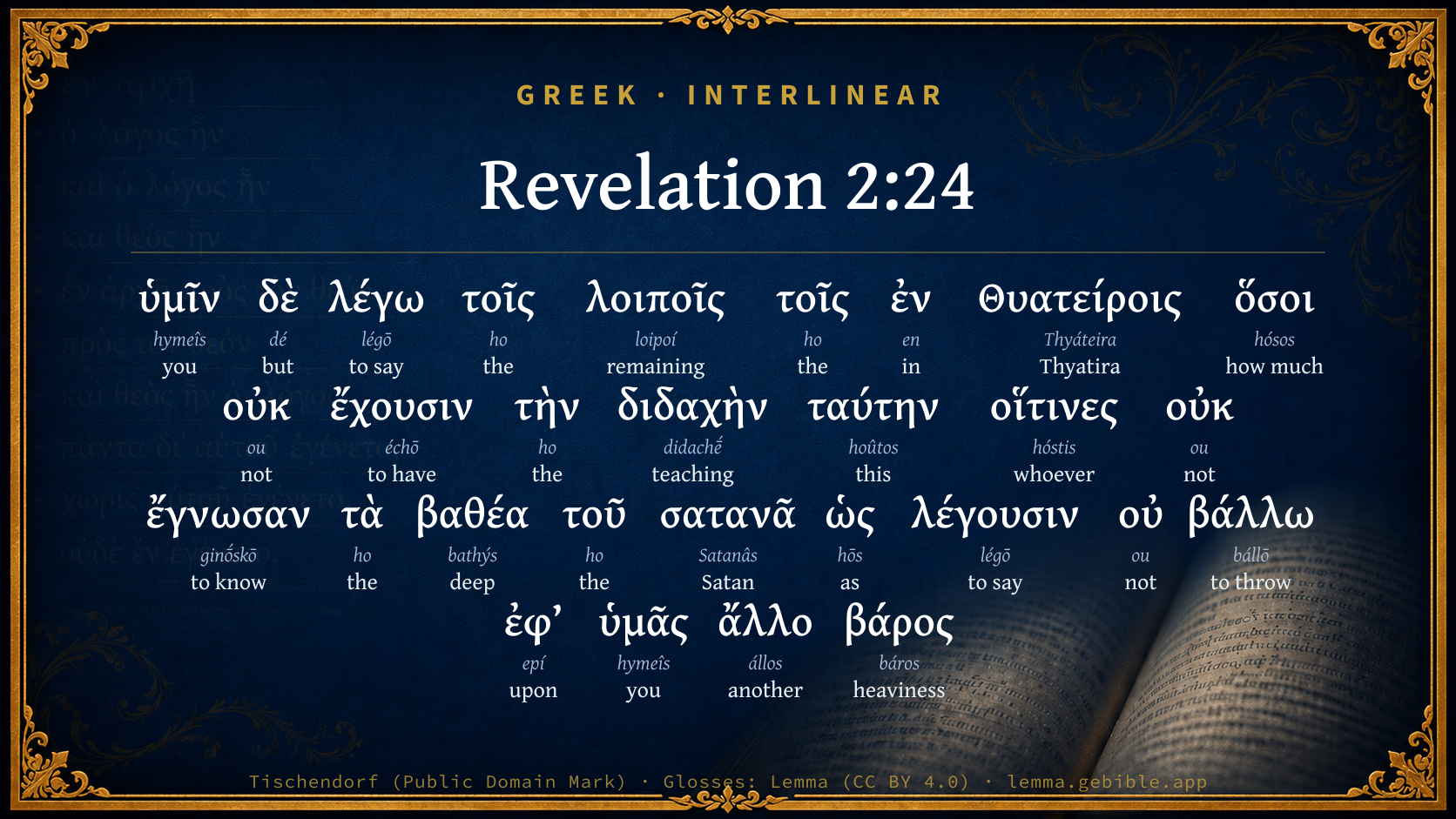
  1. ὑμῖν hymeîs G5210 “you” Personal pronoun, 2nd person, Dative, Plural
  2. δὲ dé G1161 “but” Conjunction
  3. λέγω légō G3004 “to say” Verb, Present, Active, Indicative, 1st person, Singular
  4. τοῖς ho G3588 “the” Article, Dative, Plural, Masculine
  5. λοιποῖς loipoí G3062 “remaining” Adjective, Dative, Plural, Masculine
  6. τοῖς ho G3588 “the” Article, Dative, Plural, Masculine
  7. ἐν en G1722 “in” Preposition
  8. ὅσοι hósos G3745 “how much” Correlative pronoun, Nominative, Plural, Masculine
  9. οὐκ ou G3756 “not” Particle, Negative
  10. ἔχουσιν échō G2192 “to have” Verb, Present, Active, Indicative, 3rd person, Plural
  11. τὴν ho G3588 “the” Article, Accusative, Singular, Feminine
  12. διδαχὴν didachḗ G1322 “teaching” Noun, Accusative, Singular, Feminine
  13. ταύτην hoûtos G3778 “this” Demonstrative pronoun, Accusative, Singular, Feminine
  14. οἵτινες hóstis G3748 “whoever” Relative pronoun, Nominative, Plural, Masculine
  15. οὐκ ou G3756 “not” Particle, Negative
  16. ἔγνωσαν ginṓskō G1097 “to know” Verb, Aorist, Active, Indicative, 3rd person, Plural
  17. τὰ ho G3588 “the” Article, Accusative, Plural, Neuter
  18. βαθέα bathýs G901 “deep” Adjective, Accusative, Plural, Neuter
  19. τοῦ ho G3588 “the” Article, Genitive, Singular, Masculine
  20. σατανᾶ Satanâs G4567 “Satan” Noun, Genitive, Singular, Masculine
  21. ὡς hōs G5613 “as” Adverb
  22. λέγουσιν légō G3004 “to say” Verb, Present, Active, Indicative, 3rd person, Plural
  23. οὐ ou G3756 “not” Particle, Negative
  24. βάλλω bállō G906 “to throw” Verb, Present, Active, Indicative, 1st person, Singular
  25. ἐφ’ epí G1909 “upon” Preposition
  26. ὑμᾶς hymeîs G5210 “you” Personal pronoun, 2nd person, Accusative, Plural
  27. ἄλλο állos G243 “another” Adjective, Accusative, Singular, Neuter
  28. βάρος báros G922 “heaviness” Noun, Accusative, Singular, Neuter

About this verse

These counts appear in no published source. They are computed here, from the morphology-tagged text and Lemma’s own curated glosses. What Lemma adds →

29
words
21
distinct lemmas
Revelation
section

Notable vocabulary

The rarest word here is Θυατείροις Thyatira G2363 — appearing just 4 times in the whole Greek New Testament.

Shared distinctive vocabulary

Θυατείροις Thyatira G2363 occurs in 4 verses of the Greek New Testament. Also found in:

Repetition

Words recur within this verse:

Cross-references

9

Topical passages linked to Revelation 2:24 in the Treasury of Scripture Knowledge — connected by theme and wording, ordered by reader-vote popularity; previews shown in the World English Bible.

  • 2 Corinthians 2:11 that no advantage may be gained over us by Satan; for we are not ignorant of his schemes.
  • 2 Corinthians 11:3 But I am afraid that somehow, as the serpent deceived Eve in his craftiness, so your minds might be corrupted from the simplicity that is in Christ.
  • Revelation 12:9 The great dragon was thrown down, the old serpent, he who is called the devil and Satan, the deceiver of the whole world. He was thrown down to the earth, and his angels were thrown down with him.
  • Acts 15:28 For it seemed good to the Holy Spirit, and to us, to lay no greater burden on you than these necessary things:
  • 2 Corinthians 11:13–15 For such men are false apostles, deceitful workers, masquerading as Christ's apostles.
  • Ephesians 6:11–12 Put on the whole armor of God, that you may be able to stand against the wiles of the devil.
  • 2 Thessalonians 2:9–12 even he whose coming is according to the working of Satan with all power and signs and lying wonders,
  • Revelation 13:14 He deceives my own people who dwell on the earth because of the signs he was granted to do in front of the beast; saying to those who dwell on the earth, that they should make an image to the beast who had the sword wound and lived.
  • 1 Corinthians 2:10 But to us, God revealed them through the Spirit. For the Spirit searches all things, yes, the deep things of God.

Cross-references courtesy of OpenBible.info (CC BY 4.0).

Where the printed editions differ

1 variant

Places in this verse where the major printed Greek editions disagree on the wording in a way that affects the translation — a comparison of editions, not a manuscript-by-manuscript collation. The editions are the modern critical texts (Nestlé-Aland 28/27, SBL, Westcott-Hort, Tregelles, Tyndale House) and the traditional texts behind the KJV (the Textus Receptus and the Byzantine/Majority text). It is not a claim about which reading is original.

  1. Different wording
    τοῖς

    “to the”

    In NA28NA27TynSBLWHTregByz Not in TR

    καὶ (kai) 'and' occurs in traditional manuscripts (TR) instead of τοῖς (tois) 'to the' in older manuscripts (NA28+NA27+Tyn+SBL+WH+Treg+Byz)

Textual data: Translators Amalgamated Greek New Testament (STEPBible TAGNT) · CC BY 4.0.

Commentary

Notes on Revelation 2:24 from classic Christian and Jewish commentators (each source and its license shown beneath its notes). The classic Christian expositions comment on the surrounding passage and are grouped to its opening verse, so a note may address several verses; the Jewish commentaries on the Tanakh (Rashi and others) are per-verse, so they appear only where the commentator wrote on this verse.

Lemma curates 59 commentaries, every one of them public domain or Creative Commons licensed, each selected and text-cleaned for this edition rather than reprinted as found. About our sources →

Joseph Benson's Commentary

Rev 2:24-25. But unto you I say, who have not this doctrine — Of Jezebel; and to the rest — Who have kept themselves from being led astray by these delusions; and have not known — O happy ignorance! the depths of Satan — The deep arts of deceit and error practised in his kingdom, to bring in all sorts of corruption, by teaching men to account things as indifferent and innocent that are wicked and abominable; as they speak —

It seems they were continually boasting of the deep things which they taught. Our Lord owns they were deep, even deep as hell; for they were the very depths of Satan. I will put upon you none other burden — Than that you have already suffered from Jezebel and her adherents. Or, I will lay no new restraints or injunctions upon you; but will only confirm the laws of truth, righteousness, and goodness, given to make you free from the dominion of sin, the truest and most important liberty. But that which ye — Both the pastor and the church; have already received through my gospel, as essential to true religion, and necessary in order to your pleasing God, hold fast — In principle and practice, in faith, love, and obedience; till I come — To put an end to your time of trial, and receive you to the heavenly paradise.

Joseph Benson's Commentary on the Old and New Testaments (1811–1818) — public domain. Text from a community e-Sword module.

Tyndale Open Study Notes

Tyndale Open Resources

2:24 The depths of Satan might be a striking reference to the Gnostic god named “Depth” (Bythos), who with his partner “Silence” (Sigē) formed a philosophic godhead. Gnosticism placed great emphasis on secret knowledge.

Tyndale Open Study Notes — © Tyndale Open Resources, licensed CC BY-SA 4.0. Text via the HelloAO Bible API.

Bengel's Gnomon

Johann Albrecht Bengel

Rev 2:24. [43] Ὅσοι οὐκ ἔχουσι—οὐκ ἔγνωσαν) The third person for the second. See Vorst. de Hebraism, c. 26.—οὐκ ἔγνωσαν) they were not Gnostics.—τὰ βάθεα) In Dan 2:22, it is used in a good sense, αὐτὸς ἀποκαλύπτει βαθέα καὶ ἀπόκρυφα.

[43] ὁ ἐρευνῶν—δώσω, He that searcheth—I will give) Both are joined together Pro 24:12; Jer 17:10.—V. g.

Bengel's Gnomon of the New Testament — English translation (T&T Clark, Edinburgh, 1860) — public domain. Text from a community e-Sword module.

Meyer's Critical & Exegetical Commentary

Heinrich August Wilhelm Meyer

Rev_2:24-25. In opposition (δὲ) to the Nicolaitans spoken of at the close of Rev_2:23, the Lord now addresses that part of the church not infected by such false doctrines; by the words οἵτινες, κ.τ.λ., the rest are then expressly characterized as such as had not received this doctrine, this not godly, but satanic, gnosis. The reference to the so-called gnosis of the Nicolaitans is here clearly indicated by the expression τὰ βαθέα, even apart from the controverted formula ὡς λέγουσιν; for to become acquainted with the depths (of divinity) was an essential pretence of the Gnostics.[1269] But it is a matter of controversy, whether the expression τ. βαθέα τ. σατ. should be conceived of as a self-chosen designation of Gnostic erroneous doctrine concerning the rest,[1270] so that οὐκ ἔγνωσαν and ὡς λέγουσιν have the same subject, or whether the Nicolaitan Gnostics are to be regarded as the subject to ὡς λέγουσιν, so that the expression τὰ βαθέα τ. σατ. is used either entirely as it sounds in the sense of these Gnostics,[1271] or according to the analogy of the designation συναγωγὴ τοῦ σατανᾶ, Rev_2:9, as a sarcastic transformation of the Gnostic expression concerning the depths; viz., as they say, of the Deity, but as it is rather in fact meant, of Satan.[1272] But if, in the former sense, the entire formula τὰ βαθέα τοῦ σατανᾶ were to be understood as one in itself peculiar to the Gnostics (ὡς κεγ.), it must also be shown how it was used by them; but this does not occur. Hence the view commends itself, that the expression τὰ βαθέα τ. σατ. is to be conceived of from the Christian standpoint. At the same time it appears far more forcible if the Gnostics themselves be regarded as the subject to ὡς λέγουσιν with respect to the chief idea τὰ βαθέα, while the further determination of τοῦ σατανᾶ is made prominent, in that the question in fact is not concerning divine depths,[1273] nor divine mysteries,[1274] but the depths of Satan, as if this judgment were put in the mouths of believers at Thyatira who remained faithful, and they therefore are regarded as the subject to the ὡς λέγουσιν.

To the rest at Thyatira the Lord now says, οὐ βάλλω

ἥξω. The expression ἄλλο βάρος has been understood in two chief respects, but with very different modifications of exposition; viz., either of the burden of suffering and punishment, or of the burden of a law. The norm furnished by the context, for the explanation of an expression in itself ambiguous, lies in the words πλὴν ὃ εχ., κ.τ.λ., which in no way contain the condition of the promise οὐ βάλλω ἐρʼ ὑμ. ἄλλο βάρ[1275] but a certain limitation (πλήν) of the preceding promise, as the πλήν is correlate to ἄλλο. If now in the words Rev_2:25, the manifestation of Christian steadfastness in faith is required, and therefore a certain incessant legal determination is made or established, the result is that every ἄλλο βάρος must likewise be a burden of the law, which, just because it reaches farther than the limitation indicated in the closing words (Rev_2:25), should not be laid upon believers. If now it be considered that the question at issue was with respect to fornication and the eating of sacrifices made to idols, and that just in respect to this the ancient church at the Synod of Jerusalem, under the guidance of the Holy Ghost, made a definite decision, but declined all going beyond this as an intolerable burden,[1276] we could not recognize hence a clear allusion to that decree; and accordingly explain the ἄλλο βάρος of any sort of legal limitation of the holy freedom of believers, which proceeds beyond the commandment hitherto faithfully preserved by them.[1277] The ὃ ἔχετε, nevertheless, is not directly the formerly recognized and still faithfully observed prohibition to avoid fornication and the eating of what is sacrificed to idols; but the expression in its indefinite extent includes the idea that because believers have been faithful in opposition to the Nicolaitans, just in their obedience they have also had their reward, viz., the blessing of eternal life, and therefore should hold fast to this treasure,[1278] while they bear still further the burden of that commandment which was hitherto borne. If the ἄλλο βάρος, therefore, be understood of the burden of suffering, it can be explained only, with De Wette: No other sorrow than you bear or have borne already. For we must infer from the mention of the ὑπομονή, Rev_2:19, that suffering was already borne; while, in case this reference were to ἂλλο βάρος, a more definite allusion to suffering previously endured would be expected. Incorrectly, Heinr.: Punishment because of anothers fault. Incorrectly, Grot.: They boast of the knowledge of many things; this I do not exact of you, as though the gnosis were the ἄλλο βάρος. Incorrectly, Beng. (whom Klief. follows): As they had borne the burden of Jezebel and her followers sufficiently.

[1269] If, in good faith, you ask them a question, they answer, with stern look and contracted brow, that it is deep. Tertull., Adv. Valent., i.Who say that they have come to the depths of the depth. Iren., Adv. Haer., ii. 38, 1. Pref.: βαθέα μυστήρια, deep mysteries.

[1270] Andr., Areth., Heinr., Züllig, Stern, Ebrard.

[1271] Neander, Apost. Zeitalt, 3d ed. ii. p. 532. Hengstenb., Gebhardt, Klief.

[1272] So Vitr.: The ὡς λέγουσιν is to be referred absolutely to the τὰ βαθέα. The word of Satan is added by the Lord himself.

[1273] Cf. 1Co_2:10; Rom_11:33.

[1274] Iren., Adv. Haer., i. 1, ii. 39, 48.

[1275] Ebrard.

[1276] Act_15:28.

[1277] Cf. Primas, N. de Lyra, C. a Lap., Stern, Hengstenb. Cf. also Ew. ii.

[1278] Cf. Rev_3:11.

Meyer — Critical and Exegetical Commentary on the New Testament — English translation by Peter Christie, edited by Frederick Crombie (T&T Clark, 1880) — public domain. Text from a community e-Sword module.

Expositor's Greek Testament

ed. W. Robertson Nicoll

Rev 2:24 . To know “the depths” of the divine being and counsel was a characteristic claim of the Ophites and the later Gnostics; cf. Iren. adv. Haer. ii. 22, 1 (qui profunda bythi adinuenisse se dicunt; cf. 3), and Tertullian’s sarcastic description ( adv. Vàlent . 1), “Eleusinia Ualentiniana fecerunt lenocinia. sancta silentio magno, sola taciturnitate coelestia. Si bona fide quaeris, concreto uultu, suspenso supercilio Altum est aiunt.” “The depth of knowledge” was a phrase of Herakleitus, the famous Ephesian philosopher, and in the creed of the Dukhobortsui, a sect in modern Russia, the Holy Spirit is Depth, the Father being Height and the Son Breadth. Since ὡς λέγουσιν refers to the errorists themselves, the quoted phrase about “knowing the depths of Satan” may (1.) contain an indignant and sarcastic retort; “depths of Satan,” not “God,” as they boast ( τοῦς . being substituted for τοῦ θεοῦ ); such teaching and principles are simply infernal. Or (2.) as is more probable the words may voice the actual claim of the errorists, who considered that some accommodation to pagan practices gave them a necessary acquaintance with the meaning of evil (so e.g. , Spitta, Pfleiderer, Zahn, Jülicher, Bousset). Their higher standing gave them immunity from any risks. They could fathom securely what the immature orthodox called immorality. Devil-study, or even devil-worship (Rev 13:4 is quite different) was not uncommon in some of the Gnostic sects throughout Asia Minor, e.g. , the Cainites, the Naassenes, and the Ophites (the earliest Gnostics, φάσκοντες μόνοι τὰ βάθη γινώσκειν , Hipp. adv. Haer. Rev 2:6 ). The idea was that as the principle of evil would ultimately be redeemed, it might be used meantime for the advantage of the initiated. Compare Mansel’s Gnostic Heresies , pp. 73, 96, 105. In En. lxv. 6 the unrighteous are punished for their acquaintance with “all the secrets of the angels and all the violence of the Satans and all their hidden power and all the power of those that practise sorcery, and the power of witchcraft.” The influence of a movement like Gnosticism, whose motto was eritis sicut deus scientes bonum et malum , gave wide opportunities to immorality, in its more popular applications. It produced the same sort of union between subtlety and sensualism which can sometimes be traced within Hinduism. In contrast to this unwholesome temper of speculation, the prophet substitutes for speculative flights the obedience of the normal Christian praxis ( cf. Parad. Lost , viii. 170 197, xii. 561 589), with a plain allusion to the Jerusalem concordat of the early church which is recommended tacitly as a safe, wise rule of conduct. In the case of the βαθέα τοῦ σατανᾶ , ignorance is bliss. John is totally unsympathetic to the local liberals. He does not combat the theoretical principles at the root of their movement. Like the prophets who wrote Jude and 2 Peter, he attacks instead of arguing, quite content to judge it by its moral fruits of libertinism. He bitterly declares that such occasional results are the deliberate object of the party. The strange collocation of this error with the habit of partaking of sacrificial food is probably due to the prophet’s stern conviction that the latter, with its friendly and liberal attitude to pagan customs, fostered the former, in the case of people who took an ultra-spiritual view of Paul’s principle of Christian freedom.

The Expositor's Greek Testament, edited by W. Robertson Nicoll (1897–1910) — public domain. Text from a community e-Sword module.

Geneva Bible (1599)

Geneva Bible translators

He pointeth out the bragging of certain men, which boasted of their deep, that is, plentiful and common knowledge, which notwithstanding is devilish.

I will speak no worse thing against you, being content to have showed you what I require to be in you.

Geneva Bible (1599) marginal notes — public domain. Text via Bolls.life.

Jamieson, Fausset & Brown

Robert Jamieson, A. R. Fausset & David Brown

you . . . and . . . the rest--The three oldest manuscripts omit "and"; translate then, "Unto you, the rest."

as many as have not--not only do not hold, but are free from contact with.

and which--The oldest manuscripts omit "and"; translate, "whosoever."

the depths--These false prophets boasted peculiarly of their knowledge of mysteries and the deep things of God; pretensions subsequently expressed by their arrogant title, Gnostics ("full of knowledge"). The Spirit here declares their so-called "depths," (namely, of knowledge of divine things) to be really "depths of Satan"; just as in Rev 2:9, He says, instead of "the synagogue of God," "the synagogue of Satan." HENGSTENBERG thinks the teachers themselves professed to fathom the depths of Satan, giving loose rein to fleshly lusts, without being hurt thereby. They who thus think to fight Satan with his own weapons always find him more than a match for them. The words, "as they speak," that is, "as they call them," coming after not only "depths," but "depths of Satan," seem to favor this latter view; otherwise I should prefer the former, in which case, "as they speak," or "call them," must refer to "depths" only, not also "depths of Satan." The original sin of Adam was a desire to know EVIL as well as good, so in HENGSTENBERG'S view, those who professed to know "the depths of Satan." It is the prerogative of God alone to know evil fully, without being hurt or defiled by it.

I will put--Two oldest manuscripts have "I put," or "cast." One oldest manuscript reads as English Version.

none other burden--save abstinence from, and protestation against, these abominations; no "depths" beyond your reach, such as they teach, no new doctrine, but the old faith and rule of practice once for all delivered to the saints. Exaggerating and perfecting Paul's doctrine of grace without the law as the source of justification and sanctification, these false prophets rejected the law as a rule of life, as though it were an intolerable "burden." But it is a "light" burden. In Act 15:28-29, the very term "burden," as here, is used of abstinence from fornication and idol-meats; to this the Lord here refers.

Jamieson, Fausset & Brown — Commentary Critical and Explanatory on the Whole Bible (1871) — public domain (CC PDM 1.0). Text via the HelloAO Bible API.

Adam Clarke's Commentary

Verse 24. But unto you I say, and unto the rest] "But unto the rest, c. This is the reading of the Complutensian, and seems preferable to the common one, as it evidently shows that the rest of the epistle wholly concerns the faithful, who have not received the former doctrine of error. I will put upon you none other burden is a commendation of the sound part of the Church, that they have no need of any new exhortation or charge to be given them, no new advice but to persevere as usual. See Rom 15:14; Rom 15:15. The expression of burden is taken from the history of Ahab, 2Kgs 9:25: The Lord laid this burden on him a word often used by the prophets to signify a prophecy threatening heavy things to be suffered. See Clarke on Isa 13:1, and "Nu 4:19"." See Dodd's Notes.

It is worthy of remark that the Gnostics called their doctrine the depths of God, and the depths of Bythos, intimating that they contained the most profound secrets of Divine wisdom. Christ here calls them the depths of Satan, being master pieces of his subtlety. Perhaps they thought them to be of God, while all the time they were deceived by the devil.

Adam Clarke's Commentary on the Bible (1810–1826) — public domain. Text from a community e-Sword/MySword module.

Ellicott's Commentary for English Readers

(24) But unto you I say (omit “and unto”) the rest, &c.

The depths.—Or, the deep things. These teachers, as was the case with the Gnostics, professed to have a deeper insight into mysteries, the deep things of God. They may have garnished their speech with this very phrase, borrowed—in sound though not in sense—from 1Co_2:10, and may have even boasted of their knowledge of Satan. But such knowledge was purchased too dearly. Better off were they who were simple concerning evil; they have a burden, but it is not the burden of judicial tribulation: it is the burden only of resisting the evils of those troublers of the Church. The allusion may be to the decree of Act_15:28; the same word for “burden” is used. They must not abandon their duty of witnessing for purity, and so for Christ; this burden they must take up, and hold fast till He come.

A Bible Commentary for English Readers, edited by Charles John Ellicott (1878–1897) — public domain. Text from a community e-Sword module.

The Cambridge Bible for Schools and Colleges

gen. ed. J. J. S. Perowne

24. unto you] The form of address to the Angel of the Church is dropped, and the Church addressed directly. And should be omitted: the sense is “to the rest of you in Thyatira,” or more literally, “to you, namely to the rest.”

have not known the depths of Satan, as they speak] The heretics condemned in the preceding verses were doubtless a sect of those who called themselves Gnostics, probably at this time, certainly in the next generation. They contrasted their knowledge of “the depths” or “deep things of God” (cf. 1Co_2:10), with the faith of the orthodox in the plain simple doctrines that were openly preached to the world: the Lord answers, that the depths of knowledge that they attained were depths, not of God, but of Satan. It is uncertain how far the quotation of their own language marked by ‘as they speak’ extends, it is hardly possible that they themselves actually gloried in a knowledge of the depths of Satan (yet cf. 2Co_2:11); but it is to be remembered that the Gnostic systems of the second century, and probably those of the first also, included a strange mythology of half-personified abstractions; and it may be that the Lord rather identifies one of these with Satan than substitutes the name of Satan for that of God. It appears from Irenaeus that the Gnostics of his time talked of “the deep things of Depth” as well as “the deep things of God.” It is curious that the phrase “the depths of knowledge” is quoted from the great Ephesian philosopher Heraclitus: possibly it was owing to his influence, that such notions found a congenial home in Asia Minor.

I will put] Right in sense, as “I will cast” in Rev_2:22, though here the true text has a present tense, as there.

none other burden] viz., than abstinence from fornication and things offered to idols, Act_15:28 sq. The A. V. rightly avoids exaggerating the verbal resemblance between the two passages, but a reference here to that phrase, adopted solemnly by the whole Church, is not impossible. Yet it is a question whether we may not understand the sentence as if the construction were “I will put on you no other burden than to hold fast that which ye have till I come.”

The Cambridge Bible for Schools and Colleges (gen. ed. J. J. S. Perowne; Cambridge University Press, 1878–1918) — public domain. Text from a community e-Sword module.

John Gill's Exposition

But unto you I say, and unto the rest in Thyatira,.... The copulative and is left out in the Alexandrian copy and Complutensian edition, and if retained, it may be rendered thus, "even unto the rest"; the persons spoken to are the same, the pastor of this church, with his colleagues, and all the rest of the faithful in it; which shows that this epistle, and so the rest, were not written to the pastors only, but to the churches; and that the pastor and his colleagues, with others, were free from the abominable errors and corruptions before spoken of; and that, in the worst of times, God does, and will reserve a people for himself, who are described as follows:

as many as have not this doctrine; who had not given into, and embraced this doctrine of the antichristian church of Rome, concerning infallibility, the worshipping of images, transubstantiation, &c. the Arabic version reads, "this new doctrine"; for notwithstanding the large pretensions of the Romish church to antiquity, her doctrine is but a novel doctrine:

and which have not known the depths of Satan, as they speak; that is, had not approved of the doctrines of antichrist, which though his followers called deep things and mysteries of their holy religion, such as transubstantiation, &c. yet, to speak in the language of the pure and faithful professors of the Gospel, they are no other than the depths of Satan, or doctrines of devils; or else the sense is, as Jezebel and her followers say, to the contempt of the faithful, arrogating knowledge to themselves, and upbraiding them with simplicity and ignorance, as not knowing Satan's devices, nor how to rescue souls out of them, as they did; but the former sense seems best:

I will put upon you none other burden; meaning not any affliction or tribulation than the present one; nor any other errors and heresies than what were broached; but no other precept or command than what follows; see Kg2 9:25.

John Gill's Exposition of the Whole Bible (1746–1763) — public domain (CC PDM 1.0). Text via the HelloAO Bible API.

Trapp's Complete Commentary

John Trapp

24 But unto you I say, and unto the rest in Thyatira, as many as have not this doctrine, and which have not known the depths of Satan, as they speak; I will put upon you none other burden.

Ver. 24. But unto you I say] Here Christ comes with his fan, shedding and shoaling out his own from others, that they might not be disheartened, when worse men were menaced,

The depths of Satan] That science falsely so called, 1Ti 6:20. Those profound points, which the impostors professed and pretended to: as the Gnostics, who would needs be held the only knowing men; the Illuminates, and other seducers, who had taken up a trick to qualify their devilish doctrines with the name of depths or profundities. Depths they are granted to be, but depths of the devil; the whisperings and hissing of that old serpent, not the inspirations of God’s Spirit.

John Trapp, A Commentary or Exposition upon All the Books of the Old and New Testament (1647–1656) — public domain. Text from a community e-Sword module.

Albert Barnes' Notes on the Bible

But unto you I say, and unto the rest in Thyatira - The word - “and” - καὶ kai - is omitted in many mss. and versions, and in the critical editions of Griesbach, Tittmann, and Hahn, and the connection demands that it should be omitted. As it stands in the received text, it would seem that what he here says was addressed to those who had received that doctrine, and to all others as well as to them; whereas the declaration here made pertains manifestly to those who had not received the doctrine. With that particle omitted the passage will read, as rendered by Prof. Stuart, “But I say unto you, the remainder in Thyatira, so many as hold not this doctrine,” etc. That is, he addresses now all the members of the church who were not involved in the charges already made. He does not say how large a portion of the church had escaped the contaminating influence of those opinions, but to that portion, whether great or small, he addresses only words of exhortation and comfort.

As many as have not this doctrine - To all who have not embraced it, or been contaminated with it. It may be presumed that there was a considerable portion of the church which had not.

And which have not known the depths of Satan - The deep art and designs of Satan. Deep things are those which are hidden from view - as of things which are far underground; and hence the word is used to denote mysteries, or profound designs and purposes. The allusion here is not to any trials or sufferings that Satan might bring upon anyone, or to any temptations of which he might be the author, but to his profound art in inculcating error and leading people astray. There are doctrines of error, and arguments for sin, to originate which seems to lie beyond the power of people, and which would appear almost to have exhausted the talent of Satan himself. They evince such a profound knowledge of man; of the divine government; of the course of events on earth; and of what our race needs; and they are defended with so much eloquence, skill, learning, and subtlety of argumentation, that they appear to lie beyond the compass of the human powers.

As they speak - This cannot mean that the defenders of these errors themselves called their doctrines “the depths of Satan,” for no teachers would choose so to designate their opinions; but it must mean, either that they who were opposed to those errors characterized them as “the depths of Satan,” or that they who opposed them said that they had not known “the depths of Satan.” Prof. Stuart understands it in the latter sense. A somewhat more natural interpretation, it seems to me, however, is to refer it to what the opposers of these heretics said of these errors. They called them “the depths of Satan,” and they professed not to have known anything of them. The meaning, perhaps, would be expressed by the familiar words, “as they say,” or “as they call them,” in the following manner: “As many as have not known the depths of Satan, as they say,” or, “to use their own language.” Doddridge paraphrases it, “as they proverbially speak.” Tyndale encloses it in a parenthesis.

I will put upon you none other burden - That is, no other than that which you now experience from having these persons with you, and that which must attend the effort to purify the church. He had not approved their conduct for suffering these persons to remain in the church, and he threatens to punish all those who had become contaminated with these pernicious doctrines. He evidently designed to say that there was some token of his displeasure proper in the case, but he was not disposed to bring upon them any other expression of his displeasure than what grew naturally and necessarily out of the fact that they had been tolerated among them, and those troubles and toils which must attend the effort to deliver the church from these errors. Under any circumstances the church must suffer. It would suffer in reputation. It would suffer in respect to its internal tranquility. Perhaps, also, there were those who were implicated in these errors, and who would be implicated in the punishment, who had friends and kindred in the church; and the judgments which were to come upon the advocates of these errors must, therefore, come in a measure upon the church.

A kind Saviour says, that he would bring upon them no other and no weightier burden, than must arise from his purpose to inflict appropriate vengeance on the guilty themselves. The trouble which would grow out of that would be a sufficient expression of his displeasure. This is, in fact, often now all that is necessary as a punishment on a church for harboring the advocates of error and of sin. The church has trouble enough ultimately in getting rid of them; and the injury which such persons do to its piety, peace, and reputation, and the disorders of which they are the cause, constitute a sufficient punishment for having tolerated them in its bosom. Often the most severe punishment that God can bring upon people is to “lay upon them no other burden” than to leave them to the inevitable consequences of their own folly, or to the trouble and vexation incident to the effort to free themselves from what they had for a long time tolerated or practiced.

Albert Barnes' Notes on the Bible (1834–1885) — public domain. Text from a community e-Sword/MySword module.

Matthew Poole's English Annotations

But unto you I say; you that are the ministers, for they are distinguished from the rest in Thyatira. The word again is plural, which lets us know these epistles were directed to no single persons.

And unto the rest in Thyatira, as many as have not this doctrine; the rest of the members of the church in Thyatira, who have not embraced this doctrine of the Nicolaitanes published by Jezebel, &c.

As they speak; those seducers call their doctrine deep things, great mysteries revealed to them; as there are the deep things of God, 1Co 2:10, so these seducers would pretend their doctrines also were deep things: Christ calls them the devil’s mysteries, deep things of Satan.

I will put upon you none other burden; I will lay no other burden of trials and afflictions.

Matthew Poole's English Annotations on the Holy Bible (1683–1685) — public domain. Text from a community e-Sword/MySword module.

Whedon's Commentary on the Bible

Daniel D. Whedon

24. Unto you… the rest—The and being omitted as spurious, you, and the rest, mean the same class, namely, the part of the Church pure from Jezebel.

Depths… speak—To boast of their depth was a trait of the Gnostics. Says Tertullian, “Put an inquiry to them in good faith, and with grave face and lofty brow they will answer, It is deep!” Says Irenaeus, “Really blind, they profess themselves to have attained the depths of the abyss.” And Eusebius says of the Simonians: “Those deeper secrets, of which they say that he who hears them for the first time would be astonished and confounded, are indeed full of folly and madness. They are such things that a decent person cannot write of them, nor open his lips about them, on account of their horrid filthiness and obscenity.”

As they speak—Or rather, say, or, as they call them. To whom does this they refer? Some reply, the Christians; but there is nothing that fixes the reference to them; and more probably it was the Gnostics who talked about the depths. It may be that the they say, has for its object the term the depths, while the phrase of Satan is flung in sarcastically by the Lord himself, to characterize their depths. It might then be printed thus: have not known “the depths”—of Satan!—as they say. Or the whole phrase, more probably, may be in the mouth of the Gnostics themselves, unequivocally professing that they do know the very depths of Satan. Their satanic bravado of licentiousness justifies this rendering. Eusebius says, (b. 4, c. 7,) that they went so far as to say, “that the basest deeds should be perpetrated by those who would attain to a perfect insight into their secret doctrine.” See our note on 2Th_2:7.

None other burden—Seems to be a remarkable quotation from the apostolic decree, Act_15:28, where the abstaining from licentious sacrificial feasts are the very burden, or Christian obligation, imposed upon them. Purity from these Gnostic depths is the only injunction he now presses upon them.

Daniel D. Whedon (gen. ed.), Commentary on the Old and New Testaments (1874–1909) — public domain. Text from a community e-Sword module.

The Pulpit Commentary

But to you I say, to the rest in Thyatira. The "and" after "I say" in the Authorized Version is a false reading, which it shares with the Vulgate and Luther: "to you" and "to the rest" are in apposition. Which know not the deep things of Satan, as they say. Two questions confront us here, and it is not possible to answer either with certainty:

(1) Who is it who say something?

(2) What is it that they say?

(1) Note that "say" (Revised Version), not "speak" (Authorized Version), is right; the Greek is legousin , not lalousin . The nominative to "say" may be either the faithful in Thyatira, "who have not this doctrine," and who show their detestation of it by calling it "the deep things of Satan;" or the holders of this doctrine, who profess to be in the possession of profound knowledge of a mysterious kind. Of these two the former is rather tame in meaning. Moreover, we should have expected "as ye say" to harmonize with "to you I say." Therefore we may suppose that it is those who have this doctrine who are indicated in "as they say.

(2) What, then, did they say? Did they call their doctrine "deep things," which the Lord here enlarges into "deep things of Satan," in order to declare its true character? Or did they themselves call their knowledge "the deep things of Satan," which they fathomed in order to prove their mastery over them? The former seems better. It is improbable that any sect, nominally Christian, would in so many words claim special knowledge of "the deep things of Satan." Rather, he who condemns the "synagogue of Satan" (ver. 9) at Smyrna, and the "throne of Satan" (ver. 13) at Pergamum, here condemns the "deep things of Satan" at Thyatim. In any case, "deep things" is the prominent thought. It is some early form of Gnosticism that is indicated, and we know from various sources that "deep" was a favourite expression of theirs with regard to the knowledge which they professed. "The Valen-tinians have formed Eleusinian orgies, consecrated by a mighty silence, having nothing heavenly in them but their mystery. If, in good faith, you ask questions with contracted forehead and frowning brow, they say, It is profound (Tert., "Adv. Valent.," 1.). Similarly, Irenaeus states that they claimed to have found out the "deep things of Bythos" profunda Bythi adinvenisse se dicunt (II 22:1). Buyov (equivalent to "depth") is the primary being or god of the Valentinian system, another name for which is Arrhtov (equivalent to "unspeakable"). Hence elsewhere, for profunda Bythi, Irenaeus uses the expression profunda Dei in speaking of these Gnostic claims (II 22:3).

Similarly, Hippolytus ("Refut.," V 6:1) states that the Naassenes called themselves Gnostics, saying that they alone knew the depths ta bayh ginwskein , which is singularly close to what we have here. Note, however; that here the true reading is ta bayea , neuter plural of the adjective bayuv , not (as in 1Co_2:10) ta bayh , plural of the substantive bayov . See also the fragment of a letter of Valentinus, preserved in Epiphanius ("Contra Haer. adv. Valent.," 1:31). I cast upon you none other burden. An obvious echo of the decision of the Council of Jerusalem respecting these very sins, fornication and idolatry, in reference to Christian liberty, (Act_15:28, Act_15:29) where the very same word (barov) is used for "burden." In Mat_11:30 Mat_23:4 Luk_11:46 Gal_6:5, the word for "burden" is fortion , where as barov is used in Mat_20:12 2Co_4:17 Gal_6:2 1Th_2:6. Here, as in ver. 22, the true text gives ballw , not balw ; and obviously the word should be rendered in the same way in both verses, not "cast" in one place and "put" in another. "None other" means none other than a more determined opposition to these specious abominations. Hold fast your own doctrine, and denounce the false. Others, much less probably, interpret "none other burden" than the sufferings in which they exhibit the "patience" for which they are praised (ver. 19). This gives a very poor meaning, and, moreover, breaks the connexion with what follows: they are certainly not told to hold fast their sufferings, but Christ"s precepts as to faith and conduct.

The Pulpit Commentary (1880–1919), ed. H.D.M. Spence-Jones & Joseph S. Exell — public domain. Text from a community e-Sword module.

John Wesley's Explanatory Notes

But I say to you who do not hold this doctrine - Of Jezebel. Who have not known the depths of Satan - O happy ignorance! As they speak - That were continually boasting of the deep things which they taught. Our Lord owns they were deep, even deep as hell: for they were the very depths of Satan. Were these the same of which Martin Luther speaks? It is well if there are not some of his countrymen now in England who know them too well! I will lay upon you no other burden - Than that you have already suffered from Jezebel and her adherents.

John Wesley, Explanatory Notes Upon the Whole Bible (1754–1765) — public domain. Text via the GEBible commentary corpus.

Kretzmann's Popular Commentary

Paul E. Kretzmann

An admonition and a warning to the congregation at Thyatira:

v. 24. But unto you I say, and unto the rest in Thyatira, as many as have not this doctrine, and which have not known the depths of Satan, as they speak: I will put upon you none other burden.

v. 25. But that which ye have already hold fast till I come.

v. 26. And he that overcomes, and keepeth My works unto the end, to him will I give power over the nations;

v. 27. and he shall rule them with a rod of iron; as the vessels of a potter shall they be broken to shivers; even as I received of My Father.

v. 28. And I will give him the morning-star.

v. 29. He that hath an ear, let him hear what the Spirit saith unto the churches.

These words are addressed to the faithful believers in Thyatira: But to you I say, the rest in Thyatira, as many as do not hold this doctrine, that did not know the depths of Satan, as they say: I do not cast upon you another burden. Some there were that had not been seduced by the immoral teachings of the false prophetess, that had kept themselves uncontaminated by her licentiousness. Even if the libertines claimed that this was the height of perfection, that they could fathom the very abysses of Satan, plunge into the very depths of immoral knowledge and practices and yet remain immune in body and mind, the true Christians knew that this was a mere pretest for indulgence in carnal excesses, and so they preserved a severe and uncompromising aloofness. Upon these people the Lord did not want to impose a further burden. He was willing to look upon their election in the matter of dealing with the evil in their midst as a weakness, as lack of proper knowledge.

At the same time, however, He admonishes: Only hold what you have until I come. They should adhere firmly to their Christian faith and its confession, to their love, service, and patience, to their refusal to join the libertines in their terrible sins. He says that His visit, His coming, may be expected soon; He wants them to be faithful and true, to overcome wickedness and evil in every form.

To the faithful Christians the Lord also promises: And he that conquers and he that keeps My works to the end, I shall give him power over the heathen: and he shall rule them with an iron rod, like the jars of a potter he shall shatter them, as I have received from My Father, and I shall give him the morning-star. That surely is a glorious goal to hold out before the eyes of the Christians. Every one that overcomes the many attacks of Satan, the world, and his own evil flesh, and clings firmly to Christ’s Word and works by which Christ performs and perfects His sanctification in them, shall become partaker of the triumph of Christ. For as it was prophesied of Him, Psa 2:8-9, that He would have dominion over the heathen, over the nations, that He would be given unlimited authority over them, so He will make those that believe in Him to the end partakers of this glory and power. The believers shall and will judge the world at the side of their great Lord and Savior. There, as the glory of eternity dawns, the brightness of everlasting life will shine on them after the dark afflictions of this vale of tears and misery. And lest the Christians forget the urgent admonition and the glorious promise of the Lord, He closes with the powerful call: He that has ears to hear, let him hear what the Spirit says to the congregations.

Summary

The Lord dictates to his servant John pastoral letters addressed to the congregations at Ephesus, at Smyrna, at Pergamos, and at Thyatira, in all of which He commends the Christians for their condition and progress, but also rebukes them for any defects in doctrine and life that were to be found in their midst.

Paul E. Kretzmann, Popular Commentary of the Bible (1921–1924) — public domain. Text from a community e-Sword module.

Burkitt's Expository Notes on the New Testament

William Burkitt

Here Christ returns to his counsel and charge given to the church at Thyatira, Unto you I say: that is, to you the angel, the governors and pastors, and to all the members of the church; I say unto you all, who have not owned nor entertained these doctrines of the Gnostics, who proudly call their filthy opinions profound mysteries and depths of knowledge, though they are indeed the depths of Satan, his policies and devices: as if Christ had said, "These vile seducers call their opinions depths, and so, such depths as Satan has brought out of hell; they are the whisperings and hissings of the old serpent, not the inspirations of the holy God; to you, I say, that I will not oppose or put upon you any new doctrine, but charge you to hold fast the old, that apostolic doctrine which you have received; persevere therein till I come to relieve you, and to release you from your persecutions, which will soon be at an end: Hold fast till I come."

Observe farther, How our Saviour concludes this epistle to the church of Thyatira, as he did the former, with a consolatory promise to such as overcome temptations, persecutions, all and all manner of opposition in their Christian conversation, and faithfully persevere in well-doing to the end; to him, says Christ, will I give power over the nations; that is, power with me, and in subordination to me, to judge the world, wicked angels, and wicked men, at the great day; then shall you rule them with a rod of iron, and dash them to shivers like a potter’s vessel, even as I have received of my Father. As if Christ had said, "I have received power, as Mediator, from my Father, effectually to subdue and conquer all mine and your enemies, and I will make you partakers of it in some measure; you shall exercise an irresistible power over them by consenting to, by approving and applauding of, that righteous judgment which I shall denounce against them, and execute and inflict upon them."

Learn, That believers shall sit as assessors with Christ in judgment, and approve the equity of his proceedings, against the finally impenitent then, though never so near and dear unto them now.

Observe lastly, The full and final reward which Christ promises to him that finally persevereth, and manfully overcometh, I will give him the morning star; that is, myself and Spirit to comfort him, and the light of glory to shine upon him to all eternity.

Note, Christ is called a star, because he enlightens all with the light of natural knowledge, and his church with divine illumination; and the morningstar, peradventure with respect to his incarnation, because as that rises not at the beginning of the night, or at the middle of it, but towards morning; so Christ came not in the beginning or middle of the dark time under the law, but in the last age of the world, in which he has shined forth the joy and comfort of all nations.

William Burkitt's Expository Notes on the New Testament (1700–1703) — public domain. Text from a community e-Sword module.

The People's New Testament

B. W. Johnson

24–29. But to you I say, to the rest that are in Thyatira (Revision). To all who have naught to do with Jezebel. As many as have not this doctrine. Jezebel then represents a false doctrine and a faction. Which know not the deep things of Satan. Have not learned the mysteries and wisdom of Satan taught by these false teachers. I will put upon you none other burden. None other than to avoid the sins of the false faction and teachers. Compare Acts 15:28, 29.

B. W. Johnson's The People's New Testament with Notes (1889–1891) — public domain. Electronic text from the Christian Classics Ethereal Library (CCEL) ThML edition.

unfoldingWord translationNotes

Door43 World Missions Community

everyone who does not hold this teaching

Believing a teaching is spoken of as holding the teaching. AT: "everyone who does not believe this teaching" (See: Metaphor)

does not hold this teaching

The noun "teaching" can be translated as a verb. AT: "does not hold to what she teaches" or "does not believe what she teaches"

what some call the deep things of Satan

Possible meanings are 1) those who called them the deep things understood that they were from Satan or 2) some people called them the deep things, but Jesus was saying that those things were really from Satan. AT: "the things of Satan, what some call the deep things"

the deep things of Satan

"the deep things that Satan teaches"

deep things

Secret things are spoken of as if they were deep. AT: "secret things" (See: Metaphor)

translationWords

Satan

burden

unfoldingWord translationNotes — © Distant Shores Media and the Door43 World Missions Community, licensed CC BY-SA 4.0. Source: git.door43.org/Door43/en_tn.

Cambridge Greek Testament for Schools and Colleges

24. ὑμῖν δέ. The form of address to the Angel of the Church is dropped, and the Church addressed directly. The sense is “to the rest of you in Thyatira,” or more literally, “to you, namely to the rest.”

οἵτινες οὐκ ἔγνωσαν τὰ βαθέα τοῦ Σατανᾶ, ὡς λέγουσιν. The heretics condemned in the preceding verses were doubtless a sect of those who called themselves Gnostics, probably at this time, certainly in the next generation. They contrasted their knowledge of “the depths” or “deep things of God” (cf. 1Co 2:10), with the faith of the orthodox in the plain simple doctrines that were openly preached to the world: the Lord answers, that the depths of knowledge that they attained were depths, not of God, but of Satan. It is uncertain how far the quotation of their own language marked by ὡς λέγουσιν extends; it is hardly possible that they themselves actually gloried in a knowledge of the depths of Satan (yet cf. 2Co 2:11): but it is to be remembered that the Gnostic systems of the second century, and probably those of the first also, included a strange mythology of half-personified abstractions; and it may be that the Lord rather identifies one of these with Satan than substitutes the name of Satan for that of God. It appears from Irenæus that the Gnostics of his time talked of “the deep things of Depth” as well as “the deep things of God.” It is curious that the phrase “the depths of knowledge” is quoted from the great Ephesian philosopher Heraclitus: possibly it was owing to his influence, that such notions found a congenial home in Asia Minor.

οὐ βάλλω. See Rev 2:22 n.

ἄλλο βάρος. ἄλλο refers forward to πλὴν so that the sense is “I will lay on you no other burden than to hold fast”; but, as in English, this does not exclude a reference backward to the sins taught by Jezebel. If so this passage confirms the rule of Christian Liberty laid down Act 15:28.

Cambridge Greek Testament for Schools and Colleges (Cambridge University Press, 1896; 21 vols, various authors incl. Carr, Maclear, Plummer, Farrar, Lumby, Moule, M. R. James, Simcox) — public domain. Text from a community e-Sword module.

Alford’s Greek Testament

Henry Alford

24.] But (contrast to those addressed before) to you I say, the rest who are in Thyatira, as many as have not (not only do not hold, but are free from any contact with) this teaching, such as (οἵτινες, as usual, classifies) have not known the depths (deep places, in the resolved form) of Satan, as they call them (it was the characteristic of the falsely named γνῶσις, to boast of its βάθεα, or depths, of divine things. Iren. ii. 22. 1, p. 146, speaks of those “qui profunda bythi adinvenisse se dicunt:” and ib. 3, p. 147, “profunda Dei adinvenisse se dicentes.” And adv. Valent. 1, vol. ii. p. 538 ff., should by all means be read, as admirably illustrating this expression. He there says, “Elcusinia Valentiniana fecerunt lenocinia, sancta silentio magno, sola taciturnitate cœlestia. Si bona fide quæris, concrete vultu, suspenso supercilio Altum est, aiunt.” We may safely therefore refer the expression οὐκ ἔγνωσαν τὰ βάθεα to the heretics spoken of. But it is not so clear to whom as their subject the words ὡς λέγουσιν are to be appropriated, and again whose word τοῦ σατανᾶ is, whether that 1) of our Lord, 2) of the heretics, or 3) of the Christians addressed. If ὡς λέγουσιν belong to the Christians, then the sense will be, that they, the Christians, called the βάθεα of the heretics, the βάθεα τοῦ σατανᾶ, and were content to profess their ignorance of them. So Andr., Areth., Heinr., Züllig, Ebrard: and so far would be true enough; but the sentence would thus be left very flat and pointless, and altogether inconsistent in its tone with the solemn and pregnant words of the rest of the message. If ὡς λέγουσιν belong to the heretics, we have our choice between two views of τοῦ σατανᾶ: either 1) that the heretics themselves called their own mysteries τὰ β. τοῦ σατανᾶ. But this, though held by Hengst.,—and even by Neander, Pfl. u. L. edn. 4, p. 619 note, as a possible alternative, and recently by Trench,—can hardly be so, seeing that the words surely would not bear the sense thus assigned to them, viz. that they could go deeper than and outwit Satan in his own kingdom: and seeing moreover, that no such formula, or any resembling it, is found as used by the ancient Gnostic heretics: or 2) that the ὡς λέγουσιν applies only to the word βάθεα, and that, when, according to their way of speaking, τοῦ θεοῦ should have followed (cf. ref. 1 Cor.), the Lord in indignation substitutes τοῦ σατανᾶ. This has been the sense taken by most Commentators, e. g., Corn.-a-lap., Ribera, Grot., Calov., Wetst., Vitr., Bengel, Wolf, Eichhorn, Ewald, De W., Stern, Düsterd. And it appears to me that this alone comes in any measure up to the requirements of the passage, in intensity of meaning and solemnity, as well as in verisimilitude.

I need hardly remark that the rendering which I am sorry to see in Tre-gelles’s very useful little English version of the purer text of the Apoc., “how they speak,” is quite untenable. In the E.V., “as they speak,” is meant to = “as they say:” but for “how they speak” (absol.), λαλοῦσιν would be required), I cast not upon yon any other burden (it is better, seeing that no τοῦτο or τό follows after πλήν below, not to carry on the sentence as if ἄλλο, πλήν … were closely joined, but to break it off at βάρος: leaving however the πλήν to take it up (see below) by and by. And this being so, to what do the words refer? There can, I imagine, be little doubt as to the answer, if we remember some of the expressions used in the apostolic decree in which these very matters here in question, fornication and abstaining from unholy meats, were the only things forbidden to the Gentile converts. For our Lord here takes up and refers to those very words. In Act 15:28, we read ἔδοξεν γὰρ τῷ ἁγίῳ πνεύματι κ. ἡμῖν μηδὲν πλέον ἐπιτίθεσθαι ὑμῖν βάρος πλὴν τῶν ἐπάναγκες, ἀπέχεσθαι εἰδωλοθύτων κ. αἵματος κ. πνικτῶν κ. πορνείας. This act of simple obedience, and no deep matters beyond their reach, was what the Lord required of them. And this βάρος resolved itself into keeping the faith once delivered to the saints, as enjoined in the next sentence. This view is taken by Bede (2) (in substance: “non ego vobis novam mitto doctrinam: sed quam accepistis, servate in finem;” but he does not mention the allusion), , Lyra, Corn.-a-lap., Stern, Hengst., Düsterd.

Grot. al. give a more general meaning, true in part: “jactant illi se rerum multarum cognitione; eam a vobis non exigo.” Bengel understands by βάρος the trouble given them by Jezebel and her followers: Ewald, the punishments about to befall the heretics, which were not to be feared by the Christians: Ebrard similarly,—they had had enough trouble already in enduring Jezebel, &c, and should not have any share in her punishment: De Wette, the burden of previous suffering implied in ὑπομονή; and so Bede (1), “non patiar vos tentari supra quod potestis,” and Beza, understanding βάρος in the sense of “burden,” so often occurring in the prophets when they denounce the divine threatenings. But to my mind the allusion to the apostolic decree is too clear and prominent to allow of any other meaning coming into question: at least any other which sets that entirely aside. Others may be deduced and flow from that one, which have meaning for the church now that those former subjects of controversy have passed away): but (though not (see above) directly and in the same sentence connected with ἄλλο, πλήν distinctly looks back to it and takes it up. It is, “only:” q. d., forget not that the licence just accorded involves this sacred obligation) that which ye have (cf. ch. 3:11: not to be restricted in its sense to their steadfastness in resisting Jezebel and hers, but representing the sum total of Christian doctrine and hope and privilege; the ἅπαξ παραδοθεῖσα τοῖς ἁγίοις πίστις of Jud 1:3), hold fast (the aor. is more vivid and imperative than would be the present; it sets forth not so much the continuing habit, as the renewed and determined grasp of every intervening moment of the space prescribed) until the time when I shall come (the ἄν gives an uncertainty when the time shall be, which we cannot convey in our language).

Henry Alford, The Greek Testament (1849–1861) — public domain. Text from a community e-Sword module.

Lesson kit

Teaching starters — assembled from the data on this page, not authored interpretation. Every prompt links to the verse data it draws on. Edit before teaching.

Revelation, in the Revelation, opens this verse with 29 words (21 distinct Greek lemmas). Its most distinctive word is Thyáteira (“Thyatira”). A historical commentator’s framing appears above. Read the whole chapter for the surrounding context.

Discussion questions

  1. The word Thyáteira carries the sense “Thyatira.” How does it shape the verse?
  2. How does Acts 16:14, which shares the word «Thyatira», read alongside this verse?
  3. What does the repetition of “to say” (2× in this one verse) do in this verse?
  4. The translations on this page render this verse differently — a whole-verse word diff, not a word-by-word alignment. What might account for the different wordings?
  5. Compare how Joseph Benson's Commentary and Tyndale Open Study Notes read this verse. Where do they agree or differ?

Things to notice

Reading settings

Reading text

Shown beneath each verse's original-language words.

Old Testament
Old Testament edition

Read the OT as the Masoretic Hebrew (MT) or the Greek Septuagint (LXX).

English shown for the Greek Septuagint (in the Hebrew ↔ Greek comparison).

Comparing translations? Open the Compare panel on any verse page to stack up to four side by side.