Galatians 4:26

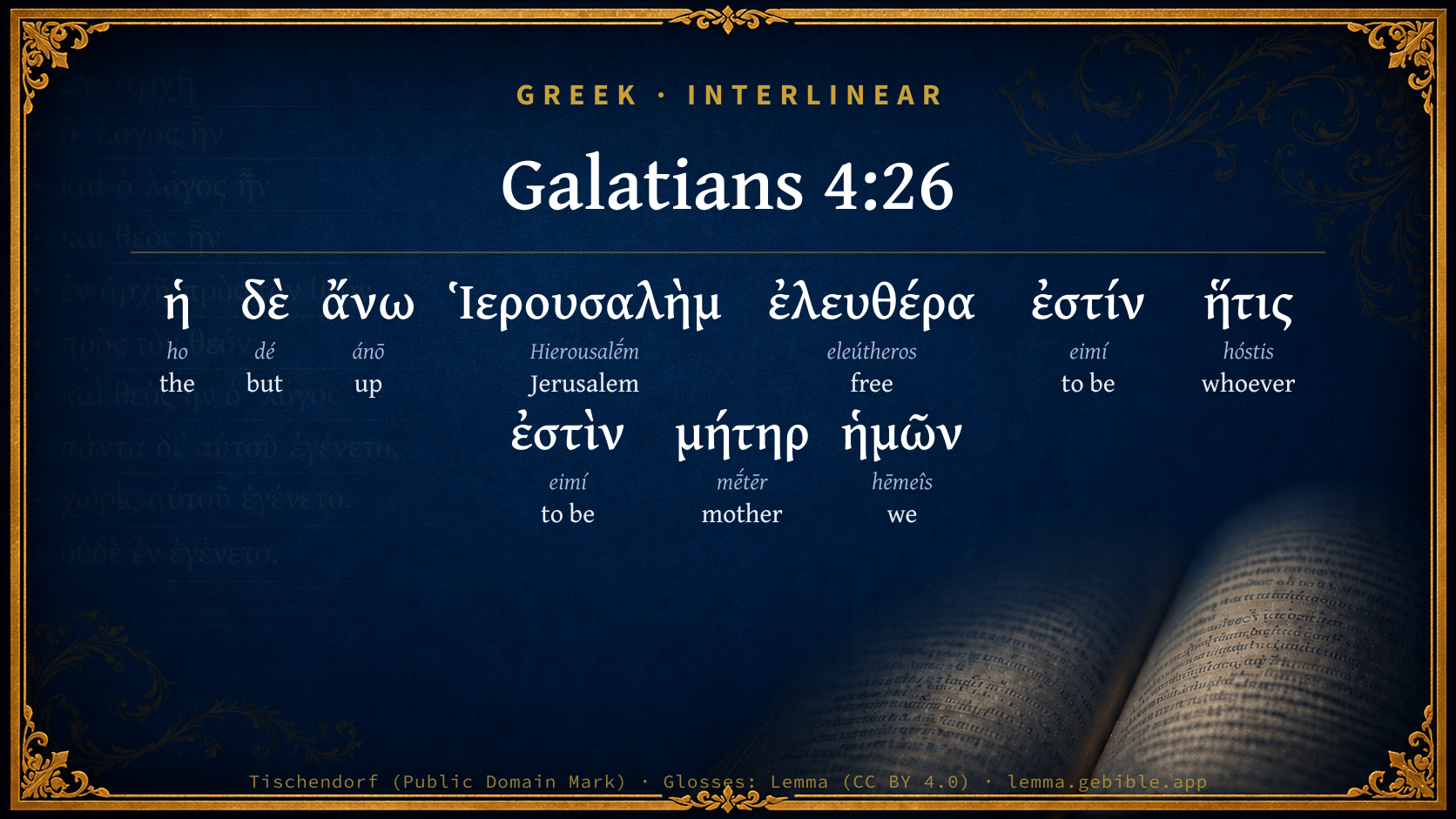
Greek (Tischendorf 8th ed.) Galatians 4:26 appears in the Greek New Testament. The text above is from the Tischendorf 8th edition. Each word links to its Strong’s number and a concise gloss. Click any word for its full Thayer’s Greek Lexicon entry.
Download image
Cite this verse

Galatians 4:26 (World English Bible). Public Domain. Lemma interlinear Bible study tool, https://lemma.gebible.app/v/galatians/4/26.

Show BibTeX & RIS
BibTeX
RIS
English Translation
But the Jerusalem that is above is free, which is the mother of us all.
World English Bible · Public Domain
Download a study sheet

One document with this verse’s original text, its word-by-word gloss line, the meaning frame, cross-references with their text, attributed commentary, and full source and license credits — printable, and it pastes into notes with its structure intact.

This verse Autodidact and up

Study sheet (.html) Plain text (.txt)

A passage Seminary Student

Up to 50 verses in one chapter. A passage sheet keeps up to 6 commentary sources and 12 cross-references per verse, in the order this page ranks them, and says so on the sheet whenever that leaves anything out. Ask for a single verse and you get the Autodidact verse sheet above.

Everything on this page stays free to read, with no account — the sheet is a download of what is already on screen, not access to it.

Want to remove ads? Support Godless Engineer
Compare translations 3

The same verse in 3 English versions, stacked beneath the original-language interlinear above. Click any original word for its lexicon entry.

Each is an independent rendering of the whole verse — the interlinear is not word-aligned to these translations.

Highlighted words mark where these versions differ — a whole-verse word diff, not a word-by-word alignment.

  • World English Bible Public Domain
    But the Jerusalem that is above is free, which is the mother of us all.
  • King James Version Public Domain
    But Jerusalem which is above is free, which is the mother of us all.
  • unfoldingWord Literal Text CC BY-SA 4.0
    But the Jerusalem above is free, which is our mother.

unfoldingWord Literal Text — © unfoldingWord, licensed CC BY-SA 4.0. Word-aligned USFM3 via Door43 (git.door43.org/unfoldingWord/en_ult).

Versions to compare (up to 4)

3 of 4 selected

Show all 19 translations

Every available English version of this verse, each an independent rendering of the whole verse.

  • World English Bible Public Domain
    But the Jerusalem that is above is free, which is the mother of us all.
  • Berean Standard Bible Public Domain
    But the Jerusalem above is free, and she is our mother.
  • Majority Standard Bible Public Domain
    But the Jerusalem above is free, and she is the mother of us all.
  • King James Version Public Domain
    But Jerusalem which is above is free, which is the mother of us all.
  • American Standard Version (1901) Public Domain
    But the Jerusalem that is above is free, which is our mother.
  • Revised Version (1885) Public Domain
    But the Jerusalem that is above is free, which is our mother.
  • Geneva Bible (1599) Public Domain
    But Hierusalem, which is aboue, is free: which is the mother of vs all.
  • Douay-Rheims (1899) Public Domain
    But that Jerusalem, which is above, is free: which is our mother.
  • Young's Literal Translation Public Domain
    and the Jerusalem above is the free-woman, which is mother of us all,
  • Literal Standard Version CC BY-SA 4.0
    and the Jerusalem above is the free [woman], which is mother of us all,
  • Unlocked Literal Bible CC BY-SA 4.0
    But the Jerusalem that is above is free, and she is our mother.
  • unfoldingWord Literal Text CC BY-SA 4.0
    But the Jerusalem above is free, which is our mother.
  • Darby Bible Public Domain
    but the Jerusalem above is free, which is our mother.
  • World Messianic Bible Public Domain
    But the Jerusalem that is above is free, which is the mother of us all.
  • Webster's Bible Public Domain
    But Jerusalem which is above is free, which is the mother of us all.
  • Free Bible Version CC BY-SA 4.0
    But the heavenly Jerusalem is free. She is our mother.
  • Bible in Basic English Public Domain
    But the Jerusalem on high is free, which is our mother.
  • Text-Critical English NT CC BY 4.0
    But the Jerusalem that is above is the free woman; she is the mother of us all.
  • Tyndale New Testament (1534) Public Domain
    But Ierusalem which is above is fre: which is the mother of vs all.

Literal Standard Version (2020), Covenant Press — licensed CC BY-SA 4.0. Text via the HelloAO Bible API (eBible.org). Unlocked Literal Bible (unfoldingWord) — licensed CC BY-SA 4.0. Text via the HelloAO Bible API (eBible.org). unfoldingWord Literal Text — © unfoldingWord, licensed CC BY-SA 4.0. Word-aligned USFM3 via Door43 (git.door43.org/unfoldingWord/en_ult). Free Bible Version, Dr. Jonathan Gallagher — licensed CC BY-SA 4.0. Text via the HelloAO Bible API (eBible.org).

Word by word

More ways to search: Search by grammar → Find every occurrence → Compare this word →

Practice this passage: Drill this verse → Learn its vocabulary →

About this verse

These counts appear in no published source. They are computed here, from the morphology-tagged text and Lemma’s own curated glosses. What Lemma adds →

10
words
9
distinct lemmas
Pauline Epistles
section

Notable vocabulary

The rarest word here is ἄνω up G507 — appearing just 9 times in the whole Greek New Testament.

Shared distinctive vocabulary

ἄνω up G507 occurs in 9 verses of the Greek New Testament. Also found in:

Repetition

A word recurs within this verse:

  • ἐστίν to be G1510 ×2

Cross-references

24

Topical passages linked to Galatians 4:26 in the Treasury of Scripture Knowledge — connected by theme and wording, ordered by reader-vote popularity; previews shown in the World English Bible.

  • Hebrews 12:22 But you have come to Mount Zion, and to the city of the living God, the heavenly Jerusalem, and to innumerable hosts of angels,
  • Philippians 3:20 For our citizenship is in heaven, from where we also wait for a Savior, the Lord Jesus Christ;
  • Revelation 21:2 I saw the holy city, New Jerusalem, coming down out of heaven from God, made ready like a bride adorned for her husband.
  • Micah 4:1–2 But in the latter days, It will happen that the mountain of Yahweh's temple will be established on the top of the mountains, And it will be exalted above the hills; And peoples will stream to it.
  • Revelation 3:12 He who overcomes, I will make him a pillar in the temple of my God, and he will go out from there no more. I will write on him the name of my God, and the name of the city of my God, the new Jerusalem, which comes down out of heaven from my God, and my own new name.
  • Isaiah 66:10 Rejoice you with Jerusalem, and be glad for her, all you who love her: rejoice for joy with her, all you who mourn over her;
  • Isaiah 65:18 But be you glad and rejoice forever in that which I create; for, behold, I create Jerusalem a rejoicing, and her people a joy.
  • Psalms 87:3–6 Glorious things are spoken about you, city of God. Selah.
  • Romans 6:14 For sin will not have dominion over you. For you are not under law, but under grace.
  • Isaiah 62:1–2 For Zion's sake will I not hold my peace, and for Jerusalem's sake I will not rest, until her righteousness go forth as brightness, and her salvation as a lamp that burns.
  • Joel 3:17 "So you will know that I am Yahweh, your God, Dwelling in Zion, my holy mountain. Then Jerusalem will be holy, And no strangers will pass through her any more.
  • Romans 6:18 Being made free from sin, you became bondservants of righteousness.
  • Isaiah 2:2–3 It shall happen in the latter days, that the mountain of Yahweh's house shall be established on the top of the mountains, And shall be raised above the hills; And all nations shall flow to it.
  • Galatians 5:1 Stand firm therefore in the liberty by which Christ has made us free, and don't be entangled again with a yoke of bondage.
  • Revelation 21:10–27 He carried me away in the Spirit to a great and high mountain, and showed me the holy city, Jerusalem, coming down out of heaven from God,
  • Song of Solomon 8:1–2 Oh that you were like my brother, Who sucked the breasts of my mother! If I found you outside, I would kiss you; Yes, and no one would despise me.
  • Isaiah 50:1 Thus says Yahweh, Where is the bill of your mother's divorce, with which I have put her away? or which of my creditors is it to whom I have sold you? Behold, for your iniquities were you sold, and for your transgressions was your mother put away.
  • Isaiah 52:9 Break forth into joy, sing together, you waste places of Jerusalem; for Yahweh has comforted his people, he has redeemed Jerusalem.
  • Hosea 2:2 Contend with your mother! Contend, for she is not my wife, Neither am I her husband; And let her put away her prostitution from her face, And her adulteries from between her breasts;
  • Hosea 2:5 For their mother has played the prostitute. She who conceived them has done shamefully; For she said, 'I will go after my lovers, Who give me my bread and my water, My wool and my flax, My oil and my drink.'
  • Hosea 4:5 You will stumble in the day, And the prophet will also stumble with you in the night; And I will destroy your mother.
  • John 8:36 If therefore the Son makes you free, you will be free indeed.
  • Galatians 4:22 For it is written that Abraham had two sons, one by the handmaid, and one by the free woman.
  • 1 Peter 2:16 as free, and not using your freedom for a cloak of wickedness, but as bondservants of God.

Cross-references courtesy of OpenBible.info (CC BY 4.0).

Where the printed editions differ

1 variant

Places in this verse where the major printed Greek editions disagree on the wording in a way that affects the translation — a comparison of editions, not a manuscript-by-manuscript collation. The editions are the modern critical texts (Nestlé-Aland 28/27, SBL, Westcott-Hort, Tregelles, Tyndale House) and the traditional texts behind the KJV (the Textus Receptus and the Byzantine/Majority text). It is not a claim about which reading is original.

  1. Extra text
    πάντων

    “of all”

    In TRByz Not in NA28NA27TynSBLWHTreg

    πάντων (pantōn) 'of all' is only in traditional manuscripts (TR+Byz)

Textual data: Translators Amalgamated Greek New Testament (STEPBible TAGNT) · CC BY 4.0.

Commentary

Notes on Galatians 4:26 from classic Christian and Jewish commentators (each source and its license shown beneath its notes). The classic Christian expositions comment on the surrounding passage and are grouped to its opening verse, so a note may address several verses; the Jewish commentaries on the Tanakh (Rashi and others) are per-verse, so they appear only where the commentator wrote on this verse.

Lemma curates 59 commentaries, every one of them public domain or Creative Commons licensed, each selected and text-cleaned for this edition rather than reprinted as found. About our sources →

The Biblical Illustrator

Joseph S. Exell

Gal_4:26

But Jerusalem, which is above, is free.

Notes of the Church

The Church is--

1. Heavenly.

2. One.

3. Invisible.

4. Free.

5. Propagative.

6. Careful of her children.

Jerusalem a type of the Church

Cf. Heb_12:22-23; Rev_21:2.

I. God chose Jerusalem above all places to dwell in; the catholic Church is composed of those in the midst of whom He dwells (Mat_18:20; Mat_28:20).

II. Jerusalem is a city compact in itself by reason of the bond of love and order among the citizens (Psa_122:3); so the members of the Church are linked together by the bond of one Spirit.

III. In Jerusalem was the sanctuary, a place of Gods presence and worship and truth; the Church is now in the room of that sanctuary; in it we must seek the presence of God and the word of life (1Ti_3:15).

IV. In Jerusalem was the throne of David (Psa_122:5); the Church, is the throne and sceptre of Christ (Rev_3:7).

V. The commendation of a city, as Jerusalem, is the subjection and obedience of its citizens; in the Church all believers are citizens (Eph_2:19), and yield voluntary obedience and subjection to Christ the King (Psa_110:2; Isa_2:5)

VI. As in Jerusalem the names of the citizens were enrolled in a register, so the names of Christians are recorded in the Book of Life (Rev_20:15; Heb_12:23). (W. Perkins.)

The heavenly Jerusalem

The Church in the creed has three properties: holy; catholic; knit in a communion. The word above intimateth that she is holy; mother, that she is knit in a communion; of all, that she is catholic.

I. Jerusalem a type of the church.

1. In election (Psa_132:13; cf. 1Pe_2:9).

2. In collection (Isa_5:2; cf. Eph_4:3).

3. In nobility (Psa_122:5; cf. Rev_3:7).

II. This new jerusalem is heavenly.

1. In respect of her birth and heavenly beginning (Jam_1:18).

2. In respect of growth and continuance (Php_3:20).

3. In respect of the end (Joh_17:24). (T. Adams.)

The heavenly origin and nature of the Church

The Church is said to be above--

I. In respect of her beginning, which is from the grace of God.

II. Because she dwells by faith in heaven with Christ. Wherefore we are admonished--

1. To live in this world as pilgrims and strangers (1Pe_2:21).

2. To carry ourselves as burgesses of heaven (Php_3:20).

(1) By seeking heavenly things;

(2) by leading a heavenly life. (W. Perkins.)

Characteristics of the Church

In that it is said she is above it signifies her heavenly origin; that she is Jerusalem, her peaceful multitude; that she is free, her great liberty; that she is mother, her abundant fecundity; that she is mother of us all, her wide charity. (Cardinal Hugo.)

Jerusalem our mother

The holy Church is our mother, and the most holy God our Father. She feeds us with sincere milk (1Ti_3:15) from her two breasts, the Scriptures of both Testaments, which God hath committed to her keeping. God doth beget us of immortal seed by the Word (1Pe_1:23), but by the instrumentality of the Church. (T. Adams.)

The comprehensiveness of the Church

The city of God, of which the Stoics doubtfully and feebly spoke, was now set up before the eyes of men. It was no unsubstantial city, such as we fancy in the clouds; no invisible pattern, such as Plato thought might be laid up in heaven; but a visible corporation, whose members met together to eat bread and drink wine, and into which they were publicly initiated. Here the Gentile met the Jew whom he had been accustomed to regard as an enemy of the human race; the Roman met the lying Greek sophist; the Syrian slave the gladiator born beside the Danube. In brotherhood they met, the natural birth and kindred of each forgotten, the baptism alone remembered to which they had been born again to God and to each other. The edict of comprehension conferred citizenship upon every class. Under it, whatever law of mutual help and consideration had obtained between citizen and citizen obtained also between the citizen and his slaves. The words foreign and barbarous lost their meaning. All nations and tribes were gathered within the pomoerium of the City of God; and on the baptized earth the Rhine and the Thames became as Jordan, and ever sullen desert-girded settlement of German savages as sacred as Jerusalem. (Ecce Homo.)

The Judaizers would have made the Jerusalem which is above, which is free, and which is the mother of us all, a mere cramped and narrow faubourg in the metropolis of Jerusalem. (Paul of Tarsus.)

Christian freedom

Jesus Christ not only called Lazarus into life, but he commanded the grave-clothes to be taken off him, that he might have liberty in life. Life, without liberty from the grave-clothes, would scarcely have been a blessing. So Jesus Christ not only gives life to the soul which believes in Him; He also commands the Spirit to descend upon him, to set him free from all enslaving habits. If the Son make you free, ye shall be free indeed, (J. Bate.)

True Liberty.

Who then is free? the wise who well maintains

An empire oer himself; whom neither chains

Nor want nor death with slavish fear inspire,

Who boldly answers to his warm desire;

Who can ambitions vainest gifts despise,

Firm in himself who on himself relies;

Polished and round who runs his proper course,

And breaks misfortune with superior force.

(Horace.)

St. Pauls allegory

And because similitudes and figures will hold faster in the memory of the unlearned, who are the greater number, than powerful arguments; after weighty reasons premised, the apostle concludes with an allegory at the end of his disputation, as a banquet after a meal of solid meat. And thus it runs, that they who sought righteousness by the law were no better than Ishmael, the son of Hagar; they that sought righteousness by faith were as Isaac, the heir of his father. That the law came from Sinai, which was seated in Arabia, a mountain quite out of the confines of the Land of Promise; the gospel began at Sion, or Jerusalem, which was the heart of the Holy Land. In this little abstract of the excellency of the Church, six portions of its glory are contained in six words.

1. She is a Jerusalem, a visible fair city, thats her external communion.

2. A Jerusalem above, thats her internal sanctity.

3. A Jerusalem that is free, which is her supernal redemption.

4. A mother, thats her fruitfulness.

5. The mother of us, which comprehends her unity.

6. The mother of us all, which expresseth the universality.

1. Jerusalem is the substantive or fundamental word that bears up the whole text, and it is as musical a word as most that run upon syllables; but it offers more pleasantness to the understanding than to the ear; full of happy signification; a name given, as the philosopher Plato was wont to say, so accommodate to the Church apostolical, that unless God had foreseen that His saving truth should first grow up within the walls thereof, it had never been called Jerusalem. And I refer myself to two things especially, how the name descended upon the Church.

(1) While the old tabernacle stood, Jerusalem was the chief place wherein men called upon the name of the Lord.

(2) Out of the same Sion went forth the new law, and Jerusalem was the mother of the first-born in Christ.

2. It was not enough in St. Pauls judgment to denominate the spouse of Christ from the best habitation (for earth is but earth be it never so much a selected portion); therefore he carries her aloft in his praise, and adds, that it is Jerusalem which is above, an heavenly city (Heb_12:22), as if it had not its original here, but fell down from the starry firmament.

(1) Because Christ our head is ascended into heaven, and governs all things beneath from thence, sitting at the right hand of His Father. As a king, upon whose safety the weal of the kingdom depends, is said to carry the lives of his people with him, when he adventures his person into danger; so our souls do hang upon Christ our Redeemer in Him we live and move, wheresoever He goes He draws us after Him; if He be lifted up on high, so are we also by virtue of concommitancy; it is His will, and we have His word for it, that where He is, there should we be also. When we pray unto Him, if our spirit do not issue out from us, and prostrate itself before Him in heaven, that petition solicits faintly, and is not like to speed, because it comes not nearer to Him who is our advocate with the Father. When we come to His Holy Supper, unless we carry up our heart unto Him by strong devotion, and presume that we see that very Body which was crucified for us before our eyes, we pollute the Sacrament for want of faith. There are such joints and bands which knit the body unto the head, as mortal reason cannot express; but through faith and love we are often with Him by invisible ascensions; but most assured be we that there He intercedes for us, from thence He assists His sacraments, sanctifieth His ministry, gives grace unto His Word. And if they did not escape who refused Him that spake on earth, much more shall not we escape, if we turn from Him that speaketh from heaven.

(2) Our Jerusalem is above, not only in the head, but in the members. I do not say in all the members; for the Church is that great house in which are vessels of honour and dishonour. Terms of excellency, though indistinctly attributed to the whole, are agreeing oftentimes only to the chiefer or more refined part. Some there are in this body, whom though we salute not by the proud word of their sublimity, yet in true possession, which shall never be taken from them, they are those that are above. Witness that the angels make up one Church with us, being the chief citizens that are reckoned in the triumphant part; fellow servants with us under one Lord; adopted sons under one Father; elect under one Christ. This is the language of the Scripture, and surely members of one mystical body, for the same Jesus is the head of all principality and power (Col_2:10). Of this family also are the saints departed, even all those holy spirits that obey God in heavenly places, and do not imitate the devil and his angels.

(3) We have obtained this dignity, to be ranked as them that are above, because our calling is very holy: He hath saved us, and called us with an holy calling (2Ti_1:9); called to doctrine which is above, which flesh and blood did not reveal, but the Father that giveth wisdom plentifully.

(4) This holy city of God is above, because it pursues not the things beneath, but it seeks those things above, where Christ sitteth at the right hand of God; it is above in its affections. The delights of the synagogue were victory over their enemies, length of days, a land of wine and olives, and flowing with milk and honey, poor accessories of a transitory happiness. This was tolerated unto them, when the first rudiments of the fear of God were taught; but these are too childish for us to look after, inasmuch as long continuance of time hath taught us to choose the better part.

(5) The Church evangelical is Jerusalem above in respect of the Jewish Hagar, propter sublime pactum, the covenant that is made with us is sublime and magnificent; not the dreadful law of works, but the mild and gentle covenant of faith in the blood of Christ.

3. Jerusalem, which is above, is free. The precedent praise of the Church adheres unto this word for the consummation thereof. If there be any that take upon them to belong to the New Jerusalem, and to the city which is above, let them show the copy of their freedom, that they are not led by the spirit of bondage, but by the spirit of adoption.

(1) What this freedom is. Our freedom consists in a manumission from a fourfold servitude.

(a) We are delivered from the yoke of ceremonies, called the bondage of the elements of this world, in this chapter, verse 4.

(b) We are most free for the new covenants sake, which is made with us. For salvation is not offered us through the works of the law, but through the promise of grace. We brethren, as Isaac was, are children of promise (verse 28).

(c) We have not received the spirit of bondage to fear, but the spirit of adoption, whereby we cry, Abba, Father (Rom_8:25). Says Theophylact upon my text, The gospel exhorts us gently, it doth not affright us tyrannously.

(d) The rewards of the New Testament are not momentary things, such as the law propounded, but heavenly. Says the same author, We are not servants that do our duty for visible wages. And all these together make the copy of a perfect freedom.

(2) How we got this freedom. We all know the procurer, and what He did to gain it for us; it is a flower that grew out of the blood of Christ. We were not protected, as Joshuas spies were, by a common woman; nor set at large, as Samaria was, by the tidings of lepers; our Deliverer is more honourable to us than our freedom. The Son of God was made a servant, that we servants might become sons. As God made nothing in nature but by His Son, by Him He made the worlds, so He did nothing for the restoration of the world without Him. He is all in all. He bath freed us from the bondage of shadows by taking a body; from the covenant of works by satisfying His Fathers justice; from the dread of fear by the sweetness of His mercy; from the sordid desire of earthly things by the operation of His holy Spirit.

(3) How we should use this freedom. No blessing hath been more abused than this. Under colour hereof the Galileans would be free from tribute, the Nicolaitans from the bond of marriage, the Gnostics from all justice and temperance, the clerks of the Roman Church from the courts of the civil magistrate, and the Anabaptists from all moral duties. No, says St. Peter to all these, As free, but not using your liberty as a cloak of maliciousness, but as the servants of God. It was St. Austins by word, You are free, therefore love God, and do what you will. If ye love Him keep His commandments. We are not so soon loosed but we are tied again, both freed and bound at once. We must recompense His goodness with our imperfect obedience. It is the law of gratitude; it is the bond of nature. As we commonly say, that nothing is more dearly bought than that which comes by gift; so we owe the greater service to Him of whom we got our freedom. Nay, we are bound to endure all for His sake. We feel the pain as much as they that curse and rage in their sufferings, but our love unto Christ doth overcome it. A free man, that will thrive, follows his trade as close as any apprentice, though not by austere compulsion. So our freedom will not make our hands slack from working, if we mean to lay up a treasure in heaven.

4. And as the Church hath taken upon it the proper name of Jerusalem, yet without any contract to the local and material building of Jerusalem, so she hath taken up the appellation of a mother, yet without any respect to nature, no way bending to natural causes, or natural affections. For not only our parents in the flesh, ,but the whole world, hath quite lost us in this word. As Moses remembered the great devotion of Levi, that he said of his father and mother, I have not seen them, or I respect them not, and of his brethren, I do not acknowledge them (Deu_33:9); so by deriving ourselves from this mother, we east our fleshly parentage aside, and we say to her, who did give us to suck from her breasts, as oar Saviour did to the blessed Virgin; What have I to do with thee? Jerusalem is ours, and we are hers, First, to know our mother, that we may not be ignorant either of her fruitfulness or our own obedience. He is a wise son, says Telemachus, in Homer, that knows his father; but he is a foolish son that doth not know his mother. Secondly, note the unity and indivision of the children of this mother. They are a cluster of grapes hanging upon one stalk, a brood of chickens clockt under the wings of one hen; there is but one stem and one progeny; one in relation to this parent, the mother of us. The third and last part puts us to observe, that the note of universality was large in Pauls days, but now much more amplified than in those times--the mother of us all. (Bishop Hacker.)

The new Jerusalem

Liberty is the element of a Christian. The fall placed nature under the bondage of sin; but then the law placed sin under the bondage of fear; but Christ first delivers sin from fear, and then delivers nature from sin. That the Jerusalem above means the present Church militant, as well as the Church triumphant the kingdom of heaven within you, as well as the kingdom of heaven above you--both grace and glory--is evident from the manner in which the expression Jerusalem, or Zion, is used in its connection of thought in many other parts of Scripture; as, for example, in the Psalms; or Isa_62:1-2; or Heb_12:22; or Rev_3:12; or Rev_21:2. Of all this Jerusalem, then, or Church-state, the character, the determining character, is liberty. If I wanted a proof of this, I might see it in the fact that everything which is not free is from beneath. Every machination of Satan against Gods people--every dark heresy that comes to confine the Church--every spiritual temptation which ensnares a mans conscience--every distress which cramps a believers mind--is from beneath; therefore, because it is from beneath, it is bondage. Bondage is from below. Jerusalem above,--that which your citizenship is--is free. Endeavour now to catch, for a moment or two, a feature, one or two features, in the liberty of the Church in heaven, that we may, by Gods grace, copy it into our liberty of the Church below. I observe that in heaven everything is very large, to us infinite. The room is boundless; the inhabitants are beyond computation--even as those stars in the heavens, which no man can reckon. But yet, as God does with those stars, so God does with everything in heaven. The gates, the fruits, the seats, the elders, the crowns, are all numbered--so that I see in heaven at once vastness and accuracy; the freest scope with the minutest observation. So be out freedom here. Our mercies are infinite. Still, every one of my mercies is known, and written down in Gods book, as a separate item. It is written; it is catalogued, and responsible. The multitude is vast; but, for each one that goes to make that multitude, I have to give a separate account how I have used it in this world. That is my liberty. Again, look at the cervices of heaven. I note that they use forms in heaven. We are told the very words, which they cease not day and night to say (never weary, though)--Worthy is the Lamb!--Amen!--Alleluia!--For the Lord God omnipotent reigneth! But oh! what a freshness, what spirit there is in those celestial formularies! Let us take our liberty. Free thoughts and full affections, in prescribed currents of regulated words, go to send up our separate feelings in all the individualities of unpremeditated prayer; and now we blend in social worship, as in the beautiful prayer and language of the holy services in which we have been this night engaged; and, in all, with the equal liberty of Zions children. That is heavens free worship, and that is the liberty of the Church around. There must be law to have freedom. The greater the law, the greater liberty; but the deeper that law is engraven in the hearts fine feelings, and the more a man is the spring of his own obedience, the more of habit, the more of anticipations boundings, the less of misapprehensions without a man, and the more felt presence of the love of Christ in a man, the nearer are we to the Jerusalem which is above, which is free, and which is the mother of us all. The mother of us all. There is no confidence which the world ever shows, so intimate and so tender, as that which a son feels for his mother. There are feelings which a man will deposit nowhere but with his mother. The mother of us all! Children of the New Jerusalem--children of the Church--set much by your Church. She is to you no other than a parent. Children of the new Jerusalem--children of heaven--remember into what a registry your name is now, by your second birth, enrolled. Demean it not; sully it not; sit loose to this world in the spirit of your minds; for, behold! she, which is your mother, will come presently, in her perfect beauty; and where should your eye be, and where should your anticipation daily be, but to that new Jerusalem, which shall come from heaven. Children of the new Jerusalem--children of liberty--take the image of your parents features. Be free in the spirit of your minds. Have freer prayer--freer hope--freely take the freedom so freely given you. (J. Vaughan, M. A.)

The liberties of the Church

We must understand St. Paul here to speak of the Church; and not of the Church triumphant in heaven, as some of the schoolmen have asserted, but the Church militant here on earth, that glorious edifice of the faithful, whose names are written in the book of life, and who are united with Christ above in a fellowship of His sufferings. But the word above is not to mislead you, as Luther has well observed; for all the processes of spiritual generation and adoption are from above; all intercourse between God and His faithful worshippers is from above; and our conversation is in heaven. All, then, that are allowed to see the kingdom of God, are to be born from above: this is the decree of the Head of the Church. As Christ, therefore, is in heaven, and as He is Head of the Church, so is the Church spiritually in heaven, even whilst she is militant here below; for the Church is an unmeasured edifice, and never can be measured till some one by searching can find out the limits of the Almighty: It is as high as heaven, what canst thou do? deeper than hell, what canst thou know? The Head of the Church is at the right hand of God; the feet are walking here on earth; and yet one mighty eternal Spirit animates the whole, one will and principle of action pervades the immense body; one thought and intention directs and disciplines all the mass;--for in Him we live, and move, and have our being; and the whole company of true and faithful believers, from the day that Christ was crucified, down to the hour when the last trumpet shall sound from heaven, do form but one mystical body, with one soul and One spirit, entire in union and perfect in co-operation. But the beauty of this city is her freedom: the real Church of Christ has ample privileges; and all her laws are comprehensive and liberal. There is no spirit of bigotry, no local attachments, no exclusive jealousy, no straining on the conscience, no turning of the fancies of man into the decrees of God. St. Paul, the illustrious scribe of that holy city, lays no heavier burthen on the chartered inhabitants than this--Stand fast therefore in the liberty wherewith Christ hath made us free; and be not entangled again with the yoke of bondage (Gal_5:1.) How easy, one would think it must be, to love the freedom which God has given us I But, alas! that which has been given us as our freedom by God, has been, by the world in general, considered irksome and intolerable. The world cannot endure a spiritual Church; it loves neither a spiritual worship nor a spiritual faith; and to worship God in spirit is what it can neither understand nor tolerate. (R. M. Beverley.)

The Biblical Illustrator, edited by Joseph S. Exell (c. 1880s–1900s) — public domain. Text from a community e-Sword module.

Tyndale Open Study Notes

Tyndale Open Resources

4:26 Just as Hagar represents slavery to human effort based on Mount Sinai (4:24-25), Sarah represents freedom in the heavenly Jerusalem, the ideal city of God. Abraham’s true children by faith (3:29) now live in the reality of God’s reign in Christ. • she is our mother: Sarah’s child, Isaac, was the freeborn recipient of all of God’s promises apart from the law. Similarly, Jews and Gentiles who live by faith in Christ are Sarah’s true children—they receive God’s promises to Abraham freely apart from the law (3:26-29; 4:4-7).

Tyndale Open Study Notes — © Tyndale Open Resources, licensed CC BY-SA 4.0. Text via the HelloAO Bible API.

Bengel's Gnomon

Johann Albrecht Bengel

Gal 4:26. Ἡ δὲ ἄνω, but she who is above) Heb 12:22; Revelation 21—ἐλευθέρα, free) as Sarah was.—ἥτις, who) Jerusalem.—μήτηρ, mother) The ancients said of their own Rome: Rome is our common father-land.—πάντων, of all) as many as there are of us. To this refer the many [children] in the following verse.

Bengel's Gnomon of the New Testament — English translation (T&T Clark, Edinburgh, 1860) — public domain. Text from a community e-Sword module.

Meyer's Critical & Exegetical Commentary

Heinrich August Wilhelm Meyer

Gal_4:26. But altogether different from the position of the present Jerusalem is that of the upper Jerusalem, which is free; and this upper Jerusalem is our mother.

δέ] places the ἄνω Ἱερουσ. in contrast with the previous τῇ νῦν Ἱερουσ. The μία μέν of Gal_4:24 has been left, in consequence of the digression occasioned by the remarks made in Gal_4:25, without any correlative to follow it (such as ἡ δὲ ἑτέρα),an omission which is quite in harmony with the rapid movement of Pauline thought. Comp. Rom_7:12, et al.; also Rom_5:12. He leaves it to the reader to form for himself the second part of the allegorical interpretation after the similarity of the first, and only adduces so much of it as is directly suggested by the contrast of the just characterized τῇ νῦν Ἱερουσ. He leaves it, therefore, to the reader to supply the following thought: But the other covenant, which is allegorically represented in this history, is the covenant instituted by Christ, which brings forth to freedom: this is Sarah, who is of the same nature with the upper Jerusalem; for the latter is, as Sarah was, free with its children, and to this upper Jerusalem we Christians as children belong.

ἡ δὲ ἄνω Ἱερουσαλήμ] is neither the ancient Jerusalem, the Salem of Melchizedek (Oeder, Michaelis, Paulus), nor Mount Zion, which is called in Josephus ἡ ἄνω πόλις (see the passages in Ottii Spicil. ex Josepho, p. 400 f.), as among the Greeks the Acropolis at Athens was also so named (Vitringa, Elsner, Mill, Wolf, Rambach, Moldenhauer, Zachariae). Both interpretations are opposed to the context, and the former to linguistic usage.[220] The contrast between heaven and earth elsewhere conveyed by ἄνω, as used by Paul (Php_3:14; Col_3:2), is found here also, since Ἡ ΝῦΝ ἹΕΡ. is the earthly Jerusalem. It is true that this contrast would have been more accurately expressed if, instead of τῇ νῦν Ἱερουσ., he had written Τῇ ΚΆΤΩ ἹΕΡΟΥΣ. (ירושלים של מטה); but in using the ΝῦΝ he thought of the future Jerusalem as its contrast (Heb_13:14), and afterwards changed his mode of representation, by conceiving the future as the upper: for it is the heavenly Jerusalem, called by the Rabbins ירושלים של מעלה, which, according to Jewish teaching, is the archetype in heaven of the earthly Jerusalem, and on the establishment of the Messiahs kingdom is let down to earth, in order to be the centre and capital of the Messianic theocracy, just as the earthly Jerusalem was the centre and capital of the ancient theocracy. Comp. Heb_11:10; Heb_12:22; Heb_13:14; Rev_3:12; Rev_21:2. See generally Schoettgen, de Hieros. coelest. in his Horae, p. 1205 ff.; Meuschen, N.T. ex Talm. ill. p. 199 ff.; Wetstein, in loc.; Bertholdt, Christol. p. 211 ff.; Ewald, ad Apoc. p. 11, 307. And as previously the present Jerusalem represented the Jewish divine commonwealth, so here the upper Jerusalem represents the Messianic theocracy, which before the παρουσία is the church, and after the ΠΑΡΟΥΣΊΑ is the glorious kingdom of the Messiah. With justice, accordingly, the church on earth (not merely the ecclesia triumphans) has at all times been deemed included in the heavenly Jerusalem (see Luther, and especially Calovius, in loc.); for the latter is, in relation to the church, its πολίτευμα, which is in heaven (Php_3:20). The heavenly completion of the church in Christ ensues at the παρουσία, in which Christ who rules in heaven will manifest in glory the lifehitherto hidden with Him in God (see on Col_3:3 f.)of the community, which is the body and πλήρωμα of Him its Head (Eph_1:22 f.). Thus the church on earth is already the theocracy of the heavenly Jerusalem, and has its πολίτευμα in heaven; but this its κληρονομία is, until the παρουσία, only an ideal and veiled, although in hope assured, possession, which at the second coming of the Lord at length attains objective and glorious realization. It is, however, by no means to be asserted that Paul entertained the sensuous Rabbinical conceptions of the heavenly Jerusalem (see Eisenmenger, entdeckt. Judenth. II. p. 839 ff.); for he nowhere presents, or even so much as hints, at them, often as he speaks of the παρουσία and the consequences connected with it. In his view, the heavenly Jerusalem was the national setting for the ideafounded on the exalted Christ as its central pointof the kingdom of the Messiah before and after its glorious realization.

ἐλευθέρα ἐστιν] that is, independent of the Mosaic law (opposite of the δουλεύει in Gal_4:25), in free, moral self-determination, under the higher life-principle of the Spirit (Rom_8:2; 2Co_3:17).

ἥτις ἐστὶ μήτηρ ἡμῶν] correlative with the above-mentioned μετὰ τῶν τέκν. αὐτῆς; hence, if Paul had wished to lay the stress upon ἡμῶν (Winer, Matthias), he must have made this evident by the marked position ἥτις ἡμῶν μήτ. ἐ. The emphasis lies rather on ἥτις, that is, she who, etc. (comp. on Gal_4:24), quippe quae libera Hierosol. To this Jerusalem as our ΠΟΛΊΤΕΥΜΑ we Christians belong, as children to their mother (Php_3:20; Eph_2:19). In bondage, it would not be our mother. Hofmann interprets differently: the freedom of this Jerusalem may be seen in her children. But this would be a correlative retrospective conclusion, since Paul has neither written ὅτι (but ἥτις), nor has he expressed himself participially οὖσα μήτ. ἡμ. μήτηρ without the article is qualitative. That ἩΜῶΝ applies to the Christians generally, including also the Gentile Christians, is obvious of itself from the context, and does not require the addition of πάντων in the Textus receptus, which is defended by Ewald (in opposition to Reiche), to make it evident.

[220] ἄνω always means above. When it appears to mean olim, it denotes the ascending line of ancestry, as e.g. in Plat. Legg. ix. p. 880 B: ἢ πατρὶ ἢ ἔτι ἀνωτέρω. Theact. p. 175 B al.; the earlier time lying behind being regarded as higher (Polyb. v. 6. 1, iv. 2. 3, iv. 50. 3).

Meyer — Critical and Exegetical Commentary on the New Testament — English translation by Peter Christie, edited by Frederick Crombie (T&T Clark, 1880) — public domain. Text from a community e-Sword module.

Expositor's Greek Testament

ed. W. Robertson Nicoll

Gal 4:26 . ἡ ἄνω Ἱερ . The Psalms and Prophets attest the enthusiastic devotion of Israelites to the city of Jerusalem. Since the temple of God and the palace of the house of David were within its walls, it was at once the holy city round which clustered the religious feelings of Israel, and the city of the great king, of whom the royal house of David were representatives ( cf. Psa 48 ). The events of the captivity and restoration associated it still more intimately with the national fortunes and aspirations of Israel. Hence both Isaiah and Ezekiel invested it with ideal glory in their prophetic anticipations of the Messianic kingdom. Their visions of its future destiny looked forward to its becoming the centre of a world-wide worship: there the great King of all the earth would manifest His presence, and thither would flow all nations, offering their homage and bearing due tribute of gifts and sacrifices. But the Hebrew ideal scarcely rose above imaginations of an earthly city and a temple on the mountains of Israel. It was the function of Christian inspiration to spiritualise this conception, to eliminate its local association with the typical temple on earth, and to substitute a heavenly for an earthly city. The Apocalypse bears witness to the process of transition. Though it adheres closely to the vision of Ezekiel, and continues to employ material imagery for expressing the dazzling brightness and intense purity of the temple-city, yet the New Jerusalem is now seen coming down from heaven to a new earth; in place of earthly light it is illuminated by the light which emanates from the throne of God and of the Lamb; and material images are interpreted as symbols of moral beauty and spiritual holiness. The Epistle to the Hebrews views the heavenly Jerusalem from another side. Whereas the Apocalypse depicts its buildings, streets and rivers, the Epistle describes the throng of angels, the assembly of the first-born, the spirits of departed saints that are gathered there round the throne of God, and contrasts the awful majesty of the living God with the material terrors of Sinai. This Epistle presents the contrast between the earthly and the heavenly Jerusalem, and between the covenants of Sinai and of Christ in a different aspect. For the Apostle embodies in his conception a purely Greek ideal of a city, the mother and home of freemen. A self-governed body of free citizens, subject to no foreign control, but maintaining justice and order in perfect peace by their own sovereign will, furnishes him with an appropriate type of the heavenly commonwealth, whereof Christians are even now citizens, dwelling in peace together in the unity of Christian brotherhood, and independent of all restraints of law because they themselves do the will of God from the heart.

The Hebrew form Ἱερουσαλήμ is naturally preferred to the Greek in all these passages, because Jerusalem is personified as an ideal city. The stress here laid on the freedom of Christ’s disciples recalls the conversation of Christ with the Jews in Joh 8:32 … but the bondage is there more distinctly associated with actual sin.

The Expositor's Greek Testament, edited by W. Robertson Nicoll (1897–1910) — public domain. Text from a community e-Sword module.

Geneva Bible (1599)

Geneva Bible translators

Which is excellent, and of great account.

Geneva Bible (1599) marginal notes — public domain. Text via Bolls.life.

Jamieson, Fausset & Brown

Robert Jamieson, A. R. Fausset & David Brown

This verse stands instead of the sentence which we should expect, to correspond to Gal 4:24, "One from Mount Sinai," namely, the other covenant from the heavenly mount above, which is (answers in the allegory to) Sarah.

Jerusalem . . . above-- (Heb 12:22), "the heavenly Jerusalem." "New Jerusalem, which cometh down out of heaven from my God" (Rev 3:12; Rev 21:2). Here "the Messianic theocracy, which before Christ's second appearing is the Church, and after it, Christ's kingdom of glory" [MEYER].

free--as Sarah was; opposed to "she is in bondage" (Gal 4:25).

all--omitted in many of the oldest manuscripts, though supported by some. "Mother of us," namely, believers who are already members of the invisible Church, the heavenly Jerusalem, hereafter to be manifested (Heb 12:22).

Jamieson, Fausset & Brown — Commentary Critical and Explanatory on the Whole Bible (1871) — public domain (CC PDM 1.0). Text via the HelloAO Bible API.

Adam Clarke's Commentary

Verse 26. But Jerusalem which is above] The apostle still follows the Jewish allegory, showing not only how the story of Hagar and Sarah, Ishmael and Isaac, was allegorized, but pointing out also that even Jerusalem was the subject of allegory; for it was a maxim among the rabbins, that "whatsoever was in the earth, the same was also found in heaven for there is no matter, howsoever small, in this world, that has not something similar to it in the spiritual world." On this maxim, the Jews imagine that every earthly thing has its representative in heaven; and especially whatever concerns Jerusalem, the law, and its ordinances. Rab. Kimchi, speaking of Melchizedec, king of Salem, says: זו ירושלם של מעלה zu Yerushalem shel malah, "This is the Jerusalem that is from above." This phrase frequently occurs among these writers, as may be seen in Schoettgen, who has written an express dissertation upon the subject. Hor. Hebr., vol. i. page 1205.

Is free, which is the mother of us all.] There is a spiritual Jerusalem, of which this is the type; and this Jerusalem, in which the souls of all the righteous are, is free from all bondage and sin: or by this, probably, the kingdom of the Messiah was intended; and this certainly answers best to the apostle's meaning, as the subsequent verse shows. There is an earthly Jerusalem, but this earthly Jerusalem typifies a heavenly Jerusalem: the former, with all her citizens, is in bondage; the latter is a free city, and all her inhabitants are free also. And this Jerusalem is our mother; it signifies the Church of Christ, the metropolis of Christianity, or rather the state of liberty into which all true believers are brought. The word παντων, of all, is omitted by almost every MS. and version of antiquity and importance, and by the most eminent of the fathers who quote this place; it is undoubtedly spurious, and the text should be read thus: But Jerusalem, which is above, is free, which is our mother.

Adam Clarke's Commentary on the Bible (1810–1826) — public domain. Text from a community e-Sword/MySword module.

John Calvin's Commentaries

26. But Jerusalem, which is above. The Jerusalem which he calls above, or heavenly, is not contained in heaven; nor are we to seek for it out of this world; for the Church is spread over the whole world, and is a “stranger and pilgrim on the earth.” (Hebrews 11:13.) Why then is it said to be from heaven? Because it originates in heavenly grace; for the sons of God are

“born, not of blood, nor of the will of the flesh, nor of the will of man,” (John 1:13,)

but by the power of the Holy Spirit. The heavenly Jerusalem, which derives its origin from heaven, and dwells above by faith, is the mother of believers. To the Church, under God, we owe it that we are

“born again, not of corruptible seed, but of incorruptible,” (1 Peter 1:23,)

and from her we obtain the milk and the food by which we are afterwards nourished.

Such are the reasons why the Church is called the mother of believers. And certainly he who refuses to be a son of the Church in vain desires to have God as his Father; for it is only through the instrumentality of the Church that we are “born of God,” (1 John 3:9,) and brought up through the various stages of childhood and youth, till we arrive at manhood. This designation, “the mother of us all,” reflects the highest credit and the highest honor on the Church. But the Papists are fools and twice children, who expect to give us uneasiness by producing these words; for their mother is an adulteress, who brings forth to death the children of the devil; and how foolish is the demand, that the children of God should surrender themselves to her to be cruelly slain! Might not the synagogue of Jerusalem at that time have assumed such haughty pretensions, with far higher plausibility than Rome at the present day? and yet we see how Paul strips her of every honorable distinction, and consigns her to the lot of Hagar.

John Calvin's Commentaries (1540-1563) — public domain. Text from the Calvin Translation Society English edition (1840s-50s) via the Christian Classics Ethereal Library (ccel.org). Calvin's coverage is partial (roughly two-thirds of the Bible); uncommented books and verses are honest gaps, never fabricated. The 19th-century editor's footnotes and remarks are omitted so the notes are faithfully Calvin's own voice.

Ellicott's Commentary for English Readers

(26) Jerusalem which is above.—The ideal or heavenly Jerusalem. (Comp. Heb_12:22, “Ye are come to . . . the heavenly Jerusalem;” Rev_21:2, “the holy city, new Jerusalem.” This “new” or “heavenly” Jerusalem is the seat or centre of the glorified Messianic kingdom, just as the old Jerusalem had been the centre of the earthly theocracy. The conception of the “heavenly Jerusalem” among the Jews, like the rest of their Messianic beliefs, took a materialistic form. It was to be a real but gorgeous city suspended in mid-air, “three parasangs” (11¼ miles) above the earthly city. Sometimes it is regarded as the exact copy of its earthly counterpart, and at other times as forming a perfect square. (Comp. Rev_21:16.) No such materialistic notions attach to the idea as presented by St. Paul. “Jerusalem which is above” is to him a spiritual city, of which the Christian is a member here and now. It is part of the Messianic kingdom, to the whole of which the Apostle gave an ideal character. He could not but do so, seeing that the kingdom began with the coming of its King, though there was no earthly and visible realisation of it. The Christian “conversation” (or, rather, commonwealth, the constitution that he was under) was “in heaven,” while he himself was upon earth. (See Php_3:20.)

Which is the mother of us all.—The true reading is, undoubtedly, which is our mother, omitting “all.” The heavenly Jerusalem was the metropolis of Christianity, just as the earthly Jerusalem was the metropolis of Judaism.

A Bible Commentary for English Readers, edited by Charles John Ellicott (1878–1897) — public domain. Text from a community e-Sword module.

The Cambridge Bible for Schools and Colleges

gen. ed. J. J. S. Perowne

26. the mother of us all] Probably we should read with R.V. our mother, where of course ‘our’ is emphatic. Comp. Gal_4:31.

The Cambridge Bible for Schools and Colleges (gen. ed. J. J. S. Perowne; Cambridge University Press, 1878–1918) — public domain. Text from a community e-Sword module.

John Gill's Exposition

For it is written,.... Isa 44:1, which is cited to prove, that the heavenly Jerusalem, or Gospel church state, is the mother of us all, and has brought forth, and still will bring forth, many souls to Christ, even many more than were under the legal dispensation by the Jewish church, though the Lord was an husband to them, Jer 31:32. The words are,

rejoice thou barren that bearest not, break forth and cry thou that travailest not, for the desolate hath many more children than she which hath an husband; by her that was "barren", and "bore" not, and "travailed" not, and was "desolate", is not meant the Gentile world, which before the coming of Christ was barren and destitute of the knowledge of him, and from among whom very few were called by grace; but the Gospel church in the first beginnings of it, in Christ's time, and especially about the time of his death, and before the pouring forth of the Spirit on the day of Pentecost, when the number of its members were few; for the names of the disciples together were but 120, when it seemed to be barren, and desolate, and deprived of its husband Christ, but was quickly to have a large accession to, it, both of Jews and Gentiles; and therefore is called upon to "rejoice, break forth", and "cry"; that is, to break forth into songs of praise, and express her spiritual joy, by singing aloud, and setting forth in hymns and spiritual songs the glory of powerful and efficacious grace, in the conversion of such large numbers of souls, the like of which had never been known under the former administration. Three thousand were converted under one sermon, and added to this first Gospel church; and the number of its members still increased, and the number of the men that afterwards believed was about five thousand; and after this we hear of more believers being added to the Lord, both men and women; and also that a great company of the priests were obedient to the faith; and when out of this church, the apostles, and other preachers of the Gospel went everywhere into the Gentile world, thousands of souls were converted, and a large number of churches formed, and a spiritual seed has been preserved ever since; and in the latter day Zion will travail in birth, and bring forth a numerous offspring; a nation shall be born at once, and the fulness of the Gentiles shall be brought in. Agreeably to this sense the Jewish writers, Jarchi, Kimchi, and Aben Ezra, understand this passage of Jerusalem; as does also the Chaldee paraphrase, which renders it thus:

"Praise, O Jerusalem, which was as a barren woman that bringeth not forth; rejoice in praise, and be glad, who was as a woman which conceives not, for more are the children of Jerusalem forsaken than the children of the habitable city, saith the Lord.''

John Gill's Exposition of the Whole Bible (1746–1763) — public domain (CC PDM 1.0). Text via the HelloAO Bible API.

Trapp's Complete Commentary

John Trapp

26 But Jerusalem which is above is free, which is the mother of us all.

Ver. 26. But Jerusalem which is above] That is, the Christian Church, the heavenly Jerusalem, the panegyris and congregation of the firstborn, whose names are enrolled in heaven, Heb 12:23. The Hebrew word for Jerusalem is of the dual number; to show, say the Cabalists, that there is a heavenly as well as an earthly Jerusalem, and that the taking away of the earthly was intimated by the taking away of the letter jod out of Jerusalem, 2Sa 5:13. {Hebrew Text Note} (Amama in Coronide.) Let us upon the sight of any famous city lift up our hearts with holy Fulgentius and say, Si talis est Roma terrestris, qualis est Roma caelestis? If there be such stateliness and sweetness here, what is there in that "City of the great King?"

John Trapp, A Commentary or Exposition upon All the Books of the Old and New Testament (1647–1656) — public domain. Text from a community e-Sword module.

Albert Barnes' Notes on the Bible

But Jerusalem which is above - The spiritual Jerusalem; the true church of God. Jerusalem was the place where God was worshipped, and hence, it became synonymous with the word church, or is used to represent the people of God. The word rendered “above,” (ἄνω anō) means properly “up above,” that which is above; and hence, heavenly, celestial; Col 3:1-2; Joh 8:23. Here it means the heavenly or celestial Jerusalem; Rev 21:2, “And I John saw the holy city, new Jerusalem, coming down from God, out of heaven.” Heb 12:22,” ye are come unto Mount Zion, and unto the city of the living God, the heavenly Jerusalem.” Here it is used to denote the church, as being of heavenly origin.

Is free - The spirit of the gospel is that of freedom. It is freedom from sin, freedom from the bondage of rites and customs, and it tends to promote universal freedom; see the note at Gal 4:7; compare Joh 8:32, Joh 8:36; and the note at 2Co 3:17.

Which is the mother of us all - Of all who are true Christians, whether we are by birth Jews or Gentiles. We should not, therefore, yield ourselves to any degrading and debasing servitude el any kind; compare the note at 1Co 6:12.

Albert Barnes' Notes on the Bible (1834–1885) — public domain. Text from a community e-Sword/MySword module.

Matthew Poole's English Annotations

The new covenant, or the dispensation of the gospel, or the Christian church,

which is above, or from above, which answereth to Sarah, and is said to be above, because revealed from heaven by Christ, sent out of the bosom of the Father, not as the law was revealed upon earth, upon Mount Sinai. Hence apostates from the doctrine of the gospel, are said to turn from him who speaketh from heaven, Heb 12:25. Or else it is said to be above, because it is the assembly of the firstborn written in heaven, Gal 4:23; hence the gospel church is called the heavenly Jerusalem, Gal 4:22. Of this gospel church the apostle saith, that it is free; i.e. free from the yoke and bondage of the ceremonial law, or from the covenant and curse of the law. Which church, he saith,

is the mother of all believers, they embracing the same faith, and walking in the same steps; from whence it was easy for the Galatians to conclude their freedom and liberty also from the law.

Matthew Poole's English Annotations on the Holy Bible (1683–1685) — public domain. Text from a community e-Sword/MySword module.

Whedon's Commentary on the Bible

Daniel D. Whedon

26. Jerusalem… above—Literally, the above, or upper Jerusalem. The same Greek phrase Josephus uses to designate the upper city of Jerusalem; and a parallel phrase, the upper city, was used in Athens to designate the Acropolis. Paul does not, however, mean the upper part of the then present Jerusalem, but a spiritual Jerusalem, higher, not only than the material one, but higher than the conceptual one,—the old theocracy;—namely, the new theocracy, the Church of the New Testament. This is called in Heb_12:22, the heavenly Jerusalem: not because it is heavenly in locality, but heavenly in nature. And in Revelation 21, John beholds the glorified counterpart of this earthly-heavenly Jerusalem descend from heaven, and identify itself with the earthly-heavenly Jerusalem, (the beloved city of Rev_20:9.) In Paul’s allegory the correspondent item to Sinai is not formally supplied, and, as the above synopsis shows, Zion seems to be needed. Yet St. Paul skips it, really because, though needed to make out a regular programme, it is not needed for the complete exhibition of the truth. Wieseler furnishes in good Greek the apostle’s “missing link” (as quoted by Schmoller) thus: “The second covenant from mount Zion, bearing children unto freedom, which is Sarah. For Zion is a mountain in the Land of Promise, and corresponds to Jerusalem, for she is free with her children.”

Is free—Her legal bonds are fallen off. She is like Sarah, whose name meant princess—free and queenly.

Mother of us all—Not a barren princess, as Sarai was, but a miraculously fertile mother of countless free and princely sons. They are the very progeny predicted by Jehovah, to be as numerous as the stars of heaven.

Daniel D. Whedon (gen. ed.), Commentary on the Old and New Testaments (1874–1909) — public domain. Text from a community e-Sword module.

The Pulpit Commentary

But Jerusalem which is above is free (hJ dem ejleuqera ejstin); but the Jerusalem that is above is free. The mystic Jerusalem in which Christ reigns, the Son of David, who is at the right hand of God. For the word "above," anw, comp. nw Col_3:1, Col_3:2, "Seek the things that are above (ta a where Christ is, seated at the right hand of God: set your mind on the things that are above; your life is hid with Christ in God;" and teuma) Php_3:20, "Our citizenship (poli) is in heaven." This is identical with the "heavenly Jerusalem" Heb_12:22, which, standing in contrast with the "mount that might be touched and that burned with fire," Sinai with its soul-crushing terrors, appears associated with the pacifying blood of Jesus, and with communion with all that is holiest and most glorious. The essential identity of the contrast in the two passages, which are mutually illustrative, bespeaks a common origin in one and the same mind. The supernal Jerusalem is not chiefly contrasted with the Jerusalem "that now is," in point of time: she is not the future only, though in the future to be manifested the holy city, New Jerusalem, coming down (as St. John writes) from God out of heaven; (Rev_21:2) but she is there now, with God. It would be in harmony with St. Paul"s representation to suppose that he conceives of her having been there with God in heaven of old, her citizens upon earth being the true servants of God in all ages. In former ages, however, she was comparatively barren; it needed that the enthronization of the God-Man, "the Mediator of the new covenant", (Heb_12:24) on "God"s holy hill of Zion," should take place before she could become the prolific mother here shown to us. Commentators refer to rabbinical speculations relative to a Jerusalem which was conceived of as existing in heaven, as illustrated by Schottgen"s "Dissertatio de Hierosol. Caelesti" ("Hor. Hebr.," vol. 1. diss. 5.), and also by Wetstein both here and on Rev. 21. It would be interesting if we could determine when those rabbinical speculations first arose, and how far it may be judged probable that they or some earlier form of them out of which these sprang suggested anything to St. Paul for the form in which he clothed his own conception of this idea; there may have been such. Meanwhile, we cannot but be struck by the purely ideal and spiritual character in which the apostle here exhibits his conception of it; though something like a terrene manifestation in the future seems indicated in Rom_8:21. "Is free;" the counterpart of Sarah, as mentioned in vers. 22, 23. That this Jerusalem is free, the apostle feels it needless to state; she to his very consciousness is the very home and bosom of God"s love, having her very existence, as well as her outward-acting power, in his pervading, actuating Spirit. Bondage, constraint, there cannot be; for all volitions are there harmonized, absorbed, by the Spirit of love uniting her component elements both with each other and with God. Which is the mother of us all (htiv ejstithr hJmwn Receptus, pantwn hJmwn) which is our mother. Here again, as in ver. 24, htiv means which, being such as she is, is our mother." We look at the Jerusalem that is above, and in her princely freedom we recognize what we her children are. The pantwn, which the Textus Receptus has before hJmwn, and which is by the general consent of critics rejected, is with much probability supposed to have come into the text by the copyist"s recollection of the similar sentencem, Rom_4:16, Rom_4:17, jAbraa ov ejsti pathntwn hJmwn. But pantwn, which there belongs to the essential thought of the context that God had made Abraham "the father of many nations," is unnecessary here, where the apostle is chiefly concerned with the freedom which characterizes the family of promise. If documentary evidence proved it to be genuine, it would find its justification in the notion of the fruitfulness which now at length, as the apostle presently shows, is given to the supernal Jerusalem.

The Pulpit Commentary (1880–1919), ed. H.D.M. Spence-Jones & Joseph S. Exell — public domain. Text from a community e-Sword module.

John Wesley's Explanatory Notes

But the other covenant is derived from Jerusalem that is above, which is free - Like Sarah from all inward and outward bondage, and is the mother of us all - That is, all who believe in Christ, are free citizens of the New Jerusalem.

John Wesley, Explanatory Notes Upon the Whole Bible (1754–1765) — public domain. Text via the GEBible commentary corpus.

Luther on Galatians

Martin Luther

VERSE 26. But Jerusalem which is above is free, which is the mother of us all.

The earthly Jerusalem with its ordinances and laws represents Hagar and her offspring. They are slaves to the Law, sin and death. But the heavenly Jerusalem is Sarah, the free woman. This heavenly Jerusalem is the Church, that is to say the number of all believers throughout the world, having one and the same Gospel, one and the same faith in Christ, one and the same Holy Ghost, and the same sacraments.

Do not mistake this one word "above" to refer to the triumphant Church in heaven, but to the militant Church on earth. In Php 3:20, the Apostle uses the phrase: "Our conversation is in heaven," not locally in heaven, but in spirit. When a believer accepts the heavenly gifts of the Gospel he is in heaven. So also in Eph 1:3, "Who hath blessed us with all spiritual blessings in heavenly places in Christ." Jerusalem here means the universal Christian Church on earth.

Sarah, the Church, as the bride of Christ bears free children who are not subject to the Law.

Martin Luther — Commentary on the Epistle to the Galatians (1535), English translation by Theodore Graebner (Zondervan, 1939) — public domain (U.S. copyright not renewed). Text from a community e-Sword module.

McGarvey & Pendleton's Commentaries

J. W. McGarvey

But the Jerusalem that is above [ Phi_3:20 ; Heb_12:22 ; Rev_3:12 ; Rev_21:2 ] is free, which is our mother.

J. W. McGarvey (with Philip Y. Pendleton), Commentaries on the New Testament (The Fourfold Gospel, 1914; Acts; and the epistles) — public domain. Text from a community e-Sword/MySword module.

The People's New Testament

B. W. Johnson

26. But Jerusalem which is above is free. The freewoman and her free child represent the heavenly Jerusalem, the church of Christ. Our mother. The mother of those in Christ.

B. W. Johnson's The People's New Testament with Notes (1889–1891) — public domain. Electronic text from the Christian Classics Ethereal Library (CCEL) ThML edition.

unfoldingWord translationNotes

Door43 World Missions Community

is free

"is not bound" or "is not a slave"

Rejoice

be happy

you barren one ... you who are not suffering

Here "you" refers to the barren woman and is singular. (See: Forms of You)

translationWords

Jerusalem

free

barren

unfoldingWord translationNotes — © Distant Shores Media and the Door43 World Missions Community, licensed CC BY-SA 4.0. Source: git.door43.org/Door43/en_tn.

Cambridge Greek Testament for Schools and Colleges

26. μήτηρ ἡμῶν א*BC*DG latt. Syrpesh. Harclean marg. μήτηρ πάντων ἡμῶν Text. Rec. with אcACcKLP etc. syrHarclean text, cf. Gen 3:20 of Eve, and Polycarp, § 3, εἰς τὴν δοθεῖσαν ἡμῖν πίστιν, ἤτις ἐστὶν μήτηρ πάντων ἡμῶν.

26. ἡ δὲ. Corresponding to the μἑν of Gal 4:24, but imperfectly in form, for instead of speaking now of the second covenant, St Paul takes up the contrast to the present Jerusalem, and speaks of the Jerusalem above to which the members under the second covenant belong.

ἄνω Ἰερουσαλὴμ. On Rev 21:2 Dr Swete gives many references illustrating the belief in the celestial city, e.g. Apoc. Baruch iv. 2 ff. (Ed. Charles, pp. 6 ff.): “Dost thou think that this is that city of which I said: ‘On the palms of My hands have I graven thee’? It is not this building which is now built in your midst; it is that which will be revealed with Me, that which was prepared beforehand here from the time when I took counsel to make Paradise … and now, behold, it is preserved with Me.” The expression is common in the Rabbinic writings, e.g. T. B. Chagigah, 12b. To the earthly Jerusalem corresponds the entirely heavenly and spiritual Jerusalem, and to this believers belong; cf. Php 3:20.

ἥτις. Probably in the same loose sense as in Gal 4:24, see note there. Otherwise, free in that she answers to the freedom which we her children possess.

ἐστὶν μήτηρ ἡμῶν. See notes on Textual Criticism. The Text. Rec. spoils the thought. For it suggests that the Jerusalem above is the mother of all whatever the nationality, whereas St Paul meant to emphasise the thought that it is the mother of us Christians, those who are under the second covenant only.

Cambridge Greek Testament for Schools and Colleges (Cambridge University Press, 1896; 21 vols, various authors incl. Carr, Maclear, Plummer, Farrar, Lumby, Moule, M. R. James, Simcox) — public domain. Text from a community e-Sword module.

Alford’s Greek Testament

Henry Alford

26.] But (opposes to the last sentence, not to μία μέν, ver. 24, which, as Meyer observes, is left without an apodosis, the reader supplying that the other covenant is Sara, &c.) the Jerusalem above (i.e. the heavenly Jerusalem = Ἱερ. ἐπουράνιος Heb 12:22, ἡ καινὴ Ἱερ. Rev 3:12; Rev 21:2, and see reff. on ἄνω. Michaelis, al., suppose ancient Jerusalem (Melchisedek’s) to be meant.

Vitringa, al., Mount Zion, as ἡ ἄνω πόλις means the Acropolis. But Rabbinical usage, as Schöttgen has abundantly proved in his Dissertation de Hierosolyma cœlesti (Hor. Heb. vol. i. Diss. v.), was familiar with the idea of a Jerusalem in heaven. See also citations in Wetst. This latter quotes a very remarkable parallel from Plato, Rep. ix. end,—ἐν ᾗ νῦν δὴ διήλθομεν οἰκίζοντες πόλει λέγεις, τῇ ἐν λόγοις κειμένῃ, ἐπεὶ γῆς γε οὐδαμοῦ οἶμαι αὐτὴν εἶναι. Ἀλλʼ ἦν δʼ ἐγώ ἐν οὐρανῷ ἴσως παράδειγμα ἀνάκειται τῷ βουλομένῳ ὁρᾷν καὶ ὁρῶντι ἑαυτὸν κατοικίζειν. διαφέρει δὲ οὐδὲν εἴτε που ἐστὶν εἴτε ἔσται· τὰ γὰρ ταύτης μόνης ἂν πράξειεν, ἄλλης δὲ οὐδεμιᾶς. Εἰκός γʼ, ἔφη.

The expression here will mean, “the Messianic Theocracy, which before the παρουσία is the Church, and after it Christ’s Kingdom of glory.” Mey.) is free, which (which said city, which heavenly Jerusalem) is our mother (the emphasis is not on ἡμῶν as Winer: nay rather it stands in the least emphatic place, as indicating a relation taken for granted by Christians. See Php 3:20. The rendering adopted by Mr. Bagge, “which (Jerusalem the free) is (answers to, as ἥτις ἐστὶν Ἄγαρ above) our mother (viz. Sarah),” is untenable from the absence of the article before μήτηρ, besides that it would introduce confusion, and a double allegory).

Henry Alford, The Greek Testament (1849–1861) — public domain. Text from a community e-Sword module.

International Critical Commentary

26. ἡ δὲ ἄνω Ἰερουσαλὴμ ἐλευθέρα ἐστίν, “But the Jerusalem above is free.” Instead of a formally perfect antithesis, either the Jerusalem that now is, and the Jerusalem that is to be, or the Jerusalem on earth and the Jerusalem above, the apostle mingles the two forms. The same point of view from which the seed of Abraham are, not the Jews, but believers in Christ, makes the new Jerusalem not the Jewish capital, but the community of believers in Jesus the Christ, and the conception of that community as destined soon to take up its abode in heaven (1Th 4:15ff.) and as already living the heavenly life (cf. Php 3:20ff. Col 3:1-3) converts the Jerusalem that is to be, which would be the strict antithesis to the Jerusalem that now is, into the Jerusalem above (already existent). Heb 12:18ff. (see esp. v. 22) presents a similar contrast between Mount Sinai as the place and symbol of the giving of the law, and the heavenly Jerusalem as representing the community of believers (cf. v. 23), probably independently developed from the same root, not, of course, the source of Paul’s expression here. The freedom referred to in ἐλευθέρα is manifestly the same that is spoken of in 2:4, 5:1, and implied in antithesis to the δουλεία spoken of in 4:1-11.

The conception of a restored and beautiful Jerusalem appears even in the O. T., Ezek., chaps.40 ff. Zech., chap. 2 Hag 2:6-9, and in other pre-Christian Jewish writings: Sir. 36:13ff. Tob. 13:9-18, 14:5, Ps. Sol. 17:33. In I Enoch 90:23, 29 the displacement of the old house by a new one is predicted (cf. Hag 2:9). See Bous., Rel. d. Jud 1:2, p. 273; Charles, The Book of Enoch, note on 90:23. This conception of a new Jerusalem (though the precise phrase is apparently found first in Rev 3:12; Rev 21:2; Rev 21:4EEzr 7:26, Ezr 7:13:36; Apoc. Bar. 32:2, which, like the Apocalypse of John, were written after the destruction of Jerusalem in 70 A. D.) doubtless furnished the apostle with the basis of his conception here expressed.

ἥτις ἐστὶν μήτηρ ἡμῶν· “which is our mother.” The form of expression is derived from the allegory of Hagar and Sarah; ἡμῶν refers to believers in Christ in general; the idea literally expressed would be, of which (community) we are members. The addition of πάντων by TR. may perhaps be traced to Polyc. Phil., chap. 3, or to the influence of Rom 4:16. On the force of ἥτις, see note on ἅτινα (v. 24).

International Critical Commentary — older volumes (1896–1929), various authors — public domain. Text from a community e-Sword module.

Lesson kit

Teaching starters — assembled from the data on this page, not authored interpretation. Every prompt links to the verse data it draws on. Edit before teaching.

Galatians, in the Pauline Epistles, opens this verse with 10 words (9 distinct Greek lemmas). Its most distinctive word is ánō (“up”). A historical commentator’s framing appears above. Read the whole chapter for the surrounding context.

Discussion questions

  1. What does “up” (ánō) contribute to the verse as a whole?
  2. John 2:7 shares the word «up» with this verse. How do the two illuminate each other?
  3. “to be” occurs 2× in this one verse. What is the effect of the repetition?
  4. These translations render this verse differently. What is at stake in choosing one wording over another?
  5. Reading how The Biblical Illustrator and Tyndale Open Study Notes read this verse, where do the two commentators agree and where do they part?

Things to notice

  • These translations choose different wording for 2 words in this verse.
  • “to be” occurs 2× in this single verse.
  • 9 distinct Greek lemmas span 10 words in this verse.

Reading settings

Reading text

Shown beneath each verse's original-language words.

Old Testament
Old Testament edition

Read the OT as the Masoretic Hebrew (MT) or the Greek Septuagint (LXX).

English shown for the Greek Septuagint (in the Hebrew ↔ Greek comparison).

Comparing translations? Open the Compare panel on any verse page to stack up to four side by side.